|
|
| Home | Marine Aquariums |
Freshwater Aquariums |
Planted Aquariums |
Brackish Systems |
Ponds,
lakes & fountains |
Turtles & Amphibians |
Aquatic Business |
Aquatic Science |
Ask the WWM Crew a Question |
| Please visit our Sponsors | ||||
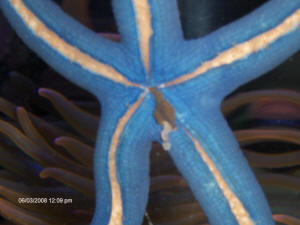
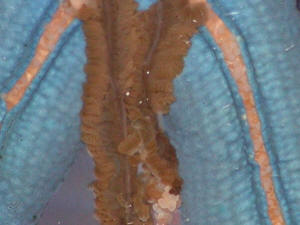
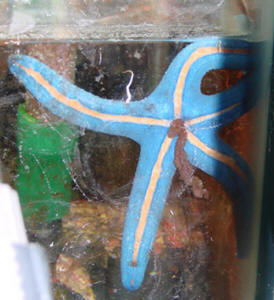
Rotting serpent star, Blue Linckia
6/24/09 Re rotting serpent star, Blue Linckia
6/25/09 Linckia treatment --
04/12/09 Re: Linckia treatment 4/12/09
Starfish, Linckia... hlth. -12/14/07 Hi there, I have had a blue Linckia for just over a year now and have never had any problems up until the last week. My tank is 180ltr and houses a YT, a red headed fairy wrasse, 2 Lyretail Anthias, 2 common clowns, 1 black cap Gramma, various hermit crabs, a purple pincushion urchin and the blue starfish, also various softie corals. A few weeks back I had a dip in KH so did a decent water change but buffered the KH back up gradually. During this dip the starfish seemed to excrete some purpley looking stuff from his centre on the underside. After buffering the KH this disappeared but not sure if that was just coincidence. <Hmm... maybe a stress induced spawn?> He perked up for a few days and did the usual round the tank laps but yesterday I noticed he has what looks like a small knife wound right in the centre of his main body on his upperside. Since then it has developed into a hole and is kind of white and flaky. <This sounds like either an injury or a sign of starvation.> Is there anything I can do to help the star or should I let nature take its course? <Do you have a refugium? If so, I'd move it to there. These animals eat mostly diatoms, bacteria and other "slimy stuff." Since you have other animals which also eat similar things, it might not be getting enough to eat.> I know they have good rates of regenerating but surely not if things like crabs and bristleworms stuck in? If he is doomed will my tank be polluted by leaving him in there? <not if it's still alive and slowly degrading> Many thanks in advance for your help. <Please see here for more information on these echinoderms: http://www.advancedaquarist.com/issues/may2002/toonen.htm> Regards, Esme <Good luck, Sara M.> My Blue Linckia is not well 10/3/07 Brilliant site guys... <I don't know about the brilliant part...> Over the last week I have noticed my Blue Linckia Starfish lying in one place.. This is not normal for him as he is often wondering all over the place.. However yesterday I picked him up to examine him and found 2 big holes in the underneath of his body 1 on each leg. The other legs are fine but he seems to be detaching his 2 bad legs. I have a feeling this might be down to a parasites. <More likely starvation, which is the cause of death of almost all linckia starfish unless kept in very large tanks. The problem is there is no consensus on what they actually eat.> Can you tell me what to do as I don't have a QT tank and although I want to do my utmost for the little fella I don't want him poisoning my Trigon 350. Also how do I know when he is dead? <When there is no more movement anywhere, including the tube feet. Not much can be done here except keeping up water quality. Sadly you are seeing the fate of most Linckias.> Please can you give me advice on what you would do here please. Thank you very much. Phil. <Welcome> <Chris> Damage to Blue Linckia Star -- 07/18/07 I have a 90g FOWLR system that I set up in October 2006. I've gone extremely slow with it because we've been adopting a child from Russia, so I've only added fish over the last 5 months. So at this point the tank has only a Cardinal Banggai, a Percula Clown, and a Gold-Headed Sleeper Goby ... plus a Camel Shrimp, Peppermint Shrimp, Cleaner Shrimp, a Chocolate Chip Star, a Sally-Lightfoot Crab and a bunch of snails. I have a Bicolor Pseudochromis in quarantine, and when I bought the Bicolor I also brought home a Blue Linckia. I know the likelihood of survival is small, but I was up for the challenge. <The stars you list are not easily kept...> What I wasn't expecting based on everything I read was for the shrimp to feast on the Linckia. <If it is damaged, yes, easily> They didn't bother it for the first 2 days, but last night I noticed the Camel Shrimp was picking at it something fierce. So I moved the Camel Shrimp to the Q-tank. At that point I didn't see any noticeable damage, but it was obvious that if I didn't move the Camel Shrimp it was only a matter of time. Then tonight I came home from work and the Peppermint Shrimp was on it and picking at it - and they must've been doing it all day because the damage was obvious on 3 of the Starfish's arms where there are white "welts" about 1/4" in diameter. So I grabbed the Peppermint and moved him to the Q-tank too. I realize this Star is likely to die regardless of the damage, but if I am the rare exception and can keep this star alive, does that damage heal? I assume so. But how quickly? Chris <It may rally... though this is rare... generally takes weeks to grow over... Please read here: http://wetwebmedia.com/linckiadisfaqs.htm and the linked files above. Bob Fenner> Orange Linckia Sea Star problem! 5/30/07 Hello, <Hi Isabelle, Mich here.> I've been doing some research, and I haven't found anything on my problem with my sea star. It's an Orange Linckia Sea Star, and he seems to be shredding. His arms are shredding at the tips and he's darkening. I'm assuming he's dying, <Likely so.> but I can't seem to figure out what's wrong. <Linckias often just don't do well in captivity. Their diet is poorly understood.> The salinity of the water is perfect, the PH is fine, <Vague.> Nitrite is 0, <Good.> Ammonia is 0, <Good. ...Nitrates?> KH is fine. <More vague.> There is enough algae in the tank as well, but he doesn't seem to be eating anymore. <Again the diet of this creature is not well defined. Also, most animals, including humans, don't eat when they are actively dying.> I had an issue before I got him, about two weeks before I got him, the store that I bought my previous fish one of them had a fungus. Two of my fish died then, but I did over 10 gallons of water change, I used my undergravel filter as well, cleaned out my filter. <Likely unrelated to the Linckia issues.> When I added the new fish, the Sailfin Algae Eater, <? Tang?> 3 Turbo Snails, and the Sea Star I had added a stress coat for them. <Will mess with your protein skimmer... if you have one... Hopefully you do... but in case you don't.... More here: http://www.wetwebmedia.com/proskimrart2.htm > Every one of my fish is fine, except the sea star. I don't know what's wrong with him. <I'm sorry my friend, it sounds like he is dying.> I have no chlorine in the water either since I only use filtered water when I change the aquarium water. <Are you testing for this? More here: http://www.wetwebmedia.com/water4maruse.htm ... Better/safer to use RO/DI water more here: http://www.wetwebmedia.com/ca/volume_2/cav2i4/RO_systems/reverse_osmosis.htm > Any help would be appreciated, don't want another one of my fish to die, because I know this one dying would be my fault. <Please research and understand the care requirements of any animal you plan to care for before making purchases.> Thank you, <Welcome!> hope you have a good day. <You too! Mich> Kind regards, Isabelle T. PS: If you need a picture, I'll send one, thanks again. Linckia Star Health 4/25/07 I got two of these about four months ago and they were doing great. Always roaming the live rock and seemingly doing fine. When I got them they were part of a cleanup crew package that I got from well known online retailer. <Common in many "cleanup crew" packages.> FS is the hint. Anyway just three days ago I had notice both of them not moving anymore. They were just staying in the same place and no longer roaming the rock. I presume they were about to die so I removed them from the tank. <Ok> I tried putting them upside down to see if they would turn back around but never did, so I removed them to avoid possible problems. MY question is after reading so much about this guys I realized they are very hard to keep alive for a prolonged period of time. <Learned why it is important to research everything, can't rely on a vendor to get you the right livestock.> Why would the retailer sell them as part of a cleanup crew if they are so hard to keep? <Because they make good money off them.> I have a 90 gallon semi reef tank that I do 22 % water changes every week. I am using the Berlin method for keeping the tank clean. I just recently removed all the rock from the tank to clean it and give it a good scrubbing. <Why?> I did this in saltwater and returned it as soon as I cleaned each piece. I did this because the tank was filthy. <With what?> I am assuming when I did this that I killed off the micro fauna that was on the live rock I guess thus starving the Linckia. <Probably a good portion of it, but what these starfish actually eat is not really known.> My question is should I get some fresh live rock to reseed the tank. <Never a bad idea to add some every 6 months or so to help keep up diversity, but populations will recover with time.> I have to sand sifting stars that are doing great. So I can assume there is plenty of fauna in the sand. <For the moment, will clean these out with time and most eventually starve.> Thanks Leonard Papagno <Chris> Blue Starfish Help...An All Too Common Tale - 04/06/07 I
recently purchased a blue starfish. <<Likely a Linckia
species...not a good choice. This genus of starfish fares
very poorly in captivity, with few surviving more than a few weeks to
months>> Acclimated it very slowly as I was told to. I
put him on top of a rock and a few hours later he was hanging upside
down inside of the rock. Two days later he hadn't moved
and I suddenly noticed red slimy, worm like "things" hanging
out of him (I think it's his insides). <<A very bad
sign>> When we lifted the rock and revealed the starfish he had
white bumps on all of his arms and puss looking white things coming out
and hanging out of the bumps. When we took him out he had
more red things hanging from him. <<A "goner">>
I'm desperately worried about what I should do. <<Nothing to
do but dispose of the carcass I'm afraid>> Is he
dyeing? Is he dead? <<My guess is the latter>>
Will he harm my other fish? <<Indirectly through declining water
quality, yes...remove it from the tank>> This is a new system 6
gallons about 2 months old. <<Is this a typo? Six
gallons and you have fish in here as well? Not more than a
single very small species I hope. And at two months old this
system is much too "young" to be adding sensitive animals
like the Linckia...as well as being much too small (needs
"lots" of live rock on which to graze). Please do
research your purchases beforehand. And even so, a six
gallon tank is going to be a very limiting factor regarding livestock
selection>> Please help urgently. Stef and Percy <<Regards,
EricR>> Blue Linckia (Linckia laevigata) starfish 3/11/07
<Hi Joe, Mich here.> My question is that my starfish tubing/feet,
I don't know what to call it is hanging out of its arm. Is
this a cause for concern? <The podia, tube feet generally
extend out from the arm, so I'm not really sure you are describing
something "abnormal".> Is there something I
should do? <No> I am not sure if I caused this.
<No, you didn't cause.> I took him off a rock to feed
him. Any input is appreciated. <Unfortunately these beautiful,
commonly imported creatures really don't belong in the home
aquarium. Their diet is poorly understood and though some
will accept meaty food they rarely survive more than 18 months in home
aquariums. Death appears to be caused by
malnutrition. Sorry I don't have better
news. Please research the care requirements of any creature
you add to your system. More here: http://www.wetwebmedia.com/linckiastars.htm http://www.wetwebmedia.com/linckiafaqs.htm and related links
in blue.> Thanks,
Another "Good ol" Linckia question ... health,
comp. 11/21/06 Hi Bob, Hope you don't mind being emailed
directly, but I'm a bit desperate (and I do realize you must get a
LOT of mail) <Mmm, some, some days> I have been reading your
pages for years now, but have never actually asked a question before (
your FAQs are so comprehensive, I've always found what I'm
looking for, thanks for the years of valuable passive assistance).
However, I'm stuck this time and hope you can help. My Blue Linckia
(WAIT!! ....please keep reading) <Heeeeee!> who I have had happy
and healthy for about 2 and a half years now in a FOWLR 90
litre tank lost a leg last week after I added a Valentini
Puffer, a Dragon Wrasse , and a turbo
snail (yeah, I know.. I bought the Wrasse on a
whim , with no research, just advice of LFS, stupid!), <A
Novaculichthys will get too large for this volume... the Toby and it
will easily pick the Linckia to bits...> a Domino also died with
in 2 days, with a very minor abrasion on one side. The leg
was quite mangled and half of it was in the bottom of the tank ( I
suspect the puffer , but can't prove anything), I
removed him and cleaned the leg up to a tidier cut just at the disc
with a scalpel hoping he would grow it back, then put him back in. Then
I noticed the puffer having a go at the "Manky bit" and
don't know if it's because it is a tempting wound now , or if
she was responsible in the first place. <Too likely this latter>
So I upended a small 5 litre tank inside the main tank and put him in
there with some live rock, because I was afraid she would not let him
regenerate. <Not at all probable to happen...> He wandered around
inside the little tank for about a week looking pretty good , but this
morning I found him curled up and flaccid on the bottom, and another
leg seems to be exuding the same white fibrous material from a new
small wound that the original damaged leg had coming out of
it, and the damaged limb is showing no sign of repairing itself, he
looks in bad shape, staying rigid with few "feet" coming out
or moving around, can't even feed him because he won't relax
over the food , which disappears immediately to a fish . I was afraid
he was starving in his small enclosure, so I have put him back in the
main tank to "take his chances" with the puffer What should l
I do, please help. can't bear to lose him? <... another
tank...> My tank is something of a miracle anyway , since it has no
skimmer , is only 90 litres with a basic trickle filter, but he has
been so healthy for so many years , he obviously finds it ok,
<Yes... much preferred to a too-sterile typical reef setting for
this Asteroid> as does my clown . Pseudochromis bicolor and other
anemones etc. <Other anemones?> The ammonia and nitrites are
still nonexistent , PH is fine and so is salinity , only the
temperature is varying by about 2 degrees daily at the moment as we are
having a very hot spell ( any tips for cooling a tank?) <Posted on
WWM> Thanks for the help in advance Cheers, Rama <This Linckia is
very likely a goner... your "luck" with this sort of mixing
is nearing an end. Bob Fenner> Blue starfish with red bumps? Linckias and using WWM 11/10/06 Hello I just purchased another blue star fish. <... another nutter butter?> The first one died within 2 wks. I think It's because I did not do the acclimation process correctly. <Mmm... possibly a contributing influence/factor> I read up on how to do the acclimation, and brought another one. It has been 5 days, and the starfish has been moving around fine Until today I noticed it had some red bumps or spots on it. There is something (threadlike) hanging out of the middle (stomach area). Is this a sign of a disease? <Of a sort... overall stress reactions from...?> This first starfish started to ooze red stuff, then finally fell apart. Not sure what to do. Can the starfish be saved? <Not likely> thanks J & L <Please read here: http://wetwebmedia.com/stardisfaqs.htm and here: http://wetwebmedia.com/linckiadisfaqs.htm and the linked files above. Bob Fenner> Blue Starfish Dead? 10/17/2006 Hello, <<Hi!>> Forgive me if this is a stupid question. How do you tell if a blue starfish is dead? <<Check its pulse? :P>> I looked through the forums and found loads of articles referencing failing limbs, exposed sores, cuts, etc, but nothing that would tell me what a dead blue starfish would look like. I did see one article that said it would be obvious. My blue starfish was very active and moved around the tank frequently since I got him 6 weeks ago. Two days ago he stopped moving. Using the advice in the forum, I am not moving him. He looks like he is starting to slightly deflate. <<A sign of poor health if not death.>> Other than that, he looks normal without sores, cuts, etc. He just stopped and froze. <<Is he attached to the glass? If so not likely dead. In my experience dead starfish are quickly consumed by clean up crews 'watch him for further deterioration.>> Thank you in advance for your help for a very basic question. <<Glad to help. Lisa.>> - Joe Linckias... "take the blue... or the orange..." - 09/14/06 Crew, I bought one blue and one orange Linckia yesterday. I think I acclimated them slowly enough, but the orange one has been hanging out near the water surface (doing laps around the tank on the glass). The blue one has moved his arms some but not traveled. I understand from your site that 90% of these creatures do not survive. <More> We bought them "out-of-the-box" at our LFS because they give a discount and because we thought one acclimation was better than two. <...> How will we know if they are dying/dead? <Decay... the death of your other livestock...> Since the survival rate is so low I want to watch for an early demise and remove them from the system if necessary. My system has been up and doing well for a few months now and I would hate to have a big ammonia spike. Thanks, Mike <... BobF> Blue starfish...severe wounds!! Please can you help?? 8/18/06 Hi, my name is Kev and I've been keeping marines for nearly a year now. I have a 4 ft tank with 40 kilos of liverock, a Deltec mce600 skimmer and around 27x flow. The current livestock is 4 green Chromis, 2 ocellaris clownfish, a royal Gramma, a chalk goby, a six-line wrasse and a yellow tang. There are several red and blue legged hermit crabs, as well as 2 Halloween crabs. About 6 months ago I purchased a blue starfish (linckia laevigata). For the first 5 months it was very healthy and was very active. <Is a good long while for this species, genus in most marine systems> Then out of the blue a large chunk of flesh was hanging off one of the arms and there were some small wounds on a couple of the other arms. Around this time I had been struggling to control my nitrates and they had risen to around 30. Despite 6 large water changes over 4 weeks with ro water and instant ocean salt, the nitrates stayed the same. I bought a new test kit to make sure and the results were the same. I tested the new salt water and nitrates were around 1-2. After posting on forums, it was decided the nitrates were due to overfeeding. <And a lack of purposeful denitrification, uptake...> I have since cut down on feeding and have also changed my salt to Tropic Marin Pro Reef. Over the last month the starfish has been looking active again and has regenerated a lot of where the wounds were, despite nitrates at around 30. Last night, I came home to find another large chunk of flesh hanging off and the starfish looking worse than ever. This was totally out of the blue and I can't find what is causing this. The night before, my girlfriend had lit an incense stick outside the tank room. Could this be the cause of the starfish's injuries or could it be something else? <Likely the latter> I've asked on forums but I have received little feedback, none of which gives a confident cause. Have you seen this happen before and if so what was the cause? <Have seen numerous times... think this is best described as "cumulative stress" coupled with "captive unsuitability"...> I apologize if the email is long winded but I wanted to give as much information as possible to try and get to the bottom of what is causing my starfish to fall apart. I would be extremely grateful if you could shed any light on this situation. Kind regards Kevin Shackleton Yorkshire, England. <Please read here: http://www.wetwebmedia.com/linckiadisfaqs.htm and the linked files above. Bob Fenner> Green Linckia Star Disease My question to you is about my green Linckia star. <Graham at your service. I've had one of these Linckia sp. starfish for almost a year now. In my opinion, these are extremely hardy provided you give them stable water parameters as well as a sufficient food source (Such as lots of liverock). Here is a picture of mine which was taken roughly 7 months ago: http://ee.1asphost.com/spsfreak100/Dsc07915.jpg > I watched him for three weeks in the dealer's tank. He moved around and was beautiful and they assured me he was healthy as well as a very hardy star. A month after I brought him home ( he cleared a week quarantine with me) he is starting to lose one of his arms. The beautiful dusky teal green is turning white with his top layer fading, exposing his underneath structures. Can I treat him? <The loss of limbs is not a good sign. As you have probably already know, starfish have an extremely sensitive hydrovascular system. This is very sensitive to even the slightest changes in pH, salinity, and temperature. Even the slightest change in one of these parameters can cause the hydrovascular system to go into a "shock." The effects of this often ends up in the loss of limbs and the slow demise of the starfish. Unfortunately, it can take up to 6 months to find out that the starfish suddenly starts to literally "fall apart." This means that even though the starfish may have appeared healthy in the dealers tank, it's very possible (and likely) that the starfish will die because of a quick acclimation during transit. What can you do to reverse this? Unfortunately, nothing.> I feel sorry that I shortened his quarantine ( he was adjusted to both tanks by drip acclimation for several hours) but I did not want him to starve. It was my impression that he is a deposit feeder. <Not much is known about the feeding behaviors of the Linckias. However, it's suspected that they may feed on bacterial films or sponges on the rockwork/glass.> At present less than a half inch of his arm is sloughing. If I can treat him, what is the treatment of choice? And how do I ensure his diet during treatment? <As I stated above, nothing can be done other than to give him the best care possible. Make sure you have no sudden changes in your water chemistry, provide the starfish with lots of liverock, and hope for the best. Take Care! Graham> Thank you for your help again. Orange Linckia Treatment 1/11/06 We purchased an Orange Linckia (it may be a Tamaria stria but appears to be reef safe) through mail order almost a week ago. Acclimated with a drip for 10 hours (water from shipping was .3 lower than quarantine with lower PH). He looked good, but had a tiny white patch under the tip of a leg (bad I know). The leg appears to be dissolving very slowly, white part is coming out and some of the orange tissue has peeled. He is moving around slowly at night and sometimes attaches to rocks. I added a UV to the quarantine (pretty stable QT with refugium - Temp 78, SPG 1.25, PH 8.3, Ammonia/Nitrite/Nitrate 0). His leg seems to be getting slowly worse. A few amphipods have also been roaming over him since the leg worsened (not swarms, but a few). <Doug, the linckia will sometimes harbor a parasite (Thyca crystallina), a cap shaped snail that adheres to the arms and literally sucks out fluids and tissue. If you see something like this remove it. Do not take the star out of the water in doing so. Other problem may be necrosis of the legs. Although you have acclimated this star correctly, God only knows how it was handled during collecting and shipping. This is a bacterial infection and If you decide to treat be sure any medication you use is safe for invertebrates. Most of the time the treatment doesn't help too much.> I've been reading on your site that you sometimes recommend Nitrofurazone (25 mg per gallon), or possibly other antibiotics. I have a clam, frags and new snails in the QT so I would have to move him to treat or "dip" with antibiotics (but I have another small tank and could transfer some water). Any recommendation on treatment or should I just continue to watch him? <I'd first look for the parasitic snail first. If none present the choice is yours to treat or not. May be better to observe a while and if it worsens, consider treatment.> Thanks, <You're welcome> James (Salty Dog)> Doug Re: Orange Linckia Treatment 1/13/06 Hi again, I checked for snails with a magnifying glass and there are none. It has gotten worse (spreading to another leg with many white "globs" coming out). He is still moving a little and raising his good arms (trying to eat I suppose). Truly sad, I won't buy another Linckia as I now realize that contributing to the collection practices is wrong. I am sure this is from acclimation (I think - before I got him,<I'm sure.> because I did everything I knew how to do). Is there any antibiotic you would recommend trying? I hate to put him through anything else - but he is moving toward a slow death now. I even saw some reference on your site to cutting off the legs with necrosis - but I am not sure about that at all (can't quite imagine it but if recommended with some antibiotic treatment I would try). <I wouldn't cut any legs off, in closed systems they just don't grow back as well as they do in nature. If it were me I'd probably start treating in a QT with Maracyn (saltwater). The erythromycin it contains should produce some results. James (Salty Dog)> Thanks! (You're welcome> Re: Orange Linckia Treatment 1/13/06 Thank you! Should I just follow the instructions as they are for fish? <Yes> I will be moving him to a new QT (10 or 20 gallon) since there is a clam in this one and live rock, etc. Also, how long should I treat with the antibiotic <Follow manufacturers instructions>(since I presume... possibly incorrectly, that I shouldn't put live rock in with the antibiotic).<You should never treat anything that doesn't need treatment including live rock. You will have to provide food for the starfish while in quarantine. James (Salty Dog)> Blue Linckia with white rotting - 01/09/2006 You all truly are incredibly helpful. I'm not quite sure if you'll have any answers for me, but we'll see. To begin, back in July we found a 75 saltwater system that was being sold for about 400 dollars, including 2 heaters, 2 bio wheel filters, two power heads with an undergravel filter, two 48" strip lights with marine Glo and another white bulb in it. With a yellow carpet anemone, some dead corals (yes he mixed them), a blue Linckia, a percula clown, a Foxface, and a Kole tang, along with a bunch of very alive but boring rocks (no coralline algae, no feather dusters, no nothing just some cleaner worms and shrimpy things) There was one piece of good rock in there which I'm sure was only interesting because it was added later, since it doesn't match the other rocks at all. We kept got rid of a few things and added some others, but the tank was established in our home back in August. With the Linckia. Personally I'm surprised he survived the transition, never mind that now its 5 1/2 months later and the thing is still alive. He lost one leg a while back, I don't have the date on hand, and right now he's about to lose a second, and from the looks of it, he's only got two good legs. My first question is this 1) What can I feed him??? <... Please read here: http://wetwebmedia.com/linckiafdgfaqs.htm> Should I buy something, I've been subsidizing the tank with green plankton stuff, its a liquid and its bottled, <Not of use> should I be doing more for the Linckia in particular. 2) Is there anything I can do like medication? <... please see the previous link... the FAQs files linked above...> 3) What about quarantine, I have another 44 gallon tank slightly younger, less lighting, less established, but its fish only. (Pseudochromis, tomato clown pair, blue damsel) <Not worth moving unless there is a great deal more healthy live rock there> 4)Would it be better for me to amputate his leg for him. make a clean cut of it? <Mmm, no> I realize he's a blue Linckia, and that for everything he's been through, he's still alive for 5+ months, in our tank, I do not know how long they had him before we acquired the tank. His other stump is pinkish, a little but white, but I was told pink was healing white was bad (infection). I realize I can't truly expect to see him around in my tank for long, but I'd like to make it as disease free as possible for him. Any ideas on what to do for him or references would be greatly appreciated. Thank you <What little I know re this genus of Seastars is posted on WWM. Bob Fenner> Blue Linckia 12-06-05 I recently added a blue linckia to my system. I read a great deal before doing so and know that they eventually parish from starvation. Besides offering a meaty food is there an algae supplement that can be added to the tank since this is their main diet? Also since being added four days ago he has stayed in the same area. <That doesn't sound good.> I acclimated him for about four hours and was wondering if he hasn't moved because there is an abundance of what he likes or perhaps I didn't acclimate long enough. <Your acclimation period sounds plenty long. Time is secondary to proper acclimation procedure. I will assume you did everything right. Odds are he is dead at this point. If he starts to deteriorate or you see the stomach protruding, but will not retract if the linckia is flipped over then I would toss him. Linckia are extremely hard to find healthy and should truly be avoided.> Thanks for the help...again. <Glad to help, Travis> Blue linckia death 11/7/05 Hi. We love your website and appreciate all of your advice. We have a few questions for you regarding two creatures and a healthy tank environment. We thought we did plenty of research and added a Blue Linckia Starfish to our tank about three weeks ago. During the first three weeks it appeared to be healthy and well acclimated. It traveled throughout the tank all over the rocks and the substrate and even onto the glass. Unfortunately, by the third week, it seemed to be declining and now finally died (so sad). Days before dying, it remained on the bottom of the tank-sort of twisted around itself almost upside down with its arms not extended. We are wondering if there is something we should have done differently (especially since we would like to replace it with another one.) This tank is just over a year old with a VERY stable environment (salinity, pH, temp etc) with excellent water quality. The tank is 260 gallons with just over 200 pounds of live rock. <Good conditions...> We don't have any live sand and we would rather not replace the current artificial rock/gravel substrate with sand at this point since all of the other inhabitants seem healthy and we don't want to have a 'sand storm' or unnecessarily stress out the fish. Other inhabitants include: Yellow tang, Hippo tang, two Firefish, two purple Firefish, coral beauty angelfish, two tomato clowns, mandarin goby (more on that below), three BTA, 200 various hermit crabs, 1 emerald crab and three skunk cleaner shrimp. We feed the fish a varied diet regularly including brine shrimp, frozen Mysis, Formula 1 and 2 (flake and frozen pellets). We hope that and were assuming the starfish was getting plenty to eat. We are about to do a water change this weekend (about 20% as we normally do 1 time a month). We read somewhere that a blue Linckia can be sensitive to fish waste (yikes we have a yellow tang'¦..the fish waste machine-will monthly water changes be beneficial to a star? <Not a big deal in a tank of your size, type> We carefully vacuum the tank to remove the water and then add our RO water and synthetic salt that has been aerated (at least for 24 hours prior). <Good> We would like to be able to eventually convert this tank into more of a reef tank. I think we read in one of your books that live rock and particularly live sand is beneficial but it wasn't clear to us whether sand is critical for a healthy environment as long as there is some form of substrate and live rock. Is sand (especially live sand) necessary for keeping fish and inverts healthy? <Not necessary, but useful... and with time, exposure to live rock, all substrates become "live" to an extent> Is it essential for maintaining a reef tank or is the live rock and artificial gravel sufficient? <The latter> Is the lack of sand the cause of the linckia death? <No, doubtful> If sand is critical, would putting sand in a 'hang on' refugium benefit the system? <Would> We have had the mandarin for a month and it seems to be doing very well. We can see plenty of copepods on the rocks (for now anyway). Since we already have a separate 10 gallon Q-tank, we would prefer not to add a refugium to the system to complicate things, but we are willing to consider an 'AquaFuge refugium' to hang on the side of the sump in order to try to keep the copepods population high. The largest one we see available is 24' long X 4' wide X 12' high. Is it worth it or even necessary to add any refugium at all? <Is worth it, not necessary> If so, is this type sufficient? <All helps> If we keep the artificial gravel in the main tank but add live sand to this refugium, would that fulfill our need for live sand? <Yes> We appreciate your guidance as always. Take care! Pam and Rob. <Most imported Linckias do "just die"... from consequent stress, holding, shipping, starvation in the process of collection, processing, transport... Likely yours is one of these... that is, nothing you have done, could have done would likely aid in its recovery. Do seek out a "very fresh" specimen if you intend to try one again. Please read here if you haven't already: http://www.wetwebmedia.com/linckiastars.htm (the linked files above). Bob Fenner> Sick sea star... Using WWM, another Linckia bites the... 8/13/05 Dear Crew <Cameron> I have bought a Blue Sea Star (Linckia Laevigata) from my local aquarium 2 weeks ago. <I do hope, trust you investigated this animal's needs, dismal survival history before purchasing...> I noticed some time ago that the white lines on the underside have been red. It has been difficult to see because it has been hiding in a cave, but I notice a few days ago that it seemed to be wounded. Today, it has come out from hiding but minus one and a half arms. There a long white string-like tendons hanging off it and bits scattered throughout the tank. There are only 2 fish in the (50 gal) tank - a common clown and a yellow tang, although there are various crabs that came with the live rock. Shops are closed on this side of the world (7pm Friday night) and I'm debating whether to get it out of the tank ASAP, but I don't want to kill it if it might survive. Do you have any suggestions as to what might cause this and what action I should take? Any help would be appreciated. Thanks Cameron <Do. Please read here my young friend: http://www.wetwebmedia.com/linckiadisfaqs.htm and the linked files above. Bob Fenner> -The incredible shrinking Linckia- I have a blue Linckia that is orange in color. <Isn't that an oxymoron? :) > I have had it for over six months. She moves around actively has no sores of any sort. The problem is that she keeps getting smaller and smaller, I feel that she may be starving what can I do, I don't want to lose her? <Unfortunately, this is all too common with Linckia stars, especially larger ones. Since their diet consists of mainly microfauna, it takes a pretty large and well established tank to keep them truckin'. You can hand feed them by placing bits of seafood (got any sponge based marine angel food?) on the substrate in front of it's path or literally drop it right on top. Try this a few times per week or more. Good luck! -Kevin> Mushy Linckia (2/27/04) I have a Blue Linckia star fish. <How long have you had it. More than 90% die within a few weeks of being introduced into the tank. I killed six of them before giving up. I should have stopped after just a couple, but I'm too stubborn.> Last night it was very alive and okay. I noticed , there was white damage one of his arms. This morning it just collapsed on tank floor and crawled. His three legs getting mushy but the other two is okay. After I checked your web side I separated it to another tank. I don't know anything about it and Please help me How can I help him. (I bought him 5 days ago it lives with 4 damsel and one anemone) What kind of antibiotics I have to buy. Or it is already dead. It is not moving ,but one mushy leg it seems getting okay. Thank you for time. Beril <Sorry to be pessimistic, but your star is almost certainly doomed. Most develop infections & die due to poor collection/transportation practices or to failure to acclimate very, very, very slowly. You could try some sort of broad-spectrum antibiotic in combination with pristine water conditions, but I'd say the prognosis is exceedingly poor. Do read on WWM or in Reef Invertebrates about the many disadvantages of this genus. Next time, try a Fromia. Yes, they are smaller, but they are very colorful and are much hardier. Good luck, Steve Allen.> Another Dead Linckia (3/2/04) Hi Steve, As you said my starfish died. Thank you very much for your time and information. Take care, Beril <So sorry Beril. I know exactly how you feel. :( Do consider a Fromia next time. They're quite attractive, though small, and much hardier. Steve Allen.> Keeping Genus Linckia Stars (3/7/04) Hi Bob! <Steve Allen helping out today.> I'm hoping you can help me with a question on my starfish. After years of freshwater I decided to make my dream come true and start a salt. I've setup a 46 bowfront, 50 pounds. of live rock and sand, with skimmer. It's been setup for almost 3 months with only snails, hermits, a brittle star, a Sally Lightfoot, an Emerald, a Blood shrimp and three recently added soft corals as occupants. <Don't be surprised if one of your crabs eats the shrimp. Also, Emeralds have been known to eat fish.> After reading as much as possible, I've decided to wait for about 5/6 months before adding fish. <That sort of patience certainly give the reward of a much more stable system.> Now for the question/problem. I'm working with a man from a LFS who also sets up and maintains saltwater systems professionally for restaurants, offices etc. Needless to say I've been placing more trust in him then myself. Even though I read as much as I can so that I have as much knowledge as possible. Three days ago I added an Orange Linckia and Blue Linckia. Nothing I've read has stated that either are particularly hard to maintain. Now after looking at you site I've afraid I was duped :( The man I've been depending on is extremely nice and seems to know what he's doing. Am I wrong? Please help! :) <Genus Linckia is problematic. I killed several myself before giving up. If you get the rare one that is not already dying of the rigors of collection/transport, and if you slowly acclimate it to your tank, and if there's adequate food, they actually do well. If they survive the first month, they'll probably be fine. It is important to keep your water quality optimum and avoid fluctuations in SG and pH because they cannot adjust quickly enough. Very important to do small daily top-offs (evaporation replacement) with RO water so the SG does not bounce up and down. Stars like an SG closer to real seawater than fish need. I'd say about 1.024. pH should be around 8.2 and stable. Consider and electronic monitor--much easier to use than color-change test kits, IMO. If these stars die and you really want something, do consider genus Fromia instead. Hope this helps.> Linckia Follow-Up (3/7/04) Sorry Steve! Didn't know it was you. <Back with you again.> LOL I'm planning on getting a Fromia soon. :) <Good choice> However, now I'm confused Steve. I was expecting you to "yell" at me for making a big mistake on the Linckias. First, THANK YOU for not doing that! LOL But why didn't you? LOL <Because I made that mistake several times in the past myself. Naturally, when you're new at this, you expect that if an LFS is offering something for sale at a relatively low price (generally under $20) it is actually a viable option. Live and learn. It's not the buyers who need to be chastised, it's the dealers.> My tank's pH, ammonia, nitrate and nitrite levels have been great. <zero, zero, and not too much right?> My SG has remained at 1.025 since setup, so I guess I'm doing something right. :) <The mark of a conscientious marine aquarist. :)> I have PC lighting and a Remora hang on skimmer with a filter box which I find has helped with the "scum" floating at the water level. <Yes, and makes the skimmer more efficient.> However, my skimmer stopped working earlier this week. <Hmm> It suddenly started up again although I still checked the pump. Today it seems to be doing the same thing. Could something be going wrong with it? <What pump did you choose? Some are more equal than others. Output can be variable from day to day due to tank conditions. Review the owner's "manual" (one sheet of paper!) for anything you might try. You can always e-mail AquaC and ask them for help. Jason Kim is very customer-friendly and conscientious.> (You guys are great BTW! SO patient with us newbies!). <Everyone's been a newbie at everything they now do well at. Always worth remembering.> As for the Emerald. Do you think if I return it and get a mated pair of Banded Coral shrimp it would be all right? I've read about the Banded being aggressive at times but would the fact that they were a pair make a difference? <I've never had a problem with mine. A pair would be very nice and they supply plenty of egg & larvae to feed fish. There is some risk to your fire shrimp (Lysmata debelius) with having Stenopus though. Consider adding another fire shrimp instead. As hermaphrodites, they should get along and mate.> Again, Thanks for all the help! And forgive me if I bug you a lot in the future! I just found your site and am thrilled that I did! I make sure to check through by searching first though, so I don't bother you too much. But sorry, I just know I will!! LOL <No problem. It's good for the mind to try to find the answer oneself first, but we're all happy to help here.> The Linckias Didn't Make It (3/15/04) Hey gang! <Steve Allen again tonight>.> Just wanted to give you an update on my Linckias. Just to remind you, I have a 46 gallon bowfront that at the moment has a cleaning crew, (including a bristle star, Emerald crab, Sally Lightfoot, snails, hermits and two cukes), and some soft coral and a Blood shrimp. Yes, you told me about the risks between the crabs and shrimp. LOL But I also had 2 Linckias. A blue and an Orange. Well both have gone to that big beautiful reef in the sky! :( <Sorry to hear, but not unexpected as we discussed before.> Unfortunately I was unable to retrieve the orange until it was pretty much "gone". Hadn't seen it for a while but didn't realize it was dead. You know how stars can be! Out in the open some days and hiding the next. <Yep> But I was able to get the Blue out sooner. So obviously I suffered from a Nitrate spike. :( I hope this won't cause too much trouble. The tank's been up for 3 months now and has a lot of purple coralline algae and copepods etc. I did a water change so I would think it would be O.K. What do you think? <Nitrate shouldn't be to much of a problem. Ammonia and nitrite are much worse. A couple of extra water changes should do.> Question #2-- I'm planning on sticking to Fromias <Better choice & quite attractive> from now on but am interested in a Tiger Star--Ophiolepis superba. What do you think of this star? <Very nice serpent star. I have 4 myself. Easy to find. Very active and hardy if carefully acclimated. Tend to lose a leg (or part of one) here & there, but grow back readily.> Is it reef safe? <Should be. Pretty much sticks to detritus and seldom gets big enough to go after any fish.> Is it hardier? <Yes> Will it be as secretive as my bristle? <IME, serpents are seen a bit more than brittles. Should come out when food hits the water, especially in subdued lighting.> Also, I have only 24 lbs. of Arago-Live which makes a bed of about 1 inch. I've left the back of the tank without any sand so that I can clean it better since the sand is larger and from what I've read any deeper can be a nitrate trap. I'm hoping in the future to add a sump to add a DSB in. I think switching now would be a mess and would take up a lot of swimming space. What do you think? <There are pros & cons here. Adding more sand will be messy and take up space because it needs to be 4+" deep. A DSB in sump would be easier. On the other hand, if you add slowly with a long funnel, you can get the sand in without too much mess. Really a matter of your choice here.> Thanks again for your help! Now I must go and light a candle for my stars. :( Eileen :) <Thanks for the follow-up & I hope things go better with stars in the future.> More on Linckias (3/15/04) Thanks Steve! I placed the snail back in my reef, since it is not of the menacing variety. It sometimes buries itself in the sand...seems to feed on detritus. <Typical of Nassarius. I like them myself.> Good to hear maybe I'll have some luck with the Linckia (knock on wood!). The reference materials I have on Linckias say they are "easy to keep", but after posting in some reef forums, I discovered most folks have bad luck with them. <It's the initial period that gets them. Successfully acclimated ones with lots of food available do very well. Unfortunately, most are already "dead stars walking" when the leave the store, with no hope of recovery (even though they look fine outwardly). Wondering if once the sponge is gone, should I feed maybe some sponge-based angel food? <That stuff seems to float too much. Hopefully it will eat other things.> Water is (me bragging here) PERFECT in my reef, so I don't have to fight that battle. <I hope you didn't just jinx yourself ;). On your trip to Madison, if you get a chance, stop by the Great Dane Pub downtown. Great joint for micro-brew and nice atmosphere:) <Alas, I'll be at a meeting at the Fluno Center the whole time. Oh well, Epic Systems is a wonderful host.> Thanks again for the help:) <My pleasure, Steve Allen> Vicki, Madison, WI Blue Linckia Problems (7/5/04) Hi, <Hi. Steve Allen with you this evening.> First off, I would like to thank everyone from your crew for keeping such a great and informative site available. <Thanks. It's my pleasure to play a small part.> And here to my problem, which I hope you might know how to resolve or identify....I recently bought a blue Linckia starfish at my LFS. It seemed to have acclimated well after introducing it to the tank, moving around, climbing up on rocks and glass. <How long did you acclimate for? A couple of hours I hope. Linckia stars are particularly difficult to acclimate.> However, after a couple of hours....something started to come out of the mouth of the starfish which looked almost like a tapeworm or maybe even its guts. <More likely the latter.> It started with just one worm like thing and ended up with three things hanging out of the mouth, each about 4-5 inches in length. I have attached a picture. <I did not make it.> Ever since these "worm/guts?" have detached from the starfish it moved back to the sand bed and hasn't moved since, not sure if it is dead or dying or else. I have not attempted to move, because I read it is best to leave them alone. I has no sign of discoloration so far. Have you ever seen or heard something like this???? Could this actually be its guts that it is expelling (like sea cucumbers do to get rid of parasites in the digestive system???) or could this even be a tapeworm??? <I am not aware of tapeworms infesting invertebrates. The most common parasite of seastars are a species of snail. I would fear that this material is part of the starfish and that it is disintegrating. Keep an eye on it and remove it if it stays put and begins to "melt." Do read up on this species. The vast majority do not survive the trip from ocean to tank. Mortality is likely over 90% and most are already dying by the time they are purchased. Fromia are a much better choice, but all echinoderms require sloooooow acclimation.> Thanks in advance for any advice <I hope it helps.> Sick Orange Linckia Dear Bob- I have an orange Linckia and at night he swells up on some of his arms. He also has some brown spots on some of his arms. He seems to do fine and look better during the illuminated period and I am afraid I may loose him. Please let me know what I should do. Thanks in advance and I appreciate the time you take to answer these questions. Dr. Ron Widen <the symptoms do not strike me immediately as pathogenic but I do wonder about the nutrition that this animal has been getting. They need a tremendous amount of food as deposit feeders. A good "rule" for sea stars is to only keep one per 100 gallon aquarium and the aquarium should be set up for at least 1 year minimum. Even then they will need fed several times weekly. Any compromise of this requires daily feeding. Most starve or suffer attrition within mere months... some hang in longer. Do consider if this applies here, my friend. Best regards, Anthony> Linckia Starfish Hello! I hate to bother you guys with a "is the doctor in" type fish questions... but I am really quite concerned and after researching for 3 nights a total of 9 hours, I can't find any solid information. I hope you will tolerate my inquiry.... <Certainly> I recently purchased a purple Linckia via mail order. I say purple Linckia not just because that is what the retailer called it. <Many animals sold as Linckias/Linckias... please see here: http://www.wetwebmedia.com/seastars.htm> I have studied pictures of both the supposed Linckia and the purple more predatory star it is often confused with. I notice the other star has sort of brighter orange feet, while mine has sandy colored feet. Mine has 5 arms not 6- although I'm not sure if that matters and although he might not be a Linckia it is my educated guess. <Doesn't sound like a Linckia laevigata... perhaps a Tamaria... a predatory species.> A day prior to his arrival I decided to do a partial water change. My numbers seemed great, nearly negligible, but I had very slight ammonia and nitrate so I thought some exporting might help perfect his new home. <Detectable ammonia? Not good> After testing after the water change... both were higher. Maybe from water exchange stirring the sand? <Perhaps... but perhaps from a dissolving, decomposing seastar> I tested my source water and it appeared that my tap has a high (25) ammonia level. I'm not sure what to think except maybe ammonia and chlorine are related? <This is a BIG question... you should not have twenty five ppm of ammonia... with an OTO test method? Chloramines are how high in your tapwater? Please contact your municipal water district (their number is on your water bill), and ask re the titer/method of administration of what sorts of sanitizer they employ... And by all means, irrespectively do make-up and store your new water per something like the protocol described here: http://www.wetwebmedia.com/water4maruse.htm? I didn't treat the water I tested, (and when I water change I do aerate the salt water mix at least a day prior... also my kit is Red Sea... and I'm not sure of its accuracy.) At any rate.. he was already on the way and it seemed like more water change might make the picture grimmer so I just held my breath. <All these issues are not easy to discuss here, independently... you should either treat your new water (if it's not coming through an R.O. or D.I or both device) with a dechloraminator, or store, aerate it for a week or more before use> On with the tale... he arrived after a bit of delay... about 1PM rather than 9AM and it must have been a stressful trip. In the order also were 2 Mithrax, 5 peppermint, 3 Chromis, 1 blenny. The blenny was dead and one Chromis died. <Arggggg> I drip acclimated him and after he entered the tank he climbed onto some live rock and stayed there. He is in a prominent position, but not really high traffic. I only have a royal Gramma who doesn't create traffic. (The Chromis are in quarantine) I did not quarantine him because I am not confident how well cycled the quarantine tank is and the 2 fish bioload seemed enough, also there is no live sand or rock in there and if he is a Linckia he is supposed to eat detritus... however he is right in the light... and at "dusk" and at night he doesn't move either. <My friend... your quarantine system must be stable, you have to make sure that you can rely on stable, high water quality there> After he climbed up on his perch he curled his toes a little. 6 hours later they were uncurled. He makes a sort of cobweb above him. I know he is making it because I wiped it off one leg and it was back within the hour. The perch is in fairly high water flow. <Yikes...> Here's the problem... I'm coming on 48 hours and he has not moved. <...> Today I lifted him off of it (I wasn't hard he doesn't even use all of his feet to attach) and dipped him for one minute in a Lugol's dip (mixed with the tank water). <What? Why?> No difference now. He didn't like the dip. He curled his toes. I flipped him over while he was in the bath and I did not see anything imbedded in him or any abrasions. I also gave in and did another partial water change (although smaller) last night. We are leaving in 5 days for vacation. (the first in 2 years- of course I feel guilty anyways) If this guy dies in there while we are gone... he could wipe out the tank. I feel really bad for him. Although his toes look fine and he isn't showing any degrading of tissue he doesn't seem healthy. Any advice? All other tank mates seem happy and busy, Anthelias polyps are open. <I would move, isolate this animal in your quarantine system... move all else before your trip.> I appreciate your time, greatly. (If relevant... 33L, 220 PC full/actinic 14/12 hours a day.) <Not> P.S. Your site appears to be non for profit. Can I donate? How? I do have a PayPal account. -Brooke <We do have an Amazon "begging bowl" at the bottom of the homepage and indices... But please donate your time when you are back, rested from your trip and can focus on a longer term plan for your aquatic hobby... We can start at "square one", perhaps help you develop a relationship with a local dealer... a better regimen of set-up and operation of your quarantine procedure. Do enjoy your holiday away. Bob Fenner> Re: Linckia Starfish I thank you for your time. It would seem from your response that I am doing things sloppily but I do research for hours and hours each day and I am really attempting to be responsible... <You are close to a more complete understanding I assure you> The link you gave me regarding the Linckia (sounds like a bad pun) did not work so I was hoping you can repost it, if he is not the Linckia (I thought it was the predator star with the orange feet... you think it is the true Linckia with the orange feet?) that is important to understand. <Search the index yourself here: http://www.wetwebmedia.com/marine/inverts/index.htm the area is an article on seastars, their FAQs posted near the bottom with the other Echinoderm pieces> Prior to our trip I will quarantine him. Also... I mean he moves enough that I do clearly know he's moving; he's just not "on the move", if you follow me? <Yes> I will attempt to bring a higher level of care to the husbandry of these beautiful marine animals. Believe me, it's not for lack of desire. Both tanks appeared well cycled with zero readings. Only after the order did the readings go askew. I suspect my test itself to be of low quality... another is on the way. <Good> Please do not feel burdened with a response, I know you are too busy already. I just wanted you to know that I welcomed and appreciated your feedback. <Never a bother. Bob Fenner> Brooke Luck with Linckias I have a 55 gallon reef tank. Its contains plenty of live rock, hard & soft corals that do fine, and several inverts, such as crabs and fire shrimp. I have had no success with adding starfish, particularly red & blue Linckia starfish. They seem to die off within 1-2 weeks. Is there something I'm doing wrong? Do they require certain food. Should I acclimate them slower? I would love to add several of these creatures but they keep dying, please help. Thanks, Jeff <<There are some folks who have success with Linckia Seastars, but they are few... these species take a beating in their collection, holding and transport from the wild... and just don't appear to be "tough", or compatible with captive aquarium conditions... I would wait a few months to let your system age a bit more, and then maybe try one of the smaller, colorful stars... my fave genus Fromia! Bob Fenner>> Linckia Star Thanks for your quick response, I'll keep an eye on the Linckia. If it dies will it kill everything in the tank or just pollute the water which I know could do the same thing). I just wanted to add a cleaning crew but it seems I made a bad choice. Will brittle stars fare any better?, I've tried different types of hermit crabs, blue legged, scarlet and they all seem to have a taste for my snails and the scarlet for the coralline algae which I saw them working on a rock which they cleaned the purple coralline algae right off. I work too hard to make it grow for a crab to have it for dinner. Any suggestions on a cleaning crew. Thanks and keep up the great work. I'm saving my money so hopefully in a couple of months or so I can buy your book, have read great reviews on it. <<The loss of life from the Linckia dissolving would be slow... Brittle stars are hardier by far. For cleaning crews, I'd have to see the spec's (again) on your set-up and other livestock. By and large I don't favor snails or hermit crabs for the reasons you state above and more. Look more to preventing unsightly algae by proper set-up, stocking, maintenance...Bob Fenner>> Orange Linckia Star Hello Bob...I just bought an orange Linckia about a week ago...he is alive, but slowly perishing...he has this brown thing in the center of him now...what could this be?? thanks <no idea from the description "brown thing"... do remove the star to a QT tank to prevent fouling of the main display from the starfish crawling into an inaccessible area and dying and to get the creature direct care needed (in QT). Best regards, Anthony> Blue Linckia Hi bob, Need your advice. I bought a blue Linckia about 4 days ago and he is doing great. Yesterday I noticed one of his arms was cut open and I couldn't figure out why. Then I noticed something green coming out, like a green worm. What it was is my Linckia regenerating new starfish. He has generated that one but I don't know if its even alive. Should I just leave it alone or move it to a breeding container? <Leave it whatever it is where it is> Non of the fish are picking at it but it does float around from time to time with the currents. Also the Linckia seems to be regenerating another one. Again should I just let nature be or should I take it out? <I would just watch and wait at this point. Please read over the following: http://www.wetwebmedia.com/seastarf.htm re others experiences with this species. Bob Fenner> Linckia Problems (10/21/04) Hi. <Sorry for the late reply. Just got back after a week away from WWM and found this in my inbox. Perhaps someone else replied earlier. BTW, please capitalize "I" and punctuate in the future--it makes it much easier to read and respond to a query.> I have just started a tank about 2 months ago <better to wait several months to add most stars> and I just got a starfish and it isn't doing so well...it is a blue 5 legged star <Linckia laevigata, notoriously un-hardy. The vast majority die within days or weeks of purchase. In fact, most are already dying from poor handling by the time they get to a dealer.> and I think he is actually eating himself. <More likely disintegrating. I can't see how one would eat itself.> I just got him less than a week ago and I think it may have been damaged when the woman at the store removed it from the coral it was attached to because some intestine looking piece fell off his stomach. <Already dying there as noted above.> The starfish used to be very active around the tank but is not anymore and I am pretty sure he is picking at his own tentacle..<tentacle? Starfish do not have these. They have arms and tube feet. Not tentacles.> My fish recently got the Ich and I have been treating them outside <very smart> of the tank so as to not harm the starfish or my other invertebrates but I still don't know what is wrong with my poor guy. Any suggestions as to why he would be eating himself or acting like he is dying? thanks so much, Charlene <Sorry to say, your star is dying and there is little if anything you can do to save it. I'd guess it's already dead. If still alive, you could put it in a hospital tank and treat with a broad-spectrum antibiotic. How did you acclimate this star to your tank? How did the store acclimate it to theirs? It requires slow-drip acclimation over a couple of hours because these animals are very sensitive to changes in salinity and pH. If you want a star in the future, I would recommend the much hardier Fromia species. Hope this helps, Steve Allen.> Linckia problems... Greetings Bob & crew! Just stumbled across your site while searching for info on a lethargic Blue Star. VERY IMPRESSED!!! Being new to the saltwater scene, please allow me to give you a break-down on how I've started and what I've got: <ok> HARDWARE, ROCK, SUBSTRATE, ETC 75G AGA Reef-Ready Tank w/corner overflow Coralife Compact Fluorescent Fixture[2 65W Actinic; 2 65W 10,000K] EcoSystem 3012 Sump w/20lb Miracle Mud (no skimmer) Gen-X MK-4 Return Pump (1190 gph) Won Bros. 250W Pro-Heat II Titanium Heater (in sump) 3 Maxi-Jet power-heads [Model 1200; 295 gph] (1 too many?) Ultra Ground Titanium Grounding Probe (in sump?) Red Sea Wavemaster Pro Wavemaker Tsunami ATI Dosing System w/Rio 90 Powerhead [for make-up water] 2 Moon Beam 470 Nanometer Blue Night-lights <cool!> 115 lbs LR (Tonga & Haitian) 80 lbs CaribSea Aragonite Seaflor Special Grade Reef Sand 40 lbs CaribSea Aragalive Reef Sand Crystal Sea Marinemix Salt Water: AquaFX RO/DI LIVESTOCK: 6 Turbo Snails 40 Astraea Snails 30 Blue Leg Crabs 3 Peppermint Shrimp 2 Fire Shrimp 5 Green Coral Crabs 2 Brittle Stars 1 Blue Linckia (See below) WATER QUALITY - Tetratest & Aquarium Systems SeaTest Kits Temp: 75 to 76 - Lifegard Little Time or Temp SG: 1.024 to 1.025 - SeaTest Full Range SG Meter ALK: 6 to 7 <That's in dKH and not Alk I presume> pH: 8.1 to 8.2 - pHep by HANNA NO2: <0.3 <It better be 0!!! Nitrite is highly toxic but you are likely getting a false positive on your test kit (I'll guess that it's the Tetratest kit). Get another kit and have your LFS test it to make sure that you have none> NO3: 2.8 average NH3: 0 PO4: 0 Ca2: 405 to 465 (Kent Liquid Calcium added to make-up water) 20% to 25% water change twice a month Approx. 3 qt.s. evaporation & make-up per day O.K. Here goes: I initially filled the tank on April15th. Obtained & introduced LR on April 27th. On May 7th brown algae showed up on rock, glass and substrate. After cycling the LR for 2 weeks, I added Caulerpa to the mud in the sump and it propagated well. On May 9th I introduced the snails, crabs and shrimp. Algae was gone within a couple of days. Awesome!! On May 18th NO3 jumped to 5.68 and upon investigation found 5 dead Astraeas. I'm assuming this was the cause of the NO3 spike.<A nitrate level of 5 is hardly a spike, it's only toxic at a few hundred> No change in NO2 or NH3. Removed dead Astreas and performed 20% water change. The next day NO3 was back to 2.8. On May 29th I added 2 Blue Linckias (wish I had read up on them first!). On June 3rd NO3 had jumped back up to 4.54. You guessed it! <Nope, a nitrate level of 4 would have no effect on the star) A deceased Linckia (stomach distended and tips chewed off 2 appendages) <Sounds more like an acclimation problem to me. They need to be dripped for several hours>. Performed a 25% water change an am now closely monitoring the second Linckia which appears to be somewhat lethargic and pretty much staying in one spot on a rock under an overhang. I was contemplating quarantining the poor fellow, but from what I've gathered in your responses to others experiencing this same dilemma, I gather I should just leave him be and keep an eye on him. <You got it> As I stated at the beginning of this message, I'm a neophyte to this hobby and guess I'm looking for constructive criticism as to how I'm handling things. I started purchasing and reading books on saltwater/reef set-ups last November (5 months before I even began to purchase the tank and components)<excellent!>, but it seems there are as many opinions as there are authors! [Tullock, Paletta, Tunze, Shimek, Skomal and Metelsky to name a few]. <Look for books by Borneman, Nielson, Fossa, Sprung and some sketchy characters named Bob Fenner and Anthony Calfo> One question I have is the recent appearance of red slime algae in the mud/Caulerpa chamber of the EcoSystem sump. Is this a normal phase? <Sometimes yes, sometimes no> Do I need to remove it or let it go? <Siphoning it out wouldn't hurt> Another question is when might I expect to see the development of Coralline algae on the glass. <3 weeks, 2 days, 11 hours, 26 minutes, and 32 seconds. Actually, the time it takes coralline to get going varies from a few weeks to a few months so just be patient and keep your calcium and Alk high> There is a fair amount on the LR but I'm wondering how long it takes to propagate to the aquarium glass. Does the presence of the Turbo and Astraeas on the glass negate the production? <Nope, or we'd all be in trouble!> Should I be adding Strontium? <That's debatable but it doesn't hurt> If so, how much and how often? <Follow mfg's recommendations> Is lighting a factor? <Yep, but your lighting is perfect intensity for many species of coralline> At this time, my Actinics come on one hour before the whites (which run for twelve hours) and remain on for one hour after the whites go off. <14 hour day? A bit long, try not to exceed 12 at the most> At the end of that cycle, the Moon Beams come on for six hours, shutting off just before dawn. Another concern is feeding. As stated in the list of livestock above, basically all I have are janitors, as I will be out of town for ten days in July and want to hold off on adding any corals and/or fish until my return. Do any of these guys require regular food or are they okay with what's on the LR and in the live sand? <They'll be fine for 10 days provided there's plenty of algae on the rocks. It would be preferable to have someone throw in some pellets half way through though.> I have been hand feeding the Fire Shrimp a pinch of flake food every couple of days (amazing how they will eat right from your fingers!) but that's about it. I have purchased a package of Formula 1 but have yet to try it, not knowing who will eat it and how much to use. <Everyone will eat it, try half a cube for starters then go from there> I sincerely apologize for being so long winded here,<hehe> but I figured too much info is better than not enough. I truly enjoy the education I'm absorbing with this hobby, and although I have a minimum habitat thus far, I just can't get enough of it and look forward to setting up other systems; experience (and funds!) permitting. <Damn that funds thing, think of the incredible tanks we all could have!!!> Thanks in advance for any enlightenment you might be able to provide. <Good luck, -Kevin> Greg Binder Blue Linckia trouble part II Hey Kevin, First off, thanks for the quick reply. <I bet this one will be quicker!> To clarify; yes, the ALK I referred to @ 6 to 7, is indeed dKH. You were correct about the NO2 test being a Tetratest. <Figures, I'm not a big fan of most of tetras products as they have quality issues.> Had all tests performed at LFS a little over a week ago to see how his results related to mine and he read 0 Nitrites. I think he uses Aquarium Systems SeaTest kits primarily. <That's what we use at the shop too. They're cheap, hard to screw up, reasonably accurate, and it's readily apparent if the reagent is bad. If you want better accuracy, go for Salifert or LaMotte> I'll check & pick up one of whatever he uses. Didn't drip the Linckias. <That's pretty much the do or die activity with these critters> Floated the bags for about an hour adding 3-4 oz of tank water every fifteen minutes. Had I been aware that they are considered an advanced aquarist's species, I wouldn't have even thought about purchasing them. <I wouldn't say they're for advanced aquarists, they just need a really really long slow acclimation and a big ol' established tank with lots of microbial life to eat.> The second one I mentioned as being lethargic seems to be showing a little more movement the past couple of days. I've got my fingers crossed. I could kick myself for not researching these guys before acquiring them. <Ah, happens to everyone, you'll know next time.> I'm looking at it as a reckless act on my part but if there's an up-side to it, it's that at least I've learned to look before I leap! (More reading!) I did, by the way, order both the New Marine Aquarium - Reef Invertebrates and Book of Coral Propagation immediately after sending off the first e-mail. <Great!> In regard to the time element regarding the development of the algae being 3 weeks, 2 days, 11 hours, 27 minutes and 32 seconds.......What time zone are you writing from, and are the minutes and seconds from the time you typed them or from the time you hit the SEND key? LOL. <Hehe, geez, I lost count already!> I had extended the lighting time from 10 to 12 hours after I introduced the janitors and saw how quickly they had seemed to clean up the initial bloom. Not a necessary move, eh? I'll go ahead & cut back to 10 hours if that's the case. <Well, you said that the daylights were on for 12 and the actinics on for an hour before and after, so after renting a supercomputer for an hour I came up with a photoperiod of 14 hours, maybe I misunderstood you. The idea is just not to go past 12 hours, it's very abnormal for these critters and can even be a little stressful to the photosynthetic ones.> Thanks again Kevin for the education and sharing your knowledge and expertise. <That's what I'm here for, enjoy! -Kevin> Gratefully, Greg Binder Purple "Linckia" Starfish I have a large purple Linckia starfish I recently introduced in my 55 gal tank. He moves continually ALL over the tank and seems to be perfectly content...my question is every morning he has what appear to be "blisters" or "bubbles" on the top side of his arms. When touched they emit a small amount of fluid or nothing at all and disappear. What could this be and should I worry? Thank you for your help. Tami <Mmm, do a search on your computer with the scientific name of this animal (Tamaria stria) and "aquarium". Don't know what these structures are... but a 55 gallon system is too small for this species. Bob Fenner> Blue Linckia Parasites? Hi Bob, <Jamie> Sorry for the unsolicited email, I tried to post in the forum but it seemed to fail, hope email is okay. <Yes> I have introduced a Blue Linckia to my tank. All was well for 2 days, moving about quite a bit, grazing etc. until it came to stretch of live heavily algae covered where it stopped. Nothing unusual there. I assumed she had stopped in delight at the deep growths and was getting down to some serious grazing <Mmm, Linckias don't eat much algae> ...but then I noticed something strange'¦ The middle section of one of her limbs seemed to be going into a hole in the live rock. Far Deeper than she would have the dexterity to get in herself. She had been there overnight without moving so I though I should investigate further. Upon moving her gently I discovered a huge wound on her underside directly over the hole in the live rock. Something has attacked her from underneath! <Mmm, much more likely the vacuolation originated from inside this animal> In the hole in the live rock I caught sight of white/grey coloured shrimp type creature making its escape. It was quite small perhaps only 6-7mm long and seemed to swim on its side and backwards. I've now placed the Linckia in a recovery cage far away from the scene of the crime. My questions are; What was the shrimp type animal? There could be hundreds of them in the live rock. Can I get rid of them? What other organisms will eat these pests? <See WetWebMedia.com re: shrimp identification, compatibility> What are the chances of the Linckia surviving? <Very small... this is a very difficult genus of asteroids for aquarium use... almost all die soon after distribution... due to poor, rough collection, handling, shipping... Please read here: http://www.wetwebmedia.com/linckiafaqs.htm and the linked files (above, in blue)> Why did she remain over the hole? Surely a Linckia 10cm in diameter can overpower even the most determined tiny shrimp. One of its limbs is now only attached by about 20% of its cross section. Should the severed section be removed? Can Linckias regenerate limbs? Thanks in advance for any ideas/comments. Jamie Buchanan London, UK <Read on my friend... and choose better suited species in future. Bob Fenner Blue starfish Bob, First, many thanks on your informative faq's. It has been a great help. <Ah, just as planned!> Secondly, a question about my blue starfish (Linckia laevigata). I got it two days ago, after acclimating it into the tank, it was quite active the first day, moving around the sand and rocks, pretty much all over the place.. but the second day, it was on this rock all the time, not moving at all. Visibly it appears to be alright, not much different from day 1. is this normal? <Not a-normal... have seen this species in the wild and in captivity not seem to more for days, weeks, only to resume activity... as long as it has no apparent discolorations, vacuolations, I wouldn't worry, and I definitely wouldn't handle/move the specimen unnecessarily. Bob Fenner> The tank is a 55 gal, finished cycling live rock, with some snails and crabs in it, but no fish. I didn't clean the live rock too meticulously so there were some die-offs during cycling... that should provide ample food for the starfish and critters, no? <Perhaps> thanks for your help! -Alex Did I Just Doom My Linckias? Hiya Bob. I may have gone and done something stupid, albeit unintentionally. I acquired my first Linckias (2 blue and 3 maroon) yesterday, and after acclimation, picked them up from their bags and transferred them into the aquarium, thus exposing them to air. The acclimation procedures did not indicate that keeping them submersed at all times was necessary, I just happened to read on another website that it is; did I just doom them to certain death? (ps...I read your entire FAQ's and articles on Seastars but found nothing to address my concerns.) Sadly, Sherri J. <This is likely no problem... some benthic invertebrates do have trouble with trapped air (notably Sea Urchins/echinoids)... let me assure you, after collecting, shipping thousands of Linckia laevigata and lifting them into the air aplenty... this is not a major cause of loss or diminished vitality. Bob Fenner> Re: Saltwater smells bad, Linckia Seastar Wow thanks for the quick response. To respond to a few of your questions... on over 3 weeks! so orange Linckia star <Are you target feeding this guy?> I have tried and he blows right by or over it...no interest. he has been very active until today and he has disappeared into the rocks. I can't find him at all...could he be the source of my smell? <Not likely but I would want to find him and get him out if he has expired> My dog faced puffer who was a gem in my reef tank (again I am lucky or maybe a case of ignorance is bliss, who knows!) just passed last month at 10.5 captive years. It smells musty and stinky like something rotting. When I first got my live rock I cycled it in Rubbermaid containers in the garage with a heater and power heads...smells like cycling rock just not as pungent. I'm not sure if any of the corals are dead, I don't think so, but I do see them spewing a clear slimy looking material that looks to have little white specs in it. <Don't like this...It may just be corals that are expelling waste and but it could be something worse. A while back I had a few mushrooms that let go of their rock...They were dying when I saw them spewing stringing stuff. Either way, if your corals are closing and opening with regularity, they aren't dead> It only comes from one section of the coral....first it was the mushrooms a couple of days ago then today I saw my cabbage doing it. All the corals have their polyps out and feed and then retract normally after lights out. How can I tell if they are dead and do you have any idea what they are shooting out? <Could be their symbiotic zooxanthellae. Or it could be simply waste materials. If you feed them regularly, it may be excretion. If you aren't target feeding it's probably not excretion> I once saw on discovery channel that corals reproduce once a year by shooting hundred of spores into the water could this be what mine are doing? <Never say never in this hobby but I'm afraid that it's not very likely> I have two cap 1200 power heads in the tank facing each other to create a random current. The current is very strong throughout the tank and the surface turbulence is high. <Good!> I am attaching the pictures again they are in jpeg format, I'm not sure what I did wrong but hopefully you will get them this time. I am also adding one more of a bristle worm I found crawling about in broad daylight today that doesn't look like a friendly. Can you confirm if it is or not please? <Yep...bristle worm. Bristle worms are okay unless it's really big...like big enough that it could eat something that you don't want it to eat> I really appreciate your time, thanks again! <You're welcome! In regards to the smell...Look around on the floor and be sure nothing has jumped out of your tank. This happens to everyone from time to time. Also, I'm not that worried about the sponges, but give the mud the old "sniff test" and see what it smells like. Check your livestock carefully to be sure that nothing has died underneath the rocks or in a dark corner. And finally, keep doing those water tests...especially ammonia. If your smell is coming from something in the tank that's dead, you will (sooner or later) get an ammonia spike. Be watching for it. If it happens, do a water change and take out whatever is necessary to find the dead critter. If the water smells like something has died, then something has most likely died. You've just got to find what it is and where it's hiding. Hope this helps. David Dowless> Terre Lost Linckia complications Anthony, Thanks for the response, can I ask one last question? <please do my friend> Once again I had a giant Linckia disappear, I have a feeling this is trashing my tank, I lost a black urchin, I have a Turbinaria who's polyps were always out, not they are completely retracted yet they occasionally come out, once more I have a giant feather duster who's feathers are now thin, not extended. I am wondering if my best bet would be to break the tank down, and replace 1/2 water with new, It is going to take forever to get nitrates down by 5 gallon changes. <yes... I would agree... the tiny water changes are just not enough. A properly conducted large water change (adjust pH, temp, SG, aeration, etc carefully to match main display) can bring serious relief fast and is the lesser of two evils so to speak> I also have a Singapore angel who I thought was harmless, until I caught it taking chunks out of my meat coral, if its eating this, it may be picking on others, so I need to remove this fish anyway. <yes... definitely. Dwarf angels are notoriously dangerous... few work long term in reef aquaria> One other point, I have a purple tang, the angel, and 3 smaller damsel sized fish, I am wondering if I would not benefit by eliminating one of the smaller fish as well, this would help lower trates. What do you think? (The tank is a 55) Thanks again, Tom <removing the small fish will not help much, unfortunately. The single best thing for nitrate control after water changes and deep sand beds is aggressive protein skimming. Make your skimmer work better or consider a second unit to compliment the first (and clean them alternately for uninterrupted skimmate production). Best regards, Anthony> Echinoderm Quarantine (9/8/04) Greetings crew. <Steve Allen today.> Can't find what I need in the FAQ archive. I am planning to get a starfish for my minireef. After extensively researching my choices, I am leaning towards a Fromia sp. of starfish (waiting for a pretty red or orange one to come in). <Best choice. Most Linckias die.> I am wondering if I should set up my QT differently than I do for my fish and corals? <Bare bottom is fine. Echinoderms are happiest at normal seawater salinity (SG around 1.024).> Is there anything special that I should do for keeping a starfish for 4-6 weeks? <4 is fine. You will need to feed it things like frozen Mysis.> I currently have a 10-gal with heater, 20w of PC, powerhead <Consider leaving this out. Definitely use a screen to keep the starfish room getting stuck in the intake.> and a whisper 30 filter. Plenty of PVC <not really needed for the star, but no harm.> and a fake Caulerpa plant as well. <Again, not needed.> Anything else I should have on hand just in case of problems? <Not that I can think of. The key factor is slooooow acclimation (use drip--read article on WWM). This will also be the case when moving to the display. Stars tolerate only very gradual changes in SG and pH especially. Temp and other factors are important as well.> Just wondering before I get my new reef family member. <Smart to learn first and buy after. Good luck.> Thanks again for all your help. AA pleasure.> -Ray Question or statement from the unknown about starfish? I have blue starfish and it has a big gash on one of its legs and on a different leg it seems to be rotting away at the very tip <and I have a pimple on my forehead that has appeared just days before a big meeting! Your problem however can be addressed in the wetwebmedia.com archives where tons of free information on this and many subjects abound. A general search can always begin here: http://www.wetwebmedia.com/ your specific organism is addressed on this page and the many links at the top: http://www.wetwebmedia.com/seastars.htm also, please be sure to always quarantine this notoriously delicate species and all other for 4 weeks before ever thinking about putting them directly into a display tank (fear of necrotic infection and disease wiping out other healthy animals. Anthony> Linckia In Trouble (5/11/04) Hello, <Hi. Steve Allen tonight.> I need some help with a starving starfish (I think). <OK> I bought an orange Linckia starfish about a week ago from an online website. It seemed to be fine until today. I think it is not getting enough food, but what I found out in reading about them was that they only eat algae. <Well, they eat pretty much any organic detritus, and generally do not require (and may not accept) supplemental feedings in a well-established tank. Placing a small bit of shrimp or other meaty marine food next to the star may result in it moving onto and consuming the offered tidbit.> Do I have to feed them anything else? <Worth a try.> It has seemed to shrink and only some of its legs are sticking to the glass and the little legs underneath have seemed to close up. A couple days ago he moved to the bottom of the tank and then back up to the top, so I thought everything was ok, but I feel he is in real trouble now. <These are concerning symptoms. Are you aware of the fact that probably more than 90% of all Linckia stars die within days or weeks of introduction. Most are already doomed on delivery due to shipping stress. How long did you acclimate it for. Stars require slow acclimation over a period of hours. Otherwise, they die (slowly over days) from damage due to osmotic stress. At this point, there is little you can do other than maintaining pristine and stable water conditions and waiting to see what happens. Trying to feed it is not a bad idea, but it may not be interested.> Other "critters" in the tank are: 1 Yellow Tang, 1 Flame Angel, 2 Percula Clowns, 1 yellow tail damsel, and 2 cleaner shrimp. 55 gallon tank been up and running for about 6 months. <Your Yellow Tang requires a minimum of 75 gallons eventually, preferably more.> Thanks for your help. Joey <Hope this helps.> Blue Linckia Hi fellas, I'm really bummed because I think my new Blue Linckia may be dying. I brought him home on Thursday of last week and drip acclimated him before putting him into the tank. Within a few hours he had crawled behind a live rock where he's been ever since. He does move around and I see his arms moving so he's alive. Since Saturday I can see protruding from that area two long skinny things that look like innards of some kind, but I can't see his mouth or his topside (covered by rocks) so I can't tell where they're coming from. Any thoughts? I really like this guy!! Ana M. Saavedra <Sorry to read of your star's apparent failing health. Unfortunately this genus is not generally an aquarium hardy species. Most die soon after export... due to poor collection, handling, the trauma of shipping principally. Please see here: http://www.wetwebmedia.com/seastars.htm and the FAQs files beyond... or input the name in the search tool on WetWebMedia.com and you will see your experience is common. Bob Fenner> Re: Blue Linckia <Anthony Calfo with the follow up.> Wow - I had read that they were supposed to be relatively easy to keep. <although they are understandably popular for their beauty and common availability/low price... I have never read a single reputable reference that cites them as hardy.> Do you think there is anything I can do at this point? <it is likely to die... still, let me suggest that you keep it (or put it) in quarantine for healing or damage control (to prevent the fouling of you whole tank). Please be sure to always use a QT vessel for every new fish and invertebrate. Read through WWM archives on the importance of QT. Starting here (two QT articles on this list recently): http://www.wetwebmedia.com/Latest%20Articles.htm > What do you think the long skinny things are? <the matter is covered redundantly if you have the time to browse the FAQs (4 pages on seastars which much of it specifically on blue stars... links at top of this page: http://www.wetwebmedia.com/seastars.htm The gist of it though is that they ship very poorly and even when you get a good one, you need a minimum tank size of 100 gallons that is mature (over one year old) with copious algae to support their strict diet. Else they simply starve to death slowly> In fact, here's a quote from the page you sent me to!! "Among the favored species are the very attractive Sand Sifting Star, Archaster typicus, the Little Red Starfish and Orange Marble Starfish (Fromia elegans and Fromia monilis respectively), Blue Starfish (Linckia laevigata), and Purple "Linckia", Tamaria stria." <indeed... true, my friend. They are "Favored" in the trade... very popular. But that does not make them hardy. Just cheap, pretty and purchased too often by ill-advised/ill prepared aquarists. No slight to you. You did say you read somewhere that they are hardy. To avoid such events in the future, perhaps simply read a wider scope of information for a better consensus. I wish you luck as always. Kindly, Anthony> Re: Blue Linckia 2/6/03 Well, interesting developments never cease with this hobby.... The innards "disappeared" (drawn back in? expelled and munched by crabs?) <all possible, indeed> Then the Linckia started to move and made his way to the back wall where he stayed for a day and now I found a piece of one of his legs on the substrate. <that part sucks> A chocolate chip starfish had been hanging around nearby - <uh-oh> do they inflict damage on one another? <rather a one-way street. Chocolate chip stars like many (the rule is "thorny-backed" are omnivorous or predatory) are indeed meat eaters. Often put in coral tanks where they sometimes behave and other times forage for flesh. Its the very thing that makes them so hardy- they are indiscriminate feeders> I was under the impression that most sea stars are OK together. <quite the contrary... other than Linckia, Fromia, Tamaria, and a handful of other "reef stars", most Asteroids are at least omnivorous... some specifically prey on other echinoderms> He looks better, frankly, despite the missing leg bit. <good to hear... that may be true. Do you now have some very mature/algae covered rock for it to graze? Feeding on natural benthic/deposit life forms will save this stars life> He looks more "turgid" if that makes any sense. Could it be that my buddy is on the mend? <possibly, my friend. I do hope for the very best> Ana M. Saavedra <kindly, Anthony> Re: Blue Linckia 2/6/03 Anthony, Thanks for the speedy response. Yes, this tank is about 7 months old and there are a lot of goodies in the form of algae on the live rock and on the back glass. <excellent to hear... Indeed helpful and reason to hope> Fingers crossed. Should I toss the leg or can it regenerate a starfish?! Good question. If the leg has enough matter from the central disk, it can very well regenerate a whole new starfish. Leave it in peace for a day or two... perhaps more. If it does not rot promptly and you see even slight tube foot activity say 48 hours from now... that would be a very good sign> Ana M. Saavedra <best regards, Anthony> Blue Linckia, leopard wrasses and angels Good evening Bob! <cheers, bub... Anthony Calfo in your service> Well, I know you've probably heard this a hundred times now.... I bought something for once without doing any research, a blue Linckia~ I was at a wholesalers and it was $5 and I've always wanted one. <impulse and cheap price... a recipe for death> Don't shoot me! <oops...sorry. I jumped the gun on the harassment> As soon as I put it in the tank it promptly disappeared into the woodwork, "Great! I just bought a lovely blue star that I'll never see!" hehe. <or worse... it will starve, dwindle and die back in the rockwork and wipe out the while tank when you go on vacation. Have a nice Holiday! <G>> He's being more social nowadays and hanging around the clams. (Been in the tank about 2 weeks now) I read the FAQs and he's relatively healthy, he was kind of a grey/blue when I bought him, but he's not "cob webbing" or anything. Ok, my question is do they have any food requirements other than detritus and micro creatures? <wow... these starfish like most sea stars need a lot of food. If you do not/cannot target feed them weekly if not daily, then they need very large aquariums (over 100 gallons) and very mature displays (well over 1 year old with a lot of live rock). Else they will slowly starve over a period of months like most. Surely not to live beyond one year, I am truly sorry to say> Currently he's in one of the most beautiful/healthy 58gal tanks in Miami that has been established for over 5 years. ;] It has a 3"+ fine sand bed, tons of little benthic critters, etc. <awesome... the maturity of the tank is a tremendous help. Still... spatially... it is a bit small in surface area to sustain this deposit feeder. Especially if you have any blennies, gobies, tangs, etc that graze the rock competitively> Other than fish food (Spirulina flakes and pellets) I feed the tank Dt's concentrated plankton every other night, which the brittle stars seem to love. Also, are Linckias nocturnal? <yes> It doesn't seem to move around during the day at all, like the brittle stars. Is it normal for Linckias to stay in the same position for a day and a half or more? <common for imported ones...duress> Do they feed on diatoms that accumulate on the glass as well as feeding on stuff in the sand? <not only diatom algae per se> His suckers seem to be in good shape, nothing looks irregular. <good to hear... a good sign> Just they move really slowly, so a person tends to worry. <understood> And he doesn't seem to get all excited like the brittle stars when I add plankton. ;] <true... he is a strict detritivore... no suspension feeding at all> On another note, (thanks for reading all this, I have a special skill at rambling!) would a leopard wrasse and a yellow Coris wrasse be compatible? <likely not... and you truly must avoid putting a leopard wrasse in a tank this small. They are categorically very difficult to sustain for more than a year or two. Best success is in huge aquaria (over 200 gall) with few other fishes> And would they be compatible with a bicolor blenny? <stick with the yellow Coris and you will likely be fine... although there is always a chance of territorial aggression from the blenny> (My bi-color is currently in my 10gal nano, where he is king, I can't wait to see his expression when I put him in the 58g that I'll be moving to once my boyfriend has the 75g setup, heehee Two reefers living under the same roof is a dangerous combination. ;]). Also, are Rusty Angels reef safe, hardy, okay for keeping w/ above mentioned fish? <now that's a hardy choice :) Seriously... a fine angel. Reasonably hardy and easy to feed... tends to be long-lived in captivity. As far as reef safe... eh... as reef safe as dwarf angels get (nibbler)> If so, should I keep a pair or single? Okay, that's it I swear!! <oh... you are headed for a smack <G>. You do recall that you have a 58 gallon aquarium, don't you :) > Oh, can you sex bicolors? <is this a trick question... Ok, I'll bite: yes... the male is the one wearing the smoking jacket and the female wears a silk Kimono> The males are so pretty during mating time. <OK> Thanks so much for everything, I think you guys are awesome and I hope to know as much as you do someday. Sweet dreams~ Morgan Moore <ha! Thank you for putting up with the wise guy in your luck if the draw. Best regards, my friend> Sick Starfish Hi Bob, I have a blue starfish, Linckia
laevigata. He was doing great up until this morning. He was active,
worked his way around the tank, etc. This morning we came in and he has
what looks like a small cut at the base of one leg. White stuff has
come out, but is still attached by fibers to the body. I don't know
how it happened - crab, sharp rock, who knows. Does he need to be
removed as a threat to foul the tank, or is this the kind of thing that
heals in time? <Cuts, vacuolations (missing areas) are real trouble
with this species... Often indications of disease, parasitism... not
catching to other species... and if your Linckia should perish, it
won't immediately pollute your system. Do keep your eye on it.
Otherwise I would leave this animal in place w/o specific treatment.
Bob Fenner> Thanks, Dale Blue Linckia starfish: Help Mr. Bob I need help figuring out why I can't keep blue Linckias. <Actually... L. laevigata is not easily kept... most do die... mainly from infections, parasites that "take over" consequent to the traumas of collection, shipping, handling... the ones that do "make it" have had better histories in going from the wild to captivity and have been placed in well-established (many months...) large, reef systems...> I have tried 3 so far. One a year and have lost each one. All my chemistries are in check. Nitrates are kept at about .07. the rest is good. I have a reef tank and check for just about everything except oxygen and organics. I have a 105 gallon oceanic show tank. That is actually growing corals for me. I change the water so often I am almost sick of water changes (but it is worth it). Back to the story: I buy a blue Linckia and it usually last for a couple of days. then it kinda become real thin and nasty looking. Then the crabs take over. <The types, numbers of crabs you have may also be big trouble here> Are these not acceptable with a reef and fish system? <They're on the "just barely" worth trying side IMO... Please read over the survey piece: http://wetwebmedia.com/seastars.htm and consider a more appropriate species... like a Fromia...> I only have 4 fish in this set up: Purple tang, 2 clowns, and a flame hawk. Or does the unknown inhabitant of the tank getting it: Bristleworms ETC? Or are the Crabs actually killing it from the word go? <Maybe so, particularly the crustaceans> Thanks for any help you can give me. I would sure like to figure this one out because it is my little girls favorite fish. Kevin Johnson <Do try to interest her in the Purple "Linckia" other hardier species shown on our site. Bob Fenner> Starfish Missing A Few Legs? Dear Crew: We have a reef tank that has had in it for several months some snails and hermit crabs, one purple Linckia star and an emerald crab. Two weeks ago we added three corals and a fire shrimp and a brittle star. This week my Linckia star appeared with some of each of its legs eaten off. Any idea what could be eating it so I can remove it? Tracee <Hard to say, Tracee...Could be the crab, or it could be some sort of bacterial infection, which starfishes tend to be subject to now and then...In fact, I have a Centropyge angelfish that loves to "graze" on the tips of one of my brittle star's legs...this kind of thing may be happening to your animal. Keep up the highest possible water quality, observe the interactions between the animals carefully, and be prepared to remove either the offending party or the injured starfish if necessary. Good luck! Regards, Scott F> Linckia coming to a bad end - 4/2/03 I purchased a Linckia star fish that did not move for 4 days, <Not unusual, but not a really good start, in my experience> i also noticed its stomach was hanging out, After calling my fish store they said they put out there stomach to collect food <Yep. Some species>, a few days later i picked up the star fish and the stomach fell off. <Yeah, probably just expelling gut as a signal of some form of stress. Did you acclimate or is this in the acclimation tank? What were all of your tank readings? These are things to check before purchasing. Also a good idea to see what the purchase tank readings are as well for reference.> my pet store said that it is a defense mechanism if they feel threatened and there stomach is out it will just release it to protect themselves... is that true. <Utter bull@#&*. I don't even want to go there. Certain types of seastars are known to do this as a feeding mechanism, but I have not heard of it as a defensive mechanism. (at least not in my experience) I suggest you do a little research before you purchase such animals as it is somewhat well known that Linckias are not exactly the hardiest of echinoderms. Also, keep in mind the place you purchased the animal from is always trying to make a buck. They will tell you whatever they think you need to hear. (most will anyway). In any event, quite a lot has been written about these starfish, not only here, but on a great many other sites as well. Here is a great place to start: http://www.wetwebmedia.com/seastars.htm and read through the FAQ links as well! Lots of great information there. I would identify your species of Linckia and let you fingers do the walking (on your keyboard) and find out all you can. Knowledge is half the battle, my friend. In the mean time I think it is best to watch this animal and see if it might not recover. If it does not seem to move for many more days and you notice no podia movement, then it might be time to remove the Linckia. With that, we do appreciate your coming here to learn and ask questions. You are already on your way to enlightenment.> Thank you <thank you. Paul> |
|

|
Features: |
|
| Featured Sponsors: |