|
FAQs on Olde Glass, Metal Frame, Slate
Bottom... Aquarium Repair
Related Articles: Glass
Aquarium Repair, Acrylic
Aquarium Repair, Cleaning Aquariums, Marine Tanks, Stands and Covers, Used Gear for Marine Systems, Designer Marine tanks, stands and
covers,
Related FAQs: Glass Aquarium Repair 1, Glass Aquarium Repair 2, G lass Aquarium
Repair 3, Glass Aquarium Repair
4, Glass
Aquarium Repair 5, & FAQs on Repairing Glass Tank:
Scratches/Blemishes, Cross-Braces, Leaks, Chips/Cracks, Whole Panes, Tools: Cutting Glass, Silicone, Moulding/Frames; Techniques; Troubleshooting/Repairs, &
Acrylic Aquarium
Repair, Used Aquarium
Gear,
|
|
|
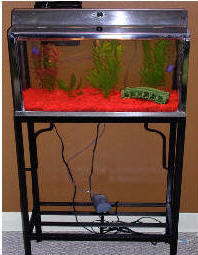
Vintage Aquarium 9/9/19
Hello WWM Crew,
I recently pulled an old metal framed aquarium out of an outdoor shed at my
parents house. I'm having difficulty finding information on it. It is extremely
heavy and I believe it has a piece of glass on top of slate with a DIY silicon
job that my dad must've done...
<Someone did, yes. This is a Metaframe (co.) tank... likely from the 1950's>
I found a page on your site that talked about restoration of older tanks so that
is how I found you. I've included a couple pictures and am hoping that you could
tell me a little more about when it would have been manufactured, brand, tips on
resealing, etc.
<Mmm; to make it authentic would require cutting out the silicone, removing the
added glass bottom and (trying to) reseal the inside corners w/ "Pecora" or
such... heated asphaltum. Instead, IF I were to attempt a repair (to set up,
fill w/ water), I'd cut out the existing silicone and reseal with black (color
and it is a different consistency) silicone as someone has tried here. Yes, I'd
remove, reseal without trying the existing, AND fill outdoors, make sure the new
seal is working before moving the tank indoors>
Also, if its important, I believe, based on measurements, that it is a 45 gallon
long. There is a small oval indention in the frame on the bottom edge of the
front and back that looks to be where a badge with the brand may have been
located but it has since fallen off.
<Yes; tis the case. Look up/Google "Metaframe" and you'll find examples of the
type of slope-cut frame, bracing here, oval for label>
Please feel free to forward this along or to refer me to anyone that may be a
good source of information!
Thanks for the time!
Wes
<And you for sharing. Bob Fenner>
|
.jpg)
.jpg)
.jpg)
.jpg) |
Resealing a tank from the 60’s/70’s. 10/30/18
Hello, I was referred to you for a suggestion on how to reseal an older tank
with a slate bottom and tar as an sealant.
<Oh yes; I recall... did reseal them w/ heated Pecora et al. and have done so
for "retro" purposes in recent years>
I have a 5 gal with the original light the only thing I’m missing is the lid.
<Do seek out on eBay and such>
I would like to reseal the tank and showcase it since it’s special to me. Any
suggestions?
<Yes>
Is there a tar base out there that can be used that’s safe for the fish?
<There are... sold as liquid asphaltum>
I'd like to keep it in the original condition instead of removing the slate. Any
assistance is greatly appreciated. Thanks, Robin
<I encourage you to "cheat" and just use black Silicone (aquarium sealant).
Folks won't be able to see it, and it will much more likely make a good seal
(that is if you intend to fill it with water) than trying the tar-based
material. Unless you're a big risk taker, I would NOT try heating the present
packing material to remove the slate bottom or glass sides. DO read on WWM re
such repairs... USE only "Aquarium" intended Silicone/Silastic. Bob Fenner>
Re: Resealing a tank from the 60’s/70’s.
11/1/18
Thank you so much for your help Bob. I'll try the black aquarium sealant.
<Ah good. This is the route I'd go, have gone for a long time. The asphaltous
material is a mess... >
I didn't try it before because I was told it wouldn't seal.
<... The same formulation is used to hold glass buildings together>
I'll also look on eBay for the lid to go along with the light I have. Glad I was
referred to you. Thank you again, Robin
<Thank you for your follow up message Robin. BobF>
Scratch repair on a Metaframe tank - 05/11/2012
|
|
I recently acquired a 2.5g Metaframe aquarium that has some scratches in it, but
holds water. It doesn't have the soft tar sealant like another Metaframe I have,
it's hard as a rock.
|
|
WWM: The
same, Pecora (sealant), but older, more exposed to air likely
|
|
I was wondering if I can use the normal methods for cleaning scratches?
|
|
WWM: In the
frame, yes. The glass, no
|
|
I've read the glass is different than modern day glass used in aquariums and I'm
worried about causing more damage to the glass or other repercussions. I've
included a picture of my find. Thank you for taking the time to read my
question. Jeff
|
WWM: I would
leave all surfaces as they are; other than cursory cleaning. More likely to do
harm, lose value if refurbished.
Bob Fenner
|
|
Vintage stainless steel tank sealant softening
10/19/2011
I own a 1970 stainless steel framed aquarium (glass bottomed)
which has never been used (long story). Unfortunately, when I
recently test filled it to the brim in connection with an eBay
sale, a small leak in a base strut became apparent.
Searching the web for advice and coming across your informative
site I was delighted to find what looked to be the perfect
solution headed "Stainless Steel Tanks 9/17/09".
I heated up 89 litres of water to a high temperature and filled
the tank to the brim. Disappointingly, after approximately half
an hour, the leak in the black pitch looking sealant had not
stopped and water
continued to ooze out covering the flat surface the tank was
standing on.
As that surface was a kitchen work top I had to rapidly empty the
tank again. The tank is 36 inches long, 12 inches high and 12
inches wide therefore it won't fit into a normal sink and the
bottom of our bath is curved so that can't be used either. I
noted that suggested
alternatives are, a propane torch (On GLASS? You cannot be
serious!! )
<With a wing tip, carefully, yes>
or a hair-dryer but the hot water treatment sounded the
safest.
My questions are,
1. How long should it take for the hot water to soften the
sealant enough to plug the leak, bearing in mind that the both
the water level and it's temperature will be constantly
falling?
<I think this technique, technology does not apply here... You
apparently have an early Metaframe product that was sealed, not
w/ Pecora but black Silastic. Heating this up will do no
good>
2. The article 'Removing Black Tarry Sealant (Bob's
go)' advised not strip down and refurbish these vintage tanks
as they are 'collectors items'. What would a collector do
with a leaking tank if he didn't strip and refurbish it?
<Is this really a "tarry sealant?"... IF so, you may
have to soften it... there are solvents as well as heat guns...
and remove, find some original (it's about in some places)...
heat this up on a hot plate, work it into the joints. IF you care
naught for "authenticity", I'd Silicone the tank no
matter what it's present seal is made of>
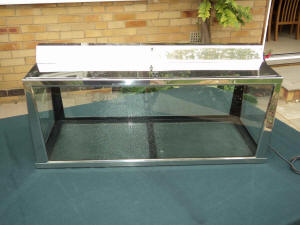
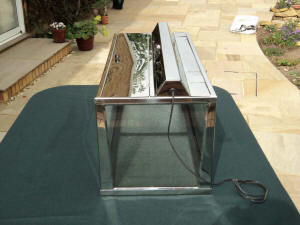
Attached are a couple of photos of the tank taken in October,
2011 It would be a shame if such a
little beauty could not be restored for aquatic use.
Compliments on a great site!
Ray
P.S. Feel free to edit the above in any way you feel is
appropriate.
<Cheers, Bob Fenner>
|
|
|
|
CO: Bob Fenner , useful I hope
10/28/11
dear bob I was reading in the Metaframe aquarium repair
section , I think I found the '' tarry sealant
'' ? I am going to be doing more research on product
along with applying it , here is a link to what I hope will be
the modern day replacement ::::
http://www.glaziershardware.com/Pecora-Mirror-Tac-1-Gallon-Can_p_1357.html
<Thank you for sending this along>
I hope this works and is nontoxic , lol
thank you
warren
<DO contact the manufacturer re. Again, t'were it mine,
I'd run a bead of black Silastic inside the interior seams
and call it a day. BobF>
|
Tank emergency. Olde Meta/l/frame
leaker 12/8/10
Hi crew. I received a vintage 75 gallon Metaframe about 10 days ago
from a friend, but at the time I didn't know that is what it is.
After some research I found out what it was, and the weight of it being
full, deeply disappointed, I realized I couldn't use it as a
brackish shark tank like I have wanted to do for several years, as my
floor will not hold that kind of weight. So after 2 days of thinking I
decided that I would make a terrarium. I divided the tank in half and
placed 2 pieces of glass that I had pressed together and sealed with
100% silicone, making it 1/4 of an inch thick. I then sealed that in
and started my 2 day wait, all the while buying and planning the set up
of the land and water feature. So I figured out how much water the one
half will hold, as I only had the glass cut 9 inches high, and I found
that it will hold 15 gallons. I was tickled that It would hold a decent
amount of water for the tropical fish that I had bought at That Fish
Place in Lancaster, PA.
<Good folks there>
So last night I spent several hours setting up the aquarium side of the
terrarium and put the artificial plants in place and the gravel and a
really neat homemade submerged waterfall. I knew I had to wait until
today to add the water, and I actually gave the tank an extra 12 hours
to finish curing the silicone just to make sure it was going to be
right. About 2 hours ago I added 14 gallons of water and aquarium salt
to start the cycling and sat down to admire my handy work. To my horror
after like a week of planning and working so hard on this terrarium, it
is slowly leaking from what I assume to be a bottom seal under the
tank.
<Mmmm>
I am so very very upset. It is leaking about 3 fl oz. per hour, so
it's not a terribly bad leak, but it is a leak none the less. I
cannot lift the tank and honestly I put so much work into the set up
that I really don't want to tear it down to fix it. I already have
the soil and plants in the land side of this terrarium. Is there any
way to fix this leak without having to empty it out?
<Not really, no>
I am wondering if there is some kind of sealant that I can apply under
the water as you can for pool patches, that won't release toxins
into the water, or very minimal toxins that will filter out after a few
hours/days.
I don't have any animals or fish in it right now, and I'm
willing to wait another few days or a week or so to add the fish and
the House Geckos to their new home. What can I do? Please help me!
I'm so stressing right now.
<Best to "bite the bullet" Robin... drain, clean out, let
dry... cut away the old Silicone sealant on the inside seams (all) and
re-seal. Please see here re: http://www.wetwebmedia.com/glstksilastic.htm
and the linked files above. Bob Fenner>
Re: Tank emergency 12/8/10
Thanks for your quick response!
<Welcome>
I am so confused. Shortly after sending you the email, it stopped
leaking completely.
<Heeeee! Happens... some "dirt" has gravitated over the
area... the physical properties of water... being sp3
hybridized/hybridised if you're English, have conspired to (who
knows for how long? I do not) plug up the hole for now>
I didn't do anything to it while I waited for your response, so
I'm not sure why it stopped, though I'm certainly not
complaining lol. Is it possible that there is a hole in between the
sealant and the metal at the top of the tank (which I feel won't
matter as the water level is 9 inches below the top rim), and I may
have gotten water into that hole and it just ran its course through the
metal part of the frame on the outside of the glass?
<Yes; though not likely the source of the water... as you state, the
level is currently way down from there... But the water/leak can
originate from most anywhere inside where there is water and exit
elsewhere>
The final amount of water that leaked is about 2/3 cup so about 5 1/2 -
6 fl oz. When adding water to a new tank I always allow the water to
run down the inside panel of the tank so as to not mess up my
decorations in the tank (if that Tid bit helps any). In my mind it
makes sense to me, (and just because it makes sense to me doesn't
mean that it does to anyone else or that it is even correct.
lol) but I don't know much about Metaframes or their
construction,
<Oh, I do... my time in the trade encompasses this Mattel bought
brand, Pemco before it... Good units, but olde, subject to leaking. As
general practice, I encourage folks to seal (if not done yet)>
so I'm just not sure. I just took a closer look and it even appears
to be drying up around the base of the tank.
<I'd keep reading where you were referred to.
BobF>
tanks of old-
3/26/10
Greetings from the Panhandle of Texas- I am searching for an aquarium
from my past. The sixties and seventies were great years and there was
a glass fish tank of five or ten gallons, if I remember correctly. The
tank was all glass and rectangular and had no seams. The four bottom
corners were rounded. The top edge was pinched to decorate. I know
there are some in an old garage some where gathering dust and I need to
locate a few of them -
this is my mission!
Any help would be greatly appreciated. Bob R.
King of the Wild Frontier
<Ahh! I do wish I'd kept and collected olde aquariums and gear.
A friend is quite an expert... Gary Bagnall of ZooMed... Do write him
re sourcing:
http://zoomed.com/cm/company-information/customer-service.html
and do please say hello to him for me. Bob Fenner>
Stainless steel tanks
9/17/09
Old Metaframe stainless tanks that leak can always be fixed for free
and no work so if you find one buy it! Place it in a sink and Just put
hot water in it. It will soften the tar And overnight it will stop
leaking. And will never leak again until you take the water out. But if
you store it empty the tar dries out and It will leak again then just
give it the hot water treatment. Can do this over and over so leave the
tar in it. And old aquarist secret. Gary
<Great tip! Just a couple nights back I gave a pitch at the local
SDTFS and there were a couple of olde tar type tanks... circa Pemco
going into Metaframe era... Cheers, Bob Fenner>
Re: Stainless steel tanks
9/17/09
Yea, I probably shouldn't have said anything I won't be getting
any more
free leaker tanks.
<Heeee! They're likely a better hedge against future economic
downturn than
US dollars... Make that a surety. Cheers, BobF>
old aquarium (RMF, any secret?), Metal
rusting frame -- 4/30/09
Hi,
I have searched the whole web for this info I hope you can help me. I
recently got a 45 gallon aquarium with metal sides and top, the metal
is rusty and we want to clean it and restore it. How do we do this
safely?
Thanks Stacey
<Hi Stacey, you really can't. Obviously you could wire-wool away
the rust and then coat with varnish, enamel or epoxy, but that would
likely save you precious little money compared with buying a new one.
Corroded metal is potentially toxic to fish, and in any case, it does
imply the metal frame holding the glass panes together is weaker than
when built. I can't see any point to using this tank for keeping
fish. Compared to the cost of the heater, filter, lights, etc., a new
glass aquarium is fairly trivial.
Cheers, Neale.>
<<What Neale suggests is about S.O.P. here... you may be lucky to
have just slight corrosion, and be able to "rub off" most all
with something like a "Scot Brite" pad or similar...
Otherwise... starting with a small/fine "paper" (hand or
power tooled) grit for metal polishing... and buffing out with finer...
And as stated, for freshwater, likely this is all that will be
necessary... I would not use such metal-framed tanks for brackish,
marine. Bob Fenner>>
Re: A bit more re: old aquarium (RMF, any
secret?) -- 4/30/09
Its not rusted through and a lot of it is stained.... So do you think
it will fail if used?
<Is it a "newer" old metal framed tank... with a bead of
Silicone/Silastic in the inside corners? If not, I would definitely
reseal it with (likely black... flows nicer and hard to see)... and
otherwise, not likely that the tank will fail if set on a flat, level
stand. BobF>
Re: A bit more re: old aquarium (RMF, any
secret?) -- 4/30/09
not sure of the age.....its like two 20 gallons put together long and
skinny
if that helps determine the age. Also the metal is straight, not angled
like on some tanks.
<Mmm, maybe a Metaframe product... you may be able to see the not-so
distinctive spot-welds at the corner overlaps of the nickel/chromium
frames... And any length, not an importance. B>
Re: A bit more re: old aquarium (RMF, any
secret?) -- 4/30/09
Also its only rusted on the top supports.
<Ahh! Even easier to clean... and not so much involved in structural
integrity. Read here: http://wetwebmedia.com/oldetkrepairfaqs.htm
Bob Fenner>
MetaFrame Aquariums 8/16/07 Dear Crew,
August 15, 2007 I occasionally search for old MetaFrame fish tanks
(aquariums) and for information concerning their repair, especially
trying to effectively bond glass to slate. The best solution came from
your WetWebMedia, so I have been reading and researching your site.
<Okay> I still have my first (and favorite) 29-gallon slate
bottom tank, which I was given in 1973 and still use. Since then, I
have acquired at least a dozen old tanks (all different sizes), several
of them with slate bottoms. I fancy myself repairing them, gathering
lids, lights, hoods, etc. and selling them or making gifts of them as
"retro" tanks, which seem to have some interest among fish
hobbyists. My wife fancies me getting them the heck out of the house,
along with all the other "treasures" I have
"collected" over the years. Can't blame her. She needs
room for her "treasures", after all. <Neat!> In reading
your questions concerning the black adhesive used for the old
MetaFrame, I have learned a couple of things. 1. To remove the black
goop you must heat it. One way to do that is to put the tank in your
oven and put it on a low heat, the lower the better. Then just watch
until the goop starts to get warm and gummy. Do not overheat, as the
glass will break. Be careful not to burn yourself when removing the
tank - the metal gets hot, too! If the tanks is too big for the oven,
use a hair dryer. Much milder, less dangerous, and easier to handle
than a propane torch, f'sure. And, it works fine. Takes longer, but
much safer. I am no expert, but would not recommend "hot
tanking"; that seems unnecessarily harsh. And it may create new
problems. 2. Silicone does not bond to slate. Period. That is probably
why MetaFrame did not use silicone. I have not been able to find out
what the black goop is, as I would prefer to use it, if I could. It is
possible that you could get an adequate seal between glass and slate
using silicone, but do not expect it to be permanent, because...o, yes,
silicone does not bond to slate. That is why the best solutions to
repairing a slate-bottom tank are: do not repair it and pawn it off to
someone like me as it is and get a different tank, or, (my personal
favorite) put a new piece of glass directly on top of the slate, and
seal it to the vertical glass walls with (100%) silicone. Duh!!! Sure
wish I had thought of this before trying several different bonding
agents, including silicone, all to no avail! In closing, if anyone
wants to "network" with me on buying, selling, trading, or
just swapping lies about MetaFrame aquariums and associated hardware,
please get in touch. As I learn more about the history of the company,
the bonding characteristics of glass, slate, and various adhesives, I
will gladly share that. I am not in this to be a capitalist, but hate
to give away such fine old aquariums. And it is fun! I am more
interested in learning and puttering than anything else. <Great
Mike> Thank you for your time, and, if you are going to post any or
all of this correspondence, please feel free to edit it as much as
desired. I am not sure what you would consider relevant, and I do tend
to go on and on. And, God Bless Elvis Presley (January 8, 1935 - August
16, 1977). Michael L. Stewart CactusMike@bigfoot.com (480) 650-8650
(((Note to self: check this website for a reply. Otherwise, what is the
point???))) <Heee! I am going to take your offer as noting that we
should go ahead and post your contact info. Will archive on a new
subFAQ re "olde tanks". Thank you for sharing your passion,
and techniques! Bob Fenner>
Old Aquarium, sell... or repair?
2/22/07 I visited a local pet store and inquired about repairing a
55 gallon aquarium that has been sitting in my mother's garage for
20 years. I am 63 years old and I remember my father having
fish in that tank when I was a child. Obviously, it is close to 70
years old; it is on a metal stand with wheels. <Neat!>
The aquarium has a slate bottom with drain hole that
appears to be in good shape. The problem is that one of the
larger glass sides was broken and needs to be replaced. I
have considered selling it in a garage sale or just giving it away, but
the pet shop owner indicated that it might be of some value. <Yes;
might be> He said that he doubts that a replacement glass would be
advisable thinking it would probably leak and thought it might be
better to use it as a terrarium. It occurs to me that if I
installed glass of appropriate thickness and was successful with
sealant application, the aquarium should be adequate to maintain
fish. What would you advise. <Mmm, well, unless
you're in a big hurry, I'd "shop" it around... see
what it might sell for... And if all you're interested in is having
a useful system... I'd trade it in for the money and buy a brand
new outfit. OTOH, I do like antiques in the field... so, repairing it
might be the way to go... with "matching" technology (likely
Pecora sealant...)> If I were to install a new glass,
could I purchase the glass from a local retail glass dealer? <Mmm,
yes... if this were the route you settled on> What thickness would
you recommend. <Likely 3/8 or 1/4" plate... The latter likely
being what it is otherwise made of> Also, is it your opinion that
the aquarium I have described would be of value as an
antique? <Yes... And I do encourage you to contact an
old (okay, middle-aged...) friend, Gary Bagnall... of ZooMed... who is
about the most "in to" person of such gear that I know...
Have cc'ed him and another hobbyist/collector friend, Chuck Rambo
here... And maybe try a pic or two... on eBay...> Thank you for your
assistance, Charlie Marsh Jacksonville, Arkansas <Welcome, Bob
Fenner>
Old Glass, Slate Tank repair, speculations re
fish physiology re env. nitrogenous compounds 2/18/07
Dear Crew, <<Hello, Anne. Tom with you today.>> I recently
purchased a 55 gallon slate bottom aquarium. I've scraped the old
silicone out, cleaned and resealed the tank three times. I still have a
major leak. The slate is flaking. Could it be leaking the water?
It's very hard to lift the tank to tell where the leak is coming
from. I am also not sure that I can safely dismantle the tank.
<<This one's a little out of my area, Anne, but if the
slate's flaking, you won't get proper adhesion with the
silicone. Both the slate and glass must be perfectly clean and, in the
case of the slate, sealed, in order for the silicone to bond properly.
Now, my shortcoming, if you will, is in knowing how to properly seal
the slate in order to get the bond that you'll need to prevent
leakage. I would hazard a guess here that you'll need a clear epoxy
sealer that's, obviously, suitable for aquarium use but, beyond
this, I'm at a loss to provide any hard information.>> I have
been researching fish for ten years and am hoping to get a PhD in
aquatic animal medicine. <<A commendable goal/pursuit.>> I
haven't started college yet and am having trouble understanding a
few things. I understand pH and the measuring of Hydrogen ions. What I
don't understand is the direct effect pH and ammonia have on fish.
Is it merely the fact that fish don't come into contact with
ammonia and nitrates in the wild? <<From an evolutionary
standpoint, I would offer that this is, in part, the case. Fish have
adapted, around the globe, to a variety of differing conditions which
is why we don't have 'one-size-fits-all' water parameters
in the hobby. The most obvious example is the difference between
saltwater and freshwater life but variations in pH in different areas
of the world are certainly other cases in point.>> Does it affect
their bodily functions? <<Absolutely. Ammonia, for example,
adversely affects (burns) the gill tissues causing swelling/damage
which inhibits/prohibits the uptake of oxygen and the expulsion of
ammonia. The result is suffocation. Likewise, nitrites bond with
oxygen-transporting hemoglobin in the blood resulting, effectively, in
the same thing, i.e. suffocation. pH fluctuations can cause damage to
the skin, eyes and gill membranes as well as altering, with sometimes
fatal consequences, the very narrow range of the pH of the fishes'
blood.>> From what I understand it's not that fish can't
handle the levels it's how quickly it changes. <<This is
true, to an extent, with pH levels. Ammonia and nitrite levels,
ideally, should never even be measurable but fish can/will adapt to pH
levels outside of their particular norms as long as these remain
stable. The current thinking in the hobby now is to adapt our fish to
the pH levels of whatever our primary source of water -- tap water, for
instance -- might be. Attempting to chemically alter the pH is, all too
often, the recipe for a disastrous change in the pH levels of our
tanks. Better to maintain stable pH conditions outside of the
'ideal' than to set the stage for a potential calamity. (This
almost always takes the form of a plummet in pH levels due to
insufficient buffering.)>> I know some fish can survive with
gradual acclimation to abnormal levels. I have a bad feeling that
I've got things very messed up! <<I don't think you have
things 'messed up', Anne. These aren't easy concepts to get
a handle on. The important thing to do is take it slowly. Lots of folks
become overwhelmed by the volume of information and throw up their
hands in despair. Narrowing your focus to very specific topics until
you're comfortable with each one will help in avoiding
'information overload'.>> Please help a very obsessed and
very confused fish fanatic. Thank you so very much, Anne ( I
hope to one day be as smart and knowledgeable as all of you)
<<Well, in my case that might be taking a step backward but, for
all of us, thank you. I've got the feeling that you'll far
surpass my knowledge with a little more time and research. Best
regards. Tom>>
|
Leaky MetaFrame Aquarium
3/19/07 I have searched your website to see if
there were any specific tips on how to re-seal an old stainless
steel frame MetaFrame aquarium and while there were some tips, I
didn't find anything specific enough. <Let's add
here> I have a 10-gallon MetaFrame that leaks all over, and I
need to re-seal the entire thing. <Yes> I saw that the
black linseed oil <This was/is just a solvent for the
"Pecora" tar-like substance> or whatever sealant
used back then should be replaced with silicone, and that
silicone won't adhere to this old sealant. <Correct>
How do I get the old sealant out and remove the glass pieces so I
can clean everything thoroughly enough for the silicone to
adhere? <Mmm, no need to remove the glass... Removing the old
sealant can be a chore... some folks with lots of nerve and good
eye-hand coordination can use a propane torch (outdoors) and a
wing tip to spread the flame, to soften, loosen the old
material... and a sturdy putty knife to remove most all...
Otherwise, digging at this with hand tools, single-edged razor
blades is what works...> (They're really stuck in
there...) And, after cleaning the glass and putting it back in,
how do I apply the new sealant and where do I put it to ensure a
good seal between the frame and the glass pieces? <In the
corners, all inside seams, including the upper inside edge of the
frame... I would use black Silastic... to match... easier
flow...> Do I put this sealant inside and out? <Only on the
inside> And, should I remove the slate bottom too or can I
just run sealant around the bottom edges? <This latter...
after all the "tar" is removed, and all the surfaces
cleaned up with a solvent (my faves are Xylene or Toluene)>
Any help you can give would be great, I don't want to break
the glass or do this project more than once if I can help it!
Thank you, Jessica <Mmm, or there's always selling this
relic (on eBay or such) and using the proceeds to buy a new
all-glass... which is what I would do if all you're
interested in is having an aquarium that doesn't leak. Bob
Fenner>
Re: Leaky MetaFrame Aquarium
3/19/07 Bob- Thank you so much for your help on
this! Your tips were specific and very helpful. I do have a new
all-glass aquarium that's low-maintenance, but I love a
project, and I like these "relics" too. <Heeee! Are
you talking about me or the tank!?> This will be my second
one. Thank you again. Jessica <Welcome my friend... Oh, and if
you have time, would you please consider making a few images,
perhaps penning a short article re your experiences here? I will
gladly help you place such. Bob Fenner>
Re: Leaky MetaFrame Aquarium - 03/20/07
I will do that. It will be a little while before all
is up and running, but as soon as it is, I will send a couple of
pics and a letter. Thanks again! <Do appreciate this... As am
SURE many folks will who follow your input. BobF>
|
Fixed Metaframe 4/16/07 Hi Bob!
You gave me some help about a month ago, suggesting
some ways that I could seal up my leaky Metaframe aquarium. You
asked me to send pics when it was done and it is...so here are the
pics! <A very nice job indeed; including an 'olde'
stand!> I cleaned the entire thing, scraped all of
the old sealant out of the cracks, cleaned the glass with both
acetone and then glass cleaner, and then I used aquarium-grade
silicone and sealed up all of the edges. (Using the old water on
the finger trick, I was able to press the silicone down in to the
cracks for a good seal.) I then filled it with water to check for
leaks, there weren't any after 2 days so I drained it and put
it on the stand that I also restored, and it's been humming
along ever since. I wanted to let it run a little before adding
fish, but in a couple of days, I'm adding those and this
project will be complete! Thank you again for you help,
your website is a real asset to the aquarist community. Jessica
Beebe
<Thank you for sharing! Bob Fenner> |
|
|
Repair of slate bottomed tanks 9/13/05 G'day Bob
<Peter> It seems like you know a little bit about slate bottomed
tanks. From what I can find out they were originally sealed
with a tar - linseed oil mix (although I'm not sure if the whole
tank was sealed with that, or just the bottom). Seems though
that most folks try and reseal them with silicone, which doesn't
stick to potentially oily surfaces very well. <Correct... have to
absolutely clean> I have a half dozen 55 gallon tanks
that would be nice to get sealed. Am I better off to try and
reseal them with tar-oil, or clean them off with Palmolive and try
resealing again with 100% silicone? Any suggestions would be
greatly appreciated. Thanks for any help. Cheers Peter Unmack <Well,
the semi-purist in me would like to encourage you to go with the old
tar-seal... the actual lazy person I am would clean up the tar, lay a
thick silicone bead down/twixt the angle of the glass walls and bottom,
and the practical person would insert a piece of glass in the inside
and silicone that in over the slate... Bob Fenner> Removing Black
Tarry Sealant (Chuck's go) I was given a 45 gal aquarium which
has a chromed metal frame. The aquarium leaks around the bottom in
several places and I was considering removing the bottom and using
silicon to reseal. The glass and slate like bottom are all sealed with
a black tarry type of sealant. The sealant has dried and hardened. How
does one go about softening the sealant and removing it? < I collect
antique aquariums and have a few suggestions for you. Many of these
tanks actually leaked when new. They recommended that you fill them
with hot water and let them sit for a few days. The putty softens up
and the weight of the water reseals the tank. Try this first before you
tear the tank down. Once the tank is full of water they stay water
tight for years. Try and find the hood that goes with them. When they
are all together they look unique by today's standards and are
still quite functional. If you decide to tear it down you will need an
additional piece of glass for the bottom. Sometimes the silicon does
not stick to the slate so you have to cut an additional piece of glass
for the bottom and them reseal the tank with silicon. Make sure that
you use the silicon that is made for aquariums. The silicon you buy in
the hardware store has fungicides in it that are harmful to
fish.-Chuck> Denny Earle
Removing Black Tarry Sealant (Bob's go) I was given a 45
gal aquarium which has a chromed metal frame. The aquarium leaks around
the bottom in several places and I was considering removing the bottom
and using silicon to reseal. The glass and slate like bottom are all
sealed with a black tarry type of sealant. The sealant has dried and
hardened. How does one go about softening the sealant and removing it?
<Good questions. First, an important note re this tank and the
prospective project of removing, re-doing the sealant: Do strongly
consider NOT doing this and INSTEAD saving or selling the tank as is...
it's a collector's item that has more value as is than as a
re-done fish tank. Now, if you want to "fix it", there is a
possibility that gingerly heating the old sealant (with a gas/propane
torch... careful) and cutting with hand tools (putty knives, tile
knife, single edge razor blades with a holder...) might do the job,
along with cleaning up the residue with an organic solvent (e.g.
toluene, xylene)... OR you might have enough seal to just glom on over
the existing tar material with the silicone, encasing it if you will...
do all the joints, not just the bottom here. But my choice is really to
save or sell this "relic" as an antique. Really. Bob
Fenner> Denny Earle
Rebuilding old tank with steel frame I need help, <Hi
Theresa, MacL here with you today.> I'm rebuilding a 100 gallon
tank. It has a steel frame, when I took out the old glass, I had to
take out some kind of tar. <Theresa that's a very very old tank
if I am picturing it correctly and yes it might be something similar to
tar. New glass tanks are put together with silicone
instead.> I was told that it has to be hot tanked and NO ONE in
Portland does that anymore. <I had to look up to be sure what hot
tanked was and here's what I got. "Typically you send it out
to be "hot tanked," boiled in caustic soda. This will remove
all of the rust. It will also open any impending pinholes if the rust
has gone that far. It will also remove any tin coating on the inside
which was supposed to prevent rust in the first place." That's
for the steel corners of the tank Theresa. And their point is, I'm
afraid that they are all concerned your tank is going to leak.> I
already have the new glass, and have broke the front panel (have to buy
a new piece). What I want to know is there another way to make this
tank water tight and not have it pop. <Well I was sitting here
thinking about it, what about putting a new tank, or glass pieces
inside the old tank. Totally sealed with silicone? You'd have to
use all new glass and just set it INSIDE the older tank so you can use
the stand and keep the look.> The glass guy seems to
think that I need to get it hot tanked or just buy a new tank. I
don't have that kind of money. <I know it gets so expensive.>
I have had this tank for at least 15 years, just wanted new glass,
already have built a new cabinet stand for it. Please help, is there
any other way! <The insert is the only way I can think to go without
just totally scrapping the tank Theresa because there is no way to tell
how strong the steel is. Good luck and let me know what you decide,
MacL> Thank you Theresa
|
|

