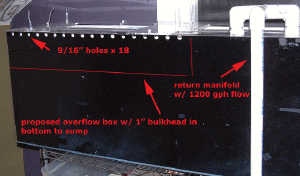
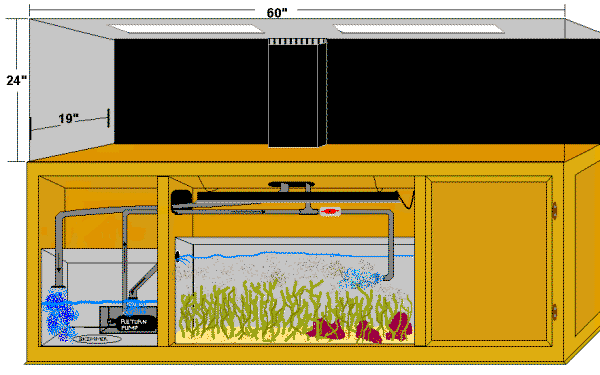
|
|
| Home | Marine Aquariums |
Freshwater Aquariums |
Planted Aquariums |
Brackish Systems |
Ponds,
lakes & fountains |
Turtles & Amphibians |
Aquatic Business |
Aquatic Science |
Ask the WWM Crew a Question |
| Please visit our Sponsors | ||||
|
Where Does The Hole Go? Hi, I have a 30 gal. reef and want to add a refugium. I have an old 10 gal. sitting next to the 30 gal. it is full of 7 or 8 macro's and the bottom of the 10 gal. is even with the top of the 30 gal. I want to run a canister filter from the 30 gal. to the 10 gal., and drill a 1 inch bulkhead in the side of the 10 gal., and let the water return with no pump via gravity. I am not sure at what height to place the hole? I know near the top would give more water in that tank , but I am concerned about the amount of critters that would make it to the main tank with the return near the top without having a power-head in there stirring everything up? Thomas Giddens <Unfortunately, Thomas- that's one of those things that you're gonna have to experiment with. I'd advise placing the hole towards the top, myself. Regards, Scott F>
- 135 Set-up/Plumbing - Hi guys! Thanks for your great site! I've poured over it as well as others gathering info and have a few questions for you regarding my set-up. First off, this will be a freshwater tank which I will later turn into a reef. For now though I want to lay a good foundation to make the change easier and to have a great, clean, low maintenance and well set up tank. The tank is 72L X 18W X 24H and came with an Amiracle wet/dry with a single drip plate (24x12x14). This tank has one back/center overflow (3 sides at 6" each) I want to have at least 1350gph(10x) flow rate and am debating a bunch of plumbing, pump, filter issues: 1.. OVERFLOW: Considering my desired flow rate and current overflow box, what alterations to it would you recommend? <Get a second overflow installed? I don't know... not sure this single overflow will be up to your demands.> What's the max for this overflow and what diameter bulkhead should I use for it's downspout? <Uhh... you tell me, how big is that hole at the bottom of the overflow? I'm going to guess an inch - if larger, that is better, but if only one inch, then expect about 900 GPH max.><<RMF says 600...>> 1st concept: I've always wondered about the possibility of drilling intake bulkheads near the bottom of the tank and plumb them to the backside of the in-tank overflow box at the waterline - a sort of below the waterline overflow. My thinking is that this will aid in the removal of waste. <And water.> I'm not used to overflows and can't imagine effectively removing waste by only skimming water from the top. <Well... it's been working well enough for long enough that there are no significant changes in the design. I would caution you strongly about plumbing bulkheads well below the water line. Do make sure you have redundant valves and fittings beyond the bulkheads as a failure in anything attached to that bulkhead will result in draining your tank onto the floor.> 2.. RETURNS: For the returns I was thinking of using the manifold set-up. 2nd concept: create a spray bar along the back of the tank just above the sand level, elevating the rock structures just above the sand level with pvc stubs glued to the bottom of the tank. The idea being that this would help eliminate waste build-up and keep it waterborne. If I did this could I link a water level return between it and the pump to avoid back siphon during pump failure, would this work? <I think that in theory it will work - practical experience will tell the tale.> 3.. FILTER: How much additional sump will I need (something that I could later use as a refugium)? Do you think the single wet/dry will be ok for now (handle 1350+ gph?), what other additions or modifications should I look into? <Consider something other than a wet/dry if you plan on building a reef or refugium... look for a sump that is better adapted to this use. Wet/dries do not convert well to other uses.> (I know I'll need to get rid of the bioballs when I go reef.) <Actually, because the tank isn't set up yet, I'd recommend you just get rid of the whole filter and look for something else... don't wait to "get rid of the bioballs" - toss them now.> I want to keep mechanical filtration simple (such as drip plate or some other prefilter.) <How about a Berlin sump... simple micron sock to remove the waste.> I basically want to eliminate the need to vacuum and keep the tank as clean as possible. Suggestions please. <Cleanliness is only next to sterility in a marine tank. Sterility is not your friend or ally in marine husbandry.> 4.. PUMPS: I know you suggest Iwaki but I'm thinking (until I go reef at least) of going with the much more affordable "quite one" pumps. Unless you happen to suggest another better but still inexpensive pump. Would having two (redundant) pumps be overkill? <No.> I'm a little worried about depending on only one pump to run an entire system. What float switches do you recommend for preventing low sump/pump burnout? <Don't have any favorites here.> Thanks for the time and help! J <Cheers, J -- > Tank Drilling Hello, Just a quick question. Should I have my glass 120 gallon (tall) tank drilled in the bottom or out the back? Thanks! Todd <Hey Todd, I have seen both ways work, but personally I would drill the back of the tank (assuming that it is not tempered glass). I am a firm believer in if something can go wrong it will. Myself, my floor, and my landlord would much rather have a leak on upper back of the tank than the bottom. I have never seen 120 gallons spilled on the floor and really do not want to. Best Regards, Gage> Re: Tank drilling Sorry to persist.... <Don't know what's going on with Gage's email but I'll give it a go> But I have just a few more questions. I am trying to find someone who will drill the tank. Most everyone does not want to attempt it. The only glass company that is willing to try it, sounds a bit flaky. <If this is a glass tank... much easier to drill before assembly...> If it were your tank (I know.... you would have bought it drilled), and you had to have it drilled..... where would you have the holes drilled (I mean can you be very specific, as in inches from top and sides), and how many holes, and what size? Also where would you purchase the bulkheads? <How big a tank? If it's a small one (less than more than a couple of feet in length/width, a couple of inches from the edge and top (you can manipulate the level of water inside the system with plumbing outside) to give you some "edge" for structural strength> Would you ever consider using a HOB overflow? If you had to use a HOB overflow, would you use a double intake type? <I would, have... even built, manufactured these years past... and I like the "waterfall" varieties better than the double intake designs, but greatly favor the doubles over single tube types> I very very much appreciate your input. Thanks, Todd <You're welcome. Bob Fenner> Re: Tank drilling Thank you for the super fast response. <Now it's the 18th?! Yikes> Where would you drill the holes at in the back? And how many? <Ahh, I see below from previous correspondence this is a 120 gallon system (likely six feet long). I would drill at least two, maybe three holes... if two, 2" inside diameter, and if three, 1 1/2" inside diameter... two at either corner set with two inches of glass at top and the side and the third at the same level in the tank mid-back> Can I just drill several return holes and avoid having to use powerheads inside the tank? <Yes> Do I still need to use an internal overflow? Or can I just put cages over the outlet holes? <Can use either one, I prefer the latter> And how many outlet holes should I have drilled? <IMO two> How can I determine if the tank is tempered? If it is tempered, am out of luck having it drilled? <The folks doing the drilling will be able to tell you. More likely than not the glass is not tempered though.> I appreciate all of your input. Thanks again! <You're welcome again. Bob Fenner> Re: Tank drilling Thank you very much for the replies. <Welcome> If I drill (3) holes 1 1/2" which should I use for the returns? <One inch ID should be fine> Or should I drill more for returns? I suppose I could just drill (3) holes and use the center for the output and the two end holes for the returns? <I would use two more holes for the return... about the same level a few inches from the overflow holes (you can fit manifolds, diverters inside the tank... threaded on to the bulkheads/throughputs> I guess I could then find some ball jets that could attach to the bulkheads to divert the returns any angle I wish? <Ahh, yes> I also imagine that I would need a stout return pump to push lots of water? What GPH size pump would you recommend? I was looking at the Velocity T4, but perhaps that is not enough flow for the returns to have good water flow? <Depends on a few factors... will you have a sump style filter arrangement... at what "head" (difference in water level)? Or will the pump have to "pull" or push through a mechanical filter membrane of some sort? Much to consider> The above should cover it. I very much appreciate your thoughts. Thank you again, <A pleasure to share with you. Bob Fenner> Re: Tank drilling Hello, Yes this would be for a sump style filter. The head would be approx. 3 - 4 ft. Just to reiterate. I should drill (3) 1 - 1/2" holes approx. 2" from top and sides. One being in the center. Then also drill (2) more additional holes for returns. These should be drilled about the same level and a few inches from the overflow/outputs. It sounds like I would then bring the three overflows down into one or two lines going into the sump. From the sump/return pump go to the (2) return holes on the back of the tank. These (2) return holes can then be used to divert the water at whatever angle is best suited via eyeball diverters. Thus eliminating the need for powerheads. <Yes> However, the pump will need to push enough return to make this useful. At the same time not drain the sump too quickly. Any suggestions on keeping this balanced? <Mmm, yes... an oversized pump with a throttling mechanism... likely a ball or gate valve... the water going into your tank will surely overflow back into your sump/refugium... the most important item (other than making the sump as large in volume as possible) is to initially fill all, turn the pump on and mark the level in the sump... and NOT fill the sump up any further than this...> Would hate to drain the sump or overfill it. Perhaps a few ball valves installed inline to fine tune/adjust the flow? Thanks! <That's the ticket! Bob Fenner> 120 tank drilling 2/24/04 Hello Anthony, I really like your idea with doing away with the "reef ready" tanks with the unsightly overflow towers. I plan on ordering a 120 from my LFS, I currently have a 90 dedicated to LPS only and do plan on keeping it that way (no mixed garden here, thanks to you, and the rest of the crew) , <excellent to hear!> but I'm running out of room and plan on transferring the inhabitants to the 120 one of these days. <its one of my fave size/shaped tanks: 2X2X4 feet><<... four by two by two... LWH. RMF>> I would like you're opinion on how I should have the tank drilled , I plan on ordering the tank from all-glass and having them drill the back walls at the top to accommodate 1 1/2" bulkheads that have strainers on them for the overflows to the sump, how does that sound? <exactly the way I'd do it> or is there a better way that you would recommend? <spot on. And if it goes reef... then include a slender horizontal overflow sealed in front of the bulkheads for better skimming (see this in my Book of Coral Propagation or write back for the passage to be e-mailed to you)> I was thinking 4 or 5 holes would do? too many or too much? <hard to say.. you need to determine what corals you will keep, what flow they will need, and if you want to/can run all of that flow through the sump (versus less holes plus a closed loop and second pump). No powerheads regardless> Would you have a better idea than drilling then with a 90 degree elbow and a strainer on it to get this down to the sump to allow for more water flow (and a bigger pump) or do I not need this as much with LPS ? <good skimming is needed with all truly> Also I was thinking about drilling for the returns , should I do that or should I just run the piping up from the back of the tank? <that one is really just a personal preference. I favor up over the back and drilling less holes> I was thinking about you're closed loop manifold, if that makes a difference. thanks for you're help. <best of luck! Anthony> 120 tank drilling II 2/27/04 ok, thanks Anthony. You mentioned that I should install a skimmer box in front of the bulkheads, <not needed but helpful... much better skimmate> I do have your BOCP, I looked at it, but how can I build this?? and how do I secure it to the tank?? <its simply siliconed cut and seamed glass in a dry tank (or low drained tank)> One more thing, I asked if I should go with 4 or 5 1 1/2" bulkheads drilled, you needed to know what kind of animals I intend to keep in there to determine if I should go with that or less.... well I am going to keep it a dedicated LPS tank, so how many should I go with here to provide the flow these plump, fleshy corals will need?? <You really need to pick the corals by species name my friend... not just saying "LPS". That could mean Nemanzophyllia which suffers from even moderate water flow, to Hydnophora which requires remarkably strong water flow> Also my sump should be able to handle the flow right?, <yes... if designed well. Diffused flow to prevent excessive turbulence and bubbles being aspirated> as long as my pumps can put it out right? I could also lets say have 5 holes drilled and plug them if I don't need them, or if I someday want to add a closed loop pump to the system right? thanks once again. <all of these questions are really simple to see/understand if you'll take the time to visit some LFS shops to peep their functioning systems... better still, a local aquarium society with fellowship from local members to show you their tanks and systems. If none of this is possible, you can start or follow a thread with pictures on message boards to see how others do their systems. We are such visual creatures.. you need to see these systems in action and all will be so much clearer. Anthony> Bulkhead Sizing... Thanks for all the answers! It was helpful! <Glad to be of service!> I have one other question though, I received my pump in the mail and attached it to my plumbing, when I found out that my overflow can not handle the pump rate (500 gph with a 1" overflow). I then found out (albeit too late) that a 1 pipe can only handle 300 gph. I built my overflow myself, but then I started looking at the retail ones (i.e.. CPR overflows) when I found out mine couldn't handle it. I'm a bit confused. These CPR overflows are rated at 600, 800, 1200 gph etc. yet they mostly all have 1 inch bulkheads. How is that they are getting a higher flow rate with the same pipes size? And would I be able to do something to achieve this with my current overflow? <Well, bulkhead size is so important when configuring overflows. I cannot recall a situation where someone has regretted going with larger bulkheads (like 1.5 inches or more..). Give it a thought. Unfortunately, the best advise I could give you would be to experiment with your current overflow, and perhaps consider the addition of another bulkhead/standpipe and see what kind of results you get...Good luck! Regards, Scott F> BH Overflow Size and Turnover...still confused !! 2/17/04 Good morning crew. sunny Scotland calling.. haha <Good morning! Warm Pennsylvania replying... more funny stuff!> I'm still unsure in my head if the bulkhead overflow sizes and water flow rate would be right to make this tank a successful reef tank. Here's where I'm confused I have a 180g main tank and considering something like a 60g sump. The 180 was drilled in the shop I bought it from with TWO, One and one quarter inch (1 1/4") holes, and I was figuring on returning the water via the Closed Manifold idea of Anthony's. <The closed manifold makes for excellent flow distribution.> Now I've read that you need somewhere between 10 - 20 times the total turnover per hour. would these 2 holes provide that kind of throughput, <Are the holes 1.25" (likely only to accommodate 3/4" bulkheads), or do the holes accommodate 1.25" bulkhead fittings? As a drain, 1.25" bulkheads will probably accommodate in the nationhood of 5-600 gph each, leaving you quite short of your target flow rate.> and if so what rate/kind of pump would you recommend (I'd prefer an external one if possible). <Iwaki is widely considered to be the "gold standard" by which all centrifugal pumps are judged, but GRI and Little Giant also make excellent pumps.> As a side thought, although the holes are only 1 4", as the bulkhead fitting comes out of the tank, would it help any to increase the diameter of the pipe here to speed up the water rate ?? <For returns, lager diameter pipe is helpful to increase flow, but this effect is very much diminished for drains. If you find that you are not satisfied with the amount of flow that your drains can handle, you may have to supplement with other types of circulation.> Many thanks Raymie (Scotland) <Best Regards! Adam> - Turnover - Can I get sufficient flow through the overflow on a 125 reef ready all glass tank using a Blueline 40 HD-X pump. <I think so... if it has two overflows, then it should be no problem.> Will I need to run all 4 bulkheads for drains or will the 2 one inch be enough. <The two should be sufficient.> Any suggestions I am trying to convert from J tube overflows to internal type. <I take it then that this is a new tank.> Tank has been set up 9 years and is stocked with SPS LPS and soft corals. <No worries. Cheers, J -- > Planning A Tank For Maximum Performance! Hello again, <Hi there! Scott F. with you today!> Thanks for the info. I purchased a 75 gal. tank! I have also located a glass company that will drill the tank. The plan is to use a 1 1/2" bulkhead, I am guessing that this would provide a max of 1500 gph? <I think that you might want to use two 1 1/2" bulkheads, just to be safe> I have read that the bulkhead should be place 4" below the top but not sure on the horizontal position? <If you are using an overflow box to house the bulkheads (which I prefer, myself), then the bulkheads are in a vertical position> I am also considering building a manifold out of 1" pipe with 3 outlets. I used the head calculator on Reef Central and looks like this would output around 750 gph with a Mag 9. The intent of the tank is FOWLR at first and to add coral after the tank has established. Would the 750 gph be enough for the corals or would it be better to have 2- 1 1/2" bulkheads, bigger return pump and add more outlets to the manifold? <Yep! Bigger is better, when it comes to flow, IMO! You can always cap an unused manifold or bulkhead. it's much tougher to drill a tank once it's up and running> Question on the overflow plumbing. I plan to have a tee come out of the bulkhead and cap the top end. This should quiet the overflow? I have also noticed that some folks have mentioned ball valves and gate valves. Where should these be placed in the plumbing to and from the sump? <All sorts of options. If it were me, I'd look into a "Durso standpipe" as an option. This is a great way to quiet overflow noise! Do a search on the 'net under "Durso Standpipe" for more details> The skimmer will be in-sump. Many of the DIY sump plans seem incomplete for me. <Yep- I prefer manufactured skimmers, myself!> Thanks again for the info. I just want to avoid as many mistakes as possible because it seems that once it's up there's no turning back. Sincerely, Doug R <Agreed, Doug. Take everyone's advice with a grain of salt, including mine! I'd get more opinions from fellow reefers (use the WWM Forum or Reef Central), and talk extensively with the people who are making/seeing you tank! Good luck! Regards, Scott F.> Drilling question 2/3/04 Hey guys, I have a FOWLR 300 gal. tank that has 1 inch corner overflows with a Little Giant MD5 pump. Even with brand new pre filters, the water backs up in the overflow because the drains cannot keep up with the pump. So my question is how do I make the existing hole bigger from a 1" to a 1.5" bulkhead overflow? Since there is no longer a way for a pilot drill on the hole saw I am a little confused. Thanks Sean <you cannot drill over another hole in glass safely without a reciprocal drill ($10K machine). In your case, you will need to drill another hole or simply make due otherwise here, bub. Anthony> Drilling question II 2/3/04 Hi, Anthony sent the following, but I forgot to mention that the tank is acrylic...........any suggestions??!!?? <ahhh, yes... an important distinction! In this case, the solution is easy. Block the back of the hole soundly with a piece of solid wood or scrap acrylic. Then advance the piloting drill bit in the hole saw's mandrill far enough to at least compensate for eh depth of the hole (thickness of the tank's acrylic) and let the bit bite into the block on the other side first as you start to drill over the old hole. Best of luck. Anthony> Drilling question 2/3/04 Hey guys, I have a FOWLR 300 gal. tank that has 1 inch corner overflows with a Little Giant MD5 pump. Even with brand new pre filters, the water backs up in the overflow because the drains cannot keep up with the pump. So my question is how do I make the existing hole bigger from a 1" to a 1.5" bulkhead overflow? Since there is no longer a way for a pilot drill on the hole saw I am a little confused. Thanks Sean <you cannot drill over another hole in glass safely without a reciprocal drill ($10K machine). In your case, you will need to drill another hole or simply make due otherwise here, bub. Anthony> - Plumbing the Overflow in a Small Tank - To the experts, Please help I'm going nuts! I have searched the web site for hours and cannot resolve my plumbing problem. These are the basics. 30 gallon tank with a 10 gallon sump. DIY overflow (2 lees breeder boxes) 3/4 U pipe and 3/4 bulkhead fitting. 3/4 tubing down to sump. Return back to the tank is as follows: Mag 5 pump to 1/2 in. tubing to a Y fitting to 1/2 in. tubing to 1/2 in. 90's with Line lock fittings ending in the main tank. Now to the problem. I can't run the Mag 5 full open unless I remove the Durso stand pipe I've installed in the over flow. I have made 3 designs with the same results. All are design's from Mr. Durso's web site. All are based on 1 pipe size larger than the bulkhead, meaning they are constructed out of 1 in. pipe tee's, 90's etc. . I even made the straight 1 with out the Tee. All with the same results. Also can you help me out with flow rates with a 3/4 bulkhead and a 1in. bulkhead in my situation? <Hmm... think you are suffering from a couple of issues - first, I'm pretty sure the outlet of that pump is 1/2" which means that you are not restricting the pump when you use 1/2" plumbing which in turn means that the pump will perform at the rated flow. So onto the bulkhead - I think the maximum flow rate for a 3/4" bulkhead is 1,000 GPH, but not sure what the standpipe would do to change that - you might want to experiment by taking off the top of the Durso, so you just have a straight pipe, see how that runs with the pump wide open and then add the parts one by one until you find the limiting factor.> All help would be greatly appreciated, Thanks from a big fan. <Cheers, J -- > Overflow Question Hey! How is everybody? <Beautiful day in San Francisco. Ryan Bowen with you today> Thanks again for such a great site! Got a question. I have an established 40 gallon tall and I want to add a sump but it just isn't possible for me drill holes for an overflow. <Hmm...Most overflows require no drilling at all> I'm not sure how to get the water movement correct. <Choose an overflow with about a 400gph rate. Since you're not going the drilling route, you will need a submersible pump, and don't skimp. The cheaper ones add a lot of heat to the water.> I have a ten gallon laying around that I was planning on using for the sump. <Go to PetCo, get a super-cheap 20-30 gallon instead. The extra water volume is the true reason for all this labor- 10 gallons is barely worth the effort.> I was thinking about using 2 of the same pumps (quiet ones, 300gph) to move the water to the sump and back up, into a SCWD wave maker, then into the display tank. <Hmm...I would use a CPR Overflow or a Tunze outlet. Look up some DIY Sump designs here: http://ozreef.org/ And then pump it back up with an adequate pump.> I don't about all the water pressure, gravity, calculations and stuff. <Trial and error can be pricey, so you may want to read the Circulation FAQs> The top of the tank is about 4ft off the ground. What can I do to make this work without drilling? <See above> My main focus it get everything I can out of the display and off the back of the tank. <Great> The health of the tank is good and I think a sump could make it much better. <Can't improve perfect health!> I cant afford a bigger tank and I want my 40. Any advice would very much appreciated. <Surely! Good luck, Ryan> -Nick
Where to drill the hole 1/20/04 Hi Anthony, (or other helpful WWM crew) <Adam here today.> Please help! I have search the FAQ and other forums and cannot find a definite answer. I am planning on drilling the back of a 75 gal non reef ready tank. I plan on using 1" bulkheads which require 1.75" holes. My question is: where to place the holes in relation to the top of the tank/water level? Where should the center line of the hole be? I plan on using a screw in strainer and/or a 90 elbow as I have read that will allow some adjustment. Is there a standard or good old "rule of thumb" I have read that the distance from the top should be the diameter of the hole drilled? But does this mean from the top of the tank or from the top of the water level? Please help as I sure don't want to drill in the wrong place. No chance for a oops "do over"! Thanks, and as always WWM is the best source of reliable information! <I have not heard a rule of thumb on this either, but I suspect that leaving one "diameter" distance from the lip of the tank has more to do with preserving the strength of the glass than anything to do with tank drainage. I would say that that is a reasonable guide, but you may have to use an elbow to raise the water level to an acceptable level. I would also suggest leaving several inches between holes if you are drilling more than one. Adam> Where to drill the hole 1/20/04 Hi Anthony, (or other helpful WWM crew) <howdy> Please help! I have search the FAQ and other forums and cannot find a definite answer. I am planning on drilling the back of a 75 gal non reef ready tank. I plan on using 1" bulkheads which require 1.75" holes. My question is: where to place the holes in relation to the top of the tank/water level? Where should the center line of the hole be? I plan on using a screw in strainer and/or a 90 elbow as I have read that will allow some adjustment. Is there a standard or good old "rule of thumb" I have read that the distance from the top should be the diameter of the hole drilled? But does this mean from the top of the tank or from the top of the water level? Please help as I sure don't want to drill in the wrong place. No chance for a oops "do over"! Thanks, and as always WWM is the best source of reliable information! <the distance from the surface of the water is somewhat subjective... but most folks want it as near to the surface as possible for aesthetics if no other reason. Drilled lower, however, you can extend the elbow upwards (and add pipe/tubing if needed)... however this is a possible point of leakage (into the sump at risk of overflow) in the event of a power failure. I prefer to drill high... and for a 1" bulkhead, the highest you can go is about 3" from the top of the glass on center (of the hole... thus, there will be a full 7/8" above the drilled hole). A whisker lower would be nice to play it safe. I'd suggest 4" on center from the top and use an elbow on the inside of each hole to act as a standpipe for adjusting the water level. Best regards, Anthony> To Drill or not to Drill 1/15/03 Dear Crew, I need to know if I can drill a hole( bottom or side) in a 125 gal. O Dell tank. I bought it about 3 years ago used. I don't know how long they had it. Would you be able to help me with this (temper or not). The company is no longer in business. Thank you! Tom <Hi Tom, Adam here today. As you probably know, drilling tempered glass can be very dangerous. As a general rule in larger tanks, if any of the panels are tempered, it will be the bottom. In such a large tank, it is unlikely that the sides are tempered, but I would want to be sure before drilling. You might be able to tell if the glass is tempered by looking at it through a diffraction grating. Tempered and non-tempered glass will show different patterns when viewed this way. Check with a local glass shop for help. As an aside, this is why you see a pattern in automobile glass if you look at it with polarized sun glasses. HTH. Adam> I think I got hosed: plumbing question 1/8/04 This question is for Anthony. <at your service> I've been reading your articles on plumbing a reef system and I'm curious about the rate of flow you suggest and how that can best be achieved. Am I reading correctly that for a reef system consisting of live rock, live sand, corals (mostly LPS), and inverts you recommend water circulation approaching 20X the volume of the tank per hour? <quite correct... with many successful reef tanks (see Paletta 2003 for example) cited with flow rates approaching 40X per hour. Much more akin to the dynamic flow on a real/proper reef> So for my 175 gallon tank I would need to provide approximately 3,500 gph water turnover? <correct... and to be delivered in a random turbulent way of not surging (never laminar unless keeping those few species that need it)> I purchased an Oceanic 175 gal bowfront tank that is drilled for 1" drain lines and ¾" return lines in each corner overflow. <heehee... nice looking tank, but much is writ (here in WWM archives and on the 'Net abroad at great length) about the size of these so-called "reef-ready" tanks> Using the calculations I can find it does not seem possible for me to get anywhere near the suggested 3,500 gph to drain from my tank, not even if I use all four holes for drainage and run a separate return line (which will look like crap on a tank that was going to sit in the middle of a room). <you are exactly correct> I have read a few of your FAQ's concerning improving the rate of return by enlarging the size of pipe as close to the bulkhead as possible, even if I go from 1" to 1-1/2" or 2" for my drain lines on the other side of the bulkhead how much improvement might I actually see? <I cannot say... depends on the run downward: number of bends, tees, elbows... released underwater or not, etc> What is the best configuration above the bulkhead to maximize the flow of water to the sump? <this one is relative to the rockscape and needs of the corals placed upon it. Rather an experimental endeavor. Simply have enough outlets/nozzles tapped into the manifold in advance and cap off what you don't need later> The bottom of the tank is tempered so drilling additional holes does not seem to be possible, unless there is some way that I do not know of to drill tempered glass, or enlarge existing holes in tempered glass? <none alas> What are some other tricks to improve the amount of flow from drain lines? <none safely without creating noise/suction. You can just drill extra holes in the back wall like a normal drilled overflow if that glass is not tempered> On the return line side, am I correct in the assumption that I can use any size line for the return, but will experience greater losses due to friction with a smaller line? <not exactly... rather a volume vs. velocity gig here. You might consult Escobar's "Aquatic Systems Engineering" for many such technical questions/explanations> I had originally planned to use 2 or three of the holes in the overflow for drain lines and the remaining line for return, but if I need to use all four holes for drain lines I'm not left with an option other than to provide an outside return line. The pump will sit on the floor below the tank so there will be about 6' of head loss. What size pump/line would you recommend using for this situation. <I wish to help... but it simply cannot be estimated from here not knowing the system and livestock. You really need to figure out how to deliver the safe flow (say 20X) by the means available to you. In this case, a 4000 GPH return pump that is teed/bled as needed is on par> Have you ever heard of anyone running underwater electrical line through a drain line to get power to their lighting? <its possible, but not appealing to me regarding complication/safety> Thanks in advance for any assistance you can provide, it is much appreciated. Jeremy <I do wish I could be of more help, but our (mine and yours) hands are tied by the undersized overflows drilled IMO. You may simply have to deal with a powerhead or water pump to support the undersized flow of the drains. In that case, estimate what can safely be pushed through those drains (200-300 gph through a 1") and then make up the diff with a sexy Tunze streamer in the display for example <G>. Best of luck, Anthony> Re: Tank Drilling for undersized overflow 1/8/04 Anthony...thanks for your reply. I have never drilled a tank before. The oceanic (boo, hiss, never buy another one) back panel is 1/2" thick non-tempered glass. Could you describe step by step how you would go about drilling it. <hmmm... it's not something that I can describe properly in the brevity of an e-mail. It's also not something that you want improvise on. It's truly worth it for you to contact a local aquarium shop or aquarium service person that has a proper drill press and diamond hole saw with experience drilling a few hundred tanks. Truly worth the investment here> I think this is something I could do myself judging by the amount of people who have done so and could practice on an old tank or sheet of glass before I screw up the good one. <yes... ultimately its not hard at all> Am I correct in assuming that it should be drilled low on the back side inside the overflow? <not sure I follow. Most are drilled as high as possible and depend on the presence (or not) of an internal sealed horizontal overflow> The largest bulkheads I saw on the marine depot site were 2" requiring a 3" hole, but they did not list a flow rate for these. Do you know what kind of flow I can expect from a 2" bulkhead? <there is some such data in our archives if you care to do a keyword search... as well as calculators for these things on the big message boards like RC. I, however, simply consult the bulkhead mfg's website or specs to be sure> Is it any harder to drill a 3" hole than a 1.5" hole? <not at all... its all about having a sharp hole saw and proper coolant> If I need more than (2) 2" bulkheads I don't think they would fit in the overflow unless they were at different heights, would that work? <not sure here... I have no idea how deep you want/can afford the overflow to be> If I drill the back then I can use the 1" bulkheads for the return lines and use one of the 3/4" bulkheads to run power through. <I suppose... although I do not see the imperative need for submerging the power cords> I am very appreciative of your help with this. I want to make sure that I get this all done correctly. I hope you won't mind if I continue to follow up with additional questions as they arise. thank you for all of your help...Jeremy <always welcome Jeremy... best of luck. Anthony> Hole dia. Hello Mr.. Fenner, <Howdy> I strongly assure you that it is a great honor. I am in the process of reading your book which my spouse gave to me as a Christmas present. I have a question. I just purchased a 180 gal perfecto tank and want to run it with a 55 gal sump,. I was thinking of using 4 over flow holes evenly distributed across the back of the tank and my intention is to have a turnover rate something near 10. -What size holes should I get drilled???- I'm thinking a pump feeding 2000 gph at 4.5 feet. -does this sound good to you?- <Mmm, yes... I would make these through-puts 1 1/2" inside diameter... a few things to remark here... Do look a bit further into the actual configuration possibilities you have here... perhaps corner "towers" with the overflows drilled through the bottom, with risers as drains threaded into them... would be better> I can't find any information the applies directly to this issue. <Take a read through the many articles and FAQs folders on Marine Plumbing posted on our site www.WetWebMedia.com> I want some good flow. Also, this will be a very lightly populated fish only with live rock. Everybody tells me not to bother with a sump and high turnover rates but I want all chances on my side and I want a couple happy fellers in my nice tank; I like the idea of higher turnover.. so what size holes do you think I should get drilled? do you think 4 is overkill? <The holes will likely be 2" diameter, and four is not too many> Thanks so much in advance for any and all time spent on this; your work and contribution is fantastic. <Thank you for your kind, encouraging words. Bob Fenner>-Plumbing... 12/19/03 hi, <Hi Pete, Adam at your service.> I have a 5' tank, about 100 gallons sump included, the return from the sump is from an Eheim 1060 so ~ 500 gph but prob much less after 4ft head height and several bends: <I agree you are probably getting much less than the rated flow.> the problem is that it takes ages for the level in the main tank to reach its proper level after the 1060 has been switched off and then back on again, e.g. after a water change. <you can calculate the actual output of your pump by calculating the gallons per inch of tank height and then timing how long it takes for the water level to rise and inch once you restart your pump. A little arithmetic, and you can calculate GPH or GPM.> It fills the tank until the sump is empty and the pump is taking in a water + air mixture and the bracing bars in the main tank are submerged, <Yikes!> then eventually a siphon begins and the water level falls to the level of the hole I drilled in the sump intake pipe in the main tank which breaks the siphon (with a big gargle), the level is now stable. <Whew! A relief it does not flood, but as you know this is still not right!> The pipe taking water from the tank to the sump has an internal diameter of 1 1/4'', I've read on this site that these pipes can take a flow rate of >600gph, presumably without emptying the sump first and siphoning to the point where the siphon break is. <I agree 1.25" pipe should easily handle the flow you are achieving.> The pipe going from the main tank to the sump comes through the side of the aquarium and bends 90 degrees down, it has a half inch diameter hole in the top of it on the part inside the tank before the 90 degree bend which I've blocked otherwise the siphon never occurs and the water level won't come down, neither does it when the hole is partially open. <You have essentially created a Carlson surge device. I am surprised that a hole above the desired water level does not cure the problem though. Try the following to see if any solves your problem: Turn the elbow inside the tank sideways or upwards so that it acts more like a stand pipe. If that doesn't work, try replacing the elbow outside the tank with a "T" to create a "chimney" on the top of your drain line (picturing the "T" fitting as the letter "T", it would be sideways). You may have to extend the "chimney" with a piece of pipe to ensure that the top is above the top of the aquarium.> The pipe taking water to the sump is currently slightly submerged in the sump to prevent noise, though having it above the sump water level makes no difference to the above problem. Though the many answers to the problems I have read on this sight have been informative I haven't found anybody else with this problem yet! <please do let us know which if any of these suggestions solves your problem.> many thanks, <my pleasure. Adam> Pete Overflow Dilemma - Dear Bob: <Actually, JasonC today...> It's been several weeks since I e-mailed you but I have another question that I have been unable to answer. I have just about everything ready to go for a new 180 gallon marine aquarium (FOWLR) that I have been setting up. With your input I decided to purchase a Euroreef CS8-1 Skimmer as you may recall from my prior e-mails. It will be placed in a 50-gallon sump in a stand beneath this aquarium. My question deals with the tank itself. It is from All-Glass Company and features two corner overflows (not the newer center-located overflows that are found on their newer tanks). The Mega-Flow Overflow Kits that the dealer sold with this tank are a tight fit since All-Glass now uses the Durso standpipe system because of noise concerns, etc. As you know, these feature a 1" bulkhead fitting in each corner and a 3/4" PVC return line. The numerous postings on various websites regarding flow rates for this and other drilled setups has my head swimming! The nice folks at All-Glass indicated that each overflow can handle a flow rate of 600 gph -- 1200 total for the tank. The many letters I have read seem to present a different picture, indicating flow rates as little as 200 to 300 gph. <Nah... a total of 1200 GPH is about right.><<Mmm, nope. The earlier guesstimates are closer to reality. RMF>> I have a Mag 18 ready to use for the return plumbing to the tank. I made this choice after calculating flow loss due to friction and head pressure through the 3/4" return plumbing. The return line will use a 'Y' connector to split the flow path and eventually bend thru the 90 degree elbows near the top of the tank. I estimated a return flow of about 820 gph -- or roughly 410 gph for each return line. Based on the lower flow rate numbers from above (draining thru the 1" bulkheads) I am now concerned that this pump may be too powerful. If this was your setup would you install a ball valve to control flow? <I'd install one for other reasons... being able to take the pump out to service it, etc. But again... I think you'll be fine with your pump selection.> I'm not sure how mag drive pumps can handle any type of back pressure, so I'm reluctant to do this. Or, do you believe these overflows can handle a Mag 18 without interruption? <No worries.> Just to note the Mag 18, according to the manufacturer, has a flow rate of 1200 gph at 5', and 825 gph at 11' (which is the figure I used). Thanks for any advice you can offer. Sam M. <Cheers, J -- > - Overflow Calculations - Hi Crew, Would you kindly check my calculations/idea? <Sure.> I am setting up a 75 gal non reef ready tank. As such, I need to use a hang on overflow siphon box (yuck). I really don't want to risk drilling the back unless you think it is worth taking the chance? <Not a chance you or I should take, but if there's no water in it I'd take it to a glass shop and have it drilled.> Anyway, I wish to set up a 15 or 20 gal sump/refuge. As the tank is in the living room I would not wish to have any flooding to explain to my wife! <Understood.> If I keep the water level 2 inches below the top of the tank this would be about 7.4 gals short of overflow. If I then keep the submerged pump in the sump 6 or 7 gals below the sump high water level, then there should be little chance of the tank overflowing in the event of a siphon break? correct?? <Only if the water remaining the sump is not more than the 7.4 gallon margin of error in the top tank. Sounds risky to me... evaporation and top off will be your biggest issues.> The only worry would be the pump running dry and burn out? Which I could live with. <If that happened, you could lose everything in the tank.> Does this sound correct or am I missing something? <It 'sounds' correct but still more risky than I would be willing to tackle.> Also, when adding make up water, would I add to the tank or sump? Does it matter? <Doesn't matter.> Thank you for your assistance. Happy Holidays. <Cheers, J -- > Bulkhead drain rate 12/14/03 Anthony, My bulkhead-drilling project resulted in 6 1.5" bulks installed across the back of my 135; I now wish I'd drilled a seventh hole, and may do so yet...the problem I encountered is that each bulkhead doesn't flow nearly what I'd hoped it might...careful flow testing with a stopwatch and a measured 6-gallon volume of the tank discloses that the maximum drain rate for a 1.5" bulkhead with the usual 90-degree threaded elbow and strainer installed is just 385gph. It seems that removing the elbow increases flow to ~485gph, but then there's no way to control water level...and of course the tank drains much lower when powering off the pump. [The bulks are draining through a vented T at the back, of course.] I thought you might find the 385gph number useful for future WWM FAQ's. Regards, JACK MARCH <yes... much appreciation for this my friend. Yet, for future readers of this message in the FAQs, your measure (albeit accurate, I trust indeed)... is only accurate for the length and run of the specific pipe/path you are using. Others with more or less plumbing, fittings, turns, etc will have differing flow rates. Nonetheless the measure is still quite helpful for perspective. Kind thanks, Anthony> Bulkhead drain rate 11/22/03 Searching though your very informative FAQs, I get the general idea that a 1" bulkhead in the back wall of a tank can be expected to drain about 600gph; <Hmmm... to clarify: some aquarists/mfgs claim this flow through a 1" bulkhead, but truthfully it is not likely. <<Tis impossible with gravity alone. RMF>> Only occurs when overdriven (drawing a noisy siphon). Reading through the FAQs you will see that I advise folks to expect half this much> however, I recently installed one of these guys with the elbow and strainer... and was dismayed to find that his max flow was only 200gph with the elbow and strainer in place, 300gph through the open bulkhead sans elbow and strainer. <yes... agreed. And it speaks to my very common rant/peeve with so-called "reef-ready" tanks sold which really are a joke because they have too few/small holes to actually be reef-ready> (I measured the flow coming out of a 1" drain line attached to the bulkhead by simply putting a stopwatch on the time required to fill a calibrated Rubbermaid gallon container. The bulkhead attaches to a 1" T fitting to let it "breathe" as it drains. [I subsequently installed a 1.5" bulkhead, which returned a more useful 400gph through an identical elbow and strainer, running through 1.5" flex PVC pipe.]) Is this low flow a surprise to you? <nope... common. And it has been surprising aquarists for about 20 years I can recall <G>> Or has no one ever taken the trouble to actually measure the flow through these things? <ahh... there is the mfg specs. As well as the calculators on the big message boards (like RC) as well as some technical manuals on aquatic systems engineering. All to be revealed with a little digging/research by us when planning for a tank> The reason I ask is that I'm planning to drill my 135-gallon tank which is currently draining through much-hated siphon overflows, and naturally I'm trying to figure out how many and what size bulkheads to drill into the rear wall of the tank. <I would recommend enough holes (size/number) to handle 2500 GPH if this is to be a reef> The Iwaki 70RLT on the tank is probably running ~1200gph through the tank (with another 200 diverted through a UV)--so how many 1.5" bulkheads would you expect would be needed? <the above 2500 GPH to get near the recommended 20X turnover for a healthy reef aquarium> Thanking you for your time and patience, JACK MARCH <best of luck to you. Anthony Calfo> Re: bulkhead drain rate II 11/23/03 Anthony, Thanks for your prompt and helpful response! Perhaps you would be so kind as to answer a follow-up query: <our pleasure> Although this particular tank is freshwater, I want the flexibility to convert it to either FOWLR or reef as time and opportunity may permit, so as I'm taking it offline for drilling I'd certainly want the 2500gph drain capacity you mention; <indeed... not such thing as too much flow here> but the inside back wall is just 71" long, so...the math works out to [assuming a 1.5" bulkhead will drain 425gph, which I would guess is just slightly optimistic] six 2.5" holes every 10.5" or so--which leaves just over 7" between holes. <yes... correct> Forgive my ignorance in this area, but does this much glass removed from the rear wall leave enough structural strength to contain the contents of the aquarium? <a valid question. But no worries... this is safe here. Safer still is to cluster them towards the ends (avoid the center where there is some bow/deflection to the long panes of glass)> What is a safe minimum distance between holes to prevent half-inch glass from breaking? <its variable by tank... but as little 3" can easily be done oftentimes. This decision is to be left up to the professional who drills your tank. The other option is to simply drill fewer but even larger holes> Of course, the obvious solution would be to consider 2" bulks, but I already have the drill bits and 1.5" bulks, so I'd hate to have to re-invest yet more of my exiguous bucks in 2" hardware. <understood> On the subject of OEM "reef ready" tanks, I have a 210 & 240 Oceanic with absurd 1" bulkheads in each corner overflow; <agreed... absurd. The tanks are fine/beautiful... but the marketing/drilling/drainage is flawed in my opinion for most reef aquarists> when I bought the tanks I was such a newbie I had no idea what a huge problem this would be as I added experience and flow to the system. Really, it makes me angry--the systems as sold to me were essentially a frauds, but I was too inexperienced to know it. <alas... this is not uncommon, and most often occurs out of ignorance by your merchant, not so much as malice/fraud> By converting the two pump return lines to drain lines and using 1.5 flex PVC from the 1" bulks I've been able to bump flow to a measured 3273gph on the 240, <yes... helpful indeed. The compromise most with these systems make> but this is still far short of where I'd like it on a grossly overloaded FOWLR system. <correct> [Incidentally, it's dismaying to note how much more a vertical 1" bulkhead flows than a horizontal one!] <really... please do share these numbers/perspectives> I've always preferred WWM over RC, much less bs on your site than with the mostly BB format of RC; their flow calculator is pretty useless for addressing this issue of bulkhead drain rates, viz., <rather geared for experienced aquarists too> Calculators < http://reefcentral.com/calc/> ->Drain Size Calculator < http://reefcentral.com/calc/drain.php> Using the following input parameters Gallons per Hour = 2500 Drain and Overflow sizes are calculated as Recommended minimum drain pipe diameter = 2.06 inches Recommended minimum linear overflow size = 38 inches Truly I appreciate the wealth of information and sheer hard work your site represents, dunno what I'd've done without you, since I'm not much of a joiner and the LFS's aren't exactly cutting edge in terms of the tech side of the hobby; <its a labor of love on our end> one memorable comment from an LFS owner was to the effect that you certainly wouldn't want [even!] 10:1 flow in your tank--why, my gosh, that'd turn it into a whirlpool! <ughhh... what are they smoking?> Right...and weren't the '50's a wonderful time to be alive? Now lemme see where I put that Supreme AquaKing... <heehee... its with the box filters and glass wool... and coconut carbon> Regards, JACK MARCH <kindly, Anthony> Re: bulkhead drain rate Once again, thank you for your courteous and informative response to my queries. The tank in question is a stock Oceanic 72x18x24 glass 135 with an 18" center brace, so there is no detectable bowing of the rear panel when sighting down the length of the tank. Therefore I'll assume, based on your kindly-shared expertise, that it's safe to drill six 2.5" holes evenly spaced across the back glass... <seems doable to me> and, BTW, the "professional who drills your tank" would be me, a rank amateur; but I've drilled a total of 3 holes in much thinner glass [.25"] previously, using a diamond bit and Honda coolant as a lubricant, had no trouble despite using a handheld drill, just kept the rpm's--and pressure--very low, so no detectable heat build-up. <all good... indeed a possible DIY project. Just nice to have a professional do it and insure his work> A 1" fipt x fipt vertically-mounted bulkhead [as sold by Oceanic on most of their "reef ready" big tanks] can be modified to flow at least 900gph [confirmed using an actual stopwatch and measured vol. of water to calculate flow rate] by CAREFULLY opening up the 2 male PVC adapters with a Dremel and immediately placing a 1>1.5 flush bushing inline below the bulk to bring the drain line out to 1.5", then using standard techniques [e.g., long-turn elbows or 2x45 elbows, no 90 elbows] to construct the drain line. A <very interesting... thanks you for sharing this> above the bulk is the usual Durso standpipe with again 1.5" PVC. Using 4 of these modified 1" bulks I'm easily running 3273gph in my 240. [although naturally the overflows have been lowered] But a horizontal 1" bulk will max out at a meager 200gph with elbow and strainer, or 300 running wide open--even connected to a T behind the tank to admit air and smooth the flow. I've no idea why there should be such a large difference between flow rates--vertical mount vs. horizontal--but we humble aquarists can't argue with the laws of fluid dynamics. <agreed> I really appreciate you sharing your wisdom and experience with the rest of us, Anthony! Regards, JACK MARCH <a labor of love... wishing you the best my friend. Anthony> - Glass Drilling - Hello. My husband just bought me a 150 x-tall (All-glass) I think tank... I would like to set it up for a reef... however, I have a question and couldn't figure it out by reading other posts, although it is possible I missed it. The dimensions of the tank are 4 ft long, 2 ft wide, and 21/2 ft deep... I would like to drill some holes in it and set up the overflow as described in Anthony's book where there is a glass shelf built in to the aquarium that the water flows over then into the bulkheads... Problem is, we don't have a LFS, and the largest hole that the local glass shop will drill into it is 1", which won't even accommodate a 1/2" bulkhead fitting, right? <Actually, think it will... typically bulkheads are about 0.5" larger than the plumbing they are intended for... but a 0.5" bulkhead is much to small for a drain - you need 1" or better.> (Also, they say if they break the tank it's my tough luck, I guess I understand...) <Yes, much better to drill before the tank is assembled.> So anyways, If I can't get them to do a 11/8" hole to accommodate a 1/2 overflow, how many would I need to accommodate the overflow I would like? <Hmm... to match the same flow rate as two 1" bulkheads, I think you would need seven or eight 0.5" bulkheads.> I would like to just have one large pump in my sump to handle all of my circulation needs if I can do that, would prefer not to use powerheads... and will all these little 1/2" bulkheads drilled, will it reduce the strength of the tank? <Yes... will need to brace up the area where they are drilled, but the nature of Anthony's overflow design is such that you will brace the tank sufficiently.> Any suggestions? <Start considering other options... perhaps external overflow boxes or find another glass shop that can drill larger holes - you really need two, 1" bulkheads.> I think the glass is either 3/8ths or 1/2"....it's still in the back of the truck! Thank You! Ginger <Cheers, J -- > Plumbing question Hi, I have a small problem and I came across your site. I can't trust my local pet store I feel they are lying to me and ripping me off. I have a 90 gallon reef ready tank and an Amiracle SL wet/dry filter. I have had it in storage for a couple of years, and I've seemed to have forgotten how to connect the filter to the tank. The pet store is telling me I am missing a part and will need to purchase a $70 replacement kit. Knowing that I only need ONE part they are encouraging me to buy the whole kit. The worst part is I'm not sure what part I'm missing so I can't order the part through the Doctor's Foster & Smith catalog. They are telling me that the part I'm missing connects the white flex hose to the male end PVC pipe that comes out from the bottom of the tank. ANY help you can give me will be so appreciated. < hi, it is kind of hard to understand what you mean with out a picture, on the bottom of your tank you should have 2 bulkheads (they are black and go through the hole in the bottom of your tank. Out of this bulkhead you said you have a piece of pipe. If it is an All glass or oceanic tank it will be 1"pipe)to connect your hose to the pvc pipe you will need a coupling they sell them at home depot in the plumbing section. you do not need to buy the whole kit .take the pieces to the store with you and they can help you. Later MikeH> thank you in advance - Drilling Advice - Hi crew members I am going to buy a 20 gallon long tank and have it drilled. <Hmm... this is not an ideal tank for drilling. The glass used in smaller tanks is rather thin, and even 'cheap' [float glass rather than rolled or tempered] which tends to make the panels brittle. Your best bet for getting the holes cut is to disassemble the tank, then re-silicone it together once the holes are cut.> I would like one hole for an overflow down to my sump. Then have another hole drilled for a closed loop. I do not want powerheads in my tank as you can see. <It wasn't obvious until you mentioned it ;-) > The sump will be 10 gallons. Would the hole for the overflow to the sump be ok at 1". <I think so.> And when you drill for a 1" bulkhead what size should the hole be? <1.5"> Is the same size hole for the closed loop ok? <Sure, but you could size it down to 3/4"> Or would bigger be better. <Larger would likely give you trouble - weaken the panel.> I want 15-20 times turnover. So I was going to get a mag 4 to use as the closed loop pump. Is that too much or too little? <It's going to be quite a bit - you may be challenged to keep the water in the tank rather than have it slosh over the sides. The fluid dynamics of such a small box are going to be a challenge. Any chance I can convince you to try all this with a larger tank? Your overall plan is good, but I'd really like to see you attempt this with something larger.> The tank is going to have zoanthids mostly. No fish. Also would it be ok to drill the overflow in the side pane of the glass just about 1/2" below the top of the glass? <Sure.> The hole for the closed loop can go anywhere right? <For safety's sake, I'd put that just below the water line. If you put the bulkhead in the bottom of the tank and something in your plumbing fails, you will be quite sad.> Thanks, Karl <Cheers, J -- > - Drilling Advice, Follow-up - Hello JasonC <Hi.> Thank you for the fast reply. <My pleasure.> My hotmail account is not working good and I was afraid you guys didn't get my last email. I know the 20 gallon tank is not a great size to work with. It is all I have the room for and am allowed in my rental. <Fair enough.> It is an acrylic tank so drilling should be better right? <Oh sure, much better.> And if I went for a 3/4 hole for the closed loop and used a Mag 3 (350gph) would that be better or more safe so that water does no splash around. <I would plumb it in externally at first so you can experiment before you commit to drilling the hole. The Mag 4 isn't really a beefy pump and if I recall the outlet is 3/4" so you're not really going to be holding it back much.> Thank you again Karl <Cheers, J -- > Plumbing Dilemma... I just acquired a 70 gallon reef ready tank . its got 3 holes on the bottom of the tank and 2 on one of the ends about 2/3 to 3/4 the way up. I have two canister filters and I'm not sure how to plumb this set up. As of right now I'm not sure if I'm going fresh or salt but I've got to get this plumbing thing figured out. <The fun part...LOL> Should the return lines be on the bottom of the tank with check valves in case power out age? <Frankly, check valves scare the hell out of me! They are vulnerable to failure...at the most unfortunate times... I'd prefer something above the water line, like Sea Swirls, which have the added benefit of oscillating water flow...Neat stuff...> And the line feeding into the pumps be the ones on the side? I just can't find any info out for this kind of tank. <Well, there are about as many approaches to tank plumbing as there are hobbyists...No real right or wrong answers...Just do what works or you, and remains reliable and functional...> I'd really appreciate your help , and maybe I'm way off , any suggestions ? <As above...check out Sea Swirls for returns...> I'm lost. Thanks. Sean McConnell <Well, Sean-there are lots of approaches here...you can look into plumbing on the WWM site...lots of good information here- check it out! Good luck! Regards, Scott F.> - Return Pumps and Bulkhead Size - Hello. <Hi.> I currently have a sump with only one bulkhead (outlet) to which a little giant pump is connected (closed loop). The pump has 3/4" inlet and outlet. I need to increase my flow and would like to put a bigger pump. My question is, can I hook a pump that has a 1" inlet to the 3/4" bulk head (with adapters obviously) and not create any damage to the pump? <It won't damage the pump.> Will the flow be affected? <Yes, the smaller bulkhead will limit the pump's output just a bit.> It will be difficult to drill another hole. <As long as this sump isn't glass, consider using a Dremel tool to cut the hole out larger - in the ideal world, you should use the 1" bulkhead here if you can.> Thanks --AGT <Cheers, J -- > New All-Glass Tank Overflows - 9/19/03 Thanks for your reply Anthony. I have to know your opinion on the new all-glass tank overflows. I do plan on upgrading my 90 gal reef to a 120 in a few months. My question is to you do you approve (or like) the new design location of the overflow boxes on the reef ready tanks. Would you get one of the new ones or get an old one, what are the drawbacks of them being in the middle back of the tank? I don't know if I like how they put them in the middle of the tank. Do you think I should get one of the older styles while I still can , that is if it will suit the reef keeper better than the new style. <I'm grateful that they have addressed the issue in the hobby of having/providing drilled aquaria. My opinion of their old and new styles however, like any other commercial one I've seen, is that they are insufficiently drilled - lacking enough or large enough holes. What happens then is that aquarists often buy a properly sized sump/return pump for their display... but learn that the drains cannot handle them. So they throttle back the pump and need to add powerheads in the display... how ironic! And they are nearly as ugly, IMO, as those glass overflow towers <G>. My preference is to have overflow holes drilled high along the back wall... not the floor with a glass tower. I described modifying this with an internal horizontal overflow (more discreet and efficient) in my Book of Coral Propagation. We have several messages about it in our archives here at wetwebmedia.com too... do check them out with a keyword google search - toggle terms like "internal horizontal overflow" and see what you get. Hmmm... not sure if I've helped here or not. Holler if not :) Anthony> - Plumbing Question - I have a 180g reef ready Oceanic Tank that is going to be a FOWLR, the manufacturer claims that the supplied bulkheads should allow for 1800g/hour flow. <Have owned this tank... 1800 GPH is approximately true.> After reading several FAQs this does not seem realistic, the return bulkheads (2, one in each rear corner) are 3/4" ID and the drains (2, one in each rear corner) are 1" ID. Do you think this is realistic, I would like to attain this 1800g/hour flow. <Keep in mind that a this flow rate will be noisy. Better to get decent turnover - I used an Iwaki 40 [1,200 GPH] and then relied on powerheads in the tank to boost the circulation for the organisms in the tank. Much more quiet this way.> I am looking at using a Dolphin AMP Master 3000 or 4700 which I would reduce to the size of the bulkhead fittings right below the bulkhead. I was also thinking of the possibility of using the teed return manifold and using all 4 bulkhead holes as drains, If you think this is a better idea what size pump would you recommend and what would you recommend for plumbing (tubing size etc.). <I think this would work... could add probably another 500-600 GPH per 3/4" fitting. Keep in mind that you still have to pass water past the slots in the overflow towers which will become a limiting factor. I'm pretty sure the 1,800 GPH rating takes this into account.> I was thinking of running 1.5" pipe to the top of the tank and then reducing it and splitting it into either 1" or 3/4" pipe with 3/4" tees to direct the water. <You could do this or build a manifold that distributes the water at several places along the water line - many options open to you here.> I know this is a lot and not necessarily coherent but I would appreciate any help you can give me. Regards, D'Wayne <Cheers, J -- > -180 plumbing query- I have a 180g reef ready Oceanic Tank that is going to be a FOWLR, the manufacturer claims that the supplied bulkheads should allow for 1800g/hour flow. After reading several FAQs this does not seem realistic <Actually, it probably is. We run a 180 Oceanic at the shop at around 1500gph and the water levels in the overflows are still very shallow.>, the return bulkheads (2, one in each rear corner) are 3/4" ID and the drains (2, one in each rear corner) are 1" ID. Do you think this is realistic, I would like to attain this 1800g/hour flow. <I would say so, but install a gate valve on your pump just in case> I am looking at using a Dolphin AMP Master 3000 or 4700 which I would reduce to the size of the bulkhead fittings right below the bulkhead. <Have you checked out the pump curves on these guys? Even after a T and a few elbows, this may end up being too much for the tank to handle.> I was also thinking of the possibility of using the teed return manifold and using all 4 bulkhead holes as drains, If you think this is a better idea what size pump would you recommend and what would you recommend for plumbing (tubing size etc.). <If you really wanted to go wild with the return this would be a viable option, but I'd keep it below the max since who knows how high the water level in the tank will go.> I was thinking of running 1.5" pipe to the top of the tank and then reducing it and splitting it into either 1" or 3/4" pipe with 3/4" tees to direct the water. I know this is a lot and not necessarily coherent but I would appreciate any help you can give me. <No worries, and very coherent! I think the amp master 3000 would be a bit much for this tank. Big dolphin pumps, IMO, are best used on a closed loop that by-passes the overflows. Check around the forums for ideas on intake manifolds as well as return options (sea swirls!!!). I would pick a good sized return pump that wouldn't go over 1500-1800 gph after you have taken into account all the head pressure (elbows, t's, height, etc). I hope this helps! -Kevin> Regards, D'Wayne - Overflow Design - I'm about to have some large tanks made and was wondering - is there any reason to build these tanks with conventional overflows, i.e., hole in the bottom of the tank with a stand pipe and overflow baffle? Would not a hole (or 2 or 3) in the back of the tank with a bulkhead and strainer located at the waterline accomplish about the same thing? <Indeed... as they say six of one, half a dozen of the other. Either would work fine. Cheers, J -- > Drilling Acrylic Can anyone offer some experience/advice for the placement of holes in acrylic tanks in relation to the seams? I'm setting up a large reef system and I'm plumbing 1 inch bulkhead returns (two per end) in the ends of the 3/4 inch acrylic tank. I want to place the bulkheads as high as I can and was wondering if I can drill the holes right next to the top seam? My understanding is once acrylic is solvent glued it's essentially all one piece, yes? Thanks! Eric <My general "rule of thumb" is to leave gaps at least as wide as the cut out diameter from seams. You can adjust the water height in the system with plumbing distal to the tank if this is a/the concern... either ell's, tee's or valves. Bob Fenner> - Overflow Design - Hello Bob! - Please forgive the intrusion, I do normally post my questions to the "Crew" in general. <Well, it's JasonC here this time... hope you don't mind.> I'm looking for help with designing the overflow/s for my aquarium. I'm in the process of establishing a new reef setup (seam rupture on previous 14 yr. old tank) that will be installed in a wall and viewed from two sides. I awaiting the arrival of a 375 gal. acrylic aquarium from Tenecor (ships next week) which I ordered sans overflows. I did this because my plan was (is) to utilize some type of "external" overflow system. The dimensions of the tank are 96x30x30x3/4, of course the overflows will be installed on the end, or ends. My idea is to drill a series of holes at the top two inches of the tank to function like the teeth on an internal overflow, and attach the overflow box (drilled for bulkheads - 2 x 2") to the outside of the tank. If this sounds feasible to you, what would your recommendation be for the size of the skimmer holes? <It's kind of a sketchy plan... you will need to 'attach' the overflow box just as if it were part of the tank - with acrylic cement, otherwise it's going to fall off... you should consider just having this built onto the tank.> How many and how far apart (without compromising structural integrity)? <I'd go with 1/4-3/8" holes, as many as you want, not too close to any seam or edge.> What's the max flow I could expect through these holes? <Depends on how many you drill, but the number would be pretty high to match your expectations... perhaps 20-30 per end.> How big should the skimmer box be to handle the flow (say - max 2000gph)? <Well... drilling small holes isn't going to get you this high a flow rate unless you drill a lot of them - with standard bulkheads you need two to three 1.5" holes to reach a flow rate that high. Additionally, flowing this much water in and out of the tank is going to be very noisy... I would consider lowering the recycle rate in favor of some strong water movement within the tank via strong powerheads like the Tunze Stream Pumps.> Thickness of the acrylic? <I assume you mean for the overflow box... 1/4" would work - doesn't need to be heavy duty because it won't be holding much water at any given time. And... as I mentioned before, you will have to bond this to the tank with acrylic cement.> Have I missed anything >:-) <How about three large holes with bulkheads and strainers, plumbed directly to your sump?> If you think this is a bad idea my second choice would be to utilize an overflow design like Anthony describes in his coral propagation book. <I'd rather see you do this.> Saying that, what would be the measurements of this design? <The same as the width of your tank.> I would want to keep the dimensions to a minimum for aesthetic purposes. <Again, and I think we've discussed this design before... you should really be working with the people at Tenecor to help you realize this design rather than trying to augment the tank after its arrival. Add a couple of inches the length and this portion will be hidden behind the wall - this way you can have either a standard overflow on each end or perhaps something similar to Anthony's design. Any attempt to attach something to the side of your tank is ill-advised - if you have little or no experience with acrylic adhesives, you could potentially ruin your tank if you are not careful. If you've never worked with acrylic before, it's actually not that easy to make a five-sided box that doesn't leak - and you're talking about a four-sided box that needs to be attached to the tank.> If you have other ideas please feel free to expound. <My thinking here is that you should just keep it simple - drill two 1-1.5" holes on both ends - add bulkheads with strainers, and plumb these to your filtration system.> Any assistance will be greatly appreciated. Respectfully, Eric <Cheers, J -- > Reef Plumbing - 8/27/03 Anthony, I have absorbed almost all I can on the website, plus all the questions you all have answered so graciously in emails. I believe I have all the kinks worked and am looking to make sure there aren't any more flies in the soup (I've had a few). 10 months of research and I still don't have all the answers *sigh* The tank is a 90G glass with a 29G Sump that will house the AquaC EV-240 PS, 2 250W heaters, etc. I found a diagram that you had posted about reef aquarium hardware and am going to use an internal skimmer box that spans the back of the tank. It will be plumbed with 4 2" bulkheads that drain into the sump. <excellent> The water will be initially returned by an Iwaki MD70RLT (you talked me into it), but the sump will also be pre-plumbed for another Iwaki (55 or 70). The second pump will be added 6-9 months after the "above the display tank" (your very convincing) 29G refugium is complete to make sure it has time to mature producing ooooodles of zooplankton before corals are added. <heehee... it will pay off my friend :) > The second pump should increase the flow rate to ~2000-2400Gph @ 6ft. Each pump will be split for 3 return lines that will be routed through the canopy and have swiveling 45 degree elbows just below the water's surface (4 corners 1 middle front and 1 middle back). I had initially thought about just getting an Iwaki MD100RLT, but I like the redundancy. Comments? <agreed... the redundancy is good. Also... see here for a manifold description: http://www.wetwebmedia.com/pbh2oret.htm > The only other thing I have a question on is who should I graciously mail the check to? haha. Thanks once again for everything and I'm sure we'll be talking again. Jeremy <very welcome my friend... best of luck! Anthony> Reef Plumbing - 8/28/03 Ok Anthony. The inevitable has happened. I have discovered 2 more questions since your last response. <all good :) > How far should the internal skimmer box be below the top of the tank? <just low enough for comfort/safe running... likely around or not much more than 1-2" from the top of the tank. The running water level will only be 1/4" or so over that> I also read your article on the manifold setup u gave me the link to (excellent informative reading). <thanks kindly> When I plumb the tank will there be any problems that you foresee by hooking up both return pumps to the single manifold? <hmmm... I'm not trilled about it... does complicate matters slightly. If both pumps are plumbed at the same height on the same sump... then OK. Else, it is not recommended> I also anxiously await the arrival of my copy of "Reef Invertebrates" Once again thanks to you, Bob, and the whole crew for the amazing wealth of knowledge you so kindly share with those of us wishing to increase our understanding in this amazing hobby. Jeremy <best regards! Anthony> - Overflow Planning - Hi Guys, <Good morning, JasonC here...> Great FAQs! Unfortunately I didn't find anything pertaining to my situation (searched the internet as well). I've been in the hobby for about 30 years, devoting the last 14 to reef aquariums. I'm in the process of setting up a 375 gal. acrylic tank and have some thoughts about the overflow/surface skimmer I wanted to bounce off you. I've always used over-the-top suction type overflows in the past and they've served me well (with proper maintenance), but plan to use drilled gravity overflows with this system but with a different twist as I'll explained below. I didn't want anything inside the tank so I've ordered it without a built-in overflow. I'm also installing it in a wall to be viewed from front and back so any overflow will be in the end (or ends?). I have two ideas as follows: 1) Drill a series of holes (3/16 or 1/4 inch) at the desired water height in the end of the tank and build/attach the overflow box to the outside. <You'd almost be better off putting in a divider at one end that would act as a spill-over and having an overflow the width of the tank, then hide this portion by the wall, rather than trying to add something to the end of the tank.> 2) Install bulkheads (1 1/2 or 2 inch) with strainers at the desired water height and plumb to the sump. <Or you can do this - the quick and easy solution.> Whaddaya think? Any thoughts on the number of holes/bulkheads? <On one end, two, 1.5". On both ends, one each would be fine.> Whichever system, I'm thinking I should use both ends of the tank for overflow? <Ideally, but it wouldn't be difficult to use just one end - just add a slight slope to the tank so that gravity helps move the water to that end of the tank.> Thanks much! E. Russell <Cheers, J -- > - Overflow Planning, Follow-up - Hello again! <Hello to you.> Thank you for the reply. Sorry for the resend earlier, just not patient enough some times. Anyway......I would like some clarification on your earlier reply, if I may? When I suggested installing large bulkheads with strainers through the side of my (acrylic) display tank at the water's surface as an alternative to an internal overflow your response of "quick and easy" leaves me to believe you don't think much of the idea (correct?). <No... what's wrong with 'quick and easy' - nothing wrong with bulkheads.> I'm interested to know your opinions on why you would or wouldn't use this method. <I think you misunderstood.> I really would prefer not to install bottom plumbed overflow boxes inside the tank and don't want to diminish tank space with an internal divider/spill-over on one end. If you have any alternative ideas for a "through the side" gravity overflow/skimmer system I would love to hear them as well. I'd also like your opinion on skimmer size. The tank is a 375 gallon reef. I know what the marketing literature says but I'm curios to know if you think the AquaC EV-240 would be large enough or if I need to spring for the EV-400? <Think it would be worth it to have the EV-400.> Thanks again for your time. Eric <Cheers, J -- > Plumbing question (overflow and return) Hi WWM crew, <Hi Isaac, Don here today> I am in the planning stage of my new 180 gal reef system. I am moving to a new house in 2004 so I am starting my design drawings now. <OK> I plan to have two overflows where water leaves the main tank, for redundancy. How big of a opening do I need for each overflow? <Minimum 1.5". I would plan on 4 or 5 across the back> I also plan to have holes drilled in the back wall of the tank, rather than on the bottom. The overflow will just consist of a bulkhead fitting, with a strainer on top to prevent stray snails from plugging the pipes. No overflow boxes. I think this provides me with the cleanest look without taking any real estate. A crude ASCII drawing is below if you see what I mean (equal-space font recommended, such as Courier): side view +-------+ | A | v | | | | | +----+--+ | | | | | | +-------+ To sump Where the "A" is the strainer and the "v" is a hole on top of an inverted T for a vent hole. Do you see any issues with this design, in terms of noise, surface skimming or other issues? <I would put in an overflow box the length of the tank. See here: http://www.wetwebmedia.com/plumbingmarart.htm. I would also make sure there is enough room for a Durso Standpipe to eliminate noise. Search with google to find plans for these standpipes.> Now to my return lines. See following diagram: side view +-------+ | | v | -----+ | | | | | | | +--+ | | | +-------+ From sump I plan to tee off a vent hole "v" to the side of my return line to prevent back siphon in case of a power outage. Do you think this will work? Will the return water shoot through this vent hole? <Oh, yes, you will have a real nice fountain out the top. Do not do this. This is another reason to have an internal box to help control the amount of drainage during power off.> Thanks in advance. Keep up the great work and contribution to this hobby. <Thank you, Don> Isaac -AGA new style overflows- This is for Kevin Sliech, if possible: <More than possible!> Kevin: I read an email that you replied to in the dailies on 6/24 (sorry, I am behind). I was wondering where you got your information on All-Glass' changes, <Straight from the horses mouth, our regular tank-delivering wholesaler along with a pamphlet from AGA. I don't believe they're available yet, truck loads had supposedly left but we still continue to receive old-style tanks as they blow out their stock of them.> and if you can point me to a link or elaborate further? <It appears that AGA has yet to update their website this decade, so it will be little help to you. In short, the overflows (now called Megaflow or something fancy-pants like that) will be located on the back tank wall instead of in the corners. On tanks with a single overflow it will be centered on the left (I think left..) back half of the aquarium. On the 4' tanks that require two they will be each centered on a half of the back. On the 6' tanks, it appears that instead of centering them on two 3' sections on the back, that they're instead centered on the first and last 2' sections. I hope this makes some sense... I believe the drilled holes will be the same, but due to the shape of the overflows, there will be many more slots. This is great for folks like me who have all kinds of crap growing and blocking them. The accessory kit has the "Durso" modification to silence the gurgling. I hope this long winded response helps! -Kevin> Plumbing a 90G tank WWM Team, <Hi Mark, Don here today> First of all, I just want to say thanks for taking the time to respond to people's emails and by doing so building an incredible database of info (you may even want to publish a book of Top 500 FAQ's). <'Tis a labor of love!> Anyhow, I have a 90 gallon tank that I want to drill (I have such a fear of my tank/sump overflowing that I won't do anything until I feel comfortable with water overflow). <Could not agree more, siphon overflows are a disaster waiting to happen> I live on the 15th floor of a condo building so I don't need upset neighbors! Anyhow, I am just curious if you happen to know of any places in Manhattan (or close) that would come to my place to drill the tank? <No, but you might post the question in our forum at www.wetwebfotos.com/forum> I plan to talk to my LFS and browse the yellow pages but thought I would throw the question out there in case you know of a reliable person. Also, I was planning on having 2 or 3 overflow holes drilled even though I only have a 500 GPH pump but I'm planning now for future growth. Is 2 or 3 enough? How big should they be? I'm assuming I can "plug" the ones I don't need at first? <I would plump with anything less than 1.5" pipe. You will have to get the bulkhead you need and then drill to fit than. Something like 2.75" if I remember right. You can make the decision but I would drill at least 3 maybe 4. Better to over design. If necessary, you can plug the drains you don't need.> Thanks in advance for your time. <You are welcome, Don> Mark Overflow Question Hey crew, I was just reading over the dailies and came upon one titled "Overflow Dilemma", and that's when it happened. I had an idea. The person writing the question wanted to drill overflow holes in the backside of his tank. I was already planning on buying hang-on overflow boxes that use a siphon. My idea is to use 4 modified Durso Standpipes, as seen on Durso's website for external overflows, going directly through the back of the tank, instead of the overflows. They would be spaced along the back of the tank at the same level. I would also use the egg crate "screens" on the standpipes to keep debris out. Would this work? I'm thinking it would, if I maybe upsized the sump I'm planning on using? <Perhaps. Easy to do if you provide some "true unions", perhaps some flexible tubing in your install> This could save a bunch of money! Please let me know. <Does sound like a much better arrangement. Bob Fenner> Overflow dilemma Hi WWM crew! <Hi Bob, Don today> I'm getting ready to set up a 30 g acrylic tank in my office. I want to drill overflow holes at the top-back of the tank, and add an external overflow box. I'm looking for around 300 gph through the sump, and figured that eight 3/8" holes would give me just less than one square inch of area - plenty (I thought) for 300 gph. To test, I adjusted my garden hose to get around 300 gph by timing a 5-gal bucket to fill in 1 minute (I'm good with the math like that) . I drilled eight 3/8" holes in a row near the top of the bucket and let it fill. The bucket overflowed, so I drilled two more holes. It still overflowed. I enlarged all 10 holes to 1/2", and then it looked like it barely kept up with the 300 gph (and that's almost 2 square inches of area). Where is my thinking off here?? A one-inch drain pipe (.78") is supposed to be good for roughly 600 gph. <<Yep, a fallacy. RMF>> <Yes that is the current rumor, but IME it is more like 300 or less per 1" hole. I would over design and put 2-4 1" holes equally spaced across the back. If nothing else, it will leave you room for expansion if necessary and it is a lot easier to drill the holes now and cap them if you don't need them.> I'd like to get your thoughts and advice before I drill something that won't work. Thanks for the great job you all do !!! Bob <Thank you and good luck with your new tank> Taking The Plunge! (Cont'd.) I would rather go with the internal drilled overflow but am not sure if I'll be able to get the tank drilled. If I am unable to get my tank drilled will these 2 things reduce my risk of flooding the room? The LFS doesn't drill tanks here. I haven't checked with glass companies yet, but my thought is they won't guarantee it. <Well, the potential for failure is higher on the over-the-side overflows. If the siphon breaks, you can burn your pump out. And it is true- some LFS's and even glass places won't drill aquariums. Perhaps the dealer can return the tank to the manufacturer for drilling there?> 1. My sump is large enough to hold the amount of water that the overflow could siphon into it if the return pump fails. <Good. That takes away one major concern right there!> 2. Put a float switch in the sump so if the water level gets to a low point, which means the tank is getting really full, it shuts off the pump until the water level has returned to a 'safe point'. <Float switches are favored by some, but they are not foolproof, either. They can clog with debris or coralline over time, and can fail. Much better to rely on a well though-out plumbing scheme...> The only problem I could see happening then is the float switch failing. <Yep!> Then Again, I could set the return line at a level in the sump so if the water level went below it, air would just be pumped.... Not good on the pump, but would save me from a flood. <True...But could lead to a fire...! Sheesh- I'm painting a grim picture here, huh?> Am I missing any scenarios that could make me think I'm on Noah's Ark when I wake up in the middle of the night? <I think that you pretty much covered them!> Thanks. Bill <My pleasure. Regards, Scott F> Drilling Tanks (7-23-03) Wow! thanks for the fast response! I actually just bought Bob's book last night and stayed up most of the night reading it <Awesome!> (it was rough this morning). Anyhow, just a couple of follow up questions. I plan to follow your advice and get the tank drilled. Where is the best place (bottom, top back, etc). <In my opinion, bottom.> I see conflicting opinions on the various chat room sites (I guess that is why they are called opinions). Also, how do I obtain chemical filtration with a LR/PS setup? <I would buy a small outside power filter and run carbon through it, if not going with a sump other wise there are plenty of places to put carbon and other things in the sump.> Do I just buy a sump with various components? If so, any suggestions on sump "kits" (I'm not the most handy and work a lot of hours so I really don't have the time to make my own).<Here are a few place to try: http://www.myreefcreations.com/main.html http://www.lifereef.com./frame.html Also see our facts on WWM for tons of info. Cody> Thanks so much for your advice. Mark Predrilled & Drilling Tanks (7-21-03) First of all, I wanted to say your website is fantastic. I'm glad to have found it. <Me too! You got Cody today.> My question involves pre-drilled tanks. I recently received a NON pre-drilled 90 gallon tank from a friend that bought it 2 months ago but never set it up (he was transferred to London). Anyhow, I am now ready to buy filters, pumps, etc for it but have been reading that pre-drilled is best. Do you feel it worth spending the money to have the tank drilled (not sure if I trust my abilities)? <Yep, much safer than the hang on type overflows.>Also, by reading the emails on your site, that live rock is the way to go. But, 100 lbs of LR is expensive. Is there a compromise (i.e., a w/d filter with less LR needed)? I'm more interested in FO tanks but am trying to be some what flexible in case I want to move to reef/anemones.<I would just go with LR and a skimmer. You could go with a little less LR if you're doing FO. There are also many places on the internet to buy LR for good prices, check our sponsors. Stay away from w/d dry as they are nitrate producers and need constant upkeep. I would invest in a good book such as the Contentious Marine Aquarist by our very own Bob Fenner and keep reading the many facts on WWM. Cody> Thanks Mark Bulk Head Draining Noise 7/16/03 Hi Anthony, How are you doing? Wish you still had your store in Cheswick. <wow... good to hear from you my friend!> Love the new book by you and Mr. Fenner. Great job. <thanks kindly :)> Anyway, I read the questions and answers on the web site and am baffled on how to correct this problem. I just purchased a new 120 long for a reef setup (upgrading from a 55). The trickle filter is a 30 gallon sump filled with live rock and a Berlin Turbo Skimmer. <do consider replacing this skimmer or adding another/better one on the future. Mediocre at best IMO> The return pump is a mag drive 1,200 gph flow (4' height). There are 4 bulkhead drains drilled into the tank for drainage to the sump (according to my receipt, they are 1.75" bulkheads). <likely 1" bulkheads (which require a 1.75" hole)> The noise from the bulkheads is unbearable. <indeed... four 1" holes is borderline IMO for 12OO GPH. A siphon is being created. I have 5 holes on my 50 gallon mini-reef for the same sized pump> Sump noise is okay. The water draining at the tank level is the problem. I tried a couple of different drain setups and the T got rid of the sucking noise. I am now dealing with a raging flow that sounds like Niagara falls in my living room. The only thing that seems to quiet it down to a reasonable level is cutting the flow in half. This seems insufficient for a reef display. <absolutely> After reading all the postings, it seems like 4 drains should be plenty (which from a flow perspective, it is). How do I get rid of the noise? Should I have a couple more drain holes drilled to lower the flow per hole? <would be a good remedy... or even have just two drilled in the display wall to install the 1200 GPH pump on a closed loop. Then add a smaller pump for the sump return> The only other solution I can think of is to let the pump rip wide open all day when we are not home or are sleeping, and turn it down to half when we are there. Is this a bad idea? <hmmm... interesting. Not thrilled about it, but can't really argue well against it if it is a minority of the time. You can get solenoids and put them on timers to do this for you if you like (timed restriction during your eve/viewing hours)> I am concerned about stressing fish and corals by constantly varying the flow like that. <arguably it could be good for variety/feeding opportunities> Everything I read says that 1,200 gph should be good, and I think the setup should handle it, but I cannot stand it. <in terms of total flow it is on the low end of the good range. Most reef aquaria require 10-20X flow per hour> Ready to return everything and stay with the 55. <no worries... not that bad <G>> I have broken it down and set it up 4 times already and am pretty frustrated. If you are still located in Pittsburgh, do you do any in home consulting services? <I am still in the burgh... but at a loss for time on the consults. We have several good professionals in the area though. Our (WWM) old friend Steve Pro would be good to start with at Pro Aquatic Services: dspro@sgi.net > If I can't get this resolved soon, I am giving up (my wife will go crazy). Thank You, Andy <truly not that bad mate... easily resolved. Do consider the closed loop and/or chatting with Steve for a visit. Best of luck, my friend! Anthony> Plumbing a 90 gal for up to 1800 gal/hr? - 7/8/03 Gentlemen, I hope your Independence Day was a BANG! <A many entendre well wish, perhaps... at least for a manic ADDH adult <G>. Ha!> I'm planning a 90 gal. reef and was considering running all of the flow (up to 20X) through a 36x12x16 inch sump to be housed in a shed outdoors here in sunny SoCal. <interesting... and have heard of this done by folks in your area. I recall the founder of Aqua C (Jason Kim) talking about doing this for his reef in San Diego area> I'm trying to move much of the noise and evaporation outside and to avoid those unsightly powerheads. <understood and agreed> Does this sound like a "sound" concept? <indeed possible with your climate> If so...... Can this be done through a single corner overflow box and how large? <possible... although it will require some finesse to temper the sound. Do consider a half sized pump for the sump/return and perhaps a second pump on a closed loop on the tank to hedge your bets> Finally, what size bulkhead and drain diameter? <easy to figure, but too much to detail here per many sizes. Do decide on one pump versus two... and then check mfg specs (like Rainbow Lifeguard) for tolerances. 1" holes should only take 300 GPH each at most... but 2" holes may take more than 2X300GPH quietly. Also consider using the Durso standpipe modifications for a quieter overflow. See more info here: http://www.rl180reef.com/pages/standpipe/standpipe_menu.htm Thanks! <always welcome my friend> P.S. I hear Anthony may be guest speaking our SCMAS club meeting soon. I would love to purchase his autograph....especially if there is a book attached to it! <I would love to come back to Cali soon :) Perhaps SCMAS could work something out with SDMAS (San Diego) or even DMS (Phoenix) to save on the airfare. I likely can stay at our good friend Bob Fenner's to save on lodging too. I'm easy <G>. I post my schedule at www.readingtrees.com and love to meet up with fellow fish nerds :) Especially our WetWebMedia friends! With kind regards, Anthony> |
|

|
Features: |
|
| Featured Sponsors: |