|
|
| Home | Marine Aquariums |
Freshwater Aquariums |
Planted Aquariums |
Brackish Systems |
Ponds,
lakes & fountains |
Turtles & Amphibians |
Aquatic Business |
Aquatic Science |
Ask the WWM Crew a Question |
| Please visit our Sponsors | ||||
Help with bloated stomach queen.
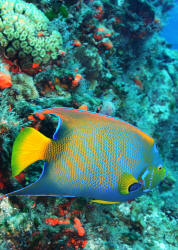
10/5/11 Queen Angel won't eat... no useful info. 8/16/06 I have a queen angel, about 6 inches. beautiful fish. Problem is it won't eat. <How long have you had this animal? At what size was it when you procured it, what foods has it been eating?> I have tried to feed all kinds of foods with no success. Water quality is good. <Like the prez, "they're terrorists", non-informational> I even put a sponge in there and still nothing. The guy at my LFS, said to buy some garlic <Oh, just like in the wild> and to mix that with its frozen angel food. My question is could that work??? Or is there anything at all you can recommend? My tank is 125 gallons.... <... Six inches is a bit beyond ideal size for acquisition... Please read here: http://www.wetwebmedia.com/marine/fishes/angels/holacanthus/ciliaris.htm and the linked files above. Bob Fenner> Queen angel update/HLLE cure/Caulerpa Culture dear bob, back in November I e-mailed you about the HLLE problem I was having with my queen angel. you were kind enough to respond right away with some suggestions that I add a macro algae culture and freshen the live rock. <yes, I recall> well since that post I wanted to let you know that my angel has improved dramatically! the lesions that once ravaged here face, eyes, and lateral line are now limited to her "cheek" area. it seems that she has a ravenous taste for the Caulerpa and I provide it to her 3 times a week. thank you so much for your suggestions. <Ah, great to hear of your success> the fresh algae is costing me close to $10.00 a week in addition to all the other frozen goodies, fish eat better than I do! As such I've tried numerous ways to grow it myself but with no luck. several times I tried placing a fresh harvest in a floating acrylic breeder in the display tank but the algae deteriorated in 4 days. my 75 gallon tank is lit with 2 Coralife 10,000k fluor. and 2 actinic lights. I have also tried cultivating the algae in my 100 g reef system equipped with power compact lighting. however, a $25.00 "bush" attached to a piece of live rock turned my tank green and then died in as many days. now as a last ditch effort I have placed some freshly harvested cup, blade, and grape specimens in a 20 g undergravel filter set up. 12 hour light with Coralife reef sun and a generic incandescent plant bulb. there are 3 small fish in the tank to fertilize - so far it seems that the algae is also dying in this tank too. what could be wrong? <A few things... I would go back to/with the compact fluorescent lighting, use just some live rock for attachment, and boost both alkalinity and biomineral content (mainly calcium)... keep these above 4 meq/l and 400ppm respectively> I am seriously considering installing an ecosystem refugium from Leng Sy's website however if I'm unable to grow the algae what is the point? your thoughts? Gisela <The miracle mud systems are also very good/worthwhile. Bob Fenner, who would also look around, ask your local marine hobby club, perhaps the stores if they know someone who has the opposite problem... that is, too much Caulerpa... not uncommon.> Adult Queen Angel Questions Hi Bob !!! I need your advice regarding my adult Queen angel. I had my Queen angel for one week and up to now, she refused to eat all kinds of dried food including frozen krill. There're a lot of "coaches" I mean fishes like damsels and tangs) around and hope that she will learn from them but she didn't. What should I do? <You state this is an "adult" specimen? Better to start with juveniles, sub-adults... as they are not so finicky about eating novel foodstuffs... Do you have plenty of live rock? If not, I would add more, quick, from the tropical West Atlantic (rather than from elsewhere)... hoping there are materials (sponges, tunicates, algae mainly) that this fish recognizes as food, and that the rock modifies the water/environment more to this fish's liking... otherwise, keep trying all different types of foods, perhaps soaked in a vitamin prep. ahead of offering> How long can she go without food or can she find food in my reef aquarium? <Perhaps a few weeks> Secondly, my queen angel doesn't like to swim out in the open like the rest but instead like to stay in one or two location. She doesn't appears to be sick. Is this a normal behaviour ? <Normal for a Holacanthus ciliaris that is "stressed" from capture, moving, being held in a very small space in "weird" surroundings...> Your articles regarding this species also stated that " The species is found foraging and hiding around rocky reefs, not in open, upper waters or over sandy bottoms. Provide some similar habitat." Could you kindly clarify? Thanks. <A note that this Angel requires plenty of cover to duck into, and forage on and about. Next time (if there is one) start with at most a four inch long specimen. Bob Fenner> Queen Angelfish Gentlemen, <cheers, good sir> I have finally decided to venture into the world of large angelfishes. <magnificent fishes...but not plural in display <wink> and for large aquaria only in the long run (over 150 gallon)> After setting up two 80 gallon tanks a few years ago, and stocking them with a few tangs, and other unique fishes I thought it might be time to spend some money on a nice angelfish. So after much reading, and studying I decided that a Queen angelfish would be a good first choice. <indeed... a beauty, hardy, etc> I purchased one that is about 5 inches long, possibly a little longer. He looks absolutely perfect; a real stunner of a fish. I set him in a well established tank with a Harlequin Tuskfish for a tank mate. <Hmmmm... a tough pair in the long run...both reaching a foot in length with nasty attitudes. Good luck> Both fish are roughly the same size, and do not display any aggression towards each other. <yet...heehee> I have had the fish for roughly 2 weeks. <Ahhh...yes> So now that we have some background, I will say that I am a bit concerned about the eating habits of this fish. Having seen other large angels eat, I was expecting a fish that would become an aggressive feeder after the initial settling in period. I saw him eat Mysid shrimp in the LFS, several times, and was expecting him to eat the same thing at home. And while he does eat, I am concerned that he isn't eating enough. Normally I feed my fish twice a day. I will put some Mysid shrimp in the tank in the morning, and then either some Mysid, or chopped clam or shrimp in at night. Of the food that I place in the tank he only seems to sample the fair. Let's say that I place 20-30 Mysid shrimp in the tank; of this he may only eat between 7-10 individual shrimp. He will also nibble on Spirulina flake, and Nori clipped to the side of the tank. As I stated I was shocked to see the fish not go after the shrimp avidly. <this problem could easily have been avoided by a proper quarantine period in your home while the fish got used to your schedule and feeding> Especially because everything I have read seems to say that these fish are supposed to eat greens, <not at all so much as they get older... more so when younger> and small crustaceans. <indeed> I have concerns that if his eating doesn't improve, I won't be able to add any other fish to the tank that might eat too aggressively. Or at the very worst, I may loose a great fish to poor nutrition. <exactly... even if your Tuskfish (or any other fish) was not directly aggressive to the angel...some passive fish are just intimidated by the activity of others to the point where they will be out competed and indeed decline unto death. This may be a the reality of your system. Was your Tuskfish in first and a frisky/fast feeder as most are. All the more reason why the angelfish (and all new animals) should have been quarantined, my friend, if there was any hope> Are my concerns founded or am I just being pedantic? <very real concerns indeed> Should he be eating more, or does it sound that he may be eating enough? <Standard angels are definitely aggressive feeders to the point where they intimidate other fishes! I think your fish could be eating a lot more, If it is convenient... do try a jar of Sweetwater plankton. An amazingly attractive food to slow/shy feeders. And let me know what the results are if you do. Heehee... I'm not a spokesperson for the product either! Just a satisfied customer.> My instincts, and what experience I have, are telling me that he is not eating enough to remain healthy. <agreed...he will not perish within weeks...but months likely at this rate> Any advice that you may offer would be of great value. You've already ready been an enormous help with a small juvenile Naso tang. Many thanks, Michael Mariani <best regards, my friend. Anthony Calfo> Queen angel not eating Greetings Bob and Anthony, I have a real quick question, <<Hello, it's JasonC this time...>> I have a 160 fowl, setup for several years, I have 5 fish total, the largest is a show queen, a beautiful and curious fish. Everything has been perfect for the past 7 months, no disease and more importantly no ICK!!! I try to feed these guys an assortment of foods, however they seemingly have gotten spoiled on fresh oysters to the point they wont eat frozen food (who could blame them??). Approximately two weeks, I changed 20 gallons of water, with a new salt I had never used (Crystal Sea), prior to I had always used Instant Ocean. I use RO water only, and let it mix for 24 hours (heated), all of a sudden my queen started hiding, and refused to eat oysters, further, some of the other fish followed the same course of action. I changed more water, assumed that it could be a bad batch of oysters, and bought more with seemingly the same result. The only food I have been able to get this fish to eat is romaine, but it eats a quarter of what it did before. When its feeding time it will come out and stare at me waiting for food, but it seems no matter what I feed it its not interested, tonight not even the romaine. Color is still good, but I fear if I cant get it eating voraciously again as it did in the past, I may lose it. Is it possible that it hates the new salt? <<That's a very easy theory to test, just go back to the Instant Ocean salts. Depending on the age/health of this individual, I would think you have enough time to test this out. Also a note on the romaine lettuce - you and your angel would be much better off with a dried seaweed product... Nori, Sea Veggies, Seaweed Selects or otherwise... terrestrial vegetables just aren't the proper source of nutrition for these fish.>> Or, could it be internal bacterial infections from bad oysters? <<Also a possibility, but very hard to test - probably need a microscope and tissue samples from the food you have been feeding.>> I have changed no other variables other than those stated. What do you think? <<Start with the salts... easiest thing to test/prove out.>> Thanks, Tom Griffith <<Cheers and good luck. J -- >> Queen angel not eating Thought I would let you know what was causing the lack of appetite behavior, apparently my AC was slowly on the outs, when it quit working, I checked the water temp, 87F! <Doh!> Needless to say after adding ice to bring the tank back below 80, these fish started pigging out again! Thanks for your help <Yowsa.... hopefully the drop in temperature was gradual (2-3 days?). A sudden drop in temp can be worse than the drop of the high temps. Please be very alert for an ich outbreak in the next week and be prepared with a QT tank if necessary (do not medicate in the main display). Best regards, Anthony> Juv. Queen Angelfish Not Eating >Hi. >>Hello. >Recently (three days ago) bought a rather small queen angelfish (~3") just turning into his adult colors. He looks healthy and is swimming all over the place. He is in the quarantine tank now and likes swimming in the current from the powerheads and back filter. Just one problem. He swims up to the food and won't eat it. Anything. I've tried formula one (flake and frozen), formula two (flake, frozen and pellets), frozen angelfish formula, Mysis shrimp, brine shrimp, Nori and generic flake food. He isn't lethargic, and swims up fast to the food but turns up his nose. Any advice or suggestions? >>Well, first thing I would do is either go back to the purveyor, or contact the retailer from whom you purchased the fish. Find out how long they had him as well as what he was fed. Next thing I would do is give him a couple of days to get hungry, and then start offering the foods mentioned EXCEPT the brine. If that fish is really hardcore about being picky, I'd also try (but not long-term) bloodworms, just to see if it's that he doesn't recognize the other items as food. There are many people who are big proponents of garlic as an appetite stimulant, and I seem to recollect an article written in the online Advanced Aquarist Magazine (I believe you can find it through www.reefs.org). Also, please search our site for other information here--> http://www.wetwebmedia.com/MarInd3of6.htm http://www.wetwebmedia.com/marine/fishes/part2.htm (scroll down to the angelfishes) Now, this may also be a case of the fish not recognizing what's food, in which case you may want to consider putting a cheap, ravenous fish like a very small damsel in there to stimulate feeding response in him. If you do so, be sure to give it a freshwater dip before putting it in with the angel, and in my mind this would be a last resort. Hopefully, the retailer you purchased the fish from should be able to tell you what the fish was eating before. >Thanks in advance. Steve B. >>You're welcome, Marina. Queen On A Hunger Strike? I have a queen angel that has been a voracious eater and bully, but as of late he hasn't eating since taking a nibble on a green Sinularia that I purchased. When I bought the coral, I placed it in the tank, and he took two nibbles of it. I quickly removed the coral and place it in one of my other tanks. <Good move if you want to save the coral!> The angel has no external problems and it is in perfect condition, just that it has stop eating. the other fish in the tank are doing fine. The water parameters are perfect. Can you please share some light on this situation? Thanks, Pablo <Well, Pablo- I suppose that it's theoretically possible that the Sinularia, which does produce some unusual chemical compounds, any of which could potentially serve to help discourage nibbling by fishes. Perhaps there was some sort of a toxin that the fish ingested while "snacking". Or, it may just be a coincidental "hunger strike" caused by some other stressor. At this stage, do keep a close eye on the fish, and observe for other obvious signs of stress or illness. Sometimes, it might simply take a small water change to bring the fish around. Take appropriate action as necessary. Good luck! Regards, Scott F.> Queen Angel and food sponges Bob, Hi, what types of sponges do Angels eat? Like the Queen angel fish. I know there are many types of sponges in the ocean. Such as tube sponges etc. But what type do these fish like to eat? Thanks again. <Mmm, you'll need to do some legwork... on fishbase.org: Queen Angel Look at the link to "Food Items"... and all the way to Gerald Allen's 1985 reference... or get thee to a large college library for a computer based bibliographic search. Bob Fenner>
|
|

|
Features: |
|
| Featured Sponsors: |