|
Related FAQs: Sea Stars 1, Sea Stars 2, Sea Stars 3, Sea Stars 4, Sea Stars 5, Brittle Stars, Seastar ID 1, Seastar ID 2, Seastar ID 5, Seastar ID 6 & Seastar Selection, Seastar Compatibility, Seastar Systems, Seastar Behavior, Seastar Feeding, Seastar Reproduction, Seastar Disease, Seastar Disease 2, Seastar Disease 3, Star Disease 4, Star Disease 5, & Asterina Stars, Chocolate Chip Stars, Crown of Thorns Stars, Fromia Stars, Linckia Stars, Linckia Stars 2, Sand-Sifting Stars, Related Articles: Echinoderms, An Introduction to the Echinoderms: The Sea Stars, Sea Urchins, Sea Cucumbers and More... By James W. Fatherree, M.Sc. Brittle Stars, Crown of Thorns Seastars, Marine Scavengers, Asterina Stars, Sea Stars, Class Asteroidea part 2 of 2 To:
Part 1 | 
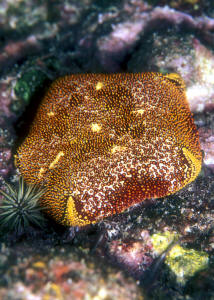
| By Bob Fenner | Culcita novaguineae in Hawai'i |
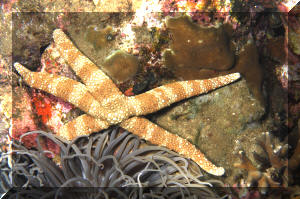
The Genus Nardoa: Especially when started small, these species tend to get along with most all other invertebrate livestock. From the Indian to Central Pacific Oceans; Africa to the Philippines. Typified as having knobby tuberculations on their aboral surfaces. | Nardoa frianti Koehler 1910. Bears tubercular warts on the margins of the body as well as the upper/aboral surface. Eastern Indo-Western Pacific; Andaman Sea, Micronesia, Noumea, Philippines. N. Sulawesi pix, first at night, close-up during the day. |  
|
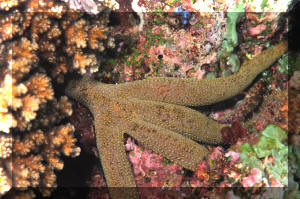
| Nardoa novaecaledoniae (Perrier 1875). West Pacific; Noumea, N. Australia, Indo, Philippines, PNG. Here in N. Sulawesi, and St. Louis... Found in shallow reef, rocky areas 1-5 m in depth. |  
|
Bigger PIX: The images in this table are linked to large (desktop size) copies. Click on "framed" images to go to the larger size. |
 |
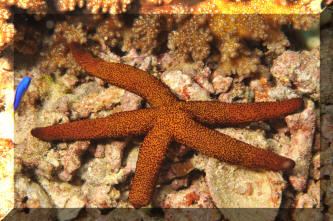
| Nardoa rosea Clark 1921. Large tubercles on non-marginal parts of arms. Found in shallow reef, rocky areas. | |
Not So Spiffy Choices, But Often Seen: Much less desirable, but commonly offered and attractive are the "knobbed" Sea Stars, Family Oreasteridae of the genera Protoreastor, Pentaster and Pentaceastor. They are distinguished by having dull spines, bumps or knobbles on their dorsal surfaces, with these often seen in colors that contrast with their overall body pigmentation. Sold under names like Red-Knobbed, Chocolate Chip, and other labels, these species are hardy but aggressive feeders, more than happy to mount and consume sessile clams, oysters and all manner of corals, soft and stony. | Protoreastor lincki African or Horned Sea Star An opportunistic omnivore of other invertebrates that can literally cleansweep an aquarium of sedentary life. | 
|
| Another "Knobby" species, the Chocolate Chip Star, Protoreastor nodosus at a wholesalers and close up in N. Sulawesi. An opportunistic omnivore on other invertebrates. Found widely throughout the tropical Indo-Pacific. Select for smaller 2-3 inch specimens and keep them well fed. |  
|
Bigger PIX:
The images in this table are linked to large (desktop size) copies. Click on "framed" images to go to the larger size. |

%20MD.JPG) |
Family Oreastridae: "Plump" stars. Have large, domed discs with short or no arms at all. Not easily kept... i.e. rarely live in captivity. | Another typical offering, the "Doughboy" Sea Star, Choriaster granulatus, Lutken 1869, is a big, bulky Indo-Pacific asteroid that scavenges in reef shallows. It should only be employed in systems of hundreds of gallons size with corals that can be spared... as it is a coral eater. | 
|
| Bigger PIX: The images in this table are linked to large (desktop size) copies. Click on "framed" images to go to the larger size. |
 |
| Culcita schmideliana (Retzius 1805), the Spiny Cushion Star. Indian Ocean; eastern Africa to Malaysia. To ten inches in diameter. In Malaysia and N. Sulawesi |  
|
| Nidoriellia armata (Gray 1840), a Chocolate Chip Sea Star. Family Oreasteridae. To 6.6 inches in diameter. Mid to Eastern Pacific; Hawaii, Sea of Cortez to Peru and Galapagos. Blunt arms, large central disc, large aboral spines dark in color. Variable color and shape. Intertidal to 73 meters, feeds on benthic marine invertebrates, gastropods and algae. Galapagos pix below. |
| Pentaceraster cumingi (Gray 1840), the Panamic Cushion Star. Family Oreasteridae. To 13.4 inches in diameter. Mid to Eastern Pacific; Hawaii, Sea of Cortez to Peru and Galapagos. Variably red, orange to greenish blue bodied with large red spines. Feeds on micro-fauna in substrate, benthic algae, seagrass and other echinoderms. Usually found on sandy bottoms from shallow to 180 meters depth. Galapagos pics below. | |
Family Ophidiasteridae: About "Linckia" Stars: There are a great many seastars sold as Linckia/Linckia spp. that are decidedly of other genera. Some are not peaceful bacterial et al. detritus feeders as the "true" Linckias of many colors (and at least two species). Do make sure and get a positive identification to species, and research the nutritional, and system size and type needs before purchasing stars. The true Linckias are good choices where available in initially healthy condition, and placed in established, large systems (at least a hundred gallons) with plenty of live rock, detritus to feed on, and not too many competitors. Named in honor of J.H. Linck who wrote a monograph of seastars in 1733. Tropical Atlantic and Pacific. | Linckia columbiae the Fragile Seastar. Semi-tropical Linckia species found in the eastern Pacific. One off of San Diego California in the process of sampling/eating a sea anemone. | 
|
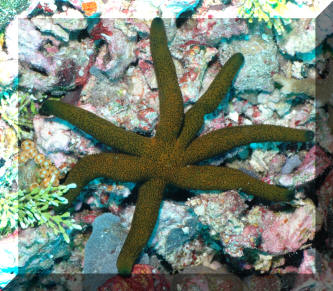
| Linckia guildingi Gray 1840, the Green Linckia. Usually with five (sometimes 4 or 6) arms that are cylindrical in cross section. Skin appears smooth but is coarse with low, hard nodules. Though called "green" occurs in other colors (tan, beige, brown, blue, reddish). Big Island Hawaii pix. |  
|
| Linckia laevigata (Linnaeus 1758), Linckia Seastar. Blue and greenish ones in Fiji. Also found in other colors, brown, tans, violet to burgundy, even mottled... And there are other species of the genus offered to the trade. This animal is very (95+ % IME) often doomed from the retailer to aquarists... having suffered too much damage and neglect in the process of collection, holding, shipping... Look for damage (ex. right) and avoid such obviously poor specimens. In the wild this is an algae, bacteria, detritus feeder... that needs space (hundreds of gallons) and mulm (muck, dirt, call it what you will, on the bottom of its system to survive. My advice, look to other genera, species of seastars. | 
|
| Bigger PIX: The images in this table are linked to large (desktop size) copies. Click on "framed" images to go to the larger size. |
%20MD.JPG) |
|
Bigger PIX: The images in this table are linked to large (desktop size) copies. Click on "framed" images to go to the larger size. |
.JPG) |
| A Purple "Linckia", Tamaria stria Gray 1840. Eastern Pacific; Baja to Columbia. Need rock substrate for habitat, not over-zealously clean. Best kept one to a tank. Family Ophidiasteridae. | 
|
"Other" Asteroids One Sees From Time To Time: | Echinaster luzonicus (Gray 1840). Variable in color (yellow, green, brown, red... to mottled). Western Pacific. This one in S. Sulawesi. | 
|
|
Bigger PIX: The images in this table are linked to large (desktop size) copies. Click on "framed" images to go to the larger size. |
%20MD.jpg) |
| Mithrodia bradleyi Verrill 1867, Bradley's Sea Star. Family Mithrodiidae. Subcylindrical arms that constrict toward the small central area. Irregular blunt spines over all arms. To fourteen inches across. Eastern and Central Pacific; Lower Sea of Cortez to Peru, including Galapagos Islands. Galapagos pic. | 
|
| Mithrodia fisheri Holly 1932, Fisher's Star. Body covered with large bumps. Color variable; from white to cinnamon, generally with dark banding on roundish arms that have a lateral row of blunt spines. Feeds on sponges, bryozoans, other sessile invertebrates. Most about 4-6 inches in diameter though attains at least a foot. Daytime and nocturnal. Kona pix. | 

|
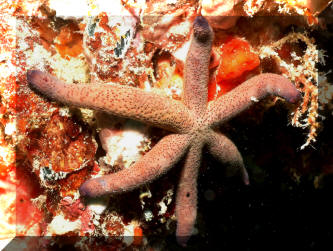
| Ophidiaster hemprichii Muller & Troschel 1842, Hemprich's Star. Legs round in cross section, of variable color, usually reddish brown, with grey blotches. Body made over with nine rows of articulating plates. To four inches overall. Tropical Pacific. | 
|
| Phataria pyramidata (Gray 1840), the Pyramid Star. Family Ophidiasteridae. To 9 inches in diameter. Eastern Pacific; Sea of Cortez to Peru and the Galapagos, rocky shores to 130 meters depth. Triangular shaped feet. Galapagos pic. | 
|
| Phataria unifascialis (Gray 1840), the Blue Sea Star. Family Ophidiasteridae. To 7 inches in diameter. Eastern Pacific; Sea of Cortez to Peru and the Galapagos, rocky shores to 50 meters depth. Dorsal surface blue or tan with black pebbled lines, underside orange. Algae feeder. Galapagos pix below. |
About Cool/Coldwater Seastars: A brief mention of a despicable practice... the selling of colder (non-tropical) organisms, in this case seastars, into the aquarium interest. These animals rarely acclimate to warm water conditions, either falling apart within days or stress-starving to death in a few weeks. Avoid them unless you have a system designed (chilled) for their appropriate keeping. Two California, U.S.A. examples that need to be kept at 68-70 degrees F. or cooler: | Patiria miniata, the Bat Star, photographed in Southern California. | 
|
| Bigger PIX: The images in this table are linked to large (desktop size) copies. Click on "framed" images to go to the larger size. |
 |
| Pisaster ochraceus, the Ochre Seastar, photographed in Southern California. . | 
|
There are many other Sea Star choices, okay to terrible, but one especially warrants mention. Please click on the name to see and read about the notorious Crown of Thorns Starfish. Habitat: Sea and Brittle Stars, though they are slow appreciate adequate open space as well as coral and rocky arrangements where they can forage, hide, and find the conditions of current, lighting and shelter that they prefer. Echinoderms are used as biological assay specimens for pollution, for measuring the quality of synthetic sea salt mixes, and for other test parameters. This gives you and idea of how sensitive they are. Some of them are the first to be mal-affected by metabolite build-up in water or by the presence of metallic contaminants. Should yours start "acting funny" (e.g. slowing down, refusing to eat), don't hesitate- check your water quality and make necessary adjustments. It may be better to move the affected specimen if your system water requires major changes. Predators generally leave these animals alone, but I would not put it past certain Triggers, large Angels, Puffers, large Crabs, or Lobsters to try out your Sea Stars out of boredom or hunger. | Action (ouch!) photos of a big puffer (Arothron stellatus) with a matching dimension appetite. I saw this big boy out of the corner of my eye on a dive in Pulau Redang, Malaysia. What really got my attention was the Linckia laevigata he cleaved an arm off shortly after taking the first pic! |  
|
Reproduction: Reproduction is by sexual means and by fragmentation. The latter capability foiled attempts in the Philippines and Australia to reduce populations of Crown-of-Thorns Stars by having divers hack them up with machetes. This merely produced more animals and added to the reef-destruction problem. Natural predators are much more effective control mechanisms. Feeding: Most of the Sea Stars offered in the hobby are fed bivalve mollusks (clams or mussels) or other meaty foods (shrimp, krill) once or twice weekly. In the wild, their diets are more cosmopolitan. To keep them well-fed, the aquarist will likely need to use a feeding stick to position the target food where the Star will find it immediately, before other tank inhabitants grab it or it is swept away. For small specimens of the detritivorous species like Fromias, even Linckias, many aquarists rely on just placing their specimens in suitably "aged" systems that are not meticulously clean. I strongly suggest providing supplemental feeding. Disease: Sea Star diseases can be troublesome, especially for those with multiple specimens. Most notable are a fungus (Branchiomycetes sp.) and Vibrio bacterial infections that are primary sources of disease and mortality. Proper selection and providing an appropriate environment are not all a hobbyist can do to assure ongoing success. The use of a quarantine system for a few weeks is a good idea, possibly using special medications for fungal problems and furan compounds or antibiotics for bacterial difficulties. It bears repeating that such treatments should always be administered outside the main system, in a tank that includes provisions for monitoring water quality. If one or all related organisms in the phylum start dissolving or otherwise dying in a captive system, one must act quickly- make that immediately- to arrest a total wipe-out. Changing 30% or more of the systems water and/or removing affected stock to treatment quarters is strongly indicated. Summary: Who needs science fiction when we have invertebrates like the asteroids and ophiuroids? When chosen carefully, the Sea Stars and Brittle Stars can provide great interest and visual appeal in the right aquarium setting. The Brittle Stars are extremely reclusive, although they may occasionally scuttle out during feeding sessions, and their valuable bio-maintenance services usually go unseen, but not unappreciated. Bibliography/Further Reading: Mancini, Alessandro. 1991. Starfishes in tropical marine aquaria. TFH 9/91. Rohleder, P.G. Undated. Linckia and Fromia- Two starfish for the reef aquarium. Aquarium Digest International #53. Schlais, James F. 1981. Walking on water. FAMA 8/81. Wilkens, Peter. 1974. Stars to brighten your aquarium. Marine Aquarist 5:3, May/June 74. To:
Part 1
|
|