|
FAQs about True Puffer
Identification
Related Articles:
Puffers in General,
Puffer Care and Information, A
Saltwater Puffer Primer: Big Pufferfish! by Mike Maddox, True
Puffers, Freshwater Puffers,
Burrfishes/Porcupinefishes,
Tobies/Sharpnose Puffers,
Boxfishes, Puffer Care and Information by John
(Magnus) Champlin, Things That My Puffers
Have Told Me by Justin Petrey,
Related FAQs: True
Puffers 1, True Puffers 2,
True Puffers 3, Tetraodont Behavior, Tetraodont Compatibility, Tetraodont Selection, Tetraodont Systems, Tetraodont Feeding, Tetraodont Disease, Tetraodont Reproduction, Puffers in General, Puffer
Selection, Puffer Behavior,
Puffer
Systems, Puffer
Feeding, Puffer
Disease, Puffer
Dentistry, Puffer
Reproduction, Freshwater Puffers,
Burrfishes/Porcupinefishes,
Tobies/Sharpnose Puffers,
Boxfishes
|
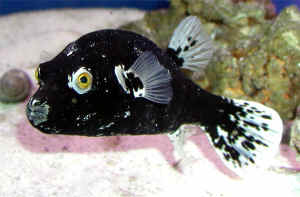 Who am I? Who are
you? Who am I? Who are
you?
|
|
Takifugu poecilonotus... ID, care...
2/17/12
I had some puffer problems and on the pufferfish.net forums it
was suggested to me to see if i could contact Neale Monks or Bob
Fenner at WWM for the care facts of the Takifugu
Poecilonotus.
<Fire away.>
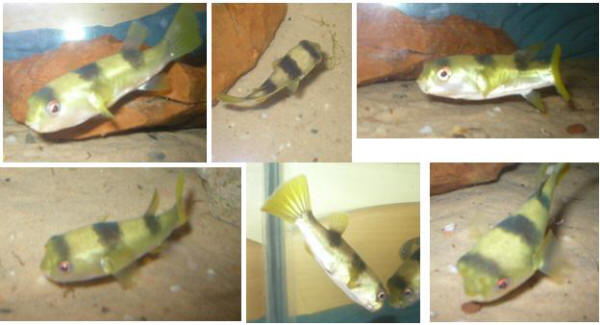
(The pic attached is one of my puffers around 2.5 inches a week
before he died)
<Wow, this species is the spitting image of Chelonodon patoca.
Amazing that they should evolve almost identical
colouration.>
Long story short, I went to a fish store around 5 months ago to
get 3 dwarf puffers, tiny thumbtack size at the time. I had a
nice ten galleon tank set up for them with lots of vegetation
(real and fake) to hide in. 1 Puffer died within the week, but
four months later i had two really active, healthy puffers that
were around three inches in length and most definitely NOT dwarf
puffers.
<I see.>
I absolutely loved those puffers. I fed them brine shrimp daily,
once a week they had snails and every other week, glass shrimp.
Towards the end of the fourth month they started to show signs of
distress and become agitated. I became worried that they
weren't getting everything they needed and started to brows
through lists of aquarium puffers to see if i could find the
species.
<Ah, now, how sure are you that these are Takifugu
poecilonotus? I've never seen that species in the trade,
though I admit they both have very similar colours. By contrast,
Chelonodon patoca is an occasional import. There aren't any
obvious differences, though Chelonodon tends to have a more
angular head and boxy body, whereas Takifugu are more streamlined
and have a more tapering body. All this said, oddball Takifugu
species do turn up very occasionally.>
Last week their energy levels dropped dramatically and they just
laid around on the bottom of the tank and hardly even ate. I
continued to look for what species they were and even posted my
puffer's picture online on a forum and no one knew what
species they were.
<I see.>
The 13th of Feb I started just going through the list of puffer
species that Wikipedia had and Google searching each name of
every individual puffer on that list. Feb 14th, when i woke up
and checked on my puffers.. they were dead. Yesterday I finally
found what my puffers were, Takifugu poecilonotus, and that they
were brackish-marine fish, only freshwater as fry.
<In common with many other Takifugu spp.>
I would love to have a second chance with this species, but i
can't seem to find any info on them. Are they freshwater as
juveniles then brackish water? High end Brackish or Marine? If
anyone on this site has info on this particular puffer it would
be much appreciated. I feel horrible about the death of the two I
had.
<Hmm… do download, read "Takifugu obscurus is a
euryhaline fugu species very close to Takifugu rubripes and
suitable for studying osmoregulation", a good
laboratory-based primer on Takifugu species including Takifugu
poecilonotus. The gist of their study is that apart from T.
obscurus, none of the other Takifugu species adapts to freshwater
successfully. They further note that Takifugu poecilonotus adults
are seen in the sea, spawning occurs in the sea, and it's the
"fingerlings" found in river estuaries. Bottom line,
treat these as temperate (~18 degrees C; i.e., a cool room
temperature) high-end brackish to marine (SG 1.010+) fish. A
chiller may be needed in summer to prevent overheating, but
certainly ensure a spacious tank with lots of water current and
oxygenation.>
Thanks,
Jessie
<Hope this helps. Cheers, Neale.>
|
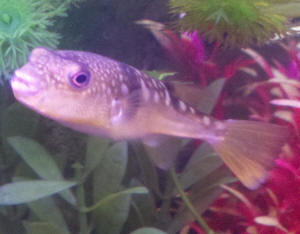 |
|
Re: Takifugu poecilonotus 2/17/12
Thank You :)
<Most welcome. Neale.>
|
|
some ID please if you can
1/8/12
How are you guys,
<Fine.>
Went to the beach (Pattaya Gulf of Thailand)
tonight as it was low tide to look for snails, Hermits and some
crabs to add to my Sump and Fuge set up.
Found a lot of life there.
Saw some nice anemones (which I decided not to touch) caught a
little octopus but decided to put it back as I don't think it
is something for the aquarium.
Also found tons of snails (Nassarius) and crabs what I was
looking for Anyway now my son found this one can someone ID this
puffer?
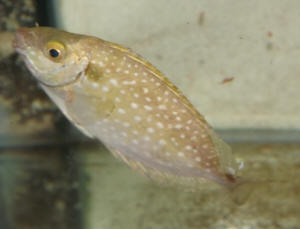
Also found some of these fish?? Not sure if they are fit for the
aquarium but the wife said to take them grow them and eat them??
She is Thai and gave them some Thai name but would like to find a
name and check out what they are?
can anyone help?
Dirk and Noi
<Hi Dirk and Noi. The puffer is a Chelonodon sp., likely
Chelonodon patoca or C. laticeps (taxonomy of this genus is a
little messed up in my personal opinion... forget about most of
the online picture IDs and much of the printed material). The
Rabbitfish is likely Siganus canaliculatus
http://www.flickr.com/photos/puffinbytes/5492401605/
and
http://farm5.static.flickr.com/4018/4548481776_0b40d288ca.jpg
which is
actually a food fish. Cheers, Marco.>
|
|
|
|
Question about golden puffer, ID 04/26/09
Hi guys,
<Hi Eric.>
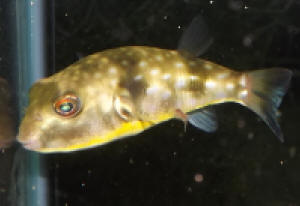
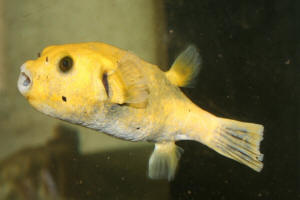
I just had a question about my recent purchase, a golden puffer
from the Christmas islands. My question is, how can I be for
certain that my puffer is truly a golden puffer? It is about 6
inches in length and only about 60-70 percent of it's body is
yellow. The rest of his body is a light gray color. Kind of like
the bottom portion of a dogface puffer, but it doesn't have
the distinct mask like the dogface puffer has. I also don't
see any sign of his original patterns (black with white dots).
Attached are some
pictures so you can see for yourself. Please let me know what you
guys think.
<A yellow A. meleagris. The almost equally yellow colour
morphs of A. nigropunctatus have slightly different body/head
proportions, more black spots as well as a at least grey area at
the mouth.>
Thank you, Eric
<Welcome. Marco.>
|
 |
|
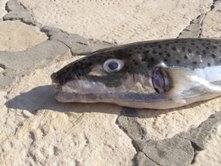
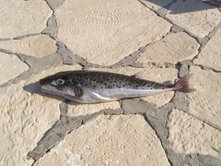
UNIDENTIFIED SWIMMING OBJECT 9/15/08 Hi
Bob, <Hello George!> Your help in identifying this fish
will be greatly appreciated. All the best, George Some
information follow (the fish was found on the Aegean Turkish
coast)******** Further to our correspondence two hours ago, I am
sending in the attachment the pictures of a strange fish which I
found dead in the sea on the Turkish coast just across from the
Greek Island Castellorizo. I had never seen this fish before and
it looked very weird due to its unusual shape. The fish in the
pictures was about 30 cm long, weighing about 400 grams. Peculiar
characteristics of the fish were as follows : 1. It had no scales
and had rough skin with spots. The skin texture was like the skin
of a stingray. 2. It had no operculum and no vents to discharge
water. Since we forgot to perform autopsy, I can not tell if it
had any hidden gills. The question is : As it did not have any
operculum, how did it manage to circulate water for oxygen
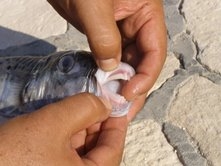
extraction ? 3. It had fleshy lips, but no teeth in the shape
that we are familiar with. Instead, it had a monobloc (U shaped)
upper and lower jaw bones with sharp cutting edges all around the
arc, which apparently work like a giotine. Both in the centre of
upper and lower jaws, there was sharp protrusions like a parrot
beak, which apparently the animal used to fight or catch its
prey. Since I found it dead, there is a possibility that it may
not belong to the fauna of the Turkish coast. It might have come
from North African coast or from the Red Sea. Another possibility
may be that it could have been brought by a yacht (frozen in the
fridge) and thrown into the sea on the Turkish coast. akin --
George J. Reclos Ph.D. <Am pretty sure this is a Takifugu,
likely T. rubripes Bob Fenner>
|
   |
|
Re: UNIDENTIFIED SWIMMING OBJECT
9/16/08 Hi Bob, <Neale> > So far as I know,
Takifugu doesn't occur in the Northeast Atlantic, so
isn't like to be seen in the Mediterranean or Black Seas.
<Had thought that this might be a contaminant...> In any
event, the streamlined shape reminds me immediately of the
pelagic Lagocephalus that we see here in the UK from time to
time. These are big pufferfish with classic silvery
countershading typical of oceanic fish. I think the species
in question is Lagocephalus sceleratus judging by the black
spots on the silver body. <Ahh! I do agree> It's an
exotic species that got into the Mediterranean via the Suez
Canal, as did Lagocephalus suezensis, another species worth
considering. Lagocephalus lagocephalus is the native species, but
it's usually quite plain in colour. Cheers, Neale <Thank
you Neale. Will send to Geo. in Greece, post along side on WWM.
BobF>
|
| Ahhh - I think it's actually
Arothron stellatus! -- 07/08/08 Hi, <Hello!> I just
purchased an "Arothron mappa" from my local fish shop;
the puffer is currently about 3inches in size without tail.
It's been in the tank 24 hours and is eating fine and very
active. However, now it's settled in, its colours are not
typical of a Mappa. I contacted the shop and they insist it was
labeled 'Arothron mappa' from the distributor TMC, but they
thought it might be a Brown Dog faced puffer. <'¦In my
opinion importers/traders should know what they are dealing
with'¦> But I am worried its actually Arothron
stellatus, it has a rust brown base colour with tiny black spots
over its upper body and tiger stripes on its belly flanks with
scribble pattern on its belly...maybe a juvenile stellatus? <May
very well be possible. Young A. stellatus are found here:
http://www.fishbase.org/Photos/PicturesSummary.cfm?StartRow=2&ID=6526&what=species
and
http://www.fishbase.org/Photos/PicturesSummary.cfm?StartRow=6&ID=6526&what=species
and here's a nice drawing on how this fish changes with the
years:
http://www.museum.wa.gov.au/faunabase/_images/Arothron_stellatus.jpg
. Also see here http://www.wetwebmedia.com/tetraodontpuffers.htm .
In contrast A. mappa always have star like lines radiating from the
eyes (compare to some pictures, I'm sure you'll know what I
mean.> I have seen adult grey Arothron stellatus in the wild
numerous times while diving and although the quoted size is 4ft, I
have not seen one that size, I have seen about 6 of them in the Red
Sea at different times over the years and the largest was just over
2 ft. Have you heard of Arothron stellatus having a 'sub'
species which are not the usual grey colour? <The young can be
very colourful. I've seen stunningly red, yellow and orange
ones. However, the grown adults become grey to light brown or tan.
They can appear very mottled, especially when sleeping or
stressed.> What are chances of it actually being an Arothron
stellatus do they import them for the aquarium hobby
<Sure'¦ much too often, sometimes as 'brown dog
face puffer', sometimes as 'red puffer'.> and do you
know how big they reach in captivity? <At least the 2 feet,
likely 2.5 ft. The larger ones are very rare in nature, too.
However, I believe one should plan with the size an animal *might*
reach given good care. Most A. stellatus imported simply die or are
killed as they grow.> As I might have too contact a public
aquarium at some point in the not to distant future to house it,
the shop is willing to swap for what I wanted but I worry what they
would do with it? <I guess they would sell it to someone else
(who might or might not have an adequate tank). A public aquarium
might be a better place, but naturally they often do not wish to
obtain all the tank busters the hobby produces. Cheers,
Marco.> |
Re: Ahhh - I think it's actually Arothron
stellatus! -- 07/08/08 Thank you Marco <You are welcome.>
Seeing I made the shop double and triple check what he was and
check with their supplier for peace of mind, as they are a very
well known major aquatic chain here in the UK and he was sourced
from an equally well known importers I am little annoyed (that I
trusted them). <Understandable. Neither am I sure they have the
time to spend hours studying literature on each of their thousands
of fish, nor do I believe this would be necessary, but a simple
look into FishBase or a book like Randall's reef and shore
fishes would have easily given the right ID in this apparently
unclear case.> He was a lot darker in the shop so I could not
see just how defined those black spots were and the stripes on his
stomach and his colour convinced me he was not Arothron stellatus,
but looking at photos of juveniles I am convinced he is. I attached
a photo of him as the evidence speaks for itself. <Very nice
specimen, thanks for sending. This picture and post will help
others to ID their puffers.> Thank you for your help, very much
appreciated. <Anytime. Take care. Marco.>
|
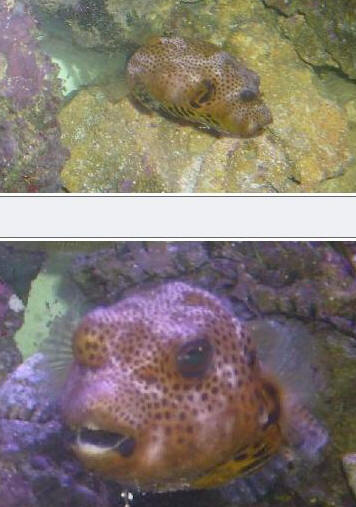
|
Please help, Pufferfish Id - 11/1/07 <Hi
Marcus> I have this Puffer that I cannot find what type he is
anywhere. <He is a neat looking little fish, isn't he? I
believe it's Arothron reticularis, commonly called the
Reticulated Pufferfish. It also looks very similar to Arothron
mappa/Map Puffer, but I've never seen one without radiating
lines around the eyes. Please see these links for more info/photo
comparison re:
http://www.fishbase.org/summary/SpeciesSummary.php?id=6594
http://www.fishbase.org/Summary/SpeciesSummary.php?id=7857
http://www.wetwebmedia.com/tetraodontpuffers.htm > Marcus
<-Lynn> |
|
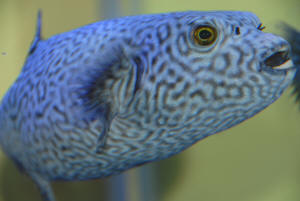
|
|
Re: Puffer <ID> and Brackish Tank
<env.> query 7/12/07 Hi guys Its me again.
<Hello.> I purchased this puffer today. And I need to ID
the new puffer. It was sold as a marine puffer. The LFS was not
able to tell me what type of puffer fish it is. All he could tell
me was that he lived in salt water. <Statistically a fairly
safe bet! About 2/3rds of the family Tetraodontidae are either
exclusively or mostly marine.> A few questions: 1) What puffer
do I have? Is it a Chelonodon Patoca? Takifugu? <Doesn't
look like C. patoca to me. That species has milky-white spots on
alternating mid-brown and silvery transverse bands. It
doesn't look like any of the brackish water Takifugu spp.
that I've seen traded. So I'd tend to go with what your
retailer said, and assume it's a "marine puffer" of
some kind. Which one, not sure. There are numerous look-alike
species in the family, so identifying them can be tricky. A
little time at Fishbase might help, especially if you can narrow
down the list by establishing where it came from... Southeast
Asia, China, etc. Counting the number of rays in the dorsal and
anal fins will help. See here:
http://filaman.ifm-geomar.de/identification/specieslist.cfm?famcode=448&areacode=
. For what it's worth, it doesn't look like an Arothron
puffer to me, the head's wrong, and I'd tend towards
either a Takifugu or Torquigener species.> 2) Can this puffer
thrive in brackish water? mid to high end brackish? <Assume
not, until you know better. While it is true that very many
marine puffers routinely enter brackish water for periods of
time, in many cases these jaunts are limited to hunting
excursions or spawning events. It's a whole other issue to
maintain such a fish at SG 1.010 permanently. While SG 1.018 is
probably safe, just as it with many other marine fish, anything
less than that should be undertaken only with care, and while
observing the puffer for signs of distress or loss of
appetite.> 3) Maximum length it grows too? <Without a name,
who knows! But something in the 20-40 cm bracket is typical.>
4) Any other unique behaviours that may require special
treatment. <You number-1 issue is to try and establish if this
is a temperate zone, subtropical, or tropical species. Many of
the Takifugu in the trade are subtropical fish and don't last
long in warm water. In the meantime, I'd be tempted to keep
this fish at a low-ish temperature for the time being, say, 22-24
C rather than anything higher. This would be safe for tropicals
while not too stressful for subtropicals. Other than this, you
can probably treat this fish as any other marine puffer.>
Thank you guys once again. <Sorry couldn't be more
helpful. Nice fish though! Neale.>
Re: Puffer ID Follow Up - 7/12/07
7/13/07 Hi guys. Just a short note on the puffer from
yesterday's dailies. This likely is Tetractenos hamiltoni
also called the common toad fish, another Australian species,
which appeared in trade this year. It's marine, but enters
estuaries. Very toxic if consumed, even compared to other
puffers. They like to bury themselves in sandy substrate and live
in groups. See e.g.
http://www.amonline.net.au/FISHES/fishfacts/fish/thamiltoni.htm
and fishbase.org re. Cheers, Marco. <Hello Marco. Thanks so
much! Not a species I have ever seen in the trade in the UK
(yet). Sounds an interesting species. I like the idea of a
schooling species that stays relatively small. Let's hope
this species turns out to be amenable to aquarium life. I note
from Fishbase that its a subtropical species, so by analogy with
the also subtropical Takifugu ocellatus I'd have to assume
that it requires slightly below tropical temperatures, around the
18-20C mark. Correct? As for salinity, these estuarine puffers
seem to be very tolerant, so by analogy with Arothron hispidus we
can probably assume anything from 1.012 upwards should work well.
At the very least, it sounds like a species worth experimenting
with in the high-end brackish community, provided you had a
marine tank you could move it to if things didn't work out.
Cheers, Neale.>
Puffer ID Follow Up - 7/12/07
Temperature for Tetractenos hamiltoni 07/14/07 Hi guys. Just
a short note on the puffer from yesterday's dailies. This
likely is Tetractenos hamiltoni also called the common toad fish,
another Australian species, which appeared in trade this year.
It's marine, but enters estuaries. Very toxic if consumed,
even compared to other puffers. They like to bury themselves in
sandy substrate and live in groups. See e.g.
http://www.amonline.net.au/FISHES/fishfacts/fish/thamiltoni.htm
and fishbase.org re. Cheers, Marco. <Hello Marco. Thanks so
much! Not a species I have ever seen in the trade in the UK
(yet). Sounds an interesting species. I like the idea of a
schooling species that stays relatively small. Let's hope
this species turns out to be amenable to aquarium life. I note
from Fishbase that its a subtropical species, so by analogy with
the also subtropical Takifugu ocellatus I'd have to assume
that it requires slightly below tropical temperatures, around the
18-20C mark. Correct? <<Yes, that is exactly what the
temperatures are in the natural habitats (East coast: New South
Wales and Queensland; see
http://www.amonline.net.au/FISHES/fishfacts/fish/thamiltoni.htm
and click on the underlined word 'map') in winter
following http://www.marine.csiro.au/~lband/web_point/ . In
summer, it may be slightly warmer, though, at least in the
coastal and estuarine waters.>> As for salinity, these
estuarine puffers seem to be very tolerant, so by analogy with
Arothron hispidus we can probably assume anything from 1.012
upwards should work well. At the very least, it sounds like a
species worth experimenting with in the high-end brackish
community, provided you had a marine tank you could move it to if
things didn't work out. Cheers, Neale.> <<I am not
sure if they can be kept in a community. Although they live in
groups, it is known they attack and kill other fishes of similar
size when they are trapped in tidal pools and cannot flee, a
condition quite similar to an aquarium. I hope the keeper of this
puffer reads our discussion. Cheers, Marco.>>
Re: Puffer ID Follow Up - 7/12/07
7/15/07 I am not sure if they can be kept in a community.
Although they live in groups, it is known they attack and kill
other fishes of similar size when they are trapped in tidal pools
and cannot flee, a condition quite similar to an aquarium. I hope
the keeper of this puffer reads our discussion. Cheers, Marco.
<Marco -- Yet another single species aquarium pufferfish! Too
bad. I agree, I do hope our questioner is reading all of this.
Cheers, Neale>
|
|
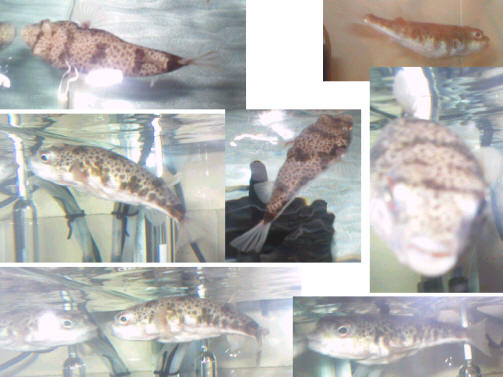
|
| Whassthis? -- 06/28/07 It's Tetraodon
fluviatilis that has either [a] been messed about with in Photoshop
or [b] is the "Bengal variant" of Ebert (2001) in
Aqualog. This variety has small spots and reticulations along the
sides of the body, whereas regular T. fluviatilis have less complex
markings. My understanding is that Tetraodon fluviatilis and T.
nigroviridis are not really "species" but ends of a
continuum, with a whole variety of intermediate forms. Cheers,
Neale <Mmm, well... I took this pic ayer at the local S.I.O.
Aquarium... in full seawater... Thank you! BobF> |
|
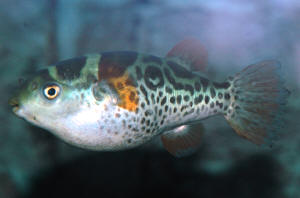
|
| Puffer ID'¦ Marilyna pleurosticta --
05/09/07 Hi. I was wondering if you could help me distinguish
what puffer this one could be? <Sure.> I was advised by the
LFS that this is a freshwater (that they kept in a brackish 1.004
or so) and that it was native to New Guinea... I'm from
Australia by the way and according to my research there are no
common puffers in the Oceania region, for freshwater anyway. But
currently, I have it in a tank with the following water parameters.
Temperature 22-24 - I believe it should be at 24-26 <yes.>
salinity - 1.002 or so diet - crickets, bloodworms (plan to feed
snails and small fishes) ph - 7 and above <should be around
8.> Questions: 1) Is this Amazon puffer (Colomesus asellus) or a
banded puffer (Colomesus psittacus) or something else? <No,
although they may look similar. Your puffer is a Marilyna
pleurosticta.> 2) Are any of the water parameters wrong, which
needs to be adjusted. The critical one is how much salt is needed
for this species of puffer.. at what level. <They often enter
estuaries and river mouths with brackish water, but basically they
are marine fish and need corresponding water parameters. They
probably were caught in a river mouth and therefore considered
freshwater fish.> 3) How can I tell from the puffer fish that it
needs less salt or more salt in the water? behaviour? physical
colouring? <Heavy breathing and a black belly. They can stay in
brackish water for a while, but I'd start raising the SG by
0.002 a week> 4) Are crickets bad for puffers? <No, but
seafood such as shrimps, clams etc. is more appropriate.> 5)
What are the best scavengers or clean up crew that is best with
this puffers? Would Cory's be regarded as dinner? I was advised
that Plecos could work best? <Hermit crabs and snails when your
tanks reaches marine salinity.> Please advise of best
environment for my new puffer (had him for a week).. as I plan to
have him for the longer term. Thanks very much. <You are among
the first to have this species in your tank. Good luck and have
fun. Marco.> |
Re: Puffer ID'¦ Marilyna pleurosticta
II -- 5/11/07 Hey Marco, thanks so much for your
help.... <Glad I could help.> That's the most information
that I have found.... Do you have like a care sheet that you can
forward... as I have searched the net and have found nothing about
this species of puffer... <No surprise. This species is
relatively new in the hobby. You might want to try visiting
http://www.thepufferforum.com. There is at least one
other person from down under with this species. Try sending a
personal message to the user navy asking how her puffers did the
last months. Care for them probably is not too difficult. A cycled
marine tank with low nitrates and a varied diet will be among the
most important things.> Thanks again.
<You are welcome. Marco.> |
|
|
| Puffer ID--No Pics 2/27/07 Hi
there, My name is Mike. <Hi Mike, Pufferpunk here> I set up a
brackish aquarium virtually two years ago and have always been on
the lookout for different fish. My local pet shop got two of these
puffers in (see pictures) but could not tell me what they were. I
took a chance anyway as they are beautiful fish, and after hours on
the internet, I cannot identify what type they are. They
like to bury themselves in the sand most of the time, they are not
aggressive towards the other fish I have in there, some small also.
They are quite amusing to watch when they bury themselves up to
their eyes. I have had them for about 4 months and they live quite
happily in the brackish community home. I first thought they were
Congo puffers because of their tendency to bury themselves and the
placement of the eyes up top at the front but I understand that
Congos are freshwater. Mine have lightish-green bodies with big
blue eyes and light yellowy spots all over. They have one dark band
that goes right the way round the bodies near the head and a couple
of large dark spots on the rest of their bodies. Please help me
identify what these guys are and any information you could possibly
provide for me. I thank you in advance for reading this
message and replying to me at your earliest opportunity.
<I'm sorry but none of those links work for me.
Look here for your puffer: http://www.thepufferforum.com/forum/ug.php/v/PufferPedia/?sid=84750776d8d66060c112006b16594204
If you don't see your puffer there, post a pic of your puffer
in the forums at that site for ID. ~PP> Mike |
Hi PP, Mich here. I copied and pasted this query
because the images were so large it crashed the
server. The photos are in the email with
images folder (hopefully) and you sent the message to me and not
Mike. His email is below. Hope that helps,
-Mich |
| Hi PP. I could see the pics and (hopefully) know
the ID, but you already answered. See below. See you at TPF.
Cheers, Marco. |
| My name is Mike. I set up a brackish aquarium
virtually two years ago and have always been on the lookout for
different fish. My local pet shop got two of these puffers in (see
pictures) but could not tell me what they were. I took a chance
anyway as they are beautiful fish, and after hours on the
internet, I cannot identify what type they are. They
like to bury themselves in the sand most of the time, they are not
aggressive towards the other fish I have in there, some small also.
They are quite amusing to watch when they bury themselves up to
their eyes. I have had them for about 4 months and they live quite
happily in the brackish community home. I first thought they were
Congo Puffers because of their tendency to bury themselves and the
placement of the eyes up top at the front, but I understand that
Congo's are freshwater. Mine have lightish-green bodies with
big blue eyes and light yellowy spots all over. They have one dark
band that goes right the way round the bodies near the head and a
couple of large dark spots on the rest of their bodies. Please help
me identify what these guys are and any information you could
possibly provide for me. <Most likely Takifugu niphobeles. Gets
15 cm (6 inches) and will need a full marine environment for long
term care. Also have a look at FishBase. Cheers. Marco.> I thank
you in advance for reading this message and replying to me at your
earliest opportunity. Mike. |
| Actually I found it in the Brackish folder. On my
first try the pictures did show some marine slugs, but then I saw
the T. niphobles probably in the picture folder. Actually I just
saw I typed wrong and had one 'e' too much in the species
name, hope that is not a problem. Cheers, Marco. Oh
good! I don't know why those links didn't work
for me. What folder did you find that at? I
had guessed, probably a Takifugu of some kind. If at all
possible, I link folks to TPF, as we can't cover everything
they may need to know about puffer keeping in 1 letter.
~Jeni <No problem... and a great example of how
"things" can work out... RMF> |
|
|
Masked or Blackspotted Puffer? 3/2/06 WWM
CREW, A while back I bought what I thought was masked puffer. The
dealer had several like sized puffers identified as Blackspotted.
<... where are the spaces between your sentences?> One looked
like a masked puffer to me [a wider white band across face, whiter
belly and no obvious black spots]. I grabbed that one as they were all
priced the same, knowing masked puffers are much rarer and expensive..
I've had the fish a few months, doing fine, but after reviewing my
sw fish literature, visiting fish stores and internet research, I not
sure if it is a masked or Blackspotted. Any help distinguishing them?
Thanks,
Paul <See WWM, fishbase.org re and fix your English before sending!
Bob Fenner> -Arothron Color Morph- 12/8/05 Hello
Tireless Crew Members, My local fish store has an interesting looking
2" puffer. He's listed as an Arothron Hispidus (White Spotted,
Stars and Stripes, take your pick). The interesting thing about him is
he's solid black with the "stars and stripes" barely
visible in a tan/white . Is there a black color morph to this species?
I've Googled every possible combination and can't find a black
version or talk of this particular morph. They've had him for two
months now and he seems to be a survivor worthy of purchase. Thanks for
your input. Jeff <Jeff, This is a fairly common fish with an
interesting color shift that is a bit harder to find. It is probably a
dogface puffer with a black morph as you have deduced yourself. It will
need very good filtration, a solid maintenance schedule, and a variety
of hard shelled foods. If it will eat shrimp or crab or mussels at the
store and is active and healthy with a high level of curiosity at the
store, then it sounds like its worth buying. Please have a 125 gallon
or bigger tank at home for him as he hits 12+ inches. Also check out
WWM and www.thepufferforum.com for more
information on the fish and its needs BEFORE you purchase it. It is
always better to put it on hold and get the setup right instead of
scrambling for filtration afterward.> <Justin>
- Name that Pufferfish - Hi Scott:
<Actually, JasonC here...> how are you doing, <Well, and
you?> hope you're doing great!!, recently, I went to
purchase my harlequin tusk fish, and I didn't find it, well
there was one specimen, but it was to large for my tank 120gal tank
in witch I have (clown trigger 3" and puffer 3 1/2"), but
I was fascinated by one 4" puffer fish that I saw, they have
it like a (DALMATIAN PUFFERFISH), and it was like 120dlls, so I
started to search for information about these fish, and I
didn't find anything, only one picture that I attach) but they
only have it like (pufferfish). I was wondering if you could tell
me the scientific name of these fish, or other names that these
type of puffer it's call, so I can search for more information.
<I'm pretty sure this is an Arothron nigropunctatus,
commonly known as the Dog-face Puffer - this is just a unique color
pattern, and quite pretty.> With my research I come to the
conclusion that is a golden puffer in his early stage, but I am not
sure, and if it is would it grow with the same black color, or
change to yellow color???, and what size will it grow in a tank??
<Hard to say what the colors will do over time - nigropunctatus
grow to about 13 inches in the wild.> Thank you for your time,
and tips, I added the picture that I found on the net, It was an
identical fish. (thanks again). <Yes, very pretty and unique -
would make a good addition to your tank.> PS. I herd that
puffers are like lionfish, that they could be several puffers in a
fish tank, but not same species, is it true??? <It's true,
but works best in larger systems - 400-500 gallons.> also you
told me that the harlequin Tuskfish (was a great option for the
tank, with my other two fishes, If I don't find these fish
(Australian), witch one do you recommend, (the Philippines
harlequin Tuskfish), or a miniata grouper, please tell me your
opinion two my final fish addition. <The Philippine specimens
are less colorful, and sometime caught with questionable means. If
your store has one, do consider putting a deposit on it and waiting
a week or two to make sure the fish is in good health.> (thanks
again). Saludos!! JSG
<Cheers, J -- > |
|
|
Dalmatian Puffer? Hope all is well to the whole Wet Web Media
crew! Your help is always much appreciated!<thanks>The reason I
am contacting you is my girlfriend and I visited our LFS this past
weekend and saw some unusual puffers that we have never encountered
before! The body structure is like a Dog Face but the color is what is
unusual! The color on some were like a Dalmatian dog but more black
than white kind of swirled all over its body. <Either Arothron
nigropunctatus or an Arothron meleagris species puffer fish> Others
were just straight black but with white fins with black spots. The LFS
called them Dalmatian Puffers but when I asked about them they did not
know anything about them.<have seen these "Dalmatian puffers
before"> I don't even think this is the correct name for
them. Well anyway, we ended up buying one because it was an unusual
type of puffer plus my girlfriend fell in love with it because every
time she walked up to it would come to the front of the tank to greet
her. <Puffer fish tend to be very social animals> If you
need a picture E-mailed I can probably do so.<ok>I would just
like to know the proper name for this puffer.<again, either Arothron
nigropunctatus or an Arothron meleagris species puffer fish> I would
also like to know if it changes appearance during different stages of
its life.<Do read more on our puffer fish webpage http://www.wetwebmedia.com/tetraodontpuffers.htm>
One
other question that I have been wondering about is I was debating on
whether to get a Red Emperor Snapper as a new addition.<This fish
grows to more than 3 feet in the wild> Right now I have a porcupine
puffer, that other puffer that I have described above, and a Huma
Picasso trigger. All these fish are fairly small in size and have a lot
of growing to do the only draw back is I know the snapper grows
rapidly.<It sure does>My question is how fast do Triggers,
Puffers, and the Red Emperor Snapper grow? <depending on how they
are fed, fast or very, very, very fast> Well have a good day and
thank you for your time it is much appreciated. <would not go with
the snapper, will grow too large for any but the largest of home
aquariums (couple hundreds of gallons, plus) Good Luck, IanB>
Takifugu ocellatus 3/31/04 <Hi, Pufferpunk
here> First, thanks for providing what I consider the most
comprehensive captive aquatic information source there is! :)
<Awwww shucks, thanks a lot!> My question regards a puffer
I found on your site: Takifugu ocellatus is this puffer available in
the US, and if so, under what common names? <Personally, I
have never seen it available for sale in the US. It's common name
is ocellated/peacock puffer. I did recently hear of someone on my
puffer site that found one in Florida, but I'm not really sure
about the ID. Here's the thread:
http://puffer.proboards2.com/index.cgi?board=marine&action=display&num=1080532270
> I wasn't able to find much information about it, even on
Fishbase. How large does it get? <It's cited in Dr Klaus
Ebert's book, The Puffers of Fresh & Brackish waters to grow to
6".> What water parameters does it prefer (if I'm
even able to acquire one). <Here is what Dr Ebert says about
this puffer: "This exceptionally attractive marine puffer is
imported from China. It is a lively swimmer & neither a fin-biter
nor aggressive towards conspecifics (it's own kind). Unfortunately
it has proven tricky to maintain. No long-term data are available. It
is hoped that this attractive puffer will be imported again so we can
discover the optimal maintenance conditions for it & so that
interested aquarists have a chance to try & breed this beautiful
fish". I assume it eats foods and has habits similar to
other puffers. Thanks for any info. Michael <You're
welcome. Definitely not a fish for keeping in captivity, as even Dr
Ebert couldn't maintain one. There are other nice fugus available
though, like the one the guy has at the end of the thread I sent you.
~PP>
Arothron Reticulated Sourced Do you think that you can help
me find an AROTHRON RETICULARIS? I have come to the conclusion that
this fish is commonly confused with the HISPIDUS. <Yes> I already
have almost all the other AROTHRONS finding them has had there
challenges but this one I am running in to a lot of brick walls is this
found under any other names .... toadfish puffer pufferfish. Any help
would be great. Thanks again Bunkley <I encourage you to seek
out the resources, personnel of the larger online marine livestock
etailers... Dr.s Foster and Smith, Marine Center... (.coms)... contact,
and ask them specifically to search out this puffer. Bob
Fenner>
Re: Arothron Reticulated Thank you for the info. I did go to
the link that was on the first email response. It did not take me to
the exact page of the response that I found on the second response. So
all said and done thank you for all your help and direction. I have
already gotten in contact with a couple of wholesalers and retailers.
They understand the struggle in finding that Arothron. <All has to
do with factors like this genus' members distribution, common
occurrence and these areas nearness to modern airports/collecting
businesses... some species are far more common underwater than
others> They put me on a couple of watch lists for it. Thanks for
all the help and your info in the articles around that link are really
interesting. Bunkley <Welcome. Bob Fenner>
Puffer question Hey Guys, <Joe> Love your
website. I have had a Mexican (Arothron) puffer for about three months
now. "Puff Daddy Pig" is about a foot long and its age is
unknown. My question is will it turn into a golden puffer? <Mmm, not
likely... A. meleagris are one, the other, or mixed... genetically>
He is about 20% gold now and the rest of him is brown with white dots.
I have not noticed much change in his coloration since purchased. I
read that puffers rarely change into one of there three color stages in
captivity. Is this true? <As far as I know, yes> Thanks for
doing what you do! Joe <Thank you. Bob Fenner>
Coldwater (Atlantic) Arothron Dear Bob. As you are supposed
to be an expert in Tetraodontidae may I ask you if you can tell me
something about the Arothron spp that a fisherman brought to us last
day at our Aquarium Finsiterrae Spain. <Mmm, I know a little... more
about the Balistidae (Triggerfishes) of the same order> It was
collect in Atlantic water 16ºC . We presume that it is a
tropical animal unlikely realized but we still don't know the
species. I will appreciate your help on that mater. <Wow, this is
cold (Brrrrr!), and yes, some Arothron species are found in cool,
non-tropical waters. Generally, these do adapt to more warm water
conditions (mid-20's C.) but should be thermally acclimated to such
slowly (like a degree C. per week), otherwise kept at lower temp.s with
a chilling mechanism. Will refer your question to our "Puffer
Queen" Kelly Jedlicki for her input. Bob Fenner> Antonio Vilar
<antonio@casaciencias.org> Aquarium Finisterrae - Casa de las
Ciencias <http://www.casaciencias.org/>
Re: Coldwater (Atlantic) Arothron (right family, other genus)
Dear Robert I thank you very much your quick answer I tried to send you
the pictures of it but the line could not with it. Here it is again.
What do you think about <Ahh, yes... this is almost certainly a
Sphoeroides pachygaster (family Tetraodontidae). Please see
fishbase.org here: http://www.fishbase.org/Country/CountrySpeciesSummary.cfm?Country=
United%20Kingdom&Genus=Sphoeroides&Species=pachygaster Bob
Fenner>
Starry Puffer I just recently picked up a Pufferfish,
Arothron stellatus, from my LFS. They called it a "mappa"
puffer, but looking at different websites (yours included), the
markings seem to deem it a Starry puffer. It seems as if these puffers
go through a "yellow phase" as listed on
http://chunkypuff.net/projectpuffer/a_stellatus.htm. <Hmm,
some do "turn yellow", others more mottled... others just
stay "normal colored" their whole lives> I was wondering
what this phase was. Does it mean that my puffer will lose it's
yellowish/orangish hue? I really like the current coloring, kind of
leopard-printish on top with patches of tan and yellow/orange...
picture included of my new acquisition happily swimming around in my
QT. BTW, do these really get to be 4 feet in the wild?
<Maximum length, yes... I've seen them about three feet...>
Mine is barely 3" and I can't imagine it growing even half
that size!!! I've also included a picture of my Japanese
Swallowtail Angelfish, Genicanthus melanospilos. I don't see any
mention of this species on your website and was wondering if you could
shed some light on this species for me. <Care the same as the
other Genicanthus listed...> She eats wonderfully and runs the tank.
Simple looking, but beautiful at the same time. The Marine Center
website has it listed (very inexpensive fish, BTW) but there is no
picture of it on their site... and no info. <Hmm, sounds like a
"road trip" for photo taking to me...> Any books or
websites you can recommend to find very-detailed, lengthy information
on a specific species of fish within the trigger, puffer, angel
families? <Please see the "bibliography/further reading"
sections at the end of each survey piece posted on the
www.WetWebMedia.com site> Thanks so much for all you do for us
hobbyists... you're truly a priceless resource... and we are all
indebted to you! <Wowzah, high praise indeed. Bob Fenner, at the
Western Marine Conference Center for the last few days...>
Arothron sp. question Hi Bob! Finally had a viable reason to
write you a note! I am the curator of Seahorse.org, and have been
involved with marine organisms and their propagation for around 10
years or so. Recently I found myself utterly enrapt with puffers,
especially the more rare Arothrons like the Mappa and Stellatus. I just
got a beautiful little baby today, and am having a heck of a time IDing
him. There is a photo of this exact fish at
http://chunkypuff.net/projectpuffer/a_reticularis.htm, however, all of
the other photos of A. reticularis I see look nothing like this fish.
So, is this NOT A. reticularis, or is A. reticularis quite different
looking as a juvenile than it is as an adult? <Yes, quite so... and
pretty variable... I have many pix of sub-adults to absolute
bruisers... a two foot one bit off and swallowed a whole large arm of a
Linckia laevigata star in front of me (I was suitably impressed) just
this last week diving in Lombok, Indo... and a few juveniles (back at
home)... have you looked on fishbase.org for images?> Thanks for the
help on this, as well as all of your wonderful writings that I have
enjoyed so much over the years. Cheers, Christopher Burns Curator
Seahorse.org <Outstanding, and will add your site/URL to our links
when moving these queries about. Bob Fenner, in Singapore on way to
KL...>
Re: Arothron sp. question Hi Lorenzo, Thanks for taking the
time to respond! I appreciate it. Also appreciate the offer for the
link. Would a banner be helpful? Once we get out links page up and
running, I will definitely add a reciprocal link to WWM! Glad you liked
the site. Cheers, Chris Re: Arothron sp. question Chris,
Bob's on photo-safari and other business in Asia right now, I'm
tending his mailbox due to the mountains of hobbyist emails he gets
every day. Unfortunately, I don't know enough about puffers to be
able to help you out! I just wanted to send you a note to let you know
that you aren't being ignored! Bob gets back on June 12th, and in
the meantime, he occasionally manages to finagle internet access while
he's not underwater with a camera attached to his face. So maybe
you'll hear from him before then, I dunno! Very nice site, by the
way! I'll have to make sure we have a link on WWM! Best regards,
Lorenzo Gonzalez
Subject: RE: Arothron sp. question Did I miss something here?
<Oh, no Chris, it was just Bob, I'm sure, reminding me to add
the link... he manages to get online briefly, occasionally, and fires
emails off like wildfire when he has the chance, obviously that one
went off in a couple of different directions! I'll get that link on
the WWM site...<I put on the Links under "Seahorses" and
on the Tube-Mouthed Fishes general article Zo. Bob Fenner>
-Lorenzo
Help with Midnight or Black Puffer I recently saw a neat
looking fish. I know that it was a dogface but I thought it was strange
because it was totally black in color. I asked around and many have
told me it was a color morph of a regular puffer, either Arothron
Meleagris or Arothron Nigropunctatus because no one has ever seen a
whole separate species in which this fish could possibly be. Many have
also told me that it is rare and worth the $75 price tag for a 6 incher
or so as some have told me that they have been seen at that size for
$100-$200. I was wondering if you have any information at all about
what species of fish this is, compatibility with other fish, size,
behavior and really anything that you can tell me. <Yes... likely a
color morph/variation of Arothron meleagris, but could be A.
nigropunctatus... these happen in the wild throughout this species
range. Here's our principal sites coverage:
http://www.wetwebmedia.com/puffers.htm> Thanks a lot for any reply
at all, I know people respect your views and opinions and I hope you
can help me. <Glad to be of assistance. If you'd like to see
some other pix of these tetraodonts let me know... Maybe I'll
finally get off my duff and write a bit about the phenomenon of
xanthistic varieties of fishes... Bob Fenner> Sincerely,
Casey
|
|


