|
FAQs on Oscar Disease/Health
9
Related Articles: Freshwater Diseases, Ich/White Spot Disease, Freshwater Medications, Oscars, Neotropical Cichlids, African Cichlids, Dwarf South American Cichlids, Cichlid Fishes in General,
Related FAQs: Oscar Disease 1, Oscar Disease 2, Oscar Disease 3, Oscar Disease 4,
Oscar Disease 5,
Oscar Disease 6, Oscar Disease 7, Oscar Disease 8, Oscar Disease 9, Oscar Disease 10, Oscar Disease 11, Oscar Disease 12,
Oscar Disease 13,
Oscar Disease 14,
Oscar Disease 15,
Oscar Disease 16,
FAQs on Oscar Disease by Category: Environmental, Nutritional, Social, Infectious, Parasitic, Genetic, Treatments, & Cichlid Disease 1, Cichlid Disease 2, Oscars 1, Oscars
2, Oscar
Identification, Oscar
Selection, Oscar
Compatibility, Oscar Behavior,
Oscar Systems, Oscar Feeding, Oscar Reproduction, Neotropical Cichlids 1, Cichlids of the World, Cichlid Systems, Cichlid Identification, Cichlid Behavior, Cichlid Compatibility, Cichlid Selection, Cichlid Feeding, Cichlid Reproduction,
|
|
Please help me, help my mother's fish.
Oscar hlth. 2/22/10
Hello,
<Hi,>
I have an issue, obviously considering if I didn't I wouldn't
be writing.
<Well, you're honest at least!>
My mother has an aquarium which I believe to be a 75-90 or so gallons.
She has two large Oscars (one is 11 1/2 inches and the second is
smaller at 8 1/2) And a Plecostomus that's over a foot long.
<Yikes, that's a busy aquarium. Marginal water quality, I'm
sure.>
That is all she has in the tank other her filter then decorations which
she uses real stones, although they are large stones she uses smaller
ones for the gravel and a few large ones for the decorations, no fake
plants.
<That's fine - Oscars will uproot stuff, and Plecs aren't
precisely delicate in their swimming movements. Large flowerpots are
cheap and cheerful "caves" for fish like these.>
One is what I believe (thru research) to be an Albino Tiger Oscar (the
larger one who is sick right now), breed from an Albino and a Tiger
Oscar, the other I believe to be a Tiger Oscar (the smaller not sick
one). My mother has had these fish for 5-6 years, and they have only
grown about 2 inches in this period of time, so I am not sure how old
they are.
<Size is about the going rate for these species.>
She got them from a friend who didn't want them any longer. She has
had them in this specific tank for 4 years.
<OK.>
She doesn't use live or frozen foods, just pellets.
<Fine.>
She also never has to do water changes or treatments her tank is that
healthy (well besides this issue).
<Never does water changes? How bizarre. You should be doing 25%
water changes every week or two.>
And we are not sure of the sexes since they are hard to determine.
<You can't sex Oscars outside of breeding anyway.>
Just today she noticed her larger fish is sick, he/she has a swollen
belly on both sides, and has a white/ clear sac looking thing coming
out of the anus.
<Prolapse. Very common when cichlids are maintained in poor
conditions.>
I've researched on your website and came to the conclusion to use
Epsom salts for use of a treatment.
<It's not so much a treatment as something that minimises the
symptoms. The digestive tract becomes swollen with bacteria or
Protozoans, expands, and pushes out the anus. So while Epsom salts
relax the muscles and allow the Prolapse to reduce somewhat, this
doesn't fix the problem. You need the right medication, and then
must also improve the water quality. So it's a two-step thing.
http://www.wetwebmedia.com/metranidazole.htm
http://www.wetwebmedia.com/FWsubwebindex/OscarDisF8.htm
http://www.wetwebmedia.com/FWsubwebindex/oscars.htm
>
I called her to tell her this and how to do this (by your instructions)
but then she was looking at the fish and its changing colors, its head
is turning a greyish color and its fins are turning color from white to
a vibrant yellow color!
<Likely some sort of systemic infection.>
They are not upside down, he isn't swimming sideways, he just sits
with his face in the corner towards the top. The other fish is acting
and eating normally. I noticed months ago that the fish had holes in
there head (right off the bat thinking hole-in-head) but I read on it
and these fish apparently do have holes in there head so we waited to
see if I over-reacted.
<Oscars very, VERY commonly get Hole-in-the-Head, and it's
related to poor water quality, especially non-zero nitrate levels. Any
nitrate level above 20 mg/l will severely stress cichlids including
Oscars.>
These holes haven't changed since then, which has been months. So
now that it is changing colors I thought best to contact you. I know
you have many people writing in about swelling bellies and things
coming out of there anus, but not all of that and color changes!!
<Perhaps, but taken together this does strongly suggest poor water
quality.>
There's bloat, but that's just the belly swelling, so I
didn't think it was this. Then I was thinking prolapsed rectum,
from reading the letter with the lady with a Oscar that had swollen
belly and the anal issue, and color fading, but not changing color such
as my issue. I'm really starting to get nervous, these fish mean a
lot to me (although they are my mom's fish) they are what made me
love fish and aquariums, I could stare at them for hours and not get
bored. I almost think I love them more then my mother does.
<Despite what The Beatles said, Love is *not* all you need. Oscars
need good water quality.>
So if you can help me please do. I appreciate you taking the time to
read this. Also, not sure if this will get posted on the site or just
an e-mail back please let me know. Thank you.
-Jennifer
<Happy to help. Cheers, Neale.>
Oscar hurt 2/18/10
Hello,
<Hi,>
I have 2 Oscars, 1 is approx 7" (tiger) the other quite small
approx. 2" (albino tiger). Also, in the tank is a 10" irr.
shark ,a black knife, a green Severum, and a 8" Pleco. Tonight
when I got home it appeared that the big Oscar tried to eat the small
one. This happened once before but awhile ago.
<And of course you sensibly moved the smaller fish to its own
aquarium...
only a fool would leave them together after something like this,
surely?>
Now his scales are all messed up and he swims upside down and in
spirals.
<Ah, but no, you *did* leave them together.>
Is the anything I can do or is he injured beyond help?
<Obviously each Oscar needs its own aquarium. Sexually mature
specimens are not tolerant of one another, except in very large
aquaria. Since you don't mention the size of the aquarium, I'm
going to assume it's something far too small, like a 55 gallon
system. A single Oscar, by itself, will take over a 55 gallon tank. At
75-90 gallons, you could add ONE catfish. But for the selection of fish
you have, anything under 200 gallons would be insane.>
I did put StressCoat in the tank and separated him into one of my
breeder net cages, Please help .
<Breeder cages? You mean you have Oscars cooped up in those things
for Guppy fry? How's that going to help? Move these fish to their
own aquaria, and treat as per Finrot. Given proper water quality and a
tank of its own, an injured Oscar should get better, and the loss of a
few scales shouldn't be fatal. Does rather depend on whether
you're prepared to make the effort.
Unfortunately we get messages from too many aquarists who can't be
bothered, and simply euthanise fish they've somehow managed to get
half-killed anyway. Sad I know, but it's the reality, and if you
detect my slightly cross tone here, forgive me, but that's the
reason. Cheers, Neale.>
re: Oscar hurt
Look I didn't ask for help to be berated like that.
<Well, if I hurt your feelings, I'm sorry.>
I have kept fish of all species for over 25 years and never ran into
this problem before.
<Perhaps, but it wasn't a surprising problem. Oscars don't
get along.>
As far as the tank goes its a 125 gallon with FX5 Filter turning the
water over 3x per hour.
<Way too little water circulation. For large cichlids, you really
should have much higher turnover rates, at least 6 times per hour, and
ideally 8 or more.>
Not a 55 Gallon like you think.
<Still, it's too small for the Oscars, or they wouldn't be
fighting. What can I say?>
I put him in that to separate him immediately with no where else to put
him, sorry I don't have another tank but I do the best I can.
<Sometimes the best you can do isn't good enough.>
I guess that why I don't go to these sites. Who needs to be setup
for a lashing when they ask for help.
<All I can say is that I analyzed your problem on the data offered,
and gave you what is an accurate diagnosis. I'm not sure what else
you expected me to say. You didn't tell me the size of the tank.
Since most of the "my Oscar killed its tankmate" messages
come from people with small tanks, I mentioned how a small tank
wouldn't work.>
I have NEVER euthanised a fish.
<Sometimes euthanasia is appropriate, so in itself isn't a black
mark against anyone. What matters is how you euthanise a fish, and that
you perform euthanasia when it's appropriate to do so.>
I do put forth effort.
<Glad to hear it.>
This Oscar has been with other Oscars and never hurt the smaller like
this.
<When they're younger, they're tolerant. But once sexually
mature, they become aggressive.>
Sorry for the inconvenience, CHEERS, Jeff
<No inconvenience at all. I'm merely trying to help. Cheers,
Neale.>
re: Oscar hurt
I was wrong it is filtered 6x per hour.
<Well, that's much better.>
So basically no more fish for that tank especially another Oscar.
<Depends on the fish you're adding. A good approach with these
robust communities, what in England we often call rough-and-tumble
communities, is to choose fish that are completely different from each
other. That way,
no-one sees anyone else as a threat. So an Oscar, a Plec, a trio of
Tinfoil Barbs, perhaps a Leporinus (though these can be nasty) and
maybe some type of "eel" like a Fire Eel can work out great.
All the fish are looking for
different things out of life, so no-one gets too cranky. But keep a
bunch of cichlids together, and inevitably they *all* want the same
flowerpot or cave, and the end result is a fight. If the tank is
overstocked, then aggression might be minimised because no-one becomes
the territory holder, but overstocked tanks create a whole set of new
problems, like high nitrate levels and the resulting likelihood of
sicknesses such as Hexamita infections.>
I guess that I just got a very territorial one because I did have 3
together for 6 years until my heater unknowingly broke and they got
sick.
<Sounds a fair analysis. If you had three females for example, then
you'd be fine. But males are mutually aggressive, and mated pairs
will also be aggressive to any other Oscars. In general, Oscars are
best kept one to a tank. That way, they're very peaceful by big
cichlid standards.>
I have since prevented that from happening again by getting an alarm
that is audible as well as visual if it wavers more than 3 degrees.
<Would further recommend a "heater guard" if they sell
them for the heater you have. These are simply plastic clip-on things
that keep the heater safe. Better still, get an out-of-tank heater like
the Hydor ETH, or else build a sump and stick the heater in
there.>
Thanks Sorry about the confusion, Jeff
<No problems. Good luck, Neale.>
Oscar Vertical w/ bent tail
Oscar With Internal Infection - 2/7/10
Please help!!! My 8 yr old Tiger Oscar has been swimming vertically for
about 2 wks. Two days ago his tail began to bend. I have been reading
your information, but am still unclear what could be the problem (swim
bladder, etc.) He is in a 90 gal. with 3 other Oscars, who are fine. I
have the ability to quarantine him. Should I do this and try the Epsom
salt? Is the correct dosage 1 tablespoon per 5 gal.? Should I try
feeding him, and what? Any help would be greatly appreciated. We have
had him since he was only an inch long. Thank you Tracy
< Start by checking the water quality. Ammonia and nitrites should
be zero.
The nitrates should be under 20 ppm. Place the fish in a hospital tank
with clean water. Treat with a combination of Metronidazole and
Nitrofuranace.
The key to a complete recovery is early treatment. These medications
can be bought online at drsfortersmith.com
Chuck>
Scales are missing on Red Tiger Oscars
2/1/2010
Hi:
<Hello Denise,>
My son and daughter each have a small Red Tiger Oscar.
<Bad choices as pets for children. These are very difficult fish to
keep properly.>
The Oscars are kept in separate 5 gallon tanks with filters.
<Insane. Make that 55 gallons for each tank, and we're
talking.
http://www.wetwebmedia.com/FWSubWebindex/oscars.htm
Five gallons is barely enough for a Betta, let alone an Oscar. Did you
tell the pet store you were doing this? If they told you that was fine,
then they're idiots. If it was your idea, and somehow you though
they'd be fine for a while, then, well...>
They are fed 2 small gold fish feeders every other day and flakes on
the other days.
<Did you read ANYTHING about Oscars before purchase? If you did,
you'd known feeder Goldfish are a VERY BAD food item for Oscars.
Not only are they a major source of parasites, they're also loaded
with fat and Thiaminase.
http://www.wetwebmedia.com/fwsubwebindex/fdgfdrartneale.htm
http://www.wetwebmedia.com/ca/volume_6/volume_6_1/thiaminase.htm
>
We have done the water changes and de-chlorinated the water. Lately we
have been noticing that each of the Oscars seem to have white spots,
but more like the scales are missing, not like Ick. I thought they may
be scraping themselves on the gravel but we never see them do that and
it is getting worse. Any ideas?
<Yes. You're killing these fish. Whether deliberately or through
sheer ignorance, you've stuck two perfectly nice animals in
enclosures they cannot possibly be maintained in, and then fed them the
worst possible diet. So these lovely, intelligent animals are being
poisoned to death.>
Thanks,
Denise F
<Denise, I really, really do not like yelling at people. And when
people write back that their feelings are hurt because I've yelled
at them, that's sad. I volunteer here precisely because I like fish
and I like people. But
when I get messages like this, it's hard for me to return a
measured, let alone kind, response. Not one aquarium book ever written
would ever suggest keeping Oscars this way, so my only conclusion has
to be you read nothing
at all before buying these animals. Given you haven't said anything
about water quality, I have to assume you didn't cycle the tank for
6 weeks before adding the fish. So essentially everything that you
could do wrong, you have done wrong. It's not the fish's fault,
it's not the retailer's fault, and it's certainly not my
fault; it's your fault. Time to read what I've sent you to,
think about what you've done, and react accordingly.
These fish aren't going to survive these tanks, let alone get
better.
Either return them or euthanise them.
http://www.wetwebmedia.com/euthanasia.htm
If you want to keep them, you're going to need a 55 gallon tank for
each one, or a 75-100 gallon tank for the two of them. Don't delude
yourself into getting a 20 gallon tank now, and then saying you're
going to upgrade in a couple months. These fish grow EXTREMELY fast
when kept properly, and will need that 55 gallon tank within 6-9 months
of hatching. So get real, focus on what needs to be done, and move on.
Feel free to write back and
yell at me for being rude if that makes you feed better. But my concern
here is for your fish, and the bad example it's setting your kids.
Cheers, Neale.>
Re: scales are missing on Red Tiger Oscars, hlth., nutr. --
02/02/10
Hello Neale:
<Hello Denise,>
My apologies for my ignorance. I did tell the pet store exactly my
plans and purchased the Oscars at the same place. The same place I buy
the feeders. Obviously they were either only concerned with the sale or
they had less knowledge than I did.
<Well, you do have to treat advice from store clerks with caution.
Some specialist retailers are staffed by outstanding fishkeepers, and
I've learned a lot by listening to them. But all too often the
generic pet stores employ staff who know little to nothing about fish.
In general, take the advice, but double check against a book or a web
site you can really trust.>
Many years ago, I too had an Oscar for many years, fed him feeder fish
and never had a problem.
<It's like the old maxim, "playing Russian Roulette once
and surviving doesn't make it safe". Work on predatory fish
has demonstrated without any ambiguity that diets high in Thiaminase
lead to ill health and premature mortality. Do read Marco
Lichtenberger's piece here at WWM on this topic.
The incidence of parasite infections following the use of cheaply
produced feeder fish is very high. Furthermore, goldfish and minnows
are rich in both fat and Thiaminase, and Bob Fenner believes, after
autopsies of numerous fish, that these feeder fish are the #1 cause of
premature death of Lionfish. The #1 cause! These feeders are killing
more Lionfish than bad water quality! Thankfully, feeder fish simply
aren't sold in the UK, so this isn't an issue here. The hobby
has moved on, and aquarists switched to safer, cheaper, and less
expensive foods. But for whatever reason, the US market has changed
yet.>
Never did the pet store say anything about having a 55 gallon tank, nor
did they tell me about feeder fish being bad for them to eat.
<Not impressed by them, I have to say.>
Once we started noticing the problem. We immediately began the water
changes every 3 days between 25 - 30%. We are now feeding them frozen,
thawed shrimp and peas.
<Again, do go back and read about Thiaminase. Shrimp contains a lot
of Thiaminase, and over time, over-use will lead to vitamin B1
deficiency. I'm sure you already know about how the Royal Navy was
plagued with the problem
of scurvy back in the 18th century. The sailors were getting lots of
calories, but for some reason would get sick within a few months of
leaving harbour. The problem was that their diet, while adequate in
other ways, lacked vitamin C. Over time this meant they became sick.
Only with the introduction of citrus fruits into the sailors'
rations did things improve (from whence comes the nickname for the
British around the former Empire, "Limeys"). It's
precisely the same thing here: shrimp, mussels, clams, squid and other
Thiaminase-rich fish and seafood may contain lots of calories and
protein, but they also contain Thiaminase, and over time, you're
creating problems by using them. Restrict Thiaminase-rich foods to once
or twice per week. The rest of the week should be made up of foods
that lack Thiaminase. These include good quality pellets (e.g., Hikari
Cichlid Gold), earthworms, snails, fresh or frozen cockles, fresh or
frozen tilapia fillet, and of course plant foods like cooked peas.
Indeed, a perfectly adequate diet could be based around just good
quality pellets plus the cooked peas to ensure adequate fibre.>
I have done a lot of reading over the past few days and the Oscars seem
to be improving dramatically.
<Good.>
In addition we are currently looking into a 55 gal tank.
<That's fine for one Oscar; two will eventually fight in that
space, unless by some miracle you have two females, or else a pair that
get along from the word go.>
I thank you and appreciate your advice no matter how loud you were
yelling.
<Glad to have helped. Good luck. Cheers, Neale.>
Sick Oscar
Oscar With Internal Infection -- 1/21/10
We have a pet Oscar who has been sick now for about a week. We have
cleaned the tank and treated him for Ich, but he has continued to stay
on the tank bottom and will not eat. I read about this on your site
saying he is distressed. The thing were worried about seems to be a
problem I can't find an answer to. He seems constipated, not with
reg poop, but this clearish white long poop which he continues to push
out almost constantly the past few days. We can't find anything
describing this and don't know what he could be sick with.
Therefore I do not know how to treat him..
Please help because he is a beloved family pet. He usually eats from
our hands and jumps up to hit the lid when he is hungry. The past week
or so, he barely moves around stuck on the tank bottom and will not
eat. He seems to be getting a whitish color to him, especially on his
top fin. He still moves his side fins but on one of them, there is a
tiny white speck.
< Check the water quality. The ammonia and nitrites should be zero.
The nitrates should be under 20 ppm. The water temp should be around 80
F.
Treat with a combination of Metronidazole and Nitrofuranace. These
medications may affect the biological filtration.-Chuck>
Albino Oscar Cichlid Has Gold Growth Over
Eye 1/21/10
I looked through all the Oscar cichlid help pages, and none of them
quite fit my current problem. I work in a local pet store, and one of
our albino Oscars has this weird growth over its right eye. It
basically looks like skin is growing completely over the eye, only
it's very shiny and gold.
Like the shade of pyrite. It's not cloudy or transparent, you
can't see through the gold at all. The Oscar is still a baby, only
about 3in long, and this is the 2nd one that was shipped to us this
way. The first one was a few weeks ago and the growth or whatever it is
gradually took over until the entire eye was covered in gold and it was
blind in that eye. The other eye stayed clear and normal, but the fish
eventually died. The current one has the growth half-covering the eye
at the moment, it seems to work its way inward evenly until only the
very center of the pupil is left clear, and then it grows over that as
well. Any idea what it could be?
<Have seen this, and have a theory/guess that it is a genetic
anomaly...
From the great deal of inbreeding that has gone on over the decades of
producing these sports in the far east... is a growth that is part of
the fish itself>
I have access to the following medications if you think they will help
(and I'm not averse to buying something else with my own money if
needed):
Clout, Melafix, Pimafix, Jungle Parasite Clear.
<I really don't think this is an infectious or parasitic
situation... nor nutritional. But genetic>
I'm sorry I can't give you parameters for the tank, I'd get
in trouble for writing it down even if it's to help the fish.
They're kind of weird here.
But the tank is a 10 gallon, he's the only fish IN his tank, and
the temp is set at 76F. Any help you can give me would be greatly
appreciated.
Jeanette
<Perhaps if this fish perishes it can be preserved, presented to a
fish pathologist for histological examination. Bob
Fenner>
Dying tiger Oscar --
01/12/2010
I've had my Oscar for about 2.5 years, for some reason his tank
became overwhelmed with algae,
<Blue-green algae by any chance? Or hair algae? Either way, almost
certainly down to marginal water quality, insufficient water changes,
and inadequate water turnover.>
I tried using some Algicide-RX,
<Toxic... even though sold as safe, shouldn't really be used in
tanks while the fish are in them.>
(because he keeps killing the algae eaters)
<These don't fix algae problems.>
and it seemed to get worse. Since yesterday he hasn't been acting
right, now he has something like blood on the inside of his body
building up around his fins and tail and he can't move his
tail.
<Sounds like he's reacting badly to environmental conditions.
Would do a 50% water change immediately, taking care not to expose the
fish to dramatic changes in pH or temperature. Make sure the new water
has water conditioner added to remove chlorine, chloramine, and copper
(and ammonia, if there's some in your water supply).>
He has a little bit of a milky film on parts of him also.
<Mucous appears when fish are irritated; it's the equivalent of
a rash on human skin.>
I have completely drained and clean the tank to start it over (as
recommended by the local pet store).
<While a big water change is good, this assumes the filter isn't
disturbed, and it's almost never a good idea to take a whole
aquarium apart if you have fish already. At best, put some tank water
in a bucket and keep the filter running -- once switched off, the
filter bacteria can start to die in as little as 20 minutes if they
don't get enough oxygen (canister filters are very bad in this
regard).>
I don't know what to do and I really don't want him to die.
<Do review the basic needs of Astronotus ocellatus, here:
http://www.wetwebmedia.com/FWSubWebindex/oscars.htm
Most premature deaths come down to tanks that are too small, badly
filtered, and improperly maintained. Poor diet is another key issue
(avoid Goldfish and other feeders, unless you deliberately want to make
your Oscar sick).>
Any help will be GREATLY APPRECIATED. thanks.
<Cheers, Neale.>
Re: dying tiger Oscars -- 01/12/2010
he should be back in his tank by the end of the night,
<Good.>
I added stress coat+ and DeChlor.
<Ok. But do check if you have chloramine, and if so, use a
dechlorinator that removes it: not all do.>
I also added some to the temporary tank. once the regular tank is up to
temp then I'll put him in.
<Fine. By all means use hot water from the hot water tap, and mix
with cold water. A good dechlorinator should remove copper, the only
possible reason not to use hot water. Using hot and cold water speeds
up bringing the tank temperature to the correct 25-28 C required by
this species.>
What's his survival chance?
<No idea. Depends on how sick he is, whether he's been poisoned
by the Algicide or stressed by the sudden change in environmental
parameters.
Consider: when you suddenly kill all the algae in a tank, you suddenly
load the filter with a lot of dead stuff to clean, and the decaying
algae uses up oxygen as it rots. This is why you should NEVER use any
kind of "killing potion" in an aquarium, whether for snails
or algae. Much better to fix the underlying problems, and let algae and
snail numbers decline naturally.>
the filter will have new filters also.
<But you won't be throwing out the cycled, mature biological
filter media, will you? That would be mad. By all means replace
mechanical media (e.g., filter floss) used to trap silt as often as you
want, but biological media (e.g., sponges, ceramic noodles) should be
used carefully, replacing no more than 50% within a 6 week period. If
you think you've poisoned your tank, then this is one of the VERY
FEW situations where using activated carbon alongside biological
filtration makes sense.>
I have 10 gallons of the old water that he is in now, should I add that
into the new water?
<Water carries little/no useful bacteria. So use, don't use, as
you prefer.
Makes no difference at all. Actually, I'd throw ALL the old water
out, and use completely new water, and then acclimate the Oscar to the
new aquarium just as if you'd just purchased him. In other words,
stick him in a bucket with just enough old water to cover him, and then
add a cup or two of water from the tank every 5-10 minutes until the
bucket is filled. I'd then half empty the bucket, and repeat the
process. Once you're done, and this should take an hour or so, lift
the fish and put it into the aquarium. Throw the old water away. Only
LIVE FILTER MEDIA matters so far as restarting your aquarium goes,
i.e., the sponges, ceramic noodles, or whatever used in your filtration
system. Keep these alive by connecting the filter to bucket of aquarium
water, and don't switch the filter off for more than 20
minutes.
Reconnect the filter to the aquarium ASAP.>
Thanks again. Louis
<Cheers, Neale.>
Re: dying tiger Oscar -- 01/13/2010
I got him back in the big tank last night, but today he's just kind
of floating around and his tail is real stiff. His scales toward the
back of are turning like a whitish color and look like they are
starting to dissolve. Any ideas?
<Does sound very serious. Without seeing the fish, or at least a
photo, it's hard to say anything sensible. I also need to know the
water quality and water chemistry. It's all very well talking about
the fish, but if you have non-zero levels of ammonia and nitrite, or
extremes of water chemistry, then these could be major factors in the
fish's ill health. I'm also concerned we haven't yet
mentioned the size of the tank or the filter turnover rate. A small
tank with an inadequate filtration system could easily have had poor
water quality, and algae problems of the type you were
trying to fix are often caused by poor water quality and lack of water
movement. In other words the algae problem might have been a symptom of
issues with the aquarium, and then the use of the Algicide just tipped
things over the edge, to the degree your Oscar suffered from acute
oxygen deprivation, poisoning, or whatever. In any event, really the
only thing you can do is ensure optimal water quality, try not to
disturb the Oscar too much, and hope for the best. In particular,
review all the basics of the species: a tank at least 55 gallons in
size, and realistically 75+ gallons, a filter with a turnover rate of
at least 6, and preferably 8, times the volume of the tank per hour (so
a 330-440 gallon/hour filter for a 55 gallon tank). Water quality
should be 0 ammonia, 0 nitrite, and nitrate levels less than 20 mg/l.
Water chemistry shouldn't be extreme in either direction; aim for
pH 6.5 to 7.5, 5-15 degrees dH. Water temperature should be slightly
warmer than average, 25-28 degrees C. But do bear in mind warm water
contains less oxygen, which is why light stocking and generous water
turnover are important. Cheers, Neale.>
Re: dying tiger Oscar -- 01/13/2010
he's in a 55 gallon tank, and the filter is a AquaTech 30/60.
<This is a hang-on-the-back filter, right? Pretty useless for big,
messy fish, in my opinion. Adequate biological filtration perhaps, but
very poor mechanical filtration, and not enough water circulation to
keep the whole tank nicely oxygenated. External canister filters,
ideally combined with reverse-flow undergravel filters, are the way to
go when keeping big, messy cichlids.>
he has pretty much lost all of his scales. he's still moving his
gills fine, and his front fins but he still can't move his tail. I
hate to see him suffer, but I keep hoping for the chance that he will
come out of it.
<Do see WetWebMedia re: euthanasia.>
I don't have all the stuff to check the water, but I took some to
the pet store and they said its fine.
<"Fine" doesn't mean anything. Get the numbers.
Really, you should own, at minimum, a pH test kit and a nitrite test
kit. The problem with the guy at the pet store doing it is that often
these guys don't have a clue.>
I just found out that one of the tank heaters is malfunctioning so I am
going to replace that today.
<Well, I can see how that would make a big difference.
Malfunctioning hot or malfunctioning cold?>
I will try to get a pic today. Thanks.
<Cheers, Neale.>
hole in head 1/5/10
Hello, Lately I have noticed my albino Oscar has a few
holes in his head as well as it seems his fins maybe rotting. I have
done multiple water changes
<Test results?>
and used medication.
<What type and how administered?>
However when meds are used my fish just sat at the bottom of the tank
and looked like they were going to die. I have two Oscars in a 75 gal.
Any and all help is greatly appreciated. Thank You, Scott Newton
<Read here: http://wetwebmedia.com/FWSubWebIndex/FWHLLECases.htm
and the linked files above... Bob Fenner>
re: hole in head 1/7/10
I threw away the package for the meds however it was a powder that
changed the water to a greenish color. It did not work at all it just
caused my other Oscar to act like he was dead for a few days. Hope you
can help Thanks Scott
<... Please read where you were referred to. Some folks adhere to
the belief that HLLE is resultant from Protozoan infestation... others
(myself included) consider it more a symptom of "poor water
quality" and lack of nutrition. BobF>
Possible Sick Oscar! Please Help!
1/4/10
Hello,
I recently inherited an Oscar fish when my daughter moved out and,
unfortunately, know very little about them.
<Mmm, will try to assist/help>
The Oscar is black with reddish-orange spots but I don't know
exactly what kind he is or what sex for that matter.
<Not important... all Oscars are the same species... See here:
http://wetwebmedia.com/FWSubWebIndex/oscars.htm>
He is currently about 5" long and 4-5 months old (That is how long
we have had him.). He is housed in a 55 gallon tank. He also has two
Bala Sharks, a Painted Glass
<Mmm, not compatible>
and three Plecos as tank mates. Perhaps unusual mates but they have
been in the same tank for a little over a month and have been nothing
but harmonious. Originally, he was in a tank with two African Cichlids
but they were extremely aggressive toward him so he had to be
removed.
Yesterday, I noticed that the Oscar is very pale, kind of gray looking,
his mouth is wide open and his gills are open too; almost as if they
are swollen.
<Yikes! Environmental problem of some sort...>
The tank is at 78 degrees but I am not sure about the water
quality.
<In the meanwhile... ASAP, do a size-able water change (like
half)... do you know how to do this? Please see here re: http://wetwebmedia.com/FWSubWebIndex/fwh2ochgs.htm>
I am going to take a sample to the local fish shop today. All of the
other fish look and behave normally.
<The Oscar, being the largest... needs more oxygen, is more
susceptible to types of chemical challenges>
I feed the Oscar cichlid pellets but have never given him any live
food.
<This is fine. See the first reference... the linked files above...
re Feeding>
I just did a water change
<Ah, good>
but I am wondering if there is anything else I should be
considering.
Perhaps a disease or something that I do not know about. Anything you
can suggest would be helpful as I am new to this (still learning) and I
want to do right by this wonderful fish.
Thanks! Connie
<Thank you for your care and caring Connie. Do have your shop test
for ammonia, nitrite and nitrates in particular. You likely need more
filtration, and in time, a larger tank for these fishes. Bob
Fenner>
Re: Possible Sick Oscar! Please Help! 1/5/10
I just wanted to thank Bob Fenner for his input in this matter and for
his timely reply. Unfortunately, I lost the fish anyway.
<Ahh>
But at least I was able to make an attempt to save him. Although I
found the Oscar extremely fascinating (I was kind of in love with him),
I am not planning to get another Oscar so I shouldn't need any
advice in the future.
I couldn't bear it if I killed another one due to my own ignorance
about the species. Thanks again to Bob and to all of you who give
expert advice to all of us novices!
Connie
<Happy to have tried to help Connie. Life to you,
BobF>
|
Floating Oscar on side... "Bring in another
victim of env. dis." 12/16/2009
<Hello.>
I have poured through your site and looked up everything I could
on treating
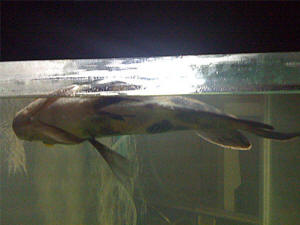
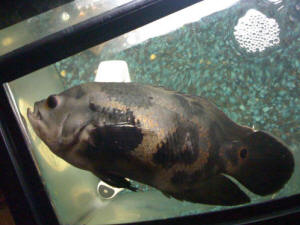
my poor tiger "Oscar". I believe he has swim bladder
disorder, as he has been floating on his side at the top of the
tank for four days.
<Okay, so if you've even casually perused the site,
you'd know that "swim bladder disorder" is really
just a name for some symptoms, which almost always stem from
improper care. Also, some research would have been more helpful
to you prior to this condition developing.>
I did a 50% water change the second day, which admittedly had not
been done in a couple months.
<Why not? Are you aware of the need for water changes? They
dilute the toxins (waste products) from a closed system. If you
don't do them, your fish is swimming in a cesspool. Have you
ever tested the water? Chances are good that Nitrate is through
the roof. If you're not sure what I'm talking about,
please educate yourself on the nitrogen cycle. Here's a link
to a wonderful article:
http://www.wetwebmedia.com/FWSubWebIndex/fwestcycling.htm>
I had also been told when we first got Oscar that the light at
the top of the tank would be enough to heat the water and that
there was enough oxygen in the water that he did not need
bubbles.
<What is the temperature in the tank? A two-dollar
thermometer, plus Googling "Oscar temperature" would
have told you that this is likely not the case. As for
oxygenation, what type of filtration do you have? Often,
hang-on-back filters do adequately oxygenate water; when I run
canisters, I always provide extra oxygenation, just to be
safe.>
Our tank is 38 gallons and Oscar is approximately 3 years old and
4 inches long.
<This fish should be twelve to fourteen inches long by now.
Most reach the ten- or twelve-inch mark in their first year of
life. The minimum size for an adult Oscar is 75 gallons, if this
gives you any indication of what's gone wrong here. Something
in his environment has prohibited his normal growth.>
The temperature of the tank dropped considerably last week due to
a freeze we experienced, which the tank is next a large
window.
<Well, this would be an excellent reason to invest a little
bit of money in a heater.>
On the third day, after researching more, I got a heater and air
tube.
<Here, I'm not sure I can say "Better late than
never." The damage appears to have already been done by some
aspect of his poor environment. However, whatever catfish you
have in the tank with him will likely benefit, even if he does
not.>
I bought Kordon Amquel Plus and Nova Aqua Water Conditioner (a
different brand than I had previously). I performed another 50%
water change, refilling with hot water and heating up to 80
degrees, <78 is fine.>
added the air tube and the Kodav water treatments. The small
catfish was ecstatic,
<Yay! Clean water!>
but Oscar still remains floating.
<What are you feeding this fish on a daily basis? Dry foods,
when used as the sole source of food, cause constipation.>
I tried feeding him shelled peas by putting them into his mouth,
but he just spits them out.
<He's been through many, many changes in environment
lately. This could be terribly stressing him, as well. Please buy
Ammonia, Nitrite, and Nitrate tests, and provide those readings
in numbers.>
His abdomen is not noticeably distended, though he seems
uncomfortable.
<When was the last time he ate?>
I try to rotate the side which is facing up out of the water and
periodically will hold him slightly under in an upright state so
that he move his fins. He seems active at that point and wants to
swim, but pops up to surface like a balloon and is too tired to
control where he goes.
This morning I found him up against the heater and had a
seemingly burned area on his poor head.
<Oh, no. This is going to open him up to infection on top of
everything else. You've got to get on top of water quality
very quickly in order to avoid infection here. Medicating this
fish could stress him so much as to kill him.>
I added Melafix and two tablespoons of aquarium salt to the
water.
<What was your reasoning for this treatment? Melafix is likely
going to do nothing here, though it does act as a mild
antibacterial, but this fish has so much working against him that
Melafix is useless. Another thing you'd have learned if
you'd read on our site as much as you state is that Aquarium
Salt really is only useful in treating Ich. It can help detoxify
Nitrite and Nitrate, but at the amounts you're adding, is
likely doing nothing.>
I did not dissolve it first, as you mention in other posts.
<???>
I want him to keep his strength up. I am going to test the water
with a kit, as it appears the test thermometer in the tank that
shows temperature, Ph and ammonia levels has not changed at all
and are high.
<Yes...the tests. Please provide these levels. Be sure to test
not only Ammonia, but Nitrite and Nitrate, with the test kits
that contain reagents in bottles, not the dip strips. This is
what you've been missing. Toss that in-tank thing and buy
some real tests that give real results. They take five minutes
longer than the "live" tests, but provide more accurate
results.>
I changed the water filter, though I was worried that it would be
"too clean" in a short amount of time.
<You are absolutely right. Why are you doubting your own
actions, but failing to read and answer these questions prior to
making the mistakes?
You claim to have read, read, read, but if you had, you would
know the answers to most of your problems stem from environment.
You've removed any biological bacteria that did exist in the
tank by removing the filter cartridge.>
Is there any way to drop them quickly?
<Huge daily water changes. Borrowing cycled media from another
filter and placing it into your own. A product called "Dr.
Tim's One and Only" will instantly cycle the tank. It is
the only beneficial-bacteria-in-a-bottle that I can recommend --
most of them are nothing more than a waste of money.>
I am not sure if you recommend him not eating at all or trying
something else, like live
earthworms, dried earthworms, medicated food (if so what brand?),
etc.
<At this point, I would allow him to fast, and concentrate on
water
quality. You'll find that when it approaches healthy levels
(0 Ammonia, 0 Nitrite, Nitrate under 20), your fish may begin to
eat again.>
Should I add more salt or wait three days after another water
change?
<I'd stop adding salt. You could try Epsom Salt after the
water quality has returned to normal if he still refuses to eat,
in the event that this may be some sort of digestion problem.
But, I really doubt that it is.>
I am afraid to make anything worse and just want him to get
better.
<Making him "better" should have started a long time
ago. At this point, bring water quality up to par and hope for
the best. Try and get a hold of something, explained above, which
will instantly mature your filter. In the event that you
can't, huge daily water changes are the only thing to do. Buy
liquid test kits, and test daily. You're ultimately looking
for parameters mentioned above.>
How long can they be in this state before it is too late?
<I honestly don't know, Jessica. I'm surprised this
fish is still alive.
He is at least one-third of the size he should be. He was kept
cold for much of his life, and has been living in high, high
concentrations of his own waste. Just do those water changes and
get water quality back to where it should be.
Though you say you have read our site, I'm going to ask you
to go over this information one more time. Please begin by
reading here:
http://www.wetwebmedia.com/FWSubWebindex/oscars.htm,
as well as those linked files above the title of the article.
There's just too much going wrong for this guy. Please let me
know if you have any more questions.>
Thank you for all your help!
Jessica
<You're welcome.
--Melinda>
|
  |
Re: Floating Oscar on side
12/16/2009
I appreciate your terse tone.
<I appreciate that you understand the seriousness of the
situation.>
We used to be up on the water changes
monthly, <This should at least be bi-weekly.>
but I have been left to being primary caretaker. My boyfriend
bought Oscar for his daughter, for which he said he used to have
one and thought all the extras were useless. Okay, so live and
learn, I have been doing all research and ignore his obvious
thoughtlessness.
<Absolutely. The best thing you can do.>
I purchased the test kit last night, which are the strips, I am not
sure I can afford another kit now. The ammonia: 1.0, nitrate +3: 10
(1/2 way between 0 & 20 in color), nitrate +2: .5, hardness:
300, chlorine: 0, alkalinity: 80, pH: 7.8 alkaline.
<Okay, so you've got Ammonia, and I'm guessing you mean
Nitrite for the second reading, so you've got that too. This
means that the cycle has somehow been interrupted, and it was most
likely done when you "overcleaned." From now on, big
water changes, frequent testing, until things get back to normal.
The good thing is that your huge water changes have effectively
diluted Nitrate, which is also toxic at higher levels, and so
you've made progress there.>
I will look into the good bacteria you mentioned for the tank.
<This, or getting some cycled or 'seeded' media --
perhaps a local fish store might have some?>
I feed him Oscar show pellets. I have tried Hikari cichlid gold,
but he wont touch it. We gave him feeders in the beginning, but
stopped when I read what the damage that can bring.
<Absolutely. Not even necessary dangers!>
As far as supplements, the first I read of those was recently.
<Okay, so there's no problem in feeding pellets as a staple.
But mix in some "wet" stuff, too -- bits of fish filet,
bloodworms, peas, etc. There are some supplements sold for
freshwater fish. I use Seachem Nourish. But Oscars routinely grow
very, very large without the use of supplements, so his lack of
growth is ultimately due to neglect, apparently on the part of your
boyfriend.>
I didn't know there was a difference between aquarium salt and
Epsom I terms of using it as a laxative.
<It will make all of the difference. The Epsom salt even
instructs humans to use it to relieve constipation, by orally
consuming it, and bloat, by soaking the bloated area in it. My mom
worked on her feet for most of her life (hairdresser) and an Epsom
Salt bath helped her swollen ankles and feet every night.>
Oscar was a healthy eater. He last ate about six days ago. I
didn't feed him, so can't tell you how much he ate, but it
wasn't everything. I try to put one pellet on at a time and
have him eat it before I drop another.
<A good method. L
The other "feeder" drops in about seven at one time, so I
am not sure if it is constipation or purely water (the latter I
suspect).
<The overfeeding could also be a cause of the interruption of
the biological cycle. Then, the problem was compounded by
overcleaning.>
I will perform another water change.
<Yes -- keep doing them, and keep testing!>
I will wait on salt until water conditions improve.
<Okay. The reason for this is that the water quality improvement
may remedy his condition without the use of anything else.>
To clarify, I have looked through your site for hours and hours,
but only upon it's discovery yesterday. I had also researched
other sites before finding yours, which had the most content and
advice.
<I'm glad you found us. I think that there are some really
basic things that you're on your way to figuring out, and after
you get there, keeping fish will be so much easier. Please feel
free to write back if you need more help.>
So, thank you for help and I will do my best to make things
better.
<You're welcome. Thanks for accepting the truth for what it
is, and doing your best to fix the situation. Oscar appreciates
it.>
Sent from my iPhone
<--Melinda> |
Oscars not feeling well
12/3/09
Hello I was looking through your site and I didn't come across an
answer to my question,
<Oh?>
I work in a retail store that recently started carrying Oscars and
other Chiclids.
<It's "cichlids", as in sick-lids.>
The Oscars were doing fine till just a few days ago.
<Ah, famous last words...>
I know that Oscars are very territorial as they get bigger and the tank
we have them in is small but being a store we don't have much
choice.
<You're going to lose a LOT of money if you adopt this approach.
Bob has written much here at WWM re: the aquarium business, but the
bottom line (in more ways than one) is that you get the gear needed to
keep whatever fish species you want to sell, rather than order in a
bunch of fish and then just hope for the best.>
I have 5 Red tigers and 2 Albinos in a 50 gallon tank (Small I know)
and I do 50% water changes 2x a week. but I came back from the
thanksgiving holiday and found 3 of the tigers had lost their color and
were sitting in a corner of the tank with fins clamped and breathing
hard. I quickly did a water change and checked the parameters
<Classic stress behaviour. First dumb question: how did you cycle
the tank?
Second dumb question: do you track water chemistry and water quality on
a routine basis? And final dumb question: what are you feeding these
fish?>
PH:7.6
<What's the water chemistry beyond this? In other words, do you
know the general and carbonate hardness levels?>
Ammonia: 0
Nitrite: 0
<Somehow, I doubt these two numbers. Be open minded. Check two or
three times across the day. The vast majority of sick fish are sick
because of chronically poor water conditions. Ammonia and nitrite have
to be zero all
the time, and with cichlids, nitrate levels below 20 mg/l are extremely
important.>
Salt: 0
Temp: 83
<Much too warm; the warmer water is, the less oxygen it holds.
Unless you have a darn good reason to do otherwise, tropical fish
should be maintained at 25 C/77 F.>
When I came in this morning there was one that looked like he had a
coating of mucus on him I am at a loss on what to do I don't know
if we are just too over crowded or if its something else.
<Could be overcrowding, depending on the size. Assuming regular
levels of filtration and water changes, half a dozen inch-long Oscars
would be fine in 50 gallons, but above a couple of inches in length, 50
gallons would be
a deathtrap.>
The only thing we have done differently is when we were gone for the
weekend the lights were off for 3 days since we don't have them on
a timer could they be stressed out because the lack of light? any info
will help.
<Lights will not be a big deal, but Oscars, like all fishes,
don't like bright lights, loud noises, or really anything else that
would disturb any other animal. Use your common sense here. Cheers,
Neale.>
Re: Oscars not feeling well 12/3/09
OK I just ran another test and here are the results
PH- 7.6 still
<This is fine for Oscars; indeed, optimal, given that poor
biological filtration is more dangerous to them than non-acidic pH
levels.>
GH- 30 PPM
<Low.>
KH- 40 PPM
<Extremely, dangerously low. Do read here:
http://www.wetwebmedia.com/FWsubwebindex/fwh2oquality.htm
http://www.wetwebmedia.com/FWsubwebindex/fwsoftness.htm
For general fishkeeping, especially with big, messy fish in a
relatively small tank, moderately hard water with a medium level of
carbonate hardness is extremely useful.>
Ammonia- O still ( I will check it one more time early afternoon and
check again before I go home)
<Hmm...>
Nitrite- 0 (Same as Above)
Nitrate- 0
Temp- 80
<Little on the warm side.>
I also did another 30% water change and added a little Methylene Blue
(2 Drops per 10 gallons)
<Why? Do bear in mind all medications are toxic (including the ones
doctors give us). Overuse, or misuse, will cause problems. Adding
"a little" of anything just in case is really VERY
unwise.>
I haven't had time to look at the website you gave me been busy
here with other stuff but I will look after I get off work.
<Fair enough... but do set some time aside. You might want to start
off here:
http://www.wetwebmedia.com/FWSubWebindex/oscars.htm
>
the tank has been established for about a year we had sword tails and
platys in their before we got the Oscars.
<OK.>
I check the water bi-weekly and haven't had a problem with ammonias
in 6 weeks. We feed them a mix of Pellet food, Frozen Brine and Frozen
Bloodworms and every so often I feed Micro Crabs.
<Since you're aiming to sell these fish, I'd stick with an
pellet/wet-frozen diet. Live foods are a variable, and you just
don't know if they're bringing in parasites. Goldfish/minnows
are downright lethal, but even crabs and earthworms have a small risk
attached. They're one more thing to worry about. Instead alternate
between a quality pellet food (like Hikari Cichlid Gold) and chopped
mixed seafood that you can buy in bag from places like Asian markets.
Here in England a 454 g/1 lb mixed bag of squid, prawns and mussels
costs £3-4, and that'll work out much more economical
than food sold at the pet store. Small strips of tilapia and coley
would also be economical and safe.>
Thanks so much for the help I am new at this and I have taken on the
responsibility of these critters. (not to mention I have really taken a
liking to these guys and it kills me to seem them sick).
<Oscars are indeed the classic "Pet Fish" which is why
they're so popular. Kept well few, if any, fish are as smart or
easy to tame. Lots of stories about them being taught tricks, including
playing with ping-pong balls! They love human company, and once
settled, can even be petted (check out You Tube for lots of such
examples).>
~Shawn
<Cheers, Neale.>
Tiger Oscar's Behaviour 11/16/09
Oscar Swimming Funny
Hi, I have four tiger Oscars in a 6 foot tank, they are approx 1 1/2
years old and were placed in the tank together when they were about an
inch long. I have one Oscar that has currently changed his behaviour -
He
has always lived and built his nest behind a structure in the tank and
usually sits within the area of his hole, however lately he is lying
vertically (nose up, tail down) against the structure, he has slowed
down on his eating, not swimming much, and I've noticed over the
past two weeks that when he is resting (and sometimes swimming) he
floats on his side, his top fin is laid against his body and also
"lays" his tail on the bottom of the tank. He doesn't
have a swollen abdomen, no hole in the head and no white spots. The
other fish are acting as normal (they have built their owns nests
within the tank and seem content). I have been changing the water twice
a week (about 50%) for the last two weeks - I usually do my water
change every 2nd week. I do regular water tests (about twice a week)
and act upon any inconsistencies of the water. I feed the Oscars
pallets once a day. Any advice would be greatly appreciated. Regards,
Donna.
< Sounds like an internal infection. It could be caused from stress,
diet or poor water quality. Isolate the infected fish in a hospital
tank and treat with Metronidazole and Nitrofuranace as per the
directions on the
packages.-Chuck>
3 year old tiger Oscar, hlth., env. --
10/21/2009
Hi, my name is Shawna and I have a Tiger Oscar that is about 3 and a
half years old now. I cleaned my tank about a month
ago<"Cleaned?"... as in altogether? Better to not do this;
but instead to change part of the water out, clean the sides down,
vacuum the gravel at weekly intervals>
and now my Oscar has been getting strange marks on him.
<Likely from a loss of nitrification (biological filtration
capacity)>
At first, along the top of his body just underneath the top fin on both
sides, he was starting to look pale.
His stripes also started to become very pale and white in color, which
is usually caused from stress i thought. This went on for a few days
and then his eyes started to get very cloudy.
<Bad... burned>
This cleared up within a week and I started to think he was all better
now. Then i noticed where he used to be pale in color on his body, by
the top fin, he had a spot that had very minimal peeling and now his
scales seemed to be a bit swelled. It has also seemed now that his
tiger stripes have pretty much disappeared or faded out where this is
happening.
He is still eating and is swimming normal, really he seems perfectly
normal other than these swelled scales. The symptoms to me remind me of
a human sunburn!
Instead of getting red, he gets pale, he is peeling and his scales are
swelling much like how a sunburn bubbles. I had a Marine Glo light
which glows a blue which has been used for some time now so i don't
think its lighting. He is in a 108 gallon tank with a 6" goldfish,
a 7" Dempsey, a 4" peacock cichlid, an 8" Pleco and a
smaller other fish that I have no idea what it is that was given to me
months ago. I have had my water tested
<What results? Appreciable ammonia et al?>
quite a few times and have not changed a thing that i have done since i
have gotten him. The only thing that changes is the type of food. Right
now I am feeding him floating cichlid pellets. On occasion, crickets
and guppies but i have not done this for quite some time. I have never
ever fed him low quality foods!! Im not understanding what is going on
because he is not acting strange at all, I have noticed that a couple
times when the paleness started, he seemed almost itchy but that has
stopped. I hope nothing is serious and there is a solution. Thank
You
<Mmm, again... the clean-out... Please read here:
http://wetwebmedia.com/FWSubWebIndex/fwestcycling.htm
and the linked files above; esp. on troubleshooting. I would be looking
for a good starter medium, like Dr. Tim's "One and Only".
Bob Fenner>
Oscar not well 10/8/09
Hi we have two Oscar fish who seem to be unwell. One is active and
eating well with fin rot.
<Do review water conditions. Almost always, Finrot is triggered by
water quality problems. Just to recap, Oscars need a big aquarium, and
for two specimens, 75-100 gallons is required. The filter needs to be
very powerful, at least 6 times the volume of the tank in turnover per
hour, i.e., for a 75 gallon tank, 75 x 6 = 300 gallons per hour. The
water chemistry isn't critical, anything from pH 6.5 to 8 is fine,
with 5-20 degrees dH hardness. But water quality is absolutely
critical, and there should 0 ammonia, 0 nitrite, and nitrate levels
below 20 mg/l at all times.>
The other more placid fish is sometimes going onto his side, and has a
huge opening where his anus is filled with white fluffy beads that fall
out and inside he looks raw red. He just isn't himself.
<Well, do, I'd guess not. He's very sick indeed, and
probably needs to see a vet. At the very least, antibiotics will be
required, and these will require a prescription from a vet in most
parts of the world. If the body cavity is open like this, the fish is
exposed to massive amounts of bacteria, and septicaemia, among other
things, is likely. The fish will be in severe distress. Does it feel
pain? That's hard to know for sure, but the fact it isn't
eating proves it's uncomfortable and distressed. Either take it to
the vet, or else euthanise it. Those are your two options here.
http://www.wetwebmedia.com/euthanasia.htm
>
He eats well.
We have been to the aquarium a handful of times this week with concerns
over our nitrate and ammonia levels.
<Nitrate or nitrite? These are different things. Nitrate doesn't
tend to cause immediate problems, but constant exposure to levels above
20 mg/l does stress cichlids and is connected with various diseases
including Hole-in-the-Head and Hexamita infections. Nitrite, on the
other hand, is immediately toxic, and even low levels will stress and
eventually kill fish.>
My husband has been doing regular large water changes, he changed their
diet to a seaweed type and now based on the professional recommendation
stopped feeding them and medicated the water with Bactonex but this
says on the bottle that it is a prevention aid for fungal, bacterial
and parasitic infections.
<Too far gone for off-the-shelf medications.>
Do we need antibiotics or do you suggest something else?
<Antibiotics.>
We are on day two of using this medication and the white fluffy beads
were expelled this morning. The guy said the fish would improve
noticeably within a few days. Just now as I look at him I can see a
little scale falling off him . There is no slimy coating, no white
spots, no funny eyes, the one we are most worried about with the large
butt with beads and what looks like air bubbles inside of him
doesn't have fin rot.
<It's a bacterial infection. The bubbles are pockets of
respiratory gases released by the bacteria. Basically, it's
gangrene.>
He's alert though and comes up to us for look. The fish don't
fight. We got them 4 weeks ago together.
<How did you cycle the tank before you bought them? I ask because
some people mistakenly think you can buy an aquarium and buy the fish
on the same day. You can't. You buy the aquarium, and then you add
a source of ammonia for about 4 to 6 weeks, and then add your fish. The
ammonia can be household ammonia, but an easier option is to add flake
food in about the same amounts as you'd add if there were fish in
the tank. The flake decays, produces ammonia, and that starts the
cycling process. Using a nitrite (not a nitrate) test kit you monitor
the nitrite levels, and by about week 2 or 3 you should find nitrite
has peaked and starts to drop down. A week or two later it's at
zero, and that's when your tank is ready for some fish. By the way,
while you're cycling the tank, you also do your weekly water
changes, 25% at a time.>
They seem to be best friends sleep touching and swim together all the
time.
<Shame they're so sick. Do note that only juvenile Oscars are
gregarious; adults are territorial.>
Can you please help as our local stores are all saying the same
things.
Change the water and get nitrate levels to 0.
<Why are you/they focusing on nitrate? Nitrite is the dangerous one,
nitrate is much less dangerous.>
My husband has been tirelessly cleaning and doing everything they say
and yet the water levels are not great-lower but I think he mentioned
.2 ammonia and .5 nitrate.
<I'm guessing you actually have 0.2 mg/l ammonia and 0.5 mg/l
nitrite (not nitrate). This would imply your tank is still cycling, and
should not have any fish in it.>
Thanks so much and thank you for your time.
Suz
<Hope this helps. Cheers, Neale.>
Please help me with my baby Oscar
9/29/2009
Hi, my name is Laura I was looking up about bleeding Oscar fish and I
came across your reply on somebody else's question and I hope that
you can help me.
<Bleeding? From its fins? In most cases when blood appears on the
skin or fins, it's Finrot. And most of the time, this is caused by
poor environmental conditions. Oscars in particular need large,
well-filtered tanks with a mature filter.>
I have had my Oscar Fish for about a week and a half and today when I
was falling asleep he through some pebbles/gravel at the tank wall so I
woke up to see what he wanted and I noticed while he was pooping some
red liquid stuff was coming out, and when he finished going the red
stuff continued to come out.
<How did you cycle the tank before adding the Oscar? Don't
forget an Oscar aquarium will need a big biological filter, and
that'll take some 6 weeks, minimum. You'd have to cycle the
aquarium using a fish-less method, such as adding flake or seafood to
the tank every few days. Once ammonia and nitrite levels hit zero, the
tank's ready to become a home for an Oscar.>
I noticed that sometimes his 'droppings' are white and
sometimes they are dark, if that matters at all. Also he has two white
small dots on his head (about the size of a piece of salt) that have
recently appeared, I don't know what they are and I can't get
my hand close enough to see if they are stuck on him or not.
<The white specks are likely dead or dying skin.>
What should I do, is he sick? If he is do you have any suggestions on
medication of any sort. His water has been cloudy lately even after we
do water changes (siphoning the tank as well for all of the droppings
and extra food and dead plant leaves), we have done them from 10% up to
40% trying to clear it up, we don't know what is causing the
cloudiness. Right now bc he is small we have a 10 gallon tank (we are
upgrading as he gets bigger)
<Bingo! You cannot possibly keep an Oscar in this tank.>
we do water changes frequently, we have a new filter, a water heater
that reads 79, and a tube that makes bubbles, he also has a piece of
drift wood and water plants (that we bought from the pet store). We
have an algae eater (we feed him algae wafers bc there is not enough
algae in our tank yet), and we use water conditioner called NovAqua
Plus and something that removes
nitrate-nitrite-ammonia-chlorine-chloramines its called AmQuel
plus.
<This water conditioner treats the new tap water you add to the
tank. It does NOTHING for the ammonia and nitrite produced by the
fish.>
We feed him freeze dried Brine Shrimp, and sometimes minnows, but not
recently.
<Don't feed your Oscar live feeder fish, ever. Earthworms,
cockles, frozen lancefish, unshelled prawns, and so on can be used to
make a nice mixture of treats. The staple should be a quality pellet,
such as Hikari Cichlid Gold.>
He is an active little guy kind of a crazy fish he likes to move and
knock the plants all over the place, there hasn't been a change in
behavior or anything, I just know from reading up that it is common for
Oscar Fish to get hole in the head, and parasites, and other weird
diseases...
<All these "weird diseases" are caused, at some level, by
bad care.
Hole-in-the-Head is typically associated with poor water quality,
including nitrates above 20 mg/l, and unbalanced diet. Parasites
usually come from either newly introduced tankmates or, more likely,
feeder fish. As I say, don't use feeder fish.>
I would like to prevent this from happening to our fish. If you have an
ideas to why this is happening to our sweet Oscar please e-mail me.
Thank You! -Laura
<Laura, you have much reading to do! Oscars are difficult to keep,
and require at least a 55, preferably a 75 gallon, tank with a strong
external canister filter. Do read here:
http://www.wetwebmedia.com/FWSubWebindex/oscars.htm
Cheers, Neale.>
Hey again! Oscar reading, again...
8/28/09
Hey guys. I contacted you guys maybe 6 months to a year ago about a
Tiger Oscar I had owned that got a fungal infection (white puffy
substance on the body).
Well, I've recently started a new family. I have now 2 new Oscars,
a baby tiger and a baby albino. Also, with them I bought a Black
Convict Cichlid.
In the tank I already had a full grown African Cichlid and a
Plecostomus that is about 8 inches. They're in a 55gal tank,
<Oh my friend! This is too small a system for what you list. You
will need a tank at a minimum twice this volume>
water temp usually at 78-74 degrees. I noticed my albino's
fin's are starting to turn black. I've never seen this before
so I Googled it, and got mixed answers from fighting to disease. Any
thoughts??
<In a word: stress...>
Thanks again.
Luke Whittemore
<Read here: http://wetwebmedia.com/FWSubWebIndex/oscars.htm
and the linked files above. Bob Fenner>
Please help
Oscar In Mourning, Probably Not 8/23/2009
Hi my name is Selena. I have a tiger Oscar which I'm worried about.
He recently lost his mate, I have fed him feeder fish to help cheer him
up but that has not seemed to work. About a week ago he has stopped
eating and also been swimming on his side. He is curled like he is dead
but he is not.
I have checked. If u could please help me that would be great. Thanks
Selena
< I think you should be concerned with why the other Oscar died. The
same disease could be affecting this Oscar too and not the death of his
tankmate. Do a 50% water change , clean the filters and vacuum the
gravel. Remove the feeder fish. They introduce lots of diseases. If
your Oscar acts hungry then feed him a high quality cichlid pellet. If
not then he may have an internal infection. treat with a combination of
Metronidazole and Nitrofuranace. This will affect the biological
filtration so watch for ammonia spikes.-Chuck>
Tiger Oscar "Shedding"
7/23/09
My 4 year old tiger Oscar looks like he is "shedding skin."
He isn't eating or swimming. He just lays on the bottom of the tank
and looks like he is dead but isn't. He will only move if you make
him. I have checked
the water and even did a partial water change..Usually when he gets to
feeling "down and out" a partial water change helps revive
him (approx every 4-6 weeks).
<<Water changes should be done... every week... RMF>>
What do I do now?
< Check the water quality. The ammonia and nitrites should be zero.
The nitrates should be under 20 ppm. The water should be around 80 F.
If all these parameters are within range then I would recommend doing a
50% water change, vacuuming the gravel, cleaning the filters and
treating with Nitrofuranace. Follow the instructions on the
package.-Chuck>
Re: tiger Oscar, hlth. 7/26/2009
Water change helped a lot! He acts like his old self again. Thanks.
>Ahhh!<
"<<Water changes should be done... every week...
RMF>>"
Female Albino Oscar (6 - 7" Long) -
Breathing Difficulty 7/7/09
Female Oscar With Breathing Difficulty
Thank you in advance for your help with our Oscar. We have a breeding
pair of Oscars and 1 Pleco in our 120/g tank. We got all three in April
of 2006. Our female looks like she is having difficulty breathing,
gasping for air. We have no problems with our air pump as there are
plenty of bubbles going into the water, but our pH is low, which we are
working on now to raise it. What else could be wrong with her, or is it
our tank that has a problem? Our other two fish are not having any
difficulty breathing. We have excellent filtration (2- Rena PS3's)
in our tank, and the water is crystal clear. We are located in SC and
the water temp is a bit higher then we like (84º), but it
has never bothered them before. She last laid eggs about a month ago.
He goes through the motions, but doesn't fertilize them. Any idea
as to why she would have problems breathing? She isn't eating as
well as she usually does either... I don't want to lose her, if
possible. Thank you!
< Heavy breathing could be a symptom of many things. First check the
water quality. The ammonia and nitrites should be zero. The nitrates
should be under 20 ppm. If you don't have any test kits then do a
50% water change and see if things improve. The stress of breeding
could have caused an internal infection which will affect the gut and
cause additional stress to the entire fish. The fact that she is
breathing heavy and not eating may be the early symptoms of that
internal infection. Get some medicated food with Metronidazole in it.
It is sold at DrsFostersmith.com. Follow the directions on the
package.-Chuck>
|
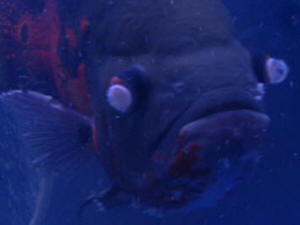
Oscar With Eye Problems 7/3/09
I am writing in desperation for my 2 year old Oscar
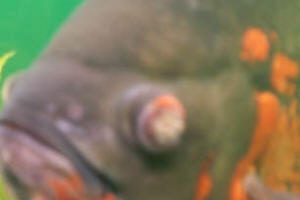
"Diesel". I awoke last Wednesday to find both his eyes
covered in what appears to be fungus. I tested the water and the
nitrate levels were 200ppm, all others normal, I did a 25% water
change. Thursday, it spread to his fins, tail, and face. I did
another water change, took out activated charcoal, added ammonia
remover insert to filter, and treated with Pimafix, nitrate
levels still 200ppm. By Sunday, fungus was no longer on his body
but still on his eyes, nitrate levels still 200ppm. I did a water
change, switched medication to API fungus cure and by Monday the
majority of the fungus came off his eyes but now appears like his
eyes are rotting. Wednesday did a water change and added
activated charcoal, and still no improvement with eyes. Today,
water is still green from medication, no improvement with eyes,
the nitrate levels are still 200ppm. He hasn't eaten anything
since last Wednesday, even if I try to hand feed him and his eyes
look like their rotting. He doesn't appear blind and has been
more active the last few days but I don't want to lose him.
Please help!
**the first two pictures are from today and the second two are
from last Thursday.
< The bacterial infections have taken their toll on your poor
Oscar. It is difficult to cure infections with nitrate levels
this high. I would recommend a 50% water change vacuum the gravel
and clean the filters. The bacterial infections may have
penetrated the lenses of the eyes and lifted them off. Treat with
Nitrofuranace or Erythromycin as per the directions on the
packages.-Chuck>
|
  |
|
Oscar With Eye Problems II - 7/6/09
I really appreciate your help. I did as you said although it was
difficult to get the medication, but I have noticed he now has a
brown discolouration all on his underside, should I be treating
for parasites as well?
< For now just go with the antibiotics. If you actually see
parasites then they can be treated later with
Fluke-Tabs.-Chuck>
|
Sick Oscar 6/6/09
I have been searching your site for answers but could not find any for
my particular situation. I currently have a tiger Oscar that is about 4
inches long. I noticed some white spots on his pectoral fins and before
that he was staying at the surface behind my power filter. I figured he
has Ich because these are the most common signs of it. I currently put
him in a quarantine tank for treatment. The display tank has no other
fish and is set at 82 degrees Fahrenheit to speed up the life cycle and
let parasites die off. I am currently using super Ich cure by API. The
quarantine tank is at about 84 for the same reasons. Now for my
question. About a day after the first dose I noticed the spots starting
to fade a bit and maybe a few
going away. Now his pectoral fins seems to be a little frayed and maybe
some slight if any cloudiness in his eyes. Has my Oscar developed even
more illnesses do you think? I rarely ever have sick fish so I'm
not sure what to do. I appreciate your help and time. Thank you.
<Hello Jonathan. It's actually not uncommon for Ick (Whitespot)
to lead to secondary infections such as Fungus and Finrot. What happens
is that the white cysts on the fish's body burst open when mature,
and that's how the "baby" free-living parasites get into
the water and so are able to find new hosts. But the damage to the
fish's skin allows infections to set in. So, as always, review
water quality, since that's the thing that makes such infections
probable, and also treat for Finrot and Fungus using a reliable
medication of your choice (not salt, not tea-tree oil!). In the UK and
Europe, I recommend eSHa 2000, but there are doubtless other products
you might use elsewhere in the world. Do remember to remove the carbon
from the filter while treating your fish with medications. Cheers,
Neale.>
Oscar problems multiple
05/25/09
Hello, and thank you for reading this.
<Service to you!>
I have had quite a few Oscar problems and somehow have always seemed to
fix whatever was going on. I've had 3 Oscars for about 4 years now.
One is over a foot, the others are 8-10 inches. The largest was very
aggressive and was moved to his own 55 gallon tank.
<About all there is room for>
The other two seem to be paired up. They love each other. Although they
have never had any eggs, they tail quiver and lip lock and when one is
sick
(seems to happen often lately) they stay by the other's side. They
are also in a 55 with one 6-7 inch Pleco.
<Overcrowded...>
My first problem was my largest. He got HITH.
<... from water quality, the crowding...>
Obviously my fault, not changing the water enough. Pure laziness. It
got really bad, but with enough water changes it suddenly healed. He
looks
normal now! I was feeding Wardley pellets, crickets on some days and
brine shrimp. Next my other two got HITH. These two are an albino and a
red. Mostly it was the red. It got so bad that I thought my red's
eye was going to fall off.
<... where is this going?>
I just kept with the water changes, used Melafix and salt in the water,
and voila! He healed. Everything was better, and unfortunately I went
back to being lazy with water changes. No excuses, but I have a house
full of animals and now I'm paying the price. My largest is in his
own 55 with one Pleco. He has one decorative log, temp stays at 78 and
the filter is a dual BioWheel. He has a couple holes now, not too
serious (although I know it can get out of hand) but for the last few
days he's been laying on the bottom with his fins close to his
body. I used Jungle Fungus because it has both fungal and bacterial
fighting properties, and also saved my Albino recently when he was
doing the same thing. I've been using VitaChem vitamins and
Melafix/Pimafix and today did a 50% water change. After the water
change he's suddenly been swimming a LOT more. Laying on bottom
some, but what more can a foot-long fish in a 55 tank do?
<I don't understand... what are you asking?>
I think the meds stressed him out and now that he's swimming
I'm going to do one more Melafix/Pimafix dose tonight and put in
new carbon filters tomorrow.
<Cut the "fixes"... they're bunk>
My BIG worry is my red in the other tank. I know you are going to ask
for water test numbers, but I've never done a water test in my
life.
<...>
If I had the equipment I would do it right now and send. But I'm
just grasping right now to save Oscar. Albert and Oscar both have a
serious case
of HITH right now, as far as I know.
<... see WWM re>
Oscar looks much worse, but Albert's was so bad he really looked
like some of his head was scraped down. He was floating head down for a
while.
<Pathetic... likely your nitrates and other pollutants are sky
high>
Then floating midway on his side, not even leaning on anything. My fish
guru suggested I treat for bacterial infection, and then use Jungle
HITH
Guard.
<My young friend... stop medicating... Your fishes problems are
environmental in nature... You're neglecting the care of the
animals in your care...>
The HITH Guard did nothing. I finally used clout,
<...>
which has worked in the past, and the white poos sticking to the
filters disappeared. The floating copepods disappeared too! Of course I
was doing
lots of water changes. The whole time Oscar was doing great (he's
the red). He would stay next to Albert (Albino) but he was eating
great. Both heads started healing. Albert's grew back - doesn't
look shaved down anymore. Then Albert started laying on his side on the
bottom, with fins close to his body. And he stopped eating. He would
try to eat, but not really. And Oscar starting spitting out his food. I
was feeding Hikari floating pellets
(Can't find large Wardley and they're bigger now, so....) I
noticed the clamped fins and also a hole in Albert's right fin.
That kept getting bigger. And I noticed a little bit of raggedness on
his tail, and I thought fin rot! I used the Jungle Fungus med - and it
healed him right up. Now he is my healthiest Oscar! I've been
feeding them Oscar Grow large pellets floating and sinking a couple at
a time, to make sure they are eating. OK, so a few days ago both were
swimming and eating great. I did a water change on Friday. And I used
clout one more
<... No! Metronidazole is toxic in repeated exposures>
time, because Oscar's holes started growing again. One day Oscar
was stealing Albert's food, and the next day Oscar is open-mouthed,
head up as
if not enough oxygen, and not eating. His gills seem to be hard working
and one side has a whiteness on it that resembles his holes. His holes
have
suddenly gone crazy, like they're growing deeper/bigger within just
a couple of days. They're eating away around his eyes. As he
breathes it looks like there's a flap from inside his mouth - all
the way around - that goes with his breathing. I've looked down
into his mouth to see if any rocks are stuck, thinking he grabbed one
with one of the sinking pellets, but I can't see anything, like
it's swollen. He was head up for 2-3 days, and now he's gone to
the bottom. Not leaning over, but sitting on his stomach with his mouth
open and what looks like labored breathing. I thought it was low
oxygen.
<... pollution... organic...>
That's why I did the water change Friday. He's got two filters
(without any filter in them, but running) one is two-sided, but no
BioWheels, the other
is a large penguin BioWheel, and there are two long airstones going.
His mouth has not closed, and he's still on the bottom, with these
terrible looking holes. Albert is doing great! He's swimming, looks
healed (still has some holes but if you saw him a couple weeks ago
you'd be amazed). I haven't fed them for a few days and I'm
thinking this is the end for Oscar. I saw some more stringy feces
sticking to the filters although not really very white, so I was going
to add Jungle Parasite tonight because it has the Metronidazole and the
(p) med can't think of the name. Praziquantel?
<...>
I have had great luck with jungle except for the HITH Guard. But I
don't know if this will help him or hurt him. I don't know if
this could be some
kind of fungus or bacteria, or just water and it's the end of his
days. :( I don't have a way to move him. If I treat it means Albert
gets treated too. I use prime and stress coat and aquarium salt during
water changes.
<Cut the salt>
I have been feeding very limited because I wanted to get rid of those
copepods, and they are gone. I have also treated with Melafix and
Pimafix for 4 days and added the vitamins. I will wait until morning to
put in the jungle parasite - but if you don't think I should please
let me know! What else can I do?
<Read>
Water temp is at 78.
I also have one more question. My neighbor is giving me his 125
gallon.
<Yay!>
I planned on putting Donovan (my largest) in there so he would have
some nice room to swim, since the others are smaller, but if Oscar
lives should I put the two in there instead? And if Oscar doesn't
survive, is there a way to put both Donovan and Albert in the 125
together or would they tear each other up? (Have been apart for a long
time now). Thank you thank you, please help me with what you think I
should do next. The water change did not help Oscar at all - but it did
help my largest. I am very worried.
-Jenn
<Then apply yourself... Read on WWM re Oscars, FW maintenance...
learn to/use test kits... STOP "medicating"... you're
doing harm... Bob Fenner>
Overmedicated? 5/27/09
update: Oscar died overnight.
<Hi Jen, Mac L here assisting the great Bob>
I believe I killed him by overmedicating.
<Sadly I think so too but you had a combination of problems involved
in this as well.>
This is the first large Oscar I've lost, I feel sick. I don't
know how Albert is going to deal, because like I said they were a pair.
Can Albert go on and be okay as a single Oscar when he's had a mate
his whole life?
<Albert will be better as a large solo Oscar then trying to add
another one because they can and they will tear other Oscars up if you
try to add them and they are not compatible>
Will he get depressed? Should I introduce him to my largest when I get
the 125 ready? Or keep one in the 125 and one in the 55?Thanks,
:( :(-Jenn
<Honestly in my opinion Jen an Oscar is too large a fish for a 55. I
have seen their bodies become misshapen and stunted when kept in a
small tank and their growth is so rapid. You obviously care about your
fish. You could possibly try to put them both together in the larger
tank but being aware that it very well might not work and they might
have to immediately be separated. Oscars are great pets but in the wild
get absolutely huge and I really wish that stores would tell people
more about them when they buy them. Don't you just love it when
they come talk to you or spit water at you for your attention? Good
luck!. >
Re: Oscar problems multiple 06/03/09
Thank you for your reply. So far Albert is doing well and he's very
active, every time I come near the tank he's there asking for
attention.
<Good behavior>
Yes I love that about Oscars. They are very in tune with us. Even if
it's only because they're pigs!
<Heee!>
My next objective is to get that 125 set up and ready for Donovan, my
giant. I do understand that a 55 is too small. I did a nice water
change for Albert yesterday and will do one every other day to help him
heal. The only thing I add to the water is vitamins. Thanks again for
your help.
-Jenn
<And you for this upbeat update. Cheers, BobF>
|
Oscar's tail (entire tail) eaten off, help!
5-10-09
Hello,
I'm in a bit of a hurry (as I'm sure you'll
understand why, as you read on), so I apologize in advance if
this information is already posted on your site.
<Likely is written elsewhere, and you would actually get a
reply more rapidly using the Search box...>
Our Oscar and Pacu have been tankmates since they were babies,
together for over a year now. They'd been best buddies, with
only the occasional bullying by the Pacu. Well, it finally
happened, 2 nights ago we caught the Pacu eating the Oscar.
<Pacu are omnivores with a taste for fruit, but I'm sure
they'll bite small, sick, weak or moribund fish. So while
they're fairly trustworthy fish kept alongside tankmates of
similar size, if this Oscar was substantially smaller than the
Pacu, or for some reason weakened, then that might explain
what's happened here.>
Fins are nearly completely gone, tail IS entirely eaten away
(into the fleshy part). I'm going to attach a photo.
Naturally, we moved it into a QT tank, doing water changes daily.
Didn't think Oscar was going to even make it through that
first hour, now here we are, 2 days later and he's figured
out how to swim normally again, ate last night, poo'd just
fine! My main question (and reason for writing) is...will adding
aquarium salt reduce the risk of infection/fungus?
<No.>
Will it also aid in the healing process?
<No.>
I intend to add some tonight, just because I know that it does
help, I'm just not sure how, haha.
<The idea salt is a cure-all is an old one, but it really
isn't much good.
For one thing, marine fish get bacterial infections, and
they're in seawater! This Oscar is in seriously bad shape.
You need a robust, aggressive treatment here that deals with both
Fungal and Bacterial infections, since your Oscar WILL get both
if not promptly treated. I'd be looking at Seachem PolyGuard,
Seachem NeoPlex, eSHa 2000 or similar.
Obviously NOT something like Melafix, which is, at best, a
preventative tonic. A proper antibiotic such as Maracyn would be
a very sensible augment to the treatment, especially if the
tissue remained red and sore for more than a week or so.>
Will the tail grow back, or will our little Oscar just be
tail-less for the rest of it's life (if it continues to
survive and do well)?
<Given time, fish show an amazing ability to regenerate fins.
It all depends how much of the bone on tip of the caudal peduncle
(the muscular "stem" of the tail) has been damaged. If
the peduncle is basically sound
and the bones intact, with luck, this fish could regrow its
fins.>
Thank you in advance for ANY information you can give me.
It's MUCH appreciated.
Patricia
<Cheers, Neale.>
|
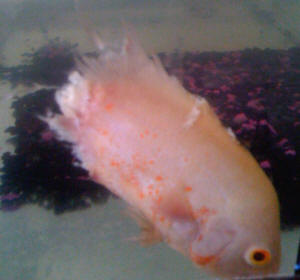 |
Re: Oscar's tail (entire tail) eaten off, help!
5-10-09
"Pacu are omnivores with a taste for fruit, but I'm sure
they'll bite small, sick, weak or moribund fish. So while
they're fairly trustworthy fish kept alongside tankmates of
similar size, if this Oscar was substantially smaller than the
Pacu, or for some reason weakened, then that might explain
what's happened here."
Not this little bastard, I've learned there's nothing
trustworthy about him! :) While the fish is incredibly loving and
docile with me (insists upon being pet during water changes and
such), it will eat anything in the tank simply because it can
catch it.
<Ah, I see. Does happen, as I said. The idea Pacu are pure
herbivores is widely quoted by erroneous; do also be careful when
petting your Pacu: they are confirmed "biters" and have
extremely strong teeth and jaws evolved for crushing nuts. Your
fingertips will be as nothing in comparison!>
Tis a naughty little fishie. I really should have known better,
however since the O is just over half the size of Pacu and
they'd been together so long, I made the simple mistake of
believing they were fine together.
Lesson learned.
<The hard way...>
I'm not sure why it prefers "meat" over
"fruit", maybe because it's THE DEVIL??
<They're omnivores, as I said, and view both as food, much
as we do. While Pacu are generally very good choices for robust
communities alongside Red-tail Catfish and the like, clearly
combining them with smaller Oscars isn't reliable.>
Also, we will treat the Oscar, I can't tell you how much we
appreciate the advice on medication. While the Oscar is in bad
shape, I'm quite surprised at how much fight this little
thing has in it! Maybe it's because my 5 year old sits at the
QT tank all day chanting "Fight, fight, fight". Hehe
:)
<Hmm... is she chanting for a rematch, or simply hoping the
Oscar lives to fight another day?>
I'll be bookmarking this site, I'm very happy with the
quick response and such detailed, helpful information. You're
amazing :)
<Thanks for the kind words. Cheers, Neale.>
Re: Oscar's tail (entire tail) eaten off, help!
5/16/09
Hiya Neale...Just an update on my Oscar, in case you remember the
conversation we had about it! "Dogfish" is doing very
well, appears to have some re-growth of the fins, still not sure
whether or not the tail will come back. It is eating well,
swimming wonderfully, and is getting excited to see me at the
tank again :) Yay! Strong little fishie, eh?
<Glad to hear the good news. Clearly you're doing the
right things, and let's hope for a complete recovery! Cheers,
Neale.>
|
Oscar is literally falling apart --
4/30/09
I have a 55 gallon fish tank and have two Oscars and a sucker fish.
<Oh... well, the "sucker fish" could easily be part of the
problem, or at least an exacerbating factor. Gyrinocheilus is
aggressive, while Pterygoplichthys is opportunistic, and both will suck
on the sores of
large, slow fish such as Oscars. So even if the wound started off
fairly trivial, these fish can make things much worse. I'd bear
this in mind, and observe accordingly. It also goes without saying that
a 55 gallon tank is barely adequate for a single Oscar, let alone
two.>
We have had the two Oscars since July 2008 and they were both in very
good health. They were purchased small and both have grown at the pace
the should. The larger of the two developed white spots on it over a
month ago and we treated it with Ick medication.
<Now, what sort of "spots" were these. Ick is very
specifically a parasite infection, and what you see is salt-grain like
powder all over the body, often on the fins first. It's very
different to, for example, patches of dead white tissue caused by
fighting or Finrot. Then again, Hexamita infections can cause erosion
of the sensory pits on the head, and on Cichlids especially this very,
very common when water conditions aren't
optimal. What you see are the sensory pits gradually getting bigger,
and as they do so, they become focal points for secondary
infections.>
Since then it has gone down hill fast. It has holes in its gills that
are blood red and it seems to be literally falling apart. Not just his
head all over his body.
<A photo would really help; if actually Ick, then Ick medication
should work very effectively, assuming it's used correctly (e.g.,
you removed carbon from the filter before use). But if the problem is
something else,
then you have to act/medicate accordingly. Metronidazole (trade name:
Flagyl) is the standard anti-protozoan medication used for Hexamita,
dosed at 250 mg per 10 US gallons, once per day for at least three
days. Nothing else works for Hexamita. Regardless, we're almost
certainly dealing with a
secondary bacterial infection as well, so an appropriate antibiotic is
surely essential, for example Maracyn or Maracyn 2.>
We have gone to every store and purchased all different medication as
well as keeping the water in the tank clean by changing over 1/2 every
few days.
As of today, he is not doing good at all. He's developed ulcers all
over, holes and chunks and today will not eat. Can you help me.
<Do send along a photo (500 KB, please no bigger) and we can try and
pin things down a bit better.>
The other Oscar is in the same tank and it is fine. He does not have
one imperfection.
<Hmm... this is curious. On the one hand, it isn't uncommon for
Hexamita infections for example to crop up on one fish but not in
another, perhaps for reasons such as genetics. But in the case of
non-social fish such as Oscars, you can't rule out some behavioural
aspect, either direct physical damage (leading to secondary infections)
or merely psychological bullying (in which case the victim can be
stressed, and so has a weaker immune system). In any case, you
can't really keep two Oscars in a 55 gallon system, so part of the
solution will be isolating the sick fish, treating, and ultimately
rehoming. Do recall Oscars *easily* top 30 cm / 12 inches a piece,
often by a wide margin. They are highly territorial, and other than
mated pairs, do not live in social groups except when young.>
Thanks
Kathie
<Cheers, Neale.>
Astronotus (systems; behaviour; health) --
04/22/09
My question is like many other ones, but also different in a few
ways.
<Oh? Most Oscar questions boil down to too many specimens in too
small an aquarium, with too little care being taken over water
quality.>
I have a Orange Albino Oscar, and a Black Tiger Oscar, and for about
4-6 months they've been great together.
<Famous last words. Let's be crystal clear about something:
Oscars aren't sociable fish. They are territorial, and except in
big tanks, they often don't get along. Juveniles are gregarious to
be sure, but as they age, they
become less accommodating. Mated pairs generally form loyal bonds and
work well together, but territorial males will be hugely intolerant of
one another, and will fight.>
Until recently, My Orange Oscar, looks kind of like it's shedding,
on both of it's sides in the middle.
<Fish don't normally shed their scales. So if you have a fish
obviously losing scales, that tends to mean either it's sick, or
it's being physically damaged, e.g., through fighting.>
It lays on the bottom (not on it's side) either normal, or very
slightly tilted. He's not to active, he comes to the top when i
feed them, but won't eat much. The reason i said my question was
different from the ones on your site at the moment, is because i have
the tiger Oscar in there with it, and it seems like almost every time i
feed them, the black Oscar will jump out of the water and land on the
orange one.
<Sounds like aggression or bullying to me.>
The orange Oscar is also missing it's top fin since this morning. i
don't see any pieces of it's fin in the tank, so I'm
thinking it got eaten.
<Again, consistent with social behaviour issues.>
Last but not least, i have a odd tank I'm not to sure of the tank
size, (30-50gal)
<Dismal. You need more than 50 gallons FOR JUST ONE OSCAR, let alone
for three of them!>
i know that's a big difference but it's a half octagon tank,
and i don't know how to measure it.
<Easy. Empty the tank. Fill the tank up again, counting how many
buckets containing X gallons of water you need to fill it.>
I run two 20 gallon topside filters,. the kind that hang on the
back.
<Hang-on-the-back filters are hopeless for large cichlids. You need
big, heavy-duty filters with inlet and outlet pipes at different ends
of the tank. External canister filters are the ideal, but wet/dry
filters and
reverse-flow undergravel filters can work well too (though the latter
will need a gravel tidy to keep the Oscar from upturning all the
gravel). Allow 8 times the volume of the tank in turnover per hour;
e.g., a 100 gallon tank would have a filter rated at 800 gallons per
hour. Sounds a lot, but trust me, a 40 cm Oscar makes A LOT of
mess.>
i have a air tube on the back of the glass letting air bubbles go into
the water.
<OK.>
i feed them feeder minnows,
<Stop this! Feeder minnows are completely the wrong thing for these
fish, and in the trade we call these "parasite bombs".
Minnows, goldfish and other Cyprinidae contain Thiaminase and fat, both
of which cause serious health problems for Oscars. You certainly
aren't doing your Oscars any favours here. See those strong jaws
they have? They're for crushing shells. Oscars LOVE crayfish,
shrimp, snails and other such things.>
and fish flakes, and algae pellets, which they seem to love oddly
enough.
<They're omnivores, and plant foods (such as cooked peas) are a
good addition to their diet.>
I do my 25% water change twice a month, and i notice that a lot of
people say once a week?
<Yes, you should be doing AT LEAST 25% water changes per week. In an
undersized, under-filtered tank like yours, twice a week would be
better. Look up Hole-in-the-Head disease and Hexamita infections. These
are difficult (and expensive) to treat, but plague Oscars kept in
conditions such as yours.>
Please tell me if i should start doing the 25% change more often, such
as once a week.
<Yes.>
Please help, thanks, Mike F.
<Done my best. Do read some more, here:
http://www.wetwebmedia.com/FWSubWebindex/oscars.htm
Cheers, Neale.>
Tiger Oscars are real bad help please
Sick Old Oscars 4/14/09
Hi guys, I really need your help. I have two tiger Oscars and they are
very old and very sick. A friend gave them too me four years ago and he
had them for six years.. The oldest one is totally blind that's how
I got her, She also over the last few weeks can't stay upright and
she won't move very much. her scales look really old and withered,.
It makes me sad to see her like this. her fins look tied and painful.
Now the boy??? He is a pig and is too dominate all the time he is huge
and the youngster of the two. He is healthy, probably too healthy at
times. The problem with him is,, he has a hole on the side of his face,
near his gills. I have changed water. have done gravel, used
medications, got new filters. Temperature is ok, tested water, all is
great in that area. This hole is now the size of a 5 cent piece. he
looks fine but he must be in pain. I have just noticed on the glass of
the tank these tiny tiny white worm things crawling all over the tank..
This must and has to be bacteria correct??
< Bacteria typically do not crawl and look like worms.>
I need your help and there is no limit I will not go to help this pair.
They are apart of my family. I no there fish but I got them in bad
condition, and they have had a great life when I got them please guys
help me please. I have read some of the other people you guys have
helped,, and I hope you can do the same for me. I have a 220 liter tank
with a aqua 170 filter water heater that on 28 degrees, the diet is
gold fish and feeders once a month as a treat, they get crayfish and
shrimp. They eat bloodworms and Oscar pellets. can you help?? thanks
for your time.
< Do a 50% water change, clean the filters and vacuum the gravel.
Fluke Tabs will get rid of the "worms". These are parasites
probably brought in with the feeder goldfish. Then treat with a
combination of Metronidazole and Nitrofuranace. Change the diet to a
high quality cichlid pellet and skip the feeder fish. Keep the nitrates
under 20 ppm with water changes.-Chuck>
Oscar has white "tufts" of fuzz
under chin 4/15/09
Hello, I was looking @ my tank today and noticed my albino Oscar is
developing 2 white fuzz spots under its chin on the right & left
sides.
It almost looks like a "fu-man-chu" lol! But I'm
wondering I this is body fungus?
<Mmm, could be... not uncommon a spot for such... from these
Cichlids injuring themselves>
I really have no place to treat it if it is, and what the best thing to
do?
<Likely just do your best to preserve, present good water
quality>
Its in the tank w/ 2 other Oscars that are about 1 1/2 times
bigger.
<Oh! Maybe they are fighting... I would be keeping an eye out for
aggression, be separating the smaller one if so>
One is a regular Oscar & the other is a tiger. Neither of the
bigger two have this problem. Please help, & thanks!
<Welcome. Bob Fenner>
Sick Oscar! Please Help! -
4/13/09
I have a 3 year old Tiger Oscar named "Mo". I
"saved" from a guy keeping her in a 10 gallon when she was
nearly 8 inches long! I have had her for nearly 6 months and upgraded
her tank from a 10 gallon to a 55 gallon, and she has been doing fine
up until now. She has lost a lot of her scales, and has turned from a
dark greyish black to a bright yellow. Do fish jaundice?
< They can suffer from liver dysfunction but I am not quite sure
about the jaundice.>
Now she is acting erratically (attacking the back of the tank) and
swimming listlessly around the tank. She has been eating her food, and
she hasn't lost any weight, but now instead of attacking Bakka, the
Pleco,
which she does on a regular basis, she is now attacking the back of her
tank, and has been having what look like small seizures. Her whole body
shakes uncontrollably for 2-5 seconds, and she seems to be having
trouble breathing. I have done research for two days, and I can't
find anything about them turning yellow and seizing, so I don't
even know if I'm on the right track. Does this sound like something
that is common and can be treated, or am I essentially watching my Mo
die? She spends more time than usual on the bottom of the tank now.
I'm sorry the information is so scattered, but I'm trying to
make sure I get you all the information you need to help me with her!
The Pleco isn't showing any signs of sickness or the yellow tint Mo
is showing, so I don't think it's something contagious, but
you're the experts not me! Thank you for all your help and time!
Terri
and Mo
< Important information would have been water quality tests. High
nitrates from lack of water changes could stress the fish and cause
bacterial infections to set in. I would recommend a 50% water change
then vacuum the gravel and clean the filters. Treat with a
Nitrofuranace type of antibiotic as per the directions on the package.
After treatment you will need to look for ammonia spikes because the
biological filtration may have been affected by the
antibiotics.-Chuck>
Oscar Illness
Oscar With Head Trauma 4/1/2009
I have a 7 year old Oscar that is about 14 inches long and housed in a
90 gallon aquarium. Yesterday he jumped out of the water and hit the
underside of the hood of the tank very hard. When that occurred he
floated to the bottom and was in what would seem like a coma. He was
just laying on the bottom not moving or even breathing. I was really
confused but not sure what to do so I left him there. About two hours
later I checked on him and we was swimming around but seemed as if he
was blind. He kept swimming into the side of the tank and into the
bottom. This morning he was on his side just laying on the bottom,
gasping for air and trying to swim but cant get up. Im not sure
what's wrong but he has a few scratches, one his head, one under is
bottom lip, and one on each of the covers over his eyes. Im not sure if
you guys have any ideas for me but, I don't want to let him suffer
nor euthanize him if there is a chance.
<He may have knocked himself out and caused some form of brain
damage. No real treatment except wait and see. Usually you should see
some improvement in 24 hours.-Chuck>
Re: New Oscar Fish, hlth.
3/20/09
Hello again WWM,
<Hi,>
Here are the difficulties I am having with my Oscar now. I immediately
moved him after our last contact to a 40 gallon tank, by himself. (My
husband thought he had a 55 gallon, but it wasn't) The tank had
been in
storage for several years, but I cleaned it up before we put Oscar in.
We have two filters, Penguin 200 biofilters, and no heater since the
thermometer was staying consistently at 76/74 degrees. (He is in a
very
warm part of the house.)
<Try putting a maximum/minimum thermometer in this room for a while.
I'd have thought keeping a heater in your tropical aquaria would be
a no-brainer, warm house or not. I cannot stress too strongly how
quickly
cichlids are harmed by sub-optimal temperatures. For Oscars, the lethal
temperature is well known because it limits their (non-native) range in
Florida; anything north of Tampa Bay, FLA is not warm enough for them.
If you're having trouble keeping a cichlid healthy, temperature is
certainly one factor to consider.>
He has been swimming all the time and eating a lot. Very playful when
begging for food already. However, I noticed a couple days later a
couple white dots on his fins. I thought they were just particles in
the water,
but they stayed. Then I researched and learned about Ick. I bought Ick
Clear by Wardley and treated the tank last night. I am going to do a
50% water change tonight, and repeat the process in three days. When
should I put the carbon back in the filters?
<Only when the full course of medications has been run, usually 24
hours after the last dose.>
The ph and alkalinity and water hardness have all been high. I have
been wondering how to fix those problems, but the nitrates and ammonia
have been safe.
<Ammonia is only "safe" at zero, and nitrate is only safe
below 20 mg/l. If you don't have those values or better, then
again, this is another likely source of trouble.>
I also noticed some cloudiness on Oscars eyes, both, and learned about
pop-eye.
<Cloudiness is an early warning sign of what can become Pop-eye.
Again, review conditions; pop-eye (or cloudiness) in *both* eyes
usually indicates chronic water quality issues.>
I can't tell if I am just being too worried and thinking he has
everything, or if he is actually getting pop-eye. I have attached some
pics of our beautiful Oscar, and I'm hoping you can help me get him
in top shape again.
<He looks in basically good health, but I would be alert to the eye
problem and review temperature, water chemistry and water quality.
I'd counter any potential problems by taking great care not to
overfeed, and also doing regular water changes. As you say, he's a
handsome fish; let's keep him that way!>
As I said before, I have no Oscar experience, but I am used to high
maintenance things, since I have two kids under 5, a husband, and a
Newfoundland dog! I really believe I can take good care of him once I
get
the hang of it.
<I'm sure you will. Oscars are rewarding fish, though they do,
admittedly, require a fair amount of work.>
Oscar has not shown any signs of stress.
<Ah, take care here:. While loss of appetite is a good sign
something is wrong, a healthy appetite doesn't automatically mean
everything is rosy. If fish eat a lot, and then that overwhelms the
filter, you can end up with a water quality problem a few hours later
you don't notice, and then by the next time you feed the fish,
things have returned to normal.>
He is constantly swimming and wanting food.
<He's training you. Resist!>
I have also been looking for info on how much to feed him.
<Less than you think. Better to offer 2-3 small meals per day than
one big one. Yours looks a decent weight, but take care not to
overfeed. Good quality pellets (Hikari Cichlid Gold are probably the
best) make a good staple, but Oscars eat crunchy things in the wild, so
offering them crickets, krill, small snails and even things like
houseflies are all good and will help avoid constipation, a common
problem. Conversely, avoid live feeder fish, whatever your retailer
might suggest. These are the single worst food for an Oscar.>
We are planning to upgrade our tank size this summer too, to maybe a 60
or 75 gallon, and invest in a Fluval filter.
<Cool.>
Thanks again! Alison
<Cheers, Neale.>
Re: New Oscar Fish 3/20/09
Hello again,
<Hello!>
What do I need to buy for my tank?
<At minimum, for Oscars you want a heater that will keep the water
at about 26 C (79 F), and a reasonably robust filter. When shopping for
heaters, look for one that comes with a plastic "guard"
(e.g., the Superfish Aquarium Heater) because these will be less likely
to be broken by the Oscars. Oscars have a bad habit of moving things
about, and if they can dislodge the heater, it can fall to the bottom
of the tank and potentially crack. As for the filter, I'd buy an
external canister filter rated at not less than 6 times the capacity of
the aquarium in turnover per hour, and ideally 8 times. So for a 55
gallon tank, the minimum filter would be rated at 6 x 55 = 330
gallons/hour, and a better filter would be 440 gallons/hour.>
Why is the water so bad?
<Don't know. Is it actually bad? Have you checked? Invest in two
test kits:
pH and nitrite. You may already have them. The pH should be between 6
and 8, and while the value doesn't matter, it should be steady. For
the next seven days (i.e., between one water change and the next) do a
pH test daily, and see if the pH is steady. Commonly fish tanks
experience a pH drop, and while this doesn't matter too much if
very slight (e.g., from 8 to 7.8) if it drops a lot (e.g., from 7.5 to
6.0) then you have a serious problem. The nitrite test kit will tell
you if your filtration system is adequate. It should register 0 mg/l (=
0 ppm). If it doesn't, then you likely are overfeeding or
under-filtering.>
I will get a heater today and hope that helps. Should I buy any drops
or anything for the eyes?
<I'd check the water quality/chemistry first, as mentioned. If
everything is good, I'd expect the fish to recover. Using an
anti-Finrot medication such as Maracyn wouldn't do any harm though
(remember to read the instructions though).>
Did you think they looked normal?
<Difficult to say for sure, but did seem slightly opaque.>
I have been feeding him Hikari Gold and dried krill.
<Both good foods, but both are "dry" and consequently
prone to causing constipation or bloating. Think about what would
happen if we ate beef jerky all the time! Would augment this diet with
"wet" foods. Wet frozen foods, even human foods, can be
ideal. A bag of mixed seafood from a grocery store or Asian food market
is an inexpensive and healthy way to feed large predatory fish. A small
morsel of squid or mussel makes a healthy dinner for any Oscar. The
more variety you give, the less chance of disease.>
Sorry for all the questions, but I am going to the pet store today and
want to get everything I need this time. Thanks, Alison
<Do review the article on Oscars, here:
http://www.wetwebmedia.com/FWSubWebindex/oscars.htm
Hole-in-the-head and Pop-eye are the two commonest problems with
Oscars, and both are "chronic" diseases that creep up on you
through environmental issues rather than suddenly appearing thanks to a
pathogen. So it's important to get the fundamentals right with
Oscars. There are a few books about them too, any one of which might
make for a good night's reading.
Cheers, Neale.>
Re: New Oscar Fish, hlth. -- 03/22/09
Sorry to bother you again, but I am really worried about Oscar now. I
did 50% water change last night, added water heater, and checked
levels. ph was 7.8, Alk was high still, ammonia was 0, nitrate 20.
<OK. These are borderline conditions for Oscars, though to be honest
I doubt the reason your fish isn't healthy. While Oscars prefer
soft/acid water, specimens here in England seem to adapt to
"liquid rock" readily enough.>
All Oscar has done is lay on the bottom of the tank, fins clamped
breathing heavily.
<Not a good sign.>
Gills look swollen and fins kind of torn.
<Assuming he hasn't been in a fight or you were clumsy when
netting him from one tank to another, then the torn fins imply Finrot.
When this comes "out of the blue" it tends to mean poor
environmental conditions. Whatever your test kits say, I'd operate
from that assumption. Specifically, I'd treat for Finrot, increase
aeration/circulation, stop feeding, and perform water changes as
regularly as the medication allows (some meds may recommend water not
be changed for a period of days).>
I put Maracyn in this morning, but no improvement so far. Will it help
him, or should i have gotten Maracyn Two?
<Not "instead", but certainly, if Maracyn doesn't help
by the end of its course of days, then do a big water change, and start
a course of Maracyn 2.>
Why was he swimming before the heater and water improvement and acting
sick now.
<Simply because one thing happens after another doesn't mean
they're related. Oscars demonstrably don't "adapt" to
sub-optimal temperatures, and since millions of people keep Oscars with
heaters, there's no reason to assume your Oscar has had some sort
of allergic reaction! What I will mention is this: don't trust the
setting dial on the heater! Make sure the water is being heated to an
appropriate temperature by checking with a thermometer.>
he has still eaten but i am really worried and don't know what to
do now.
Thanks, Alison
<Don't feed while medicating. Cheers, Neale.>
|
Sick Oscar (Astronotus; another sick fish
"treated" with Melafix) 2/15/09 Hello~ Your
website is very informative and great except I cannot find any
emails that match all my Oscars symptoms. Hopefully you can help
me. I have called a couple of local fish stores and even went to
a Oscar website in which I was criticized for letting my Oscar
get this way. My Oscar's name is Dorothy (not really sure of
the sex but that is what my boys named her.) I have owned Dorothy
for 5 years she is 10 inches. I had her and a Sunfish, (that I
saved from the frying pan)who was about half the size of Dorothy,
in a 55 gallon aquarium. No decorations other than some large
rocks. No gravel or sand. Made it easier to clean. Last year we
had to move into my parents house because we bought a farmhouse
that needed to be remodeled from top to bottom. I had to move
Dorothy and the Sunfish into a 30 gallon aquarium. I have a 55
plus gallon Whisper pump hooked up and a suction cup bubble wand
to help the air flow. I rinse the filters every week and after 2
weeks I change them completely. I keep the temperature of the
tank at about 80 degrees. About 2 months ago, the Sunfish died
suddenly. The night before he was eating and the next morning I
found him dead. Instantly I was concerned as to what happened. I
pulled the pump out cleaned it from top to bottom. Changed about
25% of the water. I did not want to do more because Dorothy
became melancholy/depressed. She stayed in the corner and would
not eat or swim around. For a couple of days I thought that she
was being moody because she no longer had a tank mate. After
about the third day of not eating I really examined her. I
noticed that she had what looked like fungus. I treated her with
fungus medication followed the instructions with that. She
bounced back for about a week. Then she started hanging in the
corner again. This time she had her nose pointed down and her
tail pointed to that top of the tank. I tried to get her to swim
around by seeing if she would follow my finger along the front of
the glass, a game we played when she was a baby, but she would
not move. I also noted that her stomach looked bloated. This is
when I emailed into a Oscar website after trying to find some
reason why this happened and how I should treat it. After feeling
like a very bad parent I was told that she had a Urinary Tract
infection? and was told that there is no real cure for this try
some aquarium salt. I bought the aquarium salt gave the correct
dosage and hoped for some type of reaction from Dorothy. Nothing.
Next I called a local Aquarium shop and talked to the owner who
told me that it sounded like she may have Dropsy. I have never
heard of this before and he told me to treat her with Melafix for
7 days then do a 25 % water change. I started treating her and by
the end of the week she was now laying on the bottom of the tank
and her stomach looked less swollen. I did the 25% water changed
and started week 2. Now when I go in to sit by her tank she comes
over to the front of the tank close to me. I noticed that she has
a mark on the bottom of her chin/jaw. What is this called?
Someone mentioned it in a prior email on your website and said it
was chin sink? I couldn't find any more information on this
and how to treat this? I have sent a picture. She did not have
this during the prior treatment. I have now treated her for 2 1/2
weeks with the Melafix and the aquarium salt. The water has
turned really cloudy, the medicine bottle said that was normal. I
tried to entice her with worm pieces and she tried to eat but it
looked like she was having a hard time swimming normally, it is
almost like she is having spasms when she swims, and then when
she did get positioned in front of the worm she couldn't
scoop it up in her mouth. After a few attempts she went back to
the corner of her tank. I took a spoon and pushed it towards her
and she kind of sucked it in. It was a short lived victory for me
because that was the first thing she has eaten in a month. It has
been 4 days since then and things have not changed. I don't
know what else to do. If you can help me out by maybe coming up
with whatever is actually wrong with her or maybe a different
treatment? Thank you for your time. ~Shannon <Shannon I
can't tell from the image anything useful, it's just too
blurry! But please, let me say this: both salt and Melafix are
useless. Assuming that this a bacterial infection, use an
antibiotic such as Maracyn (or, if that doesn't work, Maracyn
2). Make sure to run the full dose, for all the require days,
removing carbon from the filter during the process. Bacterial
infections typically look like sores, ulcers and so on, while
Fungal infections are very obviously bundles of fluffy white
threads. They often occur together, and mostly in tanks with poor
water quality. So review conditions in the tank. Cichlids are
sensitive to ammonia and nitrite, but also nitrate causes
problems about 20 mg/l. Alternatively, external bacterial
infections can be caused by violent tankmates or rough handling
on the part of the keeper. Cichlids typically fight by wrestling
"mouth to mouth" and in the process can damage
themselves. Oscars are actually peaceful fish, and shouldn't
be combined with species notably more aggressive. Since this fish
is an Oscar, I'll also mention the use of feeder fish as one
of the best ways to make a healthy fish sick. You should never,
ever feed an Oscar feeder fish. They need a varied diet based on
good quality cichlid pellets such as Hikari brand pellets,
augmented with various invertebrates (they love earthworms!) and
green foods such as tinned peas. Cheers, Neale.>
|
|
| I think we need a crusade against Melafix. It seems that every
sick fish we get photos of has already been treated with stuff, and
remained sick. How did it ever get onto the market? Who endorsed
it? Neale <... and I've just seen in a Brit mar. mag....
there's now a saltwater version! Gahhhh! BobF I think we need a
big banner or something on the "Before You Write" page
that says: "If you've treated your fish with Melafix,
Bettafix or Pimafix, and it's still sick, then try using a
PROPER antibiotic, antibacterial or anti-fungal." <I
agree... and have tried to intimate this...> Or words to that
effect, anyway! Did you hear that Australian fish magazine Sara and
I had written for appears to be closing down? Shame. <Had
heard> Cheers, Neale <Sign of the times... BobF> |
Oscar Tank Problems 2/11/09 Hello there- my name is
Sieba, I live in central California in the mountains. I moved in with
my boyfriend 2 years ago, and have since been the one taking care of
the fish tanks. The tank is about 150 gallons, two Oscars, one a foot
long, the other about 9 inches. Two plecostomus each 14 inches long,
two jack Dempseys, each about 7 inches long, and one foot long catfish.
is this tank overcrowded? < Check the nitrates with a test kit. They
should be around or under 20 ppm. If they are higher than this they
need to be reduced with water changes. If you cannot keep it under that
level with weekly water changes then you should reduce the number of
fish so that water changes will keep the water under these levels.>
How much filtration should I have? < The filters should turn the
entire tank volume over 3 to 5 times per hour. This means that your
filters should pump at least 450 gallons per hour.> What temp is
best? < Somewhere between 75 and 82 F.> I really want to take
care of them properly since my boyfriend doesn't do a thing to
help. The Oscars have these white pock marks on them, I treated them a
few weeks ago with fungus clear, but have no idea if that was the
correct treatment to use. The fish store people here know NOTHING!.
Please help me! Thanks! < The white marks on the fish are commonly
referred to as Hole -In-The-Head Disease. It is usually associated with
poor water quality and diet. I would recommend doing a 50% water
change, cleaning the filters and vacuuming the gravel. Look to change
the diet to a quality pellet food like Spectrum New Life. If the holes
get worse you might try treating the tank with Metronidazole. If you
are close to Sacramento then there are members of the Sacramento
Aquarium Society that may direct you to stores that may be better
informed.-Chuck>
|
|

