|
FAQs on Freshwater Angelfish
Systems
Related Articles: Freshwater Angels, Discus, Juraparoids, Neotropical Cichlids, African Cichlids, Dwarf South American Cichlids, Asian Cichlids, Cichlid Fishes in General,
Related FAQs: Angels
1, Angels 2,
Angelfish
Identification, Angelfish
Behavior, Angelfish
Compatibility, Angelfish
Selection, Angelfish
Feeding, Angelfish Disease,
Angelfish Reproduction,
Cichlids of the
World, Cichlid Systems,
Cichlid Identification, Cichlid Behavior, Cichlid Compatibility, Cichlid Selection, Cichlid Feeding, Cichlid Disease, Cichlid Reproduction,
|
|
Powerheads and angelfish 12/7/17
Hello:
Just wondering if any type of current is bad for freshwater angels? I
have a powerhead here from a while ago and I heard they are good for
cutting down on algae, but I assume that one would have to turn it up
too high for
algae and it seems that not many fish appreciate much current outside
Plecos. Thank you
<Angels don't like current, no. Nor do they like bright light, and they
certainly don't need live plants. So a tank optimised for Angels need
not to be hard to keep algae free, with or without a Plec for company.
Decorate
with rocks and bogwood, plus a few floating plants up top, and
physically remove any algae from the glass as/when required. So far as
current goes, something like a turnover rate of 4-6 times per hour is
ample, preferably with the flow of water dispersed around the tank
(e.g., with a spray bar) as opposed to a single jet (i.e., the default
filter outlet). Whereas Angels come from deep, sluggish backwater pools
and streams within the
rainforest, Plecs mostly come from a completely different environment,
shallow water rapids and riffles. There are exceptions of course, but
the popular L-numbers tend to prefer, and often demand, cooler, brighter
tanks
with a lot more water current and oxygen. Your standard issue farmed
Angels and Plecs are not so picky, and there is overlap if you're
careful, but L-numbers haven't been bred across the generations for
hardiness, and many are wild-caught, and simply must have conditions
close to their natural default. Cheers, Neale.>
How large is too large? FW Angel stkg./sel., sys.
12/12/16
Hello:
I saw a freshwater angelfish in the LFS today. It was about 6-7 inches each way
and about an inch thick. This was a really large angel. I was wondering if it
would be too big of a fish for a 29 gallon tank, if it was kept alone? Thank you
Judy
<In all seriousness, you wouldn't keep any other 6-7 inch cichlid on its own in
29 US gallons, so while in theory an Angelfish singleton should be fine in
anything upwards of a 'deep' 20 gallon tank, that really only applies to the
smallish farmed varieties (which commonly get to about 10 cm/4 inches in
diameter). The bigger Angels, like Altum Angels, do need more space, and I'd
suggest being cautious here. For sure, if the tank was otherwise empty (even
minimal substrate) and well-filtered, it should be okay for a fish this size.
But long term I suspect you'd be fighting an uphill battle keeping nitrate
tolerably low, and if you didn't, Hexamita and HITH are both on the radar as
possible problems. Make sense? Cheers, Neale.>
20 gallon long or tall 9/8/15
Hello:
<Howsit?>
If a person were to keep one angelfish with a Bristlenose Pleco and they
had a choice of a 20 gallon tall or 20 gallon long. Which would be the
better choice.
<The tall.... both will work functionally, but I'd rather see Pterophyllum
in a more upright setting>
The long would be a bare bottom and the angel would be about 6-7 inches.
Or do angels just prefer tall tanks?? Thank you
<W. Bob Fenner>
|
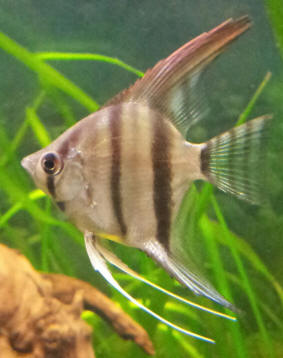
Angelfish; ID... 3/7/14
I have kept a marine aquarium in the past and i have now gone back to
keeping fresh water fish, could you please tell me what type of
Pterophyllum this is, please see attached picture, as i want to
set up a biotope with them as the centre piece to my aquarium? Aquarium
is the Jewel
Rio 300, ph 6.8 , NH3/NH4 0ppm, NO2 0ppm, NO3 10ppm. The tank is planted
with drift wood, there are 5 Angels and 3 Ancistrus... Thank you.
<Well, this is a wild-type Angelfish of some sort, or at least, a
Pterophyllum species with colours similar to those seen in wild fish (as
opposed to the tank-bred varieties like Golden Angels, Marble Angels,
Koi Angels and so on). It's clearly neither an Altum Angel (Pterophyllum
altum) which has a much different body shape, nor the Dwarf Angel
(Pterophyllum leopoldi) which has a distinctive spot at the base of the
dorsal fin between the two vertical bands on its flanks. There are a
bunch of other regional varieties sold under names such as "Peru Angels"
and "Peru Altums" and so on, usually at a premium price, and these may
or may not be true Pterophyllum scalare, the species upon which the
tank-bred Angel was largely derived from (the farmed Angel being a
hybrid rather than a true species). So, to cut a long story short, your
fish seems to be some sort of "Pterophyllum scalare" though it doesn't
seem to have the red eyes typically seen on true wild-type Pterophyllum
scalare (whether wild-caught or carefully tank bred). In terms of
biotope, the fish we call Pterophyllum scalare actually comes from quite
a range of habitats, though invariably ones with slow water flow.
Swamps, sluggish streams, vegetated riverbanks, that sort of thing.
Water chemistry is fairly variable, rather than the typical extremely
soft and acidic water favoured by, say, Altum Angels and of course
Discus. A deep (at least 40 cm/16 inches) aquarium with lots of vertical
objects (which Angels use for setting territorial boundaries as well as
spawning) is recommended. Lighting should be subdued if possible
(floating plants are ideal) but to be honest unless your Angels are wild
caught they'll be extremely tame and much like goldfish in their
readiness to settle down and even beg for food! The classic Angel
aquarium has a sandy or gravel substrate (sand is more authentic for
South America) some vertical bogwood roots and some tall plants like
Amazon Swords (not actually that common in the Amazon!) from the same
part of the world. Hope this helps, Neale.>
|
 |
Re: Angelfish
3/7/14
Thank you very much for your quick response. Just wanted to make sure on
which type of angelfish so that i can get it as near as possible to correct
biotope. There are five angelfish and three Ancistrus species, no more fish
are being added. Thank you again.
<Most welcome, Neale.> |
ANGELFISH EMERGENCY...was told bob might be able to help????
6/7/13
I have a 29 gallon Marineland night/day aquarium with a
penguin bio-wheel filter, a bubble curtain, and fake plants/decorations.
I have 4 baby angelfish that I LOVE in this tank. (Am
upgrading to 55 gallon in a month.
I used stability and prime to successfully cycle the tank 3 months ago.
My tap water ph is 8,
<High for Angels>
and so was my tank. i started using RO water (mixed 50/50 with tap water)
and lowered it to 7.9. My current readings are: ammonia (under
.25....but there),
<Mmm>
nitrites (0), nitrates (5). the ammonia is due to a mini-cycle
caused by medicating. Unfortunately, one angel either got
Columnaris or Hexamita. He jerked, shimmied, clamped dorsal and tail
fins, and looked like someone drew a red line outlining his body
underneath the dorsal fin. He hung at the top for 2 days (while
i tried heat and salt, because i hate throwing more chemicals
in the tank). I didn't know what was wrong, he was getting worse, so i
mistakenly used Maracyn and Maracyn 2 to try to heal
him, which messed up my cycle. My bf (trying to help) decided the whole
problem stemmed from me messing with the ph, and did a 50% water change
with tap water and prime only...which threw the ph up to 8.4.
<Yikes... very toxic w/ any ammonia present>
We keep trying to be good "parents", but seem to keep making things
worse!
the fish then developed a white patch on his head, in the middle of his
yellow stripe (which is what made me think Columnaris. but i later read
that it may have been caused by Hexamita...hole-in-the-head...and
actually be lack of slime). so, i next treated the fish with
parasite guard and triple sulpha.
<... please; no more medications. They're doing more harm than good>
I've also put stability in the BioWheel every other day to try to keep
ammonia and nitrites out. He seems almost cured (except the red line
remains). Unfortunately, I leave for a 7 day vacation tomorrow,
and the tank is showing .25 ammonia.
<Hide all food and med.s and enjoy your trip. Yes; don't feed, nor treat
this system further>
A second angel is slightly clamping his dorsal fin, which i think is
irritated by ammonia (using prime....they've never been exposed to any).
i won't be there to change the water if it spikes, and prime only
protects for 48 hours. I am desperate to find a product to keep my
babies safe for the week. I bought an aqua clear ammonia remover filter
insert, and also AmQuel plus and NovAqua plus because i was told it
would keep them safe for 7 days. i put fungus guard
<.....>
in the tank yesterday (per the instructions the tetra rep i called today
gave me), to hopefully clear the red line and white spot (or lack of
yellow spot) on his head, which she claimed was a secondary fungal or
bacterial problem. i am putting the carbon back in tomorrow, but am
scared about the mini-cycle while I'm gone! Could someone PLEASE advise
me how to proceed?
<See the above>
I leave tomorrow. I am a new forum member under kelly5978. I created an
album with pictures, to help show you what's going on. I know it's short
notice, but I'm begging for help! Also, if the pictures help you know
what's really wrong with him, please tell. I plan to work on the ph with
regulator or peat when I return!
Thank you, Kelly
<Bon voyage. Bob Fenner>
Re: ANGELFISH EMERGENCY...was told bob might be able to help????
6/10/13
Thanks for responding! I knew all the meds were bad!
<Mmm, they do have their place... but are way too often mis-used>
They've had nothing for 3 days, and everyone seems okay.
<Ah good>
Sparkle has nothing besides a little cloudiness on his tail where he was
nipped while sick. I took everything out (meds i mean) with a
water change, prime, carbon filter and leaving them alone.
<Very good>
The ph is 7.9. I SLOWLY (.1 every 24 hours) brought it back down with
25% RO AND 75% tap and prime. Has been for 5 days every time I check.
Since I put the carbon in, ammonia and nitrites are zero. Nitrates 5. I
understand they may still go through mini-cycle. My 3 questions:
1. I set up an automatic feeder (set to lowest setting). Did you say
DON'T feed them?
<Yes; or just barely>
I will take it down if that's what's best. I know I'm doing too much and
harming them with good Intentions.
2. Do I stop using the RO WATER? I've got such mixed feelings. 8.4 is
just sooo high for angels, but I've heard horror stories about RO water
crashes.
<I would do as you've been; mixing the RO w/ just "some" tapwater; the
latter for a bit of mineral content (necessary)>
I promise of they're alive when I return...no more medicine. I really
was trying to help. Just listened to too many people!
<Ah, my friend. In the final synthesis, each of us must decide for
ourselves. Listen to others for input; but do require that they have the
ability, present the rationale, science backing their opinions>
I do have an er tank now that I will use in the future if needed.
3. Do you advocate aquarium salt on a regular basis in an angelfish
tank, or only when sick, or not at all?
<Not at all in the majority of systems, circumstances. Do search, read
Neale's article on WWM re>
Thanks so much!
Kelly5978
<Certainly welcome. BobF>
Bob f....what to do now? 6/15/13
Bob responded to my desperate plea about how to handle my sick
angelfish on vacation. I cannot find the email, and really need
follow up help. My profile is under kelly5978. Bob advised me (very
wisely) to put my medications and food away and go on vacation! I did as
advised, and all my fish are alive and well...except sparkle. If you
read my previous questions, my angelfish was clamping and twisting his
fins, shimmying, had a red line under his dorsal fin, etc. Parasite
guard and triple sulpha seemed to cure him. Upon my
return from vacation, however, he was hiding in the tree stump. I
finally coaxed him out and he ate. He has a definite
indent or hole on his head (in-between and above his eyes) that is a
darker yellow than the rest of his head. I hate to medicate them again,
but I can't just watch him die! His tail is also jagged and he stayed
the same size, while the others grew while i was gone. The rest
of the fish have NO symptoms. I can only think Hexamita (was
incorrectly treating for Columnaris). My Lfs does not carry metro or
hex. If bob (or anyone on staff) could please advise me one more time, I
would be so grateful! Do I just hope water changes help?
<Yes; this is all I'd do>
Or start parasite guard (which has Prazi and metro as ingredients) again?
<Not a good idea to expose fishes more than once to Metronidazole. Hard
on their kidneys>
Or order metro online? I just want to do whatever I can to help him, but
know that I go overboard when left to my own devices. I'm sorry to
bother you again, but truly hope for help!
Ammonia -.25 before water change. 0 now
Nitrites-0
Nitrates-5
Ph-8.0
<I would lower this over time to the "mid 7's"... with mixing in more
RO, perhaps using a commercial (Phosphoric acid-based) pH adjuster...
ahead of using change out water. Bob Fenner>
Thank you,
Kelly5978
Re Water change confusion, angelfish troubles.
6/21/13
Hello, and thank you in advance for helping me again. I wrote a few
weeks ago, asking what to do about a sick angelfish while I was on
vacation. The advise I received was good, so I'm hoping for a little
more advise. I have a 30 gallon Marineland tank with a bio-wheel 150
filter, 5 juvenile angelfish, a Pleco baby, fake plants, a little
driftwood (recently added to hopefully lower ph), a sponge filter, and
bubble curtain. I cycled the tank months ago, but recently used Maracyn
(above mentioned sick fish), and other meds, and now get ammonia
readings. I have been told Water changes are the answer, but the angels
act funny every time i do so! They clamp fins (especially tail fins),
don't swim around as much, and seem more than just a little stressed.
<Are you saving the change (new) water up between use? I'd store it/this
for a week...>
I make sure the temp is the same, and use prime. However, i am worried
maybe I'm trying too hard to create a perfect tank, and ending up
hurting the fish I'm trying to make happy! I'm hoping if you hear my
story, you might be able to point out where I am going wrong....and help
me get my tank back on track. I love these fish, and feel like all my
problems stem from some little thing Im overlooking, or doing
incorrectly! Here are the things I am currently doing, that may be to my
own detriment.....
1. My ph out of tap is 8-8.2 (way higher than the 7.0 /straight RO water
at the lfs). I began mixing 75% tap/25% drinking water (store bought,
label states RO, ozonation). It brought my ph to approx 7.8 and I use
neutral regulator to keep it there. I recently added driftwood also. I
understand a stable ph is more important than a low one, but everything
I read about angels indicates they are more affected by ph than other
breeds.
<Not so much the cultured (vs. wild-collected ones). You have the
former>
I also bought peat moss, but haven't used it because it doesn't say
"aquarium" on the bag, so I am afraid it's not the correct kind, and I
don't know if my messing around with the ph isn't worse than just
leaving them at a high one! My kH/gH are very high, so i have to use RO
water to make any changes. My questions: what is the safest way to lower
(and maintain) ph?
<Please read here:
http://www.wetwebmedia.com/FWSubWebIndex/pHAlkAdjF.htm
Also, is it really that important to angels, or should I just leave it
high?
<... I'd keep under 8.0>
Final ph question: if you advise me to just leave it alone, how do I stop
doing the RO water mix without creating a swing?
<... measure the new water to make sure it's about the right pH>
2. As stated above, I treated a sick fish with many different medicines
(so stupid!!!!) and Am now going through a mini-cycle, which is even
more dangerous because of my high ph. I tested the water just now:
ammonia-.25, nitrites-0, nitrates-5, ph-7.8. My questions are: should I
keep changing the water daily to get rid of the ammonia, or is it just
going to keep coming back until I let it work itself through?
<Stop feeding or feed very sparingly... and hold off on the water
changes unless the free ammonia exceeds 0.5 ppm>
I'm just confused as to how "spikes work" (i was once told I leave the
ammonia until it reaches 2 ppm, then change water, but got conflicting
advise from someone else). My bf gets really upset that I spend so much
time changing out water, and believes that if I just leave it alone, the
fish will be better off. I just need a professional opinion, which I
will follow. I have tried to figure this out through research, but
everyone seems to disagree on what works! So, do I keep changing water?
Or leave them alone? Again, they seem more stressed by the water
changes, and/or the new water, then the ammonia!
3. I believe my sick fish had Hexamita or hole-in-the head. I tried many
different medicines (which I know know was very bad), and parasite
clear/triple sulpha seemed to finally work. However, a couple of
the angelfish still have white poop. Should I worry?
<Not at this point no... the feces could be due to the ammonia
presence... THIS needs to be addressed first and foremost. All else is
secondary>
4. Final question, specific to angelfish....is there any point
to a bubble curtain?
<Not really, no. Mostly for looks>
I always though it was making the water better (aeration), but I forgot to
turn it back on a few days ago, and noticed the angelfish seem much
calmer!
I've never seen them so still, just kind of floating around (....and now
I will worry that they're too calm...geez I'm a worry wart)! I have
battled tank problems and diseases since I started this tank, so I guess
I'm not sure what happy fish look like! If they're not gasping, the temp
is the same, they are all upright, and they all eat....I'm going to
assume they are happy without the bubbles. Please correct me if I'm
wrong!
<I'd leave out/off>
Sorry for the long email. I didn't want to bother you folks with 5
different emails about specific subjects, and hope it was ok to just ask
them all here. Thank you for your help! I just want the best for my
fish!
<Welcome. Bob Fenner>
Re: Water change confusion, angelfish troubles.
6/21/13
You are so wonderful for responding so quickly. The link was invaluable
information, but I want to ensure I have this right. First, the
white poop could be ammonia related, and i shouldn't worry.
<Correct>
as for the ammonia, the fish are ok in it under .5ppm, so don't change
water until then.
<Not "Ok", but better than suffering the stress of too much, too often
water changes>
Do i need to redose prime every 48 hours?
<No; not a solution and can/does forestall establishment of
nitrification>
Or is that low level not lethal?
<... please search, read on WWM rather than writing what is gone over
and over... ANY NH3, NH4OH present is debilitating>
I'd never heard of holding the new replacement water a week before using.
<.... read on WWM>
I'd be afraid of bacteria, but will choose your knowledge over my
intuition any day! When do I add the prime? Right before adding to tank?
Here's my understanding and questions based on what I read about ph...
the RO water is only lowering the kH/gH, NOT the ph? And the lower
ph is actually just unstable ph, that fluctuates, unless I add the
buffer? If I am correct on that point, then am I using the correct
product -neutral regulator- in my effort to lower ph and soften water?
One of your comments on a different post made me think the "buffer" is
to keep a ph from falling, which is the opposite of my problem. I
know the cichlid salts raise ph, and discus buffer lowers. All i want is
neutral and stable. So, should i stop using the neutral regulator until
i lower the kH and ph to the correct level, and then add it to keep it
steady? And, what's the best way to accomplish lowering kH?
<See WWM...>
I know the ph up and down products are no good, but isn't there just an
easy way? All these calculations leave way too much room for an error on
my part! Are pillows any good? I use an API master kit for the reg
readings (Ammon, nitrites, ph), but I use the strips for kH/gH. My
results are darker than the darkest level. I probably have no hope at
lowering this ph (or kH) but My fish ARE nervous and shimmy
sometimes as if uncomfortable.
And after reading your links regarding how ph works in the wild, and how
hard it is to try to manipulate a little aquarium, I'm just wondering if
I'm fighting a losing battle.
<Not>
I love angelfish, and don't want a different type of fish, but I sure
don't want to keep my fish in water they hate! The link helped me, but
led to more questions. I'm sorry to bother you, but I'm truly trying to
understand and do this right. Im sure my confusion is apparent and
irritating. sorry. Are there any links that walk you through safely
lowering stable ph? With which products to use? Also, would live plants
help lower kH/ ph, or give me even more problems?
<Will definitely help>
After reading more, I see that I could possibly just use ALL RO water,
and a buffer to create a neutral kH/gH (and ph won't matter). How slowly
would I have to do this? And if I achieved it, would it remain stable?
If so, would I add buffer only for the amount of replacement water? Or
the equivalent of the entire tank again?
I think I understand now that kH is what really matters, and softens the
water. Then, a buffer is added to keep ph stable. Is this right? What's
the best way to accomplish this?
Again, sorry if I made your head spin with all my questions. My angels
are gorgeous, and I truly appreciate your help!
Kelly5978
<Take your time... read. B>
Re: Water change confusion, angelfish troubles.
6/21/13
Sorry, forgot a question....does the API master drop kit measure free
ammonia? Or all ammonia? How do you know the difference?
Kelly5978
<... use your search tool w/ the string: "API ammonia test kits, total
ammonia?"... Read re Salicylate tests... IF you're using Prime, you'll
want to get/use SeaChem's test for both free and total... >
Freshwater Angelfish and hard water 12/4/12
Hello:
<Hi Judy>
My husband and I just moved from Georgia to upstate NY, We transported
one large angelfish in a five gallon bucket. We arrived at his parents
house where I put the angelfish in a ten gallon tank that we set up, as
we were there for a week. My husband's parents live in Utica, NY and
have a ph of 8.8 and a really low gH/kh. The gH/kH would suit Discus.
The angel did great. We transported him down to our apartment in
Schenectady, NY in the bucket again. I tested the water there and the ph
was 7.2 but the gH/kH was off the charts. It was tested with one of
those API test kits and it took about 12 drops to get the gH tester to
change color and 10 drops to get the kH to change color. Obviously the
apartment does not even have a water softener. We were so
exhausted we ended up just putting the fish into the heated 46 gallon.
This was two days ago and he is acting normally and eating with gusto.
I am wondering if a gH/kH that is really high will lessen the life span
of angelfish or lead to disease? Should I rehome him or just leave
things as they are if he happens to be fine with it?? He is alone in the
tank. Would that cause stress? Would he be better off with a few
Glowlight tetras?? Thank you for your time with my questions. I am
shocked at the difference in water readings between places that are
close together geographically
<As it happens, I have water that might actually be even harder and more
alkaline than yours. I know a lot of people, myself included, who keep
angelfish in local tap water. Most of the angelfish you can get are not
wild caught, so they tend to be a lot more forgiving than they would be
if brought in from the wild. The important thing here is
stability, both in hardness and in pH. Yeah, the very hard water
might make them a little more susceptible to illness with everything
else equal, but as long as the tank is well maintained and stresses are
kept to a minimum, this fish should have a full life. I would
actually be a lot more worried about Utica water because those
conditions would indicate a lack of buffering that could give you wild
pH swings. The Schenectady water looks like it should be stable.
If the fish has not been in the tank long, you might be able to get away
with putting a few more similar-sized angels in there (after quarantine
of course), or removing the current fish and reintroducing it with the
imports after rearranging the tank. This tank should be large enough to
allow more than one territory assuming you have it arranged with that in
mind. You could try the Glowlight tetras, but there is a chance
the angel will be aggressive toward them. Angels can be very nasty
when they put their mind to it. On the other hand, in general, tetras
are very fast and if you move a school of maybe eight in, the group
might do just fine. The angel should be okay on its own, too.
You have a lot of options here, but I don't really think your fish is in
any danger.
- Rick>
Re Some questions regarding Angels... Sys., repro.
10/21/12
I spoke with the person who keeps/runs Angels plus. He told me that his
Manacapurus are kept in hard water/wild caught fish and have spawned for
him. ( though he wont tell me the ph he says my water would be much
better then what he has,) Should I be wary of this. You told me my water
was fine so I assume it is.
<... likely so>
The photos on his website look great but could the spawns have
reproductive/health issues from hard ph, ect.
<No such word... etc. is a contraction for et cetera res>
Another thing If I do get the 2 Manacapurus I plan on getting to pair up
and breed. What do i do with the Synodontis catfish/ Rummynose tetras?
will they harm the spawn/fry?.
<The Mochokid may well consume them... I'd remove all, or the
parents/spawners to elsewhere... This is gone over and over...>
What filters are good for breeding tanks?,
<... see WWM re>
I know power filters would suck up free swimming fry, maybe its best to
just start with as juveniles the same filters I'd use in the tank in
case they breed as adults. Steve did tell me he has seeded sponge
filters to cycle tanks much sooner then the 6 to 8 weeks you said would
cycle the tank. Although I think to be wise I'll take my time cycling.
<Yes>
Another thing he said in his site that black worms live are not a good
idea to feed angels as they might contract a disease, is that true.
<See WWM re this as well... the search tool on every page, the indices.
Bob Fenner>
Angelfish Tank 10/7/12
I am redoing my 72 Gallon bow front and want to set it up primarily as
an angelfish tank.
<Should be a nice setup.>
My questions are -
How many angelfish could I fit as adults? I was thinking somewhere
between
6-8 and can rehome extra males if needed for compatibility purposes.
<I'd be conservative here and go with 6, but if you have good options
for rehoming you might start with eight or ten and pick the six that
develop the nicest colors. You probably won't be able to sex them early
anyway.>
Could I also accommodate a large shoal of Corydoras and larger tetras?
<The Corys probably, as long as you have places for them to get away
from the angelfish. I think other species depend on how densely planted
the tank is. Angelfish get territorial, especially when breeding, so
anything that can't hold its own is at risk, and anything that can hold
its own could injure the angelfish. I've had an angelfish take out a
Bristlenose Pleco.>
Are there any other species who could work well?
<Bristlenose Plecos work pretty well provided you give them places to
hide where the angelfish can't go. I'm using an inverted terra cotta pot
with a door cut into the side. That works well because the angelfish is
way too big to fit.>
I have read numerous conflicting reports of compatibility and am
wondering what my tank could comfortably hold. I was especially
interested in a Gourami or two but am unsure based on what I have read.
<A big enough tank that is densely planted gives you a lot more options
than an open tank. Best would be to introduce everything you want at a
young age and at the same time after a fishless cycle so that nobody is
a newcomer aka intruder. - Rick>
Keeping manacapuru Angels./how long
9/16/12
I was thinking of setting up a 55 gallon tank next year sometime and
buying 2 sliver dollar size Manacapuru Angels to stock it with after
cycling/etc.
I've asked various source's including the dealer, Angels plus. and A
World of fish and they both told me the angels will not outgrow the
system. I do have some questions however.
Sense these are the offspring of wild caught Manacapuru Angels is my PH
of 7 okay?- because of my PH being 7 do you think I'd be better off
getting their Koi angels instead. Ro water I could get at my LFS but its
expensive.
It has a pH of 5.
<Let's ask the question again, this time focusing on hardness (pH itself
isn't that important). If you have soft to moderately hard water that
has a pH in the range 6.0 to 8.0, you should be fine keeping any mass
produced or farmed Angelfish variety. Wild-caught Angels are
substantially more demanding and need soft water (10 degrees dH or less)
but again the pH isn't that important. "Rio Manacapuru" or "Red
Shoulder" Angels may or may not be wild-caught (F0 are wild-caught, F1
fish are descendants of wild-caught fish, F2 descendants of those, and
so on). Use your common sense here. F0 or F1 specimens should be kept in
soft water with a pH around 6.5 to 7.5. But F2 specimens may be somewhat
less fussy, so you could get away with slightly harder water. But
whatever else these "Rio Manacapuru" Angels might be, they do seem to be
Pterophyllum scalare, and that species is fairly adaptable so don't fret
too much. You shouldn't need to go with very soft, very acidic water in
the same was as you would wild-caught Pterophyllum altum or wild-caught
Discus. Of course, "Rio Manacapuru" Angels aren't bullet-proof fish and
you wouldn't want to keep them unless you'd had some experience of
keeping cichlids generally and Angels or Discus generally. If this is
your fish time keeping Angels, then plain vanilla Silver Angels look
very similar and would be much easier to keep. Some of the fancy Angels
are also quite robust (Marble Angels for example) but for the most part
if they look flimsy (Koi, Albino, etc.) chances are they *are* flimsy,
so shop accordingly.>
The filtration I was told to get for this system are canister, they as
follows. Rena xp3 and HOB Ac70 the heater should be a hydro in line 200
watt heater. What temp should I keep the young at?.
<Not too cold; 26-28 C should be fine.>
Finely if I do a fish less cycle how long would that take before I could
add the Angels.
<Angelfish shouldn't be kept in any aquarium less than 2 months old.
Install the filter, get the tank cycled (which takes 4-6 weeks) and then
add some suitable companion fish (Corydoras sterbai is a classic "warm
water" Corydoras ideal for use with Angels, but Brochis splendens is
cheap and widely sold and works well) and wait and see everything is
okay. After a couple weeks, add some dither fish (Rummynose Tetras are
perfect) and then again, leave for a few weeks. You can then add the
Angels. If you're keeping the wild-caught fish, you may want to be even
more cautious about stocking the tank. Cheers, Neale.>
Re: Keeping manacapuru Angels./how long 9/16/12
Thanks. I'll get the true hardness tested at a later date.. I will see
what Vanilla sliver angels look like too.
<"Vanilla" isn't a breed. It's an idiom. What I mean is ordinary Silver
Angelfish. 3-4 black stripes, red eyes, silver body.>
In a 55 gallon stocked with 2 Angels plus other fish how often and how
much do I change the water.
<20-25% every week is ideal.>
Also what type of Syphon do I use to help keep water messes to a Min.
<I use a regular hosepipe. But you can buy special gravel cleaner
siphons at aquarium shops. Cheers, Neale.>
Question about ph and angelfish
8/14/12
Hello:
I have a tank with two light colored angelfish, 46 gallon. The ph in the
tank reads 7.8. In the past I tried to keep black angelfish.
<Notoriously delicate; something about the inbreeding required
to "fix" the black colour. Oddly enough, they also have a reputation for
being overly aggressive! At least, they did back in the 70s/80s when
they were at the height of their popularity.>
I had six, but not all at once, and everyone of them died within a few
days.
<A lesson there… First question though: How big were they?
Angelfish with body lengths less than, say, 5 cm/2 inches are markedly
more delicate than bigger specimens. The coin-sized specimens
widely sold can be worth buying, but are often much more difficult to
acclimatise to your aquarium than expected. So, with delicate strains,
there's much to be said for buying half-grown specimens.>
Any other type of fish I had lived and thrived even a black lace which
is not completely black. The LFS guy that ordered in these black fish
tested our water and said that our ph was too high for any angelfish.
<Some truth to this, but not much. Wild Angelfish certainly come from
somewhat soft, acidic waters, though not necessarily the same very soft,
mineral-free, blackwater favoured by Discus (at least, this is true for
Pterophyllum scalare, the majority ancestor of the Pterophyllum hybrid
sold in pet stores). Anyway, the hybrid sort we see in pet stores
doesn't come from anywhere because it's a man-made fish, and like many
hybrids, it's much hardier than any of its ancestors. Provided the water
isn't crazy-hard, it can do well; here in England, Angels are often kept
successfully in "liquid rock" around the 20 degrees dH mark, pH 8-8.2.>
I did read that the people at angelfish plus in Florida who have a huge
hatchery breed angelfish at a ph of 8.5.
<Quite possibly. It is important to realise (and many people don't) that
pH isn't the critical issue; hardness is. Fish don't like sudden changes
in pH to be sure, but most of the Amazonian fish we keep in community
tanks are just fine between pH 6 and pH 8. For the most part, if you
moderate the hardness you can ignore the pH -- I have rock-hard water in
my tanks, so mix it 50/50 with rainwater, and don't really worry what
the pH is.>
They said that it is all about what the fish has evolved in. I do know
that the wild caught live in 6.8-7ph.
<And the rest… for some of the species like Pt. altum, we're talking pH
5-6!>
My thoughts are that the black angelfish are just too delicate and need
the low ph to survive.
<Unlikely the pH is an issue, but do check your hardness and act
accordingly. If you do something like change the pH directly (with
commercial pH-down products) you will make things even worse because an
unstable pH is even worse than the wrong pH.>
Is this true?? Thank you
<Most welcome, Neale.>
Re: Question about ph and angelfish (RMF, anything to add?)<<Nope>>
8/14/12
Hello:
The black angelfish were almost adults and I need to check water
hardness.
Thank you!!
<Most welcome. Cheers, Neale.>
Re: Question about ph and angelfish (Bob, would you check my theory here
re: alkalinity?)<<Yes, comments added>> - 8/17/12
Hello:
<Hello again Judy,>
I am the one with the two angelfish in the 46 gallon with the high ph. I
can't find a kH/gH kit around here, so I took a water sample to the guy
that sold me the black angelfish that died. He tested the water hardness
with a test strip, one of those 6 in 1 deals.
<Okay. These are trustworthy enough for "ball-park" figures like whether
there's detectable nitrite or if the pH is above or below 7, but you
should be aware they're somewhat difficult to read accurately and
consequently not good tools for accurate measurements.>
He said that our water is very soft, (we do have a water softener),
<You are using water from a domestic water softener in an aquarium?! You
really shouldn't be, for the same reason you shouldn't drink that
softened water either -- domestic water softeners don't really soften
water, they replace temporary hardness (= carbonate hardness in aquarium
terms) with sodium salts. That's fine for washing, but not good for
fish. Use the non-softened tap, usually the one over the kitchen sink,
that your installation engineer probably set aside specifically for
drinking water.>
alkalinity is high and ph is 8.4.
<Well, this doesn't make sense at all. Alkalinity is temporary hardness
(I believe) and precisely what your water softener is meant to be
removing!><<Unless the alkalinity is coming from elsewhere? Very soluble
natural gravel? Shells, coral skeletons as decor in this tank?>>
He told me that my only choice was to lower ph with ph Down or ph
correct,
<You shouldn't actually change pH directly, EVER, but instead ensure you
have the right hardness for your fish, and only if the carbonate
hardness is low, then use an acidic pH buffer to steady the water
chemistry at 6.5 or 7. Normally hard water (at least, water with high
carbonate hardness) maintains its own pH at around 8 without much effort
from the aquarist, assuming regular water changes. Let's remind
ourselves that (freshwater) fish aren't overly fussed about the precise
pH, but they do need a steady pH; your Angels are fine between pH 6 and
8, so long as its steady. That your pH is 8.4 suggests a very high level
of carbonate hardness, so my guess is you ARE using the "un-softened"
tap/faucet without realising it.
Mail order a (liquid/drops) carbonate hardness test kit -- it's probably
the most useful single water chemistry test kit for the freshwater
aquarist. What you're after for Angels is a carbonate hardness between
2-10 degrees KH. As I've stated already, the precise value doesn't
matter much.
Now, once you have a carbonate hardness reading, you can decide what to
do.
If it's high, say, 12 degrees KH, then a 50/50 mix with rainwater or RO
(not domestic water softener) water will give you a carbonate hardness
of 6, and likely a pH around 7.5. That's PERFECT for farmed Angels, and
will be nice a steady between water changes, so there's no need to add
any potions. Easy! Collecting rainwater obviously costs nothing once you
have the water butt and have cleaned up your guttering (this is how I
get zero hardness water, England being a great place for rain if nothing
else!) but RO water doesn't cost much if you buy it from a good aquarium
shop in bulk.
Under-stocking tanks and avoiding overfeeding ensures best value from
each water change (i.e., you keep nitrate below ~20 mg/l and pH doesn't
drop too much). Unless I was keeping a lot of tanks or doing a lot of
water changes, I wouldn't buy my own RO filter -- they're expensive to
buy and expensive to run.><<Not compared w/ other technologies here in
the U.S.>>
but that is not a great idea due to the fact that you have to do water
changes. I have Malaysian wood in the tank and it turns out that the
tannins make little dent in ph. I think that the only thing to do is
accept the high ph. My question is are those test strips any good?? Is
high alkalinity bad for angelfish or is it like the ph issue??
<<Both can be an issue; particularly w/ black angels, small, challenged
specimens. As Neale states, best to have neutral to slightly acidic pH,
moderate GH/KH>>
Thank you
<Hope this helps, Neale.>
|
4 Angelfish, FW, comp., sys.
6/15/12
Hi Neale, how are you? mid term already?
<Been and gone.>
so regarding the below situation I had told you about, now that the eggs
disappeared (died), the two black Angelfish have turned against the
marbled one, (the father of the eggs) and they continuously attack and
harass him. He is always cornered or hiding behind the plants, I feel
sorry for him.
Is this normal?
<Yes. Angelfish are cichlids. That's something we often forget.
Like all cichlids, territorial pairs can be venomous in their aggression
towards other fish, including their own species. As a very
general rule, single Angels are easy to keep, and mated pairs are
usually stable and well behaved. But if you have 3, 4 or 5, you're
playing a lottery. You need at least 6 before you can trust groups to
school together most of the time.>
Now, our new aquarium arrives next week, its going to be a 47" x 19.5" x
15", 52.83 gallons; will this ease the fights?
<More space will surely help.>
Question on the new aquarium, at the bottom corners, left and right, I
will have two "sand-boxes" (2" tall glass divisions 4" x 8") built
within the aquarium, one for each of my Striped Raphaels, I intend to
put some sand in them so they can bury and do their thing.
<Understood.>
Which kind of sand you recommend? which you don´t, and any kind of tip
will be welcome,
<Avoid any sand that's sharp or abrasive. Also avoid calcareous sand as
that'll harden the water and raise the pH. Smooth silica sand is good,
chemically inert and cheap. In the US, it's often sold as pool filter
sand.>
as always, thanks a lot Neale!
Lorena.
<Most welcome, Neale.>
.png)
.png) |
|
Freshwater angelfish and black lights UVA 438nm f15t8
5/18/12
Hi gang. Just wondering if anyone knows pros vs. cons with freshwater
angelfish and using black lights at night. I have read many articles and
have seen many mixed reviews. My angels are beginning to pair off and
some are starting to spawn and I didn't want to disturb their breeding
process or be detrimental to their health at all. Please help with any
suggestions or knowledge available. Thank you!
Heather
<Not sure there's any compelling arguments either way. Fish can see
slightly into the UV range, so what seems invisible to us might not be
to them. Personally, I wouldn't use them. On the other hand, there are
plenty of "moonlight" tubes and LEDs available that don't disturb
nocturnal fish but provide enough light for us to see what's going on.
Dim red tubes and
LEDs work great, too. Cheers, Neale.>
Hex tanks and angelfish 4/15/12
Hello:
<Salve,>
I was wondering if anyone keeps angelfish in hex tanks??
<Have seen this, with juvenile specimens especially.>
I have seen hex tanks as big as 65 gallons, but I think that would be too small
for the usual six angelfish.
<Correct. A pair might work though, if you could be sure it was a pair.>
Are the hex tanks just worthless for all fish??
<Almost worthless, yes. If you treated them as "nano" tanks and stocked with
nano fish and shrimps, somewhat scaled upwards for a 65-gallon system, an expert
fishkeeper could have some fun. Cherry Shrimps, Badis and Dario spp., Kuhli
Loaches and Dwarf Rasboras could be used to create a fun system, perhaps planted
with bogwood roots and Java ferns to create a vertical display in the centre.>
Someone told me that they are more likely to leak.
<The better sort are made from Acrylic in one piece, and these shouldn't leak at
all under normal circumstances. Glass ones, yes, because they have more silicone
joins -- and these are weak points on any aquarium -- would be proportionally
more risky than a rectangular glass tank with fewer joins.>
Thank you!!
<Cheers, Neale.>
Six freshwater angelfish and tank size 2/6/12
Hello:
I was just wondering what is a good size for six freshwater angelfish?
I am assuming a 90 gallon, but I heard of someone keeping them in a 75
gallon.
Thank you!!
Judy
<Either of these tanks should work. Angelfish form territorial pairs
when breeding, but other times can be quite social in largish groups.
Pairs hold patches about 30 cm/12 inches radius around their spawning
site. No guarantees that they'll tolerate other Angels though, and
many fishkeepers will have a story about a psychotic Angel. Whatever
else they are, they're cichlids in good standing. Cheers,
Neale.>
Six freshwater angelfish in a smaller tank
2/7/12
Hello:
I was wondering if six angelfish could go in a 46
gallon, with HUGE filtration,
<Fine until they become sexually mature; of a size to be sexually
mature.
With cichlids, territoriality is an issue, but so is their acute
sensitivity to nitrate (anything above 20 mg/l).>
like an Aquaclear 110 and a sponge filter for a 40 gallon inside, or is
it also a space issue?
<Yes.>
I am thinking it is an issue of space due to aggression. Thank
you!!
<You'll have six youngsters, but once they pair off, the tank
will adequate for that pair, and the remaining will need to be
re-homed. Cheers,
Neale.>
New
Angelfish, hlth./env. �� 10/12/11
Hello Crew,
<Hello Rose and Peter, Sugam with you today>
I started a 45g tall tank in Feb, and have used your site as a
reference whenever I needed help.
Normally I can find the answer I need no problem, however today I am in
search of some help and have been unable to find a similar situation
amongst your archives to help.
<Happy to assist as best I can>
We have a 45 gallon tall tank (24" H x 12" W x36" L), a
steady 78 degree, planted, with a Rena XP2 Canister filter (carbon
changed monthly), Flora Sun Light, Whisper 60 air pump, with a 24"
wand and action air decoration.
My pH is 7.0, Ammonia is 0 ppm, Nitrite is .25 ppm
<this is toxic! Since your tank has been up and running since Feb,
the Nitrites should be down to zero. How did you cycle this tank and
what are you using to test your water>,
and Nitrate is 10 ppm. We do a single 10 gallon water change a
week.
<what water are you using for your water changes? Do check it for
nitrites>
Our school up until yesterday consisted of 1 panda Cory, 3 skunk Cory,
and 2 bandit Corys (all about 6 months old and no bigger then
1.5") and probably about half a dozen snails that must have been
eggs that hitch hiked on my last addition of plants.
They have been a great yet unexpected addition, as I do have some algae
growth<.> <How long have you had the snails and have you
identified the species?> Yesterday my boyfriend added 4 small
(quarter size) veil angelfish ( 2 each of marble and gold, they came
from same tank in store), 3 upside down cat fish (about 1" in
length each) and 8 neon tetras about .5" in length each, as a
surprise for me Everyone ate dinner when they were fed earlier, a
mixture of crisps, pellets and brine here and there.
<That is a lot of life to add in a single day. Please be vigilant of
you water parameters and rectify your nitrites at the earliest. Any
amount is toxic and the new additions are only going to accentuate the
problem. The angels alone, at adult size are going to be a handful in
this tank and as such, I do believe you are quite heavily stocked. Do
keep in mind that they are cichlids. While not as aggressive as some
other cichlids, I wouldn't place them with small fish such as neon
tetras. Too much of a risk in my opinion.>
The angels are swimming around at the surface, with their lips kissing
the surface ever since I took them from their bag and released in the
tank. I have had 2 angels in the past one <so>I know it normally
takes a day or two to come out from hiding in a corner. The tetras,
also seem to be coming up and gulping air here and there, but nothing
like the angels who are staying at the surface. The upside down cats
are hanging out behind the filter output tube/wand.
Are they acting this way because there is not enough O2 in the water,
<could well be the case but oxygen levels are easily tested. I would
imagine the nitrites are a major contributor here> cause I
introduced too many new fish at once <also likely to add to the
problem as stated above>,
or is there something possibly wrong with my water.<as mentioned
above>
Thank you for taking the time to read my question, any advice is
greatly appreciated.
<Please do read here regarding caring for the
angelfish.
http://www.wetwebmedia.com/fwsubwebindex/fwangelfishes.htm
Please also use the search feature to research the other species you
have in your tank. Do work towards rectifying the nitrites at the
earliest and manage the levels through dilution. As for your query on
oxygen levels, do secure a test kit or take a water sample to your
store for testing. A rather simple guide for oxygen levels is surface
agitation. Typically, if there is sufficient movement on the surface of
the water, oxygen levels tend to be higher. This, however, is just a
basic indicator and I do recommend testing.>
Rose & Peter
<Good luck! Sugam>
Re: New Angelfish, hlth./env. - remedial action 14/10/11
Sugam,
<Hello again, Rose>
The Nitrites have been 0 from Feb-until this week- we test weekly and
that was the first time they ever registered.
<Aha good! Likely because of the bioload added>We use a API
Master kit to test all the levels. We use our tap water, we fill 2
water jugs, let them sit for 5-7 days before adding to tank. <Good
practice, letting it sit. I assume you continue to use some water
conditioner to neutralize other pollutants as well?>I called the
location I got my plants from... and the snails are offspring from
whatever they have in their tank... all they could tell me was they
were "plant safe" <Okay, just watch keep an eye on them.
The reason I asked is I have had hitchhiker snails multiply like crazy
in my tanks in the past. You can read about freshwater snails here -
http://www.wetwebmedia.com/fwsubwebindex/fwsnailfaqs.htm>I just
measured the tap(city) water tonight to see if there is nitrite in it,
and it reads as 0ppm, we did a 15 gallon water change (what we had
already set out for this weekends water change, and we filled the jugs
back up so they are ready to go if we need to do it sooner) <Sounds
good, how did the nitrites read after?> When we started the tank in
February (weekend of Valentines Day), we filled it with 40 gallons of
tap water that had sat, plus 5 gallons straight from the faucet. We
added half the amount of salt that the API carton called for (4.5
tablespoons instead of 9), and 45ml of API Stress Coat+, we then let
the tank run/cycle for 3 weeks, at 1 week I added a 12" x 6"
x 3" wood that I had soaked for a week, changing the water out
everyday to get rid of some of the tannins. I choose to add the wood
not only for aesthetics, and a hiding place for the fish but because
or<our> pH was high, for the first 2 months or so, despite
treatments, & using reverse osmosis water for the water changes it
wouldn't come down. <That's interesting, likely the source
water has high pH.> At three weeks we added 3 Corys and some tetras,
the pH was too much for the tetras and they didn't last more then a
month but we still have the Cory's and the pH has also leveled out
to a 7. Since doing the water a couple of hours ago, all the fish have
stopped bobbing at the surface, except for one who periodically goes up
for a minute then goes back down to mid tank. The nitrite reads less
then .25 ppm. <Excellent! They should read 0 so keep testing over
the next few days and ensure they get back down. Glad your problem
seems to be sorting itself out. Do keep in mind that the water change
has likely helped in two ways - for starters, it has diluted the
nitrites which, I suspect, were the cause for the behavior you
observed. The process of pouring in new water has also likely improved
the oxygen levels in the tank. I would be checking both the parameters
over the next few days as the water starts to stabilize and age. You do
sound like you are on the right track and I am certain your fish
appreciate the efforts you are making to keep them health and
happy!>
Thank you <Anytime!>
Have a wonderful evening! <And you>
Rose & Peter <Sugam>
Re: New Angelfish, hlth./env. - remedial action 14/10/11
<Hi Rose>This morning I woke to the fish back at the surface with
a .25ppm reading on the nitrates. <Did you mean nitrates of
nitrites? I assume the latter. As I mentioned in my previous email,
this isn't entirely unexpected. Since a significant bioload has
been added to the tank recently, a mini-cycle may well have been
triggered. Are you reading any ammonia? While there are commercial
products in the market that will help you bring nitrites under control
and you may well consider them, I prefer to strike the balance through
dilution. Have had a decent experience with some of the Sera bacteria
starter products if you are inclined to go that route.> Peter was
getting ready to do another water change as I left. <Try not to
change too much water at once. I find it is better to do smaller
quantities more often.> Besides the water changes is there anything
we can do to help remedy the situation? <As mentioned above, I would
suggest staying on top of the testing and water changes until this
mini-cycle runs its course. Please also look at cutting down and even
stopping feeding completely for a few days until you have things back
under control. Don't worry, fish can typically go a few days
without feeding. Whether the food is consumed or wasted, it is still
adding to the problem.>Thanks Sugam!
<You are welcome! You do seem to be vigilant about the conditions
and I hope things come back under control shortly. Please consider how
you are going to address the potential issue of the angels getting to a
size to harm the tetras.>
Re: New Angelfish, hlth./env. - remedial action 14/10/11
Everyone seems to be doing better, we did have one loss.<Sorry for
the loss Rose but keep at it and as conditions improve, the fish will
get better. As long as the exposure is not long term, the chances of
them making it through are pretty decent.> Nitrites, and all other
levels are holding. <Glad to hear it. Please stay on top of it till
things stabilize.> Thank you for all your help and support. <Glad
to have been able to
help!>
New tank Set up, FW
Angels 7/5/11
Hello Everyone,
<Hi Dori>
I��ve been researching for a while and your site has been
most useful (thank you) however, I still don��t feel I have
the answers I would like. So your advice to my particular situation
would be great!
<Ok>
My son-in-law gave me a 50-55 gal. tank. (48�� X
12�� X 21��). I want to set it up for freshwater
angel fish. I��ve had a freshwater tank before and always had
an algae problem. I��ve set up the tank on a solid wall away
from windows and direct sunlight.
<Good>
After reading posts on your website for two days I have a good
understanding what��s required and which fish are compatible.
I��ve purchased a new bio-filter which hangs on the tank,
filled the tank and let it run for a couple of days. I thought we were
ready to purchase fish.
<Mmm, no... better to cycle the tank w/o livestock...>
I took a tank water sample with me to the pet store. They tested it and
pH was nearly 0.
<Mmm, no... perhaps 7.0... "neutral"... i.e., neither
acidic nor alkaline>
I live in a valley in the middle of a forest in NW PA, USA. We have a
community gravity fed spring water system. No treatment center, no
chlorine, the water I receive in my house is the same as the water
coming off the hill. I do not have a filtration system on the
house.
Readings from my faucet
GH is 0 ppm,
KH is 0 ppm,
pH is below the lowest reading on the test strip which is 6.0, <Mmm,
a good idea to add a source of alkalinity here. Please read:
http://www.wetwebmedia.com/FWSubWebIndex/pHAlkAdjF.htm
and as much of the linked files above as you need to understand>
NO2 is 0 ppm,
NO3 is 0 ppm.
On the advice of the pet store, I purchased 20lbs of crushed coral,
rinsed well and added it to the midsize gravel.
<Mmm... I wouldn't do this, use this as a pH adjustment
technique in general>
24 hours later; water is nearly clear,
Temperature is 80°F,
GH is 0-30 ppm,
KH is 0 �� 40 ppm,
pH is 7.0-7.5,
NO2 is 0 ppm,
NO3 is 20 ppm.
<This last is puzzling. Where did the nitrate come from?>
I��m using API 5in1 test strips. I know all of these levels
will adjust some once fish and plants are introduced and they create
their own little bio-world.
Questions:
1. How long should I wait to introduce the fish and plants? What is the
recommended progression of introduction or can I add all at the same
time?
<Please read here re cycling: http://www.wetwebmedia.com/FWSubWebIndex/fwestcycling.htm
and the linked files above... Livestock are best added in
"batches"... some hardier organisms first... the Angels
likely last>
2. I read the crushed coral will breakdown after time and need
replaced. What is the time frame for breakdown?
<Likely several months, a year or more. You'll be able to tell
in time... via testing... let's say weekly, during regular
maintenance (e.g. water changes)>
3. Based on the before and after readings; are there other water
treatment options I should consider before adding freshwater angelfish
and compatible companions?
<Mmm... well... not really>
4. There are so many beautiful angelfish. I��ve read you
recommend 4-6 angelfish because they are schooling fish, do they have
to be the same variety?
<They do not have to be the same; though most all commercially
available Angels are the same species (actually di-hybrid cross). This
is somewhat similar to domestic dogs, or cats... Though different
"breeds" they are potentially inter-breeding>
5. Any other recommendations or suggestions you have?
<To enjoy the process; keep an open/inquisitive mind... Keep asking
questions, reading, sharing>
There are a lot of advice sites on the www, but I like yours. Your
answers and advice are thorough and you��re not afraid to
tell it like it is. I have enjoyed reading some of your posts. I will
be anxiously awaiting your reply.
<Thank you for your earnest input. After a lifetime in the trade,
hobby and some related sciences to the interest (ornamental aquatics),
it was and is my desire to share w/ others, have friends do the same...
to aid their successes>
Thank you in advance for your time and consideration.
Sincerely, and best regards,
Dori
<And you, Bob Fenner>
angelfish
torture or not 1/24/11
I am sorry Neale I have one more question on a completely different
subject. I have one small angelfish (along with other angelfish and
tetras) in a 20 gallon aquarium and I was wondering if it would
be cruel to trim his side fins. They have been getting long
and droopy and slowly been effecting his swimming. I have no reason at
all to hurt my fish but I just don't want him to have a struggle
moving around my tank. Would clove oil hurt him because I heard that it
can be used to sedate fish. By the way, I really appreciate the helpful
answers you have given me !
thank you once more,
><>
Tavian
<Yes, this would be extremely cruel Tavian. Not only cruel, but very
likely to result in a secondary infection such as Finrot. Don't do
it! Angelfish should be kept in tanks with at least 25 cm/10 inches of
water simply because of their shape. A "long" 20 gallon tank
may not be deep enough, but a "deep" 20 gallon should be
fine. Long-fin Angelfish invariably have problems swimming and I do not
recommend them. The standard Angelfish with normal length fins usually
manage to swim about very well, provided the
water current is not too strong. Cheers,
Neale.>
Angels and New Tank
12/15/10
Hey Guys,
<Hello Davina,>
I have used your site before and had great results. I'm hoping you
can help again. I have set up a new tank (28g, sand substrate, 30g
Fluval filter, heater, and a silk plant) . It cycled for about 4 weeks.
during the cycle stage I had an issue with a white fungus on my suction
cups and air tubing which has been dealt with and is no longer a
problem.
<How did you cycle the tank? Simply running it empty *isn't*
cycling. To cycle the tank there *must* be a source of ammonia. Some
folks use ammonia solution from the hardware store to raise the
concentration in the tank to 2-5 mg/l once per day. Others use small
punches of flake food. Either way, there does need to be something the
bacteria can "eat".>
I tested the water and everything was normal. I put in one of my Neons
for a day to make sure the water was fine.
<An odd choice. Neons are Angelfish food, and they also require
cooler water than Angelfish. Neons need 22-24 C/72-75 F, whereas Angels
are kept between 25-28 C/77-82 F. In any case, when adding one batch of
fish after a second batch of fish, you should leave a gap of at least
two weeks between each batch of fish. It will take several days for any
problems to be apparent, and two weeks or more to be sure everything is
stable in terms of pH and nitrate levels between water changes.>
After 24 hrs I put him back in his original tank and transferred the 2
angels, yesterday morning, that the tank was intended for. I woke up
this morning and they were both dead.
<Sorry to hear this.>
water levels are reading nitrite and nitrate at 0 and ammonia at
.25
<Dangerous; indicates inadequate filtration, perhaps because the
filter wasn't mature yet. The fact you have zero nitrite and
nitrate further supports this idea, because the bacteria that produce
nitrite and nitrate
aren't yet present in sufficient numbers.>
and the pH is reading 7.6 and the temp is sitting at 70.
<Much too cold.>
I don't know what I have done wrong. I have had these angels for
about a year now. They were both female and about 2" in body
diameter (not including fins). They have bred together on multiple
occasions (although not successful obviously). Can you tell me what may
have led to they death?
<See above.>
There was no strange behaviour from them either. Thank You soo Much
:)
<Hope this helps. Cheers, Neale.>
Angel fish in a 20 gallon long 06/09/10
Hello:
<Hello,>
I was wondering if it is possible for a 6 inch freshwater angelfish to
be happy in a 20 gallon long tank,
<In terms of water quality, then yes, it's do-able, but if the
Angelfish is so "tall" its fins are dragged along the bottom
of the aquarium, then it won't be terribly happy. Most of the
common Angels sold only get to about 10 cm/4 inches long, and maybe 12
cm/5 inches tall. But if you have a deep gravel bed for plants, you may
not have much more than 20 cm/8 inches of water depth, which would
really be too little for Angelfish. So you'll have to use some
common sense here.>
with four fancy male guppies??
<Potentially Angelfish food, either whole or one bite at a
time.>
Wouldn't the guppies be attacked?
<Yes, Angelfish will nip at the fins of Fancy Guppies. Large
Angelfish can, do eat small Guppies whole.>
I also have 12 Neons in there, but I would move them to the ten gallon
as I know they would become a snack.
<Indeed.>
Would a 20 gallon tall tank be much better for an angel???
<Breeding pairs of Angels are usually kept in tall 20 gallon tanks,
but in community settings, Angels are best kept in systems 30 gallons
upwards.
Apart from extra space, this allows you to keep sensibly-sized
tankmates alongside the Angels, such as Gouramis, Bleeding Heart
Tetras, Dwarf Rainbowfish, and so on.>
I noticed some places sell the angelfish and say they may grow to eight
inches tall,
<These will be non-hybrid Angels, and tend to be quite expensive.
Things like Pterophyllum altum, true Pterophyllum scalare, and
Pterophyllum "Peru". The standard sort sold in ordinary pet
stores, including all the
ones with non-wild-type colouration, are hybrids that rarely get this
tall.
Veil-tail Angels are the exceptions of course, but I don't
recommend keeping them in community settings because they're so
commonly nipped by otherwise "nice" fish.>
Thank you!!
Judy
<You're welcome, Neale.>
Re: clown loach with parasites, Now
Angel sys. 04/03/10
Looks like I will Have to invest in a bigger tank at some point, My
fishies get on fine at the moment I have 5 tetras (2 bleeding heart, 2
rosy and 1 black phantom), the angel and a peppered Corydoras. My tank
is only 60liters, I didn't think the Angel would last but I now use
him as an oxygen saturation indicator (His visible gill gets a little
pale just before I do my weekly water change)
<Not oxygen... metabolite concentration/build-up>
he is very handy and if I am keeping him for a while longer I might get
him some friends (once I've got the bigger tank of course). How big
would you recommend for say 3 Angels??
<At least a "29 gallon", 30" long world>
He is grey so I might get a black one and a white one. All my fish are
rescues and I don't normally add new ones till I lose the old ones,
But if I upgrade then I might get a few 'pets' rather than just
pity fish.
Thanks again
I'll try to stop bugging you with my rambling now
<Be chatting, BobF>
Angelfish in Strong Currents
8/26/2009
Hello Crew, Hope all is going well for you. I need some information
please. I try to do as much research as I can before I add a certain
type of fish so it can feel at home and it can be enjoyed more.
<Very good.>
However; when it comes to angelfish I must have missed some things. I
have purchased about 10 angelfish over a period of time and now I only
have 4 left.
<How big were these Angels when you bought them? The small ones,
with bodies the size of US quarters, really don't travel well, and
a lot of people have trouble settling them in. Mass production also
means that these sensitive fish are exposed to parasites and bacterial
infections. So while Angels should be hardy, it's a good idea to
get fairly large specimens with a body diameter 2-3 inches, and to
quarantine new livestock for a few weeks.>
I checked my water and there is nothing wrong. I am feeding them the
right foods. The only other tank mates are cories. I thought since all
but 2 of the 10 were bought through the mail that that was the problem.
Today I went to a LFS and saw a couple of angels that I wanted. I told
her the problems I had been having with keeping them. She asked what
kind of filter I had and when I told her I was using 2 Marineland
emperor 400's on a 75 gallon tank she said that was probably what
caused the deaths because angels do not like strong currents.
<Angels live in rivers, and they're adapted to steady but not
turbulent water flow. You're aiming for a water flow rates some 4-6
times the size of the tank in turnover per hour, but without
turbulence. Careful use of vertically arranged rocks and bogwood, tall
plants, and spray bars rather than nozzles should all spread out the
flow producing a steady but not tiring flow of water. The Marineland
Emperor filters are "hang on the back" filters, and the water
sluicing over the sides into the aquarium shouldn't really create
too much turbulence, but they're rated at 400 gallons per hour. Two
of those will be 800 gallons per hour, and that's almost 11 times
the volume of the tank in turnover per hour. In other words, way too
much for Angels. The Corydoras will be in seventh heaven to be sure, as
will other fast-water fish such as loaches and minnows, but Angels
won't be happy.>
I never read this doing my research but when I got home from the store
I found an article stating the same thing about currents. The filters I
have do not have a flow control like the older ones I used to have.
<Remove one filter and see how you go. Provided water quality
remains good, you may find that works as a long-term solution.>
My question is this. So far the 4 I have all seem OK and are eating
well.
Should I take all of them out of the tank and take to a LFS even though
they seem OK? I truly wanted a tank with angels only (and the
cories).
<A fine combination, though water warmer than 25 C can be a strain
on some Corydoras species; Corydoras sterbai is the "species of
choice" for tanks where the water is maintained at 26-28 C, for
example with Discus.>
Should I take one of the emperor filters off and only use 1 or would
that still be too strong?
<One should be fine.>
I am at a loss here as to what to do. Please give me your thoughts.
Thanks, James
<Cheers, Neale.>
Re: Angelfish in Strong Currents
8/26/2009
Thank you Neale, but if I remove one of the filters I am worried about
the remaining bio filter being strong enough initially until it can
build up more.
<There's no real risk of problems developing. You can remove 50%
of the biological media from a mature filter without any noticeable
drop in water quality, hence the recommendation made my filter
manufacturers that you replace that much media every X months.>
I guess I could add a product that helps strengthen the bio filter?
<No need.>
Also, the cories I have are panda and another type I just bought today
called speckled.
<Well, Corydoras panda is absolutely typical of the genus in its
wants.
There's a nice review of this species on the excellent Scot Cat web
site, here:
http://www.scotcat.com/factsheets/corydoras_panda.htm
Numerous species of Corydoras are speckled, and that name by itself
doesn't mean much. Corydoras paleatus is one possibility, it's
common name being Peppered Corydoras, but you might also consider
Corydoras julii and Corydoras trilineatus, the two species being both
nicely speckled but widely confused, the latter being often given the
former species' name. Any old how, with the notable exception of
Corydoras sterbai, virtually all Corydoras prefer cooler to warmer
conditions.>
The room the aquarium is in does not get sunlight but was a room added
on after our central air was installed so during the summer months even
with the heater unplugged the temperature is usually 27C. I assume that
will put too much strain on the cories?
<As a summertime high that's fine. But certainly allow the tank
to cool down to 25 C or even slightly lower in the winter. Your
Corydoras will be happier and healthier for it. In fact, you'd be
surprised how many fish prefer water that's a little cool: Danios,
Neons, Platies, Swordtails to name just a few. We often overheat our
tanks, on the assumption "the tropics" are hot and muggy.
While air temperature may be high, the water is often quite
cool.>
So even though I love those little guys I guess I will take them back
to the fish store for credit. I am so discouraged now I may just get
rid of all my fish and aquarium as well.
<Which little guys? The catfish or the Angels? Don't be
disheartened!
Getting a fish tank "right" is like gardening -- it takes
time. But once you have everything set up just right, it's a thing
of beauty that requires little by way of effort or expense.>
Thanks again Neale.
James
<Cheers, Neale.>
Re: Angelfish in Strong Currents
8/26/2009
Neale, if I let the temp go down to 25C or lower in the winter
won't that be too cool for the angels?
<No, this is just fine for farmed Angels. If you look at the
Fishbase page for Pterophyllum scalare, the species from which the
farmed hybrid we usually keep is mostly derived, you'll see
it's tolerance is between 24-30 C, so you have plenty of scope to
tweak the temperature as required.
http://www.fishbase.org/summary/SpeciesSummary.php?id=4717
In fact for most middling tropicals, things like Angels, gouramis, most
tetras and barbs, etc., 25 C is just about ideal.>
And lastly, my tank has a brace that runs from front to back. If I go
to one emperor filter I will not be able to center it because of that.
Will that make a difference with the water intake being different from
different
side of the tank?
<Wouldn't matter in the least, and in fact your fish will choose
the end of the tank they prefer. So your Angels may well gather at the
end away from the filter, perhaps hovering around underneath a nice
clump of floating Indian Ferns or similar. Cheers,
Neale.>
Angel Fish Habitat 6/24/09
Hello Crew, hope you are having a great day. I have a question about
angel fish please. I have a 75 gallon fw aquarium with some cories and
a bristle nose Pleco. I am going to add some small angels to my tank
soon but wanted to know if it was OK to continue using a bubble wand I
have attached to the back of the tank.
<Sure>
I do not have the air pump turned up high, just enough for the effect
of bubbles rising up against the back glass. I didn't know if this
would be too much turbulence for the angels or not because of their
slow movements.
Please let me know. I appreciate your help.
James
<Should be fine. BobF>
Angelfish, FW, sys.,
reading 4/19/09
I currently have a 55 gallon tank that has been circulating for quite
some time now and I want to put Angelfish In It. I also have a 20
gallon tank (yes I know Its a tad small) with 3 angelfish In It
right
now, and I love them!
So all an all I know most of the Information I need and those facts I
don't I learn from the closest pet store or online. One thing
I'm not finding Is a matter of life or death (for the fish not me
ha ha) but yes, What needs to be the water circulation from the pump
(strong or soft?)
<Medium>
and the air circulation from the air stones (vigorous?)
<This too>
also would It be suggested to use an underground filter?
<Could be>
Thanks.
Amanda Larson
<Please read here:
http://wetwebmedia.com/FWSubWebIndex/fwangelsysfaqs.htm
and the linked files above. Bob Fenner>
Angelfish. FW, sys. 6/3/08
Hello, and thank you for considering my question. <Hallo indeed, and
you're certainly welcome!> I am very interested in purchasing a
single angelfish, to live on it's own in a 5 gallon tank. Would it
be alright in a tank that size? <no> The tank is well filtered
and heated. Also, is there anything important that I need to know
before purchasing one? <Please read
http://www.wetwebmedia.com/FWSubWebIndex/fwangelfishes.htm re angelfish
requirements> I have owned a variety of fish before, but this is my
first angel. I have done some research, so I know they like their temp.
between 76 and 84, they grow to 6 inches max. and that they eat
tropical fish food. <Good basic info. Do read into 'tropical
fish food'> I continue to believe that WetWebMedia is the most
reliable source for aquatic life information. <Thank you. I
don't want to undersell you, but here is a link on some basic
aquarium principles we hold:
http://www.wetwebmedia.com/FWSubWebIndex/fwlivestk.htm ...also dealing
with aquarium sizes. Also, common sense can prevail. If your fish has a
maximum size of 6", it won't hardly be able to turn around in
a 5 gallon tank, much less live a healthy life.> Thank you again for
all of your previous help, and for the advice that you will now give
me. <Always happy to be of service.> Lena.
<Benjamin>
Fixing Up My Grandparents Tank... FW Angel
sys., hlth. 12/25/07 Hello WWM, <Joe> Recently, on
Christmas day, I visited my Grandparents and it was sad to find out
that the Angelfish I had bought them 6 years ago passed away. I set the
tank up for them when I was in 7th grade, about the time when I was
getting into the hobby. I didn't know a lot, and I set up a 6
gallon eclipse tank with some tetras, the angelfish, and an anubis
(sp?) <Anubias> plant. The tetras never made it, but the plant
and angelfish did. <Needs more room...> The anubis plant is still
around, and has grown well and green. The angel grew very large in the
small tank, reaching about 4 inches in length, not having a lot of room
to swim. It was until a year or two ago I realized the tank was too
small, and was surprised how he was still alive and well. <Might
have lived much longer, better in a bigger volume> Getting them a
larger tank would be hard, since they don't know a lot on how to
keep the tank. <What other possibilities are there Joe? Patterns...
consequences> I considered taking him and placing him in my larger
freshwater tank, but it would have caused problems in my tank, and yet
the angel provided my grandparents with company. They loved the fish,
<... not by my def.. If/when something is "loved" the
folks involved do their best to provide what is "positive to the
nature" of the other/s...> and were pretty sad to see him
go. I couldn't tell what was wrong with him, couldn't see any
markings, but I did notice his eye was a little red in one spot for a
while, and when he died that his mouth was a little chopped up looking.
My cousin said it was fungus, but I am not sure. It looked like he had
"chin hairs' or something. Now we need to decide what to do
with the tank. Its been established for 6 years, and I don't know
if it is a good idea to dump it, do some serious cleaning, take out the
rocks, etc. I figured I would clean half the tank water out and wait a
few weeks in case there were diseases. <Environmental only
likely> Here are the parameters. Temp 79, Ph. 6.8, Nitrate 35. I
need your advice on what to do. Should I get a new tank, do some
cleaning, dump it. Also, a suggestion on what fish would do well in the
tank and some plants that can also cope with the low lighting the tank
has. Thank you Joe <All posted on our site, "waiting" for
your perusal... Including FW Angelfish Systems if you'll look. Bob
Fenner>
Freshwater angel fish... sys.,
hlth. 9/25/07 hello crew, <Hello.>
greetings and thank you in advance, I will describe the problems I have
been having with freshwater angels. I have only been trying plain Jane
pet store angels, not wild types etc. I have had success with convict
cichlids, breeding and rearing the young no problem, and my nano reef
tank is doing just fine, right now still just "easy" animals,
Zoanthids and parazos and a three stripe damsel, and
"utility" species, so I have a decent amount of experience
keeping fish, my Malawian tank is doing fine, not breeding yet but
giving it time, so enough back-story. <OK.> I have recently
purchased a few angel fish, one whose body was roughly the size of a
half dollar, and 5 the size of a nickle, I watched the tank as best I
could. The large fish is still alive and swimming, but the small guys
have all perished. <Very small angels do not travel well. Also,
angels are bullies, and big ones pick on small ones. Contrary to
popular myth, they aren't really schooling fish. Juveniles
congregate in groups, it is true, but adults form territorial pairs.
So, the classic way to start with angels is buy a group of 6
identically sized angels, rear them together, and then remove the
excess fish once a stable pair has formed.> There are not detectable
levels of ammonia or nitrite, the nitrates are a bit higher than i
realized, the tank had previously been the home of my breeding pair of
convicts, as well as some tiger barbs and a guppy, the guppy being the
only one still in there. <Angels, like all cichlids, are intolerant
of nitrate. The goal is less than 50 mg/l, and ideally less than 20
mg.l.> I had tried angles before, prior to the convicts, and failed
then, i then tried the convicts and right away, in the same tank they
did just fine. <Convicts and angels are very different fish in terms
of hardiness. This is especially true with "fancy" angels,
which are the ones most commonly sold. These have been selected for
looks, not hardiness or behaviour, with the net result that many fancy
angels are very unpredictable in terms of maximum size, disease
resistance, hardiness, and aggression.> ok on to the questions, I
apologize for the long story before the question. Just how sensitive to
hardness, nitrates, and PH are domesticated angels? <Varies, but as
a baseline, tank-bred angels are indifferent to pH and hardness within
a range of around 5-20 degrees dH, pH 6-8. Nitrates as mentioned can be
more of an issue.> Am I likely to have better luck starting with
slightly larger angels? <Quite possibly. But the main thing is to
ensure your water chemistry is similar to that of the breeder. As with
any fish, changes in water chemistry are more of a deal than what
precisely the water chemistry values are. Also, try and avoid the very
fancy varieties, things like veil-tails and koi angles. Ideally, pick
wild-type angels, as these have been messed about with the least. They
will have three or four vertical bands on the flanks and red eyes.
Marble angels seem to be reasonably robust, too. Gold angels are less
so, and black angels significantly less so.> oh sorry, the tank is a
55. <Should be fine for 6 angels while they're young, but a
breeding pair could easily dominate it.> I did massive water
changes, using a API tap water filter prior to angel fish introduction,
like 13 gallons changed out, current filtration is the H.O.B. filter I
had in with the convicts, as well as new Zeolite, (fear of overwhelming
the system) and a recently added Fluval 303 which I had not been using,
but has carbon in it as well. <OK. Here's some comments on your
filtration system. For angelfish (and cichlids in general) you need a
filtration system that provides at least 6 times the volume of the tank
in turnover per hour. The Fluval 303 has a turnover of about 220
gallons per hour, to which you should add the turnover of your second
filter. You're looking for a total of at least 6 x 55, i.e., 330
gallons per hour. But this also depends on how well the filter is
maintained, and also on what media you use. Zeolite and carbon are both
redundant in a well maintained aquarium. Zeolite isn't very useful.
It needs frequent replacing (weekly, really) and isn't as effective
or economical as a biological filter. Zeolite is really only for
hospital tanks and very acidic tanks where filter bacteria will not
grow. Carbon is even less useful. It serves no useful purpose at all in
a properly maintained freshwater aquarium. Doing 50% weekly water
changes will dilute dissolved organics in the water much more
effectively than adsorption by the carbon. Moreover, carbon removes
medication from the water, making it impossible to treat your fish. So
remove both the carbon and the zeolite. Instead, invest in biological
filtration. Pack both filters with a bit of mechanical filter media
(perhaps 1/3rd) and the rest biological filter media (the remaining
(2/3rd). the water I have is very hard, i don't have to add
anything for the Malawis. <Shouldn't be a problem. People
routinely keep and breed angels here in England where the water is
harder than Lake Malawi.> I am at a loss, and i need to know what I
am doing wrong. please help, I desperately wan to have success with
angels, and eventually Discus. <Whoa... get the angels right, and
then move to discus. If you can't keep angels, you have no chance
at all with discus.> I am at the point of all but giving up on any
soft water species and sticking to the African rift lakes, central
America and salt water creatures. <That's certainly a viable
approach to take. Fishkeeping is a whole lot easier when you choose
fish that like your local water conditions. But in this instance,
I'm not sure water chemistry is the critical factor.> Also at
some point, after moving to my own house rather than apt. I wish to try
native fish, so albeit yes I have "Great Expectations" I am
trying to progress in a logical sort of manner. again Thank you for
your help, Forrest P.S. have tried to eliminate any typos, spelling
errors or grammatical errors. <Well, I hope this helps!
Neale>
Re:
freshwater angel fish �� 09/25/07 thanks again. will add
up on the biological filtration more, and get the nitrates down ASAP,
and yeah the Discus are quite a ways off, figure it's always good
to have a goal though, I am not thinking of discus in less than 3
years. Thanks again, Forrest <Very good. I'm not sure it takes 3
years to get up to speed for keeping discus, but definitely keeping and
breeding angels for a year or so will teach you all the basics. Modern
discus are really not all that difficult to keep, especially compared
to wild discus. But they ARE less forgiving of mistakes than angels.
Once you're happy you can handle angels and get them to breed
successfully, there's no reason to feel nervous about discus. As
ever read, learn, and be patient while your skills improve. Cheers,
Neale>
Re: FW
Angelfish, Stocking plan, planted tank start up. ��
09/25/07 Hey Andrea, <Hi Terri!> Its me again! Thank you very
much for your wise ways, I am now completely obsessed with organizing
this new tank...its sort of funny and very neurotic;) <It gets that
way ;-). Beware of MTS (Multiple Tank Syndrome.)> Anyway, due to
various reasons, things have really changed and we've decided that
we should go with a smaller 20 gallon tank. <Bummer. I usually try
to get the biggest I can. I never hear anyone say "I wish I went
smaller."> Now we have to learn about new compatibility setups.
I have some questions; please advise.. <I'll do my best.>
Planned setup is now 20 gallon planted tank: 2 Apistogramma <Ok.>
5 neon dwarf rainbows <Ok.> 3 zebra loaches <Ok. Sounds
good!> 1) Could I fit another small school of tetras in here? If so,
which compatible species do you recommend? <Hmm...I'd say really
that this is pretty stocked the way it is. I suggest you start with
what you have picked out, the least aggressive (rainbows, then loaches)
to most aggressive (Apistos) and do more learning and research. This is
a hobby of patience. Get these, and enjoy them over time (start slowly,
stock this over about 3-4 months) and do some extra learning. Subscribe
to one of the many aquarium forums out there, and start making some
friends. It will help TONS, and you will learn a lot of tricks of the
trade, that will help you decide if or whether to stock anything else,
and what to add.> 2) I read that dwarf or chain loaches are very
inbred and tends towards aggression. Is this true? I think they would
be a better match for my setup since they are smaller, but not sure if
I can get them here where I live. <I think that Botia Striata (zebra
loaches) are a fantastic choice. I have not heard the same inbreeding
information as you, but that does not mean it does not exist. I suggest
doing a search for chain loach on the WetWebMedia site and online for
more information.> 3) Would the zebras loaches be ok with the
Apistos? <Yes, I believe so, but again, search on WetWebMedia is
your friend here ;-).> 4) Would yo yo loaches really be unsuitable
for a 20 gallon setup? <My feelings are yes. They can get pretty
large. Also, they really like to dig, so they might really disrupt your
plans for a planted tank.> 5) Is there a personality difference in
general between Apisto. bitaeniata and Apisto. agassazi? I'm having
trouble finding information on the former. <As far as I am aware,
there is not much of a difference personality-wise, no. You might try
searching on Google.com proper for Apistogramma dedicated sites, which
might have more species specific information. Breeders, and breeding
registries for specific cichlids generally keep up on a lot of species
specifics. You might also try the local library, for books on South
American Cichlidae.> 6) Would the loaches be ok in a heavily planted
aquarium? I know they have a tendency to move stuff around, but was
wondering if you ever heard of it being a major issue with this
species. <Some are ok, others can be a real pain. Kuhli loaches like
to bury themselves in the substrate. Clown loaches get very large and
can knock over rocks and driftwood. However, I have kept skunk Botia
and zebra loaches and even clowns in planted aquaria. Much of it
depends on a few factors: Your determination and tolerance of their
tendency to move things/dig and whether or not you want to keep
substrate stirring snails. Snails are a natural part of loach diets.
Many planted tank keepers are huge advocates of Malaysian Trumpet
Snails and other decorative snails and shrimp. The two do not mix.
Loaches will eat them. So, it is one of those compromise things, where
you will have to research and decide for yourself.> 7) I live in
Yellowknife, Northwest Territories Canada and the pet store here really
doesn't have a good selection of fishes. I sort of have to wait for
whatever to come in and then get it then. Are you aware of any good
online stores that ship to Canada? Do you think online purchasing and
shipping of fish is safe? <I think it is safe, as I have done it
many times. I have both sold and purchased fish online. The key is to
do so from reputable sellers and buyers. Try checking out some of the
sponsor sites on wetwebmedia.com. They are ALL reputable online fish
retailers, and I am sure many service Canada. Also, there is a site
specifically for fish that is similar to eBay called Aquabid.Com that
you could look into; many Canadian sellers on there.> 8) Do you
think Apistos are a better choice compared to (German Blue) rams? <I
think both fish are fantastic fish. It is personal preference.>
Thanks so much for your time, it is so greatly appreciated as I am
starting to feel slightly overwhelmed by all the options. You guys are
a life saver! <You are most welcome. Anytime. Get yourself an
account on an aquarium message board, they are a huge help. I really
love the one here on wetwebmedia.com and aquariumadvice.com.>
Cheers, Terri
Angel
Fish question, beh., hlth. 4/18/07 Could you please
tell me what the average life expectancy is for a freshwater angel fish
in a 7 gallon tank? I have had one for 6 years and he is
suddenly very sick and I was just wondering if this is the expected end
of his life cycle. Thank you! <Hello Cindy. In a 7 gallon
tank, a baby angelfish will reach the size to be moved out about 3-4
months after hatching. Anything beyond that is, to be honest, cruel. So
it is definitely time to move him out to new quarters. At minimum, you
should be looking at a "tall" 20 gallon tank for your
angelfish, and I'd heartily recommend something much larger if you
want your fish to look its best. Like most other medium-sized cichlids,
angelfish should live around 10 years in captivity, potentially quite a
bit longer. Be sure and read the article on angels here: http://www.wetwebmedia.com/FWSubWebIndex/fwangelfishes.htm
and then peruse some of the related articles as well. There's no
shortage of information on angels out there, including some quite nice
books.> Sincerely, Cindy <Cheers,
Neale.>
Re: Angel Fish question,
hlth. 4/19/07 Thanks so much - from the article, it
looks like my fish probably has hemorrhagic septicemia in one of his
fins. <Haemorrhagic septicemia is very uncommon, and I have no idea
how you diagnosed this. Far, far more likely that it is sick from being
kept in a 7 gallon tank. Please trust me on this: the aquarium is too
small and likely the nitrite and ammonia levels are too high because of
an undersized filter. Unless you're changing 100% of the water
every day, the nitrates are probably too high too. These will cause
serious health problems in the long term, as seems to be happening
here.> I had been treating him for fin rot with tetracycline, but
perhaps I missed the mark. It may be too late to switch to Flagyl as he
is in serious distress. <Haemorrhagic septicemia is a symptom not a
disease. It may be caused by many things including a virus. So shotgun
treatment with an antibiotic is pointless. If you seriously think this
is the problem, consult with a vet. Your fish isn't going to get
better by itself.> I will do what I can and see if it
works. He is fighting the good fight to survive, but odds
may be stacked against him at this point. <Please
understand this: the odds are stacked against him because you made it
so. The conditions you are keeping this fish in are unhealthy and
wrong, and hence your actions are causing this animal to be sick and
likely in pain. He isn't sick because of some random disease that
stole into your home during the night. It's because you aren't
caring for him properly. Your move.> He lives alone in the 7 gallon
tank, and until he got sick a week ago, seemed to be a very happy
camper - responding to my voice, dancing for me, etc. He
truly is a pet just like a puppy and I am devastated he is so sick.
<Just goes to show. Your fish gave you so much back. Yes, he was a
pet, and yes he depends on you. All he wants in return is a larger
aquarium that will cost you very little to obtain.> Thanks again for
the info - I have bookmarked it for future reference.... Cindy <No
problems. Cheers, Neale>
Plants for Discus and Angel
Fish �� 4/10/07 I have a 60gal freshwater
aquarium with 2 Discus and 2 Angel fish in it I would like to know if I
should use artificial plants or real plants... <Aquatic plants
aren't part of the normal discus (or angelfish) habitat: these fish
live in the "flooded forest" where nutrient poor waters wash
around sunken wood and the trunks of huge trees. The fish live hidden
among the wood, and when pairing off, guard bits of wood on which they
lay their eggs. So by all means use real or plastic plants if you wish,
but the fish don't care. They'd sooner have nice tall bits of
real/artificial wood that they can explore, guard, or school around.
Also bear in mind not all common aquarium plants enjoy soft/acid water.
Vallisneria spiralis and the common Amazon sword Echinodorus bleheri
for example both like neutral to basic, moderately hard water.>
...also if it is a good idea to use volcanic rock in it as
decor. <Volcanic rock -- if you mean artificial lava rock rather
than actual pumice -- does acidify the water. This is the porous,
reddish-brown "rock", right? While harmless enough in a tank
with a basic pH and lots of hardness, in a soft water discus tank
I'd personally be vary wary of using it. At least, not without
trying a little first, and monitoring the pH for a few weeks before
buying any more.> I do not want the fish to get hurt on the rock.
<They shouldn't.> I would also like to know how many of these
fish I can put in it if I was to add other fish and what kind of fish I
can add with them and how many. <Discus, and to a slightly lesser
degree angels, need good water quality. Understocking is the easiest
way to get this. Also, once they mature, angels especially become very
territorial, and will hold an area about 60-90 cm in diameter,
vigorously pushing away any conspecifics. So while you can probably
house half a dozen of either fish in a 60 gallon tank, the question is
whether you want to and whether the fish will put up with that once
mature. As for tankmates, both angels and discus appreciate slightly
higher than average temperatures. Lace gouramis and moonlight gouramis
can work well though both are a bit large. Clown loaches also work
well, but again, rather large. Small tetras (e.g. Neons) become
angelfish food so not recommended. Bleeding heart tetras, silver
Hatchetfish, African Glowlight tetras, and other non-nippy characins of
this size would work well. Warm-water catfish include Brochis spp.,
Bristlenose Plecs, and non-subtropical Corydoras (i.e., not bronze or
peppered Corys). Very small Suckermouth cats, like Otocinclus spp., can
attack the sides of these slow moving fish to eat the mucus, so avoid.
Likewise aggressive loaches and cichlids will often terrorize them. All
this said, discus are perhaps best kept alone, simply because it makes
maintaining water quality good so much easier.> George <Cheers,
Neale>
Setting Up A FW Angelfish Tank -
10/14/06 Hi my little brother told me about your site when I told
him I wanted to set a freshwater angelfish tank like his. My question
is could I put 4 adult angelfish in a B45 gallon Odyssey bow front
aquarium. Also what plants do you suggest to use with these fish. Also
what kind of tetras do you suggest to house with angels. Thanks --
Sbatiste < Four angelfish will fit quite nicely in that aquarium. I
would recommend medium to low light plants like Anubias, java fern, and
come Cryptocorynes. Small tetras like Neons may get picked on by the
angels. I would recommend larger bodied tetras like rosy, bleeding
heart or emperor tetras.-Chuck>
Fresh Water Angel Fish
7/24/06 I have had a 20 Gallon tank for over a year
with two Angel fish and two Silver dollars. <Mmm... going to be
crowded...> I was offered a complete 46 gallon bow front tank and
will be moving them to a new home. <Ah, good> I recently have
been getting concerned for one of the Angels because its fins have been
getting torn. <The crowding...> I'm sure this is aggression
from one of its tank mates and Im hoping that the upgraded tank size
will help avoid that. <Very likely so> Do you think I'm on
track with this? <Yes> Also I would consider adding some smaller
fish to the new aquarium to but am not sure what could survive with my
big guys, any suggestions of a fish that would stay pretty small and
would be able to hold its own? Thanks, <Mmm, well this
new 46 will be crowded with the growth of the four present fishes...
but some mid to larger sized Danio species, perhaps a minnow-shark to
add interest... Of course there are many catfish possibilities... maybe
a trio of Corydoras species... Bob Fenner> Closely related:
Freshwater Stocking 7/24/06 I currently have 2 Angel Fish
and 2 Silver Dollars in a 20 Gallon tank. This week I will
be upgrading the tank and would like to get one that is big enough to
add a couple Rams to. I was thinking of a forty gallon, do
you think that would work? Thank you for your help, <Eventually
bigger... BobF>
Angels, Rams, and Maybe Ich - 05/10/2006
Good Morning~ <Good afternoon.> I recently purchased 4 small
angelfish and also a Microgeophagus ramirezi (because it was
the only one in the tank/store-and very cute) to put in a long
20gal. <Uhh, this is a quarantine system, I
hope? A single angelfish will outgrow a 20 gallon tank, let
alone four of them.... They're rather territorial,
too.> Did tests this morning: ph: 7.2-0-0-10. Did a water change.
Temp is 80. I noticed a small whitish spot on top of the
head (the ram) <Possibly ich? I do hope this is a
quarantine tank.> I noticed that some of the other posts say these
fish stay mostly near the bottom, but this little guy is more
mid-tank-especially after the water change. <Probably
not a problem, but I would advise that you watch him closely.>
Should I do a smaller water change with RO water... 1 gal with 1 gal
tap?... <Perhaps.> or add salt... or medicate... <Only if
you're confident of disease.> or just wait and
see. Any suggestions/ideas on what to do about this
would be greatly appreciated. <I'd go with the "wait and
see" for the moment, and be watching him very closely for now.>
Thanks Again, Judy <All the best to
you, -Sabrina>
Angels, tankmates and tank size?
- 04/05/2006 Hi there <Hello.> I have an established
40gallon freshwater tank which was given to me 8 months ago by my
stepfather. It has gone really well so far, no losses (touch wood) and
everything seems hunky dory. I'd like to set up an additional tank,
using your guides on how to set up - as it completely new to me, but
I'm not too sure on which fish to buy. I'd like angel fish and
a Plec for definite, if possible, but can you offer some advice on the
best tankmates and those to avoid... also how big a tank would I need
to keep 2 or 3 angels plus a couple of others? <Mm, can get by with
a pair of angels in say a 30 or 40g tank, but do keep in mind that 3
angels will lead to having only 2 angels. These are
cichlids, after all, and therefore VERY aggressive during
breeding. You could start with a half dozen small ones, and
as they pair off, get rid of all but your favorite pair. A
Bushynose Ancistrus Plec or any of the smaller, meat-eating
Hypancistrus Plecs would do well in a 30 or 40 with the pair of
angels. In fact, you could probably do a pair of either the
Bushynoses or Hypancistrus (L260 "Queen Arabesque" Plecs are
my personal favorite) and breed both the Plecs and the angels in the
same system, perhaps. I've seen others do the
same. If you do a large enough tank for other tankmates,
some of my favorites to suggest are smaller Botia (I like B. striata),
Pantodon buchholzi / African butterflies (may need live insects as
food), larger livebearers like platies or swordtails, moderately sized,
placid tetras like emperors or Congo tetras.... Lots and
lots of options for you. I would stay away from other
cichlids (except perhaps some of the smaller Apistogrammas if the tank
is big enough) and definitely steer clear of any of the
"nippy" tetras and the like. I'm sure
you'll have fun with this endeavor! All the best to
you, -Sabrina>
New
angelfish sudden sickness... systems... nutrition... 2/8/06
My 8 year old brother recently received a second-hand 25 gallon tank
from a family friend a few weeks ago. It came with 3 red tetras, 2
Corys, 1 blue Gourami, and 1 Plecostomus. Four days ago, he bought two
angelfish from the pet store. They are all fed flakes. <Need more
than this> The tank is vertical, so most of fish stay close to the
bottom during the day and swim up at night, but the angel fish are
mostly seen at the top of the tank all the time. One of them liked to
stay close to the heater, the other swam around. Today, one of the
angelfish (I'm not sure if it is the heater one) started to lay on
his side and is just breathing and moving his fins around a bit.
<... likely water quality related> My mom called her friend who
has fish and was advised to put the sick fish in a separate tank with
some sea salt, which is what she did. So, it is now in a large jar with
the water from the old tank and added salt.( I was confused by this
because these are freshwater fish ) It has no water pump or heater, and
it is laying on its side the same way. <Will die there> The other
angelfish is in the original tank and is doing fine. I haven't seen
any bullying, but there is a curious cat in the house which likes to
watch them closely, but it doesn't seem likely he would only stress
one fish. I want to research more, so I could know what else to tell
you (I don't know anything about fish) but it looks like the little
one doesn't have much time. Could you please give me some idea of
what happened, and what we can do? Thank you for your help. <Please
read here: http://www.wetwebmedia.com/FWSubWebIndex/fwangelfishes.htm
and the related/linked files above. Bob Fenner>
Water
Parameters for freshwater Angel Fish Hi, <Hello> I have a 20
gallon aquarium and am new at this hobby. I bought the
aquarium as a kit from my LFS. They gave me everything I
needed including a heater and all the necessary water conditioning
agents for my new tank. I let it run for 24 hours as they
said and then bought a small angel fish for it. I had my
water tested a while back and they said it was at the stage where I
could add another fish if I wanted too. Well a couple months
have passed and I have done 10-20 percent water changes weekly adding
stress coat with water conditioning in it to the water when I change
it. <Nice record keeping. Stress coat may not be
necessary, as long as you are adding something to dechlorinate the
water.> I looked all over your sight and could not find a part where
it told me what my values needed to be in my aquarium for angel fish.
<The best site for this info is http://www. fishbase.org - search for
freshwater angelfish. Best pH range: 6.0 - 8.0> I want to
test my own aquarium so that I don't have to drive to the store
every time I want it tested. <Right on> What are the pH ranges
for angel fish? <As above.> What should my nitrite, nitrate, and
ammonia levels be at? <Ammonia and Nitrite should be at zero,
Nitrate should be as close to zero as you can get. Your
regular water changes will keep the Nitrate in check.> When reading
what I could find it said that my ammonia should be very close to 0 if
not 0. And my nitrates should be around the same. but
I'm getting confused with all the information and sometimes get
confused what is supposed to be 0 and what is supposed to be 5.0 and
the like. If you could tell me what I the values need to be
at for angel fish I'd much appreciate it. thanks for reading this
lengthy question, Sam <Thanks for asking. Sounds like you
are on the right track, keep it up. -Gage>
Achin'
for Angels - 06/23/2004 Hi there, <Hello.> I just want to say
thanks first to you all being there to help us all out! It
really is invaluable. <Many thanks for your kind words,
Maggie!> I have been reading all the Angel sites I can find
including your FAQ's and I'm starting to think that
unfortunately I won't be able to keep Angels in my tank. <Well,
let's hear it.> It is a 25G tall, <What
dimensions? I, personally, wouldn't keep angels in
anything less than a 29/30g tank; they just get too big, ultimately, to
have much space in anything smaller than that. It is
possible, however, to keep and breed a single pair in a tank as small
as 20 gallons - I just wouldn't do it.> and I would like to keep
a pair of angels and my 4 Panda Cory's. Would there be a
problem with aggression with only 2 angels? <When (not if) they
breed, it is quite possible.> I would like to start with 6 and try
to get a breeding pair and then return the other 4.
<That's generally the best way to get a pair.> I don't
think I could have more than 2 Angels in only a 25G, could I?
<Certainly not. One pair would become more dominant,
decide to breed, and likely kill the other pair - or at least harm them
significantly.> My Panda's currently have a hard enough time
with my 6 Danios trying to get to the sinking pellets I try to feed
them. Will the Angels also give them a hard time and be a
threat to them if they do breed? <Indeed, it is
possible. I would think that the Corys would likely steer
clear of the angels, but yeah, there is the possibility of aggression,
here.> (I would be putting the Danios in another tank if I get the
Angels) I really want to keep Angelfish but not if it means
all my tank inhabitants end up stressed and unhappy. <Very, very
noble/kind of you to be thinking of the fish, here! Always
glad to see that. It may be worth a try, but would be even
easier to ensure the safety of the Corys in a larger tank, where the
angels can establish a territory, and the Corys can actually get *out*
of the territory. In a small space, it is likely that the
angels will claim the entire tank.> Your advice is greatly
appreciated! Oh p.s. will the Angels eat my Amano shrimp?
<Yes, almost certainly. I lost almost an entire breeding
colony of Caridina japonica/"Amano" shrimp to a single wild
Pterophyllum altum. I don't doubt that domestic P.
scalares would look at 'em any differently. I guess
shrimp are yummy!> Maggie Masters <It might be worthwhile to
examine just what it is about angels that you like so
much. Shape? Color? Personality? And
then determine what other fish look the way you like, or act the way
you like, or whatever it is that intrigues you about the
angels. I know it can be tough to find a replacement;
I'm quite smitten with the P. altums, and there just is no
substitute for them, to me - but perhaps you can find something that
will fit the bill, in a smaller package :) There are some
small dwarf cichlids that share similar personality traits (I like
Apistogramma cacatuoides and Biotodoma cupido). Black skirt
tetras are a near-mimic if you like the color pattern of angels, but
don't care for cichlid behaviour. Hopefully, if you look
hard enough, you'll find something
perfect! Wishing you and all your critters
well, -Sabrina>
FW Angelfish
Info Hello first I love the site just thought I would like to say
that. And I would like to know more about the angelfish. How difficult
are these fish? What do they eat? How big of a tank do they need? And
can they exist with other fish? Thanks and please write back. < Go
to fishbase.org for general info on angelfish. These are pretty good
aquarium fish that prefer slow moving, warm, acidic, clean water. Pairs
can be housed in a 20 gallon but groups should be in 50 gallon well
planted tanks with medium sized tetras. Keep them with fish that are
not too aggressive and not too small to be eaten. They are not too
picky about food and are easy to take care
of.-Chuck>
Too Hot for
Angelfish? I'm a new fishkeeper's mom - my son, the
fishkeeper, is 8 so I'm the responsible party. He wants
an Angelfish so we bought a 20 gal tank, cycled it, got 3 platys to
establish the tank. It's been about a 6 weeks
now. The problem is our tank temperature is consistently 82
to 84 F during the day without the heater on. I placed the
heater at 79 F as the minimum for overnight. I would like to
stock the tank with another fish or two - but one that prefers the
really warm temperatures. We'd purchased a Black skirted
Tetra but she died within a few days - I'm concerned that it was
too warm for her. I feel bad when the little fella's die
so please give me the names of several hardy fish that prefer really
warm temperatures. (I know Angelfish are delicate - I'd
like to operate the tank around the needs of the Angelfish if
possible.) Thanks. Cathy for Malcolm < Temps
around 82 to 84 are fine for angelfish. At those temps the water
isn't able to carry too much oxygen so make sure that you have
plenty of aeration.-Chuck>

