|
FAQs on Freshwater Angelfish
Behavior
Related Articles: Freshwater Angels, Discus, Juraparoids, Neotropical Cichlids, African Cichlids, Dwarf South American Cichlids, Asian Cichlids, Cichlid Fishes in General,
Related FAQs: Angels 1, Angels
2, Angelfish Identification, Angelfish Compatibility, Angelfish Selection, Angelfish Systems, Angelfish Feeding, Angelfish Disease, Angelfish Reproduction, & FAQs on:
Wild Angels (P.
altum), Cichlids of the World,
Cichlid Systems, Cichlid Identification, Cichlid Behavior, Cichlid Compatibility, Cichlid Selection, Cichlid Feeding, Cichlid Disease, Cichlid
Reproduction,
|
|
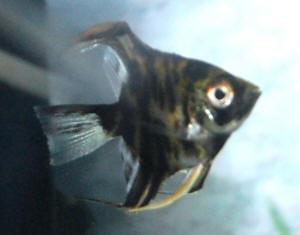
angelfish swims weird 3/19/17
Hi,
<Hello Olivia>
I have had my angelfish for over a year and she seems perfectly healthy.
I have her in a 20 gal tall tank (which I know is on the small side but
I didn't know better when I got her and I can't get a bigger tank right
now)
and I do a 20% water change twice a week. The temperature stays around
78.
I feed a variety of flakes, bloodworms, and shrimp. She lives with some
cherry barbs. I was just wondering if it is normal behavior for
angelfish to swim backwards and upside down.
<Not upside down, no>
She will usually swim normally, but sometimes she will swim kind of on
her back or swim backwards slowly
around the tank. She is very friendly and comes right up for food and
gets along great with the cherry barbs! The only thing is the weird
directions of her swimming and is that normal?
<Not; and the issue here may be mostly genetic. Freshwater angels are
tremendously inbred for most stocks. However, the flake food itself may
be influential; I would substitute a fine grade pelleted food for the
flake>
Thank you!
Olivia
<Welcome. Bob Fenner>
Occasional angelfish bullying in brighter light
8/11/16
Hello:
<Howdy>
I have two freshwater Pearlscale angelfish about half-dollar
size. One was purchase about two weeks after the other and is bullying the first
guy quite a bit, but only when the lights are brighter.
<Mmm; best to keep Pterophyllum in a group... IF you only have so much
resources, system size... three individuals; to split up aggression>
When the blue light is on the bully is calm. I am thinking that I need to get
rid of the bully soon due to the stress on the calm guy.
<Or add a third, about the same, or larger individual>
The bullying is not a lot, but probably enough, and I am thinking it will get
worse over time. If the calm guy holds his ground the bully backs off, but if
the calm guy zips off, the other guy takes off after him. It is too bad the calm
guy doesn't realize that if he "holds his ground" and doesn't "run" the bullying
would stop. I guess you would agree that a re-homing is probably the best bet in
the long run? Thank you
<See WWM re stocking Angels? Bob Fenner>
Angelfish 10/8/15
I have a large angel. He was doing great. We got him over a month ago and for
the last couple days he has been swimming towards the top of the water like he
isn’t getting enough air.
<Not so much air, as oxygen. Cichlids are more sensitive than many other
community fish to low oxygen levels (catfish and loaches can and do gulp air
directly). When stressed you will see them "gasping" which is in fact trying to
move the oxygen rich surface layer of water across their gills. Lowering the
waterline 1-2 cm so the filter splashes the water more and increasing water
movement (perhaps by using a spray bar) should increase the amount of oxygen in
the water. If your Angelfish perks up, then that's your problem: tank too small,
filter too pokey, water too warm, or some combination of these. Also note that
dramatic changes in pH can trigger a similar behaviour, though often pH-stress
causes fish to dart about nervously as well.>
We have an air stone and a filter on the tank.
<Perhaps not enough of either.>
We just recently added some dark small gravel to the tank bottom. Could that be
our problem somehow.
<Can be, if you lost some water volume by adding more substrate (so the tank is
more densely stocked per gallon) or disturbed the substrate so much that buried
organic matter (gunk) is using up oxygen from the water column.>
I don’t want to lost him. He’s a good 7 inches from top to bottom.
<Big!>
We have several Corys, another angel, and a few hi fin tetras in the tank with
him and they all do fine together. There hasn’t been any aggression since the
first two days all the fish were in the tank. Advice please.
<Rejigging the tank can rearrange territories, and adult Angels that got along
before aren't always sociable after such changes. Hi-Fin Tetras doesn't mean
much to me, but some species (Serpae Tetras, Black Widows/Petticoats, and a few
others) are confirmed fin-nippers and can cause stress for Angels.>
Thank you.
Julia
<Cheers, Neale.>
Angelfish mouth locking 6/16/15
Hello:
<Hey Judy>
I have two angelfish in a 75 gallon. There was a singleton and a new one was put
in the tank. The singleton went after the new one and there was mouth locking.
This morning the new guy, I guess the loser has a really white mouth, so he/she
went into the smaller tank. Some people think the mouth locking is
mating, but that was aggression as the new fish was being chased this morning.
<Can be both or either>
I am thinking I may need to keep an eye on the new one to see if this turns into
fungus.
<Yes>
Oh...would dither fish help with aggression, something like Rasboras although
Rasboras may be to small or nippy.
<Dither fish are a good idea; even in a 75. There are some larger Rasboras; many
other possibilities>
These angels are quite large, Thank you
<Welcome. Bob Fenner>
Freshwater Angelfish Growth Rates
5/30/15
Hello! First, I want to thank you for patiently answering so many questions, and
providing knowledge to so many.
<Thanks for the kind words.>
I have looked through all of your information on raising angelfish fry, and I am
following your advice, but I have a question about my runt fry. I was allowing
the parents (Philippine blue) to raise their fry, and they had been
free-swimming for two or three days when I found that most of them had been
eaten. I managed to rescue nine, of which two are left. One is now dime-sized
and looks like a small copy of its parents.
<Cool.>
The other is about one-fifth of the size of the larger, and not as
well-developed. It looks like it stopped growing just as its angel fins were
beginning to grow.
<Not uncommon. Any number of reasons, from bullying (dominant fry monopolise
food) through to parasitic infection.>
They eat baby brine shrimp, frozen beef heart, and flakes. I've kept up the
brine shrimp in hopes the little one will grow better with it - it is still too
small for the beef heart, no matter how tiny I make it.
<Do bear in mind brine shrimp nauplii are nutritious; adult brine shrimp are
not. Do try some alternate foods: frozen lobster eggs are usually a winner, but
Liquifry and Hikari First Bites may be more convenient.>
The little fish also will drop to the bottom of the tank and lay there twitching
with alarming frequency. I keep expecting it to die, but it pops back up and
continues swimming. Will it ever grow? Does it have a neurological problem?
<If it sinks rather than floats in midwater, chances are it has a malformed swim
bladder, and this could make swimming difficult, and this in turn could mean it
gets less food. Not curable. Not fatal, either. Certainly don't aim to breed
from it, but if it is feeding and growing, albeit slowly, you could choose to
keep it in a peaceful tank with things that will neither compete for food not
peck at its fins (for example, Corydoras or Kuhli Loaches, but not tetras or
barbs).>
I don't want to euthanize it because it is the only company the healthy one has.
<Angels are social when young, but territorial as adults. The "runt" would
likely do better kept singly, or with alternate tankmates as outlined earlier.>
Thank you for your time.
-Amanda
<Most welcome. Neale.>
My fw angelfish color; RMF's go
8/29/13
Hello, I have been looking through the different angelfish q&a's
on your site but I am not positive that any resolve my dilemma. I am
knew to the hobby but I love it, and love my fishys. I started
my 10 gallon tank about 4 or 5 months ago. Currently I
have 1 zebra pattern angel, 1 male fancy Molly,
<Mmm, do read a bit more re this livebearer. Mollies like hard, alkaline
water (often w/ a modicum of salt) that the angel, neons, and cat listed
don't appreciate>
1 female swordtail, 2 small neons, a small male guppy and
a banjo cat. The problem is, for the last 2 months the color of
the top fin on my angel has been progressively getting worse. It started
with a little bit of rot at the tip pf the fin but now the entire fin,
and the top of head is a brown green color.
<Bad... >
I also noticed today that there are little red spots on the fin.
<Almost assuredly the trouble here is induced, environmental...
a ten gallon is too small for keeping even just one Angel... what re
your water quality (readings from tests)? How much nitrate is
accumulated here?>
I have been adding jungle start right to the tank and that took care of
the rot from the beginning. But his color still is bad. I also use
jungle aquarium salt,
<As stated, Pterophyllum really don't like much salt/s>
tetra safe start and tetra ph correct monthly along with 20 percent water
changes. I have been told that my municipal tap water is hard for fish
tanks but my angel fish has never changed eating habits or behaviors. I
am simple looking for some guidance on what i can do for the fish.
<I would trade the Angel (and maybe the tetras, catfish) and get more
simple, hardy fishes that like your type of water... Perhaps some
Platies... Do read here:
http://www.wetwebmedia.com/FWSubWebIndex/fwhardness.htm
and the linked files above>
Thank you for your time
<Glad to assist you, your growth, understanding in the field. Bob
Fenner>
My fw angelfish color; Neale's go 8/29/13
Hello, I have been looking through the different angelfish q&a's
on your site but I am not positive that any resolve my dilemma. I am
knew to the hobby but I love it, and love my fishys. I started my 10
gallon tank about 4 or 5 months ago. Currently I have 1 zebra pattern
angel, 1 male fancy Molly, 1 female swordtail, 2 small neons, a small
male guppy and a banjo cat.
<Far too many fish for 10 gallons. Do understand that aquarium size is
crucial to success, and many/most problems beginners have come down to
overstocking small tanks. A 20-gallon tank is the minimum for Angels and
Mollies.>
The problem is, for the last 2 months the color of the top fin on my
angel has been progressively getting worse.
<Ah, this happens a lot. Almost certainly environmental.>
It started with a little bit of rot at the tip pf the fin but now the
entire fin, and the top of head is a brown green color. I also noticed
today that there are little red spots on the fin.
<Yes; the red patches are areas where bacterial infection clog up blood
vessels. Tissue death follows quickly, then erosion of the fin
membrane.>
I have been adding jungle start right to the tank and that took care of
the rot from the beginning. But his color still is bad. I also use
jungle aquarium salt,
<Irrelevant here; not a cure for anything much besides Whitespot if used
correctly.>
tetra safe start and tetra pH correct monthly along with 20 percent
water changes.
<Messing around with pH is a very bad idea for beginners. Unless you are
lowering the hardness of aquarium water, you should NEVER change pH
directly.>
I have been told that my municipal tap water is hard for fish tanks but
my angel fish has never changed eating habits or behaviors.
<Hard water isn't necessarily bad. Mollies and Guppies love it, farmed
Angels will be fine up to 20 degrees dH, pH 8, and catfish generally
don't care provided water quality is good.>
I am simple looking for some guidance on what i can do for the fish.
<Hmm... bigger tank for a start, then stop messing about with water
chemistry until you understand the background science and what you're
trying to achieve. Medicating for Finrot using a reliable medication
(e.g., eSHa 2000 or Maracyn 1 and 2) will cure the symptoms, but only if
the environment is good will Finrot stay away. Remember, Finrot bacteria
are simply "good" bacteria that have been allowed to go "bad" because
the fish have a weakened immune system. You can never remove them from
an aquarium, and you wouldn't need to if the fish are healthy.>
Thank you for your time
<Most welcome. Do start by reading:
http://www.wetwebmedia.com/FWSubWebIndex/fwset-up.htm
http://www.wetwebmedia.com/fwsubwebindex/fwh2oquality.htm
http://www.wetwebmedia.com/fwsubwebindex/fwhardness.htm
http://www.wetwebmedia.com/ca/volume_5/volume_5_3/stocking.htm
http://www.wetwebmedia.com/FWSubWebIndex/fwlvstksel.htm
http://www.wetwebmedia.com/FWSubWebIndex/fwacclim.htm
http://www.wetwebmedia.com/FWSubWebIndex/fwestcycling.htm
You'll find plenty of links on these articles to yet more reading
material plus FAQs. Cheers, Neale.>
Re: My fw angelfish color – 8/29/13
Thank you for the details. This site is great! My closest fish
store is about 20 miles away so I don't get to talk to a pro very often.
I am definitely a beginner and made some beginner mistakes, but
definitely want to learn more. The angel fish was one of the first fish
I put in my tank but was not aware of the detailed of having an angel
fish.
<Not really that demanding, at least, farmed Angels are pretty easy. But
they do need a spacious tank, 20+ gallons. Do read:
http://www.wetwebmedia.com/fwsubwebindex/fwangelfishes.htm
And follow the links above.>
I think I am going to see if the fish store will take the fish, get a
nice testing kit and go from there. Thanks a lot for the info and
reading material. It is much appreciated.
<Most welcome. Cheers, Neale.>
Petite Angelfish, growth, beh.
1/30/13
Just over two months ago I bought a 30 gallon freshwater aquarium that
was already cycled and had fish in it (the person was moving). In the
tank there was a white, almost translucent angelfish who was
quarter-sized, along with some other fish, including a good-sized,
aggressive rainbow shark (who has since found a new home). The angelfish
was skittish, but has
gotten over that and is now quite friendly and confident. It eats well,
has a good weight, no signs of illness and my water quality is pretty
good (it's a tad bit alk, about 7.5 because we are on well water, but at
least there is no chlorine and the nitrate and nitrite levels are 0);
however, my Angelfish has not grown a bit - according to what all I have
found, my
Angelfish should have grown quite a bit, but it is still at
quarter-size.
Is there anything I am over looking, or do some angelfish just not grow?
Thanks for your time, Amelia
<Yes indeed, some fish fail to grow, especially if
something wasn't right when young. If they don't grow quickly in the
first 6 months, cichlids like Angels often grow much slowly thereafter.
Bad genes could also be at fault here. Provided the fish is otherwise
healthy and you have no reason to suspect Hexamita (white, stringy
faeces) or Camallanus worms (red threads visible at anus) I'd tend to
leave things be. Cheers, Neale.>
my angelfish are freaking out 10/11/12
Dear: WWM crew
i have a 29gal freshwater tank with 5 beautiful angelfish in it and i
have had this set up for along time now and the angel's have always came
and see me when it was time for feeding or me just walking by the tank
but now when i feed them or i walk by they start swimming erratically
and hiding from me can you tell me what i need to do to fix this problem
thanks
Mark
<Hi Mark. The two obvious explanations are that [a] they're stressed; or
[b] something is spooking them. On the stress side of things, check
water quality, water chemistry (pH drops are common in older tanks, and
will stress even fish from acidic habitats), water temperature and so
on. On the spooking side, review livestock first and foremost. Have you
added any new
fish, even small things that might actually be nippy or simply
boisterous?
Are there any fish that have grown and now scare them, like a catfish?
Within the group, are there any mated pairs pushing the others around?
Angels are schooling fish outside of spawning, but as adults, groups
smaller than 6 tend not to be stable. Alternatively, check for direct
sunlight or excessive noise in the room (vibrations, i.e., bass sounds,
are very alarming to fish -- ask any angler!). Children sometimes bang
around there house and bash the aquarium, and that'll scare most fish. A
last factor to consider is aquarium size: 29 gallons is way too small
for 5 adults, and they could well feel cramped. Cichlids especially can
react to
overstocking by becoming shy. More than likely, there's a combination of
things going on; review, and act accordingly. Cheers, Neale.>
Re: my angelfish are freaking out 10/13/12
thanks for the info I bumped up the temp and now they are starting to
act normally again
<Glad to help. Do review my comments on aquarium size though! Cheers,
Neale.>
Angels fighting 6/24/12
Hi Neale! good morning,
<Good evening from England.>
quick recap, I have 4 Angel fish (2 black, 1 marble, 1 white) and 2
Striped Raphaels, yesterday we moved them from a 23 to a 55 gallon
aquarium.
<I see.>
The marble and pearl paired a month ago and hatched eggs, I told you the
marble became very protective and aggressive towards the blacks, but
ever since the eggs died, the papers changed, the two black ones are the
dominant now and they won´t let marble go near the white one, she seems
to want to go with him but if he tries they attack him, even when he is
hiding or just swimming in the bottom they go look for him and poke him.
;-(
<Yes.>
I am very sad because of this he looks so lonely. An aquarium should be
a peaceful thing to look at but every time I look I get stressed!
Marble wants to explore the new aquarium just as the other 3 do but they
won't let him.
<And won't. It's the nature of Angelfish to form pairs and bully any
others that come within range of their territory.>
I understand 55 is still not big enough but that´s all we could do at
the moment.
<55 gallons would be big enough for a group of 6, but you do have rather
a lot of other fish.>
The cats are so happy on the other hand with their sand beds :).
<Good.>
So is it time to let go of 2 Angels? should I keep the marble and white
knowing they are a pair?
<Wise.>
and return the blacks that appear to be 2 beautiful males, I´m just
worried about the two that go, they are approx. 7 or 8 months old, will
they survive in a new aquarium (my aquarist would take them)
<Once you return the fish, it has to take its chances. It may get bought
by a skilled fishkeeper -- but it might not. It's often better to donate
the fish to someone who know keeps fish, or get in touch with your local
aquarium club.>
please advise! my husband always wants more so if we remove 2 Angels he
wants to get some Green Tiger Barb Sumatra, would this be a good choice?
and how many?
<Terribly choice. Tiger Barbs are very nippy, and Angelfish are too slow
to avoid trouble.>
thanks so much,
Lorena.
<Cheers, Neale.>
Re: Angels fighting 6/24/12
Hi again! Just a doubt regarding:
I wrote: I understand 55 is still not big enough but that´s all we could
do at the moment. You replied: "55 gallons would be big enough for a
group of 6, but you do have rather a lot of other fish."
I only have 4 Angels and 2 Striped Raphael, that's it, 6, you meant a
group of 6 Angels? Introducing 2 more Angels now would solve the
problem?
<Angelfish and Discus both tend to form more stable groups with less
bullying in them when kept in groups of 6 or more specimens. Don't know
why this is the magic number but it seems to be the most reliable
starting point if you want a whole group of either species. Now, your
55-gallon tank is quite large, and could hold 6 adult Angels with ease,
but the two catfish are going to get quite big, 15-20 cm/6-8 inches, and
add that to the adult Angels at around 10-12 cm/4-5 inches a piece, and
you see why I'm cautious about recommending you keep them all in the
same tank. As juveniles you might be fine, and as/when they get bigger,
you may upgrade the tank or move out the catfish. At the very least,
this tank will be heavily stocked and will need very robust filtration
and substantial weekly water changes. It's doable for sure, but not
ideal, hence my reticence.>
Sorry I got confused! Thanks.
<Cheers, Neale.>
Freshwater Angelfish and <bent> ventral fins
6/19/12
Hello:
<Judy>
I have an angelfish pair in a 46 gallon, one Blue Cobalt and one
Platinum.
The Platinum is still a juvenile. On the juvenile one of the ventral
fins is very bent. Is that a genetic "defect" or when the fish grows
will it straighten out? Thank You
<Quite common aberration... and most likely developmental
(ontogenetic)... raised in cramped quarters w/ too many siblings...
these "tweaks" happen.
Not self-correcting, but no problem in terms of the life/health of
specimens, nor the outcome of their own breeding. Bob Fenner>
Angel Fish Question - Pectoral Fin
coloring 2/15/12
Hi Guys - I'm hoping you can answer a question for me. I can't
find an answer anywhere.
I recently bought a few quarter sized Blue Angels. One
of them has a light pinkish/red tinge encompassing the base of each of
his pectoral fins. It does not look inflamed per se, and its somewhat
difficult to describe. It is shaped like a half moon around the base of
the pectoral fin.
<Could be; most likely is, just genetic expression. This sort of
marking is quite common>
I'm wondering if this is just genetic coloration, or an area of
blood flow through that muscle tissue, or perhaps some sort of
infection?
<Most likely both the first two>
The fish seems completely normal in every other way, eats well, and
swims fine.
None of the others have this though.
I feel like this is something I have seen in Angel fish that I have
owned in the past from time to time, but I cannot specifically
recall.
<Look at enough Pterophyllum pix... in books, the
Net... and you'll see this>
I know this isn't the best description, and I was not able to get a
good photo of it to attach for you.
Have you ever seen any pinkish coloration circling around the base of
an Angel's pectoral fins before?
<Yes>
I'm not sure if I should return him to the store, or if it is a
normal genetic thing for this particular fish. I brought one back
earlier today that had the same thing on only one of his pectoral fins.
So, perhaps its a genetics thing from fish to fish? The shop is
reputable and I know the tank is healthy there, unless this is a
disease issue. The other few I got last week from this same tank show
none of this pink-ish color in the pectoral fins.
I also noticed a pinkish spot on the skin of his lip, very light, looks
similar to when a fish has been hooked and then released. However, that
seems to be very, very light. The pectoral fin coloration issue is a
fairly light pinkish color as well.
Any info you may be able to provide is much appreciated.
Thanks!
Mark
<I wouldn't worry re. Bob Fenner>
Re: Angel Fish Question - Pectoral Fin coloring 2/15.12
Thanks for getting back to me so quickly Bob. I really appreciate it.
Your answers put my mind at ease. This morning, the pinkish coloration
on the pectoral fins was gone. I imagine it may have been coloring due
to stress from the move to his new home.
<Could well be>
Can I ask you just one more quick question though? I noticed the shape
of his operculum, specifically the rear part of it near his head is
shaped a little differently. Not major but it is cut differently than
my others.
The others have a more rounded operculum entirely covering their gills.
His is a bit more square/jagged or pointed shaped. I can see his gills
slightly, more so than the others more because of this. Its as if the
bottom rear part of his operculum on both sides is millimeters shorter
than if it were full and rounded nicely. The gills are not inflamed or
anything. Its not overly noticeable, I probably only saw it because I
was so heavily watching his every move last night.
Would you think this is normal as well or genetic expression?
<Mmm, not so much, or likely. These opercular malformations are
distinctly more common nowayears, with captive-bred angels being raised
in sub-optimal conditions. FWIW, the bent gill covers don't seem to
often cause problems, and the developmental issues aren't passed on
to offspring>
Have you seen something like that before?
<Very common; yes>
He seems perfectly happy with his surroundings and normal otherwise.
Was not able to track down any similar pictures on the net.
Thanks again!
Mark
<Welcome. BobF>
Re: Angel Fish Question - Pectoral Fin coloring 2/15.12
Thanks again Bob. You've been a tremendous help.
Best,
Mark
<Glad to participate Mark. B>
Timid angelfish 1/30/12
Hello:
<Judy>
I am the one with the 29 gallon, with the 10 tetras
and the juvenile angelfish. I refunded the tetras over the weekend as
the angelfish was not getting to eat. The angelfish is in there alone
and is acting very timid and frightened it seems. He/she does not come
up to eat and freaks out when I open the tank lid and is always hiding
like when the tetras were there.
Is this normal for an angelfish that is a juvenile and alone in a 29
gallon??
<Yes... Pterophyllum are social animals/species>
The girl at the LFS said that the juveniles "need company"
but that sounded like a ploy to sell more fish, plus more angelfish
need a much bigger tank.
I think now I should have purchased a larger angelfish that could hold
it's own. Thank You!!!
<Read here: http://www.wetwebmedia.com/FWSubWebIndex/fwangelselfaqs.htm
and the linked files above. Bob Fenner>
Freshwater Angelfish fish growth
1/27/12
Hello:
<Judy>
I have one angelfish in a 29 gallon. He/she is about the size of a
quarter not including the fins. How long does it take for a juvenile
angelfish to reach adulthood??
<A few months... faster w/ more frequent feeding, water
changes>
How old are these juveniles when they are shipped to stores??
<A handful of weeks to a few months>
Thank you
<Welcome. Bob Fenner>
Angel Fish et al. terr. beh.
1/7/12
I have had a 29 gallon tank set up for almost 2 years
now. Over time I have experienced several problems with water quality
and because of that I have had to learn a lot more about fish and water
then I ever thought I would.
<Worthwhile lessons... can/do relate to your own health>
This past year we only had one pH problem and that was quickly
remedied.
Fortunately, over the past 6 or so months we have been free and clear
of any problems- until tonight.
Okay, so it might have been before tonight, but this is the first time
I am noticing it, and I often watch my fish and their unique
behaviors.
Recently, my two angel fish have been increasingly aggressive
to the other fish, mainly to the black finned tetra (who they
have never bothered before). I thought at first it was just those two
making problems until I saw my other two fish which are also tetras
nipping at the angel and each other! What really got me is my Pleco
swimming upside down to eat the fish flakes and then, when that
isn't enough circus behavior he starts chasing the other fish. I
have never seen my Pleco act like this.
At first I assumed they were not getting enough to eat but between my
fiancé and I, they are getting fed two or three times a day.
These are the original fish in the tank and they have been together for
quite some time.
The tests are all coming back great- 0 ammonia, 0 nitrate, 0
nitrate,
<Zero NO3? How is this rendered?>
barely hard water, great temps, ph is where it should be... I'm
lost. Any ideas?
Becci
<Yes; the first, most likely explanation is that your angels are
maturing... exhibiting reproductive behavior... Are very territorially
aggressive during spawning... Please read here re:
http://www.wetwebmedia.com/FWSubWebIndex/fwangelreprofaqs.htm
Elsewise, the unrest could be due to some aspect of water quality... Do
use the search tool on WWM re. Bob Fenner>
Angelfish acting weird 1/2/12
So this mourning my 2 day old marble angelfish seemed completely fine
and happy but then i noticed he was going with the current of the
filter.
<Bad sign.>
I thought he was playing
<Not normally something fish do. In fact "play" behaviour
has almost never been observed among fish.>
but then i noticed he was having trouble swimming and was just laying
on the ground.
<Weak'¦ sick'¦>
I quickly took out the little house decoration i had because he seemed
to be going under it and i didn't want him to be crushed.
<Wise; suffocation when trapped inside ornaments is a risk.>
He has now ceased even trying to swim an is just laying there. I have a
ten gallon tank with only 2 baby angelfish in it, and from the research
I've been doing this mourning it seems that's to small
<Correct; 20 gallons is about right for Angelfish, singly or in
matched pairs (they are territorial and potentially aggressive, and can
bully one another).>
but the lady at the pet store said it was fine
<She was wrong.>
i just couldn't get anything else. Since i just checked my water at
the pet store w days ago when i got the fish, i know everything was
good.
<Need numbers here, not your opinion. At minimum, the pH and nitrite
level. To recap: Angelfish need water that is soft to moderately hard
(2-15 degrees dH) and between pH 6 and 8. Water quality must be
excellent; 0 ammonia, 0 nitrite, and nitrate below 20 mg/l. Angelfish
should not be kept in new tanks; only in tanks that have been cycled
and running for at least 6 weeks, and ideally 2-3 months. Water
temperature should be middling to high; 25-28 C/77-82 F.>
Both haven't eaten either since i got them
<Unusual; while they can be shy for the first few hours, but the day
after being introduced they should be eating readily. If not, you have
a problem, very likely non-zero ammonia or nitrite levels.>
but according to my Googling i just have to let them get used to the
environment. I tried a 25% water change but it didn't seem to do
anything. Im really new at this so i just don't understand what i
did wrong
<Hmm'¦ do read:
http://www.wetwebmedia.com/fwsubwebindex/fwset-up.htm
http://www.wetwebmedia.com/FWSubWebIndex/fwlivestk.htm
http://www.wetwebmedia.com/ca/volume_5/volume_5_3/stocking.htm
>
and i really hope he doesn't die but i think he might have swimming
bladder disease
<Essentially no such thing. What new aquarists (and disreputable
retailers) call "Swim Bladder Disease" is merely a vague,
hand-waving idea that the fish got sick and died somehow from something
that wasn't their fault. Almost always, "Swim Bladder
Disease" is in fact environmental stress, either directly causing
their death (e.g., non-zero ammonia level) or else causing such stress
that a secondary infection (e.g., Mycobacteria) became
established.>
and I'm so lost. Any suggestion on how to keep this one alive or at
least save the other?
<In the short term, ensure water quality is good by doing 20% water
changes daily. Don't feed the fish until and unless ammonia level
stays at zero. Remember to use water conditioner when doing water
changes, ideally a variety that neutralises not just chlorine but also
chloramine, ammonia and copper. Long term, determine why your aquarium
is wrong, and fix it. Do read:
http://www.wetwebmedia.com/fwsubwebindex/fwangelfishes.htm
Follow the links re: disease, systems. Cheers, Neale.>
|
Question - Angelfish
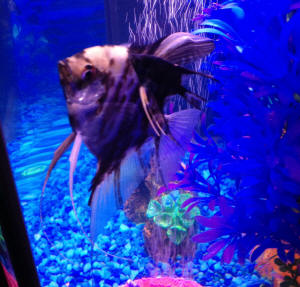
FW Angelfish Adjusting to New Tank 11/17/11
Hello, I am emailing on my angelfish Mulder. I have had him about
5 months.
I guess I get paranoid because when I got him (or what I believe
is a him)
I had to treat for internal parasites i.e. not eating and white
stringy poo.
A bit about my tank... 16 gallon tall, well planted for hiding
(not real plants) 78-80 degrees. I do water changes every three
days or so. Zero ammonia and nitrites. Nitrates don't ever
register to 20 ppm so always below 20. May seem crazy, but I love
taking care of him. His only other tank mate is another
angelfish, Scully, who is smaller. They get along very well
actually. I know having two you should be careful for aggression,
but so far so good.
I feed them a varied diet. Frozen foods like bloodworms, brine
shrimp, beef heart and glass worms. Every so often flakes, but I
don't have great luck with those. Mulder the large one is a
Marble and Scully is black. I will attach a photo.
It's Mulder I'm worried about. He stays in one corner of
the tank most of the time. Swims up and down the corner of the
tank. Only ever so often will he take advantage of his large home
and swim off, and its usually at night when all the lights are
off. Sometimes he doesn't want to eat, but most of the time
will eat a small bit. They have been in this tank for over a week
as I upgraded it. I have been doing water testing everyday to
make sure I don't cycle. I used old media, rocks, filter and
plants. I wanted a tall tank for them to grow and be happy.
Mulder used to have red eyes, but since the move I think he's
under stress because the next day his eyes were white/silver. The
red over the past few days has come back a little, but disappears
and comes back often. He has started a while back getting gold
color on his crown, and I noticed it moving to a gold iridescent
color up his dorsal fin. I know their colors can change but I
wanted to let you know. I read up on diseases and wanted to see
if with the weird swimming, mostly staying in the same corner,
loss of red eyes, color change and not having the ravenous
appetites they should have may possibly be an underlying symptom
of something? This is my first time with angelfish so I want to
do my best because I love these little guys :). I may be over
worrying because of the parasites when I first got him, but any
input you can give would be great. Thank you for taking the time.
I've attached a photo of Mulder and Scully so you can see my
babies lol. Sarah Richert
Chicago IL
< Give them some time to adjust to their new surroundings.
They feel more secure when the lights are out and that is why you
see them swim around at that time. When they adjust they will
become more active.-Chuck>
|
|
|
Odd Angelfish Behavior 11/3/11
Hi there! I've been searching and searching for a reasonable answer
to my problem, both on your site and other places and I've found
good answers but I'm not sure if they apply to my situation. So,
here goes: 29 gallon bare bottom FW tank, been running for almost a
year now, started with goldfish, rehomed them recently because they got
too big for the tank. I bought a heater and replaced the goldfish with
2 marble angels (so pretty!). My ammonia and nitrites are always at 0,
the pH steadily between 7-7.2. The nitrates have always been around
20ppm with the goldies, but I recognize that angels are exceptionally
sensitive to nitrate levels so today I did a large water change that
brought the levels down to undetectable. Today I also cranked the heat
up from 74 to 78 (it took all day to get there) and replaced the media
in the larger of my two filters (Top Fin 40 and 10, hoping the
bacterial colonies in the 10 will sustain for a while till the new
filter builds up). I also have always used small amounts of marine salt
(1 tbs per 6 gallons) in my tank with no problems to speak of.
<All sounds/reads good, with the exception of the salt. I'd
skip. Should I refer you to Neale's piece re?:
http://wetwebmedia.com/FWSubWebIndex/SaltUseFWArtNeale.htm
So, the angels have been in there for little more than a week. They are
always hiding at the back of the tank near the bottom behind a
rock,
<Mmm, not good. Should be out front...>
and today I noticed they both have been hiding behind the heater all
day near the surface of the water. They venture out during feeding but
seem to always stay at the back, at the surface or on the bottom. The
past few days I've tinkered with the tank quite a bit, testing
water, doing the big water change, rearranging decor, etc. I'm
wondering if they are just freaked out and too scared to come out, or
if the salt is affecting them, or if the temp change was too much for
one day...help! They're so pretty I would love for them to swim
around a bit so I can admire them. Thank you so much for your help
:)
-Michelle S.
<Could be what you list, a combo... I'd just stop fiddling w/
the system, proffer a small amount of food twice a day... Bob
Fenner>
Odd Angelfish Behavior Update 11/3/11
Hello again! I wanted to shoot y'all an email before you took the
time to write out a detailed response...the angels are fine this
morning!
<Ah good>
They are swimming around the tank, exploring and looking much more
comfortable. I still would love your expert opinion on 2 things,
though!
(1) I keep reading about "dither fish", like a small school
of fish to keep the angels from being on guard, do I have room for any
in my 29 gal?
<Mmm, yes... perhaps a trio of White Cloud Mountain Fish, small
Danios, my fave three small barb species (see WWM re
stocking/selection)>
And, (2) I do keep small amounts of marine salt in my tank, this is ok,
right?
<Not really necessary, or helpful likely. See Neale's article I
cited>
I guess it messes with the hardness of the water,
<Can add to it>
I have never tested my water for hardness but I guess I should. Or, is
it ok as long as it is consistent?
<Can't tell w/o testing eh?>
Y'all are great, and are the only online source that I trust 100%
for all of my fish-keeping needs. Thanks :)
-Michelle
<Thank you for sharing your passion, intelligence w/ us. Bob
Fenner>
Re: Odd Angelfish Behavior Update 11/3/11
Thank you for your very quick response! Ok, so upon reading Neale's
article that was suggested, I'm going to begin phasing out the
marine salt through weekly water changes. I believe the local water to
be hard as-is (based on showering in it lol), so the addition of marine
salt may make it detrimentally so for my angels (Jude and Lulu).
<Ahh!>
On another note, I would love some little glow Danios or white clouds,
but...
1) would fish as small as Danios or white clouds eventually become
lunch for the angels?
<Likely not... they are quite fast, and not w/o some modicum of
developmental cognition>
2) the only LFS's here in my little Texas town are a PetSmart and
Petco.
They both have little white fish called "white cloud
minnows", however they are grouped with the goldfish and look
different than the pictures of white clouds I've seen online, which
show them to be silvery and more colorful.
Are these white fish the same things, or do they sound like baby white
feeder goldfish?
<DO check on the Net re... Tanichthys albonubes are quite
distinctive... though/and it definitely WOULD be better that they had
not been mixed w/ goldfish/comets, as they are very prone to be
biologically diseased>
On a side note, the angels have returned to camping out by the heater
again, although its 80 degrees in the tank and all morning they've
been swimming around freely. :( I have the thermometer on the opposite
side of the tank so I know the warm water is being circulated. I fed
them some brine shrimp this morning, which they ate enthusiastically,
and there are no physical signs of illness. Weird!
-Michelle S.
<Intelligent fishes... given to "abstract" behavior at
times. Cheers, B>
Re: Odd Angelfish Behavior Update
Merci du conseil <3
-Michelle S.
>Welcome Mich. B<
Angelfish 8/18/11
I have a 75 gallon tank with 16 quarter size angels in
it. All was fine and then suddenly they're in a tight group
at the top or in the corner.
<Mmmm>
I change about a third of the water weekly. Everything has been fine
for about a month till now. Feed flake food with brine shrimp twice a
week. Any suggestions? Thanks Shark
<Water testing... somehow you have an anomaly of some aspect/s of
water quality on your hands... Likely Chloramine sanitizer (from the
tap water or conditioner) and/or some type of metabolic accumulation
(ammonia, nitrite?)... Chemical filtrant use, careful storage and
treatment of change out water (a week) ahead of use is suggested. Bob
Fenner>
Pterophyllum leopoldi hangs at surface
8/2/11
Hi guys!
<Hello Aslak!>
I have a 240 litre SA community tank with some (five) young Leopoldi
angels.
<Nice fish.>
I've had the fish for about six months. I've noticed that they
from time to time "hang" at the water surface. I know fish
tend to do when there's too little oxygen in the water, however
none of the other fish in the tank does this, and I've read a
couple of places that this behaviour is considered normal for Leopoldi
(or angelfish in general perhaps?) because they like to skim the
surface for algae.
<Perhaps. My understanding of Angels in the wild is that they feed
primarily on insect larvae at the surface. I would be open minded about
the oxygen issue, and check circulation is adequate, especially in
summer.>
I have tried to find more info but it's a difficult issue to search
for as the search terms give me mostly irrelevant hits.
<I bet. In older books this species was known as Pterophyllum
dumerilii, even though this name is (apparently) a synonym of Pt.
scalare.>
They do seem to stop this behaviour if I direct the flow from the
canister filter along the tank, but I figure that might just as well be
because the increased flow removes the surface algae film or makes it
hard to "hang out".
<Sounds more like the oxygen issue. Do provide a good turnover, 6x
the volume of the tank per hour, but disperse the current by directing
jets at the sides of the tank, tall rocks, etc. Spray bars can work
nicely.
Alternatively, add an airstone or two.>
I'm also curious about plants. As far as I know Angelfish in
general lives in areas with little or no aquatic plants.
<Correct.>
Is this different for the Leopoldi?
<Not so far as I know.>
Right now the tank is scaped with mostly driftwood and roots, but I do
have some Vallisneria in there as well.
<Which will be welcomed.>
I am considering removing the Vallisneria and introduce some Amazon
Frogbit as the only plant life in the tank. Any thoughts on this?
<Floating plants would be excellent additions to this system, but do
ensure they don't block the oxygen exchange between the water and
the air above.>
Thanks for any enlightenment you can provide ;)
Cheers, Aslak
<Cheers, Neale.>
Re: Pterophyllum leopoldi hangs at surface 8/3/11
Evening Neale!
Thank you for your reply. I'll be sure to keep an eye on the
Leopoldis and increase the flow if needed. The last few days I've
had the spray bar turned downwards and "backwards" towards
the wall of the aquarium.
<Can work well.>
I'll once again turn it back out towards the open water if
needed.
Thanks!
- Aslak
<Glad to help. Cheers, Neale.>
|
Small Angel Fish, colour, hlth. 5/10/11
Hi Crew,
<Laura>
I have several questions to ask. I am glad I found your site, it
is full of interesting and useful information. I have two tanks
of angel fish. I have a 55 gal with 6 quarter to half dollar size
angels. I have another tank that has handicapped fish in it.
Their fins have been chewed off mostly because the place I got
them from had to many in a very small tank. The handicap tank is
35 gal. I had the water tested today and all of the measures are
good. Nitrate 0, Nitrite 0, ammonia 0, Ph is 6. All Angels are
dime to penny size. I keep the tank temp at 82 F. Now for the
questions.
1. Is there any knowledge about why some fins grow back with
color and some grow back clear?
<Mmm, there likely is, but I am not familiar w/ it/this.
Perhaps querying on Cichlid sites, or a visit to a large college
library. Do see here re searching for literature: http://wetwebmedia.com/litsrchart.htm
2. I am in question about the dark mark under the fin in the
picture that is attached. It looks like a scratch, but on closer
inspection in the picture it looks like it may be just a
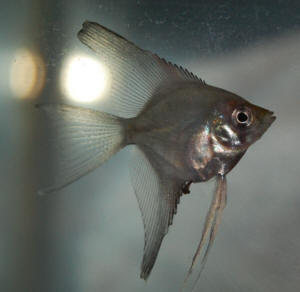
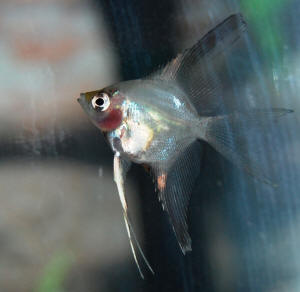
coloration thing. Can you tell me if I should be worried or
isolate the fish?
<I would not be worried. This appears to be
"natural", not resultant from some pathogenic
disease>
I know that if there is a concern then I should isolate, but
moving such a small fish would cause stress, so why cause stress
if there is no need to do so?
<We are of a like mind>
I have attached two pictures. One of each side of the fish so you
can see the difference.
3. How big are angel fish when they start to pair off?
<Sometimes as small as the body size of a quarter>
The 6 in the 56 gal are quarter size to a bit bigger, so I am
wondering how soon it will be before they start this process. I
keep the tank at 82 degrees.
Thank you
Laura
<And you for sharing. My survey article and our collective
input re Pterophyllum is archived here:
http://wetwebmedia.com/FWSubWebIndex/fwangelfishes.htm
and the linked Angel files above. Cheers, Bob Fenner>
|
|
|
Re: Small Angel Fish
5/11/11
Bob,
<Laura>
Thank you for your fast reply. I truly appreciate it and
the web site that continues to offer insightful
information. Thank you for the referral to other resources
for my investigation about fin growth color. Could I ask
one more question? One of the small angels has bent fins.
Should I try to clip the bent part off?
<Mmm, I would not. Though if the "reason" for
these deformities is developmental, and
"fix-able" through genetic determination, it is
"too cruel" in my present value system to justify
the pain, likely loss>
I am concerned that this break will be a place for
infection, although the fish is not showing any signs of it
now. I will attach a picture of "ZigZag" so you
can see what I mean.
Thank you so much
Laura
<And you. Bob Fenner>
|
|
|
|
Re: Small Angel Fish
5/12/2011
Mr. Bob,
<Ms. James>
You're awesome! This website is incredible. Thank you
for your swift reply as I was worried about ZigZag.
Laura
<Welcome dear. B>
|
|
Angelfish Fighting
Angelfish Acting Like Cichlids 11/22/10
Hi Crew, I hope you can help me. I have a 190 litre corner aquarium set
up for a community tank. Have shoal of penguins, rainbow fish, platies
and some Plecs and two adult angelfish. I used to have a few more
angels but as they grew I decided to keep just two and sell the rest.
The two I have generally swim close to each other but have recently
been attacking each other regularly. They seem to nip each other and
chase and even lock mouths.
I have had angels before which I knew paired up and were breeding
however these do not seem to be doing this. What would you suggest here
to fix this solution? I know its virtually impossible to sex the angels
and I guess I have either two females or males. Would you add another
angel? This could turn worse again? Any suggestions would be much
appreciated. I do love these two angels and it doesn't seem like
either has much damage but I would rather prevent anything worse!
Thanks Mark
<Angelfish are cichlids and tend to be territorial amongst
themselves. They are kept best in groups of six but then they would be
likely to pair up.
Lower the water temp to the mid 70's. This will take them out of
their breeding temps and see if that reduces the
aggression.-Chuck>
freshwater angelfish help 10/18/10
Hi,
<Hello,>
I have two large Koi marble angels in a 55 gallon tank. They both got
along well at first, but now they are fighting a lot.
<Unfortunately, this is what they do. Angelfish school when young,
but as adults they are more or less territorial, particularly
males.>
Their fighting consists of nipping each other just below the mouth.
<Yes.>
The one that is being nipped will tilt back like he is submitting to
the other fish and then will nip back.
<The dominant fish is a male, and the weaker one most likely another
male as well.>
There is only 5 zebra Danios and one much smaller angel. They don't
seem to mind him.
<"He" is probably a she, and because of that, the dominant
male is happy to have her around.>
I want to keep them both. Can you give me some advice?
<This is a very tough problem to solve. There are two things you can
do.
One is to add more females. Because Angels are virtually impossible to
sex except when spawning, adding females requires you to cozy up to an
Angelfish breeder and get some female specimens from them. You cannot
sex juveniles in aquarium shops. Possibly adding random Angelfish to
the tank would work, but you'd need at least 3 more specimens for
this to work because 6 appears to be the "magic number" when
it comes to getting Angels and Discus to school together as adults. In
smaller groups they almost always do what you're seeing --
individual fish become territorial and possibly bullies. Otherwise, all
you can do is remove one of the two Angels that are fighting, and hope
the remaining two coexist peacefully. If you
have another tank, the third Angel could be kept there by itself;
despite being described as schooling fish, adult Angels work just fine
kept singly.>
I have never asked you a question before so I don't know whether
your response would go to my email or to your site specifically.
<We do both!>
Thank you!
<You're welcome. Cheers, Neale.>
FW angel fish, beh. 1/20/10
Hi,
<Hello.>
I have had my angel fish for years, along with two Bolivian ram fish.
For years they were all in a 10gal tank, but 3 weeks ago I put them
into a 20gal tank. My old fish tank did not have a heater, my new tank
does.
<Oh?>
Ever since the fish have been in the 20gal tank, the angels stay by the
heater most of the day and rarely swim away.
<May like the heat, but if they're a pair, they may also be
treating the heater as a potential spawning site. Add a better such
site, like an upright slate or a bogwood root, and see what
happens.>
The temperature is 77F, about the temperature of what the smaller tank
used to be. So I'm wondering why they are behaving this way... is
the water now not warm enough for them?
<Angels can do fine at 25 C/77 F, but slightly warmer water, around
28 C/82 F, is optimal.>
Also, another weird behavior is that both angel fish, one more than the
other, tends to only use one of its fins... why is this?
<No idea. Have also observed this. May imply some injury or
abnormality; Angels are terribly inbred these days, and the quality of
the stuff sold in most pet stores is, at best, fair to
middling.>
Thanks,
Malwina
<Cheers, Neale.>
Pterophyllum (behaviour; aggression) 6/1/2009
i have had two angel fish together since i bought them about none
months ago. for about the last month the bigger one has been pushing
the smaller one around. it doesn't look like it is biting the other
and i haven't seen any sores.
<Aggression... move one to another tank... Angelfish are territorial
when mature, and (unless the tank is very large) should be kept either
singly or in matched pairs.>
it just like it swims right into the other and just pushes it. so i was
wondering why it would just start doing this all of a sudden?
<Aggression.>
is it some kind of mating thing?
<No. Cheers, Neale.>
Re: Angelfish (moving tank; not eating)--
05/09/09
Hello Neale (or whoever) I have another housekeeping question. I
didn't intend any rudeness in not updating re the angel. Really, I
don't know how much correspondence re follow-up, my background
knowledge or lack thereof on fishkeeping, etc. you want to wade through
in a day.
<We're always pleased to get a "thank you" or some
such after sending a reply, and if you want to drop us a line to say
your fish pulled through whatever crisis you were enduring, that's
always nice to hear.>
I'm sure you receive quite a lot. I did test the water in the other
tank as you suggested at the time (brand new API liquid bought to
stabilize the new tank). It was fine Ammonia 0 Nitrites 0 Nitrates 10,
ph 8.2 temp 78F He did
start eating - took 8 days. I was dismayed, however, because he still
would not wag his tail whenever he saw me as he had formerly.
<Angels don't wag their tails when happy, so I'd not read
much into this.
With cichlids, "happiness" is best detected by how strong
their colours are, and how readily they leave their hiding places.
Stressed cichlids are either abnormally pale or unusually dark,
depending on the species. Nervous cichlids won't stray far from
their lairs.>
Nevertheless, he is now in the 50 gal and, after a couple of days of
sulking and being wary about all the water movement from the bubble
wand at the back, I think he now likes his new digs. He sits front and
centre watching the room as he had in the past. The only glitch is
that, where it is positioned, he cannot watch television with us in the
evenings as he had before.
<I'm sure he doesn't care; do be careful not to
anthropomorphise! This can be dangerous; a fish might seem
"interested" because of the flashing lights of the TV, but it
could just as easily be feeling threatened, and it's
interest in the TV is because it can't figure out the nature of
this particular stimulus in its environment. The best
"entertainment" for any fish is the addition of active but
peaceful schooling fish. These give more sedentary fish like Angels
something to observe and avoid as they swim about. Angels specifically
use schooling fish as cues to their environment; if these "dither
fish" are swimming about happily, the Angel will feel reassured;
if the dither fish are hiding or nervous, then the Angel will fear that
there is a predator nearby. Congo Tetras and Rainbowfish such as
Melanotaenia boesemanni are particularly good choices because they
don't nip fins but are big enough not to be eaten by a hungry
Angel.>
I am seriously thinking of moving it forward a few inches in spite of
the nuisance it would be to do so now because, whenever it is on, he
goes to that side of the tank and pushes his nose into the glass as
though he is trying to see it- he can hear but the picture isn't
there.
<I honestly doubt this; fish actually don't like noise of any
kind. They have far more sensitive ears than we do, and the vibrations
pressing against the glass also form waves that their lateral line
picks up. Please, be careful about putting human thoughts/motives onto
an animal. You'd be doing it no help at all. Much better to think
about where Angels evolved -- the Amazon and Orinoco rivers -- and
created an environment that would reflect that. Vertical bogwood roots
or even slates for example are reassuring to Angels, because Angels
evolved that flat shape so they can slide into gaps where other fish
couldn't go. They also spawn on upright surfaces. So to an
Angelfish, something like a tall tree stump is a slice of
heaven!>
Anyway, I had a slight trace of nitrites a few days after the move but
I did a 40% water change with double Prime, Stability, and Cycle added.
It has been stable since but will test every two or three days for a
while yet. There are still more fish to be moved. Current inhabitants
are: Angel 2 Farlowellas almost as old as the Angel (Yes, I feed them
blanched greens, etc. every few days) 9 Glowlights - 2 vintage and I
added 7 more (all I could find locally that day) 1 Pleco - approx. 8
inches, also vintage To come: 1 male and 3 female swordtails 3 green
barbs (maybe 1 or 2 more?)
<Do not add Green Barbs, but which I assume you mean Barbus
tetrazona, also called the Moss Barb. This is a confirmed fin-nipper,
and will harass your Angel. It also needs to be kept in groups of 6+.
Never mind about TV for Angelfish; keeping schooling fish in groups of
3 is downright mean.
Honestly. Much, much better to up the number of Glowlights to, say, 20,
and you'd find they schooled so much better and would look really
nice.
Glowlights are borderline-safe with Angels, and big Angels (the 15
cm/6" specimens) can eat them. Domesticated Angels rarely get so
large, so you'll probably be okay.>
And, I think I want a weather loach I stay pretty much tropical, tank
bred, non-mayhem producing, fairly adaptable fish for a variety of
reasons.
<Weather loaches do okay in tropical tanks up to about 25 C/77 F;
I'd not keep them long term any warmer. That would stress them and
they certainly have shorter lives kept thus.>
My question concerns the Pleco. He does not seem comfortable. This tank
is sand only.
<Sand is fine for Plecs, though they can make a mess swooshing it
about with their tails!>
The former was half sand and half eco-complete - the red and brown
multicoloured variety. He lived beneath a big piece of Mopani wood
which formed a private cave along one side. The substrate gave him a
secure resting place. I moved his cave with him and positioned it as
before. He spent the first few nights strewing sand everywhere and
completely redoing the topography. Each morning I would reposition
uprooted plants and wait for the water to clear. Now he stays mostly
behind another large piece of driftwood, hidden beneath a few larger
plants and doesn't even enter his cave. How do you house large
Plecos on sand?
<It's actually hard once they get above a certain size. I've
used smooth silica sand in my tank alongside a Panaque catfish. She
makes quite a mess!
I find using rocks to stabilise the sand banks helps, and I
deliberately create a cave where she can lurk. Vallisneria or some
other fast-growing plant eventually binds the sand together, minimising
the mess. But even
doing all these things, it's probably not ideal to keep Plecs above
15 cm/6" in a tank with a sandy substrate; at least, not if you
want the sand to stay nice and flat all around the tank. Plecs are
burrowing fish: they forage by sifting sand, and they dig burrows when
laying their eggs. They love sand and they will mess it all up!>
Should I get a piece of slate to give him a firmer bottom?
<While that sounds a good idea, it's actually not that great.
Flat slates will trap water and detritus, so you'll have all this
decaying gunk underneath. I'd recommend buying a nice hollow
ornament or flowerpot (the fancy terracotta amphoras and what not look
great half buried in sand).
Your Plec will use this readily, leaving the open sand largely alone.
Slope the sand so it's deeper at the back, and hopefully dirt will
slide down to the front. Use a turkey baster to pipette out dirt
as/when you see it, to save having to drag out the bucket and siphon
every 5 minutes.>
My husband thinks that he was just trying to dig the wood down to where
light would not enter it but I think he might be experiencing
insecurity because of the fluidity under him.
<Well, these catfish certainly will dig burrows, and by definition,
these will be away from the light. So I think your husband is right on
the money here.>
Opinion?
<Cheers, Neale.>
Re: Angelfish (moving tank; not eating)--
05/09/09
Thank you sincerely. I get the impression that you rather like manning
the help line.
<Well...>
I had kept a couple of tanks years ago - back in the 70's and
80's but it was always a secondary, sporadic hobby and I never
really understood what I was doing. I did read some but either there
was a lot that wasn't known or I never found the right references.
I now have one of those granddaughters who is allergic to all things
furred and feathered. (She has a bearded dragon.)
<Nice beasties! One of the very few reptiles that actually seems to
enjoy human company, even being petted.>
I had never in my entire life lived in a household with only human
inhabitants so after stewing for a year or so, I decided to go back to
aquarium keeping. It wasn't long before I found WWM. - Of course,
the internet didn't exist back in the 70's - but anyway, this
site in particular was enormously helpful. This time, I could do it
with some understanding of the requirements - not that I didn't
muck up badly a few times. The only saving grace is that this time I
either knew immediately what I had done or had a source to which I
could refer. Gratitude doesn't begin to cover it.
<Glad to help.>
The terra cotta sounds good. The rocks are red jasper so it will fit.
Pleco has already dug some holes collapsing some of the rock formation
so we have a disagreement with the aesthetics. But really, I just want
him to feel at home. He too, was once in the 10 gal, about an inch long
when he arrived.
Rest assured - angel glows as ever. He has lived in the same room as
the TV since his arrival several years ago and has never seemed
nervous. I don't suppose he follows movie plot lines, just watches
the flashing lights. I just thought he was looking for them, expecting
them to be there as before.
<Unlikely... there's no obvious reason any cichlid would find
flashing lights attractive or even reassuring.>
Maybe the glowlights are his dithers for now and I do intend to get
more - would have at the time if they had been available. But what do
you do with schooling fish when some perish?
<Usually, the problem is the fishkeeper has made the wrong choices.
Pick species that enjoy your local water chemistry. If you try to keep
Neons in hard water, they'll never do well. Neons don't like
high temperatures either, so you want to keep them around 23 C/73 F;
that's too low for things like Angels. So it's all about
picking the right species for your local conditions. Tetras are good
for soft water, barbs for middling, slightly soft to slightly hard
water, and rainbows are best for hard water.>
I used to have 4 glowlights in a 10 gal. (first tank I got, yes, I know
- too small but that was then) I had two left so am now augmenting the
numbers. Similarly, I had 5 green barbs - never did find one of them;
sometimes I think I still have 4 and will find him or her when I take
that tank down. But appreciate the heads up on nipping. Hadn't
thought of that but they wouldn't have stayed there long anyway if
they tried. There was one baby sword a while back that decided to
follow those trailing fins and nip them - there were several in the
tank but one was just a bit bigger and more aggressive than the others.
He was isolated and rehoused the next day.
<Swordtails are semi-aggressive, and they also need fast-flowing,
rather cool water; they'd be a bad choice for tanks with Angels, to
be honest.>
I am going to say - maybe the Serpaes.(Don't gasp). I have three of
them left from the five that were once in the 10 gal and, yes, I know
how you feel about Serpaes.
<My first fishkeeping mistake! Terrible fish.>
But they were all 5 in the same tank as the angel for the last couple
of years and never harassed him at all.
<They might not be Serpae Tetras! There are actually a whole bunch
of very similar Hyphessobrycon, some worse than others. Or you might
simply have brought your Serpaes up well!>
The only time I experienced what you speak of with these fish was when
I tried to include some threadfin rainbows. That was one of the
mistakes - never again.
<Ah, yes...>
So I have been wanting to tell you my favourite Serpae story from about
a year and a half ago.. All five were in the 30 gal with angel, Pleco,
farleys, etc. Also in there were two Rummynose (again, I had had more)
and one of these was ill. I couldn't figure out what was wrong but
he was definitely going downhill. The other one was fine (still is) and
all other fish were fine, so I decided it was not likely a virulent
infection or anything so I left him there. I was hoping that if I just
kept the water clean, he would rally but it didn't happen. Anyway,
I was watching day by
day. One day, I couldn't find him. So I had my face right up to the
glass peering all around. The Serpaes were in their usual position in
the tank. After a minute or two, one of them broke ranks, went over the
far side and fished (pun not intended) under a piece of driftwood,
hauled out the body of the Rummynose, carried it to the front of the
tank, and dropped it right in front of my face. Then he turned around
and went back to his usual place in his group. So I have to have some
respect for these Serpaes anyway.
<Hmm... Serpae tetras are [a] cannibalistic and [b] known to have a
feeding frenzy behaviour. I doubt this Serpae was "house
cleaning" but it's entirely possible he saw the body, took a
bite, dropped the fish, all coincidentally in a way that looked as if
he was bringing out the body for you to remove. Call me a boring
scientist if you like!>
And yes, I got tired of seeing the surviving Rummynose swimming alone
so have added a few more.
<Cool. Thanks for writing, Neale.>
Re: Angelfish (moving tank; not eating) 5/11/09
Neale:
FYI - no need to reply
<Ah! But I will...>
a) I have thought it over and decided to follow your suggestions re
stocking. I can house these others elsewhere. The tank should be
cool.
b) Rest assured that there is sufficient verticality in the landscaping
to satisfy his atavistic urges.
c) If you haven't already, try Hagen Waste Remover or Ultrafin
Waste Disposal or their equivalents to end the need for constant turkey
baster removal. They work - I never see clumps of fish waste. Just know
that
initially, water quality will go off with the increased rate of
decomposition so it's best to have the fish elsewhere until the
tank has restabilized.
<Yes I have used these, but they have limits. For one thing, they
won't do anything for the wood-chippings produced by Panaque and
other large herbivorous catfish. Secondly, they don't do anything
beyond clumping silt; silt remains in the mechanical filter media
within the filter. All they actually do is [a] clump silt and/or [b]
speed up the decay of some solid wastes by bacteria (but not wood,
chitin exoskeletons, etc) so by all means use and enjoy, but do realise
their limitations. For what it's worth, I've been testing
Bio-Wish BioBombs for a magazine, and I'm pretty impressed by them.
But no bolt-on good removes (or even diminishes) the need for regular
water changes. Most of what effects your fish's health isn't
the solid waste but the dissolved metabolites (nitrate, etc). Cheers,
Neale>
Angel Behavior 6/12/08 Hi Guys, I really
enjoy your site; there is so much useful information here. My question
is about 2 fairly new angels that I have in a 30 gallon tank along with
a Pleco, 2 platys, and a few very small tetras. I had 2 mollies in
there, but they were bullying everybody, so I have moved them out of
the tank. My water levels are: no ammonia, no nitrite, very low
nitrate, temp at 80 degrees, pH about neutral slightly lower. Everyone
seems healthy and they all seem to be eating normally, however, my 2
little angels have started keeping their fins closed. There are no
other signs or symptoms of anything. This has been going on for about 4
or 5 days now. Any ideas? Thanks! Sara <Hi Sara. There's no
obvious reason your Angels should be sick. My only immediate concern is
with the "small tetras" -- several species of tetra are
fin-nippers and will harass Angelfish. Serpae tetras (Hyphessobrycon
eques, plus related species like Jewel and Flame tetras) and Black
Widow tetras (Gymnocorymbus ternetzi, also known as Black tetras and
Petticoat tetras) are the most notable of these. It's also worth
mentioning that Platies need a pH above 7, and ideally around 7.5, to
do well in the long term. In any event, Angelfish are prone to
bacterial and other internal infections, particular when very small and
mass produced. If you can, treat with something against Hexamita in the
first instance because this is so common among farmed cichlids
generally. http://www.wetwebmedia.com/metranidazole.htm
http://www.wetwebmedia.com/FWSubWebIndex/fwangelfishes.htm Once
you've done that, take all the usual precautions against possible
sickness (lots of water changes, no live foods, etc.) and keep an eye
out for other symptoms, if any. Very small (coin sized and smaller)
Angels travel poorly and need great care to do well. Cheers,
Neale.>
Just A Thanks (Oh, and a question) -
10/06/2007 Hello y'all! I just wanted to drop a quick
"thank you" note to you for (generally) having a wonderful
site and (specifically) for helping me out with an issue I was having.
I have as my centerpiece tank a 60 gallon hex (FW). I really wanted to
have angelfish, so after cycling the filter on my established 55, I
purchased 6 angels and 4 Cory cats. The Corys (Corys?) behaved
properly, but the 6 young angels wouldn't come out from their
hiding spot behind the driftwood. They wouldn't even come up to
eat. This is my first time with cichlids, but I knew that when they
aren't going for food, something's wrong. I was getting more
and more concerned... so I went to work with the searcher. Dither fish
do work, it seems. Three hatchet fish, and now my little angel school
is all over the tank, and swimming hungrily to the top, constantly
telling me they're starving, and basically brightening my room (and
life) for the past week. Thanks again, John <John, thanks for taking
the time to write. It's appreciated. The use of dither fish is very
useful with dwarf cichlids as you've discovered, and yes, they do
help. Hatchetfish are lovely animals, though they seem to have a
constant appetite, and perhaps need a little more food than you'd
imagine to stay healthy. I find a mix of Spirulina flake and small
carnivore pellets does the trick admirably, but once in a while I
hand-feed mine with small earthworms and the like. Hatchets are
skittish at first, but settle down quickly. But always keep the tank
covered, as they love to jump! Cheers, Neale>
Re: swordtail fish... Angel beh. 8/9/07
Hello Neale: Let me tell you something about the angel fish. Now before
I feed the fishes I have to knock on the shell, and he comes right out
to eat and back to the shell, he hangs in there all day and night.
Thanks for the help. Love Mely <Hello Melida. Yes, angelfish are
territorial. In the wild, pairs claim bits of sunken wood or tree
roots, and guard them vigorously. This is where they lay their eggs.
While I have not heard of an angelfish guarding a shell, I can
certainly imagine it happening. Cheers, Neale.>
My Angel fish... beh., hlth. -- 07/08/07 Hello!
<Ave!> I've found your website very interesting and
appreciate the knowledge you are sharing with us!! My question seems to
be a difficult one, since I've been searching for an answer for 3
days online now. <Okeley dokeley.> I noticed on Friday evening
that my angel keeps shaking her head, her feelers and her fins. The
shaking is random, not all at once, but it is very fast and vigorous.
<Often irritation, e.g., from ammonia/nitrite, or else an early sign
of whitespot, which irritates the gills before anything else.> It is
a fairly young angel, and on the smaller side. I've had my aquarium
for about a month now, and she is the only angel that has survived.
<Ah, angelfish are among the worst fish to start with. They are
very, very sensitive to ammonia and nitrite. So I'm guessing water
quality issues are at work here. What's the nitrite and/or ammonia
level in the tank?> So far, she has been very resilient to anything
and everything; swimming fast and eating well. She is still eating, but
seems as if she's hungry all the time. <Angels are constantly
hungry. Pretty typical of cichlids generally. Do watch what you give
them though. Angels respond to extra effort in their diet. Frozen (wet,
not dried) bloodworms are the absolute ideal.> I watch them and she
gets her fair share. I also have freeze dried brine shrimp and frozen
food that I supplement 3 times a week. <Sounds okay, but brine
shrimp are the fish-food equivalent of iceberg lettuce or celery -- no
nutritional value at all. Fine as a treat, but not a stable. Good
quality flake and pellets are the way to go, ideally
"vegetarian" flake and "regular" pellets, since
most of your fish are herbivores/omnivores (Plec, shark, loach, silver
dollars, platies.> I have a 30 gallon tank with 2 silver dollars, 2
black fin tetras, 1 Plecostomus, 1 red fin shark, 1 catfish and a clown
loach. There is no stress, they all seem to co exist peacefully...
<Famous last words. Your red tail shark will OWN that 30 gallon tank
by the time it is mature and everyone else will be living only for as
long as he lets them. The catfish -- I'm assuming a Corydoras --
should be in a group. They're not happy kept alone. The Plecostomus
is almost certainly not that at all, but a species of Pterygoplichthys
that will grow to around 45 cm long at which point it physically
won't fit in the tank. Silver dollars can (will) get large and are
far too big/active for a 30 gallon tank. Even a 60 gallon tank would be
a tight fit for them. Clown loaches are also schooling fish, and get to
30 cm long when mature, and routinely require tanks around the 100
gallon mark to do well. But apart from the fact most of your fish
won't fit in the tank you have, they're *almost* all nice
community species. Who's the odd man out? The Black Fin Tetra,
which I'm assuming is our old friend Gymnocorymbus ternetzi. This
fish looks a bit like a mini-angelfish with a greyish body and black
vertical stripes. Lovely animal, but A NOTORIOUS FIN-NIPPER! One of the
classic species NEVER to keep with angelfish. To Gymnocorymbus
ternetzi, an angelfish is a swimming buffet, to nibble on at leisure.
When kept in groups of a dozen, they're sometimes fine, but when
kept as just two, they are not only nippy towards their tankmates,
they're also deeply unhappy.> ...so I cannot figure out what the
problem is. <Likely water quality issues and/or fin-nipping.> Any
and all advice is most appreciated. I thank you for your time and hope
you all have a great day! Kristi <You're welcome! I hope
you're able to sort things out, but even in the short term this
community is unlikely to work out. Be sure and buy an aquarium book (or
borrow from the library) and read up on maximum size, social behaviour
before purchasing! Good luck, Neale>
Strange Cichlid With Hump On Its Head -- 06/16/07
Hi, I've got a question bout my Jack Dempsey. Recently I've
notice he hits his head on the tank by running into it on purpose. I
was worried and looked up a Jack Dempsey and I found that mines totally
different. Well he has a huge thing on top of his head, I mean its big
and I've been thinking its a tumor can you please help me out and
tell me what it is. Thank You <Most Central American cichlid males
develop a fatty tumor on their head. this stores fat and probably helps
them attract a mate and store energy to defend territories and attract
females. A hybrid called a Flowerhorn has been specially developed to
emphasis this trait. Some foods are suppose to enhance it
too.-Chuck>
FW Angelfish behavior -- 06/14/07 Hello
there, <Hello.> I have a 55gal tank with 4 angels and some misc.
fish they have all been together for years in this tank with no changes
in water quality or filtration apparatuses. About a month ago one of my
~5yr old angels started looking a little ragged (a few minor white
fuzzies too) and was having some trouble swimming so I put in a divider
and ran some antibiotics through before the symptoms spread to the
others and it seemed to recover in a week. <Red or ragged fins are
almost always early stages of Finrot, and white fuzzy stuff is usually
fungus. Both are typically caused by poor water quality and/or physical
trauma, such as fin-nipping or fighting. Either way, you really need a
combination Finrot/fungus medication rather than antibiotics.> After
the meds I did the water change and put in the new carbon and figured
all was well. <OK.> About another week later the same fish became
obsessed with the bubbles coming out of the power head and swims in
them almost all day every day. I thought this was weird but since all
the others were doing just great, I chalked it up to him having a
stroke or something and being some what mentally retarded. <Probably
more boredom than anything else. Fish have minds, and they like to do
stuff.> Well that theory changed when about another week later the
other 5 yr old Angel is now participating in the bubble obsession and
they both do this now most of most days and every now and then they
swim mouth up for a 20 seconds or so and then back to normal or in the
bubbles. <Hmm... must be fun!> The two angels that are
participating in the bubble swimming I purchased at the same time from
the same place and have the same look (more body than fins). One is
black and white stripe (the original bubble swimmer) and the other is
white with a nice gold crown. The other two angels are have the more
fins than body shape and are about 3 yrs old, and these angels have
never looked better, their fins look amazing and have the long almost
hair like extensions from each joint in the tail and anal fins which I
usually interpret to happy fish in and good water quality. <Sound
nice fish. Not sure what you mean by hair-like extensions though:
Finrot can cause an identical thing, by eating away at the fin membrane
but leaving the fin ray more or less intact.> The other two angels
also look pretty darn good with no visible lesions or infections, they
have clear eyes and all have a healthy appetite! (frozen blood worms
and Omega flake food). To top it off the other two angels have recently
been spectating at the bubble swimming events, they haven't
participated yet but they are watching closely. <All sounds
fine.> Sorry this is so long but I felt my problem was odd and
needed a thorough explanation for you to be able to give advice.
<Don't see this as a problem. It's just a relatively
intelligent species exhibiting quirky behaviour. This kind of thing
happens more often that people assume. You have to remember than
animals are "programmed" to exhibit certain behaviours, and
when they can't because they're captive, that drive gets
channeled into other behaviours. In this case, it sounds as if the
bubbles are catching their attention in the same way that potential
prey animals might, and the angels are stalking and hunting the
"prey". Who knows, really? The main thing is you should try
and cross off any other possible explanations. For example, is the fish
trying to swim upstream, to get away from the other fish? Angels are
not schooling fish when mature, they become territorial, and a mated
pair will try and drive away any other angels that enter their
territory.> Thank you for reading this far and I hope you have heard
of this before and have a remedy. <Never heard of this, so
interesting!> > Take care > Sincerely, > Missi Blue
<Cheers, Neale>
|
Angelfish behavior 6/18/07 Hello Crew,
<Hello.> Thank you so much for your speedy reply. I am
disappointed to say that I have new developments with the angels.
<Oh dear.> The bubble swimming continues with no change and
they are swimming up stream toward the power head) but one of my
angels has a few other symptoms now and I would like your
personal opinion on which medication to try next, I hate to put
them through more than one due to the unnecessary stress it
causes. <OK.> So last time (5 weeks ago) I used Maracyn-Two
and that was when only one fish was showing symptoms and they
weren't that clear. <Wouldn't have been my response.
Antibiotics are potent tools and used improperly cause more harm
than good. If used at all, they're used last of all. It's
also axiomatic of good medicine that you don't use a
treatment until you've identified the problem.> Now
another angel has some "stuff" (pictures attached)
around base of his left pectoral fin. <At first glance I'd
have said it looks like fin rot. The odd thing is that the fin
membrane itself looks fine, it's the base of the fin that is
infected. Typically, fin rot works from the distal end of the fin
(the "fringe") inwards to the base.> This has been
there for the duration of the problems but was much smaller and
was hard to tell if it was just an imperfection. Now it is very
obvious it is nothing of the kind and needs attention; could this
also be what is making the bunch swim crooked from time to time?
<Hard to see how or why, except this: when fish find
themselves in the wrong water conditions, their instinct is to
swim out of them. In the aquarium, this manifests itself by
swimming into the current. Now, couple this was Finrot (or
possibly Columnaris (a Flexibacter infection) and you have two
signs indicating that not all is well in the aquarium. Not proof,
but an indication. At the very least, check ammonia or nitrite,
nitrate, and pH as these will give you a good handle on the
environment. Fin rot is definitely associated with high levels of
nitrite and ammonia, and Columnaris tends to be common in
overstocked tanks or tanks where water changes are infrequent
enough, and the nitrates will indicate this nicely. You're
aiming for ZERO nitrite and ammonia, and under 50 mg/l nitrate
(ideally under 20 mg/l). The pH for tank-bred angels should be
around 6.5-7.5.> In my past experience with infections they
have progressed so much faster than this so I am in new
territory. <Depends on the infection. Viral infections like
Lymphocystis take quite literally years to develop and then fade
away, while other infections go from nothing to life threatening
in days, as with whitespot.> All the descriptions for
treatments I have looked at describe the cotton-like stuff and I
have seen that many times and this looks different. <The three
"fin" infections are Finrot, fungus, and Columnaris
(sometimes, but inaccurately, called "mouth fungus",
even though it can occur on more than the mouth and isn't
caused by a fungus). Fin rot is usually a pink infection where
the fin membrane dissolves but the bones are left behind,
creating a ragged appearance. Fungus looks like off-white threads
and almost always is associated with mechanical damage such as
fin-nipping or poor handling. Mouth fungus is usually a greyish
slime with a texture like short tufts or threads. Commonly on the
mouth (hence the name) but can occur elsewhere. Almost always
occurs on fish kept in fetid, poorly maintained aquaria.> It
is light peach colored and more dense and localized. <I agree,
it is odd. But I'd assume it is fin rot and treat
accordingly.> Hopefully you can see this from the pictures.
Also I attached another picture showing the "hair like"
extensions you were wondering about. Hope I was right in thinking
they were a good sign. <Just the style of fancy angelfish you
own. Wild angels don't have these threads, but some of the
artificial varieties do.> Thanks again and I will be awaiting
your reply. <Cheers, Neale>
|
|
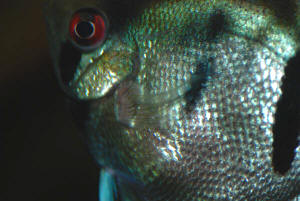
.JPG)
|
Little and Large Angelfish, FW beh. 5/21/07 Hi Crew,
<Matt> Thanks for all the great work you do! I have had 2
Angelfish (P. scalare) in a freshwater tank (30 gallon) for about 6-8
months now. They are alone apart from 4 Cory's. All the water
conditions are good. 0 Ammonia, 0 Nitrite, 10 Nitrate, pH 6.5, temp 78.
Both Angels are healthy and active. The problem I have is that when I
bought them they were both approx 1 inch. However, very soon afterwards
the marble angel (I have a marble and a golden) grew to approx. 4
inches whereas the other angel grew considerably slower and is only
approx. 2.5 inches. <Ah, yes... very often Cichlids (and other
animals) will/do exert influence on conspecifics (chemical and
behavioral) limiting their growth...> I know at least one of them is
a female as I have had eggs laid on a leaf. <And as you apparently
speculate, both may be...> I have a few thoughts as to the reasons
behind the different growth rates. I would appreciate your input and
opinion. My first thought is they could both be females and the larger
one is the dominant fish, and therefore is stunting the growth of the
second? <Yes, possibly> My second thought is that one is a male
and one is a female but I haven't read anything about significant
size differences or growth rates between genders. <Usually, all
things else being equal (good luck finding this occasion), the females
are larger...> Could this be the reason? They both get to the food
when fed so I've ruled that out as the reason. Do you have any
other suggestions? Thanks in advance for your help, Matt. <Mmm, a
larger system, more specimens... would tend to "even out"
growth rates in such circumstances. Please read here: http://www.wetwebmedia.com/FWSubWebIndex/GrwLmtChems.htm for
one aspect of what is happening here. You ought to consider
writing/investigating for natural history essays... You have a good,
curious mind, capacity for relating... Bob Fenner>
Re: Little and Large Angelfish -- 05/21/07 Hi Bob,
<Matt> Thanks for the comments. I actually gained my BSc (Hons)
in Coastal Marine Biology in 2003, and although I have subsequently
ended up in a completely different career field (Retail Management), my
love for/interest in Marine Biology is still strong, so you're
suggestion to write/investigate is tempting and definitely food for
thought. <Ahh!> Thanks, Matt. <A pleasure my friend. Bob
Fenner, who is serious re your having another starter/career as a
content provider>
Angel Fish question, beh., hlth.
4/18/07 Could you please tell me what the average life
expectancy is for a freshwater angel fish in a 7 gallon tank? I have
had one for 6 years and he is suddenly very sick and I was just
wondering if this is the expected end of his life cycle. Thank you!
<Hello Cindy. In a 7 gallon tank, a baby angelfish will reach the
size to be moved out about 3-4 months after hatching. Anything beyond
that is, to be honest, cruel. So it is definitely time to move him out
to new quarters. At minimum, you should be looking at a
"tall" 20 gallon tank for your angelfish, and I'd
heartily recommend something much larger if you want your fish to look
its best. Like most other medium-sized cichlids, angelfish should live
around 10 years in captivity, potentially quite a bit longer. Be sure
and read the article on angels here: http://www.wetwebmedia.com/FWSubWebIndex/fwangelfishes.htm
and then peruse some of the related articles as well. There's no
shortage of information on angels out there, including some quite nice
books.> Sincerely, Cindy <Cheers, Neale.>
Re: Angel Fish question, hlth.
4/19/07 Thanks so much - from the article, it looks like my fish
probably has hemorrhagic septicemia in one of his fins.
<Haemorrhagic septicemia is very uncommon, and I have no idea how
you diagnosed this. Far, far more likely that it is sick from being
kept in a 7 gallon tank. Please trust me on this: the aquarium is too
small and likely the nitrite and ammonia levels are too high because of
an undersized filter. Unless you're changing 100% of the water
every day, the nitrates are probably too high too. These will cause
serious health problems in the long term, as seems to be happening
here.> I had been treating him for fin rot with tetracycline, but
perhaps I missed the mark. It may be too late to switch to Flagyl as he
is in serious distress. <Haemorrhagic septicemia is a symptom not a
disease. It may be caused by many things including a virus. So shotgun
treatment with an antibiotic is pointless. If you seriously think this
is the problem, consult with a vet. Your fish isn't going to get
better by itself.> I will do what I can and see if it works. He is
fighting the good fight to survive, but odds may be stacked against him
at this point. <Please understand this: the odds are stacked against
him because you made it so. The conditions you are keeping this fish in
are unhealthy and wrong, and hence your actions are causing this animal
to be sick and likely in pain. He isn't sick because of some random
disease that stole into your home during the night. It's because
you aren't caring for him properly. Your move.> He lives alone
in the 7 gallon tank, and until he got sick a week ago, seemed to be a
very happy camper - responding to my voice, dancing for me, etc. He
truly is a pet just like a puppy and I am devastated he is so sick.
<Just goes to show. Your fish gave you so much back. Yes, he was a
pet, and yes he depends on you. All he wants in return is a larger
aquarium that will cost you very little to obtain.> Thanks again for
the info - I have bookmarked it for future reference.... Cindy <No
problems. Cheers, Neale>
Angelfish Lying on Side?!? 11/27/06 Hello Bob.
It's Glenda again. You may remember me from the email I sent about
my Honey Gourami whose stomach was rotting away (July 24). <Ah,
yes> My new problem is one of my black Angelfish: Why is it lying on
its side on the floor of the tank? <Not good> It eats heartily
like all the others but doesn't move around much otherwise. No
other visible signs of sickness but it has been so for a few days now.
It first started by staying at the top of the tank behind the flow of
bubbles coming from the filter. Any idea what's wrong with it?
<Yes... darker varieties of FW angels have a decidedly higher
incidence of "swim bladder" disease... symptomatic by this
sort of lack of 3-dimensional control... Not cure-able> I am still
using my 25 gallon tank but the fish are a different collection: 2
Black and 1 White Angelfish, 1 Black Ghost, 2 Upside-down Catfish, 2
Silver Gouramis (one whose pectoral fin rotted off in Sept. over the
course of about 6 months. Still living happily otherwise though so I
just monitored it but didn't really worry about what caused it to
happen. <Could be negative interaction between the Knifefish or
Mochokid catfish... more likely at night...> They are 3+ years old.
Probably a small injury that never healed I guess? <Yes... and/but
most likely related to the other species noted> Seems ok now.), 2
Plecos, 1 Yo-yo Loach, 3 Guppies, 2 Rainbow Sharks and 1 Albino Shark.
<Oh! Or these minnow-sharks...> Once again, thanks for your help.
<The one angel will likely perish... perhaps better to euthanize.
Bob Fenner>
Breeding FW Angelfish Are Aggressive
8/19/06 Hello Bob and Crew, Ever since one of my angels laid eggs,
she has been extra aggressive towards the other one. She was always
dominant, but it is getting pretty bad. I figured that if I add in
another angel and switch the decor around that would give her more to
think about. We have some angels at the pet store where I work that are
similar of size but the one I have permission to take is the most
aggressive in the tank. Will this be a problem if the new one wants to
be the dominant one? I just don't want my angel to get beat up
because she's real pretty and all she "can" do is hide in
the back corner beneath the plants. Thanks for your help and advice!
< Angelfish are cichlids and really don't like other fish around
when they have fry or eggs. An over protective mother with guard the
eggs from her mate if she thinks that he is going to eat them. Adding
more fish will give her more fish to beat up. If she has no mate then
reduce the temp to the mid 70's and she will stop breeding and she
will not be as aggressive.-Chuck>
Weird Angelfish beh.
7/25/06 Hi, my name is Stacy. <<Hi Stacy, I'm
Lisa.>> I have a problem with one of my angelfish. I was reading
the FAQs and saw some symptoms but my concerns weren't answered. I
purchased my first tank about a month ago so I am really new to the
fish world. I started off with a few Bala sharks and recently I got two
angelfish. <<Is your tank humungous?? Bala sharks get to 14'
in length. Not suitable at all for most aquariums and certainly not for
a beginner. You should return to the LFS, or acquire a tank of 300+
gallons.>> All of the fish are doing fine except for one
angelfish that, since the first day (yesterday), has been swimming near
the top of the tank sometimes turning to its side. It doesn't move
around too much and I haven't seen it eat anything yet. The other
angelfish is happy and doing well and likes to swim everywhere. Is
there anything wrong with it or is it just still in shock from the
move? <<You don't provide any test results from your water.
How did you cycle the tank? Lisa.>>
Freshwater
angelfish Dear WWM crew My name is Cassandra Allen and I am 9 years
old. My dad said I should write to you about a question. He says you
know a lot about fish and aquariums and are very helpful. <We
certainly try.> He gave me and my sister each a 29 gallon aquarium
for Christmas. Then he divided his fish up between us so he could
change his 80 gallon tank into saltwater. <Very nice!> I now have
an angelfish that is about 4 years old and some golden barbs and Serpae
tetras and a couple of Corys. Here's my question: About how long
does a freshwater angelfish live? He looks kind of old. Thanks. <It
would of course depend on the specific species but 10 years is not
uncommon. If he is looking 'old' it may be due to water quality
or some other aspect. Be sure to feed him a good variety of foods
including the occasional treat of frozen Mysis shrimp or bloodworms.
Ronni>
Very aggressive Angel fish (fresh water) My angel lives in a
55gal aquarium with 2 silver dollars a blood parrot, Raphael cat, and a
few others. Last night my angel got very aggressive towards every fish
in the tank including the bigger iridescent shark. His body color would
fluctuate between light and dark. His eyes would also get dark red. I
put him in another tank last night and this morning I noticed redness
around his fins. Does this sound like a disease you are familiar with?
And what do I do to treat him? This fish must be saved; my wife gets
really upset when her fish die as do I. Help please!!!! <I don't
know of a disease that causes aggressive behavior but the red streaks
sound like a bacterial infection of some sort. There are a number of
treatments, Maracyn 2 by Mardel, Anti-Bacterial by APPlus, and I'm
sure there are many others. Check out http://www/wetwebmedia.com/FWSubWebIndex/fwfshparasites.htm
for more info. Ronni>
Fading Angels I have two small angle fish with predominate
stripes, well they had predominate stripes but the stripes are now
starting to fade. Is this a result of putting them in a new tank?
<Well, this is likely stress-induced, be it from moving into a new
tank or more likely from environmental conditions. Do you test for pH,
ammonia, nitrite, and nitrate? If so, what are the values? If not,
definitely do so, or if you don't have test kits, swing by your LFS
with a water sample so they can test it for you. Any of these values
being out of whack can cause stress in your fish, which would cause
these (and other) problems.> I have a larger angel fish that acts
well with the smaller ones and they often hang out in a group. I also
have a fancy goldfish. (I know you're probably thinking this
wasn't a good idea because the angel fish will attack the goldfish
but they actually all get along) <Well, the compatibility issue
really isn't about aggression, but water parameters. Angelfish need
a water temperature around 78F-82F, and goldfish prefer their water
around 68F-70F. It's just not a good idea to keep coldwater fish
and tropical fish together for this reason; one group or the other is
going to suffer for it.> it too has lost the purple it had on its
back and face and is now all orange. <The goldfish was purple? Are
you sure, purple? Unfortunately, goldfish don't come in purple,
only black, orange/gold, and white, or any combination of the three. It
may very well be possible that your fish was dyed to make it more
'colorful' - this practice is actually harmful to the fish. But
aside from that, goldfish will change color (say, from black and orange
to just orange, or from orange to white, for example), sometimes
attributable to temperature or pH changes.> What is causing my fish
to lose their stripes and color? I feed them 3 times a day and they are
active. <Also, how big is your tank? Can you give us any more
information about your setup to help us be better able to help you?>
Please get back to me as soon as possible on some solutions to this
problem thank you, Sam <You're quite welcome! -Sabrina>
Aggressive Angels 3/7/04 I have these 2 angels in a 29 gallon
tank (also a Pleco + 2 clown loaches + some cichlid that I don't
know the name, but he is not aggressive at all because nobody really
likes the corner cave he's in). Just recently one of my angels
(yellow one) has been nipping the hell out of my other angel (marble).
The yellow is just a touch bigger, but I bought them both at the same
time over a year ago and never noticed this behavior before. I am
pretty sure the marble is a female as she has a rounder belly. Any
suggestions? <Angelfish are still cichlids. I'm not sure how
large your tank is, but adults need around 20g each. You could have 2
males.> I have no more tanks free to separate them except for the 20
gallon with the GSP in it, and I'd like to keep him solo except for
maybe add one more fish that eats algae and stays small. <There are
no BW algae eaters that can go w/a GSP. Also, a GSP will kill any fish
that is slow-moving or long-finned (like your angel. Angels prefer soft
water, the opposite of BW, which what your GSP needs to live in.>
But really, this nipping has to stop. He nipped off all her nice
flowing fins and I'm pissed. <Just acting the way cichlids will
act.> And it's for real aggression, not just playing. <I
think that angel may eventually kill the other one. Can you find a new
home for one of them? Thanks again. -LH <Good luck ~PP>
Fallen Angel I have five angels in a fifty five gallon with
Dojos and Corys. The head female and three others have started tearing
up one of the angels. They almost killed it before I moved it to my ten
gallon to heal. First, do you have any idea why a school of angels
would suddenly start isolating a male, bite his scales off and eat his
fins and tail? Second, I have another 55 with a 8inch Pleco and two
6inch Oscars, two ten gallons and a 29 brackish with four green spotted
puffers. I do not want to put him back into the original tank for fear
of them starting it again, but fear the puffers or the Oscars may hurt
him also. He is too big for my ten gallon. Could he survive in the
brackish tank with puffers or with the Oscars? <Angelfish are
cichlids and do become very aggressive when they mature and pair off to
breed. Most likely the female has bonded with another male and they
were upset at another males being in their space. I would not return
him to this tank. I would also not put him in with the puffers. Even if
he was able to adjust to the brackish conditions, the puffers would
tear him up. You could try him with the Oscars, they are large but not
overly aggressive. But it is a risky venture. If the Oscars start to
breed, they will quickly kill him. I think it's time to pick the
pair of Angels and sell/return the others. Don>
Re: poor beaten angel Thank you very much. I just cleaned the
Oscar tank, so I will let it settle before the transfer. Now the Head
female is beating up on another male I have. She appears to be a loner,
and not to have paired with anyone. Do I just keep moving them out till
I can spot the pair?? She is your typical silver and black striped, the
largest. The one I just moved is black, and the one she is fighting
with is of marbled coloration. The only two she will be left with are
hi-fin angels. I can not tell the sexes on those, but one has
significantly larger fins. Do the colors or hi-fin make a difference on
their pairing? Is it just possible that she may not be pairing with any
of them and is the one I should remove. I hate turmoil in my tanks, but
these fish are the oldest ones I have. Thank you for all your help.
< Sexing angels can be tricky. Typically the males are larger, have
loner fins and develop a hump on the forehead. Some angelfish experts
look at the angle of the anal fin. The female is testing the males to
find one that is strong enough to stand up to her for breeding. Cool
the water down for a couple of weeks and this should reduce the females
desire to breed. Feed the fish with high quality food and keep the
water clean. In a couple of weeks raise the water temp to 80 degrees F
and see if any of the males are4 ready to take her on. You might want
to separate the males and keep them warm to accelerate the growth
process so they will be a bit stronger when you reintroduce them next
time.-Chuck>
Re: poor beaten angel Wow, thank you. I will do as you
advised... The black angel is doing fine in the Oscar tank, but is very
lonely. How small of an angel tank mate could I get before the Oscars
would devour it? < Anything that would fit in the Oscars mouth is
too small.-Chuck>
Fat Angel Hey Bob, I wrote you a while ago regarding my koi
angel needing a friend. Well she got a silver slightly bigger than her,
and she keeps nipping' at him! Is she establishing dominance or are
they flirting? <Hi, Don here. She's just putting the newcomer in
his place. Common in cichlids. As long as there are no fins being
ripped they should settle down in a few days. But do keep an eye on
them> Also I fed them bloodworms. In which she ate all of them and
her belly is so fat and she is swimming a little sideways. Will she
make it? What is going on??? Erica <A one tine overfeeding of
bloodworms should not cause any long term problems. Skip their dinner
tomorrow and see if the bulge goes down>
Angelfish Aggression Thank you, Chuck at WetWebMedia, for
your quick response to my urgent question/problem. I have taken your
advice to heart, and took the angelfish out of the goldfish tank. I
agree that possible aggressive behavior on the part of the angel would
eventually be a problem. I do think I saw a new nip or two out of the
tail of my shubunkin. His tail is frayed a bit anyway and the other
goldfish are CONSTANTLY playing. There is no way that I could leave any
even POSSIBLE danger to my sweet goldfish. They are just so cute and
happy and do seem to enjoy life so much. So, the more docile male
angelfish is back in the tank with the fighting female, with a
separator between them. They have spent most of the time just staring
at each other. She is seen occasionally trying to bite through the
separator. She really IS aggressive. He, seemingly emboldened by the
separator, will approach her and try to nip her through the plastic,
too. At first, though, he was pretty crept out to be back so close to
her and retreated to his furthest corner. Then he realized he was
protected. Poor guy. I have a 10-gallon that I may put him in
eventually. BUT I DIDN'T WANT ANOTHER TANK!!!!! The work! The work!
The work! I feel like I have devoted every spare minute the past two
years to FISH!!! But I love them. I do. And I wouldn't give this
hobby up for anything. Sincerely, and thanks again Rebbie. <I am
glad that your fish will happy and healthy for a long time with a
caring owner like yourself.-Chuck>
Angelfish Problems I have a pair of Marble Angle fish. The
last set of fry are about 3 months old. We removed them from the
parents tank about three weeks ago from our 30 gallon tank. Recently,
the female had not been eating, and 2 days ago she was laying upside
down on the bottom of the tank. I thought for sure she was dying. The
next day she seemed fine. Today we noticed her straight up in the
bubbles, kind of acting like she wasn't getting enough air. Then
after doing that she went back and laid on the bottom. Is there
anything I can do to help her?? <The stress of breeding has taken a
toll on her and it sounds like she has succumb to an internal bacterial
infection. Do a 30% water change, vacuum the gravel and clean the
filter. Treat the tank with Metronidazole as per the directions on the
package-Chuck>

