|
|
| Home | Marine Aquariums |
Freshwater Aquariums |
Planted Aquariums |
Brackish Systems |
Ponds,
lakes & fountains |
Turtles & Amphibians |
Aquatic Business |
Aquatic Science |
Ask the WWM Crew a Question |
| Please visit our Sponsors | ||||
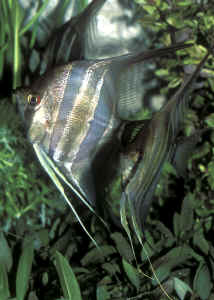
Keeping Wild FW Angelfish 3/3/2009 My friend Danny recently got a tank, 52 inches long, 14 inches high, 12 inches wide. After cycling, he got three wild caught angelfish, about 3 inches long. I don't know if they are altum or another type- but he's lucky that he lives in an area with very acidic water- pH a little above 6.0. I told him angels grow big and live along time, I talked him out of rams after what you told me. (is this good advice) < Rams will do well with angelfish. They both have the same water requirements and the rams will stay towards the lower portion of the tank.. Will three such fish outgrow a 53? < Three fish will not outgrow the tank.> How big of a tank will they need at maturity? < The 53 will be plenty big for three angelfish..> He wants to put more fish in, is this a good idea? < A group of six would make them feel very comfortable and probably get a couple breeding pairs.> What are good foods?, right now the fish get tetra flake and some frozen cichlid diet. < I recommend a high quality pellet foot as the staple diet.> Does he need crushed coral to balance and buffer pH, with fish like this?, Pet store person wanted him to do it. < It is a good idea to add a buffer to stabilize the hardness and pH. Very soft water can be unstable. The buffer will prevent the pH from going too low. Crushed coral will help. But I recommend a buffer added to water before it is used in the aquarium. Chemical additives should be done slowly outside the aquarium. the newly buffered water can then be added while doing small water changes.> How long do angels live? < Lots of reports with angel fish living up to 10 years. Some much longer-Chuck> Thanks Re: Keeping Rams and Neon/cardinal tetras. Now Wild Angelfish Setup -- 03/07/09 I was wondering for a friend if 3 young wild caught Brazilian angels in a 55 gallon tank... 52 long 14 high, 12 wide need any tank mates,(or will they outgrow such a setup on their own) <The tank is fine. Would do better in schools of 6 until they pair off and start to breed.> What tank mates would be good? The water is rather acidic, about 6.2. 80 degrees, water is good. thanks < Small round bodied tetras like diamond tetras would be good. Cory cats, dwarf cichlids would also make good tankmates. Small torpedo shaped tetras get picked on. Gouramis get their ventral feelers bitten off.-Chuck> Re: Keeping Rams and Neon/cardinal tetras.
03/29/09 Wild Pterophyllum (maintenance; tankmates) 1/31/09 I was wondering for a friend if 3 young wild caught Brazilian angels in a 55 gallon tank... 52 long 14 high, 12 wide need any tank mates, (or will they outgrow such a setup on their own) what tank mates would be good? The water is rather acidic, about 6.2. 80 degrees, water is good. thanks <Alex, wild-caught Angels are challenging fish to keep, comparable to wild Discus. I would strongly suggest keeping a group of six rather than three specimens to avoid issues with bullying, and also to hang off adding tankmates until the Angels are settled and feeding well. Depending on the species (there are at least three Angelfish species) a 55 gallon tank could be adequate, but I'd recommend something bigger simply because it makes life easier keeping good water quality. Regardless, filtration will need to be top notch, and water changes should be generous, as nitrate is a particular killer for wild-caught cichlids generally. Water chemistry isn't critical with Angels, even wild-caught ones, since they come from a range of habitats, unlike Discus, which are exclusively blackwater fish. But do understand a low pH reduces the efficiency of biological filtration, so a sensible strategy would be to stabilise the pH around 6.5 or 7.0, whichever you prefer. Below pH 6 biological filtration essentially stops working, so at pH 6.2 you're already pretty close to the wire. Once the fish are settled and feeding, possible tankmates would include Cardinal tetras, Rummy-nose tetras, Harlequin Rasboras and Silver Hatchetfish. Neons and Danios aren't an option because they prefer cooler conditions, and in any case adult Angels are perfectly capable of eating fish such as Neons. Warm-water Corydoras such as Corydoras sterbai could be used at the bottom, and most Ancistrus species could be used as well. If you wanted something exotic, then perhaps Brochis or Dianema would be a possibility. Avoid anything too aggressive or territorial, and obviously nothing nippy. In particular take care with species of Hyphessobrycon, some of which would work, but others of which are too nippy. Cheers, Neale.> Re: Wild Pterophyllum (maintenance; tankmates) thanks I'll show him this next time he comes over <Happy to help. Neale.> Re: Wild Pterophyllum (maintenance; tankmates) 1/31/09 Also how much and how often should he change his water? <Same as with any cichlid: 25-50% weekly, taking care to avoid sudden pH changes. All cichlids are sensitive to nitrate, and doing water changes is by far the best way to avoid Hexamita (Hole-in-the-Head). That's a disease that's difficult to cure, so best prevented. Cheers, Neale.> Thanks again! <Most welcome. Neale.> Keeping wild angels 1/29/09 My friend Danny recently got a tank, 52 inches long,14 inches high, 12 inches wide. After cycling, he got three wild caught angelfish, about 3 inches apiece. I don't know if they are altum or another type- but he's lucky that he lives in an area with very acidic water- ph a little above 6.0. I told him angels grow big and live along time, i talked him out of rams after what you told me. (is this good advice) <Wild Angels are indeed wonderful fish, and if you have soft water already, you're all set. They mix well with Rams, but I wouldn't risk commercially bred Rams. Partly because farmed Rams don't live long, and partly because I'd be worried they'd introduce something nasty into a tank of Angelfish. Since both fish are cichlids, they can and will be subject to similar diseases.> will three such fish outgrow a 53? How big of a tank will they need at maturity? <Should be fine in this tank, though a pair of Angels can be very territorial. Assuming the tank has lots of tall plants, bogwood or other hiding places, they should be fine in a tank this size.> He wants to put more fish in, is this a good idea? <Dither fish of some sort, e.g., Hatchetfish or Rummynose Tetras would be a great idea. But take care to avoid any nippy barbs or tetras. If you want to breed them, you'll likely need to buy a few more. Angels cannot be sexed, so usually need to be kept in groups of six to allow pairing to occur naturally.> What are good foods?, right now the fish get tetra flake and some frozen cichlid diet. <Wild Angels will expect primarily insect larvae, e.g., Bloodworms, Glassworms, Mosquito larvae, etc. Once settled I'd fully expect them to consume a wide variety of things, including good quality flake and pellet foods.> Does he need crushed coral to balance and buffer PH, with fish like this, pet store person wanted him to do it. <Assuming he changes the water regularly, the pH shouldn't change too much between water changes. I wouldn't add crushed coral because that would raise the pH and hardness. But I would use a pH 6.0 or pH 6.5 buffering product. There are many available, usually containing phosphoric acid. Used carefully they work very well. Do see here: http://www.wetwebmedia.com/FWSubWebIndex/fwsoftness.htm > How long do angels live? <Potentially 10 years or so. Kept properly they breed readily, so your friend may soon get lots of F1 wild-type Angelfish to share with you and your local aquarium shops.> Thanks <Cheers, Neale.> Microscope and Altum Angels In light of my new employment, I intend to treat myself to a microscope. You told me of one marketed as a kids' toy, available at Fry's - do you remember the manufacturer? <Mmm, it's the fabulous Intel/Mattel QX3! Put these descriptors in the WWM Google search tool and you'll find I'm a big fan (have one at two arms length right here!> Also, at some point or another, I want very much to take another stab at Altums, but I've gotten myself paranoid with this angel 'plague'. Apparently, some views are that it's not Hexamita or Chilodonella/Costia/Ichthyobodo type illness, but I'm not at all certain of anything, except that it's very frustrating. I've spoken with angel breeders, discus breeders, other hobbyists, and for every one person I speak to, I get a completely different answer. <Look for "very fresh" stock... and treat them (orally, with Metronidazole... with or w/o food) yourself... is what I would do> General consensus is that it kills all your angelfish, and roughly 80% of your discus, and is incurable. But I'm not willing to accept that. If it'd be okay with you, I'd like to discuss what my experience was, what I did, etc. Might you be willing to criticize, let me know what I could have done differently? <Mmm, don't know you, the situation well-enough... but suspect this plague is the same pandemic the trade saw and spread fifteen years back or so> See? You spoke of gurus and got yourself condemned to answering angelfish questions.... <No worries. Bob> Altum /Wild Angel Spawning - 8/16/03 Dear Bob, <Anthony Calfo in his stead... Bob is away in Indonesia presently getting tattooed... er, well... at least plastered> My wild angel has been breeding for 4 times already and this time around it has been hanging around a male altum. What's the feasibility that I can have the eggs hatched and survive, or should I not waste the eggs but let her have her old mate instead. Winston <I'm not sure I follow your question, my friend. Has this female spawned unsuccessfully four times with another male? Or simply by herself (common)? At any rate, do leave her with the new/current male to see if a successful rearing isn't possible. I'm hoping that your water has been adjusted to be very soft and acidic. They will not be as likely to hatch or be fertile in harder water. Anthony>
|
|

|
Features: |
|
| Featured Sponsors: |