|
FAQs about Marine Worms, Vermiform Animals
Identification 15
Related FAQs: Worm
IDs 1, Worm IDs 2, Worm IDs 3, Worm
IDs 4, Worm IDs 5, Worm IDs 6, Worm
IDs 7, Worm IDs 8, Worm IDs 9, Worm
IDs 10, Worm ID 11, Worm ID 12, Worm ID
13, Worm ID 14, Worm ID 16, Worm ID
17, Worm ID 18, See
Also: Flatworm ID 1 +,
Nemertean, Proboscis, Ribbon Worm ID
1, Nematode, Roundworm ID
1, Nematomorpha, Horsehair Worm ID
1, Acanthocephalans, Thorny-headed Worm ID
1, Tubeworm/Featherduster ID
1 +, Bristle Worm ID 1 +,
Hirudineans, Leech ID 1, Sipunculids, Peanut Worm ID 1, Echiuran Worm ID 1, Invertebrate Identification, Worms 1, Worms 2,
Worms 3, Flatworms/Planaria, Fire/Bristleworms, FAQs on: Worm Behavior, Worm
Compatibility, Worm Selection,
Worm Systems, Worm Feeding, Worm
Disease, Worm
Reproduction,
Related Articles: Worms,
Featherduster Worms,
|
|
|
Worm ID please 4/5/11
Hello,
<Hi there>
I am having a hard time figuring out what these little guys are.
They look
kind of like the legs of little brittle stars (I have quite a
few) except they're 2-3 inches long, singular and in random
spots on the same rock. Also they're more clear than white
with red stripes and tiny hairs. Any
idea would be greatly appreciated.
Angela
<Read here: http://wetwebmedia.com/polychaetes.htm
These are Errantiate Polychaetes... Bob Fenner>
|
|
|
Strange worm? 2/13/11
Hello Bob and crew.
<Connie>
After feeding my reef tank tonight, I noticed a strange creature I am
hoping you can identify for me.
At first I thought it was a very fast, small red fish...but it seems to
be some sort of worm.
<?>
It is probably about 2 inches long. The 'head' of it is white
or light grey and the body is red. It is rather fuzzy, especially the
head area. It wriggles it's body to swim, and looks like a fish
swimming very fast all over the tank.
It has what actually look like fish eyeballs, and darts to the surface
to grab food. It knows exactly what it is doing -- darting to the
surface to grab food, then swimming to more food or to shelter, then
back to grab more food.
My Randolph's <?> Damsel seems to be a bit afraid of it.
Any idea what it could be or most importantly if it could be
harmful?
< Who knows?>
I couldn't possibly get a photo of it due to it's speed -- it
actually hurt my eyes to follow it darting around the tank.
The tank is 55 gallons, around 65 lbs live rock, all parameters are in
'normal' range.
Thank you!
<Likely an epitoke... See the Net re Errantiate Polychaetes. Bob
Fenner>
Strange worm? Email 2 2/13/11
Hello again. I think I was finally able to find out what the worm in
question is. It appears to be an Epitoke?
<Oh, likely so>
The lights are out on the tank right now and I can still see it
swimming around like crazy under the moonlight.
Almost the craziest thing I've ever seen in my tank -- the craziest
being the corpse of what I think was some sort of yellow Blenny
swirling around in the filter currant, which I had never seen before
and must have been living in there unnoticed for a good couple
years....
<Mmm, no; not as an epitoke>
he sure was a cute little fish and I was so sad he was dead...I
actually thought he was a large leaf swirling around in there until I
saw eyeballs.
Hopefully I was able to identify this Epitoke creature correctly, since
they are apparently harmless.
Thank you Bob and crew....for all the personal help and the great
website.
<... welcome! B>
black and white worm in my live rock
12/31/10
I had to re-arrange some of my live rock today as my purple tang had
died an I needed to gain access to it to remove it after moving a piece
of liverock I discovered a strange looking black worm with white
markings that comes out and burrows its head into my substrate.. I am
hoping that you are able to determine what type of worm this is and
tell me whether it is safe to have in my tank.
<Mmm, really need a well-resolved image, or very careful physical
description to help you>
I have a 55gal tank that currently has about 45lbs of live rock, 2
Allardi clowns, a cleaner wrasse, 2 cleaner shrimp, a peppermint
shrimp, 30 hermits, 12 snails, a bta, some pulsing xenia, some candy
cane coral, 3 blue mushrooms, a colt coral, and some other type of
coral that I was told was called fantasia (most certainly is NOT
Aiptasia) and another grassy looking coral. I want to make sure this
worm is reef safe as I would hate to lose any of my corals. Please get
back to me asap and have a happy new year!
Christina
<Thank you. Please read here: http://wetwebmedia.com/marinvind1.htm
scroll down to "Worm ID's"... Bob Fenner>
Re: black and white worm in my live rock... not reading...
1/1/11
Ok so the worm only comes out when the lights are off and it seems to
be about 1 1/2 inches long when it extends itself from the rock.. It
doesn't seem to leave the rock at all though its only millimeters
in diameter and its all black except for a few creamy white vertical
stripes. When it extends its body from the rock it burrows its head a
few millimeters into the substrate and then pulls its head out and
sticks its head into the substrate in another spot within reach. I wish
I could get you a picture but unfortunately I don't have a high
resolution camera that will take a good picture through the glass of my
tank. Hope this helps you with an id
of what I'm dealing with here. And thanks again
<... segmented? Processes on the head, eyes? Please... read where
you were referred prev. BobF>
Re: black and white worm in my live rock 1/2/11
I checked out the where you told me to but did not come across any ids
of the worm in my tank its too small for me to see its eyes the
description I gave you is honestly the best I can possibly give..
<Dang!>
From what I've told you is everything in my tank safe from
This worm or is it something I should catch and remove asap
<I'd leave it be. B>
Polychaete question, that or tubiculous
snail ID 1/02/10
Hey their Guys,
<Howsit?>
I know Polychaete questions and bristle worms can become annoying but I
have scoured the internet for this one and cannot find anything close
to it. Anyways The worm in the tank is white and has 4 antennae. Now
this is rather normal but it gets better. It lives in some sort of
calcium type white egg it is oval and about 1/4" in diameter. It
is slightly opaque and I can see him inside of it during the day. It is
really shy but it apparently like to collect stuff and put it around
its egg house. Right now it collected red seaweed, a very tiny clam,
and another piece of seaweed.
It comes out of the egg type deal for a few seconds and then backs up
into it immediately so a picture is rather hard to capture. Have you
come across any worms or Polychaetes or bristles that live in a semi
transparent opaque white circular egg thing?
<Mmm, yes... though this might also be a tubiculous snail...>
Any information would be great. Also it resembles a centipede and does
not contain bristles on its body and has 4 antennae around its mouth
area.
<Many Sedentariate Polychaetes appear smooth-sided... There are
thousands of species... Do you have pix to send along? Please read
here:
http://wetwebmedia.com/HighInvertInd.htm
the second tray... FAQs on Worm ID's, further down on
Polychaetes... Bob Fenner>
Re: Polychaete question
1/4/2010
Ok guys,
I have finally identified the questionable animal it is a Eunice
norvegica.
<A neat animal>
If anyone describes a worm like creature that has no bristles,
<Mmm, actually, this species does have noto- and para-podia>
looks like a centipede, and builds cocoons out of bits and pieces of
seaweed, clams, or corals it is most likely what I currently have
living in my tank. They can also be rest assured that they are safe,
excellent scavengers, and have a relationship with corals by taking sps
corals and "gluing" them to their tube for protection.
Cheers, Jerry
<Thank you for sharing Jerry. Bob Fenner>
|
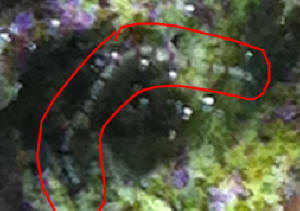
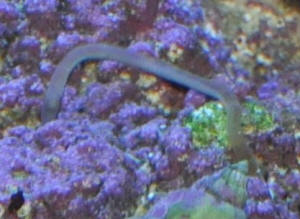
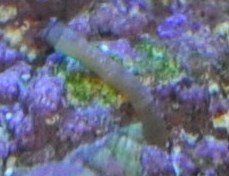
White worm -- 11/10/09
Bob, I apologize if you did get this email and I am just in too
big a hurry.
<Don't recall ever seeing this>
I can't find any article or picture like this worm. I am very
concerned for my fish. I tried to meet your picture size needs
and hope sending two was not too bad but hope you can determine
what this worm is and if I should remove the rock (major
aquascape project) to protect my pets. Its too skittish and fast
to catch. Trapping hasn't been successful.
It has also been suggested it may be a Polychaetes, Glycera rouxi
(found on your site) but it is white, not brown.
<Come in different colors, shades... are there any bristles on
the side of this worm? Your pix are too poorly resolved to see
much. Take a look on the net for the family Glyceridae>
I don't see where this is "good" or "bad"
for SPS and LPS. I have both.
I see there are several responses dated 11/9/09 but have never
written to you so am possibly just too anxious for your
knowledge.
Thanks, Jolene
<Might be an Errantiate Polychaete... could even be a
Nemertean from the pic:
http://wetwebmedia.com/ribnwrmidfaqs.htm
Bob Fenner>
|
  |
Re: white worm --
11/10/09
Your site is awesome. I've read so much about (*&*&(^
worms in the last few days! I don't see any "legs" it
just slithers (partially) out of the rock then nips at it and
quickly retreats back, then out again.
<Ahh! Then doubtful this is a Polychaete (means: "many
bristles")>
Its very thin. It appears it probably has two tentacles at the
mouth end but is so small/short I can't really tell. It
doesn't look like any of the worm pics on your site (or any
other) of any color. Actually, the closest resemblance is from your
site in worm section 4 (I think) under Polychaetes reproductive
comments. But, it has not been swimming freely or floating in the
water column. What do you think?
Jolene
<Nah, not an epitoke... these are very active, as you state, and
rather short lived... and don't generally feed! BobF, who's
sticking with his guess that this is a Ribbonworm for now>
Re: white worm -- 11/11/09
Thank you so much and such fast communications! I will keep a close
eye on it and read more about ribbon worms. It doesn't sound
like they are harmful. I'll try to get a better picture for our
club meeting (11/21) so they can see a better picture than what I
currently have. I'll send to you as well. They are the ones who
introduced me to your site.
I know our club would love to have you a guest if you are ever in
our area (Arkansas).
Jolene
<I do get out and about. Please have your "program
director" designate contact me re. Cheers, Bob Fenner>
Re: white worm -- 11/11/09
I'll pay more attention when the lights go out and try to get a
better picture. I can't get the rock out without disassembling
the tank and don't want to do that unless absolutely necessary
but of course I will if needed.
I feel better that you guys have not said "oh no, its a
>>>> get it out quick"!
<Ahh! I would leave this animal in your system. Are interesting
behaviorally and not damaging given "large enough
systems" which you have>
White and no appendages. Is that "common"?
<Not uncommon>
I can't find an exact picture anywhere but Bob's remarks
and thoughts also sound very reasonable.
<Thought I'd referred you. Please see here:
http://wetwebmedia.com/ribnwrmidfaqs.htm>
How does one become a worm expert?
<Heeee! Study... college courses in invertebrate zoology,
diving, working in sorting and identifying benthic animals for
bioassays.... There are MANY worm groups (phyla) and tens of
thousands of species... all sorts of life styles, feeding modes,
free-living to obligate parasites... tiny to quite huge>
A very "special" person I'm sure! I've not seem
anything like these little worms in the Caribbean where I dive. I
guess they are there, yuk.
Jolene
<Heeeee Heheeee. Just have to be looking closer. Much to see.
Bob Fenner> |
|
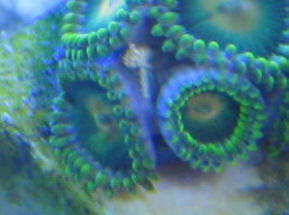
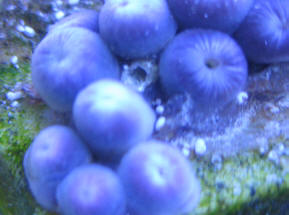
Worm living inside my Zoa 10/26/09
????
A while back I took some pictures of this worm looking thing
coming in and out of my Zoas, here it is:
This was a while back and eventually I stopped paying attention
to this.
But for the past few days the Zoas have been... not extended to
their full potential and I picked them up to take a close
look.
I saw something that caught my attention. It looked like a shell
that was growing between the polyps. I got a tweezer and broke it
up, turns out to be a tube. Yeah, it looks like there's tube
growing into the Zoas!
<It's just a hitch-hiker tube-dwelling worm of some sort
or another (further ID unlikely). It's nothing to worry about
and not why your Zoas are not extending.>
You can see it right in the middle
WHAT IS THIS?!
<See above.
Cheers,
Sara M.>
|
  |
|
Hitchhiker ID 10/14/09
Hello Crew,
I've found a couple strange organisms in my tank recently I
would like some help identifying. The first came attached to the
tube of a trumpet coral. I cleaned it before I put it into the
tank, but this didn't wipe off and looked like coralline
algae. Over the past couple weeks it has filled out and opens up,
sometimes in the day sometimes at night, showing the tentacles
that encircle it. It seems like an interesting organism though
attached in a bad spot.
<Good desc.. Does appear Polypoid... colonial, lacking a hard
skeleton...
The arrangement of tentacles... My guess is on this being some
sort of Zoanthid... You may want to try removing it... as it will
too likely grow, outcompete your Trumpet. Do see WWM re Zo
compatibility... as there are some important cautionary remarks
re doing this scrubbing outside the display tank, with gloves,
eye-protection... should you go the removal route>
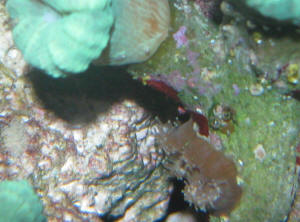
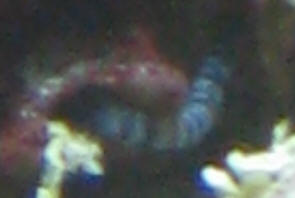
The second is living in a piece of live rock that has been in the
tank for 4 months. It looks to have taken up residence on one
hole and has not moved in the last week. It is a blue worm
looking thing.
<Indeed>
What I found strange is the pile of 'shavings' that has
accumulated beneath this organism's home. I have blown the
pile away twice now and it has collected again. The sum of these
'shavings' is much larger than what I have seen of this
animal. I can't tell if it is waste, or if it is tunneling in
the live rock. Any help would be very much appreciated.
Thanks,
Adam
<Appears to be a "segmented worm" of bluish
colour... could be a member of a few phyla... Need a "head
shot" of good resolution to guess further.
Please read here: http://wetwebmedia.com/HighInvertInd.htm
the second tray down. Bob Fenner>
|
  |
|
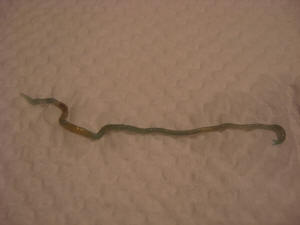
Worm ID 10/14/09
I have attached and image with a worm I caught when my green
Goniopora coral retracted.
<Good catch>
At first it seems to be part of the coral since the coloration
and segmenting make it almost identical to the flesh of the
Goniopora. I have looked around and, although a few people have
posted similar pictures
of it, I haven't been able to properly identify it nor find
out if it is harming the coral or should be left alone.
Thank you for the help,
Rod
<A Polychaete of some sort... For the size,
circumstantial/location evidence, I'd leave it out. Read
here:
http://wetwebmedia.com/polychaeidfaqs.htm
for more. Bob Fenner>
|
 |
Free Swimming White Worms
9/2/09
Dear WWM crew,
<Ray>
I have a 75 gallon salt water aquarium. It has been set up for a year
and a half and I haven't added anything new to it in the past six
months, besides food. Last night I looked in my tank with a small
flashlight to see if I
could find any new life when all the sudden all of these small, white,
free swimming worms came out of the darkness and into the light. They
swam in an "S" shape motion. I searched today to try and find
out what these critters are, my best guess is some kind of a bristle
worm larvae.
<Agreed... or small species of adults>
Although, I watched a video of bristle worm larvae on YouTube and they
don't seem identical.
<There are thousands of species... quite diverse>
I was able to record a video of these worms which I uploaded to
YouTube
and can be found at this link:
http://www.youtube.com/watch?v=YssgPWaDtzo
.
<Neat!>
I'm fairly sure that these worms are not harmful seeing as my fish
are all healthy, I'm just curious as to what they are.
Thank you,
Ray
<I concur that these worms are very likely much more beneficial than
deleterious. Part of the wonder of the seas, aquariums. Enjoy! Bob
Fenner>
|
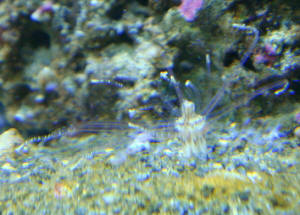
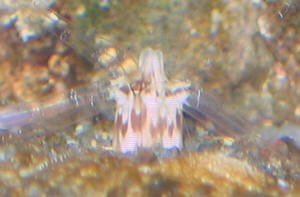
Identification: Weird tentacled sand worm
I'd like some help with an identification if you have the
time. I've found several of these creatures recently in my
sand. I've experimented with giving them a bit of Mysis and
they rapidly eat it all up. When disturbed, they quickly shoot
into the sand. Once the coast is clear, they look like
they're inflating as they come out. I managed to scoop one
out with a spoon and the body is actually a curved worm about an
2-3cm long. The one shown is about 1cm out of the sand and half
that in diameter. The tentacles are 2-3cm from center to end.
Thanks for your help
<I do think this/these are some species of Terebellid (a
family of Polychaete worms). Very neat! Bob Fenner>
|
  |
Worm ID: It's a Worm.
8/11/2009
<Hi Denise.>
We are new to the saltwater world. We currently have a 29 gal. BioCube
that has been up and running for several weeks. We have Caribbean live
rock, 3 damsels, two different types of snails and some small hermit
crabs.
On one of the rocks there is a dark green plant that looks like a flat
tube (only maybe an inch long by half inch wide). For the last several
nights, I've noticed a small, brownish, worm-like thing coming from
the far
side of this plant (I can't tell if it's attached to the plant,
the rock or nothing). As soon as I shine the flashlight on it, it
retracts out of view instantly. Each night I've seen it, it looks a
little longer (tonight it appeared to be 2-3 inches long). I don't
see any outstanding features on it... it looks to be about the diameter
of a thin spaghetti noodle. I only see one of these things and was just
wondering what it might be and/of if it may be harmful.
<It is impossible to ID without a picture, but do
have a look here:
http://www.wetwebmedia.com/wormidfaqs.htm and look at the linked ID
pages
at the top of the page and see if you can spot anything that looks
familiar. Now worries though, worms are generally a good thing in an
aquarium.>
Thanks!
<My pleasure.>
Denise
<MikeV>
Protula magnifica anatomy, Worm ID
5/15/09
To Bob Fenner,
I have a question concerning the actual anatomy of the Coco Worm
(Protula magnifica, P. bispiralis). All I can find are pictures of the
worm in its tube with its crown(s) unfurled, but none of the worm
itself!
<Mmm, most any general invertebrate zoology text will have a general
Sedentariate Polychaete graphic or two...
See Robert Barnes, Buchsbaum...
A client of mine found a strange worm wiggling about on his substrate
in his 58g. Reef Tank, and I can only attribute this creature to his
Coco Worm.
<Mmm... there are MANY species of such tubeworms... can easily come
from live rock, et al.>
I looked into the worm's tube, but couldn't see anything due to
the curvature of the tube itself. What we saw writhing on the sand
looked like half of a peanut worm and half of a Hermodice carunculata
Bristle worm. We
found no crown on the worm (of course), or in the tank. I removed the
worm just in case, although in the fifteen years I've been keeping
reef tanks, I've never seen anything like this. Unfortunately, I
have no pictures of
this fascinating thing, but would rather receive anything on the
anatomy of a Coco Worm (a drawing would suffice). Please help me find
out what this thing really is.
Michael
<... w/o even an image? Please read here:
http://wetwebmedia.com/wormidfaqs.htm
and the linked files above... Yes, "that will be very time
consuming....".
Bob Fenner>
Re: Protula magnifica anatomy
05/18/09
Thank you Mr. Fenner for the Invert Zoology text references. I've
looked over wetwebmedia.com/wormidfaqs.htm as well, but couldn't
find anything even close to the strange worm I saw. I can't help
but keep thinking, "If only I'd had a friggin'
camera!" Thanks again.
Michael
<Welcome... a drawing? Basic description? BobF>
|
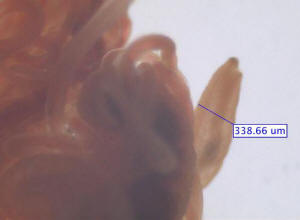
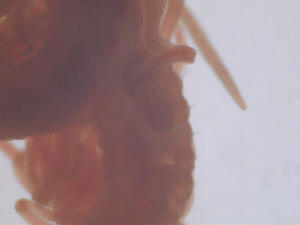
Red Tentacle Worm: Possible Cirratulid or Terebellid
-- 4/29/09
Hey,
<Hello, Ryan>
I have not found any information that specifically related to
this worm. It is segmented, with LOTS of tentacles coming
off.
<Up and down the length of the body, or concentrated at the
top/head area?>
Initially I assumed it was a spaghetti worm, but it is solid
white. Currently, at the head end, it is about 339um in width. I
am very curious to find out what this is, especially since it is
in a tank with some corals, and a pipefish.
<It looks like either a Terebellid/spaghetti worm (numerous
long, very thin tentacles emerging from the head area only) or a
Cirratulid/hair/medusa worm (2 feeding palps, shorter tentacles
emerging along the length of the body). Both are beneficial,
deposit feeding Polychaetes that are generally harmless except in
situations where the population has become excessive. In these
cases, it's possible that too much contact with the tentacles
could irritate the coral. When/if this happens, the offending
Polychaete can either be removed manually if it's located
within the soft sediment, or sealed into its home in the rockwork
using frag/'super' glue. Thankfully, this sort of problem
doesn't happen all that often, so you should be okay. For
more information, please see the following links:
http://www.wetwebmedia.com/polychaeidfaqs.htm
http://www.reefkeeping.com/issues/2002-06/rs/index.php
More info at WWM regarding these -- just enter the terms in our
search engine:
http://www.wetwebmedia.com/WWMAdminSubWebIndex/question_page.htm
>
Thanks, Ryan.
<You're very welcome. Take care, LynnZ
I have taken many pics under a microscope, these were the top
three for showing its shape, and tentacles.
<Thanks, great photos!>
|
 |
|
|