|
FAQs about Marine Worms, Vermiform Animals
Identification 10
Related FAQs: Worm
IDs 1, Worm IDs 2, Worm IDs 3, Worm
IDs 4, Worm IDs 5, Worm IDs 6, Worm
IDs 7, Worm IDs 8, Worm IDs 9, Worm ID
11, Worm ID 12, Worm ID 13, Worm ID
14, Worm ID 15, Worm ID 16, Worm ID
17, Worm ID 18, See
Also: Flatworm ID 1 +,
Nemertean, Proboscis, Ribbon Worm ID
1, Nematode, Roundworm ID
1, Nematomorpha, Horsehair Worm ID
1, Acanthocephalans, Thorny-headed Worm ID
1, Tubeworm/Featherduster ID
1 +, Bristle Worm ID 1 +,
Hirudineans, Leech ID 1, Sipunculids, Peanut Worm ID 1, Echiuran Worm ID 1, Invertebrate Identification, Worms 1, Worms
2, Worms 3, Flatworms/Planaria, Fire/Bristleworms, FAQs on:
Worm Behavior, Worm Compatibility, Worm Selection, Worm
Systems, Worm Feeding, Worm Disease, Worm
Reproduction,
Related Articles: Worms,
Featherduster Worms,
|
|
|
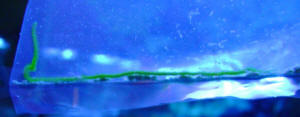
Long Black Worm: Nemertean -- 8/25/08 Hello Everyone,
<Hi there, Kayren!> This site is GREAT! <Thanks!> You
have helped me identify most of the interesting things I've
discovered living in my 40 gallon tank as a result of using live
rock (about 35 pounds so far - I know I need more). It's been
set up for about 9 months now, and going pretty well. I have an
Emperor filter on the back rated for 80 gallons (containing
filter floss, 2 regular carbon filters, a Poly Filter and one bag
Chemi Pure). <That's a packed filter!> I have a
submersible 7 watt UV sterilizer. I will soon be getting a 350
Magnum Deluxe and a protein skimmer. I'm also using an under
gravel filter with about 3 inches of gravel; crushed coral, I
think. (I found out afterwards that's not particularly the
best way to have gone). <Unfortunately, it's not, but with
proper attention it should be okay. Please see these links (along
with related links at top of page)
http://www.wetwebmedia.com/FWSubWebIndex/ug5proscons.htm
http://www.wetwebmedia.com/u_gfiltmarfaqs.htm > The occupants
at the moment are a Fox Face Rabbitfish, an Olive Tang, a Sailfin
Tang (they get along ok), <Unfortunately, they won't long
term. A forty gallon display doesn't supply enough room for
any one of these fish, let alone all three. They may be okay
right now if they're all very small, but as they grow
they're going to get stressed. When that time comes,
you'll very likely see increased aggression and disease
issues. Please see these links (and related links above):
Rabbitfish/Siganids: http://www.wetwebmedia.com/rbtfshsysfaqs.htm
Tangs: http://www.wetwebmedia.com/tangsysfaqs.htm > ..a
Mandarin Goby, <These are sometimes referred to as gobies,
however they're actually Dragonets. Also, unless it's
eating 'alternative' foods (frozen Mysis, etc),
you're going to need a continual supply of small live
invertebrates (amphipods, copepods). These can be obtained either
through cultivation or purchase. Please see these links (and
related above): http://www.wetwebmedia.com/mandarins.htm
http://www.wetwebmedia.com/mandfdgfaqs.htm > a Yellowtail
Damsel, <Can be mean little suckers!> 5 Green Chromis, 2
Red-leg Crabs, 1 Blue-leg crab; and the occupants this site
helped me to identify: a Brittle Star, Spaghetti Worms,
Stomatellas, Feather Duster Worms, <Nice hitchhikers.> ..as
well as a few others. Question: Is it ever a good idea to just
take out the airlift tubes and stop using the under gravel filter
after it's been set-up, or would the water underneath the
filter just get too yucky? <Could be a problem, but should be
okay. What you'd have would essentially be a 'plenum'
Please see these links (along with related links at top of
pages): http://wetwebmedia.com/Plenums.htm
http://wetwebmedia.com/plenumuse.htm > The individual I
encountered two days ago is the one I need your help to identify.
<All right, now we get to the fun stuff!> I searched the
site, but didn't find anything that sounded like it. I was
using a new gravel vac (actually an Eheim Sludge remover that
works really well). Shortly thereafter I noticed this LONG black
worm in the gravel, but visible because it was pressed up between
the glass and the gravel on the side. It looked similar to an
earthworm, but without the middle part. It looked to be between
1/4 - 1/2 inches wide, perhaps about 1/2 inch in girth, and the
part that I could see was about 6 inches long; I never saw the
end but I could tell the worm continued past the part I could
see. It didn't look like it had any legs; and what I assumed
was the head portion could have been about 1/2 inch long, and
looked comparable to something being wrapped in cellophane tape
(maybe it's a 'tape' worm! lol). <Heheee!>
After moving around a bit, it moved deeper into the gravel, but I
think it's still near the glass because I think I can still
see parts of it. Anyway, your expert opinion would be greatly
appreciated. <LOL Well, I'm hardly an expert, but I'll
offer my opinion anyway! Your mystery creature looks like a
harmless Nemertean, or Ribbon worm. Please see these links for
photo comparison and more information:
http://www.wetwebmedia.com/ribnwrmidfaqs.htm
http://www.chucksaddiction.com/hitchworms.html> I've
attached a picture taken in the macro setting. <That's
wonderful, thank you.> Thanks. (My apologies if the picture is
more than a few hundred Kbytes). Kayren
<You're very welcome. Take care, -Lynn>
|
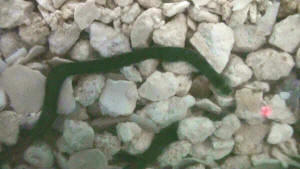 |
Wondering what this is - some sort of worm?
07/07/08 hi - Just wondering if you could tell me what this
thing is? When its tentacles are extended fully it is approximately
1 inch wide. Its body is between 1/4" and 3/8" long. The
body is barely wider than the width of the metal of a paperclip. It
moves rather quickly - it can navigate its way halfway across my
30" tank in about a minute if need be. <Ah, looks like a
"medusa" worm: http://www.wetwebmedia.com/polychaetes.htm
(scroll down, see after feather and bristle worms)> The colors
are fairly true in the photo - the bluish tint to its legs are due
to the actinic lights in the tank, however with the actinics off
the legs appear to be clear (white/translucent). I found it earlier
this evening after the lights had been off for 2-3 hours. Although
I turned the lights on to take photos of it, it didn't
instantly seek shelter from the lights... Any idea what this is,
and if I find it again should I remove it promptly? <Oh no, they
are good guys. And you likely have many more than just this
one.> thanks again,
Jason
<De nada,
Sara M.> |
|
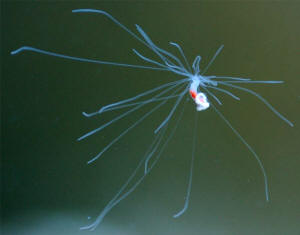 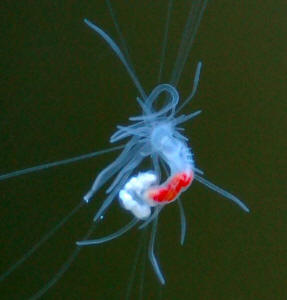
Gorgeous pix. RMF
|
Weird worm question... comp.,
ID, 4/25/08 Hello Recently I received a Gorgonian from
a major on-line retailer. After placing it in my tank I noticed a few
small orangey-reddish-brown worms that look like bristleworms to me as
they had a row of bristles (single) on each side (they were still in
the bag with the shipping water... they did not go into my tank, but
not sure if there were others that did!). They were 1/2" or less
in size. However they are very similar to earwigs, especially the mouth
parts. I did not get a pic... sorry! Any ideas or thoughts? <Are
likely as you state... some sort/species of Errantiate Polychaete
annelids...> I am worried that maybe there were babies or something
on the rock that I missed! I spoke to the retailer and they said that
they treat and quarantine all inverts for at least2 weeks and have not
had any sort of problem. Am I being paranoid? HELP I cannot find any
pics of them on line!! <Please read here:
http://wetwebmedia.com/polychaecompfaqs.htm and the linked files
above... Bob Fenner>
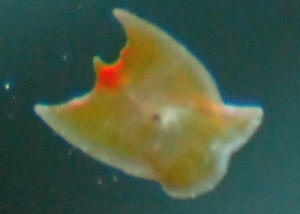
| Strange Creature... Planaria... Mmmm,
flatworms 3/9/08 Hey Gang. <Hi Wuf, Mich
here.> I have been trying to identify this creature for a few
days. I can't for the life of me figure out what it is. They
are starting to accumulate on some of my rocks. To give you an idea
of scale, the specimen pictured in IDme1.jpg is right at 1/16th of
an inch. Any idea? -Wuf <Well the good news... Yes I can tell
you what it is... The bad news... you don't want it. Is a pest,
an Acoel flat worm. Yours is looking like its reaching plague
proportions. You will likely need to address the situation. More
here: http://www.wetwebmedia.com/flatworms.htm
http://www.wetwebmedia.com/pestflatwrmanthony.htm Sorry to be
Mich> |
|
|
|
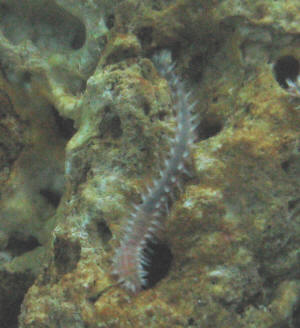
New Tank, New Live Rock, worms? Bristleworms
12/28/2007 Hi Crew~ <Hi Rachel, Mich here> Can you also
please tell me what kind of creature this is? <Are Errantiate
Polychaetes, Bristle worms, and generally beneficial
detritivores.> I turned my light on and noticed several of
these centipede things on my live rock. I just started the tank 2
weeks ago. Is this a bristle worm?? <Yes.> Should I be
worried to add fish? <No.> I only have snails and 3 small
hermits now. <Let your tank cycle and mature a bit. In the
meantime set up a QT tank for any new livestock. More here:
http://www.wetwebmedia.com/QuarMarFishes.htm
http://www.wetwebmedia.com/quarinverts.htm
http://www.wetwebmedia.com/quaranti.htm
http://www.wetwebmedia.com/ca/volume_3/cav3i4/quarantine/Quarantine.htm
Thank you so very much for your help. I have researched so many
pics but cannot find anything that looks like this. <I would
not be worried here.> Sincerely,
Rachel
<Cheers, Mich>
|
|
|
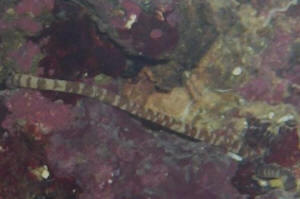
Worm or snake? 12/28/07 <Hello
Heather and Mr. Vice President... Mich here asking to be pardoned
for the long delay in response.> We are setting up a reef tank
(65 gallons) and have been at this for about 2 months. Two days ago
we noticed this little guy. <Well I didn't invent the
Internet or win a Noble Prize, but is sure looks like a Peanut worm
(Sipunculid sp.) to me!> We've seen him stretched out about
2" in length. He doesn't seem to be particularly afraid of
the light and will only go back into hiding whenever we try to go
anywhere near him. Is he friend or foe to the reef tank? <The
convenient truth, is he is a friend!> Thank you for your
assistance. Heather Cleaveley & Al Gore <Welcome!
Michelle Lemech> |
|
|
Search for a photo of a specific
marine worm 12/16/07 Hello friends and colleagues, I received
the email below as MASNA President and I'm casting a wide net among
my friends and colleagues in hopes that one of you may have an idea to
help this woman out in her search. If you don't have an answer for
her, please pass this along as quickly as possible to anyone you think
could help. I suspect that even finding a picture of any species in the
Tubificoides genus would yield something very close, but I really
don't profess to know much about marine worms! Thanks, Cheri
Phillips MASNA President www.masna.org <Hi Cher... did a quick
look/see via Net resources... Think these folks will have to go to a
large (college with a bio. dept.) library... find the original
description... If unfamiliar, I'd have a reference librarian show
them how to search on BIOSIS or Zoological Abstracts... Bob Fenner>
Subject: Marine worm My father in law, Don Maurer, did a lot of
research back in the 1970s in the Chesapeake Bay. He wrote numerous
journals on marine biology. Because of his dedicated work he had a
marine worm named after him. The worm is called "Tubificoides
Maureri". No one in the family knows what it looks like. I
can't seem to find a picture on the internet of it. I was wondering
if you knew where I can locate this? I wanted to frame it as a
Christmas present for him. Thank you for all of your help. -Amber
Kuhn
|
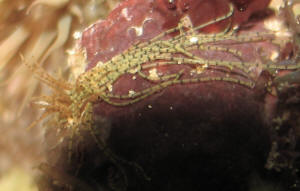
Red worms with black Rings?
7/8/07 Hey Crew! I have searched the website, but found no
definite answer. In my tank, these hair thin worms come out at
night in clusters. They come up from the sand in the same spot
every night. They are very thin colored pinkish red with small
black rings. I am worried that they are some type of parasite
that will either harm my fish or coral. If they are harmful, what
would be the best way to get rid of them. Thank you very much
guys. <No worries. They're most likely some kind of
Terebellid polychaete or "spaghetti worm" (highly
desirable and fascinating little critters). Each cluster is one
worm. Those thin hair-like things are the worm's feeding
tentacles. Please give no more thought to getting rid of them and
do enjoy them. :) > - R Delaney <Best, Sara M.>
Re: beautiful spaghetti worm 7/9/07 My bad... it's
a hair worm, not a spaghetti worm. Sara <Yes. RMF>
Re: Red worms with black Rings?
7/10/07 OK Great! Thank you so much. <No problem. I forgot
to say it could also be a "hair worm" (Cirratulid
polychaete). It doesn't really matter though. Both kinds of
worms are very good to have. :-) Best,
Sara M.>
|
|
.JPG)
|
|
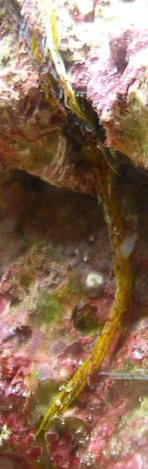
Worm, snail of sorts? 7/7/07
Hey there, I am once again in need of the WWMedia crew
assistance. Attached are photos of some sort of worm/snail
that I found in the tank today. I have had the lights off
in the tank for two days, trying to kill off an obnoxious
brownish red algae that has taken up residence in one corner of
my tank. <That sounds like Cyanobacteria. Try increasing water
flow to that area. If you have it many other places in your tank
and/or other nuisance algae problems, you could have excess
nutrients.> When I turned the lights on this evening, I
noticed a small whitish tube protruding from the lip of a piece
of rock. It had a crazy long tentacle coming out of it, just sort
of moving around and checking things out. It doesn't have a
fan or any other distinguishing characteristics to speak of. I
have looked through the many pages and faq on the different
worms, but I can't find anything that resembles what has
shown up. Nothing has been added or disturbed for several months,
and I can't account for this new addition. <It's
pretty hard to tell from the photos. My guess is that it's
some kind of peanut worm. It would help to have better pictures
of where the worm is coming from.> Any help would be greatly
appreciated. Since the new growth is so small, it will show up
quite nicely if you enlarge the pictures. I was actually shocked
to see it on the computer. It didn't look so great on the
camera. <Actually, it's pretty grainy even when I zoom in.
:( > Thanks in advance for all of your help!!!! <De nada.
Don't worry about the worm. It's almost certainly
harmless. Sara M.> Thanx!! Rachael Moore
Re: Worm, snail of sorts? --
07/07/07 Thanks for the advice.. I moved the powerhead to
that area, and it seems to be helping. <cool :)> I noticed
today that I also had my first bristle worm that I quickly
removed. <Hmm... the vast majority of bristle worms are
beneficial scavengers. Believe it or not, plenty of people
actually buy bristle worms to put in their tanks. There's no
need to remove them unless they're quite obviously one of the
few types that eat coral and get huge.> I most definitely have
some excess nutrients in the water. I would also like to know if
you can recommend a nano skimmer that will work with an Aqua
Clear hang on filter. <Well, I don't know of any skimmers
that would attach to an Aqua Clear hang on filter. I suggest you
just get a hang on skimmer that would act independently of the
Aqua Clear. Aqua C (not the same as Aqua Clear) does make a nano
version of the fabulous Remora that I think would work well with
your tank.> The filter works great, but due to nutrient excess
and the fact that I travel extensively, I need something to help
pick up the slack. <A skimmer should help. However, do make
sure you keep up with your water changes. Water changes are
especially important in smaller tanks.> Can you direct me to
some skimmers that will work with this setup? 20gal Odyssea cube
25gal Aqua Clear hang on filter <For a good overview of the
different skimmer options, please see:
http://www.wetwebmedia.com/ca/cav1i1/protein_skimmer_impressions.htm>
Rachael Moore
<De nada
Sara M.>
|
|
Mmm, maybe a Phoronid. RMF
|
|
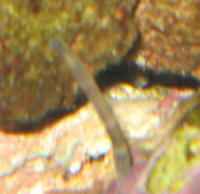
Worm ID 6/29/07 Hello Crew, <Hello
Tom, Mich with you today.> I have a question about worms.
<Do you have worms? Heee!> I found that after the main
lighting goes off for the evening I have worms. <Good!>
They are coming from the pores in the live rock. <OK.> They
are a grayish color and have a flat end. It almost looks as if
they were cut in half. I have attached a picture to assist. <I
see.> The tank is twenty gallons with twenty five pounds of
live rock and forty pounds of sand. An AquaC Nano Remora skimmer.
It has only one small wrasse, some hermit crabs and 3 snails. Are
these worms something to worry about? <Nope! Looks like you
have some peanut worms (Sipunculid species). They are beneficial
members of the clean up crew, feeding on detritus. > If so, is
there a creature that enjoys them as dinner? <Hermit crabs may
prey on them. But you want to keep these worms in your
display.> The wrasse is asleep when the worms come out to
play. Thanks for a great site. <Welcome! Glad you Tom
|
|
|
|
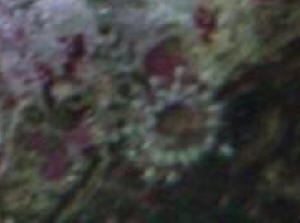
What Is This Flower Like Thing? A Serpulid Fan Worm --
06/28/07 Hi Crew <Hi Judi! Mich with you.> You have all
been great answering questions in the past. <Wonderful to
hear!> I have 'something' on my live rock and finally
got a decent pic of it (below). <I see.> I could not find
any reference to this on your website or in your book. <Oh, I
promise you they are there.> When 'shy' it is just a
pin-prick of a white dot. Then it will open like a flower to what
you see above (the ragged white circle in the middle of the
picture). It is smaller than the head of a pencil eraser. I have
recently found one more on a different rock. I have noticed it
for at least 6 months now, so I'm sure it has been there
longer. It active during the day and at night. <Judi this is a
feather duster, a Serpulid fan worm, a harmless filter feeder.
You can learn more here and the related links in blue:
http://www.wetwebmedia.com/feather.htm > Thanks for your help.
<Welcome! Mich> Judi
Re: What Is This Flower Like Thing? A Serpulid
Fan Worm 6/30/07 Thanks Mitch. <Welcome Judi!> I
was wondering if it was something like that; <Yes, I am quite
confident with this ID. However, there was a little discussion
about this and I am wondering if you could tell me, can this
creature go from open to "shy" as you put it
quickly...i.e. if it is startled does it quickly close?> I
thought from pics I've seen that most of the Serpulid Fan
Worms appear in clusters in the book, and this one is solitary.
<Yes, there are colonial and solitary species.> I do have a
couple of small feather duster type worms. <They are
common.> I also get two spaghetti worms - one type is a bright
red and the other has alternating black/white segments. Both
easily found in the book. Great book, by the way. <Glad you
like it! Judi
|
|
Mmmm, maybe not. RMF
|
| Questions about worms 6/24/07
Dear WetWebMedia Crew, Firstly, thank you for the plethora of
information on your website. It's been an extremely valuable
asset in helping me along with my saltwater aquarium. I wanted to
share with you these pictures of what I initially believed was a
single large worm on my live rock. Instead, it seemed to be a mass
of worms moving together. My question is, what exactly were they
doing? Is it a sort of worm mating ritual? Please let me know.
Thank you, James <Mmm, perhaps a manner of living... that
confers an advantage in avoiding predation by moving en masse. Also
helpful juxtaposition for reproduction. Bob Fenner> |
|
Need ID on annelid or Cnidarian'¦ a
Peanut Worm (Sipunculid sp.) -- 06/11/07 Hello WWM Crew! <Hi
there Paul!> The information on your forums has been invaluable!
<Glad you have found this helpful!> We reside in the Northern
California Bay Area. <Lucky you!> We have had a 35g for about
4 months now, initial 2-month curing period with live rock and live
sand and added 10 Mexican hermit crabs, 10 Nassarius snails, 2
peppermint shrimp, 2 cleaner shrimp, and 1 scarlet shrimp after the
curing period. Both peppermint shrimps, one of the cleaner shrimps,
and several of the hermit crabs did not survive after I placed
about two more inches of live sand into the tank about a week after
they had been introduced. <Sorry for your loss.> The tank
dimensions are 30X12X22 LxWxH. The water tested is a consistent
79C, Salinity 1.024, pH 8.4, Phosphates, Ammonia, and Nitrites 0.
Nitrates 10, Alkalinity 9, Mg 1200, Ca 440, <Allow to drift
lower, under 400.> and Sr 940. In the third month we added two
orange spotted gobies and a maroon clown to the tank. I have moved
the maroon clown into a 100g we have downstairs (with a 20g
refugium w/live rock, sand, Caulerpa) today. This tank has been set
up for 3 months now, water parameters are the same as the 35, and
includes a refugium recently converted from a wet/dry with live
sand, rock, and Caulerpa. <Excellent!> The orange spotted
gobies in the 35 were both placed in together, and immediately
paired up. They are small, only 2" in length, one being larger
than the other. The larger goby is vigilant about sifting, rises to
the top and eats copepods near the surface. It also picks at the
live rock. The smaller goby is less active, and follows the larger
around most of the time, sifting occasionally as well, but does not
engage in any other foraging. I feed the tank twice daily with
Spirulina enriched brine. The larger eats very well and the smaller
follows, both resulting in distended stomachs, so they have both
for sure been eating. <Very good.> In the past 2 days, the
smaller goby has been eating less, say 3-4 brine instead of the
usual 10. Today, he stayed in the cave they had dug out for most of
the day, only head and eyes protruding, but not emerging or eating
during the evening feeding. Is this normal behavior? <Mmm,
doesn't sound like normal behavior for this individual fish...
The brine shrimp don't provide much nutrition. These fish would
likely benefit from supplementation with a vitamin /HUFA supplement
such as Selcon. I would try offering some alternative foods as
well, Mysid shrimp would be a better alternative.> I know that
the 100g with the refugium would better support the diet of these
gobies. <Likely so.> Would it cause unnecessary strain to
place the larger or smaller goby into the 100, thereby splitting
them up? <Perhaps as the smaller of the gobies seems to be a bit
of a follower, but you never really know.> Truthfully, the 100g
has seen the death of 4 of these orange spotted gobies (2 purchased
from an unreliable LFS and 2 due to stress) as well as an algae
eating blenny (also purchased from the unreliable LFS, which we do
not buy from any longer). <Yikes!> Now, onto the initial
subject of this email( ;) sorry for the long email), which is and
ID on some annelid or Cnidarian in the 35. I love searching the
tanks with a flashlight late at night, and have been amazed at
population explosions of zooplankton and other nocturnal creatures.
<Tis fun!> Tonight, when I was observing the live rock, I
came upon a tentacle that extended about 5 cm out of the interface
between the live rock and sand. It was a vivid black and white
banded tentacle about 3 mm wide and the banding alternated black
and white about every 3 mm. It immediately disappeared from view by
retracting, but in a bizarre fashion. The tip invaginated toward
the medial end of the tentacle very quickly. The tentacle was
tubular, did not taper at the end, smooth, and matte in appearance.
I could not get a picture, but hope you can identify with this
information. <I'm fairly certain you have a Peanut worm
(Sipunculid sp.). They are beneficial detritivores, a positive
addition to your tank. Do enjoy you nocturnal surveys!> Thank
you!
<Welcome! Mich>
Paul |
|
.jpg)
|
Worm id... Sounds (looks???) like a Peanut worm
(Sipunculid sp.) -- 6/12/07 Hi Crew! <Hi Jamie!> Hope you
enjoyed your weekend. <Mmm, I've had better... my camera is
currently on the bottom of a local lake. I suspect this may delight
several WWM crewmembers.> I am hoping you can help me identify a
worm I just discovered living in the live rock in my aquarium. I have
attached 2 pictures, but all I have is a digital camera <More than I
have currently and I'm having photographic withdrawals.> and it
is hard to get a close picture that isn't blurred. <Look for a
macro setting... The symbol often looks like a flower/daisy. I really
miss my camera!> The "worm" is curved in the center of the
picture. <Good thing you said this, otherwise I wouldn't have
had a clue!> I am pretty sure the creature in question is not a
bristle or fire worm. <I'm pretty sure you're correct!>
This thing is smooth, white, no noticeable segments. One end attached
in the live rock. Although he is curved in the attached pics, at times
one end is extended and it almost appears there is a "nub" at
the front end of him. The portion of him that is visible is about 1 cm
long, by 3-4mm wide. Doesn't seem to be calcareous, as he is very
flexible and is frequently bending from one side to another. <Yep, I
think you have a peanut worm (Sipunculid sp.), more by the sounds of
it... than the looks of it.> I have searched the FAQ's and read
the related articles on WWM, but didn't see anything similar to
this thing. I am reluctant to pull him out of the tank if he is
beneficial, but just want to make sure he won't pose a threat to my
fish. <Peanut worms are beneficial scavengers, which feed on
detritus.> As always, thanks so much for your feedback and advice.
It is greatly appreciated. <Welcome! Mich> Jamie
Re: Worm id... Sounds (looks???) like a Peanut worm
(Sipunculid sp.) -- 06/13/07 Mich <Hello again Jamie!>
Just wanted to say thinks for the info. <You're welcome!> I
did some more research last night and as a result I figured it was a
peanut worm as well. <Very good!> Only thing that had me second
guessing was the color. I read that most peanut worms are brown but the
guy in my tank was white, but otherwise he looks very similar.
<White is not unheard of.> Sorry to hear about your camera,
<Thanks!> and the resulting hard time it sounds like you are
going to get from your fellow Crew members. <Oh, no the crew in
question (You know who you are! ;) Heeheee!) was trying to remove said
camera from my possession a few weekends ago.> But on the brighter
side, it's an excuse to upgrade to a better camera, right? ;-)
<More than you know!> And thanks for the photography tip! <Oh
you are most welcome! I'm glad I could help!> I never thought
about the macro setting. <Yes, this will improve the focus/clarity a
great deal on all those up close photos.> Thanks again. <I'm
happy I can help. Mich> Jamie
Saltwater "worm" question?? ID 5/27/07
Hi there. <Hi Jimmy, Mich here.> I've had my tank for 2
months now, and I have noticed 3 "worm" looking things in the
small rocks at the bottom of my tank, that are probably about 1/2"
long and thin, and have small spikes all around them on the edges, and
when I looked closer, I could see blood, I'm guessing, pumping from
the top of their bodies to the bottom. I'm wondering what the heck
are they and are they harmful and any information at all?? <Sounds
like some type of bristleworm, most are harmless scavengers that help
to keep the tank clean. Some photos and more info here and
the related links in blue: http://www.wetwebmedia.com/polychaetes.htm
> I would avoid handling these worms. And if you must,
then wear gloves. The "spikes" called chaetae can
cause problems ranging from irritation to severe pain should you get
stuck.> I tried to take a picture, but it won't turn out and I
can't turn the flash off from my camera. <...Now where did I put
that camera manual? What's that quote about a thousand
words?...> Thanks in advance. <Welcome! Mich>
-Jimmy
LR Hitchhiker...Worm ID 5/7/07 Hi Crew!
<Hello.> Can anyone help me ID a hitchhiker that I discovered
last night?...dang thing freaks me out. <Will try.> I
specifically did a search on WWM with the worm's characteristics
and I guess there may be cause for concern. This worm has a lamprey
mouth, stretches to about 3 inches (maybe longer). He hasn't left
the LR so I can't really tell how long he (or she) is but I do know
it has a tapered end. It takes bites out of the LR but immediately
retreats back into the hole. It is tan and dark brown striped. It did
come out while the lights were on, but was very active last night. I
did get video of it, but couldn't get a good close up pic. Does
this critter sound harmful? Thank you...any help would be greatly
appreciated! Jennifer <Sounds like a harmless peanut
worm. Do a search on these and see if it matches what you
have.> <Chris>
Re: LR Hitchhiker...Worm ID 5/9/07 Thanks Chris.
<Sure> From what I could research it appears that is what I
have. Is there a specific website giving detailed info on
them? <Try tracking down Dr. Ron Shimek over on the marine depot
forums, he should be able to help out with
identification.> I take it he is a pretty harmless
critter? <Yep> Thank you again for your help! Jennifer
<Welcome>
<Chris>
Kermit the Phyllodocid Hi, <Hi Pat> I
found this guy in my last shipment of frags. <Pretty!> He was
in a patch of neon green Favia and managed to grab the rock while
he left his hiding place. I could not find anything like it. Do I
have a three mile island fire worm <Heeheee, good one!> or is
there another variety I do not know about? Do you know what kind it
is and if is reef safe? <I can't be sure without seeing some
close-up photos, but it appears to be a Phyllodocid polychaete
(Family: Phyllodocidae). These are predators/scavengers of small
worms, etc. If it were me (and since it's already caught), I
probably wouldn't put it back in the tank. Please see these
links for photos and additional links/information. At
the first link, see Faq labeled 'Hitchhiker worm 10/16/05'.
http://www.wetwebmedia.com/wormidfaqs6.htm http://home2.pacific.net.ph/~sweetyummy42/hitchworms.html
Pat
<You're very welcome! Take care. --Lynn> |
|
|
|
|