|
|
| Home | Marine Aquariums |
Freshwater Aquariums |
Planted Aquariums |
Brackish Systems |
Ponds,
lakes & fountains |
Turtles & Amphibians |
Aquatic Business |
Aquatic Science |
Ask the WWM Crew a Question |
| Please visit our Sponsors | ||||
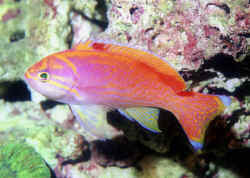
Anthias Quarantine And Introduction 11/6/09 Lyretail Anthias 6/25/09 Pseudanthias flavoguttatus Information 10/16/08 Hi, I'm trying to collect some information on Pseudanthias flavoguttatus (Red-Saddled Basslet, found that as its common name but unsure if its the correct common name). <These come and go... this is one of the more common, common-names> I need any and all information you can provide me with because the fish store that I work at can get these in and we have never heard or seen this fish in person (only recently viewed a couple pictures online and I want to get a couple for my tank provided they are capable of keeping in an aquarium). Thanks for reading this and I hope to hear a response from you! -Jon <I have no practical knowledge (or other) re this species of Anthiine. Have seen it on occasion at LA marine livestock wholesalers, but never kept it, nor know of others with such experience... I would be cautious here... keep in a small group, in a largish, well-kept system of size... offer live foods frequently... to gain an idea of its "touchiness". Bob Fenner> Pseudanthias ventralis... sel., care... reading Is Ventralis Anthias impossible to keep in captivity? <No> Can you give me some tips on how to successfully keep this fish; <Is posted... http://wetwebmedia.com/anthiina.htm and the linked files above> I have a sixty gallon tank with (peppermint hog, rhomboid wrasse, chrysogaster Anemonefish pair, McCosker's wrasse pair, a yellow and purple tang. And a 20 gallon qt tank. Thank you <Mmm, this system is a bit small, already too crowded. RMF> Anthias article pictures 10/2/06 Hello, <Hi
Peter> I was just going over your article on Anthias. I think a
couple of the pics are incorrectly labeled. <Possibly> The second
picture of Pseudanthias bartlettorum doesn't look correct. Red
dorsal fin, no purple at all, and the tail all look like something
other than P. bartlettorum. Maybe a pale dispar? <<Mmm, nah...
tis a female: http://fishbase.sinica.edu.tw/Photos/ThumbnailsSummary.php?ID=12719>>
<Maybe...> The first picture under P. evansi I believe is a
bartlettorum. <<Again... don't think so: http://fishbase.sinica.edu.tw/Photos/ThumbnailsSummary.php?ID=7799>>
And the third pic under evansi looks to be either a juvenile P. tuka or
P. pascalus. I just saw juvenile P. evansi at a LFS and the basically
look like adults, except a solid line of demarcation between the purple
and yellow, not the dots. <<... Is also correctly identified as
labeled IME. RMF>> Hope this was helpful. Regards, Peter <Will
take another look... though there is a huge variation in color/markings
for many Anthiine species. See fishbase.org for some examples. Bob
Fenner> Purple Queen Anthias 1/13/06 Hello, Can you give me any information on the husbandry of the Purple Queen Anthias (Pseudanthias pascalus). They have a pair at the pet store and they said that they are hardy and eat common frozen preparations and I shouldn't have problems with them. The only information on WWM is they're hard and do better in bigger systems. Better to ask question first I suppose. <The purple Anthias is a delicate fish to keep. They are carnivores and should be fed zooplankton, vitamin enriched brine, copepods and frozen preparations. They are a reef safe fish, with males being much more vibrant than the females. They grow to about 5" in length. Females should be introduced first if adding a pair. Males will generally fight with each other as in nature there is only one male to a harem. James (Salty Dog)> Brian Help with Quarantine follow up 4/28/05 Hi Adam, Thanks for all your advice. I lost one Anthias, but the other is doing really well. Only problem now is that he won't eat anything except the brine shrimp fry. He refuses Mysis and Cyclop-eeze. Any suggestions on how to get him to take other food. Thanks. <Sorry for your loss. To coax your remaining Anthias to take other foods, try offering the new foods mixed in with the brine nauplii. Another good strategy is to invoke Pavlov... Figure out a way to signify feeding time to the fish. A consistent change in lighting, current, placing an object next to the tank, etc. (even your approach can work if the tank is in a low traffic area) can be used to train the fish to expect food when it sees that change occur. The change must be consistent and must be unique to feeding time, and it may take many days or a couple of weeks to work well. Best Regards. AdamC.>Â - Anthias [Stocking] Concerns - Hello, wanted to say thank you for all your meticulous research on aquatic life, it's mind boggling sometimes going through it. I recently combined my 2 small coral nano tanks into one larger tank. I actually didn't remove the other tanks, much to my wife's joy, but instead plumbed them with ball valves and PVC to the larger tank- the tanks were a couple years old, a 20 gallon, for around 5 years and a 40 gallon going on 2. I dumped the gravel from the 20 into the 40, put a 150 HQI and 2x65watt actinics, put a SeaSwirl on the return and filled with macro algae- there was a lot of weird stuff in that sand, little shard-like glass needles in my hands, kept the rock in the 20 and used that as a QT for 6 Dispar Anthias. I used a skimmer on the 20, this tank is way too small for them I know- and I was sweating bullets, but I figured better a well established 20 then a new 55, which would have made catching these incredible swimmers impossible. Anyway, I did see a fair amount of activity in the refugium, and the only fish in the now display system where a 3" palette surgeonfish and a full grown scooter dragonet, he's a she, but don't tell my wife that, just upsets her that 'Scooter' might be a girl- yea, we name them, but 3 of our 4 cats are a derivative of 'Kitty', so not real original, but the thought counts. Anyway, I added the dispars, and everything seems alright, they are young, and all females, I know I may have problems long term, and I am prepared to deal with that using the refugium if I have to - catching could be a problem, hehe, but I'll figure it out. I had a good friend get me 6 Banggai cardinals, directly from England, had to pick them up in the box, rush home at 80 mph and put them in the QT, they all made it, little miffed, but ok. I feed the Anthias several times a day, have since day one - a Midas blenny somehow ended up in the display - sneaky little devil, but he seems harmless enough, thinks he's an Anthias - so does the tang now, (Dory) lame huh? Anyway, the display is 180 gallon, 30 gallon LifeReef sump/skimmer, 40 gallon hex refugium, the qt is turned off from the main system but runs on its own little skimmer. The Anthias, Midas blenny and tang all hang out with the stony corals on one side of the tank where the rockwork nearly reaches the surface, the other side of the tank is slightly calmer, a little less bright, more low lying caves and open upper space, I was hoping the cardinals would appreciate that side more, but who knows, anyway- that's it for fish, think this is going to cause me a problem? <Doubtful... they'll all get more brave in time and disperse.> I've actually kept corals for quite some time, but fish is a whole other ball game, they move! Ahh, I'm hoping I'm not overstocking, there's a lot of live food in the tank, and whenever I figure out how to make an autofeeder feed frozen foods, I'll get to go on vacation and see them for real! Till then, thanks and take care. Just getting worried that these two might not mix well in my size system - one is active and the other is kind of slow, one is a greedy pig, one is kind of slow - pretty, but slow - speaking of slow, baby neon gobies - they are just adorable, but painfully slow. So 6 dispar Anthias, 6 Banggai cardinals, 1 palette surgeonfish, 1 scooter dragonet - total water volume is around 240 gallons, total live rock is only perhaps 150 lbs, 100 of which is well established. I have a Rainford's goby that I might put in there, but other than that, no more fish - is this pushing the limit of my system? <No, you're doing fine.> I need to leave room for growth, they are all adolescent at best, but I would prefer not to stress the animals, if this is a bad idea, the cardinals can go in another tank, thanks for the info. <Think you are fine where you are... if you can stop adding fish at this point you'll be in good shape with room for the corals to grow and increase in bioload.> Aaron <Cheers, J -- > - Problems with Squamipinnis Trio - Hello to all the marine mavens at WWM. Quickly, the system: 5 y.o. 110g FO w/misc. inverts (2 Lysmata hermits, snails and 140# FIJI LR, 190g total system 1 return through a 30g Miracle Mud ref. and the other return through 40g 5" Deep Sand Bed reactor tank (Nitrates 0). They dump to a sump with AquaMedic T 1.000 skimmer and AquaC Remora. Fish in tank are 1, 6" (w/o tail) Sohal tang, 3.5" Purple tang (they get along with little to no aggression! I'm lucky!), pair of ocellaris clowns, 1 Banggai cardinal. Feed about 1/3 dollar-bill sized Nori sheet and calculator-button-sized piece of Marine Supreme Plus or frozen Mysis once a day. I do a 30G water change about every month. I have 2 separate quarantine tanks (30g and 10G) that run always and move the AquaC to the 30G when quarantining newcomers so I get no ammonia readings during quarantining. These tanks have Marineland Penguin bio-wheel filters and get occasional water changes with waste water from main system water changes so the bacteria keeps happy. The perplexing problem: I wanted to add some smaller, colorful swimmers to the community. Red Sea natives if possible. After much reading in WWM and Hamlet-like deliberations I purchased a male and two female Lyretail form a mail order source (since the specimens at LFS generally look terrible). I received a fine looking male, 1 fine female and 1 smaller female. I gave them a 2 min, temp, pH adjusted FW dip with a few drops of Meth-blue and put them in the 30G q-tank. After a day or two they were all eating frozen Mysis piggishly 3 times a day. After about a week, the larger female began chasing the male(!) until he hid all the time under some PVC, behind a pump, etc. Came out to eat though and then hid again. After a few days of this, he died(!) Now the large female and the smaller female were left in the 30G for another week and the smaller female started hiding all the time so I decided to get them in the display since the 30G was maybe just too small and you advise in other posts to get them in main system ASAP. So, in the main system they go along well with everybody and even schooled around the clowns (because of similarity of color?), but after a few days the larger female began breathing heavily and hiding all the time and eventually died (about a week in the main display) in sort of a cloud of white filmy smoke surrounding its carcass. Now only the smaller female is left. Its breathing was OK but eventually hid all the time and one day just disappeared (week later). Is there something toxic in the system and the others are just riding it out or what? <Probably not... I will explain.> I feel like such a failure. There is some BGA in main display and what looks like turtle grass in DSB otherwise I just don't get it?!? <Unfortunately, schools of Anthias rarely work. There is a dynamic that exists when they are in huge groups as they are in the wild that gets magnified when small groups are kept in captivity, and it seems the smaller the group the quicker they all croak. Pretty much, the dominant female is always trying to become the dominant male. The omega female [that's the one on the bottom of the heap] is always getting it from the dominant male and dominant female. In short, this is stressful for everyone, in your case all three. Quite often this stress just accumulates, so what likely happened to your fish was the end result of the stress. Your display system just isn't quite large enough to house a school of Anthias. I've seen them work in a 240, but even then there are random disappearances, usually first from the bottom, and then the male who is replaced by the dominant female. I think it's better to try just one, or go with Anthias who are better known for peaceful pairing like the square-spots.> John <Cheers, J -- > About: Dispar Anthias Date: Tue, 8 Feb 2005 Hi! I'm wondering about Dispar Anthias Pseudanthias dispar relating to adding on to my pair. <Hello Kevin, James (Salty Dog) to assist you.> I currently have a 100 gal. tank (fish only) with live rock and a 32 gal. hospital tank. In my 100 gal., I currently have 9 Blue-Green Chromis, C. viridis which are all in healthy condition. I have a Blonde Naso Naso lituratus, a Yellow Tang Zebrasoma flavescens, and a Red Coris Wrasse Coris gaimard. I've been researching about Anthias in general for a while and learned about the social groups, feeding, etc. I've always wanted to keep a shoal of dispars, but rarely came across good specimens. One day at the LFS, I came across two shy specimens which looked great!! I decided to buy them at $14.99 a piece (pretty good from what I've seen in other places). When I brought them home and put them into the tank, they hid for 3 hours. Then slowly started to peep out. The next day, they were out with all the other fish. I tried Mysis, but no luck ( though they were lookin' at it!). Then, they turned into pigs!!!!!!! They now eat everything I put in. Now, everything looks great, but I was just thinking how nice it would be to have a few more of those beauties. Do you guys think I could pull off adding 4 more to the tank? I mean will the dispars in my tank accept the newcomers? If not, I already have my mind set on some purple queens (not tuka), (Pseudanthias pascalus). I think the key to keeping docile shy Anthias is to first have an established shoal of dither fish (Chromis), then put in the Anthias. Without my Chromis in the tank, the dispars probably would not have had the nerve to go feed. Well anyways, please reply, and I want to compliment you guys on such an informative and well done web site. <Kevin, I think you will be approaching the overcapacity of the tank. Anyway here is a link to a very informative article by Bob Fenner. http://www.wetwebmedia.com/anthiina.htm James (Salty Dog)> - Anthias Question - Howdy crew! <Howdy.>
Quick question for ya. <Ok.> I have 3 female lyretail Anthias in
my 90G reef. They have been in for about 2 weeks
now. I noticed that two of the three are really starting to
have it out. They lock their mouths together and spin around
and around, very odd looking. I have read that they can be a
bit mean. Will they kill each other? <In time, yes.> Is this one
trying to become a leader, or a male? <Or at least assert its
position in the chain of command... this is very typical for
Anthias.> Should I let this continue or remove one of the two.
<If you don't remove the others, you will be left with one
anyway.> Your recommendations would be greatly appreciated. <You
really need a much larger tank to attempt a small school of Anthias,
and even then the lowest one on the totem pole is often lost.>
Thanks. Paul
Pseudanthias pleurotaenia hi guys I have a quick question. I have a female square spot Anthias in a 125 gal. fish only tank, with a red Coris wrasse and a maroon clownfish she eats very well. anyway my questions are is the juv. coloration different from the female coloration and will she turn to a male without any other Anthias in the tank? <Juvenile coloration (yellowish) intensifies (to a more bright, golden yellow) with age, but most will not change to even a duller male coloration w/o the presence of at least a single other individual of the same species... better, best to have small, odd numbers of individuals (3,5...) IF your system is large enough. Yours is big enough for three. Bob Fenner> thank you for any help tom Pseudanthias evansi 9/28/04 HI all- Just was wondering if you knew of anyone keeping Pseudanthias evansi successfully? I have experience with several species (Pseudanthias bimaculatus, bicolor, bartlettorum, cooperi, and the fasciatus shown on your website) and was wanting to try this one. <If you have been successful with other Anthiines, you may be better equipped than the average hobbyist to maintain P. evansi. Do keep in mind that there are many factors that make these fish difficult. They often suffer from deep water collection, poor handling and shipping stress. They often won't feed around aggressive tankmates. Extended quarantine in suitable quarters is advised both to ensure freedom from disease as well as to give them time to associate the keeper with feeding. Multiple feedings per day are recommended (often required), and sometimes all non-living foods are refused. This is a tricky one for most of us with real jobs!> When I have seen them in stores I have never seen one actually eat, but they were usually singles or pairs. What do you think? Doomed? Thanks, John Boe <Refusal to eat is generally a good sign to avoid purchasing any fish. However, if you plan on making a dedicated, conscientious attempt at keeping this fish I would not let this alone preclude your purchase. Lack of cover and excess of activity in the retail environment may have a lot to do with refusal of these fish to feed. Providing live foods in a quarantine environment with minimal traffic, subdued light and plenty of cover may get them feeding. Contrary to popular belief, attempting to maintain shoals of Anthias is folly. Constant bickering usually ends with one surviving male and sometimes a female. I would not suggest attempting more than a pair. These fish are most certainly doomed in all but the most skilled, conscientious hands. Buying such fish always begs the ethical question of saving these individuals vs. encouraging more collection of a difficult species. Consider this dilemma and your skills carefully and perhaps politely expouse the benefits of supplying customers with hardier choices to your LFS. Lastly, do look for the recent print article by Scott Michael on his top ten choices for Anthias in captivity (Aquarium Fish Magazine I think). Scott's advice is top notch. Best Regards. Adam> Randall's Anthias 9/17/04 I'm looking for info about the temperament and heartiness of specifically the Randall's Anthias. I can't seem to find any hobbyists who have kept them. Are they pretty new? <not at all... but you have not found much info because they are a simply dismal species to attempt to keep in captivity. Most conscientious aquarists will leave these species in the ocean. They are very delicate, most always require live foods (gut loaded prey is a must here)... they need dim tanks and very passive tankmates. One male can be kept with several females in large aquaria (200 gall-ish)> I've gotten as much info as I can about Anthias in general, but I know they can vary from type to type. I won a complete setup at a raffle and five were included. <wow... how very irresponsible of the donor to show and offer these fishes as an impulse/prize animal. Simply irresponsible - this is a very delicate species for expert care only in mature tanks> One unfortunately didn't make it, but the others are doing well. <they may hang in for some weeks or even months. It is very unlikely they will survive to even see one year in captivity. Mark my words, my friend. You might save them if you make this a species tank and focus as per above needs/instructions> I'm trying to decide if the four will be ok or if I should get another three females (hopefully from the same batch) as soon as possible. They will be in a 120 with 100g sump with few tankmates. (probably a CBB and a pair of O clowns) <please do not import/buy any more of these fishes my dear... not until you have demonstrated an ability to keep the current ones (healthy over 6 months). Best of luck, Anthony>
Shy (Or Scared!) Gramma (8/17/040 Hello Crew, <Steve Allen tonight.> I have another question. I had Recently purchased a fairy Basslet from my LFS (local fish store) <Gramma loreto, I presume.><<Actually, no. An Anthiine species. RMF>> I took him home and floated him w/o quarantine (I know, I know), <tsk, tsk> But anyways the first thing he seemed to do was go in hiding, which I expected every fish would do when being introduced <yup> but he really never came out, though I did get glimpses of him while using the bathroom =) <I won't touch that one.> but that was the first 2 days he seemed perfectly fine but now I don't see him at all...is this normal behavior or is something wrong? <They are shy, but will usually defend d their chosen spot quite vigorously, even against larger fish. And they do com out to feed unless ill or seriously intimidated.> My Maroon Clownfish <the possible culprit here> and my Panther Grouper are doing perfectly fine (no the grouper is an inch long, he wasn't eaten). <Hmm...I've never seen one quite that small. Do bear in mind that it will grow to 18+ inches and will be able to swallow the Gramma whole someday, though he will likely eat it in pieces sooner than that. Maroon clowns are very aggressive, and I would strongly suspect that it picks on the Gramma behind your back to the point that the Gramma may have gone into permanent hiding. In such situations, the intimidated fish eventually starves to death.> But I was just wanting a quick background on the fairy Basslet. <Read this: http://www.wetwebmedia.com/grammas.htm><<... anthiines.com>> Should I wait a couple more days, or should I start tearing the rockwork away in an attempt to find him? <Oooh, I would not want to be doing that. First off, you're likely to squish something. Secondly, if the Gramma is alive and hiding, he'll just hide again as soon as he finds a nice cranny in the new arrangement. Thirdly, if he's dead, he is small enough that your detritivores and biofilter should be able to handle the decomposition load unless you have a small tank (less than 55G or so). Tearing down rockwork is tedious and can wreak havoc on a stable system. And you'll never can get it back to the same arrangement if you like the way it looks now. Not worth doing without a compelling reason, such as removing the Maroon Clown if he gets dangerous as he gets bigger. Though beautiful, it is one of the most aggressive Clowns. I keep mine with tankmates that don't take any guff. In your shoes, I'd keep an eye on ammonia and nitrates. If no spike, I would let a dead Gramma rot in peace. If you really think it is alive but never comes out during feeds, you can go ahead and tear up the rockwork and find it. Remove as much rock to plastic containers as you need to in order to be able to catch your fish. (I recently had to pull a couple of hundred pounds out to catch a 5" Picasso Trigger--a real PITB.) I would then remove the Clown (and maybe even the Grouper) to a quarantine and let the Gramma establish itself and grow comfortable for a couple of weeks before re-introducing the others. Sometimes simply re-arranging the rock a bit while all the fish are in there will break up territories, but I doubt a Maroon Clown will be adequately confused by this.> Thanks a bunch, Chris <Hope this helps.> Loss of Appetite Hello Crew, <Hi there, MikeD here> I am at a dilemma because my Anthias has not been eating for more than 2 weeks<Very bad. this fish's metabolism won't let it last long at this rate>. All methods to coax it to eat prove futile<As in?>. It just remain stationary hiding behind the rock hardly moving. Previously this same fish has been eating like a pig but all of a sudden it just stopped eating. I have tested the water parameters and all appear to be ok<Define OK? ANY ammonia or nitrite is not OK>. I change 20% water every 5days<Great>. Adding insult to injury, I purchased a bottle of Selcon and dropped 10ml of it (as per instruction) into the display tank and now the tomato clown is following suit, it has not been eating for 4 days already. My tank is 120gallons reef comprises of protein skimmer and sump, filters etc. Kindly advise me what to do.<It's time to do some detective work here. First off, have you tried adding LIVE brine shrimp to the tank? While not a great food, very few smaller fish can resist "dinner on the hoof. I suspect that your tank is either contaminated (have you ever treated it with copper or formalin?), that you have ammonia higher than you realize is dangerous, or that you may have a faulty unit that's allowing voltage into the water, such as a dying power head or heater. Watch closely, try the live brine, and keep up your water changes. Try to get exact ammonia and nitrite levels as well, ok?> Thank you for your time. Regards Richard Sexing Bartlett's Anthias? Hi--one of the species that I'm interested in for my reef tank is the Bartlett's Anthias. <A beautiful fish!> I understand for Anthias it's important to have only one male, with multiple females. My question is, how do you sex these fish? Thanks, Beth <Well, Beth, one of the more reliable sex indicators that I am aware of seems to be an elongated, clear first or second ray of the dorsal spine in mature males. Color is also a possible indicator. Typically, you can buy a group of immature specimens and one will generally become a male. That would be my approach to getting a group together. Good luck! Regards, Scott F> Anthias squamipinnis (Lyretail) Hey guys. <Howdy> I
ordered 1 male and 2 female Lyretail Anthias and received them right
before Thanksgiving about 3 months ago. They arrived beautiful and the
male was almost 4''. I had never seen any males that large at
the LFS. I was not expecting them to be this big and only had them in a
10 gal QT about 3 weeks, not long enough but was worried about the size
of the tank. They were all eating well and looked good. They have been
in the 55 FOWLR for over 2 months. A couple weeks ago I noticed one of
the females looked very skinny. <Very common... a fifty five gallon
chock a block with live rock isn't enough culture material to keep
this trio going... w/o very frequent offerings from outside the system
by you... Do look into adding a live sump/refugium that will/can
provide nearly continuous live food fodder> I have been watching and
all 3 are eating. The second female looks a little thin but not bad.
They are in with a Purple Tang, Coral Beauty, False Perc, royal Gramma
and a damsel. I am feeding Mysis, Brine, formula 1 and 2, angel
formula, Nori, Spirulina, Sweetwater Zooplankton and reef complete
flakes. After rereading CMA I noticed a little excerpt about some fish
eating but wasting away. Tangs and Anthias as examples. <Yes... too
familiar> I also read the WWM article on Anthias and they showed a
doomed female. All other fish look well nourished (maybe even a little
round). So I reduced the feeding amount a month ago. The
male is the largest fish in the tank. About 5-6 times as large as the
females and for sure gets his share of food. My question is how should
I feed the Anthias? 2, 3 times a day? <Or more often... your tank is
crowded livestock wise... and will require more maintenance as a
countervailing strategy to keep up water quality as a consequence of
trying to feed the zooplanktivorous Pseudanthias> I have typically
fed once a day but may have to change after doing more research. Should
I remove the skinniest female or both to the extra tank to better
monitor the feeding? <Oh! Yes... actually better, best to remove the
trio to less crowded, more specialized settings> I am not sure if it
best to put both females together if one is really weak or leave only 1
female with the male. He does not harass either of them now. Is she
truly doomed if she is already pretty skinny and low on the totem pole?
And if she goes will the male kill the other? <Not doomed. I would
move all three. Can recover with frequent feedings of nutritionally
boosted (e.g. Selcon soaked) foods.> Any help would be greatly
appreciated. Thank you. Walt <Thank you for writing. Bob Fenner>
- Square-spot Anthias, Follow-up - Hi, Just wanted to let you know that Sascha, my 6" Squarespot Anthias, is eating again! <Most excellent!> I've attached a picture of him. I tried everything I could think of to tempt him to eat but nothing seemed to work. Finally, a full three weeks to the day that he stopped eating, he finally took some of my homemade refugium mush (liquefied clams, mussels, oysters, krill, Spirulina powder, Cyclop-eeze, Selcon, Nori - held together loosely with agar powder). <Is sometimes how it happens... just when you are wondering, "Will this fish ever eat again?"> He wouldn't eat much at first but he took a little more with each meal and started taking different foods too. <Great news.> I can't tell you how much I appreciate your words of encouragement. I was sick with worry that he wouldn't make it. Now his appetite is as voracious as ever and he has his colour back too. Sascha and I say thank you! <My pleasure.> Susan <Cheers, J -- > Cloudy Eyes? Hi Guys <Scott F. your guy tonight> Done a search but after spending an hour looking couldn't find the right question/answer Had a kashiwae Anthias with cloudy eye - Popeye - no eye. Water conditions as good as they are gonna be.......no other fish with problems. <okay...> Now another of the same batch of Anthias has developed a similar problem. Is this parasitic ?? I was of the understanding that this wasn't a contagious problem..........or am I mistaken. <Well, sometimes these types of problems are a result of water conditions. I know that you indicated that they were good, but perhaps this was a result of poor environmental conditions somewhere along the chain of custody from reef to store.> Is this likely to have come in on the fish (if parasitic) and what can be done to treat.........tank is around 1000G full of corals/inverts/fish so no chemical treatment and no way can the fish come out. <Well, this doesn't sound like a parasitic malady to me. Possibly you're seeing a bacterial infection of some sort. It may be possible to treat the affected fishes with antibiotic foods. Of course, I'd continue to maintain excellent water conditions, and quarantine all new arrivals for a minimum of 3 weeks.> Would love to hear your thoughts. Any sites or links to research on this problem would be appreciated if you guys know any. Regards, Steve. <Well Steve, I'm not aware of any specific sites that specialize in disease, but you can peruse the WWM site, or do a key word search on one of the larger search engines under "fish diseases", and see what you can come up with. Good luck! Regards, Scott F.> Pairing up Highfin cardinals Hello, <HI> yes I would like to have a mated pair. How do you tell them apart or do they change sexes like clownfish do? <You can't tell them apart and no they do not.> <<Actually... can be sexed at size. RMF>> Anthias as well? <really depends on what kind of Anthias (most of the time the males are different from females> Should I add 3 to my tank and see what happens? Thanks for any help, Jeff <the best way I have found is to take 5, (better odds of getting males and females) put them in a tank together and you will start to notice over time, that 2 will start to hang out together all the time. you will also notice them chasing the other ones all the time. remove the ones they are chasing and you have you self a pair. Good luck MikeH> Anthias In Trouble... I recently purchased a pair of square Anthias from a trusted LFS (I say trusted because it is the only LFS that I have never had fish problems with). Anyway, I have them both in a quarantine tank, but the male (about 3.5-4 inches) is not faring well. Initially, he was not moving around very much, just remaining almost vertical near the side of the tank. Next he began to break the surface gasping for air, and spitting water. Too, I have noticed long strings of feces (sometimes brown, sometimes white) trailing off behind him. These problems have since subsided. <Possibly sign of an internal parasitic infection of some sort> Now it appears as if he cannot right himself, sometimes sitting on the bottom, sometimes sideways, sometimes upside down. Occasionally when upside down, he will catch himself as if surprised, and will swim normally back down to the bottom. <Hmm.. that sounds like an equilibrium problem of some sort, possibly caused by improper decompression/collection procedures...> I just noticed yesterday, that his right eye is swollen, and appears as if the bubble on the eye is full of water (as it glistens as if filled). <Well, that could have been some sort of trauma to the eye caused by hitting his eyes on the tank walls or some other object.> I have not seen the male eat, even when tempted (as suggested in one of your threads) with live brine shrimp. He is not at the top anymore, but just lying on the bottom, directly under the filter or next to an air stone, almost motionless, usually not upright. His breathing appears a little shallow. I do see him occasionally wave his fins about. The little female appears perfectly healthy. <Sounds like he really suffered during collection, and has had some possible medical challenges as a result> In the quarantine tank are 1 sponge filter, and three airstones (pumps). All parameters are perfect. I have been keeping the lights in the tank off. <All sounds great> Any suggestions? I hate to see this fish suffer. His mate tries to comfort him, but she gets no reaction from him. Thank you. <Well, as far as the swollen eye is concerned, you certainly can try Epsom salts in the tank to help draw down the swelling. On the other hand, it seems like the other possible problems that he is having are related to capture and collection. You will just have to keep up the TLC. Provide him with some more nutritious food options, such as Sweetwater plankton (a "fresh" product that comes packed in water in a jar. Good stuff!!! You can get it from Drs. Foster & Smith on line..). Keep your water conditions optimum, and the tank well-aerated...Don't quite on this guy...Good luck! Regards, Scott F>
-Compatibility follow-up- I wrote a few days ago about the possibility of putting a Genicanthus angel into a 90 gallon tank. You discouraged me (moderately) from doing this, which was more or less how I viewed things before I wrote you. I've decided to pass on the angel and now I'm contemplating a new possible alpha species, a male lyretail Anthias. <ok> The tank is just being set up and will be a reef system with mostly large polyped stony corals-- moved from a smaller aquarium. There is currently no refugium, but I have the space to add a small one and was thinking about doing so rather soon. <Any little bit helps!> Meantime, I work at home and feeding the Anthias several times a day wouldn't really be a problem. <Cool> Three fish-- a flame angel, a twelve-line wrasse, and a royal Gramma are to be moved with the contents of the smaller tank. My plan is to add a radiant wrasse, yellow Coris wrasse and perhaps some sort of blenny after the transfer is complete and the others are settled in, stable. Then, finally, the lyretail. Your opinion of this combo? I know the Lyretails can be aggressive, but other than the flame angel, I'm guessing he won't have much interest in the other species. <You should be fine> Suppose I made the blenny a Midas mimic of the female lyretail. Would you guess this would get much of a reaction out of the male squamipinnis? Would the blenny be inclined to swim with a male, or only the female(s) it mimics? Or perhaps neither in an aquarium environment? <Whoa, good question. I hope that you try it and can relay the experience back to us! I would suspect that they'd much rather hang out w/ the females, but I've never heard of anyone trying it the other way. Good luck! -Kevin> Thanks for your time/answers Derek Milne Anthias - Four Is A Crowd! Hello, I need to know if I could get away with adding a male Lyretail Anthias and 3 or 4 females? My tank is a 125gl AGA, with a 35gl sump ecosystem (lots of Caulerpa and copepods) for filtration 130lb of live rock. Water parameters are good. I run my protein skimmer on cycles. The coral I have are a Foxface and various mushrooms. My fish I have are a mated pair of maroon clownfish (f=4.5/m=2.0), Naso tang (beautifully, inches now) a purple tang (I know, blame my wife (4.5 inches) 5 green Chromis, 4 Talbot damsels all 0.5 to 1 inch, a cleaner shrimp and a mated pair of coral banded shrimp. I am a firm believer in if it isn't broke don't fix it . Tank has been set up for 10 months now. I would like to add a school of some sort, if that is not a good choice do you have any suggestion or should I leave it alone and let it be. <Well, it sounds like you are running a nice system! A lot of people are under the impression that it's desirable to keep Anthias in small groups. Usually, in all but the largest tanks (hundreds of gallons), this type of arrangement will lead to problems. Although found in large groups in the wild, it doesn't always work in captivity (at least, not for extended periods of time). I've seen friends try this, and it seems like they are always looking for "another female" to replace one that died "mysteriously". The only time I saw someone have success with this type of aggregation was in a (deliberately) over-crowded situation. This was neither humane or attractive. The fishes were more concerned with survival than in aggression...If you do try the grouping that you are considering- get them all at one time, and from one source...Quarantine and add them together...Personally, I think that your tank would be over-crowded if you went for a group like this...My call - leave this highly successful tank as it is! Do seek the advice and opinions of others, of course - but that's my two cents worth! Hope this helps! Regards, Scott F> - Anthias not Eating - Hi there crew, <Hello, JasonC here...> I purchased a male pink square Anthias not quite a week ago. He is in my 20gal quarantine right now and has been hiding in a piece of PVC I have in there since he arrived. My water parameters seem ok (0 Ammonia, 0 Nitrite, 40 Nitrate, 8.2PH). My problem is that I haven't seen him eat anything since he arrived. <Hmm...> They fed him in front of me at the LFS so I know he was eating at that point. <Ok.> I've tried Prime Reef, Formula Two (he ate that at the LFS), Flakes, Mysis, and Blood worms but it just sits in the tank until I take it out several hours later. I leave the tank light off but I have never seen him come out of the pipe. I hate to watch him starve to death. <I agree with you there.> I wasn't worried about him not eating for the first few days but now that its nearly a week I am concerned. He's all alone in quarantine so he's not being bullied by anything. Any thoughts? <Yeah... try live brine, or any other live foods you can get a hold of. With any luck the live food will excite the fish into eating. Once the live foods start to work, start mixing in the other foods and wean off the brine shrimp. I would also rinse with it well the brine before you feed with it. Last though, and I can tell you've already asked... do try to keep in the mix the same items they were feeding at the store.> Thanks, Andy <Cheers, J -- > Anthias engelhardi? >Hi Marina,
>>Hi! Is this "ReefVan" of the DIY
fame? Great to see you here. >Saw you were hosting on WWM
so I figured I'd ask a you an identification question on some new
Anthias that a reefer buddy of mine just bought. >Uh oh.. I
haven't got an I.D. bible handy. >They were sold as
Anthias engelhardi, yet trying to find a photo in reference books or on
the 'net was very difficult. Now that I've seen some pics I
have my doubts as to what these really are... See attached ... Van
>>Boy, you weren't kidding when you said that it's
difficult to I.D. online. My results doing several searches
would indicate to me that there is no such described species as Anthias
engelhardi at this point. I'm sorry I can't be of
more help, but at this point I've exhausted every search engine I
have. How about posting the pic on http://www.wetwebfotos.com/talk
(you'll have to register, but it's fairly painless) or on RDO
(reefs.org), maybe Mary or someone has run across this critter
before. Marina - Anthias Selection - <Greetings, JasonC here...> Hello guys, I saw a Ventralis Anthias in my LFS and was really impressed. <They are pretty.> I occasionally hear of people putting a single one of these into a smaller system (30-40 gallons, fish only). <You hear about it, but do you hear about their long term viability? I don't.> Other times I read about putting this type of fish in a larger system only. <That is my recommendation.> Is the larger size necessary only when keeping multiple Anthias? <No, it's important to the issue of water quality and physical space.> Can a single be kept in a healthy, yet smaller environment? <Not of this species, and really even the more hardy variety do better with larger tanks, the super large tanks [200g plus] are necessary for groups/harems.> Thanks for the tips. <Cheers, J -- > Bicolor Anthias, low spg I have a Hawaiian bicolor Anthias (beautiful fish) I got from FFExpress 3 days ago. I acclimated him to my 20g quarantine tank which I had at a S.G. of 1.012 to reduce the parasite load (FFExpress uses shipping water S.G. 1.014 for the same purpose). <Are you sure about this? Not a good idea> I was excited at first because he was eating (Sweetwater Plankton), active and appeared to be doing well. Today he is not eating and is tipping to one side as he swims. He keeps opening and closing his mouth. I tested the water, and everything seems to be ok. Temp 75 degrees, pH 8.3 no ammonia or nitrates. I cannot see any parasites. I did a 2 gallon water change which raised the S. G. to 1.014. I would appreciate any advice you can give me. <I would raise it a good 0.001 per day till you were back to NSW/1.025, offer live foods. Bob Fenner> Tom Berry Anthiines in a small world Hi Bob, <Steven Pro in this morning.> I am considering a 24" cube, in which I would like to keep a small group of Anthias (Pseudanthias squamipinnis). It will be a FOWLR with a thin sprinkle of fine sand (for all intensive purposes bare bottom), 40 - 60lbs of Fiji LR, aquascaped in whatever way would be most suitable for the fish. A twelve gallon sump, Berlin skimmer, and a turnover 10 to 12 tank volumes per hour. I would buy all females, and introduce them all at the same time, hoping for a male to develop later. My question is: (A) is it feasible? <A 24 inch cube tank is only about 60 gallons, so you will be limited in fish numbers, but it is workable.> (B) How many should I get if I want to achieve a stable group without fighting and bullying etc.? <I would plan on some fighting/bullying. There is always going to be some of that, but four should be able to settle in and work out who is in charge without the aggression becoming too terrible. I would seriously consider a refugium for optimized plankton production and a slightly higher flow rate. Two to four common cleaner shrimp may not be a bad idea either, both for their cleaning duties but more importantly for their own in tank plankton generation (babies).> Thanks, Matthew <You are welcome. -Steven Pro> Sudden Anthias Deaths Hello, <Good evening! Scott F. here tonight!> I haven't written you guys for quite some time, thought I had learned a lot and had things under control. You guys helped me save my purple tang and maroon clown from a bad case of ich. I just returned them a week ago to my main tank after two months of leaving it fallow and everything is wonderful in there, so I decided to purchase new fish. <Glad to hear that!> I bought a pair of lyretail Anthias last night. I put them in a freshwater ph adjusted , methyl blue dip, temp. 78 for 10 minutes which is what I had dipped my other fish for and I watched the Anthias the whole time for any signs of discomfort but they seemed fine for the entire dip. <Great procedure> Then I put them in my quarantine tank which I had tested and all levels were great. Ammonia and Nitrite were zero, Ph 8.2, temp 78 and salinity 1.023. Soon after I put them in the male kept floating a little to one side and then leveling himself out, then I came to look at him again and he was upside down, I thought that was a very bad sign, but then he righted himself again. Anyway the point of the story is that today they are both dead and I thought I did everything right. My question is did I leave them in the freshwater dip too long, or were they sick from the get go? The guy at my LFS said they were doing good at his store and were a healthy pair, they looked good to me as well, although they kept hiding under the rocks at the LFS. What did I do to kill these fish overnight, please if you have any idea, let me know so I don't do it again. Thank you, Kylee Peterson < Well, Kylee- first of all- don't be too hard on yourself. Your procedure was excellent! Initial dips and quarantine are excellent ways to prevent a variety of problems. Please don't let this experience change your diligent efforts. The possibilities here are numerous. It's really hard to say exactly what caused their sudden death. Typically, sudden events like this are the result of some form of shock, brought on by environmental changes, disease, or even poisoning. Perhaps they fell victim to osmotic shock as a result of the dip...Sometimes, even the use of prophylactic medication, such as copper, malachite green, etc. can be toxic to these fishes. There is also the possibility that these specimens were stressed or in the process of contracting a disease before you even purchased them. The fact that they were hiding in the dealer's tank was a possible tip-off to some kind of condition. It was certainly not your fault that the fishes died. It was probably a combination of several factors, which combined to create this unfortunate result. Don't be afraid to try again with these fishes, but do select some individuals that are actively swimming about the tank. Perhaps that might give you the "edge" that you need to be successful with this fish. Good luck!> Anthias Trials & Tribulations Hi Bob and crew, <Scott F. this morning> I appreciate all the sound advise that you provide for me and everyone else who strives for their own perfection. Therefore, here I am asking yet another question in regards to a topic that I have always had trouble with....Anthias. I have previously purchased several Bartlett's Anthias and failed to keep them alive as you guys have predicted due to a poor source, a fish near starvation, and perhaps water volume. These pretty fish are expensive and I simply do not have the wallet nor the heart to keep watching them perish a few days after my purchase. Therefore, this will be my last crack at taking a stab at an Anthias before I promise myself never to get this fish again. Hopefully, with your advise, I will succeed. To refresh your memories : 45 gallon reef running for approx. 1 year water quality is great, with a slight bit of nitrate (10 ppm at most) due to external wet dry filters; ample water movement w/ protein skimmer; corals look great and everything seems to be 2 thumbs up. Fish in abs are : a one and a 1/2 inch Kole tang two 1 inch pink skunk clowns a one and a 1/2 inch royal Gramma a one and a 1/2 inch sixline wrasse all in abs have been in there for over 5 months... here in lies the problem: I purchased myself a tiny 1 inch juvenile female lyretail Anthias thinking that this species is hardier than the previous ones bought before. I placed him into the tank at night when the rest of the fish were sleeping and everything looked okay. In the morning when I woke up and turned on the lights, the sixline wrasse woke up and continuously attacked the little Anthias and it really looked like the wrasse would soon kill the weak and shy Anthias. The wrasse occasionally does that to new comers into the tank (it was the first fish in the tank) but not with this much aggression, so therefore the other fish managed to negotiate a truce...however, this does not look like it was going to happen to the Anthias as it was being hunted down.....not just being chased off when in the view of the wrasse. In my persistency to have a surviving Anthias, I tore down my reef in order to capture the wrasse and relocated it to my friend's reef tank for temp. housing. After a long while of putting my reef back together, the Anthias is once again hiding but emerged later on in the day only to have the Kole tang chase it around. Why all this aggression towards the Anthias??? Its just a little girl! It is once more back in hiding.....I purchased some Sweetwater zooplankton due to the fact that after reading all the questions and answers, it seemed like a highly appreciated food for the Anthias <Indeed- good stuff!> .....it seemed to take notice of the food and may have eaten a couple of pieces.....not much....it still seems very scared....every time it peaks out, the Kole tang would swim by or perhaps swim at it which scares the Anthias right back into its hole in the back and bottom of the tank........ Will I ever have success with this fish? Did I do the right thing in removing the wrasse? or should I have left them to negotiate their own truce? The Kole Tang is definitely not going after the Anthias like the wrasse....but there is aggression towards it which is scaring off the very timid Anthias. Will it feed soon? By the way, I placed the fish in there last night so it may be a bit soon for a juvenile Anthias to be brave and explore.....I read that this is a tough aquarium species so I thought it would be able to hold its own......Any advise to succeed will be greatly appreciated and immediate actions will be followed. Thank you. Sincerely, Jimmy <Well, Jimmy, I think that you did do the right thing in removing the wrasse, however, it is important to note that you are adding a newcomer into an established system and social order. In a fairly small tank, such as yours, the social order is seriously disrupted any time a new fish is added. Your Anthias is one of the hardier ones, but it is still a small fish in unfamiliar surroundings. I'd keep a very, very close eye on this fish over the next several days, and be prepared to take action, if necessary, to protect the fish. Although it is certainly possible to keep this fish in your system, I would have not purchased this fish. Not to keep beating this issue, but I think that your tank is at its maximum population capacity, and very careful attention needs to be paid to husbandry (i.e.; water changes, protein skimming, etc.). You may want to consider moving up to a larger tank at some point to try more species, or perhaps setting up a dedicated tank for this species. Good luck!> Pseudanthias squamipinnis (lyretail) sexual transformation Hello, I have a school of 4 females and 1 male in a 55g reef. About 3 weeks ago larger female started transitioning into a male, even though nothing was wrong with the male and he is larger then she is. Now he is hiding and she is giving him a hard time. Well, this is not the worst part of the story. Couple of days ago I noticed color variations and fin changes on the other 2 females suggesting they are also turning into males. Why is this happening and what should I do with this school? <Interesting event... don't know the ultimate cause, but suspect that the small volume, crowded condition has something to do with this... agonistic behavior somehow aiding to triggering the change> This school is pretty aggressive. They share the tank with a 3" powder blue tang, 3 Chromis viridis, a six line wrasse and a tomato clown. I will be moving the fish and the corals in a 90G in about a week, so I will have pretty good opportunity to catch the fish. Thank you. <I'd shoot for even a larger tank size... as big as you can. Bob Fenner> Feeding Fresh Foods Hi Bob, I have two questions. 1. Do you need to feed fresh seafood to your saltwater fish? <can be very nutritious, is recommended for many fishes and corals> If so do I just go to the local store and buy fresh shrimp, clams and squid and put it in a blender and then freeze it? <sounds good... be sure to freeze it as you have stated. Never feed raw fresh for risk of disease transmission. In fact... studies have shown that previously frozen foods have less bacteria and more nutrition because they are frozen quickly after catch and "preserved" whereas fresh raw foods are kept chilled only for an extended time> I assume you wouldn't cook it because it's not cooked in the ocean and it would be too hard to chew. <actually no cooking because it destroys nutrients> I have the following Saltwater fish so you know a little about what I'm trying to feed. A pair of Maroon Clownfish, a Purple Tang and a Scott's Fairy Wrasse in my 55 gallon. In my 46 gallon I have a Coral Beauty Angel and a Foxface rabbit fish. <you have a mixture of omnivores and herbivores> I'm concerned about my Fairy Wrasse because I want him to have a good meat based diet. <exactly... try Gammarus and mysids froze from the LFS freezer too. Also, fresh (jar) Sweetwater Plankton... a find for Anthiines> I feed Formula one and two flake and some tetra flake. Seaweed sheets once a week and the frozen Pygmy Angel food along with Frozen Brine Shrimp. <all fine but the brine (a hollow useless food)... do add some higher protein crustaceans to the diet like krill, shrimp, mysids, Pacifica plankton, etc> I'd appreciate any advise on the fresh frozen food you can provide.............Thanks again........Chet Get more from the Web. <best regards, Anthony> Fish Identity (Fancy Bass) My LFS has a couple fish in that
they have labeled "Pink Anthias". They don't really know
what it is, and I cant find any pictures that resemble this fish. Could
you help me identify it? <Sure: try fishbase.org for the family
(Serranidae) and the genera of the subfamily Anthiinae, and these
latter are posted with our coverage here:
http://www.wetwebmedia.com/anthiina.htm and the references there.>
Body shape similar to the purple queen Anthias. The back is a light
pink, and it lightens up as it goes towards the belly where it is very
light. The eyes are purple. The dorsal fin is purple, The pectoral fins
are clear and very long. <Ahh, good clues> And at the very fringe
of the tail, there is a reddish stripe going from top to bottom. The
stripe is not clear, but the rest of the tail is very translucent. Any
ideas? Thanks, Bob <Mmm I have a friend named Bob Smith... works
with Leng Sy at Ecosystems... the Miracle Mud folks. Bob Fenner> Anthias Hi guys, have an Anthias compatibility question. I have a large peaceful reef tank (360 gallons) that has 5 Anthias in it (one mail, 4 females). They are the square box type. I'm wondering if Anthias are territorial to other species of Anthias? <Generally, yes, but depends on species.> In other words, can I put another male and several females of another species like lyretail, bi-color, Bartlett's or something to vary it up a bit more. <Probably not with this group.> The tank is pretty lightly populated so stocking capacity isn't the issue - its whether or not they will get along in a 8ft tank. Thanks, Jim <You are welcome. -Steven Pro> Disease Anthony, <Steven Pro in this morning before running off to MACNA.> I purchased some Bicolor Anthias from Marine Center, unfortunately since they claim to QT their livestock I added them directly to my main tank. <They should have still been QT by you again. There is always the additional shipping trauma to get them through.> The 3 that I purchased from them died within less then a week. Now the 2 that I have had for more the 8 months are looking bad. <The first three that died could have had some initial conditions, but living eight months points to something going on in your tank.> 1 is in my QT tank, he has medium to large white spots where the color has faded, and is not moving much. The other went in the rocks and stills looks ok but isn't as active as it has been for the last few months. System water test ok: Ammonia 0 Nitrite 0 Nitrate 10 pH 8.2 Cal 425 KH 11 System temperature 79 degrees <All seems well> Any suggestion, yes I know that I should have QT the incoming fish but I always heard good thing about MC from your web site <As have I, but like I mentioned above, being put in a little plastic bag and shipped across the country is stressful. QT gives then time to settle down, put on some weight, and show any signs of disease, before going into the display where they have to compete. Now to your problem, nothing jumps out at me. You have witnessed these guys eat, no one is picking on them, you have a refugium, and plenty of room for everyone?> Thanks, Mark Johnson <You are welcome. -Steven Pro> Bicolor Anthias Bobster... I was looking over the posted FAQs
and saw one that raised a question for me: Regarding dimorphism in
bicolor Anthias... are the extended 2/3 dorsal rays of the male soft or
hard? <The first dorsal is composed of hard/spines> Tipped with
yellow conspicuously too? <Yes... quite bright in healthy, wild, or
just caught individuals.> I have very little experience with this
fish... brought in a few tens of them over them years as special orders
for aquarists that thought they were a "hardier" species.
<Mmm, a common misconception... actually a rather touchy species,
quite shy and retiring... that needs lots of space... not a big
shoaling species as many other Anthiines> I just never looked or
noticed much difference and always wondered: now wondering if we were
just getting a preponderance of females and unsexed by the time they
ran the gauntlet to make it all the way over here to the East coast :)
<Possibly... or immature males. Did you buy them out of Hawai'i?
This is about the best location for this species> I didn't see
pictures of both sexes BTW on FishBase.org... indeed an awesome
resource, just lacking a photo here. <As I recall (having just
glanced there yesterday) the pix by mainly Dr. Randall are of dead
specimens...> Ciao, bub Antoine <Be seeing you, Bob F> Stocking and Sexing Bicolor Fancy Bass Anthony, I keep reading that Anthias should be stocked 1 male with the remaining being female. How do you tell a male and female Bicolor? I know that the male is larger in size but other then that, I can't find any color differences that other members of the species show. <Mmm, females are quite similar... a distinctive difference is their dorsal fin structure and coloration. In females the third ray is extended, the second and third in the males which are bright yellow at their ends... And it would be better to have more than one female with your male... in a quite large (at least one hundred gallon) system. Bob Fenner, who encourages you to read about Pseudanthias bicolor on fishbase.org, where you can click on the image, see other images, scan Google's crawl of Net images.> Thanks, Mark Johnson Square Anthias I don't have many fish in my reef.
Considering putting in a male square Anthias, and a few females. I know
they can be solitary, and if multiple ones are placed, should be placed
at the same time and one male with multiple females. The tank is quite
large and peaceful (360g) so space shouldn't be too much of an
issue. Is this species ok with one pink male, and 3 or 4 females ? Or
should it just be one male, one female ? Thanks Jim <A great fish
for the right setting. The cover of the hobby mag. FAMA has a nice male
shot I took in Australia a few months back for their August issue. I
would definitely go with a group of females in this size system... much
more "natural"... and will afford you and your livestock many
more interesting possibilities for such behavior. Bob Fenner> Evan's Anthias Hi Bob and crew, Pardon my frustrated e-mail but as you read on, I think you may understand. Two days ago, I bought an Evan's Anthias <A very difficult species> I believe, they look almost the same as Bartlett's so I get confused at times. <The Bartlett's would be a much better choice.> This is my second crack at an Anthias as my first Evan's perished suddenly after doing well for about a week or so. It began coming out less and eventually just sat at the bottom behind a rock and never fed and soon died afterwards. At that time, I blamed it upon my amateur status, my getting rid of a fairy wrasse which might have stressed the Anthias by either losing a dither fish or just re-arranging the aquarium to get the wrasse. However, that is a while ago. This time around, the reef has been established for quite some time now. <How long? Less than one year and it is not old enough.> 0 ammonia, 0 nitrite, and little nitrate. I have a skimmer, ample filtration, and good water movement. I just can't understand it! This Anthias is exhibiting the same signs of the previous one. <Fairly typical for the species.> It came out for a little while yesterday to swim and ate some dried ocean plankton by Hikari and actually looked quite good aside from being a bit nervous which was expected. Today, it only came out in the morning and ate very little. Soon after that, it went back behind a rock peering out and breathing heavily. It continued to hide and breathe heavily the whole day and now deep into the night. Its only tankmates in this 50 gallon reef are two pink skunk clownfish. Please help me out guys.....is this the end for this Anthias as well? <Quite likely.> What am I doing wrong? <Likely a probable with room, available food, and appropriate species.> Would a different food help? <Yes, live food from a refugium is needed.> I was going to do a water change.....its been about 2 weeks but I wanted to wait till the Anthias got acclimated....should I do it now? <Will not really help or hurt, I suspect.> Does it need another one of its kind in there with it <No> as the fish store had three of them in the same smallish tank....much smaller then mine and it still lived and looked okay <Living for a little while in the pet store is very different from living long-term in your tank. It usually takes fish quite awhile to starve to death. Many make their way into hobbyists tanks before the perish.> Why would it not be as active and swim around in my tank which is much bigger with good water? <Running out of energy due to starvation.> Does it need a wrasse or a dither fish beside the clowns who are always out in the water albeit staying pretty much in the same place as clowns do. What is going on here guys? I just so confused and frustrated but look forward to hearing from you. <If you wish to make a sincere effort at Anthias, get yourself a copy of Scott Michael's work "Reef Fishes: Volume 1." He has a very nice, detailed section on selecting Anthias and their care.> Sincerely, Jimmy <Good luck to you and your fish. -Steven Pro>
|
|

|
Features: |
|
| Featured Sponsors: |