|
FAQs about Fancy Basses, Subfamily Anthiadinae
Stocking/Selection
Related Articles: Fancy
Basses, The Sunburst or
Fathead Anthias,
Related FAQs: Anthiines
1, Anthiines 2,
Anthiine Identification, Anthiine Systems, Anthiine Compatibility, Anthiine Behavior, Anthiine Feeding, Anthiine Disease, Anthiine Reproduction,
|
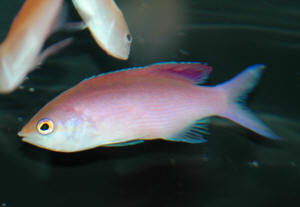
Avoid "too skinny" specimens...
Anthiines should be fed meaty foods... several times a day.
|
Lyretail Anthias 5/23/18
Hi Crew,
We recently got some Lyretail Anthias for our saltwater tank. We got a large
male (4”) and two small females (1.5”) from the LFS. We ordered two more females
online to make a bigger group. We have the 2 groups of fish in their own
quarantine tanks since they came from different sources. The two females we
ordered online are pretty big (2.5”) and one of them has a spiked/pennant dorsal
fin. Does that indicate the fish has started turning into a male?
<Possibly>
If so, would the process reverse if we housed that fish with our existing male?
<Likely so>
I’m a little worried about putting them together as I’ve heard males are
aggressive to each other.
<I wouldn't be (overly) concerned>
Thank you,
Pegine
<Welcome, Bob Fenner>
|
Parasites? 12/22/16
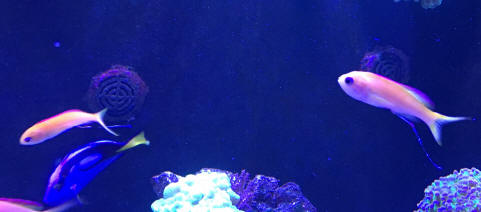
Hi there. Worried my 2 female Ignitus Anthias have parasites?
They have stringy white poop and are a bit emaciated....?
<This subfamily of basses very easily suffers for lack of nutrition... Need to
be fed a few times daily, or better still; have a large, robust refugium and DSB
with RDP lighting associated (plumbed in with) their main tank to provide live
food items. At the very least an automated feeder can be hooked up to provide
nutritious and palatable pellets during the day (Hikari and Spectrum are fave
brands). Are these fish parasitized? Can't tell from looking... a fecal sample
could be netted out, examined under a microscope... One could lace their foods
with anti-protozoal (e.g. Metronidazole) and anthelminthic (e.g. Praziquantel)
medications. These ideas are gone over/archived on WWM. Write back w/ specific
questions if something is not clear, complete after reading. Bob Fenner>
|
 |
|
Re: Parasites? 12/22/16
Fish are fed twice a day with variety of Hikari and SF brands: brine, mysis,
Spirulina brine, plankton, PE Calanus, caviar, marine angel, marine algae,
spectrum pellets periodically, 3 colors of seaweed, all sometimes laced with
Selcon, but not always.
<I'd double plus the frequency here. Good food choices>
Tank is a Red Sea Max 650 (so ~175 total volume, 30 refugium), display is 3 inch
sand bed,
<I'd add an inch here>
almost 5 years old, refugium with live rock, sand and macroalgae with red LED
bulb running 18 hrs/day. Glass is covered daily with countless
copepods.......Male Ignitus is very round and healthy looking, only the 2
females look poorly.
<Mmm; maybe they're being "run ragged"... I'd add two more to split up the
aggression here>
Other inhabitants: yellow tang, regal blue tang, blue eyed Cardinal, fox face,
Royal gramma, dragon goby, yellow watchman goby, mated spawning percula clown
pair, green mandarin goby. I can try increasing to 3 or 4 daily feelings and
using the Selcon soak daily instead of only sometimes.
<Ah yes; good>
I believe I do have some Metronidazole. Just wanted to be sure that was ok to
use in display with all other fish, live rock, inverts, coral, etc.
<Mmm; am NOT a fan of such "shotgun" approaches. I myself would NOT be treating
here>
I do have a quarantine set up and running at all times just in case if I need to
move them...Thanks.
<Thank you again for writing so lucidly. Bob Fenner>
Re: Parasites? 12/23/16
10-4 got it. Thanks a ton Bob
<Welcome Julie; and please keep us informed. BobF>
Re: Parasites? 12/23/16
Will do, although I thought of one more thing, regarding adding 2 more Anthias,
I'm wary of doing that as this male seems pretty aggressive.
<Yes; the larger part of why I suggested a higher female to the one male ratio.
Your 175 should be large enough>
I had a single one when I added the 3 (it was leftover from a batch of 5 very
small juveniles that did not survive) and within 24 hours he bullied that single
one to jumping out of the tank and he was dead when I got home.
And this was months ago even before they were "sexed" really, they were only
about an inch and a half when I got them. So I'm concerned if he bullied that
settled one when he was a new addition to the tank, how much more so would he
bully new additions now that the tank is "his" territory.....I may try
increasing the feeding and using the Selcon every
day first for a couple months to see if that helps before adding more.
<Your concern is valid. I would (use two nets! Maybe a friend with another one!)
net out the male and hold him in a plastic floating colander (spag. strainer)
for a day or two, allowing the new females to settle in. Bob Fenner>
Re: Parasites? 12/23/16
Great idea. Thanks!
<Welcome Jules. B>
Re: Parasites? Anthias; stocking f'
1/2/17
Well sad news, came back from a week long vacation today and one of the females
is gone. Can't find her on the floor anywhere so she must have died.
<Yes... and dissolved, been eaten with this much time gone by>
And being so small, the clean up crew would have taken care of her overnight
easily. :( With us being away for a week I wasn't able to get any additional
ones before we left but I will get them now. How many total should I have?
<The more (females) the merrier, better... I'd get five, seven...>
So we have the one male, one female, should I get 3 or 4 more? I suppose I
should get more than I need in case 1 or 2 don't survive.
<Yes>
Thanks
<Welcome. Bob Fenner>
|
Color Morphs of Lyretail Anthias
3/18/14
Good afternoon crew!
<Li'l Bri>
I am hoping to add a group of lyretail Anthias to my 150 gallon aquarium
(told myself I'd never get a tank bigger than 10 gallons. That turned
into 20. Then 55. Now 125... I've been eating Top Ramen to recover from
the expense! Haha.
<Heeee! You don't need that couch!>
So worth it though!) I've been doing extensive research and have noticed
that Anthias collected from different locations have different color
morphs. I'm specifically interested in the difference between specimens
collected from Africa/Kenya and those from the Maldives.
<Ah, Pseudanthias squamipinnis likely>
What is the color difference between males from these two places?
<Ones closer to the Red Sea are more salmon colored, with brighter side
spots>
Also, are females from these sites a vibrant apricot orange or more of a
dull, muddy orange?
<Ones toward the P.I. are more bright orange>
Finally, are the specimens from one of these places generally healthier
than those from the other?
<Very good question. My fave are the ones from further into the Indian
Ocean and Red Sea; but more has to do w/ handling and time in shipment
than source location in terms of hardiness>
Thank you very much for your thoughts,
"Little Bri" (coined by Bob)
<Cheers, BobF>
Re: Color Morphs of Lyretail Anthias 3/18/14
Yep. Time to Craigslist the furniture… I feel like this is going to be
very obvious once you tell me, but what does P.I. mean?
<Philippines Islands>
Is it the Pacific Islands? So your favorites would come from the
Maldives then?
<Mmm, really depends on the quality at hand; secondarily the price>
Sorry for all the confusion, but everywhere I look online and in the LFS
seems to have the same name for fish of very different coloration! The
LFS says they can also get some from Fiji. Would these be the most
vibrant orange?
Thanks again!
<The ones from FJ are fine. BobF>
RE: Color Morphs of Lyretail Anthias 3/18/14
Thank you!
<Certainly welcome. B>
Stocking question 12/27/13
Hello wwm crew,
I currently have a question regarding stocking of Anthias.
<Ok>
I currently have a 120 reef. Amm : 0 nitrite: 0
nitrate: 0.75ppm. Corals include everything from Zoas to Acros. I also
have a rbta, gbta, and maxima clam.
I am a heavy stocker, but do deeply care about my fish. Let me first say
that before giving my current fish list. I also feed multiple foods
multiple times a day and do a 30gal change weekly.
I currently have stocked:
8 dispar Anthias
2 snow onyx clowns (I believe they are occ x perc)
2 potters angels (pair)
<Neat!>
1 flame angel
1 coral beauty angel
1 eibli angel
1 Chromis (yes he is the only one and will remain the only one as he
prefers to shoal with the Anthias and kill all other Chromis attempts)
1 mimic tang
1 lieutenant tang
(The tangs do get switched out when they start to look cramped)
1 twin spot goby
1 black ember blenny
1 mandarin (he also eats Mysis)
1 purple pseudo
1 Cebu Pylei wrasse
Everyone is doing very well, with absolutely 0 aggression.
I would like to add 3-5 purple queen Anthias. I am
wondering if they would mix well with my dispar?
<I think you should do fine with this addition. Do realize that the
Purple Queen is a bit touchy; especially when moved>
Thank you,
Kim
<Welcome. Bob Fenner>
Bartlett's Anthias/compatibility 7/23/13
Hello, I've been a long time reader but this is my first time writing.
My 55g
<Small for Pseudanthias spp.>
is 2 and half years running, though Hurricane Isaac wiped out all of my
livestock and many corals last fall. I've been slowly letting it settle
back down and become fully stable once more. Ammonia, nitrites,
nitrates, phosphates have been at zero, though I do grow algae on the
grass and have had hair algae off and on since the tank's crash. I have
approximately 80#
of Fiji and Florida LR and a shallow 2 inch) sand bed. My LR critter
population is teeming (worms, breeding Mysis shrimp,
Copepods/arthropods, sponges, snail eggs, tiny brittle stars, etc). I
also have thriving Zoa colonies, mushrooms, a huge finger leather
<Needs to be kept trimmed here>
which survived the storm, and other soft corals and LPS and a few
inverts (3 peppermint shrimp, a Louisiana native shrimp ( I apologize
for not knowing the exact species...husband brought him home from
fishing on Lake Pontchatrain), a fighting conch, a few snails, couple of
hermits, an emerald crab,
<Watch this; predatory>
and plan to add 2 skunk cleaner shrimp).
Current inhabitants: 1 starry blenny (about 7 months), a coral beauty
(3inches, approx 3 months; I know it's a risk with the corals but one I
am willing to take), 2 teeny (barely an inch, though one has
grown slightly bigger and appears to be taking the female role)
<See/saw this lack of pronoun in your next email... Premnas; you're done
stocking here>
that I added 2 weeks ago. Knowing these last two will become meaner with
age, I wanted to go ahead with my last fish before they grew too much.
I added a Bartlett's Anthias
<A social species; as most Anthiines... doesn't live solitarily>
yesterday. He's about 2 inches, alert, feeding well, and seems to have
adjusted well. I've combed wet web media's FAQ on Anthias/fancy bass,
reading all entries, but I am having trouble finding a direct answer:
With this mix, should I add another Bartlett's?
<You don't have room here. I'd remove the one ahead of the Maroons
growing, likely killing it>
I am unclear if having another if its kind is necessary for the fish to
thrive or if this will simply lead to aggression.
I am aware they are frequent feeders; is there too much competition in
here for the Anthias to feed well?
<Yes>
I am hoping that aggression will not be too bad as the tiny clowns will
grow up with the Anthias, and the coral beauty is not much of a bully.
Thank you for your hard work and wonderful site! I'd like to think I've
learned much.
<Glad to do what we do... informing, inspiring others. Again, I'd just
stick fish-wise with what you have here. Bob Fenner>
Bartlett's Anthias follow-up 7/23/13
I realized accidentally left out that the tiny clowns are maroons...this
is why I am wondering if the Anthias may have trouble.
<Ah yes. Thank you. B>
Thank you again!
Anthias; stkg./sel., comp.
5/29/13
Dear Wet Web Media,
I have desperately tried to answer this question through
hours of reading, but I must give up and ask as there is no answer. I
have a Pseudanthias hypselosoma
<"A"? This is a highly social species; lives in groups in the wild.
Shouldn't be kept solitarily>
a in my 50 gallon tank
<Needs more room>
that I am ready to put into my new 265 gallon. I had hoped to find some
more P. hypselosoma to add with her,
<Ah, good>
but they seem to be hard to find right now. I realize that the common
opinion is to not mix different species of Anthias, but I thought in a
tank this large maybe it could be done.
<Yes, it can be and P. hypselosoma is found in mixed species shoals>
Assuming it can (if not you can stop me here), how would you suggest
doing this? Add the other species as a group and down the road add more
P. hypselosoma?
Add one fish of the different species, and add the rest of both schools
at the same time? Is there another method?
<Any of these will work... I'd likely choose the more common P.
squamipinnis to go/get along here>
So, assuming I know how to add the next species, are there any species
to avoid because of obvious personality problems?
<That and other aspects of suitability>
I'd rather avoid pugnacious types, however, I realize many are hardier.
I'm starting to think it is hit or miss with most and just try my best.
<Not hit or miss... use other people's experience as a guide>
If I had a choice, I'd do the Pseudanthias pleurotaenia (although I'm
afraid of the personality here) or the Pseudanthias pascalus (too
difficult?).
<Yes and yes>
Finally, is there any reason I can't add Anthias to a new tank as long as
they are fed?
<Not from what is stated, no>
Thanks!
Alyssa
<Welcome. Bob Fenner>
Anthias - compatibility and tank introduction
3/5/13
Hi WWM,
<Aditya>
What I have: a 500g FOWLR with some soft corals that has been
running for a year and a half. Started off with some of the hardier fish i.e.:
Damsels and Clowns. After a year and a half this is my current stock list: 6
Chromis, 1 Bicolor Angel, 1 Flame Angel, 2 Firefish, 1 Long Horned Cowfish,
<Will grow quite large here in time>
2 Blue Damsels, 2 Four Stripe Damsels, 2 Yellow Tangs, 2 Regal tangs, 2
Ocellaris, 1 Six Line Wrasse, 2 Magenta Dottybacks = 26 fish in all (all within
2-4 inches) Now all these fish seem to be getting along quite well but for the
occasional squabble.. for the most part there seems to be enough space to keep
them all happy. However I am noticing that my four stripe damsel is getting more
and more territorial these days and the damsels get aggressive and chase each
other once in a while.
<Yes; tis their nature, particularly Dascyllus as you've noted>
The Dottybacks (porphyreus) were added last (just a week ago) and I've
already seen one go head on with the 6 Line Wrasse, then they seem cool with
each other again.
<Sixline's are akin to Jack Russell breed dogs... Big fishes in little fish's
bodies>
Now where I live Anthias are rare. For the first time i managed to get hold of
10 lyretail Anthias <2inch long and have them in QT. They are happy and eating
just about anything i give them (rotifers, Mysis, brine, flakes, NLS, etc).
<Feed them often; several times per day... be on the lookout for excessive
bullying; move the alpha fish/es to the main system if so>
My QT then developed a crack and I had to move them to the fuge They seems
to like it here with all the rock and moving water. I've always loved this fish
but never had the opportunity to get them until now. Now that i have them i am
terrified of having them slaughtered in the DT... in your experience do you
think the damsels / Dottybacks pose a serious treat?
would the grouping of the Anthias deter bullying?
<Mmm, the size/volume of your tank, the swiftness and smarts of the Anthias
should hold them in good stead. You've done well by isolating the new fish,
letting them rest up, grow acclimated to the main system water. I doubt you will
have troubles between them and the established stock>
I've had the Anthias in the QT/fuge for 5 days now. It is a very small space in
comparison to the DT. When can I move them to the DT?
<Now>
Should I remove the 4 Stripe or the Dottybacks before I move them in?
<I wouldn't try, no>
Catching anything in my DT is going to be a huge challenge. Or do you
think they may all just get along given the space in the tank?
<Highly likely so; yes>
I almost immediately regretted adding the damsels and the Dottybacks when I got
them, but at the time figured tank size would take care of any problems.
Thanks for taking the time to read this!
Best
Aditya
<And you, Bob Fenner>
Re: Anthias - compatibility and tank introduction
Bob,
<Ad>
Thanks so much for the response, wasn't expecting something so quick!
I've been dying to get them in the DT, they do look lovely. As of now they all
get along with each other, no aggression between the Anthias. .
<Thus far; will/do "bicker" in time... problematical when/where crowded>
The only thing that concerns me is feeding. In my fuge I am able to drop food
right above them and wait as they come and grab it, do you think they will
notice/get to the food in a 500g DT with a bunch of other aggressive eaters?
<Yes; consistency... where, when foods are placed... what you do ahead of
offering becomes imprinted on all>
In the fuge a couple will see the food and then trigger a feeding frenzy
with the others.
On another note how many fish (<=3 in community fish) do you suppose I could
eventually stock in my tank moving forward?
<Many choices... peruse what is archived on WWM for FOWLRs, large systems, the
compatibility FAQs for what you've already stocked.>
I always wanted a high tank and built mine to be 6(L) X 4 (H) X 3(W). Its
a pain to clean sometimes but has the aspect ratio of a large screen TV which is
nice.
<I imagine>
Thanks again
<Welcome. BobF>
Aditya
Re: Anthias - compatibility and tank introduction 3/8/13
Bob,
<Aditya>
Just wanted to close the loop on this and let you know what happened. I released
all 10 Anthias in the DT and they are all doing extremely well.
Eating like pigs. The damsels go at them once in a while but they seem to be
swimming in the top half of the tank most of the time in front of the wave
makers and avoid the damsels in the lower sections.
<Ah yes>
Thank you
Aditya
<And you for this follow-up. BobF>
Re: Seastar Issue, and now comp., sel. of P. squamipinnis
8/20/20
Bob,
<Christine>
Thank you for your response to my Seastar issues. I have decided
that two Fromia milleporella stars will be the extent of my future
Seastar purchases, I am selling my conch, and working double time in
building up the pods in my refugium.
<Good>
As I may have mentioned, I currently have a 6 foot 125 gallon display
with 40 gallon refugium and 40 gallon sump. I have 4 clowns, an
indigo dotty back and a run of the mill cleaner wrasse. My
intention is to add 1 male lyretail Anthias and two females, which I
believe you indicated in your previous response would be ok for my size
tank.
<These should be fine here>
A few questions have been on my mind, firstly are two females and one
male going to be enough to distribute any aggression, or is that not a
huge concern with Anthias?
<Not problematical w/ this species (Pseudanthias squamipinnis>
Are Anthias a dithering fish?
<Mmm, can be>
Fosters and Smith offer two types of lyretail Anthias, one they simply
refer to as lyretail Anthias and another they refer to as Maldives
Lyretails.
<Same (widely distributed) species:
http://www.google.com/search?sourceid=navclient&aq=0&oq=maldives+lyreta&ie=UTF-8&rlz=1T4GZAB_enUS459US459&q=maldives+lyretail+anthias&gs_upl=0l0l0l48020858lllllllllll0&aqi=g4&pbx=1
>
The only difference that I notice, aside from price, is that the
Maldives male appears orange, whereas the "generic" lyretail male
appears more red.
<On close examination, this species shows more/less such differences
here/there>
(I would prefer the red incidentally) and wonder if my perception is
accurate.
<It is>
I am also curious now as to whether the females from either region will
be the same vibrant yellow color, or if their color varies from region
to region as well.
<It varies>
Is there anything not commonly read about that would help me further
with Anthias? Any skeletons in their closets?
<Not as far as I'm aware, and I've seen this species, collected it for
the trade widely>
Also, I do like the look of a small school of blue green Chromis
and was wondering if adding one in the future would be an option for me
and if so, how many?
<Perhaps five>
My only concern is that each time I have attempted this, they usually
fight among themselves until there is only one survivor, I hate to see
this and have read that it is common.
<It is>
However I have not yet attempted a school in this size aquarium, I know
that more Chromis will spread the aggression out, but am not sure if I
have a big enough system, or enough room left, to hold the size school
required.
<I give you good odds here>
I have seen beautiful blue reef Chromis, and was wondering if anyone has
had better luck with these, or do they tend to pick each other off too?
<About the same>
I understand that I may just be better off stopping after the Anthias.
Incidentally, I have been tossing around the idea of moving my black
ocellaris into a separate tank altogether to see if they will mate.
<Very common... in any size volume; easier to breed, raise young where
in smaller, isolated settings>
One is clearly a very dominant female who has paired up with a little
male.
Thank you as always for your advice!
Chris K
<Welcome. Bob Fenner>
Blue Face Angel in a reef tank, comp.
8/6/12
Hi Friends,
Thanks for the whole lot of FAQs on the hobby !!
<Welcome>
I have a not so quick question.
I had initially planned a SPS tank of 4’x4’x2’ but due to some design
mistakes I had to rethink to make it Softy and some Zoanthid tank. I am
in the middle of stocking the tank.
Some details regarding the tank
• Circulation is by way of 2 EcoTech
Vortech MP40W ES. Set in Async Mode.
<I'd leave these on continuously... in opposite corners, near the
surface, spin the water in a gyre>
• Lighting is using 4x Mazarra
• Skimming is done using a Deltec TS
1060 inside the aquarium itself.
• Filtration is by a Fluval G6
canister [will be no media. Just lots of Live Rock rubble as a
substitute for a Pods refuge
<The discharge of this vertical, in the direction of the gyre>
• Using 4x 11oz Chemipure Elite
rotated every alternate month.
• Around 100 Pounds live rock [Tonga
branch type] in display and around 20 odd pounds in the canister.
• 4” DSB using CaribSea Fiji Pink
fine aragonite.
• Water change every month -
100liters.
Fish and Inverts
• One yellow tail Anthias
<Social species... I'd add more>
• Blue Tang
• Yellow Tang x 3
• Percula clown [pair]
• Maroon clown [pair]
• Blue Face Angel [I know this can
be a turning point]
• Skunk cleaner shrimp x 3
• Peppermint shrimp x 2
• Assorted 20 odd snails [mostly
turbo]
• Would a sea cucumber get torn off
by the Angel?
<Might be; but if a small species, likely ignored>
Can I add the following without crowding?
1. Psychedelic Mandarin [pair]
<Hard to keep fed here. See WWM re>
2. Orchid Dottyback
3. Royal Gamma
<2, 3 fight, but in this size, shape system likely fine>
4. Some kind of Goby [please could you
suggest any?]
<See the groups on WWM... Stocking/Selection FAQs>
5. Wrasse - A pack of three?
6. Any dither fish feasible?
<Ditto re the above 5, 6>
I need to decide quickly since I don't want the angel to become the big
bossy and then add further fishes to upset the balance.
<It is the alpha animal here and will be>
Corals
• Star Polyps
• Small cluster of Zoanthid
• Handful of Mushrooms including one
giant mushroom of 4” diameter.
• Pulsing Xenia
• Toadstool Leather 6” diameter
• Plate Coral
• Unidentified coral similar to Moon
coral but flat oriented instead of dome shaped.
• Clam
• Green Bubble tip Anemone [hosted
by Maroon pair].
• Montipora [flat table type
structure] x 2
Any corals you would suggest that stand a good chance with the Blue Face
Angel? Or is it just impossible?
<Just have to try, see... not most Acroporids>
I always wanted a Blue Face Angel and decided to take the risk with a
4"-5" specimen I saw at the LFS. It was quick to feed when I checked
there and was alert and no body damage was seen as well. Since I know
big Angels can pick on BTAs, I wanted some protection there and got 2
Maroon clowns [3"-4" and ~1.5"].
The bigger clown went straight for the BTA. Initially the smaller
Maroon Clown was not allowed even near the BTA but over last 2 days, he
can be as close as 2"-4" nearby.
Does that mean I have a pair now?
<Likely so. Bob Fenner>
Re: Blue Face Angel in a reef tank, now more re aiming in-tank pumps,
Anthiine stkg. 8/6/12
Hi Bob.
Thanks for the prompt response as usual :)
You suggested I leave the Vortechs running in sync mode facing each
other.
<Mmm, no, not facing each other... but "shooting" along the side, placed
near the top... pushing water in a clock or counter-clockwise fashion>
This is not possible because the tank is designed for viewing on 3 sides
and top [rimless and low profile]
That is why I put the pumps on opposing mode in one side each to try and
create a horizontal gyre [or similar]
Any way to improve this?
<Add another couple pumps>
The discharge from the canister [pod fuge] is just close to one of the
Vortech. Should serve the purpose yes?
<Yes; if aimed in the same general direction>
Regarding the fish suggestion, I had initially added 7 of them. Dwindled
to just the remaining one within 2-3 days.
Should I add more of them? How many if yes?
<I'd add more Pseudanthias... small (female or sexually
undifferentiated), but healthy>
The Maroon Clowns have indeed become a pair as both of them now nest in
the BTA. She does push him around a bit but I am guessing since he is
allowed inside the BTA, the pair is made?
<Very likely so>
Cheers
Ranjith
<And you, B>
Hardy Anthias...(Mmm…) – 06/14/12
Hey WWM Crew and Bob.
<<Hey Scott>>
As always, thanks for all the input!
<<Is our pleasure>>
I'm upgrading to a 240 (96x24x24 inches) in the near future.
<<Sweet>>
I would like to add a small shoal of Anthias.
<<Mmm, okay… I do have some experience with these fishes and larger home
tanks such as yours. Do consider that even in a larger tank such as the
one you aspire to obtain; none of the Anthiines are “easy” to keep,
these fish should not be considered as “add ons” to a system IMO…but
yes…there are some easier to keep than others. A very important aspect
of their captive husbandry is…what will you keep with them? Fast moving
and aggressive or just boisterous fishes are a detriment to their
long-term good health in captive systems. Something to consider strongly
when picking tank mates.>>
In reading through the posts as well as the articles, I read several
species are considered hardy
<<Maybe “hardier than others” is more accurate>>
(ex. Dispar and Bicolor for a couple). My questions is, can you directly
compare the various Anthias species and tell me the top 5 species rated
for suitability to aquarium use (ease of feeding, hardiness, etc).
<<There’s a pretty good rundown of the species more commonly available,
here (http://www.wetwebmedia.com/anthiina.htm). Do peruse it if you
haven’t already. As for “my choices,” if I were to pick five species for
aquarium keeping re their adaptability and willingness to feed, they
would be as follows:
- Pseudanthias squamipinnis, the Lyretail Anthias
For bigger tanks of 200g+ I think the Lyretail is supreme in groups of
1-male to 4 or more females. And if possible, obtain a wild-caught
male…much more colorful than a captive-turned specimen (and likely more
expensive!).
- Pseudanthias bartlettorum, Bartlett's Anthias
The Bartlett’s is great for smaller tanks or if you want a big group in
a bigger tank. But beware my earlier warning re tank mates else you will
be finding them everywhere…outside the tank.
- Pseudanthias bicolor, the Bicolor Anthias
- Pseudanthias dispar, the Dispar Anthias
- Pseudanthias huchtii, the Red-Cheeked Fairy Basslet
The Bicolor, Dispar, and Red-Cheeked are about equal in my
estimation…with perhaps the Red-Cheeked having a slight edge on
adaptability.
- Pseudanthias pleurotaenia, the Square-Spot Anthias
For big tanks that want something not often seen in home aquaria, a
grouping of the Square-Spot is unique…and these fish adapt/feed well in
my experience. Overall I feel the first two I have listed are the best
choices for captive keeping in the long term. But unless the tank’s
emphasis is on keeping Anthiines, I feel even these will wane/waste (or
just jump out!) over time>>
Thank you for your opinions!! I have a lot of faith in your experiences!
Scott
<<Happy to share… EricR>>
Re: Hardy Anthias...(Mmm…) – 06/15/12
Thanks for the response Eric.
<<Quite welcome, Scott>>
In regards to their tankmates, my current tank inhabitants includes (all
single unless otherwise noted) purple tang, a Tomini tang, 2 starcki
damsels, coral beauty, flame angel, lemon peel angel, cherub or pygmy
angel, ocellaris clownfish, two starry eyed blennies, two cleaner
wrasses, two neon blue gobies, and a small royal gramma (loreto). In the
future I'm considering a couple different species of butterfly (tinkeri,
red sea raccoon, or saddleback), a mystery wrasse, or another tang
(powder blue, gold rimmed, or Naso). Do you think these, either current
or future, are too stressing for Anthias?
<<Mmm, for the most part…yes…especially the tangs, damsels (to include
the clowns), and angels.>>
Again, the new tank will be 8ft by 2ft by 2ft with several bommies of
live rock and a deeper sand bed.
<<Acknowledged and understood. If you decide to go forward with adding
Anthiines to this new tank, I think P. squamipinnis (Lyretail) is
certainly the best choice here…but still at a disadvantage over the long
term.>>
Thanks for the input! Scott
<<Always happy to share… EricR>>
Re: Help regarding adding livestock
5/29/12
Dear Bob,
<Hey Andy>
Thank you for the reply. I would like to explain something here.
<Please do>
The fish are packed real nice and the LFS keeps all the parameters
intact, in fact I should not address him as a LFS, instead he likes to
keep a lot of tanks and he doesn't sell the fish to anyone, in short, he
doesn't keep the fish to sell, unless someone like me pushes him real
hard. All his tanks are top notch and maintained really well. And I have
had all my fishes from him only since the beginning and I haven't faced
any problems so far with a single specimen.
Another thing, I have read this a lot of times that Anthias require
multiple feedings in order to curb the aggression and to keep them
happy.
<This can be so; particularly if they're (too) crowded>
I feed my fish NLS food and as per them, they strictly advise us to feed
no more than 2 times in a day, so will this regime work for the Anthias?
<Can, could... if they start in a good index of fitness (not thin)>
I do offer the fish Nori sheets by two little fishes every other day or
so, but that's all. Any suggestions?
<I encourage you to add an automatic feeder for the NLS pellets... have
it come on a few times per (during lights-on) day>
One last thing, 10 lyretail is a satisfactory number for a 225
gallon tank or should I add or subtract from that count?
<I'd go w/ 5 or 7...>
Regards,
Andy
<And you, BobF>
Re: Help regarding adding livestock... Anthiines
5/29/12
Hey Bob,
<Andy>
The problem with the autofeeder is that the pellets don't sink fully and
they float away into the overflow,
<Ah yes>
I had 2 autofeeders and I faced the same issue with them. NLS pellets need
to be a little wet and then they easily sink..any idea how to go about
that?
<Mmm, can't really be wetted... turn to mush, decompose>
> One last thing, 10 lyretail is a satisfactory number for a 225 gallon
> tank or should I add or subtract from that count?
> <I'd go w/ 5 or 7...>
Thank you for the clarification, the first time I emailed you with the
intended livestock, you didn't object to adding 10 of them, but after
reading a lot about them, I was a bit skeptical upon adding so many.
<Ahh, better to allow space for interaction, the addition of other
motile livestock. B>
Regards,
Andy
Lyretail Female gulping air, chasing bubbles
8/24/11
Hi WWM Crew,
<Laura/Dez>
Hope all is well with everyone there.
<Ah, yes. Thank you>
I have an 85 gallon very established reef tank with a tied in
refugium.
My livestock are 1 Midas Blenny, 1 Male Bartlett Anthias, 1 Female
Lyretail Anthias, and One Male Lyretail Anthias.
<Mmm, want to mention re the shoaling behavior by species of most
Anthiines>
I also have 1 Candy Basslet and two Yellow Watchman Gobies. My tank
parameters are: KH:9, Calcium: 440, Nitrates: 0, Phosphates: 0,
Magnesium: 1400, Temp: 77/78 F.
About 2 weeks ago my Female Lyretail Anthias started hanging out in the
upper right corner of the tank.
<See my above related comment>
She is continually chasing bubbles, gulping air from the surface,
making her own bubbles, and chasing them like mad.
She appears to be eating well, and there is no aggression from any
other fish towards her. She looks healthy - no torn fins, spots, signs
of any outward disease. Her behavior is puzzling, to say the least and
stressful to watch. I am not sure if she is distressed in any way or
playing some bizarre game with herself and the bubbles.
<Is a "displacement behavior" set... taking the place of
what this fish would other be doing (in the wild)... Circling about
here and there w/ her own kind more or less>
Do you have any idea of what might be the issue here and what can
possibly be done about it?
<More of the same species, or trading this one fish in...>
My other Anthias are fine and not exhibiting this behavior in the
least.
Thanks in advance,
Laura Garmizo
<Thank you for sharing. Bob Fenner>
Re: Lyretail Female gulping air, chasing bubbles
8/24/11
Hi Bob,
<L/D>
Thank you for the reply.
<W.>
Given my tank parameters, current stocking, if I did "more of the
same" in terms of adding more Anthias, how many more of each
(Bartlett/Lyretail) would you suggest?
<Please read here: http://www.wetwebmedia.com/anthiselfaqs.htm
I am either going to have to go this route or take the three Anthias I
have out (two Lyretail - male and female, one male Bartlett)
and abandon the idea of Anthias and go with another species
completely.
<I do agree w/ your plan/direction>
Curious to hear your thoughts.
<Do write back after reading if you/I are not clear, complete in
them.
BobF>
Laura
Anthias and Wrasse harems 3/19/11
Hi!
<Hello Dustin!>
I currently have 4 Bartlett's Anthias in a 29 gallon QT tank.
<Mmm, need more room by this by far... Will be both psychologically
and socially, let's combine the two terms, psychosocially too
cramped in a very short while>
They have been
there for a week and all seem to still be females. For the first couple
days all of them were eating and swimming around. Now one is hiding
behind the powerhead
<Oh, already. See, I did state "in a very short
while">
in the tank and not eating and another has a pretty beaten up tail
fin,
<Ditto>
but is still swimming around and eating. My assumption here is that
there is some jostling for dominance going on,
<In part, yes>
but I don't want it to be at the expense of a couple of them
dying.
<Which they will if not moved>
What can be done to help this situation?
<Umm>
Do they need to be partitioned or separated in some way?
<Not in this volume, no>
The Anthias are going into my 210 gallon upon completion in QT.
<Anthiines are one of my "generally don't quarantine"
groups/families of fishes... They suffer too much from the delay,
compared with simple dip/bathing and expedited placement in
main/displays. Is this clear to you?
Like most Gobioids, Blennioids... much more of the time these fishes
"die mysteriously", jump out, starve, beat each other up...
I'd place them in the larger system, stat.!>
This carries over into the harem of Flame Wrasses I just purchased them
today and put them into a different 29 gallon QT tank.
<These two I'd dip (pH adjusted freshwater... detailed on
WWM:
http://wetwebmedia.com/dips_baths.htm
and the linked files above)>
The harem consists of 1 male and 3 females. I want to make sure I
don't run into the same problems
I am currently having with the Anthias.
<Similar, yes... Move these Jordan's Cirrhilabrus>
The only decor in either tank is a few PVC pipes, a heater, a
powerhead, and an air stone.
Thank you in advance for your assistance!!
Dustin
<Certainly welcome. Bob Fenner>
Re: Anthias and Wrasse harems-- 03/19/11
Thank you for your help. I figured you would say to move them over, I
just needed you to push me over the edge to do it. I really don't
like not quarantining anything.
<Ahh; is at least a two-sided saber>
I think going forward I will have a 75 gallon quarantine tank when
introducing groups/harems so that I can
quarantine (not for the 210, but when I upgrade). Would this be
sufficient or should I not quarantine in any size tank really?
<... not certain species...>
Thanks again,
Dustin
<Another welcome. BobF>
Re: Anthias and Wrasse harems 3/21/11
Sorry to bother you again. I switched all the Anthias and wrasses over
to my display tank. Unfortunately the male died due getting caught in
the net by his mouth.
<Ahh>
It took a few minutes to get the net out of his mouth because they have
some wicked teeth. He died within 15 minutes after the stressful issue.
All the other fish are doing quite well and eating already. Some
already taking NLS!
<Ah, good>
The male is being replaced by the company I purchased from because they
had a 7 day guarantee. My question is the longest I can wait (I know
the sooner the better) to put a male into the tank without a female
switching???
<Usually a few weeks>
The reason being that the company doesn't have any males in at the
moment and I don't want to have one sent to me if it is too
late.
I read on your site that it can happen in 2 weeks, but I assume that
once it gets too far along it will cause problems and don't know
how long that is.
I can't thank you enough,
Dustin
<BobF>
Anthias Stocking 1/28/11
Good Evening
<Good morning Eric.>
Not sure if you remember everyone that emails but I was the person
trying to mix the skunk clown with the ocellaris.
<I recall that query.>
Needless to say the ocellaris would continue to harass the skunk so I
decided to move it to another tank. I am now looking to add the final
peice <piece> to the tank and was considering a school of
Bartlett's Anthias. I currently have a 90 gallon with the following
fish load; Convict Tang, Potters Angel, Yellow assesor
<Assessor>, Black Stripe Blenny, and my skunk clown. Do you think
adding 5 Bartlett's would be over kill?
Looking for your opinion.
<In smaller systems, Bartlett's Anthias do better kept alone
with their own species. In your system,
yes, adding five Bartlett's would be overkill/overstocking.>
Thanks,
<You're welcome. James (Salty Dog)>
Eric
Getting Community Tank (including Anthias) On Spectrum
Pellets/Feeding/Stocking/Anthias Compatibility 1/13/11
Dear WWM,
<Hello Laura>
Hope all is well on your end.
<Is good.>
I have a well established 85 gallon reef tank. I have a pair of
Ocellaris clowns, a pair of Yellow Watchman Gobies, a Midas Blenny, a
trio of Bartlett's Anthias (one male, two females), and a pair of
Lyretail Anthias
(male and female), and one Yellow Clown Goby.
<Please cap pronouns (names of fish, etc.) in future queries, saves
me time if I don't have to do it.>
My question is actually two fold. Firstly, I have been feeding this
tank a frozen food mix called Rogger's Food in the morning that is
universally consumed by all. Then, I do a small midday feeding of
Spectrum pellets, as well as a small evening feeding of Spectrum
pellets. Everyone BUT the female Lyretail, one of the female
Bartlett's Anthias, and the Yellow Clown Goby eats them.
I have an upcoming vacation and very much want to get everyone on the
Spectrum pellets. The three fish who do not eat them do not look as
colorful or fat as the fish that consume them. It is frustrating to see
three Anthias eat voraciously eat pellets, and two hold back, as well
as the clown goby. How do I get these last three holdouts onto
Spectrum? My tank manager is encouraging me to use a "tough
love" approach and nix the frozen a.m. feeding. He feels the fish
are getting a food source they prefer, and as
long as that happens, pellets won't be accepted. I welcome your
advice.
<One of the problems you face is that Anthias in nature, are mid
water feeders feeding on plankton. There is not much time for them to
get at the food before it falls to the bottom.
Because of this, Anthias should be fed small amounts several times per
day and there is no guarantee that all Anthias will accept pellets.
Your other problem is tank size, much too small for the Lyretail
Anthias, a minimum of a 125 gallon tank is recommended.
Mixing Anthias species in small systems just adds stress and can create
the behavior that you are seeing. Your tank is overstocked to begin
with and finding a new home for the Lyretails would be beneficial to
your system.>
I have done enough research on New Life Spectrum to know that I want it
universally accepted and to be a very large part of my fishes diet.
And, I am seeing the difference in my own tank between the fish that
eat it and don't eat it.
<Is due in part to their feeding habits and territorial issues also
come into play as you are now witnessing. I use the product myself and
can attest to it's quality.>
Second part of my question...one of the female Bartlett's Anthias
of the trio is ostracized. She hides in the back of the tank behind a
Favia coral.
She only comes out to eat the frozen food - she is one of the Anthias
who does not eat pellets. The other two Bartlett's (male and
female) seem to have formed a pair and don't accept her. When she
tries to come out, they bully her back behind her coral. It is
difficult to watch. Here, my tank manager says "nature is
brutal" and that she is either going to break in to the group and
fight for a place or not survive, with very little we can do about
it.
<Nonsense, environmental issues abound here. Not enough room for
everyone to be happy.>
The Bartlett's have been in the tank about three months. In the
beginning, she was out more, but over time, has become very
reclusive.
Any advice is appreciated.
<Read here and related FAQ's/articles found in the header.
http://www.wetwebmedia.com/anthiina.htm>
Very best,
<And to you as well. James (Salty Dog)>
Laura Garmizo
R3: Bartlett's Anthias'¦Think/Ponder Before
Adding -- 10/11/10
Hi Eric,
<<Hey Laura>>
All Anthias are in the tank now, all are eating and swimming about,
exploring.
<<Very good>>
They seem to call an upper left area by one of my corals
"home", but are, for sure, beginning to venture out a
bit.
<<Considering the size of you display, they will likely
'occupy' the majority of the open water above the reef
structure>>
Clowns seem well behaved, and the only time they leave their area is
for feedings.
<<So good so far, eh>>
I am trying to feed a bit more so that everyone sees that there is
enough food to go around to curb any potential aggression.
<<Excellent... Providing sufficient food/feedings is a major
factor toward limiting agonistic tendencies, in my
experience/opinion>>
As per your advice, I am watching the clowns very carefully.
<<Good to know>>
My little Yellow Clown Goby, who resides right near the Anthias group
does have a nipped tail today, but is out, eating, and acting normal. I
assume that was one of the Anthias trying to establish territory.
<<Mmm, maybe'¦>>
She has never had anything "nipped" before. Again, am upping
the frequency of my feedings to satisfy the Anthias and curb
aggression.
<<Am sure it is appreciated by/beneficial to all your fishes/tank
inhabitants>>
I am crossing my fingers!
<<Me too!>>
Feel things are going as well as could be expected, at this point.
<<Agreed>>
Again, your concern about my clowns is my major concern right now.
Very best, and thanks!
Laura
<<Enjoy the Anthiines! Eric Russell>>
Bartlett's Anthias'¦Think/Ponder Before Adding
-- 10/07/10
Dear WWM,
<<Hiya Laura>>
Hope all is well today at WWM.
<<Is a beautiful day here in South Carolina>>
I have a very established (3 yrs old) 85 gallon reef aquarium with
refugium and the following inhabitants: A pair of black and white
ocellaris clowns, one pair of candy basslets, one pair of yellow
watchman gobies, a midas blenny, and a yellow clown goby. Despite the
beauty and great personalities of these fish, there was a lack of fluid
swimming movement in the tank that I felt was missing.
<<Mmm, indeed--lots of watching and
waiting'¦>>
After researching appropriate fish, I added one male Bartlett's
Anthias to the tank.
<<A haremic species--best kept in groups (given the proper
environment/space) for long-term success>>
The beauty of this fish swimming in the tank made my reef come
alive,
<<They (and most all Anthiines) are spectacular fish>>
and now I am a bit sorry I did not add Bartlett females to make more of
a display.
<<Yup--the social interactions of these fish, aside from being
necessary to their well-being, are a joy to observe>>
Would this still be possible, or am I asking for trouble?
<<Most anyone will tell you it is better to add the females
before the male, when possible. But based on my experience with this
particular species of Anthiine, I think you can add a small group of
females here. Though hardly a 'gentle' fish re conspecifics,
the Bartlett's is one of the 'more gentle Anthiines' in
this aspect of their behavior>>
If it could be done, how many would I be best to add?
<<Even though these fish are comparatively small, like all in the
genus, they do need more space for their continued well-being than many
hobbyists realize. I consider your tank size to be marginal for keeping
these fish, but considering your current stocking density, and if you
haven't 'filled it up with rock,' I think the addition of
three females with the male you have is doable. But'¦ I do
have a concern re your clowns'¦ Even in large aquariums
(hundreds of gallons) these fish do not prosper if at all harassed.
They often jump from the tank if chased--or if not, simply succumb to
stress. Before adding these fish, you need to assess your willingness
to remove any antagonistic tankmates that arise>>
Let me know your thoughts on this.
<<As just stated... Do also consider the need for multiple (2+)
feedings per day>>
I have heard that it is better to have one thriving, healthy, long
lived Anthias in the tank than a harem that will "self
destruct."
<<Can't say I have ever seen a 'thriving, healthy, long
lived' SINGLE Anthiine specimen. I have seen folks keep single
specimens, but'¦ These fish are 'wired' to be in a
group with others of their own kind. The problems that arise come from
hobbyists not providing/not being able to provide the necessary
environment parameters--with the differing species differing in their
ease to provide such. A 'mixed reef' system where the Anthias
are added as an afterthought really isn't the best home for these
fish. It is my opinion that to be truly successful with Anthiines, the
system needs to be 'designed around' these fish. That said, the
Bartlett's Anthias is one of the more forgiving species. If they
are given a chance to acclimate/settle in without being harassed at
all, and are fed a varied diet multiple times per day (I would
definitely add New Life Spectrum 1mm pellets to the menu), they can
provide you much enjoyment here>>
Would love your thoughts.
<<Hope you did/do>>
Thanks in advance,
Laura Garmizo
<<Is a pleasure to share'¦ Eric Russell>>
Re: Bartlett's Anthias'¦Think/Ponder Before Adding
-- 10/08/10
Hi Eric,
<<Hey Laura>>
Thank you so much for your prompt and wise advice.
<<Ah, am glad you think such--quite welcome>>
I would like to try to add the three female Bartlett's Anthias you
suggested here.
<<Thought you might>>
The male was added only yesterday, so I can act quickly to minimize the
situation of the male going in first.
<<Okay'¦ Though not so much a problem with this
particular species, in my experience>>
I do feed twice daily.
<<Excellent'¦ I am a HUGE proponent for feeding
one's fishes very well--and feel many 'fishy issues;' both
physiological and psychological/social, are brought on by insufficient
feedings and nutrition>>
My morning feeding is a frozen food called Rogger's food, which is
a mixed seafood and Spirulina blend, fortified with garlic and Selcon.
The evening feeding is a mix of 1 mm and .5 mm New Life Spectrum
Thera-A pellets.
<<I've not used the Rogger's product, but can vouch for
the palatability and quality of the Spectrum foods. But even with as
good a food source as this, I prefer a bit more variety offered.
Foodstuffs like frozen Mysis, Glass Worms, Blood worms, Daphnia, and
Krill and Plankton--in addition to what you have listed (my wife tells
me my fish eat better than we do [grin]>>
My clowns have shown some aggression issues toward the gobies in the
tank,
<<Not surprising (the only fish to ever draw blood from me while
working in a tank, was a Clownfish)'¦>>
who, in turn, established territories in other areas and basically
"avoid" them, which has worked well for these fish.
<<This won't work with the Anthiines (your system is just too
small)>>
I have not seen my clowns show any aggression toward my Midas Blenny or
Candy Basslets, the only fish that really "swim" in the tank.
It seems the Yellow Watchman's and the Clown Goby are much more apt
to get a rise out of the clowns. However, I would keep a close eye on
this situation regarding the Bartlett's Anthias group.
<<I do suspect the Clownfish will 'have to
go'>>
At any rate, provided you feel I have a fair chance at success with the
plan,
<<Remove anything that harasses the Bartlett's, and I give
you a 'more than fair chance' here>>
I think the beauty and grace these fish would add to my reef would be
well worth it if all works out, which I am hoping is the case.
<<Time will tell>>
I was awed by the addition of one Bartlett's Anthias, so this
grouping would be spectacular.
<<Indeed>>
Thank you so much, Eric.
Laura Garmizo
<<Happy to share, Laura--please do keep me apprised of your
progress with the Anthiines. Eric Russell>>
R2: Bartlett's Anthias'¦Think/Ponder Before Adding --
10/09/10
Hi Eric,
<<Hello Laura>>
Just an update on the "lone" male Bartlett's Anthias...he
is eating everything I put into the tank - Spirulina flakes, Spectrum
Pellets, Rogger's Reef frozen blend.
<<Very good--this species does usually adapt quite well to
captive care>>
The clowns have swam over from their lower left corner of the tank
(they live here and spawn regularly) once to "check him out."
They did so and swam back, no aggression shown at this point
whatsoever. Just a "who the heck are you?" kind of thing.
<<Mmm, ok--but do keep an eye on them. A 'group' of
newcomers may well bring about a different response, especially should
they perceive their territory is under threat>>
The females are drip acclimating as I write to you (I did act
fast).
<<Indeed you did!>>
The male Anthias seems to have procured an area for himself by a
chalice coral I have on the upper half of the tank's right
side.
<<Let's hope the space/area is sufficient>>
Will keep you posted.
<<Look forward to your updates>>
And, thanks again for your timely advice.
Laura
<<Has been my pleasure'¦ EricR>>
Ventralis Anthias <fdg. mostly... other Anthiine
stkg./sel.> / HOB Refugium <stkg.>-- 08/24/10
Hello WWM Crew,
<<Hiya Scott>>
Thanks to James and Eric for my questions a few weeks ago, the info was
much appreciated.
<<We are pleased to assist--Eric with you again today>>
After reading all of the Anthias FAQ's and articles on WWM (yep,
all of them), I had a few stocking questions involving Anthias.
<<Okay>>
The second part of my question involves refugiums; I have not done all
my research about the myriad of uses of refugiums and the benefits they
offer,
<<Can be substantial>>
but I will finish reading those posts later today / tomorrow.
<<Excellent>>
I purchased my 120g reef tank on Craigslist, it was set up at the
owner's house for about 10 months, and I have had it in my
possession for about 1 month now. There is significant growth and life
on the life rock, the water parameters are perfect (~4 ppm nitrates, 0
ppm nitrites, 0 ppm ammonia, 8.3 pH, 140 ppm Alkalinity,
<<On the low side if you have many stony corals--but still within
the 'accepted range'>>
450 Calcium, can't remember the exact phosphate or magnesium
levels, but nothing alarming).
My plan was to let the tank recuperate for a few weeks before adding
any new livestock, the corals and fish all survived the move and are
doing great.
<<Wise of you>>
One day I come home from work (about a week after having the tank set
up) and there are three new fish in the tank (Yellow Banded Maroon
Clownfish, Blue Mandarin Dragonet,
<<Mmm'¦>>
and a Royal Gramma). My girlfriend saw them at the store and "had
to have them".
<<I guess you forgot to update her with your plan?
[grin]>>
I was worried that the tank would be too "new" to house fresh
livestock but all of these fish seemed great and are still actively
eating and looking great now (3 weeks later).
<<Okay>>
My questions are about a few of the more rare Anthias species.
Specifically the Borbonius Anthias,
<<Have 'seen' a few of these...stunning fish (but oh what
a price tag--$300+ each!!!)>>
and the Ventralis Anthias.
<<Also very attractive>>
I have read that most of these fish do well in groups (1 male and
several females).
<<As is the case with most all Anthiines... I don't know much
about Odontanthias borbonius though I do believe it to be a deep-water
species like Pseudanthias ventralis >>
However, due to their outrageous ticket price (specifically the
Borbonius Anthias),
<<Indeed>>
would it be OK if I only introduced one of this species into my
tank?
<<I would not recommend this. In my experience, even those
so-called 'hardy' Anthiine species like Pseudanthias
squamipinnis and Pseudanthias bartlettorum can have problems when mixed
with aggressive (as in Damsels, Tangs, Basslets) and/or extremely
active (as in most Tang species) tankmates. Even the considerable
investment aside, these fish would need/do best in a dimly lit (versus
highly phototrophic) reef system, and tankmates chosen with much
care>>
I also read that the Ventralis Anthias is a fairly fragile fish.
<<I have heard it can be hardy once acclimated--to the right
system>>
In order for me to receive one (or more) I would have to special order
them from my LFS (highly trusted) and he would receive them from his
supplier. Would it be better to buy this species as well in a group or
can it survive solo?
<<In a group, but'¦'¦'¦>>
My worry here is that this fish (or group of fish) would be under too
much stress going from supplier to LFS to my tank, with zero
acclimation time in the middle grounds (LFS).
<<Unless your LFS is willing to hold these fish to assure they
are fit and eating before you pay (not likely, considering), this is
your only method of acquisition>>
My LFS will not be getting any of these fish in to sell regularly
unless they are special ordered so this would be my only option.
<<Understood--and not unusual considering the price/delicate
nature of these fish>>
The second part of my questions involving housing these fish is about
feeding.
<<Can be problematic>>
I currently have a 25 gallon sump / refugium (several
"hand-fulls" of Chaetomorpha and live rock and I have added 2
bottles of Copepods to the Chaetomorpha which I feed regularly with
Phytoplankton).
<<The Phytoplankton should be added sparingly--can be beneficial,
but is also easily abused>>
I was wondering if I will need a more established or possibly an
in-tank HOB refugium in order to have enough natural life for the
Anthias to feed on.
<<You may already have too many 'competitors' for these
live foods (the clownfish, mandarin, royal gramma--plus whatever else
you may have that isn't listed). But'¦ The best way to
seed this refugium is to obtain a cup of substrate and/or small bunch
of Chaetomorpha from several other hobbyists' systems and add it to
your refugium>>
There seemed to be mixed results regarding the feeding habits with most
people's Anthias from what I read on the WWM FAQs. Some people had
theirs chomping up Mysis shrimp, others had to go to more exotic routes
with Glass Worms, etc.
<<Indeed'¦ You will have to experiment here. And it
seems the higher the price-tag the more trouble it is to get them to
feed!>>
I have no problem with buying as much prepared food as needed to keep
these fish fat and happy but if you think that I need to get a more
established natural food colony then I will certainly wait to get these
fish.
<<A larger mature refugium will certainly help--but I think not
having a species-specific system is your biggest hurdle to keeping
either of these two species for the long-term>>
Aside from what I have done already to form my refugium, is there
anything more I can do besides just waiting and letting it form
naturally?
<<Make it bigger--else, not really>>
Thanks for all of the info;
<<Happy to share my friend>>
I look forward to the advice as always.
<<I think you risk much trying to add either of these fishes to
your current system>>
Scott M
<<Eric Russell>>
Re: Ventralis Anthias / HOB Refugium -- 08/25/10
Thanks for the response Eric,
<<You are quite welcome>>
I will definitely spend my next paycheck elsewhere rather than on a
Borbonius.
<<All things considered--a good idea>>
My final question is that you said to use the Phytoplankton sparingly,
why is this?
<<To minimize abuse/pollution. There's likely little in your
system that will consume this (some notable exceptions would be
Gorgonians, Tridacnids) other than the tiny target critters you listed.
'Feeding' your refugium is recommended for reasons of
increasing population densities of the beneficial biota therein beyond
what it might sustain otherwise (some of these little critters become
'cannibalistic' in the absence of adequate foodstuffs--a
situation that obviously defeats the purpose of fostering these critter
populations in the first place), indeed adding some 'live'
Phytoplankton to your system as a whole can prove beneficial to many of
the same organisms there. But, this is all too easily
'overdone' if one is not judicious with such liquid food
supplements. I merely urge you to be mindful not to overdo. Cheers
mate'¦ EricR>>
Fancy Bass getting lonely. Stkg./sel.
6/24/10
Good day WWM Crew, and thank you for all the valuable information you
have on your wonderful website.
<Welcome Patrick>
Recently, I purchased a male Bartlett's Anthias. He was eating and
swimming around my 75G saltwater tank just fine, but recently he has
been hanging at the upper corner of my tank and not swimming around
like he used to.
<Mmm, I see below you understand likely the reason why>
After reading upon your website, I realized the problem might be that
he is missing all the ladies in his natural
environment. Currently I have about 100 pounds of live rock, a Remora
hang on back protein skimmer, a Eheim Classic canister power filter and
about 3-4 inch of livesand. For live stock, I have one 3 inch
Bartlett's Anthias, one 2 inch Clown fish, one 1.5 inch Damsel fish
and two Bubble Tips Anemones. My question is, is one female Anthias
enough to keep my lonely male Anthias happy?
<Two, three would be much better>
I understand in the wild a male Anthias usually have around 7-8 female
with him, but I don't want to get more then one. So is that going
to be ok?
<Better than zip>
Also, I want to get a Royal Gramma and a Christmas Wrasse in the
future, am I over stocking my tank?
<Mmm, no>
Will all my fishes get along?
<Yes, they should... unless the Clown is a rogue individual of a
larger species... e.g. Premnas>
Thank you for all your help and all you have done for the hobby.
<Welcome. Bob Fenner>
Fathead and Waitei compatability
04/18/10
Hello WetWeb Crew,
<Wendy>
I've a question about Fathead Anthias compatability. In my 180 gal
(6 ft long) reef tank, I have single 1" Fathead, a 3"
Holacanthus bermudensis, a 3" Paracanthurus hepatus and 6 other
small fish (Mandarin, 2 Firefish gobies, Bluedot Jawfish,
<Do read here re this species please: http://wetwebmedia.com/BluSptJawF.htm
2 Percula). Would a group of 5 Waitei Anthias be compatible with the
single Fathead and other current fish?
<The Serranocirrhitus won't cause the Waitei any harm or
concern, the Atlantic angel might if too boisterous... This Anthiine is
not easily kept though...>
From research I've done it appears that the Waitei would not be a
problem, but I'm not sure if Fathead would harass them when grown
larger?
<I strongly doubt that it will/would. Bob Fenner>
Re: Fathead and Waitei compatability 4/18/2010
Dear Bob and WetWeb Crew,
<Welcome Wendy>
thank you so much for your thoughts on Waitei group. As they are not
easily kept I will forgo the attempt at keeping these, and perhaps add
2 more Fathead Anthias...?
<Mmm, Fatheads/Sunburst Anthias are not "that" outgoing
that I'd recommend them much for a larger system... If you're
looking for something of this subfamily that are rather hardier,
outgoing, relatively/at all available, I suggest Pseudanthias
squamipinnis... others that are listed on the linked files above where
you were last referred>
Regarding the Bluespot, I believe all's well (4" sand bed,
fine and reef grade mix with much live rock and rubble). I have read
thru much info on your site with regard to him, but wondering if
there's anything in particular you meant which seems not right in
my tank for a Bluespot Jawfish?
<Sorry re... I have a pending article re this/Rosenblatt's
Jaw... need what you state, but also cool/er water... a good cover over
the top of the tank!>
I am watching the interaction between he and other animals, especially
the angel which I've had from a 3/4" specimen,
<Ah good>
and so far all
seems peaceful, with a nice burrow constructed , and eating great just
as in the qt tank.
Best wishes,
Wendy Dyke
<And you, BobF>
Lone Female Lyretail Anthias 2/17/10
Hello,
<Rebecca... Oh, Kev!>
I recently purchased a single female Lyretail Anthias.
<Are intensely social animals...>
Seems to be doing very well eating regularly and swimming above the
liverock high in the water column. Really an awesome looking fish but I
was wondering if a single female would turn male.
<Not very strikingly, but can, yes>
I don't' think so but I have searched and found contradictory
information on several other forums. Thanks for any insight you can
give me on this. I always have confidence with information I get from
the crew here.
Thank again for your help.
Kevin
<Welcome, and please read here:
http://wetwebmedia.com/anthibehfaqs.htm
and the linked files above. Bob Fenner>
Gender ID question regarding Lyretail anthias (Pseudanthias
squamipinnis) 11/14/09
Hey, there!
<We're as happy as can be>
In reading through WetWebMedia and other resources, all of them state
that the male Lyretail is red,
<Mmm, well, not always... some diversity in this species wide
distribution from the western Pacific to the Red Sea, E. Africa>
while the female is orange. The accompanying photos typically show the
male with an elongated dorsal spine.
<Typically so>
The coloration on the female is typically shown as a fairly uniform
orange with a little color gradation from dorsal to ventral, and the
dorsal fin is not elongated.
<Yes, but...>
I recently ordered three females from a reputable online retailer. To
my surprise, all three fish, while predominantly orange, have markedly
deeper coloration on the dorsal side and elongated dorsal spines.
Did the vendor do me wrong, or are there color and physiology variables
among the females that I've simply not seen before?
<I think you likely have three "more males" than any
females here... but don't despair! As they say on late night
sale-a-thon commercials: "There's more!" If there's
enough room, a bit of time going by, weeks to a few months, will show
two of them reverting back to more female coloring, morphology>
I'm simply trying to head off the inevitable turf war if I end up
with three males in a 140-gal tank.
Thank you!
Derry
<I'd hold on to them... Take a few pix for later reference...
You'll see.
Bob Fenner>
Anthias (err Pseudanthias!) Sex Change'¦
Pseudanthias bartlettorum -- 09/30/09
Good evening!
<<Morning here'¦howdy!>>
I understand that the dominant female Anthias in a group will become
the male.
<<In the absence of an existing male, yes>>
However, if I were to purchase a single male Bartlett's Anthias, is
there a chance it would revert to being a female if it lived sans
harem?
<<Not likely, no'¦ I have seen females in transition
revert back when exposed to a male/more dominant female'¦but
can't say I've seen or heard of a full blown male reverting in
the absence of others of its own kind. Speaking of which'¦
While there are some Anthiine species that can be kept as a single male
specimen (e.g. - Pseudanthias pleurotaenia, Serranocirrhitus latus),
most all benefit from the presence of others of their own kind. I think
this is especially so with Pseudanthias bartlettorum'¦in fact,
I would consider it a requirement for the successful long term keeping
of this fish>>
My tank is only 75gallons in size which I don't believe is enough
for even the smallest shoal, but I love these fish dearly and want to
learn more of their husbandry and behaviour.
<<Ah but that is the nice thing about the Bartlett's Anthias.
This fish is an excellent aquarium choice among the
family'¦and given proper consideration to stocking of other
fishes, a group of about 5 of these small fish would do fine in a 75g
tank>>
Also, will the solitary male's colour fade without females
around?
<<More than color will be affected re'¦health and vigor
too. I do not recommend the keeping of a solitary specimen of this
species>>
Or with intense lighting? I've read that Bartlett's aren't
naturally found as deep as many other species.
<<In my, experience lighting intensity has not been a factor with
P. bartlettorum>>
Thanks for your time and help!
A.S.
<<Happy to share'¦ EricR>>
Dispar Anthias... sel., fdg..... ranting...
7/13/09
Hi Crew,
This was <the> statement for today's picture:
<">The Dispar Anthias. Indo-west Pacific. To almost four
inches in length.
Hard to keep if not immediately trained to take food. Best fed a few
times daily. Females have slightly longer pelvic fins. Sipadan
08<">
I would not say it is hard to keep if not trained to take food. Nothing
hard about taking care of a dead fish.
Get to the point and say it will die if not trained...
The hard part is in trying to train it. I know because I was not
successful.
<Sam, if you would have read here first,
http://www.wetwebmedia.com/anthiina.htm, it is
unlikely that you would have purchased this fish. I for sure am not one
to gamble my money if I
didn't feel I had a chance at keeping an animal alive. Although Mr.
Fenner's statement is true, there
are some folks that have had success with this fish. And, as I recall
from previous queries, your tank size is around 10 gallons, much too
small to have long term success with any of the Anthias species.
James (Salty Dog)><<Well done James. RMF>>
Sam
Re Dispar Anthias 7/14/09
Hi James,
<Sam>
You have a good memory, I did have a 10 gallon but recently went to a
24.
And you are also probably right that I would not have bought it if I
read that even for a 24 gallon.
<Indeed.>
But it was such a nice fish I decided to believe the e-tailer.
My point was that it is not difficult to take care of, it is difficult
to train. If not trained it is impossible to take care of. And if
trained then there is no difficulty.
Thanks for being there.
<You're welcome. James (Salty Dog)>
Sam
Anthias sex-change question 6/22/09
hello, thanks in advance for your help!
<No problems!>
I started with 1 male and five females in a 100 gal tank, and
everything was fine for two months. the male became injured somehow on
its side and was lost. the remaining dominant female began what i
thought was the change into the male (became more aggressive, color
changed, and spine grew). over the next two months, i would see her
attack and chase the others into hiding until they all died one by one,
leaving only the dominant female (she hasn't fully changed into a
male). six months have since passed, and i want to try another school
of anthias. i guess my question is, if she was halfway through the
change when the last Anthias died, will she return to a female after
being alone all this time?
<Nope; sex change in these fish is a one-way ticket.>
she still seems somewhat aggressive toward my 3 chromis. i don't
know whether to get more females (hoping she'll complete the
change), or to start with a male and more females. or would the best
option be to catch her and trade her to my LFS?
<Up to you, but certainly, don't add any more males. If you add
females, the sex-changing female/male fish you have should be fine.
Alternatively, remove him/her, add some more females, and let nature
take its course.>
thanks!
Mike
<Cheers, Neale.>
Re: Anthias sex-change question
6/23/09
Thank you so much for your help! I've relocated the angry fish, and
I've started with a new shoal of 6 females and one male.
<Cool. Enjoy your new fish! Cheers, Neale.>
Pink Square Anthias Instead of Fathead Anthias?
(Nope'¦choose the Bartlett's) -- 05/04/09
Bob,
<<Hiya Zach'¦Eric here today>>
I recently inquired to you about a trio of fathead anthias for my 75. I
couldn't find a trio of fatheads anywhere, but I found two online
distributors, one with a trio of Bartlett's anthias for 130$ and
the other, with two female pink square anthias for 40$ and a male for
40$. Which would you recommend based on my tank stats and how easy they
are to keep?
<<Well Zach'¦ I have kept all three species you mention
here. For a system the size of yours, the Bartlett's are far and
away the best choice. The Fatheads are just downright mean when it
comes to conspecifics, and require much more room to allow less
aggressive individuals some space to 'escape' aggression. The
Pink Square's, while slightly less aggressive toward each other
than the Fatheads (in my experience), just get too darn big for a tank
the size of yours. This Anthiine species can grow to more than 9'
in the wild'¦ And while they wouldn't get quite that big
in your tank (likely about 6' or so), as far as Anthiines go and
their inherent need for space (kinda like so many of the Tang species),
these guys are bruisers requiring again, much more room than your tank
provides. That leaves the Bartlett's'¦ Being rather
peaceful (as Anthiines go) toward conspecifics'¦as well as
smallish in size (less than 3')'¦not to mention quite
hardy'¦this is without a doubt the best choice here for
success in your system>>
Thanks,
Zach
<<Happy to share'¦ Eric Russell>>
Re: Pink Square Anthias Instead of Fathead Anthias?
(Nope'¦choose the Bartlett's) -- 5/05/09
Eric Russell or Bob or whoever,
<<Hey Zach'¦Eric here again>>
How about a trio of Fiji Lyretail Anthias?
<<Hmm'¦have kept these as well'¦and another
superb aquarium species of Anthiine. These get larger than the
Bartlett's, and are more aggressive toward
conspecifics'¦but if your system is geared to their needs (
http://www.wetwebmedia.com/anthiines_ii.htm ,
http://www.wetwebmedia.com/fijifwgfaqs.htm ,
http://www.wetwebmedia.com/anthiina.htm ), and not overly stocked or
stocked with other aggressive species, then a trio in your 75g tank may
be possible'¦though I still feel the Bartlett's to be the
better choice in this size system>>
Sorry to keep bugging you but they just came in on a site and they look
beautiful for a cheaper price.
http://liveaquaria.com/diversden/ItemDisplay.cfm?c=2733+3&ddid=62528
Thanks,
Zach
<<No problem Zach'¦ Do realize that whichever Anthiine
species you choose (Bartlett's or Lyretail); making them the
'focus' of the tank will be beneficial to their
health/vigor/longevity. Regards, EricR>>
"Moderate" lighting??? Also, an Anthias question
for you... -- 03/27/09
Hey there, Crew!
<<Hiya Crystal!>>
So I've driven myself crazy with reading through the lighting FAQs
and the low-moderate light corals FAQs.
<<Have you now>>
I am still doubting myself that I have the "right" amount of
light that I need.
<<Oh?>>
I have a 75 gallon Tenecor with approximately (guessing) 100 lbs. of
live rock, live sand, skimmer in live rock filled sump, yadda, yadda,
yadda. It's been up and running for five years with minimal
stocking (have a love for tiny fish like gobies and blennies) so
it's all sorts of stable and a very happy place to be a fish.
<<Cool>>
Here's the lighting question that I'd like an answer to -- even
if it's only a personal opinion with no specifics (as I've
learned that most "facts" of this addictive hobby are):
<<Indeed>>
One 96W Actinic PC
One 96W 50/50 PC
One 96W 10K PC....all over a 20" tall tank.....would you call this
"low" or "moderate" lighting?
<<Hmm'¦ Considering that two-thirds of the bulbs are
Actinic and 50/50, I think this is in the bottom-half of the
'moderate' scale (make sense?) and likely ideal for many of the
Corallimorpharians and other organisms with similar lighting
requirements>>
As in I can feel comfy making a home for mushrooms (especially
Ricordea), zoos, and MAYBE even some LPS's that state
"moderate" as the lighting needs?
<<Ah, yes'¦ Corallimorphs (as stated) and Zoanthids
(though some Ricordea and Zoanthid species also do well/color up nicely
under more intense lighting) should do well'¦and for suitable
'LPS' specimens I would look to the genus Plerogyra (Bubble
Corals) and some of the 'Red Colored' open brain species (red
pigmented specimens seem to do better/have lower light requirements
than green pigmented specimens)>>
Now for the Anthias question. Since my love of gobies and blennies and
a Jawfish, oh my, has left me with a tank that does not have a whole
lot of action from across the room.
<<Mmm, indeed'¦ Sounds like a tank that spends most of
its time watching 'you' [grin]>>
I've had my eye on adding an Anthias. GORGEOUS!
<<Agreed, though these fishes pose certain obstacles. Many
species are difficult to feed, most all are easily intimidated by other
fish, some species 'just don't do well' in
captivity'¦and'¦being 'haremic' in nature,
most species require others of their kind for their long-term physical
and psychological wellbeing'¦which makes the size of your tank
a limiting factor here as well>>
Understand that they can be shy at first but eventually will swim
around once they are comfy.
<<This is not a certainty'¦depending much on species
selection and environment>>
And I think the fish I have are lovers, not fighters.
<<Many are relatively peaceful toward other fishes'¦but
not when it comes to conspecifics. These fishes all utilize aggression
to maintain their sense of 'order' among the social
group>>
The particular Anthias I'm interested in and can't seem to find
all that much info/opinions about is the Ignitus Anthias (Pseudanthias
Ignitus) or Flame Anthias.
<<Mmm, yes'¦has not been often seen in the West I think
(and thus not documented), though it seems to be turning up more
lately>>
Both the male and the female are awesome in coloring and I'd only
be looking to get a bachelor or bachelorette. What, if any, opinions do
you personally have about this fish?
<<From the little I have read/know, it seems this Anthiine
species 'may' be on par with Pseudanthias bartlettorum
(Bartlett's Anthias'¦which by the way, would make for a
good alternative species here) re hardiness, ease of feeding,
suitability to captive care'¦ I also think this fish will fare
much better in a group than as a single specimen. Do consider a trio
(male and two females)'¦though if your tank is as lightly
stocked as it sounds, four females and one male of this small Anthiine
species might prove to be a better numbers>>
Hardy, shy, easy to feed, likes long walks on the beach and getting
caught in the rain -- oops, not that one.
<<Hee-hee!>>
Any thoughts would be appreciated.
<<You have' em>>
As always, thanks so much for any and all anecdotes and I look forward
to hearing from you...
-Crystal
<<A pleasure to share'¦ Eric Russell>>
Anthias/Compatibility 3/6/09 I have a 180-gallon
reef tank with a Hippo Tang, Powder Brown Tang and 2 Ocellaris clowns.
I would like to add maybe 2 or 3 different species of anthias. So far I
am thinking of Dispar and Bartlett's. My question is should I get
all male or all female? Or does it even matter? <Anthias do best
when kept with their own species, I would not mix. One male to a harem
generally works best. Anthias species all share the trait of being
hermaphroditic. If a dominant male perishes, the largest female of the
group will often morph to take its place. Do read here and related
articles/FAQ's. http://www.wetwebmedia.com/anthiina.htm> Thanks
for your help. <You're welcome. James (Salty Dog)>
Re Anthias/Compatibility 3/6/09 Thanks for the
reply. <You're welcome.> Ok, so I will get all the same
species and probably 3-4 females and then let one of them turn into a
male on its own. Do you think Dispar would be ok or should I stick with
Lyretail? <Will be up to you here. The Dispar is one of the hardiest
of anthias and likely the most territorial. The Bartlett's usually
commands at least double the price of a Dispar and is also one of the
hardier specie of anthias.> Thanks again. <You're welcome.
James (Salty Dog)>
Midas Lyretail Compatibility Issue... Anthias stkg.,
beh. 2/27/09 Hi - <Hello Andy> I have
a 150 gallon tank with 200# of live rock. I just added a Lyretail
Anthias and he wants to desperately kill my Midas Blenny. <Mmm,
yes... perhaps too similar, not wanting to share the same niches>
From the research that I have done, I thought that the Midas was going
to mimic the Lyretail. I also thought of the Anthias as quite a docile
fish. <Well... for one, you really need to have more than the one...
Pseudanthias squamipinnis is always found in good-sized shoals> Boy,
was I wrong. The Anthias actually goes with an open mouth to bite my
Midas in his own hole. I have never seen such direct aggression. They
don't resemble each other except maybe a little shade of pink. What
goes? <Displacement behavior... get more Anthias...> I tried to
catch the Anthias but it's almost impossible to do so. It
recognizes my net and scurries into the rocks. I can probably catch the
Midas but I feel I am punishing the wrong fish. Do you think this
"open mouth" aggression will stop? <Not likely
enough...> The Midas is reciprocating, however, his fins are
starting to tatter slightly and he hangs out in his hole a lot now.
He's not going to die all of a sudden, right? <Quite
possibly> I could catch the Midas possibly and then reintroduce him
at a later time. Do you think that would work? I really prefer the
Midas over the Anthias...I hope I am not stuck. Thanks, Andy <May
not seem like a good idea, but adding a handful of subadult or female
Pseudanthias squamipinnis is the route to go here... Read on WWM re
Anthiine stocking... Bob Fenner>
Anthias advice, stkg./sel. 2/16/09 Hi, I have
a 90 gallon with some corals (The tank is mostly filled with water;
lots of swimming room) with a clown fish, 2 Bartlett's anthias, a
square anthias and for the past 2 months a Thompsons anthias according
to the LFS where I got it (although it looks more like a bi-color from
the pics available online). <Mmm... better to have a haremic shoal
of just one species... what you have is not really workable> The
Thompson/bicolor has turned out to be a very aggressive male so much
that my 2 Bartlett's are hiding most of the time. All was peaceful
until he came along, the bigger squarespot having a very neutral
temperament. <I see> So it seems I have 2 choices: Get the
Thompson out, if I can catch him, and bring him back to the store. Or I
can add a couple of more Bartlett's so the aggression will be
spread out more and easier on each one. Any suggestions? Thanks. <I
would remove the Thompson's, add more Bartlett's for sure.
Please read here: http://wetwebmedia.com/anthiselfaqs.htm Bob
Fenner>
|
Question about Fancy Sea Basses/Anthiinae, sel.
-- 02/05/09 Hey Crew, <<Hey Andy>> I hope
all is well. <<Okay for a Thursday mate>> I have a
stocking question, if you don't mind. <<Fire
away'¦>> I have a 90 gallon reef with about 90lbs
of live rock, a 30 gallon Chaeto/live rock/deep sand bed
refugium, and a 20 gallon sump. I employ an AquaC EV-180 skimmer
and four Koralia 3s for in-tank circulation. Lighting is two 250W
14,000K HQI and four 65W PC 03 actinics. My current stock list
includes various SPS and LPS--seven various Acropora and
Montipora, 5 Duncan heads, and 2 heads of Candy Cane--and two
Lysmata amboinensis. I haven't had any fish in the tank since
September, when my power when out for a week while I was on
vacation (hard lesson learned ....). <<I think I remember
something about this. At any rate'¦wise of you to let
the tank go fallow for a while to give the beneficial micro- and
macro-fauna some time to recoup>> So, I'm starting to
think about restocking. I've never had more than 5 fish, all
of which have been community/reef fishes, and I would like to
keep it that way. <<Okay>> I got the idea that it
might be neat to have a single schooling species in my tank
<<Indeed>> --I keep going back and forth as to
whether this would be as cool as I think it would be, or whether
I'd miss having a variety of fishes <<Although seen
more in freshwater systems (especially those super cool Japanese
'planted' systems), a single-species marine tank would be
quite worthwhile, in my opinion'¦and even of benefit,
when attempting to keep some of the more delicate social
species>> (it's nice to have a variety not only for the
diversity of colors and shapes, but also for the different roles
different fishes play in the tank--some eat microalgae, some sift
sand, etc.). <<Ah yes'¦and it is astute of you to
realize this. A single-species display does present certain
challenges re the 'maintenance' fishes. But some
purposeful research could likely turn up one or two options for
successful cohabitation with your 'centerpiece' fish
specimens of choice>> I've been doing some reading on
WWM and other sites/books about Anthias, and I've read that
many types of Anthias can be hard to keep, some require muted
lighting, many require lots of space, and pretty much all require
multiples. <<Agreed'¦and with many variations of
these requirements among the differing available species>>
I'm hoping that someone who has experience with these
beautiful fish can advise me . . . is there a type of Anthias
that will do well as a small group in a 90 gallon, or is this
tank just too small to even think about them? <<One single
species jumps to mind here'¦Pseudanthias bartlettorum,
the Bartlett's Anthias. P. bartlettorum is smallish and, as
Anthiines go, relatively peaceful towards
conspecifics'¦both desirable attributes when attempting
to keep Anthiines in small volume displays. They are also, in my
experience, just as hardy as the considerably larger and more
aggressive Lyretail Anthias (P. squamipinnis). There are other
small Anthiines available, but none more suitable to a tank your
size than the Bartlett's Anthias I think. A single male with
four to eight females (total number dependent upon other fishes
stocked) would be fine. The only real problem I've
encountered with this species is their propensity to 'jump
from the tank' if harassed. Small aggressive fishes like
Damsels and Pseudochromis species are to be avoided as tankmates.
And although most Tangs will ignore them, the boisterous activity
of most tends to make the Anthiines hide or stay to the outer
edges of the display, and no doubt is also a cause of stress. So
do your homework and choose tankmates carefully. As for
feeding'¦frozen mysis and glass worms are usually
readily accepted. P. bartlettorum can also be trained to accept
New Life Spectrum pellets'¦and doing so, in my
estimation, will at least double your chances for success
here>> Thanks in advance for your guidance. Andy
<<Happy to share, Andy. Eric Russell>>
Re: Question about Fancy Sea Basses/Anthiinae -
02/05/09 Wow! Thanks for the great response, Eric. Much
appreciated. Andy <<A pleasure my friend'¦
EricR>> R2: Question about Fancy Sea Basses/Anthiinae -
02/06/09 Dear Eric, <<Hey Andy>> One
follow-up question regarding the Bartlett Anthias, if I may.
<<Of course>> It seems that ordering specific numbers
or a particular gender (e.g., I'd like to order 1 male and 4
females) may be difficult unless I get lucky enough to find a LFS
that carries both. <<Actually, many shipments of these fish
have a male among them'¦if only from the dominant female
making 'the change' while the group is held together. But
no worries, since these fish are protogynous hermaphrodites, just
order females in the number you want and let nature decide which
one will dominate the group>> Because these fish are
hermaphroditic, however, can I buy 5 females and expect that one
will morph into a male? <<Ah yes!>> Andy
<<EricR>>
R3: Question about Fancy Sea Basses/Anthiinae -
02/07/09 Thanks, Eric. <<Welcome, Andy>>
That's the problem--I have yet to find an on-line shipper
(any of the reputable ones, anyway) that will let you pick your
sexes, much less guaranty the sexes of the fish you get.
<<Ah yes'¦but for a few, most are not located near
the actual holding facilities from which the fishes are selected
and shipped'¦but some, like LiveAquaria.com, do often
offer 'sexed' individuals from among the 'social
species' of fishes, when available>> My worry is that I
would order 5 fish and receive 2 males.
<<Understandable>> But, now that I know I can go to a
LFS and pick up 5 females and one will eventually turn male,
that's great. <<Indeed>> Thanks again, and have a
great weekend. Andy <<Quite welcome'¦and the same
to you. EricR>>
R4: Question about Fancy Sea Basses/Anthiinae -
02/08/09 Please entertain one more question from me
Eric, and then I shall let Anthias rest. <<No worries,
Andy>> These fish are hermaphroditic, and females will
change to males but will the opposite occur? <<Not that I
am aware'¦at least not after completion of the
transition phase>> Will males turn to females, such that if
I did get 2 males in a group of 5, one would do a sex change?
<<I think not'¦ I have seen females that appeared
to be in the beginning stages of turning male suppressed/reversed
by the introduction of a true male'¦but I do not think a
terminal male can/will revert to female>> I guess it's
that these fish are in such demand that most online shippers that
currently offer them won't guaranty sexes, and, in fact, most
places are limiting the number of fish they will sell you.
<<Really? I find that odd>> I picked up 5 today at
That Fish Place in Lancaster, PA, and I believe that only one is
male (they all pretty much look alike, but one has a very long
dorsal spine). <<Ah yes'¦the male should also
display a bit more and darker pink
coloration...eventually>> We'll see . . .
<<Indeed>> Thanks again. <<My pleasure, mate.
EricR>>
R5: Question about Fancy Sea Basses/Anthiinae -
02/09/09 Eric, <<Hey Andy>> As you were
instrumental to my purchase, I thought I would share a few
pictures of my new charges. Take care. Andy <<Ah! These are
beauties, and look to be in quite good shape'¦a very
aquarium-suitable species indeed. Thank you for sharing my
friend. Eric Russell>>
|
  |
|
R6: Question about Fancy Sea
Basses/Anthiinae - 02/09/09 Thanks!
<<Welcome>> They are really beautiful and I have
gotten a lot of "Oooh" and "Aaaahhhh" when
friends have seen them. <<I'll bet!>> I did a lot
of research on how to introduce these into the tank, and saw
Bob's/other's admonitions that quarantine is best
skipped. <<Indeed this is so'¦ There are species
and oftentimes just circumstances where quarantine is not the
best approach>> So, with much trepidation I prepared a pH
adjusted freshwater, aerated dip with 37% Formalin and dipped
them all for 7 minutes. <<Excellent... And though the
Formalin may prove too harsh for sensitive/delicate species (I
would probably have made do without here), your Bartlett's
seem to have endured it in fine shape>> They are the only
fishes in the tank, so I guess we'll see. So far, so good.
<<Yes>> One thing I noticed that I've never seen
with any other fish I've had in my tank is how these fish
love to be cleaned by my cleaner shrimps. I read where Bob said
that he highly recommends the use of cleaner shrimps with these
fish, and I can see why! <<Biological 'cleaners'
such as these can be most beneficial, agreed'¦and
when/where they offer a practical solution, are certainly a
better approach than 'poisons'>> It is really
amazing. <<Ah'¦agreed again!>> Andy
<<EricR>>
|
Sexing Dispar Anthias -- 02/05/09 Hi,
<Hello.> I recently purchased a trio of beautiful Disbar Anthias.
<Pseudanthias dispar.> Two of them are doing great and eating
like pigs <Good to hear.> but I did lose one of them in the first
few days. It seems he fell prey to something in my tank that was ate
most of his tail, he died shortly after that. I'm not sure what
could have done this except one of my Emerald Crabs. I have a fairly
large one that I haven't seen in a while. Anyway, I'd like to
replace that fish with another, the problem is I want to make sure I
replace it with a female so they will all get along. <May first want
to find the reason for the death of the fish before replacing it.>
The two I have seem to look very similar except one has a slightly
yellow/orange color compared to the other which is more pink. They both
swim together most of the time and get along great. As far as I know
they could both be female, or both be male for that matter but I would
expect them to fight if that was the case. Is there a definite way to
sex these fish before I purchase it at my LFS? <With a little
training. The male P. dispar have a bright red dorsal fin. The females
are yellow to orange with yellow tail and a pink line from the tip of
the snout to the lower part of the eye. Their dorsal fin is only pale
red. Please see here: http://www.wetwebmedia.com/anthiina.htm
Cheers, Marco.>
Anthiinae for me?? Sel./stkg.
2/2/09 I hope this message finds you all well and in good
spirits. I have a stocking question for my 120 gallon reef relating to
anthias. Currently I house a 5 in. purple tang, a small pair of tomato
clowns who I hope will soon be a mated pair in their xenia home, and a
5 inch Labout's fairy wrasse who I love, both for his personality
and the fact that my LFS gave him to me at store cost due to a shipping
mistake ( I ordered a Lineatus and the wholesaler shipped my current
pet ). Anyway, I want to add a splash of color and movement to the
display because my purple tang hides in his cave mostly until feeding
time (which to my understanding is normal), <Mmm, should become more
social with time, familiarity> my clowns rarely leave the xenia and
my wrasse is normally the only thing in the open. I am leaning toward a
group of either Ignitus or Resplendent Anthias. I have found most
information relating to the Ignitus being favorable, however the
Resplendent seems to be harder to get info about. Any thoughts? <Can
be a more touchy species... both/all Anthiines need to be acquired in
"good shape"... not skinny... and introduced all at once
ideally... with but one decided male/alpha specimen in hobby sized
systems...> I'd also like your thoughts on how many to purchase
for both the health of the group and so I don't crowd my tank.
<Five would be best... three would do> As I've said time and
again, you guys are the first place I turn for information because
I've never been led down the wrong path. Thanks again. Shawn Green
Baltimore, MD <Either of these species will be mighty fine given the
provisos stated above. Am sure you will enjoy their color, behavior.
Bob Fenner>
Mixing anthias to reduce male aggression? 1/31/09
Dear Crew, <Carolyn> Is it possible for a male of one type of
anthias to form a harem with females or another? My reason for asking
is that when I lost my male carberryi anthias not 1 but 2 of the
females changed sex to become males. <Happens at times> As a
result, the lone female tends to be protected (and possibly harassed)
by the dominant male while the subordinate male remains at a safe
distance. <Hopefully there's room...> Would you recommend
leaving the situation as it is (they're in a peaceful 135 US gallon
system with a 30 US gallon sump, other inhabitants are: Randall's
shrimp goby/shrimp pair, pair of false percula clowns, mandarin, female
Lamarck's angel, female flame angel, 5 yellow tail blue damsels)?
The alternatives would be to see if I can get hold of some female
carberryi anthias (risking a similar situation re-occurring), or to add
some female Lyretail anthias in the hope that they would accept the
male carberryi as their alpha male. <Mmm, would be better to trade
out one of the present males, for a small female...> Not sure what
to do for the best - don't like to see the lone male looking so
lonely without some females of his own! <Try the local fish stores,
clubs, even Craig's list to see if someone needs a male...> Many
many thanks for taking the time to read this, I've found similar
questions on WWM, but none that answered mine... Carolyn <Welcome.
Bob Fenner>
Sunburst Anthias and Bartlett's Anthias
11/15/08 Hi WWM crew, <<Hello Benson>> You guys
probably heard this a million times but this truly is a great service
you provide. <<Ah but we never tire of hearing it
[grin]'¦many thanks>> Too my question, I would like to
add a Sunburst Anthias to my 100 gallon tank. <<A splendid
fish'¦ And can prove difficult to keep, with individuals kept
singly seeming to fare better'¦ in my opinion/experience. But
have you read here?
http://www.wetwebmedia.com/serranocirrhitus.htm>> Will the
Sunburst Anthias have any problems adapting to its new tank mates and
will the current inhabitants be okay with the addition of the Sunburst
Anthias? <<The other Anthiines you have listed shouldn't be a
problem, but the Damsels may take exception to this introduction and
cause problems. It is also important that the Sunburst Anthias have
some caves/overhangs available to it so it can retreat from any bright
lighting you may have on the tank>> Also, dose my tank have the
capacity for a new addition? Here is my current live stock: 2 True
Percula Clowns 1 Black Saddleback Clown 1 Kupang Damsel 1 Four Strip
Damsel 1 Yellow Tang 1 Pink Spotted Goby 1 Six line Wrasse 1 Midas
Blenny 3 Bartlett's Anthias 1 Kole Tang (In quarantine tank for 22
days so far) 2 Cleaner Shrimps Assorted snails and hermit crabs
<<Aside from the Tangs this is an assortment of fairly small
fishes'¦ The addition of this Serranid should be fine re your
stocking capacity but do keep an eye out for any harassment from the
Damsels>> Benson Wong <<Regards, Eric Russell>>
Is It Okay To Add The Male bimaculatus Anthias First? --
10/20/08 After over a year of searching for a trio (I've
been unsuccessful in finding a group), I've given up and decided to
pick up a 4.5" male Twinspot Anthias (Pseudanthias bimaculatus) in
hopes of picking up two to three females sometime in the future. The
male is currently in a 30 gallon quarantine and doing well, eating
mysis and brine shrimp. <<Very good>> I've read
conflicting reports that the females should be added first or at the
same time as the male. <<This is the consensus for the
'best' chance of a successful grouping, yes>> I had also
read that there was a risk that by adding the females first, that the
dominant female would eventually change to a male. <<More than
just a 'risk' if left too long'¦best to add the male
within a week of introducing the females, in my opinion>> Lastly,
I had read that it was possible that the male would likely bully
females added after the male had been added. <<This too is
true>> Will I be ok with adding two-three females with the male?
<<Possibly>> Or is this asking for trouble? <<The
more females added at one time the more any aggression will be spread
around'¦be aware that the females too will establish a
dominance hierarchy among themselves. Three is a good
number'¦five would be better (assuming the system can handle
them)>> The main tank is currently a 100 gallon set up over a
year and a half old, FOWLR. The tank is currently inhabited by a pair
of 1.5" Ocellaris Clowns, a 4" Raccoon Butterfly, a 4.5"
Achilles Tang, <<Mmm'¦a delicate species that needs a
bigger tank than this>> a 3.5" Queen Angel, <<Also
'too much fish' for this size tank>> a 3" Mystery
Wrasse, a 3" Algae Blenny, and a 3" Eibli Angel. I know, too
many fish for a tank this size. <<Not 'too many' for the
tank so much as just inappropriate species selection re>> I have
a 240 gallon tank currently being set up, which will be the FOWLR for
the Queen Angel, Raccoon Butterfly, Eibli Angel, and probably the
Achilles Tang with eventually more fish. <<The Queen Angel can
reach 20' in the wild'¦and the Achilles needs lots of
swimming room (and lots of water flow). With an eye toward the future,
I would be reluctant to add anything but a few very small fishes
here>> The 100 will be converted over to a reef with the clowns,
mystery wrasse, algae blenny, and trio of bimaculatus Anthias.
<<Do be aware the Clowns may pose a problem re the
Anthias'¦I have seen Damsels chase small Anthiines to the
point they jump from the tank in an effort to escape>> Which, by
the way, would it be ok to add one of the fairy wrasses to the 100 with
the mystery wrasse? Or will they fight? <<A similar or smaller
sized specimen will likely be attacked>> I enjoy reading your
site and many thanks in advance! --Wes <<We are all happy to
share. Regards, EricR>>
Anthias and Jaw Fish? Sel./Sys.
10/14/08 Hello Bob and Crew, <Chris> Thanks for the
amazing resource! <Welcome> I have 2 stocking questions for you.
I am currently upgrading what has been a very successful 30 gallon SPS
dominated tank (yes, required lots of overkill equipment not normally
seen on a system this small to maintain proper parameters) to a 65
gallon display with a 37 gallon sump and 20 gallon refugium. I will
have approximately 50X turnover in the main display (non laminar flow,
random to keep my SPS happy) <Ahh! Much better, and easier to
maintain> Filtration for the new system will consist of an AquaC 180
skimmer, ~100 lbs of Fiji live rock and the fuge (on reverse daylight
cycle). I will be using a Phosban reactor and carbon reactor (carbon as
needed) to maintain low PO4 and high clarity. The system will be
running an AquaController maintained calcium reactor and Kalk reactor
to maintain pH/Ca/Alk. <Lots of automation> My current stock
includes a small flasher wrasse, a yellow assessor, a mandarin (eats
mysis) and a Banggai cardinal. I also have a golden angel (Centropyge
aurantius) that has been in my quarantine system that I would like to
add to the new tank should it be able to prove itself generally
uninterested in eating SPS corals clams and Acans. <You'll
see> (small frags/a clam will be rotated through the QT system to
assess this behavior as best as possible.) There are two additional
species I would like to add but am wary of stocking capacity and fish
behavior. 1) In the past, I have always maintained ~1 inch of sand in
my reef tanks (which was vacuumed weekly as part of my water change
routine). I have read several opinions on this site and others re sand
depth and this species. Do you think this fish <... Opistognathus
aurifrons?> be reasonably content with 2-3 inches of sand and would
it be okay to employ this much sand with a weekly/bi-weekly vacuuming
regimes? I would rather not go into the uncharted territory of DSBs if
I can help it (and would gladly forgo this specimen if need be).
<S/b fine here... may well pile up some of this material... No big
deal> 2) The other slightly controversial addition that I would love
to include but fear I may need to forgo is a m/f pair of some sort of
Anthias. I have found hugely conflicting information in regard to the
husbandry of these fish. I see that conspecific aggression is a major
issue in haremic groupings between females or between two males. I have
not been able to find any information about the behavior of a male
female pair (particularly in the relatively small system) Pseudanthias
bartlettorum seems to be on the smaller end of the easier to maintain
members of the group. Nemanthias carberryi also seems to be a smaller
species that might be suitable (sources conflict on adult size). What
are your thoughts on putting a m/f pair of these or other Anthias in
the described system? <Some species, as you state, can/do get along
in smaller numbers, sex ratios in captivity. Bartlett's is a good
choice here, but your system is getting a bit crowded...> I do not
anticipate adding additional fish to the system beyond this stock list.
Thanks for your time and input, Chris <And you for sharing. Bob
Fenner>
Re: Anthias and Jaw Fish?
10/14/08 Hello Bob (and crew), <Chris> Thanks for your
quick reply. My apology for not including the species of jaw fish I am
looking to keep! I thought i had included that info but in retrospect i
see that i did not! I wanted to house a single Opistognathus
rosenblatti <Ahh, named in honor of Dick Rosenblatt, of SIO here (in
San Diego)...> in the system. Will he work in the proposed
environment? Best regards, Chris <Mmm, I discourage its use here...
this species really needs much deeper substrate, a much larger display
to "feel comfortable"... it would too likely perish (or jump
out) quickly here. The TWA "goldhead" would be a much more
appropriate choice/try. Bob Fenner>
Fish Selection, Anthiines mostly 8/8/08 Dear WWM
Crew, <Alex> First thanks for all of your help that you have
provided me, you guys do a great service!!! <Welcome> So I am
starting up my 90 gallon reef tank, which will be mostly SPS along with
a few other LPS, Ricordea and Zooanthids to go along with it. I just
wanted to run my fish list by you guys to see what you think: 1) Evansi
Anthias 2) Purple Queen Anthias 3) Bartlett's Anthias 4) Ventralis
Anthias <Mmm, would select amongst these, go with one, two at most
species... of a small odd number school... see WWM re Anthiines,
Selection...> 5) Head Solon Fairy Wrasse 6) Green Mandarin I have
been reading a lot about the Anthias, and they all seem to get along
with their co species, but the general consensus is that they are
naturally seen in the wild in groups. So would this be an ok mix with
all of these anthias, or should I try and get a school of
Bartlett's anthias, and forget the others? <Better the one,
or... as stated above> Another question I had is if I were to go
with this selection of fish, in what order to you think I should add
them, and how far apart should I let them get used to their new
environment before adding another fish? AJ <The Callionymid last.
Bob Fenner>
Lyretail Anthias Pair? 07/22/2008 Hi Crew, <<Good afternoon,
Andrew today>> I recently purchased a male Lyretail Anthias for
my 90 gallon. I was planning to keep him alone but he is such a
wonderful fish that I'm now considering buying a female.
<<Hmmmm.. ok>> I'm wondering if it would be OK to add a
single female or if I would need to add two+ females to spread the
aggression? I know these fish can be aggressive toward each other and
want to make sure they can live together happily as a pair before I add
a female. I don't feel I have room for more than one female in the
tank so if a pair won't work I'll keep the male by himself.
<<Given your tank size, and already placed male, I would give
this a miss, as adding one or two females will lead to a lot of
aggression and the inevitable mat happen, which I don't think is
worth the risk>> Thanks, Melissa <<Thanks for the questions
Melissa, I hope this helps. A Nixon>>
|
Anthias Selection -- 05/27/08
Good Morning! <<Hello!>> Just a quick question
for you guys. <<Okay>> I have a 75gal in the post,
and I'm planning my stocking for it. There's gonna be a
dwarf angel, a chromis, a trio of yellow-tail blue damsels and
maybe a mandarin a year down the line. <<Mmm, a mature
in-line refugium should be on this list as well'¦and
well ahead of the Mandarin>> I would also like to add a
solitary Anthias (I believe my tank is too small for a group?).
<<Considering the other occupants, yes>> Would a
single Anthias fare ok in this tank (with good water quality and
frequent feedings obviously)? <<There are several species
of Pseudanthias that can do well as 'loners'>> If
so, my supplier can get: Evansi, Dispar, Lori or Fathead. Which
would you recommend, if any? <<Of those listed the Lori is
the best choice considering its tankmates, though Pseudanthias
lori will need some caves/overhangs to be able to get out of any
bright lighting. The others you have listed do not make for good
selections due being too delicate or too easily harassed by
aggressive tankmates, in my estimation>> I prefer the
Evansi or Dispar as I'm looking for something colourful to
take centre-stage in the water column along with the Chromis.
<<Better choices in my opinion; again considering the other
fishes on your proposed stocklist, would be either a single
Pseudanthias huchtii or single Pseudanthias squamipinnis (males
of course)'¦or'¦ if you don't add more
livestock than what you have listed already, you could probably
get away with a specimen of Pseudanthias pleurotaenia>> I
think reading your site that the Fathead is probably the
hardiest, but most likely to hide? <<It would probably hide
no more than the Lori'¦but would likely be bullied by
the tankmates you plan to keep>> Cheers, Chris
<<Whichever Anthiine specimen you choose, I would make this
the 'first' piscine addition to this tank. Regards,
EricR>>
Re: Anthias Selection -- 05/28/08 Thank you
so much for your reply. <<You are quite welcome>>
WetWeb really is the place to come for level-headed advice.
<<Ah! Thank you for the kind words>> I've been
umming and arring about the Mandarin for some time. I think that
unless I come across a healthy specimen in a shop that eats
frozen/prepared food in front of me, then I'll give it a
miss. <<Wise'¦ And even then, it's no
guarantee it is receiving adequate nutrition for its long-term
health'¦they really do need a largish, mature system
with plenty of live rock for browsing'¦and all supported
by a plankton generating refugium>> After reading the
faq's on your site I've decided to drop the idea of an
anthias. <<Honestly'¦considering the size of your
system this too is a wise decision. There are lots of interesting
and hardy fishes that' will' do well in your tank>>
I'll also drop one of the damsels,
<<Mmm'¦actually, a trio of these little bullies is
likely better'¦ to help spread aggressions. Unless you
are able to come across/obtain a 'natural' pair>>
get a couple more chromis and a royal Gramma'¦so my new
stocking plan is: Dwarf angel 2 yellowtail blue damsels <<I
would keep this at '3'>> 3 chromis Royal Gramma.
The dwarf angel I'm considering is a bicolour. <<Can be
difficult'¦>> Well, my head says coral beauty
would be a safer choice, <<Yes'¦ If a
healthy/undamaged specimen is obtained. The Coral Beauty is
susceptible to damage from handling/transport'¦but can
otherwise prove to be a hardy aquarium specimen. I kept one of
these in my reef system when I lived in Ipswich, a number of
years back>> but my heart says bicolour! <<My vote
goes to my personal favorite the Flame Angel (Centropyge
loricula). These are little fish that are hardier than both of
the previous species mentioned and that adapt readily to aquarium
life>> What stocking order would you suggest?
<Hmm'¦Royal Gramma first'¦then the Dwarf
Angel'¦followed by the Damsels (Chromis or Yellowtail)
in no particular order>> Cheers again. Chris <<Be
chatting, Eric Russell>>
|
Anthias Stocking 04/11/2008 Greetings WWM Crew!
<<Hello, Andrew today>> Great site. Indispensible. Kudos
all around. <<Many thanks>> Some background info then my
very first question to the WWM crew... 150g reef, 180lbs live rock,
DSB, 8 Aquarium Systems model 1200 power heads w/ 6 of them on 2
Natural Wave timers, lighting is PC's & VHO, 632 watts total,
sump, in-sump skimmer, 16g refugium with 8 peppermint shrimp, Astrea
snails and alternating lighting. My interest lies mostly with as many
varieties of compatible fish I can house without overtaxing the system.
<<Sounds good>> I also have soft corals such as star
polyps, mushrooms and various leathers along with a clean up crew of
Blueleg hermits and Astrea snails. The system was set up in 2001. At
it's peak I had 5 Bartlett's Anthias (Pseudanthias
bartlettorum), 3 large Green Chromis (Chromis viridis), a pair of
Maroon Clowns (Premnas biaculatus), one Powder Brown Tang (Acanthurus
japonicus), Hippo tang (Paracanthurus hepatus), Flame Angel (Centropyge
loricula), Emperor Angel (Pomacanthus imperator) (no problems between
them either since the P. imperator was introduced as a juvenile after
the Flame. He is now a sub-adult and awesome!). <<Good>>
Things were going along very well until I changed jobs that required a
lot of travel and then a very serious illness. Needless to say
maintenance suffered and casualties mounted. Surviving are star polyps,
mushrooms, cabbage leather, the Emperor Angel, Hippo Tang and the
Maroon clownfish. <<A shame to hear about the illness etc>>
About a year ago I became well enough and started to get the system
going again with a massive maintenance, water changes, lowered lighting
wattage and photo period to reduce algae problems, rotated LR to a
quarantine system, cleaned it of detritus and algae then returning to
the display tank, cleaned, vacuumed, scrubbed and re-arranged. I've
done this relatively slowly so as to not shock the survivors. I love
them all. I did remove the Maroon clowns as the female became
increasing belligerent towards her tankmates as per their normal
behavior. However, this included the Emperor although, thankfully, no
serious fisticuffs. My issue with her also had to do with constantly
digging up the DSB. Current status: Looking good again but still have
not yet added back the VHO lighting nor added any new corals. I'm
running 384 watts of PC's right now. Fish are alert, active, eating
well and coral polyps fully extended. Since we're back on track I
thought it time to add a few new fish. <<Really good to hear its
all getting the glory back>> I went to my LFS to browse but with
the idea to get a few Green Chromis. Alas, none available. Ah, but he
did have an immature pair of Tonozuka's Fairy Wrasse (Cirrhilabrus
tonozukai) at such a reasonable cost I couldn't resist.
<<beautiful fish>> They adapted quickly, swimming all over
the tank, alert and eating well. I can't wait to see them mature!
At the time of my visit he also had a very good looking pair of
Square-Spot Anthias (Pseudanthias pleurotaenia). I was tempted but
resisted the impulse since I know to go slowly. Plus, it was just a
pair. I would have preferred to add 3-5 at one time. The next week I
visited the LFS again and the pair of Square-Spot Anthias were still
there. Still looking good and on sale at a price even better than some
online outlets! You know what happened next, right? They too, have
adapted quickly, swimming out in the open, alert and eating very well.
Both male and female appear to "get along" or, behave
normally as you would expect from this species. The male will
occasionally chase the female into a cave or overhang if she lingers
near him in the open too long. She looks none the worse for wear and
immediately peeks out from another crevice. <<Do be aware that
these are more a fragile fish of this family, seem to suffer from
"mysterious deaths" all too often>> She appears
cautious and alert for the male but no fear. Both will feed together
along with the rest of the population. Both cruise the entire tank and
both may be at either end or at the same end with the male above and
the female nearer the bottom. They have been in my system for 3 weeks
at this point. So far, going very well... Now we're getting to my
question... Whew! Ideally, I would like to house a small harem of P.
pleurotaenia. I do understand "ideally" and a captive system
may not be compatible. Would you say it safe to add 2-3 female
Square-Spot Anthias with the current pair? I have seen on the WWM site
a recommendation to leave it at a pair in a smaller system. Other sites
simply say to house one male and X number of females depending on
system size. My concern is the addition of females after the first
pair. Even in my larger system. <<I would just keep it as you are
with the pair, i feel that adding anymore of this SP. of fish, in your
tank size is going to asking for issues. They are not the easiest fish
to keep as it is>> Anyways, thanks for reading my story and I
appreciate very much all your work on this site. Regards, John
<<Thanks for all the questions, and nice story. Hope this helps.
A Nixon>>
Anthiinae Placement/Chaetomorpha Growth -- 02/08/08 Hey
crew, <<Hello>> This is my first time writing, though
I've been visiting your web site for almost a year now.
<<Welcome then'¦ How may I assist?>> Because of
WWM and very a helpful LFS (ALL ABOUT FISH in Concord, CA) my 125g long
is a thriving soft/LPSs reef. <<Ah, very nice to know>> My
current stock: 1- 6" Blonde Naso 1- 5" Emperor Angel
<<Do be aware, this tank is not large enough for the above
mentioned fishes for the long-term. As these grow they will need twice
this volume to preclude developmental/behavioral/health issues>>
1-2.5" Purple Firefish 1 large Colt Coral 1 med Frogspawn Misc.
mushrooms, hermit crabs, snails, etc... I have a 40g 'fuge
(Chaetomorpha) <<Excellent>> Euro-reef RS100 skimmer
<<I do like this brand of skimmer'¦ I have an (old?)
CS12-3 that a couple of the Sedra pumps just died on. I replaced all
with a trio of the ER-modded Eheim 1262 pumps and WOW'¦falling
in love with this skimmer all over again! '¦but enough about
me [sheepish-grin]>> There are no water quality issues; I do 20g
weekly water changes, sometimes more. <<This 'is' about
the single-best thing hobbyists can do for their systems>> My
Emperor and Naso are my "Pets" and will readily eat out of my
hand. <<Yes, can become quite 'personable'>> After
several months of waiting, my LFS received 9 Bartlett's Anthias (1
male, 8 female). <<A very aquarium hardy species>> Would
this be too many? <<Right now, no'¦but do keep in mind
the future requirements of the tang and angel>> How long to qt?
<<I don't recommend quarantine for Anthiines'¦best
to place directly in the display>> I have a 29g FOWLR (6 months
old or set up my 55g (would be bare) what would be the best protocol?
<<As stated>> Also I have read/heard conflicting facts on
the growth of Chaetomorpha algae. I have a very slow growth rate. I
have 40 watts of PC lighting on a reverse cycle. PO4 is undetectable,
NO3 10-15 (API and Red Sea test kits) any thoughts or suggestions?
<<A couple'¦ Try boosting both light intensity (65w+)
and spectral quality (5000K-6500K), and flow (add a small powerhead for
circulation) to the refugium. Regards, EricR>>
Re: Anthiinae Placement/Chaetomorpha Growth - 02/08/08
Thank you for your speedy response! <<You are quite
welcome!>> I've been driving myself crazy over all of this.
<<Oh?>> I have been putting together plans for a 240g long.
<<Ahh! And a much better home for the Naso Tang and Emperor Angel
than the 125g>> I have a Contractor building a stand/canopy for
this tank size with matching sides (to keep the wife happy about the
whole thing, she chose color, style.....). <<Wise
fella'¦>> Constantly thumbing through your
"Facts" for advise/set-up info before transferring all
livestock from the 125. <<Do let me know if I can be of
assistance re'¦ I have a self-installed in-wall 375g reef
biotope display with 75g sump and 55g inline refugium'¦auto
top-up, semi-auto water change, etc'¦and lots of opinions
[big-grin]>> No other livestock will be added; I know the Angel
and Naso need their space. <<Very good to know, mate. And that
shoal of ten small Anthiines will be a sweet little accent to these two
very showy fishes>> Hopefully much happier in a 8ft then in a
tall 6ft. <<Yes>> When done would love to send you
photo's. <<Please do!>> Once again, thank you very
much. <<Very happy to help my friend. Eric Russell>>
|
Anthias with black tips on fins,
beh. 12/16/07 Hello, I noticed within the past few
days that one of my Lyretail Anthias' bottom fins have a
blackness on the very tips. I thought it may be the beginning of
fin & tail rot, but the fins are not tattered at all; Also he
is behaving quite normally, being very active as usual. Any ideas
of what it is and what I should do? <Highly likely nothing...
What species is this? Can you send along an image, pic?> Tank
is 90 gallons, 75lbs of live rock, live sand, hermit crabs &
various snails. Two Lyretail Anthias. (No other fish. The tank is
only 3 months old). Skimmer. I feed the Anthias Mysis shrimp
(frozen), Sweetwater zooplankton, Cyclopeeze, and sometimes they
actually eat omega flakes with garlic. <Is this Pseudanthias
squamipinnis? Might be that one is "turning" into a
male... or more male... BTW, this and most other species of the
subfamily (Anthiinae) are better kept in small odd numbered
shoals in such small volumes as yours. Bob Fenner>
Re: Anthias with black tips on fins Thanks for the quick
reply, Bob. Yes, the fish is a Squamipinnis and I am fairly
certain that the other one, which is orange, is the same species
but female. The orange Anthias was labeled as a Dispar at the
LFS. Maybe you can confirm it for me from the pics. <Mmm,
definitely not a Dispar... looks to me to be a sub-adult male of
the same species... Squamipinnis... note the colored dot on the
pectorals, the overall salmon coloring... Has progressed beyond
being a female... Likely a factor here in the more darkened fin
margins of its conspecific here> I do realize after much
reading on this site that a pair of Anthias may not have been
ideal, but these two seem to get along quite well, swimming
together and such. Every so often the male will chase and try to
nip at the female, <Actually... the more male and less
male...> but the female just jets out of the way unbothered
and sometimes even nips back. I also forgot to mention that there
was a bruise on the male (same one with the black tips) and
thought maybe it could be related. The bruise seems to be healing
though; As of today it is almost gone. <Enjoy them! If
introducing other individuals... get smaller, definitely
unsexually differentiated or female individuals. See
Fishbase.org, WWM... for pix. Bob Fenner>
|
|
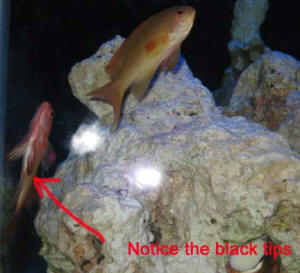
|
Help with possible bacterial infection? Anthias hlth.,
sel. -11/18/07 Hello crew, <Harry> I had purchased 3
Bartlett's Anthias from a LFS. They were eating fine at the store
and looked healthy. I brought them home and put them in my 10G QT
(small I know) but I didn't know that Anthias need a bigger QT, I
do now. All was well for 5 days, then they stopped eating and were
staying down at the bottom and they were rapidly breathing and 1 was
flashing on the bottom of the tank I think. they showed no interest in
food at all. <I hope you moved them post haste> Someone suggested
maybe it was stress related due to the small space, so I moved them to
a spare 40g holding tank that has live rock, mushrooms and various
other coral that I don't know what to do with yet. The morning
after I woke up to find that 2 of the Anthias had no tails at all. It
was like they rotted off or something ate them off. Someone suggested
maybe it was Marine velvet. <Mmm, no. IF Amyloodinium they'd be
dead> I looked up the symptoms but I'm not sure. Could it have
been aggression related. <Only barely> The first Anthias to die
out of the 3 looked normal its tail was intact, no visible injuries.
the other 2 who's bodies looked like they were rotting away died
the day after. Could it be bacterial in nature? <After effect,
yes... as in decomposition. Root causal, no> I'm hoping that it
is Marine velvet because a fallow period in the 40 will eradicate it.
Now what if it is bacterial or viral what do I do with all the live
rock and coral that is in the 40 that I infected. How do I treat the
rock and coral with out killing it. Will a fallow period work with
bacterial infections. Any information on what it could have been would
be greatly appreciated. Thanks, Harry <I have high confidence that
the "cause" here is/was simply stress... Anthiines almost
always need larger quarters to feel safe... and Bartlett's are a
highly anxious species... By and large I advise simply placing them
sans other protocols, including quarantine, dipping... Bob
Fenner>
Re: Life after ich, dither fish -- 10/18/07 Hi Bob,
<Stan> I do have room (360 gallon tank). I have several Bartlett
anthias on order. <Ah, a good species selection here> I also have
a gold band maroon clown and a mystery wrasse in the quarantine tank. I
also have a firefish and a zebra goby the main tank as well. I will add
more smaller fish in the future. Thank you for all your help. My tank
is looking very healthy but keeping my fingers cross. Stan <Life to
you my friend. Bob Fenner>
Lyretail Anthias... comp., sel., sys. 9/27/07 I was
thinking off purchasing some lyretail anthias <Likely Pseudanthias
squamipinnis> for my 72 gallon tank. Upon doing my homework all
seemed to be well as this is the hardiest of the anthias but then I
read some questions I found disconcerting about the fishes attacking
each other. <Mmm, yes... they live in large to very large shoals in
their wide geographic range... establish and challenge "pecking
orders" and ranging males continuously> Should I purchase 4
female Anthias for my tank with the assumption one would turn male or
is it better to buy 3 females and one male? <Either way... but
definitely only one certain male in a volume of this (small) size> I
plan to QT them for a month <Mmm, for fishes as these... small,
continuous zooplanktivores... a shorter duration, even just a dip/bath
and a prayer, may prove more prudent... to forego starvation and its
ill-effects> but will them being in the confined space of a 10
gallon QT tank lead them to aggression? <Oh yes... and over-stress
in general> And lastly along with the 4 Anthias I have 2 ocellaris
clowns, neon goby, blue-green Chromis and plan on getting a flame angel
and royal Gramma. Is this to much for my tank? <Mmm, is right about
some sort of maximum> I have 100 lbs of live rock and a good
skimmer. Thanks for the help. Adam <Thank you for writing, sharing.
Bob Fenner>
Adding Anthiines/Compatibility Issues -- 09/06/07 Hello Crew,
<<Howdy>> I would like to start keeping Anthias (probably
Bartlett's), but I am unsure if there will be compatibility issues
with my current livestock. I would appreciate any opinions/advice you
have. <<I'm happy to share>> Current setup: 150 gallon
3 year old lightly stocked reef, 160 lbs live rock, 2x250watt MH,
Euro-Reef RS180, 50 gallon sump w/refugium. Livestock : 1 Black Cap
Basslet 3 Pajama Cardinals 3 Clown Gobies 2 Neon Gobies 1 Pearly
Jawfish 1 Ocellaris Clownfish 1 Crocea clam 1 Derasa clam Various Coral
Thanks for your help. <<Adding some Anthias shouldn't be a
problem...and Bartlett's are an excellent choice here. Do be aware
they can be quite skittish when first introduced and might jump if
startled/chased by other fishes (though I think this is a small concern
re your stock list). This usually is not an issue once the Anthiines
become established...and placing some plastic eggcrate material over
the tank opening(s) for a week or two initially may help to keep them
in the water where they belong. Regards, EricR>>
Anthias/bioload and urchins - 7/20/07 I am currently
stocking my 72 gallon FOWLR tank my current tankmates are 2 ocellaris
clowns, 1 neon goby, 1 blue/green chromis, 1 flame angel (still in QT)
2 cleaner shrimp and various snails and emerald crabs. I will also be
buying a 6 line wrasse and royal Gramma. I had intend on getting a
school of chromis for my tank but after purchasing 5 they started
knocking each other off until only 1 was left. I was thinking about
purchasing some anthias but because of the cost and how sensitive they
are to water conditions ( I am a newbie to saltwater- tank has been
running for 5 months) I was a little leery about purchasing them. I
think that I will though as with all the incredible help I receive from
the internet has turned a relative newbie into someone secure in
running their tank. Anyway I was wondering how many anthias I can
purchase without overloading my tank. I know I have to buy 1 male and
the rest females. What do you suggest? I was also interested in
purchasing an urchin. I have done some homework on them and I think
they should be OK in my tank but what type of urchin would you
recommend for my tank. Thanks for the help. Adam >>>Hello
Adam, Jim here. Given all the fish you have, and the fact that you will
be adding a Royal Gramma and a Sixline wrasse (add the Sixline last) I
think you're fully stocked. My advice, for several reasons, (even
though you haven't told me what species of anthias you're
looking at) let go of the anthias idea. Cheers Jim<<<>And
the urchin? RMF<
Room for Anthias? 7/5/07 Bob, Tank is 90 Gallon with a 25 gallon
Sump. Currently Occupants are Foxface and Dog Face Puffer (once he
emerges from quarantine). Do you think I have room for a trio of
Anthias? Thanks Roy <Might be bothered to munched by the true
puffer... Do pick out a "good" species if you go this
route... See WWM re Anthiine Selection. Bob Fenner> Re: Room for
Anthias? 7/9/07 Bob, Would I be better off then with a few Damsel
instead of the Anthias or would they just spook the Foxface? Roy
<Either should work out... B>
Tangs and Anthias in a display at my fish store 6/13/07
Hello! I have been reading your FAQS/articles for a number of years now
and have finally encountered a question that I could not find an answer
for on the site. <There are, assuredly... lifetimes of these!> I
am in the final stages of opening a fish store and I have 3 large
acrylic tanks (they are 8 ft. x 4 ft. x 18 in., holding roughly 300-350
gallons of water apiece, not including the sumps). These tanks will be
for selling corals out of <Mmm, please pardon (my usual)
kibitzing... but why so deep? Cheaper, easier to work in, illuminate
specimens in shallower water...> and I would like to keep in each of
these tanks, a handful of 'show' fish which won't be for
sale. <A good idea... to add interest, keep some pests (algae,
snails, worms...) reduced... Nice place for store
"mascots"> In one of these I would like to keep Surgeons.
My question is: what would be your suggestions as to how many would be
a good number and what specific types of tangs do you think will do
well together? <Mmm, better for each tank/system to have just one
species/genus really... Likely a Zebrasoma, Ctenochaetus... perhaps a
smaller Acanthurus...> I have successfully kept (and still keep in
my tanks at home) a yellow and hippo/regal tang in a 125g for close to
5 years now, but I would like to have something different and maybe not
quite so 'common' for display at the store. <I understand...
there are several choices...> I hope this is not getting to be too
much but I would also like to keep a school of Squarespot Anthias in
the second of these three tanks, and was wondering what your
suggestions would be as to how big of a school I should have; and what
male:female ratio you would suggest. (The anthias would be the only
fish in this tank) <Mmm, one alpha male... perhaps a couple of
already not-quite so alpha males along with... and an odd number of
sexually indeterminate juveniles/females... a total of under twenty>
(I know you're probably waiting for my questions about the third
tank now, but I really don't have a clue as to what I want to keep
in that one yet....so if you have any suggestions....) ;) <Oh...
this will come to you in time...> Please feel free to edit my letter
in any way you see fit, especially my 'subject' line as I
couldn't really think of a completely appropriate way to word it.
Thank you in advance for your time and your advice, it is very much
appreciated. Nicole P.S. I would like to thank you all for your
FAQS/articles on the aquatics business as they have helped us
tremendously in getting our business set up. <Congratulations on
your new enterprise! Please do send along your URL for our posting,
promotion when you have this up and going. Bob Fenner> Anthias
pairing 5/17/07 Hello WWM crew, <Hi Allegra (the person, not
Fexofenadine HCL I presume) Mich here.> My question is
about the idea of finding a mate for my Hawaiian Bicolor Anthias. Bob
F. had mentioned that this type of anthias is more likely to get lonely
and it would be better for him to have a female around (the fish, not
Bob). <Heeeee! Perhaps Bob could give your anthias some
lessons on charming the ladies.> Here's the rub...there
isn't much coming out of Hawaii currently, so the search is getting
hard. What are the chances of a similar looking female, such as a
Bartlett, filling the bill? <Not likely. A different
species. Would you be happy with a monkey as a life
partner?> I hope it doesn't take a couple of females or more to
make this guy happy (again the fish, not Bob).
<Heeheeeee! The fish may be happy with one, Bob on the
other hand... > Thanks, Allegra <Welcome! Mich>
Re: Anthias pairing 5/18/07 Hi Mitch, <Hello
again Allegra!> I'm glad I brought some humor to
your day! <Me too! Thank you!> You're right, my
husband might act like a monkey, but I don't need to put a diaper
on him. ;-) <Hee! Yet...> I'll keep
looking for Ms. bicolor anthias somewhere out there...(sounds like a
corny song). <I hope you find her! Perhaps beneath the
pale moonlight...> Allegra
<Cheers! Mich>
Pairing Different Anthiine Species? -- 06/04/07 Hi WWM
crew, <<Greetings Allegra>> This question is about a
Hawaiian Bicolor male Anthias I acquired a month ago.
<<Okay>> Bob F. had made a comment about finding him a girl
given that this particular type of anthias is more prone to loneliness
when kept singly. <<Indeed>> Whether Bob is being
sentimental or not, <<Just a big softie...>><Am> I
would like to entertain the idea of a female joining him (the fish, not
Bob). <<Ha!!! Bob will be soooo
disappointed!>><Ditto> Here's the rub...there is little
being exported out of Hawaii currently, <<Mmm, not the first time
I've heard this...even my friend here in 'the biz' has
stated same>> so what is the chance a similar; say Bartlett,
female could be introduced instead? <<These Anthiines will
coexist in an aquarium, but they never truly 'mix'...at least
not in my experience. I've observed these two particular species
together; as well as other mixes, and though the two may 'hang
about' with each other, there likely won't be any true
'pairing,' and thus a lack of the 'stimuli' afforded a
true species bond. Very much unlike Bob, who is quite happy when ANY
female shows him a bit of attention...>><Heeee! Tis so.
RMF> I hope it won't take more than one female to keep the boy
happy (don't say it!). <<Er, but, um, okay...dang it!>>
Thanks for the help, Allegra <<Happy to share. EricR>>
Lyretail Anthias For An Eight-Foot Display?
5/15/07 Hi crew, <<Hello Matt>> I would like to get a
group of Lyretail Anthias for my 8x2x2 SPS reef. <<A fine
choice! One of the larger and hardier species commonly
available and are great for larger systems ... and is what I have in my
own 8x2.5x2.5 SPS reef>> I have read/been advised to purchase
anywhere between 6 and 12 fish. <<Ok>> What would your
recommendation be? <<I have 5 (1-male, 4-female) at the moment,
and this is about as 'few' as you want for reasons of spreading
aggression. I think a group of twelve (with only one male)
would be fine for your tank>> I was thinking of 12, however I
have read that if you do not get the ratio right for a given tank size
that you could end up with two females developing into males and trying
to split the harem....... <<Not really... Even in an
eight-foot tank, with these large Anthiines a single male will control
the entire tank. Inadvertently introducing two males would
result in the less dominate male being harassed to the point of
starvation/death from the continued stress, and is why I emphasize a
'single male' for your group>> Whatever the number, my
plan would be to special-order a group of females and introduce them
all at the same time. <<This is quite acceptable...but let me
suggest you acquire a 'wild caught' male instead. I
have observed 'tank converted' Lyretail males on several
occasions and their color/color patterns are noticeably different in my
experience...and while they are still beautiful fishes, they are never
quite as spectacular/intense as the wild caught males in my
opinion. Most apparent on the 'captive made' males
is the lack/lessening of color to the finnage as compared to the wild
caught males, most notably the missing 'blotches' of red on the
pectoral fins...>> Thanks, Regards, Matt <<A pleasure to
share. Eric Russell>>
Pseudanthias bicolor sel. - 04/20/07 Thanks Bob for the
thumbs up. My only confusion is the repeated advise to only keep 1
anthias per tank unless there is room for a "harem". <Mmm,
this species is a bit different from a/the "mainstream"
anthiines... lives amongst a rock patch... less inclined to one-alpha
male assemblages...> Are the bi-color's less aggressive towards
each other, whether male or female? <Yes> Would another one fit
into the stocking list of a 100gl tank? <I do think so... and would
make for a more interesting display... perhaps a male and a smaller
female. Do please see here re sexing: http://fishbase.org/Summary/SpeciesSummary.php?id=7874
BobF> Appreciate the impute, Allegra
Tang compatibility and introduction order 3/28/07 Hello
WWM crew! <Marc> First off, let me congratulate you on your web
site, there so much info found on it (though it sometimes takes a long
time finding it, since it is so huge, but, hey, no big deal). I
currently have a 125 gallons reef tank (Perfecto, 72x18x22) with a 60
gallons sump (with something like 50 gallons of water in it). My return
pump is a Velocity T4 (1500 GPH) which also feeds the refugium section
of my sump (in which I just added light with a small ball of
Chaetomorpha). I have 2 Seio 1500 et 1 820 (for approximately 30X) for
water motion. The filtration of this tank is accomplished by
approximately 140 pounds of LR (mix of Fiji, Sulawesi and Brazilian)
and a Beckett Protein skimmer (46" tall, diameter of 8") with
an Iwaki MD100RLT pump in recirculation and fed by a Mag7. It is lit by
2 250W MH bulbs and 2 6' VHO (165W each). Now for the livestock. I
only have a couple of corals for now (the tank has only been up and
running since November 2006), but I plan to add more as it matures. I
have : - Iridis wrasse (Halichoeres iridis) - Yellow tail damsel -
Green clown goby (Gobiodon atrangulatus - Lawnmower blenny (Salarias
fasciatus) - Banggai cardinal (Pterapogon kaudneri - 3 peppermint
shrimps (Lysmata wurdemanni, which made a terrific job on Aiptasia :) -
2 cleaner shrimps (Lysmata amboinensis) - Several hermit crabs and
snails The 2 cleaner shrimps and the iridis wrasse were added 4 days
ago. The cleaners are doing great and have taken cleaning station on a
rock (haven't seen them clean a fish yet though). The wrasse is
also doing good, besides the fact that it had me worried the second and
third day. It buried itself in the sand for the night (which I've
heard/read is normal for these fishes), but didn't come out until 9
pm (my lights are on from noon to midnight)! Today, I don't know at
what time it came out, but when I came home at 5 pm, it was already
swimming nicely. It easily accepted frozen food, but was reticent with
flakes for the first 2 days. <Don't really eat much
dried/prepared food> So, my question was (sorry for the long intro!)
: I wish to add tangs to my setup (not right now, maybe in a couple of
months) and would like your advice on the species I've selected.
I'd like to add : - Achilles tang (Acanthurus achilles)
<Yikes... not easily kept in captivity, and very prone to protozoan
complaints> - Blue hippo tang (Paracanthurus hepatus) - Desjardini
sailfin tang (Zebrasoma desjardini <A gorgeous species... but does
get very large...> My concern is mainly about the achilles (and a
little about the hippo). I've read/heard it wasn't a very hardy
fish. What advice could you give me on that fish? <Mmm, just that...
I would hold off for now on an Achilles... really do much better in
very mature, large systems... the other two would be okay here> To
reduce aggression between the tangs I plan to add all three of them
simultaneously. Do you think this is a bad idea? <Mmm... well, I
would likely place the Paracanthurus first... wait a few weeks, then
the Zebrasoma... not so much that they will fight to the point of real
damage, but the increase in bio-load, the change in dynamic with the
other livestock... less stressful to stagger here... and leave out the
Achilles> Also, some people told me the hippo tang needs a larger
tank once at full size. What is your opinion on that? <Likely will
be fine here for a very long time> Here are the other fishes I would
like to add (in the order I would add them) - Pair of percula clownfish
(Amphiprion percula) - One or two purple firefish (Nemateleotris
decora) <Two would be far better than one> - Green mandarin
(Synchiropus splendidus) - Bellus angelfish (Genicanthus bellus) - A
butterfly, probably a longnose (Forcipiger flavissimus or the
longirostris) - Tangs! I would also like to introduce schooling fishes.
I had some chromis before (Chromis viridis). They are nice fish, but
I'd like something more colorful. I thought about anthias, but some
can be hard and require frequent feeding to ensure success. <Mmm, do
look around... seek out a grouping that are not "too" thin...
there are some quite hardy species for a setting like yours> Which
would you recommend and how many would you put in my setup? <Please
see WWM re the Anthiines... likely two species... Perhaps squamipinnis
and Bartlett's... but there are several other choices> I also
recently discovered the chalk bass (Serranus tortugarum) which gets
along well in groups. Do you have any advice on this fish? <Mmm...
well... I'd rather see this kept with other tropical West Atlantic
species, settings> Finally, I'd like to know your opinion on my
fish list and introduction order. Anything that wouldn't get along?
Thank you very much, Marc. <Looks fine to me. Bob Fenner> Re:
Tang compatibility and introduction order 3/28/07
Thank you very much for your reply. Regarding the Achilles, if I do
introduce one in my system, it shouldn't be before quite some time.
<Correct> I'll wait until my system has matured and it shall
be my last addition. <Very good... I do wish you were out here with
me, diving in Hawai'i, seeing this fish, going out with collector
friends... feeling how soft-bodied this Acanthurus is... how easily
damaged... Perhaps only time, personal experience will bring to your
awareness the fragility of this species> And on the anthias, these
were the two species I retained. I might go with the Bartlett's.
<Ahh, a good choice... do look for some "freshly arrived"
grouping... 3,5,7 individuals...> Again, thank you very much and
keep up the good work, Regards, Marc. <Welcome my friend. Am trying.
BobF>
Ventralis anthias in my 90 gal -- 03/15/07 Hi Bob, In
the last email I sent, you were saying it would be best to
keep Ventralis Anthias in groups for their health and
happiness. In a 90 gallon tank would the male become
aggressive if I add a couple females, or should they settle
in fine? <This latter> I had bought the one male because I was
concerned about aggression, in my earlier times of marine
aquarium keeping I had a rather scary incident with
squampinnis anthias and a 2 week "war" that ended with 4
dead fish (not anthias) and 2 anthias left out of a group of
9! Needless to say I have been much more careful with them
ever since. I don't have any experience yet with
Ventralis Anthias, this species is new to me, the male I have is
doing well so far, not thin, very active and doesn't
hide one bit in his quarantine tank. With my fairly heavy
stock list would you recommend more anthias? <Mmm, well, more space
would be of obvious advantage... You could try just one (slightly
smaller) female... if two, one decidedly much smaller than the others
(also female). Bob Fenner> below is the copy of my previous
email. Brian
Anthiines for a 75 Gallon Reef - 11/07/06 Hey guys,
<<Gals here too...>> I have a 75-gallon LPS reef with a
50-gallon breeder as my refugium. <<Neat!>> I have a purple
tang, yellow watchman goby (hardly ever see him), true perc., and a
black perc.. <<Mmm, the tank is really too small for the purple
tang...in my opinion>> Is there any male/ 2 female anthias that
you recommend for this system? <<Pseudanthias bartlettorum
(Bartlett's Anthias) are relatively small and supremely hardy...as
anthias go>> Or what anthias do you recommend to keep one by
themselves in this system? <<The Bartlett's anthias can also
be kept singly, and Pseudanthias squamipinnis (Lyretail Anthias) are
fairly hardy though larger Anthiines that will be fine as a single
specimen>> Thanks, Greg <<Happy to assist,
EricR>>
Lyretail Anthias...Females Turning to Males - 10/06/06 Good
evening. <<Hello>> I recently purchased 3 female Lyretail
Anthias, and they all appear to be healthy and getting along with one
another. <<Excellent...one of the better/hardier species for
aquarium keeping in my opinion>> I was wondering if the most
dominant will eventually become male? <<Indeed she will>>
How long does this normally take? <<Hmm...have seen it begin
almost immediately...completed in as little as a few weeks time>>
I know all Anthias can undergo a sex-change when a harem's male
dies, but I was unsure about my situation because they were all female.
<<No worries mate, the dominant female will
"convert." You may even want to consider adding
another female to spread the aggression among "pecking order"
of the remaining females. Having "too few' can
sometimes be worse than having too many>> Sorry if this was a
silly question. <<Not at all my friend>> Dan
<<Regards, EricR>>
Dispar or Purple Queen...Which Anthias Species is More
Suitable? - 07/22/06 Hello WWM crew, <<Howdy Joe>> Love
your site and what you do for the aquarists world. <<As Anthony
C. was so fond of saying..."is a labor of love">> I own
both Bob's and Anthony's books "some of the best reading
available for the hobby IMO". <<Am much in agreement with
you my friend>> I am currently interested in keeping some of the
before mentioned Anthias in my system and I want to know which would be
better suited. <<Not as flashy as the other, but a beauty in its
own right, the Dispar is much better suited for aquarium life over the
Purple Queen. Do peruse Bob's two-part article on
Anthiinae here: http://www.wetwebmedia.com/anthiina.htm>> And
your advice in how to do so... My current system info is as
follows: 210 gallon acrylic bow front 60x30x30 with 50 gallon
sump...mostly SPS coral...lots of caves with a mix of Tonga branch and
Fiji live rock about 180lbs. 2x250 MH 14000K with 240W
actinic on timers... 1/3 hp JBJ chiller temp between 77-79...Korallin
calcium reactor...Red Sea ozone 100mg with controller set at 25mg per
hour...ASM G4 skimmer...2 Dolphin Amp-Master 3000 pumps one for return
and one on a closed-loop...25 gallons a week water change regimen with
Instant Ocean...all water parameters to SPS coral
requirements. Tank is very stable. My current inhabitants:
5"Powder Blue tang Pearly jaw fish Synchiropus splendidus/mandarin
Red velvet wrasse Midas blenny Bicolor blenny Pseudochromis
fridmani/purple Skunk cleaner shrimp Coral banded shrimp Sally
lightfoot crab 3 Emerald crabs Assorted snails I feed a mixture of
Cyclop-Eeze, oyster eggs, DT's phyto-plankton,
Selcon, Mysid, a pre-made angel/butterfly frozen food and
Nori. My wife and I really love these Anthias and would love to have 1
male and 2 females, what do you recommend? <<Considering your
current stocking level/system size/setup, I think a male Dispar Anthias
with 3-5 females would be fine here>> Thanks in advance Joe
<<Is my pleasure to assist. Regards, EricR>>
Squareback Anthias...Not a Beginner Fish -
06/28/06 Hello, <<Howdy>> I found your website last
night and I've barely been away from it to sleep
since! I can't express how fantastic it is to discover
all of the seemingly impossible-to-find info on the saltwater hobby
gathered in one place on the net. <<Ay...gobs of info to
absorb...>> Thank you for saving me many headaches :)
<<Welcome...a collaborative effort>> Though we had a reef
tank years ago that thrived nicely, it's been several years since
and I feel out of the loop with all the current ideas and technology.
<<Yes...new ideas/discoveries/advancements...>> My concerns
actually arose while reading several of your previously answered
letters. <<Oh?>> My 55 gallon tank was cycled with 40
pounds of live rock and a couple hermit crabs for 2
months. A couple weeks after the test kits showed my water
was of near perfect quality, with zero on ammonia and nitrites and very
minimal nitrates, <<Mmm, would have expected this to be
"zero" as well>> I bought my first fish - a super cute
Squareback Anthias (Pseudanthias pleurotaenia) male. <<A fish for
advanced hobbyists...in my opinion. Often starve to
death...or just die "mysteriously"...>> He's been
in my tank for two days, off and on coming out from his cubby hole in
the rock. <<No quarantine eh?>> I tried to feed a pinch of
frozen krill this evening, but he seemed frightened by either my close
proximity or the opening of the canopy lid. <<My experience with
this species has been that it is generally quite
bold. Perhaps the fish is still "skittish" from
the stresses of collection/transportation. Adding a couple
small "dither" fish might help to make the squareback feel
more comfortable as well>> I'd left him completely alone
before trying to feed him so he could settle in, and I figured it
wasn't abnormal behavior when he didn't eat at the first
attempt. <<Is not uncommon...but you need to keep trying to get
this fish to feed. The sooner it starts, the better>>
Are these fish too tough to keep for a semi-novice, and do you think my
tank specs are enough to keep him happy? <<The tank sounds fine
for a single specimen of this species, though ideally you would have
let it "mature" for 6-12 months before attempting this
fish. But as stated earlier, Pseudanthias pleurotaenia can
be tough to keep alive. I would like to suggest you obtain
some frozen Mysis shrimp along with my favorite for getting finicky
fish to start feeding...glass worms...aka - mosquito
larvae. And give these a soak in Selcon prior to
feeding>> Also, if he does prove difficult to feed, should I try
to gather a harem of girly squarebacks to boost his ego?? <<I
have seen this species kept in groups in large systems (several hundred
gallons), but I strongly recommend you don't try this in a
55...would most likely end badly for all but one...even if they begin
to eat. But adding a couple small, hardy fish may go a long
way towards getting the squareback to begin feeding>> He did eat
some frozen krill at the store, and was swimming around happily showing
off his almost neon pink coloration. <<Ah yes, a beautiful
fish...one of my wife's favorites>> The research I'd done
on the web told me that these were somewhat hardy individuals and that
keeping one male in a 55 would be acceptable. <<Mmm, differing
opinions/degrees of "somewhat" I suppose...I would class this
fish as "somewhat difficult". Not impossible to
keep...and a better choice than some other Anthiinae that come to mind
(Pseudanthias tuka, Pseudanthias evansi)...but definitely not my first
pick for a "semi-novice" with a "new"
system>> However, on this site so many readers wrote to complain
that their Anthias wouldn't eat. <<A common issue,
yes>> Also, it was mentioned numerous times that
these are very social fish and shouldn't be kept as singular
specimens. <<Mmm, with caveats...beginning with the size of the
system>> One letter even mentions that he didn't want to take
these fish as the prize he'd won because they are notoriously
difficult to keep! <<Sounds like maybe your research wasn't
finished before you purchased this fish?>> I am by far not an
expert in this hobby o' mine, <<Neither am I...>> but
here's what's going on: 8 gallon water changes are
performed weekly by my hubby. <<Lucky you <grin> >>
We have a ten gallon sump with a (I think) magma filter that runs
carbon, <<Magnum?>> a Berlin skimmer that is by popular
consensus archaic and near useless, <<Better than some, worse
than others...a much better performing AquaC (Remora/Urchin) can be
purchased for about the same money>> and I'm working on
finishing up an over-hanging refugium that will house the usual fuge
stuff - macro algae, live sand, bits of live rock and hopefully lots of
good bacteria and 'pods. <<Wish you had done this
"before" acquiring the Anthias>> Temp is steady at 76,
and SG is right on target. <<What is
"target?" NSW levels of 1.025/1.026 I hope>>
We did have a brown algae issue for about a week, but my cleaner crew
seems to have taken care of most of it. <<Likely the natural
algal succession of a new system>> Thank you so much and sorry if
I rambled on, Jennifer <<No worries Jennifer. Do try
my suggestions for getting the squareback to eat, but if it doesn't
take food soon you may want to consider returning the fish to the
store. Good luck, EricR>>
Anthias Pair In 70 Gallon Tank? - 02/12/06 Hello,
<<Howdy>> Is it possible to keep a pair of Anthias (of a
smaller type) in a 70g reef cube or would the male pester the female
too much? Thanks, Ben <<Is possible...Bartlett's Anthias
(Pseudanthias bartlettorum) would be a good specie to try this
with. Regards, EricR>>
Anthias Question 11/30/05 Hello WWM Crew,
<Frank> First I'd like to let you know how invaluable your
website has been to me in starting my new hobby. <Thank
you> I have set up a 55 gal. tank which currently has 1 Blue Hippo
Tang, 1 Eel Goby and 2 Yellow-tailed Damsels (relatively non-aggressive
as long as you don't go near "their" cave) along with
40lbs of LR and a cleaning crew (snails, hermits, peppermint shrimp and
a cleaner shrimp) and I was interested in adding 2 or 3 Lyretail
Anthias. Would this be too much of a bioload for my tank to
handle? <Frank, hippos can attain a length of up to one foot
in properly sized aquariums. Your tank will eventually be too small to
add any more fish unless you plan on a larger tank in the future.
Anthias really do best with one male and several females. A 125 gallon
tank is minimum in my opinion. They are not easy fish to keep as most
are rated moderate to difficult. Do research the Anthias if you are
considering these in the future. http://www.wetwebmedia.com/anthiina.htm.
James (Salty Dog)> Thanks in advance, Frank <You're
welcome>
Overstocked or Over-rocked? It's all About the
"O"! 11/12/2005 Hello, I've got a 40 gallon
breeder tank and am currently curing 40 pounds of live rock in it. Once
I cure it I'll put the rock I have from my 12 gallon aquarium that
has gotten sort of overstocked. <... even less room after adding all
this rock...> The aquarium has a carbon filter and protein skimmer.
Anyhow, would you advise putting a male-female pair of Anthias, or a
male and two females of possibly Lyretail Anthias, Bimaculatus Anthias,
or Resplendent Anthias. They would be sharing the space with a
ocellaris clownfish, blue tang, green mandarin, a pair of banded coral
shrimp, and two peppermint shrimp. Brian <Mmm, nope... not enough
room for "any of the above".... If you didn't have any
fish here, you might fit a Fathead Anthias in... Bob
Fenner>
Pseudanthias squamipinnis 11/9/05 Hi Bob,
<McBirneys> I have been very careful with every item I have put
in my tank. I need your opinion on your "favorite" Anthias,
per information I was reading. I have a 150 gallon, and from what I was
reading on your "animal library" web page under Anthias, you
mentioned 1 male to 4 or 5 females. <For this, many other species of
the subfamily, yes> I then read on wet web that only one per tank, a
lot of females (how many would that be?) or just a few in a big system.
<Yes to these inputs as well... as many females as you have space
for are allowable... one per fifteen gallons or so...> I have a
reef/fish system and I did read they are very aggressive.
<Mmm, I would say not very aggressive... compared to some abstract
scale for marine reef fishes> Would my Nassarius snails, cleaner
shrimp, and peppermint shrimp be in jeopardy? <Doubtful the
Anthiines will fool with any of these> Would I not suggest this to
people who have reefs? <Au contraire! A great fish for color,
behavior, compatibility... in many large such settings> I work at a
store in Las Vegas, and we try to not carry fish that would not work
well in captivity. <Good> I have ordered some of these due to
their hardiness, and I want to advise our customers as to the number in
their tanks. <Mmm, you've covered it here pretty much... One
definite male per... unless the system is several hundred gallons... as
many females as they'd like up to a limit per gallonage...>
Obviously a small tank would house only one female. For myself, would 2
or 3 females in a 150 be okay.....(remember I have shrimp). <Yes>
Thanks and take care. Carrie :) <Thank you Carrie. Bob
Fenner>
Compatibility: Anthias, Tangs, etc. 8/9/05 Hey Crew! :-)
<Jenn> I had a couple of questions on
compatibility. First off, my tank will be 225-gallons with a
large sump and a "sensible" amount of live
rock. Not into the "rock wall" thing some
aquarists have going, I like more of a loosely packed "tunnel-ly
cave" idea. <Okay> First questions relate to
Anthias. I'd like to have several in my tank as a focal
point. Rather than one individual of many types of fishes,
I'd like to play around with a few species, and keep them in pairs
or schools. For Anthias, I was wondering what a comfortable
number would be for a school, considering the space?
<Depending on the species... a trio to a dozen or more> Other
fishes would be gobies, tangs, a pair of clowns, and perhaps some
Genicanthus sp. angels. Also, WILL the Anthias school in the
aquarium?? <Most species, yes... some are not
schoolers> Lastly (relating to Anthias) in a tank this size would
two species co-habitate as they do on the reef? <Could> If so,
then which two species might I have the best luck with? <Many
choices... best to use WWM, fishbase.org and pick out two that you can
get, that are found in the same geographic area, habitat...> If not,
then how many MALES of one species are likely to establish themselves
in a tank this size without encroaching on one another's'
territory? <One of each species> Okay second batch relates to
tangs. I know the general consensus is one tang per species
per tank. But lately I've happened across several tanks
with 2 or more Acanthurus tangs in them, not to mention other species
of tangs... and I've seen SEVERAL tanks with two to three Zebrasoma
sp. Now, aside from the fact that this is impossible (hehe)
how is it best/safely accomplished? <Adding all at once, when small,
and/or adding new ones that are much smaller...> I'm thinking an
achilles and a powder blue... <Not easily kept...> But if I
can't be satisfied they'll live long, happy lives, then
I'll opt for a regal instead of the powder blue and go that
route. So this is more of an exploratory question, as
I'm wondering how so many other people do it successfully. :-)
Thanks! Jenn <Is done... often... with space, hiding places...
enough food. Bob Fenner> Squarespot Anthias stocking Good
morning Crew! <Barbara> I recently got a free 75g...haven't
set it up yet but I wanted to run a few questions by the experts before
I buy anything. I really like the Squarespot Anthias, I would like to
have a male in this tank. My plan is to use some of the LR from my 55g
reef tank to start the cycle, add 6 to 8 saltwater acclimated mollies
to the tank to keep it going (and also I thought they might provide a
food source with their offspring). I will then add 4 to 6 peppermint
shrimp for the same reason. I am also going to have some macros in the
tank. I'm also going to wait until the tank has matured (3 months
or so) before I add the Squarespot. Sound good so far? <Yes>
Eventually I would like to add as tankmates, a long nosed butterfly and
a dwarf fuzzy lion (after the Anthias is bigger). I would appreciate
any thoughts or ideas you might have about this arrangement. Thanks!
Barb <These should all go... I would try a small male Squarespot...
added a few weeks after placing maybe two small females here... Much
more interesting... Bob Fenner>
How Many are Too Many...Part 2 (4/30/05) Hi again,
<Hi. Steve Allen back with you.> Would you recommend any other
smaller Anthias that are easier to care for? There should be a lot more
room in the tank soon anyway, because I am expecting the parrotfish to
die, as it refuses to eat. <I would not give up on it too
easily. Be sure to try a variety of different foods. Perhaps you can
find another aquarist or a fish store that can give it a try.>
Anyway, so what other Anthias would you recommend for this tank once
the parrotfish is gone, that are easier to care for than
squarebacks? <I would suggest that you check out the
information about Anthias on WWM and in the book "Marine
Fishes" by Scott W. Michael. No Anthias is easy. They like room to
swim and need to be fed several times per day. The best way to
accomplish that is with an upstream refugium (search WWM) supplying a
flow of microcrustaceans into the tank.> Thanks for your help,
Joe Marano <I hope it helps. Do the research and you ought to
be able to find what you need.>
Stocking and Sexing Bicolor Fancy Bass Anthony, I keep
reading that Anthias should be stocked 1 male with the remaining being
female. How do you tell a male and female Bicolor? I know that the male
is larger in size but other then that, I can't find any color
differences that other members of the species show. <Mmm, females
are quite similar... a distinctive difference is their dorsal fin
structure and coloration. In females the third ray is extended, the
second and third in the males which are bright yellow at their ends...
And it would be better to have more than one female with your male...
in a quite large (at least one hundred gallon) system. Bob Fenner, who
encourages you to read about Pseudanthias bicolor on fishbase.org,
where you can click on the image, see other images, scan Googles crawl
of Net images.> Thanks, Mark Johnson
Square Anthias I don't have many fish in my reef.
Considering putting in a male square Anthias, and a few females. I know
they can be solitary, and if multiple ones are placed, should be placed
at the same time and one male with multiple females. The tank is quite
large and peaceful (360g) so space shouldn't be too much of an
issue. Is this species ok with one pink male, and 3 or 4 females ? Or
should it just be one male, one female ? Thanks Jim <A great fish
for the right setting. The cover of the hobby mag. FAMA has a nice male
shot I took in Australia a few months back for their August issue. I
would definitely go with a group of females in this size system... much
more "natural"... and will afford you and your livestock many
more interesting possibilities for such behavior. Bob Fenner>
Re: Square Anthias Bob, thanks for the response. Just got 6
females and a male Anthias. One of the females is 'orange',
while the rest are yellow. The male is obviously pink squared.
<An intermediary... "next" male in line...> Anyhow,
that orange one has a real faint square showing. I imagine it is
perhaps about to turn, or has just turned male ???? <Mmm,
yes... sort of... subdominant> Will the presence of the male cause
it to just stay as a female or has it already turned and they'll
eventually be doomed together ??? <In your size system, likely stay
a "non-functioning", not total male> Other than that, they
are in excellent shape and have already started eating on the Mysis.
They are in quarantine for a few weeks until I put them in the main
tank. As a side question, are male Anthias, one to a tank for same
species or across the entire genus. In other words, can a pair of
ventralis Anthias peacefully co-exist in a large tank ? Thanks Jim
<Many males, harems of all species can coexist in large enough
systems. Bob Fenner>
- Anthias Selection - <Greetings, JasonC
here...> Hello guys, I saw a Ventralis Anthias in my LFS and was
really impressed. <They are pretty.> I occasionally hear of
people putting a single one of these into a smaller system (30-40
gallons, fish only). <You hear about it, but do you hear about their
long term viability? I don't.> Other times I read about putting
this type of fish in a larger system only. <That is my
recommendation.> Is the larger size necessary only when keeping
multiple Anthias? <No, it's important to the issue of water
quality and physical space.> Can a single be kept in a healthy, yet
smaller environment? <Not of this species, and really even the more
hardy variety do better with larger tanks, the super large tanks [200g
plus] are necessary for groups/harems.> Thanks for the tips.
<Cheers, J -- >
Pseudanthias evansi 9/28/04 HI all- Just was
wondering if you knew of anyone keeping Pseudanthias evansi
successfully? I have experience with several species
(Pseudanthias bimaculatus, bicolor, bartlettorum, cooperi, and the
fasciatus shown on your website) and was wanting to try this one.
<If you have been successful with other Anthiines, you may be better
equipped than the average hobbyist to maintain P.
evansii. Do keep in mind that there are many factors that
make these fish difficult. They often suffer from deep water
collection, poor handling and shipping stress. They often won't
feed around aggressive tankmates. Extended quarantine in
suitable quarters is advised both to ensure freedom from disease as
well as to give them time to associate the keeper with
feeding. Multiple feedings per day are recommended (often
required), and sometimes all non-living foods are
refused. This is a tricky one for most of us with real
jobs!> When I have seen them in stores I have never seen one
actually eat, but they were usually singles or pairs. What
do you think? Doomed? Thanks, John Boe
<Refusal to eat is generally a good sign to avoid purchasing any
fish. However, if you plan on making a dedicated,
conscientious attempt at keeping this fish I would not let this alone
preclude your purchase. Lack of cover and excess of activity
in the retail environment may have a lot to do with refusal of these
fish to feed. Providing live foods in a quarantine
environment with minimal traffic, subdued light and plenty of cover may
get them feeding. Contrary to popular belief, attempting to
maintain shoals of Anthias is folly. Constant bickering
usually ends with one surviving male and sometimes a
female. I would not suggest attempting more than a
pair. These fish are most certainly doomed in all but the
most skilled, conscientious hands. Buying such fish always
begs the ethical question of saving these individuals vs. encouraging
more collection of a difficult species. Consider this
dilemma and your skills carefully and perhaps politely expouse the
benefits of supplying customers with hardier choices to your
LFS. Lastly, do look for the recent print article by Scott
Michael on his top ten choices for Anthias in captivity (Aquarium Fish
Magazine I think). Scott's advice is top notch. Best
Regards. Adam> Randall's Anthias 9/17/04
I'm looking for info about the temperament and heartiness of
specifically the Randall's Anthias. I can't seem to
find any hobbyists who have kept them. Are they pretty
new? <not at all... but you have not found much info
because they are a simply dismal species to attempt to keep in
captivity. Most conscientious aquarists will leave these species in the
ocean. They are very delicate, most always require live foods (gut
loaded prey is a must here)... they need dim tanks and very passive
tankmates. One male can be kept with several females in large aquaria
(200 gall-ish)> I've gotten as much info as I can about Anthias
in general, but I know they can vary from type to type. I
won a complete setup at a raffle and five were included.
<wow... how very irresponsible of the donor to show and offer these
fishes as an impulse/prize animal. Simply irresponsible - this is a
very delicate species for expert care only in mature tanks> One
unfortunately didn't make it, but the others are doing
well. <they may hang in for some weeks or even months.
It is very unlikely they will survive to even see one year in
captivity. Mark my words, my friend. You might save them if you make
this a species tank and focus as per above needs/instructions>
I'm trying to decide if the four will be ok or if I should get
another three females (hopefully from the same batch) as soon as
possible. They will be in a 120 with 100g sump with few
tankmates. (probably a CBB and a pair of O clowns) <please do not
import/buy any more of these fishes my dear... not until you have
demonstrated an ability to keep the current ones (healthy over 6
months). Best of luck, Anthony>
|
- Problems with Squamipinnis Trio - Hello to
all the marine mavens at WWM. Quickly, the system: 5 y.o. 110g FO
w/misc. inverts (2 Lysmata hermits, snails and 140# FIJI LR, 190g
total system 1 return through a 30g Miracle Mud ref. and the
other return through 40g 5" Deep Sand Bed reactor tank
(Nitrates 0). They dump to a sump with AquaMedic T 1.000 skimmer
and AquaC Remora. Fish in tank are 1, 6" (w/o tail) Sohal
tang, 3.5" Purple tang (they get along with little to no
aggression! I'm lucky!), pair of ocellaris clowns, 1 Banggai
cardinal. Feed about 1/3 dollar-bill sized Nori sheet and
calculator-button-sized piece of Marine Supreme Plus or frozen
Mysis once a day. I do a 30G water change about every month. I
have 2 separate quarantine tanks (30g and 10G) that run always
and move the AquaC to the 30G when quarantining newcomers so I
get no ammonia readings during quarantining. These tanks have
Marineland Penguin bio-wheel filters and get occasional water
changes with waste water from main system water changes so the
bacteria keeps happy. The perplexing problem: I wanted to add
some smaller, colorful swimmers to the community. Red Sea natives
if possible. After much reading in WWM and Hamlet-like
deliberations I purchased a male and two female Lyretail form a
mail order source (since the specimens at LFS generally look
terrible). I received a fine looking male, 1 fine female and 1
smaller female. I gave them a 2 min, temp, pH adjusted FW dip
with a few drops of Meth-blue and put them in the 30G q-tank.
After a day or two they were all eating frozen Mysis piggishly 3
times a day. After about a week, the larger female began chasing
the male(!) until he hid all the time under some PVC, behind a
pump, etc. Came out to eat though and then hid again. After a few
days of this, he died(!) Now the large female and the smaller
female were left in the 30G for another week and the smaller
female started hiding all the time so I decided to get them in
the display since the 30G was maybe just too small and you advise
in other posts to get them in main system ASAP. So, in the main
system they go along well with everybody and even schooled around
the clowns (because of similarity of color?), but after a few
days the larger female began breathing heavily and hiding all the
time and eventually died (about a week in the main display) in
sort of a cloud of white filmy smoke surrounding its carcass. Now
only the smaller female is left. Its breathing was OK but
eventually hid all the time and one day just disappeared (week
later). Is there something toxic in the system and the others are
just riding it out or what? <Probably not... I will
explain.> I feel like such a failure. There is some BGA in
main display and what looks like turtle grass in DSB otherwise I
just don't get it?!? <Unfortunately, schools of
Anthias rarely work. There is a dynamic that exists when they are
in huge groups as they are in the wild that gets magnified when
small groups are kept in captivity, and it seems the smaller the
group the quicker they all croak. Pretty much, the dominant
female is always trying to become the dominant male. The omega
female [that's the one on the bottom of the heap] is always
getting it from the dominant male and dominant female. In short,
this is stressful for everyone, in your case all three. Quite
often this stress just accumulates, so what likely happened to
your fish was the end result of the stress. Your display system
just isn't quite large enough to house a school of Anthias.
I've seen them work in a 240, but even then there are random
disappearances, usually first from the bottom, and then the male
who is replaced by the dominant female. I think it's better
to try just one, or go with Anthias who are better known for
peaceful pairing like the square-spots.> John <Cheers, J --
>
|
Look before you leap/purchase I RECENTLY PURCHASE A SQUARE
BOX ANTHIAS AGAINST MY BETTER JUDGMENT. <Then why did you buy
"him"? I take it this is a/the more colorful gender
member> I HAVE HEARD THESE FISH ARE DIFFICULT TO KEEP.
<Historically, yes> I HAVE HIM IN A 75 GAL REEF WITH ONLY
TWO OTHER TANK MATES A SCOPAS TANG AND A CORAL BEAUTY. COULD YOU
GIVE ME SOME ADVICE SO THAT I MAY HAVE SOME SUCCESS KEEPING THIS FISH
ALIVE? DO THEY REQUIRE ANY SPECIAL CARE? WILL ONE BE ENOUGH ?
>> <Better kept with a couple of females (yellow)... once
trained on meaty food items (they're zooplanktivores in the
wild>, in a peaceful arrangement (they should be the dominant
species), in a large (at least a hundred gallons), with lots of water
movement, good filtration, this species can live a good long while...
Most die because of one of the above missing elements. Bob
Fenner>
Anthias, Mandarins. <Kim, Lorenzo Gonzalez here, holding
down the fort for Bob while he's underwater in Asia for a couple
weeks.> I just purchased an Anthias, though I thought it was a
purple queen I am beginning to think it's not! He is most
definitely no purple for one thing, but a brilliant orange. And there
was nothing shy about him at all. I must say this fish was an impulse
buy, my husband took me to the store to get my little Singapore angel
and he picked this Anthias out as well. <Glad to hear you feel
guilty about the 'impulse buy'... :-) > I was not interested
in Anthias in anyway...and from reading your information I am reminded
why. Though this fish was a little more then most of my other tank
inhabitants, he seems to be the nicest one in there! I worried about
him the first night, noting that he had ick on his pectorals and that
his color was poor, but the next morning at feeding time....well you
would never have known he was the same fish (by the way I really
don't know if it's a he or a she but I named it Felix so
it's a he) <If she's not a he, she probably will be
eventually, without a bigger 'he' around to keep her a she...
Anthias are like that.> His color was bright a fiery, his attitude
about the food I put in there (plain old brine shrimp) was exuberant!
In fact he eats better then the pair of lemon damsels that I have in
there. my tank is a 60 gal with about 50 -60 lb of live rock and 40 lb
of sand.) He seems to have taken the tank over and has even put the
little six-line wrasse in it's place, it kept pouncing on my
scooter blenny. The most amazing thing is his curiosity, it overwhelms
even the wrasse. He wants to see everything!!! Last night I was mopping
the floor this was only his second night with us) and he followed me
around the tank as if trying to figure out what the heck I was doing.
It was really quite cute. And everybody else in the tank comes out now,
I've seen more of my lemon damsels and my wrasse in the last two
days then I have in the last four months. <The 'dither-fish'
effect, in reverse! (Usually a bunch of small, 'stupid' fish
are used to get a bigger, shy one to come around)> But the true
reason I wrote was that I needed some more info on this fish or just
Anthias in general, since I'm not really sure what he is.
<Go to www.FishBase.org and type in 'Anthias' in the common
name search, to figure out which sort you have. Then read Bob's
articles, and/or Conscientious Marine Aquarist.> I usually research
my fish to death, just ask the guy at the pet store, I think I drive
him mad with all my questions. I have to write them down I have so
many. <That's sure a good practice, sure is. > It took
me almost 2 years of reading and research before I even set up my tank.
But I wanted my husband to enjoy this thing too, so I thought I'll
get this and see what happens....well now he's my favorite fish,
and I want to keep him happy and healthy, and alive. <Glad to hear
you're both enjoying it so!> Another thing I had to ask about
was the dismal report on the dragonets, the whole reason for starting
my tank was to in the end purchase on of these magnificent animal...but
not to have it die. Has there been any good news on these fish? Is
there anything extra I need to do? <Yes. And I hate to say
this: You'll need to get rid of the little wrasse, and the
'scooter blenny' (if it's the 'scooter' of the same
family as the dragonet you so desire), before you purchase your
Mandarin. The 60 gallon isn't big enough to produce food for all
these direct competitors, even with the mountain of live rock
you're piling up. You should wait until the tank is a year
established, as well.> I plan on having well over 100 lbs of rock
before I even think of getting one (Though resisting has been VERY
hard) I would really appreciate anything you could give me as far as
information. <You've got a great attitude, and a responsible
approach to all this: very nice to see that. A crop of feather, bubble,
cup (harder to keep) or common 'strap' Caulerpa will help
provide a breeding ground for the tiny creatures your future mandarin
will need to eat. Quite good for the general water quality as well.>
Just as a side note: My tank is a 60 gal 6 mo old. It has a emperor 400
And power heads at each end I will be getting a skimmer soon) There are
2 lemon damsels, a scooter blenny, a six-line wrasse, a Singapore
angle, as well as a cleaning crew of sundry crabs and snails, and soon
some shrimp. <Sounds just like one of the tanks we have in the
living room, even the Emperor 400, which we had leftover from our
freshwater days. The only thing we have on there that you don't is
a skimmer. Get one. I would highly recommend a Remora from AquaC.
(www.proteinskimmer.com). Compact enough to hang between the wall and
the tank, and very effective and safe. (no overflow) You won't
believe what the skimmer will pull out of your water... Best regards,
Lorenzo >
Dispar Anthias Dear Bob, In looking at the last fish to add
to our peaceful 140 gal. community (yellow tang, flame angel, sleeper
goby, neon gobies, convicts, green Chromis, royal Gramma, cleaner
shrimp, soft corals, and SPS corals; I have seen the beautiful
"Dispar Anthias" from Hawai'i for sale at a fine
retailer. <A good choice in a small school... received
"fresh", in good shape... and feeding> They are about 2 to
2 1/2 inches, orange-pink and look a bit like a small grouper.
<Which they are! The subfamily Anthiinae is a part of the Basses,
Groupers family Serranidae> Can't find much on this species in
books I have or searching WWM. <Mmm, here:
http://www.wetwebmedia.com/anthiina.htm> Would you recommend it? How
large will they become? <Worth trying, about three inches> As
always, your advice is my direction. The fish I've lost was a
cleaner wrasse bought on impulse without reference to TCMA or WWM where
there was clear warning. Howard <You are aware, learning... and
caring. All positive traits. Bob Fenner>
Anthias Dear Bob, Thanks for the information. I must have
misspelled "Anthias" <Ahh!> on my search. WWM
data and pictures are superb! <Much more to come... soon, the
capacity to make, show better, much larger scans... stay tuned> I
gather that I should either choose a single specimen or stock 3 or more
of these beauties. Perhaps I should watt to find a species other than
"Dispar" species. <Perhaps... most Anthiines better in odd
numbered groupings... not singles. Bob Fenner> Thanks again.
Howard
Anthias Fun Hello WWM crew, I need somebody to talk me off a
ledge here. For two weeks I've been holding a 3.5" Lyretail
Anthias at my LFS. <One week too long for my tastes. I would prefer
to watch it and see if it was going to die from shipping stress. But
once it was in the clear, I would much rather QT at home where I could
feed it three times per day. Very few LFS have the time or inclination
to do that.> It has been in good shape for the entire time that they
have had it - no disease, a little shy, but still well aware of its
surroundings. Its belly is slightly pinched, but it chases after food
very aggressively. I've had it fed a couple times while I watched,
and I suspect that it is recovering from a fast due to shipping stress.
<Or just not getting fed at all.> My best guess is that it was
formerly a super male and has now regressed to subordinate male
coloration...it still has just a little bit of the super male
appearance left, which I anticipate will fade. Now, I know well and
good how fragile Anthias are, and I've read the pertinent info on
WWM as well as Scott Michael's articles, chat transcripts, and
books relating to them. Still, this appears to be an unusually healthy
specimen. Do you see any compelling reason so far to avoid it?
<Depends mostly on your tank and your husbandry. If you have read
Scott Michael's works, you have a fair understanding of what will
be required of you and your system. You will be the best judge if you
can measure up.> The complicating issue at hand is that I have an
out-of-town move coming up in 2 weeks that will necessitate about 6-8
hours of time in the bag between tanks. <You had my vote until
here.> The Anthias will be going into a 75 gallon, Berlin-style tank
hooked up to a 30 gallon sump/refugium. In the meantime, it will need
to go into a 30 gallon standalone tank with a juvenile tomato clown, a
6-line wrasse, and a chalk bass. In your opinion, is this do-able?
<Definitely not the best situation.> One last
question...Michael's philosophy on the hardier Anthias species
seems to be that, if you can't house a full harem, you're
better off keeping a solitary specimen rather than a small group. Do
you agree? <Yes> Thanks for all your input...you guys run a great
operation! Jason PS - Picked up Anthony's book...great read, and
very helpful. Any word on when Bob's next book will (finally) be
released? <We (Bob, Anthony, and I) will all be getting together
over the next two weekends to discuss upcoming works. We will keep you
all posted. -Steven Pro>
Anthias Dear Jason and Anthony, <<JasonC this time...
greets,>> For quite some time I had a pair of Pseudanthias
evansi. Beautiful fish, they swam together. Unfortunately, I left a
small opening in the aquarium lid and lost one, jumped out and perished
(inexcusable carelessness). <<Bummer, do excuse yourself though
at some point, this does happen to all of us at some point or another -
I lost a harlequin tusk this way. If we don't make mistakes like
this, how do we learn?>><Second, other hand... RMF> The
other is doing fine. <<Ahh good.>> I would like to replace
his buddy. Can I add another of this evansi species safely?
<<Oh... good question - think it's a coin toss honestly.
Often once territories are established, it can be hard to introduce
new, same species fish... I think I would try.>> Other
Pseudanthias species? <<Odds are likely lower for a different
species.>> The balance of my community is peaceful: yellow tang,
sleeper goby, green Chromis, convicts, flame angel, cleaner gobies, and
purple fire fish. Over 150 gallons. <<Ahh, this is a good size to
make the attempt, at least a good amount of room to seek refuge from
the potential aggression - which may never happen, mind you.>>
Never had a disease process thanks to WWM advice on quarantine and
water treatment. <<Ahh good, keep it up.>> Howard
<<Cheers, J -- >>
Question: I have a mature 75 gal tank with both soft corals
and fish and have a few misc. questions that the books don't seem
to agree or comment on.
- I would really like to get a cow fish. The big question, will the
cow fish eat the corals and the shrimps?
- I am about to purchase Chevron Tang and would like to know if it
safe to add another tang at a later date.
- I am considering getting a school of Anthias, any recommendations
outside of the Dispar?
Bob's Answer: Hey Blithe, you're right, most books
are not in agreement... and if you ask me, many are obviously written
by folks who have precious little practical or scientific experience...
Yep, the Lactoria (cowfish) will gladly munch all crustaceans and some
of your corals. Other tangs, even another Ctenochaetus should mix okay
with the Chevron. Just make sure they're larger or much smaller.
Need to know more about you, your system to make broad generalizations
re: the Anthiinae. There is a huge range of survivability in the group
(as large as any other fish family), but I don't want to unduly
influence browsers to try expensive fancy basses. Take a gander at
Scott Michael's new book for some pointers re: t hese miniature
basses.
|
|

