|
Related FAQs: Sea Squirts, Ascidians
2, Ascidian ID, Ascidian Behavior, Ascidian Compatibility, Ascidian Selection, Ascidian Systems, Ascidian Feeding, Ascidian Disease, Ascidian Reproduction,
Related Articles: Live Rock, Review
of Tyree's "Cryptic Filtration" Book,
Sponges,
/The Conscientious Reef Aquarist
Almost Us!? Sea
Squirts, Tunicates, Ascidians, Subphylum Urochordata, Phylum
Chordata Pt. 1
To: Pt. 2,
Pt.
3, Pt.
4, Pt. 5,
|
|
|
By Bob Fenner
|
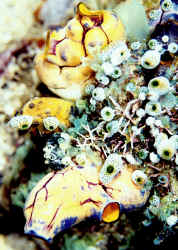
Polycarpa and Atriolum
|
Tunicates, Sea Squirts: Grouped within the same phylum
in zoological classification as the vertebrates are a couple of other
subphyla of interest to marine aquarists. The Urochordata don't
look much like fishes, birds, mammals, lacking a backbone, but do share
four other important characteristics with them. During larval
development they possess a tail, a dorsal nerve cord, a dorsal
(non-bone) stiffening structure (the notochord), and pharyngeal gill
clefts.
These "lower" chordates are variously
called tunicates (for their cellulose matter that makes up their body
covering), Sea Squirts (for their apparent and real capacity to
forcibly eject water) and Ascidians (Greek for "little body")
for the Class of attached forms. There are pelagic tunicates, grouped
in the Class Thalicea, but these are of little interest to
aquarists.
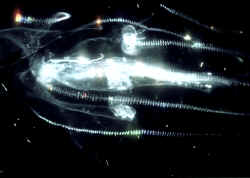
| A Thaliacean "Salp". The (Class)
Thaliacea include about seventy barrel-shaped pelagic animals that
filter feed (like all Urochordates), but from one end opening to
the other exiting as they locomote through the water. This Class is
further subdivided into three subclasses. The Pyrosomida are
colonial and the Salpida and Doliolida are not. |
|
The Ascidians on the other hand are a major part
of the "cryptic fauna" of live rock... often making up
a sizeable proportion of this material (second only to sponges). Though
they may not be easily recognized, tunicates are among the most common
marine invertebrates, and an important functional component, for
aquarists as well. Looking and overlooked as
sponges, Ascidians, mostly are likewise attached to the bottom, but
bear two sometimes difficult to identify openings, or siphons...
incurrent and excurrent, to move water through their individual or
colonial bodies. Unlike Sponges, tunicates can/do respond to touch,
shadows, other stimuli, by closing these siphons.
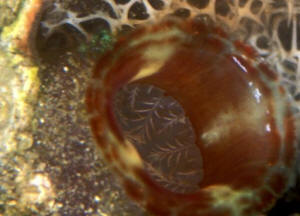
| A solitary species in Indonesia showing a detail of
the "gill net" inside the incurrent siphon. This
branchial organ serves multiple purposes... allowing for
respiration and food gathering, as well as out-gassing of carbon
dioxide. |
|
Bigger PIX:
The images in this table are linked to large
(desktop size) copies. Click on "framed" images to go to
the larger size. |
|
%20MD.JPG)
|
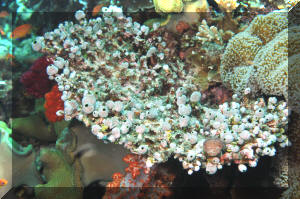
| Other Ascidian species are colonial... of many
colours, shapes, and variable openings. |
%20MD.JPG)
|
Some Common, Colorful Species:
Genus Aplidium:
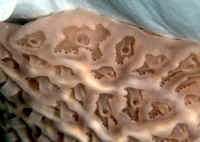
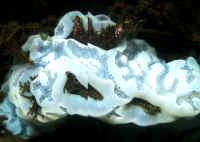
| Aplidium crateriferum Savigny 1816, Crater
Sea Squirt. Tropical Indo-Pacific; Red Sea to Western Pacific.
Usually grows under rocks (here a colony is doing well under a
Sarcophyton in Australia and one in N. Sulawesi). Can be grown in
captivity (even reproduced). |
|
Bigger PIX:
The images in this table are linked
to large (desktop size) copies. Click on "framed" images
to go to the larger size. |
|
%20MD.JPG)
|
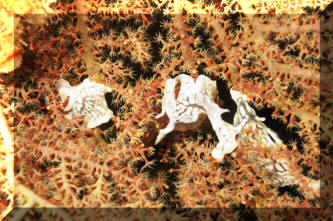
| Aplidium protectans. (Herdman 1899) Globular colonies
Pinkish w/ whitish zooids. S. Leyte 2013 |
%20MD.JPG)
|
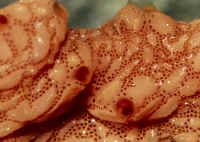
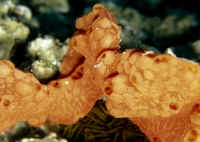
| Aplidium tabascum. Colonies reddish to
orange, opaque. Indo-West Pacific; common in northern Australia. N.
Sulawesi pix. |
|
Bigger PIX:
The images in this table are linked to large
(desktop size) copies. Click on "framed" images to go to
the larger size. |
|
MD.JPG)
|
Genus Ascidea:
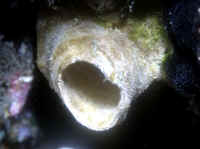
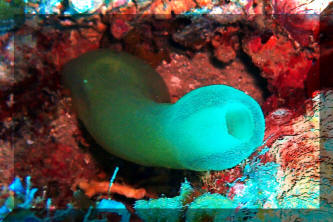
Ascidea sydneiensis Stimpson 1855.
Yellow-Green Sea Squirt. Solitary urn-shaped zooids of up to four
inches in height. Large and few oral siphons. Variable in color.
Worldwide in tropical seas. Hawai'i pic.
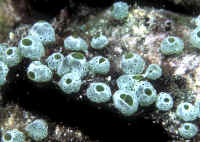
Other desc. for below (from Charteris); single green to yellow tube, one
siphon at tip. Roatan 2016 |
|
Bigger PIX:
The images in this table are linked
to large (desktop size) copies. Click on "framed" images
to go to the larger size. |
|
|
Genus Atriolum:
Genus Botrylloides:
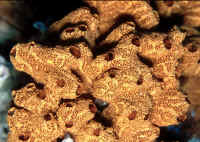
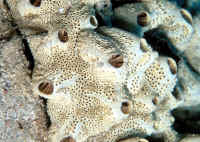
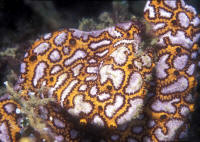
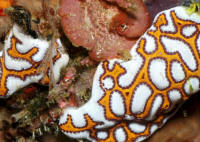
| Botrylloides species. Row Encrusting
Tunicate. Tropical western Pacific to the Red Sea. Low growing
colonies with distinctive rows of individuals and round chimneys.
Red Sea images. |
|
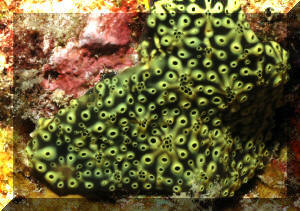
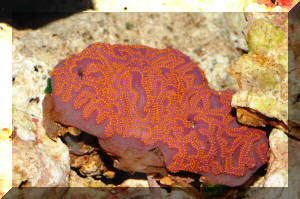
| Botrylloides sp. N. Sulawesi (Lembeh Strait)
images. |
|
Bigger PIX:
The images in this table are linked to large (desktop size) copies.
Click on "framed" images to go to the larger size. |
%20MD.jpg) |
Genus Botryllus:
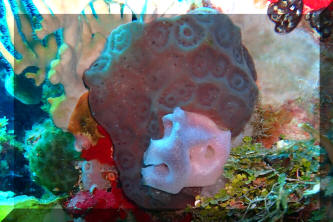
| Botryllus sp. Geometric Encrusting Tunicates.
Several species that share the trait of symmetrical incurrent pores
surrounding excurrent. Roatan 2016. TiffB pic. |
|
Bigger PIX:
The images in this table are linked
to large (desktop size) copies. Click on "framed" images
to go to the larger size. |
|
%20MD.JPG)
|
To: Pt. 2, Pt.
3, Pt.
4, Pt. 5,





%20MD.JPG)
%20MD.jpg)