|
FAQs about Sea Squirts Identification
1
Related Articles: Sea
Squirts/Tunicates/Ascidians,
Related FAQs: Sea
Squirt ID 2, Sea Squirt ID 3,
Sea Squirt ID 4,
Sea Squirt ID 5, Sea Squirt ID 6,
Sea Squirt ID 7, Sea Squirt ID 8,
& Ascidians 1, Ascidians 2, Ascidian
Behavior, Ascidian
Compatibility, Ascidian
Selection, Ascidian Systems,
Ascidian Feeding, Ascidian Disease, Ascidian Reproduction,
|
|
| Martian Pictures, Ascidians at
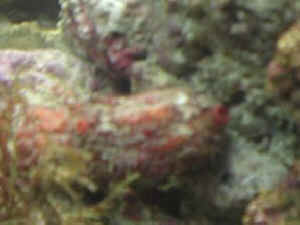
least 02/17/07 Hello Crew! <Marti> I
have learned an amazing amount of information by reading and
searching through your site - thanks for such a great
resource. I noticed that people often have questions
about "hitchhikers" on LR, and wanted to send you two
good pics of tunicates that may be found attached to them. <Very
nice images> Based on information in your site, the translucent
ones seem to be Rhopalaea species (?R. crassa), but I am still not
sure what species the "green" Martians are. Can you help
ID? <Mmm, no... other than that they are tunicates... Both
indicative of your good care.> Thanks again for a great
resource! Marti D. <Thank you for your kind words and sharing
your images! Bob Fenner> |
|
 .jpg)
|
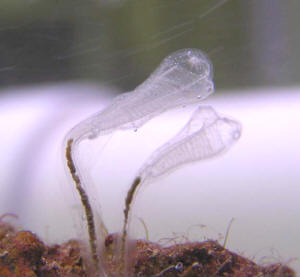
Dismal survival: Lollipop "coral" Tunicate 3/14/05
Dear WetWebMedia, I've been trying to find information of blue
tunicate:
http://seadwelling.com/v-web/gallery/MarineInvertebrate/bluetunacate080904
. However, I have not found its scientific name or any information of
this species. Do you guys anything about it? Thanks a ton in advance,
Robertino <commonly ascribed to the genera Oxycorynia or Neptheis,
this tunicate is referred to as the (blue) Lollipop "coral".
It has an absolutely dismal rate of survival in captivity. It escapes
me why the organism is even collected or offered for casual hobby use
(versus collected for scientific use, study or at least species
specific home tanks with focused care). Anthony>
|
|
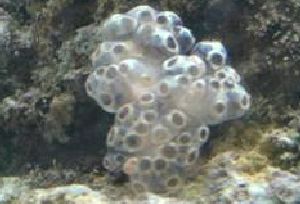
| Coral or Tunicates? 11/9/05 Greetings
crew (or Bob, of course) <Hello Sam, stuck with Josh I'm
afraid.> Thanks to the help I've received from you folks
over the past several months, I'm now enjoying watching new
critters appear from the recent addition of live rock into what
will eventually be a 125 gallon reef. <Makes television seem
overrated doesn't it!> I awoke one morning, and
discovered the critter pictured below, and am wondering if you can
help identify it. <I'll try.> My best guess is that
it is a hitchhiking bit of Pocillopora (verrucosa perhaps?).
<Hmm...Structure seems too smooth (no fuzzy
appearance).> I suppose I could just be patient and see
what it turns into, <I doubt it will change.> but my
patience is currently being spent on going fishless for 6 months to
allow pods to develop. <Good. Stocking too quickly reduces much
that comes with live rock (I'm sure it's still
torture).> For what it's worth, this is a group of
three, with the bubbly appendages extended. There are several other
groups of single (polyps?), and I'm discovering more singles
everyday. <Sounds like tunicates to me.>
<<DEFINITELY appear to be tunicates to me. Very
exciting, this means your system is doing very well! Of note (explained in further detail
in the book "The Natural Marine Aquarium - Reef
Invertebrates", tunicates are actually members of the Phylum
Chordata - chordates are those with a spinal column (of sorts in a
tunicate), Class Ascidiacea Pretty neat, huh? Check out this
site if you're interested in ascidians http://ascidiacea.com/. Also of
note: There seems to be a difference in spelling of this class, I
find 'Ascidiacea' as well as
'Ascidiacea'. MH>> More photos
available if it will help. I don't currently have any with the
appendages retracted, but could endeavor to take some. Any help you
can provide would be greatly appreciated, <I hope it has.>
Thanks, Sam <Welcome. - Josh> |
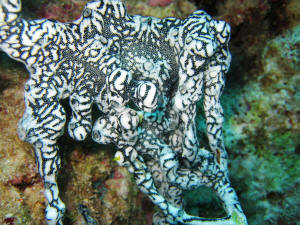
| Sponge/Asc. identification 9/29/05 Is there any
chance you could identify this splendid sponge for
me? At least I think it is a sponge--it appears to have
siphonophores. The photo was taken in the Red Sea <A nice pic...
of an Ascidian, sea squirt... Please see here: http://wetwebmedia.com/ascidians.htm Bob Fenner> |
|
|
Strange Growths Thanks for your reply. I'm still having a
little trouble identifying this species. I looked at the tunicates
using the links provided, but it doesn't seem to fit. A better way
to describe these might be almost looking like maggots. They are
solitary but are growing all over my filter bodies and media.
They're pretty gross looking since they are the same color and
shape as maggots. I'd like to get rid of them but they seem to be
coming back once removed. Thanks for any further help you can give. Tim
<I would try to id them by answering the questions on Dr.
Shimek's page, http://www.rshimek.com/animal_identifications1.htm.
Once they are probably identified, I can help you figure out why they
are so prolific. -Steven Pro>
Re: strange growths No luck with that. The question section
on that page pertains to creatures found in sand beds. I followed some
of the other links for identifying and wasn't able to find
anything. I looked at them more closely and notice they have a
filamentous top around the opening and are spongy in appearance (rough,
porous) and even feel sponge-like (soft and squishy). <With this
additional clue, I have a good idea of what you have, having seen it
before myself. I believe it to be a tunicate, but I cannot find a
picture of the one I am thinking of.> Sorry to keep bothering you
and I appreciate your help. Do you have any other suggestions/ideas?
<Sorry. I did flip through several of my books, but did not find
what I was looking for. Anyway, they are not dangerous, more likely
beneficial in removing dissolved organics.> Thanks again, Tim
<You are welcome. -Steven Pro>
Sea Squirt Info. Search Hello all and how is everyone? I have
acquired a sea squirt and after trying to find on your web site could
not find the particular one that I have. It's common name is
Herdman's Sea Squirt it's scientific name is Herdmania momus.
If you could direct me in the right direction or give me any
information you may have on this animal I would greatly appreciate it.
thanks for all your help you guys are great Dela <Mmmm, I suggest
you place the scientific name in as many of the internet search engines
that you can stand... this is what we'd have to do. I have never
had a brush with this non-indigenous (though extant) species in the
U.S. Bob Fenner>
Ascidians in the Great White North 7/19/03 Been trying to
find some reference to these, but have not been able to find one.
<Hmm... do look into our new Reef Invertebrate Book if you like.
Beautiful coverage of the ascidians if I may say so: https://secure.wetwebmedia.com/order_form.jsp
http://wetwebfotos.com/store/nma-ri.html
> They kinda look like tunicates to me, but I'm not sure.
<quite correct my friend!> They are on the back of a
powerhead. I noticed them a couple of days ago and thought
they were eggs, but closer inspection revealed "tails" or
"tentacles" coming from them. They do appear to
have 2 holes, like siphons. <indeed... sea squirts. and a handsome
colony at that. If you have higher res pics of this colony and would be
inclined to give permission to use them with credit to you name,
I'd love to stick them in a lecture or presentation for example. Do
send to readingtrees@yahoo.com if you can/are willing> Help. Thanks,
Noel <with kind regards, Anthony>
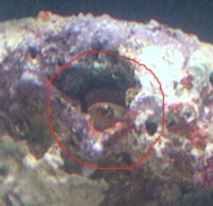
| Squishy thing ID... Hi folks! I found this
really strange looking creature inhabiting a cave in a piece of
live rock I just bought today. It's soft and retracts into the
cave when touched. It has a clam shaped "mouth" which it
opens as it as the entrance to the cave, like you see in the
picture here. But, it doesn't leave the
cave. Nor does it extend anywhere past the entrance. I
am at a total loss. Any idea what it is? I need to ID it
so I can find out if it is beneficial or a pest. <I doubt that
it's a pest, but I cannot tell what it is from either your
description or the picture. Maybe it's some sort of tunicate?
See if you can take a better picture that's much larger than
this one and I'll give it another shot! -Kevin> Tom |
|
|
Re: Strange Unidentified hitchhiker Unfortunately, I
don't have a digital camera and can't get a better
shot. Oh well, I'll do so research on Tunicates and try
to figure it out.<good luck, IanB> Thanks anyways. Tom
Re: strange creature I think it IS a Tunicate. A
Flat Tunicate, I think is the type this is. It is also light
sensitive. I shined a flashlight onto it directly and it closed
it's mouth. It has a really wide maw. It
looks like a flat mollusk with a clam type mouth. No shell at all.
<Weird things do tend to show up from time to time on LR, IanB>
Tom
| Clear Growths 7/22/03 How are you doing?...
<cheers> first let me say that since I have entered the world
of marine aquariums your website has been a lifesaver....I have
searched through your articles for info on this particular question
without any luck...perhaps I am not using the right search
terms.....I have a 55 gallon aquarium, Magnum 350 Canister, Duel
Bio-Wheel, and Aqua-C Maxi Jet 1200 Remora skimmer, 70/30 mix (lbs)
of live sand/crushed coral, 35 lbs of live rock (getting more, love
it), about 40 blue-legged crabs, a few Astraea snails, and two
black-tailed Dascyllus damselfish..... all chem. levels (ammonia,
nitrite, nitrate) are nil ....ph 8.-8.1.....My tank is now three
1/2 months old, since my tank has cycled I have noticed a
burgeoning of life, especially in the last month, it is amazing,
little things here and there. Most of the questions I have had
about this developing of life I have been able to find here or in
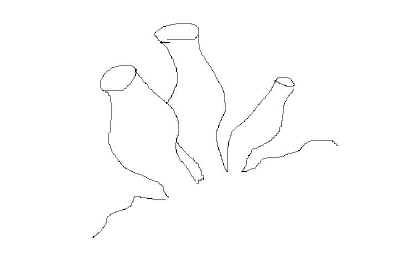
books. Only recently I have noticed a clear "growth" on
my live rock which brings me FINALLY to my question....What is
it?....it is small enough that I am not able to get a clear picture
of it with my digital camera so I include a rough, rough sketch of
what it looks like to appear to me (imagine this image several
times smaller)...I hope it is of some use....I assume that these
growths are normal (if not good) as my tank is maturing, however,
as a teacher (and life time learner) I am always wanting to know as
much as I can.... I appreciate you time and hope to hear from you
soon...Thank You.....Daniel <a good sketch... it appears to be a
tunicate (AKA sea squirt/Ascidian). The opening at the top of each
tube is the exhalent opening. Do use these terms to search our
website for pics that might look familiar in form. No worries about
a perfect match... too many to name/illustrate all <G>.
Anthony> |
|
|
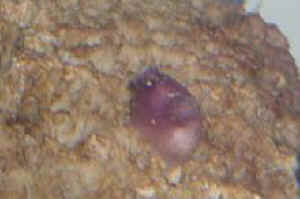
| Ascidian ID Hello, <Hi there> I have
attached a photo of something which I think is a sea squirt that
came on a piece of cured live rock. <Does look like one to me as
well> I do not know if you can tell from the photo but any help
of identifying this critter will be great. What should I be
concerned with if it is a sea squirt, this is a fish only tank with
some live rock. Thanks for the help Drew <Completely innocuous.
You can read about these animals on WetWebMedia.com Bob
Fenner> |
|
|
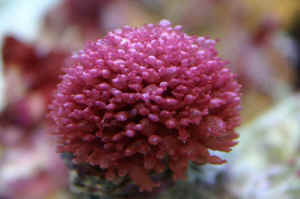
| Please help ID this hitchhiker: Ascidians
11/17/03 http://ebay.webyhost.com/IMG_0179.JPG
Thank you, James <it is an Ascidian colony, James. Some
"colonial" tunicates (AKA Sea squirts. Anthony> |
|
|
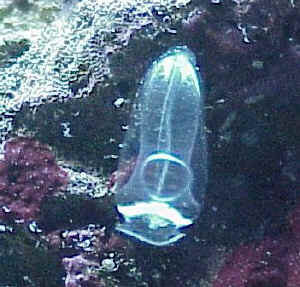
| Tunicate Or Extraterrestrial? All Hail the
Crew: <Scott F. here with you today!> I was hoping you guys
could help ID something that is growing in my tank. I have attached
a picture. As you may be able to see, it is translucent
with a white stripe around the bottom opening. There is
also another opening at the front. There appears to be
an outer lining surrounding an inner body. Thanks for the great
site! Rich <Nice photo, Rich. I think that you have a tunicate
of some sort here, possibly a Rhopalaea species. Or- it could be
some sort of alien creature of some sort...LOL. In actuality,
tunicates are harmless, interesting animals that are all part of
the diversity of your tank. Enjoy it! Regards, Scott F.> |
|
|
| New tank + picture ID OK--I'll try it
again at this address. R/Janet <Got it!> New tank + picture
Hi--here's a picture with the red thing--you can see two
"mouths" on it, one in the middle and one on one end. The
thing flexes, but doesn't move, per se. The mouths open and
stay open for awhile, then close tightly. The green thing is above
it. We've had a bunch of those pop out. Any ideas what these
are? <Yep... good clues. Very likely an Ascidian, sea squirt.
Please see here: http://www.wetwebmedia.com/ascidians.htm>
I know it's a little blurry, but it's hard to photograph
through glass. Yesterday I found what looked like to be a small
mucus sac up on a rock. When I came back, one of the brown crabs
was eating at it. Any idea what that might have been? <Perhaps
just a bit of algae... amazing what pops up in these systems,
eh?> If this is a sea cucumber, can you tell if it's a
non-poisonous kind? The hermit crab is sort of aggressive and
I've seen him nipping at it. After reading the articles on your
site about sea cucumbers, I'm thinking I may not want one!
<Most hermits will nibble on most anything...> Another
question--the hermit crab ate the clam. The clam was slightly open,
and certainly appeared alive (he was opening and closing his shell
periodically). The crab got his legs in there and pretty much
cleaned out the clam shell. My husband thinks this means the clam
was already dead and there must be a problem with the water.
<Maybe... I'd not take bets for sure on either side> We
also saw a dead brown crab today (maybe the one that at the mucus
sac?). We have corals growing and the fish are fine, so except for
the water being a little warm (we've gotten the temp down from
82F to 80F), I think it's OK. The water looks good and the
algae problem is gone. I've tested for the usual suspects, and
nitrates and nitrites are 0, ammonia might be a trace (those color
kits are sometimes tough to read), and pH is 8.3. Are there any
other things I should test for, and will hermit crabs eat live
clams? I'd like to buy a few blue-green Chromis today, but
he's worried that something is wrong. <Not all... or better
put, there are species that are a much better gamble than others.
See WetWebMedia.com here for suggestions or NMA Reef
Invertebrates.> Our clowns (the false Percula kind) are fine and
I am wondering if they might be breeding, based on the behavior I
see in my fresh tanks. They hide together and mostly only one comes
out and swims. The other just comes out slightly from the hiding
place. Both appear healthy and are swimming fine. Do clowns breed
in tanks, or do you need a special set-up? <Does happen... see
WWM...> Another crab question--this crab changes shells several
times a day. Have you ever heard of that? He never stops eating,
either. <Typical> How would we know if we have mantis shrimp
in the tank? Would they have eaten the fish by now? <... WWM>
Thanks in advance for your help. I do appreciate it. R/Janet <Be
chatting... and reading. Bob Fenner> |
|
|
|
|


