|
FAQs about Sea Squirts Identification
2
Related Articles: Sea
Squirts/Tunicates/Ascidians,
Related FAQs: Ascidian/Sea Squirt ID 1, Sea Squirt ID 3, Sea
Squirt ID 4, Sea Squirt ID 5,
Sea Squirt ID 6, Sea Squirt ID 7,
Sea Squirt ID 8, & Ascidians
1, Ascidians 2, Ascidian Behavior, Ascidian Compatibility, Ascidian Selection, Ascidian Systems, Ascidian Feeding, Ascidian Disease, Ascidian Reproduction,
|
|
|
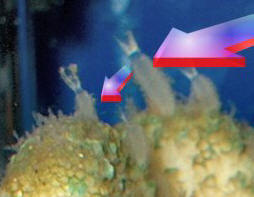
Unidentified Underwater Object: Likely Ascidian -- 4/12/08
<Hi Joe!> You know, I am bound to find something that is
unidentifiable even to the WWM crew. <Heheee! You may well
have succeeded this time!> LOL. You guys have been fantastic
and I find myself coming back yet again with an unknown critter
that seems to have stumped me and most of my friends. It was
speculated that it could be a jelly fish of some type <I can
see why someone would say that. The pattern in the middle is very
reminiscent of one!> ..but this guy is fixed on the LR and
doesn't move... I attached the best pics I could, any ideas?
<Well, to be honest, I'm fairly well stumped myself. My
best guess is that it's some sort of Ascidian or sea
squirt/tunicate - something similar to the Botryllus species at
the following links:
http://massbay.mit.edu/exoticspecies/exoticmaps/images/botrylluss_big.jpg
http://www.armofthesea.info/images/animalimgs/goldenstar_lg.jpg
For more images, please enter 'Botryllus' in Google's
Image search engine:
http://images.google.com/imghp?hl=en&tab=wi More information
on Ascidians: http://www.wetwebmedia.com/ascidians.htm > TIA
Joe Brillon <Hope that's it! If not, let me/us know. Take
care, -Lynn>
Re: Unidentified Underwater Object: Likely
Ascidian - 4/15/08 <Hi Joe!> Well you thwarted my
efforts once again to stump you and the crew over at WWM.
<Heheee! I have to admit that you very nearly succeeded this
time!> That is exactly it, <Yay!> many thanks again.
Until next time where I will try again to leave you scratching
your head. <LOL You're very welcome, I look forward to
it!> Take care. Joe Brillon
<You too, Joe. Have a great week! --Lynn>
|
|
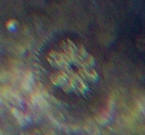
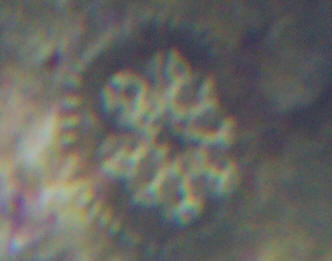 Likely so. RMF Likely so. RMF
|
|
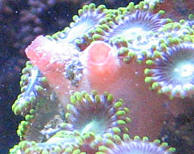
Red Tube Hitcher 02/19/2008 Good afternoon!
<<Hello, Andrew here>> I've noticed some strange
red tubes among some Zoanthids today and I was wondering what
they were. I figure they are some sort of filter feeder, but
I'd like to know if they are harmful to my Zoas. These tubes
shut and retract a bit if I touch them. I have attached a couple
photos of them. There are more on that rock, too, but all seem to
be connected to something in the base. Thank you for your time!
Zoa« Stevens <<What you have there is a sea
squirt, or otherwise known as an Ascidian. These are a harmless
filter feeder and will not hurt your Zoas. More info can be
found here and the linked articles and FAQ's.
http://www.wetwebmedia.com/ascidians.htm >> <<Thanks
for the question. A Nixon>>
|
|
 Who you calling a squirt? Who you calling a squirt?
|
|
Identification 1... Tunicate 10/2/07 Dear Bob,
<Hi Jason, Mich with you in the wee hours of the morning.>
I found a couple of these guys in my wet/dry trickle filter. See
attached picture. <I see.> They are definitely mobile and
have skeletons <Mmm, not really. I know what you are seeing
but it is not truly a skeleton.> but no idea if they are bad
or good. <They are good. What you have is a tunicate. They are
very neat creatures indeed! Some are extraordinarily beautiful. I
saw and photographed many in the Bahamas.> They are not in my
refugium or main tank so I'm not quite sure how or why they
are in my wet/dry filter. <They are there because the
conditions are favorable and there are no predators.> Thanks
for all your help and making this hobby fun. <Welcome and
thank you for your kind words. Is always good to hear from folks
who are enjoying the hobby. Mich> Jason
Blurry photo... Maybe a tunicate? 10/2/07 Dear
Bob, <Nope, Mich again.> I have quite a few of these red
bubble entities around my live rocks. They have various tubular
openings with what looks like red hair type worms that extend out
from them. They don't seem to bother my fish or other
inhabitants but I am curious as to what they might be. <I am
having a difficult time making out the image in the photo. Does
your camera have a macro setting? You might trying retaking the
picture with the Macro turned on (the symbol often resembles a
flower). This may be a tunicate as well, but I'm really not
sure. A clear picture, may just clear the picture! ;) Thanks
<Welcome! Mich>
Jason
|
|
.jpg) 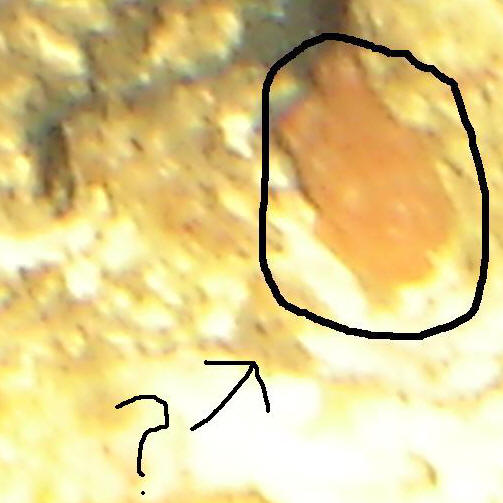 Bingo! Bingo!
|
Strange growth on coral 10/11/07 Hi, I
have a coral that is growing a strange tip on one side. Now I have
string worms crawling on it too. What is it? Should I try to pry it
off? It is getting bigger. <Wow, that is very strange. My best
guess is some kind of parasitic barnacle or mollusk.> Also, I am
finding more and more of these worms in my tank. Should I do
something about them? <Remove the growth. Whatever it is, it
doesn't look good.> Sammy
<Best,
Sara M.> |
|
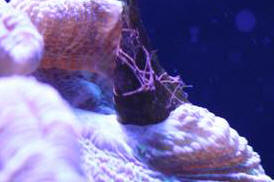 You got yourself an Ascidian there
mister. RMF You got yourself an Ascidian there
mister. RMF
|
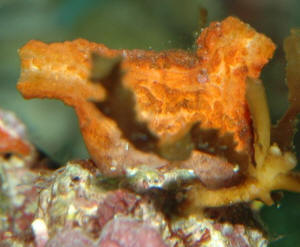
Crabs... and Ascidian, IDs -- 08/02/07
Hey Crew. <Hey now! Mich here.> It's been a long time
since I last wrote (about 3 days). <Heehee! That is a long time
from this email address!> I have some crabs in my display about
which I'm curious. Pics are attached. The first pic is just a
cool, very big sea squirt that I have--just a cool pic, no
question. <Neat!> The second pic is of a decorator crab (I
think Schizophrys dama). <Likely so.> It is small (maybe
1/4" tall) and I think it's a really cool crab (watching
him lumber about, etc.), but I also know your general feeling about
crabs. As you can see, he has poached some polyps from my tree
corals. I saw him molesting them tonight, although they didn't
seem to mind too much. <Hopefully he's just fragging it and
not noshing on it.> Anyway, question #1 is whether I should get
him out of the display and, if so, <He's not "reef
safe". whether I can put him in my 30g refugium (4-6" DSB
with 4lbs live rock and Chaeto)? <Could.> Will it eat my
pods/Chaeto? <I'm not sure. I'm not finding much on the
diet of this particular species but most crabs are opportunistic
omnivores.> I could put him in my 30g QT, but not much in there
for him to do. <This may be a good option.> Third pic is of
some type of filter feeding crab that I noticed tonight. Not a very
good picture, but it definitely has sweeper arms that it uses to
filter feed and you can clearly see its filters in the attached
pic. It doesn't look like any Porcelain Crab I've ever seen
(which is the only crab I found while researching that has similar
feather-like appendages). So, question #2 is any idea what type of
crab this is? <Is likely a Neopetrolisthes or Petrolisthes
species.> Final question (no pic) is the suitability of what I
think is a Mithrax forceps (Red-Ridged Clinging Crab). It came in
on some live rock and I've been observing it for several
months. It doesn't seem to molest anything other than the
little bit of macroalgae that I had (notice past tense) in my
display. <"Seem to molest" is likely an accurate
description... Most crabs are opportunistic omnivores.> Muchas
gracias.
<De Nada!>
Andy
<Mich> |
|
|
| Local Reef club couldn't give me an ID, hope
you guys can. ID Question, need more details -- 4/13/07 Hello,
<Hi Greg> I posted pics at my local reef aquarium club and
nobody was able to id this mass. <Bring it on, I love a good
challenge!> I picked out a rock to frag some Zoanthids and
noticed this on the bottom of the rock. I am assuming a pistol
shrimp had tunneled under the rock. The rock was sitting in the
sandbed and I can't remember if it had space under it for flow.
<Hmmm, that's what I'd like to know too! My first
thought is that it's a colonial tunicate/sea squirt colony of
some sort. It's not unusual for them to be in protected areas
or overhangs, but underneath a rock like what you describe would
seem to be pushing it. However, I suppose it might be possible if
there was enough room under there and some degree of flow. What
I'd like to do is get just a little more information, such as
how large the mass actually is. It doesn't have to be exact
I'm just trying to get an idea of scale. Also, are the
tube-looking cells that make up the mass gelatinous, soft, rubbery,
or hard? Finally, if you notice anything else, please let me know.
Let's see if we can figure this thing out!> Thanks for your
time, Greg... <You're very welcome, Greg. I look forward to
hearing back from you! --Lynn> http://i113.photobucket.com/albums/n225/heysemo/100_0392.jpg
http://i113.photobucket.com/albums/n225/heysemo/100_0391.jpg
http://i113.photobucket.com/albums/n225/heysemo/100_0390.jpg |
| Re: Tunicate Id - 5/5/07 <Hello again!
Lynn here.> You called it perfectly. <Yay! Thank you so much
for letting us know.> I placed the rock higher in the tank to a
position allowing me to see underneath the rock. It is a tunicate.
It's obvious to me now after seeing it fully expanded and such.
<I bet it's beautiful too!> Thanks for your opinion.. you
guys nailed it.. <I'm so glad we could help, Greg.> |
|
 .jpg)
|
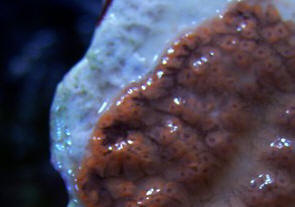
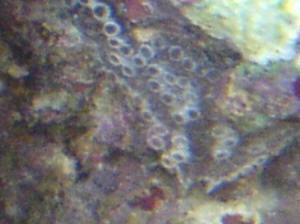
Grey disc with white circles... ID Tunicates
(Clavelina robusta) 3/21/07 Hi, <Hello Allan,
Mich here.> Please could you let me know what this grey disc
shape thing is please (photo attached) <Looks like a colony of
tunicates, I believe Clavelina robusta.> my tank has been set up
for 4 weeks and I noticed this on the live rock about 2 weeks it
was about 1cm across. It expands over a few days then sort of
deflates and seems to spread or grow, but today it seems as if
it's splitting into 2. any help good or bad please. Tunicate
are a delightful addition. More here:
http://www.wetwebmedia.com/ascidians.htm >
thanks
<Welcome! -Mich>
Allan |
|
|
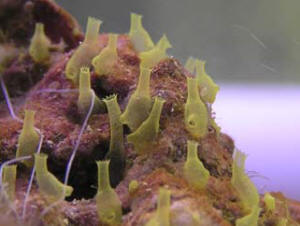
| Green Tunicates 3/8/07 I just
read your article "Almost US!? Sea Squirts, Tunicates,
Ascidians, Subphylum Urochordata, Phylum Chordata" on Wet Web
media. I was actually looking for a pic of some green
growth I have in my tank, that people referred to as tunicates, and
recommended your article. I am sure they are tunicates, but can you
help identify what species? (See pic, attached). I got them on some
Gulf of Mexico LR from my LFS. <I cannot identify these to
species... perhaps a perusal of the popular works of Dan Gotshall,
Alex Kerstitch...> Thought you might enjoy the picture to add to
your "collection". Thanks for all your help! Best
Regards, Marti DuGuay <Thank you for sharing. Bob Fenner, who
has traveled and dived in Mexico's California for more than two
years total time, but obviously (due to lack of pix, knowledge) has
only (shades of Karen Carpenter) "only just
begun".> |
|
|
Tunicate Invasion 3/5/07 Hello:
<Hi.> You have been very kind in the past in answering my
questions and I hope you can help me with this one. Not long after
I transferred my very healthy Dwarf Zebra Lionfish from to my 55
gallon display tank, I began to notice white specks on the glass
and ornaments. They were accompanied by the things in the photos
attached to this email. They look like some kind of parasite but
they are not affecting the fish at all. They are though making my
tank look terrible as you can see. I keep the water and gravel very
clean and I also scrape the glass but these things return. The tank
has been up for five years and I never saw these things UNTIL I put
the Lion in there. What are they and how do I get rid of them? As
always, any help is very much appreciated. Thank you for your time.
<These are tunicates, are not directly harmful/parasitic at all.
Please see WWM re: for more detail about them. an
overabundance may indicate an underlying nutrient issue though.>
Robert Sabbia
<Adam J.> |
|
Mmmm, no. Are Syconoid sponges. RMF
|
|
|