Featured
Sponsor


FAQs on Controlling Cyano/Blue-Green Algae 14

Related FAQs: Control of Cyano/Blue-Green Algae 1, Cyano Control 2, Cyano Control 3, Cyano Control 4, Cyano Control 5, Cyano Control 6, Cyano Control 7, Cyano Control 8, Cyano Control 9, Cyano Control 10, Cyano Control 11, BGA Control 12, BGA Control 13, & BGA Identification, Algae ControlMarine Algicide Use, Nutrient Limitation, Marine Algae Eaters, Culturing Macro-Algae; Controlling: Red/Encrusting Algae, Green Algae, Brown/Diatom Algae

Related Articles: Blue-Green "Algae"/(Cyanobacteria), Algae Control, Marine Maintenance, Nutrient Control and Export, Marine Scavengers, Snails, Hermit Crabs, Mithrax/Emerald Green Crabs, Sea Urchins, Blennies, Algae Filters, Ctenochaetus/Bristle Mouth Tangs, Zebrasoma/Sailfin Tangs, Skimmers, Skimmer Selection, Marine Algae, Coralline Algae, Green Algae, Brown Algae,  Diatoms, Brown Algae


Healthy, established systems rarely have appreciable BGA.

Dusting on my sandbed
BGA? 7/17/08
Morning crew,
<Hello.>
I have a question regarding a dusting that has started appearing on my sandbed. When I first saw it I thought it may be red slime algae aka
Cyanobacteria (not sure of spelling). Anyhow, I performed some tests to see where my params where.
Nitrates 0-5ppm
Salinity 1.023sg
Ammonia 0
Nitrites 0
Alkalinity 7dh
Ph 8
My parameters looked fine so I figured maybe it was a flow issue but I have a 90 gallon tank with 2 1200gph powerheads not to mention the return pump from the sump that adds even more flow per hour on top of the powerheads.
<Your water tests can be deceiving if the BGA is using up nutrients keeping your tested levels low. I would raise your salinity to 1.025 and possibly the KH a degree or two to give the competing algae (coralline) an helping hand. In regards to flow, it sounds like you have plenty, just be sure it is directed in a way to prevent dead spots that become detritus sinks.>
In the past, I have seen red slime algae and it looked like a maroon color. Today I saw red slime algae in a friends tank at it's beginning
stages an it was bright red (never seen that before) and my tank most definitely didn't go thru any of that. The dusting on my sandbed is a
deep purple similar to that of coral line but different.
<BGA has many forms and colors.>
From my experience I have never seen coral line grow on a sandbed so this is why I thought red algae but this doesn't have the colors of
red algae. I have also started to get a nice coral lone algae spurt growing all over my overflow box and powerheads.
<Good, in time this should take over the rest of the tank too.>
Any idea what this could be on my sanded? Is it red slime and if so what can be causing it?
<It does sound like BGA. Feeding, dirty filtration, source water, sandbed, incorrect flow, all the usual suspects: http://www.wetwebmedia.com/bluegralgae.htm >
Thanks in advance
<Welcome, Scott V.>

I am Lost Help!, Cyano treatment and related problems 7/11/08
Hello and thanks in advance,
<Hi>
I have been the example for so long on how to do things properly that I have found myself speechless. I have a beautiful 135 Gallon Reef with a beautiful collection of fish and corals that has been successful for over 2 years. I do not want to bore you with ALL the details but my water is near perfect.
<Numbers please near perfect is not of much use.>
I have/had an great collection of tangs and wrasses along with a clown trigger ( I know I know). Here is the issue.... Tues, Morning I noticed a bit of red slime Cyano and my Naso was wedged between two rocks dead.
<Why?>
I treated the tank with Red Slime Remover by Ultra Life as I have in the past.
<I would not add anything to your tank that does not list its ingredients. Most likely you dosed your tank with Erythromycin.>
All was well while the Lights were on. As directed I turned off my canister that I run with live rock and carbon and left just my refugium and Hydor on. The next morning, All my fish were sluggish and blotchy with labored breathing. I lost my powder blue and flame angel. I thought this may be lack of oxygen due to treatment so I began full power and filtration again.
<Or due to a crash in water quality due to the possible destruction of the biofilter.>
The tank looked to have fully recovered during the day. Still water quality including Phosphates were in check.
<Numbers please.>
This morning, same thing but I lost my harlequin tusk and the same labored breathing, etc. Now that the lights are on everything is back to normal. I just don't get it, Help!
Tony Romano
<Hard to say what exactly happened since we don't really know what you added to the tank. Best bet here is to watch water quality closely and do a few extra water changes. Again I will stress how important it is to not add unknown substances to the tank.>
<Chris>

Identification assistance   6/19/08
I've looked every where for an image close to this to id just what is growing and is it good. Pictures attached. Water parameters are almost
perfect. NH3-0, No2-0, No3-5, Calcium 460, Phosphate 0, 9 DKH . SD-1.024 10% water change weekly. 55 gallon reef setup. Remora skimmer, wet/dry sump, 700 gph return, 265 watts of 65k( 8 hours) and actinic(10 hours).
60lbs LR and aragonite substrate.
Can you help me id this red fast growing entity? Once I know what it is I can figure out what to do about it if anything.
<It looks like Cyanobacteria. Please see here:
http://www.wetwebmedia.com/bluegralgae.htm>
~ Karl
<Best,
Sara M.>

Re: Identification assistance, BGA    6/19/08
Thanks for the quick response Sara.
I came to the same conclusion but can't understand why. Water parameters are perfect.
<Well, for one thing, there's likely no such thing as "perfect" water parameters in any marine tank. Secondly, nutrient levels can be low *because* you have algae/Cyano growth. These organisms can use up the nutrients such that sometimes you don't detect them. When you test for these things, having high levels is a certain problem... but having low/zero levels doesn't necessarily mean you don't have a problem.>
The PC lights are needed for 2 anemones. There is indirect sunlight but no direct sunlight. The best method would be to starve the Cyanobacteria,
<Of nutrients, yes... of light, no. Cyanobacteria can do quite well even in very low light. In fact, there are species of Cyanobacteria which can actually live inside of rocks. When scientists went looking for an organism that might be able to survive on Mars, they looked at Cyanobacteria. That's probably a lot if useless trivial, but point is... it's a survivor (thus dimming the lights probably isn't going to help).>
I surmise so I cut the PC lights by 2 hours and placed a cover on the front of the tank during the day. Any hope that will help? Would like to keep the anemones if at all
possible.
<Do more water changes, add more filtration, feed less (if you can)... more water flow might also help. Etc... the topic is covered quite extensively here on WWM (please see the FAQs pages linked on the article I linked you to).>
I really do appreciate your knowledge and advice.
~ Karl
<De nada,
Sara M.>

Agreed. RMF.

BGA 6/5/08
Good Morning crew,
<Hi there Melanie.>
We are currently enjoying (?!) a BGA outbreak in our 75 gallon reef tank.
<That is where all the BGA enjoyment went!>
I have gone through and read everything I can find on BGA on wet web, but I have some questions anyway.
<OK>
-75 gallon (48"L x 20"H x 18"D), 20 gallon sump, with in sump 1500 GPH pump and protein skimmer, one powerhead in the tank for movement, approx 90 lbs live rock, 3" aragonite sand bed.
<I would increase this depth by at least 1”.>
The tank is in a high light area, although we keep heavy drapes closed during the sunny parts of the day to avoid direct sunlight.
-Ammonia, nitrite, phosphate 0, nitrate 0 (false reading?),
<Possibly misleading, yes.>
temp 78 - 80, Calcium 440, PH 8.1. Salinity, 1.025. Water changes are approx 10 gallons weekly using RO water with Prime added to it.
<No need for the Prime with RO water.>
The mixed salt water is always at least 48 hours old before we use it. We keep a bag of activated charcoal in the trickle tank filter which we change once per month. Tank is 13 months old. This is the first algae outbreak since the initial break in period. 3 Pajama Cardinals. 2 Clarkii clowns, 1 cleaner shrimp, 1 spiny urchin, perhaps 20-24 hermit crabs, 4 or 5 snails (we had many more. They disappeared only to have hermits occupying their former address - go figure!)
<It is the story with hermits, especially this many. They will continue to thin themselves and the snails out to a point.>
1 Torch coral, 1 Goniopora, 1 Clove polyp, 1 Open Brain, 1 Button coral, 1 Porites, 1 Finger Leather, 1 declining Zoanthid.
<A rather toxic mix together.>
All corals except for the zoo are doing very well after a lighting change. He was declining before that as well.
-We were initially sold a single 400 watt MH fixture on the premise that there is no such thing as too much light. (we were new and green, had money to spend, and thought everyone in this trade was honest).
<!>
After nearly a year of heat issues and some corals that looked like they were frying, we switched to a combination 2 x 150 MH (10 000K), 2 x 96 watt actinics, 4 x 1 watt lunar LED's.
<A more suitable combo for this system.>
We have played with the height until we think we have it figured out for heat versus light. The actinics run 12 hours per day, the MH 9 hours and the lunars 2 hours. So basically there is some form of light in the tank from 10:30 am to midnight.
<Sounds good.>
The outbreak has been going on for about 3-4 weeks. These are the changes that took place up to the outbreak
-The lighting switch was done in mid April.
-We added the Clove polyp, the Finger Leather, the Urchin and the Clowns.
-We switched salt mix from Instant Ocean to Red Sea Coral Pro. (the makeup water shows a trace of phosphate)
<Do test this mixed vs. unmixed to trace the source.>
-our Emerald Crab died
<Generally a poor aquarium choice anyhow.>
-we tore down and rearranged our live rock to better use it aesthetically and for the coral placement.
<Can be a telling event.>
I feed once or twice a day with Ocean Nutrition Formula One pellets, every two days with one cube San Francisco Bay frozen Marine cuisine, mysis shrimp, or plankton, about once a week with PolyLab Reef-roids, and once a week use Kent Marine Coral Vite supplement.
<With the frozen foods, do thaw them and drain off the liquid, this can have a big impact.>
I should note that we are a six hour drive away from the nearest LFS. The store I am in contact with right now suggest purchasing a "Two Little Fishes PhosBan reactor 150 package". However since our tank did not have this problem from the start we are not sure this is the way to go. I would rather figure out what's causing it and fix the problem.
<My feeling exactly. The Phosban will simply treat symptoms, not the problem.>
Do you recommend upping our snail population?
<Not without thinning out the hermits substantially first. They will have no impact on BGA anyhow.>
The amount of food I am using now is about 2/3 what I was giving a month ago. I don't think I am overfeeding but now I'm paranoid.
<Sometimes it is not how much you feed, but how you feed. Adding the food a bit at a time, waiting until it is consumed then adding a bit more may help. This will limit the amount of “broadcast feeding” and the consequent degradation of water quality. In respect to the moving of the live rock, this presents two considerations. First, you may have possibly stirred up settled detritus/nutrients in the system, leading to the outbreak. The second thing to look at here is how this rearrangement may have changed the pattern of your water flow. It is possible this has left a dead spot for detritus to accumulate, fueling the BGA. Other than this, do investigate the other factors you have been reading about: substrate, mechanical filtration cleaning, feeding, circulation in general, etc.>
I would like to add a Blackcap Basslet and an Anthias right now and a mushroom coral down the road a little. Am I starting to stretch the limits of this tank?
<Either fish will be fine, with the careful selection of the Anthiinae. This will put your tank to full or near fully stocked. As far as the addition of any corals, you will find in time the need to select which type you wish to keep long term. The mixing will only work for so long, in time some will suffer through allelopathy.>
Thanks in advance for any help/suggestions you may have.
<Welcome.>
You have been a great resource for us in the saltwater tank as well as our outdoor waterfall / pond.
<Good to hear, thank you!>
Melanie.
<Scott V.>

 
Cyanobacteria 5/31/08
Hi Crew,
<Sam.>
I have a 10 gallon about 5 years old with a neon goby, clown goby, spotted cardinal and candy canes. A few months ago I neglected to change my bulbs and by the time I did the coralline algae was disintegrating from the glass and Cyano showed up.
<A bad feeling after so long.>
Now that I have new bulbs the coralline is coming back but the Cyano is still there. It is improving but I would like to get rid of it. Every 5 or 6 days the glass in front is pretty foggy with the stuff and it does cover some rock but I don't see it on the sand.
<Good, it does sound like you are on your way of ridding it. If the light alone was the problem, it will take a bit of time for the Cyano to vanish.>
Anyway, I would like to cut the light down from the current 12 hours to 9 to see if that helps. But that will also mean that the fish will get fed once in the morning and by the time I get home in the evening the lights will be out. So I will have less light, less pollution since I am feeding less. Will this have any adverse affect on the corals or fish?
<You may be fine doing this, there is no way to know without knowing more about your tank (lighting, water flow, water tests, etc.). If you have improved the situation with just the light, give it time and it will continue to improve if that is indeed the issue.>
I also assume a Polyfilter would also help me.
<It doesn’t hurt, but not a cure all.>
I just read somewhere that after use it can be rinsed in fresh water and it is ready for another round.
<Nope, the Polyfilter can also act as a mechanical filter pad, in which case you can rinse out the particles caught in it. But as far as recharging the Polyfilter, you will need to simply replace it periodically.>
Thanks,
Sam
<Welcome, a link below re Cyano and other possible contributing factors. Have fun, Scott V.>
http://www.wetwebmedia.com/bluegralgae.htm

Re: Cyanobacteria 7/17/08
Hi Crew,
Well, it is 6 weeks since I made some changes. The lights are on only 9 hours and I feed once a day. I also siphon it out whenever I get a chance. It is improved. It takes longer to see enough worth siphoning and the glass stays cleaner longer and my other pest algae are also thinning out. I guess the name of this game is patience starting from day one.
<Yep, it can take time. Continue with the progress you are seeing and all will be gone in time.>
Another change is in the fish. The cardinal has until now been very timid but now when it come to feeding time she is up there first and chases after anyone getting in her way. Does that mean I cut the feeding too much?
<No, marine fish are just aggressive when it comes to food. If you fed three times a day you will see the same behavior.>
The problem is the lights are out when I get home after work so there is no way I can feed them a second feeding unless I extend the lighting time. In any case I am not changing anything until this stuff is gone.
<You can have the lights come on later. This will allow you to see the tank when you get home. Your livestock won’t really care when the photoperiod is, so long as it is consistent.>
Thanks
<Welcome, thank you for the update, Scott V.>

Live Sand/DSB Questions 05/29/2008
Hi Crew!
<<Good evening, Andrew today>>
In the last couple months I have been fighting a war against Cyanobacteria. I refuse to treat with any chemical treatments until I have exhausted any and all natural ways to rid this out of my system. With that said I have resorted to siphoning out the bulk of the colonies, since I am not sure what is causing this outbreak! pH is 8.1 dKH is 9 Ca 400-425 Salinity 1.024 Magnesium 1200 Nitrate 0 Nitrite < 5 Phosphates 0 (but read they can be very trick to get an accurate reading on)
<<It is true, that usually false test readings are had when suffering from a plague algae outbreak as the algae is absorbing all the nutrients, giving you a false reading>>
I am running 4x39W T5HO fixture no more than 6 hrs a day with nice reflectors and 8 months left on the bulbs. I run a nice Euro Reef RS80 with an Auto Top Off that skims well, also my top off water is TDS 0. I added a Phosban reactor and carbon in the last week hoping it will help. My next route is adding MORE sand to my display not only because I lost some when cleaning but also because I would like the perks of a DSB. I currently have about a 2in sand bed in my 50 gal display and none in my
sump.
<<Does the sump have a refugium? If not, creating one in the sump if there is space, or purchasing a HOB refugium will certainly aid in the issue and use macro algae like Chaeto to out compete the Cyano outbreak for their much loved nutrients>>
A buddy of mine just tore down his 75gal tank and gave me about 30lbs of nice aragonite (he did not have a DSB just a 2in sand bed, so no massive die off). I would like to add a lot of this to my sump and some to my display. I would like to do this in the best way possible and avoid any cycles or spikes in ammonia. Last night I added about 3-4lbs to the sump after washing with aquarium water and did a small water change. The rest of the sand is sitting in a bucket with a heater and power head. I do not have the time/money/or resources to drain the entire display just to add sand. So I was wondering will adding a few pounds of sand to the sump every 24-48 hours be alright, and avoid causing problems?
<<Adding to the sump would be fine. The display, I would only really use new sand, if adding large amounts, and do not stir up the sandbed to mix in with the existing sand, as this is a common pit fall>>
Also, is leaving the sand in a bucket with a power head and a heater alright for a few weeks until I can move it all into my display?
<<Yes, this will be fine>>
Please help me out here, I do not want my tank to crash in efforts to make it better! Thanks in advance for the help you guys rock!
<<As mentioned above, I am a stickler for NOT adding sand from another aquarium to one of mine, if any, it would be just a cup full to add life. As long as the sand is cleaned though, you should experience any problems if adding in small amounts>>
<<Thanks for the questions, hope this helps. Regards, A Nixon>>

BGA 5/24/08
Hola crew!
<Hello John!>
I have corresponded before but this is a new topic. I have read the sections on Cyano, and would like to confirm my next steps.
<OK>
Background
I refinished, stained and varnished an older Dutch Aquarium 75G tank drilled 2 1.5 “ drains, a 30 gallon sump / refugium / skimmer. 90 Lbs Fiji LR; ASM G2; OR6500 Pump; 2 Koralia Nanos; 1 Maxijet 1200 Aqualight Pro with 2 150W HQI 2 96W Actinics; Kent Maxima Hi S 60GPD RO/DI (0 phosphate measured) .
I purchased the live rock in November, but then had to have surgery, so I kept the rock in two rubber maid tubs under a 20 inch compact 10000 K / actinic with the G2 and an smaller OR3500, RODI water changes every few weeks and an occasional deli shrimp to keep things lively. Parameters stayed good after the cycle. Sadly no visible worms or critters except some amphipods crawling on the rock. In February I threw in a few snails and crabs to help things along and eat a little algae..
FF to April 20 and, having managed to defer both death and taxes until next year, <Can be quite a feat.> I put my tank up with about 90 pounds of fine aragonite and set the tank on to cook. The Aqualight was used so I changed the bulbs to new after about one week. Ammonia nitrites and nitrates 0-0-0, SG at 1.026 temp around 79-80 no detectable phosphate,.
<All sounds good.>
After waiting about two weeks with no parameters changing I purchased a 7 small corals (Euphyllia divisa, Euphyllia glabrescens, Pink Acanthastrea (Lord?), a Zoa rock, selected mushrooms (Rhodactis, Actinodiscus, Sarcophyton I think ). Then being stupid and overconfident, I started adding some AquaVitro Calcification to boost calcium from 375 to 425 and accepted 4 creatures from a friend of a friend (Amphiprion percula, Sphaeramia nematoptera, stenopus hispidus, and a yet unidentified tang (maybe hybrid Powder blue / chocolate))who was shutting down her tank and wanted them to go to a good home. Ha, fooled her. <!>
I have been trying to feed once per day, occasionally less, rarely more, alternating Rods Food and Sectrum Thera plus (which they ate at their previous home). Tang seems happy and some surplus algae keeps him well fed. Water change too low at 10% every two weeks.
<Yes, double the frequency.>
Then I noticed one patch, then two then three on the rock of wavy bubbly green stuff. BGA.. Mostly in partially shaded and less intense flow spots. I have to assume my organic waste outpaced my bacterial growth curve. Still no detectable ammonia or nitrites or nitrates but the proof is in the slime.
<Yes it is.>
After spending the last day reading everything in your forum, I am
1) Upping water changes to 20% weekly.
2) Vacuuming the Cyano off the rock when changing
<#1 and 2 will have a big impact on the BGA.>
3) Not planning on using antibiotics. Instead, I have rounded up about a quart or two of established tank sand from 3-4 tanks, throwing half in the tank and half in the refugium.
<This is a good idea to help seed your sandbed further.>
4) I have stopped using the AquaVitro calcifihoozy
<You will want some sort of Ca/Alk supplementation as needed. You may find that the increased water changes will take care of this for the time being.>
5) I am cranking my skimmer up to colorless skimmate.
6) Added the Maxijet 1200 and then moved the 2 Koralia Nanos to blow directly on the BGA patches.
<This will help those areas, only to create dead spots for the BGA in other areas. Keep your flow where your corals need it, kind of an art. You will need to experiment to find a random, ideally total tank flow with few or no dead spots.>
7) Waiting to feed until my fish beg with little cups outstretched, saying “Please, sir, more?” .
<Heee, just about all of us can feed less!>
7) Playing Jimmy Buffet loud, drinking rum, and dancing in front of tank with silk Hawaiian luau shirt..
<This seems to have the largest impact of all in my tank.>
Is there anything I have overlooked which you would recommend? I want to nip this in the bud.
<Your plan sounds good. The elevated water changes alone will have a huge impact, you will be able to back off these a bit in time.>
Thanks
John
aka Fishnu
PS Tang refuses to eat Cyano despite small sign saying “Hair Algae. Really.”
<Really? I would think the sign should do the trick, you must have a stubborn Tang! Have fun (you are!) and good luck, Scott V.>

Cyano Problems 5/23/08
Dear Crew,
<Hello>
Hope all is well.
<Yes, thanks.>
I am having one heck of a time keeping BGA in check, and I'm hoping you can help me figure this out. I honestly don't know what more I can do to keep it in check. The cyano hasn't taken over my tank or anything, but it's definitely noticeable, and it builds up on certain rocks consistently and it's started to appear on pieces of LR
that previously were unaffected.
<To be honest this is pretty common and expected, it is a very durable life form and will grow almost anywhere. Eliminating it is almost impossible, keeping it in check is about the best we can do.>
I have a 110g with about 95lbs of live rock that's been running for about 1 year. Internal circulation with 2 Koralia 3s and 2 Maxi-Jet 1200s is about 2,200 gph, and the return pump gives an extra (I'm guessing) 500 or so gph. I have a large sump in which there are about 10 gallons of water and that houses an AquaC EV-180, a TLF Phos reactor (with 150g of TLF media) and some carbon. I also have a 30 gallon refugium in which I keep a very large tuft of Chaetomorpha, a 5" deep sand bed and about 12-15 lbs of live rock. My animal load is light--a Sailfin Tang, a Gold Stripe Maroon Clown, a small Copper Band Butterfly, a Brown Combtooth Blenny, and a Royal Gramma, 4 Acro frags, a Montipora cap., a Merulina ampliata, a nice purple Acro. millepora, several mushrooms, a Capnella, a Dendronephthya, 5 or so polyps of Candy Cane, and 2 Open Brains. I do 10% water changes every Sunday without exception, during which I siphon off all the BGA from the rocks. All of my mixing water and top-off water is RO/DI that has TDS of 0. I use Reef Crystals for a salt mix. I have tested my RO/DI water and my mixed salt water, and both read 0 phosphates. My display water also reads 0 phosphates (as well as 0 ammonia, nitrites and nitrates). Calcium is 410-450 ppm, magnesium is 1,250 and alkalinity ranges from 3.0 to 3.5 meq./L. Temperature ranges from 77 to 79.5. The only things I dose are ESV B-Ionic 2 part and Brightwell Aquatics Magnesion-P. I test my water every week for ammonia, nitrite, nitrate, calcium, alkalinity, and magnesium. Lighting is 2x250W 14,000K HQIs and 4x65W actinic PCs. I feed my fish once or twice per day (New Life Spectrum flakes and live black worms, with an occasional live clam), and then only as much as my fish can eat in about 1 minute or so.
<Might want to switch out the flakes to their pellet formula, holds nutrients better, allowing the fish to get more and the tank to get less.>
I do, however, "broadcast" feed my SPS corals using Eric Borneman's recipe and DTs Oyster Eggs and I know this can add a lot of nutrients to the tank, but I only feed about 1.5 tsp of food per feeding 2 or 3 times per week.
<Still may be enough to spur a little cyano growth, it doesn't need much fuel at all.>
My SPS are showing really good growth, which tells me that phosphate isn't adversely impacting them. But, the BGA has gotten worse in the last few weeks although I've always had some. The only thing I've done to the tank is remove my bio-balls from my sump over a 2-week period. I have read every post/article on controlling BGA--I've cut back on my feeding, I've cut back on the photoperiod (MHs run about 9 hours per day, and the actinics run 11 hours per day), I siphon off the BGA, and I vacuum the substrate (1 inch of CaribSea Super Reef--0.5mm to 2mm). Can you help me figure out what is missing from this equation, as I'm totally stumped?
Thanks in advance for the help.
Andy
<A couple of minor things to try here. First make sure your pH is at the appropriate level, I have found that I get more cyano when the pH falls a bit. And second try to increase the circulation in that particular area, maybe add a small powerhead aimed at the rock. Otherwise, if it is just small patches of cyano keep doing what you are already doing to keep it in check and learn to accept that you will always have some, that's what I have done and it makes my life much easier.>
<Chris>

RE: Cyano Problems 5/23/08
Thank you! My pH is a constant 8.2-8.3. It seems to never vary from that reading no matter when I test.
<This is a good thing.>
I switched to the flakes because my fish didn't seem to dig the pellets. I am glad to hear that this is an accepted problem because almost everything I've read about BGA basically says "you're doing something wrong--BGA can't grow unless you are feeding it . . .". Thanks again.
<In my eyes a little cyano is unavoidable, although I guess what "a little" is subjective. Its one of the oldest, most basic life forms on the planet, keeping it out of your tank completely would be nearly impossible in my opinion. As long as it is not taking over I would not worry about it too much.>
<Chris>

Re: Not sure what to look for... BGA 05/15/08
As always, thanks so much for your replies. I had read through much of the site looking for something similar to this, and reread more again and still really haven't found a description for this mysterious death... Certainly not saying that it isn't in there somewhere, though! I suppose I have to chalk this one up to an inevitable death. I have asked for another ABT, hopefully this time one more along the lines of 4" to 5", if the juvi's are harder to get in healthy. I've noticed in the past few days that there have been quite a few emails regarding Cyanobacteria/Bluegreen Algae. I can't say I've rid my tank of it, but I'm trying to keep it under control.
<Good... I 'judge' the loss of suitability of wild habitats by the incidence/patchiness of BGA... and there is way too much of "more and denser of this" in the world's reefs>
I'm looking to purchase an upgrade/bigger skimmer, but in the meantime I'm using my net to scoop up the Ciano patches, dumping that sand in a bucket, and taking it outside and rinsing it off with the hose and spray nozzle, then putting the sand back in the tank.
<Better to siphon/clean this mess in place, toss the water...>
It only amounts to 2 cups of sand, but when I try and vacuum the colonies off it just clumps with the sand and won't come up the tube.
<Oh!>
I'm also aggressively vacuuming the substrate and it seems to be helping some, but it is still reforming in some areas. Last night I did a 20% change
again, and took about half the LR out and rinsed it in a bucket of tank water that I had siphoned out. I rinsed all filter media as well. Nitrates are still consistently showing less than 10 ppm.  Now, in your opinion, how quickly would these measures show any result?  Reading, it seems that nitrate is the primary nutrient that feeds this mess, correct?
<Is one of the principal rate-limiting nutrients/factors, but not all by far... Is typically NOT the threshold material (typically soluble phosphate, HPO4, is)>
What else would be a big factor that's truly a measurable? I've thought about taking all of the sponges out of the FX5 and just leaving the ceramic bio media in it, I want to keep the filter since it moves so much water...
<I would do this>
But I like the fact that it does filter solids and particles out of the tank. I was thinking back to when I was naïve and had an 80 gallon tank with an Emperor snapper and a dogface puffer, and the primary filtration was a Fluval 404 which I NEVER cleaned. My nitrates were so sky high that I had
a thick mat of brown hair algae that completely covered the back glass... but with all that nasty nitrate and nutrient level in the substrate, not once did I have Cyanobacteria. Here, with a much better bioload, good filtration, and maintained nitrates less that 10ppm, boom - Bluegreen Algae.
Thomas Roach
<Bob Fenner>

Cyanobacteria "red slime" toxicity 5/12/08
Dear Crew@WetWebMedia.com,
<Hello.>
I have maintained marine aquariums since the mid 1970s. I used to be in the aquarium retail, wholesale and aquarium maintenance service business (for four years). Always had some aquariums to deal with that has red slime problems from time to time.
<A sometimes frustrating battle.>
The usual ways to combat it was to reduce nutrient levels, add animals to help graze it, and physically siphon it off.
<Reducing the fueling factors being the only real cure.>
Over time, the red slime would disappear or be greatly reduced. Rarely did I resort to chemical treatments.
<Almost always not a good idea to use, rather treat it at the source.>
I never experienced any fish mortality during red slime removal until recently. Twice now, I have had angels (flame angel and P. Chrysurus) die within hours (but no other fish) in my 180 gal reef after physical disturbance of red slime algae patches during water changes by siphoning the red slime off during standard substrate (about 5/8 inch deep) vacuuming. I have never had any fish die as a result of this before during my years of experience. I believe that I may have a particularly toxic form of red slime algae in this system. Have any of you heard of this before from anyone else?
<Hmm, yes it can be toxic. This or/combined with the factors of water quality that lead to the BGA contributing to the demise of the fish.>
I can see that I need to eradicate this slime from my system to order to keep angels.
<By which adjusting the water quality to be more suitable.>
My phosphate levels are only about 0.03 ppm and NO3 is just about 5 ppm.
<Deceptive readings, the BGA itself will use these nutrients up, giving a lower reading.>
I use miracle mud (40lbs) in my macroalgae/mud filter and just changed 50% of the mud March 1, 2008. Red slime had a minor presence before the new mud was added, but has recently been in a bit of a blooming phase, which is sometimes common in newly setup systems with miracle mud. It should be noted that the angels were in perfect health prior to the water change/red slime vacuuming process. Any comments or new ideas about a plan of action. Thanks.
<Just to give the system some time before adding angels and to track down the source of the BGA. It does not and should not be part of a properly kept system! A link a related FAQ’s below to help you diagnose what is going on. Welcome, Scott V.>
http://www.wetwebmedia.com/bluegralgae.htm

Re: Cyanobacteria "red slime" toxicity 5/13/08
Crew,
Thanks for your comments regarding my toxic red slime problem.
<Welcome.>
In addition, I suspect that I may have dinoflagellates on the bottom of the tank (I know it is very rare). I saw your pictures of an aquarium with this problem and my substrate looks similar (it has the brown diatom look on the bottom like newly set up systems; but my 180 has been set up for 4 years). This could also be contributing to toxic water conditions (for angels) during water changes while siphoning off the bottom.
<More indicative of greater issues re water quality.>
There is also some green hair algae on some of the live rock (not real bad).
<Ditto.>
Interestingly, the macroalgae mud sump has no red slime or Dinos in it that I can see. Just heathly Caulerpa and just a bit of green hair algae on walls (which I remove regularly). I do use RO water. My tank currently has 7 fish that range from 1.5 to 7 inches. I read one of your articles that mentioned you want at a minimum 10X the tank volume being circulated.
<Yes.>
I assume you are referring to circulation through the filter system not internal circulation with power heads, right?
<The total system flow, but this is a minimum that is very often met with sump flow-through alone.>
I do have 2 Maxi jet 1200 power heads on each end; and the main pump is a Iwaki MD 70 RLT, probably circulating about 1100 -1200 gals per hour. I have a value to control flow. It's max flow at 4 ' head is 1500 gph. I could increase some but the tank is Reef Ready and I've extended the drain tubes with sponges up to utilize the overflow boxes as refugiums. When you turn up the value to let the Iwaki pump at full strength, the water can't drain fast enough into the sump/mud filter.
<The typical “reef ready” tanks will not keep up with this pump.>
I suppose I could cut those tubes down and I may be able to increase the MD 70 RLT to its max flow rate. What do you think?
<This will not make much of a difference, but removing the foam on the drains will help out. The main issue with these overflow systems is the bulkhead (drain) size. They are simply drilled for too small a hole!>
To fight this algae problem the plan of action will be: 1) maybe increase circulation;
<From the sound of things, yes. This can have a huge impact.>
2) add some carbon (1 TSP) per 10 gals (I don't generally use because of my macroalgae/miracle mud filter seems to keep the water very clear and I don't want carbon absorbing my miracle mud trace elements)
<Carbon will not have an impact on the algae production.>
plus I also run a protein skimmer (Mag 7 pump with "Berlin like" skimmer);
<Good.>
3) cut the lights off for 1 or 2 days straight, then only have about 4 or 5 hours of lighting for now;
<Very little impact, even if it were to kill the algae it would return with the lighting. This is treating a symptom and not the cause.>
4) continue using 300 g Phos Ban PO4 absorbing material in a bag in the sump; and clean the overflow sponges more frequently;
<Yes, clean all mechanical filtration very frequently.>
and continue with 30 % water changes once per month or every 3 weeks;
<Or even up the frequency until the issue is solved.>
5) only feed the fish every other day (one formula cube) Any comments?
<Letting the cube thaw and draining off the liquids will help out, as will adding pieces of the cube to the tank as the previous piece is consumed (not just dumping the whole lot in), minimizing pollution from feeding. Lighting is just one component of algae/BGA production, you will need to figure out where the other components are coming from and resolve the problem. Good circulation and cleaning your mechanical filtration often are musts. Also consider your substrate. If it is large grain it may be acting as a nutrient sink.>
Thanks. John S.
<Welcome, Scott V.>


Cyanobacteria 5/5/08
After months of silence, I find myself writing several times this week… I got home last night, and in the span of the day prior, I have had a patch of Cyanobacteria appear on my sand bed that is about 6” long by 4” wide.
<You are catching it early.>
My tank is 200 gallons, 6’ long. I have 0ppm of Ammonia, Nitrites, and <20 ppm Nitrates. <Part of the problem.> My PH is 8.2 and my salinity is 1.025. This tank has been up and running now for over a year, and my tremendous battle with Ich was the only issues I’ve ever really had. Up until yesterday it has been problem free all of this year.
<You can overcome this too!>
The contents of the tank are approximately 100 – 150 lbs of live rock, 50 to 100 Obsoleta snails,
<A controversial snail and many of them! Nice article on these:
http://reefkeeping.com/issues/2006-11/mg/index.php. >
a dozen or so red or blue legged hermit crabs, a Passer Angel 6”, a yellow tang 5”, a Lunare Wrasse 6”, a maroon clown 2”, and a Snowflake Moray about 14”. There have been no new additions, the last being the Snowflake about 2 to 3 months ago. Every two weeks I do a 25% water change. The tank is filtered by a Fluval FX5 (circulation, cleaned every 2 weeks), a wet/dry rated for 150 gallons (pad and overflow cleaned weekly), a 180 gallon rated protein skimmer, and a small ‘Magnum’ canister filter which I use to run carbon on occasion (filter pad cleaned every two weeks during water change). The last water change was almost two weeks ago (One is due this weekend).
I’ve read on here that Cyano can be caused by nutrients, lighting, current, etc. I have added lighting recently. <Oh!> Initially I had a 36” T5 strip and a 48” Coralife 130w strip. Recently I acquired a Coralife 36” 190w strip with one 10K bulb and one actinic bulb, hoping to encourage the beautiful purple coralline algae to grow. This strip is on one side, and the other two are over the other side of the tank, over the Cyanobacteria. I made this change about two weeks ago.
<The lighting may be a factor in where it is growing, but not too much so in why.>
At this time I also moved my protein skimmer to the opposite side (away from where the Cyano is), in order to keep the bubbles from getting in the siphon tube of the wet/dry.
<A HOB skimmer? If so you will be better served with an in sump model truly capable of handling a tank this size with such large fish.>
I am quite sure there are plenty of nutrients in the tank, <Me too!> as I feed about two cubes of food per day (either marine cuisine and squid, or emerald entrée and angel formula), plus some silversides for the eel. Every other day I put a small sheet of either blue or green dried seaweed on a clip for the tang and angel. However, this has been the routine for months, and I have not had a water quality issue.
<It can be a cumulative effect over time.>
I’m guessing the sudden appearance of the Cyano is either due to the lighting for some reason, or the change of current from moving the protein skimmer.
<It would have appeared sooner or later without these changes.>
I plan on removing it by vacuum either tonight or tomorrow when I do my water change, but I was really surprised by it’s sudden appearance when it has never been present before.
<If it appears at some point in time, when it does, it does not happen slowly!>
Are there other questions I should ask or conditions I don’t see that might cause this, and do you see anything that stands out that might have caused it’s sudden appearance?
<From the sound of it I encourage you to look into a better skimmer. Also you need to make cleaning all mechanical filtration a weekly chore at the very least. Two other factors to consider are substrate and circulation. If you have a coarse substrate combined with these large (and ever getting larger) fish you have a recipe for detritus accumulation and nitrate production, fueling the problem. The circulation issue is not so much that you moved things around, but do you have enough? You will need a minimum of 10 times your tank volume circulating through an hour to keep things in suspension to be removed by your filtration ( hence the need to clean, frequently).>
One other question, regarding an Atlantic Blue tang. I think the answer is yes, but would it be too much to add one of these? If the answer is no, I’d like to consider possibly removing some of the livestock in order to accommodate one. I have wanted one since seeing them while snorkeling off Cozumel, I think they are absolutely gorgeous. I do not believe the Passer angel would be an issue, as he gets along well with the Yellow Tang; my thoughts would be more concerning the Yellow. I’ve been told that Tangs of different shapes/species/colors can get along fine, but do you?
<You very well may get away with it, for a while. You already have many sizable, only getting larger, fish and nitrate accumulation is a factor coming into play already. I would not add another fish to this system.>
Again, thanks for all of your time and efforts!
<Welcome, thank you. A link re the Cyano below, Scott V.>
http://www.wetwebmedia.com/bluegralgae.htm

Re: Cyanobacteria 5/6/08
Thanks, Scott V. Very informative answer and makes me think.
<You’re welcome.>
I don't know that an in-sump skimmer would work with this set up, in that the wet-dry is about the largest size I can get underneath the tank due to the cabinet construction, and it holds about 4 to 5 inches of water in the bottom. Any larger tank/sump would have to go in with the tank off the stand, and that's not an option, obviously.
<Too bad.>
I've thought about trying to make this a 'refugium' with a higher water level, but there is always a concern of power failure or disaster of sorts and not having the reserve room for water causing flooding in the house (this would be bad for the hobby, coming directly from the Missus.).
<If you don’t have the transit volume this will happen eventually.>
The skimmer is a HOB skimmer, yes. I'm sure I could add an additional one, however, or a larger/better model if you have a suggestion. I've read suggestions about these 'backpack' skimmers on this site, but I believe they are combo hang on units that wouldn't suit this need, correct?
<They have stand alone skimmers, they are not the best. Aqua C, Bermuda Aquatics and Deltec (if you have the $) all make good HOB skimmers.>
I checked my nitrates prior to doing my water change this weekend and they were less than 10ppm. It may have been mis-interpreted when I said they were always less than 20ppm, what I meant to say was that 20 ppm was as high as it's ever gotten since Mr. Fenner chastised me in a most welcome and beneficial way, but typically it is much less (0 - 10ppm).
<Heee, you do need to keep nitrate at a reasonable level!>
I will read the link you put on the Cyano. I tried to vacuum it, but the base is mostly sand and it just bunched up and was really non-vacuumable (is this even a word? :D ) <I think not!> What I did this week when I did the water change was to really vacuum the substrate. I had been using a powerhead to blow off the live rock and siphon the water from the tank the last few times; Prior to that I had always vacuumed the substrate. Maybe getting away from that was part of the Cyano reason. We will see how this works, as I changed 20% and cleaned all mechanical filtration this weekend. I did notice it was reforming this morning. This ticks me off.
<Irritating isn’t it. That is why frequent cleaning is needed.>
I think I will try the Atlantic Blue Tang, but not with the current livestock; I believe I'm going to remove the Snowflake Moray first, as I would think he would be responsible for quite a bit of bio load, and the LFS will gladly take him.
<Good move.>
The ABT I'm looking at is a juvi, about 3 inches.
I'm not in a rush, so he may sell anyhow and it will be a mute point. At worst I just end up reducing the livestock.
<Not such a bad thing, it will make your Cyano issue easier to control. Thank you for the update, Scott V.>
Thomas Roach

Re: Cyanobacteria/Obsoleta snails 5/6/08
Wow, just read your link for the Obsoleta snails...
<Not gospel, but an educated point of view none the less.>
and yup, that's where they came from, North Carolina. Now they've been in the tank for months, and, well, they do eat algae for sure. They come out of the sand bed at night and munch algae off the glass.
<If all is well then great. >
I have little fan worms on my live rock that they don't bother, and some other snails as well. What do you recommend on them?
<I would not remove them if all is working out. As far as the number of the snails go they either have or will weed themselves out to an appropriate level. This could be a contributor to your nitrate and will pass in time.>
Should I get them out?
It would be easy enough over the course of a few nights, picking them off the glass. I would think, if they are omnivores, they would be good cleaners, though.
<If it’s not broke…>
Now, the tanks temperature is definitely not suited for them, it's between 79 and 82 most of the year.
<My main issue with these snails.>
Whatever you think is what I will do. Regardless, it's a good post for FAQ. They are for sale on eBay, and reading the shipper's description seem like a wonderful little snail. Good to at least put it out there for your readers to decide.
<Exactly, this site is about informing so a person can make their own educated decisions!>
Thanks again!
Thomas Roach
<Welcome, Scott V.>

Red Slime Eaters 5/3/08
Hello,
<Hello Amanda>
We have recently found at least three different species that consume the "red slime" Cyanobacteria in our two nano tanks. Since there
seems to be a dearth of information regarding biological controls for red slime, we felt it proper to share. The first is the common (according to WWM) bristleworm - the dull orange/gray variety. We have a number of small ones in our secondary tank, and they emerge from the substrate to climb the walls and devour sheets and chunks of the red slime with gusto. They then backtrack quickly along their path and disappear into the substrate, usually hiding in a small shell. As I write this I am watching a 3-cm worm eat about 1 square cm of Cyanobacteria.
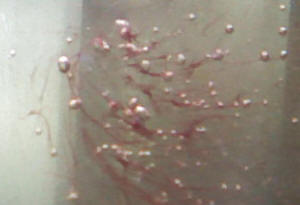
The second is a crustacean, ranging from 2-5 mm in body length. I have included a photo taken under our microscope at 40X. Many of these
"bugs" have large praying mantis-type front limbs, which have been described before on your site, but some do not. These creatures are
often observed scraping the Cyanobacteria with their mouthparts.
<Mmm, interesting. Bob may have an idea what it is.>
The third organism has appeared in our primary tank, where the red slime is being consumed by a greenish-yellow growth. Under the
microscope the greenish stuff appears granular, with the grains on the same scale as the red slime cells themselves. This leads us to believe
it is a type of bacteria. I have also included a photo of the back wall of our tank. Note how the green is arranged in a linear "front", with
little to no green left behind. More desirable types of encrusting algae are filling in the gap.
We hope this interests some of you.
<It certainly does, Amanda. Will share with others. Thank you. James (Salty Dog)>
-Amanda T

Nice pix. RMF.

Slime in a new tank! 4/29/08
New Aquarium-Old Problem (Nuisance Algae Bloom in Newly Established System)
Hi there!
<Good evening! Scott F. in tonight!>
Hope you can settle my frustrations a little.
<The doctor is in...LOL>
I have just set-up a new 70G marine set-up. Have had 2 other marine tanks before. The new tank matured nicely and I have started to stock, with just a couple of fish and some shrimp (all from my previous tank). They have all settled in well and seem their usual happy selves.
<Good to hear!>
I have, however, got a Cyanobacteria bloom. I do a 10% water change every week and the tank has been going for 6 weeks (3 and a half weeks cycling and 2 and a half weeks with stock). In my other tanks, I have had this bloom when the tanks were not long set-up and so am not overly surprised it has happened. However as it is a bigger tank the bloom is on a bigger scale. I would like to know how long these blooms usually last and what I can do to get the edge over it. I have tried sucking it out, but it comes back within the next couple of days. Thanks a lot, Jamie!
<Well, Jamie- I'm glad that you are aware of these blooms as a normal part of the aquarium maturation process. They are caused by excesses of nutrients in a system with immature (or even non-existent) nutrient export processes. Once the population of beneficial microorganisms reaches a sufficient size, you'll realize a decrease in the algae. In the mean time, your best bet is to contribute to the nutrient export processes any way you can. Nothing earth-shattering or revolutionary here. Start with continued regular water changes (your 10% is fine, or you can be obsessively geeky like me and utilize two 5% water changes per week). Make sure that your protein skimmer is functioning well, and regularly producing skimmate. Next, be sure to utilize some sort of chemical filtration media, such as activated carbon, Poly Filter, etc. somewhere in your system, and replace it regularly. Maintain brisk circulation within the system, which helps to drive off excess C02 and keep detritus in suspension for utilization by animals, or for removal by mechanical filtration media. Perhaps you might want to try to grow some "purposeful" macroalgae, such as Chaetomorpha, in you sump or a refugium (illuminated on a "reverse" day/night schedule with the display, which will help stabilize pH as a side benefit) to compete with the nuisance algae. Harvest the macroalgae on a regular basis, which will which will truly remove nutrient from the system. Finally, don't forget about the most important ingredient- a healthy dose of patience. Given time, good husbandry, and patience, the natural nutrient export systems in your aquarium will develop and your nuisance algae problem will be a thing of the past. You can do it- hang in there! Regards, Scott F.>

Cyanobacteria problem 04/15/2008
Dear Crew,
<<Hello, Andrew this evening>>
I really appreciate all your time devoted to this wonderful site. I have been reading your information for years; however, I'm stumped.
<<Ok, lets see if we can unstick you>>
I am having an increasing problem of Cyanobacteria and I've been following the information that I've found on your site. Here are the specifications that I have:
55 gallon with sump, 4" DSB
Polyfilter (changed weekly)
Carbon (changed monthly)
50/50 compact fluorescents (changed 1 week ago) on timer for being on for 11 hours <<Reduce to 8 hours>>
1 royal Gramma
1 open brain coral
Daisy polyps (small clump)
Frogspawn (5 small stalks)
10 or so hermit crabs
12-15 various small snails
1 spiny sea urchin
A lot of Caulerpa
A lot of live rock (never kept a tally of the #'s, but the tank is full)
Produces 1 ½ cups dark skimmate per week
Ph 8.1 (adding Kalkwasser slowly to increase)
Temp 81 deg. <<Maybe drop this down a few degree's>>
Ammonia 0
Nitrate 50+ <<Yikes>>
Nitrite 0
Phosphate 0 <<This will more than likely show zero as the bacteria (Cyano) will of already consumed the trace element>>
System has been in use 5+ years
I feed only a few specks per day of variety of foods (3-4 square mm total)
<<Change to feeding once every other day until this issue is sorted>>
The problem slowly started about 4 months ago with the typical red slime starting to cover the live rock and substrate. Of course I started removing it manually, watching my feedings, increased water changes, etc. But it kept getting worse until the red slime turned into a green-grayish fuzz over everything. For the past 6 weeks I have been doing 10% water changes 2-3 times per week, started testing more frequently, but it continues, including the nitrates at 50+. I have scrubbed some of the rocks, but within 2 days the fuzz is covering it just as long (2-3" in some spots) as the rocks I didn't scrub. I have no idea where the nitrates are coming from. I have tested my source water (it's 0), I don't think I have a large bio load, I change filter media as suggested, my Ph is too low, but I'm increasing this with no improvements. The LFS reports that "Cyano blooms" are cyclical, but I'm not convinced as my Nanocube is just fine even with a larger bio-load proportionately. In over 6 years of reef keeping, I have never experienced a problem to this extent, and I'm about to give up. Thanks for any suggestions.
<<Does your water, once mixed show any nitrates? I think cutting down your feeding to once every other day, drop the lighting down to 8 hours. You don't mention the amount of flow in the tank in the above description. For your tank size, i would suggest, minimum, 1375gph water circulation. Use powerheads/pumps to produce this required amount of flow. AS this is an unknown to me right now, i can only suggest it could possibly be this as its been a contributing factor to Cyano on previous encounters. Do continue to syphon out what you can. A couple of large, 50% water changes are in order to hopefully bring the nitrates down.>>
<<Hope this helps, please do reply with a follow-up on thoughts/specifics of your flow. Regards. A Nixon>>

Re: Cyanobacteria problem 04/17/2008
Thank you for your quick response.
<<no problem>>
The flow rate (675 gph) is, at best, half of what you recommended as I originally did not account for the reduction in flow due to the 2' rise of the return pipe and other flow impediments. I will add additional powerhead(s) as needed. I will also follow your other recommendations. I use a combination of pre-mixed water from the LFS and mixing my own depending on my schedule for the day. I have tested my own RO water before and after mixing, and the pre-mixed. All were zero nitrates. However, I did not test for Ammonia. I will do this, as it has just occurred to me that it may enter the system as ammonia. Thanks, again for your help.
<<Sounds like a good plan to me. Good luck. A Nixon>>

Blue Tang Problems 04/05/2008
Hi All,
<<Hello, Andrew today>>
I have recently been having some trouble with a Blue Hippo Tang in my 75gal reef aquarium. It has begun scratching on the rock work in the tank more frequently than normal, and has numerous raised bumps on it, about the size of a pinhead, and a few of them are white. I originally thought it was Ich, but as none of my other tank's inhabitants (2 percula clowns, 1 coral beauty, 1 Hawkfish) have had any symptoms or odd behavior, I figured it was something else. The tang has had this problem before, though not as badly as lately and those bumps usually went away within a few days or so, but this recent outbreak has lasted about 5 days now. My water parameters are pretty good, 0 phosphate, 0 nitrite, 0 ammonia, 2.5 nitrate, pH 8.3, salinity 1.025, calcium at 450 and Alk at 8, so water quality shouldn't be the issue. I am inclined to think it is something fungal on the Tang, and if so, what should be used to treat it? I have been soaking the food in Selcon and garlic alternately to try to help out. The tang eats very well, I usually feed Formula flakes, pellets and frozen foods, I tried to get it to eat Nori and seaweed, but it refuses to eat anything off a veggie clip. Any advice?
<<Does not sound fungal to me, it does sound like Ich, and Ich that has not gone away from a previous infection. I would suggest moving the stock to QT and treat with hyposalinity and monitor all. More can be read here http://www.wetwebmedia.com/ichart2mar.htm >>
On a hopefully unrelated note, I have been having some Cyanobacteria problems for a few months now, it will grow on the rock and glass until I siphon it off during weekly maintenance, and then grow right back. Skimming through some of your files here at WWM, I read that the DOC's from frozen foods can fuel Cyano growth <<Potentially, yes>>. I usually feed one cube a day, and until very recently, hadn't decanted the 'juice' out of the cubes, would that be the source of the problem?
<<Quite possible, yes. The juice from the frozen foods contain a high amount of phosphate (even though some foods say they don't). Cyano can appear from a few things overfeeding, too much light (lighting period), high phosphate and nitrates, flow....One of these area's are providing the means for the Cyano to bloom>>
Thank you for all your help, your services are invaluable.
Kindly, Daniel
<<Thank you for the questions Daniel, hope this helps. A Nixon>>

BGA Problems 4/1/08
Greetings,
<Hello Victor.>
I have a 125 gallon SW tank with about 90 lbs of live rock, 2x 175W 10kK metal halide lights, 3 small fish, and it is about 10 months old now. My AquaC EV-180 skimmer pulls out earthy smelling scum, not at all "foul" smelling.
<Earthy is a good description, foul in the eyes of others!>
The fish are fed 2 times a day with mysis and some omega 1 flakes.
<Be sure all this is actually eaten.>
Now the problem is that microalgae film growth is very sparse; I can't even see it. The only thing that grows on the glass is some weird green calcareous algae splotches about the size of a pencil tip as well as some Cyano and coralline. Halimeda, turtle weed, and tufts of other macroalgae seem to do ok. They grow slowly. Valonia is just about everywhere. There are probably only 10 small snails in the tank. I have been using Oceanic salt, but just recently switched to Reef Crystals since Oceanic seems to be lacking ingredients. Is there a SAFE way I can promote green film algae and diatoms??
<You are better off promoting the growth of the macroalgae. Promoting the growth of diatoms will just cause other issues in your system.>
The idea is that the microalgae will encourage the growth of microfauna and scavenge away nutrients to stop Cyano. I read that sodium silicate can be used to grow diatoms, but I don't know where to get it. I haven't tested it, but I'm sure there are nitrates and phosphates in the tank, so I'm guessing iron is missing from the water.
<It is more likely the phosphate or nitrate are limiting the growth, being used up as it is produced/released.>
I hardly ever use my overpriced magnet cleaner.
<This will make no difference.>
When the tank was first setup, the film algae grew like crazy, but I suspect that's due to washing the sand with carbon filtered tap water and the introduction of liverock.
<Yes, it is part of a tank’s normal lifecycle.>
The copepods were everywhere but now they're gone :(
<What fish do you have? This is more than likely the cause.>
-Victor
<Promoting the growth of your macroalgae will give you what you are looking for, preferably in a separate refugium. This will allow you to tend to the algae’s lighting needs without affecting your main display, and give you a haven for pod production as well. As far as your Cyano issue, check all the usual suspects: water flow, feeding/stocking levels, dirty mechanical filtration, substrate, etc. A link for you below to point you in the right direction. Good luck, Scott V.>
http://www.wetwebmedia.com/bluegralgae.htm

Re: Sick Anemone / Possible unknown toxic conditions... Mis-Id on algae... recourses   4/1/08
Hello once again!
I want to thank you for your previous advice and trying to help me save my BTA. Unfortunately it did not survive. I think I have finally discovered my problem though. I believe I'm dealing with a Dinoflagellate in my tank.
<... not from the pic... this is BGA...>
I stumbled across a post on aquariacentral.com that explained my symptoms exactly and even offered a picture that looks exactly like what I have in my tank (attached). Here is the link to the post
http://www.aquariacentral.com/forums/showthread.php?t=86128&highlight=dinoflagellates
So far I have lost only three Astrea snails, but have been noticing a little darting from my ocellaris clown fish and my yellow tang has been scratching against the rocks as well.
<...>
Anyways I took your advice and upgraded my protein skimmer. I choose to replace the SeaClone with the AquaC urchin. I also removed the phosphate resin filter pads.
<Good moves>
Currently I plan to follow this strategy to ride my tank of he Dinoflagellate bacteria.
<Stop! Dinoflagellates are algae... and what you show are Cyanophytes...>
01. Turn off lights for a full 48hrs followed by a reduced lighting period of 5hrs
<This won't do it>
02. Filter with ferric oxide hydroxide
<... what other life is present? Can/will it live with HPO4 removed?>
03. Elevate any parameters which aren't at recommended levels 04. Add a good quality activated carbon to a canister filter 05. Cut feeding to at least every other day and feed small amounts 06. After a couple of days with no light siphon out dead material with 10% water change (using RO/DI water)
Would this strategy alone be sufficient to kill the Dinoflagellate bacteria?
Is there anyway to kill the spores or stop the dormant cycle? Thanks in advance for all your help.
Brad
<Please read here: http://www.wetwebmedia.com/bluegralgae.htm
and the linked files above. Bob Fenner>

Cyano problem 3/19/08
I've read the articles available on WWM regarding Cyano, (and other sources), however I'm not 100% sure that this is the correct ID. I have what appears to be pink to red, (& sometimes green), transformation of portions of the sand bed popping up in my tank. The sand looks normal other than color although when I siphon it up I noticed that the red sand does clump together. A different looking red algae has appeared on some rock as well.
<Sounds like Cyano, although could have some diatoms mixed in as well.>
The tank has only been running for about 15 wks.
<Fairly common in this new of a tank.>
I only have 4 fish in the tank with about 8 small coral frags. There is plenty of rock in the tank however the rock was dead coral rock, (Marco rock), which was seeded with pieces of live rock and live sand from a couple of my friends active tanks. Nitrates, Nitrites and Ammonia are all at acceptable levels.
<Numbers please, less subjective. Also phosphate levels here would be helpful/vital to figuring out the problem.>
I do not overfeed, feeding small amounts 3 times a day.
<That's pretty often, most livestock does not need this. I would cut down to once a day.>
I've been performing 10% water changes weekly and trying to siphon any of the red sand as soon as it shows up. The tank is an 85 gal with approx another 13 gals in a small sump/refugium. The refugium has some Chaeto with sand and rock rubble. I also have an Aqua C EV120 skimmer and PhosBan reactor running. I have a Pan World return pump rated at 1100gph with 2 Koralia 3 powerheads on each end, (each rated at 850gph). I can't seem to eliminate this problem. I clean it up and the next day or two it's back. I don't want to chemically treat the tank. Is there any other thing I can do? Yesterday I tried to direct the powerheads a little bit more toward the direction where the problem has been occurring, (in the front of the display). I had been feeding frozen brine and mysis shrimp but I now rinse the frozen food before feeding, (I'm not sure if that helps).
<Does help, but you may want to switch to a good quality pellet food for a while, cut back on nutrients until your tank matures.>
I read that the gelatin contributes to the problem, (if this is indeed Cyano). Is there a different type of brine/mysis shrimp that is safer to use?
<Forget the brine, and mysis alone is not enough for the fish.>
I'm getting frustrated at not making much headway in eliminating this "Cyano" problem. Any help is, as always, appreciated.
Frank
<In a 15 week tank Cyano is to be expected. For the most part here I would advise patience, time to allow more acceptable but slower growing algae t take hold. Test your source water for phosphates and nitrates since these can greatly effect cyano's growth. Also cut back on feed to limit nutrients. Otherwise just keep doing what you are doing. I would definitely NOT be chemically treating the tank, the Cyano will return after treatment, although your bio-filter may not.>
<Chris>

Re: Follow up response to Cyano problem Part II   3/19/08
Chris,
<Hello>
I'm not at home so I don't have my log with me but I know the ammonia was 0, I believe nitrites were also 0 and I believe nitrates were >0 but <.5.
<Ok>
I did not measure phosphates.
<This is important here, but check it out in you RO/DI water for it, most likely won't see any in the tank since it has already been bound in the Cyano.>
I use RODI water and the unit has only been used for this tank, (basically less than 250 gallons filtered).
<If the water is bad enough some undesirable materials will slip through.>
I just changed the PhosBan media last night, (the previous media was used for the 15 wks).
<Most likely past its lifespan.>
Regarding feeding: you are suggesting feeding pellets only once a day, I thought I read that they need to eat SMALL amounts at least 3X's a day.
<With the exception of a few fish, the vast majority do not need to be fed more than once a day, or even every other day. What fish are you keeping?>
However I will follow your recommendations. I do have a Tang so I have been giving him Nori, (Is this a problem?).
<Not really, just don't leave it in the tank to decompose.>
thanks again, I will be diligent.
Frank
<Welcome>
<Chris>

Algae Control... Andrew, chatting...  03/11/2008
Hi crew.
<<Hello, Andrew here>>
i researched the BGA like bob told me to do, and i still don't see what I'm dealing with here. What's all over my stuff is a powdery sand. I also did not see any ways to control this or stop it.
<<Picking this email up. Can you please explain in detail the type of algae your experiencing? Colour etc etc, even better, please provide a photo of the algae. Thanks, A Nixon>>

Re: Algae Issues 03/12/2008
Hey Andrew, how are you today?
<<Hello, all fine thank you>>
OK, the stuff I have (I'm not sure if it is algae or not) is a brown powdery substance, and when i add water you can see it floating as it gets kicked up, kind of like sand or dirt. I watched it just about take over a live rock I have in the tank yesterday. I will send a good pic of the stuff, and in the pic, the live rock is red, and the stuff on it, is the white colored stuff (it looks whitish-brown on the rock). Please don't mind Gary; usually the snails don't go near this stuff.
<<the brown could well be diatom algae, which is fine and will pass in time. However the red tinge to the system looks to be the start of Cyano bacteria, which does need to be tended too. All info on this bacteria can be found here http://www.wetwebmedia.com/bluegralgae.htm >>
If you could help me out I would be really happy. Thanks Andrew.
<<Hope this helps. A Nixon>>

Red slime algae... continuation?  03/14/2008
What are your thought on taking out the live rock and cleaning it, two pails of prepared salt water-one to clean, one to rinse.
<<I agree, just match the parameters of both pails>>
I have 8 fish in my saltwater tank and a bubble anemone, and a star polyp. Since this red slime got really going my anemone has moved 3 times. Using a hose just doesn't get ahead of it.
<<It can be a long battle, but one which can certainly be won. Some read material here and linked files and articles http://www.wetwebmedia.com/bluegralgae.htm >>
Also what do you think of deceasing the light to 8 hrs and slowing increasing back to 12 for the corals.
<<Certainly. 8 Hours of lighting is more than acceptable anyway>>
Marilees
<<thanks for the questions, hope this helps. A Nixon>>

"Don't wanna be an American idiot"

Re: red slime algae... still not reading...  Expect more...  03/15/2008
After many worthwhile hours of cleaning rock, water changing, etc etc I believe I have a handle on the red algae. Now it's day by day maintenance cleaning to get rid of it entirely. I could only do 1/2 of the rock because the bubble anemone and the star polyp were attached to the others. I didn't want to disturb them but I did use a hose to filter out the algae I could get off the rock. I did lose one cardinal fish, although it was always hiding or possibly not well. No spots or anything when it passed away.
I've decided to not add anything else to the aquarium for awhile, to get it balanced first.
All tests came out ok today high range ph, nitrate, nitrite, ammonia, temp and salt water balance.
Marilee
<<Sounds like your moving forward well with this.. It's a battle, but it can be won. Sorry to hear about the cardinal though. Good Luck and good day. A Nixon>>

Re: red slime algae... reading? Nah, no time for that    03/19/2008
Hello again
<<Hello Marilee, Andrew today>>
I thought I had everything under control but I am faced with another issue regarding the famous red slime. I managed to clean the rocks, used my
trusty hose to clean the remaining rocks and the glass but I am absolutely stumped about what to do with the crushed coral bottom. I use a large hose to suck it up, it rattled around and then drops down but still some of the red slime remains. I can't seem to get control on the bottom. Any ideas or suggestions would be greatly appreciated. Fish and coral are fine, aquarium is doing much better except ......for the Red Slime.
<<Having crushed coral as your substrate does make it more difficult to deal with. Keeping good flow over the sand bed will help. Maybe consider in the future, switching to a better reef grade sand such as sugar fine aragonite. Continue as your doing, its not a short battle to win. BUT, you will win with perseverance>>
Marilee
<<Thanks for the questions, A Nixon>>


Red Slime on sand, Antibiotic treatments 3/5/08
Good Morning.
<And too you.>
Sorry to bother all of you so early this morning, but I have a bit of a problem. I have been getting a case of red slime algae on my sand and rocks. Almost looks like pudding skins. I have done water changed with RO water and tried to remove it. It just keeps coming back worse than it was and is getting scary close to my corals which I heard is bad. By the way, my water param.s are as follows:
Ammonia = 0
Nitrites = 0
Ph = 8.4
Nitrates = 5 - 10 ppm
I took a trip to my LFS and they suggested UltraLife Red Slime Remover.
<I would not use, is an anti-biotic, Erythromycin if memory serves.>
I was hesitant to put anything in my tank, but after trying to get rid of it and failing, and because it was coming very very close to my
corals, I decided to use some of this product.
<Better approaches here, like finding what is driving its growth. Test for phosphates which are often the cause, and find and remove the source of it.>
I know this is bad, but I felt that my corals were going to be victims very shortly.
<Still may be due to lower water quality, potential restarting of the nitrogen cycle.>
I used a diluted dose and it worked very very well. All gone in about 24 hours.
<Will return if conditions are right.>
All my life, snails, sand sifter star, 2 tank raised clowns, and corals are all healthy. In fact, my mushroom corals have about tripled in size and look great since dosing with this stuff. The only problem was that my protein skimmer started to go crazy (AquaC remora) and was foaming and filling in seconds. I had to turn it off until the water cleared up from the dose of red slime remover. After two days I turned it back on and the same thing. It is foaming like crazy and producing millions of bubbles in the tank. I know that this has to be because of the red slime remover. Because the damage has already been done, do you have any suggestions at all of how I can turn the skimmer back on without having to watch it 24 hours a day?
<Lots of water changes.>
Any help fixing this problem would be wonderful. Thanks for all of your time and efforts on this wonderful site.
Matt
<I would be doing lots of water changes and watching the water quality very closely. Your biofilter was very likely severely damaged by the Red Slime Remover. See here for more. http://www.wetwebmedia.com/bluegralgae.htm .>
<Chris>

Aiptasia and Cyanobacteria problems 2/21/08
Hello,
<Hello, Scott V. with you.>
I have a 55 gallon FOWLR saltwater tank with a small sump holding an ASM G-1 skimmer, a pump that's rated for a tank my size and a powerhead. My live rock came with some Aiptasia and I didn't know what it was until it became a big problem.
<This happens.>
I also had some small spots of red Cyanobacteria which I've been vacuuming up and with the addition of the powerhead have been at least held in check. I've since tried multiple attempts at squirting boiling water and a Kalkwasser paste on the aiptasia and it knocks them back, but they typically come back in full force in a few days.
<These can be tough to eradicate.>
I finally got frustrated and actually pulled the live rock out and squirted boiling water on the aiptasia over the sink. This was a bad idea because my live rock now smells like it's uncured.
<Yikes! You likely killed more than the Aiptasia.>
I figured this would add quite a bit of dead organic matter to the tank so I did a large water change the next day with RO water heated and aerated for a couple days with added buffer.
<Good move.>
Then I had to leave town for a few days so I decided to let the two yellow tail damsels I have go without food for a few days to hopefully knock back the Cyanobacteria.
When I got back the Cyanobacteria had gone berserk. It's covering everything in the tank now and as an added bonus the Aiptasia is back too.
<Likely nutrient/nitrate accumulation from the die off related to the boiling water.>
I haven't had a chance to do a reading for PH, Ammonia, Nitrates and Nitrites yet, but I imagine there's something wrong due to the huge growth of the Cyanobacteria.
<Mmm…yes.>
All I have in the tank is two yellow tailed damsel fish and some snails. I don't really want the damsels because they're too aggressive for the type of tank I'd eventually like to have (even though I've grown attached to them). My LFS said they'd be willing to take them back.
<Good, damsels are good to start with only if you want damsels.>
I also recently bought an RO filter and since the switch the bacteria has been getting worse even though I'm doing more frequent water changes with supposedly higher quality water. It seems to be running much faster than it's rated 25 GPD (I can fill up a 25 gallon Rubbermaid in 6-8 hours). If I wanted to get this checked where would I go to see if it's good quality or not?
<A TDS meter can be purchased fairly cheap. This can tell you the current quality of the water and help you monitor long term for prefilter/membrane replacement.>
I'd like the learning experience of getting rid of the aiptasia and Cyanobacteria, but the tank is in bad condition now and my efforts don't seem to be gaining any ground on a bad situation. What are my odds of saving the tank at this point being new to the hobby? Would it be better to start over with a new clean tank, or keep fighting.
<Keep at it, this battle can/will be won and you will learn much doing so.>
Are there any more measures I can take other than being diligent about water changes and squirting the aiptasia with boiling water?
<In this case I recommend revisiting the Kalk concentrate. Get hold of a syringe and actually inject the solution into the Aiptasia.>
How effective are urchins at controlling Cyanobacteria?
<They are not.>
What about red-legged hermit crabs for aiptasia?
<Some (Dardanus megistos in particular) are known to help.>
At this point I think adding more invertebrates will just make the situation worse due to the amount of aiptasia and Cyanobacteria.
<They are a related problem, excess nutrients in the system fuels the growth of both.>
I'm concerned my skimmer isn't doing enough to keep up with all the organic matter from the dead aiptasia should I look into additional skimming/filtering/powerheads?
<If you can more skimming would not hurt; otherwise just keep up with the water changes.>
Thanks for your help
<Welcome, do check out the links below for Aiptasia and BGA control. Good luck, Scott V.>
http://www.wetwebmedia.com/marine/inverts/cnidaria/anthozoa/aiptasia/aiptasia.htm
http://www.wetwebmedia.com/bluegralgae.htm

Red algae... BGA, ID, contr.  02/13/2008
Hi crew!
<<Hello, Andrew here>>
Thanks for taking the time to answer my question. I have a red algae growing in my tank & I am not sure what to do about it.
<<Looks like Cyano bacteria to me>>
I have a 75 gallon tank set up last May/June. I have about 75 pounds of rock--some live, some not. There is about 20 pounds (guess) of live sand and crushed coral.
<<Crushed coral sand is notorious for collecting debris and detritus>>
The following is the livestock in the tank: 1 yellow tang, 2 clownfish, 2 anemones, 3 feather dusters, a sea cucumber, 2 mushroom rocks, a toadstool leather coral, a star polyp rock, 3 snails, 12 hermit crabs, 1 sexy dancer shrimp and a coral banded shrimp. All tank inhabitants seem to get along really well. (Had some trouble when introducing the second clownfish, but they are buddies now). I am running 2 powerheads, a Penguin BioWheel 350, a Coralife Super Skimmer 125G and a bubbler in the back and a heater. The temp in tank runs between 77 and 79 degrees. The lights--regular lights--are on from 8am to 8pm.
<<When was the last time you changed the bulbs? Out of colour bulbs can be a cause of plague algae>>
I am feeding a variety of foods--Kent Marine Zoo Plex liquid form, marine flakes and frozen Formula One cubes.
<<Do you thaw out the frozen foods in some tank water and then wash in Ro water? If not, I would start to do this. Frozen feeds are notorious to carry high levels of phosphate. How often do you feed? Maximum once per day on your stock.>>
The last tests I did showed the PH at 8.4, Ammonia at 0, Nitrite at 0 and Nitrate at 20.
<<Ideally, you could do with getting the nitrates down, at by another 10ppm. The BioWheel filter could be the cause of this. When was the last time you washed the wheel on it? and wash it in tank water by the way.>>
I do not know if the phosphates are high and that is what is causing the algae growth?
<<Looks like it could be a combination of phosphates (which are currently at an unknown level), and nitrates>>
The algae is really pretty--dark red, but it will take over if I don't get it out of there. We have siphoned out quite a bit. I am not sure how to test for phosphates? Is that the same as PH?
<<Buy yourself a phosphate test kit to start with, and find out what the level is. After knowing that, you can then devise a plan to start eradicating the Cyano>>
Should I try putting in a PhosGuard type of treatment? We have done 2 water changes in the past month hoping to get rid of this algae.
<<Go for a 10% weekly water change routine until the problem is resolved. Continue to syphon out what you can>>
The last time we had this algae take over--about 4 months ago, water changes seemed to take care of it, but this time it is not. Is this an algae that I even need to "worry" about?
<<See comments above>>
The mushroom corals really seem to like whatever is in the water that is causing the algae. Everything in the tank seems to be doing very well--the algae is just more of an eyesore than anything. I am attaching a picture--not a great one, but you can see the algae growing on the polyp rock. Also, towards the top left of the picture, you can see one of the anemones that I have. It was a stowaway on a piece of live rock--but I don't know what kind it is.
<<The anemone you have there, in the attached picture is a glass anemone, or commonly know as aiptasia. These are pest anemone's and should be killed/removed from the tank so they do not spread. Review this link and read articles http://www.wetwebmedia.com/marine/inverts/cnidaria/anthozoa/aiptasia/aiptasia.htm >>
<<Further reading can be found on this link regarding the Cyano bacteria issue your experiencing. http://www.wetwebmedia.com/bluegralgae.htm >>
<<Thanks for the questions and I hope the above helps. A Nixon>>
Any help would sure be appreciated! Thank you! Angela Anderson

BGA. RMF.

SW questions and Cyano 02/08/2008
Hi Crew,
<<Hello, Andrew today>>
I have a 10 gallon that is almost 5 years old. It has a neon goby and a clown goby and candy canes. There is a small filter and a small power head and about 10 pounds of rock.
The lights are 65w PC. I know it is time to replace them since they are 10 months old and the coralline on the glass is starting to lose color. I am also having a Cyano outbreak. Is this related to the lights or more likely to ?
<<Its very possible indeed. Some other factors that are involved with a Cyano outbreak are phosphates and lack of flow. Read more here. http://www.wetwebmedia.com/bluegralgae.htm and linked articles and FAQ's >>
I change one gallon a week and I do not test for calcium. Is it ok to use
sea-lab 28 without testing? On the other hand, is it beneficial?
<<As with any additive, never add something to your tank unless you can, and do, test for them to ensure the levels are correct>>
Thanks
<<Thanks for the questions. A Nixon>>

Cyano? Red Hair Algae 02/05/2008
Hello WWM,
<<Hello, Andrew here>>
My tank has had an algae problem for a while, and I believe I am slowly taking it out. First of all, I got a better Pinnacle RO unit which replaced my crummy tap water filter.
<<Certainly going to help no end>>
The algae has decreased significantly, but it is not quite gone yet. The one I notice the most is a long, thin, hair like red algae, that grows in certain spots mainly the substrate. I wasn't sure if this is Cyano, but I guess I won't find out until I do more water changes and more skimming. Is there a different between Cyano and red hair algae? Its my main problem. Would a Phosphate reactor help here?
<<There are a few different types of red hair style algae's such as Gelidium, Polysiphonia and Asparagopsis. Providing a photograph of the algae in question would help a lot to advise what type of algae you have. And to answer the question, yes, Cyano and red hair algae's per say, are quite visually different. A phosphate reactor would certainly be a good device to add if you feel the phosphate levels are high and your unable to control them yourself>>
Thanks, Joe
<<Thanks for the questions. A Nixon>>

Re: Cyano? Red Hair Algae 02/06/2008
Its hard to identify. It is very long and tin and it is waving violently all over the sand. I thought it would be dinoflagellates, but I don't think so.
Could it be my salt? When I my tank had a low water level, I did a lot of top of (over time) to get the level back up with the RO water. The algae never returned here, but one I did a water change with a 1.023 gravity, the same as in my tank, it started to appear. Could it be my salt? Is it because it is old and has been exposed to air since December 2006?
Here are two pics.
<<The algae in the two picture's are Cyano bacteria. Have a read here for more information. http://www.wetwebmedia.com/bluegralgae.htm and linked articles and FAQ's>>
<Thanks for the questions. A Nixon>>

Cyano/BGA Problems 1/26/08
Hi crew,
<Hello, Scott V. with you.>
I was hoping you could help me with a BGA outbreak. I am running a 54 gallon tank with wet/dry sump filtration, remora skimmer with Seagel in preskimmer box, 40 lbs LR and LS, 2 MJ 900 for circulation, and a PC current-USA orbit 130W. The tank is currently running fallow due to crypto outbreak (fish in QT, post copper treatment and are doing fine).
<Good to hear.>
The system residents include 2 emerald crabs, a few margarita snails, two turbo snails, and a peppermint shrimp. Many bristle worms, stars, etc on the LR along with two small colonies of red mushrooms. The system is approximately 6 months old.
<OK>
During the QT process I switched salt from Oceanic to Reef Crystals because my calcium was exceeding 500 with only dKH 6. Current tank readings are as follows: Ammonia-0, Nitrite-0, Nitrate-0, Calcium-320, dKH-7, Phospates-0 (but I suspect it is higher),
<Likely being consumed as it is produced, same with your nitrate level.>
Temp-77.5, Ph- 7.95, Sp. Gr. 1.023. I did raise the tank temperature to 83 degrees and lowered specific gravity to 1.017 for three weeks during crypto treatment. I continue to buffer the system with Seachem Reef Buffer to raise alkalinity, although this is getting difficult because of the declining calcium levels.
Obviously, I made changes to the system recently during treatment. During the last few weeks, red slime/BGA has been growing on the LR, LS, and glass. I am performing 10% water changes twice weekly, vacuuming the gravel and scraping the algae. I have not fed the system in weeks, but the skimmer continues to pull a cup of dark skimmate per day, so obviously I still have quite a bit of organic material.
<Yes, it appears so.>
Although the bulbs are only six months old, I replaced the 6700/10,000K and the 420/460 actinic bulbs in case this was contributing to the Cyano. So, I've read the numerous articles on WWM and I am trying to control the situation through not feeding the system, frequent water changes, replacing aging bulbs, scraping off the algae, etc. I was OK with this approach until I noticed that the snails are not doing well (I've lost several of them and the rest will follow shortly; I believe this is more related to the hyposalinity and increased temperature);
<Likely so.>
today, two rather large bristle worms are out during daylight, writhing on the substrate apparently dying. Could the BGA/Cyano be releasing toxins now that they are being removed?
<No, likely the changes in water chemistry.>
Would this affect the worms and snails? The 2 crabs and the pep shrimp continue to do well, as do the red mushrooms. I know that I have a problem with my calcium/alkalinity balance;
<Your balance seems fine, both are just on the low side.>
I feel like I could go back to Oceanic salt and continue to buffer alkalinity, or the other option would be to try a two-part dosing product.
<I would try the latter, this will raise the calcium and alk proportionately. >
Beyond that any imbalance in the system favors Cyano/BGA, could the low alkalinity and calcium be contributing to the Cyano problem?
<It doesn’t help your situation. Part of ridding your tank of Cyanobacteria is provide competition, which the lower levels impede.>
The fish are doing very well in QT, and I plan on leaving them there until this is resolved. Anything else I could try?
Thanks as always
<Do look into removing the biofiltration in the wet/dry filter. They tend to be detritus traps and nitrate producers. Your live rock will act as your biomedia. Perhaps you could convert the section into a macroalgae refugium, very beneficial towards solving your problem. Also, I would increase the flow in the tank with another MJ or two. This will help keep things in suspension for your skimmer to remove.
You are on the right track. Best of luck to you, Scott V.>

Re: Cyano/BGA Problems 1/28/08
Thanks, Scott--
<Happy to help Mike.>
I've often wanted to convert the biofiltration into a refugium.
Unfortunately, I have a ProClear SL 60, which is a very small sump.
http://www.pro-clear.com/wetdry.html. I really don't know how I would modify this...could you direct me to a link?
<None in particular that I am aware of…to do this will require some innovation and design replacing and changing the baffles in the system. Perhaps to mimic sumps out there with built in refugiums.>
Alternatively, I was thinking I could put LR rubble in the biochamber and perhaps CPR's In-tank refugium in the sump. What do you think? If I just went with LR Rubble, would it need lighting <No> and would it make a difference that the rock was not fully submerged.
<I would be inclined to put it only in areas that will be submerged, even increasing the water level as high as your transit volume (how much your sump catches with the power out) will allow.>
Any ideas about modifying the SL 60 would be appreciated if you think it is worth the effort.
Mike
<There is no one easy way to do this. It may be more worth your while to add an additional tank or other container as a dedicated lighted macroalgae refugium. If you have the room for both this will likely be the easier route to take. Many benefits to you towards your problem. Either way I would remove the biofiltration in this system. Good luck, Scott V.>

Red slime experience -01/17/08
To the crew:
We have been noticing so many people writing in lately about red slime, we thought we'd briefly share how we dealt with the problem ... and won (in no small part from the advice given here on this awesome site).
<cool>
Our 120-gallon reef tank (4x2x2) became so infested with red slime over the summer that almost everything died. All the coral. All but about five fish. The top of the tank was almost solid with the stuff.
We tried Red Slime Remover about six times. When you use this, you must turn off your skimmer. It did nothing.
<Sometimes it works, sometimes it doesn't...>
Eventually, we gave up trying to fix it and emptied the tank. We sent the fish to a holding tank at our LFS. We drained ALL the water. Scrubbed ALL the rock. Replaced the bio-balls with crushed live rock.
<interesting>
Added two more power heads,
<good idea>
one that does nothing but keep the surface moving. We took out half the sand and added new sand.
Then we replaced all the rock (ended up with a nice arrangement) and added new water. We let the tank stay empty two weeks while we monitored all the chemistry. Some slime started coming back, so we shut the lights for a week and it went away. After turning the lights back on for another week with nothing untoward, we brought back three fish. A week later, we brought back the rest of the fish.
All has been stable now for three months. The tank is healthy and filled with coralline. An unexpected bonus was the rebirth of our Plate coral, which was dead ... so dead, we scrubbed it in fresh water and put it back in the tank because it was a pretty skeleton.
It sat in the sun, out of water, for an hour. Today, it's huge and healthy.
<Wow! Incredible, congrats.>
And we learned about needing way, way more water movement than we ever thought we'd need. We learned about the importance of keeping the temperature stable and lower than it got without a chiller (on the agenda for this summer, for sure). We learned the importance of PATIENCE.
<Ah yes, the true "miracle cure." ;-)>
And we learned that everyone has a different opinion about what you should do, and the answer is somewhere in the middle. We are more diligent about water changes and keeping our stock of fish low and not mixing coral that doesn't chemically get along.
<awesome>
Thanks to all of you for your ongoing care of all of us who endeavor to keep a slice of the ocean (or a pond, or lake) in our homes!
<Thank you so much for sharing your story/experience with us.>
Michael and Dianne
<Best,
Sara>

Red Cyano outbreaks.
Tweaking A New System For Long-term Success! 1/17/08
Right off the bat sorry about the length of this rambling email but if often seems people don't give you enough info. And I'm unsure where to start.
<No problems! I appreciate the information! Scott F. in tonight!>
Ok first off the tank setup. 90g tank no sump. 100 - 150 lbs of LR. 3 Hydor Koralia #4's and 1 #3. Also have a single Maxi jet 295 gph with prefilter for particle filtration which I clean ever 5 days. 1 Aqua C Remora Pro with Mag5 pump. 1 Phosban media reactor with Dr.s foster and smith Phospur phosphate remover. 1 Phosban media reactor with carbon. (am aware it gets used up quickly but I just change it every 2 weeks or so) Both media reactors are driven by 106 gph Minijet pumps. 2 Visitherm Stealth 250 watt heaters. Lighting is a Current USA Orbit extreme 130 x 4 watt strip. Everything except 50 lbs or so of the rock has been added within the last month to month and a half.
<Nice equipment!>
The tank was previously a stripped down bare bones FOWLR that had 50 or so lbs of rock. Equipment was a Rena xp3 canister with factory enclosed media. Had 3 Maxi jet 295 gph powerheads also. Lighting was a 260 watt Coralife. Tank was started up with tap water in middle of may in 07 and used tap water for the (few) water changes I did. (yes lots of horrible newbie mistakes that am earnestly trying to correct).
<Well, as exasperating as they are- if you learn from them, they were a good experience.>
Stock list varied, but finally settled on a 5 inch Honeycomb Grouper a 21 inch Blackedge Moray a 3 inch Bennett's Sharpnose and a 5 inch Naso lituratus. (Have since located a local reefer with a 250g tank that will take the Naso if am unable to get a bigger tank in time and the grouper I can setup a simple FOWLR if he grows to large but the max size in wild is supposed to be 12 inches) I am unsure if this counts as a heavy bioload or not. Before I started earnestly trying convert the tank to semi reef it was covered in long green algae am fairly sure is Bryopsis. Also had lots of red Cyano. Not sure what nitrates were due to learning that API test kits can be junk. They were reading as around 50ppm though. Ammonia and nitrites were 0 ppm. Phosphates were never tested.
<Well, you've solved some possible problems and are on the way to solving others. A population of heavy eaters in a system with limited nutrient export capacity and unchecked nutrients is an open door for nuisance algae and other problems!>
In preparation for cleaning up the algae monster I started doing large (35 gallons or so) water changes with distilled water.
<Better.. RO/DI is even better still. Make sure that your distilled water source is a good one. Good source water is a huge component in successful husbandry practice.>
I did about 4-5 of them before adding 25 lbs of LR from the LFS that turned out to be less then fully cured. I did two more largish ones while the rock finished curing. (this rock was added in late November) Most of the equipment arrived mid December and a couple days after Xmas I went to a LFS a couple hours from me and got another 80 lbs of Fiji rock. I was assured it was fully cured but upon getting it home I noticed bits of dead things on it. Picked off what I could and added it to the tank.
<"Fully cured" is a tough claim to live up to. There is almost always die off associated with transport and acclimation of rock into a new system. Consider all rock as "uncured" to some extent and you'll be better off.>
Skimmer was added about 2-3 days later. After the earlier large water changes the green hair algae covering the back glass started looking sickly so I removed it over the course of 4 days or so by scraping and siphoning it out slowly so as not to cause an ammonia spike. Current water parameters are 0 ppm ammonia, 0 ppm nitrites, 40-50 ppm nitrates, 0.5 ppm phosphates kH is 10 don't have a gH test. Old calcium test was incorrect so it was way to high around 580 ppm. Will let it slide down to 450. I have been doing 25g water changes every 6 -7 days. (have done 4 IIRC since the upgrades) Essentially the tank has been complete since December 30th or so. Sand bed was supposed to be 3 inches or so but the eel moves it around so much its 5 inches in some places and bare in others. Should I add more sand to try and make it fairly deep overall ?
<Well, it really depends. Deep sand beds do help with nutrient export and provide other benefits, such as supplemental food production, etc., in well-managed systems. They can be potentially problematic in poorly managed or overstocked systems.>
My question are as follows.
I keep getting red Cyano outbreaks in places. I siphon it out soon after spotting it. It doesn't seem to spread extremely fast. Mostly on sand but a couple on rocks in the back of the tank where I think I may have had low flow.
<Often a supporting cause of Cyano outbreaks.>
No huge patches...nothing more then a few square inches. (have since shifted flow to the offending area) I am new to the whole reef experience, so I'm unsure as to whether or not the green Cyano and the stubborn bits of Bryopsis still hanging there are something that is a result of massive nutrient build of from many months of bad maintenance or from live rock still curing?
<A bit of both, I think. You need to sort of "hit your stride" with nutrient export and husbandry (ie; water changes with quality source water, use of activated carbon and/or other chemical filtration media, and aggressive protein skimming), and think about stocking and feeding your system for long-term success. These are skills that will come with time. You've don a pretty good job of identifying and correcting your mistakes thus far- keep it up! I do think that the stocking of this system needs to be re-worked. The fish population is too much for this system.>
I don't know if this indicates something badly wrong with my tank, or just still settling down from the addition of all the live rock and general disturbance of the tank.
<Again- a bit of both, IMO.>
I feed the eel and grouper every 2-3 days with shrimp and cod. I only feed as much as they will eat with no excess floating around the tank. The puffer and tang get algae sheets a couple times daily.
<Good- but you really need to think about trading these big guys for smaller, more sustainable fishes for this aquarium. This is just too much bioload for this system for any length of time. I'm having visions of sardine cans or crowded elevators here! Do some reading on the WWM site about small fishes, like Blennies, Gobies, Fairy Wrasses, etc. There are tons to choose from, many of which are every bit as sexy as the brutes that you are keeping now, and they are all better suited to a 90 gallon system!>
So in short, do I just need more patience and keep doing what I'm doing?
<Yes, you do need to "stay the course" and continue improved husbandry practices.>
Or is there something major I need to change?
<Well- yes again! You need to pair down the bioload, as mentioned above. In addition to endless water quality and nuisance algae issues, the fishes themselves will suffer from being in quarters that are simply too small. Make some tough decisions and trade in these larger fishes for small ones better suited for life in a 90 gallon aquarium.>
I did so much work and put a fair amount of money into beefing up my tank in hopes of keeping several softies and a couple Montipora species. Just would like to know if the tank just needs time.
<As above- time and some tweaking.>
I have some small frags and colonies of Green Star, Green Tree, and some Clavularia, plus a couple colors of Actinodiscus. They are growing even with the high nitrates but slowly.
<Yes, I would imagine. Do also consider "specializing" in one type of coral, too. In other words, just soft corals, or just the Mushrooms, etc. Better for long term success, IMO.>
Thanks in advance,
Brian
<Hang in there, Brian- you are learning! Good luck! Regards, Scott F.>

Re: Red Cyano outbreaks.  – 1/18/08
It's Brian again
Would it help if I got rid of everything but the Moray?
<Ummm, Bri... need to send prev. corr.. I can barely remember what's in my own tanks>
Really cool fish and he's essentially full grown for his species according to fishbase. Im unsure about your comment on aggressive skimming.
<Uhh... there are a couple dozen of us here... don't think it was I you were "chatting" with>
I clean my skimmer daily and it runs 24/7. I'd like to not have to siphon out red Cyano every day or two and not have green hair algae on the rocks. That's my end goal.
<... Okay>
I'm still trying to decide what to do as the LFS in this area are less then wonderful with there saltwater fish. (goldfish feeders for all!)
<No thanks... I'll have Cheerios>
If getting rid of everybody is what I'll have to do in the course of making my tank a nice reef I'll end up doing it. Will it be possible to have a fairly coral laden reef tank without a sump and a fuge?
<Yes... they can, usually do make all "easier" though>
I don't want to give up my wonderful fish in exchange for a colorless tank. But also lack the space for a fuge/sump. As for specializing in corals I don't follow what you mean. Also am getting conflicting opinions on what corals I can keep with my 520w PC only reef. Opinions range from nothing but low light softies to high light sps.
<Read on... read on>
Thanks again for the help,
Brian
<Re: algae, here: http://wetwebmedia.com/marine/maintenance/index.htm
scroll down... Bob Fenner>

Thinking of upgrading 01/11/2008
Dear fonts of knowledge,
<<Hello, Andrew here>>
I have been running my marine tank for about 3 years now. All in all, it is quite healthy. I must s