|
|
| Home | Marine Aquariums |
Freshwater Aquariums |
Planted Aquariums |
Brackish Systems |
Ponds,
lakes & fountains |
Turtles & Amphibians |
Aquatic Business |
Aquatic Science |
Ask the WWM Crew a Question |
| Please visit our Sponsors | ||||
Hello. I'm planning to set up a dedicated 40gal
BTA/maroon tank 7/17/07 and need some advice. Just to come
clean, I've had the pair in my 12gal for 3 months now and realize
that I need to step things up (they are still relatively small).
<When you say pair, do you mean you have two maroon clowns (or a
pair as in one maroon and one anemone)? If you have two maroon clowns,
a 40g tank is going to get too small. Full grown female maroon clowns
(and if you have a pair, one will always end up female), are even more
aggressive in a tank with a host anemone. Not only will she not
tolerate any other fish in the tank, she will make her male partner
miserable in a small tank (and she'll probably start biting you
too). Seriously, just about any fish tough enough to spar with an adult
female maroon clown would be too big to add to a 40g tank.> I want
to keep things as simple as possible, so I figure to go the hang-on
route, skimmer and filter-wise--no sump. I understand that this
isn't a lot of water volume for an anemone tank, <Activated
carbon would also help.> but I am religious with making weekly water
changes, plan to use the best skimmer possible, and keep the fish stock
to a bare minimum (I am also aware of maroon aggression issues, and
will take care here). <Hmm... having two fully grown maroon clowns
and an anemone in a 40g tank is probably not what I would call
minimally stocked.> As far as lighting, I'm unsure--I've
heard that halide's might present heat issues in a system this
small. Would a T5 fixture be better in your opinion? <In my opinion,
you should get a bigger tank. Even a 65g (which has the same footprint
as the 40g breeder) would be better. Metal halides can cause heat
issues in any size tank. However, the heat can be controlled by keeping
the light at least 8in above the water's surface and pointing a
good fan at the light.> Thanks for being there! Eric <No problem.
Thanks for writing :-) Best, Sara M.> Anemone Tank. BTA Bio-tope....Adam J. back in the saddle Hello Crew, <Matt.> I have a 60 gallon setup strictly for bubble tip anemones. <Okay.> My specs are: 0 Nitrate, 0 Ammonia, 460 Calcium (kept by a Korallin reactor) 11.8 DKH, 8.2 Ph, Temp 76. My system is 2x175 halides with spider reflectors, Mag 9.5 Return, 2xMaxi Jet 1200's on a 10 second on/off timer with sponges over intakes, Tunze 9010 and 25 gallon sump. <Sounds good.> Recently I purchased a beautiful Indo Pacific Rose Anemone. <Wild collected or cultured?> He floated around for a little and then attached himself to a crevice in the bottom. I have now had him for 3 days and he stays fully inflated in a shaded portion of the tank. He was kept under 250 watt halides at the LFS so I know he can't be afraid of the lighting that I have. The second day after I purchased him I fed him a piece of silverside, <Not really a favorite of mine for cnidarians to be honest. Look into Mysis, krill, clams, scallops, and so on.> which apparently was too large because he spent a whole day spitting it out. <Yes anemones are very easy to over feed.> I have decided to now feed him much smaller pieces. My question is. 1. Does my tank have too much flow for these anemones? <I would think not.> 2. Will keeping my calcium reactor on this system have any benefits? <Yes.> 3. How long after an anemone regurgitates it's food do I wait to feed it again? <Wait at least 48 hours maybe even 72, in fact I'd give the anemone a little bit more of a settling periods before I started feeding that heavily.> 4. Will the addition of dosing Tropic Marin's A & K hold any benefits? <I don't see the need really with regular water changes and the reactor but it won't hurt.> Your time is very appreciated, <The anemone is still settling in I wouldn't worry yet.> Matt <Adam J.> Stressed Bubble Tip Anemone, Entacmaea quadricolor, Tank Overheated -- 6/19/07 Hi Guys! <Hello, Brenda here> So this is the deal, I've had a bubble-tip anemone for about 10 months now and it has always seemed happy. It is brown colored with a very orange base. It attached itself to the lowest point in the fish tank against some live rock and stretched its body through the live rock so it could get light. It always took to food and always opened up when the lighting came on in the morning. A few weeks ago, the temperatures in the area went over 100 degrees and we didn't have our air conditioner on at the time. <Ouch!> I didn't anticipate the heat (darn that weather channel) so I didn't have any type of cooling for the tank when it happened. (I now have some emergency frozen 2 liter bottles of water to float for such days). <Great! Using a fan to blow air across the surface of the water will also help.> Now, the anemone will not come through the live rock to get light. I moved some rock around to see what it looked like, and the foot does not seem damaged at all. Its appearance around the mouth looks very leathery while the mouth itself used to be very tightly shut but now stays open to about the diameter of a pencil. The tentacles are no longer bubbly at the tips, they taper to a point. I moved the live rock around it so I could have access to it to feed it in the morning, but when I got up to look at my fish tank, the anemone was completely shut. Is my anemone out of whack, sick, sensitive to light now, trying to get better? <Your anemone is likely still stressed from the heat. Leave it be, don't try to move it. It will move when it is ready. Moving it will add more stress.> I've had the water tested at the LFS and they said everything is fine. <I don't trust tests done by LFS. You really need to be able to test your own water parameters. Parameters can change over night. Pristine water conditions will be the key to its recovery.> The only other issue I can see with the tank is that a bit of my purple coralline algae seemed to turn brown after the day of overheating. <Your coralline algae will return.> Thanks for your help! <You're welcome! Brenda> BTA, lighting. 5/20/07 Hi guys how are you doing. I have a 65 gallon tank with 130watts of Actinics, <I would switch these out... see WWM re> and 175 watt Odyssea HQI bulb, powered by a Rio 2500, <Ditto...> and a protein skimmer. i have a Maroon Clown and i am looking to buy a BTA for him. I know he will accept the anemone because at the LFS he was housing a BTA. I have great water parameters. some zoanthids and a carpet of green star polyps about 14 inches long. <May be allelopathy issues here...> I was wondering if my lighting is enough to house a BTA. Thanks Orestes <For how deep a system? Please read here: http://www.wetwebmedia.com/btasysfaqs.htm and the linked files above, and where you were referred to. Learn to/use the indices, search tool... Bob Fenner> Re: BTA, comp. 5/21/07 My tank is 36"L x 18"W x 24"H with about 85lbs. of live rock. It has been running for almost two years with no outbreaks of any kind. <Ahh, thank you for this follow-up. It does seem that this is one of the "happy cases" where all Cnidarians have "gotten used to" each other. Do take care not to introduce any new "alpha" specimens. Oh, and yes sufficient illumination here if the BTA is placed somewhere near/underneath the HQI lamp. Bob Fenner> New Bubble Tip Anemone, New System, Over Stocking -- 5/13/07 Hi Bob - Thanks for the site - certainly the first port of call for any queries. <Hi Colin, Brenda here! Thanks for the positive feedback! I received both of your e-mails and I will answer both together.> Yesterday we bought a large bubble anemone. On the receipt, it called it a "purple base maroon anemone", but I cannot find references to that on the web. <Try searching Bubble Tip Anemone and/or Entacmaea quadricolor.> We were told at the store that the anemone likes to adhere to rocks, rather than the sand at the bottom of the tank. However, when we put it on a rock near the top (to be close to the light) it quickly detached and started floating around. This was a worry, because we also have a large carpet anemone that seems to be doing fine, and we didn't want the two to come into contact with each other. <Two different anemone species should not be kept in the same tank.> Anyway, the anemone seemed to like the gravel at the bottom of the tank better. It became very large indeed (dinner plate size), and even looked as though it may be splitting. It seemed to be starting to settle. It looked great actually. But when I got up this morning the entire anemone was sandwiched between two large (40lb) rocks. It has flattened itself out, and is sitting a wide but thin the crevice between the rocks. It does not seem to have reduced its surface area that much - but it is flat like a pancake in the crevice. My guess is that it may be responding to the stress of being manhandled a lot last night. <I don't recommend handling the anemone, other than to place into the tank. There is a lot of stress involved when an anemone is moved from one place to another. This includes from the LFS to your home.> But is it dying? <I don't know, would have to see a picture.> Ours is a new system; we finished the cycle three weeks ago, and everything looks good. <Ouch!!!!! New system? Anemones need stable, established environments. Most systems take 6 months to a year to become established.> We have a 120 gallon tank with a 50 gallon refugium. We live on the beach in south Florida so we filled the tank from the sea. Nitrates, nitrites and ammonia all look good. We have a protein skimmer. Circulation is good. When we put the anemone in, we noticed the pH was only 7.8 so we put some buffer in. <I don't recommend the use of pH buffers. You need to be monitoring calcium, alkalinity and magnesium, with a full understanding of their relationship to each other.> We did a 20% water change about 4 days ago. Also, our temperature might be a bit high at 80-83. <80 -- 81 is fine, anything higher is too warm.> We have only 4 60W 2 foot fluorescent bulbs providing light. We are working on getting some more light. <That is not nearly enough lighting for either anemone. Both of your anemones will quickly decline under your current lighting.> Over the last three weeks we have put in: A large carpet anemone, a sail fin tang, a powder brown tang, two saddle back clowns, a volitans lion (not eating dead food yet, but showing promise), 3 sally lightfoot crabs, 2 emerald crabs 15 assorted hermits, + 1 small blue damsel left over from the cycle. Everything has been doing fine. <You are WAY over stocked for such a new tank.> Yesterday we added: Two large black percula clowns, they fought a little with the saddles, but seem to have calmed down, pretty much kicked the saddles off the carpet anemone. <Your system is too small for more than one pair of clownfish. They will eventually fight until the death of one or more.> The bubble anemone, Two electric flame scallops (one of these might have come into contact with the anemone.) <You need to slow down here. I suggest returning the two anemones. At this stage in your new system, I recommend keeping no more than the damsel and one pair of the clownfish, at the very most. Everything else should be returned. Please search WWM regarding cycling, stocking, toxic water, live stock compatibility, and established systems.> Thanks for any help, Colin Second E-mail from Colin: Bob - Sorry for repeat mail. I have something to add to my previous mail: part of the anemone can be seen through the back of the tank. The tentacles are somewhat inflated. <It is stressed, and will only decline.> It seems to be sucking in one of the scallops. I cannot reach in there to pull off the scallop, and I don't want to move the rock because it is very heavy, and I will probably damage the anemone. <Not a good situation you are in. The anemone will not do well in your system. Moving it is going to cause stress. However, removing and returning the anemone is going to be the best option for the long term health of the anemones.> Thanks again, Colin <You're Welcome! Brenda> BTA, Entacmaea quadricolor in a Nano Tank -- 5/8/07 Hello Crew, <Hi Matt, Brenda here> Throughout this past year I have relied heavily on your FAQ's to obtain knowledge in proper husbandry. <Great! Happy to hear you find it helpful.> This particular is regarding a new setup with a 24G JBJ Nano Cube. I have used 'cured' rock from my 200 gallon reef of over a year, along with water from the same tank to quickly cycle the new Nano Cube. <Did you transfer any of the sand? An established sand bed is important.> My Nano setup is: 150 watt Viper Light, Remora Protein Skimmer, Koralia Powerhead, 35 Lbs Live Rock, JBJ Auto Top off, Milwaukee Ph Monitor and so on. My question is this, with careful weekly water changes and diligent checking of water parameters, is it possible to have several 2-3 rose anemones in this species only tank? <It is possible, but I don't recommend it. Water quality can go down hill fast in smaller tanks. One anemone can quickly out grow a tank of that size. Also, a powerhead can be deadly to an anemone.> Also, what is the proper temperature to maintain such creatures? I am hovering around 77-78 right now. <79 -- 81> I would appreciate any input as I value your experience highly. Thanks, Matt <You're welcome! Brenda> Shrinking BTA, Entacmaea quadricolor -- 4/10/07 <Hi Brad, Brenda here> Hello, I am fairly new to aquariums. I have a 55 gallon salt water tank with a satellite lighting system with dual actinic and dual daylight compact fluorescent bulbs. I have a Bak pak protein skimmer, a cascade 300 filter, a power head, 40 lbs live rock and 30 lbs live sand. I have had it for eight months. I just started playing with coral about 2 months ago. I have 1 tang, 1 maroon clown, I have one small mushroom coral, 2 large feather dusters, 1 sponge coral, 1 polyp, I just purchased a BTA (4 to 6 inch) 5 days ago it has been doing fine. It was doing great this morning when I went to work. I came home at 6 it had shriveled up drastically its bubble tips are about the size of long grain rice. <A picture would help. If the tentacles are short and stubby, it is likely hungry. It needs to eat meaty foods like krill, silversides, lance fish or mysis shrimp.> Tested water, all levels are at zero the temperature was low at 72. <The temperature is much too low for an anemone. Gradually bring it up to around 79 -- 80 degrees. What is the salinity, pH and alkalinity?> I do not know if this is the problem or not please help. Has it died or what has gone wrong. <It could be the problem, or it could be a combination of things. It could be expelling waste, what have you been feeding it? It may still be acclimating to its new environment. Anemones will shrivel up from time to time to expel waste. I doubt that it is dead. If it starts to look like it is melting or decaying get it out fast and do a large water change. A dead anemone can really spike the ammonia.> Thanks, Brad <You're welcome! Brenda>
Re: Move the BTA, sys. 3/14/07 So the BTA has to go. I want to set him up in his own tank with his clown fish. I hope this will be of overall benefit to the tank. I have a 15 gallon and a twenty gallon high to choose from. <These are really too small to be sufficiently stable... I would not use anything smaller than forty gallons here> The height of the 15 is 12" and the height of the 20 is 16" I would prefer to use the twenty but I need to know the most economical way to light the system. It will house only the BTA and the clown. Since the depth is not huge could I get away with a dual fluorescent fixture, or do I need to do something more expensive like a VHO. The BTA is currently under a satellite VHO fixture but is about 10" from the light. Any advice would be greatly appreciated. I want to keep the BTA. It is very healthy and happy and I want to keep it that way. Thanks in advance <Please read on WWM... re... Here: http://www.wetwebmedia.com/btasysfaqs.htm and the linked files above. Bob Fenner> Bubble Tip Anemone and Prime -- 3/11/07 Bob, <Hi Cindy, Brenda here> I have a question about a Bubble tip. My husband got this guy on Thursday. He put Prime in the tank today. <Why? Prime is used to remove chlorine and ammonia. It is also used during cycling to reduce ammonia, nitrate and nitrite toxicity. You should be using RO or RO/DI water. An anemone should not be added to a tank until it is well established. It is recommended to wait six months to one year before adding an anemone.> Now the Anemone is sucked back until it is very small and looks a little jelly like. <It is not unusual for an anemone to deflate from time to time. It needs to expel waste. If it looks like it is melting or decaying, it is dead. Need to remove it, do a large water change and monitor your water parameters closely.> What could be wrong with this guy and is there anything we can do to help him? <Without more information on your tank such as equipment, age, water parameters, and as to why Prime was added, I can't offer much help.> He did try to feed him today but he wouldn't eat. <That is not unusual for a newly introduced anemone.> Cindy <Sorry, need more information. Brenda> Tank Temp, How can BTA cause problems? Let me count the ways! 3/2/07 Dear Mitch, <Hi Jason, Michelle here.> You stated that the bubble tip anemone can cause big problems, how? <Oh! Let me count the ways! Anemones like to go on "field trips". Usually at the most inopportune times, say when you are on vacation, maybe because they miss you, and are trying to find you. This is when they have their "golden opportunity" to go for a spin and get sucked into a power head or your overflow with disastrous results. Not the least of which could include dumping several tens of gallons of water onto the floor...imagine coming home from a nice relaxing vacation to find that treat! Or just dying and taking everything else in the tank along. Oh! The possibilities are endless! Just let your imagination wander! I tend to think of them as Murphy's embodiment in a reef tank! Anything that can go wrong, will go wrong, and at the worst possible time! Thanks Jason <Welcome! Mich> Turtle Weed/ Anemone Tank 2/20/07 I'm setting
up a tank and would like to have turtle weed and an anemone. I'd
like to grow out the turtle weed until it covers the liverock, then add
my bubble tip anemone. Here are my questions: 1. Can Chlorodesmis
fastigiata aka Turtle Weed withstand high water flow? <Mmm,
relatively high, yes... more than most hobbyists produce. I'd like
to ask you though... is Entacmaea found in such a setting?> 2. Would
the Turtle Weed negatively affect the anemone or vice versa? <May
find that the Anemone doesn't open up as much, far... but then
again, might just be harder to see...> 3. I've read that Turtle
Weed might release toxins into the tank. Will this kill my anemone,
fish, etc.? <Only under "dire" situations... with regular
maintenance... shouldn't be a problem> Well, thanks in advance,
<Welcome. Bob Fenner> Maroon Clown and Anemone Addition....it's that
"and" part that scares me...... - 02/06/07 I have a 60
gallon SW tank that I have had set up for about 3 years now.
<Cool.> I presently have a coral banded shrimp (he is
so cool!), 2 blue w/yellow tail damsels and a fire goby/Dartfish
(depends on who you talk to as to what this fish is actually called).
<Microdesmidae is the family name, you go by that there is no
confusion....as you elude to it's not the case with common
names.> I am looking at obtaining a maroon clown that is already
attached to an anemone. I know that these clowns can become
"mean". <An understatement.> Do you think these fish
will work together? My plan is not to add anymore fish after
this. <Well it sounds as if the clown could adapt easily to your
current tank environment, I would be much more concerned with he
anemone to be honest. Most simply perish in captivity and
have very particular needs from species to species.> I want to add
more live rock (currently have 34 lbs), and would like to eventually
have a pom pom xenia. My water parameters are all
good. I recently obtained the correct lighting that I will
need for the anemone and the xenia. <What type or anemone....what
type of lighting?> I have a UV sterilizer that I run 12
hours a day and a protein skimmer. Thanks for your help.
LaVonda <A.J.> Re: Nitrite & Anemone 1/29/07, BTA sys./lambda Dear
Mr. Fenner/James Thanks for the Article on Anemones. <You're
welcome> One thing to clarify though, I use 4 Osram Compact
Florescent Lamps: CFL (Daylight) each with 120W/6500K and the CRI: 85
therefore altogether they produce 480W of daylight. My tank is an 80G
tank (43L x 18W x 24H). Please let me know whether the lighting will be
adequate for the Quadricolor Anemone. <With your 24" tank
depth, it will be borderline unless the anemone decides to move to the
upper one third of the tank.> Also let me know how to measure
whether a bulb is full spectrum, broad spectrum or wide spectrum. It is
by the CRI value? <CRI is Color Rendering Index. An index
number of 100 would most duplicate the sun's spectrum at high
noon. Keep in mind that light intensity is very important
here in regards to keeping photosynthetic animals such as the
Quadricolor.> Thanks for your support, <You're
welcome. James (Salty Dog)> Best regards, Akila BTA Lighting Acclimation 12/4/06 Hello All, <Jackie> I currently have a BTA in a 24G AQUAPOD <A dangerously small volume for such an animal> (depth 17.5 ins) with 70W 14K HQI bulb, 12 moon lights. Just setup a 90 (depth 24 ins) gallon reef tank with a Coralife 2-65 watt Actinic and 2-65 watt 10,000K Compact Fluorescent Lamps. <Much more suitable...> With the lighting change do I need to acclimate the BTA in terms of the amount of hours I have my new lights on? <Mmm, better to not fool much with the photoperiod, and instead initially situate this specimen a bit higher (on rock) toward the lighting... in shallower water... it will move in time per its liking> I kept the lights on in the old system for 12 hours per day. <This is about "right"> Also, will I have to acclimate my fish and inverts to the new lighting system? Thanks, Jackie <Depending on how "light dependent" the various invertebrate species are (not the fishes). Please read here: http://www.wetwebmedia.com/acclimcoralslight.htm and the linked files above. Bob Fenner> Anemone Specific System -- 11/22/06 Hey Eric, <<Hey Ken>> I had mentioned to you a couple of times about having an anemone with clownfish in my reef tank. <<Mmm....I recall>>>> I had this combination for a few years before getting out of the hobby about 10 years ago. To me, you cannot beat looking at the interaction of this relationship. <<Would agree, fascinating to observe...and a draw to folks both in and out of the hobby>> I had a pair of maroon clowns and a bubble tip anemone. When I set up my tank now, this was my plan again. <<I don't advocate mixing motile and sessile invertebrates in the same display. Aside from the issues/difficulties encountered from allelopathy, if the anemone decides to go walkabout you can have a real mess on your hands>> When I told you that I was going to do this along with soft coral and LPS, you had said that a specimen or specie specific system would be a better idea if I wanted to keep an anemone. <<Indeed I did/it is>> I read similar in Bob Fenner's book as well. <<I hear tell he's a pretty smart fella <grin> >> Can you tell me more about this as I am interested to hear more? <<Mmm, well...in the simplest of terms a specimen tank is a tank set up to house a "single" anemone...a species tank can house (if large enough) several specimens of the "same" species...though this is generally ill-advised unless the tank is quite large as most anemone species don't even tolerate conspecifics>> I have two questions. If I kept an anemone what else do you recommend that I could keep in the tank besides it that would "work"? <<Hmm...ideally you would not mix corals with the anemone, and you definitely want to avoid other aggressive cnidarians and noxious soft corals (Euphylliids, Faviids, Alcyoniids, etc.). But, were I to try this I would lean towards those organisms low on the aggression/noxious scale...maybe something like Xenia/Anthelia (do be aware these organisms can easily overrun a system) or even Acroporids. I would let the anemone establish itself first, and add the other organisms after...placed well away...though this is still no guarantee if the anemone decides to move about. Be sure to read here (http://www.wetwebmedia.com/marine/inverts/cnidaria/anthozoa/anemones.htm) and among the MANY associated links re these amazing and virtually immortal creatures>> I am not looking to do just fish and live rock. <<I see>> The other question is, could I keep multiple anemones in a 90 gallon with several clownfish? <<Not likely unless the anemones are clones/asexual reproductions of the same anemone. As for the clownfish...what usually happens in this situation is the dominant pair will stake claim on "all" the anemones and spend their time defending re...very stressful on all involved. It is best to keep only a single pair of clownfish in this size system in my opinion>> This would really be interesting if this would work. <<You would need a considerably larger tank I'm afraid>> My tank certainly has the lighting, the water flow, and a good skimmer. <<Indeed...but not the space requirements>> I have another lighting question: I notice that color appearance of corals and polyps vary under the different color lighting. <<Yes...many hobbyists lean toward bulbs in the "blue" spectrum (12,000K-15,000K) for this reason For example, in the store, the star polyps looked greener than in my tank with the halides on. Once they go off, the colors obviously change. I have 10,000K Ushio (I believe) 250 watt bulbs. If I went with a 14k bulb, how would the look be? <<Likely the look of the 14,000K bulb would be more to your liking>> Also, do the corals prefer 10k or 14k? <<Fortunately many/most of the organisms we keep are highly adaptable. My personal opinion...if you wish to optimize growth use the 10,000K bulbs (of which Ushio is among the best)...if growth is not an issue then I would "experiment" with the different 12,000K-14,000K bulbs to see which brand/color temperature best suits your sense of aesthetics (20,000K is too dim/blue for my taste, though this would be great for a deep-water biotope)>> Thanks and regards, Ken <<Have a great holiday. Eric Russell>> Re: Anemone Specific System - 11/24/06 Hi Eric, <<Howdy Ken>> Well that kind of puts my anemone tank plans up in the air. <<Tis something to think about, yes>> Might be back to the mixed-garden again. <<Is the "most popular" it seems...though I am hopeful biotope/species/specimen specific tanks are becoming more prevalent as folks become more/better educated about providing for the "long-term" care of these wonderful creatures we keep in the glass boxes in our homes>> At what point do you recommend me putting an anemone into the tank? <<In to a mixed-reef tank? I'm afraid I can't/won't recommend you do that my friend. I know many hobbyists do (must admit to even seeing such displays at the Waikiki Aquarium a couple weeks ago)...and many hobbyists claim to be successful...though I question whether keeping one of these animals alive for 3, 4, even 5 years is being truly "successful" considering they are considered in some circles to be virtually "immortal." I have seen too many times through my own experiences (mistakes) and those of others what disaster usually/eventually results from mixing anemones with other inappropriate organisms>> Should I wait for the tank to be more mature? By the way, all is going well with the tank (knock on wood). Readings are as follows: Ph- 8.14 (depending on my windows) Alk - 10 dKH Ca- 410 ppm Nitrate- 2 ppm I am also surprised to see that in the less than a week that I have my lights on that I have coralline algae growing. <<Excellent>> If I go with 14k bulbs (HQI), will I still get decent coral growth? <<Likely so, yes>> I would like to change the appearance but not at the expense of stunting the corals. <<Not an issue...there's been anecdotal evidence that 10,000K bulbs are more "optimum" for coral growth...the 14,000K bulbs will not stunt/harm the corals>> Are the 14k detrimental to the corals? <<No...as stated, the Kelvin rating may not be "optimum" for the growth of "shallow water" organisms, but as long as enough intensity is provided (and you have enough) the corals will do fine under 14,000K lamps>> Who makes the best 14k HQI bulb? <<Mmm...I have only begun "experimenting" with the higher Kelvin temperatures myself after being a die-hard 10,000K user for many years. Ushio and Iwasaki now offer 14,000K lamps and are quality brands...and I recently saw some XM 15,000K bulbs on a friend's tank that looked very nice (less "blue" than I had imagined they would be...I don't want a tank that looks like Papa Smurf pee'd in it)>> Have a great holiday. Regards, Ken <<To you in kind. Eric Russell>>R2: Anemone Specific System -- 11/24/06 Eric, <<Ken>> When you say less coral growth with 14k, does this refer to all corals or only sps? <<Not just SPS, no...the 10,000K spectrum "favors" over higher spectrum lamps those corals typically found in "shallow" waters (less than 30') in my opinion. But as I stated previously, these same corals seem to do well under the 14,000K lighting when provided with adequate intensity for their needs, though "growth" may be "slower" under the higher Kelvin-rated lamps>> Thanks, Ken <<Always welcome. EricR>> Bubble tip anemone lighting 11/14/06 I have
read through all of your questions and answers which only leads me to
know how ignorant I am regarding the correct lighting for our bubble
tip anemone. I am asking in advance of having any problems
because I do not want to have any problems. So my question
is do I have the right lighting or do I need to change. I
have a 45 gallon tank 36 X 38 X12. Has sand and live
rock. One yellow tang, 8 snails, 3 peppermint shrimp, 2 fire
shrimp and a flasher wrasse. Want to get the anemone settled
prior o getting a clown fish. The lighting consists of a 36
in 96 watt actinic light and a 96 watt 10,000 K
florescent. Is this good or do I need more. The
tank gets very little direct sun and minimal indirect
sun. Thanks so much for your help Karen <This can work
with supplementary (meaty) feedings... a couple of times a week. Bob
Fenner> Bubble Tip Anemone and Lighting 11/10/06 Hi, <Hello, Dr. J here> My wife got me a Rose Bubble anemone yesterday, and last night I put it in my 39 gallon via aqua tank (it's a real deep tank with 4 - 18 watt bulbs on top). <Ahhh'¦a very beautiful anemone> It is already clear that this is not the best environment. <Definitely benefit from more light if live rock doesn't reach the upper half> The tentacles are not bubbled at all, and some are gray (off and on, one minute it looks better or worse than the next). What would you advise I do? Best Regards, Holland Haverkamp <Holland -- both the lack of light and depth of the system can make it challenging, but it can be done. RBTA's can be kept in low light situations (less light, more feeding), but they will expel their zooxanthellae, resulting in poor color. I would first make sure you have a higher salinity (1.024 -- 1.026 SG). Upgrade the lighting as much as possible, feed twice a week if not more and make sure to use plenty of trace elements. Good luck. Cheers! -- Dr. J> When to Introduce My BTA? - 10/26/06 Hi. <<Hello>> I've read many of your FAQ's and haven't seen the answer to my question. <<Okay>> It involves the bubble tip anemone. I was thinking about adding it to my 55 gallon (once it's finished cycling of course). I would QT it for 21 days and then place it into the main aquarium. But my question is that would it be better to add the BTA before anything else so that it can get situated? <<Mmm, yes indeed...though as I'm sure you are aware after reading through our FAQs, it is best not to mix these motile creatures with sessile invertebrates>> I have created a "bommie" FYI. I know all I have done wouldn't keep the BTA from wondering but I just wanted to know if that would help me? <<Like you say, not if the anemone decides to go "walkabout">> All intakes are protected and there are no other potential fatal hazards (including other fish that will be added in the near future won't be a threat to the thriving of the BTA). All water parameters are perfect (e.g. 0 ammonia, nitrate, nitrite, 350 ca, 10 dKH, 75 F, etc) and 260 watt lighting. There may be things I have left out but all the conditions are perfect for supporting life, all I ask of you is to answer my simple question. <<You have my answer>> Hopefully you understand everything and write back soon. Thanks!!! <<Regards, EricR>> Bubble tip lighting - 10/18/06 Hi, First of all I want to say what a fantastic website you have here, I feel I should thank you guys for putting so much time and effort into this great resource and keeping it free, fun and EASY to use. This site has saved me (well, my fish) from disaster at least three times! <How nice of you to say. I know as someone who has been working here for a while its always a pleasure to read what people are working on in their tanks.> I have a 60x24x24 (inches) tank with a large 48x18x15 sump tank (running of a 6000L per hour return pump, adequate?), living rock, 1 yellow tang, 5 damsels and a pair of maroon clownfish. I also have a couple of pieces of mushroom rock, some polyps and a toadstool coral, all of which I am happy to pass on should I decide to keep an anemone in my system. <I am a fanatic about water movement so its never enough for me. Your judge should be how your fish and corals are doing. Are they flourishing? Or are they just there?> My question is to do with lighting for an Anemone; At the moment I am running two 150w metal halide bulbs as the main light source and two blue actinic fluorescent tubes for evening viewing pleasure. I am keen to keep a Bubble-tip anemone (Entacmaea quadricolor) for my clowns and having read your FAQ's pages I feel my set-up is large enough and filtered/skimmed well enough but I am still concerned and unsure about my lighting. I understand that with most anemones more is more when it comes to quantity and quality of lighting in the home aquarium, Will my two 150w's punch through the 2ft water depth well enough to keep a bubble tip happy? <I think you will be fine with that as long as you keep your bulbs fresh. By fresh I mean, replace the halides no more than 6 months from new and actinics as well.> If not, I was going to consider upgrading but I am unsure as to whether my best option is to go for two 250w halides or to beef it up even more with 2x400w halide bulbs? <The concern that I have is that your tank is very long 60 inches and usually the halides have a smaller perimeter than three feet. I know normal recommendations from some lighting companies for that would be three bulbs or possibly four. Placing them about every two feet. I think you would be okay with the 150watt bulbs if you add one or two more. Even if you decide to add or upgrade I would recommend at least three bulbs for your tank.> Also, I am wondering if mercury-vapor lights would be of any use to this animal as I do have three 125w MV lights hanging around which I could add to my current lighting to boost the watts per gallon ratio, this would of course be a cheaper (free!) option than upgrading my MH ballasts and bulbs, but utterly pointless if the light is 'wrong' and not of any use in keeping anemones alive. <It depends on the light spectrum of the bulb and I would be very careful with those lights making sure they had proper cover. I would worry about water getting the bulbs and them possibly exploding.> Thanks for your time :-) PS> This is the second copy of this email I have sent to you, I believe the attachment photo that was on the last email may have been too large a file size (therefore stopping the email getting through) sorry! <No worries, we are working hard to get everything answered with Bob gone diving I think you are going to do amazing but I would worry more about the entire tank getting all the light. Good luck and if you have more questions let me know. MacL> BTA sys., beh. 9/1/06 Hello there! <Hey, Mike G with you tonight.> I have cruised your site for quite sometime and while I've found tons of useful information, I haven't really been able to find the exact answer to my question. <I'll try my best to help.> Yesterday I got a bubble tip anemone and placed him in my 25 gal tank (I have about 20 lbs of live rock, two green Chromis and a percula clown, which I also purchased yesterday in hope of it bonding with the BTA <Perculas and Bubble Tip Anemones are really a hit or miss match. True and False Percs tend to radiate toward the carpet anemones in nature.> system consists of an Eclipse filtration system with original fluorescent lighting <The system you speak of is an unsuitable one for the maintenance of most marine invertebrate life. Protein skimming is generally preferred to conventional filtration methods when dealing with these creatures, and anemones are especially demanding with regard to water cleanliness. Additionally, the light that you are providing this animal with is less then ideal. Anemones require very high amounts of lighting, and your chances of success increase with the amount of light you provide. In most cases, heavy power compact lighting is considered the minimum for a Bubble Tip, though I personally prefer not to keep them in anything less then metal halides. I strongly suggest that you upgrade your lighting, as it would be in the best interest of your anemone. An inexpensive skimmer might also make a wonderful purchase.> and he seemed to do fine. I originally put him in the center of my tank on the live rock, and later in the evening he had moved up on the glass towards the top of the tank, near the current from the pump. He looked fine, bubble tips and all. This morning I woke up to find him in the same condition. I went out for the afternoon and when I returned, I found him in the same place, still adhering to the glass, but completely closed up (his tentacles were not even visible) and was excreting a brown slimy substance (which I have read is relatively normal). I realized that I might need better water flow since they tend to like a little current, so I went out and purchased a powerhead and got that running. <Good choice/research.> After a couple of hours, he began to open back up, but his tentacles were completely deflated and dull in color. His mouth was also open fairly wide which I know is a bad sign. <Indeed it is.> Now, his mouth has closed a bit (it is still open about � inch (or a little less) in diameter) and some of his tentacles are plumping back up, but his color is still bad and I can see some slimy whitish/clearish stuff coming off of him. I have tried searching the site and haven�t seen exactly this scenario. I think it might be dying because of the open mouth�.is there anything I can do to save it <I don't think that the anemone is currently in a critical condition. If you provide it with proper current, lighting, and filtration by way of powerheads (be sure to cover the intakes with a sponge to prevent waking up to anemone puree), a new lighting system (I'd invest in a 100 watt metal halide fixture in your situation, they are not all that expensive these days and would do wonders for the creature. If not, look for a decent power compact setup (I'd consider 200 watts of power compact to be your minimum, though more is always a good thing). Also, look into getting yourself a skimmer.> and why would this happen so quickly \when all of my water parameters seem to be perfectly fine (pH ~8.2; nitrates ~20mg/L; nitrites 0; ammonia 0; SG ~1.023) and all other livestock is doing well? <Your nitrates could be lower, and your salinity could be higher (anemones tend to do better at salinities of 1.024 to 1.025, and the less nitrates that are present, the better.> Thanks so much for your help!! <You're very welcome. Good luck! Mike G> Ali Myers Anemone biotope 8/25/06 Hi! I have just
purchased a 40gal. cube (24" x 24") aquarium with a 14K 250W
metal halide light. The tank has a nicely plumbed closed-loop
arrangement for flow. <Keep those intake screens screened> For
system stability, I will tie this into a system of around 400gal.
(120gal. display, 33gal. frag tank, 30gal. sump, the rest refugiums
with Chaeto and live rock). Most of the rest of this system has been
running for a year or so. <Nice> I would like to set this 40gal.
up as an anemone biotope tank. Specifically, I would like to set this
up as an E. quadricolor tank and use tank-propagated RBTAs and/or GBTAs
so I'm not depleting wild stock. <Okay... would stick with one
individual or be assured of the clonal background of more than one>
I would like to start out with a pair of pink skunk clowns (A.
perideraion). Does this pairing seem feasible, with caveats to the
whims of the individuals in question? <Mmm, yes> Otherwise,
I'm having a tough time researching the biotope in question. What
would be natural (as far as an acrylic box can be) fish/motile
invert-wise to place in this tank? I want to give the tank over to the
anemones, so I don't wish to include any other sessile inverts. I
know design ideas are the fun questions, so please go wild. <Heeeee!
Am not that sort of fellow> Thanks for any help you can be in
focusing my research! Andy <Mmm... the best approach I can suggest
would be to actually go diving, take a look/see around where Entacmaea
are found in the wild (the West Indo-Pacific... into the Red Sea),
second-best would be to closely look over pix of this species for clues
as to what their world looks like, what is found in association... A
raised (in the middle) rocky area... Bob Fenner> Diced anemone - 25/08/2006 Hello and thanks for your help. <Hello!> I got home from work today to find my BTA sucked up in a powerhead. <A common occurrence. I really wish people would prepare for this...Listen people... anyone reading this page...YES YOU!... STOP SCROLLING... IF YOU WANT AN ANEMONE, PLEASE PLEASE PLEASE PLEASE PLEASE PLEASE COVER YOUR POWERHEAD INTAKES. There. Sorry about that.> I immediately turned off the power to the unit and it slowly retracted it's tentacles from the powerhead. I've noticed a small tear-like cut on the side of it, but it is sticking strong to the glass and appears to be opening up a bit since then. I have no idea how long it was stuck in the powerhead, but when I noticed it, there was a significant amount of cloudiness in the tank. After about an hour (with the BTA out of the powerhead) the tank cleared up. I added some carbon to the pre-filter box on my skimmer just in case I have some toxins in the tank. There are fragments of the tentacles all over the tank. <I'd pull out the fragments, but leave the anemone well alone.> I guess my question basically comes down to, is my anemone going to die and if so, should I remove it before it does or wait it out and see if it will recover? <Given the situation, I think it deserves a chance. Keep the tank pristine clear, give it a chance to recover. And relocate that powerhead.. and please please please cover it!> Thanks for your help. <You're welcome. I hope the anemone pulls through. John W.> Todd Bubble Tip Bleaching...Not Enough Info...Not Enough Light 8/24/06 Hi, <Hello> I have had a BTA for 1 year now. When I purchased it it was a maroon color, I was told it was from the Red Sea region, and that the color would not change. After about 5 months it had significantly changed in color. It was a cream color, now it is completely white. I went back to my LFS and explained the problem. He promptly told me that that was no problem and all I had to do was add phytoplankton every other day. So I purchased some and have administered it properly and kept it refrigerated. The outer portion has regained some of its color but the part that fans out and has the bubbles is still white. The bubbles are so small they are almost non-existent. The BTA is housed in a 29 gal. with a PowerGlo light approximately 7 inches from the BTA. <You are very lucky to have kept the BTA that long under those conditions. Your tank is too small to house anemones and the lighting you are using is no where near enough. Water parameters can change too fast in a small tank, something anemones do not take well. Lighting on your tank should have been somewhere near 4 to 5 watts per gallon.> I put an Iodine supplement in the water once per week. This has not seemed to help at all. I feed the BTA weekly with fresh shrimp. Should I purchase a different light, different plankton supplement, different food or anything else? <Yes, larger tank (minimum of 55 gallon), better lighting, but unlikely your present anemone is going to reverse it's condition. Read here. http://www.wetwebmedia.com/marine/inverts/cnidaria/anthozoa/bubbletipanemones.htm> Thank you so much for your help. <You're welcome. James (Salty Dog)> Lighting Upgrade For A BTA 8/17/06 Crew, <Scott F. here tonight!> Some background: I have a 55 gallon (48" long X 18" deep) that has been setup for about a year and a half now. After researching and reading through all your FAQs on BTAs, I purchased one about two weeks ago. My current lighting is 260 watts (4 * 65 with 2 of them daylight and 2 actinic) of PC bulbs. The BTA seems to be doing well, stayed right in the spot I picked out for him, eating well, etc. Based on what I've read through your FAQs, 220 watts of PC lighting is the bare minimum for keeping a BTA in a 55 gallon (found this info in an Anemone Lighting FAQ answered by Steven Pro). <Yep...really bare minimum for long-term maintenance of these animals, in my opinion.> I'm interested in upgrading my lighting without trashing the whole thing, I have a 48" Outer Orbit fixture. An idea that I was considering is leaving the 2 65 watt actinics in the hood, removing the daylight bulbs and replacing them with one or two halides retro fitted. Some options would be two 175 watt 10k bulbs on each end, two 250 watt 10k bulbs, one 175 watt in the center or one 250 watt in the center. Do you think just one 175 watt or 250 watt in the center would be adequate? <I'd go with one or two 150 watt double-ended pendants, myself, like Reef Optix III's.> If I used just one halide bulb in the center I could leave the PC sockets on the ends and place shorter length/wattage bulbs on the end (like a 32 watt bulb on each end). I'd like to upgrade it in some way that will help my BTA to thrive without replacing the entire lighting system. Thanks in advance for any input you can give me on this and thank you VERY much for the great info you guys have compiled on your site. Here's a link so you can check out how the BTA is looking: http://i106.photobucket.com/albums/m243/nickterp/clownanem.jpg Nick <Thanks, Nick. I think that a simple addition of a halide or wo will do the trick! Good luck! Regards, Scott F.> Bubble Tip Anemone/Photoshock...Terrible English/Grammar 7/20/06 I bought a Bubble Tip Anemone about a week ago it settled in straight away. My set up is a 25g bow front. <Too small a tank for this animal.> It is 6 months mature and has 2 Fluval 205s, one chemical and one biological. I has 5 tubes of t5 lighting, 55watts actinic, and 80 watts white. The Bubble Tip Anemone goes in when I turn the lights on in the morning and only comes out when I turn most of them off do you know why this is? <More than likely, photoshock. Read here. http://www.wetwebmedia.com/acclimcoralslight.htm In future queries, please do a spelling/grammar check before sending. Do not have the time to correct errors. Thank you. James (Salty Dog)> Re: Bubble Tip Anemone/Systems 7/11/06 Hello again and thank you for such a fast reply, you guys are good! <Try our hardest to please.> <<Not me... I try my hardest to inform, inspire... RMF>> I recently added some rid ich+ into my tank to try to cure an ich problem. I realized the mistake I made soon after. <Mmmm, should have done some research on this before adding.> I did a water change immediately and added the carbon back into my Fluval 104 filter. Everything in my tank immediately went into shock. After about 4 hrs, everything calmed down and everything seemed back to normal. I came home from work today (the next day) and the anemone is pretty shriveled. Is there something else I can do? <I'd get the anemone in another tank ASAP or let your dealer hold it. I'd use a Poly-Filter or Chemi-Pure in place of the carbon. Works much better.> Also I have two Rio 200's in the tank for water flow. One on the top pointed horizontally toward the bottom, sitting above the anemone but not heaving the anemone in the flow path, and the other power head at the bottom blowing across. Does this seem right? <Sounds OK to me. The anemone will move if he doesn't like where he is. Don't know whether I'd expect it to do anything now. Needs to go.> And is there a better way to arrange this? <It's fine.> I have attached our last conversation and some pics to help. <Yes, always reply with original query.> By the way, the back of the tank is mirrored in case it looks confusing. You should be able to see the power head placement. Thank you so much. I know you guys are busy. You should set up some way of making contributions so we can compensate your time. <Been set up for years. Go to bottom of page at this link if interested in donating to the cause. http://www.wetwebmedia.com/ Do not see any pics, Dave. I'm good at that also.> Thanks, <You're welcome. James (Salty Dog)> Dave E. quadricolor Sexual Repro... 5/15/06 Hi - I have been reading the anemone sections and not found the answer to this question. <Okay.> The 2 rose anemones are emitting a whitish cloudy substance such that the whole tank is now cloudy. <Sounds as if they are reproducing sexually; http://en.wikipedia.org/wiki/Sea_anemone, okay in LARGE tanks but not in small ones like yours...can have an adverse effect on tank mates, run some carbon and do some large water changes.> Yesterday, before I realized it was coming from the anemones, I did a 5 G water change, cleaned the sponges and replaced the charcoal filter. It was clear for about 24 hours until now when I noticed the cloudy stuff coming from the anemones. <What is your water quality? At times they do this to increase their chances of survivability when death appears to be imminent....too small IMO...water quality can go astray VERY quickly.> Much thanks, Laurie 24 G NanoCube. 1 high fin Cardinal 1 clown 1 cleaner shrimp 2 soft corals, hermits, snails <Adam J.> Anemone Lighting/T5 Lighting 5/14/06 Hi Bob, <James today, Ron.> there's a lot of confusion out there on lighting. <Yes> Locals say that these new T5 are the strongest fluorescents out there. Is it possible to keep a bubble tip anemone alive and healthy with four T5's on a 75 gallon tank, total of 216 watts. <Ron, I've been doing some investigating lately on the T5 lamps and the best comparison I can make is that three 54 watt T5's are comparable to one 150 watt metal halide in light intensity. If your 75 gallon is a "tall" model, you will probably be at the edge of having enough light to support the BTA. The beauty of the T5 system is that the bulbs are rather compact and many of them can be incorporated into a hood and they do emit less heat than VHO's of comparable wattage. My suggestion would be to use a six light system which should give you more than enough light for BTA's.> Thanks, <You're welcome. James (Salty Dog)> Ron. Future Anemone addition 5/10/06 Many thanks for the response. <Anytime> One more question which I hope you can answer. <Will try> I am planning to build up the rocks in my tank, to create a wall right up to the waters surface. My main aim is to eventually get a Bubble-tip anemone. <One of the better choices> My main concern is the amount of light it is going to need. I currently have 4 T5 tubes (3 white and 1 actinic) totally approximately 220 watts. (it is a 65g tank). <Probably ok> My plan was to situate the anemone as close to the surface as possible, with the hope that my two ocellaris clownfish would become its residents. (Although I understand this is bit 'hit and miss' with this anemone). <Most captive raised clowns have little interest in anemones, at least initially. Also remember, the anemone is going to go where it want, you may place it on top and it may decide it likes the back corner better. One of the downsides to these creatures> Does this sound feasible to you without upgrading the lighting system? <With good feeding regiment should be ok> Many thanks, Luke <Chris> Anemone Lighting/Systems - 3/20/2006 Hi there, <<Hi
Jeff!>> I got a 12g Nano Cube Deluxe for Christmas. <<Lucky
you!>> The Lighting is two 24-watt 50/50 compact fluorescent
lamps. Is that enough for a bubble tip anemone? <<A 12-gallon
tank is not large enough to house this animal.>> I was also
wondering if you knew if you can fit a protein skimmer in a Nano Cube.
<<Look into models that hang onto the tank, or look into adding a
sump, to which you can add a skimmer.>> Thanks for your time,
Jeff Sehl |
|

|
Features: |
|
| Featured Sponsors: |

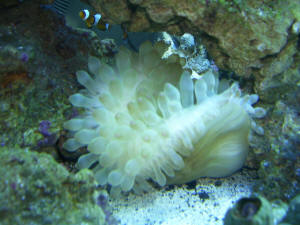 Badly bleached... RMF