|
FAQs on Bulb, Bubble Tip/Rose
Anemone Identification 1
Related Articles: Bubble
Tip, Rose Anemones, Entacmaea quadricolor, Use in Marine
Systems by Bob Fenner, Bubble Tip
Anemones by Jim Black, Recent
Experiences with BTA's by Marc Quattromani,
Anemones,
Cnidarians, Colored/Dyed Anemones,
Related FAQs: Anemone ID 1, Anemone ID 2, Anemone ID 3, Anemone ID
4, Anemone
ID 5, Anemone ID 6,
Anemone ID 7
Anemone ID 8,
Anemone ID 9, Anemone ID 10,
Anemone ID 11,
Anemone ID 12,
Anemone ID 13, Anemone ID 14, Anemone ID 15,
Anemone ID 16,
Anemone ID 17,
Anemone ID 18,
Anemone ID 19,
Anemone ID 20,
Anemone ID 21,
Anemone ID 22, Anemone ID 23, Anemone ID 24, Anemone ID 25, Anemone ID 26, Anemone ID 27, Anemone ID 28, Anemone ID 29,
Anemone ID 30,
Anemone ID 31,
Anemone ID 32,
Anemone ID 33,
Anemone ID 34,
Anemone ID 35,
Anemone ID 36, Anemone ID 37, Anemone ID 38, Anemone ID 39, Anemone ID 40,
Anemone ID 42,
Anemone ID 43,
Anemone ID 44,
Anemone ID 45,&
Cnidarian
Identification,
Related FAQs: E. quad. FAQ
1, E. quad FAQ 2, E. quad. FAQ 3, E.
quad FAQ 4, E. quad FAQ 5,
BTA Compatibility,
BTA Selection, BTA Behavior, BTA
Systems, BTA Feeding, BTA Disease, BTA
Reproduction/Propagation,
Anemones, Anemones 2,
Caribbean
Anemones, Condylactis,
Aiptasia
Anemones, Anemones and
Clownfishes, Anemone
Reproduction, Anemone
Lighting, Anemone
Identification, Anemone
Selection, Anemone Behavior,
Anemone
Health, Anemone
Placement, Anemone
Feeding, Heteractis malu,
|
|
 |
New Print and
eBook on Amazon:
Anemone Success
Doing what it takes to keep Anemones healthy long-term
by Robert (Bob) Fenner
|
|
Saltwater Aquarium Identification Question
Crew,
<Marshall>
I want to thank you for the amazing job you do in provide the best
information available to your fellow aquarium fanatics. I donate regularly
on your website and I urge others to do so also.
<Thanks for your kind words! we are really glad to help fellow hobbyists and
thank you so much for your donations too.>
I have a question for you that I have not been able to find a clear answer
to either on your website or through a general Google search.
I have attached three pictures (hopefully not too large) that are the basis
of my question. As background, I have had my around 110-gallon saltwater
reef tank for well over 20 years.
<Wow !... You’ve been doing things right.>
It has fish, live rock, corals, bubble tip anemones, conches, snails, and
other lifeforms. I have not added anything to the tank for probably over 10
years, and all of a sudden a couple of months ago what I think may be a
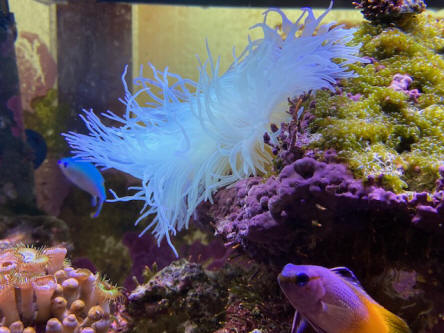
white anemone basically appeared out of nowhere. As the photos show it is
obviously thriving in my tank.
<I see>
For my personal knowledge, I was wondering what genus & species it is. As I
said I cannot find the answer so I am hoping you might be able to help me.
<Does look like a Long tentacle anemone (Macrodactyla doreensis)... Bob,
what’s your guess?>
<<Oh, answered concurrently. He lists BTA... so would go w/ that anemone as
my guess. B>>
Stay Healthy and Be Safe!!
<And you!>
Thank you.
Marshall E. Ochylski
<Cheers. Wil>
Saltwater Aquarium Identification Question /RMF
Crew,
<Marshall>
I want to thank you for the amazing job you do in provide the best
information available to your fellow aquarium fanatics. I donate regularly
on your website and I urge others to do so also.
<Ahh, I thank you>
I have a question for you that I have not been able to find a clear answer
to either on your website or through a general Google search.
<Okay>
I have attached three pictures (hopefully not too large) that are the basis
of my question. As background, I have had my around 110 gallon saltwater
reef tank for well over 20 years. It has fish, live rock, corals, bubble tip
anemones, conches, snails, and other lifeforms. I have not added anything to
the tank for probably over 10 years, and all of a sudden a couple of months
ago what I think may be a white anemone basically appeared out of nowhere.
As the photos show it is obviously thriving in my tank.
For my personal knowledge, I was wondering what genus & species it is. As I
said I cannot find the answer so I am hoping you might be able to help me.
Stay Healthy and Be Safe!!
<Endeavouring to>
Thank you.
Marshall E. Ochylski
<Am glad you listed your livestock... this is very likely a (pedal) tear of
a BTA, Entacmaea... your Bubble Tip Anemone... this form of asexual
reproduction/cloning occurs under both good and stressful conditions... and
in time this piece will grow to be a new (though genetically identical)
individual.
Thank you for sharing. Bob Fenner>
|
 |
New? BTA varieties? 5/12/18
Greetings.
It's the new variety of rare bubble tip anemones like Inferno, Flame,
Sunburst, Lemon drop, Rainbow. Where were these pretty color strains
earlier and how did they come about all of a sudden, is my question.
Could you throw some light in this regard?
<Strange... after decades in the trade, I never heard these names
applied to Entacmaea...
Looked on the Net, and do see such...
Know nothing regarding; have never encountered in the wild; though other
bizarrely colored specimens that I make out as BTAs.
See here on WWM:
http://www.wetwebmedia.com/marine/inverts/cnidaria/anthozoa/bubbletipanemones.htm
I say "let the buyer beware". Bob Fenner>
Re: Unusual BTAs/names 5/14/18
Thank you Mr. Fenner.
<Welcome Anupam>
Request for an article. Re "exotic" BTAs
5/15/18
Hearty greetings.
This is a request from just one amongst all the earthlings for an
article by the Veteran if & when he is pleased, to solve the eye
boggling mystery for the simple minded laymen behind the unrealistically
eye candy avatars of the much favoured Cnidarian (E. quadricolor)
emanating seemingly from some sorcery or discovery of some sort.
The following link shows one such specimen-
https://m.youtube.com/watch?v=GkhqgnNaw7w
<Hey Anupam. If you're hinting that you'd like to see me/someone here on
WWM pen such, it won't be me. (Again) I don't know the origin of these
Entacmaea, but I fully suspect they're man-made (not natural)... Have
seen comments re "Rainbow" et al. Anemones since 2007 or so... "From
China?"
Until I see these "varieties" underwater myself or see reports by
credible people re...
Bob Fenner>
Re: Request for an article. 5/16/18
Thank you again.
<Thank you Anupam. B>
|
Help with an anemone. ID, BTA or Anemonia?
6/19/15
Hello. I left my LFS today after purchasing an anemone they assured me was NOT a
Majano after I told them I was concerned that it looked a bit like a Majano. He
convinced me that it was a bubble tip,
<Might well be; though very small presently>
I brought it home, but before I stick it in my DT tank, I wanted to research it
myself and try to identify it. I have had no luck. There is only one anemone in
all of Google images right now which resembles mine and I found it on your
website. It is this:
The person questioned what it was and the answer was not definitive here either.
My question is, if you ever heard back from this person confirming bta or
Majano? It is listed on your anemone identifying question page on this website.
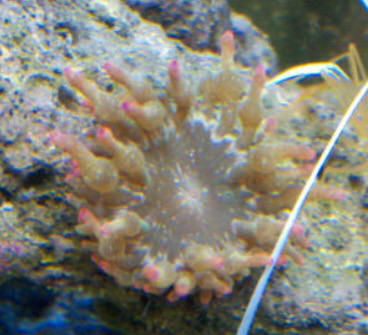
Here is my anemone:
As you can see, the distinguishing patterns on the face are identical and both
have the bubble tips. Neither have the identifying five or six white lines
around the mouth that are common with bubble tip anemones and they don't quite
match any of the Majanos I have seen either except for the fewer tentacles and
more visible open face. They are very confusing. Are they perhaps a different
species than either? Any help you can give would be just brilliant. Thanks so
much!
Trisha
<I urge patience here. In time it will be obvious what this is; in the
meanwhile, enjoy it. Bob Fenner>
|
 |
|
Re: Help with an anemone; ID 7/7/15
My anemone has been confirmed a bubble tip, although the professional I spoke to
guessed it is possibly a very similar and related breed instead. I figured I'd
let you know in case anyone else has a similar question.
<Thank you, BobF>
|
|
Actinarian ID from pix
4/25/14
Hi, talked with Penny @ AquaCorals of Maine today and e-mailed a picture
to identify my anemones and she gave me your web site. Can you guys tell
me what they are ? They don't seem to bother anything in my 220 reef
tank and probably once a year they split. Eventually 1 will disappear
but I end up with 2 at all times. Thanks Gene
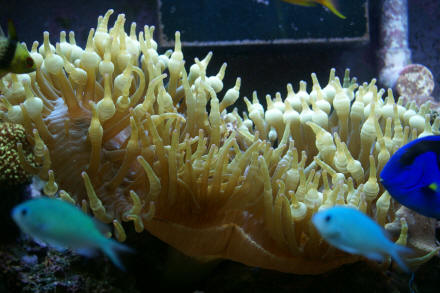
<Almost assuredly Entacmaea quadricolor, BTAs. See WWM re. Bob Fenner>
|
 |
anemone and polyps... Entacmaea ID,
disappearing Polyps 3/23/12
Hello WetWebMedia I ordered a green bubble tip anemone and candy apple
polyps they are doing great but my anemone looks like it has a lot of
red in color and only a little green. Is there any chance it could be a
rose bubble tip anemone?<Possibly. There is a tremendous amount of
variability in color with E. quadricolor even within the same
animal. In addition,
your specific lighting, water parameters, etc can all affect the color
over time. If it is healthy, I would not be concerned, just enjoy
it ;)> My other question was that my polyps arrived great there was
only 4 polyp heads but 2 of them disappeared! Now there is a tiny head,
and another head that looks like it has its head in a bubble. I think
my yellow tang may have eaten the\the other two. <possible> Do
you think they will repopulate and start to make a colony? <If your
water parameters, lighting, etc are all appropriate, there is no reason
they would not. Observe its progress>I was able to surround it
by live rocks. It has great flow and light. I am feeding it perfectly
and all. I am just hoping the polyps will make
it. Thank you <You are welcome, Bobby>
|
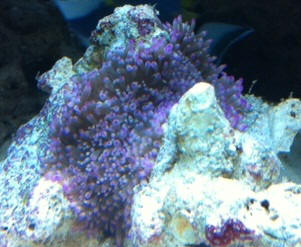
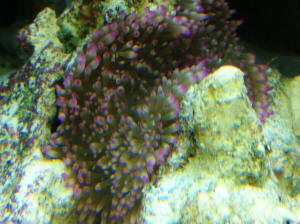
Anemone ID question (with pic) 1/19/12
Hi there!
I've enjoyed browsing your site, I've always found great
information! I have a question for you regarding a mystery
anemone I acquired yesterday. I was in a local fish store and saw
what I though was a purple Ricordea mushroom,
<Mmm, no>
until looking closely... I asked the man who worked there and he
didn't seem to know what it was (it was in a harlequin shrimp
tank, towards the top attached to the glass in the back) the man
said it must be a small bubble tip anemone,
<I do think he's right... from the shape of the animal,
its tentacles, wrapping about the rock... Entacmaea
quadricolor>
and said if I want it I can have it for $15. I inspected the foot
(intact) and the mouth (closed tightly) the color is beautiful,
brown foot and tentacles, fading into a bright purple/lavender at
the tips. I took it home and after looking online cannot find
anything regarding "purple" bubble tips.
<Oh! The species occurs in many colour variations>
The anemone is small, maybe 3 inches across.
<Yes; "it has shrunk"... from a lack of food,
inauspicious circumstances likely... Can/will come back w/ good
care>
It seems to be doing well so far, but it is a mystery. I have no
idea exactly what species this is.. Can you help? Thank you so
much!!
Leah
<Please read here:
http://www.wetwebmedia.com/marine/inverts/cnidaria/anthozoa/bubbletipanemones.htm
and the linked files above. Bob Fenner>
|
|
|
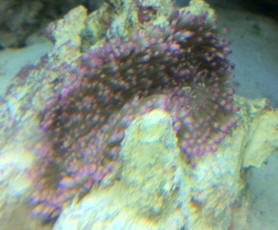
Anemone ID pic 4 1/21/12
Just a few more pictures so you can get a good view...
<Thanks. B>
Leah
|
 |
|
|
Anemone id 10/30/11
Hello,
<Hi Rob>
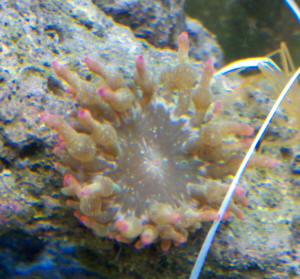
I purchased this "anemone" at my lfs. I was told out is
a bubble tip anemone. However I have not been able to find a bta
that looks anything like this. Can you tell me if this is the
case?
<Could be an Entacmaea... Please see here: http://wetwebmedia.com/btaidfaqs.htm
Thanks
Rob
<Welcome. Bob Fenner>
|
|
|
Re: Anemone id 10/30/11
Thanks bob. You say it could be however I guess my concern was did
I receive what I was told the specimen was? I was worried out could
be a majano our other nuisance anemone.
<Could be Anemonia as you state... but let's let it grow and
see. Cheers, BobF> |
|
Anemone ID 2/5/11
Hello,
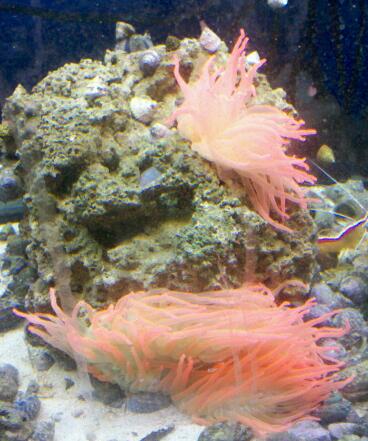
My LFS has this specimen in stock. It looks like two different
anemones, but it is one large one. The owner said it is an
Australian Bubble Tip Anemone and is asking for $300 for the
anemone and rock.
<Yikes, pricey>
The cell phone pic isn't that good, but it is a very vibrant
orange.
Beautiful. I've Googled Australian Anemone, and I haven't
found anything that looks similar. Is this really an Australian
Bubble Tip and is $300 reasonable for this specimen in Michigan?
RBTA usually go for $80 to $160 at the stores.
Thanks,
Casey
<Is very likely Entacmaea quadricolor... but does seem
expensive to me. Bob Fenner>
|
|
|
|
ID help -- 12/08/10
Season's Greetings, Crew.
<Dan>
Would you mind taking a look at these two little beasts?
<Not a'tall>
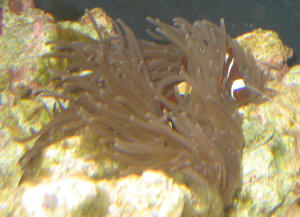
The anemone in the 2d photo was listed as a BTA, but I have
suspicions that my LFS is a little loose with their IDs. I have
looked in your ID section, but they all start to look alike after
a few hours. What do you think? I have never seen the tips bubble
up, even though it has grown steadily in the 3 months I have had
it. I feed it krill (~ 1.5") soaked in Selcon, and the
Maroons never leave it. Just wish I knew for certain what it
was.
<Mmm, most likely is Entacmaea... doesn't have to be
"so bubbly", and can/will likely change w/ time... And
the fact that your Premnas as so enamored of it...>
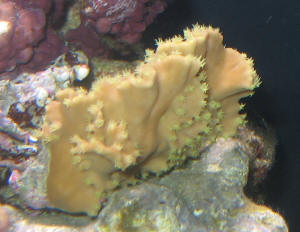
The coral looks to me to be a Montipora variety, but it has
larger polyps on it, and appears to have most of them on/near its
edges. I have a beautiful purple/green M. capricornis on the
other end of the tank, but it obviously does not have this polyp
configuration. Can you point me in the right direction
please?
<This is a Dendrophylliid... a Turbinaria species, likely T.
reniformis>
By the way, thanks for the recent assist with an H. rigida ID. I
purchased it, and it is now looking great, eating, and (to the
best of my knowledge) thriving on top of my reef stack under the
10K HQI.
All the best,
Dan
<And to you, Bob Fenner>
|
|
|
|
Anemone, ID... sys. 7/3/10
Good afternoon,
<Mmm, yes>
I ordered an RBTA last week and it finally arrived yesterday. I
acclimated it slowly so I wouldn't shock it. First off, I
would like to know if I actually got an E. Quadricolor.
<Appears to be>
The anemone is currently housed in a 14 gallon biocube
<Too small to be stable...>
that has been running
for approximately a year and a half. The return pump has been
upgraded to a MJ1200 and I also have a K-Nano for flow. I have a
JBJ K2 Viper 150 watt metal halide for lighting. I run a big
media bag of carbon in the middle chamber that I change every two
weeks and I do a ~4 gallon water change every 1-2 weeks.
Is there anything else I could do to better suite <suit>
the anemone?
<A larger system...>
I was thinking another powerhead or upgrading the existing one.
(The powerheads are anemone-proof, BTW.)
<Good>
I was thinking I should hold back on target feeding for a few
days until it inflated for the first time.
<Also commendable>
Thanks,
Jake
<Please read here:
http://wetwebmedia.com/marine/inverts/cnidaria/anthozoa/bubbletipanemones.htm
and the linked files above. Bob Fenner>
|
 |
Rumor about green BTA's, ID
2/11/08 Hello, <Hi there!> I heard somewhere that green
BTA's (Bubble-Tip Anemones) are found in lower depths, can grow to
be twice the diameter of other BTA's, and reproduce a lot less
often. Is this just a rumour or is there any truth to this? I really
like the look of GBTA's, but if they get that much bigger, I might
consider buying a Rose. TIA, Random Aquarist <There seems to be 2
forms of E. quadricolor (BTA); a smaller colonial form that it more
likely to experience lateral fission (splitting), and a solitary larger
form. However, I wouldn't let colour be an indicator of the
disposition of an anemone. I have seen green E. quadricolor that have
split, as well as "roses" that have grew to larger sizes. The
indicated max size for E quadricolor is around 400mm, so would suggest
if you want to keep an anemone of this type, you allow for that size,
even if you choose to go for a "splitter" (just in case it
decides not to!). Mike I>
|
Anemone ID, E. Quadricolor, Bubble Tip Anemone, BTA -
1/02/08 Dear Folks, <Hello Renee, Brenda here> Thank
you, ahead of time for your advice and expertise. <You're
welcome!> I have looked around the entire site, and throughout
all the areas and I don't see my anemone anywhere. I got
these from a pet store I frequent. It has taken me 4 months to
buy them, because they will never let go of the rocks they are
on, and finally, I got a big man to break the rock so I could
afford to get them...and the rock broke, one fell loose and is
now in one of my rocks re-homing himself (unharmed of course,
thank goodness) and the other is on its rock enjoying its new
home. The salesperson, by the time I got them (so many months
later) said he doesn't recall what they are, but they were
false rose something, or anyway...I have no clue. I don't see
any red rose colors anywhere. Does anyone have a clue what kind
of anemone I have here? <They are E. Quadricolor. They are
commonly referred to as Bubble Tip Anemones or BTA.> The
second one is hiding in her rock, but will come out eventually.
The first one to settle I didn't remove from a rock. Instead,
I just bought the whole rock. <Good!> I didn't want to
risk a broken foot. <Torn. There are no bones in anemones to
break.> Had that happen once...ewwwww so sad and traumatic to
see it suffer and then die. <A torn foot is not usually deadly
in many species of anemones. There may have been more variables
involved in the anemones death.> Well, if anyone can identify
these, please let me know. One already ate, as you can see, he
had Krill for dinner. This is 2 days in a row and tonight he had
2 krill. The other is still hanging onto hers and hasn't let
go, and it's sitting just inside her hole. She intends to eat
it later probably, as she already ate last night. <This is way
too much food for anemones. They do not need to eat every day.
Every 2 - 3 days is more than enough for a healthy anemone. I
don't recommend food bigger than the anemones mouth. Over
feeding will cause the anemone to expel the food later as it is
unable to digest. This will ultimately end up causing the anemone
to get nothing to eat.> Are they both the same type? Or
different and can you tell me what they are? <They are the
same, possible even clones. More information on anemones found
here:
http://www.wetwebmedia.com/marine/inverts/cnidaria/anthozoa/anemones.htm >
I thank all of you in advance. Renee <You're welcome!
Brenda><<... this looks more like Heteractis crispa to
RMF>>
Re: Anemone ID, E. Quadricolor, Bubble Tip Anemone, BTA -
1/02/08 Hello Brenda, <Hello Renee!> I wanted to thank
you. <You are very welcome!> I originally (3 months ago)
thought they were BTAs also, however when they turned so brown, I
thought perhaps they were Condys. <What color were they when
you got them? Any pictures?> My Condys are brownish and my
curlyques turned brown. <I don't recommend keeping
different species of anemones together. What size tank are you
keeping them in? What are your water parameters?> I wanted to
let you know that on the second page of the link you sent me
below Pt. 2, at the end are some links and one is not working. :)
Just a website heads up. <Yes, I see that! Note to Bob: Under
Bibliography/Further Reading, the first two links are not
working. See here: http://www.wetwebmedia.com/anempt2.htm >
Thanks so much for the ID. Renee <You're welcome and thank
you for the heads up! Brenda>
Re: Anemone ID, E. Quadricolor, Bubble Tip
Anemone, BTA - 1/03/08 Hello Brenda, <Hello Renee!> My
answers are in between your questions in bold. <The bold did
not show up when I received this. I will clean up and delete our
previous discussions so that we don't duplicate
information.> They looked peach colored and had different
shaped tentacles. I originally thought Bubble tips, that were
orangish peach in color and they were not round, and they
weren't pointy like now either. They were flatter on the end
and kind of roundish in some areas and extended in others.
<The E. Quadricolor is known to change the shape of its
tentacles.> My parameters are 8.3 ph, and everything is at
zero, and if it goes up more than 2 notches, I bring it back
down, but to be honest it runs really smooth and I don't get
a lot of spikes, which I attribute to so much live rock/coral
that it filters it before the system gets to it, clear filtration
and skim the heck out of it. <What is your temperature,
salinity, alkalinity, calcium and magnesium?> I am using 2
sets of compact fluorescent lights, 96 watts each, totaling 4
bulbs, 2 actinic 10000k, 2 blue 6500k in a 75 gallon Tru Vu
aquarium with built in overflow, 2 powerheads, <I don't
recommend the use of powerheads with anemones. If you must use,
be sure the intakes are covered to protect the anemone.> a UV
filter/removable and not always in the tank, Aquamedics UV
filter, Prefilter (home-built, to the hilt, very good pre-skim),
and a skimmer, TruFlo wet/dry and I only have a few fish, and
about 100 lbs of rock and 3" of sand (picking up 70 more lbs
of rock tomorrow from a friend). My fish are only 6 damsels, one
wrasse, one snowflake eel, one yellow tang and a Lawnmower
Blenny. I have hermits, snails, etc. I feed krill, silversides,
flaked food, Mysis shrimp, algae cubes and dried algae and I am
also bringing in fresh cultured algae, phytoplankton, zooplankton
as well as trace elements. I put Iodine in monthly. <Are you
testing before you dose? If not, I would stop dosing
immediately.> I change 20 gallons every few months. <I
recommend about 10% weekly.> I add the Trace Elements by Kent.
Anemone in that aquarium consist of (the aquarium is halved by
the overflow chamber) 2 Condy Haitians on one side, and 2
curlicues I have had for a long time live on the top near the top
of the tank (about 2' away from any other anemone up high in
a coral fitted to the side chamber, and the ones I wanted to have
identified are in the rocks to the right side, below). Nobody
touches anyone else, nor are they near each other. However I am
up for your expertise if I have made a mistake housing these
together. <Anemones do not do well long term (sometimes even
short term) when housed with mixed species. To mix anemones long
term you would need a system of a few hundred gallons or more,
even then there is no guarantee.> The curlicues are very small
and they have been pets nearly a year and are way up high in
their own colony...they arrived see through and turned dark brown
also, <It sounds like they had expelled their zooxanthellae,
and have since recovered.> The Condys are brownish, with long
pink tips and about 8" long each. <This sounds
normal.> The new anemone I sent pics in of is about 3"
long each, very small...probably a clone off of one anemone of
the same kind). The anemone I just purchased have been housed in
a pet store environment with a hanging halide light,
approximately 3' above the aquarium, which has shallow water,
great flow and a major skimmer. I am hopeful to keep the same
luck with these as I've had with Condys and the curlicues.
<Unfortunately, I do not see this happening long term. I
suspect you will have issues with the E. Quadricolor first.>
Whew what a long paragraph. I am waiting the response anxiously.
Thanks again! :)
Renee
<You're welcome! Brenda>
|
|
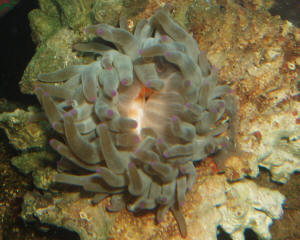 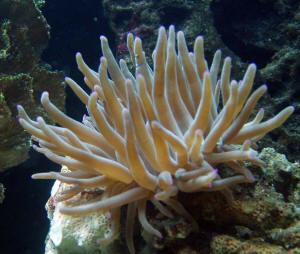 
|
| I am looking for the true identity of this
anemone!- 7/10/07 <Hi Darren> I purchased this anemone
about three months ago. The fish store told me it was a Rose Bubble
Tip that actually spawned in their coral tank? As it has been
growing I am doubting that it is a RBTA, can someone please
identify it for me? <I.D.~ Entacmaea quadricolor, Rose bubble
tip anemone> It was smaller than a Quarter when I got it and it
has tripled in size. I think I was overfeeding the first two
months? After reading around WWM I cut the feeding from every two
to three days to once a week. I have been feeding it mini Mysis. As
I said the anemone has grown but I do have a concern about the
tips. Some of the tentacles are twisted at the ends and are not
fully extended? <E. quadricolor doesn't always possess
bubble tips on their tentacles. The reason for this is not known
but things from flow to lighting to nutrient levels have been
suspected. The lack of bubble tips has no effect on the health of
the animal. Many people have purchased RBTA's with excellent
bubble tips and then a month later the tentacles resemble
yours.> It seems to like to keep the tentacles to the side and
stick it's body out. Is this normal behavior. The anemone took
hold the rock where I placed him and has not moved since. He is
about 12" from the lights, two 39 watt T5 and 3 70W MH on a 45
gallon tank. <your anemone "planted" it's foot and
it has chosen a place in your tank where it appreciates the flow
and light. This is a sign of a happy anemone. The puffy body is
usually associated with high light levels. If it begins to lose
color and become translucent then it has too much light and is
bleaching. Please keep an eye out for that type of problem,
otherwise I saw a healthy anemone. Bubble tips come with a greenish
body and reddish tips. These are referred to as Bubble Tip
Anemones. When the complete anemone lacks green pigments and is all
red it is referred to as the Rose Bubble Tip Anemone which is
usually more expensive so good find!> Thank you in advance for
all of your great info!!!!! <No Problem! Remember to keep
feeding it and observing it's overall health. Hopefully it will
split/divide and give you offspring!> Darren <Rich aka Mr.
Firemouth> <Some additional reading...
http://www.wetwebmedia.com/marine/inverts/cnidaria/anthozoa/bubbletipanemones.htm
http://www.wetwebmedia.com/btanemjimb.htm> |
|
.jpg)
|
| Mystery Anemone help - 02/25/06 I have this mystery BTA
that came in my live rock and I can't find anything anywhere
like it on the web. The pictures aren't great, but it has a
pink top like a rose BTA and a white body. Each tentacle has a
white stripe around the end that is easily visible when it is
short, but when it stretches out it is harder to see. It grew to be
about 4" tall and 3" across the top when it split the
first time. The bottom one has since split into 3. It was on a T
shaped ridge and split down the ridge. It was also shaded by the
above one so I think it split because it was stressed. It never
tried to move. After it split I physically moved the 3
'babies' and each is doing just fine. The top one grew up
again and has just split again today. It seems that 3-4"
across the top and 4" tall is about as big as it gets. All of
the above has been taking place over a period of about 6 months.
The pictures aren't great, but the anemone is just gorgeous.
Much prettier than any I have seen in a local fish store. It is the
white strip around each tip that really makes it pretty. Have you
seen anything like this or is it just 'some kind of rose
BTA'? <Don't know... but agree with you... is very
nice> Any info would be appreciated, but mostly it is just
curiosity. Thanks. Kirk Menard <Might indeed be another species.
Have seen such, and were offered as BTAs/Entacmaea. Cheers, Bob
Fenner> |
|
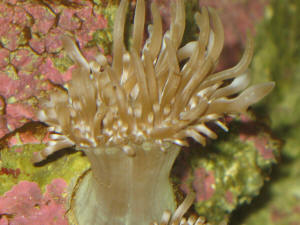 
|
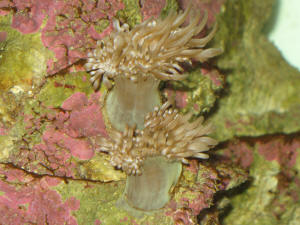
| Coral/Anemone ID 2/20/05 Bob, Do you have any idea what
this coral is? It appears to be some type of leather (Sarcophyton)
with very long tentacles. Do you know the specific name?
<<Actually, those are anemones. Probably "Bubble
Tip" Entacmaea quadricolor. Best Regards. AdamC.> |
|
|
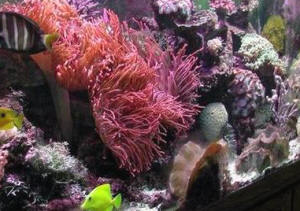
| Purple bubble tip anemone!! - 2/15/2006 I need to know
if it is possible, I am sending a picture, tell me if you get it.
<I see it here> Ok this case is extremely weird, could be a
mistake or whatever. I went to the nature aquarium store here at
Guadalajara Mexico, and new specimens had just arrived. They had 2
new bubble tip anemones that came together. One was a regular
Bubble tip anemone and the other one was this one, that under their
actinic light looked fluorescent blue. I watched the amazing color
and thought it was a blue carpet anemone, I asked the guy and he
told me it was a bubble tip!. Then it came to my mind that it
looked like purple Heteractis magnifica. <Yes> However after
bringing it home and looked carefully at it, it definitely has the
shape of a bubble tip. And the color is purple with green tips.
Doesn't look like a dyed specimen, it looks like a true morph.
Could be the stress, could be sick, but this is its first day in my
tank. Anyways it is a purple bubble tip anemone with green tips!!!.
<Do come in a few colors> I will be taking more pictures
later. I am keeping it in a 70 gal tank with 400 watt Power
compacts, on the topmost spot. I think is good lighting, I 've
also have a Galaxea on the topmost of the tank for about 4 months,
and no complaints from it. <Color of the stalk/pedicle? Are
there obvious verrucae there? Bob Fenner> |
|
|
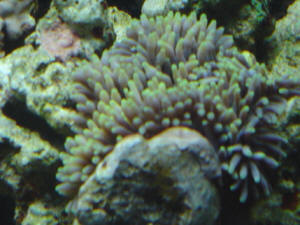
| i.d. please? here is a pic of my 3 year old
I have had him [or her] for 1 year now . my wife was watching the
tank one day and now I have 2 this picture was taken right after I
acquired him I was told he was a rose bubble tip but I haven't
found any pic's of this little bugger thanks in advance Dave
<This is a "Rose Anemone", an Entacmaea quadricolor,
most often called a "Bubble Tip Anemone"... come in quite
a few colors. Here are some others:
http://WetWebMedia.Com/anemones.htm Bob Fenner> |
|
|
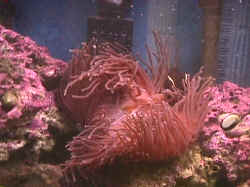
Could you ID this anemone for me? Thanks!
Sue <It's an Entacmaea quadricolor, a Bubble Tip Anemone. Bob
F>
Re: Could you ID this anemone for me?
Thanks for the super fast reply. It was bought as such and a fellow
reefer saw it and thought it looked like a Sebae. <Mmm, you can see
plenty of pix of both species on WetWebMedia.com> I have had it for
3 weeks and am debating about taking it back. It has sort of found a
spot on the sand bed but I don't think it has really buried its
foot. I tried to place it up higher and it keeps finding its way to the
sandbed. I have a 62g with PC lights...4x55. I think it looks healthy
so far. Do you? Would it be OK to make its home at the bottom of my
tank with the lights I have on the tank? 23 1/2" high tank. Thanks
again, Sue <Please read starting here:
http://www.WetWebMedia.com/anemones.htm following the links. Bob
Fenner>
Anemones I believe I read somewhere in a
book (Delbeek/Sprung) that there are two distinct varieties of
bubble-tipped anemones. One grows slowly to an adult, while the other
stay small and readily divides. Is there any credence to this? <Mmm,
well... this could be a "natural classification" division...
smaller, stressed specimens will tend to divide... larger ones are more
likely to not be collected, or die in collection/shipping. Please read:
http://www.WetWebMedia.com/marine/inverts/cnidaria/anthozoa/bubbletipanemones.htm>
I have a bubble tip which I have had for well over a year and has not
divided, but seems to be growing slowly. It is inhabited by a maroon
clownfish and I feed it small salad shrimp every so often. Sometimes
when I feed the anemone, the shrimp does not completely stick to the
anemone; is it not hungry? <Perhaps> The anemone itself seems
very happy as it does not move around at all, and gets a lot of light
as it stay up by the top of the reef structure under MH lights. Also it
has retained its green color well; in the year and a half I have owned
it, I would say it has only grown by 10-15%. Please let me in on any
trade and/or personal secrets to this success. Thank so much. <...
Anemones of "adult size" do actually "grow" very
slowly in the wild and captivity... their periodic, cyclical or not
expansion, contraction can be easily taken for "growth"...
all trade, hobby "secrets" I know of are posted on WWM...
unless haven't penned them yet. Be chatting, Bob Fenner>
-D
|
|