|
FAQs on Anemone Identification
2
Related Articles: Anemones,
Bubble
Tip Anemones, LTAs, Cnidarians, Coldwater Anemones, Colored/Dyed Anemones,
Related FAQs: Anemone ID 1, Anemone ID 3, Anemone ID 4, Anemone ID 5, Anemone ID 6, Anemone ID 7, Anemone ID 8, Anemone ID 9, Anemone ID 10, Anemone ID 11, Anemone ID 12, Anemone ID 13, Anemone ID 14, Anemone ID 15, Anemone ID 16 Anemone ID 17, Anemone ID 18, Anemone ID 19, Anemone ID 20, Anemone ID 21, Anemone ID 22, Anemone ID 23, Anemone ID 24, Anemone ID 25, Anemone ID 26, Anemone ID 27, Anemone ID 28, Anemone ID 29, Anemone
ID 30, Anemone ID 31, Anemone ID 32, Anemone ID 33, Anemone ID 34, Anemone ID 35, Anemone ID 36, Anemone ID 37, Anemone ID 38, Anemone ID 39, Anemone ID 40, Anemone ID 41,
Anemone ID 42,
Anemone ID 43,
Anemone ID 44, Anemone ID 45,
& Cnidarian Identification, Anemones 1,
Anemones 2, Anemones 3, Anemones
4, Anemones 5, Invertebrate Identification, Aiptasia
Identification, Aiptasia ID 2,
LTAs, Bubble Tip
Anemones, Caribbean
Anemones, Condylactis, Aiptasia
Anemones, Other Pest
Anemones, Anemones and
Clownfishes, Anemone
Reproduction, Anemone
Lighting, Anemone Feeding,
Anemone Systems,
Anemone
Compatibility, Anemone
Selection, Anemone
Health, Anemone Behavior,
Anemone
Placement,
Anemonia majano.
|
|
 |
New Print and
eBook on Amazon:
Anemone Success
Doing what it takes to keep Anemones healthy long-term
by Robert (Bob) Fenner
|
|
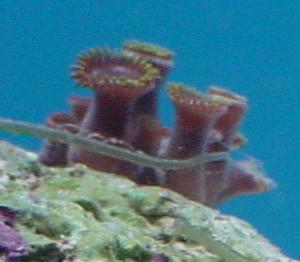
Thanks and Aiptasia? Thanks for your help on my
nuisance brown algae. I stopped using Coral Vital and the problem
cleared up in a week. It was weird, little oxygen bubbles would
form on the bits a substrate algae, causing them to float to the
surface one by one and be skimmed off by my BakPak filter. Self
Cleaning Algae! However, I've had this anemone growing in my
DSB for about a month (see attached jpg). Recently, I noticed two
more pop up in completely different areas of the substrate. Is
this the dreaded nuisance anemone, Aiptasia (sp) that I have read
about? Do you recommend that I pull these animals from my reef
tank? <You're correct, that is an Aiptasia. If you can,
pulling these anemones out manually will be a great method of
removal. Most likely, you will not pull out all of these anemones
in your aquarium. With that said, Peppermint shrimp (Lysmata
wurdemanni) may be an option. These little shrimp often will
consume the dreaded Aiptasia in a small amount of time. I would
highly recommend them for aquariums which contain Aiptasia and
need to keep them under control. Take Care, Graham>
Thanks,
Joe T
|
|
|
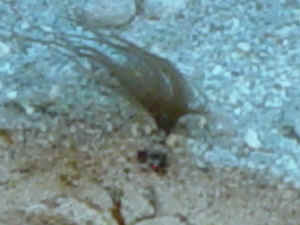
| Anemone ID Hi and good day, crew from fish
heaven. This is Bernd from Honduras. I obtained an anemone from the
Bay Islands here in the Caribbean. It is 6-7" diameter. All
the similar looking anemones I found were from the IndoPacific.
What could it be? Thanks, Bernd <Hello Bernd! This is a
Stichodactyla helianthus... Please see here:
http://www.wetwebmedia.com/marine/inverts/cnidaria/anthozoa/twaanemones.htm
Bob Fenner> |
|
|
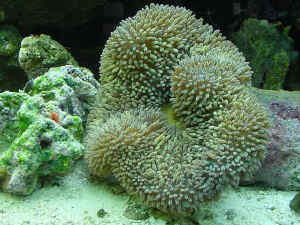
Anemone pests Hi my name is Gina and I have
recently discovered your web site (which I think is
great). I'm sorry about the attachment, I
couldn't figure out how to reduce it. I am new to
digital cameras as I am to marine aquariums. Well as you can see
from the picture what my dilemma is. I have a 55 gallon
aquarium that I purchased from my co-worker's
girlfriend. With it came a yellow tang, a tomato clown,
a striped damselfish (humbug), 3 yellowtail blue damsels, a couple
of hermit crabs, a handful of snails, and a nice amount of live
rock. To my amazement, at the time, the rocks had these
cool looking brown things that grabbed food as it came within
reach, pulled it towards their "mouths", ate it, and hey!
you can see it as it goes down the tube!! If I only
knew. I started to not like them when they began to
disperse all over my tank and when I came to realize that I
couldn't siphon them out. One of the yellow tail
damsels has disappeared, I have moved the live rock around but
could not find "the body" anywhere. I have
always suspected these nasty anemones. But we will never
know. Poor guy. I took this picture, went to Athens aquarium and
asked the an employee & owner what the heck they were and how I
could get rid of them. Well they broke the news to
me. They were not good things to have in a tank. Will
sting my fish and possibly eat the small ones. He suggested
purchasing a copperbanded butterfly fish or some
shrimp. Well the weekend before I purchase a Picasso
trigger (1 1/2"). He's tiny ;). Bad timing. The
shrimp were out because the Picasso will more then likely harass
them. So it's the butterfly fish. I have
read that they are hard to keep and well with my new Picasso
restricted to a small area of the tank ( no thanks to his size,
tank mates, and the forest of anemones) and with the size of my
tank it seems that this might not be such a great idea to add
another fish. However, I need to get these pests out of
my tank before they take it over!! I'm sure my fish
would really appreciate it! Do you have any
suggestions? Thank you Gina. <Hi Gina! These anemones
you're referring to are called Aiptasia. These small anemones
are considered a huge pest for the fact that they multiply quickly,
sting neighboring invertebrates, and are difficult to get rid of.
So, lets get to the crux of the message: How do I get rid of them?
I first recommend you return the trigger. These fish will
eventually outgrow your tank and will become extremely aggressive.
Once you've returned the fish I recommend you to buy some
Peppermint shrimp (Lysmata wurdemanni) for your Aiptasia problem.
These shrimp will feast on Aiptasia. A group of about 5 shrimp
should take care of your problem. For those larger anemones which
the shrimp will not consume, try injecting them with a calcium
hydroxide solution (Also known as Kalkwasser or Limewater, which is
available at your pet store). Mix this Kalkwasser with RO/DI water
until it becomes a thick paste. Suck some of this paste up with a
syringe or turkey baster and inject it into the mouth of the
Aiptasia. The anemone as a result should appear to melt and die. A
Copperband would not be your best choice. These fish are difficult
to care for and are extremely sensitive. Peppermint Shrimp would be
much better to buy.> Take Care,
Graham Stephan |
|
|
ID of anemones 2/5/04 Hello, <Hi Melissa. Adam
here today.> I have gone through the Wet Web Media site and
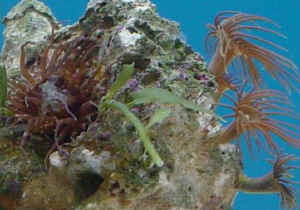
have tentatively ID'd two of my three anemones, but I would
appreciate a second opinion. All three are hitchhikers on a piece of
live rock. In the first pic, I'm pretty sure the brown anemone on
the left is an Aiptasia and I believe the colony of animals on the
right are Anemonia cf. Majano. <I agree with the Aiptasia on
the left. The critters on the right appear to be Parazoanthus or some
other Zoanthid. Almost certainly not Anemonia.> In the other
picture, I really do not know what the short-tentacled critters are.
They're about 1" tall. <These are another kind of
Zoanthid, probably Zoanthus. Nothing to worry about.> I plan
on wiping out the Aiptasia, but I think that the Anemonia and the other
short-tentacled polyps are rather cool. Would I be making a huge
mistake by leaving them alone (and will they survive in my tank AND
will they be a danger to my other fish - see below)? Currently this
piece of live rock and another piece about 3/4 of its size are the only
occupants in the 55 gallon tank. We'll slowly be moving in our
yellow tang, clownfish, and skunk cleaner, as well as our snails and
blue-legged hermits. The tank is lighted by a 4 foot shop light, and I
have two full spectrum bulbs installed. I have no plans to add corals
to this tank. <Do get rid of the Aiptasia. The others are
perfectly safe for your tank inhabitants. Without more light, they will
probably not grow much, but they should hang on.> Thanks for
any advice you can give me! Melissa <Always a sincere
pleasure! Adam>
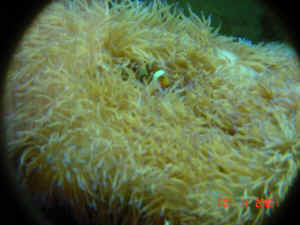
| What type of anemone is this?
<Hi Donovan, the anemone pictured looks like an H. crispa. And
quite a healthy one at that!> Take Care, Graham Stephan |
|
|

|
|
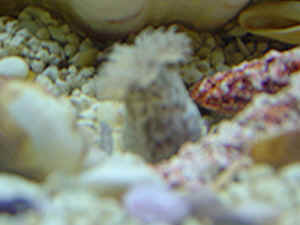
Anemone 1/28/04 I have tried to take a pic
of the anemone, but it is not very clear. Maybe it will help
though. Thanks again!! Hello! I am a new hobbyist and have found
your site very helpful already. I am currently trying
to identify an anemone and see I am not the only one!!:) However,
none of the other descriptions seem to match. This one has a
brown and white speckled base (not unlike the tiger cowry I just
bought) which mostly encloses the creature and feels sort of
leathery. It is much more sturdy than the Condylactis. When
closed up, it looks almost like a barnacle and it is attached to
a piece of broken shell. When it opens, there are short tentacles
surrounding the mouth. The tentacles have stripes running
width-wise and are cream and tan. The mouth has sort of
bubbles/cushions (hard to describe) around it. And the whole
thing is smaller than a marshmallow. It was found in NE Florida
on the east coast. Can you help describe this? Is it
dangerous? I can try to send a pic if you want, but It is quite
small and I fear it wouldn't be much help.<Hi
there! First of all, coming from the NE part of
Florida, it may not be used to tropical temperatures, and so may
not survive. If it does, it probably isn't
dangerous except to small slow moving fish. Do watch
it if it does survive to be sure that it doesn't start
multiplying rapidly. Some of these small anemones can
develop into plagues quite rapidly. I am not sure of
an exact ID, since these types of animals rarely enter the
aquarium trade. Best Regards, Adam>
|
|
|
|
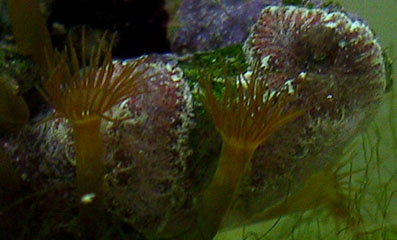
Creature ID 1/21/04 Hello again crew. I just
noticed this little thing growing in a 10 gallon setup I am using
to grow amphipods. It's kind of a grungy setup,
with tons of Ulva and Hawaiian red for the
pods. During some routine maintenance on the tank I
noticed this thing attached to the glass. I am
attaching a photo... any ideas? Steve <its a Cnidarian
and likely an anemone bud. We cannot tell any more than that at
this point. Also, please send us only web-sized/courteous images
of a few tens or hundreds of kb max. Large pics like this clog
our mailbox, mate, and block other queries from entering at
times. Anthony>
|
|
|
|
|

