|
FAQs on Anemone Identification
14
Related Articles: Anemones,
Bubble
Tip Anemones, LTAs, Cnidarians, Coldwater Anemones, Colored/Dyed Anemones,
Related FAQs: Anemone ID 1, Anemone ID 2, Anemone ID 3, Anemone ID 4, Anemone ID 5, Anemone ID 6, Anemone ID 7,
Anemone ID 8,
Anemone ID 9, Anemone ID 10, Anemone ID 11,
Anemone ID
12, Anemone
ID 13, Anemone ID 15, Anemone ID 16 Anemone ID 17, Anemone ID 18, Anemone ID 19, Anemone ID 20, Anemone ID 21, Anemone ID 22, Anemone ID 23, Anemone ID 24, Anemone ID 25, Anemone ID 26, Anemone ID 27, Anemone ID 28, Anemone ID 29, Anemone
ID 30, Anemone ID 31, Anemone ID 32, Anemone ID 33, Anemone ID 34, Anemone ID 35, Anemone ID 36, Anemone ID 37, Anemone ID 38, Anemone ID 39, Anemone ID 40, Anemone ID 41,
Anemone ID 42,
Anemone ID 43, Anemone ID 44,
Anemone ID 45,
& Cnidarian Identification, Anemones 1,
Anemones 2, Anemones 3, Anemones
4, Anemones 5, Invertebrate Identification, Aiptasia
Identification, Aiptasia ID
2, LTA
Identification, Bubble Tip
Anemones, Caribbean
Anemones, Condylactis, Aiptasia
Anemones, Other Pest
Anemones, Anemones and
Clownfishes, Anemone
Reproduction, Anemone
Lighting, Anemone Feeding,
Anemone Systems,
Anemone
Compatibility, Anemone
Selection, Anemone
Health, Anemone Behavior,
Anemone
Placement,
|
|
 |
New Print and
eBook on Amazon:
Anemone Success
Doing what it takes to keep Anemones healthy long-term
by Robert (Bob) Fenner
|
BTA and Other Anemones -- 06/17/07 Good evening
Crew. I have two questions that I hope have easy answers. First: I have
a BTA that seems to be doing quite well--was when I purchased and
remains a nice shade of light brown, shows its bubbles fairly often,
etc. One thing that concerns me a little, though, is that it seems to
prefer locations that have limited light. I have a 110 g that is
30" high, illuminated with 6 x 54W T5s (3 10,000K daylights and 3
actinics--thinking of swapping 1 actinic out for a 10000K daylight,
just haven't gotten around to doing it yet). I know BTAs like to
perch in ledges, <Mmm, only in captivity> and I have plenty of
rock, overhangs, crevices, etc. The other night I had to move the rock
on which it was perched to deal with an unstable rock underneath, and
the BTA moved and is now sitting under an overhang of rock, about 90%
shaded. I realize that BTAs will move to find a suitable location, but
is this normal? <Mmm, normal... for abnormal/aquarium settings,
yes... It will move itself...> From what I read, my lighting
doesn't seem to be too strong. <Agreed> Second: I purchased
some really nice Florida aquacultured rock and noticed that the rock
came with a few (4 that I can see) very small anemones. Some are
striped (brown and clear) and some are clear. I have tried to identify
them using WWM, but they are too small to make an accurate ID. My
question is, should I be wary of any anemone that comes on Atlantic
rock? <Possibly... there are many "pest" types... some
can/will displace, sting other life...> Put another way, are there
Atlantic anemones that one typically sees on rock that are not pest
anemones? <Yes... by definition, like a terrestrial plant
"weed", unwanted... or at least not found to have purpose as
yet> As always, I appreciate the insight. Andy Bulgin <There are
ref. works re... Maybe see the Paul Humann, Ned DeLoach series... Bob
Fenner>
Sea Anemone Identification and Concerns
6/10/07 I have spent the last few days reading your site, I am
impressed with the amount of information provided. I have felt that
I have learned more at this site then getting information from
dozens of locations and sources. With this said, I do feel as I
have not found the information needed for my newest friend. My tank
is a 29 gallon, 30" X 18 X 12 with a JBJ Formosa Power Compact
Dx series double light. 1 10k 65 watts and 1 Actinic 03 65 watts, 1
power head pumping 160GH, A Seaclone protein skimmer (working
better than most say they will I get a good collection of greenish
water and brownish foam), I have a Biowheel filter I run from time
to time to clean up the tank if it gets debris or cloudy and the
skimmer is not keeping up with the load, about 15 lbs of Live rock,
2 inches of crushed florida coral with 2 inches of live sand \
aragonite mixture on top for substrate. The tank has been going for
1 year with 5 damsels, <What species? This is too small a volume
for most...> which all seem pretty happy. Recently, I divided
the tank in half to separate the more aggressive damsels from my
new friends. My water quality is not the best, I tend to get spikes
of nitrates from time to time. I am getting better with water
cycling. Current Salinity 1.020, <Too low...> temp 78 to 80,
Nitirites .5, <Should/must be zip!> nitrates 60 ppm (High I
know, have increased water cycling) PH 8.2 ( I have been using
Proper PH, recently read why I shouldn't on your site, will
start to correct this) I have finally come around to getting some
clowns. I wanted to get Tomato or Maroon Clowns, <Not enough
room...> but was out voted by my Fiancé for True
Percula, (she likes the way they look) I went to many LFS I have 4
within a 3 mile radius of my house (lucky me) None of them had a
pair, <Will make their own> or if they did; admitted they
were not eating properly and would not sell them. <Good>
Finally I come to a store that has a large stock of little ones,
about inch to an inch and a half. I purchase 2, then start talking
about a host Anemone, this is where I started making mistakes. He
talks about lighting, and gets me to purchase the JBJ setup. Points
out a "Sebae" Anemone, that is translucent white /
Yellowish color. ( I believed it's been bleached only by
information from your site) <Is it the one pictured? This is
badly bleached> It looked extremely healthy in the LFS, it was
under MH lights. Very compulsive Buy I am now regretting. I bring
it home with the fishes, I acclimate them by floating the bags, put
some of my tank water in the bags after an hour. Everything is
going really well. I drop him in the tank, into the substrate away
from the rocks. He has some stringy sticky material, He is slightly
pulled together, but not too dramatic. He starts to open after an
hour. It's close to night time I turn off the lights and he
starts moving around, heading for the corner of the glass where the
power head rotates too. He then Stretches out and is really big, I
had no Idea he's about 6 inches across very Large. <Is
actually much larger than this...> His foot is a Dark brownish
color <Really?> and his mantle gets lighter towards the
edges, He puffed up his foot and half climbed the glass. His
tentacles, are pretty long. I was quite happy to see him happy and
flowing in the water current. I was just amazed at how beautiful my
new friend was. The next morning my heart sunk, He was shriveled
up. All his tentacles were about ¼ inch long and very
bulby at the ends. He pulled his mantle together and just looked
Ill. His mouth was shut, also no color distinction around his
mouth, it looks like an opaque white. I turn the lights on, after
an hour or 2, he starts to open a bit but all his tentacles stay
very short and bulby. <Adjusting...> This Behavior has lasted
for 3 days now. Same every night, he blooms very open and flowing
in the current, very large and happy looking, every morning I feel
like I got to get a grave ready. This morning I found a large brown
ball of what I first thought to be his stomach or insides,
<Waste material> I thought he perished. I grabbed the net and
slightly touched him and he closed right away, I then decided to
get the brown ball, I guess its anemone poop. I've never been
so excited in my life to find poop. I have attached pictures, I
guess I want to verify it's a Sebae. <Can't make out...
are there the typical "pink tips" to the tentacles? This
is diagnostic for Heteractis crispa...> Also if this behavior is
going to lead to a very sad owner, or if it's just part of the
process. I would think he would stretch out during the lighted
hours to get as much light as possible. I plan on doing all that is
possible to nurse this mistreated Beauty of the world and all the
advice / knowledge is much appreciated. My clowns Don't want
anything to do with the Anemone, and looking at the compatibility
charts, I doubt they ever will. Should I wait for the outcome of
this Anemone before thinking of finding a more compatible host for
my pair? <...> I was thinking I wanted to pick up a BTA?
<Shouldn't be housed with another Actinarian...> I do
Apologize for the very long Message, but I wanted to make sure you
had the details that lead up to my situation. I appreciate what
everyone at your site does, it helps so many people I can't
even imagine. Thanks for the time and patients to help others
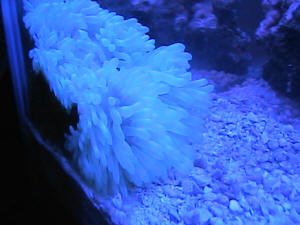
(specially us newbies) Both Lights on, First Day in the tank after
he moved into the corner, During the Night, I turned on the Actinic
03 for just a few seconds to take the Picture, His tentacles are at
least 3 to 5 inches long here. It's so Beautiful in this state.
Its really hard to believe it's the same creature how it looks
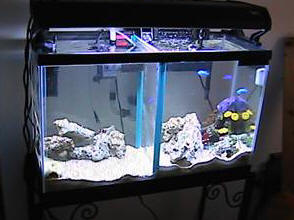
at night and during the day is amazing. A small picture of my small
tank bringing me so much Joy. Justin Sciacca <That the
base/pedicle of this specimen is dark brown, and that I can't
make out the pink tips alluded to... and to some extent, the lack
of attention by the Clowns (should be discounted due to their
likely being captive-produced)... lead me to suspect this is
"something else", maybe a Heteractis malu... Please read
here:
http://www.wetwebmedia.com/marine/inverts/cnidaria/anthozoa/anemones.htm
and the linked files above.
Bob Fenner> |
 |
 |
| Please Identify This Inhabitant
6/5/07 Hi guys, <G.V.> As always, you all provide a
wealth of knowledge to many of us in this hobby. We are grateful! I
have saved many inhabitants lives reading your pages and my tanks
are quite successful year in and out. <Ah, good> Moving
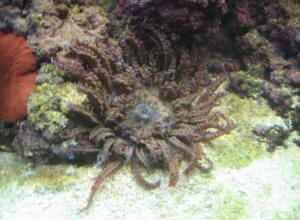
Onwards. Please identify this animal if you will. I cannot find
anyone locally who knows exactly what this is. <Is an
Actinarian, an Anemone...> It started as a little guy underneath
a rock that was over a year old and started out the size of a pinky
toenail. Now it is about 4 inches in diameter when fully open. He
appears harmless to my fish and other corals thus far and retracts
like an anemone/tube worm if I try to manipulate his position in
any way. He has moved on his own (very early on) but has since
settled in that same spot where he has been for about 3 months
already. I practice strict quarantine methods and never say him on
any of "new" additions. <Good clues> I feed him and
he is growing remarkably fast. Your response will be greatly
appreciated! Regards, G. V. Catalano <Mmm, is either an
Phymanthid, a Rock Anemone (perhaps of the "typic" genus
Phymanthus which you can look up... Google), or Actinodendrid
(maybe a Megalactis sp.). Bob Fenner> |
|
|
| What is this!!!? 5/31/07 Hi. I'm
new to this Marine world and thoroughly love the WWM site. Please
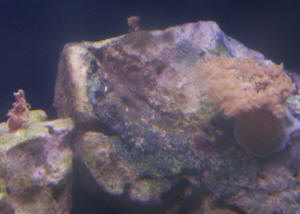
can you check the attached photo. <Yes...> It came on some
live rock. This thing extends a white tube about 1cm in diameter
and 3 inches long. On the end of it is a head like a sunflower with
waving sticky tentacles. The creature uses this to attach itself to
the glass or rocks then lifts itself up and plonks itself down
again. The long sunflower stem then retracts back inside and the
critter looks like the photo. What on earth is it? <Very
interesting... a movable polyp... looks like an Actinarian, Sea
Anemone... of some sort. All are mobile to an extent...> Thank
you. Mike B 55 gal with 20 gal sump. 2 Clarkii, 1 Regal Tang
inverts coral and alien! Central England <Do take care to keep
all intakes (pumps, overflows, etc.) screened to prevent these
"getting sucked up"... Cheers, Bob Fenner> |
|
 .jpg)
|
| Glass Anemones ID, more...
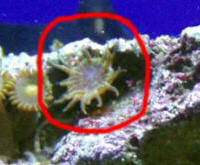
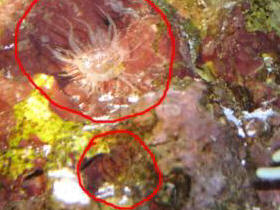
5/7/07 Hey crew Noob here, I have a question about some guys
that came with a small Zoa colony I recently purchased. I am pretty
sure I already know the answer (Aiptasia), however I do not want to
make any drastic measures until I am positive. I also have some
little guys that are suspects as well but completely different
appearance, the guy at the LFS used them as a selling point for his
live rock. Said they were light bulb anemones, sounded good at
first. I spend hours each day reading through your archives and
really appreciate having you there, It is very hard finding someone
who's opinion is really worth much in the saltwater world.
Thanks in advance <Is highly likely that this/these are a
species of Aiptasia... Read here re: http://www.wetwebmedia.com/marine/inverts/cnidaria/anthozoa/aiptasia/aiptasia.htm
and the linked files above. Bob Fenner> |
|
|
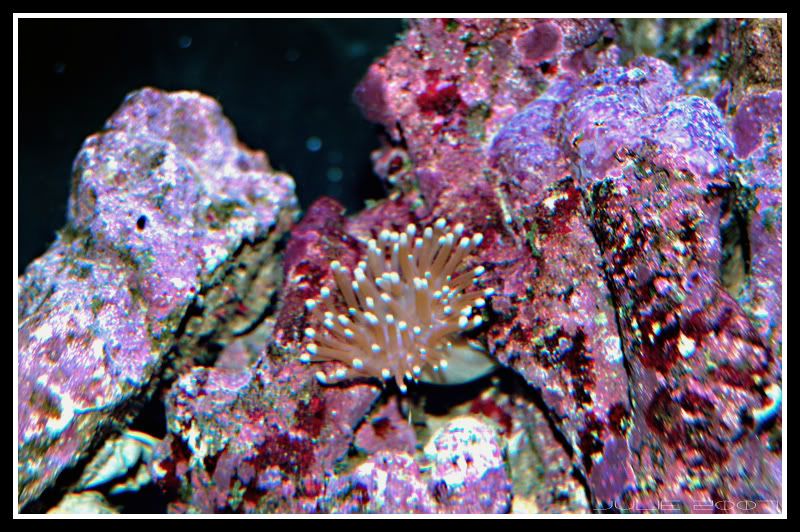
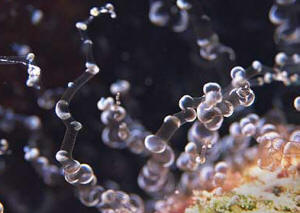
| Bubble Tip Anemone?? -- 5/4/07 Hello, A few
weeks ago I found what appears to be a tiny bubble tip
anemone. So tiny it's impossible to get any
pictures. After much searching through the many photos
both through this site and others I came across a photo of an
anemone taken in Bonaire that looks very similar to mine which I
have inserted below. With its tentacles extended it is
no larger than a nickel. It extends its tentacles as
soon as the lights go out and seem to stay that way while it's
dark. They retract when the lights come on
<Odd...> and it completely retracts into the rock crevice it
is in and cannot be seen at all. Even with a flashlight
it reacts and if I shine the light too long some tentacles move or
begin to withdraw. It's tentacles appear crystal
clear with white tips although if I shine the light just so I see
bits of fluorescent green in some of the tentacles. I
had started a 1.5 gal 'macroalgae' tank which contains a
quickly growing ping-pong ball size of Chaeto, a small bit of
feather Caulerpa and a Tonga branch with red bubble macroalgae and
a colony of feather worms. It has a Red Sea nano filter containing
a bag of Purigen. I do RO water top-offs
only. I check the salinity and pH only occasionally
(although with the addition of the anemone this lack of testing
will change). For lighting there is a desk lamp over the
tank with a 13W 6500K screw in fluorescent bulb I picked up at
Lowe's. This is where I have placed the small rock frag housing
the anemone. I'm not sure how long I've had this
anemone but I have not brought in any new rock for over 4 months.
This rock with the anemone was in my 10 gal tank but concerned it
might 'move' to a rock where I could never get it out I
opted to put it in the 1.5 gallon until I found out what type of
anemone it was. I've read through several articles
and am confused about two statements. One article
stressed "Underfeed, underfeed, underfeed; don't
feed" and another which says the anemone is
bleached and must be fed. Obviously knowing what
type of anemone you have would help in knowing which way to
go. I have fed it twice using an eyedropper. Once with
Cyclop-Eeze and the second with Cyclops (more like an afterthought
during sun coral feedings). Both times the equivalent of
about 2 drops. Its reaction was to withdraw into the
crevice and then later fully extend its tentacles again.
<Bad...> Does the attached picture offer any help in
identifying this little guy? <Is not an Entacmaea
species... looks a bit like some other possibilities...
"Curley Q", some TWA species... But whatever it is... it
appears devoid of zooxanthellae> Since he appears to be doing
okay so far without any help from me my initial thoughts are
"if it ain't broke don't fix it." But
reading "the anemone looks bleached" my second thoughts
are..."maybe its tentacles are clear because it's bleached
and starving". <Yes> Since he's so tiny
any idea how fast anemones grow? <Actually quite slowly... they
mostly "show" in added, released water...> He will
surely outgrow this tiny rock he's in at some point and want to
move which means I need to be planning on a specimen only tank for
him. Identification would also help with the decision of
whether to add an anemone fish (or not) which also dictates what
size larger tank. I did note on one of the charts that a
Domino Damsel seems to be a good choice for a wide range of
anemones. Hopefully you can shed some light on this
matter. Thank you again. Regards, Debra Just another
note, the tips of the small anemone I have look much whiter than
what appears on the similar looking anemone in this photo.
<Please have a look here: http://wetwebmedia.com/marine/inverts/index.htm scroll
down to the area on Anemones, ID... TWA species... Bartholomea? Do
you have rock, other hard material from the Tropical West Atlantic?
Bob Fenner> |
|
|
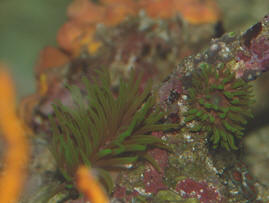
| Aiptasia? Anemonia 5/3/07 Alex (or whoever
our saviour will be today): <Saint James today folks.>
Attached are three photos of an unknown trio of anemones in our
tank. <Only could see two pics.> They arrived as
little guys, smaller than peas, on a rock on which a cocoa
worm was attached. They are now a little smaller than a
ping pong ball. (Let us know if the photos are too dark and we
can fix them if necessary.) <They are a little dark.>
We've had them since December and have watched them grow. Our
LFS said they might be bad, but they weren't sure. We just
got Ronald Shimek's "Marine Invertebrates" and found
the listing on Aiptasia .... is that what we have? They are
just getting large enough to go on walkabout. <Based
on the pictures, do not appear to be
Aiptasia. Bob?><<Is not me either, but Anemonia
majano. Why are you responding to this if you don't know:
http://www.wetwebmedia.com/otherpstanemfaqs.htm.
RMF>> Their coloring is somewhat more orange-y than photos
posted on your site or in the book, but they have the same
"clean" legs that are sharply
defined (for lack of a better word). The other day, one
of them took up residence inside the worm's tube. He's
moved and the worm seems fine. <For the length of time you
have had these, and if they were Aiptasia, you would have quite a
few of them by now.> Thanks as always .... <You're
welcome. James (Salty Dog)> Michael and Dianne PS: We
just did our second five-hour long-haired algae removal.
Sigh. We got six weeks out of the first cleaning.
<Mmmm, check our algae control articles on the site.> |
|
|
Anemone I.D. 4/26/07 Hi Crew, <Hello.>
I've bought a little anemone that is about the size of a penny from
a reefer last week. I can't take any pics of the little anemone but
I've got a pic of the mother anemone. Here's the mother
anemone: http://i142.photobucket.com/albums/r97/Francois-Etienne/Anemone.jpg
<I see what looks like a LTA to me. Do you agree? http://www.wetwebmedia.com/LTAIDFAQs.htm > The anemone has
split herself several times in aquariums since now. <Nifty.> The
first day I got it, I placed it in the bottom of the tank but the
second day, it went to a higher spot in the tank like if it wanted more
light (and I'm using metal halides 150w)... So today I placed her
on the top of my reef and she seems to open more than yesterday.
<They go where they like. Don't bother placing.> I've
tried to give it some brine shrimp but it did not eat any (is this
normal for a small anemone of the size?). < http://www.wetwebmedia.com/anemonefdgfaqs.htm > The tips of
the tentacles are white and round (not like a BTA but more like a
magnifica). <You might be correct, but the size of the specimen
makes it hard for me to be 100%. Look here for clarification on H.
magnifica: http://www.wetwebmedia.com/marine/inverts/cnidaria/anthozoa/hetmagnifica.htm
> Do you have any idea of what kind of anemone this could be?
<See above.> What would be the best food for it? <Look at the
feeding FAQ. (Don't mean to be short, but our server has been hit
hard with emails and I'm trying to fly through a chunk before
bedtime.)> Should I place in a spot with higher flow or lower flow?
<Nope, they go where they please.> Thanks a lot
François- tienne <You are welcome!
-GrahamT>
|
|