|
FAQs on Anemone Identification
3
Related Articles: Anemones,
Bubble
Tip Anemones, LTAs, Cnidarians, Coldwater Anemones, Colored/Dyed Anemones,
Related FAQs: Anemone ID 1, Anemone ID 2, Anemone ID 4, Anemone ID 5, Anemone ID 6, Anemone ID 7, Anemone ID 8, Anemone ID 9, Anemone ID 10, Anemone ID 11, Anemone ID 12, Anemone ID 13, Anemone ID 14, Anemone ID 15, Anemone ID 16 Anemone ID 17, Anemone ID 18, Anemone ID 19, Anemone ID 20, Anemone ID 21, Anemone ID 22, Anemone ID 23, Anemone ID 24, Anemone ID 25, Anemone ID 26, Anemone ID 27, Anemone ID 28, Anemone ID 29, Anemone
ID 30, Anemone ID 31, Anemone ID 32, Anemone ID 33, Anemone ID 34, Anemone ID 35, Anemone ID 36, Anemone ID 37, Anemone ID 38, Anemone ID 39, Anemone ID 40, Anemone ID 41,
Anemone ID 42,
Anemone ID 43,
Anemone ID 44, Anemone ID 45,
& Cnidarian Identification, Anemones 1,
Anemones 2, Anemones 3, Anemones
4, Anemones 5, Invertebrate Identification, Aiptasia
Identification, Aiptasia ID 2,
LTAs, Bubble Tip
Anemones, Caribbean
Anemones, Condylactis, Aiptasia
Anemones, Other Pest
Anemones, Anemones and
Clownfishes, Anemone
Reproduction, Anemone
Lighting, Anemone Feeding,
Anemone Systems,
Anemone
Compatibility, Anemone
Selection, Anemone
Health, Anemone Behavior,
Anemone
Placement,
|
|
 |
New Print and
eBook on Amazon:
Anemone Success
Doing what it takes to keep Anemones healthy long-term
by Robert (Bob) Fenner
|
Anemone ID: Anemonia cf. Majano 4/30/05 Can you please
help me identify this pest. <it is Anemonia cf. Majano... and
only becomes a pest/prolific in flawed system (in need of better flow,
better skimming, more careful feeding, bigger water changes, etc). In
tight systems, they simply do not proliferate. No worries> It
appeared on a new rock and has taken over my tank. <do examine
what the cause may be... not draining the thawed pack juice away from
frozen foods, light on water flow (much under 20X turnover), skimmer
not giving near daily dark skimmate? etc> How do I rid my tank
of this pest? <type the name of this anemone or any other
topic of interest to you into the Google search tool on our home/index
page at www.wetwebmedia.com
and you will fin many discussions of how's and whys to pest
anemones> Attached is a picture of them. Thanks Rob
Lovejoy <best of luck! Anthony>
Tube or Condy Anemone Hi <Hello> I
bought an anemone 3 weeks ago without making sure I knew what type it
was. (very stupid I know but the LFS knows my tank well and have been
excellent in the past). I am now starting to think it may have been a
bad purchase if it was a Condy anemone. <Oh?> My tank
is a 55 gallon (approx 2ft cube with sump) with live rock and corals. I
have a clown fish but am not too bothered about getting a host anemone
as he was tank reared anyway and seems fine (having been in the tank
for months.) Since getting the anemone I have 'lost' 2 shrimp
(fire and cleaner) one was almost certainly stung by the anemone - I
saw it twitching on the tank floor near the anemone before it
died. <Oh oh...> I've looked at loads of pics and
it looks like it could be either a tube or Condy anemone. How can I
know for sure? <Condylactis have a basal disc... by which they
attach to the substrate... Tube Anemones/Cerianthus produce a mucus et
al. cocoon... and have a tapering rear body... with no disc... this one
trait will serve to differentiate the two> It has long
tentacles (about 3-4 inches) is purply-blue in colour, with a small
foot of about 1 inch diameter. Sometimes it extends right out about 3
inches from the base to where the tentacles start, but most of time it
is tucked right down. <Mmm, does sound like a tube anemone...
very problematical with other livestock... release stinging matter into
surrounding water...> I bought an anemone crab which
hasn't gone near it and neither has the clown fish. <...
there are many kinds of corals, crabs... and much to consider in
mixing, trying to find compatible matches amongst them> If it
is a Condy do I keep it? <Please see www.WetWebMedia.com and
use the Google search tool with the term "Condylactis" or
"Condy"... I know nothing called a Condy> Finally my
final question - I am setting up a 100 gallon FOWLR (trigger fish,
moray eel, porcupine fish) - if it is a cordy would it be OK/better in
there? I've heard they are the few you can keep with aggressive
fish. thanks, Meirion <Study my friend. Bob
Fenner>
Re: Tube or Condy Anemone Hi <Hello
again> Really daft of me - I meant Condy (Condylactis). It
definitely doesn't have a tube - no mucous - it just sticks
straight on to the rock. The tentacles are very long in comparison to
the 'head' - some even as long as 5" - but it is only
2" across. <Does sound like a Condylactis... definitely
not a Tube Anemone> I have looked at a number of Condylactis
on the net and that is what it looks like - although it seems there are
so many species of anemone. <There are> I could be
wrong - it may be a tube anemone that has just taken a long time to
'burrow' into the sand. It hasn't ever moved from where I
have put it although it does seem to be thriving. I'll try to send
a pic. <Okay> If it is a Condylactis is it suitable
for a reef aquarium with inverts like shrimp? <Depends on the
kind of shrimp... I encourage study of animals from a given geography,
habitat... to aid in planning mixes as these. Bob Fenner>
thanks, Meirion
|
Anemone Hi is this a long tentacle anemone? Also
Will my Amphiprion Percula have a symbiotic relationship with
this anemone? <Yes and he should. Cody>
|
|
|
|
Need help with id of live rock hitchhikers Good Evening
Crew, <Drew> Hope things are well with you I am attaching
two pictures, sorry if one is not clear enough but I am wondering
if this is a ritters or Sebae anemone, it is thick at the base
and the tentacles are short and thick although I have seen them
stretch out. <Only one image came through... an Aiptasia
or Glass Anemone> One other thing I need an id on
and cant get a good picture of I can only give a description of
it. it is small, and has small orange tentacles, they appear to
be stubby, it also has long sweeping tentacle that are orange
with black stripes I have seen them stretch out to 4 inches and
grab stuff off the bottom and surrounding rock, any idea what it
is and if so will it harm my fish? <... nothing comes to
mind... but would likely leave be, enjoy> this all crawled out
of a small piece of rock I bought, I bought it for its shape and
color nothing really more appeared to be on it. sorry for the
many questions but it is hard to search when you do not have any
idea what it is LOL. Thanks, Drew
<A wondrous world indeed. Be chatting, Bob Fenner>
|
|
|
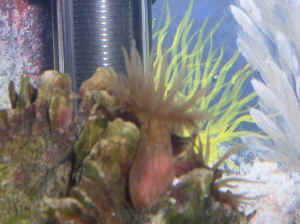
| Aiptasia Pics? I hope I resized
and compressed these pictures correctly. Thanks again
for all your help. Deb <These do appear to be Aiptasia...
though very hard to make out the pix... files can be sent a few
hundred kilobytes in size. Bob Fenner> Hi Crew, Thanks for the
great site loaded with information! These Anemones
pictured came with some live rock we purchased from
Florida. Can you please tell me if they are the dreaded
Aiptasia?? They have multiplied rapidly (maybe 30 total
in 185 gal tank), but they don't have the glassy, see through
appearance I've seen in so many other Aiptasia photos. And if
they are not Aiptasia, do you have any idea what they could
be?? Thanks again, Deb Re: Aiptasia Pics Revised Sorry
about the size. I resized a little bigger and
compressed, I'm new to sending pics over the
internet. Hopefully they are clearer this time. Thanks
Again, Deb. <No worries... but best to check the
"properties" (right click) of your image files for
size... and send as jpegs or bmps over the Net. Bob Fenner> |
 |
 |
|
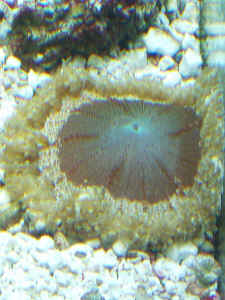
Anemone Identification 4/11/04 I bought this
anemone (see attachment) from Petco last a month ago and they had
no information on it's specific genus and species. They had
it for sale as a "zebra mat anemone". I couldn't
find any information on any species or find any pictures of this
individual. Do you have any idea what it might be? Thank
you. <I want to help you here my friend... but I
don't want to enable you either with easy answers,
particularly as a reward for an irresponsible decision: buying
any living creature that you do not know the name of, what it
needs/eats or how to care for... is just plain wrong. It
disappoints me, but I have hope/faith that you will not repeat
the mistake (which at best will cost you more than a few dollars
to buy the lighting this anemone needs, or the loss of its value
when you return it because you cannot afford or do not want to
buy said lights, etc). I'm grateful that you are at least
asking its name at this point. I see by the file name of the
image you have sent that somebody thinks it is a Phymanthus
species. Interesting. Let me guide you to investigate further by
delving into the extraordinary (there are lots of pages!)
archives we have on anemones at wetwebmedia.com. There is also
some very good coverage of these cnidarians in popular works by
Sprung and Wilkerson for example. Statistically, the overwhelming
majority of anemones collected die within months. Worse still...
they have a dismal rate of recovery from said collections in the
wild. Conscientious aquarists will resist the desire to keep the
majority of these creatures due to dubious "sustainable
collection". If you must have an anemone if/when this one
dies... do look at getting a tank-raised rose bubble-tip (E.
quadricolor). Gorgeous and (self-)sustainable! Anthony>
|
|
|
|
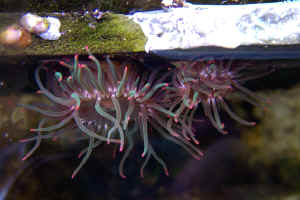
Anemonia anemone 4/6/04 Hi, I attached a picture
and have been going around and around with a few people about
what exactly these little guys are called I have been calling
them Tulip Anemone's and some people have been calling them
Aiptasia Anemone's......lol Now I know the difference and
would never give away the dreaded ones on purpose, but have I
been doing that by mistake? <this is a handsome Anemonia
(so called Majano cf. species). They can be a plague just as
easily as Aiptasia. For those with good water quality though
(good nutrient export, control of particulates at large, etc)
they present no problem and may be enjoyed. I find them to be
very attractive> These guys in the picture split pretty
easy when fed directly and are rather beautiful especially when
you have a small cluster of them growing in the same area they do
not seem to get much larger than a quarter. What do you think
they are? Thank You for your time, <best regards,
Anthony>
|
|
|
|
Making Friends With His Anemones Hello Bob,
<Actually, Scott F. in tonight> I need a little help
with a couple of questions. I have a 65g reef aquarium, about
60lb live rock, no corals. The tank is 16" deep
(height) Following are the lighting provisions for the
tank 10,000k daylight, 48" Power Glo(40w),
48" Marine Glo(40w), 48" Moon Light (20w),
24" From what I have read here, the lighting may not
be enough. Please take a look at 2 of my 3 anemones. I have
had these anemones for about 5 months now. I think one of them
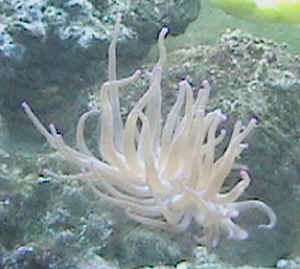
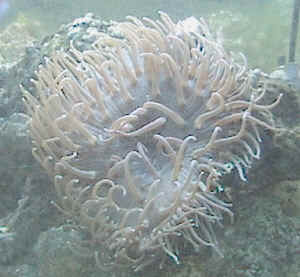
(in the photo anemone02.jpg) is a Condy? (I have 2 of them, are
they of any use in an aquarium, besides visual)?
<I'd say almost without hesitation that this is a
Condylactis species. They are among the hardiest of anemones,
IMO- but being an Atlantic species, the chances are very remote
that they will host clownfish. Once settled in, they do very well
in captivity, and are, in my opinion, quite attractive. I
don't like the idea of multiple anemone species in the same
tank, though- particularly those that come from different
geographical locales. The incidence of allelopathy
("chemical warfare"), which can cause harm to all of
the specimens, is quite high, particularly in a small
tank> Could you please help me identify the second one?
(anemone01.jpg). <It looks to me to be a Macrodactyla
doreensis, a fairly hardy Indo-Pacific species> Anemone
1 has a clown fish that shares its life. Daytime with all lights
on, the anemone 1 gets to a diameter of about 12 to 14".
Especially if I turn on the extra (external) 250w halogen work
light right in front of the glass facing anemone01. Can you
tell from the photo if anemone1 looks healthy enough?
<Looks healthy to me from the picture> I am saving
for power compacts, it will be 2 months before I can afford them.
In the mean time I supplement them (anemones and other inverts)
with phytoplankton, coral gold? (some kind of liquid food I found
at PetCo), frozen blood warms and other mixed frozen stuff, which
the fish in the tank also eat. <Well, you do want to
provide them with a variety of meaty foods of marine origin.
Anemones do need lots of food; the real problem is that many of
the foods we se are "unrecognizable" to the anemones,
and they may or may not evoke a feeding response. Additionally,
be sure to provide intense lighting. I would recommend metal
halides for long-term success> Everything seems to be
perfect, only high's I get are Nitrates and am working on
that by water changes and about to make a denitrator. Any
advice for better life of the anemones? <As above. Do
take into account their need for intense lighting, and
high-quality water and food. Adequate water movement is also
important. Once you find a regimen that seems to be working for
your anemones, stick to it. With a little extra effort, and a bit
of luck, your anemones may survive for many, many years. Good
luck!>Thanks in advance for your time Sincerely Samir
aka Kulmansam <You're quite welcome, Samir! I hope
the anemones continue to do well for you! Regards, Scott
F>
|
 |
 |
| Anemone ID 3/18/04 First off, love the
site, very helpful and informative. Do you have an idea of what
type of anemone this could be? Found along the Galveston, Texas
coast, very common in tide pools. Sorry for the poor picture
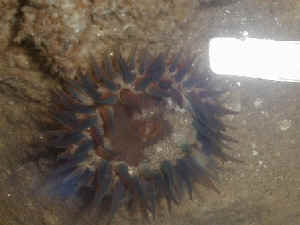
quality. Thanks guys, Eric <looks clearly like Bunudosoma to me.
Very aggressive (eats small fishes) and is a temperate/subtropical
species. Often mistaken for Actinia species. Anthony> |
| Bunudosoma anemones 3/18/04 Thanks Anthony,
and no kidding on the aggressiveness, I found 2 of them battling
over a small blue crab yesterday, are they hardy in aquariums?
<yes... very hardy if the tank is cool (under 75 F)>
Obviously something devoted to them and other animals they cannot
harm or maybe with larger fish. The colors are very variable from
blue-green to purple and red to blue and red. Thanks again for your
help. Eric <very welcome my friend. Anthony> |
|
 <Plus flash!> <Plus flash!>
|
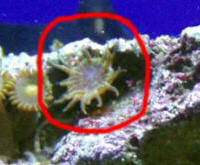
| Anemone ID Hi there, Is this a
Heteractis magnifica? Thanks. Wid <Don't think so... looks
like a died "Sebae", Heteractis crispa to me. Take a read
re dyed anemones, these species on www.WetWebMedia.com Bob
Fenner> |
 |
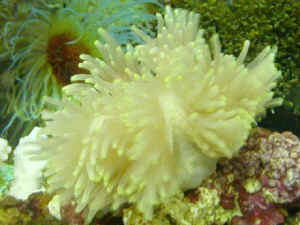 |
| Re: Anemone ID Hi Bob, Thanks for your
prompt reply :) Not to doubt your professionalism, I think the
picture's colour does not reflect the actual colour of it (I
apologize). It looked kinda yellow in the picture but in fact is
light tan in colour when it isn't in quite a good mood,
otherwise it is translucent off white. To me it isn't a bright
colour, and in fact rather "colourless" to me. Or do you
think it is a dyed but it has faded off over time? And by the way,
it's base is white and its tips are light yellow green. Thanks
so much, you guys are a blessing to us. Wid <Can you make out
the distinctive verrucae on the animals pedicle? These are
indicative on H. magnifica... Bob Fenner> |
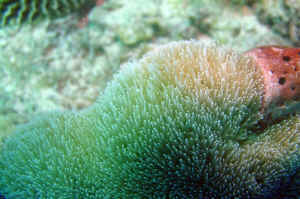
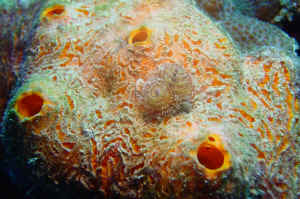
Identification of anemone and
sponge? 2/27/04 These pictures were taken in St. Croix last
weekend, <Mmm... sounds nice> I think that one is
a sun anemone, but it was NOT blue green in color as is advised in
my Reef Creatures book. <no matter... variable
color, and it really looks like Stichodactyla helianthus to me too.
The other is obviously an orange sponge of some kind... but what
kind exactly is it? <the possibilities are staggering. No way of
telling here my friend from a photo> I have non dumbed down
pictures if you want them. thanks Melissa Dickens
<best regards, Anthony> |
 |
 |
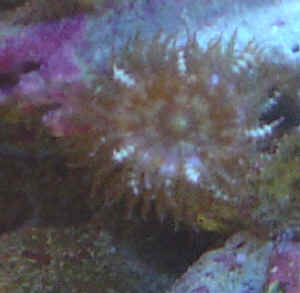
Hitchhiker ID/Refugium/Snail reproduction -
2/26/04 Hey Crew! Thank you all for such a great
site. I wouldn't have made it this far without all
of you. <We wouldn't have made it this far without your
questions. So, thank you> I have attached an image file (not the
best picture in the world) of a hitchhiker that has shown up in my
tank. If anyone has an idea of what this is I'd
greatly appreciate the knowledge. <Definitely an anemone from
the family Actinodendronidae See here: http://www.wetwebmedia.com/anempt2.htm>
My second question, is it okay to keep hermit crabs (blue legged
variety) in a refugium? <I don't like the idea of putting
hermits in a refugium as they are so omnivorous that they might eat
anything and everything> My crabs, although great at keeping the
sand on the bottom of the tank clean, are becoming pests to my soft
corals and I would like to move them into my above tank refugium.
<Really? I haven't heard of Blue Legged hermits bugging soft
corals> The refugium is about 10 gallons and has a 4
inch sand bed and contains Chaetomorpha, grape and feather
Caulerpa, and probably some other plant life. I got the grab bag of
stuff from the LFS. <Sounds good. Do you keep lit 24 hours a
day?> Thirdly, is snail reproduction normal in a healthy tank?
<Yes. Pass them around to friends and reef club members.>
Thank you kindly,
Tony Hambley
Milford, MI |
|
|
|
|

