|
FAQs on Anemone Identification
25
Related Articles: Anemones,
Bubble
Tip Anemones, LTAs, Cnidarians, Coldwater Anemones, Colored/Dyed Anemones,
Related FAQs: Anemone ID 1, Anemone ID 2, Anemone ID 3, Anemone ID 4, Anemone ID 5, Anemone ID 6, Anemone ID 7,
Anemone ID 8,
Anemone ID 9, Anemone ID 10, Anemone ID 11,
Anemone ID 12,
Anemone ID 13, Anemone ID 14, Anemone ID 15, Anemone ID 16, Anemone ID 17, Anemone ID 18, Anemone ID 19, Anemone ID 20, Anemone ID 21, Anemone ID 22, Anemone ID 23, Anemone ID 24, Anemone ID 26, Anemone ID 27, Anemone ID 28, Anemone ID 29, Anemone
ID 30, Anemone ID 31, Anemone ID 32, Anemone ID 33, Anemone ID 34, Anemone ID 35, Anemone ID 36, Anemone ID 37, Anemone ID 38, Anemone ID 39, Anemone ID 40, Anemone ID 41,
Anemone ID 42,
Anemone ID 43,
Anemone ID 44, Anemone ID 45,
& Cnidarian Identification, Anemones 1,
Anemones 2, Anemones 3, Anemones
4, Anemones 5, Invertebrate Identification, Aiptasia
Identification, Aiptasia ID
2, LTA
Identification, Bubble Tip
Anemones, Caribbean
Anemones, Condylactis, Aiptasia
Anemones, Other Pest
Anemones, Anemones and
Clownfishes, Anemone
Reproduction, Anemone
Lighting, Anemone Feeding,
Anemone Systems,
Anemone
Compatibility, Anemone
Selection, Anemone
Health, Anemone Behavior,
Anemone
Placement,
|
359%20anem%20id.jpg)
|
 |
New Print and
eBook on Amazon:
Anemone Success
Doing what it takes to keep Anemones healthy long-term
by Robert (Bob) Fenner
|
|
Help with Hitchhiker ID 12/30/08 Hi, thank
you for your time and help. <Hello Andrew, Minh at your
service.> I brought home a Bubble Coral about two weeks ago
which is doing extremely well. Several days ago I noticed two
little unknown hitchhikers of sorts, growing on both sides of the
lower part of the Bubble Coral. I have attached two pictures that
show both the top and side's of these little things, it looks
to me like maybe some type of anemone.. It has sort of a light
green base and disc with light brown tentacles, it looks as
though it might have a mouth or something circular in the center
and is about a 1/4in long, if it is an anemone should I remove
it? <Based on the photos and your description of the animal in
question, they appear to be Anemonia majano. Many consider this
species along with Aiptasia sp. to be pest anemones. You can arm
yourself with more information and ultimately decide the best
course of action by reviewing this link:
http://www.wetwebmedia.com/anemoniafaqs.htm.> I searched
around on the site and some things looked similar but I just
couldn't seem to convince myself, I apologize for another
routine question. <No worries at all, nothing is routine in
this hobby.> Thank you, I appreciate any help you can give me.
<You're welcome. Cheers, Minh Huynh>
|
[1]%20anemonia.jpg) |
|
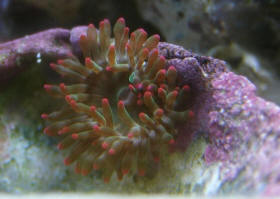
Anemone ID, Friend Or Foe 12/18/08 Hello
Crew, <Hi Sandra.> Thanks for taking the time to give your
input. <You're welcome.> Can you please tell me if the
attached picture is a Majano or a Tulip Anemone? I have no real
knowledge of anemones and need to know if this hitchhiker should
stay or go. If it is neither, a heads up as to what it is would
be appreciated. <Sure looks like a Tulip Anemone to me, nice
looking also.> Thanks again, <You're welcome. James
(Salty Dog)>
Sandra
|
 |
|
Hitch Hiking Disc ID 12/14/08 Hello WWM Crew,
I have about 10 of these discs on my live rock.. all appear to be
thriving. They move around until they find a spot they like. If
you touch them they pull right into a hole/ base and shrivel up.
They have a base like a mushroom/ anemone. I believe it may be a
variety of Epicystis sp. from other posts on your site. Here are
some pics.. <Hmm, could be Epicystis sp. (a little
bleached)...>
http://i277.photobucket.com/albums/kk60/nallender/DSC02003.jpg
http://i277.photobucket.com/albums/kk60/nallender/mysterydisc.jpg
<It's hard to tell from the photos, but they might also be
some type of Corallimorph (i.e. mushrooms, etc.).> Thanks for
all your help,
Nick
<Best,
Sara M.>
|
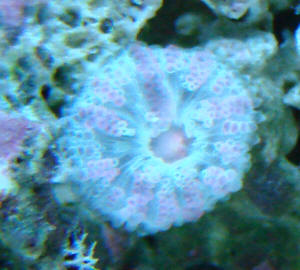
Re: Hitch Hiking Disc ID
12/16/08 Thanks for the response. I just wanted to
update you on my hitch hiker. I have posted on some forums and
searched the internet and I believe 100% that it is a mini carpet
anemone. Most stay under 1"-1.5" in diameter. A lot of
people have shown interest in these little guys! I might have to
look into mini carpet anemone propagation! <Cool... thanks for
the info/update! -Sara M.> <<Stichodactyla
tapetum... Interesting indeed. RMF>>
|
|
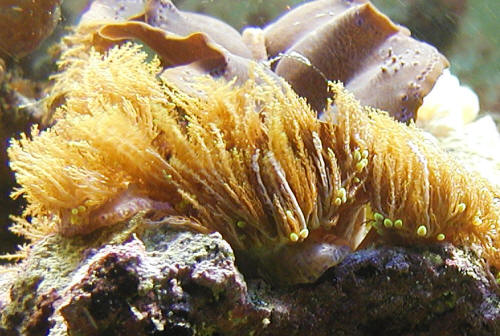
Can you help me id this? Thalassianthus
12/16/08 Thanks for such an informative site. Many of us
really trust you experience. <Thank you for your kind
words.> Attached are two pictures I took of something growing
in my reef tank � I was hoping you might
tell me what it is - and what I should do �
if anything. They are beginning to populate and are very
difficult (impossible) to remove from the rock. Is it some form
of anemone? <Yes. I am sure this is a Thalassianthus species
or at least closely related. Do a WWM search for this genus to
find further posts. The picture nicely shows small grape-like
balls, these are nematospheres, quite typical for this genus and
only found in one anemone family. Can become a pest. I have them
in a fish/soft coral tank without any problems and think they are
beautiful. But in SPS tanks or tanks with sensitive animals like
clams they may be problematic, especially when propagating like
crazy.> If so, if I try to remove them and do a partial job -
will I create a pollution problem? <As I wrote to another
poster, I'd try: Careful (!) injection of boiling water,
muriatic acid or sodium hydroxide solution as described at
http://www.wetwebmedia.com/ca/cav1i3/aiptasia_impressions/aiptaisia_impressions.htm
under �other
chemicals�. Don't kill too many at the
same time and always filter with carbon and also watch the pH
when using pH changing substances. You can also try to remove
them with an old, but clean tooth brush, just brush the foot for
a few minutes and the animal may eventually decide to loosen its
grip. Then, they can be removed with fingernails or an old knife
or piece of plastic. This method needs some practice, be aware
that they are able to burn at least the underside of your arms,
possibly even your fingers. Carbon should also be applied when
going this route. Removing them in one piece is more difficult,
but might be worth it (you'll avoid most of the pollution)
and some fellow hobbyists with less sensitive animals or fish
tanks might actually be happy about them.> One is actually
growing on the shell of my clam!! <Needs to go.> My tank:
125 gallons with about 130 pounds of life rock taken directly
from a friend's 400g tank. 30 gallon sump/refugium Skimmer.
Change water every other week (15g). 3 x 150 MH lights. 4 x 96
actinic lights. 8 moon lights. Thank you for any help you can
provide. Regards, -gene
<Hope this helps. Marco.>
|
 Nice! RMF. Nice! RMF.
Re: Can you help me id this?,
Thalassianthus II 12/17/08 Fantastic! Thank you so much
for the information. <You are welcome.> Actually, I'm
not as concerned as I was before. Since you have some in your
tank and with a careful eye on control -- they apparently are not
a serious problem. <Not in my specific tank, I put them in
there intentionally. But if you have sensitive stony corals, they
might become a problem or at least mean some work.> Just an
update -- my clam doesn't seem concerned at all at this point
-- but I'll follow your recommendations. Thanks again. By the
way -- since I had no idea what this was, I really didn't
know how to do my 'home work' before asking for your
help. �gene. <No problem. There is not
much information available in the usual aquarium literature on
this anemone family as far as I know. Cheers. Marco.>
Re: Can you help me id this?,
Thalassianthus III 12/17/08 Marco <Glen.> -- one
other thought -- I use Aiptasia-X (Red Sea) to control the
Aiptasia in my tank -- and it works well. Do you think it would
be effective on the Thalassianthus? <Yes. Works quite similar
to Calcium hydroxide.
http://www.wetwebmedia.com/ca/volume_1/cav1i3/aiptasia_impressions/aiptaisia_impressions.htm
.> Of course, I can try it without harm - just curious about
your thoughts. If I do try it (and it works) would you like me to
share that with you and your team? <Of course. It will help
others in the future. Thanks. Marco.>
|
|
Anemone ID 12/2/08 Hi. <Hi Jessy here>
I have been pointed to this site for identification of a
hitchhiker on some new living rock. Need to know what it is as
maybe its a baddy. But if not I need to know how to care for it.
Thanks in advance. <Yep you've got yourself a majano
anemone. They will rapidly reproduce and therein lies the
"pest" problem. They are one of the prettier pests in
my opinion, but you'll want to remove it nonetheless. Read
more FAQ's here http://www.wetwebmedia.com/anemoniafaqs.htm
for removal ideas.> Steve
<Regards, Jessy> :
|
|
|
|