|
FAQs on Anemone Identification
26
Related Articles: Anemones,
Bubble
Tip Anemones, LTAs, Cnidarians, Coldwater Anemones, Colored/Dyed Anemones,
Related FAQs: Anemone ID 1, Anemone ID 2, Anemone ID 3, Anemone ID 4, Anemone ID 5, Anemone ID 6, Anemone ID 7,
Anemone ID 8,
Anemone ID 9, Anemone ID 10, Anemone ID 11,
Anemone ID 12,
Anemone ID 13, Anemone ID 14, Anemone ID 15, Anemone ID 16, Anemone ID 17, Anemone ID 18, Anemone ID 19, Anemone ID 20, Anemone ID 21, Anemone ID 22, Anemone ID 23, Anemone ID 24, Anemone ID 25, Anemone ID 27, Anemone ID 28, Anemone ID 29, Anemone
ID 30, Anemone ID 31, Anemone ID 32, Anemone ID 33, Anemone ID 34, Anemone ID 35, Anemone ID 36, Anemone ID 37, Anemone ID 38, Anemone ID 39, Anemone ID 40, Anemone ID 41,
Anemone ID 42,
Anemone ID 43,
Anemone ID 44, Anemone ID 45,
& Cnidarian Identification, Anemones 1,
Anemones 2, Anemones 3, Anemones
4, Anemones 5, Invertebrate Identification, Aiptasia
Identification, Aiptasia ID
2, LTA
Identification, Bubble Tip
Anemones, Caribbean
Anemones, Condylactis, Aiptasia
Anemones, Other Pest
Anemones, Anemones and
Clownfishes, Anemone
Reproduction, Anemone
Lighting, Anemone Feeding,
Anemone Systems,
Anemone
Compatibility, Anemone
Selection, Anemone
Health, Anemone Behavior,
Anemone
Placement,
|
|
 |
New Print and
eBook on Amazon:
Anemone Success
Doing what it takes to keep Anemones healthy long-term
by Robert (Bob) Fenner
|
|
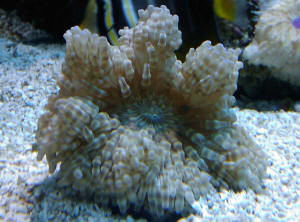
Anemone ID/Question -Heteractis aurora
01/21/09 Hi, and thank you in advance for your help. I
recently purchased a Flower Anemone from my LFS. It looks very
different than any other one I have ever seen. <Probably
because it's not a flower anemone. It looks like an unhappy
"Beaded Anemone" (Heteractis aurora).> I attached a
picture (It's the one closest to the front). I'm not sure
if you can see that it has purple tips in the pic. Is this a
different kind of anemone? <Yes... with different care
requirements. They need to be kept on a DSB, with a lot of space
to spread out. Please read here:
http://www.wetwebmedia.com/beadanemfaqs.htm
http://www.wetwebmedia.com/marine/inverts/cnidaria/anthozoa/anemones.htm>
Also, unrelated, but I also have a Bulb Tip Anemone that is badly
bleached (almost pure white). It hasn't moved in months. It
eats and looks very well, I feed it 1/4" pieces of krill a
few times per week which it chows down, for the most part the
tentacles still have the bulb tips most of the time. It moved
under an overhang without sufficient light months ago and has
just stayed there. <It's obviously unhappy.> Would it
be beneficial if I moved the rock around so it isn't so
shaded? Will it eventually regain it's color if I do that, or
will it be fine the way it is? Thanks again!! <Maybe... I need
more info re your tank/system.> Brian
<Best,
Sara M.>
|
| |
|
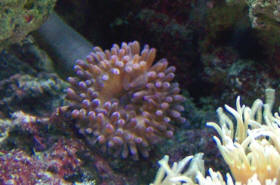
Anemone? 1/17/09 While
glancing in my tank the other day, I noticed this specimen. We
have just recovered from an aiptasia infestation. Please tell me
this is not something bad as well. <Mmm, not "bad"
per se... at least not potentially as bad as Aiptasia> If so,
what do we do to get rid of it. We used peppermint shrimp for the
previous problem. Thanks for your insight, Bellinda B.
<Appears to be an Anemonia cf. majano... Please read here re:
http://www.wetwebmedia.com/anemoniafaqs.htm and the linked files
above. Bob Fenner>
|
 |
|
Please help ID anemone 01/12/09 Hello! Let me
first start by saying that this is a great site and what you guys
do is absolutely wonderful! <Well, thank you.> My husband
and I have been keeping a saltwater reef for a few years - though
we recently had to do a new setup. We left for vacation during
last winter and apparently, the water heater failed, and before
our tank-sitter showed up in a day, everyone passed away.
<I'm sorry for your loss.> So now we're back up and
running for almost a year now and we recently added our first
anemone. We've had experience with keeping Rose BTAs and
LTAs. Our Rose BTAs would divide, relocate, grow and divide
again. This made our two LTAs shrink, shrivel, and disappear into
the filter system.? Alas, that's all gone now. What we have
now is a problem identifying our new anemone.? The LFS had it
labeled as an LTA for $19. My husband was 100% sure that it
wasn't an LTA (as this is his hobby) and bought it thinking
it a steal. <I do agree with your husband, that this is not a
LTA.> So I've Googled and researched and have come up with
conflicting photos and captions.? We've narrowed it down to
one of three possibilities in order of most likely: H. malu, H.
aurora, H. magnifica ... at some point we even considered H.
crispa. <I'm going to put my vote in for Heteractis crispa
(i.e. a "Sebae" anemone).> We have a lone Maroon
clownfish, less than 2" in length, who is minisculed next to
this anemone - but refuses to go near it. We hope someday in the
future, he may change his mind -- he's been in the main tank
only 3 days now. <If possible/easy... try putting the two in a
bucket together for an hour or so (maybe with an airstone).>
I've attached three photos, if you could help us, that would
be much appreciated! <Thanks, again, I'm going to say
it's a H. crispa.> Thank you.
Sam
<De nada,
Sara M.>
|
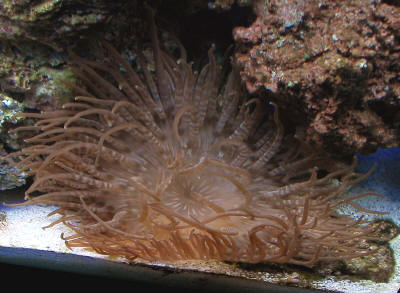 Bingo. RMF
 |
| Please help ID anemone...oops 01/12/09 Sorry!?
I forgot to mention a few tidbits. We have never seen an anemone
that is so responsive to it's environment quite like this one.
It will "jerk" suddenly when something comes in contact
with it, instead of gracefully closing itself off. <Usually,
responsiveness is a good thing in an anemone. The ones that are
slower to respond are usually not doing so well (unless, of course,
if it's an anemone that's been in a tank for a long time
and has simply grown used to people/fish/shrimp pestering it).>
We learned of this when one of our peppermint shrimp decided to
take a sample of a tentacle or when a snail decided to pass by on
another day. Because of this, we have to be careful feeding it, so
it doesn't close prematurely. Oddly enough, if our new maroon
clownfish accidentally comes into contact, it doesn't do a
thing! <Makes sense... sounds like there's a chance for love
here! :-)> It's very fast in that it closes down on it's
food in just a couple seconds and can pick up and move to the other
side of a 50g tank in less than 5 minutes. We were very amazed at
this feat since it did it with no water flow (we shut off water
flow every time there is a new addition to the tank and keep it off
for at least 30 minutes). It has not moved since it's own
relocation. <This all sounds like good, healthy behavior.
Healthy anemones, when placed in a new environment, will
"scout out" the tank, moving around. When they find a
spot they like (or is at least the best of the worst of its
options), it will settle down, anchor and stay put.> It has
buried itself into the substrate and prefers this over the rocks.
And finally, unlike our previous LTAs and BTAs that would remain
slightly open during the night for their clownfish, this anemone
completely encloses itself every night into the size of a tennis
ball. <Again, not to worry... it might change this habit in time
(especially if you start feeding a bit at night).> I believe
it's protecting itself from the peppermint shrimp since it
doesn't have a hosting fish at this time? <Just give it some
time. The animal isn't likely still just getting used to its
new home.> We've been pellet feeding the shrimps to keep
them uninterested in the anemone. I hope this added information
helps! Sorry again, Sam <No worries and de nada :-) Sara
M.> |
|
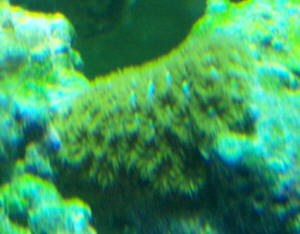
Anemone cluster identification 1/1/09
Hi crew, <Michael> WWM is an awesome website. I've had
a 120 gallon SW tank with ~175lbs live rock, peaceful fish, some
invert cleaners, a few corals for almost 3 years now. The
information on your website has helped me through many trials and
tribulations. The scariest event was a plague of BGA that spread
like wildfire in my tank, covered almost everything, starved my
algae blenny...then rapidly lifted after I vacuumed a half inch
of detritus that collected in my sump over a 1 year period! It
was an amazing feeling to see it all disappear! If I tried
vacuuming the BGA, it just reappeared within a day. <Ahh!>
I finally write to you now for the first time with an attached
picture (sorry if the pic is of poor quality). Can you help me
identify this cluster of what looks like tiny anemones. <Mmm,
yes, I think so> They are very small, somewhat brownish in
color. All of my live rock were purchased through
liveaquaria.com, except for this piece, which I bought at a local
pet store (maybe 1.5 years ago). One day, I noticed a few of this
cute little guys, then they've slowly reproduced over the
last year. I'm curious if they're considered a pest and
could eventually cover the whole piece of rock. I could remove
the rock and chisel them off. :) <Do so carefully, outside the
system... they're quite toxic... to you, your livestock>
As far as invert cleaners, I have assorted hermit crabs, snails,
a pistol shrimp and serpent sea star. All of my emerald crabs and
peppermint shrimps seem to have perished. I plan to get more. My
setup has an outer orbit light fixture with 2-130W CF's and
2-150W MH's, moonlights. I have more live rock rubble in the
sump. Any ideas on the cluster? Thanks again for maintaining such
a resourceful website!!! Michael <You're welcome. This
appears to be a group of Zoanthids... Please see the chart here
re discerning various Cnidarian groups:
http://wetwebmedia.com/zoanthid.htm and the linked file re
Zoanthid Compatibility above. Cheers, Bob Fenner>
|
 |
|
|

