|
FAQs about the Diseases of
Clownfishes: Physical Trauma, Injury
Related FAQs: Clownfish Disease 1, Diseases of Clownfishes 2, Diseases of Clownfishes 3, Clownfish Disease 4, Clownfish Disease 5, Clownfish Disease 6, Clownfish Disease 7, Clownfish Disease 8, Clownfish Disease 9, Clownfish Disease 10, Clownfish Disease 11, Clownfish Disease 12, Clownfish Disease 13, Clownfish Disease 14, Clownfish Disease 15,
Clownfish Disease 16, Clownfish Disease 17, Clownfish Disease 18, Clownfish Disease 19, Clownfish Disease 20, Clownfish Disease 21, Clownfish Disease 22,
Clownfish Disease 24,
Clownfish Disease 25,
Clownfish Disease 26,
Clownfish Disease 27,
& FAQs on
Clownfish Disease By: Environmental
Stress, Nutrition, Social/Behavioral/Territoriality, &
Pathogens: Lymphocystis, Infectious Disease (Bacteria, Fungi...),
Protozoans: Cryptocaryon/Ich,
Amyloodinium/Velvet, Brooklynella (see article below), &
Mysteries/Anomalous Losses, Cure, Success Stories, &
Clownfishes in General, Clownfish Identification, Clownfish Selection, Clownfish Compatibility, Clownfish Behavior, Clownfish Systems, Clownfish Feeding, Clownfishes and Anemones,
Breeding
Clowns
Related Articles: Clownfish Disease, Brooklynellosis, Clownfishes, Maroon
Clowns, Marine Disease,
|
It's not unusual for these fishes to be
rubbed, nicked, beaten through the process of capture, holding,
shipping... to get scratched on rocks, pulled against pump
intakes, get spined by tankmates...
|
|
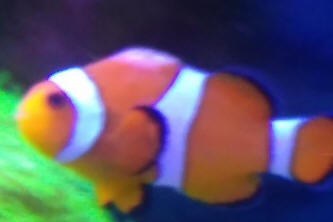
Top Fin Damage 11/15/19
Hello,
<Hey Nick>
Here are a couple pictures of my Amphiprion Ocellaris Clown. Three weeks ago I
noticed the top fin was looking white and he would rarely extend it. I've been
monitoring it and it didn't look like it was getting any worse till yesterday.
The white area looks like it's at the top of the body now.
He lived in a 55 gal tank for 5 years, and earlier this year I moved everything
into a 75 gal. The tank is stable. I haven't lost any fish in five years. I've
introduced a few corals (dipped) and some snails over the last few months. Fish:
2 clowns, 1 Royal Gramma, 2 Blue Chromis which are smaller than the clowns. The
Clowns sleep in a frogspawn. Sometimes the Royal Gramma will nip at the clowns,
but not enough to even make them swim away. Two small hermit crabs. He acts
healthy and normal, eats well.
Does this look like physical damage that needs time to heal? Is it more likely a
disease of some kind? What remedy should I employ?
I appreciate your advice!
<Does look like physical damage, this kind of wound is typically caused
by a nipping tank mate, watch carefully to identify the bully and isolate it.
This wound should heal in a few weeks.>
Thanks, Nick
<Welcome. Wil.>
|
 .jpg) |
|
Re: Top Fin Damage 11/23/19
Here is an updated picture of the top fin. It looks like even the top of the
body is affected at this point. The whitish coloration lower on his body is a
smear on the glass. The rest of the body looks fine, other than the top fin.
Does this still appear to be physical damage and not some other ailment? I
haven't found the culprit yet.
<Does look like an open wound... If environmental conditions are not ideal, it
will take longer to heal, I’d do small partial water changes (10 to 15%) two or
three times a week, add vitamin supplements to the fish diet and start using
activated carbon.>
Should I remove the wounded fish, and place in a hospital tank till recovery? It
seems that would be additional stress, but maybe worth it?
<Worth trying, this way you’ll also know if another fish was nipping at it.>
Much appreciate!
<Cheers. Wil.>
|
 |
|
|
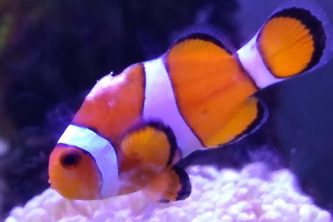
7 year old female clown holds mouth open and won't or can't eat.
5/1/17
I just noticed that the ridge on her back looks a little ragged compared to
his. Here is another video and photo.
<This fish's mouth appears damaged... either from trauma or genetics. Not
much you can do other than be patient and hope. Bob Fenner>
7 year old female clown holds mouth open and won't or can't eat.
5/1/17
> Here is a video and photo :
<Ditto>
|
 |
|
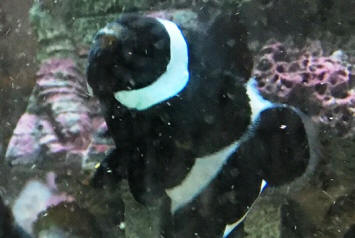
Mama clown unwell
11/24/16
<Is there a full moon? WHY are people sending files of megabytes rather than
what we list as our requirement? Deleted. SEE/READ and re-send re-sized. B>
Mama clown unwell
11/24/16
Mr. Fenner,
<Howsit Kel?>
My sincere apologies for sending such a large file. It was a gross oversight
on my part and I will be mindful of that in the future ��
Kellie Kyser
So Mote It Be
<Hotay!>
Subject: re: Mama clown unwell
11/24/16
Good afternoon,
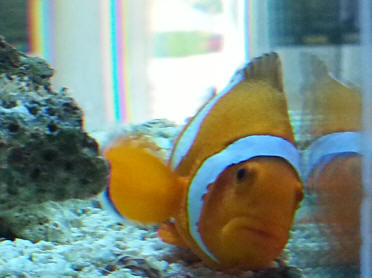
My female clown, that had injured her eye doing the bump and rub with her
mate, has not been quite the same since she healed. She stays by herself at
the bottom of the tank, occasionally moving up and around a bit, and has not
been eating. I have tried to tempt her with live brine and ghost shrimp,
which she normally devours, but now shows no interest in any food.
All other tank mates and corals are happy and healthy and water parameters
are all within range. She does seem to list a bit as can be seen in the
photo I have attached. I have scoured your site and the internet but cannot
find any information. As always, I appreciate your time and knowledge.
Kellie Kyser
<The bit on the operculum brings to mind a viral growth... most-oft labeled
"Lymphocystis". I encourage you to soak proffered foods for a few minutes
and apply directly to the water a product like SeaChem's "Vitality"; in hope
of stimulating this animals immune system. Bob Fenner>
|
 |
|
Re: Mama clown unwell 11/25/16
Thank you for the information and I will update you on her progress. Have a
wonderful Thanksgiving!
Kellie Kyser ��
<Ah, thank you; and you as well. B>
|
|
Popeye on clown
9/29/16
Good morning! My clown injured her eye as she and her mate were doing
the bump and rub.
<Good desc.>
I read on your site about doing a water change(done) and adding
Epsom salts and wanted to verify the dosage of 1 tablespoon per 10
gallons.
<Yes; about right and safe...>
I have mushrooms and palm tree corals along with button polyps.
<Should work out for these as well. I will make the obligatory
cautionary statement here re allelopathy and the need for regular
maintenance to avoid triggering a cascade event>
The other fish are a yellow tang and 2 pajama cardinals. I will have to
treat the whole tank (as trying to dislodge mama clown is like trying to
reinvent the wheel) and wanted to make sure that the Epsom salts are
safe for everyone. Thank you for your time,
Kellie Kyser
So Mote It Be
<Indeed. Bob Fenner>
Re: Popeye on clown 9/30/16
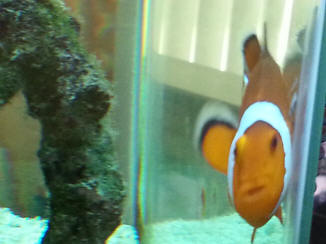
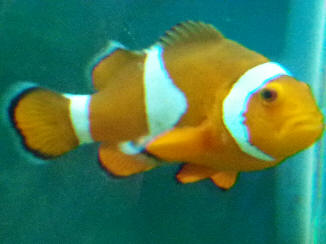
Mr. Fenner, thank you replying so quickly. In your honest opinion, should I just
let her heal naturally. She shows no sign of any distress and her eye is clear.
I have attached 2 photos. Truthfully, although I read about adding Epsom salts
to the tank, I did not see any explanation as to why it would be beneficial
other than speeding up the healing process.
<Mmm; as with human use... MgSO4 is a "muscle relaxant" and vasodilator... my
thinking (okay, guessing) is that it allows more blood flow... aiding
repair in the highly vascularized areas esp., like fish eyes>
I prefer not to use chemicals and in the 6 years of this tank running, have only
used a chemical, PraziPro, once and that was due to what was thought to be a
parasite but turned out to be a streamer of algae on tangs barb. I highly valve
<and value I hope!> your opinion on this and only want to do the best for my
tanks' inhabitants.
<Mmm; seeing these pix; and if this fish, system were mine, I would hold off on
actual treatment, salt use. As you've stated, with general good care,
nutrition... this fish should heal of its own accord. BobF>
Thank you again,
Kellie Kyser
So Mote It Be
<Still moting?>
|
 |
|
Re: Popeye on clown
9/30/16
Thank you sir and, as always, much appreciation for your knowledge and time.
Have a wonderful day ��
Kellie Kyser
<And you Kel. B>
So Mote It Be
Re: Popeye on clown
10/7/16
Good morning! Good news! My female clowns' PopEye is completely gone. I wished
to share with you the news of her recovery. Thank you for your insight on
letting her heal naturally. Have a great day ?
So Mote It Be
<Thank you for this update Kel. Excelsior! Bob Fenner>
|
Something on my Black Ocellaris' Eye 2/22/14
Hello Crew,
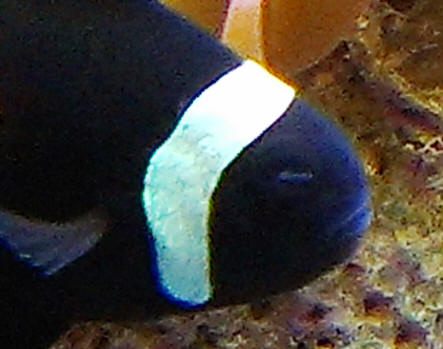
Today, I noticed something on my black Ocellaris� right eye. Please see the
attached picture.
Any idea what it could be?
<Looks to be a scratch>
Please help!
Temp 80°F
Salinity 1.024
pH 8.3
dKH 9.0
Ammonia 0
Nitrite 0
Nitrate 10
Calcium 400
Phosphate 0
<Not really zero; or the Cnidarian would be dead>
Thanks,
Andrew
<Nothing to treat here. Just good water quality, nutrition and time going
by. Bob Fenner> RE: Something on my Black Ocellaris' Eye
2/22/14
I forgot to mention that I own a 29 BioCube and the black
Ocellaris has been in my tank for one year (2/16/13). I also have a female
Ocellaris, Banggai Cardinalfish and a Fourline wrasse in same tank.
The wrasse is the newest member (1/18/14).
<Oh... the Fourline is likely bugging all the other fishes... driving the
one to smack itself into something hard. Do keep your eye on the
Pseudocheilinus. BobF>
Let me know if you need anything else.
Thanks,
Andrew
|
 |
|
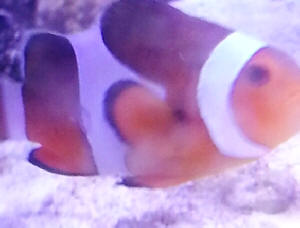
Parasite, Disease, or bite? 5/21/13
Hello and thanks again for letting me as another question. I have 2
new clownfish and they were healthy and fine and still act healthy. Today I
noticed the large of the mated pair (female I assume) has a circular mark on
her side. I have searched for ring type parasites but I am not sure if this
is one or if it just got to close for my Coral Beauty. The mark I am
speaking of is on the border of the orange and white on the bottom fish.
Thanks again :)
<I see it/this... and have looked at enlarged, enhanced. This appears to be
a physical trauma mark rather than a parasite. I wouldn't treat this fish,
or system; but keep my eyes open re aggression. Bob Fenner>
|
 |
Re: re: Parasite, Disease, or bite?
5/22/13
Thanks again for all your help
<Glad to be "here". BobF> |
|
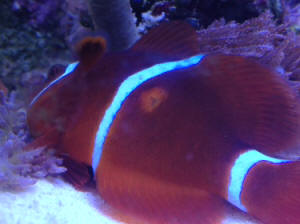
Sore on clownfish
4/2/13
Hi there! I noticed this morning that my large female maroon clown has a
raw looking spot on her side. She was acting otherwise normal, eating
well, active, but I dosed with MelaFix
<... see WWM re this tea extract... of no positive use whatsoever>
and to my surprise it seems to have stunned her to the bottom of the tank
(I'm assuming I should not dose again tomorrow if that's the effect it
has on her) but it did make for an easy photo op~ does this look like an
abrasion or something more serious?
<Appears to be a physical trauma. See WWM re Premnas health as well>
I've had her and her mate for several years, I would be crushed if she
took ill. Thanks again~ I'll wait to hear back!
Anna
<Keep reading. Bob Fenner>
|
 |
Re: Sore on clownfish
4/2/13
Thanks Bob~ I'll look up the articles you referenced! :)
....PS, are there any predatory critters that could make a mark like that?
<Yes; quite a few>
I recently lost a yellow tang who had several similar spots (poor girl
*rip*) my tank is mature and stable, I have no idea what happened because
everything tested well. Would a large bristle worm do this?
<Possibly; though doubtful. BobF>
~Anna |
|
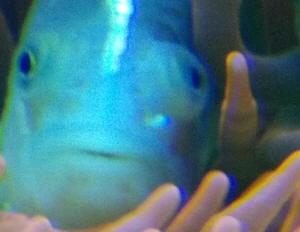
Parasite, lympho, ick, etc
4/25/12
Bob,
<Eric>
I had ick in my previous tank and when I
upgraded tanks 2 months ago decided to treat my fish in quarantine and
leave the tank fallow for 8 weeks. All went well in quarantine
after the quinine treatment. No signs of any parasites.
Within 2 days of returning the fish to the display my yellow assessor
and skunk clown developed large white protruding spots.
<Hmm>
I was able to get a picture of the clownfish. The spot is directly
in front of the eye.
<And the unilateral Popeye...>
The spot on the assessor is on its side. I am not sure if i should
leave the fish in the tank or remove them back to quarantine.
<I'd leave where they are for now>
The spot looks a little to large to be ick. They actually look like
skin tags.
<Might be>
Whatever it is survived a fishless tank for 8 weeks. I plan on
adding more fish to the display that are currently in quarantine but do
not want to make anything worse.
<I'd hold off on this for now as well>
Any ideas what this
could be?
<Not w/o microscopic examination of the area, mucus from the fish
bodies...
BobF>
Eric
|
 |
Re: Parasite, lympho, ick, etc
4/25/12
Thanks Bob. I was able to get a larger picture. Not sure of this
makes any difference.
<Nope. B>
Re: Parasite, lympho, ick, etc 4/25/12
Bob,
Wanted to let you know the white part of the bump protruding off the fish is
gone. All that remains is a flat white spot now. Is it possible
this can actually be some type of damage from the anemone? Excessive
slime or something?
<Oh yes; possible. BobF> Re: Parasite, lympho, Ick, etc
5/1/12
Bob,
Looks like the clownfish healed nicely. It seems
like it was actually a mucus ball as a few hours later I watched it
slough off the fish. Maybe it is excessive mucus from the anemone?
<Again... or just resultant from a "poke" of some sort>
My biggest concern is now with my black line blenny. He is
flashing and literally swimming in circles chasing its tail. I am
looking for the classic Ick signs but can not find any spots. The
assessor, spot fin cardinals, skunk clown all seem to be doing well.
I hate to remove all the fish but am thinking about dipping the blenny
and putting back in quarantine for a bit. What are your thoughts?
Not sure how effective this would be since I would still have fish in
the display.
Eric
<Leave all be. B>
|
|
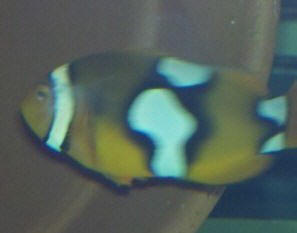
Please help me determine
what's wrong with my clownfish. 2/16.12
Hello Crew,
I have a clownfish that I have had for a year and 3 months. She
is part of a mated pair. She is also captive
breed <bred>. The clowns live in an RBTA in a 125 gallon
tank. I also have a Yasha goby and a pistol shrimp, and a
Tomini tang. My clown has some white stuff
behind her eye and her fins have been deteriorating.
There is also a patch of white on top of her right by the
fin.
<I see this/these>
I have researched quite a bit looking for an answer. I have ruled
out brook, I think in may be a bacterial infection. Her
mate has no issues at all.
<Proof against biological disease>
I currently have her in a hospital tank.
<I'd move her back>
She is being treated with furan-2 at the moment. Recently I
acquired a tennenti tang from LiveAquaria. It spent 6 weeks in
quarantine before I put it in the display tank. The Tomini tang
harassed it until it was chased out of the tank.
<Typical>
I now have a screen over the tank. I think the clownfish
took some collateral damage from the Tomini tang.
<May well be>
They are always hanging out near each other. The clownfish is
still eating well. She will not eat brine or Mysis shrimp, but
she loves nls pellets and kelp flakes. Have I diagnosed this
right? Should I be treating the fish with a different medication?
two pics are enclosed. Thank you for your help.
Dave Smith
<I suspect some sort of social issue here...
Could be the tang, perhaps too much vigorous movement in the
anemone. But the cure will not be found in isolation or
treatment. Bob Fenner>
|
  |
|
Wound or disease on clownfish? 12/27/11
Hello,
<Susan>
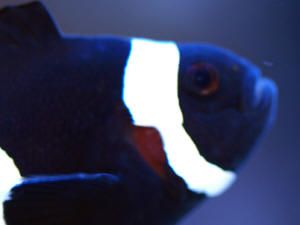
I bought this beautiful clownfish at my LFS 1 month ago. While I
was acclimating her I noticed she had what I thought was a wound
on her side, near her gills.
<I concur>
It is very hard to see in real life because she is so dark and
the bad area is right along where black meets white and looks
like it is just a marking. The flash photos really make it show
up. Once you know to look for it you can see that it is a pretty
deep depression into her side, not just a thin layer of tissue
missing. I asked the store employee and they had not noticed it
and the fish had been doing well there for several weeks.
Thinking it was just a wound I did nothing but make sure she was
well fed and had good stable water parameters. She has done well
and eats like a pig but the area has not changed one bit in a
month. I've taken a picture of it every week to compare and
it hasn't gotten bigger or smaller.
<May be permanent... a loss of "color
cells"/Chromatophores>
Last week I decided to treat her with Furan II in case it is a
bacterial infection.
<I would not do this>
I've got her in a hospital tank and I've done a four day
course of the Furan II per the directions and am now repeating
it. She is still eating well and seems to feel fine. I see no
change in the wound.
Does anyone have an opinion on what this is? Do you think I
should do more treatments with the Furan II or use a different
medication?
<No medication/treatment. I would consider this condition
likely permanent, but of no health consequence>
Thank you!
Susan
<Welcome! Bob Fenner>
|
 |
|
Platinum Clown Fin Problem. 9/13/2011
Hi Guys,
<And gals... Howsit?>
I've recently acquired a pair of platinum clownfish. I've
had them in my 14 gallon Nano Cube for about a month in a half
now. The tank itself has been in operation for about 8 months.
The male is a little over an inch long and the female is an inch
and a half. They share the tank with 2 harlequin shrimp, 2 sexy
shrimp, a boxer shrimp,
<Keep your eye on this Stenopid... predaceous>
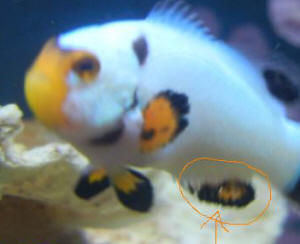
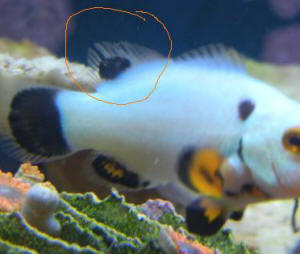
a few snails and hermit crabs. In the past week I've noticed
black blotches on their fins. I know that with age their fins
will turn black but I assumed it would just gradually fade from
orange to black. Instead it looks like someone took a black
marker and dotted their fins. I wasn't really overly
concerned with this until I noticed that the male had a few
slices down his top back fin and a small hole close to his body
on his bottom fin. I have never seen the female pick on him so I
highly doubt she's the problem. Neither clownfish hosts in
anything but the male spends most of his time around some orange
Zoas in my tank. I'm wondering what is causing this. He is
not a cheap fish so losing him to something preventable is not an
option for me. Other then his fins he looks completely healthy.
He's swimming fine and eating. I've attached a picture,
please let me know what you think. Perhaps I'm worrying for
nothing.
Cheers
Aly
<Mmm, well, I am concerned... Likely the damage is due to the
Boxer, esp. if it's a Stenopus hispidus... see WWM re...
could be a chemical reaction w/ the Zoanthid... I'd be
reading re both. Bob Fenner>
|
  |
PopEye query 3/26/11
Hi Guys and girls of the WWM crew.
I know there are a lot of questions regarding PopEye on your site but I
have a query I would just like your opinion on, as I'm stumped on
what to do for the best.
I have a pair of clarkii clowns in my display tank that have been in
there for a good 8 months now, I have just discovered the female has a
raised scratch on her side and on the same side has obtained PopEye, so
I'm assuming this is a mechanical injury, I'm unsure if it has
been done on the rock or if it is the result of swimming into my urchin
on lights out (certainly hope not),
<Mmm, it should never be completely dark in the room>
I have a huge black urchin (Spike) at over 1ft across that I've had
for over 3 years.
I have a 96l Nano tank that I was using as quarantine but, recently put
fish in and LR has I hadn't used it in so long, there are a pair of
pyjama cardinals (small), a Talbot damsel (small) and a jeweled algae
blenny in
there. The display has the pair of clowns, a blood spot squirrel,
yellow tang, pair of Talbot damsels, Koran angel, Kole tang and the
urchin. Would it be better to leave the female clarkii where she is in
the display or
move her to the Nano, with the less aggressive fish but not as good
water param.s,
<Leave here where she is>
she's not being bothered in the display tank and is still feeding
well, so in my opinion its best leaving her be and let time do the
healing. Just wanted an expert opinion.
Also will this injury heal in time or is it permanent damage,
<Likely the former>
also is there
any treatments or anything else I can do to help in the healing
process.
Thanks for your time as always
All the best
Si
<And you, Bob Fenner>
|
please ease my mind 1/31/11
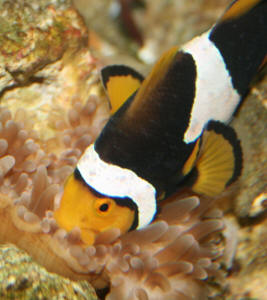
I attached a picture of my female onyx. I tried to get the best
picture I could for you to see the new spots on her white areas.
I darkened the picture in hopes that you can tell me what this
might be?
<Looks to be "just irritation">
In the picture they look like dark areas but they are really a
brownish red. She does rub a ton in the bubble anemone and I know
they can do this but I thought if she is doing it all day, I
didn't know if it might start effecting her..??
<Apparently so>
She is also sucking on the anemone's tips (she just started
doing this) ...kind of weird to me but I don't know. Eating
great... cleaning off a spot to lay eggs. Parameters are all
great. I love this pair and hope you
can help me with a treatment if necessary.
Thanks.
Tammy
<May turn out to be too exuberant for the/this anemone. Read
here:
http://wetwebmedia.com/ClnfshHostsF9.htm
and the linked files above... or learn to/use the search tool on
WWM. Bob Fenner>
Fw: please ease my mind 1/31/11
I was having trouble sending my first pic and it looks as if I
sent 4.....
so I apologize if this happened. I needed to add that the reddish
brown spots are kind of raised as if the scales are lifted or
infected... hard to describe. I also noticed on the black area is
whitish dots but not Ich.
Thanks again!
<Welcome>
|
|
|
|
Re: please ease my mind. Cln/Anem incomp.
2/1/11
Thanks Bob... you really did ease my mind. That's what I
thought it was.
Do you think I should take out the anemone so the areas won't
get a secondary infection?
<Mmm, a tough decision... on the one hand the Clown/s may
bring about the demise of this anemone... on the other, it does
likely bring them comfort>
They are by themselves in a breeding tank and if
you don't think I need to disturb the situation, I will
follow your advise.
Thanks again!
Tammy
<This being the case, I would at least separate the parties...
if not move one to another system entirely. Cheers! BobF>
Re: please ease my mind
Do you think taking the anemone out will stress the
breeding situation any? 2/1/11
<Minimally... these clowns have been bred in captivity in
successive generations w/o anemone symbionts. B>
I don't want to mess up the balance of they're breeding.
Re: please ease my mind, clown, symb. comp. 2/1/11
Thanks for all your help Bob... I know you and your site have the
best knowledge out there and are always a great help to us
rookies!
Take care!
Tammy
<A pleasure, indeed honour to serve, aid your success Tam.
B>
|
Clown Problem? Echinoid injury
1/6/11
Hello crew I have not bugged you guys in a very long time so here I
go...
<Howdy Bri!>
I have a 75 gallon tank with a Hippo Tang, Two tank bred Ocellaris one
larger than the other but when I bought them four months ago they were
same size,
<The larger, a female...>
one lawnmower blenny, and a watchman goby. Invert wise the usual snails
and hermits and a scarlet shrimp and a medium sized black sea urchin.
Ever since I put the clowns in my main tank they have stayed in the
back near the top of the water but do go down to rocks occasionally and
immediately come out to feed and they eat well. About a week ago the
smaller clown had what looked like a bump on his lower jaw,
<Mechanical injury>
I thought he just swam into something,
<Yes>
I have had fish do this before and it usually goes away. This however
has progressed into a very swollen jaw with a black spot in the middle
and he is on his side near the top of the water.
<Perhaps a run in w/ an urchin spine>
He is still eating just fine and still has his bright coloration like
he did before this happened. He looks like he is distress of some sort
but
I don't now what is causing it.
<Mmm, look on the Net for pix of folks who've had altercations
w/ echinoids... likely look very similar>
I cant find anything on the site about this kind of thing. Is it
possible he swam into the urchin, if so wouldn't this have killed
him by now?
<Yes, and no, not killed>
Does this match any type of diseases ?
<None that I'm aware of>
The other clown looks and acts normal except at night he looks like he
is pushing the smaller
clown away?
<Just normal behavior>
The tank is well with in its parameters, the only thing that is high is
my phosphate ( water issue just switched to RO water to fix this, water
company changed there treatment methods, I realized something was wrong
when I had a algae bloom from $ell). The tank has been up for three
years with no problems I had a moved the tanks previous residents to
larger system in my home and they are doing just fine. Also is the
clowns over all behavior alarming to you.
<Just patience, time going by here. No treatment, moving. Bob
Fenner>
Thanks for the help
Brian
|
Clownfish Mystery Ailment 12/7/10
Greetings,
<Hello Tom>
I've used your site as my go-to resource for years, but have
never had cause to write before, because I was always able to
find the answer I needed.
However, I'm up against something now that has me stumped
even after weeks of research. My tank is a 20 gallon with a
3' bed of sand and about 20lbs of live rock covered in
coralline algae. It's been up and running for about 7 years.
My temp is about 79 - 80°F, ph 8.1, specific gravity
1.022,
<I would raise this to 1.025>
Zero ammonia, zero nitrites and <10ppm nitrate.
<good>
I use a Remora C protein skimmer, hang on filter with charcoal
media, and a powerhead for added water circulation. Livestock
includes a recently added Randall's Shrimp Goby and
Rainford's Goby,
<How recent? Odd that many issues in systems 'happen'
after recent introductions>
and a mature Ocellaris Clown (the object of this post). I also
have pistol shrimp, peppermint shrimp and some hermits and
snails. The tank is very stable and my fish typically live
several years (the clown is
now 4 years old).
<Great!>
About two weeks ago, I noticed a raised line on the Clown's
forehead at the edge of its white stripe that looked almost like
a brow line. A day or two later, the line was more pronounced and
formed small bumps that were clearly raising from underneath the
skin and had whitish heads, almost like pimples.
Next, the bumps (3 or so) appeared to have erupted and were
orange and fleshy. At this point I couldn't tell whether the
fish had caused this damage by flashing against rocks, which it
was doing,
<possible>
or whether this was simply the progression of the skin problem.
The Clown then became lethargic, dulled
in color, began sitting on the bottom, and stopped eating.
<Mmmm, all bad signs, that can be attributed to the irritation
of whatever it might be.>
At first I tried a freshwater dip,
<with formalin would be my choice>
which seemed to help the fish temporarily. I then set up a
quarantine tank and moved the clown in and
began treating it with Furan-2 gram-negative antibacterial, as
indicated, performing daily 25% water changes.
<Ok>
After four days (the full course of the treatment) the fish
looked much healthier - its color had returned, the wounds had
closed up and the bumps receded, and best of all it began eating
voraciously and was swimming normally.
<Great>
I dipped the fish and returned it to my main tank. The tissue
damage continued to heal and it ate hungrily for the past week
and has looked much better, swimming normally, until today.
Today it appears as though the ridge on its brow is still there
and the bumps seem to be returning slightly, although there are
only 2 and they are very small (approx 1mm tall x wide. The
bigger issue is that the fish has started to sit or float just
off the bottom again and appears to be flashing in an effort to
'scratch' it's head. It doesn't appear
particularly stressed, is breathing normally and still has a
major appetite. I feel confident based on my research that this
is not Cryptocaryon irritans,
<Agreed>
as these tiny white 'pimples' are isolated on its brow
region and haven't changed much in number or appearance since
they first presented. The fins all look beautiful, and there is
certainly no slime or mucus as might be indicative of
Brooklynella. I have also ruled out the 'long stringy'
protrusions seen in fungal infections. As of now, all of my
research points to some type of internal parasite or continued
bacterial infection
<Mmm, my Rabbitfish recently had some similar marks on one
location on it's body'¦ these have now cleared up,
and I put it down to a possible scrape on a sea urchin, causing a
skin reaction>
and the strange swimming behavior makes me curious as to whether
the swim bladder is being affected somehow. I've tried to get
pictures, but the fish happily wiggles anytime I come close. I
hope you can point me in the right direction to resolve this
issue for my little friend. Thanks,
Tom
<Well, Tom my thoughts are that this fish has been stung or
has had a negative reaction to 'something' in your
system, perhaps in/ on the live rock here, maybe even with one of
the other fishes/ animals. With your obvious good care I would
expect this to heal in time. I would not be inclined to remove
the fish again, unless it really starts to deteriorate. If this
happens please write back, but I would really put my eggs in the
'fish should be able to recover on it's own' basket.
Perhaps you might make a cursory check of all of your live rock
for anything out of the ordinary, such as hydroids, large
Bristleworms etc, in the process changing the aquascape around on
the off-chance that it has injured itself not once, but twice in
the same spot! If this is something that has been introduced with
your new additions, you might try Formalin with a freshwater dip
to see if anything can be dislodged. Simon>
|
|
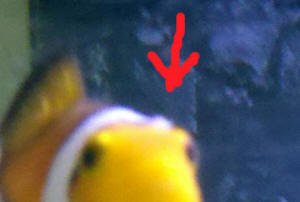
|
Pop Eye on False Percula Clown 7/12/10
Hello,
<James>
I recently encountered a problem with my false Percula Clown Fish.
I had to go out of town this weekend. I completed about a 20% water
change prior to my leaving. While I was away I received a panicked
phone call stating the tube running from my overflow box to my sump
cracked leaking water all over the place.
<Yikes! No fun>
Of course the power strip that everything was plugged in to got wet so
I had my roommate unplug everything and put in a battery powered air
pump to keep oxygen flowing through the water. When I came home to
survey the damage tonight I realized there would have been no way to
have the main pump to my tank turned back on due to the broken tube. I
set up a couple of power heads to keep water flowing and help keep the
oxygen flowing until I can purchase a replacement tube. When I was all
set with getting my temporary setup complete I noticed one of my clown
fish had what looks like pop eye in the left eye only. I was wondering
if this had / has anything to do with the lack of oxygen in the water
and if I should expect this to happen with my other clown fish or my
yellow tang or blue
tang?
<One-sided exophthalmia is almost always an indication of a physical
injury.
Read here re: http://wetwebmedia.com/PopeyeCause.htm
and the linked files above>
When my local fish store opens tomorrow I will purchase a new tube and
hopefully correct the sump issue and get things back to normal. I'm
hoping there is no permanent damage done to any of the fish. Should I
quarantine this fish or leave him be?
<I would do the latter>
Can this happen from a lack of oxygen in the tank or is it more than
likely that he hurt himself during another point?
<The latter again>
Thank you for your help.
<Welcome. Bob Fenner>
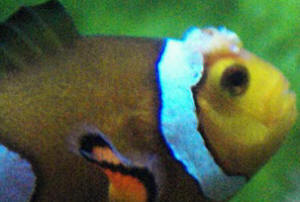
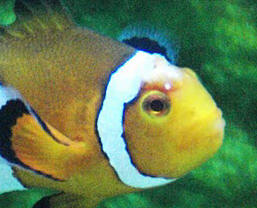
|
Is this an infection? Should I use Melafix?
Clownfish... tumour? -- 04/22/10
Hi guys,
<Howdy>
I love reading through your answers, but it looks like I have not
been able to find an answer to my question this time. I have two
tank raised ocellaris in my 55 fish only/live rock tank, and they
only share it with some hermit crabs (and whatever else lives
on/in the rocks). I have had this tank and these two fish for
about 5 years now. I will admit, am not the most gifted aquarist,
but I do try very hard - monitoring, water changes, etc... These
guys put up with me very well :-) On to my problem - my female (I
say female because she is larger?)
<Is typical>
clownfish has developed what
looks like the worst teenage pimple problem ever. There is a
localized white growth on her head that has slowly been getting
larger. It really does look like a pimple, and recently, a pimple
with white spots on it.
The rest of her body is in tip-top shape, and her behavior is
still normal - eating, "playing" with her buddy,
swimming along, etc. The water quality, to the best of my
knowledge, is within ideal parameters. In terms of the background
on this "pimple," I noticed a white area on her head
about 6 or 7 months ago. I kept an eye on it and it didn't
change at all until about 3 weeks ago, when the
"pimple" started growing. My local fish store
recommended I use Melafix, and I have been doing so according to
the instructions on the bottle, including removing activated
carbon from my filter and weekly water changes. I have been
adding it to the entire tank to treat the entire tank, per their
recommendation. The other fish has shown no signs of anything.
Unfortunately, the "pimple" seems to be getting worse
nonetheless. (It is definitely changing day to day, and I'm
afraid possibly getting worse). She is still acting fine though.
So my questions are: what is this white thing on her head?
<Likely a trauma or sting sore>
And will Melafix help?
<Never>
If not, what should I do?
<Read here: http://wetwebmedia.com/clndisenv.htm
and the linked files above till you're satisfied>
Here are links to the two best pictures I could get, but she
seems to be camera-shy so the pictures aren't great:
http://picasaweb.google.com/lh/photo/_cZvAGB05g5hcufrvwfDew?feat=directlink
http://picasaweb.google.com/lh/photo/ZjUtvC1MdPND3m9sFZU8bA?feat=directlink
<Mmm, actually, this looks more like a tumor... could have
started as an injury... Again, I would not try to
"treat" this fish chemically. You might avail yourself
of a purposeful cleaner, read here:
http://wetwebmedia.com/clnrfaqs.htm
and the linked files above... Perhaps a Lysmata species will
"clean this off"... At the most extreme, you could try
anesthetizing and excising this growth... Bob Fenner>
Thanks for your help!!
Sincerely, Burcu
|
  |
Clownfish Popeye 10/20/2009
Kind Crew,
<Josh here.>
I have a pair of spawning clarkii clownfish and the female clown just
developed popeye. I set up a hospital tank and was going to relocate
and medicate this evening. She is still active, eating and spends the
day with the male preparing the nest for the next batch of eggs. I
suspect the popeye is due to water quality / high nitrates. About 2
months ago when they first were preparing to lay eggs they completely
disturbed the sand bed. I went from having a 3" sand bed all
around to a 6" sand bed across the front and almost bare glass in
the back. They created themselves a hole to nest and lay their
eggs.
My question is should I relocate the male with the female to the
hospital tank? I wouldn't want to stress him any more than I need
to but I think losing his mate would stress him more than the
treatment. They would be paired in a 10 gallon tank for the duration of
their treatment.
I have thought about keeping her in the main tank and just watching her
to eliminate both the stress of the move and her missing her mate, but
I fear if I wait to long it may develop into something more severe.
Any
thoughts would be appreciated.
<I would not hesitate to separate and medicate. It would not be fair
to medicate them both due to the stress it causes, nor would it be
right to deny her a treatment you are capable of.>
(On a side note about the spawning, I currently have about 80 fry/baby
clowns in different stages of development since they first started
laying eggs. Since they just bonded I'd hate to lose one or both of
them
now)
<I agree, but I suggest you separate them, and medicate.>
Thanks,
Dave
<Good luck and let us know how it goes,
Josh Solomon.>
Re: Clownfish Popeye 10/21/09
Dearest Crew,
<Jillian>
Thanks again for your dedication! Reading the dailies is one of the
high points of my day (and I MUST stop doing it at work!!!!).
<Heeee! Like PaulS' "Wedding Song", "Is it work
that brings you life, or life that brings you fish?">
After reading Josh's reply to the Clownfish with popeye questions I
felt I must share my experience. I've had 2 Clarkii Clowns come
down with this condition at two different times/systems, one of which
went through several cases of it over the period of about a year.
I'm not sure what medication would be suggested for popeye but I
have noticed that with optimal water conditions (with careful and
frequent testing) and a high quality and varied diet, this problem is
easily resolved with this species. This is one of my favorite types of
clownfish and mine are still doing very well! One is about 3 years old
and the other being 5 years.
I have no experience with popeye for other marine species and the case
may very well be quite different for other fish. In my experience, this
is not a problem that needs to be treated with Clarkiis if tank
conditions and diet are good.
Just my two cents.
Thanks again for your efforts and dedication!!
Jillian
<Thank you for sharing. Bob Fenner>
Re: Clownfish Popeye 10/27/09
Josh,
<Dave>
Thanks for the advice, everything went well with the treatment and the
clown is doing very well. On the third day of treatment she started
eating and both eyes returned back to normal.
<Excellent.>
I treated her with Maracyn 2, doubling the dose on the first day and
then regular dosing for the remainder. I did a small water change days
2 and 4 and 50 percent water change (4 gallons) on day six. Starting
today I will continue to do small water changes to bring the salinity
up.
<Excellent, don't rush through this last step, it is very
important.>
My question is how long should I leave her in the Hospital Tank? I read
an article where she could be acclimated back 2 days after the salinity
is back to normal, seems a little too soon.
<Honestly that sounds fine.>
Also is there time period where the medication will dissipate?
<Carbon and continued water changes will help to reduce the amounts
of medication left in the water.>
I'd like to add her back without netting her by acclimating her in
a smaller container but I'm not sure about letting the water enter
the main tank.
<Hmm, I would not recommend risking the depositing of any antibiotic
at all into your display tank. If concerned regarding the use of a net,
try either using a very fine net that her gill filaments will be less
likely to
get caught in, or to catch her in a clear plastic container and quickly
drain the water before transporting her. As a side note, there is a
relatively new product that I have fallen in love with, it addresses
these problems fairly well, do a quick search for "Reef Gently
AccliMate".>
Thanks again, Dave
<You're welcome, Josh Solomon.>
Sick female clown - Likely physical injury.
6/25/2009
Hi Crew at WetWebMedia,
<Hi Robert.>
I have reason to believe that my female clown for 5 years may be sick
with signs of her health deteriorating. The tank is roughly 5 years old
with no addition to the tank in the past year except for a snail
otherwise it is a fish only 20g tank with a pair of clowns, snails,
hermit crab and 2 soft corals.
<Two clowns is a bit much for a 20 gallon, but since they have been
there for 5 years with nothing else, we will let that slide.>
In the past 9 months I have been extremely busy but period between
water changes has never been longer than 3 weeks. Tonight I just took
my first water sample in awhile and the salinity is 1.023, ph is
8.3-8.6 with
nitrate and phosphate at the lowest on the scale.
<So nothing too far out of range. Your corals would likely
appreciate water closer to 1.025.>
In the past month or so my female clown has developed a red lump on her
upper lip, which I thought
nothing of and was hoping her immune system would fight off
naturally.
(Pictures of her are located in the links below. The red lump is on the
tip of her mouth and can be seen clearly in the first two
photographs.)
<I see this.>
For the past two days I have caught the female resting on the sand bed
when I am not around but immediately sprung into live when she sees me.
She's still eating and eating aggressively, though. Seeing her
resting on the sand bed between two rocks during daytime is, however, a
first for me.
<It does look like physical injury. Clowns will get nippy with each
other, frequently locking jaws.>
My local LFS guessed the red lump may be a swollen tissue from an
infected cut and recommended anti-bacteria for treatment.
<Based upon the pictures, and the fact that it has been there for a
month, I would agree.>
I have peruse the net quite a bit using Google which is how I found
your resourceful webpage but I could not match any of the regular
symptoms to what I have seen. I am hoping to tap the expertise of your
community before proceeding treatment since the process of quarantine
and medicating the fish may cause unnecessary stress on the fish if the
prognosis is incorrect.
I would remove this fish and get it into a small quarantine tank. For
these purposes, it need not be larger than 10 gallons. I would treat it
for a week to 10 days with Maracyn. You will need to do regular
water
changes to keep the water quality up while the fish is undergoing
treatment.>
Thank you in advance,
<My pleasure.>
Robert.
<MikeV>
http://i181.photobucket.com/albums/x167/bobzpix/IMG_5583.jpg
http://i181.photobucket.com/albums/x167/bobzpix/IMG_5579.jpg
http://i181.photobucket.com/albums/x167/bobzpix/IMG_5575.jpg
http://i181.photobucket.com/albums/x167/bobzpix/IMG_5578.jpg
Clownfish Emergency! 4/18/09
Dear Crew:
<Sorry for the delayed response Aleasha... am out traveling>
Help please, quickly! My black clown was attacked - apparently
repeatedly - over the last two days by a leopard grouper that started
out small and was added last. He had never bothered the clown before -
but since I realized the error of my ways in the purchase of the
grouper (the ONE time I did not have my reference book with me in the
LFS) - I have tried to remove the grouper but could not catch him.
Apparently, I waited too long.
Without warning, the grouper apparently took some shallow bites/scrapes
out of my clown, and his fins. I (easily) caught the clown and removed
him to a specimen tank (and placed it in another saltwater tank, I have
out of sight of the grouper) - while I try to find out how to help the
clown. I will remove the grouper, somehow, but what can I do to save
the clown this instant? (At the very moment I type this, it is late and
LFSs are closed.) Any home remedy? If not, then what? Can I treat in
the specimen tank, or must it be a minimum of so many gallons for
proper administration of a remedy. (I know now I really do need a
hospital tank, as I should have already had. : ( Thanks for the urgent
help.
<No treatment per se, but I would return this Clown to the tank it
was in... in a floating (plastic) colander... for stability's
sake... and do catch out and return that bass! Bob Fenner>
Re: Clownfish Emergency! 4/19/09
Thank you Bob. I'm sorry to say he didn't make it. His injuries
were to severe. A lesson at a terrible cost. : (. This was the one I
wrote to your crew before about - the clown that bonded with the shy
Niger trigger. I
will catch the grouper. Sigh.
Aleasha
<Ahh, steady on. BobF>
Re: Ocellaris Clownfish Mouth Torn 2/25/09 Hi Bob,
Well, I never needed to separate the "bully" clownfish after
all, as the two clownfish must have had a meeting of the minds. About 2
days after I wrote to you, they stopped exhibiting the locking of the
lips and started getting along fine. It's been 3 weeks since my
original email, and the lip of the one clownfish has, in fact, grown
back and the bright orange color has returned to the lip as well. I was
rather surprised at just how fast the rejuvenation of the lip and the
return of its color has occurred. However, should they start this
bickering, again, I will surely use your idea. Thanks again! Bonnie
<Thank you for this follow up Bonnie... methinks one is on its way
to becoming a female here. Cheers, BobF>
Clarkii clown swimming poorly... Lionfish incomp.
9/2/08 I looked through your site for a solution to my current
problem. My Clarkii clown took a turn for the worse today. She's in
a 30 gallon cube tank with a dwarf lionfish <Incompatible...> (I
know, not the best, working on resolving this), and a black/white
damsel. I've had some Alk/ca/SG problems lately, so my water
chemistry has been a little goofed up. <...> My 58 gallon tank
shares the same water, along with a common sump/fuge. My problems
started 3 days ago. An SPS colony RTNed, so I did a 25% water change. I
was trying to feed the dwarf lion and the Clarkii got to the food
before the lion did. I gave the Clarkii a piece of raw shrimp to keep
her busy. Later in the day, I forgot about this and fed the tank one
cube of frozen brine shrimp. <?> That night, my sun coral polyps
were wide open so I fed it two more cubes. <!> Of course, she got
a bunch extra. I think she gorged herself from all this food. Today,
she's swimming terrible. <terribly> She would swim around
funny, like it was hard to control herself. It's like her swim
bladder is goofed up. She would find a spot in the rocks to hold
herself so she wouldn't have to swim. <Mmmm... this fish likely
"got poked" by the Lion> The Clarkii would end up on her
side, or with her head pointing down. Her belly is very expanded and
almost looks bloated. I don't know if I should leave her in there
(reef tank) or take her out. Would taking her out be too stressful on
her? <Leave it till it perishes... likely soon> I've heard of
people "popping" a fish with a syringe needle, but this
can't be good on the fish. What is wrong with her? Is there
anything I can do for her? or will she be ok on her own? Thanks for
your help! Ryan <Next time, going forward... compatible animals
only. Bob Fenner> True Perc Clowns with Persistent Fin
Rot... sigh... again... Same answer 08/28/08 Hello, and thank
you in advance! About a month and a half ago we purchased two True
Percula Clownfish, at a relatively young age. They were already paired,
and went through a quarantine procedure for two weeks prior to addition
to our main tank. There were no problems with either Clownfish during
quarantine. Our tank is a 100 gallon drilled tank, with two
power-heads, and a return pump running water from our sump/refugium
tank (40 gallons) below. The parameters for the tank are as follows:
380 ppm Calcium 3.7 mEq/L Alkalinity 8.0 pH 0.1 ppm Nitrate 0.0 Nitrite
0.0 Ammonia After addition to the main tank, the Clownfish both began
to host our Torch Coral. They both received minor injuries to their
tails, I'm assuming due to acclimation to the Coral, <Very
likely so> and the males tail healed fine. However, the female
developed a bacterial infection and fin rot on her tail, so we treated
her for 5 days in a hospital tank with an external treatment called
Maracyn. The infection part of the rot (the white mucus looking
material around the missing part of the tail) was completely gone, and
her tail even began to heal a bit. However, almost immediately after
adding her back into the main tank (maybe five hours,) the white film
has come back and the rot has gotten worse. <The Euphylliid
again...> Besides the physical rot on her tail fin, and the white
mucus layer surrounding the rot, she seems completely fine. They're
both eager to eat, very active, and I cannot find any other signs on
her of infection or sickness. Should I treat her again? <No... more
likely a hindrance than help> Or will it simply persist once I add
her back to the main tank? <Hopefully will heal with time going by,
the host and symbiotic becoming more known to each other> Thank you
very much for your time! Stephanie Judson <Read here:
http://wetwebmedia.com/clndistrauma.htm Particularly the citations re
such mis-pairings with Cnidarians. Bob Fenner>
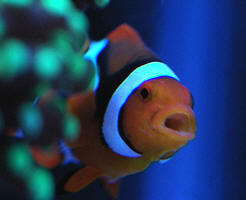
Clownfish Open Mouth
8/26/08 Hello, <Adam> After reading through the many
clownfish disease Q&As, I am still at a loss to the cause and
the solution to the problem I am facing. <Ok> I currently
have a 30 gallon long SW reef. Lit by 4 39w T5HO bulbs, skimmed
with a Tunze nano doc 9002, modded ac110 fuge with Chaeto, water
flow from a Vortech mp20, Tunze Osmolator for top off, use only
RO/DI 0ppm water, and I am also running some Chemi-pure elite and
Purigen. My ammonia is 0, nitrite 0, nitrate 0, ph 8.2, calcium
400, specific gravity 1.025, Alk 8, phosphate 0, and temp is 78
degrees. In terms of livestock, I have a coral beauty, two true
Percs, an emerald crab, a pom pom crab, a porcelain crab, hermits,
Cerith, Nassarius, 1 troches, 1 Mexican turbo, a tuxedo urchin. I
had had the clowns for approximately two weeks before I noticed the
problem. The first week they did not have a host and slept / played
in the corner of my tank. The second week they found my frogspawn
and have been hosted by it ever since. 3 days ago now I noticed
that one of my Percs could no longer close his mouth (the other was
and still perfectly is fine). I do not think it is genetic because
the onset was quick, and he was not like this before hand. The
first day he did not eat, yesterday he figured out how to eat with
his mouth open. I also feed frozen mysis (which the clowns do not
like), Cyclopeeze (which the clowns do like), reef Roids (for my
Alveopora) and have Selcon for supplementation. I see no isopods in
the mouth of the clown, and have attached a photo so you can have a
look as well. <I see and agree re this not being genetically
derived> All other evidence I can find of this phenomenon
through Google and through WWM either have the clownfish recovering
in a couple days or eventually not eating and dying, and no one
knows what causes this. Obviously I would really prefer if I could
find the cause and prevent my fish from dying. Thank you Adam
<Is likely from the "meet and greet" process with the
Euphylliid... Will likely cure itself in time. Bob Fenner>
Re: Clownfish Open Mouth 8/26/08 Today, day 4, it
looks like he is getting movement back in his mouth! I think you
are correct that it was from the frogspawn and hopefully he will
fully recover. Thank you Adam <Thank you for this update.
Excelsior! BobF>
|
 |
True Perc Clowns, Persistent Fin Rot, hosting with
Euphylliid 8/21/08 Hello, and thank you in advance!
<Howdy, welcome> About a month and a half ago we purchased two
True Percula Clownfish, at a relatively young age. They were already
paired, and went through a quarantine procedure for two weeks prior to
addition to our main tank. There were no problems with either Clownfish
during quarantine. Our tank is a 100 gallon drilled tank, with two
power-heads, and a return pump running water from our sump/refugium
tank (40 gallons) below. The parameters for the tank are as follows:
380 ppm Calcium 3.7 mEq/L Alkalinity 8.0 pH 0.1 ppm Nitrate 0.0 Nitrite
0.0 Ammonia <So far, so good> After addition to the main tank,
the Clownfish both began to host our Torch Coral. They both received
minor injuries to their tails, I'm assuming due to acclimation to
the Coral, <I'd guess the same> and the males tail healed
fine. However, the female developed a bacterial infection and fin rot
on her tail, so we treated her for 5 days in a hospital tank with an
external treatment called Maracyn. <Ah, yes... the antibiotic
Erythromycin> The infection part of the rot (the white mucus looking
material around the missing part of the tail) was completely gone, and
her tail even began to heal a bit. However, almost immediately after
adding her back into the main tank (maybe five hours,) the white film
has come back and the rot has gotten worse. <More a burn than
rot> Besides the physical rot on her tail fin, and the white mucus
layer surrounding the rot, she seems completely fine. They're both
eager to eat, very active, and I cannot find any other signs on her of
infection or sickness. Should I treat her again? Or will it simply
persist once I add her back to the main tank? <Mmm, if the fish
appears fine otherwise, I'd leave it in the main tank...> Thank
you very much for your time! Stephanie Judson <Thank you for
writing, sharing. Bob Fenner>
| Bearded Clownfish 8/12/08 Dear Wet Web Crew,
<Lindsay> I purchased a pair of Picasso clownfish <Mmm, a
"marketing name" made-up by ORA for Amphiprion
percula> just over 4 weeks ago. They are absolutely adorable!
They are active and curious fish, and get along well with the other
fish (2 green chromis and 1 firefish), and they love to swim up
close to the hermit crabs. They have been eating well; we feed them
either flakes, frozen mysis, or Cyclop-Eeze). <Good> The
funny thing is that I have noticed what can best be described as a
white beard on both clownfish (it's not on the other fish). I
read that this could be what the skin looks like from abrasion,
<Does look like this to me as well> and that either rough
foods, scratching, digging, or fighting could all be causes. I
don't really see them fighting or digging, and the only time I
have seen them "scratch" was for a week or so when the
filter tube was close enough to the back wall of the tank that they
couldn't swim behind it anymore; I have since moved the intake
tube and they have not done anything that could resemble scratching
since. I also bring my water in to be tested at my local fish store
(also where I make all of my purchases). They suggested looking at
the clownfish carefully for now for any other symptoms (white spots
especially), and that they didn't see anything
"wrong" with my water quality. I have a 55 gallon tank
with 22 lbs. live rock and live sand, and a protein skimmer. I have
since done a 20% water change. My temperature is about 78 and my
salinity is about 1.019. <Mmm, I would definitely raise the spg
here... to near seawater strength... over a few weeks time...
Please search, read on WWM re...> I attached a couple of
pictures to be sure that this is just something physical and not a
fungus or something. Like I said, I don't really see other odd
behavior and I have not seen any spots or injuries to their fins;
they remain active and eat when we feed them. When should I be
worried, what should I test for myself (I'm not sure what all
is tested when I bring it to my local fish store), and how can I
tell the difference between scratches and infection? <Mmm, only
via use of a microscope, possible tissue sampling and staining
techniques... I do think this "beard" is a matter of
physical trauma as well... and would do nothing to
"treat" it other than the suggested change of your water
density: http://wetwebmedia.com/spg_salinity.htm and the linked
files above.> Thanks, Lindsay P.S. Let me know if I need to
decrease the size of my pictures more than I have. <These are
fine, thank you. Bob Fenner> |
|
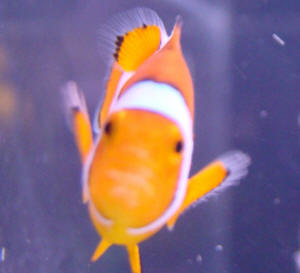 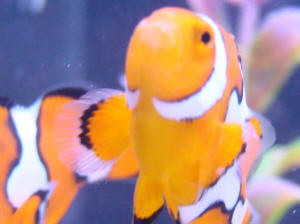
|
Black Spots on Clown Diagnosis -- 06/02/08 Good
Morning/Afternoon/Evening, <And to you> I have a False Perc
in a 29G All-In-One. He¹s been hanging out for over a
year and a half and has had excellent health. He is the only fish
inhabitant. He took a liking to the Candy Cane LPS I put in around
a year ago and generally sleeps between one of the heads and the
rock every night along with just buzzing around the tank most of
the day and occasionally, rubbing the CC. He really enjoys swimming
in the jet of the powerhead. His diet consists of mysis and
Formula-2 flake food. I give him mysis twice a week and Forumla-2
twice a week. I have attached a picture of some black
³dirt² spots that have shown up more
recently. I always remember him having some small spots but they
seem to have gotten more numerous. I cannot find any exact match of
the spots on any search other than it could be ³Black
Ich² <Mmm, no> but he doesn¹t really
display any of the symptoms (he has been and continues to be
perfectly normal). Should I attempt to follow any treatment for him
at this point or continue on unless he starts showing any other
symptoms? Other tank inhabitants are various Corallimorphs, GSP,
some hermits, a fighting conch (yeah I know but he sure is cool to
watch), and various snails, and a sand flea (filter feeder under
the sand, very fascinating). <Neat!> Water is changed 20%
every 10 days with distilled water and Oceanic sand. I run carbon
and Phosban to assist the biological filtration. I attached a pic
but I don¹t believe it is of much use. They are very
tiny spots. Thanks Chris <I don't think these markings are
anything to really worry re... they're very likely melanophores
(color cells) showing/expressing from contact with the stony coral.
I do want to mention that if it were mine, I'd add another
Percula... Bob Fenner> Re: Black Spots on Clown Diagnosis --
06/02/08 Thank you for answering my question and the format in
which you provide knowledge to everyone. It is a great service for
all who want to learn versus being told. We all have a fiduciary
responsibility to all that we keep. Chris
<Ah, welcome Chris. We are in agreement. Cheers, BobF> |
|
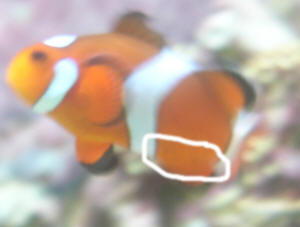
|
Clown with hairs/fungus under throat -- 06/02/08
I've got a clown with a bit of a problem. I recently lost my pair
of false Percs to a sudden outburst of violent behavior by my molly
miller blenny. (he has been removed) I got a tank bred false Perc
<Mmm, are better in duos> a month ago. It appeared to be a
healthy specimen. It' is exceptionally active & never stops,
has been gaining weight & is a veracious eater, he/she never <It
to she for now> seems to stop moving so I'm having a very hard
time trying to photograph the problem. The fish appears to have 10-15
small hairs on it's throat almost like what you would find with
fungus but not as thick & more sparsely placed. Each 'hair'
is about 2 mm long The fish is still active breathing/eating normally
But I have no idea what the hairs are. I'm thinking it's
probably some fungus. After loosing my other clowns I really don't
want to have this one die on me. <Mmm... do you have
bristle/Errantiate Polychaete worms?> The 40 gal tank has been up
and running for over a year. I have some mushrooms several types of
macro algae a tube worm, shore shrimp, various pods snails & hermit
crabs, Lubbock's wrasse, fire fish, yellow line cardinal & the
clown. The water parameters are good and the SG is at 1.023.
<I'd raise this... 1.025> I had a temperature drop in the
tank yesterday just before the appearance of the "hairs"
While I was out of town the lights & heater did not come on. I came
in a while ago & discovered the hairs & the temperature drop.
I'm still working on getting the temp straightened out. Other than
that all the other critters in the tank seem fine. Any ideas on what to
do about these hairs that have suddenly sprouted overnight? <I do
think your clown got a mouthful of podial spines... See WWM (the search
tool) re. Nothing much to do re... but wait, will self-cure in weeks to
months. Bob Fenner>
Re: clown with hairs/fungus under throat 6/3/08 I
haven't seen any bristle worms or other nasty critters & the
strange thing is the "hairs" that were on my clown's neck
are now gone! The problem solved it's self! <Ah, good> The
clown & other fish appear to be doing fine. I still have no idea
what the hairs could have been but I'm glad that it went away.
<Me too! Cheers, BobF>
|
Clown fish with bulging eye 4/16/08 Dear Wet Web Media
Crew, <Mark> You guys have become my favorite resource on
the internet. I have done some reading on clown fish with a
single bulging eye on the website and that it seems that it is
probably due to an injury (bump in the night) but I guess like
most aquarists I am just wanting to ensure that this is all it
might be. I have a 75 gallon with 175w metal halides. The system
has been setup for a little over a year with stable water
parameters. Other inhabitants include a golden headed sleeper
goby, coral beauty angel, 4 pajama cardinals, royal Gramma, 2
porcelain crabs, blue hermits, Astreas snails, Cerith snails, and
a couple of turbo snails along with a toad stool leather, colt
coral, RBTA, pulsing xenia, some Zoa's, and various
mushrooms. The clowns chose to host in the colt coral as
you'll be able to see by the attached picture.. They have
been hosting in this coral for more than 6 months. Thanks in
advance for any advice. Mark <I do concur, agree with you that
this eye complaint is highly likely due to a mechanical injury...
and will solve itself over time. Bob Fenner>
Re: clown fish with bulging eye 4/28/08 Bob,
<Mark> I just wanted to let you know that my clowns eye has
healed and she is still boss of the tank. Thank You so much for
your help in validating my research on your most excellent
website/resource. Mark
<Ahh~! Thank you for this follow-up. BobF>
|
|
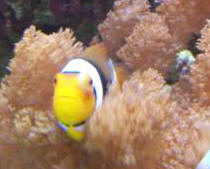
|
Re: help? Clown dis., Popeye 2/9/08 Hello again,
In the two days that I knew this fish before him starting this behavior
I had never seen him bullied, he and his friend pretty much just hung
out in their little corner together. I've heard from people around
the office that he is a couple of years old now and never acted this
way before. He has since been removed from the main tank to a smaller,
darker tank to rest but we cannot medicate as that feeds the main tank.
<Still a good idea not to medicate> I don't have access to a
camera to send you a picture, but yes, his eye is really far out of his
head. He looks like one of those bug-eyed goldfish, but only on one
side. <Fancy term, unilateral exophthalmia... Likely from a physical
trauma> He is still alive today, but has very little energy. He
looks like he's having very small seizures more than he does like
he's swimming.... I do apologize for my lack of knowledge/resources
on this matter, I don't have fish for a reason and that is because
I know they take a lot of knowledge and work. I just can't stand to
see this little guy's suffering and will do anything I can to help
him. I never dreamed I'd be starting a new job and becoming a fishy
caretaker too! Thanks so much for your time. Christina <No worries.
Perhaps a bit of reading here: http://wetwebmedia.com/Popeyetrauma.htm
Bob Fenner>
Clarkii Clownfish Acting Strange - Possibly Stung by
his Anemone? Injured Clarkii or Brooklynellosis? -- 12/13/07
Hi from Fort Walton Beach FL! <Hello Dawn! Brenda here, suffering
through the bitter cold!> First of all I just want to thank you for
such an awesome web-site! <You're Welcome! Thank you for the
positive feedback!> My SW friend turned me onto it and I have passed
it along to another SW friend. <Great!> The site is absolutely
invaluable to any experienced or novice marine aquarist (like myself).
Here's my stats: 125 gal. SG: In between 1.023-1.024 Nitrate 10
Nitrite 0 Alkalinity 300 PH 8.0 Phos 0.1 Calcium 400 Iodine .06
Magnesium 1400 <Temperature?> Setup: Proclear Aquatic wet/dry,
Proclear Aquatic Protein Skimmer, Fluval FX5 w/nitrate & phosphate
sponge, and charcoal, and 2 Maxi-Jet 1200's, VHO lighting. The 125
is an All Glass Megaflow with 2 overflows. Stock: Orange Spotted Goby,
A mated pair of Firefish, 1 blue green reef Chromis, 2 Clarkii clowns,
1 Domino damsel, 1 Bi-Color Pseudochromis, 1 Brittle Starfish, 1
Anemone, <What species is the anemone?> 1 Mexican feather duster,
1 Atlantic feather duster, 3 Mexican Turbo Snails, 5 Nassarius Snails,
Zoanthids, Xenia, Glove Polyp, Hammer Coral, Torch Coral, 2 Frogspawn,
Candy Cane Coral, Bubble Coral, 110 lbs. of live rock and several
pounds of Tonga branch. Back to the larger of the two Clarkii clowns.
"Clark" took to the anemone right away and has been really
tank mates with it since I bought it (about 4 weeks ago). <It is a
pleasure to witness!> Yesterday, I noticed Clark was sucking the
tips of the anemone, sometimes more than one tip at a time; and, acting
out of character. I understand it is completely normal for clown fish
to suck anemones (through reading articles on your site) however, when
he was doing it he was laying sideways and panting heavily. Now today,
I see some type of lesion (kind of looks like burn marks) on the top of
his head and he is acting even more out of character. He has his mouth
open the entire time with a more labored breathing and now he is hiding
out, which he (she, you get the drift) has never done in the past.
Could it be possible that the anemone stung him? <It is not likely
for this to happen after 4 weeks. It is hard to say without a picture.
I suspect one of two things, an aggressive Domino Damsel or
Brooklynellosis. My guess is that it is Brooklynellosis. More
information on Brooklynellosis here:
http://www.wetwebmedia.com/brooklynellosisart.htm > If so, will they
typically recover from such an event? I'm at a loss what to do
here. <It can recover from injury and Brooklynellosis. However, it
sounds like the Clarkii may be in the final stages of the disease.>
Since I'm new at the hobby (less than a year), I still freak out
when I notice something not right and test everything; but all is fine.
<Did you quarantine this fish and how?> I have searched your site
the past couple of hours and can't figure out what to do, if
anything. I do have a QT tank if I need to use it. <I would remove
the clownfish and place in quarantine. Read up on Brooklynellosis, and
know how to treat. If it is Brooklynellosis, the chance of this fish
being alive by morning, are slim. However, you may have more fish to
treat. I would also keep a close eye on the Damsel's behavior. This
fish can be very aggressive and harmful. Anemones do best in a higher
salinity. I recommend slowly bringing your salinity up to 1.026 and
reducing nitrates and phosphates to zero. Also, your lighting may not
be enough to support an anemone long term. Can you give me more
detailed information on this? How long has this tank been up and
running?> All of the other fish seem perfectly content and normal. I
appreciate your assistance in advance. Dawn <Good luck to you Dawn!
Brenda>
Re: Injured Clarkii or Brooklynellosis? --
12/13/07 Hi Brenda, <Hello Dawn!> Thank you for your
response. <You're welcome!> Wow, hoping it isn't the
latter of the two. I did read the article and it sounds like what he
has. <Unfortunate, but it is not uncommon for wild caught
clownfish.> Expect he is gasping for air at the bottom of the tank,
not top. It's hard to tell with the lesions, but in any case, he
looks worse this morning. At this point, he won't make it, I can
tell. It's making me feel so bad. <I'm sorry!> Even
though we probably both suspect Brooklynellosis at this point, it was
odd that the Domino (yesterday) was swimming in front of Clark and
fanning his tail at his face. Hmmmm, why would he be doing that
behavior? <Domino Damsels can be evil! I have witnessed this myself
many times. They are not welcome in my tanks.> I'm not sure what
species my anemone is. If I had to guess, I would say maybe a carpet.
<It is important to know which species, so that you can provide the
appropriate care.> It is at the bottom of the tank and has burrowed
his foot into the sand bed. He has situated himself under a ledge of
live rock so only has minimal lighting and current in that location.
<This is not good. It will not last long under these conditions.>
I have not moved him because my experience is that they will just move
themselves back where they want to. <Correct! It will move looking
for a suitable environment. If there is not one available, it will
deteriorate.> It is a kind of dirty pink color, around 1" short
tentacles that have a green tip on them. Not the bubble tip shape.
<The Bubble Tip anemone does not always have bubbles. However in
this case, I do not believe that you have a BTA. It is likely an LTA or
a carpet.> I did not QT Clark yesterday because I wasn't sure
what to do. My QT tank is I'm sure, minimally acceptable. It is a
tank on reserve that we don't use and keep for emergency purposes.
It's a 5 gallon "eclipse type" tank (I can't remember
name brand). It has a built in filter with removable media bag, no
heater (though it would be easy for me to buy one) and just a compact
florescent natural daylight tube. It doesn't have the ability to
"cycle" as it doesn't have any type of biological
capabilities. <If the clownfish is still alive, I would still
remove. Take water from the existing tank. I also recommend getting in
the habit of quarantining all new species, coral included.> I will
work on raising salinity. Do all of the other corals/fish do fine at
1.026? <Yes, and is closer to their natural environment.> The
lighting are 6' long VHO tubes. One is white, one is the blue
light. We also have moon lights for night viewing. No halide lighting,
etc. <This is not nearly enough lighting for this anemone.> My
temperature fluctuates between about 77-80 degrees. <I would keep
closer to 80 degrees.> How long has the tank been up and running.
That's a loaded question that I'll explain. It was setup the
end up July, 1st of August this year. I didn't have any inverts at
this time. Everything was fine until October 4th middle of the night.
We heard a loud "pop" and then an ensuing waterfall. <Oh
my!!!> I knew what it was and I've been heartbroken ever since.
<I certainly would be too!> That's right, the bottom of the
tank cracked and all of the water, 125 gallons +, drained out in less
than a minute. <Ouch!!!! Do you know what caused the break? Was the
tank not level?> Our home looked like a beach with water and live
sand. It actually ruined/flooded our entire home. I lost most of my
fish. I actually started thinking once the wave of shock left me and
reached into pick the fish up off of the sand bed and tossed them in
the sump. I then over the next several days found temporary homes in my
SW friends. <Good!> I tossed all of the live rock into a 55
gallon bucket with SW and a jet. I eventually got my hands on a
borrowed 55 gallon aquarium that I set up in the garage (while we
remodeled our home which we are still doing). With that being said,
everything continued to be fine in the 55 gallon while we tiled our
house and put up baseboards. We finally got the living area ready and
moved back into the big tank, that was roughly a month ago. <This is
not long enough for an anemone. They need an established environment, 6
months to a year, with one year being best.> At that time, we
started adding corals, the anemone and the like. We also got our 2 fish
that survived the disaster back; the goby and the blue-green reef
Chromis. Sorry for the long winded explanation. We have all been
through a lot lately. <I certainly see that!> This is another
reason I'm hoping it isn't Brooklynellosis, because mentally,
I'm still trying to recover from the above. <I hate to be the
one to bring you more bad news, but you will have more issues in the
near future with the anemone. It is best to remove soon and find it a
suitable home.> Thank you in advance. Dawn <You're welcome
Dawn! Good luck to you! Brenda>
| Clown with internal bleeding? 7/7/07 Hi
Crew, <Dustin> Was wondering if you could give me some help
identifying this discoloration in my clownfish. Sad to say it looks
like internal bleeding <Mmm, yes... sure does superficially>
but I was unable to find information on anything like this on your
website or anywhere else <Have never seen either> for that
matter so I can't be sure. I've had the clown for over 2
years now so I am very attached to him and don't want to lose
it. Have not made any major changes to the tank (44 corner)
recently. I did however add 2 purple porcelain crabs and a new
damsel about 2 weeks ago (after QT of course). Tank itself seems to
be doing well.. pH 8.1-8.2...ammonia 0..nitrite 0...nitrates around
15-20. <This last is getting a bit high... Please see WWM re
nutrient export> Just noticed last night that he had this dark
spot in the white midsection of his body that shows through on both
sides. See attached pictures. Any idea what's wrong with him?
<My best guess from the info. presented is either some sort of
physical trauma from the new Damsel, crabs... or to itself from
swimming into something hard... perhaps with the Nitrates and what
they might portend complicating matters> Is there any treatment
I can pursue? <Yes... bolstering nutrition (soaking foods in a
vitamin and HUFA prep. like Selcon) and keeping your eye out for
negative interactions twixt tankmates> I've noticed this
morning he hasn't been swimming as much, just staying near the
bottom front corner of the tank and did not eat much. Thanks in
advance if you can offer any help! Dustin <Mmmmm, and the usual
"default" water changes... Bob Fenner> |
|
.jpg) 
|
Split Fin on a Clownfish 5/15/07 Howdy guys, <Jeff> I
have been looking through the archives you have on the site. What an
amazing resource! In my searching, I haven't come across my
particular issue. I have a pair of clowns that have been alone in my
mature tank for 1.5 years now. The smaller of the two has suddenly
developed a split in her left pectoral fin that seems to be pretty
serious. <A trauma... from another fish... a run-in with the
environment?> The fin is split most of the way down the fin, and it
appears to be "rigid." The fish is barely able to move the
fin, and it's always in the "fully deployed" state.
Needless to say, she's sluggish, and shy. She does also appear to
be breathing at a much faster pace than the other clown. As I look at
the clowns, I have noticed that "her" fins appear to have
much duller colors than the other clown. <You have good vision>
There are no other visible spots, etc. Any idea what this could be?
<Non-pathogenic... a mechanical injury> Could it be a nutritional
problem? <Not likely> I have been lazy and skimped on the frozen
food, etc. It's been mainly flakes and dried brine for a while now.
Any ideas on what to check, or how to help her make a recovery? Thanks,
Jeff <Likely this pair are tussling... behavior to be expected...
Improved, steady water quality, enhanced nutrition... Oh, have just
finished putting in a week writing a cumulative piece on Clownfish
Disease: http://www.wetwebmedia.com/clnfshdisart.htm and revisiting
all the pertinent FAQs... Whatcha think? Bob Fenner>
Got Man/Woman Trouble? Nope, Clownfish Trouble 11/10/05 Dear
Mr. Fenner, <Yes?> Two days ago I noticed a super small white
something or other around the right gill area of my ocellaris. It is
still there. However, yesterday I noticed a small baby pea size area of
barely white (like bruised scales) on the ocellaris' body between
the first white bar and the tail bar. I've also noticed both
ocellaris swimming in and out of two caves and thought maybe the white
patch? on its body could be scraped scales (actually hard to see unless
you really concentrate). <Possibly... or the origin thereof>
These ocellaris' are tank raised. Funny thing is, this ocellaris
was not very active, sometimes hardly getting "enough" food
in my opinion. Now, he (smaller of the two ocellaris) is very active,
swimming around the tank more, and really going for its share of food!
I've read through the FAQs and can't decide on my
ocellaris' problem, hence not knowing what action to take. No
velvety look, no white/ick spots, no Popeye. The other ocellaris is
doing fine, swimming and eating. I've had these two ocellaris now
for 2 years with no problems. Other inhabitants of the tank are: l
half-dollar size Regal Tang, 2 Chromis, 1 diamond goby, 1 small long
nose hawkfish, 1 cleaner shrimp and 2 RBTA (originally l and then a
split :) ). All the other inhabitants seem to be doing well.
<Yes...> Tank readings: 77.5 deg., dKH 10.2, Alk. 3.66, CA 410,
SG 1.026, pH 8.0/8.1. Water change every week to week-and-a-half 12 to
15 gals. for a 55 gal. tank. CPR Bak Pak Reef ready skimming tank along
with EHEIM 2215 filtering the tank. Am worried about my ocellaris and
would like to take whatever action necessary to head off anything
serious. Thank you for your time and looking forward to your
help/advice. Marilyn <Gauging from your stated conditions, types of
livestock, the history... I would just try bolstering the immune system
of the fish (and all else), by administering vitamins to the water and
food... the former once a week, the latter daily. Bob Fenner>
Clown with cracked fins 11/17/05 I have a saltwater tank that
is established with healthy fish for over a year. Since the fish are
reef friendly, I decided to slowly introduce some invertebrates. I
placed a long tip anemone in the tank a little over a week ago. My
maroon clown hosted immediately. He appeared to be a little rough with
the anemone but QUITE happy. In any event, the anemone declined quickly
and is dead or at least very close. <Not uncommon> My question
has to do with the maroon clown who appeared to have developed some
white fuzz at the tips of his bottom fins. He also began to swish his
body in the sand upon occasion. Now, the white fuzz appears to be gone
from the fins but his lower and rear fins are split / cracked. What
should I do? <Mmm, not much... if anything... out of the ordinary.
Should heal in time> Could this have been from the anemone? <Yes,
likely related> Is there anything I can treat the water with? The
only other things in the tank are a couple of gobies, a Pseudochromis,
a Kole tang and some xenia. Thanks in advance, Frank <Optimized,
stable water conditions, decent nutrition... Bob Fenner>
Maroon Clown Disease/Injury I have Maroon clown, that
I've had for years, with some white fuzz or thick mucus at the
bottom of one of it's gill plates. It's acting normal, not
having breathing difficulties and eating fine, and none of the other
fish (Eblii angel, Orchid Dottyback, Yellow Watchman Goby) are having
any problems. It could be an injury because the Maroon clown gets
aggressive with attacking objects in the aquarium like the heater,
snails, hermit crabs, and moves little rocks around. <Yes... a good
speculation> I also have an Emerald crab that could have pinched the
clown and an urchin that could have skewered the clown if it tried to
move it. Please let me know what you think. I hope I described the
circumstances well enough for you. Thanks. <I'm in agreement
with your guesses... and hope that your fish will stay healthy. Bob
Fenner>
Is this an infected clown fish? Hello, <Hi there> One
of my three clown fish has developed an infection around the corners of
it's mouth. The other two have not developed any symptoms.
Initially there was what seemed to be an incision on the side of
it's mouth which in the last few weeks has developed into white
blemishes. We have tried adding a solution which was sold to us by our
local aquarium for the sole purpose of treating cuts and abrasions. We
don't know the name as shop owner made up the solution. However
this has had little to no effect. The infected skin looks as if it is
peeling off, so we thought the skin could just be healing - yet it
hasn't. <Does sound like a cut/abrasion... and these can take a
few weeks to heal> He is still eating, yet lethargic. Before putting
medicine in, his colouring looked faded, but has now brightened. We are
unsure of what to do as it has been 14 days of using solution and
overall doesn't seem to have helped. At times I thought white
blemishes were healing, but more just appear. Thank you Natasha &
Simon <I would add a purposeful vitamin mix to the fish's foods
(like Selcon) and leave off with any "medicine" use here.
With time, otherwise good maintenance this fish should recover. Bob
Fenner>
Clobbered Clown? (Damaged Clownfish?) Hi, <HI there! Scott
F. with you today!> I was wondering if you guys could offer an
opinion on one of my maroon clowns: I got two of them just over a month
ago; one of them about an inch and a half and the other a touch bigger.
They squabbled for a few days but after a week or so I was pleased to
see the little guy doing the shuddering thing and they've now
paired off nicely. I'm a little worried about the male now though.
He's always had pretty ragged looking finnage - at first I thought
it was from the fighting for dominance but it hasn't improved since
they've paired. Upon closer inspection it actually looks like the
fins are translucent around the edges rather than torn anyway.
<Tough love, huh?> He also picks up bubbles on his coat quite
easily. A couple of times I've noticed him listing slightly,
although both times he's had a lot of bubbles stuck to him which I
thought maybe was throwing him off balance slightly? He soon recovered
both times and I've adjusted the venturi on my filter head to
eliminate fine bubbles now anyway. He spends a fair amount of time at
the top of the tank but doesn't seem to have laboured breathing and
actually sleeps at the bottom of the tank. <Not uncommon for these
fishes. They tend to "nest" in areas in which they feel
comfortable> He seems happy enough other than that and is eating
fine. The colouring on his torso is fine and there are no spots or
other marks, just the translucent fins. The femaleis absolutely fine
and looks great. Am I maybe just being paranoid? If not, any
suggestions? I'm running a Jewel 240L (60 Gallon) with skimmer,
powerheads and live rock. Nitrite and ammonia are 0.0, nitrate is 2ppm,
pH is 8.0-8.3 (depending on which test kit I use), SG is 1.024,
temperature is 24oC. They're the only two fish in the tank at the
moment. I have to admit that a month ago I was not that clued up with
proper quarantine procedures but know better now. <Glad to hear
that!> Thanks in advance for any help. Ryan <Well, Ryan- I
don't think that you're being paranoid. However, do observe
this fish carefully, and maintain excellent water conditions to avoid
potential infection on the damaged fins. If things get worth, it may be
time to separate the male for a while to observe and treat as required.
Regards, Scott F>
| Cloudy eye... Maroon Clown hi i
have a problem with my female maroon clown she has a clear bubble
like thing over her left eye only, could you please give me some
info on it?............. please help........ thanks <Some sort
of involvement, opacity on this Clown's eyes... likely
secondary, resultant from a physical trauma like rough netting
rubbing against them or a bump... Are other fishes similarly
afflicted? Do check, optimize your water quality, improve nutrition
(soaking foods in a vitamin mixture like Selcon) and do your best
to reduce stress (be on the lookout for other organism's
negative interaction and do NOT add any more livestock) and this
should clear up in a few weeks time. Bob Fenner> |
|
|
|
Lockjaw clownfish 5/28/03 Hi, my Percula clown fish started
playing around my frogspawn's tentacles with its mouth for about
three days then I noticed my Percula sometimes shakes its head rapidly
and opening its mouth until lately the Percula had its mouth constantly
open and its seems like something is hurting her when she tries to eat
and now she doesn't eat anymore. Looks like her mouth is swollen
inside. <could be several things. Something embedded has become
infected (bristles/setae from an eaten polychaete worm, e.g.)... or if
you have had the fish long enough on a limited diet (same fish food(s)
without much variety or fresh fare/frozen/live)... then the fish may be
suffering from a dietary deficiency> I removed the frogspawn to
another tank hoping that my Percula will go back to her good health
again. Is the toxin from the frogspawn tentacles caused that misery to
my Percula clown? <not likely, although the clown would have killed
the frogspawn in time (1-3 year picture) from the unnatural
occupancy/repetitive abrasion> Thank you .....Joe <best regards,
Anthony>
The Eye Has It! I recently bought a skunk clown after the
passing of my porcupine puffer from not eating for over a month. The
clown now after 2 days has one eye appearing what seems to be gray on
the pupil with a bulge. I have read some facts and do not know if this
is something that will go away, infect the other fish, or have been
damaged by my domino that thinks he is king of the tank. <Well, if
it is in one eye, and bulging is the only real symptom, than there is a
high likelihood that it is swelling caused by an injury or other
trauma. Hard to say what could have caused this, but it sounds like
your damsel could have either injured the clown directly, or the clown
might have injured his eye by scraping up against a rock or
something?> I have read about the suggestions for Epsom Salt and do
not know if I need to quarantine the tank to do this. I also have a
snowflake eel but he minds his own business until feeding. Any
suggestions would be great. Thanks, Jen <I would rather perform this
treatment (or any treatment, for that manner!) in a quarantine or
separate aquarium. Epsom salt would probably not cause any undue
problems, but I'd still treat elsewhere! Epsom salt is a very
effective treatment for this malady. Good luck! Regards, Scott
F>
Spotty Situation On Clown? Hi all! <Hi there! Scott F.
with you today> I hope everyone is doing well. I starting searching
the site for an answer to this question, but it seems to me it's
the kind of question that's tough to do a word search on, as
everyone might use different words to describe it. I tried
"chin", and read over a recommended page on parasites, fungus
and etc, but didn't really have any success. I tried a few other
words but came up with nothing. Anyway, I'll get on with it.. I
have what appears to be a happy, healthy, hungry Percula Clown (named
Pesci), in my QT tank, and he has something small on his chin. So
small, that I can't be sure what it is, as I can't get a good
look at it. He's only about 1" or so long. I even tried
corralling him into the small acclimation tank, and using a magnifying
glass, but once in the accl. Tank, he just moves too fast to get a good
look at. Plus, when he sees my big fat head on the other side of the
magnifying glass, he freaks out and runs away. <Can't imagine
why that would scare a fish...LOL> I could try netting him, but I
don't know if it's worth the trauma at this point. You
can't even see this "thing" head on, only from his
profile. I didn't notice it at all until I placed a light on the
tank. It may be white, or flesh colored, hard to say, but I think it is
not completely round. He's been in the QT tank for almost 2 weeks
now. <Good job- keep him in there for the duration> The water
quality has been kept usually at about: AM=0, NO2=.025-.05ppm, and
NO3=.5-.10 ppm., PH=8.2. Had them climb a little recently (after I
noticed the spot/abrasion problem) but water changes brought that more
or less back in line. Overall, I think the water quality is fine, and
the 20G QT tank was set up just as recommended. When I bought him, he
was dipped in freshwater at the store, and then placed in water from
their invert tank for the 1.5 hr ride home. He was acclimated with
proper method before being put in the QT tank. <Sounds great!>
What I'm wondering is, how do I know if this is just a small,
originally unknown abrasion/birth defect (something like that), or a
parasite/fungus etc? I don't see any other spots anywhere, and he
seems fat and happy in every other way. He is my first fish, and I have
gone through great pains to quarantine, and prevent
cross-contamination, so I don't want to screw this up. If
everything is fine, I planned to add him to the main tank in 2 weeks.
Is their something I can do to make sure this isn't a problem?
<Well, if you suspect something that may be parasitic in nature,
I'd consider more freshwater dips (once or twice a day, for several
days). Chances are, this may be some type of parasite, which can be
eliminated without the use of medication. Keep observing carefully, and
take any action that may be needed> Any advice you can give me would
be greatly appreciated. Sorry for the long-winded e-mail. I just wanted
to give all the info I could Thank you, Eric <Eric, it sounds like
you're doing a great job! I commend you on your quarantine process,
your keen observation, and your patience. You're on your way to a
really successful experience with your new fishes! Good luck! Regards,
Scott F>
Spotty Situation on Clown? (Pt. 2) Hi Scott! <Hello
again!> Thank you for the reply. I have some good news and may have
gotten a bit lucky. After you sent your reply, I fed and observed him,
and I'd swear that spot is smaller (if that's possible). So
small that I'm really not sure that I can even see it. <Awesome!
Sometimes, these traumas simply fade away and heal with your attention
to good water quality> My eyes may be playing tricks on me. Also, I
think I may not have noticed anything at all, if I wasn't actively
trying to see it. (Darn guy plays and moves so fast it's hard to
tell ;-) That being said I think I might hold off on the dipping.
I'm thinking it is of course a great tool when necessary, but
I'm also thinking it has to be at least a LITTLE bit traumatic, and
I don't want to put him through it if it isn't necessary. Would
you agree? <Absolutely. Although it is a relatively "mild"
treatment method, there is still some trauma associated with it...The
whole point of a freshwater dip is to provide an "osmotic
shock" which parasites cannot tolerate as well as the fishes!>
On another positive note, he wasn't feeding really the first week
or so, until I switched for Formula One flakes (recommended by the nice
folks in the chat room), and then he definitely started to feed over
the past week. I just fed him a small meal this morning, and boy does
he go after it with gusto!! He's crazy about it and has a great
appetite now. <Awesome to hear that! By the way, as a note to our
readers, the WWM Chat Forum provides a great way to interact with your
fellow hobbyists. There are hundreds of talented hobbyists on the
forum, who can often provide more support and feedback on things. I
have found this a particularly valuable resource if you are trying to
find out about a new product or technique...> He even likes it
better than frozen Mysis shrimp. I guess that's a good sign, right?
<Sure is! IMO, any fish that eats is a fish that lives! With
good-quality foods, such as the ones that you are offering, and
excellent water conditions, you'll have a terrific rate of success
with fish keeping!> Thanks again for your help Scott. Pesci thanks
you too. Eric <Fooghheeeet about it! :) Glad to hear that he's
doing well! Good luck! Regards, Scott F>
- Clown with Pop-eye - Hi I have two Nemo clowns and one of
them has his left eye popping out now and is laying down a lot. Both of
them seem to be gasping for air and breathing very heavy. I am not sure
what to do. My salinity is around 1.022 with regular water changes.
Please help I don't want to loose my fish. thank you, James
<James, the description you provide sounds to me like Exophthalmia
or Pop-eye, which is usually due to some form of trauma to the affected
eye, swelling in response. This can be aided by adding Epsom salts to
the system at about one teaspoon per five gallons of water. This
problem will go away on its own, but will take some time. As for the
heavy breathing, you didn't tell me much about your tank or
filtration so it's difficult for me to make a recommendation. If I
were to hazard a guess, I would suggest you start by improving the
aeration. Cheers, J -- >
Please help!! (Clown with cloudy eye) Mr. Fenner I have a
120reef Berlin system that has been up for about 4 years. It is packed
with all of the usual inhabitants, hard and soft corals, 200lbs of live
rock, and sand etc. I woke up this morning to find my little clown fish
has his right eye all clouded over. My readings as far as calcium alk,
ammonia etc are all great as usual) nothing upset aside from my 10 gal
water change I did yesterday's always use bottled distilled water
for my changes. I am very worried. He is only about 2 inches long and I
have had him since he was a tiny little baby. I have a 18inch saddle
anemone for him as well he loves it) Can you please help me?? <The
cloudiness only on one side? Likely this fish just went "bump in
the night" and will just as likely cure on its own. Don't
panic, don't move it, don't pour anything into the water. Bob
Fenner>
Maroon clown mouth problems. Bob, I have a gold stripe maroon
clown, 2 inches plus. Has been in mature tank for 6 months. Has taken
up with a frogspawn coral, for a surrogate host. Has always been very
healthy, but today I noticed that his mouth appears to be stuck open.
The inside looks swollen, almost like he is having an allergic
reaction. He is able to move mouth a little bit, but has been unable to
eat. All other fish in tank are doing well. All tank parameters are in
line, salt concentration at 1.025, water temperature 80F. Any ideas?
Should I just let it ride and see if it passes? Thanks in advance
Kevin..... <I wouldn't change anything. As you suggest,
hopefully this "open mouth syndrome" will cure itself. Bob
Fenner>
Clown questions I have a true perc clown and it took a week
for it to adapt to the tank, no eating and got real sluggish, I took it
back to the store and asked if they would keep it a couple of days till
I lowered my nitrate and was told nitrate would not kill it?? <Like
the Damselfishes they're so closely related to, Clownfishes do
exhibit tremendous tolerance to nitrogen problems... given the
specimens start healthy.> I put it back in the tank and did a water
change and it is now eating and really seems to like my in tank
thermometer asked the store were I bought it about an anemone for it
and was told they like carpet anemone's,????Also it has a swollen
eye or one is bigger than the other? any help is needed THANKS >>
This species is naturally found in association with Heteractis crispa,
H. magnifica, and Stichodactyla gigantea (two of these are listed by
FFExpress), though they may get along symbiotically with other large
anemones... An anemone isn't necessary however, and not advised
unless and until you have a well-established system, and know what is
involved in their care... not easy. The pop-eye on one side is usually
indicative of a physical trauma... rather than infection, or
environmental cause... Bob Fenner
My poor clownfish. A little over a week ago my clown jumped
into the "bubble box" on my Mombassa skimmer. By the time I
found him he was beat up pretty bad missing scales etc) since my tanks
a reef all I did was feed him food soaked in Selcon for a few days. He
looks great but swims head up tail down I think he has swim bladder
infection. Luckily I'm moving to a bigger tank so I will be able to
put him in my Q tank. What would be the best way to treat him? Thanks,
Robert >> Really to do about what you're doing... making sure
it's getting fed... and providing peaceful surroundings... these
sorts of traumas take time to heal on their own... no way to expedite
them. Bob Fenner
Clown peculiar Hi I'm kind of new to the hobby and
recently bought 2 pec clowns. We acclimated them into the tank and
everything seemed fine. About two weeks later, we couldn't find one
of the clowns. When we found him he seemed to be just hiding by a rock
barely moving. He finally came out and his mouth looks like its
infected. It is white all over. The other clown has the same thing,
just a small area though. Does this make any sense. Thanks! Sincerely,
Steve Rubin >> Definitely a bad sign, very bad. Hopefully this
animal will turn around for you... this sort of appearance is linked
with shipping damage mostly, and is typically fatal. There is a fine
line between the damage of catching/manipulating the specimen
(typically to dip it or daub a medication on the mouth) and just
leaving it be, optimizing water quality, and hoping for the best. Bob
Fenner
Injured Clark clown? Hi Bob I have in my 58 gallon Oceanic
reef ready tank with oversized Oceanic wet dry filter and Oceanic Model
3 protein skimmer. I have a 4 inch Pterois Volitans, two 2 inch
Amphiprion Clarkii, 2 inch Abudefduf oxyodon, <The Lionfish will
consume these last four> 3 inch Centropyge Bicolor, 2 inch
Paracanthurus Hepatus and a 3 inch Zebrasoma veliferum. I also have one
medium Hermit Crab and a Condylactis anemone. As far as water quality,
my nitrates are almost nonexistent. The problem I have is one of the
Clarkii's appears to have injured his jaw and he has stopped
eating. There is a reddish spot on the left side of it's jaw that
looks like the skin has been scuffed up. It happened shortly after
putting in the Bicolor but I never saw them fighting. His bottom lip
looks swelled up and he doesn't open and close his mouth like the
other one. I think it was an injury but I wanted to check with you to
see if it sounds like an injury to you or some sort of disease. He
still looks healthy otherwise but I know he won't last long if I
can't get him to eat. I tried putting StressCoat but he hasn't
healed up. I love having these beautiful creatures in my house but I
hate the thought of them dying because of some I did or didn't do.
I have read the Conscientious Marine Aquarist ( that's why I used
all the scientific names ) and keep it in my nightstand for reference.
My fish all seem to get along with just the occasional chase and they
all have been eating very well until now. Another question I have is
about feeding the Volitans. I have read to feed every other day ( he
eats frozen silversides )<This is fine... your Lionfish will live
much longer, happier...> and was wondering if he will still get to
big for my tank. <Well, the tank is fully stocked... but should be
fine...> I know I am overstocked somewhat but I do keep a close eye
on water quality and have not had a problem yet. Thank You Steve
Bolling <Thank you for writing... and I do share your concern re the
Clownfish. This is likely a physical trauma as you suggest... the fish
probably bumped into something hard... likely at night... If it
doesn't appear to be "self-healing" I would encourage
your intervention. Prepare a wet, clean hand towel (no soap residue),
and a Cotton Swab (like a Q-tip tm), and a mercury-based topical (e.g.
mercurochrome, Merthiolate, Merbromin) and gingerly net out the Clown,
support it on the wetted towel and daub the topical with the swab
directly on the fishes sore area. Repeat every two days if the animal
doesn't seem to be responding, and do keep offering it a mix of
foods daily, including some live if you can secure this. There is good
reason to believe this specimen will recover. Bob Fenner>
|
|