|
|
| Home | Marine Aquariums |
Freshwater Aquariums |
Planted Aquariums |
Brackish Systems |
Ponds,
lakes & fountains |
Turtles & Amphibians |
Aquatic Business |
Aquatic Science |
Ask the WWM Crew a Question |
| Please visit our Sponsors | ||||
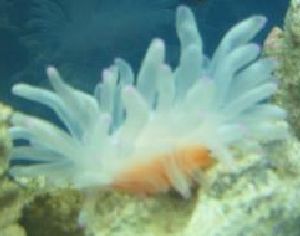
Condy feeding - Formula 1 Frozen? 06/06/2008 Hi WWM Crew, <Bill> I have a 55G saltwater tank, with a pile (sorry, don't know the total weight) of live rock and 3G homebrewed skimmer/refugium. <Together? Neat!> Livestock includes a pair of yellow topped chromis, a blue-green chromis, half a dozen ghost shrimp, a dozen or so thin-striped and dwarf white legged hermit crabs, countless tube worms, 20 or more Stomatella snails (3 came in with LR and they breed like rabbits) and a healthy supply of amphipods and copepods (enough that if I miss their mid-day feeding, the yellow-tops kick up the sand with their tails and snatch a snack out of the sand cloud.) <Very good> SG typically is .024 to .025 <With a 1 in front> - getting better at keeping stable since I added a home-brewed top-off system. It has a light sensor, so it drips make-up water only at night - re: WWM recommendations to only dose Kalk at night - and the Kalk dosing has made a marked difference in growth rates of coralline algae for me. Ammonia, Nitrites and Nitrates don't register at test (but I assume are there and being consumed.) Ph is typically at 8.3 <Good> I've recently added a Condylactis anemone, which very quickly moved to a spot with decent water flow, and settled in. It looks well. I feed the fish Ocean Nutrition Formula Two flakes twice a day, and Formula One Frozen twice a day. From the Condy Feeding FAQs, I get finely diced meaty foods are the best, and it has readily accepted shrimp and Formula One (thawed of course.) My question - Is Ocean Nutrition Formula One Frozen food meaty enough and containing enough variety to be a steady diet on its own for the Condy, or should I be hitting it often with other raw meat foods (shrimp, fish, clam, etc?) <Is fine of and by itself. Completely nutritious> Also, the FAQs recommend feeding 2 to 3 times a week - but how much? <Look to the behavior of the organism... if open, full most of the time, it is receiving enough> This critter is about 1 to 1.5 inches across the foot - spreading its tentacles out maybe 5 or so inches across. Thanks <This is about "it" for the genus. Cheers, Bob Fenner> Anemone Feeding, Food Types And Frequency - 03/15/2006 Hi. <Hello.> I have been searching yours and other websites and am having a hard time getting a straight answer on this question. I have a Condy who seems healthy and happy. Just got him, is accepting food right away. Gets natural sunlight, will be upgrading our lighting system to 250 watt metal halide. The question: How much and how often do I feed our Condy? Twice a day? Twice a week? <Once to twice weekly.> We are feeding him minced, thawed shrimp...he seems to like it very much. Should I vary it or is just the fresh minced shrimp enough. <Best to offer variety. Meaty marine foods (fish flesh, crab, shrimp) only.> Again, How much and how often? Thanks...Melissa and Micah <Read up here http://www.wetwebmedia.com/condyfdgfaq.htm and on through the related links. Hope that helps. - Josh> Condylactis Lighting/Feeding - 02/22/06 I've read many of your lighting/feeding articles and am having a little trouble determining if my lighting/feeding is adequate for my giant Condy. <<Mmm, ok...let's see if I can help.>> I have a 46 gal tank that's about 16 to 17" in depth. The Condy is situated in a crevice of rock at the bottom of the tank. I have a light from a previous tank that overhangs this tank a bit (it's a 4' light on a 3'tank). Since I already invested in the light for a tank that cracked I really wanted to see if I could continue to use it. <<I see>> Here are the specifications of the light: Orbit 4 X 65 watt PC fixture. It contains SunPaq Dual Daylight (10,000K & 6,700K), Dual Actinic (460nm & 420nm) and a Lunar Light 2-65w Dual Daylight & 2-65w Dual Actinic lamps <<Ok, got it...I think. This is probably "enough" light on this tank for the Condy, though it would appreciate/benefit from replacing one of the actinic bulbs with another daylight bulb.>> I run the Daylight lights from 8:00am to 5:00pm and the Actinic lights from 7:00am to 6:00pm. I also have some Xenia in the tank that is growing nicely and spreading. Other members include a large clown who came along with the Condy, a goby, a cleaner shrimp, a hermit crab, and a reef lobster. <<I'd keep an eye on the lobster...will likely dine on its tankmates sooner or later.>> All get along nicely. <<For now>> I feed small amounts twice a day. The clown rounds up as much shrimp and formula 1 as it can and eagerly stuffs the food into the Condy. Should I be feeding the Condy in addition to this? If so, what? <<If the pieces are small enough...and you can truly ascertain the anemone is ingesting the food (and keeping it in!), then fine, let the clown feed the anemone. But much of the time, what the fish gives the anemone is not really accepted even though it seems the anemone eats. These animals really prefer food items much smaller than most people realize. Do try target feeding "diced/minced" meaty foods (not brine shrimp!) and see how the anemone responds. The Condy and clown are new to the tank and look great! Thanks for your help - you folks are great! Frank <<Welcome Frank. Regards, EricR>>
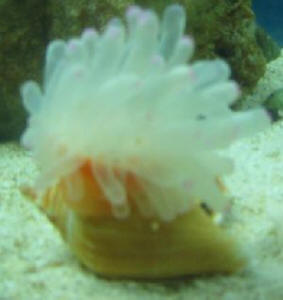
HELP! new anemone owner! Hey Bob. I constantly read your FAQs they are great! Here's my problem. I just bought a new Haitian pink tipped anemone. It has been at the LFS for months and months so I know it's in good condition with no cuts or anything. <<Sadly, these can look fine for months and months, but actually be in serious decline from lack of proper light and foodstuffs.>> but there's one problem, when I put a shrimp pellet or something in its oral disk, it's tentacles sort of fold up around the food like normal and it eats it, but no sting. Shouldn't it be at least a little bit sticky? <<I would think so, but this does vary from species to species.>> It might have stung me once or twice but it was so faint that I could barely feel it. <<Well also on the hands where calluses are the thickest. I bet if you stuck it higher up your arm it would feel different.>> please help me I really like this little guy and want to keep him alive! Clint <<Well, Clint, the trick now will be lighting, circulation, and feeding. If you've got adequate lighting then you're off to a good start. I would continue feeding, perhaps moving to something besides pellet foods, to something like frozen silversides. Keep a close eye on your water quality. Cheers, J -- >> Condy Hi Bob, <Anthony Calfo in your service> A quick question regarding my anemone....I've never really fed him and I have read quite a lot on this site. I did however feed him lately with some minced krill. <very fine... it is important in the big picture to feed fine/minced foods> Afterwards he just never blossomed again. <totally unrelated> Its been about two weeks....his colour doesn't seem to be off , but he's just not doing anything. <do check complete water quality... is your alkalinity low or has your salinity strayed?> I concerned about he rest of the system, what should I be careful of? <if you have had this animal for weeks or even some months without feeding, then you are at least looking at a problem with attrition/starvation. Some hang on for weeks... others go many months, but all underfed anemones will die within a year to say the least. Confirm that water quality is fine and coax with various meaty foods of marine origin> Roland <best regards, Anthony> My Boyfriend Bought Me...Condy! Hi <Hi there! Scott F. with you tonight!> I need some help!!!! I recently bought a Haitian pink tip anemone, and I need some information. I purchased some frozen food for it today, recommended by a local pet store. When I feed it do I need to cut it up or leave it in cubes?? <Definitely cut up the food into smaller pieces, and don't overfeed. You can squirt some of the food into the anemones tentacles with a turkey baster (very appropriate this time of year!). How do I care for it?? When I bought it I didn't ask too many questions, cause I thought that my boyfriend knew what to do with it! Please Help Thanks Christie <Well, Christie, first thing that you need to do is slap that guy! You now know never to buy any animal, especially an anemone, before you study up on it! Enough lecture...Fortunately, these are the among the hardiest of anemones. However, they still require bright light, vigorous current, and clean, stable water conditions in order to thrive. They can get quite large and very colorful with proper care. They generally will not host Clownfishes, being a Caribbean species, however, larger Clownfishes, such as Tomato clowns, do sometimes take up residence in them. These anemones can and will move around in the tank until they find a spot that's just to their liking, so make sure that all filter intakes, powerheads, etc., are configured so that the anemone is not accidentally drawn in and injured or killed should it wander around. With attention to the environment, and proper care, these anemones can live for many, many years. Do a search on this species using the Google search feature on the wetwebmedia.com site for more information. Good luck! Scott F.> New with Anemone Hi. I have a pink tip Condylactis when I got
up this morning is was a white ball but after the lights came on it
came out is this normal?? and how often should I feed ?? <there is
so much to learn here my friend... you really need to get the
information needed on animal husbandry before you buy an animal...
please, my friend... respect for living creatures. Most anemones die
prematurely because people see a cheap and cool addition to their tank
but have no means to care for it properly. Anemones in fact are more
demanding than most corals for light and water quality. Do you have
full reef lighting for this creature? Nitrates are near zero? For
feeding, please feed meaty foods of marine origin (mysids, Pacifica
plankton... never brine shrimp though... all frozen)... very fine or
minced... never larger than 1/4"even though they will sting it
(large chunks can tear, harm or kill in time). My advice to you is to
spend some time in our wetwebmedia.com archives reading articles and
FAQs on anemone husbandry. Begin on this page (scroll down for anemone
info): http://www.wetwebmedia.com/marine/inverts/index.htm
Best regards, Anthony> |
|

|
Features: |
|
| Featured Sponsors: |