|
FAQs on Carpet Anemone Disease/Health 1
FAQs on Anemone Disease by Category:
Diagnosing,
Environmental (Pollution/Poisoning, Lighting...),
Nutritional, Social (Allelopathy),
Trauma,
Pathogenic (Infectious, Parasitic, Viral)
Predatory/Pest,
Treatments
Carpet Anemone Reproduction,
Related Articles: Carpet Anemones, Stichodactyla spp., Use in
Marine Aquariums by Bob Fenner, Carpet Anemones, big,
beautiful and deadly by Mike Maddox, Bubble
Tip Anemones, Tropical
Atlantic Anemones, Anemones,
Colored/Dyed
Anemones, Cnidarians,
Marine Light, &
Lighting,
Related FAQs: Carpet Anemones 1, Carpet Anemones 2, Carpet Anemone Identification, Carpet Anemone Behavior, Carpet Anemone Compatibility, Carpet Anemone Selection, Carpet Anemone Systems, Carpet Anemone Feeding, Carpet Anemone Reproduction,
|
Doomed
|
 |
New Print and
eBook on Amazon:
Anemone Success
Doing what it takes to keep Anemones healthy long-term
by Robert (Bob) Fenner
|
|
Hoddoni anemone won't stay attached.
11/16/19
Hello, I have had it for over a year. When I first got it about 1 1/2" , now
about 6" . It is in 2 year old, 65g tank with a 3" saddleback, coral beauty
and Tomini tang.
<I'm surprised this anemone hasn't eaten the last two>
water 1.026 ph 8.2 dkh 9-10 m 1360 cal 380 . Lightning hydra 26's 4 t5's.
600gph w/wave makers. It has great color on its flesh, light pink and light
to dark green tentacles. It appetite is great.
<What and how often do you feed this Actinarian?>
It stands up when the lights come on as the lights intensify it flattens or
cones.
<... something odd here>
It won't stay attached to bare, soft or course substrates.
<Umm; see Mike Maddox's piece here:
http://www.wetwebmedia.com/ca/volume_6/volume_6_3/capranem.html
and my coverage; linked at the bottom>
Currently it has attached to a small peace of egg crate.
<READ now; this is not a natural, useful attachment>
If i try to add sand around it foot it lets go and lays on top w/stem down
but its foot curved so it doesn't touch sand. I have looked at its foot and
don't see anything obvious wrong. It has attached to snail shells, it let
them go when i cleared a 12" * 12" bare spot ( sand bed 6" ). It partially
attached to bare spot. The clown is sometimes aggressive rubbing on it so i
have the clown separated (clown pissed).
<Good>
If clown is in with the anemone it won't stay attached.
<They may be incompatible. I'd cover the anemone with an inverted
"strawberry" basket; or remove the clown to elsewhere>
? Mangrove mud on top of bare glass ? Any suggestions would be greatly
appreciated. I have tried lots of things without any real success. It had
moved around and then stayed in the same place. This is where I bared the
bottom.
<The reading. Write back if you aren't clear here. Bob Fenner>
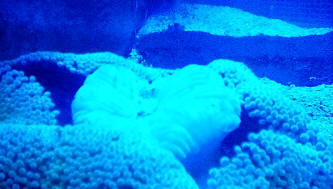
Hoddoni anemone won't stay attached. Pics
11/23/19
<Haddoni... once gaping like this.... trouble. NEEDS to be moved to another
established system. Search/READ on WWM re carpet anemone husbandry. Bob
Fenner>
|
 |
Help with Carpet Anemone problem 11/1/19
Hello Bob,
We met many years ago in Sacramento through Kim Hanks.
<Oh! Hope to see you and her this weekend. Am headed up tomorrow/Sat. to present
to both the marine and freshwater clubs there>
I've always enjoyed your talks and your book on anemones.
<Ahh!>
I've been a lucky and dedicated carpet anemone fan for over 20 years.
<Neat animals; well worth the work>
My tank has been running continuously for that time. About 5 years ago I lost my
mertensii carpet after almost 20 years due to a power outage while I was on
vacation. I replaced with a beautiful blue carpet I was told was a gigantic, but
due to the fact that it sometimes pulls itself under the gravel completely I am
leaning towards it being a Haddoni.
<Could be; these Stichodactyla species can be hard to discern. Usually the
radiating lines from Haddon's are definitive>
I had been keeping the Haddoni in my tank successfully for the past 5 years. Its
primarily an anemone tank, with a good Zoanthid polyp colony. I have a Clarks
clown a fire angel and a yellow tang in my 75 gallon tank. I use 2 2100g per
hour current USA powerheads on surge or wave settings for circulation. I run 3
little fishes carbon in a hot magnum filter, and a remora c protein skimmer.
<Good mix of filtration, circulation...>
I do a 15% h20 change about once every month or two typically. I feed once per
day, 6 days a week two frozen prepared foods which fish and polyps consume in
about 2 min.s. I typically feed my anemone directly a small sea scallop twice a
week to encourage growth. All was well in the tank. About 5 months ago I decided
to try the new Current USA LEDs and bought two strips after my 6 bulb t5 54 w
system burned up.. Everything seemed ok for a while but after a couple months,
my anemone started to move around after being in one place for a while. I also
noticed that my zoanthids were not as open and bright as before. It didn’t dawn
on me that it might be the lights for some time. I increased water changes,
changed food and played around with current a bit to see if things might
improve.
<Good...>
My anemone was sticky and took food with no issues and continued to be large and
otherwise appeared healthy other than the migration. But I know a moving anemone
is an unhappy one. It finally settled in the dead center of the tank. I took the
opportunity to put some live rock around him buried in the sand to try and keep
him in one place.
<Good move>
About three weeks back I noticed despite finally settling in one spot, its mouth
was starting to invert. In frustration, I continued weekly 10% h2o changes and
kept researching. Last week I was reading up on the LED lighting and decided
that my system was not producing powerful enough light for the SPS or Anemone
and that was causing all the issues.
<Could be the photo strength, even just the mix of spectra... being deficient>
I have since purchased an 8 bulb t5 set up which produced 450 w of lighting. All
other factors in the tank remain the same. Its been about a week now and the
anemone shows some signs of improvement but his mouth is still inverted. Still
large, still sticky, no longer moving around, but inverted mouth. I have not
tried to feed while in this condition concerned it might do harm.
<Well; a week is not much time.>
I know anemones react slowly and recover slowly as well. Are there any other
recommendations you can suggest to help with the inverted mouth now that its
been going on so long?
<Mmm; I might try adding both iodide/iodate solution and a vitamin/HUFA mix
directly to the water. SeaChem makes good brands of both; though there are other
manufacturers.>
Any suggestions on how long it might take to know if recovery is going to happen
or if I have a terminal case?
<Weeks likely>
Appreciate the guidance as I do cherish the critter and hope to keep him around
for my lifetime.
Brad Becker
408-859-XXXX (please note despite the 408 area code I am on east coast time)
<Thank you for sharing. Hope to see you Sat. in Sacto. Bob Fenner>
https://www.reef2rainforest.com/event/mars-sas-joint-meeting/
Re: Help with Carpet Anemone problem 11/1/19
Hi,
Thanks for this but I live in Atlanta. Can you forward my message on to Bob?
Thank you.
Brad
<Ah yes; hence the ref. to East coast time. Cheers Brad. BobF>
Re: Help with Carpet Anemone problem 11/1/19
Thanks Bob, I see the inline answers below. Ill try the iodine. Appreciate your
fast reply.
Brad
<Do please keep me/us informed of your observations, actions. BobF>
Urgent help about green carpet anemone... What WWM is not
4/8/15
Hello
I have recently bought a green carpet anemone and it was doing good
<well>
but today i came to see it i have seen him badly stuck into wave
maker machine.
<...>
i care fully removed him from the wave maker. But now it has a very
little movement and one of its side is shrunk and turned black. can you
suggest any cure for it.
<For you to read here:
http://wetwebmedia.com/CptAnemTraumaF.htm
LEARN to USE WWM. Bob Fenner>
Thanks
abhinav
|
Haddon's anemone; hlth
12/29/14
..
Crew:
I have a Green Haddon's Carpet Anemone which was purchased about 9
months ago. The first six to eight months it doubled in size and really
looked good. The past 6-8 weeks it has been declining to the
point where it will not eat (not sticky anymore) and is down to about
half its size.
<Has anything changed? New livestock added?>
Everything else in the tank is doing great. My question is this: having
read about allotropic responses, I removed a RBTA to another tank,
<Ahh>
but I question the presence of a significant quantity of Pom Pom Pulsing
Xenia on a bommie about a foot and a half away.
<Either could be at fault here>
Other information: three 250 watt MH, four 96 watt PC's (PAR reading at
the anemone is 100), 1.023,
<Would raise to 1.025-6>
nitrate 10ppm, nitrite 0, alkalinity 250, pH 8.3, in a 220 gallon tank
with skimmer/sump established over 5 years.
<Any HPO4? Need this>
The tank has a significant fish load,
<Ah, good>
with two hosting and bonded Clarkii clownfish. I realize this anemone
does better in a tank by itself, but it was doing so good for the first
6 months. Any insight would be most appreciated.
Jim Wedel
<Do read through what we have archived re this species en toto on WWM...
I'd be using a pad or three of PolyFilter, adding a triple dose of
iodide-ate... Bob Fenner>
Re: Haddon's anemone 12/29/14
Bob
<Jim>
I am using natural seawater collected about two miles offshore and
filtered through a one micron filter and kept in dedicated garbage cans
for at least one week before use.
<A good protocol>
I realize the salinity should be 1.025, but my hydrometer says 1.023
(possibly it is off a little bit).
<Mmm; the actual spg is assuredly higher. Check your hydrometer... it
may be "adjusted" for a given temperature; or simply be inaccurate...
most cheapy glass ones are>
I have been using this water for over 10 years and have relied on large
and frequent water changes to keep my numbers correct.
<The water IS fine; as you state>
I have read what you have on your website, and thank you for all the
good work you do to help keep the hobby going.
<An accurate way to put this; thank you>
I did recently add two poly filters, but so far no change in the anemone
(several days). Everything else in the tank is doing very well. Would
you still recommend adding the iodide?
<Assuredly yes... is a very good general "tonic" for ailing Cnidarians
and more. IF it were my animal, I'd be moving this Haddon's elsewhere if
I had another stable, established system>
Thanks for your advice. Jim Wedel
<Cheers, Bob Fenner> Re:
Haddon's anemone
12/31/14
Bob:
<Jimbo>
What would be your thoughts towards the following protocol:
I could set up a presently empty 90 gal. tank, where I took the
biologically active ceramic bio balls and have kept them
in the sump of the
220 gal. to keep them active. I could take enough of the
sand out of the
220 to set up the 90. Using new ocean water it seems like
it would be
close to an established tank, but without any possible
allotropic
conflicts. The tank does not have a sump, as I have relied
on two large
hang-on filters. I have two, 4' Current Orbit LED fixtures
that seem like they would
produce adequate lighting. Thank you again. I have attached a
photo of the anemone.
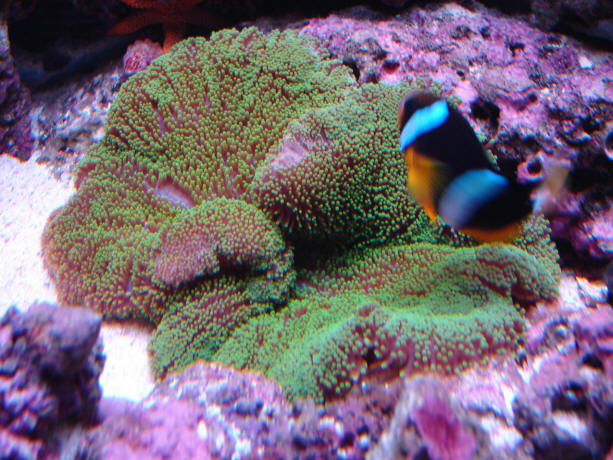
<Actually; it doesn't look all that bad to me in this pic... You could
move it though. BobF>
Jim Wedel |
 |
Stichodactyla haddoni; losing to other Actinarians
12/17/14
Bob:
I spoke with you at the SWFMAS meeting in Ft. Myers. One of my customers has a
green Haddon's carpet anemone which had been doing very well (growing from about
6 inches to about 16-18). It is in a 220 gallon, long established tank with good
water parameters and a combo of three 250 watt MH, and four 96 watt PC's.
During the past two months it has shrunk to about 8 inches and does not consume
food, even though the tentacles are still quite sticky.
<Mmm; "something/s" changed... a deficiency, a pest...>
It has two adult Clarkii clownfish hosted in it. Could they be so
aggressive that it does not expand?
<Yes; is a possibility... could remove and see if this helps>
I could send pics if it would help. There are three other species of
anemones in the tank (one RBTA, two rock anemones, and two beaded anemones)
>Oh! Much more likely they're "winning" here at the Stichodactylas loss>
and all are doing excellent.
<A good clue>
There are also a fair number of fish, but weekly water changes of 60-90 gallons
keep the nitrates in check). I do not believe the anemone had been dyed. Any
suggestions would be most appreciated. Thank you.
Jim Wedel
<I'd move the Haddon's and have you and your customer read here:
http://wetwebmedia.com/AnemCompF5.htm
and the linked files... till you have a grasp of what is likely going on here
allelopathically. Bob Fenner>
Fw: Stichodactyla haddoni
Sorry, the PAR readings are at 75 where the anemone is located.
<Better at 100 or so. I'd "move it on up" in a system where this was higher.
BobF>
James Wedel
|
Carpet Nem looking pale
12/2/14
Hello everyone! I hesitate to send too many questions your way, but
sometimes I have no other choice.
I have talked to numerous people, and you know how that goes!
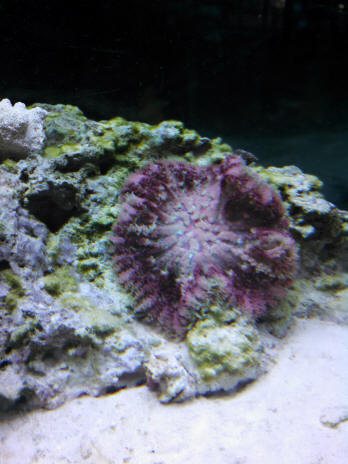
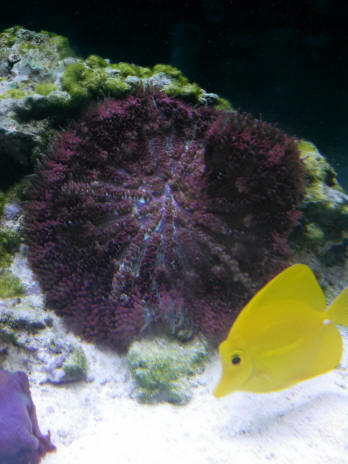
<Yes... five Megs of pix...>
I bought a "mini" carpet anemone July 2013. It has done fantastically,
growing larger than the span of my hand.
Four days ago, I noticed it wasn't opening fully AND it appeared pale.
<I see this in your too-large pix>
Today, four days later, it still looks pale, is not opening and I am
freaking out.
I've been feeding it small pieces of clam. To my surprise, the Tang
stole the clam! I tried again, and did notice the nem is still sticky,
so maybe the Tang was just lucky.
The only thing I have done differently ( and stopped!) was adding a 2
part Alk/Calcium supplement, (Reef Fusion 1&2)
I only dosed 2 days, because after testing, I realized the alk rose from
8.4 to 9.3! And the Calcium shot up from 380 to 480!!!!! Stupid me, I
didn't test BEFORE dosing and I know that was a mistake.
<Yes... you NEED to do this addition more gradually AND through water
changes... in pre-made, pre-supplemented new water>
So, the question is, do you think this fluctuation caused my carpet nem
to expel its Zooxanthellae?
<Some; yes>
AND, should I continue to feed, AND will it survive my mistake?
<Yes and hopefully>
Thanks so much for your expertise!
Pam
<Glad to share. Bob Fenner>
|
 |
|
Re: Carpet Nem looking pale
12/2/14
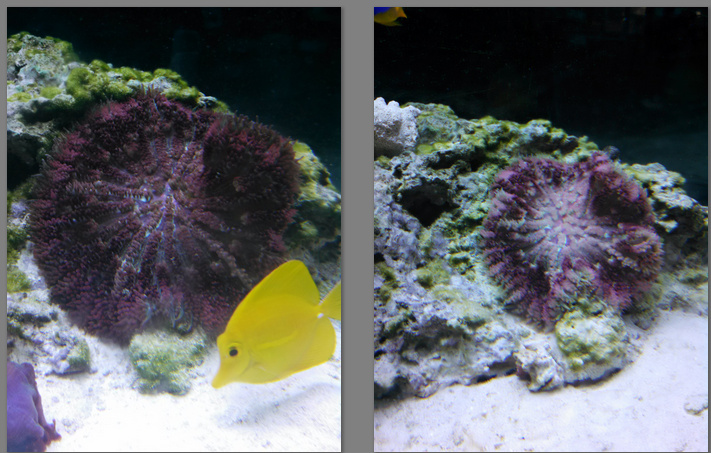
is this pic better Bob?
<Fab! Thank you Pam. B>
|
 |
|
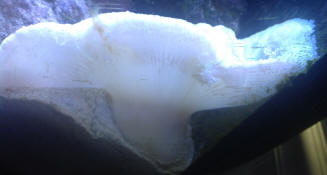
Bleached Anemone 9/29/13
Hello Crew,
<Karen>
I ordered a Haddoni Carpet Anemone from Liveaquaria. It arrived
yesterday and I am concerned that it may be bleached.
<... the pic of the animal you've sent? Yes>
It is very light green. It seems to be very healthy. It is very sticky and
quickly buried it's foot deeply in the sand. I have always had such a
good result with all live stock ordered from them.
<A reputable firm>
Should I be concerned or is it possibly the natural color?
<Am cc'ing Kevin Kohen, who runs this division of Dr.s Foster & Smith...
Am very surprised that they'd send this specimen along. Bob Fenner>
Thanks for your help,
Re: Bleached Anemone 9/29/13
Wow!!!!! Talk about customer service, and from a volunteer site! Will
let you know the outcome.
Thanks,
Karen
<I encourage you to contact LA as well. BobF>
|
 |
Re: Bleached Anemone
9/30/13
Karen,
My name is Kevin Kohen and I am the LiveAquaria.com director for Drs. Foster
and Smith. I am very sorry to see that you experienced a problem with
your recent LiveAquaria order number A2937672, as this is not the level of
service that you deserve.
I have reached out this morning to the staff in California and sent along
the image you had provided on WetWebMedia.com so that we can ensure that we
take the proper steps to correct the problem. The anemone you received
is definitely far too translucent and bleached, as its expelled most of its
Zooxanthellae. Please keep the anemone illuminated well and offer food
in the form of large Mysis, chunks of krill or other meaty foods several
times per week and hopefully it will regain its beneficial algae. This
may take up to 6 weeks, but from the sounds of it, the anemone has the
ability to capture food and adheres to a solid surface so that is a great
sign.
I have instructed our LiveAquaria.com staff to provide a refund back to your
credit card which was used to make the purchase for both the anemone and the
next day air Saturday shipping charge. You should see this on your
credit card statement in the next 72 hours.
Once again, this is not the level of service nor the quality of animals that
we are known for, and I am sorry for the problems associated with your
order. We truly value you as a customer and sincerely appreciate your
patronage and support.
If you have any further questions please feel free to reach out to me
directly or to our customer service staff by calling
1-800-334-3699
.
Sincerely,
Kevin Kohen
Director of LiveAquaria
Drs. Foster and Smith
www.LiveAquaria.com
www.DrsFosterSmith.com
www.PetEducation.com
<Outstanding Kev; thank you for your prompt attention to this matter.
BobF>
Re: Bleached Anemone
9/30/13
Bob,
Thank you very much for emailing me, I really appreciate it!
<Kevin; your "A" efforts (Dr.s F & S) ARE the industry's exemplary standard.
Am glad to bring occasional/anomalous events to your attention.
Cheers, BobF>
Sincerely,
Kevin Kohen Re: Bleached <sic> Anenome; rdg.,
finally 9/30/13
Bob,
Thanks so much for the quick response. I received a fast refund this morning
from LiveAquaria. You and your crew are the greatest! I will be attempting
to revive this anenome since it is still sticky and accepting
food. Any other hints you may have would be appreciated.
<Please do read here:
http://www.wetwebmedia.com/cptanemdisfaqs.htm
and the linked files above. B>
Karen
|
Purple Haddoni carpet/Stichodactyla/Health
1/28/12
Hi,
<Hello Alan>
Just looking for a bit of advice here. I recently saw a beautiful
purple haddoni carpet and I would have bought it but was concerned it
wasn't healthy. The mouth was open so that you could fit almost
three fingers inside, also it wasn't sticky.
I'm hoping this is just the animal being stressed as it has just
been imported in, but am also worried there is no hope for it (large
price tag).
Usually I would just stay away, but as it is so rare, (especially over
here in the UK) is it worth a chance? No guarantee is offered, but I
expect it to be sold within a day or two.
<Do not waste your money, this animal is on it's way out.
James (Salty Dog)>
Alan
Re Purple Haddoni carpet/Stichodactyla/Health 1/28/12
Hi James,
<Alan>
Not what I wanted to hear, but what I expected. That's why I left
the shop with a healthy red one, the purple one just keeps popping up
in my mind!
<Good move, but even a "healthy" Haddoni is very difficult
to keep for any length of time. Suggest reading here if you
haven't already.
http://www.wetwebmedia.com/ca/volume_6/volume_6_3/capranem.html
http://www.wetwebmedia.com/carpetanemones.htm>
Thanks
<You're welcome. James (Salty Dog)>
Alan
Problem with Carpet Anemone
5/18/11
Hi!
<Hello Liza>
I've been searching through your articles and FAQ's and still
have a question about a problem we're having with our carpet
anemone (Stichodactyla gigantea).
When fully open (or at least his typical state) he is about 15"
across, has blue foot and green tentacles (not relevant though I
guess). Has been in the tank for about 4-5 months, once he found a the
spot he liked after about 2 weeks, camped out and stayed put. The tank
is 180g and has been running for 8 months though all rock was aged (a
lot of growth, coraline algae, etc).
A few weeks back, we had an issue in the 75g tank where we had to treat
with Rally
<A scam product>
(whole other story) and though the claim is that it doesn't affect
corals, we found that it definitely did. Ended up moving all of the
corals and Monti caps into the big tank so we wouldn't lose them
but got a little crowded.
About the same time, the anemone was not opening up to his normal size
though still eating normally and not other symptoms. Just recently
he's has started moving around and has shrunk up quite a bit. This
afternoon we had seen where he had fallen off the rock
<?!>
he moved to and was upside down on the substrate. His mouth looks
somewhat distended (large) compared to his small size (4"
across).
<Very bad signs>
Righted him and we'll see his condition this evening. One of the
Monti's we put in the tank was shading him and from what I have
been reading, these guys like their light. I would expect him to move
but would you expect him to shrink up?
<... something else at play here>
Could this just be a matter of lighting or is something else going on.
In most of the postings, I read where someone has just brought one home
and mostly likely a victim of harvesting techniques.
<This and inappropriate environment>
We've had this anemone for quite a
while and he was thriving with the previous owner (did not get from LFS
but from individual).
The basic parameters in the tank are:
pH = 8.3
NH3/4 = 0
NO2 = trace (slightly off from zero reading)
NO3 = 20 ppm
PO4 = .25-.5
SG = 1.024
Temp =~78
However, even with the PO4 being high (using a reactor to try and
reduce) and higher on the nitrates, none of these have changed - have
been pretty much stable.
We have, in the last two days, removed the Monti that was shading him.
I was going to try and move him back to his original perch that he had
seemed to like so much.
Any thoughts or insight other than giving him more access to light
and/or water
change? Any additional info that would helpful?
<I would move the Montipora, any other Cnidarians elsewhere, likely
spiff up my skimmer, employ appropriate chemical filtrants to discount
allelopathy>
Thanks for you help and appreciate all the info on your site!
Liza Cobb
<Welcome. Bob Fenner>
Injured Carpet Anemone/Stichodactyla
Systems/Health 2/28/2011
Good morning fish gurus,
<Good morning, EJ.>
I recently added a carpet anemone to my tank. Right now the left half
of the tank is lit by LED lights and the right half metal halides. I
put the anemone on the metal halide side. He did not seem to like the
lights there. The parts of him that were under direct exposure would
shrink and only the area in the shade would inflate. Also he would only
grab on with half of his foot and not very securely. I woke up this
morning and found him in a fan style powerhead.
<Yikes, should have researched first.>
He has injuries around the edge but his foot is undamaged. I moved him
to the LED side
and he fully grabbed onto rock with his foot right away. He hasn't
opened up much all day today. But that is to be expected. My question
is can he survive injuries like that or is he a goner.
<A pic or two would have helped, but generally do not
survive.>
As I said his ain body is fully intact. But along the edges he has
damage.
He sort of looks frayed in spots. Also I have a rose bubble and a maxi
mini that are doing very well. Both on the led side of the tank.
Don't worry, They are several feet from the carpet (it's an 8
foot wide tank), I also have all the fish in quarantine to fight an ich
outbreak so there are no fish in the tank at this time and ammonia
nitrite and nitrate all test to 0.
<Do read/learn by going here.
http://www.wetwebmedia.com/carpetanemones.htm
http://www.wetwebmedia.com/ca/volume_6/volume_6_3/capranem.html
http://www.wetwebmedia.com/marine/inverts/cnidaria/anthozoa/anemones.htm>
Thanks for your help.
<You're welcome. James (Salty Dog)>
Ej
Bleached Blue Carpet Anemone/Stichodactyla Health,
Jame's go 1/13/11
Hello Team !
<Hello Jeremy>
I recently purchased a blue S. Gigantea carpet anemone from Tropicorium
in MI. When I purchased the animal it was already somewhat bleached and
the mouth was about an inch or so open. I know that this is a bad sign,
but I wanted to try to save this animal as I know that blue carpets and
especially this type are very rare.
<Mmm, I'd find it hard to believe Dick would sell an unhealthy
specimen unless you knowingly bought it in this condition at a
discount.>
A little background on my tank... 90 gallon corner with a 250 watt high
output metal halide also a six strip T5 high output lighting
fixture.
<Tank is really too small for this anemone. Larger systems provide a
more stable environment and Stichodactyla species do not tolerate
fluctuations in water parameters.
A minimum tank size of 125 gallons is highly recommended.>
Due to the strange shape of the tank I have the two lights side by side
to illuminate the entire tank. I do 30 gallon water changes every two
weeks and the water quality is quite good. The nitrites are zero, the
pH is 8.3 and the Nitrates are 10-15. (not perfect but not awful). I
have a "garden style" reef tank With a thriving rose BTA and
many soft chorals.
<Mmm, never heard/saw a singing coral. Joking aside, garden style
reef systems and carpet anemones do not mix well in smaller
systems such as yours.>
I have two guarded blowers to keep good water circulation. The tank has
been running for nearly three years and I have actually been blessed
with much success in just about everything I have tried to keep in
it.
When I placed the anemone in the tank ( at the bottom on the sand bed )
it opened up quite nicely ( to about 8 inches in diameter )
after an hour or so and looked pretty good and full. It was/is
definitely bleached to a point as the body of the anemone is white to
tan but the tentacles are still a bright blue. The mouth was closed to
about half an inch with a small bubble of inside about half an inch
protruding from the mouth. It looked like this for the remainder of
that day and then when the lights went out it shrunk down considerably
and its mouth opened to about two full inches and more guts started to
spill out over the mouth.
<A bad sign, anemone is stressed.>
This had/has me very concerned. About two hours after the lights were
out the mouth has closed back up and the innards were back inside.
The following morning when the lights came on it looked good again. It
had not attached its foot anywhere but it was at least stable on the
sand bed. It looked good throughout the day and that evening I tried to
feed it a small chopped up piece of krill. It was VERY sticky and did
close up over the krill and hold it for about 5 minutes but then
released it.
<I would not attempt to feed this anemone again until it has
anchored.>
That night it did the same routine as far as opening the mouth two
inches and spitting out its guts, but again after two hours or so it
was back to closed mouth and guts inside. The third day it started to
move itself back into the live rock and was almost buried in the rock
by evening. I read on another site that this could be bad and gently
tried to move the rocks around him to expose him to light a little
more.
He was again VERY sticky as he brushed up against me at one point and
stuck to me pretty good. I was very gentle in getting myself un-stuck.
I also did an extra water change at this point of 30 more gallons. That
evening I also turkey basted some Mysis shrimp onto him. I couldn't
quite tell if he ate it or not as Mysis are so small. That night he
shrunk down again and spewed out his guts and then recovered two hours
later. This morning he was open again as the lights came on and parts
of his body are starting to get a pinkish color to it, but he is still
hiding a large portion on his body in the rocks.
My question is.. Am I doing all I can to try to help him and is there a
decent chance for him to pull through if I keep my water changes going?
Please please help as I really would hate to see him not pull through.
I have a great respect for these beautiful creatures and will spare no
expense to save him.
<Based on your statements, I'd say your odds of reversing
it's present health are about 5%.
Even healthy Carpet Anemones can be difficult to acclimate to captive
conditions, even by experienced aquarists. Sparing no expense will do
little to reverse the health of your anemone. It would have
been wiser and cheaper to research this animal before buying.
Do read here and related articles/FAQs found in the header.
http://www.wetwebmedia.com/carpetanemones.htm
Thank you in advance !
<You're welcome. James (Salty Dog)>
Thank You,
Jeremy Rose
Ability to keep a Carpet. RMF's go
1/14/11
Hello Team !
<Hey Jer!>
Thanks to your wonderful site I recently learned that a 90 gallon tank
with a 30 gallon refugium is not big enough for a S. Gigantea carpet
anemone.
<Mmm, not much else...>
I was wondering if there is any size Carpet anemone that I can keep in
this tank ?
<See WWM re...: http://wetwebmedia.com/carpetanemones.htm
and the linked files above>
I have seen quite a few of these "Mini" carpets at the local
fish store lately.
<Mmmm, these have their downsides... too stinging et al.>
They are multi-colored and the guy at the store states that they do not
get more than 5-7 inches. I have a 250 watt metal halide so the
lighting should be good, but is the tank big enough?
<Yes>
I also have a rose BTA in the tank that is doing quite well.
<I would NOT mix these two here. Too likely chance of real
trouble>
Please let me know what you think as I do not want to bring a carpet
home if I cannot care for him well. Thank you in advance !
Jeremy
<There you go. Bob Fenner>
Re Bleached Blue Carpet Anemone/Stichodactyla Health 1/13/11 -
1/14/11
Hello James -
<Hi Jeremy>
Thank you for your swift response!
<You're welcome.>
At this point I care more for the health of the animal than I do for my
expense so would it be better if I
tried to return it to the store?
<You can try.>
I honestly thought that my size of tank was enough for this anemone.
Still returning him may stress him out
to the point of no return. Anything else I can do?
<Maintain stable water parameters.>
Is the fact that it is getting some pink color returning a good
sign?
<There are blue, red, green, purple, and pink color morphs, are you
sure yours is the blue morph that is rarely seen in the trade.>
Is the fact that he is sticky a good sign?
<Yes, one good sign.>
Do I really have to abandon all hope at this time?
<Since it's highly unlikely Tropicorium will take this back, you
will have no other choice but to keep it and hope for the best. Read
the links again and try to provide the conditions required.>
Thank You,
<You're welcome. James (Salty Dog)>
Jeremy
Re Bleached Blue Carpet Anemone/Stichodactyla Health 1/13/11-
1/14/11
Hello James -
<Hi Jeremy>
I was also very curious as to why all of my local fish stores tell me
the same thing and it is wrong info? Three different places including
Tropicorium have told me to just keep trying different things to get
him to eat and that most likely he will pull through just fine.
<Getting it to eat is good info, but generally will not accept food
until they anchor.
As far as getting it to recover, Mmm. I believe a couple of photos
would help us get a better idea of the actual condition of the
anemone.>
They also tell me that my tank size is fine for this type of
anemone.
Should I stop trusting my local fish stores as a place for reliable
information ?
<I didn't say it will not live in your tank, but the odds of
success are much greater in larger systems. Have you asked any of these
people if they have ever kept one in their home systems? You may want
to read this article/survey on host anemones by Joyce Wilkerson.
http://www.athiel.com/lib/questions/anemone.htm>
Thank You,
<You're welcome. James (Salty Dog)>
Jeremy Rose
|
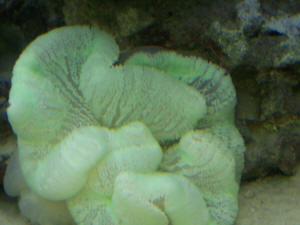
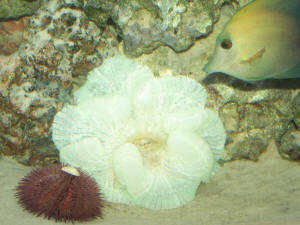
Urgent Anemone/Stichodactyla Health
6/29/10
Two days ago I bought a carpet anemone from Pet Co. I didn't
plan on buying it but I felt really bad for it.
<What an "Angel" you are.>
The conditions at Pet Co are absolutely horrible for anything
especially corals and anemones.
<This alone should have convinced you not to buy it.>
<<RMF urges all who are outraged to write PetCo corporate
re the inclusion of this species in their livestock assortment.
Totally inappropriate>>
Anyways, I'm attaching a few pictures and possibly you can
help me out. The color is a sea foam green, very light. I'm
assuming it's bleached but not 100% sure. I've never seen
a healthy anemone this light before. I have had anemones for over
10 years and currently I have this anemone in the same (but
opposite sides) of my 210 gallon tank as I have my Saddle Carpet
Anemone. My saddle is 7 years old (I've had it in my tank for
7 years).
<Very good to hear this. Most do not survive a year.>
Anyways, I'm thinking my new anemone is also a saddle due to
the stripes and there's also a brownish circle around
it's mouth.
<Likely a Haddoni.><<Is>>
It's foot attaches barely to the rocks, I have tried to dig
the sand out so it can attach to the bare bottom but it
hasn't yet. The mouth doesn't close as tight as I want it
to but does open and close, stingers are fine, very sticky.
<A good sign.>
The guy at Pet Co said he had eaten only a few hours before I
came in, I'm assuming he lied or the anemone had spit it out
because I couldn't see any food through it's white base
as I should be able to since it's so translucent. So,
I've tried feeding it yesterday and again today, it acts as
normal... grabs the food and leads it to it's mouth but
doesn't consume it. Within 30 minutes, the food is let go and
drifts away. Any advice as to keeping this wonderful creature
alive would be helpful. Hopefully this wasn't a waste of $65
and a waste of a perfect anemone that probably woulda have lived
hundreds of years if left untouched.
<I'm hoping you didn't waste your money, but it
doesn't look good. The photos are too blurry to be of much
use and the file size is too large, but it does appear there are
traces of Zooanthellae present so there is some hope.
I would not attempt to feed again until the anemone gets
anchored, as they generally will not take in food until then.
Obviously you have the necessary lighting and skill, or you would
not have had the luck you have had with your present Saddle
Anemone. I would leave be and keep a close eye on it and
hopefully the Zooanthellae will increase along with it's
health. Do inspect the oral cavity daily, a gaping mouth is a
sign of poor health and almost certain doom. If you have the
option of returning it, do it.>
Thanks for your time,
<You're welcome. James (Salty Dog)>
Angel
Ps. It does open up, it's not always closed up like the
pictures show. The flesh is white with a very subtle pink tone,
no brown at all that I see.
<Mmm, keep your fingers crossed.>
Re Urgent Anemone/Stichodactyla Health
6/29/10
Sorry about the pictures,
<Angel, do not send large files, takes up too much room on our
server.
Best to resize to a couple of hundred KB before sending.>
I just took more and I think they are more clear.
<One of them isn't bad, but too large, I have to scroll
around just to see different areas of the picture.>
I have a few shots of the mouth too which slightly alarms me as
my other carpet's mouth is normally more fleshy (puffy) when
open.
<Doesn't look good.>
And yes, I shouldn't have bought it this I know but
couldn't just leave it there to die. I actually went there,
saw it..kept thinking of it till the following day I went back
and bought it. I have a soft spot of anemones and figured if
anyone can save it it should be me.
<I don't think paying 65 bucks to watch an anemone die is
much of a deal.
You are eating Petco's would be loss.>
I'm also attaching a picture of my 7 year old saddle,
it's 22 inches across. Oh and pretty creepy, as soon as I
sent you the last email, he attached lol.
<Well, hope for the best, expect the worse. The anemone
actually looks a little worse/more bleached in these
photos.>
Thanks again for your help
<You're welcome. James (Salty Dog)>
Angel
|
  |
Stichodactyla haddoni problems --
11/03/09
Hello there, you have a great site and it has helped lots of times but
i haven't found anything on my problem yet so i was forced to
email. My Stichodactyla haddoni, which i have had for around a year now
and has
seemed to do fine the whole time, is seeming to do something odd which
im not sure is normal. I got home from work tonight to notice that it
was pushing bits of brown/black "trash" out of its mouth.
<Mmmm, is something "missing" livestock wise?>
It doesn't seem like normal discharge and its been a bit since last
time i fed it so i don't think that's it. also the ocellaris
that has been housed in it the entirety of its stay looks a little beat
up so to speak. There are
several marks around its head and its just swimming by the base of the
anemone on the bottom of the aquarium. I cant do a water change until
in the morning unfortunately so i can only wait it out until then but
if you could answer my question it would be greatly appreciated,
thanks. Bryce
<Mmm... I would add some activated carbon in the meanwhile...
Can't tell what has caused the changes you list, but they are not
positive. Bob Fenner>
Carpet Anemone/Health/Systems 9/23/09
Hey guys,
<Hello Jose>
I just purchased a beautiful blue carpet anemone and it looked great
going into the tank, but after the first day it deflated with the mouth
open and all kinds of weird substance is coming out. It still has full
color and tentacles look good, but very flat. Its been like that for 3
days. What do I do?
<You read here and see if you can provide the requirements to even
have a shot at keeping one alive. If not, I would return/exchange
ASAP.
http://www.wetwebmedia.com/ca/volume_6/volume_6_3/capranem.html
James (Salty Dog)>
Jose
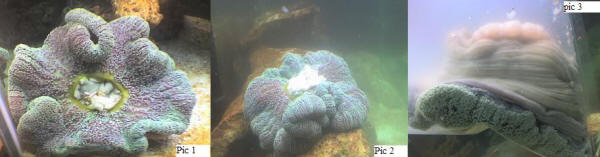
| Sick Carpet Anemone, S. Haddoni -- 3/14/07
Hello to the crew of WWM. <Hello, Brenda here> As many before
me have praised, I thank you for the invaluable information and
service you provide to this community. <You're welcome>
90 gallon tank, compact lights (2-60w, 10,000k + 260w actinic=
total 520w), <I'm not sure how you came up with 520 watts
total. Power Compact lighting is not enough for this
anemone. I suggest Metal Halide lighting.> water
tested within parameters; nitrates=10ppm, <Nitrates need to be
zero.> <<No>> ammonia and nitrites=0, ph=8.2-8.4. Yellow tang, powder
brown, scopas, mandarin goby, damsels, and cleaner pack. My husband
and I have recently bought a carpet anemone from our LFS with whom
we are very familiar with and have come to trust. We had watched it
in the store for the last 3 weeks to confirm health before we
decided to purchase him. We brought him home and for the first two
days did wonderfully. He would blossom first thing in
the morning before the lights came on and shrink back a little
throughout the day. Almost immediately our maroon clown
hosted him and they seemed to be doing well...until the maroon
clown disappeared. We have been having this maroon clown
over a year and he always came out for feedings and social
play. We have concluded from reading your articles and
gut feelings that the anemone ate our clown. Now comes
the problem. When we first bought him, he was super
sticky, now he isn't at all. In the first picture
you can see that his mouth started opening very wide. This was
about 7am, right after we deducted he ate the clown. By
3pm he started having huge fleshy bubbles exude from his mouth (pic
2), though his footing looked fine and was still firmly grasping
his rock. By 7pm a white opaque bulb came out of his
mouth, which quickly started to cloud our tank. Our
yellow and powder brown tangs and well as the damsels picked at the
substance. We could only conclude that this was the
regurgitation of the clown. During this time my husband tested the
water again, which showed an ammonia spike of 0.2. <Yikes!>
By 9pm my husband put him in a bag to transport him into a hospital
tank and he has started to turn inside out (pic 3). We
have read many of your articles where many of the anemones have
recovered from this. We can only imagine that he is sick
from eating the clown, which was too much for his
system. <Not likely. Is this a new
setup? I don't see any coralline algae on the
rocks.> Can you give any advice? <Return it to the
LFS. I suggest trying a large Entacmaea quadricolor for
your maroon, if your system is well established (6 months to a
year) and you have researched their care. The E.
quadricolor should be 3 times larger than the maroon, as maroons
can be aggressive towards the anemone.> <Brenda>
<<Too late. RMF>> |
|
|
carpet anemone... Poor English 1/29/07 hello, ive
never wrote before but I need some assistance. I have a 35
gallon tank and a large carpet about 10in across. I have had
it about 3 months and never had a problem. he made himself a
spot by the heater and stays there always. I keep the tank at 80
degrees. through the night the heater went out, it got down
to 70. I slipped the old heater out from right next to the carpet and
slid in the new one.it heated up very hot to my touch so I moved it
away from the carpet. now it keeps shrinking up and then
spreading out. the mouth keeps opening and closing to. it
dosen't look right. the tentacles that were near the heater look
kind of burned or something. is that possible? do you think I burned
it? if I did will it be o.k.? is there anything I can do to
help it? <I's, not i's... beginnings of sentences are
capitalized... Read here: http://wetwebmedia.com/carpetanemones.htm and the linked
files above. Bob Fenner>
gigantea anemone is limp... so is English, information,
reading... 12/4/06 i <I> have recently about 2
weeks ago bought a gigantea anemone, it was doing really well in my
200ltr tank, i noticed yesterday it didn't open, and today on
further inspection i found a what looks like a rotted section on the
edge of the tentacle area, it is also very limp, with little or no
reaction to touch, its mouth appears to be inside out, and my male
clown has started to pick at it. <...> i recently had a
pufferfish and a decorator crab die for what seems like no apparent
reason, <....> i cant <can't> find the puffer fish in
the tank and was wondering could this be a cause for my Anenome being
ill? or given the symptoms, is there anything you could suggest could
be the cause and what can i do to help get it back on the mend. please
help!!! <... Puffers and anemones are incompatible... you provide no
useful information re your system, water quality, tests... and
obviously haven't read what is posted re Stichodactyla in
captivity: Read: http://www.wetwebmedia.com/carpetanemones.htm and the links
above... and please, correct your English before sending... Bob
Fenner>
Anemone Mouth is "Inside-Out" - 10/15/06 First of
all thank you for all the valuable information you have provided on
this website. <<A collective effort...you are quite
welcome>> I have recently purchased a Stichodactyla haddoni
approximately 9" diameter at full extension. <<Do have a
read here and among the linked files at the top of the page: http://www.wetwebmedia.com/marine/inverts/cnidaria/anthozoa/anemones.htm>>
First of all my tank is a 90 gallon, lighting provided by dual 150HQI
10,000K dual 110W actinic PC and moon lighting. <<Sounds
good>> Temp is 77-79, SG 1.025, NH3-0, NO2-0, NO3-0 or not
detectable, Calcium 410ppm. <<Good again>> Approximately
120lbs of live rock and 3" sand bed. <<Mmm, would recommend
a bit less rock and more open substrate with an inch or two more depth
for this species>> Flow is provided by the 1200GPH return pump
corrected to 700GPH and dual outlets, also a SEIO
1500GPH. Inhabitants include: -Bubble Coral Medium-Small
Size -Green Star Polyps -Large Montipora capricornis -A few SPS frags
Acropora mostly -A few various frags -Small bright green candy cane
<<Am sure you are aware of our feelings re mixing sessile and
motile invertebrates??? I have been careful to allow appropriate
distance between all corals and allowing growing room. <<One can
hope...>> Fish include: -Pair of Percula Misbars -Atlantic Blue
Tang <<The tank is too small for this fish>> -Solar Rentis
Wrasse <<...? Solorensis Wrasse?>> -Blue Spot
Goby -Two Cleaner Shrimps Filtration is provided by a 160 (at least
can't remember exact) gallon capacity Euro-Reef skimmer and a
reverse light cycle Chaetomorpha refugium. <<Great skimmer, great
macro-algae/application>> All water is RO/DI and weekly 10% water
changes. Needless to say I am aware of the high demands of
an anemone and did quite a bit of research however this has been a
specimen I have been searching for. <<Then you are aware they are
best kept in species/specimen specific systems>> The tank is
approximately 9 months old and has been very stable with no deaths
after initial cycling except for the occasional overturned snail.
<<Yet still a bit "young" for an anemone system>>
This is not my first tank though I am no professional aquarist
<<Me neither <grin> >> I do however care to learn as
much about an animal as I can prior to purchase and now I am trying to
figure out a way to care for this animal given its recent behavior.
<<I see>> I have been reading about the problem I have and
have found conflicting information regarding it. <<Ah yes...is a
hobby based on much "opinion">> Apparently some sources
say that when an Anemone exposes its insides so to speak it is near
death likely caused by poor acclimation out of the ocean and constant
transport. <<Not uncommon>> This makes sense for me, I have
had this anemone for 6 days and it was transshipped from the ocean
probably the week before that or less. <<Likely a stressed animal
then, yes>> However I read some posts by Anthony on this website
and his concern for problems similar to this were not this serious.
<<Perhaps differences in circumstance/symptoms>> I am
wondering is there anything I can do. The anemone will eat
PE Mysis if I feed it however I feel like feeding is not necessary more
than once a week from what I have read. <<A couple
"light" feedings a week would be fine>> The anemone is
still sticky to touch but not as sticky as when I purchased.
<<Not always symptomatic of something bad as long as the anemone
can still capture/each foodstuffs>> He deflates at night and
re-inflates, as it gets closer to lights on in the morning staying
inflated throughout the day. Often it is night when I see
this inside out mouth behavior, you can almost see what resembles
'guts' bulging out of the mouth. <<Mmm...at this
point/based on your previous info I think this anemone is likely
recovering from the stress of capture/handling/transport and getting
"settled-in">> During the day the anemones mouth is
usually tight and closed. <<A good sign>> I first though
maybe a cleaner shrimp got to his mouth and started digging however
seeing the anemone return to normal eased these
concerns. The cleaner shrimp do often steel food from the
anemone with no concern of getting stung. <<Indeed...though
rarely do they do any real "harm">> The anemone does
not host the clowns currently and the clowns ignore him as far as I can
tell. <<Actually, this is better for the anemone at this
stage. Clownfish can get pretty rough at times with their
host anemones and this is hard on (sometimes fatal to) an already
stressed specimen>> I realize there is little I can do for a sick
anemone but I am curious to rather or not he is dying or I am to expect
this behavior for a new acclimated anemone or if there are any steps I
can take? <<Keep a close eye on it, maintain pristine water
conditions, and keep feeding...>> Also the anemone is attached to
the rock not the sand. <<Hmm...is there room on the
substrate? This species does like to retract/hide in the
substrate when disturbed>> The foot looks healthy and the anemone
is retaining his light green color with no sign of bleaching.
<<Keep up the good care and there's a good chance this
anemone will recover>> Thanks again, Wyatt <<Happy to
assist, EricR>>
Carpet Anemone/Gorilla Glue ... health
5/4/06 Hi there and thanks for all the help you give to all of us
out here. <You're welcome.> I have a carpet
anemone and today I was feeding it and I dropped a piece
of scallop, so I reached in to grab it and my clown kept on
attacking my hand so I used my net to pick up the piece of
food. When doing so I accidentally brushed along
the carpet and it stuck to the net. I didn't pull it off
of the net but kind of let it dangle. Since then it has been
shriveled up and the tentacles don't look as healthy as they
were. so my question is, say that the problem is
I damaged the tentacles, are they likely to
repair themselves, or what can I do? <You did the right
thing by not forcing the net from him. The anemone should
have released the net by now. No damage should
occur. Keep in mind this anemone is very difficult to keep
alive for an extended period of time. Do search/read
articles/FAQ's in regard to this anemone. In future
queries, do cap all your "i"s and beginnings of
sentences. It saves us work as we have to do this for you
before posting.> Thanks a bunch. <You're
welcome. James (Salty Dog)> Justin from PA
Anemone
Systems/Green Carpet Anemone Death 5/2/06 Hi guys
and gals. I just had a carpet anemone pass after having him
for a little longer than a week. I did a large water change
and added some carbon to try and prevent any noxious elements from
harming the rest of the livestock. Here are the specs on the
tank: 36 gallon, 30" wide, 20" tall bowfront reef
tank. <Much too small a tank for keeping this
anemone.> The tank has 45 pounds of liverock, 40 pounds of sand, a
hang on the back - 3 gallon refugium with multiple macroalgae (no
Caulerpa). The refugium lighting is on when the tank
lighting is off and vice versa. The livestock is two perc
clowns, one coral beauty angel, one star polyp, one pom pom xenia, a
few blue-legged hermit crabs, two turbo snails and a cleaner
shrimp. The tank is lit by a 130W powercompact, one 65w
actinic and one 65w 10,000K/6700K SunPaq. <Not nearly enough light
for keeping this species.> (I have two 150watt, 10,000K MH bulbs on
the way). The lights are on for 10 hours a day. The anemone
arrived and looked to be in very good condition. I placed
him on the live rock and he moved to a location in the back of the tank
lodged between some rock and the glass. A day later he moved
a couple inches away and then moved back. I fed him three
1/4" chunks of silverside during the first week. Two
days ago I fed him a 1/4" chunk of raw shrimp to vary the
diet. Before I fed him the raw shrimp he was staying
expanded about half the day and contracted the
rest. Sometimes when he was contracted it would look as
though his insides were coming out or his mouth was shaped like a ping
pong ball. After feeding him the shrimp he never expanded
again. I ordered him from liveaquaria.com so I'll get a full
refund, but that really isn't the point. I'd like to
prevent this from happening again. What parameters besides ammonia,
nitrites, nitrates can I check? I ordered some reef plus to
add vitamins to the tank and also some Selcon to dip food
in. Are there any other suggestion for improvement? <Your
system is very non-supportive for this animal. Carpet anemones are
sensitive to changes in water parameters. This can happen
fast in a 36 gallon tank. A minimum tank size of 100 gallons
would be my recommendation. Live Aquaria states a minimum of
30 gallons, yet they tell you this animal is for expert aquarists only.
Doesn't make much sense to me as these anemones can grow close to
two feet in diameter. With your size tank I'd forget
about carpets completely. I might point out that all the
anemone species the percula clowns prefer are difficult to keep for any
length of time.> Thanks for the great website. I
literally have three web browsers open at any given time because I
don't want to lose my place once I follow a link! <James (Salty
Dog)> Ryan Mullinax
Re: Anemone Systems/Green Carpet Anemone Death -
5/2/2006 Thanks Salty. I'll be sure to do more
research before any more purchases. <You're welcome and yes, do
research all animals before buying.> Can you recommend what marine
testing kits NOT to get? <I'm not real fond of the Red Sea Test
Kits (personal opinion)> I've been reading the testing kit FAQs
and they're pointing to Lamotte and Hach, but I'm reading that
they're very expensive. <Yes, I've used Lamotte kits, very
nice and accurate. I'm sure Hach follows the same
order.> I also didn't see calcium test kits on their
sites. <I'm sure both companies make this kit. The
Sea Chem Calcium Test Kit is one of my favorites, don't care too
much for their pH/alkalinity kit though. Is accurate but
clumsy to use, especially the pH. For pH and nitrate I use
Aquariums Systems kits. James (Salty Dog)> Ryan
Mullinax <Ryan, do not place phone numbers, mailing addys
or other personal info in your queries. I just delete them
anyway for your own privacy as gazillions of people read the
dailies.> <<And they are archived, viewed for all eternity...
RMF>>
Carpet Issues? >Hi everyone, >>Hello
Andrea. Marina here. >I hate to do this but I am truly
worried about the carpet anemone I got about 5 days ago. >>What
do you hate to do? Ask a question or
three? It's why we're here! >I have a 100 gal
tank with approx 125 lbs LR and a 2 1/2-3 inch LS bed. It
has a Remora pro skimmer, a canister filter and multiple power
heads. The inhabitants are: 3 pajama cardinals, 1 algae
blenny, 1 mandarin goby, 1 Percula clown, 1 striped shrimp goby of
some sort, 1 fairy wrasse, various types of polyps, a bubble tip
anemone, a smaaaallll piece of gorgonian (less than an inch), various
types of mushrooms and now a carpet anemone and the crab that lives on
it. Oh yes, and a couple of hermit crabs and a billion baby snails.
>>Ok. >It has looked fine up until the day before yesterday
when my husband forgot to turn on the lights in the morning. We had a
timer system, then he got me a Coralife light with 2 10,000K and 2
actinic bulbs that wouldn't work with the timer (too powerful for
it) and the lights were off until about noon when I came
home. >>This is absolutely NOT a
problem. The problem with carpet anemones is much more so
that they seem to do dismally poorly in home systems (require pristine
water quality, from what I understand feeding is more important than
lighting, though lighting IS important). >The anemone was lying on
its side for hours but finally stood up again by the end of the day.
>>It is not unusual for any anemone to spend a few hours to a
full day, day and a half deflated and looking as though they're
recovering from a bender. ><<Actually, in thousands of hours diving in the
tropics; I've never encountered anything but a fully inflated Actinarian. RMF>> Now it has laid down on its side a couple
of times since then, and at this moment it is slumped over its rock and
is totally deflated! >>It is at this point that
I'm more concerned about water quality, HOWEVER, you are not
outside the window of normal behavior, especially if you do directly
feed. (Have you seen it exuding waste? Does it
appear to be disintegrating anywhere at all?) >I feed a mixture of
frozen Mysis shrimp, BioPlankton and invert food but it has never
really looked like it has eaten anything that I can tell.
>>Try chunks of fish, squid, krill, shrimp. These
anemones have such powerful nematocysts precisely to catch and kill
larger creatures. >The tank is 24" tall and it is on the sand
bed. >What am I doing wrong? >>See above, test
results are important, and when in doubt, DO A WATER
CHANGE. (That's my mantra, along with QUARANTINE) >My
bubble tip has done so well that it has split about 5 times since I got
it more than 3 years ago. >>Wow, well it's good
to know that you're not completely new at this anemone thing, but
BTAs are a bit easier than carpets. >I am totally at my wits
end. please help...it would be sooo appreciated. thanks in
advance. Andrea Brown >>Don't panic just yet,
remember, all animals are shipped in darkness, this DEFINITELY
won't cause harm, especially only a few hours'
worth. Try the feeding, and do watch the water quality
closely. Marina
Carpet Anemone with crab problems - 12/9/03 oh yeah, your
reply on the carpet.... no nibbling from the
crabs. I had a large crab, and it took a huge chunk out of
it, as well as swallowed a feather duster one lonely night. <Hmmm.
What kind of crab??> As you might think, the large crab is no longer
with me......<understood if you are sure the crab was a the likely
suspect> Since then (about 4 weeks), the carpet anemone
has stared growing it's tentacles back. <Fantastic! ~Paul> GR
Carpet anemone problem 11/26/03 I just bought a carpet anemone
two days ago and today it started to form a bubble in its mouth and its
body didn't look so good it was kind of leaning over and my
boyfriend thought it was dying but I told him to leave it in the tank
just to see what would happen but I wanted to know is that normal to
get an anemone and have the mouth puff up or no. I need to know so I
don't come home and have everything in my tank
dead Please write back thanks Lori <hmm... the symptom
does not elicit any specific concern with me. Let me guide you to our
articles and FAQs where something might catch your attention:
http://www.wetwebmedia.com/marine/inverts/cnidaria/anthozoa/anemones.htm
please notice the many links at the top of this page to follow for ever
so much more information. Best regards, Anthony>
Anemone questions 10/18/03 Hi Bob, Anthony, et able...
<Hola> I have read a lot of different things on your site about
anemones and inverts, amongst other topics and much of what you say
makes sense, and some things you have spoke<n> about I have experienced
first hand. I hope you can forgive me for the length of this, but there
is a lot to tell you so you can better answer my questions as I have
many. <Okey-dokey> I have a haddoni carpet, and I must say it has
been through a lot of things, but in the year and a half I have had it,
I am pleased to say it has grown from when I bought it. <FWIW, do
realize that many anemones and corals appear to "grow" but
instead are simply panning for light as bulbs age and water clarity
darkens from lack of weekly carbon/ozone over time (months)> If you
could get the thing to lay flat, the diameter would be somewhere around
9-10 inches (or what I can ascertain through the glass with a tape
measure) and it was around 7 inches before when I got it. Despite my
success on that aspect, and given the fact that many hobbyists
can't keep a given species of one of these creatures for that long,
my success has not been without problems in between. Here is October,
since May or so I have had some problems with my tank, and my anemone
"seems" to be OK, and I don't know if the way it has been
acting was due to any single one thing or a combination of problems.
When I moved from FL to where I am now, I put everything in 5 gallon
buckets, and from an 80+ temp, the water temp dropped to a chilly 68. I
noticed some white spots around the crown of my anemone, and I was
scared as I knew this was not good. I immediately got my tank setup,
started the power heads to get some O2 going, and of course turn the
heater on. The anemone started to settle in its place in the tank, and
it would move around, so it did survive. It took some time for the
tissue to heal, and in time its tentacles even came back. <good to
hear> When it eats now, I notice as parts of the crown (that were
damaged) act as arms, and that part of the anemone inflates to grab
food, it looks clear, and the tentacles tend to disappear. However at
rest, you could not tell that there was damage to the same parts of the
crown. Other parts of the crown that were not damaged sometimes appear
to be the same in appearance, so I wonder if the damage done is
permanent, or its just going to take forever to heal? <it will heal
in time> Is it just my imagination and I am in panic mode? It took a
few weeks or so for it to look normal and as each day went, it showed
improvement. It ate like you would not believe. <healing an
reproduction tend to be slow in these animals> After that, I had
another issue. The center of the critter inflated like the oral disc
does during feeding, but I was not feeding. At the time I added a sebae
clown to it, and I noticed this swell. Time went on, it got worse and
not better. I did a water change, and it got worse quicker. I had 4
theories as to the cause of this, 1 was reproduction as I was seeing
signs consistent with what is noted in the breeders registry and my
water params are close to what Dr. Shimek (sp) has (which I know you
disagree with), <indeed... high reef temps are dangerous to
recommend to most aquarists.> the other theory was infection from my
sick clown I just added, <nope... not communicable to this/any
cnidarian> and the third theory said the classic Ca/alk issue,
<irritating if inconsistent> and the 4th said I over fed the
thing. This thing has at times eaten as much as a quarter of a pound of
cleaned squid in a week! <this is a common mistake... feeding chunks
that are too large. Harmful to even some large anemones. Fine minced
meats akin to phytoplankton only please> Possibility 1 is rare, so I
was not leaning so much towards that. I figured later on that a
spoonful of fish for a critter twice the size of mine a day was
sufficient let alone a quarter pound of squid a week. I then decided to
explore the other theory of the Ca and alk problem. My Ca was off the
test kit chart, my alk was next to nothing, and my pH was in the high
7's, and had been for a while. <yikes!> So I figured this
could be the issue, <don't make this a habit> and as far as
eating, the thing could not take in food as much as it wanted to
because the oral disc or gut was so inflated it was unreal. <there
is also the matter of the clownfish itself simply being irritating.
There is no benefit to keeping a clownfish in well fed anemones. Some
are quite irritating> After a few weeks I got my alkalinity under
control and eased up on the Ca considerably, and all appears to be well
on that. My alk is around 9 dKH, and Ca unknown. The coralline is
growing, so something must be right. So anyway, this thing is still
inflated to hell, and it is not getting better but worse. The oral disc
and the lips for lack of a better description inflated to softball
size. I read some things on the breeders registry that said for that
specimen consistent with what I was seeing. My critter stood erect, and
the softball size inflation was consistent with this. I also noted that
a nylon or silky looking substance was excreted from the oral disc, and
it was tilted at an angle as it excreted this. These findings have been
documented in the breeders registry for male specimens of
haddoni carpets in captivity. <understood/agreed> My water
parameters were the same as noted, and after the excrement, the tissue
began to shrink. <stress induced perhaps?> It took some time for
the tissue to shrink and get back to normal, and then my lights went. I
replaced 3 of my bulbs (240W of fluoros for a 55 gallon), so that was
about half of my lighting. I upgraded from 1 actinic blue and 2 10,000K
bulbs to 2 18,000K bulbs, and one appears to be a 6500K but I thought
it was a 18,000K bulb. <if your lamps were over 10 months old... I
assure you that this was the biggest stress of all, and contributory to
the size of your anemone/growth> It showed an increased amount of
improvement after a brief color change after this. It then looked a
little pale in color until I moved a rock to let it open more, and its
color came back really fast. The mouth on it is still
open, but I can see the gut is closed, and lately the mouth is not
nearly as open as it was, and I would not consider it to be gaping. It
seems to be more narrow and more elongated. I am thinking this could be
a sign of it closing. It is sticky and it has accepted smaller feedings
of cleaned squid for the past few days now. It is more open than it has
been in a while. It seems to be closing more with the clown than
before, but it is not totally closed. Is this normal with symbiotes?
<I question just how symbiotic the relationship is in many. Studies
I have read show that less than half of all anemones that can host
clowns even do. Again, not needed and possibly a source of
irritation> I have also noticed in the past when it would not eat
that there seems to be a direct correlation between the stickiness and
the correct alkalinity of my water. What have your experiences been on
that aspect? <no but interesting> I am also noticing that some
tentacles are becoming significantly larger than usual or in comparison
with the rest. The tentacles near the oral disc look like baby
tentacles of a Condy anemone. Is this a sign of growth perhaps?
<perhaps> When these things grow, do they grow from the crown out
or how? <fissionary indeed> I see no other abnormalities with my
critter. I am seeing larger folds in it when it sits in the tank, and
depending on how it folds when it eats, I can see another cyclical fold
on occasion. I can only presume that it is starting to grow even
further, but it will take some months before there is anything more
measurable. As far as tank parameters go, this is a 55 gallon Berlin
filtration tank and I have experimented with Dr. Shimek's advice
with no real adverse affects that I can contribute to the temp issue.
<heehee... other than low dissolved oxygen and a sick looking
anemone on a tank with a weak skimmer and a high DOC level. Sorry... I
couldn't resist <G>> I have a DSB, about 50 lbs of LR,
240W of fluoros, a Sea Clone 100 hang on skimmer, and 4 300gph power
heads. My water temp used to be near 86, I have since backed it down to
about 84, and everything in that tank has been like that for over a
year now. The SG is typically between 1.026-1.028 pending evap, pH
between 8.3-8.4, alk yesterday was 9dKH and in excess of 15dKH today
(but I expect that will erode tomorrow as my lights will go off, and we
know what happens). <ahhh... got the dKH. Now... your RO water is
definitely admitting minerals... or... your test kit is inaccurate...
or ... you are adding way too much buffer> I have never had a
nitrate or ammonia problem since I moved the tank, but after that I
have not had that issue. The fish look great, the clown is no longer
sick, and the anemone looks really good now as it ever has for the most
part. I am trying to get your insight at least on my anemone, and I
know you don't agree with what Dr. Shimek says, however I have
found some catches to it, and both your site and Shimek make valid and
even overlapping points. If you do use a warmer temp (which I used as
his haddoni carpet has bred in captivity in like water params), you can
have a disaster if you don't do other things correctly. However, if
you keep your alk in check along with your Ca, that is one issue. The
other issue is that you need some very serious current. As both you and
Shimek point out, the rate of metabolism doubles with every 10 degrees
centigrade increase in temp relative to a given temp. <but why would
you want to speed up an animals metabolism in a closed aquarium system
with low DO and high DOCs not to mention a tank that is honestly too
small for this animals and the amount of food fed/attempted each week
plus other livestock. Add to this the high salinity (even lower
DO/oxygen) and you have a problem IMO> To compensate for such, you
need more current to accommodate the speed of which the processes of
your biological filtration are metabolizing at. If you don't, yes
you will have a disaster on your hands. My
anemone is still growing, but as I have stated problems have come
about. Luckily I intervened to prevent it from dying. I am just
wondering what (if any) long term affects may be, or if there is not
enough information to say either way. <shorter lifespans too for the
higher water temps> Thanks for reading my novel of an email and in
advance for your opinion. Thank You, Joseph <very thoughtful
Joseph... wishing you the best of luck. Anthony>
Carpet Anemone Help I have a 55 gallon invert tank with 2
Percula clowns. I bought a green carpet anemone last night from the
LFS. This morning the anemone is not looking too good. His mouth is
somewhat spilling over. <the anemone appears to be dying of
shipping induced trauma as it is all too common with many anemones.
This and all animals furthermore need to be brought home to a
quarantine tank first to prevent the transmission of disease, improve
survivability of new stock and in this case... prevent the chance of
wiping out your entire tank if this animal should die and be unattended
for more than a couple hours overnight or while you are at work. Please
read up on proper quarantine protocol> I tested my levels this
morning and it seems okay. PH-8.2, Ammonia-0.0, Nitrate<10,
Nitrite<0.22. Nitrate and Nitrite readings are the lowest my test
kit can go. The tank is powered by a 800gph power head. Filtration is
through live rock/sand with an AquaC Remora Skimmer. I took some
pictures. Please let me know what I can do to heal my anemone! Thanks.
<please do a Google search of WWM (check bullet) from the Wet Web
Media.com home (index) page. Do a keyword search of "carpet
anemone" and other like terms (sick anemone, etc). There is a
tremendous amount of content written on this topic waiting to
help/advise you my friend> Robert Benitez
URGENT carpet help? Bob - <Anthony Calfo
in your service> I have been reading all thru your materials on
anemones and carpets. here are some pics 12 hours apart from my new
carpet in my third tank. I was very disturbed to find that a day
after my clown took to the anemone (very aggressively for the
female), I came home from work and the mouth was all swollen (like
it had turned inside out). I separated the clowns and 12 hours
later it looks like the second pic - e.g.. now more swollen looking
and moving its foot. third pic - the mouth is more under control
but don't have enough experience with carpets to know if this
is a rebound or not? Carpet has been in the tank for 5 days now and
I know it is still acclimating - just don't want it to be
dying. <alas... by any definition you have a severely stressed
animal that is dreadfully close to dieing. For starters, the very
pale cream yellow color to the animal indicates a specimens that
was bleached from stress or dyed. It should be dark green and/or
brown most likely. For how notoriously sensitive these animals are
upon import and for how quickly a dead anemone of this size and
wipe out an aquarium, I am honestly and especially disappointed
that this anemone was not placed first in quarantine to acclimate
without the additional stress and imposition of clownfish> from
the first pic you can see that the clowns were most interested in
eating from the expelled food from the mouth. I believe this is a
Stichodactyla. gigantea - can you confirm this? thanks for any
helpful insight you may have here. <this anemone needs moderate
to strong water movement right now, and quite frankly the clowns
are a hindrance and possibly a harm. Please feed this anemone very
fine shredded meats of marine origin (nothing larger than 1/4 inch
for easy digestion). Feeding several times weekly is CRUCIAL for
the survival of this animal. Maintain very good light, clear water
(carbon, PolyFilters, water changes) and aggressive protein
skimming (dark daily skimmate collected). A darker color change
would be a good sign.> ken
<best regards, Anthony> |
| Re: URGENT carpet help? also, even today it
remains very sticky to touch - should I attempt to feed even tho it
looks to be spitting everything out? <yes... please do
feed small amounts of fine food. It may be crucial for its
survival. Such anemones are hardly autotrophic but rather need
significant food daily on top of the products of symbiosis
(assuming the zooxanthellae are even working at peak health, which
they clearly are not at this point). Thus, an unfed weak anemone is
suffering a daily net loss of carbon and IS starving. Feeding is
critical for most coral and anemone at least several times
weekly> also, if you have an acclimation procedure that you use
Id like to hear it! ken <do look over the following for
Cnidarian (coral and anemone) acclimation to light:
http://www.wetwebmedia.com/acclimcoralslight.htm as far as
acclimating to water chemistry, any variation on a slow drip of
20-40 minutes is definitely in the ballpark. kindly,
Anthony> |
Re: URGENT carpet help? ok - have told my
wife to feed it since I am at work - it still seems to have strings
and small balls expelling from its mouth ... I hope the food will
help revive it - I am quite concerned about the amount of
expectorant - is this normal for a stressing fish OR for a dying
fish? <alas... not uncommon at all for a stressed
animal> well - it finally lost its foot again, left a slime
trail down to the lower corner of the tank, and turned upside
down. <yes... bad> at that point, it was obviously done
- so I took it out of the tank. thanks again for your help - there
really should be some pics like the ones I sent you somewhere on
the net so that others can SEE what is going on - <they
are on the net now and will be archived soon <wink> Thank
you> there are tons of questions from folks when these types of
things start happening that may help them see what could happen.
<yes, agreed. And do consider the value of the "deposit
game" that Bob describes in his book as an invaluable tool to
procure healthy animals and keep dealers honest even before
bringing an animal home to a proper QT (bare bottom tank, one
species per, 4 weeks, etc)> thanks again! ken
<my very best regards, Anthony> |
| Re: URGENT carpet help? Anthony Calfo -
first off let me say that I consider your help invaluable!
<it is a pleasure and honor to be of help, thank you> also,
this is in actuality my quarantine tank, with skimming - just a
little more upscale than normal. I shouldn't have let the
clowns at it so quickly tho. <indeed... the clowns are a
significant problem. QT with mixed species is improper but perhaps
of little matter here after all> yesterday the anemone was
looking quite chipper (12 hours after looking inside out) but the
stingers of the oral disk were not swollen but pointed. <picture
1(?), yes... looked quite good> but alas, this morning it was
back to inside out again. also I have been noticing small acorn
shaped white cottony mucus balls that it is expelling about the
size of a peanut - have you seen this before? <yes... sounds
like regurgitation. Common with foods fed too large (chunks).
Although this animal can sting and kill a whole fish, it is rare in
nature to have something so large, dead or stupid free fall through
a reef full of other hungry/predatory fishes untouched and land on
any such anemone. They eat zooplankton and largely at night. Thus,
very finely shredded meats are appropriate: nothing large than an
adult brine shrimp preference (although brine shrimp itself is a
very poor food). Never chunks of meat, especially to a weak
anemone. Try Mysis shrimp, or Pacifica plankton... or shred raw
cocktail shrimp> the anemone is actually green not yellow - that
could have been the flash on the poor digital camera I have.
<ahh... very well then and good to hear> however, it
definitely looks bad at this point. there are stings coming from
the mouth and when it opens wider it looks bad. I have refrained
from feeding over the last 2 days because it obviously was trying
to get stuff out of its mouth not in - should I have done something
different? <all is well is the food you were feeding was fine,
else perhaps resume feeding with small bits> the first pic is 24
hours after the yesterdays first pic, then the last two are this
morning - 36 hours after the first pic thanks for helping ! ken
<I wish you the best with this beautiful animal and beyond. Yet,
for other daily FAQ readers, this situation is rather common and
almost the rule with anemones... very difficult to acclimate into
captivity: far more dwindle than survive. IMO anemones are rarely
to be recommended to aquarists short of species tanks and study. So
many other fine and hardy animals to be had that ship well. Still,
I do not begrudge you for your efforts but rather applaud you for
your very empathetic attempts to save this critter. Again, best
regards Anthony> |
Carpet Anemone emergency!!! Hi all!! <cheers> I think
the underside of its foot has split open. <unusual and
does not occur spontaneously. If it hasn't moved or been moved
lately (2 weeks) then look for a predator (like a crab, nipping dwarf
angel of puffer, etc)> I had noticed it move behind some rocks
recently and today I tried to see if it was okay and possibly move it
to a different area. Well when I was feeling around, I
hadn't tried to move it yet, it seemed as though I was feeling
inside it. I carefully detached it from the bottom and it
looked like its inside are coming out the bottom!<indeed...
mesenterial filaments in defense perhaps. Worse... organ tissue>
There is a slime coat that it usually has when has just expelled food
from eating or where it attaches at the base, but this looks
different. It reminds me of a dying anemone after it has
been sucked in a power head. <another possibility here
is that it was fed food that was too large. Many aquarists make this
mistake with whole pieces of shrimp, krill or silversides (fish).
Although the animal stings it and draws it in... that doesn't mean
that it is appropriate, safe or even smart. Tears occur attempting to
digest a whole chunk of food that would never make its way through a
water column of fishes on a wild reef naturally. The rule is finely
minced foods: 1/4 or smaller ideally> I moved him to corner where I
can keep an eye, but I am getting nervous. Any
suggestions. I don't know what could have caused this
since it was moving while still attached under the sand bed. <no
worries for now my friend... they can heal rather quickly, sometimes
they will propagate (split)... but know that they rot quickly (24 hours
for lack of skeletal mass)... and so... no matter how bad it looks,
don't give up unless you see it become necrotic at which point
remove it immediately. Maintain good water quality and very small
feedings in the meantime> Please help, Kim <best regards,
Anthony>
Carpet Anemone emergency!!! So, if it doesn't
become necrotic within, ...let's say 48 hours, then I should be
somewhat in the "clear"?? <without a
guarantee, we can say that after 48 hours... an injured anemone with
integrity is in a very hopeful/good position. Most would succumb within
that time if they were going to> What I mean is, maybe it is healing
if a tear or wound is the case? <yes... agreed> This
morning it has swelled up to it's normal size, but it's foot
has still not completely gone under the sand bed like normal. <no
worries... all in good time. An excellent behavior. Sounds good>
Since I normally on feed once or twice a week, should I keep this
regime or increase the times per week and still keep the feedings
small?? <under normal conditions several times weekly with small
minced foods would be recommended. Almost daily for optimum
growth/health if you like. Many small feedings are better than
occasional large ones> How about adding anything to the water, aside
from water changes? <normal maintenance for now. Perhaps just a
little bit of reef iodine if you do not add it already. Small daily
doses here too are better than large weekly ones. Iodine is antiseptic,
nutritive and improves water quality slightly> Thanks again for the
help...Kim <best regards, Anthony>
Carpet Anemones Hi there, I recently bought a carpet anemone.
Before I bought the anemone I checked my tanks water. Nitrates and
Nitrites were 0 and no ammonia etc. Water was perfect. At the LFS they
removed the anemone with great care and she was not ripped or harmed in
anyway. She gripped the hand of the shop assistant extremely well. The
mouth on the anemone was also closed as it should be. I watched the
anemone before I bought it and it seemed stable and well settled in the
tank of the LFS. I then placed her in my tank at home. A week later I
now have noticed that her mouth is open. Her tentacles pull back if I
try feed her. She hasn't eaten at all since she has been in my
tank. The LFS said she was beginning to split. I have not seen any sign
of her splitting, and I am not to sure that they do split. I checked
the water now again and low and behold suddenly I have ammonia etc in
my water. Not at high levels but higher than what my tank is used to. I
am wondering if the anemone caused this. I started this morning with
doing small water changes to combat the nitrates etc. I will do on in
the evening as soon as I get home as well. etc till the nitrates go
away. My tank has been running for the last 6 months extremely stable.
Usually if something is battling and you put it in my tank it comes
right extremely quickly. This anemone has been just the opposite it as
healthy and now it is going backwards. Any ideas as I am out
of them right now. Thanks, Rob. <Continue to export ammonia and
nitrite as needed. 6 mos. is not a well aged or stable system. No
mention of lighting, flow rate, water parameters. Read
http://www.wetwebmedia.com/marine/inverts/cnidaria/anthozoa/anemones.htm and
optimize conditions as provided here. These are demanding
creatures for new systems and aquarists. Good
luck! Craig>
Green Carpet Anemone 6/29/03 Hi there, <Howdy!> I have
had a green carpet anemone for a few months now. It took him a while to
settle into a location, but he finally did. Now within the past couple
of days he has not quit moving, and I have noticed one section of him
looks like it is infected or something of that sort. It is just a ball
covered in white. <not uncommon... even with hardier species. Most
in captivity do not get the light and feeding that they need (they are
far more demanding than most cnidarians/corals> I don't think he
is going to pull through, though the rest of him still looks pretty
good. Is there anything I can do? <water changes, quarantine, closer
examination of water quality and lighting (metal halides here or VHO/PC
over very shallow water hopefully)> I noticed the Nitrates had crept
up a bit, so did a water change and got the level back down. Other than
that nothing is out of the ordinary. Ideas? Thanks, Dawson <please
do read more here my friend: http://wetwebmedia.com/marine/inverts/cnidaria/anthozoa/anemones.htm
kind regards, Anthony>
Carpet Anemone - bad choice? 8/17/03 Hi. I
purchased a green carpet anemone about three weeks ago. He
was doing fine, but now for the past three days he is shrunk and his
foot is not attached to anything. He keeps turning upside
down. His mouth was open for a while before that, but did
not seem to eat, I fed him phytoplankton, but anything
larger he didn't eat. I have a clown fish that is very
stressed over the situation, and anemone crabs are still in the
anemone. I don't know if it is dying, or what to do at
this point. Any help or suggestions? Thank you. Alice
<there is so much to cover here... let me direct you to our
comprehensive archives of FAQs and articles for starters: http://www.wetwebmedia.com/carpetanemones.htm
http://www.wetwebmedia.com/cptanemfaqs.htm
http://www.wetwebmedia.com/marine/inverts/cnidaria/anthozoa/anemoneselfaqs.htm
http://www.wetwebmedia.com/marine/inverts/cnidaria/anthozoa/anemonehealthfaqs.htm
http://www.wetwebmedia.com/marine/inverts/cnidaria/anthozoa/anehlthfaq2.htm
http://www.wetwebmedia.com/marine/inverts/cnidaria/anthozoa/anemoneplacemtfaqs.htm
http://www.wetwebmedia.com/marine/inverts/cnidaria/anthozoa/anemonelightngfaqs.htm
http://www.wetwebmedia.com/anemonelgtgfaq2.htm
http://www.wetwebmedia.com/anehlthfaq3.htm
http://www.wetwebmedia.com/marine/inverts/cnidaria/anthozoa/anemonef.htm
best regards, Anthony>
|
|