|
|
| Home | Marine Aquariums |
Freshwater Aquariums |
Planted Aquariums |
Brackish Systems |
Ponds,
lakes & fountains |
Turtles & Amphibians |
Aquatic Business |
Aquatic Science |
Ask the WWM Crew a Question |
| Please visit our Sponsors | ||||
Carpet compatibility 11/6/18
Mixing anemone/s 11/20/13
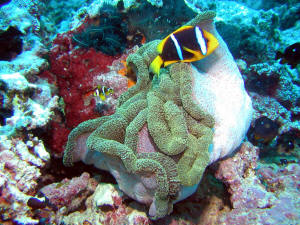
mini carpet anemone and large green bubble tip anemone 1/13/11 Hey, you guys have always been very helpful with your advice so I come to you with yet another question. A friend of mine said that I would be able to have a mini carpet anemone live peacefully with my large bubble tip anemone in my 55 gallon tank.. <Nope> if you could please give me your opinion on this that would be great as the last thing I want is to go ahead and put one in with my BTA and have one or both of them killed or have them kill off my corals. I currently have 45lbs of live rock, 25 hermits, 16 snails, 2 cleaner shrimp, 1 peppermint shrimp, a cleaner wrasse and large Allards clownfish, a decent amount of pulsing xenia, some candy cane coral, some brown polyps, 3 blue mushrooms, a Kenya tree, and a grassy type coral (not sure what type), and of course my lovely large green BTA. I just need to be sure that all of these will be safe if I introduce a mini carpet anemone. Hope to hear back soon. Christina <Welcome. Bob Fenner> Re: mini carpet anemone and large green bubble tip anemone 1/13/11 That's what I thought thank you for confirming have a great day! <And you, B>
Painted Frogfish and Carpet Anemone, incomp.
11/20/09
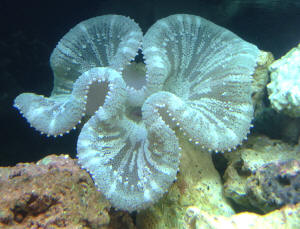
Carpet anemone in a fish only tank 5/6/08 I have an ever growing carpet anemone which has polished off several fish from the reef tank it is in. Can I move it to a fish tank with the following? 2 large angels, 1 small angel, 2 tangs, 1 trigger, 1 Foxface and 1 tomato clown? Tank size 200 gallons. I'm worried that the trigger, angels and tangs might pick on it. What do you think? Thanks, Marci <They may... or even be consumed... Large carpet anemones should be in specialized (i.e. their own designated) systems. Bob Fenner> Set up anew 55, Carpet Anem. incomp. 5/15/07 Hi Guys it's been awhile since I've been on here so I'll try to be short.. I have a 125 reef tank and due to health issues I'm down sizing a bit, here's my problem if you will, I have one rather large green carpet anemone <Yikes... not easily kept> and one tomato clown and one bi color angel and loads of live rock to which a lot of it I have colony's of bright red/pinkish w/ blue in them mushrooms I started with just about 8 I now have over 100 and baby's blooming as we speak, and in the 55 that's almost a few weeks old I have one damsel I use compact lights and have a wet dry/skimmer I've been adding rock a piece a day I also used live bacteria to kick start it a bit and several cups of my old substrate from 125 all my chemicals are good but it's still new so yeah I know what's the question here goes can I safely move my stuff from the 125 to the 55 <Not with the Anemone I wouldn't> now or should I wait as my tank conditions aren't so grand in my big tank I have algae blooms taking over and my carpet isn't happy at all!!! <Bingo... allelopathy. It would surely die if moved to this smaller system> In the 55 I'll be adding a new case of live rock once established and many corals but that's a bit down the road.. So please tell me what is best and in advance I thank you and bless you for being here.. Guess I probably should be reading all them Robert Fenner books I bought but this seems best for me .. Take care, Robin <You as well my friend. Do give away or return/trade in the Anemone. Bob Fenner> Strontium and anemones 3/11/07 Bob, <Sorry to disappoint, but tis' Brandon tonight.> A few months ago I purchased a blue carpet anemone. <Big buggers.> I introduced it into the tank and it immediately buried its foot into the sand and took up residence. <Definitely a good sign.> It would fully expand and I would feed it dime sized pieces of raw shrimp from the grocery store a couple of times a week. <My buddy and me. I love Anemones and would not trade mine for the world.> It was doing so good that I bit the bullet and dropped a hundred bucks on a very large green carpet. <Bit the bullet indeed. Two huge Anemones in one tank? Sounds like a clash of the titans to me. Seriously, there should never be more than one Anemone in any given system. And there should never be an Anemone in a system that is new and/or does not have an experienced caretaker.> I introduced it and had the same results. <This is sheer luck my friend. The outcome could have been far worse.> I was also adding Reef Solution by Ecosystem (highly recommended by my online retailer) at the rate of ½ tsp every other day to an approx. 70 gallon system. <I 'like' all the products that I sell, as well as highly recommend them. (;^D)> At about the same time, I started looking at my strontium concentration. <Here it comes.> I had always monitored my Calcium level (kept around 420-440ppm) and alkalinity levels (maintained at 3 meq/L), but after reading that strontium is the second most important component next to calcium, <<No... RMF>> I decided that I needed to start looking at it for the health of my clams and SPS corals. I obtained a Salifert Sr test kit and tested my water. The test indicated that no Sr was present. So, I discontinued the use of the Reef Solution (a blend of many components) and started slowly increasing the Sr concentration by using Kent Turbo Strontium. Over the course of a few weeks, I was able to get the Sr concentration up to 10-16 ppm as recommended in the literature I've read. <I don't personally advocate the use of supplements. I believe that if you use the right salt mix, there is no need for this, as you can easily replenish missing or depleted elements with regular water changes.> But during this time, both carpet anemones started behaving strangely. They weren't expanding like they normally had, they started moving around very frequently, and the green carpet quit accepting the shrimp altogether. Both eventually died. <Sounds like poisoning. Or likely too rapid an environment change.> Now, after reading some of your literature, I think I realized what happened. I overdosed the system with strontium and killed them. Do you agree? <Tis' possible.> I've since read that Sr (considered a heavy metal I guess) has no place in a system hosting anemones. If this is true, knowing that Sr is critical for corals, how can a balance be struck? <Sr is present, in all seawater. I don't dose Sr, and I am successfully keeping Euphyllia, Acropora, Montipora, Trachyphyllia, Tubastrea, Galaxea, and many others.> Or do you think I just over did the strontium trying to get my levels up? What do you recommend using for additives in a clam/coral/anemone system? <Tinker with your water at your own risk. Please see above Re: water changes.> I have since discontinued use of the Turbo Sr and switched back to Reef Solution every other day at a1/2 tsp. dose. My remaining anemones (a Sebae and four pink tube anemones) seem to have weathered the storm and are doing ok. <Please see above Re: one Anemone per system. This is a ticking time bomb.> Thanks, <You are welcome. Do try to get the other Anemones into other systems. Brandon F.> Bryan S. Stocking SW 2/17/06.... clowns/anemones, cpt. comp. Hi every body!<Hello Sam.> This is Sam from India. Now I have a 50 gallon marine tank which has lot of rocks and a deep sand bed. In my tank I have a Haddoni sea anemone which has two Allard's anemone fish living with it, two Feather duster tube worms, two Red anemones which are not touched by any fish. I have Haliclona sp. sponge growing on the rocks and a Purple back Dottyback in the tank. Now I want to know what kind of fishes, inverts can be added in the tank without disturbing the present livestock! Something that will happily settle with the current setting and arrangement and add some beauty and no problems. <Other than clownfish, I wouldn't recommend putting other fish in the tank, sooner or later one or more will be stung/killed by the anemone.> thanks, <You're welcome. James (Salty Dog)> Regards, Sam Carpet anemone and green star polyps Hello! I have been reading the FAQs trying to find some info. I recently bought a green carpet anemone. It was very sticky when I bought it but has lost much of its stick. I have it in a tank with two types of green star polyp (I think one is Briareum and the other is Pachyclavularia) some mushrooms, a small colony of zoanthids and two clownfish. When the lights are off the anemone opens up and looks fine. When the lights are on the anemone shrinks down and its mouth is partly open. All tests are in the perfect ranges, pH 8-8.6, ammonia 0, nitrites 0, calcium 425, KH 11. Nitrates are slightly higher then I would like but not too bad (waiting to get a new test kit as the one I am using is old and may not be giving me correct readings). I have 6 watts per gal of PC lights. What could be the problem? Could it be chemical warfare from the green star? I have read that they can be aggressive. The anemone is nowhere near the green star. Everything else in the tank is doing fine. Please help!!! <Six watts PC per gallon? A lot depends on the depth of your tank. These anemones are difficult to keep with all conditions good, and they do much better under halide lighting. Even with a shallower tank, 6 watts/gallon really isn't enough for these guys to thrive for any length of time. Please read, http://www.wetwebmedia.com/anemlgtgfaq3.htm. James (Salty Dog)><<This is little doubt, a case of chemical incompatibility between all this cnidarian life... the size of the system is not stated, but all the water gets mixed about... I would remove this anemone, post haste, to another system. Bob Fenner>> Anemones (Carpets) Hello, Will a green and blue carpet do well together in a 180 gal? Or will they poison each other? I was thinking about adding a red carpet. <probably no anyway you slice it. Green carpets are a legitimate and natural color/species. Blue, Red and Yellow carpets are most often dyed and most are not destined to live long for the stress of it all. If they are otherwise naturally occurring distinct species, then you are still beat from the extra specific aggression. Bottom line... two different anemones are not recommended together. Besides... carpets get enormous and you would need a huge tank for two three foot diameter carpets <wink>. Do read though the archives for information on dyed anemones> also what else can you feed them besides Thawed krill, shrimp silver sides? <the above foods are good if finely shredded. Feeding large whole prey otherwise can be harmful to an anemone in the long run. Most meaty foods of ocean origins are fine (Pacifica plankton, Mysid shrimp, fish roe, etc). Thanks, Scott <best regards, Anthony> Captive Anemone Compatibility Hi there again... you guys are so smart... <flattery will get you very far here <smile>> you often say that two different anemone will kill each other, knowing they are in the tank. give off poison. <yes...so to speak and/or literally> can two anemone of the same variety be together, like two carpets? or do they have to be exact carpets, like s. magnifwhatever. <if/when possible they must be the same exact species... and even then there is no guarantee. With coral there is an action known anastomize branches... it is when two separate colonies of the same species will tolerate each other in proximate growth. Very often though, separate colonies of the same species will not tolerate each other at all. It does vary among such cnidarians. I can't imagine how big of a tank you would need anyway for TWO carpet anemones (adult size measured in feet in diameter). If you are interested in a pair though... they are said to actually have distinct sexes and can actually be sexed at times. Dr. Ron Shimek has discussed/written on this topic among others. You could court him on Reef Central for further advice on the topic if so inclined. Best regards, Anthony> Injured Chromis, Carpet Anemone, Corals Hey Guys salutations!.... <Salute!> I have a 150 gal reef tank with 3 Maldives clowns, 2 carpets, various SPS's, a school of 8 Chromis, and an Asfur. Today I noticed one of the Chromis' having one side of its scales ripped off by its gills. Its still active and eats with the school but is it a disease of some sort? <tough to say but unlikely... if so it may be quite a condition. Fears here of a Septicemia. Without a clear photo were speculating here> The Asfur does magnificently disperse the school periodically in a fit of rage but I have yet to see him actually nip at one. <statistically he'll succeed one day if he hasn't already...Ha!> My other thoughts are that I have lost 2 Chromis' to the carpets, I guess they stupidly float in there at night or something because on the afternoon after the disappearances my carpets spit out a meatless carcass of bones that suspiciously look like the frame of the Chromis. <indeed> Could this particular Chromis somehow brushed the side of its face against the carpet causing some blisters? <possible... but carpets are so potently aggressive I would expect a kill> Everything seems normal, but I will make a water change today just in case. Give it to me straight...thanks!!!! <OK... separate the anemone and other cnidarians (SPS corals and the like)... its a long term recipe for disaster (3-5 year plan). Noxious chemical warfare and the motile nature of the anemone> Oh yeah any good clubs to join in the Los Angeles area? <Absolutely... MASLAC at http://www.maslac.org/ I'll be speaking there in two weeks :) several other clubs in neighboring areas... SO CAL reefers, San Diego, etc> Regards, Dennis <best regards, Anthony> Wrasse type/safety and carpet anemone move Hello again Anthony Sorry for the delay in getting back to you, I've had a minor op on my foot and only just come back to work. <no worries... hoping you are well!> I must also apologize for the long e-mail but I have a couple of worries to share with you. In my last e-mail I was asking about a Lawnmower Blenny and the fish it would have to live with in my two tanks, the gist of the e-mail and my return response is this: [regarding algae control] << I know about the skimming but I have a problem in getting a hang on type to fit my tank which has glass ledges 6" wide each end as well as front and back ledges of 2" plus no room for a sump! if you know of any skimmers I could use please tell me the brands. <Tunze makes some fantastic rail mount models if you don't mind the top mount. Else, you can use a sump model and pump from the display to an upstream vessel like a refugium with a skimmer and them let the water overflow back down to the display> I have an adapted sea clone that came with the tank (2nd hand) and the glass was broken at the top to accommodate the SC. I plan to get a new tank eventually but not yet. The other tank is newish but not reef ready and I bought a prism skimmer for 140 pounds sterling before I found your site!>> <Ughhh... sorry about the sea clone and the prism <G>> >In the FOWLR he would have to mix with 1 7" Naso , 1 7" green wrasse, 1 3 1/2" yellow tang, 1 3" pyjama tang, 2 percula clowns and 2 green Chromis. ><hmmm... I do have concern that the Green Bird (?) Wrasse will eat the Percs, Chromis and lawnmower in time. They get quite large and aggressive at sexual maturity.. they behave for a year or so. After that, I have seen them fed 4" crayfish which they smash to pieces off the rocks. Do consider removing in time. Kindly, Anthony> << I think my Wrasse is a male Thalassoma lunare , mainly green with slight flecks of blue on the body and blue/red markings on his face, he also has a yellow tail. He is very active, nosey and a fast swimmer but I haven't seen him be aggressive towards anything else in the tank. Is he fully grown at 7" and will he continue to be a good chap in my tank? <alas... no. Lunare wrasses are magnificently hardy and beautiful fishes but the are notoriously aggressive...eating live feeder fishes and crayfish as adults! I have seen specimens over 30cm long> I am very fond of him because of his character! <yes... a wonderfully personable fish> I also think my Pajama tang is not what you think of as a Pajama tang! looking on your site I got the idea that in the USA you call a Naso a Pajama tang is this right? <not correct... perhaps a typographical error. We call Nasos "Naso" or "lipstick" tang> mine looks just like a Acanthurus Lineatus (Pajama surgeon) oh dear! what now? can he stay with his tank mates listed above or not? >> <indeed... you do have a "pajama/clown" tang which is a somewhat challenging fish to keep. Easy to feed but difficult to keep alive on a captive diet for many. Also needs large long tanks with very strong water movement and they can be quite aggressive> While I have your attention may I ask about my Carpet anemone's re housing? I have moved him ,his two clowns and a cleaner shrimp into a two foot tank which I know will not do for long term but thought this would be good for a while because of the chemical warfare you warned me of in the reef where he was. <agreed> He was stuck fast and would not budge, I dare not handle him without gloves because of his stinging. I had to use some pressure to force him to let go but I don't think I damaged him in any way except for stress. <very good... and know that the edge of a credit card can be quite handy for extracting them> I didn't know they were so strong, He shriveled up to a fraction of his normal size and seemed to turn almost inside out, I was very worried for a while, he seems o.k. now though apart from a bit of mouth gaping which I know is not good but as his body has returned to normal (even bigger than before) and he is feeding I think he will be o.k. (I hope) . <agreed... perhaps just a little agitated> The problem is that he has wandered up to the very top of the tank near the lights and I'm worried he will get burned but I don't want to touch him again in case I stress him out again. What should I do if anything? <nothing just yet... the movement is common on acclimation in trying to find good light or water flow. If it continues for weeks, consider that more light or water flow may be needed> How can you move a carpet without hurting/stressing him ? <folks have also used a spoon or long thumbnail to slowly/gently peel them away from the substrate> I will need to know when he has to go into a big species tank. Also I bought 1 marine white and 1 actinic fluorescent lights for him but am wondering if this is enough light even though it is a small tank.? <may not be enough... more daylight is better for most corals and anemones... the actinic light is more pleasing to us :) > it seems bright but ...what do you think? <they are very demanding for light... it sounds modest to me but you can compensate somewhat by extra feedings (fine meaty foods)> many thanks for you patience and help. Jenny <truly my pleasure... Anthony> Purchasing a Blue Carpet Anemone - 7/21/03 I just have a simple question and I hope that you don't mind answering it for me. <Sorry for the delay. No problem at all> I am thinking about getting a blue carpet anemone for my 30 gal tank. Well, I have lots of feelings on this subject so please hear me out. <First and foremost, regardless of your lighting, size of your tank, and even if it is the only inhabitant in the tank, carpet anemones do not typically do well in the captive environment as it stands. Many, many sources on the "why's we shouldn't" so I think I will avoid delving in to that area other than to say that anemones of this type are not prolific in the wild (because of breeding reproduction habits as well as habitat destruction). Just not a good idea to "TRY" one just to see if you can do it, in my opinion.> I have 35 pounds of live rock in it and am using a 400 gal/hr power filter as well as a 300 gal/hr protein skimmer. <Very good. I like the over spec on the hardware. Well done, my friend> For lighting I am planning on using two 96 watt power compacts. The tank is 3 feet long and 15 3/4 inches tall. and the ph is 8.3 with no detectable levels of ammonia, nitrites, or nitrates. So far I haven't added any livestock to the tank besides what resides in the live rock itself. <Sounds good to me, but I still have strong feelings for leaving wild anemones in the wild. Please look through our website with the keyword "carpet anemone" and see what others have had to say as well as search the web and a few books and articles on the subject. You know my feeling, now establish some thoughts on your own. From the tank perspective, I think it would be on par for success with some sort of anemone. I must say though this would be a great aquarium for some hardy Sarcophytons, Sinularias, hard corals, clams and such. Have you thought about these instead of the carpet anemone? In any case. good luck to you, and thanks for letting me speak on the subject. Please do more research and become knowledgeable on not only the specimen but the overall effect we, as consumers, have on animals that we claim to love and respect. (This goes for me as well) OK -Paul stepping down of his soap box> Would this be an adequate setup for the blue carpet anemone? <I believe you have a very adequate aquarium for most anything. Just do a little research on the needs and current environmental impact of your specimens.> Any help would be greatly appreciated. Thank you. <thank you for visiting the site and taking the first step in being a Conscientious Marine Aquarist. -Paul>
|
|

|
Features: |
|
| Featured Sponsors: |