|
FAQs on Metronidazole/Flagyl Use in
Aquariums... To do: split into FW, SW
Related Articles: Metronidazole, Choose Your Weapon:
Freshwater Fish Disease Treatment Options by Neale Monks, Treating Marine Disease, Use of Biological Cleaners, Aquatic Surgery, The
Three Sets of Factors That Determine Livestock
Health/Disease,
Related FAQs: Medications/Treatments 1, Medications/Treatments 2, Medications/Treatments 3, Antibiotics/Antimicrobials, Anthelmintics/Vermifuges/Dewormers,
Copper FAQs 1, Organophosphates, Epsom/Other Salts, Formalin/Formaldehyde, Furan Compounds, Garlic, Homeopathic Remedies (teas, pepper sauce,
other shams...), Malachite
Green, Mercury
Compounds/Topicals, Methylene
Blue, Quinine Compounds,
Sulfas, Treating Disease, Treatment
Tanks, Medications/Treatments
II, Treating Parasitic Disease, Using Hyposalinity to Treat Parasitic
Disease, Garlic Use, Antibiotic Use, Marine Disease 1, Puffer Disease,
|
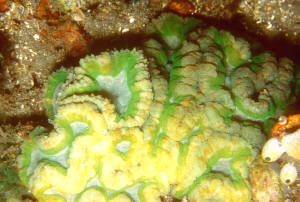 Invertebrates may not
take kindly... How about this yellow and green Lobophyllia eh? S.
Sulawesi pic. Invertebrates may not
take kindly... How about this yellow and green Lobophyllia eh? S.
Sulawesi pic.
|
|
API Fish Medication... Mainly Metro-, Prazi-
8/24/18
Hi Bob,
<Hey Branko>
I've been having issue obtaining Metronidazole and Praziquantel locally. I was
thinking of trying out API General Cure, if manufacturer is to be trusted it
contains nothing but Metro and Prazi and is very effective in treating parasitic
worms on the fish.
<The Prazi/quantel is... might be cheaper if you're using very much to just buy
from a pharma source. I think Hikari sells it in bulk if you have a distributor
locally>
I've found a new supplier which im overall happy with except some of their fish
come with some form of Monogeneans (if im not mistaken).
<VERY common>
Fresh water dip usually takes care of it, however its way too much stress for
some fish and I'd like to avoid losing fish due to that stress.
<Understood>
After reading up on API general cure I've noticed they have wide variety of
other medications in their offer, are they any good? If yes which are worth
looking into?
<All their "older" offerings are efficacious. DO avoid the more modern "herbal"
"fixes"... they're shams>
Other than that I've seen Everything Aquatics advertising
similar medication blends, as well as 100% pure active ingredients. This is my
second choice, simply because I believe it will be easier to clear API's
products on customs. Please advise on what would you use if customs is not
something to worry about.
<My take on all is posted on WWM. Do you have a copy of Ed Noga, Fish Disease,
Diagnosis and Treatment? Either the 1st or 2d edition is highly recommended as
a/the ONE source for reference>
Ps. I have discovered that Centropyge Angels can be easily kept in CU, when
introduced slowly, 0.02ppm per day, and with a chelated CU mix with 16/1 ratio
of CU/citric acid (hope this helps your readers) :)
<Ah yes; I thank you>
Looking forward to your much valued advice.
Ps Happy Birthday! :)
B.
<Ahh, again, appreciated. Bob Fenner>
Re: API Fish Medication; now Prazi avail., Centropyge dis. pic.
8/24/18
Hi,
<Bran>
Thank you for swift reply.
<Sure>
Our local pharm company charges 350$ for 25 grams. While in the US 500$ 1kg.
Just ridiculous.
<?! I'd contact Hikari:
http://www.hikariusa.com/wp/solutions/healthaid/prazipro/
Their liquid prep. in one gallon is very useful... and already solubilized
(i.e., in solution)>
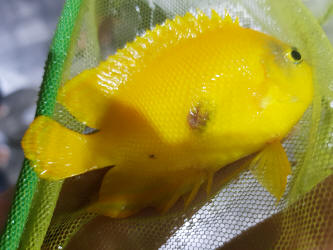
Ps please refer to a pictures of Centropyge heraldi which are in attachment.
What could cause that kind of damage? We did fw dip nothing fell off.
<.... can't tell much from a pic. Need sampling, microscopic examination...
Looks like a bacterially infected physically damaged area>
Fish has internal parasites it looks like it ate a whole marble
<... infection. Bob Fenner>
|
 |
Ich! But from where? 8/10/16
Hello WWM Crew,
How are you fine people today?
<A bit sleepy thus far... maybe 17% thus far; you?>
Thanks for keeping this site alive with all this information for us hobbyists. I
will try to keep it short. I started up a 150g tank and after 2 ½ months I added
some crabs, snails and 2 shrimp they all did fine so I added my first fish. He
also did well so I started adding my fish from my 90g slowly one at a time.
Everybody was doing fine in their new home, very active all alert and eating
very well. The tank has been running for about 6 months now so I decided to get
a Heniochus. My LFS had one for about 3 weeks and I would check him out every
week and he was eating, active, alert and no signs of parasites, so I bought
him.
<Mmm; likely H. acuminatus or... the two more popular, commonly offered species.
Really need to be kept in a small school of odd-numbers... three, five... Social
animals that get VERY stressed when kept singly... and sometimes very picky
toward esp. other Chaetodontids>
I put him in my 90g which now is a QT and kept him there for one month he was
doing very well, very alert and active and ate very well. While he was in QT
there were no signs of parasites so after the 1 month QT I put him in the 150g
with a FW dip on the way there.
<Good>
The only fish that harassed him was the Yellow Tang. There was no nipping or
chasing just asserting himself on the Heniochus. After about 5 days you guessed
it, white spots on the Heni. There are not many just a couple on his tail.
<Mmm; well; might not be Crypt... perhaps Trematodes, or even "just"
damage/reaction zones... like a bruise in humans>
I don't have access to CP just yet so I started soaking the food in Seachem
Metroplex, Selcon and Garlic and they are all eating it like pigs but I am still
seeing a couple of white spots on the Heniochus. He makes frequent trips to the
Cleaner Shrimp.
<Again; not necessarily a harbinger of doom>
I will have access to CP in 3 weeks but in the meantime do you think I should
keep using the Metroplex?
<Not for anymore than the label recommends. Metronidazole itself is a "kidney
killer". http://www.seachem.com/metroplex.php>
In your opinion do you think I will have a full blown infestation and have to
remove all and treat in a QT or is this maybe just a case of stress? I
appreciate and value your opinion.
<I wouldn't panic... NOT move the fishes, NOT treat the system further.
Cryptocaryon can/does come in on anything wet at times. VERY likely your system
has a "latent" infestation (I'd easily wager that almost all systems do)... Read
instead of fretting... Start here:
http://www.wetwebmedia.com/ichartmar.htm
and the linked files above.>
Thanks so much in advance
Brian
<Again; don't despair. Bob Fenner>
Re: Ich! But from where? 8/12/16
Hello Mr. Fenner
Thanks for the response. I am more awake than you as I am in Montreal Canada so
my day was half over by the time you sent the response.
<Ahh; about 2 PM or so here PST; about half sentient now>
I have read the link you sent before along with many other articles about Ich. I
just found it strange that I took precautions by QT and FW dipping and ended up
with white spots on him,
<Meh; very common. Isolation won't cure anything by itself... and there are MANY
instances where Crypt is deeply embedded, not susceptible to hyposalinity..
B'sides, the Crypt was highly likely (99.9 percent plus) already established in
the main/display>
by the way he is Acuminatus.
<Ah yes>
I did read a lot about them before buying and I am aware that they do better in
groups but they get so big I think 3 in a 150g is too much.
<Up to you. A singleton usually does just fine in a large enough system>
For the Metronidazole the instructions say to treat for 3 weeks or till symptoms
disappear.
<Mmm; yes; IMO, humble or not, this is too long. If interested, do a bit of look
seeing re nephritic conditions and this compound>
The LFS suggested to use 1/4 of the measuring spoon supplied but the directions
call for 1 measuring spoon to 1 spoon of food. I was using 1/4 spoon and it
wasn't enough so I used a full spoon for 3 days before I wrote to you
and it seems to be working.
<Ah good>
How much can fish take before kidney failure and what are the symptoms
of kidney failure?
<How to put this (twixt you and I not knowing each other well); this is more of
a successive approximation situation... every little bit hurts. Rather than a
threshold response... no problem till you get to such a point. All exposure is
damaging>
I have stopped the treatment since you wrote back to me and will wait it out.
Thanks so much again and nice talking to you.
<And you>
I saw your video with the Fishguys and you remind me of Paul Sorvino. Have a
good day.
<Heeee! Will have to look up this handsome devil. Cheers, Bob Fenner>
Thanks again
Brian
Hexamita ( hole in the head ). Trtmt. w/
Metronidazole/Flagyl FW 2/6/14
hi, hoping you can help me. I have a 180 Lt tropical tank with a large
variety of fish silver sharks, Plecs, bristle nose, elephant nose, ghost
knife fish, flying fox’s, angles, and clown loach’s two of my four clown
loaches have Hexamita and have gone of eating. I have had a veterinarian
give me a scrip of 400 mg Metronidazole to treat Hexamita at a dose rate
of 11 tablets day one, day two 50% water change, day three 11 more 400
mg tablets, treatment via water disbursement. After reading your blogs
and many others I am now confused as to what dose rate I should use as I
feel 22, 400 mg tablets in three days is going to be a major over
dose. Could you please help me with a dose and treatment rate, I have
been unable to remove clown loaches to a quarantine tank as it is
currently occupied with new stock and do not want to risk putting them
at risk, regards Andy
<In looking up in Noga's 2d edition, I see a similar protocol
ascribed to Langdon (1992a): 25 mg/l (95 mg/gallon... every other day
for three days... IF you have 180l... this would come out to
4,500 mg... close to 11 pills. Though some other writers (myself
included) call for other SOPs (usually 25 mg/gallon...), and advise one
treatment orally over long immersion; I don't think you'll overdose
these fishes going the suggested route. DO have the change out water on
hand just in case. Bob Fenner>
butterfly / Praziquantel and Metronidazole usage.
5/14/12
Gentlemen,
<And some of the tender gender Eric.>
I recently introduced a copper-band butterfly fish in my quarantine.
After two days of eating well I decided to start medicated her for
internal parasites. The only med with Praziquantel that I found
available was combined with Metronidazole. 37.5 mgs of Prazi and 135
mgrs of Metro.
<A good combo. for such application>
The recommended dosage that I new was safe is 100-150 mgs/40 lts
of Prazi and some 125 mgs /40 lts of Metro.
Both meds in the web mention that there little chance of overdose.
<Little?...>
I medicated my quarantine with 60 mgrs of Prazi and 250 mgrs of Metro
simultaneously. I now realize that the Metro was twice as high as I
should have dose the Quarantine water.
After 12 hours of treatment the fish was heavily breathing and gasping
for air. I then did a 100 % water change but the fish did not improve.
Until today the fish lies down heavily breathing. Its been 24 hrs now.
She is stable but not improving as I would hope. Can you please comment
on my dosage. Is it a bad idea to medicate both Prazi & Metro
simultaneously?
<That stated as "safe" s/b fine>
What would be your recommend sequence medication and dosage for the two
treatments.
<Likely just the one dose... three day, week's exposure. Better by far
to get these compounds inside the fish/es (via foods). See WWM re>
As per the info I have described is the reaction normal or her condition
( recent capture ) could of caused a liver damage or
'overload' ?
<Mmm, yes>
and at last in your opinion is there hope?
<Always>
Thanks in advance.
Eric
<Welcome. Bob Fenner>
Metronidazole, FW... 4/4/12
Hi, I have to ask for some help, live in UK an most of best products
for fish we can't get here.
<Ah yes>
And even when we phone the local vet their not allowed to give
medicines out for fish as we have to go to a zoo-ologist . 50 pound for
a consultation over phone and still didn't get Metronidazole 90.00
for home visit then not including medication . Stuck to Seachem
Paraguard.
<http://www.seachem.com/Products/product_pages/ParaGuard.html>
Well as you may guess my question is Seachem Metronidazole is it the
same as the tablet form as having to send to US for it .
<It is>
Have had to send to US for Seachem Paraguard & Antibiotic fish food
. Which is brilliant and wouldn't be without . But I just need to
know would I be able to use tablet form of Metronidazole as the Seachem
product is 4.00pounds to buy but 25.00 pounds shipping .
<Wow>
Where I can buy 60 (200 mg ) tablets for 36.00 and free shipping and
they would last longer . By the way 50 Neon Tetra's and 8 Corydoras
had Ich thanks to Paraguard & antibiotic food both from US
.(can't get them here in UK not even medicated food never mind
antibiotic food ) never lost one fish . Please help as don't know
which one to send for .
<... what are you treating for? What fish species?>
My Regards
Tina
<And you, Bob Fenner>
Re: Metronidazole 4/5/12
Was treating Neon Tetra and Corydoras for white spot .
<... would just utilize heat. Read here: http://www.wetwebmedia.com/FWSubWebIndex/fwichremedyyes.htm
and the linked files above>
But they are fine now .
Just want Metronidazole in case need it as with having to send to USA
for it ,
<READ on WWM re this compound>
Just need to know could I give my fish Tablet Form of This .
None of fish sick now but 5 fish tanks .
Which all have fish and if this outbreak or any other outbreak of
infection happens would like to make sure I have antibiotics
<... not an antibiotic. BobF>
in for fish
Regards
Tina
Re: Metronidazole 4/5/12
Hi Bob
Never had White spot before in any tanks .
Isolation tank had babies in so had to put 10 new Neon Tetra's in
same tank as rest of Tetra's without going into isolation.
Worst mistake.
Good job I turned heater up to 29 degrees and added Para Guard into
tank otherwise I would have had a really bad outbreak .
Metronidazole is an antibiotic in UK
http://www.patient.co.uk/medicine/Metronidazole.htm
<Interesting>
The flake food I gave the Tetra's also had Metronidazole added and
with having uv light in external filter also helped . Must admit though
Para Guard which I have been using for around 2-3 yrs now have never
harmed any of my plants or fish.
<Is a good product, good company (SeaChem)>
Use it in every tank which includes a 200 gallon tank , 120 gallon tank
, 60 gallon tank, 48 gallon tank. 31 gallon tank. All these tanks are
well planted which live plants (no other decoration) and I can honestly
say Para Guard is fine with plants .
Don't know about Marine plants as don't have any Oh and my
little Ultra Bowl which holds 8 gallons and I use for an isolation tank
.
I know that Erythromycin antibiotics can be used in tank as my brother
used them when his fish was sick but they can't be used for White
Spot (ick)
<Not useful on parasites, no>
Just glad that I can use Metronidazole tablets in tank as didn't
know if they were same as SeaChem make and now sending to USA for
them.
If outbreak happens again I will be ready.
Regards
Tina
<Cheers, BobF>
Metro-Pro dosing 3/29/11
Hi crew!
Well here we go again.
<Oh?>
About a week ago I introduced my 4 new discus into my
240g to join my other 17 discus.
As what seems to be the norm anymore, the smallest of the
"new" 4 was getting gently bullied, and stooped eating.
Thursday morning I saw white poop hanging from the little guy, although
it wasn't stringy.
<So...>
I removed him, placed him in a 10g hospital tank, and began treatment
with Metro-Pro (following the directions on the container: use 1/8 tsp.
per 10g daily following a 25% water change for a minimum of 10 days-
maximum of 14 days).
<This:
http://webcache.googleusercontent.com/search?q=cache:DXjJ4tHgOq8J:www.nation
alfishpharm.com/products3.html+Metro-Pro+metronidazole&cd=1&hl=en&ct=clnk&gl
=us&source=www.google.com>
I spoke to a fellow discus keeper friend of mine who has been having
discus health issues of his own. He told me that while speaking to a
"Discus Importer" who we both have purchased stock from, he
was told that Metronidazole breaks down and leaves the water column
after 8 hours. He said, therefore, that it was necessary to treat every
8 hours.
<I would NOT do this. Metronidazole is more than somewhat toxic. The
current accepted S.O.P.s for its use, call for once a day use for three
days (for prolonged immersion applications). See Noga (Fish Disease,
Diagnosis and Treatment) re. More efficacious can be baths and oral
administration (through foods, if the fish/es are eating)>
Also, this morning the sick little guy began to eat very timidly, but
at least he is eating.
Please advise
Thank you,
Pat
<See WWM re this Materia Medica for more. Bob
Fenner>
Flagyl use. Referral 11/28/10
I recently wrote about treating my clownfish with Flagyl
(Metronidazole).
I was wondering if soaked food in Flagyl would be suitable treatment
for her as she appears fine and eating well along with the other fish.
(sorry for the previous typo please amend)...
How long to treat all fish with Flagyl as the angel has been scratching
on the powerheads? Is Flagyl invert friendly? How long should I
medicate the food I give them for?
I have a quarantine tank but it is currently full.
Regards Jim
<Please read here: http://wetwebmedia.com/metranidazole.htm
and the linked Related FAQs file above. Bob
Fenner>
Re: Goldfish disease problem 11/16/10
Hi Bob, Sadly my overcrowded tank is being sorted :-( lost little Milly
the tough feeder fish today. Found her when I got home and it was too
late to try and locate a microscope. I have added (I know shudder)
Protozin by Waterlife. I really don't know what else to do now. Do
you think an internal infection as well as flukes could be
responsible?
<Could be... I want to relate to you that I've regularly used
(feeder) goldfish for pathology demo.s... They never disappoint>
They have all passed the same. Day one beginning with frequent
breathing but with good appetite and within day two laboured and rapid
breathing and death. The last three have looked rounded/full not
wasted. It is so damn quick. Now Sara who had the frayed gills is
breathing more rapidly and if following the pattern will be dead
tomorrow. It looks like I am losing my tank.... Regards, May
<I would treat with an antiprotozoal (Metronidazole/Flagyl) AND
Anthelminthic (Praziquantel/Levamisole) simultaneously, per what is
posted on WWM or in works by Ed Noga. Now. BobF>
Re: Goldfish disease problem 11/17/10
Hi Bob,
<May>
Thanks again for your time. I have done 50% or so change of water (they
liked that). I have Myxazin. I have 400mg tablets of Metronidazole. I
have looked and looked at your website and aside from mixing in huge
quantities of food I have not been able to find a ratio for dry
tablets. My partner collected from a lovely aquarium shop but was sold
the Metronidazole with just the two tabs and no direction.
<Try the search tool here: http://www.wetwebmedia.com/Googlesearch.htm
w/ the spelling: Metronidazole>
We were given the Myxazin. I have directions for the Myxazin which I
can do after carbon for 24 hours. I am sorry, I am so frustrated, we
have spent several hours trawling for dosage rates for the
Metronidazole
<This is misspelled>
after business hours - have the drugs but really worried about
overdosing and harming their kidneys/or worse. Trying to determine your
recommendation or to just go the Myxazin if we can't sort out
the dosage. Feel like a twit.
With regards,
May
<Not to worry. Try... "... in food", read the cached
views. BobF>
Re: Goldfish disease problem 11/19/10
Hi Bob,
<May>
Yes it is, it was a misspell from the toolbar from numerous
searches.
<Ahh, not able to find things if not spelled correctly>
We have done hours of reading and it got confusing as some posts were
regarding liquid treatment and the most direct talked about 100mg to 1
kilo of food and I didn't have that quantity of food but need to do
the maths but it gets very finite re/ cutting pills and worrying about
potential overdose. Can you please suggest how to use a 400mg tablet
with 7 small fish in 180litres?
<... I'd add it to the water, after crushing it up... You'll
need more tablets if you're treating the whole gallonage... 250
mg./10 gal... every other day for 3 days... Do put the two words:
Metronidazole dosage
into the search tool here: http://www.wetwebmedia.com/Googlesearch.htm
and read the cached views... for more important background>
Two nights ago I dosed the Myxazin and then did again today. Two nights
ago I also crushed 1 tablet Prazi and mixed with food. No more deaths
but still 3 of the 7 not looking great re/ breathing but all eating
with gusto still.
The lower bellies are shaped much lower than normal of all 7, bloated
and convex as they did with the four I have lost.
When I sort the dose, can Metronidazole and Myxazin be very
problematic?
<Mmm, Myxazin is malachite green, formaldehyde and Acriflavine...
all but the last is quite toxic... Can be mixed/treated at the same
time though>
Still very worried about losing the tank.
Many thanks again, May
<Welcome. BobF>Metronidazole, treatment
regimen 9/12/10
I have a saltwater fish witch I need to treat, your article says to do
3 treatments for a few hours a day.
<Mmm, as a bath... One treatment mode>
What I need to know is should I change the 10 gallon water tank each
day with fresh salt water and add the dose or just add a dose each day?
I'm afraid that I would over dose the Flame Angle.
THANK YOU ED PLATTO
<Uhh, read (again) here: http://wetwebmedia.com/metranidazole.htm
I would change any bath water (for new) for successive treatments. Bob
Fenner>
Metronidazole, dosing,
Hexamita/Octomita/Dempseys 08/25/10
Hi Bob,
<Vu Ma>
First, I wanted to say what a great and educational website you guys
have. I tried to read all I could about Metronidazole and Hexamita on
your website because I did not want to repost any old threads. So if
this is a repost then I want to apologize ahead of time. I recently
bought some fish online and it was shipped to me. They all seem strong
when they
got in but I think they brought some parasites with them. My 125 gallon
tank have been up and running for about 6 months. Water parameters are:
pH: 7.8, Ammonia: 0, Nitrite: 0. The aquarium is heavily planted, but
my fish is more important than the plants. I am religious about doing
weekly water change. I overkill on filtration. I have a Fluval FX5,
Fluval 305, and a Aquaclear 110 for this aquarium. I recently noticed
that my fish were scratching so I just put some salt in the tank as a
precautionary measure.
Well, today I notice 2 of my EBJD <electric blue Jack Dempsey...>
are not eating and one has a gray spot on his head. They are both
pooping out stringy poop. So I did some research and expect they have
Hexamita.
<Maybe>
I have bought some Metronidazole to treat the fish but I have some
questions about the dosage and usage. First, should I remove all the
salt and wait a week so I can give the fish time to recuperate from the
salt solution?
<Not necessary>
Is Metronidazole safe with salt?
<Yes>
I am afraid that if I wait a week that the fish would be to far gone to
be rescue. I am going to treat the whole aquarium since Hexamita is so
contagious and plus my 2 EBJD aren't eating. How long should I use
Metronidazole in the aquarium water?
<One dose... with good percentage water changing a week
later>
I mean until the symptoms are gone or for a certain amount of days. Is
the treatment every other day or everyday and is it
with a 25% water change or is it with a 50% water change?
<One treatment should do it>
If and when my 2 EBJD start eating again should I try to add
Metronidazole to their food or will that be too much since it is in
their water already?
<I might add it, but just once>
I definitely do not want to overdose my fish but I really want to
eradicate this parasite.
Thanks in advance and have a wonderful day.
<Welcome and you as well! Bob Fenner>
Re: Metronidazole 08/26/10
Hi Bob,
<Big V>
- I just wanted to say thank you for getting back to me so fast. I just
have two more quick question. I am using the Seachem brand.
According to them I should use 125mg for every 10 gallons. Do you think
that is a good dosage or should I go stronger? I have read that I
should do 250mg per 10 gallons.
<Can... Blasiola and Gratzek, 1992, suggest doing this daily for
three times... Langdon (1992a) suggests even more (95 mg/gal.) added
every other day for three treatments>
I also heard that Metronidazole is not very water soluble. What is the
best way to mix it into water?
<Whip it into an aliquot; add this>
Should I heat the water up and mix the medicine, than let it cool and
put it in the aquarium?
<No need to heat>
Again, thanks so much for sharing your knowledge and have a wonderful
day.
<Welcome. BobF>
Re: Metronidazole 8/29/10
Hi Bob,
<Howdy>
Since we last talked I've lost another fish. The first fish that
died had the tail-tail sign of Hexamita.
<Tell-tail?>
It was lost of appetite, isolation, and small holes around the head
area. The second fish had a combination of symptoms. He started with a
lot of scratching his face around the sand, darting, loss of appetite,
and finally isolation and death.
<These can be/are symptoms of other causes as well>
When he died his gills were red and to the meat, but he also had small
holes around his face. Is this a combination of parasites?
<Could be... or even "just" water quality issues>
It sounds like gill flukes and Hexamita. Is that possible? If so how
should I treat it?
<Diagnosis first... Microscopic/slime and more if there's a just
dead fish examination>
I bought some API general cure, which has 250mg Metronidazole for
Hexamita and 75mg Praziquantel for gill flukes. Is this the best
possible cure or do you know of better medication?
<Is a shot in the near dark>
Is Praziquantel better that formalin?
<...? for what?>
Or should I use a Seachem Metronidazole and some brand of formalin? Are
the 2 medication safe to use in conjunction with each other?
<You need to read, study... and soon. I suggest a going over of Ed
Noga's (second ed.) Fish Disease, Diagnosis and Treatment.
B>
Medic from Polyp Lab, Metronidazole... 8/2/10
Just wondering if anyone can give some comments on Poly Labs'
treatment for Whitespot -"Medic"? Supposedly reef safe and
very effective for white spot?!
<I would always treat in a QT/hospital tank.>
Is it worth a try or am I wasting my money?
Many thanks,
Jana
<Is a Metronidazole drug, see here and related FAQs for more.
http://www.wetwebmedia.com/metranidazole.htm
.>
<Chris>
Metronidazole with Cupramine copper 5/24/10
Hi crew,
Bob in his article about Metronidazole in Use With Other Chemicals,
write:
"Safe to add, treat while in the presence of other
compounds."
I'm treating in my qt tank a Arothron diadematus with Cupramine
copper
<Mmm, do take care here. Puffers and copper compounds can be
trouble, toxic>
and Praziquantel for flukes but I want to add Metronidazole for
internal parasites in fact the puffer is not eating although it is
acting normally.
Can I use Metronidazole with cup amine? Is it safe?
<Yes and yes. BobF>
Thanks a lot
Lorenzo
Metronidazole Dosage 4/27/10
Bob,
<Hello Simon!>
Have received these instructions from the Vet with regards to the
administering of Metronidazole to food. This is a suspension
(liquid).
Concentration is 200mg to 5ml.
I was under the impression that a 1% solution was required, with this
100mg of Flagyl (2.5ml) enough to make a total of 10ml of solution for
soaking foods.
However, the dosage recommended by the Vet is far less than this, with
apparently this 100mg enough to medicate 1kg of food.
Should this be 1kg of fish body weight?
Shall I stick with the 1% solution as stated above?
<I would stick w/ the 1% soln... Noga (Fish Disease, Diagnosis and
Treatment) gives three citations/inputs for Metronidazole one-time use
orally:
25 mg/kg (11 mg/pound), 100 mg/kg (45 mg/pound), and soaking Artemia in
1% Metronidazole solution for three hours in a refrigerator. Getting
the one-shot physiological dose into the target fish/es is what is
pre-eminently important here, and the seemingly higher dosage neither
is dangerous nor as far as I've ever encountered, distasteful to
fishes. Am wondering if your Vet hasn't mistaken the volume of the
soln. for the concentration of the active ingredient (Metronidazole)
here.>
Thanks, Simon
<Welcome, BobF>
<<Dear Mr. Trippick
the normal dose quoted for oral Metronidazole is to feed at a
concentration of 100mg/kg of feed thus I would suggest using this dose
as none is stated in your article I have asked the girls to put up
100mg of Metronidazole suspension sufficient to medicate 1kg of
food
Regards
Tim
Re: Metronidazole Dosage 4/27/10
Thank you Bob, I was veering towards the 1% solution, but did not want
to go against the advice of the vet without further confirmation. Will
go this route.
C&C
Simon
<Real good. B>
Ocellaris clownfish, hlth., Flagyl f's
3/12/10
Hi, I would like your opinion. I have two Ocellaris clowns in a 30
gallon long tank. I have had them for 1 month now (tank is 3 months
old), SP is 1.023, temp is 80 F, nitrites and ammonia are zero, last pH
test was 8.5, lots of live rock and bare bottom. These two clowns have
always had different personalities, the smaller one being hyper,
swimming all over the tank, top and bottom and eating aggressively. The
slightly larger one was a bit lazier, would spend most of it's time
in the same spot, fighting with it's reflection and eating very
well too.
<These personality differences are to "be expected"... the
larger "turning into" a female...>
Their feces is white and stringy like and I was given Metronidazole to
add to their food as a treatment. I started this treatment on Monday. I
sprinkled a bit on their food and let it soak in before feeding. Now,
my main concern is the newest behaviour of the larger fish. Since last
night, it has been swimming head down, at the top of the tank and out
in the middle. Does not move unless you come near it and then
immediately returns to the spot. What really bothers me is that the
fish did not eat tonight.
Any advice?
Edey
<I would cease treating, lacing the food/s with Metronidazole... If
you feel further treatment is warranted, instead look into a
vermifuge... my choice here is Prazi/quantel. Bob Fenner>
Re: Ocellaris clownfish 3/12/10
Darn I had that product in my hand yesterday but put it back because it
said not to use with invertebrates (I have two red leg hermit crabs).
Is going off food normal during this behaviour?
<Yes it is>
Last night both clowns moved to their regular sleeping spot and today
the larger is still there. Periodically turning over on its back and
head and then righting itself back up. The other clown is nearby
hovering in a small area. There is no interaction between the two at
all right now. Neither ate today and weren't interested in their
food. I am paranoid of Ich and Brooklynella (they are supposed to be
captive bred)
<But could easily contract if placed in systems w/ wild caught
fishes...>
and keep looking for signs. I don't think there are any but they
have a peculiar salt like look under certain light. It's been there
for well over 2 weeks(maybe longer I can't remember). I hope you
are understanding what I mean.
Edey
<When in doubt, treat w/ nothing. Much of the behavior you describe
is "natural"... Take care, and be patient. BobF>
Re: Ocellaris clownfish 3/12/10
One thing I forgot to mention in my first reply, when I look at the
clown fish at night with a flashlight they are clean and beautiful
looking.
During the day is when I see the stuff I mentioned. Your expertise is
welcomed!
Edey
<Mmm, do read here: http://wetwebmedia.com/clnfshdisart.htm
and hey, why not? The linked files above. B>
Metronidazole for Tx of Crypt 2/17/10
Hey there WWM Crew!
<Howdy Mr. Duncan!>
Hope you are doing well and had a nice valentine's day weekend, if
that was important to you.
<Now you're covering all bases... sort of!>
Anyway, let me get to the point. Recently I purchased a royal gramma
for addition to my 30gal FO Marine tank with only a pair of
Perculas in it. He was quarantined in a 10gal with some base rock
for 2 Ã'½ weeks, never showed sign one of
disease (Not one spot, scratch, anything).
While in QT I had not exposed him to any chemicals and took the chance
to introduce him to the foods I feed the clowns, Mainly formula one
pellets and Prime reef flakes, with Mysis about twice a week. He took
to all types of
food very well, and developed great personality staying out in the open
during daylight hours, which I know is strange for a Gramma (to get out
under bright lighting that is). Anyway, after the 2
Ã'½ weeks I moved him to the
clown tank after doing a rock rearrangement in that tank to break up
territories. He did fine, no aggression for about a week, but then low
and behold, crypt. So, I setup the 10 Gallon again (I was stupid and
drained it)
and moved him over, and treated him with some Metronidazole at 200mg in
tank water every 2 days (Seachem instructions). It's been eight
days now and he no longer has any signs, I.E. he has gone from
reclusiveness, spots, scratching, to zero spots, very hungry, out in
the open again. I think maybe he just wants his own solitary space.
Anyway I digress. I was browsing your site and could not find a length
of Tx with metro for Crypt,
<One shot is best>
and I know it has a renal toxic effect so I am afraid of overdosing.
When do you think I can replace chemical filtration and stop
treatment?
<Yes>
Seachem states "when symptoms are no longer present", but I
would think it would be at least 3 days after that.
In case you are wondering I know the clowns are probably also sick (or
carriers), but since they have been completely asymptomatic, I
haven't put them through the stress of treatment. I will not expose
anymore fish to the
30 gallon tank and I plan to keep the 10gal solely for the Gramma.
Thank you in Advance
-Cory
<Welcome! Bob Fenner>
Motoro Stingray Internal Parasites 1/5/10
Hello WWM Crew,
<Jeffrey>
First off I would really like to thank you for the database of
information you have on this website - it has been invaluable.
<Welcome>
I have had my 4-5" Motoro pair for roughly 3 months now. After a
couple of weeks of ownership, I have found that the smaller male had
white stringy feces. The larger female had the signature earthworm
looking (a.k.a. healthy) fecal matter. I did not give much thought to
it but kept an eye on the situation. However, in the past month the
situation has gotten worse. I have started treatment with Prazi for the
past two week and the problem still persists.
<Mmmm>
This is the regimen for Prazi that I am currently using as per
thegab.org's instructions:
Remove carbon.
Add 2.5 milligrams per liter of water.
If you are using the powdered version, it is difficult to dissolve.
Predissolve in tank water by shaking it up in a small container.
Dosing
Day 1 -- remove carbon, perform water change with vacuuming, and add
Prazi to tank
Day 2 -- add Prazi
Day 3 -- do nothing
Day 4 -- do nothing
Day 5 -- do nothing
Day 6 -- add Prazi
Day 7 -- add Prazi
Day 8 -- normal partial water change with vacuuming
Day 14 - normal partial water change, then add Prazi
Day 21 - normal partial water change, then add Prazi
Day 28 - normal partial water change, then add Prazi
Day 35 - normal partial water change, add carbon, treatment is
complete
The rays have a black Arowana as a tank mate and it appears as if he
has HITH and also Finrot that I cannot rid of.
<Tackle this nutritionally, and...>
I have used Binox Nitrofurazone on the black Arowana with no resolve. I
also have two NTT Datnoides and have observed extremely white stringy
feces from it as well. Water parameters are pristine with zeros across
the board and weekly 50% water changes.
I am beginning to think that these issues are all related to
Hexamita.
<Yes!>
The only problem is that all the fish in my 240G tank are eating live
Blackworms with the exception of the black aro, who currently eats the
Hikari Carnivore sticks. I'm not sure how I would administer the
Metronidazole to them.
<Via the food... shaken in a bag... altogether>
I can soak the Blackworms but I'm sure a lot of the medication will
be lost in the water. I also figured that dosing the entire tank will
not be as effective in entering their digestive tract.
<Enough will get into them to effect a cure>
How do you think I should approach this matter? I am running out of
options.
I have heard others recommend Panacur, but have also heard a lot of
horror stories associated with them.
Any help would be greatly appreciated as my options are exhausted; as
am I.
Thanks again!
A long time patron eagerly awaiting your response,
Jeff L
<Use the food/s. Bob Fenner>
Re: Motoro Stingray Internal Parasites 1/8/10
Good Evening WWM Crew,
<AM here now Jeff... power outage. Sorry for the delay>
Thanks so much for the prompt response. I have some follow up questions
in regards to the Metronidazole dosing.
1) What would you recommend the ratio of Blackworms to
Metronidazole?
<Mmm, not really important... If the drug is in capsule form, just
tip out "a little" (maybe a quarter capsule) per
"feeding portion", mix together w/ the worms 5-10 minutes
ahead of feeding. If the drug is in a tablet, use a pill splitter or
single edge razor blade to chop into quarters and grind that bit down
per feeding...>
2) What is the frequency that I should feed them the medicated worms? I
am currently feeding them twice a day - morning and night.
<I would feed at both times for... Please read here:
http://wetwebmedia.com/metranidazole.htm>
3) Also, since I am feed them the medication and not dosing the entire
tank,
would I still need to perform a water change after a 24 hour
period?
<I would, yes>
Medicating through ingestion for fish is completely new to me. You help
and information is always greatly valued.
Thanks in advance for your time and help!
Best,
Jeff L
<Welcome. Bob Fenner>
Re: Motoro Stingray Internal Parasites, & Flagyl use
f' 1/11/10
Good day WWM Crew,
<Jeff>
I read over the Metronidazole page that you provided me and I still
have a few questions that need some attention.
<Go ahead>
Quoting the web page:
*Soaking frozen or live foods in 1% solutions for a few hours in a
refrigerator is a very good idea. Actual dosages are best at about
0.25% Metronidazole fed at a daily rate of 1% of body weight. Feed just
once usually, no more than thrice.*
Does that mean that I would complete the Metronidazole treatment after
feeding my fish the medicated food three times?
<Yes; this is the S.O.P., dosing>
Or does it mean that it
would complete one of the three courses of treatment. in a three day
treatment period?
<Yes>
This is what I mean is this:
Day 1: Feed Metro laced food 2-3 times a day
Day 2: Water change.
Day 3: Feed Metro laced food 2-3 times a day
Day 4: Water change.
Day 5: Feed Metro laced food 2-3 times a day
Day 6: Water change.
Sorry if I am scrupulous with the details, but I love my rays. Thanks
in advance for all the help!
Best,
Jeff L
<Mmm, to paraphrase (Whaley & Francis-Floyd, 1991), there's
evidence that one time oral administration of Metronidazole may be just
as effective as three water-borne treatments... No more than the three
should be done. Bob Fenner>
Metronidazole 12/13/09
Hello WWM Crew,
First of all, how are you? I hope the holidays are going well for you
and yours.
I just wanted to point out something that was recently listed in your
FAQ's about the medication Metronidazole, because it was stated
that this is NOT an antibiotic, which is incorrect. Metronidazole is
primarily an antibiotic for use against anaerobic organisms, as such,
it is particularly useful for certain human infections. Because of
it's mechanism of action (inhibits DNA synthesis I believe), it
also has use against Protozoans and some helminths. And yes, even
though it is an "azole" drug (Which are usually
anti-helminthic/parasitic, IE: Mebendazole), it is considered an
antibiotic.
So it probably does have some use against aquatic bacterial infections
which I would assume would largely by anaerobic given the environment.
Not only that, resistance would be relatively low in this setting. It
may also have some use against fungal infections since it is an
"Azole" class drug (IE: Fluconazole) but I'm not sure on
this one, would have to experiment.
Since this is an emerging treatment in aquatics, I thought I would
throw in my two cents. I am a medical student by trade in case you were
wondering my qualifications. Thanks for listening.
-CD
<Hello Cory. Yes, you are quite right about this, and Metronidazole
may well have some antibacterial applications (in fishkeeping or
otherwise).
However, to keep things simple for aquarists, it's helpful to
divide medications up into groups depending on what types of problems
they fix. In this case, Metronidazole is used primarily against
protozoan parasites like Hexamita. The danger with telling people that
Metronidazole is an antibiotic is that they might go and use this drug
against Finrot or Septicaemia, situations in which it would be less
useful than other antibiotics or Antibacterials. For those aquarists
interested in the details, we do have some in-depth articles, for
example this one on Mycobacteria:
http://www.wetwebmedia.com/ca/volume_6/volume_6_2/mycobactera.htm
As you can see, Metronidazole is indeed listed for precisely the
reasons you've mentioned. Thanks for writing, and good luck at
medical school!
Cheers, Neale.>
Metronidazole for breeding pair... Symphysodon
9/16/09
Dear Crew
We have been doing a lot of reading, and are still somewhat confused
about the dosage for Metronidazole.
We have a breeding pair of Red Turquoises and have had them for about 3
months now. The male went off his food quite a few weeks ago and had
white stringy poo, so we treated him with Octozin by Waterlife. His
symptoms improved and we thought he started eating again. We also
treated the female with Octozin and then put the pair back
together.
<Never found Octozin terribly useful, to be honest.>
In the last couple of weeks however, we have noticed that he is taking
in food and then spitting it out again and swimming off rather than
eating the smaller pieces of food. We also have not noticed him poo at
all. He is dark in colour and hanging at the top of the tank.
<Sounds like Hexamita or similar; do review things like diet, water
temperature, and nitrate concentration, all relevant facts where
cichlids are concerned.>
We read that the most likely thing to be wrong is flagellates and the
best treatment for this is Metronidazole, however we have found many
conflicting methods for dosage.
<Optimal dosage is quoted in milligrams per kilogram of fish weight.
The fish can then be *fed* the precise amount of medication required
for proper effect. Because so few people know how heavy their fish are,
fishkeepers tend to go with a milligram per litre dosage instead, e.g.,
250 mg per 37.5 litres/10 US gallons (you will find both higher and
lower dosages recommended in the literature). But with the best will in
the world, this is a rough-and-ready approach. Your vet will have a
listed dosage in milligrams per kilogram fish weight, and you'd be
best going along with that.>
We live in the UK and have obtained 200mg tablets from our local vet.
We have the pair in a 100litre tank, all water parameters are fine and
we are raising the temperature to 32 degrees C (as we read that
Metronidazole will not work at temperatures lower than this) Currently
it is at 30 degrees and the male's colour has already improved,
although his stress bars are still visible. Please could you advise us
what the optimum course of treatment for Discus would be.
We were also wondering if there was any information regarding whether
this drug affects the fertility of fish, in particular Discus, as we
recently found out that Acriflavine can cause fish to become
sterile.
<Not heard of any such side effects re: Metronidazole, but an
infertile fish is certainly better than a dead one, so can't
imagine this being an issue as such.>
Thank you for your time, look forward to hearing from you.
Joe and Harriotte.
<Cheers, Neale.>
Can't get Metronidazole to dissolve 1/4/09
Morning Crew, <Yawn! Yes... If I can only wake up!> I just have a
question regarding the production of a 1% Metronidazole solution as
mentioned in the following two pages: "Skinny Yellow Tang"
and http://www.wetwebmedia.com/metranidazole.htm. I have a similar
problem with my yellow tang and would like to treat it's food with
Metronidazole. I purchased Seachem's 100% Metronidazole crystal
vial but I can't seem to get the Metronidazole into solution. It
seems like almost 99% of the crystals are undissolved even after
constantly agitating the mixture and letting it dissolve for 6 hours at
room temperature, I added 100mg to 10 ml of water. I read on your page
that "In the process of mixing Metronidazole one must blend it
well with water ahead of time... as this material is not very water
soluble." Is there any other method that can be used to make the
solution to soak pellet and flake food? Thanks in advance, Brian
<Yes... mortar and pestle... really... grinding the crystals smaller
increases their solubility and surface area. Is what I do. Bob
Fenner>
Blood parrot swim problem 4..
Treating Parrot Cichlid With Metronidazole 9/11/08
Hi again, which is better Metronidazole in the water, or with the food?
If with food, how much should I give? What I'm giving is the
floating foods (the one with red and greed colored circles). Can I get
instructions on how to add with the food and how much should I give.??
Thank you again-Doris
<Add 1/2 teaspoon of Metronidazole to 4 OZ of food. Dampen the food
with water, add the medication and roll it into a little ball. Break
off pieces and roll them into bite size little balls and feed right
away. Freeze the rest to be fed later. Remove any uneaten food after a
couple of minutes.-Chuck>
Re: Feeding Metronidazole To Sick Cichlids
9/14/08
Hi Chuck, copied that instruction already, tnx. Is this ones a day
intake? What reactions will the fish have that I should not be worried
at all when taking this med? How many mg should I buy for the
Metronidazole Flagyl?? When everything is already consumed, that will
be the end of the medication?? Will it really fix the swimming bladder?
What's the connection with salt intake as what I've read
somewhere, or if electrocuted?? Thanks again Chuck...-Doris
< Get four oz of a frozen food that your cichlid loves to eat.
Defrost the food and ad a 1/2 teaspoon of Metronidazole and mix well.
Refreeze the food. Feed it to your fish for 10 straight days. No real
side effects. If he stops eating then you need to treat the water. The
success of the treatment depends on how rapidly you add the medication
to the diet. Keep the water clean. Salt will make the fish drink a
little more. So if the medication was in the water then he would ingest
some medication while he is drinking. Adding salt will add electrolytes
to the water and make the water a better conductor of electricity. Pure
fresh water has no electrolytes so it is a very poor conductor of
electricity.-Chuck.>
Chrysurus angel sick... Actually sharks, med.s
8/8/07 Hello Mr. Fenner I have a very simple question to ask you and
could not find a direct answer on your site. Can Metronidazole be used
with leopard sharks? <Yes> I have a bad case of Ich and Hexamita
and am currently using quinine sulfate which seems to be working well
(ant thoughts?) <I would use the Quinine drug first... the Flagyl
later if all did not appear cleared up> Would you combine these 2
drugs? <Serially, not simultaneously. BobF> thank you Kelly tank
400 gallon 60 gallon sump filled with crushed coral g4x skimmer ammonia
0-10 nitrite 0 nitrate 5-10 ph buffered at every water change to 8.3
salinity 1.024 temp 76 Kelly Craven
Re: Chrysurus angel sick. Flagyl, Shark Dis. f's
8/10/07 Hello again Bob, I added the Metronidazole to the tank as
directed by fish farmacy and noticed that my leopard sharks aren't
eating....very unusual, they usually devour everything.....any
thoughts. <The Metronidazole could be affecting them in/directly...
making the fish anosmotic in terms of their sense of smell...> I
just did a 25% water change before I added meds. Tank is 400 gallons,
and tested within parameters. I have since moved them to quarantine
tank in garage 200 gallon and haven't treated it with anything,
still not eating. thank you Kelly <Shouldn't starve (to death)
during the treatment interval... I would not be overly concerned here.
BobF>
Treating Fish With Human Metronidazole 9/30/06 Dear Bob. I
would appreciate your advice. My fish he has been off his food for 3
weeks and in the last week has stopped eating altogether. A once
friendly fish, he is now withdrawn and hiding. Before he stopped eating
he was passing stringy white pooh. He has not passed any pooh for 1
week since stopped eating. I would like to ask your advice on using
Metronidazole 200mg tablets the type we take. I have read so much which
is the correct way to treat my fish without harming the other healthy
fish. Would Metronidazole be effective in the water if the fish is not
eating as I understand tropical fish do not drink the water as marine
do?. Would appreciate your advice my tank is 125 litres my other fish
are rainbows, giant Danio, 2 pearl catfish and a rosy barb. Thank you
Tina < Use 500 mg of Metronidazole per 10 gallons of aquarium water.
Treat every other day while doing a 50% water in-between treatments.
After three treatments you should start to see some improvement. A
hospital tank is best but it seems pretty harmless in a general
community tank. Some aquarists add Nitrofurazone to the water too. This
medication will harm your biological filtration.-Chuck>
Re: High
Mortality Rate, FW, poss. Hexamita/Octomita - 07/03/04 Thank you
for responding so quickly. The treatment we used contained was Parasite
Clear Tank Buddies which includes the following ingredients:
Praziquantel; N-[[(N-Chlorophenyl) amino] carbon
1]-2,6-difluorobenzamide; Metronidazole; Acriflavine. <Correct>
Is Metronidazole different from Metronidazole/Flagyl? <Mmm, no. This
is the same compound... two different names> Could part of our high
death rate being caused by not changing the carbon filter enough?
<Not really likely... perhaps a small contributing factor> We
change it about every 2-3 months. However, our water quality always
seems to be good. - Molly <How to state this... There are many such
qualities for which there are no tests, little practically known... re
their effects alone, in synergism with other factors... Bob Fenner>
Boatloads of problems, trying to cope! Guppy disease/s,
Neon Bloating, Imported fishes and Flagyl - 05/22/2006 Hello,
<Hi there> Wonderful site you have here. Thank you for the
resource. I have combed it thoroughly over the last little while and
have had some successful results with other problems, but now I am
facing a few fish troubles I can't resolve and desperately need
some help. Unfortunately, this may be a big one as I have two tanks;
one 96 Litre and one 54 Litre tank. Both are planted. The relevant
parameters for both tanks are: 96L: pH 7.5 NitrItes: 0 ppm NitrAtes: 12
ppm KH: 6 dH GH: 9 dH Temp: 24 C 54L: pH 7.5 NitrItes: 0.3 ppm
NitrAtes: 12 ppm KH: 6 dH GH 10 dH temperature: 26 C <No ammonia in
either/both I take it> I'll discuss the large tank first. In the
96L tank I keep guppies, platys, Corys and apple snails (Pomacea
bridgesii). I have noticed that the guppies have started flashing. It is
more than the "once per second" rule. This has continued for
about a week now. I have not treated with malachite green (snails in
the tank) nor have I added aquarium salt. I have been observing the
behaviour, as I mentioned, for about a week. As of yet, I have seen no
sign of Ich, velvet or any visible "hangers-on" parasites.
<Might be environmental...> First question: I am wondering what
the flashing could be about? I think the water parameters are quite
alright and I have no visible evidence of parasites. <For what you
list test wise and can see, yes> Consequently I am baffled. Also, if
needed, could I add aquarium salt to the tank even though it contains
snails and Corys? If so, at what concentration? <Mmm, not much
salt... Please read here: http://wetwebmedia.com/FWSubWebIndex/saltusefaqs.htm>
Second issue: I purchased 3 brilliant yellow guppies to attempt to
"rescue" them as they were a little under the weather at the
fish shop. Guppy #1 swims in one position at the top of the tank and
exhibits white stringy faeces. Fins are not really clamped per-se, but
maybe a little. He will swim for hours in the same position at the top
of the water, other than that, there is no visible sign of problems
with him. Abdomen does not look particularly bloated. He will not take
food. Wondering if this is simple constipation or something more
sinister in the works? <Is possible there is a problem here...
perhaps protozoal... that might call for a one-time treatment with
Flagyl/Metronidazole...> Guppy #2 has improved over the last day. He
has what looks like a tiny red blood blister on his tail. There is also
a split in his tailfin. He is now swimming with the other guppies in
the tank and eating a little bit. He also had what looked like an
abrasion on his head. I treated him with Sera Baktopur for this (30
minute dip upon arrival and a couple of successive 30 min dips). Should
I be doing something further for this guy? <Not at this juncture.
More such exposure may be more harm than beneficial> Guppy #3 I am
the most concerned about. He has what looks like blood under his scales
near his head. He hangs out on the bottom of the tank quite a lot - he
actually "rests" on the bottom. Occasionally he will swim up
near the top of the surface and stay there for 20 min.s or so. Will not
take food. In all cases, he looks like he is gasping, not super-heavy
gasping, but I can tell this is what he is doing through comparison
with other fish. I think over the last 24 hours the red spot has
decreased in size (hard to tell exactly), but he still maintains the
laying on the bottom posture. Wondering if this is hemorrhagic
septicemia? If so, what do you advise treatment with? I am in
Switzerland, so if you can suggest a Sera brand product that would be
great (seems to be all they have here), otherwise I will need a
chemical name. <How to make this known... Poecilia raised in the
orient (where the majority originate now-a-years, are often plagued
with such complaints... Quarantine, some prophylactic measures are
absolutely required... and should be S.O.P. by the
trade/wholesaler-importers... but are rarely done... There are seasonal
huge guppy die-offs on import, distribution... in the Spring,
Fall...> On to the 54 litre tank. In this tank, I keep a Betta, 11
neon tetras (the Betta does not bother or interact with them), 2 cherry
barbs, two albino Corys, a small Pleco (was labeled "silure
bleu" in the store) <Unfamiliar with this> and two
freshwater shrimps. The problem in this tank is with the tetras. When I
feed them flake (Tetra brand) their abdomen bloats up considerably.
Three tetras in particular develop swimming troubles. They angle
downwards about 50 degrees and swim towards the bottom. <Do switch
to non-dried food for a few weeks...> They seem to "float
up" and repeat this type of bobbing behaviour. It is clear that
the fish have buoyancy problems. <A bit more than this...> After
about 4-5 hours the bloating goes down and they return to normal. This
has been going on for about 5 days now. Feedings are done more than
once per day and in very tiny quantities. They may get some excess
bloodworms that the Betta does not consume, but I am careful about
over-feeding. NitrItes are elevated in this tank because initially I
thought the tetras may have had an internal infection and treated the
tank with Baktopur. <See below> I suspect it impacted the
biological filter resulting in the nitrIte rise. <You are correct
here> I am doing water changes to keep these down and have added a
product called "Nitrivec". The best I can seem to do at this
point (70-75% water change) is to get them to 0.3 ppm. My question
would thus be: what is going on with the tetras? Could this be a food
issue or is it an internal anatomy problem? <Both> They were
having this problem before the elevated nitrIte levels, so it is
seemingly unrelated to that. A whole host of problems, I know. If you
can shed some light on even a few of them I would be most grateful!
Regards to the entire WWM crew and thanks in advance for any help!
<Am wanting to relate sufficient information to assist you here in
aiding your livestock. Both systems do likely have a protozoal
complaint. I would read here: http://wetwebmedia.com/metranidazole.htm
and utilize this powerful compound in these fishes foods... and be very
careful re quarantining all new livestock to avoid re-infestation. Bob
Fenner>
Re: Boatloads of problems, trying to cope! - FOLLOW UP -
05/22/2006 Hi Mr. Fenner - <John> A million thank-you's
for your reply! I will give you a bit of updated information on the two
tanks. <Okay> First of all, I cannot test for ammonia. There are
no such test kits available in Switzerland. I suspect this is
environmental regulation. <I believe you are right... one of the
reagents does pose substantial risk> To use an unrelated example,
any type of solution that decreases pH requires the name and address of
the purchaser to be entered in a registry. <Mmm... including
vinegar?... I must have my balsamic to cook with, salads...> The
only test-kits available are for nitrItes, nitrAtes, pH, O2, CO2, KH
and GH. They do have a product called "Toxivec" on the market
which will reduce nitrIte and ammonia, but it inhibits conversion of
nitrItes to nitrAte. This, in my opinion, is not the route to go as I
suspect it will prevent the successful establishment of nitrIte
converting bacteria. Anyways, on to the tanks: 96 L: I am still
observing the flashing and there is still no outward sign of any
parasitic infestation. I will continue to keep an eye on this. Are
flukes always observable? <Not with the "naked eye"
generally. Requires a microscope to be sure> Guppy #1 has continued
to improve. He is eating and schooling with the rest of the guppies. I
am beginning to be much less concerned about this one. Have observed
normal bowel movement. Guppy #2 has worsened considerably. The red spot
on his tail has turned into a raging bacterial infection and about
1.5mm of his tail (all along the edge) has been consumed in the last 24
hours. I am now treating him at full dose with a solution containing
Acriflavine, Methylene blue and phenylglycol. This seems to have halted
the progress of the infection and the bright red areas are getting
darker and, in some small areas, white. I suspect I am getting a handle
on this problem, however, I am still concerned about this fish. He has
taken to hiding in the plants, but is quite active if disturbed by
other fish. Fins are, surprisingly, not clamped. I am encouraged by the
slowing of the infection, but not much else at the moment. Hesitant to
treat with Flagyl at this point as his situation seems delicate.
<Understood> Guppy #3 has improved a little bit too. The
hemorrhaging on his head (picture is from yesterday, today this spot is
hardly visible) has cleared up dramatically in the last 12 hours. He is
no longer resting on the bottom, but is swimming rather consistently.
He is not "full of energy" so to speak, but at least he is
moving about. He may have attempted to eat, but was difficult to
definitively see this. I am less concerned about him at the moment
although I do observe him to be somewhat lethargic. I have attached a
picture from yesterday. The 54 litre tank: Thank you for your advice
regarding the tetras. I will see if Flagyl is available here and
definitely give this a try. If this is protozoal, is there a
possibility of transmission to the Betta? <Yes... the likely
causative agent (Octomita) is capable of infesting most all fishes...
some groups more readily than others> Speaking of which, he only
seems to take blood worms. I have tried him on daphnia with little
success - he will mouth it and the spit it out. He will take some flake
food (not much) and will also consume some Spirulina pellets. I am
worried that he, being a carnivore, is not getting a sufficient variety
of protein by eating only the bloodworms. Am I justified in thinking
this, or can he live on the bloodworms and flake? <Can> Have read
the Betta FAQ, but I am concerned regarding variety in his diet. The
small Pleco is an Ancistrus, but not a Bristlenose (saw this on the
nameplate). Max size (according to information in the store) is 7 - 8
cm. He is spotted white with a white tip on his tail. Looks like a
miniature version of a common Pleco. I have attached some pictures.
Thank you so much for your help. The information regarding the
livestock practices was much appreciated. I believe it is important for
the consumer/hobbyist to be aware of this. My best to the crew!
<Thank you my friend. Life to you. Bob Fenner>
Re: Boatloads
of problems, trying to cope! - FLAGYL APPLICATION IN PRACTICE -
05/22/2006 Hello Bob, <John> Thank you so much for all your
help, it means a lot to me and I know you invest loads of time and
energy in your website. I admire and respect you greatly. Please
rest-assured that your service is much appreciated. <Very glad to
share> State of the tanks: Unfortunately, I lost two of the yellow
guppies today but I expected some losses given the condition of the
fish upon receipt. <I as well on reading your excellent
descriptions> Both had very nasty external bacterial infections; red
sores and tail damage. However, I think the one remaining yellow guppy
will survive. He has a split in his tail and a small red spot, but he
is active and taking food! He continues to school with the group and my
outlook for him is positive at the moment. I suppose a 33% survival
rate is better than 0%. Anyways, I have a question about the Flagyl. I
cannot get a commercial preparation, but I was able to procure some
250mg solid tablets. I have pulverized one into a fine, fine powder and
mixed it with 25 mL of water to make a 1% (by mass) solution (is this
okay? <Yes... is very water soluble> Hopefully you won't tell
me to do this by volume.). I know there are water solubility issues
with Flagyl, but like I said, commercial solutions aren't available
here in Switzerland. Call it "front-line" medicine if you
will...I trust that this will be sufficient for treatment. After having
prepared the Flagyl solution, I have soaked some food in the liquid for
about 2 hours now (in the refrigerator). I am basically ready to give
this to the fish, but would like clarification on something. I am
feeding several fish here. I suspect some fish will get more of the
treated food than others so there is a chance that some fish may not
receive either a substantial dose or any food at all. Thus, I suspect I
will be feeding the medicated food both today and tomorrow. Is this a
suitable spacing or should I feed today and then, say, Friday?
<Either one/way should be fine here> I was thinking to remove any
fish that didn't receive food and feeding them separately but, as
they all look the same, this may be impossible so let's go on the
premise that they will all be fed simultaneously. Given the dangers of
accumulated dosage, and the chances of some fish not getting much food,
are two applications sufficient? <Yes> Also, are these suspected
protozoa water-borne? <For part of their life-cycle, likely so>
That is, should I also be treating the water to prevent re-infestation?
If so, with what? <Mmm, this one time use should "do
it"> Final question regarding Flagyl: there are freshwater
shrimp in the tank and they will undoubtedly eat some of the food. Are
there any issues to be aware of here? <None that I'm aware of,
no> Also, guppies are flashing furiously today. I am truly
suspecting parasites of some sort. As there is no sign of Ich, I am
leaning towards body flukes. I have a solution containing: 210 mg of
Acriflavine 112.5 mg cupric sulphate 15 mg cupric chloride <Copper
compounds will kill your shrimp assuredly> that may be helpful here
- certainly better than malachite green. Will this be detrimental to
the apple snails (Pomacea bridgesii)? <Yes> I will remove for the
duration of treatment, if so. <And utilize carbon filtration ahead
of their re-introduction> Best regards to you all. I assign a finite
value to the service you provide. <Sorry for your travails here...
Bob Fenner>
Re: Boatloads of problems, trying to cope! - FLAGYL
APPLICATION IN PRACTICE - 05/23/2006 Hi Bob, <John> Thanks
for the fast, fast reply... <Welcome> At the end of the previous
message, I meant to say: "I CANNOT assign a finite value to the
service you provide." Sorry if that came out the wrong way! I
certainly did not mean it that way...your help is absolutely amazing.
<Mmm, thank you> Thanks again. No problem about all the travails.
Live and learn as they say. I've been through a lot worse in life,
so some aquarium tank problems seem minor at this point. <Ahhh>
Also: Oddly enough, they don't require you to sign for balsamic
vinegar... Best to you. <And you! BobF>
Re: more on Cichlid tank and Flagyl 4/16/06 The current sizes
of the present cichlids are as follows, Oscar 8 inches, Dempsey 5
inches, Pleco and angelic catfishes are both around 3 inches. Can I add
another cichlid to the 75 gallon tank. Thanks again Jim Second, the
tank these fish came from was a 30 gallon, my Oscar got hole in the
head and lateral line disease before the switch. I have been mixing
Metronidazole with his food. <... a very poor idea to
"keep" mixing this protozoacide/administering it more than
once, twice. Is toxic, will kill your fishes renal/kidney systems>
His behavior and appetite is fine, the only problem is the holes and
scars on his head and body. My water conditions are fine. will the
extra space in the 75 gallon solve this problem with my Oscar?
<Perhaps... see WWM re nutrition and HLLE... this is the root cure,
along with improved water quality en toto> Finally, I live close to
the ocean and fish very often, can I feed my fish live bait fish from
the sea such as Killies and spearing? <Yes> Thank you in advance
for your patience and help. Jim <Keep reading... the materials
archived on WWM re Oscars, other cichlids... http://wetwebmedia.com/FWSubWebIndex/fwlvstkind2.htm
Bob Fenner>
Treat Tank Bred Clown & Mandarin with Metronidazole?
3/4/06 We have had a pair of Mandarins in QT with plenty of live
rock and copepods for 3 weeks. They seem to be doing great (getting a
little fatter every day). We purchased 2 baby tank raised clowns and a
Fromia last week. We had planned to put the clowns in QT with the
Mandarins for 4 weeks and observe them (thinking they were tank raised
from a reputable source so they should not have parasites). <Likely
not from the source... but easily pick up in systems at stores... where
water, gear are mixed...> After acclimating, we realized that one of
the clowns pectoral fins were half gone (I'm guessing ammonia in
holding or shipping?). <Mmm, more likely a genetic anomaly...
like... Nemo... But possibly> So, we changed plans and put the
clowns and Fromia in a new QT (cycled - aged filter). The clown with
bad fins is coming around nicely. We have really babied both of them.
We've fed mostly vitamin enriched fresh brine because the one with
damaged fins still has a little trouble swimming and opens/closes his
mouth constantly. Both have grown significantly over the week. The
damaged clown's symptoms (other than the pecs) are opening and
closing of the mouth and sometimes stringy white feces. His fins are
improving slowly, as is his swimming. All of my reading suggests that
he may have internal parasites even though he was tank raised. I
believe we need to treat with Metronidazole in the food (brine for now
in his case). <Worth a try... I would not do this in the presence of
the Fromia star> My dilemma, we have a Fromia in the tank with them
and also may have contaminated the Mandarin QT in the hours before we
setup the 2nd QT (water transfer - the fish were not released into the
tank). Will Metronidazole hurt the Fromia? <Too likely yes> Would
it work to setup a third QT and move the clowns back and forth for
feeding/treatment (don't have enough cycled filter media to move
them full time yet). <Yes, this is the best idea> Should we treat
the Mandarins before moving to the display even though they show no
signs (I think they would have to be moved because there are inverts in
that tank as well)? <I would not> Sorry for all the questions.
Trying hard not to contaminate the main reef and/or hurt anything!
Thanks in advance! <Understood, and no worries> PS The Mandarins
seem to LOVE fresh brine, so getting medicine in them should not be too
hard (but some Metronidazole would still be in the water - and the
inverts would of course eat the brine too). <I would not expose
invertebrates you wish to keep to this anti-protozoal. Bob Fenner>
Treating a Non-Sick Oscar 2/2/06 Thank you so much for you quick
response. Shortly after I sent the first inquiry the poor Oscar went
flying around the cage uncontrollably as if shot out of a gun and is
now dead. My follow up question is, do I need to be concerned with the
other Oscar it shared the quarantine tank with? (They also shared a
tank at the store). I certainly do not want the remaining Oscar to meet
the demise of the first. Would you recommend using the Metronidazole as
a preventative even though the remaining Oscar looks just fine? Thanks
again for all the help, Aaron < Continue the observation in the
quarantine tank. If no problems are seen in a couple of weeks then he
should be OK. I really don't recommend the Metronidazole as a
preventative unless you actually see a disease.-Chuck>
Metronidazole Dosage 9/2/05 Dear Mr. Bob Fenner,
<Actually, Sabrina here this evening.> I'm writing from
Portugal, and I want to ask you what is the ideal dosage to apply to a
3 years old goldfish. It is suffering from swim bladder disease, and my
vet told me to use Flagyl (liquid solution, not a tablet) in order to
clean it from any Protozoals that might be causing an internal
infection. <What brought him to the conclusion there were Protozoans
involved? The most common buoyancy issue in goldfish is related to
nutritional problems.... this often happens to goldfish that are fed
strictly on flake or pellet foods.> He told me to dissolve it into
the water (1 ml/litre) <Is it in a solution? The highest dosage that
is usually recommended when using Metronidazole is 6mg/litre.> and
to partially change it (80%) after 48 hours. The water to replace
should also have Flagyl. In the total, I should have changed 3x times
the water, resulting in a 48 x 3 hours treatment. I did it, and
surprisingly, after 12 hours, my fish was relying at the bottom of the
aqua (he floats upside down all the time, and can't go down
easily). However, he was still upside down, and on opposite, he had now
difficulty in going to the surface of the water! <All sounds okay,
aside from the goldfish's reaction.... and I'm still not
convinced that it's a protozoan issue.> Another problem was,
that the water became very dirty, before the first 24 hours were
completed, and I noticed that he wasn't feeling very well. I called
the vet and he told me to put him in clean water for a while,
continuing the treatment as soon as possible. <You need to test the
water for ammonia, nitrite, and nitrate, and maintain ammonia and
nitrite at ZERO, and nitrate less than 20ppm. Anything more than these
levels would be toxic to the goldfish.> I did so, and again, at the
2Ã'º time, I had to put him again in clean water
(it was 4 days, and he was lying at the bottom of the aqua, upside
down, and with difficulty to go to the surface...). I did another
break, and when I was giving him the third dosage, he started to float
again on the surface like a balloon! We were starting to have hope that
he was going to heal, but suddenly, everything went wrong! According to
my vet, he was getting better, and it should be just a question of
time, to him floats normally again...he couldn't understand what
happened and was afraid that my fish was allergic to Flagyl...anyway he
told me to have another try after a couple of weeks, and see how this
time the things work out... That's way I'm trying to find
information about Flagyl usage and doses...I'm not sure if my vet
recommended the right dose...his size is about 15 cm (head to tail),
and he eats still very well, after + - 2 months floating like a balloon
on the surface of the water. I have already tried several methods to
cure swim bladder disease: peas, Epson salt, vicinus oil, Baktapur,
increase water temperature, and so on... If you can help me, please do
it! <I think it is possible that this is purely a nutritional
issue.... Please consider offering this fish a diet of strictly
vegetable material (shelled peas, aquarium plants like
Anacharis/Egeria/elodea, blanched spinach.... and do not offer flake or
pellet foods. Just some things to think about. Most importantly, be
vigilant with water quality - and be testing for ammonia, nitrite, and
nitrate!> Thanks and regards. Elizabeth
Simão Carvalho <Wishing you and your
goldfish well, -Sabrina>
Getting Meds for Sick Fish 8/4/05
Thank you so much for the info. Can you possibly tell me where I can
acquire some of the Metronidazole? <DrsFosterSmith.com> I called
the local pet store, and they did not have anything that had that
ingredient in it. He is still alive, but not doing well. And can you
tell me why one got this infection, and the other two did not? Karen
< Usually stress. Being the smallest fish and being pushed around by
the others or even too much food.-Chuck>
Metronidazole Harmful to
Filter Bed? Just a quick question. You suggested treating my
Firemouth for internal bacteria. infection with Metronidazole. Is
Metronidazole harmful for the bacterial colonies in the filter? Thanks,
Spyros < Metronidazole is suppose to be effective against anaerobic
bacteria. It shouldn't but I would be on the safe side and check
for ammonia after treatment. If the filter bed has been affected then I
would add some Bio-Spira to the water to get it up and going
again.-Chuck>
Finding Medications Thanks very much again for your advice.
While reading about Metronidazole/Flagyl, it can only be administered
through food. What if the fish isn't eating? And is there a brand
name associated with Metronidazole/Flagyl that I can find in a pet
shop? Victoria Barba < I still apply it to the water as per the
directions on the package. Medicated foods are better if the fish are
eating but unfortunately most of the time the infected ones are not
eating. I am not aware of a brand name for Metronidazole.-Chuck>
Metronidazole in the U.K. Hi Chuck, Thanks for getting back to
me, you cannot buy these meds over the counter here, however after
telling my vet the name of the medication he sold me some tablets of
the same name. I had to crush and dissolve in water and put in the
tank. He has only had 3 hours so far, but if you get anyone else in the
UK - tell them to ask their local vet ! thanks again. How long should I
leave the Metronidazole in the water before doing a change ? <
Twenty four hours.-Chuck>Trevor in UK.
Skinny Yellow Tang This girl is a pig, but she remains
skinny. She feeds continuously on tank algae ( green, green hair,
golden, purple ) and on Nori soaked in garlic and Zoecon or other
vitamin supplement. <Mmm, not atypical... very likely a case of
substantial gut fauna competing with your Tang here...> My dogs just
ate the Zoecon. They enjoyed the Cyclops too. <Heee!> She
doesn't eat anything else that has been introduced to the tank.
i.e. Mysis, brine, angle food, formula 2 (frozen), Cyclops flakes. She
has eaten Gracilaria when i have it. She has had a few white spots on
her from time to time but they quickly go away (twice in one month -
gone in one day). She uses the cleaner shrimp like a day spa (all day)
She is very active, curious, belly is always packed full, but never
seems to put much weight on to her back muscles, and she is a little
sunken under her eyes. She is in a 40G reef, with 200 watts
10k/actinic, NH3 - 0, NO2 - 0, NO3 - 20,, PH 7.8-8.1, sal 1.023-1.024
60# live rock, 120# live sand, dozens of hermits, snails, corals, a
BTA, Lawnmower Blenny, 2 cleaner shrimp, 4 peppermint shrimp. Should i
be concerned, and if so what should i do? thanks - Robert <A simple,
one time administration of Metronidazole/Flagyl to this animals food/s
should "do it". Please read here: http://www.wetwebmedia.com/metranidazole.htm
Bob Fenner>
Re: Skinny Yellow Tang Thanks for the advice. I will try the
Metronidazole. However I cannot find any information on the preparation
of a 1% solution. If I dissolve 1-250mg capsule in one ounce of water
does this make a 1% solution that I could soak Nori in?? Thanks again
Robert <Ah, yes, this should work fine. Bob Fenner>
French Angel Hi Bob how are you? <James for Bob today>
I have a concern involving a 6.5 inch French angel in a hospital tank.
I just revived this angel about two weeks ago from a local fish store
and he's doing fine other than a pinched stomach and some fuzzy
white spots all over. I am currently treating with formalin and
malachite green after searching the FAQ's/forums. But, what I
can't find is how to treat a pinched stomach besides foods and
supplementation. I have tried numerous foods including frozen marine
angel food, marine algae, and all types of shrimp and supplementing
these foods when I feed with Selcon, vitamin C, garlic, etc. and
nothing seems to make this pinched stomach go away. Any suggestions?
Right now water quality and levels are just fine, and I am putting him
in my 150 gal after the Ich is gone so the water quality will be better
there. What should I do? He's beautiful with a nice personality and
I spent a lot for him so I don't want to lose him. <Christine, Is
the angel actually taking food, or are you trying all these foods with
no success? Also read the link I will post here. http://www.wetwebmedia.com/marine/fishes/angels/pomacanthus/paru.htm
. James (Salty Dog)>
Angel/Pinched Stomach Thanks James, but quite frankly with
all due-respect, that article really doesn't answer any of my
questions. I guess I wanted advice directly from the source (the more
experienced aquarists like yourself). And, yes my angel is eating VERY
well, very hearty eater of almost everything I feed him. Can you help
me or no? <Christine, now that I know the angel is eating, the only
other thing that comes to mind is that your fish may very well have
internal parasites. Here is another link you can scroll through.
http://www.google.com/custom?q=Pinched+stomach&sa=Google+Search&sitesearch=wetwebmedia.com.
Hopefully you can find some info here on the problem. I'm thinking
you may want to try a medicated food. I've never experienced a
problem like this so I am at a loss. I will direct your original
question to Mr. Fenner, He may have additional input. James (Salty
Dog)>
Re: Angel/Pinched Stomach - How to Handle? Mon, 7 Mar Bob,
forwarding to you for any more suggestions. Christine replied to this
stating a link I posted didn't help her. She has given me a little
more info but my only thought on this was internal parasite(s). I
stated this to her and sent another (Pinched stomach) link to her this
a.m. James <I would have suggested actual force-feeding at this
point/juncture... with a plastic catheter... two people (one to hold
the fish...)... a mash of meaty foods, Selcon or equivalent. Bob
Fenner>
Re: Angel/Pinched Stomach - How to Handle? II Bob, Said the
angel is eating like a pig. James <Ahh, did not see this. I would
suggest adding Metronidazole/Flagyl to this fish's foods then...
very likely a digestive protozoan at play... and this will "get
it". BobF>
Metronidazole & Inverts Hello, I have a 65 gallon
fish/invert set up with a miracle mud sump, couple of powerhead/sponge
prefilters, a magnum 350 canister filter, and live sand/rock. I
currently have a smoldering case of Ich or similar (small white spots
on the fins). <It sounds like Ich.> The fish don't seem
bothered and continue to eat and behave normal. The water quality has
remained stable for some time (tank set up almost 18 months) with a
temp of 81, sg of 1.023, nitrite 0, nitrate 10-20. The inverts are
three species of starfish and many hermit crabs along with everything
in the liverock and in the teeming sump. I know that copper is the gold
standard for Ich cure and I have used it before. <Always best done
in a separate quarantine/hospital tank, never in the main display.>
However, I was wondering if Metronidazole is at all effective in the
treatment of Ich? <It is/was the active ingredient in Tetra's
medicated food for the treatment of parasites. It was supposed to be a
fairly effective product, but I believe it is no longer available.>
And more importantly, what does it do to inverts like mine? <I do
not know if it is safe when dosing into the tank. If you made your own
medicated food, you should be ok.> Also, would you recommend
dropping the salinity with starfish on board? <No lower than 1.020.
Anything lower than that would make me nervous.> I know they can be
sensitive to that. <Yes, both the low salinity and any abrupt
changes.> Finally, in addition to the obvious environmental
manipulations and in lieu of copper, do you have any other suggestions?
<Removal and treatment in a separate tank would be the most
effective and safest solution. Please see www.WetWebMedia.com regarding
parasite treatment and quarantine tanks.> Thanks for your help,
Steve Thornton MD <You are welcome. -Steven Pro>
What are your thoughts on the medicine Metronidazole I'm
currently going through a bout with what I think to be a parasite
infection (can a bacterial infection cause the same scratching in
fish?) I don't see the typical white spots associated with Ich. I
like the idea of treating the food instead of the tank. Does this work?
Wrasses are scratching the most then the tangs. They are eating great
and are other wise looking good. 90lbs LR, few mushrooms, 4 yrs old,
240g, 0 ammon, 0 nitrite 10-20 nitrates, 79 temp, 1.022 sal and no
previous out breaks. Thanks bob >> Metronidazole, aka Flagyl is a
potent anti-protozoal which has found some use for ornamental aquatic
use... but it does have its abuses and drawbacks. Not least of all that
it is toxic... especially on the kidneys of fishes. I have seen losses
from repeated exposure. To answer your following question; yes,
bacterial and parasitic diseases (by convention, bacteria, fungus,
viral attacks are termed infectious, Protozoans on up <worms,
crustaceans...> are parasitic disease causing agents) as well as
many other causes (often just environmental... irritations like
chemical, physical complaints), will/do cause "itching",
"scratching" behavior.... This is why so many folks encourage
you to first and foremost check your water quality ahead of jumping to
conclusions re whether you have a biological disease cause at work at
all. Treating the livestock through their food versus the water is a
very good idea, if you can be assured that the animals are feeding.
Given that you mention Wrasses and Tangs as the suspects... I would
hold off on treating them outright... both these families of fishes do
a great deal of scratching... Instead, I would check your water, maybe
effect a large (20%) water change, change your activated carbon out...
and possibly add a biological cleaner to the system. Bob Fenner
Metronidazole use hi bob, just wondering if you have used or
recommend SeaChem's Metronidazole for treatment of ick. <Aka
Flagyl... don't have experience with this compound for this
application... it's a systemic antiprotozoal...> Your literature
seems to indicate what I have experienced, that copper is the only
thing that works, however, SeaChem is reputable and it is a new
product. <Good company, good products... but don't suggest this
approach. Metronidazole is quite toxic to fishes, other marine life
BTW> I was bringing done my tank off copper, added (and removed)
fish, and my queen is extremely stressed and seems to have it. Thanks
tom <Would go the conservative environmental manipulation, cleaners
and vitamin prep. route for now... Bob Fenner>

