|
|
| Home | Marine Aquariums |
Freshwater Aquariums |
Planted Aquariums |
Brackish Systems |
Ponds,
lakes & fountains |
Turtles & Amphibians |
Aquatic Business |
Aquatic Science |
Ask the WWM Crew a Question |
| Please visit our Sponsors | ||||
Re Fromia Sea Star Behaviour
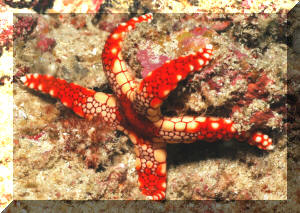
1/26/12 Fromia emission <Anthony Calfo again in your service whilst Bob has interrupted his tour of Australia to get permed hair extensions to join up with the REO Speedwagon reunion tour as a groupie. Some things just defy explanation> First let me say thank you for all the help you've already provided, here on the net and in your book. <my pleasure and thank you!> I have a situation that I have been unable to find information on so I am sending this email. I recently purchased an orange Fromia star, and a few days after introducing it to my tank I noticed a white cloudy emission coming from spots between its legs where they meet (this is occurring in at least two separate spots.) This emission continues for minutes at a time, and then stops. The star is quite mobile, is eating, and shows no signs of wasting away or dying( that is if the above is not such a sign). So my questions is what do I do...Remove it now? Watch it for a while (and if so what am I watching for)? Any help here would be hot!!! Thanks again. Kris <Kris...it is not perfectly clear to me from the description exactly what is transpiring... however here are some thoughts. If the spots where the emissions are coming from are not necrotic (no worn or abraded patches) then there may be little cause for alarm. Many echinoderms ingest some coralline and carbonate material while grazing and "spew" it after organic material is dissolved. With normal motility from this star it sounds like it may be OK. Have you noticed it scavenging any frozen green or meaty fares offered (Formula II, shrimp... even dry shrimp pellets)? That would be a fine sign. Please do a keyword search on this site too for Fromia questions in the archives and in articles for perhaps additional enlightenment. Kindly, Anthony> Orange tile starfish Today I came home and found my star fish folded in half is this normal??? <did the fish fold in half completely? I have seen this before...many times when the fish is near the front glass. they tend to fold themselves over. Is the starfish making an effort to "unfold itself"? Do you have a pic.. it would help tremendously. IanB> Thanks, James Wisson Lazy Fromia 7/22/05 After reading WWM and reading Bob's book, I decided against buying a Blue Linckia starfish and getting a Red Fromia star instead. <A good choice, indeed.> Question...In my opinion, I properly acclimated him but after a day he still doesn't seem to be doing much. He lays in the same spot of the substrate for hours and never moves at all. But if I move him to a different location (to test and see if he's still living), his little "feet" come out, grab a hold and pull his legs down tight on the rock, substrate, etc. I moved him again, this time close to the glass, and he reached his arm up extended the little feet out and pulled half of his body halfway up the glass with the other half still on the substrate and stopped again. He moved rather quickly (for a starfish) to do this. And there he still sits again. motionless for hours. He's been in the tank for about 30 hrs now. <I wouldn't lose any sleep over it. If the starfish moves when "threatened," I'd assume it was just acclimating to its new habitat. If it does not eat anything within 30 more hours, however, I'd start to think you had a problem, but I doubt it will come to that provided your tank is adequate for such a creature.> Is this normal Fromia Star behavior or should he be moving around more? Is this a sign that he's not doing well and is going to die or is it too early to tell? Is there anything I can do to help him? <Just wait. Listlessness is not always a problem. Best of luck, Mike G.> Thanks in advance. -Cody Starfish legs turning white 12/12/05 Hi,<Hello> I bought a starfish (Fromia nodosa) 2 months ago. It was fine initially but two weeks after acquiring it, the tip of all it's legs turned whitish. It is still moving around actively but I wonder why those legs would turn white and whether it would be harmful in the long run. Is there any preventive measures to take? This is my first starfish and I do not have any starfish creatures feeding on starfish in the tank (as far as I know - unless it was imported with the rocks). <A common problem with starfish. They are sensitive to changes in specific gravity, temperature, ph and oxygen levels usually encountered during shipping which causes necrosis of the legs and/or whole body which is what you are seeing. A drip acclimation is recommended for all starfish. As long as a food supply is present, the starfish should survive. I know of no cure for this. I have one now that has necrosis and its been in the tank for a year now, just doesn't have the nice orange color it once had.> Thank you for your help. <You're welcome. James (Salty Dog)> |
|

|
Features: |
|
| Featured Sponsors: |