|
|
Related FAQs: Marine Snails 1,
Marine Snails 2, Marine Snails 3,
Marine Snails 4, Marine Snails 5,
Snail ID 1, Snail ID 2,
Snail ID 3, Snail
ID 4, Snail ID 5,
Snail ID 6, Snail ID 7,
Snail ID 8, Snail ID 9,
Snail ID 10, Snail ID 11,
Snail ID 12, Snail ID 13,
Snail ID 14, Snail ID 15,
Snail ID 16, Snail ID 17,
Snail ID 18,
Snail ID 19, Snail ID 20, &
Snail Behavior, Snail Selection,
Snail Compatibility,
Pest Snails (Pyramidellids...),
Snail Systems, Snail Feeding,
Snail Disease, Snail Reproduction,
Snail Reproduction 2, Sea Slugs, Abalone, Marine
Algae Eaters, Related Articles:
Abalone, Opisthobranchs
(Sea Slugs), Nudibranchs,
Mollusks, Algae Control,
Nutrient Control and Export,
/The Conscientious Marine Aquarist
The Stomach-Footed Mollusks, Class Gastropoda, Subclass
Prosobranchia, Part 2 To:
Part 1: | |
by Bob Fenner | |
Superfamily Strombacea: Predominantly large mollusks with heavy
shells with flared lips, siphonal canals. Family Xenophoridae:
Struthiolaria, Aporrhais, the Conchs: Lambis, Strombis. |
Lambis truncata, Red Sea pix. |  
|
|
Strombus alatus, the Florida Fighting Conch. Here fighting after
death so it seems with a Queen Conch. most 2 1/3 to 3 1/2 inches. To
five inches maximum. Shells with large knobs as last whorl of
spires. Opening reddish orange in life. Head mottled brown, with
long whitish eye stalks, large white ended proboscis. | 
|
|
Strombus gigas, the Queen Conch. 6-9 inches typically, to 12 in.
maximum. Have large shells bearing a short conical spire with blunt
spikes. Shells orangish, often covered with algae. Opening rosy
pink. Covered by a claw-like operculum. Head gray with long
tentacled eyes. Live in Seagrass beds, cultured for aquariums.
Below, a two inch cultured individual, an adult shell occupied by a
large hermit crab in Cozumel, and typical in-the-wild appearance in
Belize. |
Superfamily Heteropoda: Pelagic species with a finlike foot and
reduced shells. Atlanta, Carinaria. Superfamily
Hipponicacea: Families Family
Hipponicidae™ Troschel,1861
Details Ref=®(d)Boss, in Parker,1982:1003; N=6g4s Family
Fossaridae
Details Ref=®(d)Boss, in Parker,1982:1004; N=6g1s Family
Vanikoridae {Gray,1845}
Details Ref=®(d)Boss, in Parker,1982:1004; N=1g2s(g) Family
Caledoniellidae Family Hipponicidae: Hoof
Shells. Attach limpet-like to the substrate and don't move. Unlike true
limpets (family Patellidae) these snails show spiral growth in their
shells. Four Hawaiian species. |
Hipponix imbricatus Gould 1846. Shingly Hoof Shell. At times
very abundant on the outsides of smooth boulders. Shallows to about
fifty feet of depth. May be endemic to Hawai'i. To about half an
inch in diameter. | 
|
Superfamily Tonnacea. Heavy marine snails. The Helmet Shells:
Cassis, Cassidarius. Bonnets: Phalium. Tritons: Cymatium.
Tuns: Tonna. Superfamily Naticacea: Moon Shells.
Burrowing species with globose shells and a drilling mechanism.
Natica, Polinices. Family Cassididae: Helmuts.
Typically of globular shells with short spires and apex whorls, and a
vertical groove which the animals siphon protrudes. Feed almost
exclusively on urchins. |
Cassis cornuta (Linnaeus 1758), the Horned Helmut. One of four
species found in Hawai'i. Common in shallow sandy environments.
Found buried in sand with only whorls in evidence. Largest Hawai'ian
Helmut (to 15"); used as a "blow horn" by natives in shows. Some
authors believe specimens with fewer, higher horns are males,
shorter, more numerous females. Kona pix. | 

|
|
Cassis flammea, the Flame Helmet. Helmet shaped shell, with
thick outer lip banded in seven or eight dark stripes. Feed at night
on sea urchins... overtaking and consuming them spines and all.
Bahamas pic. | 
|
Families Ranellidae and Personidae (often in Cymatidae in older
literature): Tritons. Usually have thick, heavy, sculptured shells,
though their beauty is often hidden by growth of their periostracum.
Feed on echinoderms and molluscs. Fourteen species in Hawai'i. |
Charonia tritonis (Linnaeus 1767), the Triton's Trumpet (or Pu
ole in Hawaiian). To twenty inches. . Indo-Pacific. Used by the
Greek God Triton as well as Hawaiian and other indigenous folks as a
blow horn. Important as a predator on Crown of Thorns Stars as well
as other echinoderms. Hawai'i pic. |  
|
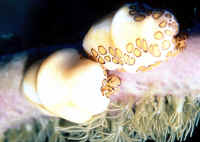
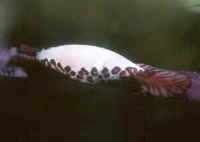
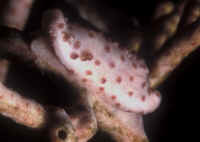
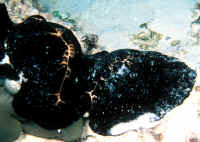
Family Lamellariidae:
http://seaslugforum.net/lamellar.htm, Coriocella,
Lamellaria, Marsenina, Marseniopsis, and
Mystinconchya. |
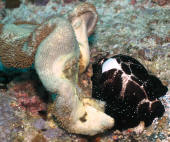
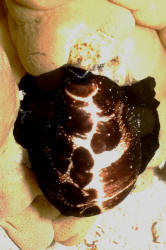
Coriocella hibyae, Maldives | 
|
Order Neogastropoda: The Advanced Gastropods. Possess a single
monopectinate gill, and a solitary auricle and nephridium. Triturating
mechanism is a radula with three teeth to a transverse row (termed a
rachiglossate condition) and osphradia with bipectinate folds. Entirely
marine. |
Epitonium billeeanum (DuShane & Bratcher 1965). Distinctive
yellow body and shell color... matching their prey, the ahermatypic
Dendrophylliid genus Tubastrea. Tropical Indo-Pacific. N. Sulawesi
pix. |  
|
Superfamily Conacea (Toxoglossa). Predators with toxoglossal
radulas, poison glands, or no radula at all. Cone Shells: Conus,
Turris. Terebridae: Terebris (highly spired).
Family Conidae: (Superfamily Conacea, Toxoglossa). Predaceous
species with a toxoglossal radula or none, associated with poison
glands. The Cone Shells (Conus, Turris) and highly spired Terebridae
(Terebra). Don't touch! |
Conus abraeus Linnaeus 1758, the Hebrew Cone. Indo-Pacific. To 2
1/2" in length. Found exposed by day in sandy areas feeding on
polychaete worms. Distinctive "Hebrew lettering" on heavy white
shells. When alive the shell is covered with a yellowy periostracum.
Kona photo. | 
|
|
Conus marmoreus Linnaeus 1758, the Marbled Cone. Indo-Pacific.
To 5" in length. Found at times exposed by day in sandy areas
feeding on other cones. This is one of a few toxic/venomous cone
species in Hawai'i. Cannot be handled anywhere safely. Kona photo. | 
|
|
Conus textile Linnaeus 1758, the Textile Cone. Indo-Pacific; Red
Sea, much of the rest of the tropical Indo-Pac, including Hawai'i.
Feeds on other prosobranch snails. Can be fatal to humans. Red Sea
image. | 
|
Superfamily Muricacea. Heavy, conical shells and long siphonal
canals. Drills (Muricidae): Murex, Urosalpinx, Eupleura, Purpura Thais.
Family Muricidae: Murex |
Murex ramosa Images of a live specimen and a cluster of eggs in
Nuka Hiva, Marquesas, Polynesia. |  
|
|
Murex tribulus. East Africa, Red Sea to Fiji. Feeds on
bivalves/mussels. N. Sulawesi pic. | 
|
Superfamily Buccinacea: Snails of many forms with long siphonal
canals. Whelks (Buccinidae): Buccinum, Neptunea. Melongenidae:
Busycon. Tulip Shells (Fasciolariidae): Fasciolaria, Mud
Snails (Nassariidae): Nassarius, Ilyanassa.
Family Buccinidae:
Babylonia zeylanica,
A good reference is
http://www.nmr-pics.nl/Buccinidae/album/index.html
I wouldn't trust them around other Molluscs. They're predators and
scavengers. Also, I didn't mention in the previous mail, but the
common name is Babylon or Babylonia snail and I've seen them
available from time to time on the 'net and locally. |
 |
Family
Fasciolariidae: Tulip Snails |
Cymbiola vespertilio (Linnaeus 1758), the Bat Volute. Sandy,
silty habitats where it hunts, consumes other gastropods. Western
Pacific; Philippines, Indo., New Guinea, N. Australia. Here
consuming the eggs of a squid in N. Sulawesi. |
|
|
Fasciolaria tulipa, True Tulip. Shell spindle-shaped. Patterned
in broken spirals of variable shape. Body dark colored, brown
operculum. 3-6 inches usually, 10 maximum. Cozumel pic*. | 
|
Family Nassariidae, Nassa Mud Snails.
Bigger PIX:
The images in this table are linked to large (desktop
size) copies. Click on "framed" images to go to the larger size. |
.JPG) |
|
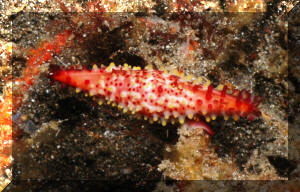
Nassarius variegates, Nassarius Snail. My favorite for detritus
consumption. | |
Superfamily Volutacea. Shells smooth, conical to low-spired. Olives
(Olividae): Oliva, Olivella. Miter Shells (Mitridae): Vexillum,
Mira. Harp Shells (Harpidae): Harpa. Volutes (Volutidae):
Voluta, Cymbium. |
Marginella plumiosum, the Glowing Marginella. 1/4-1/2 inch long.
Found on sandy bottoms in the tropical West Atlantic; common in the
Caribbean. White-cream shells with three faint yellowish bands. | 
|
|
Pusiostoma mendicaria, Bumblebee snails... a darling of the
small reef clean up interest. To one inch in length. Family
Mitridae, Buccinidae. | 
|
To: Part 1: To:
Opisthobranchs (Sea Slugs) Bibliography/Further
Information:
|
|