|
FAQs about Green Brittlestars,
Ophiarachna incrassata Reproduction
Related Articles: Brittlestars, Sea
Stars, An
Introduction to the Echinoderms: The Sea Stars, Sea
Urchins, Sea Cucumbers and More... By James W. Fatherree,
M.Sc.
Related FAQs: Green
Brittlestars 1, Green Brittlestars
2, & FAQs on: Green
Brittlestars Identification, Green
Brittlestars Behavior, Green
Brittlestars Compatibility, Green
Brittlestars Selection, Green
Brittlestars Systems, Green
Brittlestars Feeding, Green
Brittlestars Disease, & Brittlestars 1, Brittlestars 2, Brittlestars 3, & Brittlestar ID, Brittlestar Behavior, Brittlestar Compatibility, Brittlestar Selection, Brittlestar Systems, Brittlestar Feeding, Brittlestar Disease, Brittlestar Reproduction, &
Seastar Selection, Seastar Compatibility, Seastar Systems, Seastar Feeding, Seastar Reproduction, Seastar Disease,
|
|
Nature... Brittle Star Reproduction
9/11/07 Good evening crew. <Greetings fellow nature
lover.> I had an incredible experience the other day when I came
home from church, my protein skimmer was overflowing all over the
floor in my house. <Holy water?> We lost about 5 gallons of
water, which forced me to do a water change and some tank cleaning.
<Yikes! The non-voluntary kind!> When I had completed the
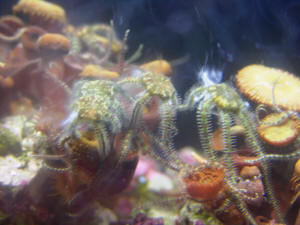
cleaning, I noticed about 7 brittle stars (I am assuming the
species) <Are micro brittle stars.> had congregated within a
colony of button polyps, and others were coming out in other rocks.
Within about a half hour of seeing them, they would come to the top
of the polyps, would stand up on their legs and started secreting a
white liquid from the underside of their body. I am guessing that I
was witnessing propagation in progress. <Sure looks like it!>
They were gathering in groups and doing this. <Gathering in
groups gives a reproductive advantage when broadcast spawning.>
I also had two of them climbing the back wall of the tank, one
chasing the other and secreting the fluid next to the other one. I
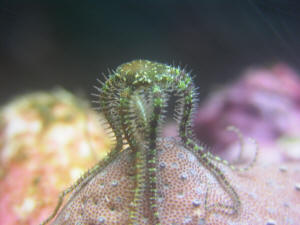
have attached pictures of one standing on my toadstool coral and
two of the stars on the polyps in a group secreting around each
other. I thought this might help others who are seeing this as well
and hope that you can affirm or correct my assumptions. <I think
your assumptions are spot on. Very nice photos capturing this
potentially procreative moment!> Great site and thanks for your
hard work, <Is Bob's blood, sweat and tears with many
ancillary providers.> its well worth the read when I need the
help. <Glad you find it Regards,
Mich> |
|
|
Green Brittle Star'¦Sick Or
Reproducing? -- 04/1/08 I have had a green brittle star for 9
months in a 120 gallon tank. It has been healthy & grown well!
<<Mmm'¦ Ophiarachna incrassata? Can indeed get
large'¦and is known to ambush and eat fish>> Without any
indication of being sick, in a matter of less than 24 hours, it rubbed
itself against a rough piece of live rock & sawed itself into 4
pieces (all but one have a chunk of the body on it). <<You
actually saw this? Strange'¦>> How can you tell if it
did this because it is sick or reproducing? <<Don't know that
you can'¦though this seems extreme for reproductive
behavior>> What are the chances any of the pieces will survive?
<<Not uncommon for those pieces with bits of the oral disc
attached to grow in to/become whole animals again'¦in the
wild. Not so much'¦in captivity>> All four are moving
about the tank with ease. <<About all you can do is keep an eye
on them'¦remove if they 'die' and begin to
decompose>> Thanks for your advice. Kristie <<Happy to
share. EricR>>
|
|