|
FAQs on Lined Wrasses, Genus
Pseudocheilinus Disease/Health
Related Articles: Lined Wrasses,
Related FAQs: Lined Wrasses 1, Lined Wrasses 2, Lined Wrasse Identification, Lined Wrasse Behavior, Lined Wrasse Compatibility, Lined Wrasse Selection, Lined Wrasse Systems, Lined Wrasse Feeding, Lined Wrasse Reproduction, Wrasses, Wrasses 2, Wrasse Identification, Wrasse Behavior, Wrasse Selection, Wrasse Compatibility, Wrasse Systems, Wrasse Feeding, Wrasse Disease, Wrasse Reproduction,
|
|
Concern about Six Line Wrasse
7/8/15
Hello,
<Jen>
I came across your site while searching for answers for our Six Line and saw
your Q & A chat, so I hope you can help!
My husband and I have had our Six Line Wrasse in a 75 gal tank for about
a year, and he has always been spunky, healthy, and full of attitude.
However, about a week ago, we noticed that his belly had gotten very
round and bulgy, and his mouth seems to be perpetually open as if he is gasping
for air.
<Likely ate/or swallowed something....>
He seems to be swimming and eating fine, and we haven’t noticed any other fish
picking at him, but his belly keeps on growing! We have looked up possible
issues for this and the only think we’ve found is that sometimes six lines may
eat too much and get clogged — ?? We honesty have no idea on how we can help
him.
<Perhaps a bit of Epsom salt...>
We would love to get your perspective! Thank you so much in advance!
Sincerely,
Jennifer & Edmar
<Really; only time going by can/will tell. Bob Fenner>
Re: Concern about Six Line Wrasse
7/8/15
Thank you so much Bob! Do we need to remove him from the tank for the Epsom salt
treatment?
<Not if you do as I would and treat w/ a low level dose... about 1 tsp of MgSO4
per five gallons>
We appreciate your time and info :)
<Ah, welcome. Bob Fenner>
Re: Concern about Six Line Wrasse
7/8/15
Perfect! Thanks so much!! I hope we don't lose the little guy! Fingers crossed!
�� Take care
<Cheers, B>
Growth on fish 12/6/13
Greetings crew!
<Ray>
I have done a complete breakdown and rebuild of my 120 reef due to
extreme infestation of grape Caulerpa. New rock, sand and
everything cleaned.
Lost most of my corals, but managed to salvage a handful.
My fish for the most part are fine, but one thing I noticed on
my 6-line wrasse.
There is a black cauliflower growth, about 2mm diameter,
protruding from his lower jaw, right below the lips.
I noticed it right at the start of my tank breakdown. He
seems to be acting appropriate, but he is in a bucket with an
airstone right now so hard to tell.
I have done searches for the source, but found nothing that looks like
it.
Is it possible to be trauma related (hit a rock or something)?
<Most likely so; yes>
I would hate to treat for nothing. Also don't want to put him
in my freshly rebuilt system to infect the other fish.
<I would not treat, nor attempt to physically remove this apparent
growth.
I might try a biological cleaner (fish) that the wrasse would accept
(crustaceans are likely to be picked to death)>
Tried to get a pic but he is quick and nothing came out. Will try
again tomorrow.
<Cheers, Bob Fenner>
Ideas or suggestions on how to proceed?
Thanks
-Ray
|
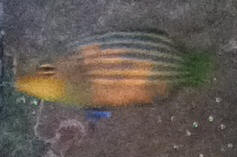
Why Does My Sixline Wrasse Look Like He Was Splashed
With Bleach? (Physical Injury?) – 04/13/12
Hello to the fine WWM crew.
<<Hey there Lindsey>>
Looking for any thoughts on what I woke up to.
<<Okey Dokey>>
My guess is that he scraped himself, but I haven't ever seen
a scrape this extensive and I'm a bit worried. The fish was
fine yesterday and seems to be eating and swimming normally. Any
thoughts as to why he now looks like he's been splashed with
bleach?
<<A physical injury as you suggest…or perhaps an
encounter with a stinging organism>>
What treatment if any do you suggest?
<<None really…aside from keeping up feedings and water
quality. There’s likely nothing you can do here…and trying to
capture this little rascal is going to cause more stress. Most
fishes have amazing recuperative/healing powers in these
instances if simply “left alone” in a healthy
environment.>>
Thanks for your help!
Lindsey
<<Happy to share! EricR>>
|
 |
Re: Why Does My Sixline
Wrasse Look Like He Was Splashed With Bleach? (Physical Injury?)
– 04/13/12
We'll do. Thanks again!
<<Welcome! EricR>> |
|
New Six Line Wrasse Sick/Injured
10/17/11
To the Gurus at WWM,
<Howsit Charles?>
I beseech <Wow!> you for your knowledge, I just picked up a
new Six Line Wrasse from a semi shady looking LFS, I have a bunch
of new live rock I wanted him to help clean. In the store he
looked fine and healthy as far as I could tell (they aren't
exactly voyeurs), so I get it home and acclimate it for probably
an hour and a half and drop him into the tank (I didn't
bother with a quarantine
<Mmmm>
as the only fish in the tank all came from the same store at the
same time). Once in the tank I can see he is twitching and
scratching on the sand and rocks. I can see some small red dots?
around its mouth and a white piece of what looks like skull or
fungus, its hard to tell. I can't quite tell if it is a
fungus on his mouth or if he is losing the skin and his skull is
becoming more exposed (ouch!). He didn't seem to want to eat
anything so I started searching for problems, a lot of people
seem to think scratching is a sign of Ick, or of flukes.
<Can be... but some such behavior is not necessarily
indicative of anything>
and it does look like he has some light hazy spots starting to
show on his fins and like 2 scales are a little lighter at the
right angle. another site says it could be mouth fungus bacteria
but it looks like the flesh is missing not something growing on
top of it. It looks like the white part is getting bigger but it
looks like it is from more skin coming off when it scratches and
when he twitches it's like he is trying to shake something
off his face.
After extensive reading of your site it seems like the most
common culprit would be an injury,
<Agreed>
I am hoping it is not an illness as well as I do not have enough
space in my 10 gal to quarantine all the fish from this tank for
the next 2 months, though I could move my inverts and rock if I
needed to do a hyposalinity stint as this display tank is only 60
gallons. Should I just wait and see for now or should I
quarantine just the wrasse or start moving the rock and
inverts?
<I would do the former... just wait for now>
Have I already infected all the other fish in the tank if it is
some parasite or bacteria, and if so what else would be
susceptible?
<Mmm, all fishes>
I have a pair of Ocellaris clowns about 1 inch long, a pair of
blue/yellow Damsels, a tiny striped goby about 1inch, some
shrimp, feather duster, flame scallop, a couple of Ricordea, an
emerald crab, some snails and macro algae. I have another 10 or
so pieces of zoo polyps, Xenias, Acans, etc in a friends tank
waiting for things to cycle a little more and stabilize with
these fish, if this is a disease would they be susceptible?
<Not the non-fish; no>
While I was looking I also found that you guys recommend using
garlic for entice sick fish to feed, so I put a drop of garlic
oil on some pellets, crushed them, and dropped the clumps into
the tank and it seemed interested and has eaten small amounts on
several occasions today (got it ~30 hours ago).
Thank you for your time
-Charles
<This is a very tough little customer/species... I'd take
a proverbial chill pill here and see what, if anything develops.
Bob Fenner>
|
|
|
Six Line Wrasse Pimple
5/18/11
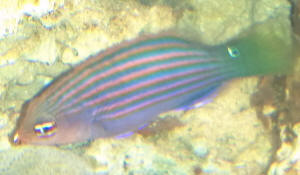
Hi, I just got looking in my 30 gallon tank and noticed my Six Line
Wrasses right eye is a little swollen and has a white
'pimple-like' spot just above the eye lid.
<Mmm...>
He does not seem to have any other problems, is still very active and
eats plenty. I am worried about it being contagious and spreading to
some of my other fish, I also have a goby, tang,
<This volume is too small for an Acanthurid>
clown fish, hawk fish and stripped Basslet that all seem to be healthy.
If you can please help me identify the problem and maybe how to fix it
that would be much appreciated?
<Would it or not?>
I do a 2-3 gallon water change two to three times a week and all the
nitrates, nitrites, ammonia and salinity are normal. The only
difference lately is the temperature has been around 80 F when its
normally around 77 F. Thanks anything helps
<This mark and eye swelling are almost assuredly environmental, a
bump/swim into something in the system; not pathogenic. What you and
your fishes really need is more room. Do read here: http://wetwebmedia.com/Popeyetrauma.htm
and the linked files above re the trauma. Bob Fenner>
|
Six line lump diagnosis
1/15/11
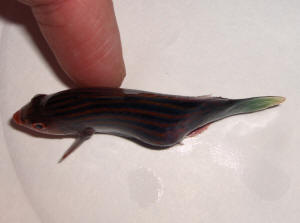
I owned this six line for close to a year. After 2 months and
surviving a bout of ich, he developed a goods sized lump on his
side. He continued to eat and behaved normally for another 8
months. Today he died. The lump was bigger than it usually was.
He ate a varied diet and had an excellent appetite until I found
him dead today. Please take a look at the pics and tell me what
you think. My reef tank parameters are exemplary. I basically
maintained an under populated tank.
Thank you,
Tony
<Mmmm, w/o opening this fish up, looking macroscopically at
what/which organs, areas are affected it's hard to assess...
but this area is not a part of the gonads, or intestines... I
suspect some sort of tumour... Bob Fenner>
|
|
|
Re: Six line lump diagnosis
1/16/11
Thank you Bob.
<Welcome Tony. B> |
Pseudocheilinus tetrataenia (RMF, any comments on the
genus and centrepiece fish generally) 1/14/11
Neale et al,
<BobF this time>
I am currently quarantining a perky little six line wrasse that I
picked up yesterday. I wanted to double check with you on treatment and
quarantine length since for many wrasses, the quarantine period can do
more harm than good.
<Yes>
I'm treating with Cupramine (slightly less than the prescribed
dose)
<Needs to be 0.15 minimum ppm... and no more than 0.35 ppm free
cupric ion... or you're wasting your time, poisoning the
fish>
and Maracyn II for some fin damage and Finrot that the wrasse appeared
to have... Is a week of quarantine too long? Too short?
<Is right about right>
Do sixlines have problems with long term exposure to copper treatment
(1 week+)?
<All fishes have trouble w/ such exposure... to put it simply, this
involvement shortens their prospective life spans. One week is a good
trade off though, don't you think, for not vectoring parasites into
your main/display system?>
Thanks,
Victor
<Cheers, Bob Fenner>
Sixline wrasse getting a cloudy bubble over his
eye 2/11/10
Hi All!
<Hi Christine, how are you today?>
I have not been in touch in some time - which is a good thing - all
goes well. Currently I have a 90 gallon FOWLR (ok and a few mushrooms
which happened by accident but now I am getting a coral itch. <Mmmm,
this can be
detrimental to your wallet!> I do have reef lighting.)
I currently have:
70 lbs live rock - many caves and overhangs
30 gallon sump/protein skimmer/refugium
2 false Perculas
2 black ocellaris clowns
2 neon gobies
2 diamond gobies
1 Firefish goby
1 gorgeous flame angel
1 yellow tang
1 six line wrasse
All get along fabulously - but I do have one or two questions.
<Okey dokey!>
I have been keeping a close watch on my wrasse - three days ago his eye
began to look a little cloudy and has a small bubble over it. It has
not changed at all since I first noticed it _ which means it hasn't
gotten worse, but it hasn't gotten better either.
<An injury probably>
Its barely noticeable to anyone but me at this point. I have not seen
any aggression whatsoever in any of my fish- could it possibly be that
he injured it somehow, brushed against a rock or something?
<Yes, the most likely cause, if it is just one and not both>
At this point should I continue to watch him closely or should I start
pressing the panic button?
<The first>
Also - would I be pushing my luck if I were to try and work some kind
of blue damsel into the picture.
<Yes>
I know they can be mean, but I have read that the yellow tail blue and
the starcki may be less aggressive, but I won't believe it till I
hear it from you - and even if it is true I still need to know if it
could be a good fit considering the particular tankmates it would
have.
<Personally I would not, they are a little aggressive, and I
don't think they are anywhere near as interesting as the fishes you
already have, so I would not take the chance>
Also - would any of those damsel do well by itself - I would rather not
have more than one if I don't have to.
<I know I always seem to say this, but if it were me, I would not
add any at all>
As always - your website is invaluable - please keep up the great
work!
<We'll try!!>
Christine
<Simon>
Re: Sixline wrasse getting a cloudy bubble over his
eye -- 2/12/10
Well - I am taking your advice. As hard as it is...
<I know... the temptation... often proves too much..>
If I have to add any gorgeous blue to my aquarium (and I do, I'm
obsessed - I believe its quite out of my control now)- I may have to
start with some blue Zoanthids or some really bright blue mushrooms -
and work from there.
<Yes, you can get some really nice blue Ricordea floridae or
Discosoma species>
Sadly and mysteriously, I lost both of my diamond gobies last
night.
<Really, both? Unusual. There must be a factor to this>
Never saw it coming -they seemed fine. I found them both right next to
each other belly side up this morning. I can't understand it. I
tested my water parameters, the only thing that was off was my nitrates
were up around just between 0 and 5 mg/L - which I wouldn't think
would harm the gobies (unless I missed a lesson that said they are
ultra sensitive) in fact today is my scheduled bi-weekly water change
and tank maintenance day so I would expect some nitrates.
<You should be ok with those levels>
I have sand substrate and I love the way the gobies kept it looking
nice.
Is there a secret to keeping them healthy for more than a few months?
Is there a hardier sand sifting fish that I should consider?
<I do believe there are a few species - search WWM re. But I would
be wary since you have just lost two, could there be some aggression
here somewhere? Are you able to feed these animals correctly? A little
investigation required here before any more fishes are added, and some
caution>
The wrasse's eye looks the same - he is out and about, eating like
a pig - spending more time than usual "asking" the neon
gobies to clean him though. (There I go pressing the panic button
again.)
<Yes, I think this fish will be fine>
As always I appreciate your help or any advice you can give me....
<No problem Christine>
Christine
<Simon>
Re: GOOD NEWS! Sixline wrasse getting a cloudy bubble
over his eye - HEALED! Thanks to you! 2/25/10
Simon -
<Christine>
Great news! I left my Sixline alone (as you suggested) and his eye
healed on its own! <Great!> Thank you for your advice and for
keeping me from pushing the panic button and trying to
"nurse" him back to health.
<No problem Christine I'm glad it all worked out, and thank you
for this follow up>
You wisely advised me not to get any Damsels to add some blue to my
aquarium. What do you think about a small Hippo Tang?
<No such thing as a small one -- they all get big, or should be
allowed to>
Or is it too late because I have the Yellow Tang and Flame Angel and
they already have established their territory?
<I think so. In my opinion the Paracanthurus should be given a six
foot tank>
As for the death of both of my Diamond Gobies I have a few theories but
its the best I can come up with.
<These are difficult fish to keep>
- I am pretty sure that I would have noticed aggression because I am
vigilant with watching my fish. I am however embarrassed to say that in
doing more research I did not provide them with any supplemental foods
- other that what I feed my other fish. Also are those fish more active
at night? Could it be possible that they showed aggression against each
other at that time?
<Yes -- the fish tank is a very different place at night, and
aggression does not have to be obvious, is not always easily detected
-- it can be subliminal, just 'there' and sometimes this is
enough for sensitive fish>
I have since learned that having two in the tank was not necessarily a
good idea unless they were a true mated pair. In that case if I choose
to try it again - am I better off sticking to just one?
<Do you really need another fish? I think fish tanks look better,
nicer, more peaceful when they are not stuffed full of fish>
I did have a pair of Firefish Gobies that lived peacefully together for
months and months - even slept in the same bolt hole - then all of a
sudden one day I noticed one was missing his entire dorsal fin and
hiding in a corner -- every time he tried to venture out of the corner,
the other Firefish would charge him and nip him something awful.
<Mmmm, having a battleground in your living room is just no fun in
my opinion, and this hobby should be nothing BUT fun. But, no matter
how many times you say it, many people just continue to add more and
more fish. If your system is balanced and you want to tinker around,
you are better off doing this with different corals than fishes>
I floated the aggressive guy for a few days but it only helped
temporarily. Eventually, I made arrangements to give one of them to a
friend of mine who is in the hobby - but no more than a few days later
I woke up and - to my surprise the aggressive one was missing - I tore
my tank down looking for him and never found any remains whatsoever.
The passive ones dorsal fin (and tail) grew back and I still have him
today - and he is doing fine.
<Thank you for this tale Christine!>
Speaking of pairs of fish - I see one website that once in a while
offers "pairs" of Flame Angels. My local fish store owner
yelled at me for being naive and claimed that if I wanted to spend that
kind of money to find out that the company paired them up themselves
and that they will kill each other once they get into my aquarium -
then I should go right ahead and learn my lesson the hard way.
<It would be a risk I agree>
(other than that she is great - and not afraid to give you her
opinion)
<That's good to hear>
I already have a Flame so adding any other Angel is out of the question
in my mere 90 gallon - however I am interested in your opinion of the
odds of finding a true pair of Flames for an aquarium.
<Poor, although some Centropyge have been bred in captivity, so it
is not beyond the realms of possibility>
Don't the males have harems?
<I don't know about the Flame specifically, but many Centropyge
do, yes, so I would not be surprised>
My Flame is gorgeous (deeper red than most I have seen) and seems to
have quite a close, friendly relationship with my Yellow Tang. At times
the Tang even seems protective of the Flame Angel. Is this unusual?
<Whenever I've had these they have definitely been loners. Have
you checked our FAQS on these?>
Thank you for all you have done!
<No problem Christine>
You have saved yet another fish!
<Marvelous news! WWM strikes again! Simon.>
25/02/10 Sixline wrasse getting a cloudy bubble over his eye -
chatting, really
<Hello again Christine>
Well Simon - you can't blame an aquarium lover for making one last
desperate attempt to get a blue fish - but I know when I am
defeated!
<Heee! Victory!>
Your explanation was perfect and it reminded me of a game I used to
play when I was a girl called "don't spill the beans". At
this point I seem to have a good balance and anything I do from here on
out (with fish) could be the bean that tips that balance.
<Indeed, and a good analogy>
I wouldn't want to take that chance. <No>. You also brought
up another good point - the Tang will grow (but I figured I had plenty
of time to worry about that)
<Actually, no. This fish will be psychologically crowded
immediately>
but - some of my other fish will also grow.
<Yes they will, the Zebrasoma especially given good care>
As for keeping my sand looking nice - maybe a few more Nassarius Snails
or a Fighting Conch - and coral for colour or perhaps a clam as I get
more confidence.
<Yes, I think this a better path -- you can get some fantastic blue
Tridacnids>
As far as my Tang and Flame - I will read more FAQS. I am hoping that
what I have interpreted as some sort of "friendly
behaviour".... the way they follow each other around, seem to
always hang on the same side of the tank grazing on the same rocks,
dart to the same place if startled - isn't actually some form of
intimidation, stalking or territorial behaviour.
<Interesting behaviour for sure>
I won't lie, I have seen the occasional tail slap and chasing - but
usually only if one invades the others sleeping quarters, and even
then, not always, sometimes they don't seem bothered by the visit
at all. However, it wouldn't be the first time I've been
outsmarted by a fish. Probably not the last time either.
<You and me both, but don't tell my wife or I'll never hear
the end of it!>
As far as stories - I have more fish stories than I have people who
will listen - so I wouldn't encourage me if I were you!
<Oh no, what have I done?>
For instance my Orange Clowns have laid claim to every Anemone ornament
I have in my tank (which is now three). Preventing the black and white
ones from going near any - no matter how many times I change the
placement of them in the tank or how far apart from each other I place
them. I am starting to see this as potentially a bigger problem with
bullying than I originally thought based on what I have just
learned.
<Mmm, Clowns can be terribly territorial, it is best to only have
one pair to a tank>
I need to watch with a new perspective. Today I placed the ornaments in
"undesirable" locations - such as front and centre in the
aquarium and wherever there is heavy foot traffic passing by the glass.
As a last resort, maybe I should remove the ornaments all together.
Otherwise I don't know how many ornaments I have to buy before the
orange guys can't keep up:)
Well - thanks again Simon.
<No problem Christine.. just a slight 'prod' here -- this
e-mail service is primarily for questions of the 'help'
variety, we do have a BB for general conversation and such..>
I don't think I would have been able to stay in the hobby if I
didn't have such a reliable source as WWM!
<Well that's great news!>
Do you guys give info on corals too?!
<Yes, plenty. See here:
http://www.wetwebmedia.com/cnidaria.htm>
Not spilling the beans,
<Well done! Don't give in to it!>
Christine
<Simon>
Re: 25/02/10 Sixline wrasse getting a cloudy bubble over his
eye - chatting, really
<Hi Christine>
Yes got it. Understood. I apologize.
<No need to Christine, really.>
Farewell and thanks again! (especially from my husband who is thrilled
that someone talked sense into me. <Heee! Something he struggles
with I bet!> I am not going to mention coral - I want him to enjoy
the moment. I will look for the BB - (not sure what it is - but I will
find it). If people share stories and I can learn from them it sounds
perfect to me!
<Me too. The WWM bb can be found here: http://bb.wetwebmedia.com/
.>
Take care!
<You too, and good health to you and your fishes,
Simon>
Sixline Wrasse... hlth., no data
12/22/08 We have had our Sixline for several months. We also
did a recent water change in our 135 gallon reef tank. She looks like
she is gasping for air constantly keeping her mouth open. She also
looks mottled, has few scales missing and have fine bumps around her
dorsal area. Hope you can help we are attached to her. Her name is
Elizabeth Taylor. Soveyda in California <Sorry to hear the bad news.
What is the water quality like? Are any other species picking on the
Sixline? Are any other species gasping for air or showing signs of
distress/disease? The fish may have some sort of parasites and may
require treatment. If there are any other fish in the aquarium they may
be in trouble as well. Honestly there may not be much you can do for
the little wrasse (and other fish) unless you can catch her and put her
in a quarantine aquarium for treatment. Also it is not wise to treat
your aquarium with "reef safe" ich medications since they
really are not effective and cause more problems with corals, etc.
Happy Holidays, IanB>
Mystery Wrasse mystery white lump -- 07/21/08 I have a
recently purchased mystery wrasse that has three white spots or
lump on his body. I started him off in QT tank and he has been
doing great he has had no signs disease or problem, until now. He
has been in quarantine along with a Royal Gramma Basslet and a
Sailfin Algae Blenny. <I hope these are separated> The QT
tank is a 10 gallon with an Emperor 400 bio wheel, heater, PVC
pipe for swimming through and protection. The bottom is bare in
the tank, I did have some sand in the tank less than 2 ounces of
sand, I removed it because it seemed to trap waste. I have been
treating the tank for five weeks now with hyposalinity, sg 1.12
<Mmm, maybe 1.012> and everyone seems to be doing fine. The
wrasse is curious and wants to check me out, the blenny has been
eating off the glass, and the basslet has been swimming upside
down having a great time. <Ah, good> The problem is the
Mystery Wrasse started off with one spot at the top of his right
gill four days ago which seems to have split and formed two
smaller white spots and now a third smaller spot appeared on his
right side on the middle of his body. I am not sure what this
could be. <Could be... parasitic, idiopathic,
"nothing" to worry about...> I have fed the tank
with live brine shrimp, rod's food, Sushi Nori and frozen
brine shrimp with Cyclop-eeze. I try to limit the amount of food
at any given time to keep water from fowling; however I have left
the Sushi Nori in for longer periods. Also, I have placed some
hair algae from the display into the QT for the blenny. None of
my other fish show any disease or problems, so I don't think
I contaminated the QT from the display. However, I have recently
placed, at the same time I got the wrasse, basslet, and blenny,
some mithrax crabs in my display with out QT to get rid of some
bubble algae. My display tank fish show no signs of disease. I
have done water changes to the QT every 7 -10 days, and keep the
lights on 12 hours a day. I am truly puzzled the hyposalinity
should kill any parasite <Might be "under the skin"
if indeed a parasite... I don't think it is> that the fish
would have. The Wrasse may sleep next to the heater and it could
be physical damage to the wrasse. Could the QT be hurting the
wrasse? <Yes> If so, should I place him in the display
after re-acclamation to the displays salinity? <Yes, I
would> The wrasse swims strong, is curios and eats frozen and
flake food. He seems healthy except for these white spots. And
now that I have been staring at him for an hour his stomach seems
large. Could I be a Hypochondriac for my Fish? <Happens> I
look forward to hearing from you. Here is link to what the bump
looks like
http://s354.photobucket.com/albums/r436/mysterywrasse/?action=view
<http://s354.photobucket.com/albums/r436/mysterywrasse/?action=view¤t=
MOV03666.flv> ¤t=MOV03666.flv
<Didn't
"exist" for me. Bob Fenner>
Re: Mystery Wrasse mystery white lump
7/23/08 Thanks for getting back to me so soon. Unfortunately
I have a new problem. I am in the process of raising the salinity
in the hyposalinity QT to the conditions in my display tank. This
morning when I went to check on the QT tank my mystery wrasse was
sitting still and not moving, which is uncommon he always is
swimming around. I looked him over and the bums on his body are
mostly gone but now his eye on the right side, the same side as
the bumps, is cloudy, puffy, and perhaps a little red. <Could
be just the hyposalinity...> The wrasse is breathing fine and
the other fish in the QT are fine. I was going to wait and do
nothing, but upon reading about Popeye and eye injury on wet web
media I found that Epson <Epsom...> salt is the best
treatment. It didn't make much sense to add Epson salt while
I was still raising the salinity in my QT to the level of my
display, so I raised the salinity in the QT to the level of my
display. <...? All at once? Not a good idea... see WWM
re...> I also moved a heater which was close to the bottom of
the tank where the wrasse had been sleeping and made his cocoon.
I was thinking that he may be getting damaged by wedging himself
near the heater or glass of the tank. Would adding Epson salt
later today be a good idea? How much, it is a 10 gallon tank?
<I would hold off...> I have a live brine shrimp that is
ready to feed, they have been growing 36 hours; should I feed him
the brine shrimp? <Some> Should I remove the emperor 400
and use a power head and an air pump so the brine shrimp will not
get sucked up and trapped in the emperor's filter? <... I
wouldn't. Perhaps turn off for ten-twenty minutes> Should
I move the other fish in QT to my display to leave the wrasse
alone in the tank? I want to leave the wrasse in QT so his eye
can heal. Also, should I add some live rock to the QT for the
wrasse to swim around and build its cocoon near now that it will
have salinity 1.023? Thanks for the help. If I haven't been
asking the right questions could you tell me a course of action
you would follow to treat the wrasse? <... You should read,
and relax. BobF>
|
Mystery Wrasse Disease 12/15/2007 Hello WWM
crew. Your website has given me years of valuable info. I have used the
experiences of others on your site for years to learn about this great
hobby. Now I have a problem of my own that I would greatly appreciate
your help. I came home today and realized that my prize fish, a 4 inch
mystery wrasse, has some sort of "disease" covering his
mouth. This disease looks like fluffy white whiskers coming out of his
mouth. These whiskers appear to be coming from inside the mouth and do
not allow him to close his mouth. <Not good... likely resultant from
a physical trauma ("jumping")...> I am at a loss because I
have not seen anything similar to this before. I have had some run ins
with marine velvet in the past, but this looks nothing like a parasite.
<Is simple decomposers...> In my (clueless) opinion it seems like
some sort of fungus growing out of his mouth. <Likely
bacterial...> The tank is a 120 gallon that has been up for about a
year. I have finally gotten around to quarantining all new specimens,
and have done so throughout the entire life of this tank. Below I have
attached a picture of the wrasse. <Didn't come through.>
It is not very helpful because the white "whiskers"
around his mouth blend with the color of the mouth, but you can kind of
see them along the bottom of his mouth. Hopefully this will help you in
your assessment. Thanks in advance for your help with this problem, and
thank you for all the help you have provided others. This is a valuable
resource for all marine aquarists. <Not much to do here... Perhaps
adding more iodine-ide-ate in whatever format you currently use would
be of help... Otherwise, waiting, hoping... maintaining optimized,
stable conditions is about it. Bob Fenner>
|
Six line Wrasse... hlth. 11/26/07 Hi Crew, I
bought this fish at an LFS a few hours after it came in. <Not
a good idea... like most marines, better to leave new arrivals at
a dealers for at least a day or two...> Two days later I
noticed a slight shadow between the pectoral fin and the eye. And
today it is very white and a slight bump. Is this some kind of
wound from capture or is it something to worry about? <Could
be both...> Fish behaves like a six line and eats like a
vacuum cleaner. The eyes also seem redder than what I recall.
They usually have what looks like two white parallel bars. This
guy is red. This is one picture where he is not just a blur but
is not clear enough to make out what the spot really looks like.
Thanks <And the pic shows discreet dots that appear to be
Crypt on its caudal... I'd be reading re Quarantine,
Parasites of marine fishes, Parasitic Systems... on WWM. Bob
Fenner>
Re: Six line Wrasse... hlth. -11/27/2007
>>Hi Crew, I bought this fish at an LFS a few hours
after it came in. <Not a good idea... like most marines,
better to leave new arrivals at a dealers for at least a day or
two...> Two days later I noticed a slight shadow between the
pectoral fin and the eye. And today it is very white and a slight
bump. Is this some kind of wound from capture or is it something
to worry about? <Could be both...> Fish behaves like a six
line and eats like a vacuum cleaner. The eyes also seem redder
than what I recall. They usually have what looks like two white
parallel bars. This guy is red. This is one picture where he is
not just a blur but is not clear enough to make out what the spot
really looks like. Thanks <And the pic shows discreet dots
that appear to be Crypt on its caudal... I'd be reading re
Quarantine, Parasites of marine fishes, Parasitic Systems... on
WWM. Bob Fenner><< Wow, you got good eyes.
<<Heeeee! I wish... only for some things>> I did not
even notice that. Now I will have to wait a couple weeks to see
what develops because even if it drops off it may just be part of
the cycle. <Yes!> But good new is that white dot is gone as
of this morning and I can not even see any mark where it used to
be. Thanks again. <Let us indeed hope... this was nothing.
Cheers, BobF>
|
|
|
Injured 6-line Wrasse,
Treatment Options 10/23/07 Hi Wet Web Media Crew, <Hello>
First of all, thanks for your great site. While in
quarantine/hyposalinity, our Sixline Wrasse got himself stuck in a
piece of live rock. My initial thought was to let him get himself out.
<Usually best.> After about a week it became apparent that he
would not be able to. We could just see part of him though one of the
holes in the rock. I used a Dremel to carefully cut away the rock
around him until I could gently get him out (He was lodged in there
pretty good). I don't think we caused him any harm while getting
him out; however, he cut himself up pretty bad during the week he was
in there. <I bet.> He has several gashes on his side and belly,
he is very discolor in certain areas (looks like he is missing all of
the scales from about half his body), and he appeared very
bloated/swollen. We dipped him in a Methyl Blue mixed with water from
his tank for three minutes and placed him in his own 10gal hospital
tank (temperature and salinity matched to the tank he was in, i.e.
still hypo). <Good> I thought he was a goner but to my surprise
he actually ate some Prime Reef flake food today (first day out of the
rock). <They are quite resilient.> Now, to the questions: 1)
Should we keep him in hypo or slowly raise the salinity? <Normally
1.025 would be best, but in this case I would not change anything that
may increase stress and increase chance of infection. But work towards
full strength salt water once it gets through this.> 2) Should we
dip him in Methyl Blue/tank water occasionally to try and fight off
infection? <I would.> 3) Is there anything else we can do to
raise his chances of survival (e.g. medications, foods, additives,
etc.)? <Quality foods, keep water quality high, and watch for signs
of infection which would require stronger treatments.> Thanks in
advance for your help. V/R, James and Beth <Welcome>
<Chris>
Long E-mail... Sick Six-line... Need for advice.
Six Line illness -- 07/25/07 Dear WWM Crew, <Hi Randall, MacL
here with you tonight.> I spend hours a day reading various
FAQ's and Articles on this site. <Very flattering.> Every
morning I print out several pages to read in my spare time throughout
the day. I know this may seem like a bit much, but I want to be sure my
husbandry is as good as it can be. <Actually, in my opinion, any
knowledge you can gain is going to assist you so you should pat
yourself on the back for learning as much as possible. Do recognize
though that we can only speak from our knowledge and experience and
keep that in mind that as you grow in the hobby you may find things
that work for you and things that do not.> Well, let me first
explain to you the status of my tank up to this point (I have learned
that the more information that I provide, the better, and the more
chance I have of knowing all of the problems associated with my tank).
This may be rather detailed, but I want to be sure I don't miss
telling you anything that you may think needs to be corrected. Sorry, I
work in engineering and probably am boring you/providing unnecessary
info, but I believe if I send this information it will prevent finding
out errors sooner rather than later. <No worries.> The Tank is a
75 Gallon Reef Tank. I have over 75 lbs of live rock, and about
1/4" of sand in front of the rock for looks only (approximately 5
lbs). This tank was started in January of this year. Filtration
includes two of the Large Penguin Bio-Wheel (Bio-Wheels removed)
Filters, (I believe Penguin 400 -$79.95 retail) inlet on the left
placed high in the tank, and on the right placed lower. For circulation
in the back, bottom, left hand corner of the tank there is a 185 GPH
powerhead moving the water behind the rocks. On the other end in the
top, back, right corner of the tank there is a 225 GPH PowerSweep
helping blast the top of the rocks and reef. In between the two
Bio-Wheel filters sits a Seaclone 100 which pulls out 1/2 cup of black
skimmate every 3-4 days. Lighting consists of 6 X 65 W PCs- 2 10k, 2
Actinic, 2 50/50 and Lunar lights. Actinics cut on, 1 hour later 10k
and 50/50's cut on, and run 12 hours. Then 1 hour later the
Actinics go off, and the Lunars run at night. I also have a unique
set-up on top of my tank as well. For copepod and amphipod production,
as well as nitrate reduction, I have a small 150 GPH powerhead pumping
water from the top of my tank, into a 5 gallon mini bowfront (on top of
my canopy) with overflows/baffles. The actual refugium part of this
set-up houses a 1-1/2" sand bed and a large ball of Chaeto (along
with cultured tigger pods, mysis, bristleworms, and snails), lit by a
13 Watt 10K Mini-Lamp on a reverse photo-period to prevent PH swings.
This overflows into a 2 gallon surge tank that fills about every minute
and then dumps into my tank via 3/4" PVC very fast, I would say at
a rate of about 500-700 GPH. It's sort of my own cheap wave-maker.
The best thing is the flow diverts through a tee and I have it directed
towards the reef. Water is topped off with RO water with added buffer.
I perform 13 Gallon water changes (gravel vac) every 5-6 days with Salt
water supplied by Fish Safari in (Virginia Beach, VA). GREAT STORE! I
feed MYSIS, frozen Cyclops-ees (sp), DT's (1/4-1/2 capful per week)
and Dried Nori, and have recently began feeding Formula 2. I have some
Zoe on the way to soak my MYSIS. I supplement Bio-Calcium (This stuff
makes coralline go absolutely out of control), Bio-Strontium, Tech I,
Tech M (Switching to a powdered Magnesium supplement soon), and SeaChem
Buffer. I also use Carbon in my filters.<The only thing about using
carbon is that it maybe taking out most of what you are adding in by
way of additives. Just a note for though.> Before you beat me down
over the tanks population, just make sure you realize that I often
bring in large fish for store credit (Fish Safari gives 1/2 what they
will charge for it, if you bought the fish from them). I have 1 Yellow
Tang (approximately 3-1/2"), 1 Blue Hippo (Maybe 2"), 2 False
Percs (about 1-1/2"), 1 Orange Spotted Goby (3"), 1 Six-line
Wrasse (1-1/2"), and 1 Scotter Dragonet (maybe 2"). I
consider my tank fully stocked and realize that both tangs should/will
be removed when they become larger. My clean-up crew consists of 2
Emerald Crabs, approximately 30-40 Astrea snails, 1 Turbo Snail, 1
Cleaner Shrimp, 20 or so small Hermits. <The thing you should watch
for with the tangs is that they will stop growing.> Corals include
various Xenia, Zoos, Montipora Cap., One Small SPS Birdsnest,
Sinularia, Green Long Polyp Longitudinal, some mushrooms, and a
Wellsophyllia Brain (sorry for the incorrect spelling) that hasn't
fully opened lately. Any advice on the brain would be great, he used to
open fully and now isn't. I believe this may be related to the Alk
so I'm bringing it up now. Water Parameters- SG- 1.023-1.024 - just
increased recently from 1.021 over a week Ammonia, Nitrite, Phosphate
and Nitrate are all 0, maybe some traces of Nitrate Calcium - 410 Alk-
about 7-8 DKH (down from 11 about 2 months ago) PH - 8.3 Day and Night
for the last few months. Magnesium- test kit on the way I recently
set-up my new 40 gal QT (Had to get rid of African Cich tank first)
tank but before this I ignorantly allowed a six-line to be placed into
my tank without QT. The Six-lines eye was popped out a few days later
but being that my yellow tang is aggressive I thought it may have been
a wound (on one eye). <Definitely could have been that or multiple
other things in an unfamiliar tank. The fish could have run into
something even but naughty, naughty for the no quarantine.> Then
last night, both eyes were clouded and "popped out", along
with one of my Blue Hippos eyes. My Fiancé also pointed out
that there was white Stringy material hanging out of the Six-lines
gills. <The white stringy stuff sounds like slime coat to me but
without seeing it I cannot be sure. Definitely means the fish is in
some kind of distress.> My water quality seems good, so I fed
Kanaplex and dosed the tank (knee-jerk reaction). I also added my first
dose of Melafix (Is this stuff worthless?) and cut my protein skimmer
off. These fish are difficult to remove, being that I would have to
remove my canopy, the 5-gallon, and all Rocks to catch any fish.
I'm wondering if I should continue these treatments and what can I
do to help this situation. Should I remove the carbon? What should I
do? <Doesn't do any good to dose anything if you have carbon
because it takes it back out almost immediately. So definitely remove
the carbon. I personally think you need to consider an antibiotic into
the tank.> I also have some BGA (Cyanobacteria) on the sand in my
tank that has shown up since introduction of my Six-line, It's only
growing on the sand and I am vacuuming it out as it comes. Any advice
here? <Only since the six line showed up? Hmmm sounds like you have
some tank quality issues. One thing here, while your varied selection
of food sounds great that seems to me to be a large amount of food.>
I'm sure you all understand the situation now and can help. I want
to apologize for the depth of this e-mail, I just didn't want to
miss anything. I seem to have at least compiled all of my current
questions into one e-mail, so that makes for less e-mails I guess. Have
a great day and hopefully you guys can help out.<Randall I think you
have a bacterial infection happening in your tank. Regardless of how
the six line got it, he appears to have it and it is spreading. The
blue tang in my experience is always the first one to show up with it
as it goes through the tank. My personal experience with melafix
wasn't good but we have many readers who have found it very
successful. Good luck, MacL> Randall Steele Smith "A concerned
father"
Re: Long E-mail... Sick Six-line... Need for
advice, More on the ill six line -- 8/19/07 <Hi Steve, MacL here
with you again> Alright, Since the last e-mail below answered by
MacL, here is what I have done. My six-lines eyes became popped out and
cloudy and my Blue Hippo tang looked as if he had ick. I pulled the two
fish out and placed them in my recently set-up QT. The QT tank SG is
1.012 and the PH is 8.2 I'm keeping the temp at 82. I added some
clout last night) and some Melafix to the QT tank. I also noticed that
both fish looked worse today so I attempted a dip of the Six-line.
Since then I have placed him back in QT but both fish are not looking
well. My question is should I being doing something different. Should I
dip the Hippo. The Hippo looked great last night and I'm wondering
if it is the water quality of the QT tank that may be bothering him. In
order to control Ammonia, Nitrate, and Nitrite (because I don't
have very easy access to Saltwater. No R/O unit) with SeaChem's
"Prime". I have been doing two 25% water changes a week. The
Ammonia has crept to 0.25 and Nitrite is 0.1, Nitrate is minimal. What
should I do to fix this problem. <Steve sometimes the cure is worse
than the original problem. I think tangs have real problems with
nitrates in the water and you do need to get them down. Seachem does
have some additional products that might work a little better to take
care of your ammonia issues. I love prime but I think maybe their other
ammonia product might be better for your issues right now. There are
several things you can do for your problem now. First, be careful with
the MelaFix and the clout. Clout is a very strong product and can do
real damage in my opinion to the fish if not extremely careful. Also
you didn't say if when you dipped your fish if you kept your ph the
same. If not that would stress the fish as well. Tangs usually do well
with dipping although they look horrible after being dipped. Especially
blue tangs. Usually they will change color, in my experience going to a
very funky whitish color and looking bad and often just laying on the
bottom of the tank. I have dipped tangs for as long as five minutes
successfully but you must be careful with them because they often will
attempt to jump out of the dipping area. Are you letting the original
tank go fallow for the one month period? How do you plan to clean it of
the ick parasites? Honestly Steve, I would consider an antibiotic for
the Popeye because often the after effect of the parasites that cause
it is an infection. Hope this helped, MacL>
| Six-Line Wrasse looks pregnant--is it? No useful
info. 5/29/07 We have a six-line wrasse, and have
had it for six months. We also have a pair of false Perc's, a
flame angel, a firefish goby, and several snails and crabs. In the
past couple of weeks, the wrasse has looked very different from
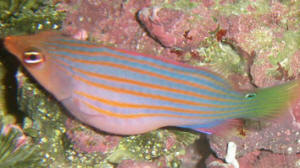
when we bought it (besides being healthy and growing big). The
stomach area looks like it could be pregnant... is this possible
since there is not pair of them? <Mmm, not pregnant... but
perhaps egg-bound...> Why would the stomach look pregnant? I
can't find any information on why this would occur. Any
information you could offer would be wonderful. We have attached a
picture so you can see what we are talking about (hopefully you can
see the huge belly). Thanks, Nick and Shar <Please read here:
http://wetwebmedia.com/marine/fishes/wrasses/index.htm for the
linked files above... and down to the Pseudocheilinus/Lined
Wrasses... Bob Fenner> |
|
|
|
Six-line Wrasse Disease?
5/23/07 Bob: <Hi, but not Bob, Chris here
with you.> I've had a six-line wrasse in quarantine for
2.5 weeks now. <Good> Animal was very healthy, eating well
- practically begging for food when he saw us. For the past week
or so it was swimming mostly near the top of the tank, but
seeming to do this to get a look at us & some possible food.
Monday night (5/21/07) we noticed what appeared to be velvet or
ich on the fish. <Bet you are glad you QTed him.>
Definitely white spots. That night, when the wrasse was resting
on the bottom of the tank, I noticed that it also looked like a
film was hanging off of the fish. Photo attached. <I believe
you are seeing the mucus cocoon that these fish create to sleep
in at night.> I treated the tank (10 gal) with 4 drops of
SeaCure copper treatment. Didn't want to give a full dose
just in case this was something else. <I would not treat at
all until you are sure of the diagnosis.> Next day, the wrasse
was still lethargic and resting on the
bottom. <Check your water parameters, copper can
wreak havoc on your biofilter.> <<This copper sulfate
solution is gone here... ab- and adsorbed... RMF>>
Didn't see the film hanging on the fish. Put 3 more drops of
SeaCure in the tank and have maintained it at
that. Did partial water change (10%) to get refuse off
the bottom of the tank. The spots are gone from the fish, but the
animal isn't eating and it is still
lethargic. <Part of the normal life cycle of the
Ich parasite, if that is what you think you have.> Fish swims
to different parts of the tank, but very lethargic. Strange film
still clings to the fish at night, but I don't notice it
during the day. <Normal> Can you please let me know if I
mis-diagnosed this fish and what might be bothering the
animal? Any treatment suggestions are greatly
appreciated. I'm also attaching a photo of a sack that
appeared in the tank when we first put the fish in quarantine. It
may be totally unrelated, but I thought it might help. <Is
unrelated unfortunately, and completely normal.> Photos were
taken 2 weeks apart, the sack is the first photo taken, sick fish
the most recent. Please let me know how I can help this animal. I
appreciate your advice. Michael Astfalk <Unfortunately the
from the picture I can't help you diagnose the white spots on
the fish. Give a look here for photos of some common
diseases. http://www.wetwebmedia.com/mardisindex.htm As
far as the "sack" is concerned, it is normal.>
<Chris> <<Is very likely Crypt.
RMF>>
|
Re: Six-line Wrasse Disease
5/24/07 Chris & Bob: <Hello> Thanks for
the reply. <Welcome> I read the article that you referenced
and found the Crypto article by Bob. Still have questions.
<Ok> So if it is ich, as Bob is suggesting, should I continue
with the copper treatments as I had started? <I would.> I
have the Seachem Copper treatment. <Make sure you have the
Seachem copper test kit as well, best to use the manufactures test
kit as well.> Salinity is 1.018 right now. Should I raise or
lower that? I typically do the quarantine at 1.012 and was
beginning to slowly raise it after the first week to get the fish
used to a salinity that would match the display tank (1.022). Temp
is 75F, should I raise this as the article
suggests? <Can raise it to 82 or so without any
problems. I would use the copper (testing levels daily)
and slowly raise the SG back to normal. It's best to
not mix treatments, way to stressful on the fish.> The fish is
mostly resting on the bottom. Doesn't seem to really be eating,
but it is still leaving droppings so I assume it is eating
something when we're not observing. <Probably, try some
meaty foods if possible, and see how it goes.> Should I be
concerned about this and what do I do so the fish doesn't
starve? Is this typical? <Not a good sign when a fish stops
eating, may need to use live brine to start it eating something if
it continues more than a few days.> Please let me know if I am
doing the right thing and if there is anything else I can do. I
don't notice the spots on the fish anymore. <You
are on the right path, watch the copper levels very carefully,
wrasse are not terribly sensitive to it, but you really do not want
to overdose. Even though you do not see spots they are
still there, treating the fish is the only way to make sure it is
ok. Daily water changes and consistent levels of copper
are what is needed here.> Michael
<Chris> |
| Re: Six-line Wrasse Disease
5/25/07 Chris: <Hello> I really appreciate
the response. <Sure> Unfortunately, the fish was dead when I
woke up this morning. I had done a 10% water change last night
since the ammonia levels had begun to rise along with the nitrites.
I was moving along exactly as you had described though - I was
raising specific gravity, watching the copper doses. I still have
questions though. <Ok> I'm about ready to throw in the
towel on this hobby. I've followed Bob's book, and I also
have Paletta's "New Marine Aquarium Book" which I had
started out with last year. I do the quarantine tank, but I'm
seeing almost 80% mortality rate to disease or stress/my errors.
About 60% of these are in the quarantine tank. I only pick hardy
fishes - Pajama Cardinals, Damsels, Firefishes, Ocellaris. It seems
like once I get them in to my quarantine tank they're destined
to die. The fish that I have in my display tank have been there for
8 months and are doing great. Only lost one in the tank since last
fall and that was probably due to some predatory instincts of my
spider crab (I suspect he ate my Clown Goby). <These also often
starve to death since they feed mainly on corals, and do not get
everything they need from most other foods.> How should I be
setting up my quarantine tank in order to have the most success? It
is 10 gal, no substrate, PVC fixtures & plastic pots
for the fish, and small bio sponge filter run by an air pump. I
break it down, typically, after each use and clean everything with
a bleach solution -including the filter. <Good> I then cycle
it back up again, usually doing low salinity
(1.012). <I would not do the lowered salinity, adds
stress and needs to be checked very accurately when it gets down to
that level. If you do continue this make sure to get a
refractometer and not a hydrometer, they are not accurate
enough.> I use some fish food (frozen food preparation) to get
the ammonia, nitrite and nitrate levels to rise. I will dose for
about a week with Stability to jump start the bio filter.
<Forget the Stability, get Bio-Spira, it works much
better. Must be kept refrigerated.> After
about 4-6 weeks, my ammonia is dropped but the nitrites stay around
.5 and the nitrates stay at around 10. <Might need
more media to allow the nitrite to get to 0.> Any dealer I talk
to says that I need to have something living in the tank in order
for it to cycle. <Nope, just an ammonia source, which
the food provides.> I simply don't know what to do, so I
purchase a fish. <Are you getting all the fish from
the same store, or maybe the same suppliers. Might want
to try mail order and see if you get better luck. All
stores and related whole-sellers are not equal.> Am I maybe
having such bad luck by trying to cycle the tank with a fish?
I'm not sure what to do. Someone else suggested moving live
rock from the display in to the quarantine tank, cycle it, then
take it back to the display. <Doesn't work.> I'm
leery of this because I don't want to be using things between
the two tanks. <Smart.> Could my bio filter be bad since I
bleached it? <No, bleach has a pretty short life, usually
inactive after a few days. If concerned add some
chlorine remover to the tank.> Could the copper treatments from
the last two times have ruined the filter? <As long
as you replace the media you should have no problems.> I read
articles on setting up quarantine tanks, but I haven't found
anything that describes how to keep it going & maintain
it. <Basically water changes and more water
changes. Sometimes they need to be done daily.>
I'm really looking for a good check list/guide to help me
maintain it. <Have you read Scott's article, as
close as we have to a checklist. http://www.wetwebmedia.com/QuarMarFishes.htm
.> Your advice is appreciated. Thanks. Michael <Stick with
it. I bet if you use a more "normal" SG your
results will improve. Good luck.>
<Chris> |
|
 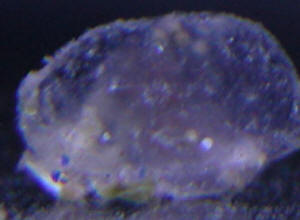
|
| Wrasse with swollen lips 3/10/07 Hello,
I have a sixline wrasse with what I believe is a bacterial
infection. <Mmmm> I am in college so my parents take care of
my fish while I am away. While I love my parents they never seem to
alert me to these problems while I am away, so I have no idea how
long this has been going on. Now that I am home for spring break, I
have transferred the sixline to an established quarantine (31 ppt
salinity, 0 ammonia, 0 nitrate, 0 nitrite, 8.3 pH) after trapping
him in a plastic container to observe and possibly treat the wrasse
with a pH adjusted freshwater methylene blue dip. I am hesitant
because I had trouble making a diagnosis from the mostly-vague
disease descriptions that I found in my available books and web
resources. I have attached photos of the wrasse's mouth. <I
see these> The wrasse also has some raised patches of light
white on its body and is twitching slightly. Although he is eating
Mysis shrimp and flake food well I have not seen any feces as of
yet. If you have any ideas as to what the affliction is and
possible courses of treatment please let me know. Thank you,
Caitlyn <Is not really a disease as in an infectious or
parasitic affliction... not pathogenic... But, skipping ahead, this
is not an uncommon "developmental" condition from this
specimen being damaged in capture, shipping, handling, perhaps a
trauma in your system... The long and short of it, is that this is
not "treatable"... but the specimen looks healthy
otherwise. I would not "treat" it. Bob Fenner> |
|
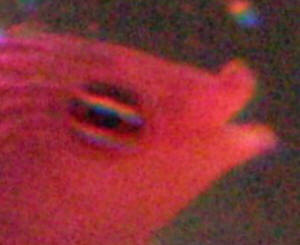
|
| Re: Wrasse with swollen lips 3/10/07 Hi
Again, Thank you for your quick reply. I do not know what to say as
the wrasse's condition has deteriorated greatly overnight, upon
observation this morning its face was completely swollen with some
rough growths. <Yikes... I obviously "spoke"/keyed too
"soon"... perhaps there is something else at play here...
Though I stand semi-firmly by my guess as to primary cause here.
Mechanical injury> I performed a 50 percent water change
although water quality had revealed nothing. The fish is breathing
heavily and lying on the bottom of the QT. The fish's condition
has worsened extremely since I have been home. Still nothing I can
do?? Please help, I do not think this is only stress. <I
don't think there is anything efficacious you can actually do
at this point. Such "developments" almost always quickly
progress at this stage to death... sorry to state. BobF> |
Sixline wrasse 1/1/07 Hey, I purchased a
sixline wrasse about 3 days ago. My water parameters are all
fine. <Numbers next time, fine is relative.> But
anyway, my wrasse is active and eating and seems do be doing well. My
problem is that on the wrasse's left side, past the
gill, there is discoloration. I don't know how to
describe this, it just seems like a patch of discoloration on the skin.
Please get back to me with any ideas of what this could be, thanks a
lot, Mael <Could be lots of things, physical damage, beginnings of a
nutritional deficiency, disease, or just normal genetic
variation. Hard to be specific without more information and
a picture.> <Chris>
Hawaiian Fourline Wrasse w/ white
spots 7/23/06 I have a question about my Hawaiian Fourline
Wrasse (Pseudocheilinus tetrataenia)... He's been in my reef tank
for a little over a year, and over the last few weeks, when the fish
wakes up in the morning, he has small white spots on his body and fins,
30 or 40 spots total. These spots resemble grains of salt, and within 3
or 4 hours of the lights coming on, they are all gone. <Is
Cryptocaryon> I am wondering if these are just pieces of
sand & debris that the fish picks up when he hides or buries
himself at night? <Mmm, no> If so, I don't know why they
would suddenly appear after a year's time? <A latent,
space-infested problem...> If they are a skin parasite or some sort
of infection, then why would they disappear every day? <Improvement
in the diurnal resistance, immune system of the host... the spots are
not the parasite... the parasite not the spots... but the resultant
irritation marks...> The Hawaiian Fourline Wrasse it acting normal,
and has a healthy appetite. He is not being harassed by any
other fish or invertebrates. All of the other occupants of the tank
appear completely healthy. Water parameters: pH - 8.3 Nitrite, Ammonia
- 0 Nitrate - undetectable Calcium - 410ppm dKH - 11 SG - 1.026
Temperature ranges from 81.7F-83.1F daily Thank you in advance for any
advice, Steve in Denver <Could be that you might get by with this
"ping-ponging" situation for years hence... Much more likely
"something/s" will change to shift the balance in the
parasites favor... see WWM re Crypt... what you might do/consider for
actual eradication. Bob Fenner>
My 6 line wrasse needs help 2/1/06 I am
trying to save a 6 line wrasse I bought about 4 weeks
ago. It had a large abdomen at the time but seemed otherwise
healthy. Over the last few weeks its abdomen has swelled
greatly. Its now has severe buoyancy problems, it tries to
wedge its self to stay upright and flips upside down if not moving. Its
vent is inflamed, and at times a thick ivory colored mass seems to
protrude then retract. I am treating with MelaFix <Worse
than worthless> in a hospital tank, and suspecting an intestinal
worm or other parasite. <Maybe> The fish is still eating
well. Is there any thing I can do to help this fish or
is euthanasia the best option? Thank you for your help,
Kim <Only if in your opinion the animal is
"overly" suffering. I would add a level teaspoon of Epsom
Salt per ten gallons of system water here... and see if "this too
passes". Bob Fenner>
Re: my 6 line wrasse needs help 2/2/06 Hi
Bob, Thanks for the response! I will try your suggestion, I hadn't
considered Epsom salt. <A very useful, inexpensive,
readily available, safe cathartic> I did use Prazipro last night,
which is fish Droncit and ordered Discomed on line last night when no
one in town had it. I gave a brief, 2-3 minute dip, which it
didn't seem to enjoy much as it thrashed about, I removed it when
its breathing became labored. But right away worms
began being expelled. <Interesting> They were almost
½ inch long, very thin on one end with the thicker part the
last to come out. <Likely either nematodes or acanthocephalans>
One was still alive but died right away. I looked at it under a
microscope and didn't see any obvious segments. <Cutting a
coronal section near the distal (head) end and looking end-on may
reveal a roundworm definitive triradiate esophagus> The fish abdomen
was much smaller this morning and it seems a bit better able to
maintain its balance. Two more questions if I may: If it survives, I am
wondering how I will know when it is "cured" and safe to go
into a tank? <A few weeks...> This is my first
experience with this problem, so I am also wondering how infectious
this type of problem can be? <Mmm, as in
spreading to other fish species? Not very in general... and all fishes
(and humans for that matter) have gut and parasite fauna> I had
hoped the MelaFix would help with the vent inflammation, I take it your
not a fan. I will stop using it today. <I would
(stop)> Looking forward to seeing you again at the WMC, Morgan tells
me he may be coming as well. It should be a great
time. Thanks again for your help. Kim <Will indeed... and twill be a
hoot. See you then/there. Bob Fenner>
Re: Much improved but still has balance
problems... 2/7/06 The 6 line wrasse I wrote you about
is doing much better, the swelling is about gone. Tomorrow
will be 1 week on the dewormer so I plan to stop that treatment.
<Good> I have been using the 1 tsp per gallon Epsom salt
treatment as well. The only remaining symptom is the balance
problem. This hasn't gone away.
<May, with time, or no> Other than a few more days on the Epsom
is there anything else you would suggest to correct this problem?
Thanks, Kim <Only good nutrition and water quality... and precious
time going by. Bob Fenner>
Six-line wrasse in trouble
WWM Guys, I wish my own GP physician were as helpful, available and
funny as the WWM Guys. My six-line wrasse, who has done so well for 3
weeks, feeding and gliding through the rocks, is suddenly doing
barrel-rolls as if he has no equilibrium. The rolling began yesterday.
Tank conditions good--90 gallons well skimmed with a Euro-Reef, no
ammonia or nitrite, ph 8.4, SG 1.023, temp 78F. Clown, Yellow Tang,
Blue Damsel and Heniochus are all well, as are corals, peppermint
shrimps, snails, stars and crabs. Just the wrasse. No marks of damage,
fins look intact, no bulging is apparent (he has stayed in the rocks
and has been hard to examine, but he seems ok). No aggression shown to
the small wrasse--even the clown tolerates him in the anemone. No
unusual additions to tank--just routine B-ionic dosing weekly
Lugol's, weekly 5 gal water change, all (except B-ionic) done 3
days prior to symptoms. Any ideas of what is going on and how to
correct will be greatly appreciated. <my friend...please accept our
apologies for the delay in reply. Bob is still in Australia and I was
out of town for several days at a conference. Poor Steve got stuck with
all of the mail by himself for several days there. Please do update us
about this situation if we can help... although from the description, I
suspect it is already dead... dreadful symptoms. Best regards (and
thanks for the compliment about our humor) Anthony>
Pyjama/Six line wrasse Hi Bob I wonder if you could offer me
some advice. I have been reading your website articles since last
December when I setup my very first marine tank (I have been a tropical
freshwater fishkeeper for about 5 years) and would like to say (like
most people do) that I appreciate the time you put into sharing your
knowledge. It is very helpful. Back to the tank, here is what I have:
Juwel Trigon 350 litre with internal filter box/heater etc -replaced
the standard tubes with 3 Triton HO and 1 actinic Eheim 2226 canister
filter Eheim 1060 pump powering Remora C Pro skimmer Vecton UV15 fed
from 2226 <Nice gear> it was cycled for 10 weeks and tested
religiously and after that period I bought my first fish: 2 Yellow
Clarkii Clowns 1 Pyjama/Six Line wrasse <Good choices> The fish
have been living in the tank for almost 2 months now and all appear
very well and colourful, feeding well, becoming more and more confident
and I am very happy with their progress. I do weekly 10% water changes
and water tests and the parameters are so (at each recorded test):
Salinity 1.022 Temp 25c Nitrite 0ppm Ammonia 0ppm Nitrate <12.5ppm
PH 8.3 As I said everything is going well but I have one concern about
the PJ wrasse. Although he appears fine in every way I can see he
occasionally rubs against a rock. By occasionally I mean like 1-2 times
per day, when I am around (normally for 6 of the 12 daylight hours).
<This is normal. Not a worry> I have inspected all of them (and
continually do so) and can see no spots, dust like films or anything
out of the ordinary. The only thing I can see on the wrasse is 2 small
patches on one side which are very slightly less coloured than the rest
of him. These don't seem to get any bigger and could be described
as neither ich or velvet symptoms (at least from what I can see). By
that I mean they aren't spotty, couldn't really be described as
white or gold or even dusty. <Natural coloration likely> Do you
have any ideas or am I worrying about nothing? I did read the parasite
FAQ on your site but couldn't really find anything that fit the
bill. I am preparing my quarantine tank to buy my next fish but
don't want to buy it until I am sure of the main tank being problem
free. <Your relating shows nothing of danger, error. I would proceed
with other livestock additions if you so desire. Bob Fenner> Thanks
Andrew
Re: Pyjama/Six line wrasse Hi thanks for the very quick
response and reassuring words. I will monitor him this week and then
buy my next fish. Thanks! Andrew <Excelsior! Bob Fenner>
Pyjama wrasse Hi again Bob <Hello> you may remember I
wrote about an "itchy" pyjama/six line wrasse the other day.
I told you that at the time I could see nothing whatsoever on him apart
from some slight discolouration which you believed to be natural.
<Yes> Since then I have been away on a business trip and returned
for my girlfriend to tell me that he had a swelling and raised scales.
<Not good> On looking very closely, in fact he had a patch
(reddish colour, like a blister) which could be described as a lesion
(maybe from rubbing against the rocks?) and his scales are a little
raised. This patch is about 1/2 inch square on his side. Since then a
small white "thing" (technical term :-) ) has grown out of
his scales. It is not a spot as in ich or anything like that and from
all my site searching (including WetWebMedia) I have concluded that
this is Lymphocystis. It appears like a small piece of shell stuck in
his side for want of a better description. <Yikes> My question is
(sorry about the long winded description), am I right with my
diagnosis? Also what is the best thing to help him along to
recovery? <I do suspect this is resultant from a mechanical
injury (a bump or bite...)... perhaps some sort of secondary bacterial
involvement> I know there is no direct cure but that good water
quality (everything is stable at sg 1.022, ph 8.3, temp 25c, nitrite
0ppm, nitrate <12.5ppm, tested weekly with 10% weekly changes) and
feeding antibiotic food additives is helpful. Any specific feeding
suggestions? I am based in the UK so any internationally sold brand
recommendations would be gratefully received. <I would likely
continue as you are doing... perhaps add a cleaner organism to the
system, (see WetWebMedia re choices) augment the food with Microvit,
Zoecon soaking, otherwise keep the system stable. Of the "lined
wrasses" the hexataenia can be easily lost through manipulation
(compared with four, eight... lined species). Bob Fenner> Thanks
again Andrew
Re: Pyjama wrasse Wow, once again thanks for the fast
response. I will let you know how I get on with him, at the very least
I don't think he is suffering (he has ceased rubbing and is feeding
well, swimming well and trying to attract attention when people are
present like normal with his amazing swimming patterns!). I am off to
buy one of the medications and will consult the site for a suitable
cleaner. Thanks!!! Just one little question I thought of, do I have to
quarantine cleaner shrimps etc or can inverts not carry ich/velvet etc?
what do you recommend. <Please see the site re this issue as well. I
don't quarantine, and very carefully acclimate such crustaceans.
Bob Fenner> Sorry to continue to question you. Andrew <Study and
then apply yourself my friend>
Bloated 12 line wrasse 3/20/03 Please help. I have
a 12 line wrasse that I have had since tank inception in Oct. of last
year. It is a 55 galloon tank, with plenty of live rock.
He/She survived a bout with some parasite which knocked off everyone
else. He survived for 4 weeks in our quarantine tank as we recycled the
big tank. He survived the introduction of other tank members into the
quarantine tank, as well. This guy is usually pretty
tough. <agreed... a durable species and genera> Three
days ago he bloated up like crazy. Fins sticking out, the
whole nine yards. <did the scales distend as well
(looking like a pinecone) or was it simply bloated. If it looked like a
pinecone, there may be more serious consequences (Dropsy). Either way,
please dose the QT with Epsom salt (as from the pharmacy) at the rate
of 1 Tablespoon per 5 gallons. Repeat with a half dose on the third
day. If no improvement by then, you may need to run a broad-spectrum
antibiotic> It has not affected his eating or buoyancy in the
least. I see no signs of eye popping, either. I
found him sitting on the bottom once in the past few days, but he
doesn't seem to need or want to stay there. As usual, he
goes to bed (believe or not) before the other fish (around 9 pm) and
comes out to eat around 8 am. He looks horrible, but
doesn't seem to be bothered by it. <the main display
can be dosed with Epsom salt just the same if need be... its a common
element of foods and sea salt (hardens water too)> We quarantine
tanked all of the other members of the tank - two clowns, one Kole tang
(who eats like crazy), one long nose hawk, and one fridmani
Pseudochromis - before we moved them all to the big tank. We
feed a combination of frozen blood worms, Emerald entrée,
Mysid shrimp, brine shrimp (which I recently read is pretty worthless),
<low nutritive value to be sure> and some seaweed for the
tang. I am concerned about the wrasse, but obviously about
the other guys as well. Any suggestions? <do
try the Epsom salt and use the google search tool with that word/phrase
to search our site for other FAQs on it for perspective> We
haven't moved him back to the quarantine tank because the last time
we did that we had to break down the entire tank to catch
him. Additionally, the tang and fridmani are two week old
additions and we don't want to freak them out. Please
advise. Pamela <the Epsom salt helps many animals
(including people... used as a laxative) regulate body fluids. If its
going to work, you should see improvement by the third day. The are
many causative agents for bloating. Best of luck... and do let us know
if it works or if you need more advice. Anthony>
- Sixline Problems - Hello gents, everyone out there had a
wonderful Thanksgiving. <I did, thank you for asking.> I've
had a six-line wrasse in QT for about 3 weeks now. It's
eating good and seems to be active. The problem he has
developing is that his mouth is receding back on his top jaw.
<Likely from an injury.> It is an increasing thing, he still can
and does eat very well, but I know from having one before that is not
how they look, clearly not the normal pointed snout that this wrasse
should have. Does this sound like anything to you guys and do you have
any remedies for it, thanks <It could be either an injury, which
will heal in time or it could be a genetic defect which happens from
time to time, and won't heal - you'll just have a
unique-looking six-line wrasse. As long as it is getting along and
eating well, I say no worries. Cheers, J -- >
- Sixline Problems, Follow-up - Thanks, I would probably
agree that it is a genetic defect, but it has gotten worse from the day
I got him, he almost has no upper mouth lip. <Well, again... as long
as this fish is eating and staying out of harm's way, this
will/should heal - it sounds to me more like a wound, but had to throw
out the genetic defect because these things do happen often enough.
Still, these fish are pretty tough customers for their size and should
fare well given a good diet and enough quiet time to recuperate.
Cheers, J -- >
Sixline Wrasse Questions (6/2/04) Hello- <Steve
Allen tonight> I just got a sixline wrasse a few days ago, and I
noticed that my Firefishes tail has been pretty well chewed up a bit. I
was wondering if the sixline wrasse was going to create a bigger
problem for my Firefish? <Sixlines can be rather aggressive at
times, and Firefish, being shy, are easy victims.> The strange thing
is, I haven't seen them fight each other, they seem to kinda ignore
one another, so I don't understand why this happened. <You never
know what they're doing the 23 hours per day you're not
watching them. You may need to watch for longer periods ad different
times of day and in different light conditions to know what's
really going on.> Another thing I noticed on my wrasse was one small
white dot. could this be ich? <Unlikely if only one spot, but watch
or more.> My other fish doesn't have anything on it. The white
dot is on the tail and seems to have come loose a little bit, it kinda
moves when the wrasse moves-I-s this ich, or something I should be
concerned about? <Could be Lymphocystis--read about this on WWM
& look at some pictures.> Thanks, Heather <Hope this helps.
Steve Allen>
Sick Sixline Wrasse? >I recently purchased (6 days
ago) a sixline wrasse. I have been waiting for months for my LFS to
get one in, so I jumped at the chance to get it. I was in a rush
this particular day, otherwise I'd have set up a QT Tank, which
I have used before with great success, and now I think I'll be
kicking myself for not doing it this time! >>You and me both,
eh? >Anywho, The fish is acting and eating normally, but I
sometimes see some white patches on its left side (and ONLY the
left side) sometimes they appear to come and go, I think they may
POSSIBLY, look a little raised from the rest of the fish but I
cannot validate this for sure. >>Probably moving too quickly
about, which is a general sign of health as long as he's not
spending an inordinate amount of time flashing. >Also its mouth
looks to be white as well. I don't see any "cysts" on
the fish, so I'm thinking it could possibly be velvet.
>>No way, not affecting one side only, and NOT if the fish is
behaving normally! Also, something as virulent as velvet
(and often Brooklynella) will kill within a day or two of first
onset of symptoms. Do look at our velvet and marine
parasitic disease articles and FAQs for more extensive descriptors.
>Also on the top fin, I think some of the tissue between the
rays is missing. Overall, the fish does not look to be in terrible
shape, but who knows when it could take a turn for the worse.
I've already set up my Eclipse 6 QT just in case he needs to be
pulled and treated. I already know, I may not be able to return him
to the display for up to 4 weeks. >>4 weeks is a minimum, not
a maximum. When quarantining or hospitalizing any fish,
the standard protocol is 30 days *disease free*. >Sorry for
picture quality, but this little guy can move! Any ideas?
>>Not really helpful ones. Though I have no idea
whether "sidedness", a preference for one side or the
other, is present in fishes, I would say that if it were any other
animal that I think he's "worrying"
himself. Watch his swimming patterns, if they're
constantly repeated, like a horse pacing its stall, then the fish
may be feeling cramped or otherwise stressed. This could
also be an individual coloration issue - the pictures seem to show
what looks like about an 1/8"x1/4" stripe or patch
located just under the dorsal fin on
the midline. Whitening or darkening of colors
could indicate stress, aggression, mating call (doubtful at this
point), any number of things. Also, you give no water
parameters, and without that I can't offer up anything
more. Marina >Thanks again for everything you do for
our hobby! I'd still be an "un-ethical" fish keeper
if it wasn't for you!
Daniel |
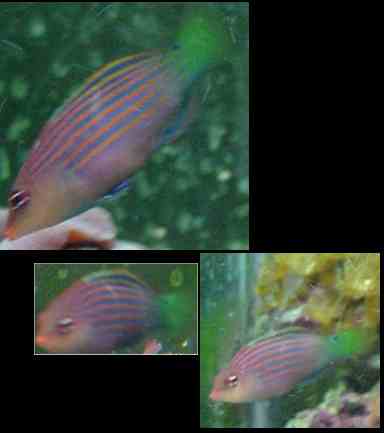 |
| Reader Input Re: Patchy Wrasse >Long time listener,
first time caller. In regards to "Daniel" who asked about
his sick sixline wrasse, I too had the same issue. His pics, while
blurry, look just like my new sixline. I was told by my LFS that
they had already guaranteed the animal for 4 weeks and I had
nothing to worry about. Live and learn on that issue. My params
were all in the normal range and nitrites, nitrates, and phosphates
were all undetectable. I thought he was a goner but I performed a
couple of small water changes, fed various Selcon soaked frozen
foods and in 3 weeks time, all of the patches were gone. Scott
>>Great, thanks for the input, Scott! Marina |
What's That Spot On His Wrasse? Hello, <Hi!
Scott F. here today!> I have a small sixline wrasse, maybe 1.5
inches in length. When I got him he seemed fine, then I noticed a small
white, raised dot above the false eye on his tail fin. A day or two
after, he and the clowns with him got ich. <Grr...Frustrating. Did
you quarantine him upon purchase? Be sure to do this in the future if
you aren't engaging in this practice now, okay?> Well, I treated
hyposalinity for 6-7 weeks, the clowns and wrasse cleaned up nicely,
except for that one spot which seems to disappear sometimes, but always
returns to the exact same spot . I have raised the salinity in the
hospital tank from the hyposaline 1.007 to 1.015, and will be moving it
up further to transfer my clowns back to the tank. However the spot on
my wrasse remains, although he is eating well and looks very healthy
otherwise. So my question is, is this spot actually ich or just a
raised coloring of some kind? I've noticed the same spot on other
pictures of sixline wrasse. <Funny you should mention this. I had a
Sixline for years that always had a similar bump on this spot. It never
went away, and never got worse. Does that mean it was nothing? Probably
not. On the other hand, it was not contagious, nor did it annoy the
fish in any way. I'd keep a close eye on the fish anyways, just to
make sure that things don't decline> Anyway, my plan is to
maintain the hospital tank at full salinity for another week or two
with just him in it, and see if he develops ich, if he doesn't then
I will transfer him back to the main tank. <I won't argue with
that strategy. Better to be safe than sorry, and certainly better to
make sure that the fish is, indeed ill before "treating"
him> Do you have any ideas or suggestions regarding this spot?
<As you are doing: Observe carefully, and treat only if it becomes a
problem. Take care! Regards, Scott F.>
Mysterious 6-line wrasse death Hi Crew, <Greg> I hope
you enjoyed a wonderful holiday season! <Yep, lots of projects,
visitings...> During my vacation, I took the opportunity
to purchase a 6-line wrasse (Pseudocheilinus hexataenia) and two
firefish for my 180g reef. These fish have been in my 20g QT
for 2 weeks and all appeared to be doing well (all eating flake food
well) -- that was until this morning when I discovered the wrasse was
dead. <Mmm, well, one thing... flake food of any sort is not
"that" nutritious...> Yesterday I did notice the wrasse
was very still (but still very alive), under a piece of PVC tubing. I
do not understand what would have caused this fish to die. <Stress
is easily a component here as well> It had no visible
spots, fungus, worms, etc. and it had a good appetite. It
had no nipped or cloudy fins (or eyes) and it did not appear at all
emaciated. Do 'special' considerations need to be
made for 6-line wrasses in QT? <Best to supply with a bit of live
rock, some live and/or meaty food> This is a bare-bottom tank with
only a few 1' PVC pipe fittings and some red Gracilaria for
cover. Although the firefish did occasionally swim at the
wrasses with its mouth open, I never noticed actual contact and they
would typically even share a flake of food. I would really like to add
a 6-line wrasse to my reef tank to control flatworms and because I
really enjoyed watching this fish in my QT but I am concerned about the
cause of this death after two weeks in QT. A secondary
concern is the effect this fish could have on the 'pod population,
since I already have a mandarin in my main tank. I do have a 50g
refugium (5' DSB + LR. + Caulerpa & Gracilaria) attached to the
180g tank to help with 'pod stocking. <This size system and
refugium can easily support both/all these fishes> My main tank also
contains about 200 pounds of LR. and 2' of
aragonite. Considering this, do you think it would be a
problem to add a 6-line wrasse to my main tank (assuming I can get it
through the 4 week QT period)? <I am inclined to suggest an extended
bath/dipping procedure in lieu of actual quarantine. There are other
folks here that are staunch four weeks or heck re quarantining, but I
am of the opinion and experience that many smaller, shyer species of
fishes are worse off for the experience... gobies, blennies, small
wrasses included> Lastly, I would also like to add a H. chrysus or a
H. iridis. Would either of these fish live peacefully with a
P. hexataenia in my reef tank? <Yes, both these
Halichoeres species are fine here> Would two wrasses begin to cause
the 'pod supply to dwindle for the mandarin? <Would put a dent
in it, but I say go ahead> As always, thank you (in advance) for the
terrific advice! --Greg <Happy to proffer it. Bob Fenner>
|
|

