|
Related FAQs: Moray Eels,
Morays 2,
Moray Eels
3, Moray Identification,
Moray IDs 2, Moray IDs 3, Moray
IDs 4, Moray IDs 5, &
Moray Selection, Moray Behavior, Moray Compatibility, Moray Compatibility 2, Moray Compatibility 3, Moray Compatibility 4, & Moray Systems, Moray Feeding, Moray Disease, Moray Disease 2,
Morays and other Eels
& Crypt, Moray
Reproduction, Freshwater Moray
Eels, Zebra Moray
Eels, Snowflake
Morays, Other Marine
Eels, Conger Eels, Freshwater Moray
Eels,
Related Articles: Moray Eels Bite, But Are They
Venomous? by Marco Lichtenberge r,
The Hawaiian Dragon Eel
Enchelycore pardalis by Marco
Lichtenberger,
The Zebra Moray (Gymnomuraena zebra) by Bob Fenner
Ribbon Morays by Bob Fenner
The "Freshwater" Moray
Eels, Freshwater Moray Eels
by Marco Lichtenberger,
Non-Moray Marine
Eels, Snake & Worm
Eels by Bob Fenner
The Diversity of Aquatic
Life Series
The Moray Eels,
Family Muraenidae, pt. 2, Less Aquarium Suitable
Species
To: Part 1
|
|
|
By Bob Fenner
|
|
Species to Generally Avoid:
I know I'm going to get heat for this section as
usual. There are folks who have had Moorish idols that thrived on
banana chips; still others carrying on clairvoyant relationships with
their Ornatissimus butterflies. I've seen this, have mercy! But for
most of us mere mortals the following does hold true.
|
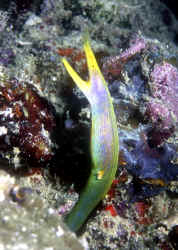
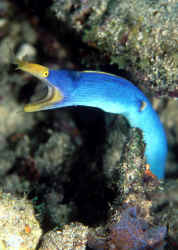
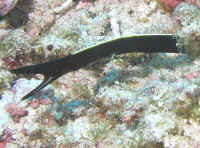
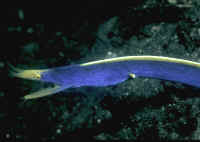
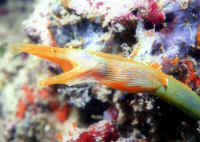
Rhinomuraena
quaesita Garman 1888, the Ribbon Moray Eel. Ninety nine
percent plus do not live a month in
captivity. Most starve, refusing all food. Next most common
category of loss is escape through the smallest of top openings,
or plumbing. Last is "simple stress".
The written record shows some people's success
with netting food and eel together and shaking, training on
select live skewered items; but most black to blue to all yellow
female ribbon morays perish within a short while. You've been
cautioned. Rhinomuraena quaesita: Fiji image at right or a
changeling female and male. Below, a juvenile (black) and male in
N. Sulawesi and a female in Mabul, Malaysia. Females are mostly
to all yellow in color.
|
|
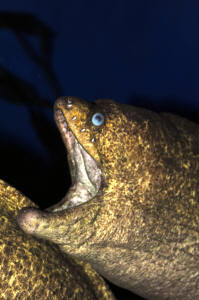
Most Gymnothorax species get too big, are too
aggressive and strong for all but the most humungous systems. If
you're going to try these, watch your fingers, tankmates and lock
(yes, lock!) that cover down. For cooler water species, do invest in
and run a chiller. species get too big, are too aggressive and strong
for all but the most humungous systems. If you're going to try
these, watch your fingers, tankmates and lock (yes, lock!) that cover
down. For cooler water species, do invest in and run a chiller.
Too often offered to the hobby are the Atlantic green
G. funebris, to eight feet! Others include G. javanicus,
the Javan or Giant Moray (to ten feet!) and G. flavimarginatus
to a mere four feet.
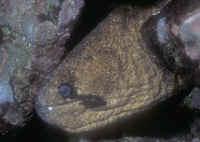
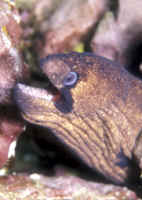
| Gymnothorax breedeni McCosker & Randall
1977, the Blackcheek Moray. To a meter in length. Indo-Pacific,
sporadically distributed on many island rocky reefs. Very numerous
in the Marquesas. Nuka Hiva pix. |
|
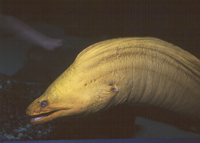
| Gymnothorax castaneus (Jordan & Gilbert
1883), the Chestnut Moray (to science) or Morena Verde. To
150 cm. Eastern Pacific; Sea of Cortez to Ecuador, including the
Galapagos, particularly the northern islands of Darwin and Wolf.
Aquarium image. |
|
Bigger PIX:
The images in this table are linked
to large (desktop size) copies. Click on "framed" images
to go to the larger size. |
|
%20MD.JPG)
|
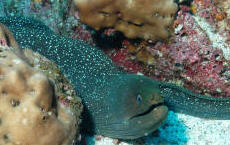
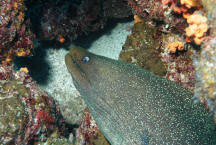
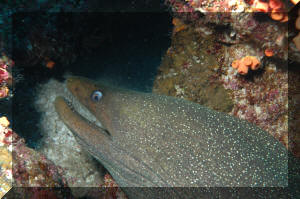
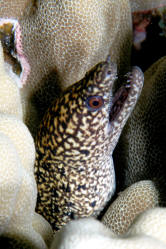
| Gymnothorax dovii (Gunther 1870), the
Speckled or Fine-Spotted Moray. To 150 cm. Eastern Pacific;
Sea of Cortez to Ecuador, including the Galapagos, particularly the
northern islands of Darwin and Wolf. Wolf images. |
|
Bigger PIX:
The images in this table are linked
to large (desktop size) copies. Click on "framed" images
to go to the larger size. |
 |
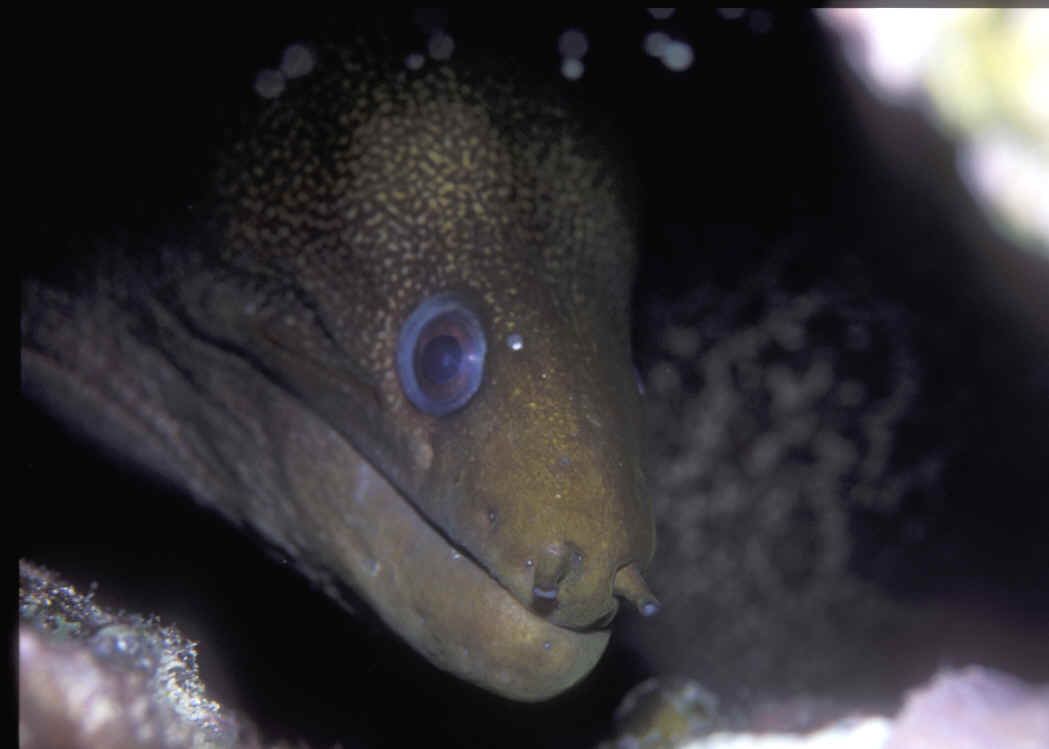
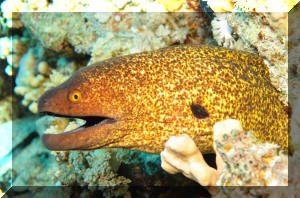
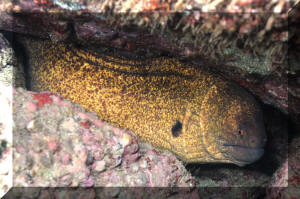
| Gymnothorax eurostus (Abbott 1861), Stout
Moray. Light brown with gold spots, tubular nostrils. To about 2
foot in length. Indo-Pacific. Most common
moray species in nearshore Similar to the also common Yellow-Margin
Moray, but with a more pointed snout and dark spots on the forward
half of the body. Hawaii pix. |
|
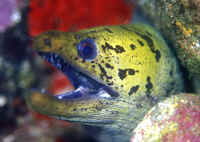
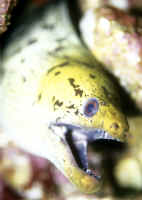
| Gymnothorax fimbriatus (Bennett 1832), the
Fimbriated Moray. To 80 cm. (32 inches) in length. Indo-Pacific;
Madagascar to Society Islands. Feed on fish and crustaceans at
night. Nuka Hiva, Marquesas, Polynesia pix. |
|
Bigger PIX:
The images in this table are linked to
large (desktop size) copies. Click on "framed" images to
go to the larger size. |
|
|
| Verticals (Full/Cover
Page Sizes Available) |
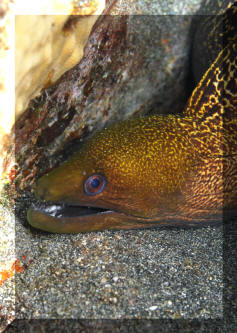 |
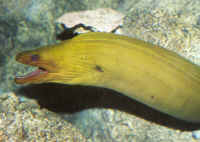
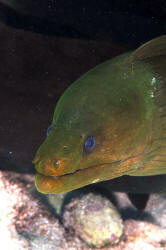
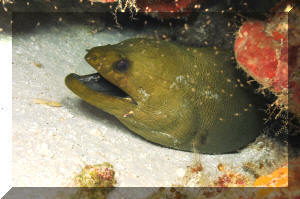
| Gymnothorax funebris Ranzani 1840, the Green
Moray. Tropical Eastern and Western Atlantic and Eastern Pacific.
To about eight feet in length (250 cm.) and 29 kg. A dangerous
biting Moray that mainly eats crustaceans and fishes in the wild...
most everything in captivity. Best left in the sea or the
occasional public aquarium display where this shot was
made. |
|
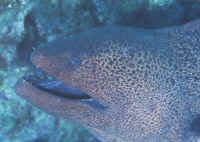
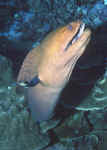
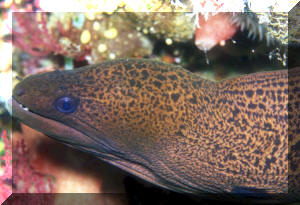
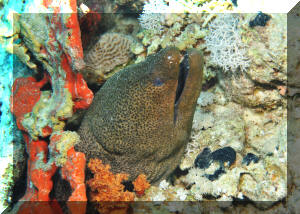
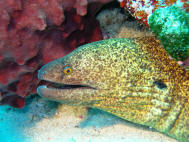
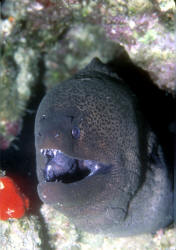
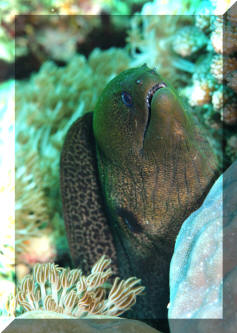
| Gymnothorax javanicus (Bleeker 1859), Giant
Moray. To ten feet, 3 meters in length. Indo-Pacific; Red Sea, East
Africa to Hawai'i. Feeds principally on fishes, secondarily on
crustaceans. Largest Moray species according to Fishbase. Shown
here in the Red Sea and Polynesia. |
|
Bigger PIX:
The images in this table are linked
to large (desktop size) copies. Click on "framed" images
to go to the larger size. |
.JPG)
 |
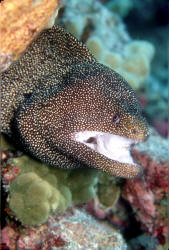
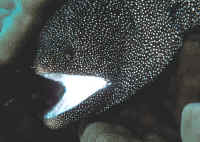
| Gymnothorax meleagris (Shaw & Nodder
1795), the White Mouth Moray. Brown to black with numerous white
spots. Dark spot around gill opening. Indo-Pacific. Most common
Hawaiian puhi/moray. To about forty inches in length. Hawai'i
image. |
|
Bigger PIX:
The images in this table are linked
to large (desktop size) copies. Click on "framed" images
to go to the larger size. |
|
%20MD.JPG)
%20MD.JPG)
|
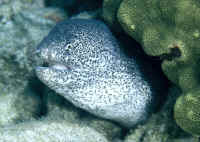
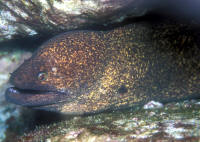
| Gymnothorax pictus
(Ahl 1789), the Peppered Moray. Indo-Pacific; East Africa to the
eastern Pacific, Hawai'i. To five feet in length. This one off
Kona. |
|
Bigger PIX:
The images in this table are linked
to large (desktop size) copies. Click on "framed" images
to go to the larger size. |
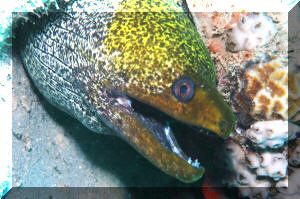 |
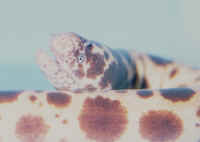
| Scuticaria tigrina Lesson 1830, the Tiger
Reef Eel. Indo-Pacific; East Africa to the tropical eastern
Pacific, including Hawai'i. To 120 cm. in length. Secretive,
nocturnal. Found foraging between rocks at night. Aquarium
photo. |
|
Other Morays:
With eleven genera and roughly 165
described species, you can be sure to see an "oddball" Moray
eel if you keep your eyes open... Know what you're getting into if
you intend to try one of these unknowns... At least look up the species
in ICLARM's Fishbase (www.fishbase.com) under the family name,
Muraenidae... to gain some insights into how big the species gets, what
it eats...
About Freshwater
Morays:
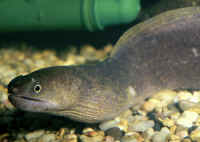
| There are some
species of muraenids that occasionally enter freshwater in tropical
and temperate areas. Click on the link above for
coverage. |
|
Conclusions:
The favored species mentioned make excellent aquarium specimens, a
majority of individuals adapting to aquarium care easily, readily
accepting prepared foods, neither launching themselves out of your
system, nor sampling their tankmates or your hand when doing routine
maintenance. Once acclimated to a tank they prove durable, disease
resistant pets.
Other moray species are problematical, growing too large, escaping
even the most heavily covered tank. Many starve outright refusing all
food, others consider all within their capacious jaws as fair game.
Forewarned is forearmed. The vast majority of muraenids are suitable
only for public aquaria or visiting in their
domain.
It is my opinion that morays provide predatory pressure
in a role similar to several sharks, cleaning up the reefs by eating
weakened, damaged prey. They should be there.
Bibliography/Further Reading:
Axelrod, H.R., Burgess, W.E. & R.E. Hunziker III.
1990. Atlas of Aquarium Fishes, Vol. 1 Marine Fish. T.F.H. Publ. Inc.,
N.J..
Campbell, Douglas C.. 1980. Morays, the Ever Popular
Eels. Freshwater and Marine Aquarium. 10/80.
Castro, Alfred D. 2001. A freshwater moray eel? AFM
8/2001.
Chlupaty, P. Undated. The Leopard Moray, an exciting yet
beautiful predator. Aquarium Digest Intl. #37.
Esterbauer, Hans. 1994. The Ecology & Behavior of
Moray Eels. Tropical Fish Hobbyist. 2/94.
Fenner, Robert. 2000. The Zebra Moray Eel,
Gymnomuraena zebra. FAMA 7/00.
Fenner, Robert. 1995. Moray eels of the family
Muraenidae. TFH 3/95.
Gonzales, Deane. 1976. Puhi (Eel in Hawaiian). Marine
Aquarist. 7(7):76.
Hemdal, Jay. 1986. The Ribbon Eel (Rhinomuraena
quaesita). Freshwater and Marine Aquarist. 2/86.
Howe, Jeffrey C. 1997. Original Descriptions (column).
Siderea flavocula Bohlke and Randall 1996. FAMA 12/97.
Margaritas, Anargyros. 1988. Sea Serpents in Your Home.
Tropical Fish Hobbyist. 11/88.
Michael, Scott W. 1996. Fishes for the marine aquarium,
pts. 22, 23; The morays- serpents of the sea. Aquarium Fish Magazine
7,8/96.
Neal, Tom. 1994. Keeping the Ribbon Eel. Tropical Fish
Hobbyist. 5/94.
Nelson, Joseph. 1976. Fishes of the World. John Wiley
& Sons.
To: Part 1


%20MD.JPG)
%20MD.JPG)
.JPG)
.JPG)
%20vert.JPG)
.JPG)