|
Moray Disease FAQs 2
FAQs on: Moray Disease 1,
Moray Disease 3,
Moray Disease 4, Moray Disease
5, Moray Disease ,
& by Species:
Dragon Moray Health,
Snowflake
Eel Disease/Health,
FW Moray Disease,
Morays and other Eels, Velvet &
Crypt,
FAQs on Moray Disease by Category:
Diagnosis,
Environmental, Nutritional,
Social, Trauma,
Infectious,
Parasitic,
Treatments
Related FAQs: Morays and other Eels &
Crypt, Moray
Eels, Morays
2, Moray
Eels 3, Moray Identification,
Moray Selection, Moray Behavior, Moray Compatibility, Moray Systems, Moray Reproduction, Moray Feeding, Zebra Moray Eels, Snowflake Morays, Ribbon Morays, Freshwater Moray Eels,
Other Marine Eels ,
Related Articles: Moray
Eels, The Zebra Moray (Gymnomuraena
zebra), The "Freshwater" Moray
Eels, Freshwater Moray
Eels by Marco Lichtenberger,
Non-Moray Marine Eels,
Snake & Worm Eels,
|
|
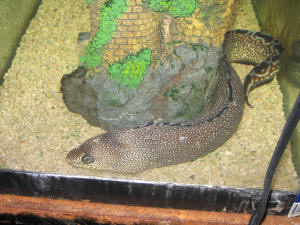
HELP.. Hungry eel can't eat! --
07/10/09
Hello all.. hope you can help'¦ We have a medium sized
Tesselata eel for about a year now. He has always been an aggressive
eater. For approximately the last two weeks when we go to fed him a
shrimp, he acts very hungry.. trying to find the shrimp. Once he finds
it he grabs it and acts like he wants to eat it, but can't chew it
or swallow it, no matter how small of a piece we try to feed him. His
breathing seems normal, water parameters are normal. We have
approximately 1500 gallons total, same filtration, but separated into 5
tanks. He is in one of the tanks by himself and all of the other fish
are fine. I see lots of article and have experienced fish that loose
their appetite for one reason or another, but he seems to still have
his appetite, just unable to get it down. Any suggestions?
<Sounds like a problem with its pharyngeal jaws/their ligaments or
less likely a swollen throat, maybe due to physical injury or possibly
due to a shrimp only diet related deficiency disease. Did the eel
happen to eat anything sharp, are you missing a fish with sharp spines,
a trigger, filefish etc. that might have jumped into the eel tank?
Options are: sedate the animal and force feed (vitamin enriched food)
and examine it (together with a vet) or try to let it heal naturally
providing perfect water quality. Since moray eels can got without food
for months, I'd use the second option first and if this fails try
force feeding. Good luck. Marco.>
My Tess Thanks 7/26/09
You Hey everyone. I wanted to shoot you a quick note to say thank you
from myself and my Tesselata eel. After a major move of his 300 gallon
home he ate once and then didn't eat again for a couple of weeks.
As soon as I decided it was a problem, I came to WWM and did some
searching on Tess's and lack of feeding. Turns out I didn't
have enough flow in the aquarium to ensure optimal oxygen saturation. I
pointed the returns at the top of the water and added a Koralia 8
Magnum to the aquarium. He ate a big sardine Ryan
<Congratulations on your discovery and rescue. Bob Fenner>
|
Question for Mr. Fenner, Moray hlth., injury
6/17/09
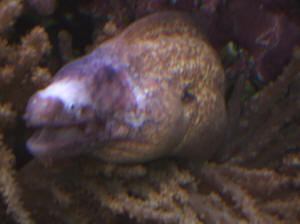
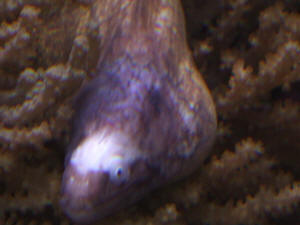
I have a white eye moray that has been getting a skin disorder on
his head.
It is starting to get worse. Could this be diet related?
<Mmm, no, not directly... Looks much more like a physical
injury, perhaps with a secondary infectious component>
I only feed raw shrimp to him and my Zebra moray. It looks like
his skin has just peeled off. Any suggestions?
<Mmm, yes... I'd expand the diet here... see WWM re
feeding Muraenids>
I have been in the hobby for 5 years and consider my water
quality to be pristine. The Zebra moray is perfect.
Thanks for any help.
BILL
http://s271.photobucket.com/albums/jj149/rbu1/?action=view¤t=DSCF1172.jpg
http://s271.photobucket.com/albums/jj149/rbu1/?action=view¤t=DSCF1174.jpg
<Bill, am going to share your email with Marco Lichtenberger
here... he is
much more up to date re eels, their husbandry. Bob Fenner>
|
  |
|
Question for Mr. Fenner, and Marco
White eyed moray; dis. -- 06/17/09
I have a white eye moray that has been getting a skin disorder on
his head. It is starting to get worse. Could this be diet
related?
<Not directly, but indirectly as Bob already noted. A
not-so-varied-diet can easily result in a weak immune system and
consequently even a small scratch can become infected quickly.
This looks like a possible bacterial infection.>
I only feed raw shrimp to him and my Zebra moray. It looks like
his skin has just peeled off. Any suggestions?
<Varied diet and vitamins. If it does not stop or if the eel
stops to eat: antibiotic baths or preferably antibiotic treatment
in a hospital tank. An antibiotic for gram negative bacteria
should be tried.>
I have been in the hobby for 5 years and consider my water
quality to be pristine. The Zebra moray is perfect.
<Should also get a varied diet and vitamin additions.>
Thanks for any help. Bill
http://s271.photobucket.com/albums/jj149/rbu1/?action=view¤t=DSCF1172.jpg
http://s271.photobucket.com/albums/jj149/rbu1/?action=view¤t=DSCF1174.jpg
<Good luck. Marco.>
Re: Question for Mr. Fenner
I greatly appreciate your help Bob. Thanks
<I am happy to try helping you and your eel Bill. BobF>
|
|
Dragon Eel is slipping away -- 2/21/09 I have
had an 18-20 inch Dragon Eel for 6 years. He's always been
blind as a bat but is otherwise a hearty eater, healthy as a
horse. He is of course beautiful, and they are no longer
exporting this fish from Japan so he's essentially
irreplaceable. Tank is 240 gallons and is kept clean, and is
professionally serviced every month. Water quality has remained
good throughout (I am a big believer in over- filtering a tank).
He has survived a very wide range of tankmates. <And eaten
some likely> About 4 months ago the tank had to be moved from
a location about 7 miles away to its current locale. The only 2
fish that came along with the eel were a porcupine puffer (about
10 inches) and a Harlequin Tusk (5 inches). Not a lot of fish for
a big tank, but hey, the economy. Since the move, the eel lost
its appetite, eating only occasionally. Diet includes prawn,
silversides, and "Variety Supreme" (or as we call them,
"gumdrops"). <Mmm... not what I would use... Do you
supplement, add vitamins, HUFAs?> I chalked his loss of
appetite up to stress related to the move, since he otherwise
exhibited no symptoms. But then about 6 weeks ago one of the 2
heaters in the tank burned out and the tank got a little cool for
a few days (about 8 degrees F below normal). He stopped eating
altogether and started to experience some sort of seizures. Once
the heater was replaced he seemed to improve a bit (he finally
moved back to his hidey-hole for a couple days, for example) but
has demonstrated what I can only call neurological deficiency
ever since, having trouble swimming, not eating at all, and
occasionally hanging out upside down. <Bad> Now, 6 weeks
later, he stall won't eat, he lies upside down in the middle
of the tank. His breathing seems labored. He has lost lots of
weight. But otherwise, he is asymptomatic--no obvious disease, no
sores, no color change apart from being slightly paler --
nothing. Just starving and wasting away. I am contemplating
euthanasia at this point. <Mmm, not quite yet> I don't
have a sick tank or the budget to buy one, really, unless I
believed there was a really great chance of it being successful.
Do you foresee any hope at this point or should I admit the
inevitable and put the fish down? Or is there something obvious I
have missed? Thanks for your consideration, Brian Maffitt
<Look into one of the commercial "appetite
stimulants" sold in the trade... Selcon, Seachem's
"Garlic Guard"... and raise the temperature to 82-84
F.... This and other Muraenids can recover from long bouts of
non-feeding. Bob Fenner>
Re: Dragon Eel is slipping away 2/21/09
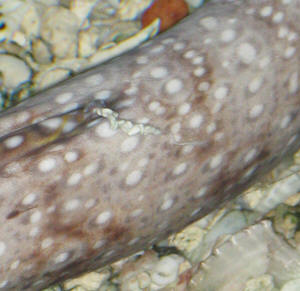
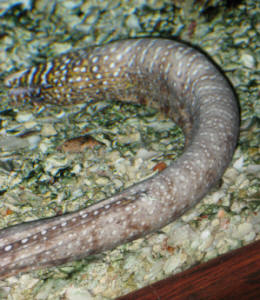
Thanks so much for your response. A follow-up--he has a white
curling emission coming from the opening in his midsection, is
could possibly be a worm, or maybe he's just pooping? I could
send a picture if it would be useful. Brian
<Would be. B>
|
 |
|
This is fecal material... I would force feed this animal... See
WWM re if you are unfamiliar. BobF. 2/22/09
Re: Dragon Eel is slipping away 2/22/09
Thanks Bob. I see many different recommendations for force
feeding on the site... the only one specific to eels involves
removing him from the tank, holding with a wet towel and using an
eyedropper or baster <Or plastic catheter of size) to
administer minced food. Is this what you would suggest?
<Yes... grind the food fine enough and add sufficient liquid
(and vitamin, HUFA) prep. to make it
"squirt-able"...> I did not see a specific FAQ
related to force-feeding, but I want to make sure I do the right
thing... <Understood. BobF> Re: Dragon Eel is
slipping away -- 03/02/09 Thanks again for the advice.
The force feeding has had no visible positive effect,
<Dang!> in fact it seems to stress the eel even more. It
now lies upside down at the bottom of the tank, curled up, and is
very pale. It's still breathing, but it breaks my wife's
heart to see it so obviously suffering... do you think there is
any chance of recovery at this point? <Brian... I do. Not only
am I "just" philosophically opposed to giving up... But
I have seen unbelievable, remarkable "Resurrections" of
Morays... I do urge you to try and keep up the faith> I'm
willing to keep trying if there is a chance. This is the first
time the eel seems to have lost its coloration... a sign? Brian
<Not really... Fishes, including Anguilliforms do/can change
color for all sorts of "reasons"... Hang in there and
thank you for the update. BobF>
|
My Golden Dwarf Moray, fdg., hlth. 12/20/2008
Hi, <Hello Matt.> I recently purchased and set up an aquarium for
a Golden Dwarf Moray eel. The tank has been cycled and three days ago I
added the eel. The specimen had been at the store for a month or two
and seemed to be doing great, except I never actually saw him eating.
So now I worry that he will not eat, I have tried feeding him
silverside last night but he is scared of it and hides. Brine shrimp he
seems to have a keen sense of smell for but has not eaten it. what else
would you recommend I try? <#1: Patience. A healthy eel won't
starve, many morays need days to weeks until they have overcome the
stress of capture and changing homes, some larger ones need even
months. #2: Keep it free of stress in the new tank, a stressed eel will
not eat, especially when it feels by you. #3 adequate food: The diet of
G. melatremus mostly consists of crustaceans, and to a smaller
percentage of fish (although they often eat small fishy tank mates in
captivity). Get some raw, frozen shrimps (no freeze dried krill) of
adequate size (or cut them into smaller pieces). What is also eaten are
scallops, clams, mussels and cephalopods like squid. Thaw them prior to
feeding and add some vitamins once a week. #4: See
http://www.wetwebmedia.com/morays.htm and the linked FAQs for further
information on feeding, a lot is already written there. Also check the
feeding part of this article:
http://www.wetwebmedia.com/FWSubWebindex/fwmorayart.htm .> Also
recently (yesterday) he became very twitchy, scratching / hitting
himself on the live rock in the tank. Now I worry that he may have some
sort of parasite but I cannot get a great look at his body (besides his
head) for more then a few seconds. My water is fine (0 nitrate 0
nitrite 0 ammonia, 8.2ph 1.023 specific gravity). Any idea what may be
causing this "twitching" <Has to adapt to new water
parameters. For disease symptoms look for apathy and elaborated
breathing.> he was formally in a system which had copper (the store)
<Can/likely has damaged the eel, lowered its life expectation. No
copper use for Anguilliformes <<= true eels, includes Morays.
RMF>> in therapeutic doses.> , but the tank I have him in does
not have any copper what so ever. <Good.> Over the last two days
he has seemed active enough at night but now he is scratching /
twitching a lot, and this in the combination with not eating has me
worried... <It can take a while until the moray has adapted to the
tank water. If you are concerned watch water parameters and its
breathing'¦> Thanks for the help, Matt <Welcome.
Marco.>
My Golden Dwarf Moray II, hlth. 12/20/2008
Hey Marco, <Hi Matt.> Thanks a bunch for the info about what this
species eats, had no idea. The eels breathing is fine <Good
sign.> but his scratching from what I saw is making his gill area on
his one side extremely red. <This is a new information. If the gills
turn red, I too would take gill parasites into consideration if the
water parameters nitrite and ammonia are still 0. Monogenes (Trematodes
aka flukes), isopods and copepods are the usual suspects, impossible to
ID when still inside the fish. http://www.wetwebmedia.com/parasiti.htm
will give you an overview and treatment options. Just avoid copper and
use organic chemicals in rather small doses. If the scratching
continues I'd start a treatment beginning with a pH and temperature
adjusted freshwater bath for 30 minutes or shorter if the eel shows
spasms or similar discomfort.> All else that's in the tank is a
feather duster a domino damsel and 2 hermits but they don't seem to
even care that the eel is there. I just hope it stops soon. Now I also
intend to eventually make this a coral tank, seeing at how copper harms
them I was curious if any of the trace elements in slightly to high
amounts will? (magnesium, calcium, iodine etc.), <No, non-toxic in
the usual concentrations found in aquariums. Toxic are copper and
similar heavy metals.> might buy a test kit for those any way.
Thanks again, Matt <Good luck with your eel. Marco.>
| What's wrong with my dwarf moray eel ? --
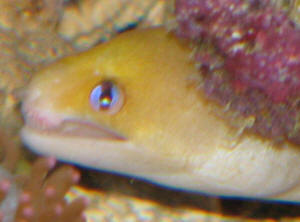
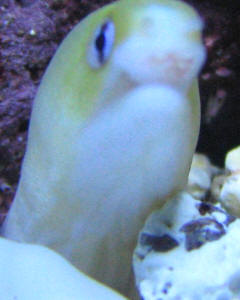
07/28/08 Hi, I searched extensively for information on this
condition and came up with nothing, so thought I'd ask the WWM
experts. Our dwarf moray eel arrived from Hawaii with a
"growth" on his upper jaw, extending into his mouth and
preventing him from closing it completely. It hasn't changed
appreciably over two weeks. It appears flashy, with a few red
specks. It has not affected his appetite, he will eat krill and
squid. Alas he also hunted down and consumed two pearly Jawfish and
possibly a purple Firefish, who is MIA for longer than usual. since
there is not a lot of info on dwarf eels on WWM, I would like to
put in my opinion that these are not safe with bottom dwelling fish
of any smaller diameter than the eel! He has also made some
threatening (though harmless) gestures towards some other fish,
particularly a medium size Copperband butterflyfish. Overall, he
has been much more pugnacious than expected given what I have read
about this animal. Any ideas on what this growth is, or what to do
about it (if anything) ? I attached a few pictures, I apologize in
advance for the rather poor quality as the eel is quite camera shy.
Thanks for any help. <Thanks for attaching the pictures.
Unfortunately I do not believe there is a way to "treat"
that growth. I have seen a few eels in my time with a similar
growth and they have all thrived and the growths have gone away on
there own. I would not be concerned with it unless the eel stops
eating. Good luck with that beauty. IanB> |
|
|
Moray Eel with possible Impaction --
06/02/08 Hello WWM Crew, <Hi Kevin.> I am having problems
with my one moray eel, it is a "Freshwater" Moray Eel, he was
living in my marine tank until earlier today. <Very good.> The
other fish in the tank are an another freshwater moray eel, a snowflake
eel, a marine Betta, and a peppermint shrimp. The tank is a 65 gallon
aquarium with a Fluval 404 for filtration. <Skimmer? A fish tank of
this size with 3 morays likely will benefit from a strong skimmer.>
The freshwater morays get fed mainly silversides, as well as pieces of
shrimp (the snowflake gets a different diet). They freshwater morays
get fed once a week till they are full as they are somewhat larger
(approx. 14-16"). I hope this is enough information. <Water
parameters'¦> Today the smaller of my freshwater moray eels
started to act odd. <What did it do?> He was moved to a ten
gallon tank with an AC 20 for filtration, as in addition to two open
sores on his body, he was unable to swim around and his body near his
anus and the anus itself were swollen. My worry is that he has become
impacted. I dropped the salinity of the quarantine tank from 1.022 to
1.014. I did this because the moray was breathing very heavily, and
have heard that saltwater has less dissolved oxygen than freshwater.
What should i do? <Where are those sores from? Can the morays burn
themselves at the heater? Are those bite marks? Find and remove the
cause of the sores. With regard to the swelling, I'd add some Epsom
salt (1-2 tablespoons of Epsomite per 10 gallons water). Check the
water quality (esp. Ammonia, Nitrates, pH, what you describe could also
be symptoms of nitrogenous poisoning) in the quarantine as well as in
the display tank and improve it by water changes if necessary (any
ammonia, nitrates >30-35 ppm). Do you administer vitamin additions?
If not, you should do so, because freezing and thawing of silversides
destroys necessary vitamins, which long turn harms the immune system or
leads to nerve damages (lack of vitamin B). Mussel, clam and scallop
meat as well as cephalopods (Squid, calamares, octopus) are useful food
items in order to widen the variety.> Thank you. Kevin <Good
luck. Marco.>
Moray Eel with possible Impaction II --
06/03/08 Thanks for the reply. <No problem, Kevin.> Things
haven't gotten must better with the moray. <I'm sorry to
hear that.> I have a skimmer for the tank but have not been using it
as it has created some very small bubbles which seemed to affect the
breathing of the fish. Because of this I was doing water changes more
frequently. Water parameters are as follows, Ammonia 0, Nitrite 0,
Nitrate 50 mg/L. My test kit said this amount would not harm the fish
but I have since done a 25% water change on the main tank. <Good.
While these parameters are not necessarily dangerous by themselves, it
would be good if you could get the skimmer working long term. The WWM
section 'bubble trouble' might be helpful
http://www.wetwebmedia.com/bubtroubfaqs.htm . But this can be done in a
days or even a few weeks, let's get back to the moray.> The
quarantine tank test the same except for 5mg/L nitrate. <Good.>
It acted odd by being out in the open, not hiding in the tubing and
caves in the tank, it also was not swimming properly and was unable to
move out of a semi curled up position, kind of in the shape of a
"C". <This does not sound good to me.> I believe that
the sores are from the live rock located throughout the tank. <Hard
to believe, only if some rocks would have fallen onto the eel. Is a
clear picture possible?> I do not administer vitamin additions.
<You should, for the long term health of the fishes.> Since
yesterday she has gotten worse, I say she because it appears that it is
a her, as her anus has opened and what appear to be eggs are coming out
of it. <Morays have expelled eggs several times in captivity. Are
these perfect small little slightly colored or clear balls (diameter
about 1-2 mm for this species) or irregular and slimy (faeces)? Do you
have a picture? If it is faeces at least the impaction seems to be
solved, if it is eggs let us hope this does not stress the eel too
much. The sores might be bite marks from mating. On some morays where
mating behaviour was observed the males bit the female, but sometimes
healthy eels might bite weak or sick ones when noticing their weakened
state.> Her skin is peeling in places near to the sores, and in
addition to this she is not breathing very well. She occasionally stops
breathing <To save energy. That is not a good sign.> , during
these times I send water through her mouth and gills using a dropper,
<I would not do that. Too much stress.> I also increased aeration
through the use of an airstone. <Much better. I hope the eel also
has some shelter to feel protected in quarantine.> Would API
Aquarium Salt work in place of Epsom Salt, as this is essentially the
only salt available around here. <No, that's different, but the
possible impaction seems to be solved with something coming out of her
anus.> Thanks for the help. Kevin. <Not too much you can do to
help her, mostly watch and do not stress the animal. Provide enough
oxygen with the air stone and the AC on full power to create a
sufficient surface current. If the sores should significantly grow in
size, you should consider an antibiotic treatment (if you have the
chance in cooperation with a vet). The natural way of healing would be
that a thin layer of whitish skin will develop on the sores (starts
some days after the wound was created), while significant growth of the
wound can indicate a bacterial infection. Identify what was coming out
of the eel or send a picture. I wish you good luck and still hope this
moray will get well again. Marco.>
Sick Zebra eel, James' go
12/11/07 Hi Bob, James with you today, Jack.> Owner: Jack
I'm 12 years old. <Mmm, a young aquarist, good for you!>
Tank: Corner 110 litres, Crushed coral base, 3 hand size & 3 golf
ball size live rocks. One hollow ship wreck. Built in filter, Heater,
Power head set up to pump in air as well. Occupants: 35cm Zebra Eel,
18cm Snow Flake eel, Blue Damsel fish. General: Zebra Eel. I have owned
the eel and tank for about 6 months. The eels have both been eating
fine every second day (Cooked and uncooked prawns, Pipis ) Tried
calamari, squid and mussels. They both swam around during the day and
night, They hand feed and loved to be petted. <Not a good idea to
hand feed eels, they have a nasty bacteria infested bite which can lead
to a bacterial infection on the wounded area. Do discontinue this
practice.> Their breathing was fine and they are very calm and seem
relaxed in their environment. I did water change of 5-10 litres every
week to ten days. I tested the water every week and adjusted when
needed. We did adjust the pH with Marine buffer (Seachem brand) I did
once put the buffer in the tank directly without mixing it in water
from the tank in a cup first and then pouring it in. Problem: Last
Tuesday I noticed the Zebra Eel's head was laying on bottom of tank
and seemed to struggle to breath and hold his head up. He was not
swimming around and stopped eating for about week. His eye was a bit
smoky gray. His stripes were fine, skin was slimy. On Tuesday afternoon
we transferred the eel to the aquarium that we bought him from. In
capturing the eel this made him swim around and seemed to pick him in
itself. <?> When we arrived at the aquarium and they transferred
it to their tank it seemed a lot better, they said they will keep it
for observation. They increased the salt in tank and the next day it
ate and seemed on a recovery. When i\I called the next day they said it
seemed to relapse back to its old ways. The next day they said it was
about the same but had a white spots on its face appearing and in its
mouth. From this position he did not recover and this afternoon the eel
passed away. The aquarium said they are not sure why it passed away but
I would love to know why so I can take better care of my other eel and
I would like to one day get another Zebra Eel. General: The Snow Flake
Eel and the damsel are fine. I did check the water when all this was
occurring and it was perfect and the aquarium checked the water as well
the day we took the eel there and they said it was fine. We have been
told that eels are hardy pet is this true. <Yes, they are hardy if
conditions are favorable for them. A 28 gallon tank is much too small
for this fish. They can grow to about two feet and really need to be in
a 50 gallon or larger aquarium. I'm guessing what happened to eel
was caused by environmental stress. They are huge waste producers for
their size and I believe this led to his demise. In reading your email,
I'm guessing you have a 28 gallon all in one nano tank. The
filtration system on these systems isn't really suited to keeping
eels or any large fish.> Thanks for reading my email but I would
appreciate your feedback. <You're welcome Jack, and please read
here. http://www.wetwebmedia.com/zebramor.htm James (Salty Dog)>
Jack
Sick zebra moray eel... too small, too little filtered,
mis-buffered... reading, Bob's go 12/11/07 Hi crew, Owner: Jack
I'm 12 years old. <Howdy: Bob, I'm 55> Tank: Corner 110
litres, Crushed coral base, 3 hand size & 3 golf ball size live
rocks. 1 hollow ship wreck. Built in filter, Heater, Power head set up
to pump in air as well. Occupants: 35cm zebra eel, 18cm snow flake eel,
Blue damsel fish. <Mmm... I wish I knew the make-up of your built-in
filter... Moray eels do produce a good deal of waste... And this tank
volume is much too small for these two> General: Zebra eel. I have
owned the eel and tank for about 6mths. The eels have both been eating
fine every second day (Cooked and uncooked prawns, Pipis ) Tried
calamari, squid and mussels. They both swam around during the day and
night, They hand fed and loved to be patted. Their breathing was fine
and they are very calm and seem relaxed in their environment. I did
water change of 5-10 litres every week to ten days. I tested the water
every week and adjusted when needed. We did adjust the ph with Marine
buffer (Seachem brand) I did once put the buffer in the tank directly
without mixing it in water from the tank in a cup 1st and then pouring
it in. <I see... and you've hopefully learned better>
Problem: Last Tuesday I noticed the Zebra eels head was laying on
bottom of tank and seemed to strangle to breath and hold his head up.
He was not swimming around and stopped eating for about week. His eye
was a bit smoky gray. His strips were fine, skin was slimy. On the
Tuesday afternoon we transferred the eel to the aquarium that we bought
him from. In capturing the eel this made him swim around and seemed to
pick him in itself. When we arrived at the aquarium and they
transferred it to their tank it seemed a lot better, they said they
will keep it for observation. They Increased the salt in tank and the
next day it eat and seemed on a recovery. When I called the next day
they said it seemed to relapse back to its old ways. The next day they
said it was about the same but had a white spots on its face appearing
and in its mouth. From this position this he did not recover and this
afternoon the eel passed away. The aquarium said they are not sure why
it passed away but I would love to know why so I can take better care
of my other eel and I would like to one day get another Zebra eel.
<Mmm...> General: The Snow flake eel and the damsel are fine. I
did check the water when all this was occurring and it was perfect and
the aquarium checked the water as well the day we took the eel there
and they said it was fine. We have been told that eels are hardy pet is
this true. <Most species, specimens if placed in appropriate
settings are, yes...> Thanks for reading my email but I would
appreciate your feedback. Jack <Your Zebra/Gymnomuraena likely
succumbed to the buffer being poured directly into the tank, along with
general stress... This system is too small... Please read re these two
species needs here: http://wetwebmedia.com/marine/fishes/index.htm the
third tray down. Bob Fenner>
|
Swollen Snowflake Eel -- 12/04/2007 Hi WWMedia Crew!
<Hello Andrew and Laura> We're huge fans! You've
help us a great deal, as we've learned enough to set up our
very first tank. Aside from some predictably difficult moments,
we feel it's been a success. <Glad to hear.> We've
read every FAQ on the site--(using the Google tool as
necessary)--not even those just regarding our problem, but
several others, which have helped us a great deal. (Also huge
fans of the CM and Bob and Anthony's Reef Inverts.)
Unfortunately, we haven't been able to find a topic that
corresponds to our situation. (Though it's probably there
somewhere.) Recently, we acquired a young snowflake eel. He
seemed healthy and inquisitive. He had a lot of personality. We
named him Gumboot. Anyway, we quarantined him for 4 weeks
<Very good> , and he seemed fine--quite happy even, eating
frozen foods, like krill, shrimp and scallops. We introduced him
into our main tank, along with a sole tankmate--a young lionfish who also seemed happy and healthy. (The lionfish remains so to
this day.) A few days ago, the eel disappeared into the rock. Old
story, I know, but in this case he reappeared, acting curiously.
Although he had been ravenous, he now retreated from food.
<Not eating can be a sign of stress, disease, injury, not
being hungry.> Soon after, we noticed a peculiar swelling or
growth just above his midsection. Since then, he will not eat. He
continues to hang out in his favourite spots, his breathing seems
OK, but the swollen area has not moved or changed, and he
hasn't eaten since Thanksgiving. <Swollen areas or bumps
on eels can have many reasons: - Parasites below the skin (marble
like appearance), - Internal bacterial infection (many shapes;
usually growing; has to be treated in a hospital tank with
antibiotics), - Various types of tumors (some will go away by
themselves, some can only be treated by a vet), - Constipation
(swelling at the belly, use Epsom salt; don't feed much
krill, but more mussel and crab meat), - Carrying eggs (eel may
increase its diameter more than three times, but yours is
probably too young). - In your case I would not exclude the eel
was stung by the Lionfish, swelling is one of the symptoms.
However, the swelling should become smaller with time unless a
piece of the fin ray of the Lionfish got stuck in there and
caused an inflammation. In that case you should see a tiny
entrance wound.> He is only about 8" long, if that
matters. (Sorry we can't provide pix, but he won't show
enough of himself to be relevant.) <I hope the list above
helps you to get an idea of the possible reason and treatment of
the swelling.> Water parameters: SG-1.023, pH-8.2, temp-77F,
Am 0, Nitrites 0, Nitrates <10. The tank is 90G FOWLR, w/ a 20
g sump, 100 lb. live rock, and a TurboFlotor protein skimmer.
<Sounds all okay.> Should we remove the eel to quarantine
and medicate--and if so, medicate with what? <Only if you know
what he has, you will know how to treat.> Or should we just
hang out and hope for the best? <Try to get a better diagnosis
with the list above.> (Is he, say, just constipated?) <Well
possible. Is the swelling mostly at the belly?> Sorry for the
somewhat obvious question, but although he hasn't been with
us for too long, we're very fond of him. <I'm sure you
are and I do hope Gumboot will get well again. Further
recommended readings are
http://www.wetwebmedia.com/moraydisfaqs.htm ;
http://www.wetwebmedia.com/moraydisfaq2.htm ;
http://www.wetwebmedia.com/snoflkeeldisfaqs.htm;
http://www.wetwebmedia.com/zebramdisfaqs.htm;
http://www.wetwebmedia.com/FWSubWebIndex/fwmoraydisfaqs.htm >
Thanks immensely... Andrew & Laura in Chicago <Hope that
helps, Marco.>
Re: Swollen Snowflake Eel -- 12/05/2007 Hi Marco!
<Hello Andrew and Laura.> We can't thank you enough for
taking the time to answer our question. We hope you won't
mind if we attach a brief rider: <No problem at all.> As if
things weren't bad enough, we experienced a 5 hour power
outage here in Chicago, during winter. Fortunately the display
tank only lost about 2.5 degrees in that time. <No problem
here for your FOWLR.> Afterwards. Gumboot came out. His
swelling was even more pronounced, and he seems quite apathetic.
He lay dead center, in the front of the tank. His respiration was
normal, <Gills are not affected.> but he was limp and not
inclined to hide. <This looks really bad.> We've
removed him to a 10 gallon QT, so we might better see what is
happening with him. <Understandable choice seeing the
pictures. Offer him some cave to feel more comfortable and keep
the water quality pristine.> He remains sluggish. We've
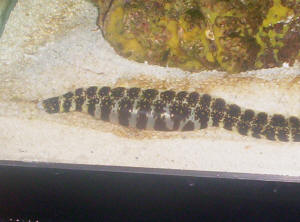
attached some pictures here <I see one, had no idea the
swelling was that large.> , in hopes that you might be able to
help us more. Do you have any sense of what might be going on
here? We're ready to dose with antibiotics or iodide
supplements, but we're not sure which way (if either) to go.
<Look for a wound from a lionfish sting and check if the
lionfish has intact stinger ends. What we see here is probably an
accumulation of fluids. If there is no wound I'd suspect an
internal bacterial infection hard to diagnose exactly/treat
accordingly without a veterinarian. You can try an antibiotic for
gram negative bacteria like Maracyn Two, but, although some eels
swollen like your moray survive, many die. It is impossible to
know without tests which antibiotics actually work, due to the
apparent use of loads of antibiotics at many collectors and
wholesalers.> Thanks again. We know you're busy, and we
appreciate your help more than we can say. Andrew & Laura in
Chicago. <Sorry I have no better news. Keep us updated, I
still hope Gumball survives. Marco in Heidelberg.>
|
|
|
|
Gymnothorax tile with possible tumors -- 09/04/07 Hello!
<Hi!> Sorry I must contact you with bad news. <No
problem.> Somehow one must guess most people who have
questions do. I believe that this is the fatal flaw for the moray
I have made. I trusted the staff at the LFS. I've been
feeding him shrimp for months and now that something has finally
gone wrong have I dug into the problem. I guess stuff happens but
I should have been able to prevent it with research, but the
sites I could find before I ran into yours mentioned morays
eating crustaceans. <They do, but not exclusively and not just
one type.> I've found your website incredibly reliable as
far as I can see. When I looked into the problem, I looked into
diet, and disease on your site. What worries me, is that even if
I correct the diet, he has what appears to be tumors on his
belly, the white portion. He's in a high brackish setup for
more info if you need that. <Okay, that's an important
information. I hope the specific gravity is above 1.010.> Say
the diet is corrected in the long term, will he be able to
survive what has happened to him? <Possible, if the diet was
the reason and apparent damage is reversible. Daily vitamin
additions will help you to correct the diet and find out.>
I'm concerned with the tumors. I doubt there is anything I
will be able to do except for do my best. <Yes, a vet would be
needed for a better diagnosis. What you can do is: check your
nitrates. Aside nutrition this problem might be caused by an
environmental issue, e.g. high nitrates or low salinity (which
you probably can exclude at least for the time you had it) for a
long time.> I thought it might have been an infection from the
substrate, which is smooth gravel. <Improbable.> I siphoned
every piece of filth I could from the gravel and did a 20% water
change of his 20 gallon tall. <Okay'¦ That tank is
relatively small, therefore it is well possible nitrates
accumulated. You may also want to check nitrites and ammonia to
see if this system is adequately filtered. Nitrates>20 and any
reading of ammonia and nitrites >0 can be a problem. You'd
have to do large water changes in that case (remember changing
50% will only decrease any harmful substance by 50%) and keep
those parameters down as long as your fish is in this tank.>
The eel is barely over a foot, and I plan on buying him a fifty
gallon aquarium as soon as I can. I just noticed what happened
today, and I sent this in ASAP. <Good decision.> His diet
will be corrected immediately with variety <'¦and
vitamins> to ensure proper nutrition. During the tank change I
took a picture of him in a holding container (plastic bowl).
<I love this species.> He stirred up a lot in the time it
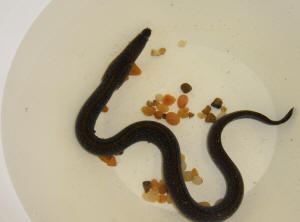
took to catch him hence the nasty stuff in the bowl. I also
disturbed a lot trying to capture him... Other than the
mysterious large bumps on him *three if I remember correctly* he
swims around and eats just fine. <I hope he gets well again.
Some types of tumors are reversible, while others are not. Good
luck and write back if further questions or comments arise.
Marco.>
Gymnothorax tile with possible tumors; follow up ? --
09/09/07 Hi again. I must thank you for your quick response.
<No problem.> Sorry mine was not so swift. <Since you
did not include our correspondence it is difficult for us to
remember your problem. Dozens of e-mails arrive here every day.
But I do assume you are the one who had a problem with a brackish
Gymnothorax tile with possible tumors?> Shortly after sending
the e-mail I contacted a friend who also keeps saltwater fish. He
suggested a full water change. I did such even though I thought
it was risky but I'll try anything that might benefit the eel
as long as it seems rational. To keep the tank "aged" I
left the old filter in so the bacteria would be reintroduced. Now
I'm trying to get the eel to eat a wider variety of food. It
ate more shrimp immediately just an hour afterwards. The piece of
squid were ignored and are still laying on the bottom of the
tank. <Take them out if they are not eaten within a few hours.
You'll need some patience to train the eel. If he's a
little hungry his motivation to try something new will be
higher.> Mussel meat will be tried. I bought silversides from
the pet store as well as krill. <Okay.> So far all he
accepts is shrimp as always. With methods of keeping his body in
top shape, what could I do to make the shrimp more nutritious in
the meantime? I know that Walgreens sells hypodermic needles I
could use to inject the shrimp with vitamins. <Can do that.
You could also soak the thawed food in vitamins for about half an
hour.> Also, asking around, I have lights used for regular
freshwater fish. Should I get those intended to emit UVA to
simulate natural sunlight? More questions asked to people I know
suggest he'd need it so he could absorb calcium (I don't
think they need it very badly but it seems to be a basic need for
a lot of animals) and produce vitamin D to fight off cancer.
<Since G. tile moray eels are predominately nocturnal in
nature, I do not think the spectrum of the lights is connected to
the disease of your eel. In addition, vitamin D won't be a
problem for a moray, which naturally eat vitamin D rich sea food
like fish and crustaceans. However, I do prefer bulbs with the
most natural spectrum for my own tanks.> The eel showed a
drastic increase in activity after the water change before
settling down under his driftwood which is in there to simulate
an estuary. <May rot in the brackish water.> Is there
anything I'm doing wrong here beside the nutrition issue?
<As suggested monitor the nitrates. Anything higher than 20
ppm can be a problem. What was the nitrate concentration before
you did the water change? It is well possible long term
nitrogenous poisoning was the source of your problem.> I
suspect I am. I don't know for sure though. There is
something else I wish to ask you in another e-mail. It has to do
with the senior project at my school and this will be sent very
shortly after this. <Okay. Be chatting. Marco.>
Re: Gymnothorax tile tumors. Malnutrition? -
10/07/2007 The eel's tumors are gone! I appreciate your
advice very much. There has been a lot of success with keeping
him healthy, along with some noticeable growth in size. His food
has been injected with the appropriate supplements as well. The
need for a new tank is growing, and I believe I could probably
get him a new one in the next few months. Adding another
question, I found this little packet in the LFS called
"Phosphate-X" or "Phos-X." Something like
that name. The description on the label says it absorbs
phosphate, nitrates, and nitrites. I don't rely on this
little packet about the size of a sticky-note and still perform
water changes, I was only wondering if it helped. On a different
matter, the eel eats about twice a week based on the information
I found on your website. I used to offer krill that was accepted
from time to time but read that it wasn't good for the eel
and promptly stopped feeding that. Silversides have been a new
favorite alongside shrimp, and squid are accepted when the eel
feels like eating them. (the food is removed after a few hours as
you suggested as not to pollute the water) I'd like him to
live as long as possible, so I've done everything I can, and
will continue to do so. The brackish water isn't rotting the
wood so far, and the salinity is as you suggested. While on that,
is there anything better than a regular hydrometer? Perhaps
something electronic? <A hydrometer is fine for brackish water
fish. Any inaccuracy will be well within the tolerances of the
fish. In fact, most brackish water fish like a bit of variation
from time to time. But your filter isn't quite so
accommodating, so it's best not to vary the SG more than a
couple of points on the SG scale at any one time (i.e., SG 1.010
to 1.012 is fine, but 1.010 to 1.018 not so much).> Another
question. My Gymnothorax tile lives in high-end brackish but what
is their environment like out where they live if they're from
Asia? <The problem here is that they are almost certainly
migratory, like most large brackish water fish. So there's no
"perfect" habitat. These morays are found -- as adults
-- in completely freshwater as well as in the sea, and they seem
to move about between the upper and lower estuary. They're
neither completely saltwater fish nor true freshwater fish, but
something in between. That said, like a lot of eels, their main
habitat is murky, muddy water where their ability to burrow,
negotiate rubble and locate food under poor visibility conditions
is useful. A typical environment would probably be sticky mud at
the bottom, murky water, large rocks and waterlogged tree trunks,
and rocky reefs. Hardly attractive for an aquarium!> Will any
aquatic plants survive in the brackish water, and what kind of
decoration should be used to make it look like Gymnothorax tile
habitat? <There are brackish water plants, such as
Cryptocoryne ciliata and Crinum calamistratum in the trade, as
well as the very hardy Java fern that does well in brackish
water, but there's little point to using them. They
aren't authentic for the sorts of habitats these eels will be
living in. Eels favour dark, murky places and they don't like
bright light. Much better to create something with a tall, rocky
reef-like structure so the eel can hide and wind itself around.
These eels don't so much swim as slither through things, and
the more 3D the aquarium, the better. Big mounds of holey rocks
would probably work very nicely. Something like a reef tank
arrangement. What you want to avoid is anything too rough and
definitely nothing unstable, as these fish are quite powerful and
excellent diggers. I'd personally be looking at an oyster
reef habitat. These are really important environments in brackish
water habitats and easy to replicate. Simply gather lots of
oyster shells (easy enough to buy as food, if nothing else) and
use silicone to cement them to some sort of rock, such as tufa
rock.> I'm thinking that if I make it as naturalistic as
possible he'll live longer than what is usually achieved in
captivity. <A good approach. The reason these eels don't
survive is not really a mystery. A few things seem consistent.
Keeping them in too-low a salinity doesn't help, and usually
leads to hunger strikes. So at least SG 1.005 is required, and
probably SG 1.010 for best results. On the other hand,
there's no evidence they "swim out to sea" when
mature, so keeping them in saltwater tanks likely isn't
required provided the salinity is at least at or above SG 1.010.
Diet is another factor. With these eels, and indeed any other
predatory fish, I'm a fan of the "little but often"
approach. Yes, you can feed them a big prawn one day and skip the
next. But the risk with predatory fish is they regurgitate the
food and pollute the tank. I'd sooner give small morsels each
night, so that there's no risk of major pollution. At SG
1.010 upwards you can use a protein skimmer with success. While
not crucial, these devices to help manage the nitrate by removing
organic waste from meaty foods before they decay. So in the long
run, a skimmer can end up saving you money by reducing the
frequency of water changes. Of course, you still need to aim for
the same relatively low nitrate level (I'd suggest <50
mg/l) but generally morays are fairly tolerant of this. Hope this
helps, Neale>
Re: Gymnothorax tile tumors. Malnutrition? -
10/07/2007 The eel's tumors are gone! I appreciate your
advice very much. There has been a lot of success with keeping
him healthy, along with some noticeable growth in size. His food
has been injected with the appropriate supplements as well. The
need for a new tank is growing, and I believe I could probably
get him a new one in the next few months. Adding another
question, I found this little packet in the LFS called
"Phosphate-X" or "Phos-X." Something like
that name. The description on the label says it absorbs
phosphate, nitrates, and nitrites. I don't rely on this
little packet about the size of a sticky-note and still perform
water changes, I was only wondering if it helped. On a different
matter, the eel eats about twice a week based on the information
I found on your website. I used to offer krill that was accepted
from time to time but read that it wasn't good for the eel
and promptly stopped feeding that. Silversides have been a new
favorite alongside shrimp, and squid are accepted when the eel
feels like eating them. (the food is removed after a few hours as
you suggested as not to pollute the water) I'd like him to
live as long as possible, so I've done everything I can, and
will continue to do so. The brackish water isn't rotting the
wood so far, and the salinity is as you suggested. While on that,
is there anything better than a regular hydrometer? Perhaps
something electronic? <A hydrometer is fine for brackish water
fish. Any inaccuracy will be well within the tolerances of the
fish. In fact, most brackish water fish like a bit of variation
from time to time. But your filter isn't quite so
accommodating, so it's best not to vary the SG more than a
couple of points on the SG scale at any one time (i.e., SG 1.010
to 1.012 is fine, but 1.010 to 1.018 not so much).> Another
question. My Gymnothorax tile lives in high-end brackish but what
is their environment like out where they live if they're from
Asia? <The problem here is that they are almost certainly
migratory, like most large brackish water fish. So there's no
"perfect" habitat. These morays are found -- as adults
-- in completely freshwater as well as in the sea, and they seem
to move about between the upper and lower estuary. They're
neither completely saltwater fish nor true freshwater fish, but
something in between. That said, like a lot of eels, their main
habitat is murky, muddy water where their ability to burrow,
negotiate rubble and locate food under poor visibility conditions
is useful. A typical environment would probably be sticky mud at
the bottom, murky water, large rocks and waterlogged tree trunks,
and rocky reefs. Hardly attractive for an aquarium!> Will any
aquatic plants survive in the brackish water, and what kind of
decoration should be used to make it look like Gymnothorax tile
habitat? <There are brackish water plants, such as
Cryptocoryne ciliata and Crinum calamistratum in the trade, as
well as the very hardy Java fern that does well in brackish
water, but there's little point to using them. They
aren't authentic for the sorts of habitats these eels will be
living in. Eels favour dark, murky places and they don't like
bright light. Much better to create something with a tall, rocky
reef-like structure so the eel can hide and wind itself around.
These eels don't so much swim as slither through things, and
the more 3D the aquarium, the better. Big mounds of holey rocks
would probably work very nicely. Something like a reef tank
arrangement. What you want to avoid is anything too rough and
definitely nothing unstable, as these fish are quite powerful and
excellent diggers. I'd personally be looking at an oyster
reef habitat. These are really important environments in brackish
water habitats and easy to replicate. Simply gather lots of
oyster shells (easy enough to buy as food, if nothing else) and
use silicone to cement them to some sort of rock, such as tufa
rock.> I'm thinking that if I make it as naturalistic as
possible he'll live longer than what is usually achieved in
captivity. <A good approach. The reason these eels don't
survive is not really a mystery. A few things seem consistent.
Keeping them in too-low a salinity doesn't help, and usually
leads to hunger strikes. So at least SG 1.005 is required, and
probably SG 1.010 for best results. On the other hand,
there's no evidence they "swim out to sea" when
mature, so keeping them in saltwater tanks likely isn't
required provided the salinity is at least at or above SG 1.010.
Diet is another factor. With these eels, and indeed any other
predatory fish, I'm a fan of the "little but often"
approach. Yes, you can feed them a big prawn one day and skip the
next. But the risk with predatory fish is they regurgitate the
food and pollute the tank. I'd sooner give small morsels each
night, so that there's no risk of major pollution. At SG
1.010 upwards you can use a protein skimmer with success. While
not crucial, these devices to help manage the nitrate by removing
organic waste from meaty foods before they decay. So in the long
run, a skimmer can end up saving you money by reducing the
frequency of water changes. Of course, you still need to aim for
the same relatively low nitrate level (I'd suggest <50
mg/l) but generally morays are fairly tolerant of this. Hope this
helps, Neale>
|
|
|
Green Headed Moray Ill. Moray with zig zag line
-- 06/14/07 My son has a green headed moray that is about two feet
long. <Green headed moray is not among those common names I am aware
of and there are several species referred to as yellow headed morays or
green morays. Possibly this species is Gymnothorax undulatus and can be
seen at http://www.wetwebmedia.com/moraysii.htm ,
http://filaman.ifm-geomar.de/Photos/ThumbnailsSummary.php?ID=4905 .>
We have had him for about four years in a 100 gal tank with a Niger.
Just recently we noticed that it has a white zig zag line under its
neck. The line is under its skin and about 3 inches long. The eel is
acting normal and has never been sick. Please help, we can't figure
out what the line is and how to get rid of it. <A picture of the
line and a confirmation of the species ID would have been helpful for a
diagnosis. While the so called lateral line organ is visible as a row
of pores at some species, it is also possible your moray is infected
with worms (nematodes) living in its skin. See
http://www.wetwebmedia.com/moraydisfaqs.htm , scroll down to
subcutaneous worms (medication is also recommended there) and compare.
Praziquantel could work, as may other products against worms. Beware
that many of those should not be used in a system with invertebrates or
live rock.> Thanks. Heather. <Glad to assist.
Marco.>
Re: Moray with zig zag line II -- 06/15/07
Hello again. <Hi.> Thank you for the link. <No problem.>
You are correct the eel is a Gymnothorax undulatus and the picture of
the worms on your site are exactly what he has. How nasty! How did he
get them and how can I stop him from getting them again once I get rid
of them? <Worm infections most often occur with wild-caught fishes.
Many worms are unable to complete complex life cycles in aquaria, but a
good (and unknown) number remains. Since the moray eel was in your tank
for 4 years without obvious infection, I can only guess the parasitic
worms (probably as eggs) were introduced with some (most likely) live
material. It is also possible other fish were infected and the worms
were able to lay eggs and infect the moray. Some of them are also live
bearers. A seemingly less probable scenario would be that the worm eggs
were introduced by frozen or live food. If you observed how fast those
lines grow, you can estimate when the infection started and thus
(knowing what you fed or added to the system) decrease the number of
possible sources until hopefully finding a definite answer on how the
worms were introduced. If you know the source of the eggs, you should
be able to avoid it in the future.> Thank you so much, at least now
we know how to treat him. <Good luck. I hope the treatment works.
Cheers, Marco.>
|
Green moray - loss of slime coat --
5/25/07 Have been referred to you all for help.
Moray eel is very sick. <I fear it looks pretty bad.> I
came home today and the pump had lost its siphon. The tank temp
(210 gal) had risen to 85 deg. My wife called me and told me that
the eel was swimming near the top of the tank and swimming
erratically. Fixed pump issue water moving slowly back down (81
now). Eel laying on bottom upside down breathing slowly but
looking very bad. The thing I notice is that he is usually dark
green but is now VERY PURPLE. I have included a link of a pic
(color not really good enough to see). But he is still green near
top and purple down the rest of his body. <Green morays in
fact are rather blue. Due to their mucous coat, which is a little
yellow, they appear green. Your specimen has lost its coat
possibly due to an accident with the pump, which also resulted in
the loss of the siphon.> Couple of white spots on him make me
think the pump thing today just stirred him up and he may have
gotten hit by the Foxface. <If those white spots are salt
grain like see WWM re Cryptocaryon, this would be an alternate
explanation for the loss of the mucous coat. If it is crypt
consider a hyposalinity treatment in another tank.> He is also
shriveled up like your hand would be if it were under water too
long. Please let me know if this is something you have heard of
before and can point me in the right direction. Thanks for
WetWebMedia, where I have probably learned more about marine life
than anywhere else! <In case of an accident with the pump,
there is not much that you can do except hoping that it will pull
through and ensuring that the other fish do not pick at the moray
eel. In case of crypt go for hyposalinity. Green morays (at least
the Atlantic G. funebris) can be found in brackish waters and
river mouths, while the parasites (at least the free stages) have
serious problems with low salinity. I'm glad you like the
site and wish the best for you and your eel. Marco.> http://www.flickr.com/photos/mitchelliii/512800176/
Link above is a pic. Everything else in the tank - clown,
Foxface, and royal Gramma is doing fine (albeit hovering over the
eel some) 0 Ammonia, 0 nitrite, 0 nitrate. Alk 7 (little low is
usually around 9).
|
|

|
Moray Eel with Eye Issue 4/22/07 I have a 24"
Fimbriated moray. He recently was moved to a 40 gallon tank because he
has been extremely aggressive. <Much too small a volume for this
specimen, species... not able to be kept stable/filtered... This fish
is a piscivore (and eats crustaceans)... http://wetwebmedia.com/moraysii.htm> Anyway the move went
well he settled in well. That night he jumped out of the tank.
<...> I found him on the brink of death, dried up. I put him back
in the tank and since then his eyes have looked different. Okay the
tank is newly cycled, but nitrates are present, high, at 100 ppm.
<Way too high...> There is no ammonia or nitrite. I cycled the
tank by using old water, old sand, old filter media. <Good> The
result was virtually no waiting for cycling but high nitrates that need
to be worked on. However he was accustomed to this exact water
environment in his previous home. He shed a layer of skin after he
jumped out but didn't appear overly stressed for such an ordeal.
But his eyes have changed. His entire eye used to be a purple color.
The entire eye area up to the edges. Now when I look closely the purple
area has shrunk. It would look on a person like the pupil was half its
normal size. However the light is dimmer in this tank, so if it were
like a person, the pupil would have been larger? How do fish eyes work?
<What do you want to know? Most fishes can "see"/register
some color... do have focusable lenses...> Does he have a pupil that
adjusts in size. <Yes> Did the prolonged air exposure when he
jumped out damage the eye? <Yes> Is it some kind of stress
response? Should I be worried? <Yes and yes... if this causes you to
action...> He has eaten since the move to this tank but not
heartily. Please let me know what you think. Worried Pet Owner
<Translate that concern into activity... move this fish to more
adequate quarters... larger volume, solid/escape-proof top, sufficient
filtration... no more than 20 ppm. nitrate... All covered on... WWM.
Bob Fenner>
Help... Moray hlth... no useful info. 4/4/07 Dear bob
<Angie> I have a golden moray eel and would appreciate your help.
He is about 6 months old, and his symptoms are; He has lost his teeth
<!?> His mouth is red and sore where his teeth were He hasn't
eaten for approx 3 weeks <I can understand why!> He has lost a
bit of colour only on his head and neck I am having great difficulty in
finding somebody who knows anything about eels. The place where I
bought him from have given "SeaCure" copper treatment,
<Mmm... see WWM re Muraenids and Cu... not generally a good idea>
however I have read a book on morays and specifies that you should
never use a non- chelated copper- based medication. <Not good with
Eels, no> I am not sure if sea cure <A proper noun... product of
Aquarium Systems... is capitalized> is chelated or not. <Is
not... is copper sulfate... As stated on WWM... their website...>
Although the main tanks water parameters have always been fine, <...
uninformative> we have moved him now to a quarantine tank. We have
given one dose of the medication so far we are supposed to give it a
further 2 days. <Of what?> I would appreciate any advice you
could give, and also do you have any contacts in England whom I could
telephone as I stated before I cant find any one and don't really
no where I should be looking. Alex Symcox <Need much more
information than you have presented here... How did this animal lose
its teeth? What have you tried to feed it... what re its system,
maintenance... I would not expose this animal to Copper compounds (for
what purpose?), nor keep it in quarantine... too stressful... Please
read here: http://wetwebmedia.com/moraydisfaqs.htm and the linked files
above... Am hopeful this scanning will reveal to you the sorts of data
we're looking for... that you'll have a clearer understanding
of your options... Read, act now. Bob Fenner>
Re: help... Moray hlth... Still no useful info. 4/12/07
HI in Answer to your questions we do not have any idea why or how he
lost his teeth we are trying to feed him gamma <A Brand... still a
proper noun un-capitalized...> fish which is what he ate before. We
put him in his own tank so we could give him the medicine that the shop
suggested because we did not want the other fish to be exposed to it.
What do you think we should do to try and get him to feed ? <What?
Apply yourself... Please read where you were referred to on the 4th...
There is still nothing useful in the way of data presented here.
BobF>
Re: Snowflake eel, blue tang, convict tang III; need a
hospital tank for proper ich treatment; how to catch an eel
03/06/07 Hi WWM, I treated the blue tang with tri-sulfa and some
spots disappeared, but he started scratching again. I do not have a
hospital tank, so what else can I do and are corals classified as
invertebrates. <See last email. Your corals are invertebrates and
without a hospital tank, there is not much you can do without harming
or killing them. Please read the WWM link sent in the last email. The
life cycle of marine ich and the so far known methods of treatment are
described there. Another good article is http://www.thepufferforum.com/forum/library/hospital/swich/.>
If I choose to do hyposalinity what should I lower the salinity to?
<Specific gravity of 1.009 for four weeks, but your corals will not
enjoy that. Only use hyposalinity in a tank without invertebrates.>
I am going to try and catch the eel, and are there any other ways of
catching a snowflake eel then pulling apart the rockwork? <A clean
bottle with a small piece of its favourite food and an opening large
enough. Bury it in the substrate. Watch at night. Chances are good you
will find your eel sitting in the bottle. Close the bottle under water
without getting bitten and transfer him carefully to a plastic bag for
transport.> Thanks, Maison <Welcome. Marco.>
Concern for Hawaiian Dragon... beh., hlth.
1/24/07 I purchased a 20" dragon for my LFS and he is
currently in QT at the LFS. I go up there almost everyday and feed on
Wed and Sat (grouper, snapper, shrimp). I have noticed that sometimes
he is only using one pouch to breath. <Not atypical... not a large
concern> I have smaller eels at home and they have never done this
so I am really concerned. The guys at the LFS don't know a whole
lot about eels and I am getting scared. Please Help!!! Thanks D <I
would not hold off on buying, moving this Moray on this basis, and
would feed it more like twice a week at this size. Bob Fenner>
|
Upside down Eel Gymnothorax miliaris
1/21/07 I really appreciate your site. Your effort has created
an excellent resource. <Thank you> I have a 12" Fire Coral
Eel (Gymnothorax miliaris) in a 50 gallon refugium attached to an 80
gallon reef tank. Salinity 1.022, Nitrate 0, Phosphate 1, Calcium
450-500, dKH 13, PH 8.4 temp 72-77 After a year and a half in the tank
alone (ok well you are never really alone in an algal scrubber) he has
come down with some odd disease, injury, or who knows what. I came home
to find him laying upside down in a rock crevice writhing a bit. I
thought he may have caused a rockslide in the medium sized outcropping
he lives in, but I am not sure. He did manage to wear the flesh off on
his rostral ridge (between eyes and tip of nose). He has a hard time
swimming upright or forward, loves to be upside down, tends to bend his
body in half and then swim forward. Very lethargic and breathing heavy,
but not too heavy. Faded white when lights come on, then color returns.
(normal I believe) I think its diet may be a little narrow. I was able
to feed him one silver side two days ago. I have since procured some
shrimp and scallops that he has yet to accept. Just trying to keep him
eating if I can. I took this creature in to save it from a friend's
horde of monster eels in his show tanks. It has been a great pet and
will rest in one hand and eat from another. Also likes to be pet.
perhaps I have a dog and need new glasses ;) Something is just jacked
up with this poor guy/girl.. I have addressed the temperature swing so
as to keep it stable at 76-77. I may have had a small PH drop after a
large algae export and water change. I did introduce a few Mithrax
crabs in the main tank about 3-4 weeks ago. Really nothing has changed
that significantly in the tank in a while. a long while. Not sure what
to do beyond trying to make him as comfortable as possible. his erratic
behavior has led me to actually try to grab him. he looks dead
sometimes but is always breathing. When I have grabbed him he had the
energy to give a strong fight and get out of my med-light grip. Of
course then he is hacked off and I try to shove some food in his open
mouth. Other than the missing patch of skin he looks fine. Eyes are
clear, yet seems a little blind. more so than usual. Wondering when I
should pull the Ginsu out and make some smoked eel sushi. Just kidding.
although it is really good ;) Any advice is greatly appreciated. Have a
great weekend! Shaun Drutar <Spaces twixt your sentences, the
beginnings capitalized... Don't know what has gone wrong here
Shaun, but the symptoms you list are definitely bad... If possible I
would move this fish to another setting... in the hopes that if that
something amiss is environmental, it will be solved thus. I do think
changing the diet up is a good idea... and I would soak such foods with
Selcon or equivalent. Bob Fenner>
Re: upside down Eel Gymnothorax miliaris
1/23/07 Hello and thanks for the reply below. I have
uploaded a few pictures...kind of blurry...to : http://www.drutar.com/weblog/blogger.html Perhaps this
might be more helpful... I really appreciate all that you guys do!
Shaun Drutar <... looks bad... You have read on WWM re Moray
Disease and systems? Bob Fenner> |
|
Re: upside down Eel Gymnothorax miliaris, & Formalin
use 1/24/07 Hello, <Hi again> I have read through Moray
diseases and systems, but at that time the Eel was not displaying
symptoms as visible as these and I was on a different path. <I
see> I am off to dig some more...wish me luck...or better yet
the Eel... <I do> ...ok...Looks like he may have a
secondary crypto infection... From what I have read formalin may
be the way to go. <Mmm, no> I have dealt with ich a number
of times in the past few years... seems one local shop's
livestock is regularly contaminated. <Mmm, yes> I usually
raise temp, drop salinity, soak food in garlic, etc...
<Good> This incident seems to warrant formalin treatment as
this poor guy is so weak... <Maybe...> I can't seem to
find data indicating the compatibility of formalin and corals,
<Assuredly they are NOT compatible... See WWM re formalin
period> I am going to assume it is not reef safe... so I will
have to disconnect this refugium from the main tank. Still
digging though. Thanks again, Shaun <Press on my friend. Bob
Fenner>
|
|
|
|
Re: upside down Eel Gymnothorax miliaris 1/26/07
Good day Bob, <Shaun> Looks like my recent removal of a
significant amount of algae from the refugium may be the true culprit.
<Really?> I found one posting about similar situations and the
idea that low oxygen concentrations hit me. I added an air stone this
morning and while he is not out of the woods yet it seems that his
breathing may be getting stronger and more rhythmic. <Better>
This may be the explanation for the zombie like behavior and
lethargy...plus its desire to leave the tank...he tried to enter the
main tank through the overflow pipe...after almost a year and a half of
residence. I am holding off on any other changes at this time. I do not
plan to medicate. <Good idea> Thanks again, Shaun Drutar
<Thank you for this update. BobF>
|
\
| Sick eel 12/23/06 Seasons Greetings, <Ho,
ho, ho!> Well, the season will not be so good if I can't
figure out what's wrong with my eel. I have a 55 gallon tank
with a Blackedge, a purple tang, and a Naso tang. <!>
Understandably the tank is a overcrowded, but I have had the tank
in its current situation for three years now. <Still...
ridiculous arrangement for these species> About two weeks ago my
eel started developing theses gray marks on his skin and recently
he has been acting erratically. He has exhibited symptoms similar
to ones that other people have reported with their eels, such as
twitching, and sometimes erratic swimming, in short spurts. There
has also been times that he has completed laid "sprawled
out" with no activity at all. He has stopped eating
completely. On the subject of eating, when I first got him he ate
krill, shrimp, scallops, squid and loved silversides. Over the past
2 years, he has only eaten krill, and will not touch anything else.
I have tried hand feeding him the krill and he will not take it.
<Yes... really time catching up with you, it...> I checked
out the tank levels, and all appear to be normal, (nitrites,
ammonia, ph, nitrates). I done water changes, and tried Melafix, as
well as pima fix in case of a bacterial or fungal infection with no
improvement, and have also done water changes. The other fish seem
unaffected by what's going on. In the past two days he has
developed a creamish white circle on his head. I can't figure
out what's wrong or what else to do. Enclosed are pictures of
the eel. Any advice would be appreciated. <Move this animal, and
the rest of your livestock... to much larger quarters... at least
150 gallons... This situation will cure itself there. Bob
Fenner> |
|
|
Sick moray - 5/12/2006 Hello WWM crew,
<GSD Leader Pup> It's been a long while since I have had to
write you. Many years ago Mr. Fenner ID'd my saltwater moray eel as
a Siderea Pictus, now known as a Gymnothorax Pictus. I have had the eel
nearly 6 years and he is approx. 2'9" in length. He has always
been extremely healthy and active, not reclusive at all like I have
read many eel species are. <Yes> His diet consists of most any
meaty frozen food (he is not fed feeder fish of any type). He eats:
krill, silversides, bloodworms, beef heart, brine shrimp, a little
veggie based frozen food once in awhile, mysis shrimp, etc. You name
it, he'll eat it. The tank is a 75 gallon (standard 4' by
18") that houses only him and is filtered by a Fluval 403. It has
been set up and running with him for the length of time I've owned
him. I've never had any problems, he's never been sick. The
tank parameters test out perfect: zero ammonia, zero nitrite, very low
(safe level) of nitrate. Salinity is within the normal range as well.
In short, nothing has changed in this tank or eels care and he is
suddenly rather sick. He was not a juvenile when I purchased him, so I
am unsure of his exact age. Given his size, it's my belief that he
was stunted prior to my ownership of him and could be older than I
would think. I'm estimating him around 10 years of age based on
prior information. Now, to get to the problem... He's going
downhill, and fast. I noticed the last couple of days he's been
behaving a little oddly, but nothing so extreme as to cause me to worry
much. He's very "friendly" and rather tame, so he will
come right up to the glass. I noticed he has some little areas near his
gill opening that look like they are holes in his body, like the skin
is rotting away. His eyes are getting cloudy (does not look like pop
eye - maybe the beginning of it though?) and there are little tufts of
eye covering that seem to be coming off. He also has little tiny pieces
of skin around his facial area that are scruffing as well. He acts
disoriented and hardly responded to a feeding, much less ate. He is
listless and gives a little "shiver" on a regular basis.
He's also open mouthed gaping on a regular basis, though
oxygenation should be fine since he's been healthy for the last 5
1/2 years. The only medication I had that seemed to fit his
descriptions was "Clout" by "Aquarium Products." It
advised treatment of one tablet per 10 gallons. It's a 75g tank, so
I put 7 tablets in. I retreated the tank last night and will do so
again tonight. <I would not use this on/with true eels, including
Muraenids of course> If you have any advice or suggestions as to
what may be causing this, I would greatly appreciate it. I suspect he
is too far gone to save, but I would like to try anyway. Thanks in
advance. <Very likely the root cause of trouble here is
environmental... a dearth of ready/soluble biomineral and alkalinity in
your water... I advise actually temporarily removing the eel, retaining
a good part of the water, dumping the tank of gravel, replacing this
and whatever else you might want to change at this time, returning the
eel and the old water, topping off with new, and running several ounces
of good activated carbon, Chemi-pure or equivalent in your canister
filter... Stat.! Bob Fenner>
Urgent help re. moray 4/12/06 Please help! 'Morris'
the moray seems to be on his last legs, as he very lethargic and just
seems to be panting his last breaths. From reading your information it
sounds as though he may have been poisoned by our rather
'stressy' lion fish. <Perhaps> Is there anything we can
do to save him or is it kinder to put him out of his misery? <I
would wait till "the bitter end" here. Morays are remarkably
resilient. May well "pull through"> The other fish seem
okay, perhaps he was the only one close enough to be poisoned? <Not
likely. Either poked, or all will be similarly mal-affected. Something
else may be at fault here. I would at least execute at 25% water change
and add activated carbon to your filter flow path> Please help ASAP,
it's breaking my heart, he is longest member of the family! Thanks
so much, Heidi <Do this NOW! Bob Fenner>
Saltwater questions: Epaulette and Snowflake Eel
2/23/06 Hi Bob, <Joseph> I have a few questions to clarify
some issues which I have not been able to find an answer to on your
website. Firstly, the article on Zebra Moray Eels suggests a simple
freshwater dip for new arrivals, instead of the usual 2-3 weeks
quarantine. Can this general rule-of-thumb be applied to Snowflake Eels
given their close relation with each-other? <Mmm, I wouldn't
actually dip either one of these. Muraenids in general don't have
difficulties that freshwater dips/baths help with... are generally
"too slimy" to have external complaints coming from the
wild... I would quarantine unless the specimen/s appeared in perfect
health> Secondly, I am considering buying a juvenile Epaulette Shark
for my 850 Litre, 8' tank. I was hoping you might shed some light
on what quarantine procedure I should use. <Mmm, most sharks I'd
skip actual quarantine on in hobbyist settings (different from much
larger commercial, public settings)... as the likely damage from such
is probably much more than it's worth> I have a 40 litre (10g)
quarantine tank however I feel that the stress caused from placing the
shark in such a confined tank may outweigh the benefits gained from
quarantining. <Agreed> From what I have learned, keeping stress
to a minimum may (arguably) be the single most important factor in a
successful introduction of livestock. <Most cases, yes> Am I on
the right track??? Perhaps a simple freshwater dip is enough? <I
would skip dipping most sharks, most scenarios as well> And how
should I handle the shark when placing it into the tank? Should I use a
large net, or gently lift with gloved hands? <Yes... this and/or a
wet-towel> Thirdly, in regards to my quarantine tank, is it
reasonable to expect to be doing small (10%) water changes (with main
system water) every few days to manage the water quality (i.e.
ammonia/nitrites/nitrates)? <Often, yes... daily...> I understand
that small tanks are almost guaranteed to be highly susceptible to a
large variation in water chemistry in a short period of time?
<Unfortunately, yes.... To be guarded against> Finally (thanks
for putting up with so many questions), when carrying out freshwater
dips I use a product called Bactonex from Aquasonic and each mL of this
solution contains 1.66mg Aminacrine Hydrochloride and 0.025mg of
Methylene Blue.. In your opinion, is this a suitable dip? <Is more
helpful than none> Thank you immensely for taking the time to
answer.. Joe (Sydney, Australia) <And you for writing, and so well.
Cheers, Bob Fenner>
| Sick Eel, No - Injured & Hunger Strike =
Typical Behavior Hi Crew, <Steve> I have a rather large
(I would guess about 3 feet long) Snowflake Eel whom I have had for
several years. <Neat animals> A little over a month ago he
stopped eating and pretty much went into hiding. <Happens> At
first I wasn't too concerned because he has done this before
and always pulled out of it. But this is the longest it has gone on
and today he finally came out of hiding and I saw something
disturbing on him. His right gill isn't opening, so he's
only breathing on one side. (I don't think I would have much of
an appetite if I had a collapsed lung either.) <No lungs, and
likely not a problem> Furthermore, that whole side of his body
seems to be deteriorated, I attached a picture. <Nice pic. Looks
like a "simple" mechanical injury to me... a gouge if you
will...> After reading the FAQs I'm afraid it may be from me
not feeding him a properly balanced diet. I regularly fed him raw
shrimp (human edible grade shrimp) and occasionally krill.. but I
didn't do that too often because it's very messy and the
shrimp is nice and clean. I don't think he's ready to kick
the bucket yet because he still keeps his head up (i.e. he
doesn't just lay on the rocks waiting to die) and he has
started moving around more, but I don't know what to do about
him not eating. Once a week or so, I've been waving some shrimp
in his face (with tongs of course) with no success. Is there
anything that can be done for him? <Mmm, really... just patience
at this point... an Echidna nebulosa of this size can go w/o
feeding for months (really), and yours looks to be in good shape
otherwise...> I've been considering getting some live ghost
shrimp to see if that will entice him to eat, but I'm afraid my
clown fish will just pick at the shrimp and make me watch them
suffer. <I'd try the shrimp... and adding vitamins to the
water, food> If I can get him eating again, can you suggest some
other foods that are relatively clean (like shrimp) that would give
him some variety in his diet? Thank you. Steve Weatherly <Most
any live to fresh, frozen/defrosted crustaceans are worth trying.
Bob Fenner> |
|
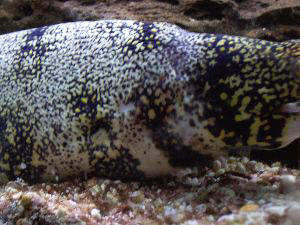
|
|
|



