|
Related FAQs: Pocilloporids, Pocilloporids 2, & FAQs
on: Pocilloporid Identification,
Pocilloporid Behavior, Pocilloporid Compatibility, Pocilloporid Selection, Pocilloporid Systems, Pocilloporid Feeding, Pocilloporid Health, Pocilloporid Reproduction/Propagation,
& SPS Corals, Stony/True Coral, Coral System Set-Up, Coral System Lighting, Stony Coral Identification, Stony Coral Selection, Coral Placement, Foods/Feeding/Nutrition, Disease/Health, Propagation, Growing Reef Corals, Stony Coral Behavior, SPS Identification, SPS Behavior, SPS
Compatibility, SPS Selection,
SPS Systems, SPS Feeding, SPS
Disease, SPS
Reproduction,
Related Articles: True or Stony Corals, Order Scleractinia,
Family Astrocoeniidae,
/The Best Livestock For Your Reef Aquarium:
Family Pocilloporidae, Part
2
To: Part 1,
Part 3, Part 4,
Part 5
|
.JPG)
|
|
Bob Fenner
|
|
| Pocillopora danae Verrill 1864. |
|
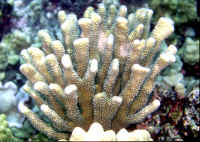
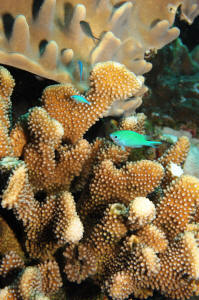
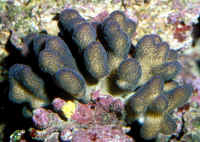
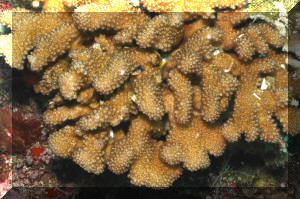
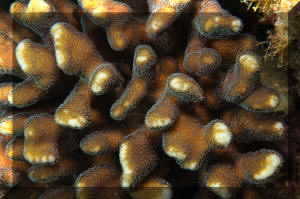
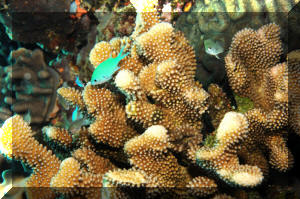
| Pocillopora eydouxi Milne Edwards & Haime 1860, Brush
or Antler Coral. Distinctive large, upright branches with light-colored
ends. A common species over its wide range. Large stand in the Andaman Sea
(Similans, Thailand) at right and an aquarium colony. Close up, 1 meter
colonies in Bunaken and colonies in Hawai'i below. |
|
Bigger PIX:
The images in this table are linked to large (desktop size) copies. Click on
"framed" images to go to the larger size. |
%20MD.JPG)
 |
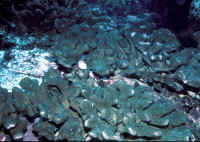
Pocillopora grandis poss:
Douglas Fenner This
one might be Pocillopora grandis (=eydouxi). P grandis usually has not only
larger branches but the branches farther apart, and the colony larger than
on P. meandrina. My guess here Is P grandis. P eydouxi is a name that has
been long used. Veron long ago reported that these two were synonyms. There
is a rule that such a name can be retained, but you have to appeal to the
Commission. Veron refuses to do that, but sticks with eydouxi. He
synonymized them long ago, long before he has come to distinguish many
additional species in the genus. As I see colonies in the wild, I see huge
diversity of variations within this nominal species, making me suspicious
that it may be a species complex. I need to check the types of both of
these, they may actually be names of different species in this complex. Or
not. Isn't taxonomy fun???? |
%20MD.JPG)
|
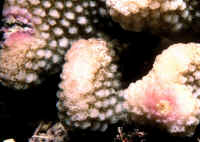
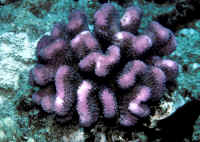
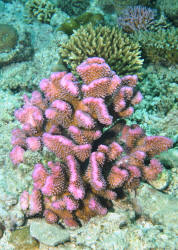
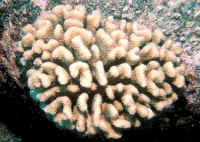
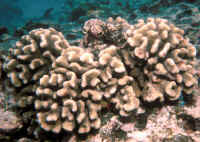
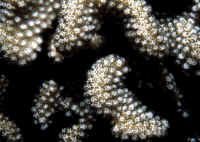
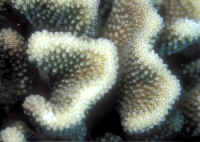
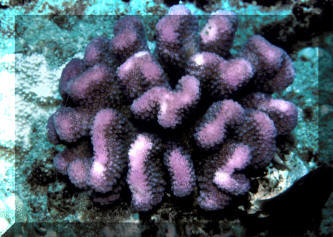
| Pocillopora meandrina Dana 1846. Flat, short, curved
branches, small verrucae. Regular arrangement of branch growth, verrucae
placement. At right: Bunaken/Sulawesi/Indo. and Hawai'i close-ups, and two
images of this common species in Hawai'i below. |
|
Bigger PIX:
The images in this table are linked to large (desktop size) copies. Click on
"framed" images to go to the larger size. |
|
%20MD.JPG)
|
To: Part 1,
Part 3, Part 4,
Part 5
|
|