|
|
| Home | Marine Aquariums |
Freshwater Aquariums |
Planted Aquariums |
Brackish Systems |
Ponds,
lakes & fountains |
Turtles & Amphibians |
Aquatic Business |
Aquatic Science |
Ask the WWM Crew a Question |
| Please visit our Sponsors | ||||
|
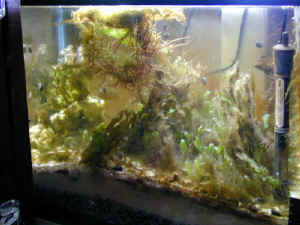
Refugium algae harvesting 2/22/05 Dear Anthony, After taking your advice I recently set up a 20 gallon refugium for my 90 gallon tank (I didn't have much space). I have a 4" sand bed with two types of macro (Chaeto & Gracilaria). When I bought the Chaeto about two weeks ago it was the size of a soft ball. Now it has tripled in size. <outstanding... truly one of the best genera for nutrient export/refugium use> It was tumbling around but now it is starting too get to big to move around freely. My question is how much should I keep in the refugium? Should I cut it back so it can tumble around again? <yes... exactly... do figure out your cycle of harvest (2, 3 or more weeks to halve it and keep it tumbling). And do be strict and habitual about harvesting it for long term success> Also It seems the fine sand that I used really compacted well and I was wondering if I should add more now or wait until it is below 4"? <not compacted... dissolved my friend. Oolite has a half life of about 18-24 months in aquaria. Do add more to maintain your desired bed depth> P.S. Is any one else amazed that you can buy a book and then ask the author questions. Well I am! Thanks again for all your help! <thanks kindly, but the honor is ours :) Anthony> New Refugium <Hello> How long would a tank take to cycle if every thing you put in it is old? I transferred about 30 gallons of aged seawater from my 135 gallon tank, that's been up and running for 5 months. I cut a piece of sponge from my 135s sump and put it in my whisper 60, the filter for the 55 gallon, which is going to become a refugium. <Hmm a few weeks or so.> Also should I fill the 55 gallon to the top? Or have a shallower refugium, like only 30-40 gallons? <depends on the sound level, I would fill it up so that it is quiet but not too high so the extra water from the 135 can drain to it.. The 135 is connected to it right?> How long will It take to cycle is the biggest question? I have a goby and pistol shrimp I'm supposed to pick up tomorrow, and my 135s only got a 1/2" sugar sand bed. The 55s got a 6"-7" crushed coral bed. Thanks a lot Tristan <Well Tristan, if the refugium is hooked up to your cycled 135 I wouldn't worry about anything and add the shrimp and goby after you q/t them for 4 weeks. if the refugium is no an inline one connected to the 135 now I would buy bio-Spira and add it when you add the goby and shrimp. that should be all you need.> <Justin (Jager)> Refugium surface gunk Hello, I have a 20 gallon refugium setup on reverse photoperiod for a 50 gallon main display. << I like this idea. >> I have an Eheim 1048 pumping water into the refugium and then it is flowing back into the sump which pumps water into the main display. When I take the top off of the refugium and look inside the walls are coated with green gunk and there is a distinct film of gunk at the top of the water. Is this normal? << I is common, and I wouldn't say it is bad. >> Is there something I should be doing to fix this like more flow, a powerhead inside or something? Could this cause problems in the main display? << It only grows where there is nutrients, light, and water motion. The easiest way to get rid of it, are to have other macro algae competing with it for nutrients. However, it may not be bad to grow. Look at it this way, you can open that lid, and scrape that stuff out every few days. That is almost like having a protein skimmer (which is something you may want to add). Remember what goes in, must come out. This "filmy gunk" may be a good way to remove excess nutrients. >> Thanks, -Brent << Adam Blundell >> Refugium "Dust" Hi. <Morning! Ryan with you> Thanks for your site, it is a tremendous help. <Surely> I tried a few different attempts to search for the answer to my question, but I could not find it. I recently purchased an external CPR HOB refugium. I got it up and running, and everything is fine with it, but I have noticed that a thin layer of sediment has settled onto the bottom of it. I assume this is from the main tank. I have not put any substrate into the refugium yet. So my question is, is there any way to prevent this from happening? <prevent? Not really, but you could use a sponge on the input for the refugium.> Is this just part of the refugium? <Natural occurrence, yes.> Can I place some sort of filter over the intake portion of the refugium? <ha! You're on my level. You would also see less of this if you increased skimming.> Should I just vacuum the refugium like I do the main tank? <If it bugs you. It's actually like a breeding ground for pods, so it has benefit as well.> Sorry about that long string of questions, especially since they all probably lead to the same answer. <Not at all, glad to see you in research mode.> Thank you very much for your assistance. <Good luck, Ryan> Brian REFUGIUM FILM Hello, <Hi Brent, MacL here> I've been doing a lot of reading on your website and wanted to confirm some of my findings. First I have a refugium with an Eheim 1048 pumping 158 gallons per hour. <Nice lil pump.> Additionally I have a 50 watt power compact in reverse photoperiod. When I lift the lid of the refugium there is a very thick film on the top of the water. Is this the sign of a working refugium or one that isn't working. <My refugium doesn't have any type of gunk at the top. It has enough of a flow so the water goes through the Caulerpa.>Should I place a protein skimmer on the refugium to get rid of this gunk? <I do believe you need more flow of some type.> Should the flow rate be increased? <Yes or perhaps its where the flow is, maybe you need to somehow point it differently?> Also what kind of maintenance should be performed on the refugium? <I prune my Caulerpa, and clean the sides.> Based on the FAQ's everything seems fine with the setup but wanted to confirm. <Sounds like you are doing great, I personally would suggest just a bit more flow or change of direction of the current flow.> Thanks in advance -Brent <Good luck, Brent, MacL> Baffle Noise Dear Sir or Madam: <Sounds like the beginning of "Paperback Writer" by the Beatles!> I am designing a refugium with a partition between the algae and pump chambers. I am concerned that water flowing over the partition into the pump chamber will produce excessive noise and splashing. <Mmm, not likely, but... can be muted with placement of foam sheeting...> A solution that I am considering is to build two partitions with bio-balls between the partitions. Water will then flow over the 1st partition and strike the bio-balls before reaching the pump chamber. Will this reduce the noise and splashing enough to justify the added complexity? <Likely so> Are there other solutions that I should consider? <Likely not> Thanks very much. Regards, Paul. <McCartney? Bob Fenner> Refugium 18 Jan 2005 Hey there Bob and Crew.......<Hi Beth, MacL here with you on her birthday!> No matter how much I think I seem to know about this hobby (that my hubby got me into, his tank became my project and up keep.....his to simply enjoy :) and foot the bill for). I read your website on a daily basis just for general knowledge as every time I take a look at the aquarium, there always seems to be something else I need to know. I've asked a couple questions in the last several months ( we started our work of art in Sept 04) all have been answered so well and I'm hoping I can once again bore you with some of my concerns and newbyness. I've been waiting a little while to write again to try and get a few questions out of the way at a time. Sorry for the long read. I'll start off by telling you about my 75 gallon aquarium. All water parameters are normal and we have been doing a 20% water change every 2 weeks. Lights are Coralife compact with (2) 65 watt 10,000K, (2) 65 watt actinics and 3 moon lamps. (Hopefully adequate lighting for the corals that I have listed below?) Canister filter (pumps 185 GPH), 2 maxi-jet 600 (one on each side of the tank...water flow ok for corals?), and a CPR refugium/skimmer, which we get probably 2 cups of green water out a week (ok?). <I would say your flow would be okay for most of the softies and some of the LPS corals. And it sounds like your skimmer is producing a lot but my question is, is what it is producing wet skimmate or is it more protein and more a dry mix. You might need to adjust to pull less water and more nasty stuff.> In the refuge I have 3" miracle mud (I know miracle anyone pays that for it) which gets a yucky bubbly stringy looking stuff on the top of it ( do I remove this or leave it?) some LR, some red Gracilaria, some grape Caulerpa and some kind of green that looks like the Gracilaria. My purpose for the refuge is to grow pods for the corals and fish. I am currently leaving the lights on 24 hrs due to not wanting the Caulerpa to go asexual (doesn't it put off bad toxins when it does? I have been feeding it to my fox face until its gone), but would like the lights to be of the same time as the main lights so the fish can have some dark time. Main tank white lights are on 12 hrs a day with blues coming on and going off 1 hr before and after the whites. (Sound OK for the corals?) Any advice on the refuge and what I am wanting to use it for would be great! Roughly 60-65 lbs of LR. 4" DAB which inhabitants are 1 sand sifting star (which I'm thinking about pulling out, I heard it eats on things that are good for the fish and corals), and about 20 Nassau's snails. Other invert include 5 or so bumble bees, 12-15 blue leg hermits, 5 Turbos, about 20 Astrea snails, 1 cleaner shrimp and 1 banded coral shrimp (also which I'm concerning removing due to the corals and food competition). In corals we have 1 hammer, 1 bubble, 1 toadstool mushroom, 1 fox, 1 pumping xenia, 1 long tentacle plate, 1 clove, 1 zoanthids ( which appears to be what I'm hoping is reproducing and good...stopped opening up and there's a ripped opened looking cut if you will spot on it?? , 1 green start polyp, 1 rock with 3 metallic green mushrooms, 1 rock with 2 hairy mushrooms and one sun polyp. I feed them all except the toadstool 3-4 times a week. I have been feeding them Mysis shrimp or Cyclop-eeze. I have also been adding calcium, iodine, strontium and essential elements 2 times a week. Does this sound correct for the corals that I have? Is this assortment of corals together ok? I have each of them at least 6" from the other. Fish wise I have 1 fox face lo, 1 bi color blenny, 1 dragon goby, 1 PJ cardinal, 2 percula clowns, and 2 damsels (total length in fish is about 12"). All are eating well and seem to be doing great, although first one and now both clowns do a twitching thingy. They don't dart around or anything just twitch then move on like they are playing. They have been doing this for a while now so I am assuming its fine? Am I at my max here as far as fish go? If not could you recommend a nice brightly colored fish? I was doing some clean up maintenance today and noticed two little grayish white shrimpy looking things on the LR. Any ideas? The only algae problem I seem to be having is green hair algae growing on the LR, so every few weeks I have been going in with a toothbrush and brushing it off but it does always returns. Hopefully with time the refuge will help take care of that. I think for now that is all I can think of, enough I know! Thank you so much for the time and efforts you put forth on this website, I for one know that if it were not for this website I would have hung this lobby up already! <Beth your tank sounds quite lovely. I'm a bit concerned it might be close to being overloaded simply because you have a large number of fish and of corals. Obviously you are willing to do the work to keep it up but it doesn't allow for much growing room of all the corals and fish. The white shrimpy things are probably live Mysis or copepods and that's great. The clownfish twitching is something that clowns do and nothing to worry about. The stringy stuff in the refugium sounds like Cyanobacteria and probably should be removed. Now about the lighting arrangements. I do believe you should give your fish some downtime with lights totally off. You can put the refugium on the same timing but you'll have to prune the refugium much more frequently to prevent it from going sexual. Watch it closely for green Caulerpa that begin turning white and get that out as fast as possible. Thank you for the kind words about the website. It is an honor to work on it. Good luck MacL> Cheers, Beth Refugium and contents follow-up 18 Jan 2005 Thank you MacL for your speedy response. Upon further inspecting and reading and looking at photos on the net I have determined these shrimpy things to be amphipods. I know I have a max load on corals in the set up. We are planning a 220 gallon reef ready in the summer and most if not all of the corals will be moved into that tank. I think I would like to put hard corals in this tank or make it a FOWLR. I will try to get the stuff out of the bottom of the refuge, and will watch for Macro going asexual until I get the rest of it out of there. What kind of macro do you think is good and I don't have to worry about it going asexual? The only thing I am getting out of the skimmer at this time is green water, how do I go about adjusting it to pull more then just wet skimmate? (more bubbles or less bubbles, is that the adjustment) As far as the zoanthids....do you think what I have described them doing is reproducing? One more questions for tonight, I have what appears to be white spiral like baby snails everywhere, on the glass, the rocks, power jets. I have seen a few baby snails in the take but not of the spiral kind. Again thank you for your support and knowledge! Beth <Hey Beth, great follow-up. Okay lets do this one thing at a time. Amphipods are for the most part good in the tank. I am assuming you ID'ed them enough to determine they are/were the beneficial ones. That's wonderful about the tank upgrade. Let me caution you though. I just had a terrible tragedy happen myself. I had a 120 gallon tank that I've been building up for ten years with fish and corals. Horribly overloaded. I had my 180 and my 220 ready to go and put off moving things over until the weekend. The electricity went off and I lost EVERYTHING. So just be cautious and plan your moving things quickly. Now the skimmer, I think you do need to make a tighter adjustment on it. Usually I believe its more bubbles and lowering the level so the bubbles basically have to "percolate" to a higher level. So that the bubbles just don't immediately froth over into the skimmer but have to push up into the skimmer if that makes sense. Yes I definitely think your Zoanthus are reproducing and let me caution you about the Zoanthus. Be very careful if you touch them. They can be quite toxic. Different macro's offer you different things. I can only give you my personal experiences. I hate grape Caulerpa because in my experience its the first to go sexual and can be a major pain to work with. My personal favorite is the "feather" Caulerpa. The snails sound amazing Beth. Its hard for them to survive in a tank setting. Just to clarify the spiral snails aren't cone snails? You'll find great pictures on the site of snails. Thanks so much for your questions Beth. Hope this helped. MacL> Refugium & Cyano: Part IV Hello again WWM Crew, <cheers> I continue to struggle with Cyano in my 20g refugium (180g display). I included two of my previous emails with responses (as well as pictures of my refugium & display tank) for history. <it pains me to see the display tank shot with 5 tangs (including a Naso!) plus a Foxface in a 6 foot aquarium. Cyano problem aside, this tank was poorly stocked and these fishes will suffer in time IMO. Do consider their cumulative adult sizes (add them up by referencing them at fishbase.org) and know that they will stunt and likely suffer abbreviated lives (could be 5 years instead of 15) and regardless, is simply not conscientious aquarium keeping. I'm also surprised that you have enough water flow to keep the powder blue content (high flow/surge species). When there are so many other beautiful fishes in the trade, it confounds me that folks will unnaturally crowd systems with naturally aggressive congeners or other closely related species> I have tried everything, even time but alas... Cyano is winning the battle. A fellow aquarist has given me some (possibly contrary?) advice recently as well. Since everyone has different experiences and opinions, I would really appreciate it if you would read through his comments / suggestions below and provide feedback. <OK... will do> He is suggesting removing my DSB and using a bare-bottom refugium and main tank as well as adding long spine urchins (reasoning below). <the DSB is not your problem, my friend... nutrients are. And while Diadema urchins are outstanding grazers on microalgae, they will not touch Cyano and they are not detritivores. I see no merit to the recommendation as it stands> This is not something I want to just try on a whim unless there is sound reasoning that it will work. Hopefully you have time to read his entire email, as I really need the additional advice. Advice I was given: 0.1 in phosphate is still way to high. You need to get it under .05 minimum. <agreed here,... do find the source of your phosphates. This is easy enough testing samples of food in water, source water, etc.> Like I said before, Cyano will out compete green algae when phosphates are high. <not necessarily true. Arbitrary and case specific in the complex environments of aquatic ecosystems> They will grow on your greens and overtake them. I looked at your pictures and your phosphate problem is most definitely from your substrate. <no one can make this claim based on a picture... and ironically, your DSB in both photos looks particularly healthy to me> You need to run bare bottom until you have your algae growing in your refugium and then only add sand to make your display tank look good. I do not run any substrate in my refugia. The Caulerpa and other matter ends up forming a mulm on the bottom which the copepods, Mysis shrimp, and other creatures feed off of. <ahhh...no. Copepods eat algae/phyto.> I am not guessing at the answer to your problem. I have been through this with many hobbyists. You need to get rid of the thick substrate in your refugia. I know others recommend the type of set up you have, but it is not conducive maintaining low nutrients in my opinion. <heehee... this sounds like my wacky anti-DSB friend from PSMAS in Seattle WA> I you do decide to siphon all of it out. Shut off all pumps and siphon carefully. Remember this: when you disturb the surface area where bacteria reside, more will end up in the water column. Increased bacterial levels in the water column are indicative of RTN out breaks in reef tanks. <agreed> I have had conversations with Sprung about coincidences with detrital/substrate disturbances and RTN outbreaks and we both had similar experiences. That is why I siphon it out carefully, taking all water with the substrate and putting as little stirred up detritus into the water column. The Cyano appeared in your scrubber because you already had phosphate levels to support it. Lighting, sand turnover and other factors can affect it also. Detrital matter making it to your scrubber would be deposited on the surface of the substrate and decay producing the necessary environment for Cyano. Anything decaying produces PO4. To convince yourself try these things. Take a sample of water from the substrate in the scrubber. A syringe would work great. I use a syringe w/filter to get just water, but, it is not necessary. If you get some crap in the test water, it is ok. Even an eye dropper stuck in the substrate and the bulb release slowly to suck in slowly will do. Run a phosphate test on the water. Or, siphon some substrate out carefully and test the water that comes out with it after letting it settle. You will be amazed at the phosphate level in this water. <this is simply not a fair assessment... all substrates in practical applications (including all those healthy DSB systems that are 5, 10, 15+ years old) will have higher phosphate in the substrate/bound. It does not mean that they will spontaneously fuel Cyano growth> When I have done studies on this I used a Nutrient analyzer in my lab and water samples from my tank (with no detectable phosphate on your type test) indicated that the substrate was still a point source for phosphate. In other words in was an order of magnitude higher in the substrate than in the water. <this is natural... you can find this on reefs too> I was measuring in umol/L. In your case I would estimate that if your water column is 0.1 ppm that water in the nooks and crannies of the substrate is aprox 1 ppm. (at least) Caulerpa thrives in a low phosphate low nitrogen environment and then takes the phosphate even lower. <Caulerpa is easily neglected/abused... be sure you understand all of its merits and risks, or simply elect to use an equally effective and fare more stable macro like Chaetomorpha or Gracilaria> Siphon your substrate into a bucket and rinse it out, put it away for later use. Once you are running a bare bottom, you will see the amount of detritus that accumulates on the bottom and you will be able to siphon it out easier. <significant detritus should not be accumulating if you have adequate (right amount and right delivery) water flow in the system... a common flaw in many tanks> In you display tank, I would add a couple long spine urchins. They will really clean the rock off good. <true... very true> Use Mexican Turbos for filamentous greens, and Astrea sp. also. <True for the former, but diatoms for the latter> My 30 gal refugium is just packed with Caulerpa. The refugia part comes into play, because all of the plant matter provides a home and food for them. They do not need any substrate. I siphon half of the brown mulm out every three to six months. In this stuff you can find tons of life. If you are thinking that the thick substrate is going to help with denitrification or removal on nitrate do not worry. With a scrubber system you never get nitrate because the algae pull out the ammonia before it even gets to nitrite. You are trying to engage two separate disciplines for nutrient removal. You should pick just one, and in my experience a scrubber is much more effective and easier to maintain. <my experience is that a DSB is far more effective and far less maintenance. My experience to back this up, beyond professional installations through the years, is the use of 48,000lbs of aragonite sand in DSBs in my coral farming greenhouse. Wrote a book about it ;)> I always had the same exact problem you are having when I tried a thick substrate. The only time I get Cyano now is when I add too much iron, manganese, and zinc. Then I get small mats forming on the top of the water in my refugia. I harvest them out, back off on the supplements and re-establish equilibrium. I harvest out a lot of Caulerpa. About a freezer bag a month. I am using a shop light on top and one in the front now on the 30. This thirty takes care of a 40 and 125 reef with a 300 gallon sump. Thank you!!! Greg <the message is still the same Greg: nutrient control - by adjusting water flow (increasing if necessary), getting skimmers to work more effectively (a 180 gall without all those tangs would still need/want 2 skimmers cleaned alternately to reduce the interruption of skimmate production), and water changes are usually too weak in problem systems (20-30 gallons weekly would be nice here to assist proper fish growth, reduce allelopathic compounds from corals and algae, and replace trace elements instead of using random concoctions from bottled supplements.). I have yet to see a tank that improved nutrient export could not eradicate nuisance algae in. Best of luck, Anthony> Refugium Maintenance 3/28/04 Hello and Good Day Crew. <cheers> I have been reading over WWM for quite some time now. I am sure I have asked questions that have already been answered on the site, and I apologize for that. My question today is one concerning my refugium. It is a medium Aquafuge (up and running for about 8 months now) It is pretty jammed packed with LS, LR, short feather Caulerpa, Gracilaria parvispora, Ulva sp., tons of Strombus grazers( Strombus maculatus) which seem to be breading at will, 1 nice sand bed clam, and what seems like millions of Amphipods breeding and in all stages of life (for my Mandarin) besides the occasional feeding I pretty much leave the Refugium alone. <all good... and mostly agreed, although I am sure your system would benefit by limiting the species of algae to one. Pick Gracilaria here as the most efficient/least noxious> I have noticed lately that it is getting pretty grungy in there with a real nice coating of sediment. <a common problem... better water flow would reduce this> Although I know this is probably pretty normal for what is going on in there...Is there any maintenance/cleaning that I should be doing short of harming everything in there? <siphoning out some of those sediments periodically would be beneficial indeed (a functioning settling chamber). But again, do add more/better water flow to keep more solids in suspension for use by filter feeders if not export by the protein skimmer> Thanks for all the help Steve <best regards, Anthony> Refugium care II 3/28/04 Anthony, Thank you so much for your response! I really appreciate all the help. Unfortunately, now I am even MORE confused... You see, in my original email. I asked if I should increase the flow in my refugium but Bob said I already had significantly too much flow. He also indicated the amount of light I am using should be plenty for red Gracilaria. I realize there are no "black and white" answers to most of these questions since so many factors are at play in various aquariums. <true true... and my dear friend is sitting across the desk from me as we speak/type (I'm visiting SD to work with homie on images for our next book). To your problem, each case is specific/unique... and while you could have too much water flow by the numbers, it may very well be the application of the flow (not adequately adjusted) that is the real problem. The proof is in the pudding here... detritus has accumulated, and nuisance algae has flourished here (refugium) but not in the display. That's pretty cut and dry mate: excess local nutrients mitigated by weak water flow> After removing the Cyano last weekend I did add another powerhead to the refugium, bring my flow into / out of the refugium to about 200 gph and the flow within the aquarium to about 400 gph. Of course this uprooted the Gracilaria as well so it has been tumbling ever since. <excellent!> I even added 3 scarlet hermits and 4 blue leg hermits to try to keep the substrate stirred a bit. <yikes... do resist this. The hermits in particular (pull them out, my friend) as these creatures are predators on desirable infauna (worms, pods) in the refugium. The refugium needs to be fishless and predator less otherwise> Still, everything is covered in Cyano. <it takes time my friend to correct... the nutrients have to first be exported (via the skimmer and/or large water changes)> It has even floated to the water's surface and collected bubbles, forming a white / red foam mat about 3/8" thick. I am preparing to scrub all of this out again and I am going to add some Caulerpa Prolifera as well. <adding the Caulerpa will be a very serious long-term mistake IMO. There is much written in our WWM archives on this subject (including contrary opinions) and especially our Reef Invertebrates books (detailed low-down on risks and benefits of Caulerpa)> I did add Phosphate Sponge and PhosGuard and this has brought my phosphate level down to 0.2 PPM so maybe this will finally be what allows me to get the Cyano under control. I am still worried though since the Cyano on the substrate is spreading daily. I just purchased The Conscientious Marine Aquarist two weeks ago because I saw it deals with water filtration, etc. I guess I made the wrong choice for my particular need (although the book is of course a terrific resource for keeping fish and initial setup). <agreed... CMA is really one of the very best comprehensive books on marine keeping. Outstanding> I am now wondering if I should remove the plenum from my refugium and just leave a DSB (currently I have both). <not needed... I'm of the opinion that the plenum neither helps nor hurts> I am also wondering if mud (i.e. "Miracle Mud" or "WonderMud") would make a better substrate if my needs are 'pod growth, macro algae growth and NNR. What do you think? <I am sure mud is not your solution here> Maybe Cyano would not grow as readily on a mud substrate? <ahhh...no. The contrary> (Too bad I bought 45 lbs of Aragamax sand for the refugium if this is the case). I guess the good news is I have a thriving 'pod population (1,000s in the refugium, Chaetomorpha, sand and skimmer) for whenever I do add the mandarins. I have spent literally days - possibly weeks worth of reading on WWM trying to beat this Cyano. If you have any additional suggestions, I would greatly appreciate your input! --Greg <I truly do feel you can/will kick this easily. Anthony> Algal Problems, 4/21/04 Hi everyone, <Michael here, up at the crack of dawn (10 am)> I have a problem with BGA growing in my refugium - on the part of the sand that is uncovered by Chaetomorpha, and on the Chaetomorpha itself. It is not in my main tank - just the fuge. What's wrong? <Do you have an extended photoperiod in your refugium? This coupled with high dissolved organics could lead to blooms. Light is never the main cause of Cyanobacteria, though: DOC concentrations could be less than ideal> And secondly, how much Chaetomorpha is supposed to be in the refugium? <I have as much as will grow in mine, I trim it when it starts getting too prolific> How tightly packed? <Don't let it choke itself out> Filling how much area? <Just let it take it's course> It is growing very well, but I've never been able to find any info on how much to keep in there and how much to thin out at one time. <Yep I have quite a lawn of Chaeto myself. I trim it about twice a month. Don't worry too much about it> Thanks for your time! Bess <No problems. M. Maddox> Hair Algae in Refugium 5/30/04 Hi Crew, I have a quick question for you this time. My refugium is being overgrown by hair algae, which is choking-out my Gracilaria and Caulerpa. What do you recommend I add to eat hair algae (but that will not eat 'pods). I have a Synchiropus picturatus and a Synchiropus splendidus so I cannot afford to impact my 'pod population. I did add a few red leg hermits and two tiger tail cucumbers to the refugium (I also had a Cyano problem) but these do not appear to have any impact on the hair algae. <No hermits are really good algae eaters. You may consider a comb tooth blenny (Sailfin, lawnmower, bicolor, etc.), but your best bet may be manual removal.> I have a small pygmy angel that loves hair algae (and I would love to remove it from my main tank because it also loves to nip at my Lobophyllia) but I am concerned it would eat 'pods too. I also have a lawnmower blenny but, as well as it likes carnivore pellet food, I am also concerned with this fish eating 'pods. <The angel is a much bigger risk to 'pods than the lawnmower blenny, but even the blenny may eat quite a few, even if it is only incidental to eating the algae. However, the impact will probably be no greater than any other control method.> Would a lettuce nudibranch be a good choice or do you have a better suggestion? <Lettuce nudibranchs would likely eat the Caulerpa before the hair algae. I am still thinking that manual removal is your best option.> Thank you for the help! --Greg <Glad to! Adam>
UV and a refugium Hello WWM. I love your site! my question is simple (or at least short) I bought a UV sterilizer and I'm using a refugium. Should I use the UV or not. My tank is cycling. My refugium is full of life tons of Caulerpa and millions of copepods. The UV defeats the refugium right? Thanks for all the info ..Bill <Actually, the UV and refugium are not mutually exclusive and ultraviolet use should have no discernible negative impact on the refugium. Bob Fenner> Getting 'pods from Refugium to Tank (1/13/2004) Hi Crew, <Steve Allen tonight> I am planning a 20 gallon plenum / refugium for my 180 gallon aquarium. <Why put a plenum in your refugium? A simple DSB should work fine.> One of my goals is to produce enough 'pods to support a dragonette. <Can you make the refugium any bigger?> Can you suggest any way to encourage / accelerate these little creatures leaving the refugium? <Good question.> I will be flowing only about 100-150 gph of water through the refugium and I have a small (1/2" I.D.) overflow for the refugium water to return to my sump. With this small flow rate <Plenty for a refugium of this size.> and only surface water being returned to my main tank, I am just concerned that very few 'pods will find their way to the overflow to escape the refugium. Do you think this will be an issue? <A valid issue. It may not be that many who get up there.> I had considered adding something like a small "ramp" than leads from the refugium substrate to the overflow opening but I do not know if this would have any effect in directing the 'pods. <A pile of live rock might work better.> Oh I do have one more question: Plenum plans on WetWebMedia.com call for a coarser bottom substrate layer than that of the top layer. I noticed that the plenum plans on www.garf.org call for the same substrate on both layers. Does having a more coarse bottom substrate make a significant difference in plenum operation? I am considering using "GARF Grunge" for the bottom plenum layer since it is a very coarse material and it contains such a diversity of life and coralline seedings. Do you think this is a worthwhile idea or would the microfauna in the "Grunge" just end-up dying due to lack of oxygen in the lower plenum layer? <Covering it with something finer will likely suffocate the fauna in it.> Maybe the "Grunge" would be better suited for the top plenum layer? <I would think so.> Would the coralline present in the refugium "Grunge" seed additional coralline in my main tank? <May eventually spread. As far as a plenum goes, I favor the sugar-fine aragonite DSB of 4-6" in a refugium. No plenum. You could wind up with sand blowing everywhere with the flow rate you plan. If need be, a 1/2 inch layer of a coarser sand on top will hold it down better.> Ok, so that was more than "one more question"...<Believe me, as a pediatrician, I am quite familiar with "just one more question..."> but thank you for all the great advice; I owe much of my saltwater success to the great people at WetWebMedia who answer my endless questions! <Me too> --Greg Refugium Bubbles Causing Troubles! Hi. Good day Mr. Fenner and Crew. <Hi there! Scott F. with you today!> I have an above-the-tank 10G refugium tank. It's about 2feet higher from the top of my 36G Tank to the left. I'm currently using a Maxi-jet 1200 to pump water up and gravity feed down back to my 36G. Both hoses are 5/8 OD. The problem is, as water comes down from the 10G, it collects air with it and makes lots of noises and bubbles in my 36G tank. How do I stop these noises and bubbles from returning into my 36G tank?? I tried a weaker pump, Maxi-jet 400, w/ the same problem. The bulkhead on my 10G is 1inch in diameter w/ a 90 degree elbow down. PLEASE HELP!!!! Thank you! -don <Well, Don- it's gonna take some experimenting. A friend of mine who had a similar problem used a length of pipe attached to the return that ran all the way into the water (below the water line)...No more bubbles! Another idea would to be to direct the water over a piece of rock above the waterline, to "deflect" the flow a bit, although this may not work well. Try the length of pipe and see if that does the trick...> Ps. Also Currently purchased a Flame Angel. He's not eating and always hiding behind the LR. What kind of food can I introduce to him to get him started?? <Flames are omnivorous, so you can tempt him with a few different things. You might want to try a nice piece of live rock covered in algae growth, so that he can "graze" at his leisure. Alternatively, you could try some frozen Mysis, which seem to have a "smell" that fish find hard to resist. Some people try live brine shrimp, but I tend not to use them. Whatever food you try, don't give up. These are hardy fish that if well-acclimated and healthy, should eventually eat well. Good luck! Regards, Scott F> I Just Wasted My Money - 'Fuge Question Hello I have a refugium that I want to set up to an existing tank. I bought some Mineral mud and macro media that CaribSea sells as a set. Well it says on the package to let sit for 2 days before turning on pumps and then let tank cycle which tells me I just wasted my money. Can I rinse this?? <Probably not.> Will it hurt the tank to let it cloud up and clear up eventually??. <Don't think it will 'hurt' anything but some portion of your substrate will end up in your filters. I'm guessing the stuff is powder-fine.> And if I am outta luck with this stuff what do you recommend for me to use to add a refugium sump to an existing reef tank?? <Just fill the thing and let it sit, as the instructions suggest. Get it running for real in a couple of days and all will be fine.> Joe <Cheers, J -- > - Refugium Considerations - Hi Folks, I have recently added a 100l refugium to my reef tank. The refugium is underneath the main tank, taking a feed from an overflow box; unfortunately a drilled solution will have to wait until my next display tank upgrade. I have set the display tank and refugium water levels such that flooding is unlikely. The return powerhead is controlled by a float switch so that the pump turns off if the overflow box fails. Not ideal plumbing, but certainly better than not having a refugium at all. The refugium has a 6 inch deep sand bed, strong T5 lighting, growing Caulerpa. The supply of algae to the UK is appalling, so Caulerpa was my only option. I understand the regime necessary to limit the likelihood of the algae going "sexual". The purpose of the refugium is to grow critters for my mandarin to eat, raise pH overnight and export nutrients away from the System. Water movement through the refugium is determined by the "return" powerhead, which pumps approximately 3,000l per hour (30x the volume of the refugium per hour). Most of the water movement occurs towards the surface, with considerably less at sand level. I thought it would be useful for the refugium to have it own local water circulation, as well as that coming from the "return" powerhead. This would increase water movement at sand level AND provide movement should the overflow box fail for any reason. Worst case scenario, I go away for a weekend and the overflow stops working, it could be 48 hours before I get home to restart the circulation. Local movement would prevent the refugium water going stagnant. Am I right in thinking some local movement would be beneficial, or am I taking the circulation too far? <I think you're on the right path.> Assuming you do agree, I would prefer to use an airstone to move the water, rather than a "critter chopping" powerhead. I know I am using a powerhead to return the water to the main tank, but critters are only likely to make that journey once! On the other hand critters could pass through a local circulation powerhead countless times - I have this mental picture of a food blender for some reason! Are there any reasons why I should not use an airstone in this way? <None that I can think of.> For example, would it impact upon the growth of the algae? <Don't think so.> The refugium is home to the calcium reactor, so a small amount of CO2 may be present in the water, which would get chased out by the airstone. I can't make up my mind whether this is a good thing or not? I am assuming the algae would love the CO2, but on the other hand my slightly low System pH would benefit from CO2 elimination. <Chances are best that if the lights in the refugium are on, the CO2 will be consumed by the algae.> On balance, do you think "circulation by airstone" is a good idea or not, in my refugium? <It's not a bad idea - I can't think of pros/cons either way. I say go for it.> Final question, about my filtration. The 350l display tank is filtered by 60kg of live rock, a Deltec MCE600 skimmer (wonderful unit - astonishing performance!), 25mg/hour of ozone injected into the skimmer, Rowaphos, carbon (changed weekly), 8% water change per week, floss in refugiums sump section (changed weekly). Before the refugium was added the display tank used a UV filter. By the time my fish are fully grown stocking levels will be heavy, but sustainable, for a reef. New additions of fish or inverts are now rare events, hence opportunity to introduce disease into the environment is low (I do quarantine as well). Should I leave the UV on the display tank to reduce any free floating pathogens, or should I leave it off the System to fully benefits from all the life produced by the refugium? <I'd leave it off. There is anecdotal evidence that systems that have been UV filtered for long periods of time begin to show an acquired immune deficiency problem, where the fish break down after years. Think there is likely some useful stuff being killed in the UV along with potential harmful stuff. I say can the thing and rely on good quarantine - perhaps run the UV on your quarantine system... is what I do.> As always, thank you very much for your time. Your help is genuinely appreciated. Andrew <Cheers, J -- > Refugium Questions I greatly appreciate all the wonderful information on your site. I have two questions: <Hi Scott, Adam here. Glad you have found good info on WWM!> 1. I'm considering stocking my refugium with small clams. I have a 175 watt MH light that hangs over the refugium. How does a small 2-3" clam stack up against macroalgae in terms of nitrate removal? Should I just stick with macroalgae? <If the goal is nitrate removal, then a deep static sand bed will provide the most benefit. Macros will work too, because of fast growth, but IMO are much more important in terms of phosphate and metal removal.> 2. Everyone seems to advocate a very slow rate of water movement through a refugium. This is puzzling to me. The reason offered is always that the macroalgae needs time to "catch" the nitrates. (Yet I never hear that corals need time to "catch" calcium or iodine or whatever.) <This is total nonsense and demonstrates a poor knowledge of uptake/exchange processes. In this regard (ignoring practical concerns) more flow is better because it delivers more nutrients to the algae.> Is nitrate fundamentally different from other dissolved substances? <Nope.> My experience has always been that like corals some macroalgae prefer a lot of water movement and some don't. My refugium is between my sump and the return pump and has a lot of water flowing through it. The macroalgae seems to grow fine. <Totally agreed. As a general rule, if you aren't kicking up sand and the algae stay in place, it should be fine.> Will slowing down the water movement actually increase macroalgae growth? In other words - does water movement through a refugium have any effect on macroalgae growth - except to favor those macroalgae that seem to like more water movement? <Quite the opposite. If you slow down the water movement (past a certain point), you will limit the nutrients available to the macro algae. Thank you for your help! Scott Campbell <Glad to! Adam> Small Refugium With Big Potential! This website is awesome! It has inspired me to take down my wet/dry with bio-balls, and build a 20 gal refugium, which I installed last night under my new 65 gal reef-to-be. <Excellent! Glad to hear that we've been a positive factor in your system's development! Scott F. here today> Questions: Because my Berlin skimmer has a footprint that takes up half the 16" length, will roughly 6-8 gallons for the refugium section be adequate, knowing that I should have more, but can't?? <Well, any size refugium is better than none! I think a 'fuge of almost any size is a great addition...Go fo it!> Also, I have a thin layer (about 5 lbs) of sand from a very seasoned tank, plus 10 lbs of small, seasoned live rock and some Caulerpa. Will this soup do it for me? <Yep- I think it will be a nice way to "jump start" your refugium. Diversity is the key> I will have a Gro-lux bulb over area, but if the down drain from my tank flows into refuge area, will that be to disruptive to plants/animals that are living there? Suggestions are much appreciated. Thanks, a 4 month newbie, and loving every minute. <I don't think that the influx from the tank will be too disruptive...Flow is important in a refugium, anyways. The "disruption" that you're trying to avoid is from predatory life forms. I hope that you enjoy some benefits from your little refugium! Good luck! Regards, Scott F> Small Refugium With Big Potential (Pt. 2) To: Scott F. --Thanks for your timely replay to my questions of the other day. <You're quite welcome> I managed to hang my Turbo skimmer outside the refugium/sump, so that I could squeeze more space for the refugium portion, which I know is better--more is better, right? Also, I was able to section off the influx from my down drain, added a few live rocks in that section with bubble baffles, and voila! It actually works the way it should. <Excellent!> I was concerned about the rather thin sand layer, so I added more Aragonite over the live sand I had, and now the bed is about 4". Should I make it thicker or is this sufficient?? <Well, tons of conflicting views here (what a surprise). I'd start with 4 inches and adjust if you feel that it is warranted> BTW, the Red Sea Berlin turbo pump conked out on me at this time. Would any 500-700 gph pump work, or do you think I need to get another same item from Red Sea? <If it were me, I'd probably stick with the "OEM" pump, and get another one from Red Sea> Please suggest what you think would work, and thanks again for a very enlightening forum for this 4 month newbie.......Barry <Our pleasure! Regards, Scott F> Refugium pondering 3/10/04 Hello, I have a slew of questions. First of all, I replaced my wet dry with a refugium which I am currently growing 3 types of macro with live rock. <great to hear of the refugium... but do consider reducing to only one species of macro... it will be better/more effective for all/many reasons. Chaetomorpha or Gracilaria get my vote strong> I have a compartment in the refugium which houses my ev-120 on my 90 gal reef ( sort of ) tank. The refugium holds about 20-25 gal. My ph seems to be a little low and I run alternating lighting on the tank/refugium. I would say my ph is about 7.8 to eight. <very low IMO. Target 8.3-8.6 Some corals like Xeniids are clearly stressed below 8.0> I have a digital meter coming to be more accurate. Now, one of my questions is a calcium reactor and co2 system more beneficial overall to a reef system than a refugium?? <apples and oranges... can't compare. They do vastly different things> I was thinking of removing my fauna in the refugium to make more room for hardware, <Yikes! keep it natural my friend... better for the tank> Hardware would be more beneficial in maintaining calcium, ph levels etc. <you should not need hardware for this, although a calcium reactor is a fine instrument if tuned well> Not to mention my ev-120 is real tight in its little compartment and I could easily put both a calk reactor and skimmer in the larger side of the sump. So basically can I regulate chemically the ph and hardness and keep the refugium or would I be better off with the reactors because I want to get a little more into coral keeping?? <you will be losing refugium benefits for the hardware here which easily can be skirted with regular Kalk dosing, water exchanges, aerating and buffering FW used for evap and salting (this is a common mistake to use raw, unaerated RO or DI water... a burden on buffers if not aerated), etc. Do reconsider the significant benefits of refugia here my friend and the ease with which you can attain stable water chemistry without mission control models ;) Anthony> Microbubbles...Big Trouble! Hello <Hi there! Scott F. with you today!> I recently added a downstream refugium to my sump for my 75 gal reef ready tank. I realize I need to remove the mechanical filter items like all of my sponges so that beneficial copepods & such can pass through to my display tank. I mainly used these sponges in the past to keep out the micro bubbles from entering my display tank. I also added 2 baffles and one bubbles trap which is about 2 inches off the bottom of my sump and 2 inches above the water level in my sump. This helped but I am still getting a ton of micro bubbles in the display. What can I do correct this? <A couple of thoughts here: First, I'd search your plumbing for the obvious...any loose seals or connections that are not 100% airtight. Even the smaller break in seal can admit air, which causes microbubbles. Another step that works is to employ large chunks of live rock (which is quite porous) to help "catch" some of the stray bubbles, or you can use a dense growth of prolific and beneficial macroalgae, such as Chaetomorpha, which forms a dense, yet permeable matrix, allowing some microfauna through, but perhaps trapping bubbles in the process.> I have tried adjusting the pvc pipe where the water enters the sump so it is below the water level, above the water level and I even tried drilling a couple of holes in the pvc pipe to let out air before in dumps into the sump but I continue to get a lot of bubbles. I should mention , when the water comes from the display tank, it comes down & enters pool hose which links directly to some pvc pipe in my sump. The pool hose dips in the middle (from the wait of the water) where it suspended in the air and then rises about 4 inches because the hose needs to connect to the pvc connection on my sump. This pool hose is constantly shaky from the force of water flowing thru it but also it gurgles & hick-ups quite a bit. I think this is from to much air getting caught in it. <Sounds like it...Exactly> I am just not sure why this is happening. I hope I am explaining myself clearly. Do you think this is the cause of my problem? <A very good possibility> Do I need to find a way level off the hose (eliminate the dip) to make the water not rise & essentially flow smoother? I am not sure if this will eliminate the gurgling/air in the hose or not. <I think that this adjustment is certainly worth the experiment on your part...try it and see> I also have a question about mushrooms. I recently purchased a mushroom rock that has about 10-15 mushrooms on it. How can I transfer these mushrooms to my main rock in the display tank. Is it best to break this rock into several small pieces & glue them to the rock in the display tank? <If you don't want them all on one rock-yes> I don't think I should pry them off the rock they are currently attached to. <No, you shouldn't> Is there better way to get them transferred/attached to the large piece of rock in my tank? Please let me know- thanks for your time -Anj <I like the idea of carefully chipping off small pieces of rock on which the 'shrooms are attached, then carefully gluing the rock in place where you want them on your reefscape. Good luck! Regards, Scott F.> Refugium care 11/12/03 Anthony, Thank you for answering my lighting question. I believe Jason was talking about the heater, being 250 watts. <yikes... I do see now. My apologies, I am back from a recent trip and reading through mail too fast as I answer. Doh! Fortunately the numbers still jive: 5-8 watts per gallon for growing bright-light loving macroalgae> I understand your new book deals a lot with refugiums, I am goring to order it this week for sure. <much appreciation... I trust that you will not be disappointed> Could you check this over and see if I have this right please. My main tank wont be running till mid summer, in the mean time I would like to use a tank that is 30'' long 15''wide by 15 deep for a grow tank to raise zooplankton, I was goring to put in a 3'' bed of south down sand, some live sand on that and some live rock. <a little more sand needed here for a good DSB. Seek 4-6"> This tank will have to be on its own till I can tie it into the main later on. You suggested for the lighting about 5 watts for this tank, 250watts for a heater, Now I was thinking of using of using a cheap triple corner filter to supply the filtering and water flow, its run by air ,that way I thought it wouldn't sheer the zooplankton as much. <true... but you should have few worries about plankton sheer (its over-rated)> Jason suggested I also add a power head to, for more movement. <agreed> Would a small filter like a whisper or Eheim work just as well, some shearing I guess. <very nice, yes... no worries. The plankton shear studies are flawed by use of brackish brine shrimp as targets (very unlike marine plankton)> I thought the power head would make a sand storm in my tank. Please give me your opinions. Charlie <a small powerhead will be a great benefit here to keep the macroalgae moving/tumbling adequately. All good. Anthony> Refugium nuisance algae 2/16/03 Dear Anthony, I have a 30 plus refugium with gallons of regularly harvested Caulerpa brachypus and a 6 inch sand bed. ORP is steady at 360 or so. R/O unit is backed by double D/I units. I haven't been able to measure any nitrates or silicates for 18 months. But still, the newer refugium ( also with DSB) grows a steady supply of the fern like green micro algae and still some red slime. <Hmmm... the fern stuff could be Bryopsis and would feed the lettuce nudibranch as long as you could grow it> Could it be that since this tank gets the overflow water right out of the show tank it will have the micro algae unless something eats it? <Not at all likely... more a matter of misdirected or inadequate water flow that allows more nutrient/detritus to accumulate here. A local nutrient issue... not system wide> Howard <kindly, Anthony> Crab Boil Hello guys... <Hi Mario, Don here today> It finally happened. After 2 years of clear sailing, something has finally gone terribly wrong in my reef. My siphon overflow stopped overflowing (these things are constant trouble IMO). <I don't believe that anyone here will disagree with that> Luckily, I have a float switch that stopped the return pump from the refugium, so the tank did not overflow. Unfortunately, my heater is in the refugium and the temperature sensor is in the main tank. Without circulation between the two tanks, I came home to find the main tank was about 76 F and the refugium was HOT... well over 120 F (that's as high as the thermometer goes.) I can't describe how terrible it was to walk in to the smell of cooked seafood (actually smelled sadly delicious). <So sorry to hear> I had about 35 lbs of live rock and some Chaetomorpha in the refugium. Should I junk the rock or do you think it's still got some life to it? Keep in mind, this stuff cooked for probably the better part of a day. I have put it in a big Rubbermaid to re-cycle, but if you think this is futile, I'll just trash it. <You are on the right track and the rock will be useful in the future, 'restocking' with beneficial life over time.> Luckily, the reef itself seems unscathed. <Indeed, the aquarium angels were with you> To anybody reading this email I can say two things: 1) put your temperature sensor and heater in the same tank and 2) siphon overflows are an accident waiting to happen. <Well said> Thanks for this opportunity to vent and share my sad story with somebody. You guys are the closest thing to therapy I have. <Well, as long as the topic is marine aquaria, I will try to help, just don't start me on that meaning of life stuff <G> > -Mario Cyano in my refugium Hey guys, excellent site.. hours go by reading through the pages, like seconds. I recently attached a 20 gal refugium to my 90 gal established aquarium. the tank it's self had been an established Fish only tank for 4 years. the fish were removed to another larger tank, substrate reduced to 1/2 inch and 150 # of live rock introduced in two installments over a 2 week period with 2 175w halides w 2NO actinic on 12 hour cycle and constant skimming with a Turboflotor (I love this skimmer, am I alone?) after 2 months of "cycling the rock" all checked out well, (test levels near nil) I plumbed in the 20 gal refugium to have it's own overflow supply from the tank, and direct pump return thereto (no sump involved) there is 6+ inches of sugar aragonite, and about 15# of live rock, with PC prism pendant 96w on same 12 hour cycle as tank. (for now) The flow rate is about 60gal/hour. ( I'm guessing there is only about 10 gallons of actual water in the tank) I placed one Halimeda sp. which doubled in size in the first week, along with 3- 1" snails from the main tank. (the main tank has a clean up crew of misc snails, red and blue legged hermits and one abalone, pro-rated for 100 gallons.) Problem after about 2 weeks, the refugium is coated in red slime (Cyano) and requires daily siphoning (sometimes twice). I stir the top layer of sand, siphon off the plant, but to no avail. it's always back. your thoughts, comments and advice are greatly appreciated. <Physical removal (siphoning as you are doing now) and nutrient control will help manage Cyanobacteria. Small (10%), frequent water changes for several days or more will help with nutrient control. Have you tested the source water? Additional flow may help as well. See here and the links at the top of the page for more: http://www.wetwebmedia.com/bluegralgae.htm.> Thanks for all the help so far! just think if only a fraction of the people reading your site write in with questions or comments, the number of people getting all this advice must be staggering. excellent for the hobby. <Amazing isn't it Blair, thanks being a part of WWM and for the kind words. Don> Blair - How Often Should I Mow the Lawn? - Hello, <And hello to you, JasonC here...> I have a 23 Gallon refugium on my 60 Gallon tank. I recently added 1/2 lb of red Gracilaria and 1/2 lb of green Gracilaria. I have read that I should be harvesting this periodically. What exactly is "harvesting"? Is it just removing a small portion? <Exactly.> Thank you. <Cheers, J -- > Nutrient-cycling... or lack thereof in his refugium Thanks Anthony, <always welcome, my friend> Just to follow-up, I tested my Nitrates yesterday. And they remain very low still. Less than 5ppm. I've seen other reef tanks who are not using a refugium and they seem to have quite a bit of hair algae accumulating. Since my refugium I have none ! <a good reading... but it does not mean that you don't have a nutrient problem in the tank... it can (likely) means that your excess nutrients are tied up in biomass somewhere... likely the waxing and waning BGA and/or the Caulerpa? I have never really been exporting any of the Caulerpa. <Yikes!!!! A tank wipe-out waiting to happen! Please do research more on Caulerpa in our archives and beyond about events of Caulerpa "going sexual" or "vegetative" (wipe-out) for lack of thinning (not pruning... thinning)> Are you saying that I should avoid exporting since tearing may cause die-off? <avoid tearing yes... but do thin by pulling unbroken (as best as possible) fronds out> Even with low nitrates (phosphate was low too last time I checked), could there still be other nutrients in the system as a result of the Caulerpa? <indeed... bound in bio-mass as evidenced by the waxing and waning of your problem> Thanks again, Steve <best regards, Anthony> Refugium sizes and nitrate reduction Greetings, I have a 300 gallon SW tank which has evolved over the past 8 years to the point where I would like to add a refugium, but have little room to do so. I bought the tank used, which was set up by the prior owner as a fresh water tank with overflow boxes to a wet-dry filter inside the cabinet. I set it up after purchase as a SW, FO tank. In doing so I removed the overflow boxes and drilled holes in the tank bottom and plumbed it with PVC pipe. I thus have water coming to the sump at each end of the tank via the PVC pipe, and returned by a large pump in the sump to the tank. I also have a large protein skimmer outside and next to the sump. Over the years the inhabitants of my 300 gallon have evolved from a community of very large fish to the following: a 12' horn shark, 7' sohal tang, a 7' niger trigger, a 4' flagfin angel, a 3' rusty angel, a 3' coral beauty, a lineatus wrasse, and a few damsels. I have two pieces full of mushroom rock that are doing quite well, and about 200 pounds of LR. I would like to add some soft corals now but am concerned about my nitrate levels. I change about 70 gallons a month, and my nitrates hold pretty steady at 40-50 ppm. I would like to reduce that level before adding soft coral pieces. From all the researching I have done, it appears that the best way to do this is with a refugium. Herein lies my problem. I have no room behind, above, or on the sides of my 300 gallon tank to add a refugium tank. This leaves under cabinet space. As things now stand, I have room only for a 10 gallon tank beside the sump (unless I put a 10 gallon refugium tank next to both the left and right sides of my sump --- the sump has 3 compartments: the center and right compartments is where the tank water drains into the sump, and the left compartment is where the protein skimmer returns water and the water gets pumped back into the 300 gallon tank). If I replumb, which would be a pain considering the existing cut-to-size PVC pipe, I could fit a 20 gallon tank in the cabinet. Question: I know 'bigger is better', but will a 10 or 20 gallon refugium make an appreciable difference in my nitrate levels to be worth the effort here? Is there a better option available to me? Thanks for your help. Elliot Segel <You need more biocapacity than 20 gallons to off-set 300 gallons. I wouldn't think it is worth it. You make no mention of substrate, but if it's crushed coral, it and the wet-dry are the culprits, along with possible overfeeding/leftover food. I would look into more LR, a deep sand bed (like 5-6" fine aragonite) slowly weaning off the wet-dry and using the mechanical filtration in the W/D, perhaps with carbon but no bio-balls or wet/dry to produce nitrates. Clean all sponges, filter media at least bi-weekly to prevent nitrate production, rely more on rock and sand which will reduce nitrates. Also think of base rock in sump for de-nitrification, place to put more rock/sand. Hope this helps! Craig> Blue/Green Algae in Refugium 4/28/03 Hi Guys, I've spent a lot of time reading material on this site. A lot of valuable information I must add. My question today is as follows: I've built a refugium a while back ago and managed to bring my nitrates down to about 5ppm from 50+. The refugium has been running for just about 2 years and is stocked with a hearty culture of grape Caulerpa only. <if the sand hasn't been added to or freshened (mineral depletion from the dissolution of aged aragonite) then you may have part of your problem solved. The other problem is that Caulerpa racemosa is one of the most noxious and toxic macroalgae... aquarists commonly report problems in the tank after about 12-18 months of use with it. Sounds like you made it longer <G>. Do consider Gracilaria or Chaetomorpha instead for better/safer vegetable filter matter in refugia> It is a 33 gallon lit 24X7 with dual daylight compact fluorescents and has a lot of strong current from the use of 2 larger powerheads. For the first year I had BGA and Cyano Bacteria breakouts, <usually a lack of adequate water flow or a poor performing skimmer> but they'd eventually die off after a couple of months - at which point I'd get great healthy, dark green Caulerpa growth. My problem is that for almost the past year I can't seem to get rid of this stubborn breakout. I try combating it by constantly mixing it up and having my skimmer try to remove it all, <the mixing of it spreads it rapidly... never stir> siphoning just about all 30 gallons out of the refugium once every 2-month large water changes. I'll siphon off as much of the organic die off from the bottom as possible here. My tank is a 75gallon with about 85 lbs of live rock, so a 30 gallon water change makes up almost 30%. <all good here> Anyway, I'm a little concerned with problem, because it is trying to grow on some of my corals and the display aquarium glass gets covered in only a few days. Plus, of course, it is hindering the growth of my Caulerpa. Some general background and water params are: <water flow in the tank should be 10-20X... do consider the pumps have aged or become clogged too and are not delivering what they used to> 75 gallon display w / dual 175 Watt MH and 4 X 40-Watt Actinics DAS Impellor Skimmer removing about 1 cup per week of dark brown skimmate 1 X Magnum 350 Canister 1 X Fluval 440 Canister 1/4 pound of Marineland Carbon once a month Tank is 3.5 years old Ca (is this my problem?) was well under 300 for (I assume) months. <wow... scary... and incongruous with the good water change schedule you mention> My SeaChem test kit had a problem (rock hard reagent B) so I used weekly doses of Ca Chloride which I NOW know has long term side affects. I may have gone close to a year with low calcium. Bad move, I know. Ca and dKH for the past few days have been balanced (380Ca and 10dkh). <very fine on the new Ca an ALK> If I maintain these parameters will the favorable conditions for other forms of competing algae help reduce the BGA? <in part... pH needs to be high too... not below 8.3 at night... closer to 8.6 by day to hinder nuisance algae> Any long term implications of cultivating Caulerpa in a refugium? <yep... its terrible for coral growth unless you are very systematic about thinning (never cutting or tearing it)> I heard from some that the die-off can put too much nutrients in the system. <it can be dangerous... there are much better algae choices IMO> Is this something I should be concerned with? Will activated carbon more frequently help? <weekly carbon does help> The overall health of my system seems good. I have many soft and LPS corals that are doing well and the BGA seems to not attach to any live rock or areas with coralline growth. Just heavy on the glass and my purple gorgonian until it decides to molt once a week to remove it. I'm only concerned about this because the first year with my refugium, I never had this problem. Any thoughts on this would be much appreciated! Sorry, I forgot to add that I am using RO for all top-ups and water changes via a Kent full size unit with HI-S membrane. All replaced recently. I am also not dosing iodine. Regards, Steve Bihari <best regards, Anthony> Blue/Green Algae in Refugium Hi Guys, <Hi Steve, Don with you today> I've spent a lot of time reading material on this site. A lot of valuable information I must add. My question today is as follows: <Yes indeed> I've built a refugium a while back ago and managed to bring my nitrates down to about 5ppm from 50+. The refugium has been running for just about 2 years and is stocked with a hearty culture of grape Caulerpa only. It is a 33 gallon lit 24X7 with dual daylight compact fluorescents and has a lot of strong current from the use of 2 larger powerheads. For the first year I had BGA and Cyano Bacteria breakouts, but they'd eventually die off after a couple of months - at which point I'd get great healthy, dark green Caulerpa growth. My problem is that for almost the past year I can't seem to get rid of this stubborn breakout. I try combating it by constantly mixing it up and having my skimmer try to remove it all, siphoning just about all 30 gallons out of the refugium once every 2-month large water changes. <I would recommend weekly smaller (10%) water changes. Have you tested your source water? Make sure it is phosphate and nitrate free> I'll siphon off as much of the organic die off from the bottom as possible here. My tank is a 75gallon with about 85 lbs of live rock, so a 30 gallon water change makes up almost 30%. Anyway, I'm a little concerned with problem, because it is trying to grow on some of my corals and the display aquarium glass gets covered in only a few days. Plus, of course, it is hindering the growth of my Caulerpa. Some general background and water params are: <Yes, this stuff can be a chronic problem> 75 gallon display w / dual 175 Watt MH and 4 X 40-Watt Actinics DAS Impellor Skimmer removing about 1 cup per week of dark brown skimmate <This may be part of the problem. I would expect to get 1 cup per day with a good skimmer that is adjusted correctly> 1 X Magnum 350 Canister 1 X Fluval 440 Canister <These can be nitrate sinks if you don't clean them daily.> 1/4 pound of Marineland Carbon once a month Tank is 3.5 years old Ca (is this my problem?) was well under 300 for (I assume) months. My SeaChem test kit had a problem (rock hard reagent B) so I used weekly doses of Ca Chloride which I NOW know has long term side affects. I may have gone close to a year with low calcium. Bad move, I know. Ca and dKH for the past few days have been balanced (380Ca and 10dkh). If I maintain these parameters will the favorable conditions for other forms of competing algae help reduce the BGA? <Yes, along with the above> Any long term implications of cultivating Caulerpa in a refugium? I heard from some that the die-off can put too much nutrients in the system. Is this something I should be concerned with? Will activated carbon more frequently help? <Caulerpa has shown chemical warfare with some SPS corals. If you keep it pruned and in control, it is less likely to go sexual and cause a problem.> The overall health of my system seems good. I have many soft and LPS corals that are doing well and the BGA seems to not attach to any live rock or areas with coralline growth. Just heavy on the glass and my purple gorgonian until it decides to molt once a week to remove it. I'm only concerned about this because the first year with my refugium, I never had this problem. Any thoughts on this would be much appreciated! <I hope the above helps. Don> Regards, Steve Re: Blue/Green Algae in Refugium Thanks for the reply Don, <My pleasure Steve> Just one response to comment on. I am guessing I'm skimming about a cup per week of dark brown skim about the thickness of chocolate milk, could be more than a cup, have never measured it. My collection cup is about 5" diameter less the chamber portion of the cup which is about 3" diameter. In this I get about 1" of skim twice a week from thick dirty bubbles overwhelming the collection cup. Now there are periods during the day where it's not skimming at all, which from my understanding is a good sign that I'm removing most of the proteins. <If your bioload is small and you don't have any dirty eaters, this is OK. But to give you an example, I have a remora pro on my 75 and get a cup a day with 5 small fish and a few soft corals. Your call here.> I may just go out and buy a small Tunze Comline 3110 to stick in my 30 gall refugium. I'm hoping this should help clear up the crud in there and help improve the lack of nutrient contents of the water returning to my display. Do you agree? PS, I failed to mention that I am using good RO water produced from well maintained Kent full-size HI-S unit. <Ah, yes, the ro/di will help with water questions I posted previously. Steve, if it were me, I would start regular, weekly 10% (7-10G), or even bi-weekly for a while, water changes with well aged water and I will bet you get rid of the BGA in a couple months time. As Anthony is fond of saying dilution is the solution to pollution! Hope this helps, Don> ...Steve Re: Blue/Green Algae in Refugium Thanks for the reply Don, <My pleasure Steve> Just one response to comment on. I am guessing I'm skimming about a cup per week of dark brown skim about the thickness of chocolate milk, could be more than a cup, have never measured it. My collection cup is about 5" diameter less the chamber portion of the cup which is about 3" diameter. In this I get about 1" of skim twice a week from thick dirty bubbles overwhelming the collection cup. Now there are periods during the day where it's not skimming at all, which from my understanding is a good sign that I'm removing most of the proteins. <If your bioload is small and you don't have any dirty eaters, this is OK. But to give you an example, I have a remora pro on my 75 and get a cup a day with 5 small fish and a few soft corals. Your call here.> I may just go out and buy a small Tunze Comline 3110 to stick in my 30 gall refugium. I'm hoping this should help clear up the crud in there and help improve the lack of nutrient contents of the water returning to my display. Do you agree? PS, I failed to mention that I am using good RO water produced from well maintained Kent full-size HI-S unit. <Ah, yes, the ro/di will help with water questions I posted previously. Steve, if it were me, I would start regular, weekly 10% (7-10G), or even bi-weekly for a while, water changes with well aged water and I will bet you get rid of the BGA in a couple months time. As Anthony is fond of saying dilution is the solution to pollution! Hope this helps, Don> ...Steve Adding a Refugium Good morning. Craig I had sent a question to you the other day and would like to thank you for the very quick reply. <My pleasure!> I had sent info about whether I should start the refugium at a later date or right away. Although I believe I didn't do the best job of describing my sump/refugium. I should have written that the refugium and the sump are plumbed so that both have separate supply's. Main sump 1 1/2" pipe from tank. The refugium supply is a 3/4" pipe wedged off the main supply. The refug. has a block valve, the feed to the sump does not. This is why I have the capability to run the sump independent of the refuge. Is your information still relevant with regards to starting the refug. right away or does this additional info change things? It sounded like you thought that I could not use the sump without the refugium running. <Yes, then you can start the refugium at your leisure and bring it on line as it is ready.> Thank you again from one dog show/ fish person to another. I also was involved in the world of dog showing. Conformation and obedience, showed an American/British bred greyhound and currently own 2 Italian greyhounds both retired now, hence the salt water tank to occupy my time. Thx from Krista in Cold Lake Can. <Ah yes, we participated in conformation and herding events, then just herding events. Have lots of friends with Greyhounds and IG's. A little breakable for around here...the IG's anyway! (Too many cattle dogs) IG's are lovely dogs. Hope this helps! Craig> Refugium questions Hello Crew....the funniest thing...usually while looking through the FAQs trying to answer my questions...i just end up with more questions. <heehee... what a surprise <G>> So here we go... 150 Gal full REEF. I have 3 sumps connected each holding approximately 20 gallons; <that part is a bit disturbing (untidy if not unsafe) but I'm Ok if you can sleep comfortably in that house with it> the center houses a Calcium Reactor and 2 return pumps; and the other 2 have separate flow control with one having Skimmer/heaters and the other Plenum/Refugium combo. Ok the plenum is simple classic Jaubert design...1.5 in. dead space, 2 layers sand (2 in. coarse, 4 in. fine on top), 2 screens...etc. On top of the sand bed sits some Live Rock and 3 types Macro algae. As far as critters outside of what came on the live rock are peppermint shrimp. Ok enough of background info....My questions: 1. Is the Plenum/Refugium design a sound one? Never had a nitrate problem. <agreed... seems reasonable and deep enough (over 4")> 2. About every week the refugium is practically replete with macro algae growth...looking much like those algae scrubber type filters...I prune it down to almost nothing but is it more beneficial to leave it in there? <hell no! It must be religiously and systematically harvested. A great benefit if you keep up with it, but a terrible scourge (toxins from macros released) if you neglect it. I personally do not recommend Caulerpa for most aquarists. Many reasons here> In other words what acts as the best denitrator...the plenum, the macro-algae, or the live rock? <none... the deep fine sand bed itself is the main denitrator (without the plenum... the plenum is useless in small applications: neither helps nor hurts)> The small shards that find their way to the main tank are absolutely relished by the fish especially the little green "grapes." <ughhh... what a dreadful plant. Impedes scleractinian growth in the long term, concentrates toxins in fishes flesh in the long run (3+ years), discolors water and limits coral health. Etc. Better to have Chaetomorpha, Gracilaria (Ogo), seagrasses... anything but Caulerpa. See Eric Borneman's sentiments on the same> 3. I wrote previously regarding feeding my SPS'. Am I to assume that the critters reproducing in the refugium are actually sending zooplankton to the main tank on a microscopic level? <some... but most are too large for SPS> If so, what can i do to further encourage such proliferation? <keep the refugium fishless and feed it periodically. Also, placement upstream (above the tank) is far more effective than downstream (sump then pump)> I want to buy more critters to place in there to support the feeding of the SPS', but am I wasting my money thinking the peppermint shrimp larvae will actually fit into the SPS' mouth? <correct for most... and I wonder if the shrimp aren't killing more good things in the refugium than they are worth keeping for their eggs> 4. What do you think of those "moist-canned" zooplankton currently being offered on the market? <if you mean, Sweetwater plankton... I love it for fishes and many corals (LPS and corallimorphs)> Regards, Dennis <Kindly, Anthony> Nuisance Algae In A Refugium Dear Bob and Company, <Scott F. here today> My new (second) refugium: 36 gallon box with 4 to 6 inches of oolitic sand inoculated with live sand from 3 sources, 20# live rock, couple pounds of rubble and shells, 5 varieties of macro algae, 10 small peppermint shrimp, 2 large scarlet cleaner shrimp, amphipods, worms, snails, and 2- 55w pc lights. It's been in operation 6 weeks connected to a now total 160 gallon system. <Sounds nice!> I have been fighting red micro algae all over this new tank even though it has a 200 gph flow through from the overflow of a nitrate, phosphate, silicate, free system. A temporary 2 inch sponge and a Poly-filter in the overflow protects the balance of the system (and allows the micro fauna and shrimp eggs to develop). There is no sign of the red stuff in the show tank, sump or Caulerpa refugium. The deep white sand is turning grey with darker grey spots. <Might be a form of coralline algae?> Nearly every day I wipe the glass and blow or brush the stuff from the rocks and substrate. Big problem is that it is damaging the (expensive) collection of Ulva and other macro plants that I am hoping to cultivate and hope to replace the Caulerpa in the other box. The red obviously came in with some of the live sand or plants. I have not had any significant micro algae in the show tank since the Caulerpa refugium got going over a year ago. New water is treated with mechanical, carbon, R/O, and 2 de-ionization units. Efficient skimming, about 120# of live rock, etc. I do 20 gallon water changes every two weeks. <all sound fine> I raised the lights 12 inches above the tank but hesitate to cut lighting more for fear of wrecking the macro plants. I put in two small pumps to increase circulation. I can isolate this tank from the system and put a Skilter on it if there were any chemical I might use? Red Out, etc.? As always, advice from WWM will be appreciated. Howard in Wisconsin <Hang in there, Howard. It sounds like you're doing everything right with this setup! I think you'll find that this red algae will ultimately diminish on its own, but you should continue to take steps to eliminate it. Part of the problem, no doubt, is that there is a high level of nutrients in the refugium, and lower flow (compared to the main tank), not to mention good, intense lighting in close proximity, all of which are a recipe for microalgae growth. I really think that things will improve with time. Once the higher algae begin to actively compete for the available nutrients, you'll see a noticeable downturn in the microalgae growth. The idea of a dedicated skimmer (even a unit such as a Skilter, which is not a unit praised for its efficiency) for the refugium might a good one. The increased circulation was a good idea, too. Please avoid any "chemical" fixes, such as the products that you mentioned. They will cause more harm than good, IMO. Time and continued good husbandry will result in the end of this algae bloom, which is, by most accounts, a pretty normal occurrence. You're making some great observations and adjustments. Just stay patient and "keep doing what you're doing". Good luck!> Re: pre-pump refugium Phil, Thanks for your quick response.<No problem it's what were here for!> To refine my question, would the refugium being on the suction side of the pump (with all the "good stuff" having to travel through the impeller) be a bad thing.<No... it should be fine having to travel through the impeller> I understand about the water flow aspect of the situation, and the refugium having its own pump would be good so that the flow through it could be adjusted while maintaining a high flow rate in the sump, correct?<You got it!> I'm also the low man on the totem pole where I work, so you have my sympathies with your weekend e-mail duty.<Thanks!! :) > Best Regards, John Jordan Refugium Question Hello, <<Hello Cheri>> Hope you are doing well today! <<Yep, perfect weather, nice sunny day, how can it go wrong?>> I was hoping you could answer a couple of quick questions for me? I am converting my wet/dry filter over to a refugium and I was not sure of a couple of things. The tank is a 55 gallon reef with a low bio load: 1 sm six line wrasse, 1 sm lawnmower blenny, 1 scooter blenny and two barnacle blennies. I also have approx 85-90 lbs of Fiji live rock and 217 watts of pc lighting: <<Sounds good. Hope the blennies all get along...little characters!>> 1. Should I remove the final water polishing sponge before the return pump? <<Yes. Perhaps look into a low sheer pump to preserve as many/much of the pods, etc. as possible so they are pumped up into main.>> 2. Should I still use the drip tray/filter pad or would it be ok to use a piece of filter pad where the water overflows into the center section of the former wet/dry now refugium? <<Your choice as long as you keep it clean regularly to prevent nutrient production. Good to have some physical filtration removing actual pieces of stuff from the water. I assume the drip tray/filter pad is under tank return to sump? This is good too if it works for you. Hard to tell from here, but they would now perform essentially the same function...physical filtration. Hope this helps with your decisions! Craig>> Thanks in advance for your response and your great site!! Cheri Refugium Hello again! Short question. Should I add a Miracle Mud refugium to my 90 gallon tank to be plankton reactor for feeding my anemones and to add trace elements to my system or better feed my anemones with prepared food? <I would do both. Have a refugium for its added benefits, but still target feed the anemone.> What about yellow water problem? <This can be dealt with by regular water changes, use of activated carbon, and aggressive protein skimming.> By the way what is your opinion about keeping seahorses? <Please refer to www.WetWebMedia.com for the articles and FAQ files.> Best regards, Darek <Have a nice day! -Steven Pro> Tiny Bubbles.... blowin' in my sump/refugium Hello Mr. Fenner, Rob from Canada again. We communicated over the A. nigripes last week...very pleased with the fish. I have a worry ...I've designed a sump that is close to what Ecosystem Aquarium uses for the miracle mud.....which I am using on my 65 gallon. The last chamber has two pumps 1 mag 9.5 for the return and a Rio 2100 which loops back into the first chamber where water from the overflow box goes .......I did this to add more flow going through the Caulerpa. I also added a MaxiJet 1200 into the chamber containing the Caulerpa and mud. <You don't need, nor want more flow... likely less... 3,4 turns per hour is about ideal> Problem is I have MICROBUBBLES out the ying yang going to the main tank......IS THIS A DETRIMENTAL PROBLEM for the fish or corals? <Possibly... and one commonly put forth here> Or is it just a visual problem? I've tried playing with the plumbing.....and have not been able to resolve the issue. Thanks again for your time and patience :) <Please read through the marine plumbing FAQs starting here: http://www.wetwebmedia.com/pbfaqsmar.htm and on to the Refugium, Algal Filters... sections. Bob Fenner> Refugium About the refugium.... I have a 20 gal tank under my display 60 gal, I built the stand so that I could connect the two, I was thinking about adding some damsels to it but now I think a refugium might be the choice. <yes... more functional and helpful rather than a burden to the systems bio-load> (I was actually thinking about this before I read my e-mail. I have a Rio 2500 to connect the two and plan on a deep sand bed, though how deep I do not know, maybe 2-3". <I say over three inches to get denitrification> I wanted to take some of the rock from my main tank (I just added another 25lb) along with some new rock, again I am unsure of the amount, <none necessary when plumbed together... decide what you want the refugium to do first... vegetable filtration, plankton generation, pH stabilization (RDP system) etc> and also to add a couple different types of Caulerpa. <If fish only system OK, but if reef-keeping, please go easy on the Caulerpa or consider more coral friendly plants like seagrasses or calcareous species> Question is how much light should I provide for this set up? <again...depends on what your refugium is doing. With plants, yes... brightly with daylight colored lamps> Should it be lit at opposite times to my main tank, is this a good idea? <if you want/need pH stabilization (there are trade offs like less aragonite dissolution for inverts with high stable pH> Should/could I add some kind of culture to give it a boost? <yes... sand from many different friends/retailers tanks for diversity> Should this tank be fed at all? <at least a little...see what your growing first> Should I add any other water movement or filtration <definitely mucho water movement in almost any case... but no filtration needed when connected inline to the live rock up in the display> other then what is originally on the tank and what goes into the refugium? Again thank you for your help!!! sorry to bother you so much but no one around here has much info on refugiums! Kim <no bother at all... set up a great system, my friend. Anthony> Refugium doing poorly :( Hello and congrats to the team work you guys are managing. Great sense of humour I might add. I'd like an opinion on my refugium. I have a 125g. reef set-up with my filter system in the basement. My filter has 2x 33g. aquariums in series for volume and misc. filter equipment. Attached to this in parallel is another 33g. tank that is a refugium. It has Miracle Mud and the feather type Caulerpa. My problem is this. My main display tank has no algae or Cyano or whatever problem at all, yet in my refugium all my Caulerpa is absolutely coated with thick red Cyano. I am ready to pull it all out and start it over. However, it is teaming with life, amphipods, bristle worms, tiny miniature white serpent stars, copepods, tons of coralline on the glass, etc...., and I don't want to waste all this or lose it. I hardly think that the Caulerpa is doing anything at this point. I always thought that the flow through this should be slow, yet I think this is why I have all this Cyano growing. <A contributing factor along with high nutrients.> I also have regular home fluorescents lighting it 24/7. (Compact lighting, or any other special type is too expensive up here to warrant using it for the filter system part of my set-up). Would this type of light, or letting the lights go off for awhile at night make any difference. <Perhaps changing the lamps would help.> Also is it really important to also have some type of Macroalgae in with the Mud? ( I know the purpose of the macro, but as I stated, I seriously doubt it is helping me at all at the moment, and I'm strictly speaking in terms of combination with the mud). Can the mud be mixed with some other sand to make a DSB instead, or should it be kept separate? <Possibly, but doing so now would probably damage much of the life you wish to keep.> I'd like to add grape Caulerpa, or Halimeda instead, except I'm afraid of the Halimeda robbing too much calcium from my main tank, and the grape ending up the same as my present feather type. Would a different type of light set-up be in order? <I am leaning towards replacing the lamps.> Also, what height would you recommend for the refuge to let water flow through properly. <I am going to stay away from that question. It sounds like you have a lot going on under there. If it works now, I would leave it alone instead of possibly causing a flood with a change.> My design is home made, but it follows the design of the Miracle Mud suggestions. I'm really at a loss as to how to improve it, and have it working properly. Thanks in advance for any suggestions. You guys are the best! Greg N. Montreal, Canada <Vacuum out as much of the Cyano as possible and change the lamps. Also, give a read through the WWM archives on Cyanobacteria. -Steven Pro> Refugium maintenance Bob, I have a two year old setup, 110gal aquarium, in-line with a 55 gal refugium with high intensity lighting, filled with live sand, live rock, many species of macroalgae, worms, etc. I have a turbo-floater protein skimmer. I run an ocean clear canister with a poly-filter. Both the tank and refugium are being overcome with hair algae. Nitrates and phosphates measure near 0. <Hmm> The tank is immaculate, with the exception of hair algae on the otherwise coralline covered rocks. I scrub the rocks and change 20% of the water weekly. <Lots of work> The refugium has accumulated debris from the flora and fauna. I do periodically farm the Caulerpa. <Good> My questions are: how aggressively should I clean the refugium. <Not very> should I remove the live sand (so that the debris in the tank can be managed). <Perhaps.> Should I pull the rocks out and scrub them? <Not really... should be unnecessary.> thanks, <At two years, it may be time to switch out, add some new live rock to your system... I might check into alkaline reserve levels... and would definitely be adding some purposeful algae eaters... Likely a Salarias Blenny, and maybe a Ctenochaetus and/or Zebrasoma species tang. Please read: http://www.wetwebmedia.com/algaeconMar.htm and the linked files to these fish groups. Bob Fenner> Sam Re: refugium maintenance Bob, Let me try to nail you down a little more. <Okay> Over time, the refugium accumulates detritus from dying algae, worms, shrimp, etc. Because I have live rock, on top of live sand, over a plenum, I assume that this detritus has worked its way into and under the sand. <It's products, to some extent> This may be the source of nutrients for the hair algae. (I use RO and exchange resin water to remove phosphates). Probably due to the algae growth, my nitrates test negative on a low range kit. <Not much, but go on> Should I clean up the refugium, removing what hair algae I can by scrubbing the rocks, and removing the live sand and plenum? <Mmm, why? In an attempt to remove potential pollutants, chemical nutrients that fuel green filamentous algal growth? Okay> This would make it easier to vacuum the refugium in the future, but would also disrupt whatever balance has been achieved. Should I increase the water turbulence within the refugium? <Total dynamic (non-linear) water movement in these settings is typically ideal at 3-4,5 volumes per hour...> Also, is there any good source re: the care and maintenance of refugiums. <Perhaps... but I am not aware of same... collected at one source. Bob Fenner> thanks, Sam Refugium What is the reason that it is recommended that refugium lights are to run opposite the main lights or all the time??? <Not always recommended... but when so, it helps to temper fluctuations in pH. pH drops at night due to respiration in photosynthetic animals (CO2/carbonic acid) and a reverse daylight photosynthesis (RDP) refugium or display can counter this effect> And what creatures should be in there (currently green brittle star, 2 snails, 1 red/1 blue hermit crabs)? <for it to work you will need photosynthetic material (coral, reef invertebrates, and commonly plants)> the refugium is 8 gal with a 20 gal sump. The refugium is slightly above the sump. <I personally prefer my refugiums in-line above the display so that plankton produced overflows nightly right into the display for coral and fish> Water is pumped into the refugium from the sump. Then there is a drilled hole with a siliconed tube to return the water to the sump. Does this seem OK. <yes, fine> Last question does UV work against the idea of a refugium <little harm...but little need for it if you are properly quarantining all new fish and coral in a separate hospital tank. Put the UV on the QT tank instead. Kind regards, Anthony> Plumbing question (more about refugium placement...) Hi Mr. Fenner, As usual I want to thank you ahead of time for the incredible website you have. In my opinion none equals it !! <And continuously improved...> I have one question about wanting to build a refugium tank. But first let me explain how my setup is placed. I have a 125 gallon saltwater tank that is in the wall that divides my kitchen, and the living room. It is a see through from both sides, and is completely enclosed in a wall cabinet I had made around it when I gutted the kitchen to renovate it. Enclosed underneath in the cabinet is my wet/dry sump that is about 20" w x 16.5" h x 12"d , and all my other filtration stuff is in the basement up near the ceiling ( mechanical filter, U.V light, pump etc...) <Nice to have this space, arrangement> My question is can I also put the refugium in the basement? <Certainly> It's the only place that I can fit it. The tank I want to use for the refugium is 12.5"d x 18"h x 30"w. Is this an o.k. size for my main tank? <Bigger is better, but this will do... including "transit volume" should your power or pump fail... Would a larger "Rubber Maid" tub fit?> I figure about a 30 gallon increase in total volume. (maybe 25G by not filling completely to the top). <Don't do this! Do check what the "means/extremes" this sump and plumbing configuration will accommodate by filling the sump minimally while all is running, turning the pump off... seeing how high the water level rises... and make this difference in height your maximum fill line... Understand?> I'm not quite sure about basic plumbing physics, and don't want to experiment with my main tanks water, and fish life at stake. If the refugium is below the main, and sump, will it completely drain the main tank if the power goes off, or even if it's running? <Ah! You do understand... only by experimentation will you find the maximum "fill line" in the sump> How would I hook it up? should I drill the sides for the water to flow through, or should I have the tubes going in, and out over the edges. I've read over all the articles on your site about refugiums, but didn't find anything about placing them in the way I have to. Is their anything special I should do to it to ensure that it wont drain? Thanks a bunch in advance. <Hmm, do you have an aquarist friend or shop that will assist you? Best to have someone look over your scheme, shoulder...> Greg N. Montreal, Canada. P.S. Do you ever come to Montreal for anything, or do you know of any expositions, or anything of the like pertaining to the saltwater hobby in the Montreal area? <If memory serves there is a marine club there... ask your retailers... Join ones on the Net... Chat with you soon. Bob Fenner> Filtration? Hello Mr. Fenner, I have a filtering question. When I had my tank built originally I had an overflow built in at one end. The person who built it also designed the filtering system. It consists of the overflow going down to a wet/dry sump then through a filter cartridge for mechanical filtering, and then returning to the tank. I've added a protein skimmer, and a U.V filter. I now want to change it into a reef system ( currently a FOWLR system), and I'd like to know if I will be adding a refugium, and separate plenum, is it o.k. to still leave the mechanical filtering in place, ( I was thinking on the intake side of the system before the refugium, and plenum. Is this a good idea, or not, ( do the mechanical filters work by pushing through only, or can they pull through also? <Both... kept clean, un-blocked... All can be run together> A friend says I shouldn't have a mechanical filter inline if I'm doing a reef tank with the refugium/plenum. I understand his reasoning that the little critters that grow in the refugium will be caught in the cartridge, and not become food for the fishies, but I think this is so only if it's put after the sumps. Greg N. <A few configurations possible here... I would run the sump/refugium in parallel... not in series. With some of the return water (from the main system) entering into the refugium being pumped separately (i.e. not through the mechanical filtration) back to the main/display system. Bob Fenner> Marine system set-up Hi mar. Fenner, A few short quick questions. Will batting in the sumps, which is put to help break up bubbles, also stop the buggies that grow for fish food in the refugium to pass through back into the main tank? <Very little. They can/will proliferate there, as will their food organisms, and make their way into the main tank> What do you think of Combi-San marine supplement from Two Little Fishies? <A good product (made by acquaintances in Germany). Very similar to "two part" additives from companies in the U.S....> I hear you often mentioning Selcon, but I don't see it anywhere where I live. <There are once again, quite equivalent vitamin complexes sold and made by other companies... you can easily order all from mail order, etailing outfits> The intake of my sump is foaming a lot to the point that you can say it is skimming by itself, ( the foam is thick, and dry) Is this a danger, ( aside from the obvious of it overflowing onto the floor, or something like that) in the sense that it might break down by itself, and get back into the water column in a more condensed form? <Mmm, no real problem here. Will subside with time going by> I am running a refugium with Miracle Mud, and Caulerpa, and a separate sump with baffles, (will add some LR later on) as the filter system. No protein skimmer at the moment. The Miracle mud instructions say it is not needed. I know from your daily questions, your opinion is to still put one, which I think I should also, but specifically for the free foaming in the sump, should a skimmer help lessen this, and keep it more under control in it's proper chamber, or would the foaming still happen just as much out in the open? <The skimmer will/would remove the foaming/action almost immediately> Should one lawnmower blenny in a 100 G. tank with around 70, to 90 lbs. of LR be o.k. I have an amazing amount of hair algae, but I don't want him to starve afterwards, or should this size of tank produce enough algae to stay ahead of his eating habits? <I would try one of about three inches to start... and in a month or two if it looks like there is more filamentous algae than you want, consider adding some other algae eating organism/s> I don't want the same to happen that I read about other peoples Lawnmower Blennies dying from running out of food. Thanks a lot in advance, Greg N. <Thank you for your well-researched, thought-out queries. Bob Fenner> Refugium question hello bob got a question for you... I have three ten gallon tanks plumbed in series with the middle one acting as a mud refugium. <Mmm, I would have the first as the mud refugium in series... with a much slower water flow through it... and most of the water dumping from the main tank into sump #2> the other two are for pumps and heaters. anyways I have quite the productive mud tank in regards to Caulerpa growth and id like your help in selecting some inverts to curb the growth (I get lazy and don't want to prune the system, and I sometimes cat reach dead or decaying plant matter.) I'm going to put a few snails in there to control the microalgae growth, and I usually have few freshly bought starfish in there to fatten up for my harlequin shrimp. there's three different types of Caulerpa in the refugium, mostly racemosa (which I noticed isn't a favorite among herbivorous fish...). regardless I seem to have too many constraints that I'm placing on myself. hermit crabs are not my favorite and I really don't want to 'taint' my tank with them (I had huge problems with them earlier in the SW tank career). <I'm not generally a fan either> I don't want an urchin in there for fear of it overwhelming the Caulerpa over time. so the two most used macro grazing inverts are out of the picture. any suggestions? also I'm trying to encourage the growth of worms in there as well as arthropods/copepods. <I would actually just harvest the excess as part of your weekly maintenance protocol. Any herbivore is too likely to favor one species of Caulerpa... perhaps eat too much. Trade, sell, or feed the excess to your main tank. Bob Fenner> Jon drawbridge Refugium question hello bob got a question for you... << Greetings, JasonC here, once again doing my Bob Fenner impersonation, giving Bob a day off. >> I have three ten gallon tanks plumbed in series with the middle one acting as a mud refugium. the other two are for pumps and heaters. anyways I have quite the productive mud tank in regards to Caulerpa growth and id like your help in selecting some inverts to curb the growth (I get lazy and don't want to prune the system, and I sometimes cat reach dead or decaying plant matter.) << may want to move that system so you can reach all of it... >> I'm going to put a few snails in there to control the microalgae growth, and I usually have few freshly bought starfish in there to fatten up for my harlequin shrimp. threes three different types of Caulerpa in the refugium, mostly racemosa (which I noticed isn't a favorite among herbivore fish...). regardless I seem to have too many constraints that I'm placing on myself. hermit crabs are not my favorite and I really don't want to 'taint' my tank with them (I had huge problems with them earlier in the SW tank career). << may be time for a second try >> I don't want an urchin in there for fear of it overwhelming the Caulerpa over time. so the two most used macro grazing inverts are out of the picture. any suggestions? also I'm trying to encourage the growth of worms in there as well as arthropods/copepods. << I would try to get over one or more of your constraints, I doubt you can have you cake an eat it too in this instance. In addition, none of the smaller grazers, snails, etc are going to be able to make a huge impact on your algae. Only a larger grazer, like a Tang or similar fish will be able to make a dent, based on your description. I would stick to the manual removal you've been doing and check out some herbivores that may have previously been off your list. >> Jon drawbridge << Cheers, J -->> Refugium Up and Running Dear Bob, My 20 gal. net refugium is up and running with three 20 watt Flu. on 24 hours per day. As you suggested, the flow bypasses the 25 micron Ocean Clear mechanical filter (also contains the carbon). <Sounds good> I have 3 Caulerpa varieties started along with a Hawaii red fern and a money plant. A shelf puts small starter plants 6 inches from the lights, Live rock and gravel underneath. <How nice> Water over flows into the main 30 gal. net sump. Some hair algae is sprouting on the rocks. With all that light, it looks like micro algae could flourish in this tank. Should I consider this a problem? <Not yet... it will likely be outcompeted, poisoned by your other macro-algae> I am now looking for ways to establish a strong variety of fauna in the refugium to provide natural feeding. I found that I can buy "cultures" of copepods, amphipods, Mysis shrimp, and Gammarus shrimp. I'd like your opinion on adding some of these. Will they multiply in the refugium and pass through the Iwaki 700 up to the show tank? <Yes it/they will> My system has a 100 micron bag as a sump prefilter. It catches uneaten food and also a lot of micro algae when the glass is cleaned. Will this filter inhibit the circulation of fauna? Perhaps I could replace it with home made cheese cloth bags? <A good idea... worth trying... but being on the sump intake side, don't think there will be much trouble here... likely any "critters" that get pumped into the main tank will be consumed...> Ca reactor is still in the planning stage. I have pretty much settled on the small Knop unit. How do you feel about having the CO2 flow into the refugium instead of the main sump? <No worries> Do you feel that a pH controller to shut down the CO2 is a necessity if the system is left on its own for 10 day trips? <No... we don't use controllers by and large ourselves...> As you said, the yellow Hawaii tang is a terrific fish - really eats up on the remaining hair algae. By the way, I have not seen an Aiptasia for over two months. While I seldom see the peppermint shrimp (occasionally at night with a red flashlight - one had an egg sack), they seem to be doing their job. I assume they are finding plenty of other things to eat. <Yes my friend> For a novice, I find skimming your daily responses, reading some, printing some, is adding a great deal to my overall knowledge of this great hobby and appreciation for the efforts people go to succeed. <Ahh, deeply gratifying to read> We're off to Cozumel soon to introduce the grandchildren to the underwater world that hey don't see in Colorado! Howard <And vice versa. Bon voyage. Bob Fenner> |
|

|
Features: |
|
| Featured Sponsors: |