|
|
| Home | Marine Aquariums |
Freshwater Aquariums |
Planted Aquariums |
Brackish Systems |
Ponds,
lakes & fountains |
Turtles & Amphibians |
Aquatic Business |
Aquatic Science |
Ask the WWM Crew a Question |
| Please visit our Sponsors | ||||
Scotts Fairy Wrasse 2nd try (MOVIE
Link) 5/4/20 Wrasse Odd Behavior 1/19/20
Hawaii Dive Collectors
6/16/18 Flasher and Fairy Wrasses 11/17/17 Scott's Fairy Wrasse; sys. 8/2/17 Cirrhilabrus luteovittatus, gen. husbandry
08/03/09 Re: Cirrhilabrus luteovittatus, now comp.
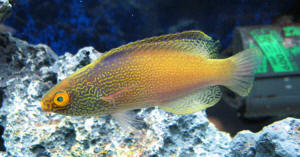
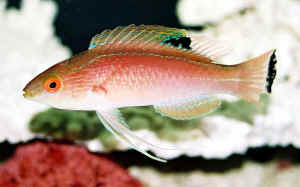
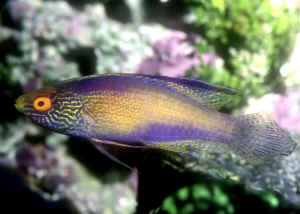
08/05/09 Fairy Wrasse Addition/Life Expectancy 11/03/08 Hello all. <<Greetings Shawn>> I hope this message finds you all well. <<Just fine thanks speaking for myself>> Just a few questions about fairy wrasses. <<Wonderful little fishes>> More specifically, Cirrhilabrus rhomboidalis and lineatus. I love fairy wrasses, and these in particular. <<Two spectacular species>> I'm thinking about adding one or the other to my 120 gallon reef tank. Currently, the tank is occupied by a 4 inch purple tang, 1 pair of tomato clowns, a yellowfin flasher wrasse, 4 inch female bellus angelfish, and an African midas blenny. All levels are well in acceptable ranges for a reef tank. First off, do you see any compatibility issues with the current occupants? <<Not really, note Purple Tang may be an issue, and the Flasher Wrasse probably won't be too happy at first but should get over it worth a try I think>> Secondly, I have looked for life expectancy estimates of these fish and have come up empty handed. <<Mmm, yes? I can only venture a guess here, but based on their fecundity with a population doubling rate of less than 15 months which is in line with Zebrasoma Tang species, I would think their life expectancy to be similar to that of the Purple Tang you have (this is also assuming no correlation between the size of a species and its lifespan). Soooo perhaps a good ten years with good care>> With the investment in either species I would like to have a relatively long term resident of my reef, assuming purchase of a young adult and barring unforeseen circumstances. <<Indeed>> As always, I look forward to your response. Shawn Green Baltimore, MD <<I hope it proves useful to you. Eric Russell?Columbia, SC>> Infection of Wrasse... Cirrhilabrus study - 10/02/08 hi WetWebMedia crew <Nigel> Hi, Recently I had some problem with my wrasse, 2 Male Lineatus and 1 Male Rhomboid. <... you have no females of either Cirrhilabrus species?> 1st Lineatus (A) was introduced 1 month ago from Shop ABC. After 2weeks, i acquire another Lineatus(B) from Shop XYZ. Both fishes came from different shipment. 1 week later i got myself a rhomboid from another different shop. on the 18th Sept, Lineatus (B) show signs of illness. It looks a bit plump (normal size) and get blown away by current created by the Tunzes easily. Obviously it was looking weak but still trying to feed. 19th of Sept, it was swimming in circle, trying hard to get itself upright. but was turning upside down most of the time. After 3 days of leaving it in the Betta box <...> in the sump, it died. 2 days later.. Lineatus (A) shows signs of illness too, same problem as lineatus (B) and behaviour totally identical. Died on the 2nd day, found it on the Tunze wavemaker. coincidently, another 2 days later, male rhomboid was showing signs of weakness and wasn't swimming in the open. but came out to feed hungrily when it was feeding time. (night) the next day, it was swimming in circle as per 2 of the ex-lineatus and hours later.. it was upside down. currently Male rhomboid is in a separate tank. wasn't able to feed but when i introduce food into the tank, it got a bit more lively. Fish is in this state for more then 5days. Non of the fishes i have gone through Quarantine process. Additional info; parameters were all intact Temperature is about 80 ph 8.2 I have left with a Female rhomboid, Female and Male Hawaiian Flame Wrasse in my tank. 1) Can the fish still be save? <Perhaps> 2) what infection is going around in my tank? <Not likely such...> 3) is it contagious? 4) what kind of medication can i save the fish? <... none> Thank You Nigel <... need a bunch more information re your system, what was actually offered as food, the history of the set ups... to render something sensible as a resp.. And you should read: http://wetwebmedia.com/marine/fishes/wrasses/cirrhilabrus/index.htm and the linked files above, en toto... Velvet Wrasses have some definite "shortcomings" in terms of their needs, relative hardiness, acclimation... You don't appear to have an awareness of such. Bob Fenner> (Bob?) Vila Fairy Wrasse 1/7/06 Good evening. <Mornin'> First I would like to thank you for all of the wonderful information you have on your web site. I am a saltwater store owner and have recommended your site highly to people looking for answers to questions and information. I always STRONGLY recommend our customers do a lot of research prior to doing any purchasing of saltwater animals BEFORE they purchase anything from any body. <Great!> I now find myself lost. I have done what I have taught my customers NOT to do. I have brought in a pair (male and female) Vila Fairy Wrasses. They are from the waters of Vanuatu, and they are just beautiful. But I can not find any information on this fish as to their requirements. Tank size, food they require, reef safe, etc. I can't even find a decent picture anywhere. <A newer species...> Could you please assist me with this, as I just put them in our 500 gallon show tank. I have never seen these before and would love to be able to give them a good home. <I know nothing re this species care... Would treat it as other Cirrhilabrus...> Thank you in advance for any help you can give me. I have searched Google, MSN, WetWebMedia, and I can not find any information on this fish. <Me neither. I do hope/trust your pair are eating... not getting thin. Bob Fenner> Lisa Fairy Wrasse Aggression 2/9/05 Good evening, WWM team. <Howdy> I've really appreciated your advice dispensed via the site in the past, but I can't find a good answer to my current dilemma, so I'm asking in the hopes that you might have some thoughts. I recently added a grouping of four C. rubriventralis to my 100 gal. system, and am having some aggression issues amongst the group. The wrasses arrived in decent shape; all were just under 2 inches in length on arrival. They acclimatized quickly in quarantine, and I moved them to my main system after two weeks. The established residents are 2 ocellaris clowns and 4 L. amboinensis shrimp, all very happy (plus various snails, soft corals, feather dusters, etc.). Initially, everyone got along well. However, after about 10 days in the main system, the wrasse that had grown the most ("Bully") began bullying the others (but not the other residents). Bully would chase the other wrasses around the tank, eventually herding them into one of the back corners. If one moved from that area, they would be chased back. I haven't seen any real attacks; no wounds, fin tears, etc., but Bully is definitely chasing, bumping, and generally making live hard on the other three. <The establishment of a pecking order.> It's now been a few days of this, and the other three have taken to hiding in the sand or rockwork during portions of the day. <As long as there is not physical nipping, biting, wounds... it may settle down soon once the order is set> Interestingly, Bully doesn't really act up during mealtimes, and everyone seems to be getting enough to eat. Water parameters have all been fine (undetectable NH4 & NO2, NO3 < 5, pH 8.2-8.3, sal. 1.025, Ca 400, dKH 11.2, temps 78-80 depending on lights). After reading all the material I can find online, my assumption is that all four were juveniles to start (as I originally wanted), but that Bully has started to make the change to a male. <Indeed possible> The aggression, while stressing the other wrasses, seems like it could be within the normal range for this social phase. <Agreed> If so, I don't want to disrupt things by isolating Bully and risk having one of the others start to change as well, leaving me with two males in too little space. At the same time, the bullying seems a bit excessive (my wife refers to it as domestic violence and is threatening to feed Bully to the cats). On top of that, the coloration of all four isn't so different yet that I can definitely tell the sex of each of the fish (I haven't found great male/female comparison photos), so they may all still be immature, or all have been male initially, although I don't think that's the case. If you'd like to see pictures, I can try to snap a few. The bottom line is that if I've got a problem fish on my hands, I'd rather isolate/trade/sell him (anything but turn him into sashimi for the cats) than risk the other three, but I'm not sure how to make the call whether to let this play out or intervene. Any thoughts? Thanks, Mark <Without severe aggression... I'd wait it out a bit longer. Anthony> "Red" Fairy Wrasse--Help Hello. <Hi there> I
saw a very colorful fish at my local fish store that was labeled
"Red Fairy Wrasse". It was about 3"-4" long and was
$56. After I went home, I researched it and couldn't find any fish
that had the common name Red Fairy Wrasse. From my research, I
concluded that all Fairy Wrasses are peaceful, rather easy to take of,
and don't get any bigger than 6" or so. <Fair
generalization> From my research, I concluded that the Fairy Wrasse
at the store was of the genus Cirrhilabrus. <Yes... you can see a
bunch of pix of these on fishbase.org, WWM: http://www.wetwebmedia.com/marine/fishes/wrasses/cirrhilabrus/index.htm
> First question: Is this true?... Second question: Should I buy
this fish and put it in my 70 gallon FOWLR with a Cinnamon Clownfish, a
Coral Beauty Angelfish, a Fuzzy Dwarf Lionfish, a Foxface Lo, and two
Sea Urchins? <Is the Lion small enough to where it won't swallow
the Wrasse? Your tank is getting crowded, but behaviorally all should
get along. Bob Fenner> Fairy Wrasses 12/2/04 Hi! I currently have a 180g setup with nine fish in it. Among those fish are 4 Fairy Wrasses- C. luteovittatus, C. cyanopleura, C. lubbocki, and C. lineatus- all are males. My question is, can a female lineatus be added safely or will she be harassed to death by the other fairy wrasses? The local LFS has a female in stock and she'd be the smallest of the wrasses in the tank. Your help is greatly appreciated! Scott <Although Fairy wrasses are relatively mild mannered (especially for wrasses!), I am surprised that those that you already have are tolerating each other. Many fairy wrasses do live as pairs or harems, so the M and F lineatus should be OK, but the other males may harass her or become increasingly aggressive due to the presence of a female. If you do attempt to add this fish, first and foremost, quarantine! Then, be prepared to remove the other males in decreasing order of aggression if necessary. It is strictly a matter of taste, but if I were in your position I would be willing to give up all of the other males to keep the M-F pair. Best Regards. AdamC.> Re: Fairy Wrasses 12/9/04 Thanks for getting back so quickly! <Glad to!> I too am surprised that they all get along as well as they do. There is so little aggression it's almost scary. Since the addition of the lineatus there has been even less than before. It is pretty cool, though, how they interact; i.e. color changing and flashing as warnings. <Seeing really natural behavior is amazing!> Just out of curiosity, why choose the m/f lineatus over a diverse group of fairy wrasses? Thanks again! Scott <Just a personal interest in observing courting and knowing that fish must be in exemplary health to breed. Best Regards. Adam> Breeding Cirrhilabrus? 10/9/04 I'm trying to breed Cirrhilabrus wrasses, (Cirrhilabrus temminckii) and (Cirrhilabrus flavidorsalis?). Do you guys have any pointers or info? Philip, S. El Monte <hmmm... I am not aware of any significant hobby or commercial breeding/culture activity with this group of fishes. Do check into the database at the Breeder's Registry online... and perhaps the old TFH "Reproduction of Reef Fishes" for field observations that might give you insight to go on. From what we know, you will need very large and tall aquaria to begin to have any chance at successful pairings for their elaborate and extended mating "dances". Also, do think about visiting or chatting with the folks at some public aquaria like Atlantic in Riverhead NY where spawnings (no attempt at rearing) is an almost daily occurrence. Best regards, Anthony> Breeding Cirrhilabrus II 10/11/04 Do you have a link to the website of the Atlantic public aquarium in Riverhead NY? <if you are going to succeed... you need to be more resourceful than that <G>: simply do a keyword search with the info given to you: "Atlantis Aquarium" "Riverhead, NY", etc... it will show up on the first google page of hits. Do help yourself, bub> I would be totally interested if the fish are spawning like crazy. <I have watched them spawn... and my NY friends say this is a regular occurrence in the evenings> By tall aquaria, how tall are we talking about? <several meters - pool sized: much bigger than home aquaria, as they need a deep column of water to run to the surface for their mating rituals... like Centropyge angels> I've already got four C. temminckii in quarantine, but I don't know if they're still in the female phase about to transition to being males or if they're immature males in development. <sex change can occur completely in as little as 10-14 day> So far the pics on the internet I've seen are probably of dominant(?) and subordinate males(?), (based on the elongated pelvic fins), but no females(?). They are anywhere from 1 3/4" to 2" in length. The pelvic fins on all of them are not elongated yet. By the way thanks for the leads. Philip <very best of luck! Anthony> Unidentified Cirrhilabrus I don't know what this wrasse is, but I've kept one before. It is one of the larger ones, growing to be roughly 5 inches in length. The base color of this fish is a drab olive green. There is a black bar running horizontally across the length of the body that's on top of an orange horizontal bar. The pelvic fins are elongate and pointed. It's belly is a light powder blue, and has a dull red streak across it's eyes. However, the feature that stands out the most despite it's drab coloration is its remarkable super bright metallic blue caudal fin, with flecks of gold. I have seen it only one other time previous to today. I suspect it may be a male Katherine's Fairy Wrasse, (Cirrhilabrus katherinae), or an Orange Bar Fairy Wrasse, (Cirrhilabrus earlei). So far on the net, I haven't seen a picture of Cirrhilabrus earlei so I wouldn't know for sure. Is this description adequate for identification? Philip S. El Monte <Not for me... please see WWM here: http://www.wetwebmedia.com/marine/fishes/wrasses/cirrhilabrus/index.htm or Fishbase.org under the genus, or Scott Michael's Reef Fishes, v.1, Or Rudie Kuiter's latest on Velvet, Fairy Wrasses by TMC. It may be that you have an as-yet unidentified Cirrhilabrus (there are several on the market). Bob Fenner> Cirrhilabrus <MikeD here> This may be an odd question to ask, but what is the normal color of a fairy wrasse's droppings? I had Cirrhilabrus wrasses of several kinds before, and have noticed some have white droppings. Of course other times, they seem normal, and are an olive green coloration. What causes them to have white droppings?<The normal explanation is that it depends upon the diet, just as with any other animal, with whatever goes in determining whatever comes out....sort of like corn in humans> While I'm quarantining this species of fish, if I had to treat for external parasites, how do I do so without killing them? Apparently, freshwater baths are out of the question for this fish.<My suggestion would be a formalin type medication if possible, and as with any fish of a delicate nature, using 1/2 the normal dosage is a wise precaution> Also while I'm at it, does any one know the life span of a fairy wrasse?<As with most marine fishes, that's a no. The hobby simply hasn't been going full steam long enough to make judgments on most species, with the best reliable information coming from public marine aquariums. wild specimens, of course, never live an "average" lifespan as the fish is removed from the food chain when it becomes lax or infirm> Philip
Australian Lineatus Wrasse 3/13/04 Hi All! Well my flame scallops are doing well. heresy) I know I'm a blind squirrel. lol Thanks for the id on the Chisel-tooth wrasse. Blasted LFS didn't have an id and I couldn't find an id, do you know anyone who'll want it once it gets 12" long? arghh. I hope it grows slowly. ;] Maybe by that time we'll have a 400g and a bigger house. lol They have a Creole wrasse now that just looks beautiful, but its only 2 1/2" long. sigh. <Congrats on your success with the flame scallops. Please do realize that success with such animals should be measured in years, not months! Many inappropriate fish make it into the hobby. I know a very famous aquarist who has a napoleon wrasse in his reef tank! These grow to several feet in length!> I'd like some advice since you guys are such wonderful advice givers... One of these days I would like to buy what I consider to be the holy grail of wrasses (one of them at least, I adore wrasses!) an Australian Lineatus Wrasse. But not until we are well established in the 180 which we will be buying sooner than later (I hope!). <Good plan to hold off until you have a system that will be stable.> Would you consider this to be a hard to keep fish? Also, what are the space requirements on a fish like this? Would I be able to keep a small one in a 33g propagation tank or should I wait for the 180? <My limited experience is that these fishes (fairy and flasher wrasses in general) are fairly hardy, but not quite so hardy as other wrasses. I would not suggest keeping it in a 33gal tank. Why subject an animal that you obviously hold in such high regard to less than ideal conditions? These fish are moderately susceptible to parasites and as somewhat timid planktivores they often demand live foods (at least for a time). Aggressive feeders can easily outcompete them for food, especially in the first few days/weeks after introduction.> Would it be okay to mail order this fish or would it be better to try and order it through a wholesaler (we know several)? <I always advise against purchasing these fish mail order. If you ask your LFS to order it for you, the will often order more than one, allowing you not only to observe it's health, but to choose. It is a whole other topic, but there are also a multitude of reasons to support your local stores.> Will a 180 be big enough, I currently have a Japanese wrasse and a super friendly exquisite wrasse in my 58g and my husband has a yellow Coris (why do they call this Coris, its sci. name is diff?) and the chisel tooth in the 75g. <Please do consider the typical temperaments of these fish, as well as your observations and consider if you really want to risk them with your "centerpiece" fish.> Thanks and I hope you have a wonderful day! Your ever-loving fan, Morgan Bob Fenner ha nihongo wo hanasu? <Thanks for the kind words! Best Regards, Adam><<Hi, wakarimas scoshe. From living in Japan as a youth. RMF>> In Search Of The Perfect Wrasse... Hello Crew, <Hello! Scott F. here today> Thought I pop in another question for my mentors. I've been wanting to purchase a Rhomboid Wrasse for some time now. <Awesome fish!> However, I've seen pairs at the LFS but never of acceptable quality by my standards. I figured if I'm going to spend that kind of money, it should be in perfect condition. <I agree with you 100%!> Are Rhomboids really bad shippers? The ones I've seen were always pale, inactive, breathing heavy, white blotches on skin, and with a few nips here and there. They told me that is how they always come. <Well, these fish tend to suffer during the collection and shipping process. They are usually found in deeper water, and the initial collection often leads to trauma. Then, like other fishes, they have to endure a number of days without food, in poor water, while being shipped to the wholesaler, dealer, and then to you. Little wonder that they look to be in poor shape! My advice to you is to either place a deposit on some at the LFS, and see if they will hold them for a few days (to give them a chance to recover a it), or to pay the extra $$ and get them from a online source like Marine Center or LiveAquaria.com.> And when I try to wait out on them, they're always sold before I can get another look. Well, the LFS has another Rhomboid in, but no pair, just one male. Would the male lose color w/o the better half? <Quite possibly. With other species of wrasses to "flash" at, he might retain some color, though> And would it be wise to add just any non-pair female if they come along later on? <Ideally, you'd want one male to two or three females. These fish are "haremic" in nature, and display nicely when kept this way in the aquarium> Another thing is, if they are still in bad condition as before, which I expect, do you think I should take a risk in buying it based on the aforementioned conditions? <I'd see if they improve a bit in the dealer's tank, first, before taking them home. See if he/she accepts a deposit> I've waited and waited. Just don't know how long I would have to keep on waiting. The LFS says they probably won't be getting any of them soon after this one. <Trust me on this- I'm a huge wrasse fan. I've missed a bunch of rare fishes over the years 'cause I hesitated for various reasons (like the ones you describe), but they always seem to be available again down the line. Maybe not tomorrow, or even next month. But eventually...It took me almost a year and a half to find a "Peppermint" Hog Fish (B. masudai), but I eventually found a great specimen. The same is true for many fairy and flasher wrasses. There will be others out there. Unless the specimen is an absolute one-of-a-kind, I would wait for a good-quality one.> Tks for your advice always. Roy <My pleasure, Roy! Don't give up the search. It's part of the fun! Regards, Scott F> Breaking The Wrasse Impasse (What Wrasses To Mix) Thanks for the advice Scott! <My pleasure!> I would love to get a harem going but Rhomboid Wrasses are so hard to come by, especially good ones. I'm afraid by the time I'm finished collecting his harem, he's too old to flash anything! <And you might have spent all of your retirement fund trying to get some, too!> Are you saying that the male wrasse is not choosy with his harem? <In most cases, the natural "social order" will form, and he will accept them. This has been my experience with a number of fairy wrasse species> And it wouldn't matter when I add them? My concern is that the male may dislike the gals that I choose for him and decides on some domestic violence! <Well, there are no guarantees when you're dealing with fish, particularly in captive situations. Fish, like people, are individuals, and you never know what they are thinking> And as for other wrasses to make him sustain color, are you speaking of other species of fairy wrasses within the genus? They won't harass each other? <Well, it is possible to mix males of the same or different species if your tank is large enough. And, in all likelihood, you'll get to observe the "flashing" behaviour even if you keep one male with several females of the same species. Again, of course, there are no guarantees that the fishes won't harass each other, but it is worth trying in a large > I do have a mystery wrasse waiting to go into my display, but I think they are quite different in behavior than the fairy wrasses. Would he work to keep Rhomboid's color? <Perhaps, as they can occasionally encounter each other...Hard to be sure, though, as they inhabit different environmental niches within the tank> I know I'm stretching... <You're doing fine!> Tks for your help! Roy <My pleasure, Roy! Enjoy the beautiful fishes that you're going to be adding soon! Regards, Scott F> Mixing Fairy Wrasses Hi, <Hi there! Scott F. with you
today!> I love your website and think it is the coolest out there on
this subject. <Awesome! Glad you enjoy it! We have lots of fun being
here for you!> I have two quick questions. <Sure> I have a 250
gallon FOWLR and am curious if wrasses can co exist together when
mixing. I have a male (4 inches or so) and female (2 and a
half inches) lineatus wrasse (Cirrhilabrus lineatus) and a
red headed fairy wrasse (2 and a half inches) (Cirrhilabrus
solorensis). They show no aggressive behaviour but I am not
sure how they evolve. I would really like to add one more
wrasse to the mix. Either a Laboute's fairy wrasse
(Cirrhilabrus laboutei) or a Golden Rhomboid wrasse (Cirrhilabrus
rhomboidalis). Do you think this is pushing it? <In a
smaller tank (like under 100 gallons, I'd say that it would be
pushing it. On the other hand, in a tank of this size, there is enough
physical space for fishes to avoid one another if they need to.
Ideally, Cirrhilabrus wrasses should be maintained in groups of one
male to two or more females. In nature, these fishes are found in
haremic units, with a dominant male defending a harem of subordinate
females and immature males. However, in your tank, I'd go for it.
There are, of course, no guarantees, but I think that it's worth a
try> Also, My tank parameters are perfect as of this
morning. O ammonia, Nitrite and under 5
nitrate. My sump though does not smell
appealing. Should I be cleaning my bio balls? <Not
really. But you could use some activated carbon and/or PolyFilter to
help remove the odor. Do a little investigating around your system to
see what could be causing the offensive smell.> Your help would be
appreciated, Thanks, Matt
Wrasse Harem Hi, <Hi there! Scott F. with you today!> First, I would like to say Thanks for your website, I think it is the best site online. I have spent many hours reading all the information there and your site has helped my further my knowledge about this hobby more than anywhere else. I have such high respect for people so dedicated to this hobby. <Thanks so much for the kind words. I'm lucky to work with some great people here!> On with my question, I am interested in purchasing a Cirrhilabrus luteovittatus , but I have seen some info that says they are semi-aggressive. I have a very peaceful tank (72 gallon) so I was wondering if you would tell me your opinion on this fish. Would he cause any problems in my tank with the other peaceful fish. I have a Purple Firefish, Clown Goby, Court Jester, Possum Wrasse, 3 small juvenile flasher wrasse (Carpenter), Exquisite Wrasse, and a Cirrhilabrus solorensis and some shrimp. <Nice mix of peaceful, colorful fish there! I like that mix! In fact, I'd call it near perfect! Personally, I have not had any problems mixing different fairy or flasher wrasses together, as long as sufficient space is provided. Yes, there is a social dynamic that may be disrupted. In wrasse communities, I generally worry for the newcomer, not the other way around. If you do add the new fish, observe very carefully and be prepared to take action, if necessary. There are no guarantees, unfortunately!> Also, if you have time, could you please tell me how you can tell the difference between male and female flasher wrasses. <Well, from an external standpoint, it's generally color and extended finnage on males. Females, almost across the board, are not as colorful as males. It's usually that simple. I know that's not much to go on, but that's usually the best way to tell. If you want a mixed group, buy a few immature specimens, wait a few months, and one will definitely turn into a male...> When I purchased them at my LFS, they said they were capable of changing sexes so that one would turn into a male, leaving the other 2 female. So my question is, is this true because I purchased them so that I could have a harem, but so far I can not tell much difference in them after 4 months. <Give 'em more time...It will eventually happen...Could even take longer, but it will happen> They rarely ever swim together but 2 of them are always flashing. The only difference is that the 2 that are always flashing have 2 elongated rays on their dorsal fins and have blue lines and the other one has 3 rays but her stripes are not blue, just a darker orange. I'm just guessing, but it seems like so far, I have 2 males and one female. <That would be my guess, too!> Do I have a chance of them turning into a harem with one male and 2 females? I would really appreciate your opinion on this. Thanks for your time, Ashley Whittington <I certainly think so, Ashley. Just keep everyone happy, observe carefully, and I'll bet that harem will form! Good luck! Regards, Scott F> Fairy Wrasses Hi Wrasse Experts, I have a 120-gal reef tank with lots of live rock and a nice sand bed. The live rock has lots of caves and hiding places. The tank is completely enclosed. Presently I have a 3.5" Siganus vulpinus, a 2" Pseudochromis fridmani, and a pair of Cirrhilabrus scottorum (5" & 4"). All get along great together, no problems whatsoever. <Sounds like it would be a nice peaceful tank. Perfect to lower the blood pressure with!> Here comes the question: What will happen if I add a second pair of Cirrhilabrus wrasses of a different species? <Most wrasses from the Cirrhilabrus family tend to be group dwelling fish. They live in harems consisting of a secondary male and numerous females. So, if you were to add more Scott's Fair wrasses, then most likely there wouldn't be that much of an issue, provided that the new additions are larger than the current ones. It might lead to a few disputes at first if the new guy is bigger than the current male. Mixing different species of wrasse can be a bit hazardous but these wrasses are known for their peaceful nature. Not to mention having large amount of rockwork helps in the equation.> I was thinking of maybe C. lineatus? <very beautiful fish! Though not seen as frequently in the aquarium hobby as the Scott's Fairy Wrasse, the Lineatus is hardier in my opinion.> Will the two males duke it out or will they ignore each other since they are not the same species? <most people I know say that they would ignore each other, but you are taking a risk with it.> If that won't work, could I add another female C. scottorum to give me two females and one supermale? <Since these wrasses are found in harems, I would go for an additional Scott's. You can get to see the male doing his "I have my harem" deal. They tend to act a bit different when there is 2 or more females to one male.> Or how about adding a pair of Paracheilinus octotaenia instead? Or should I just wait until I get my 375-gal tank before I mix wrasses? <if you could wait until you have a 375 gallon tank going then it would easier allow you to add multiple species of wrasses. Be sure to check out some of our WetWebMedia FAQs and info sites dealing with Wrasses. http://www.wetwebmedia.com/wrascompfaqs.htm Hope that helps. -Magnus> Thanks, George
Exquisite Foods For An Exquisite Wrasse! Hello WWM, <Scott F. with you today...> I've recently acquired a very pretty Exquisite Wrasse but could not find much on feeding on the site or FAQ. Currently he is getting good quality small pellet food with Selcon and frozen brine shrimp with Spirulina. Any additions needed to keep him fat and happy? As always thanks for your help and good humor. Peace, Joe <Well, Joe, my recommendation here is to utilize more nutritious marine-based foods, such as Mysis, chopped clams, or squid, which have a much higher nutritional value than brine shrimp. Your idea of fortifying foods with Selcon is a good one, and should be used with all frozen foods. Other good choices would be any of the fine Ocean Nutrition foods, such as "Prime Reef", "Brine Shrimp Plus", and-believe it or not- "Angel Formula", which, although intended for sponge-eating angelfishes, seems to be relished by a wide variety of fishes. You might have to mince it up a bit, though. Bon Apetit! Regards, Scott F> Rare Marine Fishes/Suppliers 7/10/03 Kevin here, Lately I've been on a quest to land a pair or small harem of C. rhomboidalis, with obviously little success. <hmmm.. they have been coming in regularly... just saw them fresh in Arizona and California> Do you have any clue as to which wholesalers may have the connections to get them? Aqua Marines out of LA claims that he gets them in monthly, which I doubt, <hmmm.. I would not doubt it... they are one of the best sources for rare fishes. The species has been making it in regularly at any rate> but we have since had a falling out w/ them and will no longer be doing business. <very sorry to hear it> Sergio at ERI was a hopeful prospect until his Marshall collector spilled the beans that the rhomboids he has been selling are actually a different Cirr. wrasse but look similar. <yes... I do believe I have seen both. Not that similar looking to me> He also said that true rhomboids are very difficult to get, as suspected, but there must be a Marshall collector out there who's getting them. Any thoughts, and have you ever seen a fairy wrasse that looks even remotely similar to a rhomboid? <they usually pass through the hands of the Hawaiian collectors. If you are in the industry (dealer), use your indices from Pet Business/Pet Age, PIJAC, etc to run down a list of Hawaiian collectors to appeal to> Kevin <best regards, Anthony> Kevin S. here w/ a rhomboid Q Hey Bob! No need to have this hit the FAQ's. Anthony said you might have some HI contacts for getting a pair or two of C. rhomboidalis? The usual LA wholesalers have yet to come up with anything for me. Any recommendations for a reputable supplier? Kevin <Do have a few friends who collect in Hawaii (wish you were coming out with us next week. Can you still make it, 24th to the 31st?). But... the only member of the genus recorded from there is C. jordani... "Western Central Pacific" is the stated distribution of this animal. Saw Anthony's response to you re... Have you checked (as in called) folks in LA... either Sea Dwelling Creatures or Quality Marine? Do identify yourself with WWM and myself if so. As Antoine stated, have seen this species in LA and Phoenix recently. Bob F> Re: Kevin S. here w/ a rhomboid Q <Ooo, too short notice to bail out to HI for a week, although I'd absolutely LOVE to go. Sorry for the confusion, I didn't mean that C. rhomboid. was from HI, <... not necessarily... though Randy Fernley (Coral Fish Hawai'i) does transship (mostly Centropyge loricula) through O'ahu> but since they're from the Marshalls, Anthony said that they'd hit HI soon after collection. We don't have an account with Quality, but we do with SDC. Will call tomorrow. Thanks, Kevin> <I would do so. Ask for Carl at SDC, Robert at QM. If you would like, make it known if/when you can be there (on 104th) and I'll meet you during a "book delivery day" and smooth the transaction. Bob Fenner>
Re: the rhomboid saga continues... Kevin here again... Thanks for hooking me up with Carl, he's probably the most hobbyist-like rep I've ever spoken with. <Yes, a fine young fellow (at Sea Dwelling Creatures)> Unfortunately we've been dealing with Gersh for years, and apparently he was hurt that I was asking Carl stuff instead of him. <Mmm, unusual> Oh well. Anyways, Carl flat out told me that I was "pipe dreaming", then later Gersh called back and proclaimed that he can get me a pair in 2 weeks. <Ha! Perhaps some friendly competition at work here> I'm going to cross my fingers on it, even though he wants four bills for the pair (everyone else had said 75 each, yet no one could come up with them...). I hope this works out! Lata Kevin <I've gots to get back into the collection end! Good luck. Bob Fenner> - Wrasse Id - Good day, Can you tell me what is the minimum tank size for a ruby headed wrasse? <Hmm... could this be Cirrhilabrus cyanopleura... that's what liveaquaria.com lists it as...> Also, are these the same as the blue sided wrasse? <Cirrhilabrus cyanopleura is the blue sided wrasse... as listed in fishbase.org, I would go with this common name. Maximum size is roughly 6" (15cm), I'd keep in 100g plus.> Thank you for your help. <Cheers, J -- > Lubbock's fairy wrasse Hi Bob and crew,,,,, After a long and tiring night of researching on the net for the specific name of my mystery fairy wrasse, I have concluded with 95% certainty that it is a Lubbock's. Not too shabby for an 8 dollar fish. <Must have been mis-marked> As for my following questions, you would most likely have to refer to this website's pictures as I do not have a digital camera....this is as close as I could get... <A HREF=" http://fins.actwin.com/species/index.php?t=9&i=412">http://fins.actwin.com/species/index.php?t=9&i=412 > My wrasse is pretty much a cross between the two wrasses pictured on the page....I've never seen two males of the same species look so different! <Take a look on fishbase.org re the males of species of wrasses in this genus... click on the photo shown for others on the next "page". Some are very different.> Question 1 ) What are those black markings on the fish. It look's like they've been drawn on my a sharpie marker. They are quite pronounced on my wrasse too. I've notice that pictures of other Lubbock's exhibit similar markings but perhaps more spread out and not as dark. Are they here to stay, or do they fade with age? Also, is this type of marking restricted to the Lubbock's fairy wrasse? <Mmm, no. Please see here: http://www.fishbase.org/Photos/ThumbnailsSummary.cfm?ID=13041 Not all Lubbock's show these dark markings> Question 2 ) Some of the pictures of Lubbock's shows quite a bit of bright coloration. Mine is a bit more drab but still show similar coloration. Does this mean that it is a female? Or perhaps stress and fright makes for a drabber wrasse, a trait common in most wrasse.... <Mmm, not likely a female... maybe not a "full blown" male either... but can/do change with environmental, nutritional... developmental influences> and finally, is there anything I can do to intensify it's colors...short of getting it a mate....or will they pretty much stay the same coloration regardless of effort. <All sorts of things you can do... feed foods with carotenoid content, HUFA's, vitamins... provide a large system (hundreds of gallons) with a few females of the species...> Thanks for all your help! Sincerely, jimmy <Good thinking, investigating here. Bob Fenner> Re: Scott's velvet wrasse >Much thanks for re-affirming my hunch about this silly fishes shy behavior. Kinda funny that Scott would respond to a ticket about a Scott's Fairy Wrasse. :P >Yes, but no longer Scott here, Marina this afternoon. >>I've seen the wrasse poking out of the rocks once in a while, but he is still very keen on staying hidden. At least he moves about now, always a good sign. As for the quarantine bit, I realize that it may have been a good idea, but a 4 inch fish kept in a 5 inch collection box for two weeks at the LFS I felt was more than adequate stress to put on the poor fish, not to be added to sticking him in a 10 gallon "fix-me-up" box. >>Just to be clear, firstly, the 5" "collection" box, was this fish literally being kept in a specimen container? Or was it really being kept in the kind of row display that is used by retailers and wholesalers? I would think *that* would be the more likely situation, therefore, the fish is tied into a HUGE volume of water. Please know that if you take a stressed (and therefore *very* disease susceptible) fish and move it once again, into a system with established tankmates, one day you may end up with BIG trouble. There are *very* good reasons for quarantining, absolutely NO fish or invertebrate has ever gone into any of my systems, or into the displays of the public aquarium I'm associated with. 30 days is the minimum, and it's standard protocol for all P.A.'s (to the best of my knowledge). The aquarium I'm associated with has, by far, the healthiest displays I've ever seen, and I attribute that to their religious quarantine procedures. >Definitely tho, he's got some appetite, so that's a great sign. Thanks again for alleviating my worries all. 8) Erik >>Now, we need to expect fairy wrasses to be timid, and note that they are also notorious tank-jumpers, just be sure you've got a good cover over the tank to keep him safe. Also, was just speaking to another friend who lost another Cirrhilabrus via overflow tube. The fish was alive in the sump when he found it, but it was terribly chewed up and he had to euthanize it immediately. Therefore, I'll suggest a bit of screen or something to prevent this with your new purchase. I'm going to second getting more of the same species for him if AT ALL possible, you'll be amazed at the change in behavior once they're in groups (they have "security" issues). To whet his appetite try little meaty foods such as Mysis shrimp, and small bits of krill, shrimp, squid, or octopus (just about anything marine, really). I think if you can establish a group you'll agree they're some of the BEST marines (as species go) one can keep. Best of luck! Marina >>P.S. I have another friend who established a group of picture wrasses and OH MY GOD! Just STUNNING! Have fun! Wrasse Impasse? Hi all, have a question about a Scott's velvet wrasse I just purchased. I have read in many places that this tends to be a pretty tough (comparatively speaking) fish with great compatibility for reef tanks, so I was sold; after the fact, I found out this fish also tends to be shy...and therein lies my question. I have a 125 gallon tank lit 3/4s across (leaving 1/4th the tank shaded) by 4 55watt pc tubes. Its a fairly well stocked tank for liverock, and has a 3inch bicolor, a 2 inch arc eye hawk, a 3inch perc, and a 2.5 inch Fiji false eye puffer, and two supposed emerald crabs (ones brownish red though...). The fish (the velvet wrasse) was under pretty hefty stress at the LFS where I purchased him, and after introduction into the tank (no qt, no dip, just acclimate and straight into the tank, no more stress than necessary) <Arghh- I have to give you the mandatory scolding about skipping quarantine...I know the intent was to "reduce stress", but keeping the fish in a quarantine tank for a few weeks allows the fish to settle down, feed, and relax a bit from the rigors of collection and handling. Contrary, quarantining is a terrific antidote for stress. Please, please utilize the process in the future...That being said, let's move on...> , he swam about for a few moments in something of a panic and went straight to hiding. This morning I woke up to find him in the same position (literally sitting on the bottom of the tank) surrounded by his mucous cocoon. He still hasn't moved, but is extremely intent and follows all movement with his beady little eyes. Is it normal for him to literally sit on the bottom, or should he be swimming (albeit hidden) in the water column? <Well, these wrasses tend to be a bit shy, particularly when kept singly. They tend to fare better in groups in many cases. He'll probably come around soon, if conditions in the tank remain stable, and if he is not overly harassed by the other inhabitants of the tank.> Lastly, assuming his sitting behavior is normal, I should expect 1-3 weeks of hiding before he decides to be social, correct? Thank you for your time. Erik |
|

|
Features: |
|
| Featured Sponsors: |
.jpeg)