|
FAQs about Trachyphylliid Coral
Disease/Health, Parasites, Pests 5
FAQs on Open Brain Disease:
Trachyphylliid Disease 1,
Trachyphyllia Disease 2,
Trachyphyllia Disease 3,
Trachyphyllia Disease 4,
FAQs on Open Brain Disease by Category:
Diagnosing,
Environmental (Pollution/Poisoning, Lighting...),
Nutritional,
Social (Allelopathy),
Trauma,
Pathogenic (Infectious, Parasitic, Viral)
Predatory/Pest,
Treatments
Related Articles:
Coral
Pests and Disease; pests, predators, diseases and conditions
by Sara Mavinkurve, Trachyphylliid Corals,
Trachyphyllia
Reproduction Report,
Related FAQs:
Open Brain Coral
1, Open Brain Coral
2, Trachyphylliid
Identification, Trachyphylliid Behavior,
Trachyphylliid
Selection, Trachyphylliid
Compatibility, Trachyphylliid Feeding,
Trachyphylliid
Systems, Trachyphylliid
Reproduction, Stony
Corals, Stonies 2,
Stonies 3, LPS Stony Corals, Coral System Set-Up, Coral System Lighting,
Stony Coral Selection,
Coral Placement,
Foods/Feeding/Nutrition,
Disease/Health,
Propagation,
Stony
Coral Behavior,
|
 |
|
Open brain won't extend tentacles
3/21/16
Open brain doesn't seem to be eating.
<Have you read on WWM re Trachyphyllia?>
Have had it in my tank for about a month. When I purchased it I noticed the
tentacles extended at the store and did so in my tank for a short period but
then they stopped coming out. Water parameters are fine.
<.... need data; not subjective evaluations>
Salinity 25
<No>
alkalinity 8-9,
<No units; no credit>
calcium 460 and magnesium around 1300. I've been trying Cyclopeeze, mysis and
brine. Lighting metal halides with blue actinic and moon lighting. Tank size 75
gallon. Any thoughts would be appreciated.
<Reading. Need help w/ the search tool, indices? Bob Fenner>
Thanks
Tom B
Re: Open brain won't extend tentacles 3/21/16
Thanks Bob for such a rapid response.
I will read WWM Trachyphyllia.
<Good... you will find all you need to know there... re placement, lighting,
circulation... use of iodide-ate...>
Im new to your website and do have difficulty finding topics and articles.
Help with search tools would be great.
<Where you found to write us:
http://www.wetwebmedia.com/WWMAdminSubWebIndex/question_page.htm
Salinity 1.025
KH 8-9 150 ppm?
<About:
http://answers.seneye.com/en/water_chemistry/what_is_KH,_%C2%B0KH,_dKH,_Carbonate_Hardness%3F/KH_conversion_for_dk_to_ppm_and_back>
I apologize
<No worries; am just an olde, make that practiced instructor in chemistry,
physics, bio. fields... have a knee-jerk reaction (no credit!) for
missing/non-stated units of measure. Cheers. BobF>
Tom B
|
 |
|
Brainstorming Brain Coral; hlth concerns
9/19/15
I hope you find humor in this question, not anger with my lack of knowledge,
always learning.
<Good>
I am trying to determine why my open brain coral is unhappy. He is a new
addition with only a week in the tank but I think he is unhappy with the Kessil
160 leds. He does not ever plump up, but was at the lfs. He has no necrosis or
algae but appears to be expelling white lumpy material from his mouth/exit hole.
Please, all joking aside, is this excrement from the mysis I fed him at night?
<Maybe.... >
Or is this an expulsion of his Zooxanthellae(sp)?
<Could be a bit of this...>
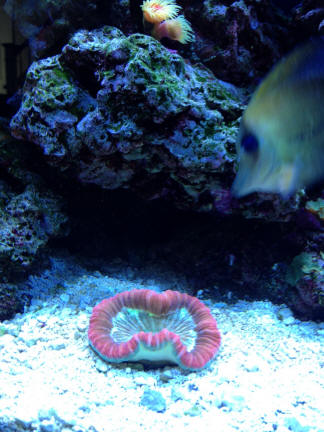
You can just make out in the attached photo that his mouth is stretched and some
excretion, maybe? If he is bleaching what is my best first response?
<Reading... need N, P, K... see your Nitrate below... Perhaps iodide-ate
supplementation>
I have a plastic cover shading him to acclimate to the leds, the lfs said he was
reacting to much light.
<? What light regimen was this coral subject to previously?>
So going forward push the nutritional elements? And as far as lighting, is my
lfs correct with the less is better? The leds are run at 25% on the softie side
and 75% on (his) the lps side with a depth of 24", he is on sand bed with cover.
Tank stats are stable 1.025 salinity, 0 ammonia or nitrites, 10 ppm nitrate
(work in progress), 8.2ph, 8.5 dKH, 450 ppm calcium,
<A bit high>
no current supplements, is there something that might aid the brains recovery?
<Read here:
http://www.wetwebmedia.com/TrachyDisDiagF.htm
and the linked files above>
I am trying to remedy this before he is beyond help, any thoughts to his
perceived current condition are welcomed.
<What other Cnidarian life is present here? (poss. allelopathy). Bob Fenner>
|
 crop crop |
|
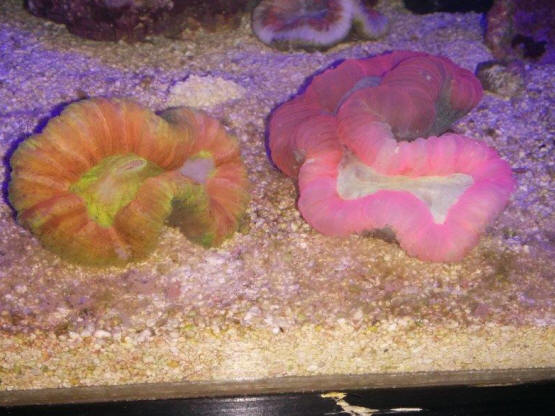
Trachyphyllia color fading
12/21/13
Seasons Greetings to everyone!
<And you Tim>
I purchased a couple of healthy open brains about 3 months ago
and they seem to be losing color.
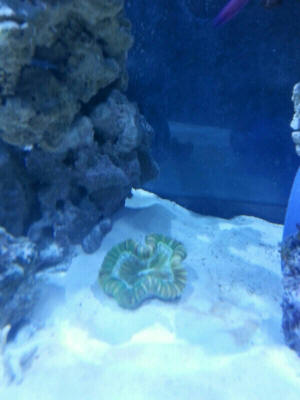
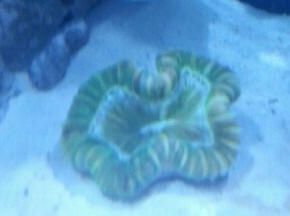
<I see this in your pix; and flesh as well. The "big three" causes of
such are a lack of (chemical) food/s, poisoning from somewhere, and
allelopathy>
I have them in an established 90G mixed reef tank with ample random
flow, under a Rapid LED DIY kit, 25G sump (with macro and LR) and a
Skimmer. I dose Kalk periodically (via my T/O) and run a BRS GFO reactor
<Mmm, a nod toward nutrient deficiency>
all controlled and monitored by an Apex controller. Parameters have been
very stable � Temp 79, pH 8.25, ALK
8-9, Ca 400-440, SG 1.026, N�s 0,
<... stop. All chemo/photosynthetic life need Nitrogen... measurable NO3
here>
PO4 0.03 (Hanna). Stock includes 2 (purple and green) LTA�s (not
doing well lately - maybe from the mistakenly shipped Condy in there for
a couple weeks!),
<And a vote for allelopathy>
several Acans, 2 Montis, a Turbinaria, various softies (Zoas, Palys,
mushrooms, Ricordeas), feather duster, coco worm, some meteor shower
Cyphastrea, sun coral, an Arrow Crab (friendly so far), a few cleaner
shrimp, various snails, a couple Favia, a couple sea stars, and a
cauliflower colt coral). I believe I have everyone placed correctly with
the LPS on the sand bed, and the SPS up higher. Softies are in various
locations. I had a new 3� Crocea clam placed fairly high for 4 months
and looked beautiful up until it closed up one day and died 2 days
later, never reopening. The LTA�s are pretty contracted and roaming
quite a bit
<Dangerous>
mostly not attaching to anything. They are still sticky so I don't know if
they are recovering from some allelopathy with the Condy or a yet
to be determined issue. I've been doing 10G water changes weekly using
RODI and Instant Ocean Reef Crystals. I started dosing iodine
<-Ide, ate actually>
a few days ago and just got a BRS Carbon reactor in. I vary the feedings
(2-3 times per week) between mussel, squid, scallops, krill and shrimp
for the bigger mouths (cut to ¼�) along with Reef Chili, Coral Frenzy
and Oyster Feast for the smaller creatures. Everything else in the tank
seems to be doing really well.
As for the brains, I am having some trouble determining if my lighting
is the issue or it is something else.
<Something/s else>
From what I have read, it seems like the fading could be caused by too
much or too little light.
<Nah>
I believe both situations can cause the loss of the Zooxanthellae which
could result in what I am seeing. I have the lights on about 12 hours a
day (ramping up and down over 90 minutes). Attached are some pictures
from Oct and Dec for your reference. As for their feeding behavior, I
used to see their sweepers come out at feeding time and they would
typically expand after a meal. Now the sweepers don't seem to come out
and lately the red one always seems to be expanded. They are still
eating but I have to place it right on their mouths and cover them. Any
ideas at what else I should be looking at? Thanks for all you do!
Carmela and Tim
<Where to send you to read on WWM... Let's try having you just use the
search tool re "Nitrate and Stony Corals", "Cnidarian Allelopathy" (or
sub species you're concerned re instead of the phyletic name...
Categorically: I'd pull the ferric oxide, increase the feeding till you
have some Nitrate/s showing... and maybe put activated carbon in place
of the carbon feeder media, re-home/move those Actinarians... Bob
Fenner>
|
 |
|
Re: Trachyphyllia color fading
12/22/13
I assumed that with a reading of .03 for PO4, I was good shape. Why
should I be stopping the GFO?
<See WWM re; am a tab busy to reiterate>
I will increase my feeding to every other day until I see some measureable
NO3. Right now I have an API test kit
<Junk... I'd invest in better for what you have invested here. Again see
WWM re>
for NO3 with 0, 5, 10, 20,40, ppm graduations. What range should I keep
the NO3 within? Could you clarify "maybe put activated carbon in place
of the carbon feeder media"?
<... see... re... you want terpene-removing capacity and don't likely
need more carbon...>
I was planning on running activated carbon in the new media reactor.
<Ah, good. B>
Thanks again,
Carmela and Tim
|
Disaster, Trachy challenged
12/17/12
Dear WWM,
<Bryce>
Sorry, I told myself I wouldn't bother you for another few months, but
my poor Trachyphyllia sp. is in great distress. I had no problems with
it, and actually was able to document growth, then it happened. One of
my power heads fell from its initial position and ended up blasting over
70% of the tissue off of my Open Brain. I removed it from the
problematic location, but I feel that the prognosis is bleak. In your
experience do they likely recover from such trauma? It is on a fine sand
bed for the time being, in a low flow area.
Bryce
<I'd just double/triple dose iodide-ate, and not worry. These animals
are
quite tough. Bob Fenner>
|
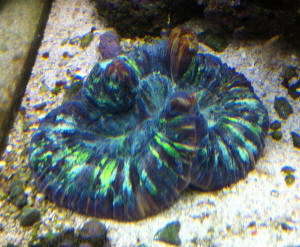
Brain coral has a brown spot, not flatworm... no data,
rdg. 2/19/12
Greetings!
<Salud!>
I purchased this brain coral and placed it in my tank tonight.
Coloration is looking great however I'm concerned about the
brown spot (see pic below). It looks as if it's the
skeleton.
<Is a necrotic area... due to what? Uhh, need data re system,
water quality, tankmates, foods/feeding, use of supplements...
and much more>
Is this a major problem? Can it heal itself?
<Can, could... but need to know what's going on here...
Read:
http://www.wetwebmedia.com/Cnidarians/Anthozoans/ScleractinianPIX/TrachyphyllidPIX/Trachydisf5.htm
and the linked files above. Bob Fenner>
Thanks!!
Brent
|
|
|
open brain - receding
12/16/11
Hiya WWM Crew,
<Hi Mitch>
First of all, love the site and have found a ton of great info
that's help me get further along in the hobby, really appreciate
it.
<Great!>
That having been said, a little background: I have a 72 gallon bow
front with overflow, skimmer, T5HO lighting, and 3 Koralia 600gph
powerheads.
Good amount of Liverock, and am just now (After about 2 years of
running) starting to go from FOWLR to reef. So far I have a
Palythoa and just added about 2 weeks ago an open brain (one of the
deeper water ones with the red outer lip and green inner bit).
<Ok. Trachyphyllia?>
So when I got the brain I gave it about a week, waited until my night
lamps had been on for an hour or two, and then turned off the
powerheads - and then used tongs to drop some thawed Mysis on the
"mouth" area. Tentacles started showing up and pushing
food into the mouth (super cool to watch!).
Now, having read on your site I know that these bad boys need to be fed
at least a couple of times a week...
<Yes, can be done during the day also>
and my wife mentioned that it had been walnut sized all day today...so
tonight I tried again (last feeding was around 5 days ago). Same
process, night lamps, power heads off, dropped some Mysis. Now
the mouths opened WIIIIIIIDE open (like I could see INSIDE the mouth),
however no feeder tentacles appeared. I tried to get a few bits
of Mysis into the mouth - but not sure how successful I was.
<This is not likely a feeding problem>
So I pulled out the test kit so see if maybe I was stressing the thing
out....trites, trates, and phates are all at zero,
<You should have a trace of NO3 & PO4 present, nutrients
essential for life>
which would have been my first thought. Also tested calcium - and
it is indeed quite low (240 range).
<Far too low - should be around 400ppm>
Could that be causing the lack of tentacle as well as the shrivel
effect?
<Yes - the coral is Scleractinian (has a skeleton) so needs to
calcify in order to survive. Without enough calcium in the water it
cannot do this.
You also need to test for Magnesium and carbonates (alkalinity, dKH.
Read here: http://www.wetwebmedia.com/calcalkmar.htm>
I've read that people on WWM have mentioned seeing the
"skeleton" of the coral: I'm not entirely sure what that
is, as opposed to the rock on which the coral is growing (again,
I'm new to this, so be gentle)...so I can't tell if I'm
seeing the "skeleton" or if it's just pulled back and
hanging out.
<Mmm, the 'rock' on which it is growing is it's
skeleton, assuming that what you have is an 'open brain' coral
and not something else. either way, the calcium needs to be adjusted,
and the Mg & dKH tested for and also adjusted if necessary http://www.advancedaquarist.com/2002/11/chemistry>
Plan for right now is to do around a 12 gallon water change tomorrow,
and also start on a nice slow Kalk drip to help maintain the calcium
levels.
Think that's the right move?
<No. I think you need to understand the chemistry more before
messing around with Kalk drips, one of the most dangerous things you
can do to your tank, especially automated. After reading &
understanding you could add a little Kalk, manually only, with testing,
and not on a drip>
Thanks, in advance, for your help!
<No problem>
- Mitch
<Simon>
Re: open brain - receding 12/16/11
Simon - thanks for the quick response!
<No problem Mitch>
I'm going to pick up some more exact test kits this afternoon -
I'm using the reefmaster kit right now, and unfortunately it
won't detect "Trace" amounts (the smallest amount of
nitrate it will show is 5 PPM etc).
<Ok>
As far as perking up the brain and calcium go, how much of the Kalk
would you recommend starting with? I've seen a lot of
different suggestions in amounts, but all were for a "drip"
setup, so not entirely sure what the process would be for adding
manually?
<Are there no instructions? You can make a slurry with some RO
water, add a little at a time, test, add some more if necessary...
until you get used to how much does what>
(as a side note, in a fit of insomnia, I woke around 3 this morning and
took a quick look into the tank with a flashlight - brain is still in
that "shrunken" state, but the tentacles were indeed visible
again)
<Good>
As a sidebar, I have a delivery of 3 small Zoanthid frags coming today
(15 - 21 polyps total) - unfortunately it was an internet order and
it's too late to stop it from coming. Think they'll be
safe in the tank?
<Should be fine>
My Palythoa (sp) is doing fantastically well and is actually spreading
like wildfire right now - from what I understand those are a relative
of Zoas, so I'm hoping they'd be okay too?
<Are Zoanthids also>
I have a small QT on the side but it's not really equipped for
sustaining corals. My plain was to acclimate, dip, and then
introduce into the DT.
<I am a fan of quarantining all livestock, everything wet
myself>
- Mitch
<Simon>
Re: open brain - receding 12/17/11
Simon - postlude today.
<Fire away!>
Open brain is fully open and happy looking. No skeleton showing
etc. Took a water sample to the LFS - calcium is at 400.
<Great!>
Looks like my test kit is old and ineffective. Treated myself to
a new one while I was there.
<An essential purchase>
Here's what I suspect, you tell me what you think: I saw coral
withered and decided that it must have been hungry and started dropping
Mysis over it...in doing so, I think I annoyed it causing it to open
its mouth real wide, not because it wanted to eat, but because it
wanted me to go the heck away.
<Hmmm, not sure this coral has the capacity to 'think'
;)>
So, in short, I'm going to give the brain a break and leave it
alone until I can confirm seeing those feeder tentacles reaching
out.
<I would just aim some food in it's direction when you feed your
fishes were it mine, daily.>
Its amazing the panic a bad test kit can cause!!!
<Yes!>
- Mitch
<All's well that ends well, Simon>
White worms on open brain
5/8/10
Hi Crew,
I have had an open brain coral for close to 2 years now and have had no
problems with it, in fact it has grown from 2 inches to well over 5 and
even grew a new mouth. I just recently moved and after getting settled
finally I noticed that it had 4 small holes in its flesh and upon
further investigation I noticed those holes were filled with little
with spiral worms if that's what you want to call them. I am not
familiar with these and
am hoping you guys can help, I would really hate to lose this guy for
he is my first coral and has been with me the longest. Is there
anything I can do or should I brace myself for the worst?
Thank you
Tyler
<Well, w/o knowing, seeing much more, I'd be extremely
conservative here, at this point... What you are seeing may be
"nothing", not deleterious...
If you'd like, please send along well-resolved pix/photos of what
concerns you. IF these were determined to be "worms" of some
sort, were trouble, they can/could be treated more or less selectively
w/ an anthelminthic.
These are covered on WWM in a few places... I'd treat such ONLY in
a separate system (not the main display)... For now, I'd do
nothing. Bob Fenner>
|
Open Brain questions (picture attached). Hlth., likely
env. 2/22/10
Hello,
<Eva>
After extensive research, asking at the LFS, fellow reefers, etc.
and not getting a satisfying answer I turn to you. So far I have
got great info about Open Brains from your website so maybe you
will be able to help.
Have an open brain in a 100g reef, ca. 60 lbs live rock, 4
T5's, nitrate 0,
<An essential nutrient>
ammonia 0, nitrite 0, alkalinity 10, calcium 420. Currently
taking care
<? How?>
of a low PH problem which is fluctuating around 8.0
<Not likely an issue>
and high salinity (that is if the new specific gravity tester is
not working right) but I think we're at around 1.029 ppm.
<Whoa!>
Two false Perculas, starry blenny, mandarin goby, two clown
gobies, watchman, snails, crabs.
Had it for about a month and he seemed very happy at first,
extending tentacles, feeding (never fed much, maybe once a week).
He sits in the front corner, low flow. Be bloated to about twice
his size once and I read that it's due to stress even though
he had his tentacles out and it didn't last that long he went
back to normal shortly after. The two clown gobies in the tank
like to move around and hang out on different corals for a while,
some corals don't mind, some do. I am not sure if the brain
does or not.
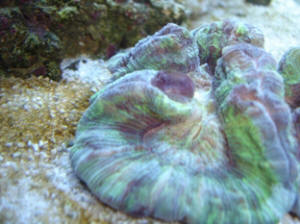
About a week and a half ago I noticed a black 'growth'
coming out of the coral . It is the strangest thing and nobody
seems to know what it could be. It is about ½ ' in
diameter, blackish brown, has a sheen to it and it's getting
bigger. It is literally coming out of on the U-shaped corners of
one of the brains fingers. Around the same time the clown gobies
started perching on it and I have noticed that it's not
extending its tentacles anymore at night or during the day. He
bloated up one more time yesterday and the black 'dome'
that's growing out of him was almost completely submerged by
tissue. Tonight I am noticing a lot of slime coming out of him,
even though I haven't fed him in a few days.
Any idea?
<This Trachyphyllia is likely reacting to the water quality
being off density-wise, the lack of NO3 and whatever you're
doing to absorb it. Chemical filtrants should be removed, the Spg
adjusted pronto. Bob Fenner>
Thanks,
Eva
|
 |
|
Re Open Brain questions (picture attached)
2/23/2010
Mr. Fenner,
<Eva>
thanks for your quick response.
<Welcome>
So, we purchased a new specific gravity tester and it must be out
of whack since it read about 1.025 ppm in my TAPWATER.
<? Is this a "floating arm" type hydrometer? Do read
the instructions on use that came with it... likely some air
bubbles are adhering to the arm here>
My old one, which I originally thought was bad read 1.025 ppm
yesterday so for now I have to rely on that.
<... please read here:
http://wetwebmedia.com/spgmeas.htm>
I am treating the PH with Kent Marine Superbuffer 1tsp per 20-30
gal of water
<How? These materials need to be pre-dissolved in new water;
best done during water changes. NOT added directly to the
tank>
so this morning after testing and it sitting around 7.8 - 8.0 I
added another 2 1/2 tsp.
We did a big water change yesterday, about 30%.
What can I do besides getting PH to stabilize?
<Read:
http://wetwebmedia.com/marine/maintenance/maintindex.htm>
We are actually in the progress of setting up a new tank 60 gal,
40 gal sump, protein skimmer, etc. We currently have an all in
one wet dry sump which we found out is not ideal for reef
tanks.
<Agreed>
It's in the works but it'll be a few more weeks and I am
worried about loosing live stock.
<Or losing it>
I also don't dose regularly, about every two weeks calcium,
strontium, not that much iodine since I heard to be careful with
it. Not sure if I'm going to right route on this, I am overly
careful and maybe not doing enough?
<... Eva, please learn to/use the search tool, indices on
WWM... Do not add anything you can't and are not testing
for>
I also try to stay away from chemicals as much as possible, super
buffer being the only thing I'm using right now.
I also just lost a clam probably due to predator?!
<Can't tell from here, the data presented>
Trying to research as much as possible.
<Good>
Your response is greatly appreciated.
Eva
<BobF>
Open Brain questions (picture attached)
Quick add:
I am thinking my nitrate is low since I have a hair algae issue
on some of the rock. The only thing I can explain it with since I
always had around 5 - 10 nitrates before.
<... read re this as well. B>
|
Open brain coral color and extension
change....problem?? 02/02/10
I have a question on my Trachyphylliid coral I added to my tank about 2
months ago.
system is as follows: 55 gallon, AquaC remora skimmer, 4 inch sand bed,
no mechanical filtration, (do run Chemi-pure elite in a HOB once in a
while), 3 Koralia powerheads for flow, and nova extreme pro T5 6*54w
bulbs.
livestock: melanurus and yellow wrasse, red and purple Firefish, tail
spot Blenny. cleaner shrimp, 60 or so dwarf Cerith snails, some adult
FL Ceriths, dozen or so Nerites, 15 blue leg hermits, 10 Nassarius
vibex
parameters: 0 ammonia, nitrite. undetectable nitrate (thanks for the
help on that one), ph 8.2, Alk 12dkh, Ca 480, PO4 .25-.5 (still using
tap water....I know).
<Oy...I hope you have good tap then.>
Spg 1.025.
my question is on how the color and extension has changed since adding
it to the tank. When I first got the brain it was a very light pink
almost flesh color with green streaks. the percentage of green has
increased a lot, which I think is a good sign. I am assuming that the
fluorescent green is the Zooxanthellae algae increasing.
<Mmm... there are a lot of things that influence coral color change,
Zooxanthellae certainly play a role.>
The pink has changed to a dark purple which I kind of concerns me but
have seen others this color.
<This is very good actually. You didn't give any photos, but
from what you're describing, it sounds like your coral was bleached
when you got it and now it's coming back to life!>
what worries me is that it does not extend nearly as much during the
day as it did at first. Could this be due to increase in Zooxanthellae
so the coral does not have to expand as much to collect the same amount
of light??
<Maybe... who knows? Corals are often unpredictable in captivity.
But you'll know if this coral was dying. If it were unhappy, it
would be bleaching and/or the tissue receding.>
The coral is fed regularly, it eats pretty much every night when I feed
the fish. I dump about half the regular feeding amount in first then
wait about 10 minutes,
<good method>
small feeders come out along the inner edge of the skirt, then I dump
the rest of the food in the tank.
<well done>
It always gets a few chucks of mini Mysis. It even appears to eat flake
food that falls on it (it closes a lobe around it at least, not sure if
it gets eaten or not). I also add Kent MicroVert, and Cyclop-eeze about
once a week (different days).
<I don't know about the MicroVert, but Cyclop-eeze is great...
and variety is always preferred.>
only other coral is a Euphyllia (frog spawn) which is at least 12
inches away so I don't think the long sweepers are getting it. also
never see any fish messing with it.
<There might be some chemical intimidation going on between the two
stony corals. I wouldn't worry about it though. It sounds like your
coral is doing just fine.>
So. all that said, do you think the decrease in extension (probably
about 50% less at least) is something to worry about.
<No. In fact, it could be a good sign even. "Over
swelling" can be a sign of declining health sometimes... maybe it
used to be swelling too much.>
What are your thoughts about the color change.
<I think that when a Trachyphylliid deepens in color (goes from pink
to red or purple), and when it responds to feeding (extends tentacles
promptly and regularly)... these are very good signs.>
Thank you, this site is a wealth of information
<De nada,
Sara M.>
brain coral, hlth. -- 01/03/10
I have had a brain coral for 10 years in one tank. I t is 3 -4 inches
in diameter. I transferred it to another similar tank
<... similar>
overnight and it went into shock and emitted a cloudy white material
and an some of its tissue is dying ... I put it back in its original
tank
<Good move>
and I am wondering what his chances are for growing back more tissue
and recovering. was it correct of
me to put it back in the tank he was in for 10 years?
<Yes. I would have done the same>
I think it has less toxins in it. Cleaner shrimp has been picking at
him.
<Do keep an eye on this shrimp... In fact, if it were mine, I'd
cover the Brain with a "strawberry basket" (inverted/upside
down) to keep the shrimp off/out... it may well be causing more damage
here. Bob Fenner>
Michelle Grangetto
Brain Coral hlth., Lack of Info --
12/16/2009
Dear Crew,
<Hey William, JustinN here>
My green brain corals are turning black and brown. What is causing this
condition and how do I treat it?
<Something related to water conditions is not favoring it --
possibly allelopathy, nitrates, phosphates, or any number of other
potential maladies. Please do provide more information so that we can
provide details. Good luck! -JustinN>
Re: Brain Coral hlth., Lack of Info --
12/16/2009
The problem started with the coral turning black around the basal
perimeter.
It was on the base that was pointing away from the front of the
coral.
The black coloration then expanded to about three quarters of an inch.
Then, black spots appeared on several locations around the coral. One
spot was on top of the coral and one spot was on one of the lobes on
the side. Then, it literally developed a brown coloration inside of one
of the folds of the coral. A second green brain coral has now developed
a black spot on top of the coral. It is a spot that is about a half
inch in diameter. The basal edge of this coral is turning black as
well.
<This still sounds like something negatively affecting the coral
within the water column. Please do provide specific water parameter
information, as well as ancillary information such as what other corals
are housed here, proximity, etc... anything that you might think has an
effect on water quality will help us paint a broader picture.
-JustinN>
Brain Not Extending It's
Tentacles/Trachyphylliidae/Health 8/27/09
Hello.
<Hello Sharon>
I have had an open brain coral for about a month and it swells pretty
well when the lights are on and is maintaining its colours. However, it
does not extend it's feeding tentacles at night. Since buying it, I
still have not seen it extending it's tentacles before. Does that
mean that it is unhealthy or is there something wrong with my water?
All the critical parameters are in check and I place it on the sand
bed. I try to feed my
corals several hours after lights off..
Please comment,
<Well, you do not mention lighting being used, would be very helpful
here, along with stating additives being used, if any. Please respond
and we will continue on.>
thanks!
<You're welcome. James (Salty Dog)>
`Sharon*
Re Brain Not Extending It's
Tentacles/Trachyphylliidae/Health 8/28/09
Dear James,
<Sharon>
I'm using a single 250w ReefLux 12k MH with LumenBrite mini
reflector supplemented with 2 actinic blue plus T5. I dose Purple Up
daily and Seachem Reef Advantage Calcium, magnesium and carbonate to
maintain ionic balance.
I also do around 10% water change weekly using natural seawater that my
LFS sells.
<May be a problem here depending on where the water was collected
from. I believe you would be better off just using a reef blend of
artificial sea salt mix.>
Thx for the prompt reply. Hope to hear from you again.
<Always include your measured levels of calcium, magnesium, dKH, and
pH, does aid in our response. I would add iodine to your additive list.
As for feeding, cut back to no more than once weekly. Corals produce
most of their food by way of photosynthesis and frequent feedings can
have a negative impact on water quality.
Do read here and related FAQ's for helpful information on keeping
this coral. http://www.wetwebmedia.com/trachyphlliidae.htm
James (Salty Dog)>
`Sharon*
Re Brain Not Extending It's
Tentacles/Trachyphylliidae/Health 8/29/09
Alright, I will try my best. Thanks for the help!
<You're welcome. James (Salty Dog)>
`Sharon*
Open Brain Question, pred.?
08/19/09
Hello, I have recently been given a very established saltwater aquarium
with some live rocks, a couple of clown fish, and Damsels, Blennies,
and an Open Brain. The Open Brain seems to be doing great. He swells up
when I feed him and seems content. Although, on the edge of it there is
what looks like a "blackhead" on/in it. It looks like poop or
algae sticking out of him. I thought maybe he was pooping but it has
been there for a couple weeks now and I don't know if it is bad. I
cannot find anything online about it. It looks like something brownish
is coming out of a "pore". There is some sticking out and
some that penetrates deeper inside the brain. Any idea what this could
be? Should I try to pull it out with tweezers or something? I test the
water every couple days and keep it right where it is supposed to
be.
<Without a picture, it's hard to say for sure. But this sounds a
bit like a gall crab. This thread here has some good pictures of the
hole they make:
http://www.manhattanreefs.com/forum/identification/27215-gall-crab.html
If this isn't it, please do send in some pictures if you
can.>
Thank you, Jessie
<De nada,
Sara M.>
Red Open Brain Help... reading
7/30/09
Hey Guys, Let me begin by saying your site is a wealth of knowledge and
I have learnt soo much from it!
I bought a red open brain about a month ago and within a week of
introducing it to my aquarium it turned from deep red to a light pink
on one lobe. The open brain has two lobes of which the other is still
brightly colored. I figured that this was because of too much lighting
so i reduced the Photo period to 5 hours.
<Mmm, not a good idea>
Since then a small part of the outer tissue has receded to show
skeleton (showing about 4 ribs all the way to the center) on the
lightly colored lobe.
<... What are you feeding?>
Once this stopped I figured that I was in the clear and the coral may
bounce back as nothing changed for a couple of weeks, but yesterday I
noticed tissue receding again on the same lobe at another point. I am
really worried now and do not want to lose this coral. I feed it every
other night and the tentacles are extended, more on the colored lobe
though.
This coral is placed on the sand and the aquarium is 20" in depth
and lit by 250 MH lighting. Ammonia, Nitrites, Nitrates &
Phosphates are all undetectable.
<... all "corals" need some NO3, HPO4... the absence of
chemical food may be the issue here or at least a large/r contributing
cause>
I keep the water temp. between 78-80 F.
I have not noticed any fish picking, I do have a flame angel though but
he does not even come close to the brain. Other coral are Finger
Leather, Plate Coral, Xenia, Colt, Mushrooms, Zoos and Montipora.
Yesterday to I did a Lugol's dip hoping that it would help the
situation. Can you offer any guidance?
Thanks for the help!
Troy
<Read here: http://wetwebmedia.com/trachydisfaqs.htm
and the linked files above. Bob Fenner>
Re: Red Open Brain Help -- 07/30/09
Thanks for the response Bob. Since I emailed I have moved the brain to
under an overhang, after reading your response on reduced lighting I am
guessing that this may be a bad idea too?
<... likely so>
Should I move it back out into the open and increase the lighting
period?
<Likely so...>
I am feeding minced shrimp, salmon & coral frenzy. What should I do
to raise the Nitrates and Phosphate? I am running Rowaphos so I guess I
should turn off the reactor?
<Yes...>
Sorry for all of the questions, I just don't want to lose this
guy.
Thanks for the help
Troy
<Keep reading. BobF>
Re: Red Open Brain Help
Thanks again for the help Bob.
<Certainly welcome Troy. B>
|
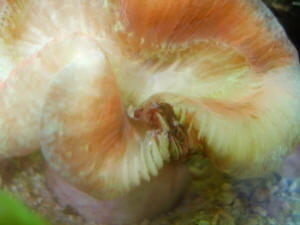
Trachyphyllia parasite 03/31/09
Greetings and Happy Spring!
<Thank you and sorry for the delay... did Michelle answer your
email? In case she forgot... I'll try to help.>
I received this small brain several weeks ago site unseen,
(online order) and it came to me with a slightly damaged area
that I found to be home to a nocturnal worm of some sort; the
area has continued to worsen. My plan is to try and remove the
creature with tweezers, and if that doesn't get it, to work
surgically, trying to remove flesh to expose the worm and then
clean the skeleton up with a Dremel. Does this seem like a
productive approach?
<Well, if you haven't done so already, no. It's highly
unlikely that this worm is the cause of the coral damage.
It's more likely that it is simply opportunistic. If you can
pull it out without troubling the coral much, then go ahead. But
don't cause more damage trying to do so. The best thing to do
is to just make sure your water quality is high, that the coral
has the right lighting and water flow, etc... and just hope it
recovers. Did you acclimate it properly?>
Would a freshwater bath be helpful or more damaging?
<more damaging>
Next, because as you may be able to see Cyano has found its way
to the exposed skeleton,
<typical>
does anyone ever use a petroleum jelly ointment of Neomycin
sulfate (eye ointment) in the marine system?
<Not that I've heard of... but it's an interesting
idea. I would take it out of the water before doing this though.
I'm not sure if it would do any good, but it's an
interesting though. If you care to experiment, I would remove the
coral from the water, apply the ointment, then cover it with an
inverted bowl (to keep moisture in)... or, cover it with a damp
paper towel. Then let it sit for a few hours. Then return it to
the tank. But again, I'm not recommending this... as I've
never heard of such a thing being done. But if you wanted to try
it, that's how I'd do it.>
Other than it being a petro/ mineral oil product, it's water
resistance might keep the antibiotics localized and in place
perhaps keeping the blue-green algae at bay.
<Yes, it is an interesting idea... >
The coral is inflating fairly well and eating even though looking
a wee bit bleachy due to misplacement in direct halide
lighting.
<This could also cause (or make worse) the damage you're
seeing.>
Any suggestions/cautions are very much appreciated, thank you.
Robert
<Please let us know how it works out.
Cheers,
Sara M.>
|
 |
Deflated Trachy 2/17/08
Gents
I'm writing to you from Guernsey, a small Island in the British
channel! I have a question that so far, despite trying many different
people, have not got an answer. I have a Trachyphyllia Geoffroyi that
has been deflated for about 3 weeks. I've had him for about 8
months and has always looked amazing. I recently upgraded my skimmer to
a Deltec apf600 on a 325 Ltr
(90 US Gallon?).
<About 86>
I changed my carbon and phosphate remover but nothing different to my
normal routine. My coral has since deflated. The flesh was very tight
over the skeleton and I thought all was lost. I was really gutted as
he's my favourite coral. I didn't remove the coral but left it
for a few days.
One night I noted he looked a bit inflated but the next day he was the
same. I have since put him in a Pyrex bowl on the bottom of the tank so
that I can get to him easily. I feed him in the bowl and he feeds well
but still no inflation. The flesh is no longer tight over the skeleton
but definitely not inflated. Any ideas what the problem is?
<Mmm, first guess would be a nutrient shortage from your new, more
efficient skimmer.... Do you have measurable phosphate?>
My conditions are:
S.G - 1.025
pH - 8.2
KH - 8
Ca- 420
Nitrite - 0
Nitrate - 15
I'm afraid that's all I test.
I do 25 Ltr water changes every 2 weeks with good quality reef salt.
Use a Ca reactor, Carbon, Phosphate remover,
<This too is too-likely a culprit... I would pull this media for
now. Some soluble HPO4 is absolutely essential to all life...>
Live rock, DSB, skimmer. All other fish / corals are in good health and
no fish appear to be irritating the coral.
Many thanks for any help.
Cheers
Jeff
<And a bit of iodine/ide supplement, and let's see how this Open
Brain does in a week or so, eh? Bob Fenner>
Re: Deflated Trachy, HPO4 2/25/09
Hi Bob, or whoever this may be going to.
Many thanks for responding to me. I've tried what you suggested and
no response as of yet. I don't have any measurable phosphate. I
removed the phosphate remover and added some Red Sea Iodine at the
stated dosage. I've
left the skimmer running. Do you think it might be worth adding a
Polyfilter? to remove something that may be irritating it. Maybe a
change in salinity? I'm running out of ideas and any further help
would be much appreciated.
Cheers
<Mmm, no to the chemical filtrant... or changing SPG... Odd as it
may sound, I'd look to adding a supplement that included soluble
phosphate...
Life needs it... BobF>
Trachyphyllia-unidentifiable parasite 1/28/2009
Dear Wet Web Media,
<Hi Tina, Mich here.>
I have had a green open brain for 6 months. Upon arrival, I noticed a
small hole in the skeleton (about the size of a pencil head eraser).
The coral expanded and ate normally until the last three months. Around
the same time, I noticed the hole in the skeleton increasing in
size.
<I'm doubting this is causational.>
When a light is projected into the hole, I can see two dark brown tubes
that retract into the hole, followed by the plugging of the hole with a
round piece of coral skeleton.
<Hard to say without a picture but my best guess is a sedentary
snail.
They are generally harmless and can often be detected by the mucus net
they produce to capture food items.>
I have searched fruitlessly for information about what this creature
might be and if I should attempt to remove it.
<In my experience the hitchhikers I have found on such corals have
generally been harmless.>
Can you help me?
<I'm not finding a good image to show you, but perhaps the
written description is enough?
Thank you very much in advance for your time.
<Welcome! Do let me know if this fits the picture.>
Best Regards,
Tina Woodruff
<Cheers,
Mich>
Re: Trachyphyllia-unidentifiable parasite
02/08/09
Hi Mich,
<Hi Tina, Sara M. here.>
This explanation makes sense to me, but I have never seen the mucus net
that you mentioned.
<As Mich has said, without a picture it's hard to say. But I do
agree with Mich that this was likely a Vermetid snail.>
I have a company that maintains the larger of my two aquariums and they
removed the "creature" from the brain coral late yesterday
afternoon.
<Bad idea!>
It was very large in size (for living in a small open brain) and had
bored a large cave in the skeleton of the coral. It did not look like a
normal snail, but more like a small sea slug attached to a hard
operculum.
<Again, I suspect this was a Vermetid, like this one:
http://www.asira.org-a.googlepages.com/IMG_0469.JPG >
Do you still feel that this creature had a commensal relationship with
my brain coral and was likely a sedentary snail?
<Not so much "commensal"... the snail gets much more out
of the relationship than the coral. In fact, the snail might even be
considered mildly parasitic in that it does take food that might
otherwise come to the coral. But they don't really cause any real
harm.>
I guess my worry now is will the brain survive the surgery, but only
time and good care will tell. Do you have any suggestions?
<Again, I wouldn't have removed the thing... doing so likely
caused more stress than good. But now that it's done, I would just
leave the coral be.
Care for it as you normally would, with good water quality, target
feeding, etc.>
Thank you again for your time and the care you took in answering my
query, you guys really are the best.
<De nada.>
Best Regards,
Tina
<Cheers,
Sara M.>
|
Crab eating open brain?? 01/04/09
Hi there!
<Hi>
I have been spending a lot of time on your site and it has helped
me tons!
I have also listened to Bob (just bought your conscientious book)
Bluezoo Radio which I listen to and love! I have a question I
needed to write in for...
I have a 29g mini- reef, running now for 3mos. Ph 8.2, 78
degrees. N , No2, and No3 all 0. Ca 380, KH 8. I am running a
Current Satellite 30" 60w SunPaq dual daylight, dual
actinic, w/moon for lighting. I am also using a hob filter using
foam, and carbon, an AquaC remora skimmer, both hung on the back
of tank, and 2 powerheads placed in the top front corners of the
tank pointed to the opposite lower back corners of the tank.
My tankmates are: 1 turbo, 1 trochus, 1 emerald crab, 1
peppermint shrimp, 1 blue knuckle hermit, and around 8 mini
hermits. I have a few small Seastars that hitchhiked into my tank
as well.
I acquired 2 colonies of Zoanthids, a sponge, some tube (feather
dusters?)
worms, and some mushrooms on my live rock.
The corals I purchased, were acquired from the same LFS;
Euphyllia Frogspawn, Dendrophyllia (my favorite) , Caulastrea
Candycane, Xenia, Nephthea, Diaseris, and a Trachyphyllia g.
(pink and green). All seem to be doing great, (with the exception
of my Trach, which brings me to write to you) expanding fully and
eating.
<This is a lot of different types of corals for such a small
tank. I would expect some chemical warfare problems... if not
now, then in the near future.>
My question is about my open brain. He's been in my tank
about 5 weeks .
I originally had him up on a rock, just an inch above the sand,
but my pesky blue knuckle hermit kept mowing him over into the
sand, along with everyone else! I have since used Aquastik to
glue all my corals to the live rock, and put my brain onto the
sand as I've read is better on your site.
<Ah, good.>
He seemed to settle in, expanding during the day, after having
what seemed to be a tough few days. He did still eat a small mash
of raw shrimp 3 days ago. I tried to feed him yesterday, and a
puff of brown 'smoke' came out of one of his mouths.
Good/bad??
<It is likely expelling waste (maybe even expelling
Zooxanthellae-- judging from how it looks a little pale, this
could be "bad").>
Tonight, after my actinic lights shut off, I found my Blue
knuckle hermit on the edge of my open brain. The hermit looked
like it was shoving his legs and claws into the edge where the
pink outside, meets the green inner side (where the brains mouths
are) kneading it like a cat. I tried to move it away from my
brain , but it grabbed hold, and wouldn't let go. I tried
luring it off my brain with a piece of krill, but it was more
interested in pawing at my brain for a bit longer until the brain
was totally drawn into its skeleton. It finally lost interest and
moved on . Was my Hermit eating my Open Brain coral??
<This is a bad sign. Hermits are mostly opportunistic eaters.
It was likely either trying to steal food from the coral, or
picking at weak tissue.>
Is my Trach dying? Should I remove my Hermit?
<Possibly, unfortunately-- but the good news is that it's
far from dead just yet. Yes, I would remove the hermit and target
feed the coral.>
2 last questions; What other corals do you think would be a
compatible next purchase to go with the corals I already have? I
would love to buy 3 or 4 fish. Any suggestions??
<IMO, you have too many different types of corals already. As
for fish... keep them small and few, gobies, Chromis, maybe
Perculas... please read, research thoroughly before
purchasing.>
I have attached a picture of my Trach that I took just yesterday,
and a pic of where things are set up in my tank. Thanks for
taking the time to answer my questions!!
<Good luck>
- Nancy
<Best,
Sara M.>
|
 |
|
|

