|
FAQs About Goldfish Disease/Health 31
Related Articles: Goldfish
Systems, Goldfish Disease, Goldfish, Goldfish Varieties, Koi/Pond
Fish Disease, Livestock
Treatment System, Bloaty, Floaty Goldfish,
Gas Bubble
Disease/Emphysematosis, Pond Parasite Control
with DTHP, Hole in the Side
Disease/Furunculosis,
Related FAQs: Goldfish Disease 1, Goldfish Disease 2, Goldfish Disease 3, Goldfish Disease 4, Goldfish Disease 5, Goldfish Disease 6, Goldfish Disease 7, Goldfish Disease 8,
Goldfish Disease
9, Goldfish Disease 10,
Goldfish Disease
11, Goldfish Disease 12, Goldfish Disease 13, Goldfish Disease 14, Goldfish Disease 15, Goldfish Disease 16, Goldfish Disease 17, Goldfish Disease 18, Goldfish Disease 19, Goldfish Disease 20, Goldfish Disease 21,
Goldfish Health 22,
Goldfish Health
23, Goldfish Disease 24, Goldfish Health 25,
Goldfish Disease
26, Goldfish
Disease 27, Goldfish Disease 28, Goldfish Disease 29, Goldfish Disease 32, Goldfish Disease
33, Goldfish Disease 34,
Goldfish Disease 35,
Goldfish Health 36,
Goldfish Health 37, Goldfish Health 38
FAQs on Goldfish Medicines:
Antifungals, Antibacterials, Anti-protozoals (
Copper, eSHa, Metronidazole, Formalin, Copper,
Malachite Green), Dewormers, Organophosphates, Salts, Mela- et
al. non-fixes, Misc.
Med.s, |
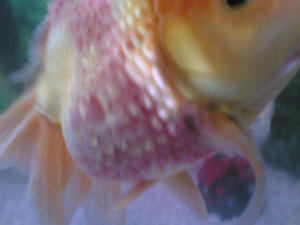
Goldfish Disease by "Types",
Causes:
Environmental 1, Environmental 2, Environmental 3, Environmental 4, Environmental 5, Environmental ,
(Absolutely the Biggest Category)
Floaty Bloaty Goldfish
Nutritional (Second Largest)
Genetic/Developmental
Eye Troubles
Lumps/Bumps/Growths (including
idiopathic tumors)
Behavioral/Social
Viral and Bacterial, Fungal
Infectious
Parasitic: (Ich, Protozoans,
Flukes, Worms, Crustacean/ Anchorworms/Lernaeids, ) Fish Lice (Argulus),
Goldfish Swim Bladder
Problems
Anomalous (Misc., Injuries, etc.)
|
 |
New Print and
eBook on Amazon
Goldfish Success
What it takes to keep goldfish healthy long-term
by Robert (Bob) Fenner
|
Sick Pearlscale, please
help! 5/24/07 Hi there! <Hoh there!> I've
spent a while looking around your site over the last couple of days,
and have found it immensely useful, but unfortunately my specific
question hasn't been answered (that I can see) so I hope you
don't mind me bending your ear for a minute. I hope you can help
me. <Me too> Last February I bought a Pearlscale (Horatio!), who
I installed in a new 50 gallon tank with a filter, a heater and gravel.
I've been scrupulous about cleaning his tank out, I never leave
uneaten food in the tank and he's generally seemed very perky and
happy. It's my first time owning a fish so I'm doing the best I
can. <Good> A couple of weeks ago Horatio started gasping at the
surface of the water occasionally; I spoke to some people and was told
that this either meant lack of oxygen or that he was snapping at food
particles on the surface. <Maybe> Given that Horatio is only 4
inches long (including his tail) and his tank is large, I was told it
was probably not the oxygen. <Hard to say... can be tested for
directly... You do have surface agitation I take it... could be a
nitrogenous, other chemical anomaly... Other possibilities> Today he
started gasping much more over about an hour; I took a close look at
him and saw a kind of clear mucus bubble/blob under each gill (more
pronounced on one side than the other). He is gasping less again now,
but the mucus bubbles are still there. I spend a lot of time playing
with him so I would've noticed any changes before. His gills also
looked purple this morning, which I investigated online and found out
this means ammonium poisoning, but the ammonium levels are well below
accepted levels (according to the leaflets which came with the tests).
<Must need be zero, zip, nada... Not "Below" anything...
None> Nitrate levels are similarly extremely low, <Need actual
values... not subjective evaluations re...> and pH is approximately
neutral or slightly above (i.e. somewhere between pH 7 and 7.5). The
only disease I've come across that's even remotely similar is
gill flukes - <Mmm, no... not after being in place so long... More
likely environmental and or nutritional issues at play here>
however, although Horatio does gasp at the surface and has mucus around
his gills, he is definitely not lethargic (he does occasionally sit on
the bottom of the tank, but is usually very active) and still both
gobbles his food in the morning and nips at his weed during the day - I
believe gill flukes also show up as lethargy, "scraping" and
loss of appetite. <Yes, well put> On the advice of my pet store,
I have used Aquarium Treatment 7 (Anti Slime and Velvet) to hopefully
deal with the presumed parasites. I put it in the tank this afternoon.
<Mmm, I would NOT do this... hurts the animal even more...>
I'd just like to know what advice you have please. Have I done
something wrong; if so, what? <Likely feeding dried prepared food
exclusively... perhaps too high protein content...> Is it even gill
flukes at all? <Not Trematodes, no... Where would they come
from?> And is there anything I can do to help make Horatio better?
<Improve the environment and nutrition... add some Egeria...> I
love my fish to bits and it's horrible to see him struggling to
breath. Thanks a lot for any help you can give me, Sarah <Mmm,
please (re?)read here: http://www.wetwebmedia.com/FWSubWebIndex/fwlivestkindex.htm
Scroll down to the gold bar... peruse the articles on Goldfish Systems
and Mal-Nutrition... Consider storing new water for the week interval,
perhaps adding the plant mentioned above (will help nutritionally,
improve the environment...). Bob Fenner>
Re: Sick Pearlscale, please help! 5/25/07 Hello WWM!
<Sarah> First of all, thank you so much to Bob Fenner for
answering my original email so quickly and so thoroughly; it's
terrific to have found WWM and have a ready and willing source of
expert advice. You guys are an absolute godsend and I can't thank
you enough (Horatio is very grateful too!). I hope you don't mind
if I ask you a few more questions. I'm afraid it's quite a long
email but I want to learn as much as I can, so hopefully you'll
humour me...? <Glad to> The first point I need to make is
regarding an error I made in my first email; I stated that Horatio
lives in a 50 gallon tank, whereas it's actually a 50 LITRE tank,
or around 11 gallons (I guess being up all night fretting about him
didn't do my accuracy any good *sigh*). <Yikes... you're
likely aware this is too small to be stable... unpolluted twixt
maintenance/water changes> I'm really sorry about that. Anyway,
I've spent the last couple of days reading everything I can on your
site, and I've noticed that the WWM experts tend to recommend at
least 10 gallons per fish, absolute minimum. <Yes> Given that
Horatio is about four inches long, including his tail, (obviously this
is an approximation; he won't cooperate and sit still to be
measured!), is this bad for him? <Unfortunately, yes> It seems
like it would be far better if he had too much rather than just enough
room/water. If so, what would be a suitable size? <Mmm, as you hint,
the bigger the better... Maybe a 29 gallon...> Now, onto your
remarks on my enquiry. Again, thank you for your thoroughness, I can
imagine how busy you must be so I'm very grateful for you taking so
much time to help me. <Am happy to assist you> You asked if I
have surface agitation; I do have the filter positioned so the outgoing
water - for want of a better word - "ruffles" the surface; I
understand this increases O2/CO2 diffusion in/out of the water by
increasing the surface area. <Good> The filter also blows
bubbles, which the bloke in the aquarium said increased O2 diffusion
too (although this same guy neglected to mention that testing the water
for ammonia, nitrate etc was vital, so I'm not sure how much I
should trust his advice - <Likely there is just "too much"
that needs relating...> luckily I found this out for myself). Does
this do any good or harm? Does it matter? <Does help> You also
wanted clarification on the various levels in the tank. I've been
testing him every day since he got sick and the results have remained
stable at the following values: pH - 7.5 Ammonia - 0mg/L Nitrite -
0mg/L Nitrate - below 5mg/L, but not 0. I can't be more accurate
than that with my test kit. <Good readings> I believe from my
research that these levels are quite good, though please correct me if
I've been misinformed. Regarding Horatio's diet; your theory
that he is being fed high-protein food was bang on. He is given two
pieces of something called Golden Sinkers (sinking food because I
believe some fish can get swim bladder problems from eating flakes off
the surface) every morning; these are 40% protein. <Yes... too
high> I do soak them in his tank water before letting him have them
as I think this aids digestion. However, he is not exclusively fed
this; he only gets those two bits a day and the rest of his food is
composed of Egeria (the plant you suggested - at least I'm doing
something right!) - he's had that type since I got him, but
I've changed the plants once as just after I got him he hoovered
most of it up. <Ah, good> He settled down after a week though. I
did try him on a different kind with broader leaves as well, but he
didn't like it and stuck with the Egeria, so I took the other plant
out. Horatio also gets a shelled pea two or three times a week, as I
read that this can help prevent constipation. Is that right? What else
can I do to improve his nutrition? <Mmm, perhaps a bit less of the
high-protein food, some added vegetable based substituted...> Given
your response to gill flukes, I can't say I'm surprised that
you consider it unlikely - I was advised to try him on the parasite
medicine by a pet shop assistant I spoke to, and I didn't want to
argue because of my inexperience. I actually really thought he had
ammonia poisoning as his symptoms were bang on, but given the results
of the tests this can't be, can it? <Not likely, though ammonia
et al. can be very transient... and the damage from "spike"
exposures can take weeks to repair> Presumably I should change the
water to remove the medicine, as you said it was bad for the fish -
please let me know ASAP. <I would change a good bit out... 25% or so
per day... for a few days> I'm reluctant to mess him about any
more in case I do more harm than good - for instance, removing large
amounts of water at a time can take away too many of the
"good" bacteria, right? <Yes... and "upset" the
metabolic activity of those remaining> Incidentally, my plan for
future water-changes is 10% every week. But advice on this is
conflicting - 50% every week, 20% every three weeks, 10% per
week...Argh! What's your recommendation? <About a quarter per
week> What do I do about the medicine? Horatio has actually been
gasping less and looking generally better since I put the stuff in, but
given your response I'm inclined to call that a coincidence.
Please, please let me know what to do about this as soon as you can.
<I would serially dilute as stated above> So, the situation now
is as follows: Horatio has returned to his usual happy self. I
haven't observed him sitting on the bottom of the tank since the
night after I wrote to you (23/05/07) and he isn't exhibiting any
signs I'd associate with a sick fish - no clamped fins, healthy,
brightly coloured scales, breathing and swimming normally and eating
enthusiastically. I've been keeping a very close eye on him
(you'd probably think I'm daft if I told you I kipped on the
floor beside his tank on that night and woke myself up frequently to
check he was okay, only I was really worried about him! *embarrassed
face*)...one of the few benefits of not being able to work because
I'm ill! In any case, rest assured I've spent a lot of time
watching him for any deterioration/improvement (he's much better
than the TV *grin*) <Heeee!> and he's definitely much perkier
now. At feeding time and whenever I come into the room he swims up and
down the nearest bit of glass, as he usually does (incredibly cute!),
and he spends most of the day swimming around biting his large rock (it
gives him something to retreat to if he wants, which I understand helps
to reduce stress, right?) <Yes... I have clay flower pots in with my
Goldfishes for this purpose> and chewing bits of gravel, as well as
eating his weed a fair bit. He's also gasping at the air much less
than he has been for the last fortnight (maybe once an hour or even
less than that). The only abnormality apart from this is the weird
clear stuff under his gills. <Maybe just connective tissue...>
I've managed to get a closer look at this since last contacting you
and it's odd, but I don't think it's mucus at all, despite
what I was advised; rather it looks as if there's a clear layer
attached to the underside of the gill covers and it's slipped out a
bit. When I look... er... if I said "up his gills", would
that make sense?...anyway, there's no visible blockage, just these
little bits of clear stuff waving out beyond his gill covers. My first
thought was that there was damage to the covers, but they look whole
and normal...is it possible for a bit of the gill to "poke
out"? <Mmm, yes...> There are a couple of emails on WWM
describing something similar; apparently it could be caused by trauma,
but it's a bit strange for it to affect both gills, though it could
explain why it's worse on one side. <I suspect this is
"genetic expression"... Is part of this specimen> Horatio
has been slightly jumpy since the clear bits appeared, but I assumed he
was panicking because he couldn't breathe properly. Maybe he hurt
himself and is subsequently a bit stressed? What do you reckon? Am I
talking rubbish? This is mostly supposition on my part, unfortunately.
<All speculation...> There is one other thing - last one, I
promise. I haven't been able to find anything on this at all.
Yesterday Horatio had two periods, lasting about 15 minutes each, when
he was gasping almost constantly. However, at all other times he
virtually never does it. The first time I couldn't work out what
was wrong - the only thing that had changed was that the oven was on
and the place had heated up significantly (I only have a small flat!).
I looked at the tank thermometer and, sure enough, the temperature had
risen by 0.5 degrees Celsius. <Wow!> I turned off the oven,
opened all the windows, the tank temperature dropped and Horatio quit
gasping. I assumed it was a coincidence, given that I thought I'd
found the problem in the clear bits on his gills. <There is also an
issue possibly with CO2 going into solution here... with the windows
closed, your breathing... any gas appliance in operation... this gas
can/does solubilize readily in aquarium water... this can cause Horatio
stress as you relate... The/a real solution here: A larger system
really> However, that evening, again the oven was on, again the
temperature went up half a degree and again Horatio started gasping.
<Yes... increasing metabolic activity while lowering oxygen
solubility> Again I opened the windows, cooled the tank and when the
temperature dropped Horatio went back to normal. Surely not a
coincidence, so my conclusion is a) there is something wrong with his
gills and b) when the temperature increases, there is less oxygen
available in the water. I believe I remember from high school biology
that cold water can hold more dissolved oxygen than warm water,
<This is correct> but that may be wrong...it was a long time ago.
Maybe just the fact that fish are cold-blooded and breathe less often
in cold water is what did it. You'll know much better than me!
<Apparently not!> Making the assumption that Horatio's tank
was unhealthily warm (and so any slight increase could cause breathing
difficulty, perhaps worsened by this gill problem - or maybe the warmth
caused the problem in the first place) I started researching the ideal
temperature for a Pearlscale. Again, differences of opinion abound. I
haven't found a majority consensus anywhere; the closest I have is
a couple of websites claiming that around 15-20 degrees Celsius is good
(that's about 60-70 degrees Fahrenheit, if you prefer that
measurement). <Correct also> Horatio's tank last night was
about 21.5 degrees Celsius, rising to 22 degrees when the oven was on,
at which point he started gasping air. I turned down the heater by
about half a degree Celsius (all too aware that a rapid change could
cause major problems in itself) and this morning the tank is bang on 21
degrees Celsius and Horatio has barely been gasping at all. Subject to
your recommendation, I believe it may be helpful to him to continue
dropping the temperature, as he may be too warm at the moment. (In my
defense, the aquarium did advise 20-25 degrees Celsius when we bought
Horatio.) I won't do anything until I hear from you, though, in
case I'm only worsening things. <A lower temperature is
advised> Wow, I feel like gasping myself now I'm finally done
writing. I'm really sorry about the length of this but, as you can
see, I'm in dire need of aid! Horatio doesn't seem to be in any
immediate danger (despite his funny-looking gills and very occasional
gasping he is acting like a perfectly healthy fish in all other
respects) but I would like to do whatever I can to make him healthier
and happier. Once again, thank you so much for helping me (and for
slogging through this desperately overlong email). Feel free to edit it
before you post it, if you want! From the very grateful Sarah and
Horatio <Thank you Sarah! Bob Fenner>
Re: Sick Pearlscale - please help! - 05/26/07 Hi Bob!
<Sarah> Just to thank you very much for all your help; I'll
be getting Horatio a new tank (around 30 gallons, as you advised -
I'll see what's available in town; <Perhaps even a little
larger... if you intend to keep other... I have four goldfish in a
90...> luckily I live in a major city so there's plenty choice).
<Do measure around for available space/s... and make sure the floor,
what you will set this system on is sturdy!> I'll maintain the
tank temperature at around 17 degrees Celsius (but drop it down slowly
so I don't shock him). Do you think that's alright? <Yes>
I'm also immediately implementing the serial dilution you
described, starting as soon as I send this email. <Good> You
mentioned changing his diet; what proportions of food are good?
<Depends on the material/s... some pelleted foods are
"complete" (really... like "all in one" dog
foods...)> Should I switch to a lower-protein food and give him one
lump every morning instead of two - and what should I make up the
difference with? Is giving him a pea every night a good idea, or should
I give him two every two days instead? <Either of these intervals
would be fine> I also understand that fish can eat a lot of
vegetables, including lettuce and carrots - any particular favourites
of yours? <I use live plants... I do NOT like terrestrial vegetables
for captive aquatics... too likely troubles with nutrients and to a
lesser extent, pesticide residues (yes)> And how much of them? You
also mentioned vegetable-based food - forgive me, but I didn't know
if you meant actual vegetables or a different kind of manufactured
food? <For the most part the latter> Assuming once I correct what
you've pointed out so far (as I've described above), Horatio
should hopefully stop gasping - my only worry therefore is the exposed
tissue at his gills. Whether it's a genetic expression or not, it
concerned me that this tissue should presumably normally be covered and
may be at greater risk of infection/harm - for instance, ammonia burns
would, I expect, be devastating... even more than usual. <Mmm,
perhaps... though such nitrogenous difficulties are damaging to all...
Very likely still the principal cause of death of captive
ornamentals...> I'm going to test Horatio's water at least
twice a week to keep a look out for any rising levels, but is there
anything else I could use and any other tips for keeping his tank extra
clean? <Redundant bio-filtration mainly...> Once again thank you
very much for all your help, we really appreciate it! Sarah and Horatio
<Welcome! Bob Fenner>
Re: Sick Pearlscale, please help! 5/27/07 Hello Bob,
<Hi Sarah> I'm writing to you, hopefully for the last time
for a while, to thank you very much for your advice on my Pearlscale
Horatio. I'm very grateful for your patience and the time you
obviously took to go over my emails - I've been following your
advice and I'm happy to report he's already gasping less,
isn't sitting on the bottom of the tank any more and generally
looks really good. I can't thank you enough for your help!
<You're certainly welcome> I've also read a lot of the
relevant articles and FAQs on WWM over the past week or so, and
I've found it an incredibly useful resource - I've trebled my
knowledge of goldfish over the last few days and fully intend to keep
working on it over the coming months. It's a terrific website (my
boyfriend thinks it's strange that I'm spending all day reading
on WWM now; he thinks I may be addicted!) - I'll definitely be
lurking around for a good while yet. <Ah good> No doubt I'll
be in touch again soon (with a new tank to set up, I'll probably
run into something unfamiliar!) but I just wanted to let you know how
much I appreciate your time. Again, my very grateful thanks and I hope
you're enjoying your weekend! Sarah <Ah yes... a bit of
gardening, some article work... made a faux meat loaf for dinner later,
and am about off with the dogs for our walk. Cheers, Bob
Fenner>
Hi there a wee problem. Goldfish
sys., dis. 5/20/07 <<Hello, Lewis.
Tom here.>> First let me say your site is wonderful and very
interesting. <<Thanks for the kind words, Lewis.>> I have a
very basic fish tank bought for my son by his aunt. We have two fan
tails and a black moor. We used to have a bubble eye but it got stuck
in a tank ornament and had worn away its side. I never thought anything
of it but unfortunately the fish passed. <<You don't say how
large the tank is, Lewis, but I'm going to guess that it's on
the small side. Don't give me too much credit on that score because
anything less than 60 gallons, bare minimum, is too small for four
Goldfish no matter how old they are. Goldfish are one of the hardest
fish to keep and the ones most unknowledgeable people will tell you are
'great' to start with. Nothing could be further from the
truth.>> On checking the tank today I noticed the black moor has
a similar sore on his side, his scales are gone and all that can be
seen is a flaky white sore with two red spots. He is also very lifeless
and I fear he is not long for this world. <<Other influences
aside, I think you can see what I'm getting at about Goldfish.
There should be no sharp objects (decorations) in the tank whatsoever.
These are fairly active fish and it requires very little to damage
their bodies/fins. Once an injury occurs, it can lead to bacterial
infections quite readily, particularly if the water quality isn't
where it should be. Messy as Goldfish are, only very large aquariums
with substantial filtration are capable of maintaining stable
conditions for these fish. There are some who would argue that the
filtering system for a Goldfish tank should be capable of turning over
7-12 times the volume of the tank per hour. By
comparison, my 50-gallon tropical tank has a realistic
turnover rate of between five and six times per hour and I consider
that a lot for the average community-type aquarium.>> Any help
would be great to save him or to identify something more sinister going
on, maybe bacteria or virus. <<It's just about certain that
your issues are going to deal with water quality/conditions, the
decoration injury to your late Bubble Eye notwithstanding. Fish
can/will heal quite nicely from injuries on their own provided they
have tip-top conditions to live in. A small, unhealthy system leads to
stress on the fish lowering their immune systems and leaving them very
susceptible to secondary problems/infections. There are different
bacteria in all aquariums. The trick is to keep the fish healthy so
their immune systems can deal with these naturally.>>
Many thanks for your help Lewis <<As a practical
matter, I can only recommend that you keep the tank very clean and
perform water changes religiously. Don't overfeed your fish as this
will only contribute to poor water quality. If your tank is as small as
I suspect it is, you should be changing no less than 50% of the water
each week along with a good vacuuming of the gravel (DEEP vacuuming)
with each change. If your Moor doesn't make it,
absolutely do not replace it with another fish. You already have your
hands full. Best of luck to you. Tom>>
Goldfish Question, hlth.
5/20/07 Hello Crew! <Claudine> I am so glad I
found your site. I have learned much from reading your articles and
archives. What an invaluable site full of useful
information! I hope you can help me. I am newbie
and this is my very first tank. Unfortunately, I think one
of my Orandas has septicemia but before I get into that, here are the
particulars involved: 55 gallon tank (cycled) 2 - Aqua Clear 70 filters
1 - 12" Bubble Wand 1 Whisper 60 air pump Plastic Plants (No live
plants. Silk plants on the way) Temp: 75 degrees
PH: 7.6 Hardness: Soft Alkalinity: 80
Moderate Ammonia: 0 Nitrite: 0
Nitrate: 20 PPM <Yikes... toward the upper limit... is
malaffecting your livestock at this concentration... I would research,
look into means of lowering by about half at least... Posted on
WWM...> Water Treatments: API Stress Coat & API Salt
(1 tbsp per 5 gallons) <Mmm, unless your water is very salt/s
deficient, I would NOT add/expose your goldfish to constantly present
added salt> Water Test: API Master Test
Kit. Tests performed weekly at minimum.
Maintenance: Weekly 50% water change with gravel cleaning
<Mmm... well, I would either limit these change %s to 25 % or so, or
make sure you store the new water for the week, in anticipation of
use... rationale posted...> Tank Occupants: 5 Orandas
(ranging from 3" to 5" but growing) <Need more room than
this... or addition of other types of filtration... e.g. a live plant
refugium tied in...> Future Plans: No additional fish to
be added to this tank. 2 other tanks currently fishless cycling to
make room for more fish Four (out of five) fish were treated
simultaneously for flukes using Prazi-Q. All five fish were fed
Medi-Gold food for their first 14 days, followed by 14 days of Jump
Start, and then on to Pro Gold. About 1 month ago I
bought my biggest fish (#5) named Monster from the LFS (he's a red
Oranda). I thought I was buying a nice, chubby, fat
fish. I soon discovered that Monster was not chubby; he was
bloated! Within a week, he went from being a chubby monster
to a full blown pine cone! <Yikes!> At the time I
didn't know about dropsy, so sadly he suffered in this condition
for a few days. In complete desperation I ordered some
Metro-Meds and then started him on that in conjunction with a course of
Maracyn Two treatment. I really thought Monster would not
make it but I wanted to give it my best shot to save him.
Amazingly he started eating, started shrinking, and he
survived! Once he recovered and I returned him from the
hospital tank to the main tank, he came alive. He actively
swims the tank, has a great appetite, normal fecal matter, and
socializes with the other four Orandas. Three days ago I
noticed that Monster had red veins in his tail. <Don't be overly
surprised or eager to "treat" for this... a normal reaction
event to the med.s, salt exposure> At first it was a grouping of
light red lines on one side of the tail. Now those
particular lines are bright fire-truck red and easily
noticed. Today, I was able to spot more of these vein things
on the same side and many on the other side of the tail. The
only difference is that these newer lines are very fine compared to the
first grouping which are more prominent and brighter red. He
has no other visible signs of injury, red patches, etc on his other
fins or the rest of his body. So far it is all isolated to
the tail fin and tail base. His four tank mates show no
signs of this or any other problem. I have not found much detail on
septicemia, but this is the closest disease <Is not really a disease
per se, but a symptom... "bacteria in the blood"... the red
streaking can be/is caused/related to a number of circumstances... in
this case a few types of stress...> I could come up with to match
what I am seeing, despite the fact that Monster is not sluggish, is
behaving normally, has a good appetite and continues to
eat. I know I may have jumped the gun, but I have removed
Monster from the main tank and have put him in a hospital tank. <I
would not have done this. I WOULD move this fish back to the better
circumstances... likely the main/display tank> Today I started him
back on the Metro-Med food and the Maracyn Two treatment in hopes that
this will make the red veins go away. I am
hoping that this was appropriate. <Not usually IMO... providing an
optimized, stable environment, regular nutrition, maintenance will see
this situation self cure in time (weeks to a few months)... Stressing
only forestalls cure> Does this sound like septicemia or are there
other diseases that may have caused this? <There are other
causes...> Is it contagious and if so should I treat the other 4
fish even though they show no symptoms? <Depends on the net
cause/s... I suspect this is NOT catching> Is septicemia something
that can be cured or is this something that is chronic that I should
anticipate reoccurring with Monster? <Is curable... fix the
environment, fix the affected fishes> If it is chronic does that
mean Monster should be kept alone (that would be so
sad)? I've checked my water quality 4 times this week
and the figures noted above have been consistent and identical each
time. PS: This is my first shot at fishkeeping and I am only
3 months into the hobby. I think I am doing pretty good for
a newbie with setup, care, water quality, and maintenance.
<Does read like you are passionate, earnest, informed...> So far
I have only lost one fish which came down with (my guess) Hexamita or
Hole-In-The-Head during its quarantine period. It happened
so fast I didn't know what to do to stop it. Thanks in advance for
any info or guidance you may be able to offer! Aloha (yep, from Hawaii)
Claudine <A hu'i hou! Bob Fenner>
Re: Goldfish Question (Bob Fenner) 5/21/07 Bob,
<I am NOT a goldfish! Heeeeeee!> Thank you so much for your quick
reply. I will be doing a water change tomorrow to try to
bring down the nitrates and will look into other means of nitrate
removal. What level should Nitrates be at?
<... you haven't been reading... Less than 20 ppm, ten would be
better, zip is ideal> I have also been adding salt per the
instruction of the LFS. Now I feel foolish for doing
so. What are the benefits or effects of salt in a freshwater
tank? <Mmm, osmotic pressure raised, some physiological
adaptation/accommodation necessary... harder for fishes to
"pump" sodium, its effects (negative) on respiration,
increasing in proteinaceous production (mucus, body slime), it's
further negative effects on respiration, excretion (through the
skin)... Many more...> When I stocked my tank I followed information
I found on the internet and in books suggesting that goldfish require
10 gallons each. <Depends on the variety, size... as well as
filtration/mechanicals, water quality/maintenance... likely 15-20 per
specimen is about right, except for large systems (let's say a
hundred or more gallons), where one can "cheat" a bit
more> I have 5 goldfish in my 55 gallon tank and you
mentioned that this is not enough space for them.
<Correct. Your water testing indicates this...> What would be the
appropriate number of gallons per fish to follow for Oranda goldfish?
<15-20...> Bob, thanks again for your help. Aloha!
Claudine <Welcome! BobF>
Please Help Me, they are all dying.
FW/Goldfish env. dis. 5/17/07 Hello, I hope that you
can help me <Hello, will try my best!> I have a 29 gallon
aquarium, with gravel and everything it actually holds about 27, that I
set up in January, I was worried about the city water supply, tests
over 2 ppm for ammonia and about 6 ppm for nitrate right out of the tap
(Chloramine) so I thought it was best to use reverse osmosis filtered
water from the store, I added Aqua-Safe... <The nitrate level is
fine, actually very good. The ammonia level is suspiciously high. Even
in London, 0.5 ppm ammonia is the standard. Regardless, 2 ppm is lethal
to all aquarium fish. Who told you the water contains 2 ppm ammonia? A
test kit or the guys in the store? You shouldn't need RO water for
goldfish. For one thing, it is far too soft and acidic for goldfish.
They like pH 7.2-7.5 and moderate to high levels of hardness.>
...and some aquarium salt, ( at the recommendation of the people at the
pet store) and set it up. <Repeat after me: Freshwater fish do not
need salt. Freshwater fish do not need salt. The only fish that need
salt are brackish water fish and marine fish. Please stop using the
salt for anything other that specific treatments, not as a everyday
aquarium additive. To harden very soft water, it is best to mix the RO
water with some tap water, around 50:50, or else use a small dose (say,
25-50% the recommended dosage) of Lake Malawi or Lake Tanganyikan salts
as sold for use with cichlids.> I got an Oranda about 4" long,
a Black Moor about the same size and a Calico Ryukin that was slightly
smaller that the other fish. <Far too many, big fishes for a brand
new aquarium. And WAYYYY too many for a 29 gallon tank. Goldfish are
totally unsuited to life in a small aquarium because they are big (30
cm or so when mature) and extremely messy (requiring lots of
filtration). While you often see goldfish in aquaria, this hides the
fact that a large percentage (the majority probably) die
prematurely.> I do approx 35 to 40 % water changes weekly, using the
bottled water, treating with 3 drops per gallon API PH Up, and the
recommended amount of Aqua-Safe, and just as much salt to replace what
is being taken out with the water changes. <In a tank with goldfish,
50% water changes are in order. The additives you're using are
worthwhile, except the salt, so good job there.> Since my tank
cycled, which took longer than expected because I did not know to just
rinse the filter, I changed the cartridge the first time, but no more,
I thought everything was fine. My ph is always 7.2, ammonia
is 0, nitrites 0 and I keep the nitrates less than 20, at 20 I do a
partial change, temp between 72 and 74. <All sounds fine. Goldfish
certainly don't need 72-74 F temperatures. They want room
temperature or slightly less. While fancy goldfish shouldn't be
overwintered outdoors under ice, they are otherwise just as much
COLDWATER fish as regular goldfish. So switch the heater off! Have a
read of this: http://www.wetwebmedia.com/FWSubWebIndex/gldfshsystems.htm
> I read that fancies need 100 gal per hour per fish of filter so I
added an additional filter/pump unit to match the one that came with
kit, the 2 combined are rated at 300 gallon per hour, and I have added
a bubbler for air. <There isn't a fixed "gallons per hour
per fish" rating. What you want is aquarium turnover, i.e., a 30
gallon tank should have all its water passed through the filter 6 or
more times per hour. So you need filtration rated at 180 gallons per
hour. Now, aquarium filters do not provide all the filtration it says
on the box for a variety of mechanical reasons, so you want to choose a
bit more than the minimum required. So on a 30 gallon tank, instead of
180 gallons per hour filtration, go for 220-250 gallons per hour.>
About 7 weeks in I lost the moor, he was fine then one day he was just
drifting with currents in the tank, completely
unresponsive. I had no idea what to do, I took him out of
the tank and put him in a bucket as I do not yet have a quarantine
tank. The people at the pet store (big help they were) sold
me Mela-fix and told me it would do the trick-it did not, my moor died
2 days later. Now I have read that this product is not really a
medicine but just an herbal remedy, and usually never does
anything. <Melafix doesn't really cure things,
it's more like antiseptic cream we'd use on cuts and bruises.
It helps keep wounds clean, and so promotes the natural recovery of a
fish over time, but don't expect miracles. As for the quality of
advice from pet stores, it can be very variable. Nothing beats reading
and learning yourself from web sites and above all good books.> Well
I thought it was just my fault for stressing him with the filter change
and that the cycle was just too much for him- this happened right as
the tank cycled. So I got another Moor and moved on.
<This is a common mistake. Never, ever buy another fish until
you've established why the last one died.> Then my
Daughter's pride and joy - the Oranda died, he started showing
signs of bloating, and his scales started to stick out- possibly
dropsy- which generally is incurable- from what I have read, we stopped
feeding him, he was such a pig, just charging around the tank like a
vacuum cleaner, we thought he was just bloated, he seemed to get a
little better for a couple of days, then died, we did not replace him,
we could not find another as beautiful as he was, just gorgeous, big
eye brows, wonderful long flowing fins, his Wen was just starting to
grow, I still shed a tear. <Dropsy is a symptom, not a disease.
It's like a fever in humans. Can be caused by all kinds of things.
Commonly, but not always, incurable because by the time dropsy sets in,
the damage to the organs is so severe that nothing can save the
fish.> Now my Ryukin is going, he always seemed so vigorous, oddly
enough from day one he has always slept on the bottom of the tank, but
in the morning turning on the light he would always jump right up and
swim all day. He has slowly lost the ability to control his
movements, I thought, once again, that he was actually
looking better yesterday, since the onset of this, he has always been
responsive, swimming some to come over and see us, but then settling
down to the bottom, now he can barley swim, but still fighting hard,
and he is bent in half and loosing his brilliant coloration, he is
still alive but it would seem just barely, as I do not yet have a
quarantine tank, I do not have any place else to put him, and being
relatively new to this hobby I really don't know what to do.
<Please do a big (50%) water change straightaway. Do the same thing
the next day, and so on until he peps up. Almost all diseases in fish
are caused directly or indirectly by water quality/chemistry
problems.> I have been reading as much as I can on the web, I am a
single father of 2 very active 10 year olds and work full time, so my
time is somewhat stretched, but I have become so attached to these
little guys that I would do just about anything for them- he is the
last of the original 3, I really do not want to loose him but I realize
that it looks hopeless. <Not hopeless. But your tank *is*
overstocked for goldfish, and your life would orders of magnitude
easier if you went with fishes appropriate to this size aquarium.
Danios, peppered catfish, and blue gouramis, for example.> I have
seen and read conflicting things about salt, water type, and
temperature for fancies. <Fancy goldfish are very similar to regular
goldfish, except they do not do well overwintering in ponds under ice.
As with all other coldwater fish, they don't do as well under
tropical temperatures on a permanent basis. Room temperature is usually
fine. See here: http://www.wetwebmedia.com/FWSubWebIndex/gldfshdisease.htm
> Also, does the type of light matter, mine is florescent. <No,
lighting doesn't matter. Some lights warm up the water to an
unacceptable degree, and no fish likes living without at least one
shady corner it can rest in, but other than that, they're fine with
the lights you have.> And about food, I have read that Ryukins have
unusual digestive tracts and should not eat pellet type food, I have
seen this in my Ryukin (when he was still eating) if he ate a pellet he
would pop to the surface like a cork as soon as he would quit moving,
he could always get down but it was a struggle, so I started mashing
his food with a drop of tank water and would spoon feed him. <Never
heard this. All goldfish do best (read: demand) a plant-based diet,
because they're herbivores in the wild. Flake alone isn't all
that good for them. Have a read of this: http://www.wetwebmedia.com/FWSubWebIndex/gldfshmalnut.htm
> Please help, I cannot bear to loose another, although I know the
Ryukin is probably beyond help, and what is the best way to euthanize,
I do not think I can bear to watch him suffer if nothing can be done,
and I do want my kids to see it either, they have seen enough. <I
hope you won't need to destroy the goldfish you have. Please do a
big water change, and then check the pH is between 7 and 7.5, and the
hardness around 10-20 dH. Ammonia and nitrite should be 0. Nitrates
less important, but ideally below 50 mg/l. Temperature between 60 and
70 F is fine. Do weekly 50% water changes. Provided you keep the water
parameters in the range given above, any goldfish should thrive, all
else being equal. If your fish is truly beyond help, read here:
http://www.wetwebmedia.com/euthanasiafaqs.htm > Thanks so
much in advance for any advice you can give me, I think you have an
incredible web site. <Thanks for the compliment.> Sincerely, Bill
Lux <I hope things work out. Your experience is not an uncommon one
(sadly) and often misleads people to think fishkeeping is hard. It
really isn't, but you do need to research things first, and start
off with small/easy fishes rather than jumping in at the deep end with
big/messy fishes like goldfish. Cheers, Neale>
Re: Please Help Me, they are all dying 5/17/07 Thank
you so much for your quick reply, I will read the articles, start
changing water, and stop the salt. <No problems, and very good.>
As for the water here I used an API test kit to test my tap water
before using it in the aquarium, it shows 2 ppm on the color bars
(Omaha NE, USA). <Odd. I lived in Lincoln for some time and never
had this problem. What I think is happening is you are using a
dechlorinator that converts the Chloramine to ammonia but does nothing
with the ammonia afterwards. That is what your test kit is measuring.
Try using the test kit on water straight from the tap. Anyway, if find
0 ammonia in the water from the tap but 2 ppm after dechlorinating it,
then your problem is the Chloramine. You need a dechlorinator that
specifically neutralizes ammonia. Some do, some don't.> As for
the size of the aquarium vs. the amount of fish, the pet store people (
I know, I know) said 10 gal per fish, and that it would fine with 3
fish 3" to 4" in size and still give them room to grow.
<10 gallon per goldfish is way too little. Goldfish can easily get
to 30 cm long and the record is something like twice that size.> I
have a heater in the tank but it is off, I know the heat is a problem,
but that is just room temp here-do they sell aquarium chillers? <Yes
they do but they're expensive. Why is the room so warm? Must be
pretty uncomfortable for the humans, let alone the fish! At the very
least, consider switching the heat in the room off at night (if you
can). Goldfish will adjust to ambient changes in summer and winter, and
in fact quite like them. Also make sure the tank isn't directly in
sunshine, as that warms up the water. Consider adding some additional
aeration to keep the water moving and improve the level of oxygen in
the water. A simple air pump and airstone will do, or you can go for
something more fancy like a spray bar for the filter. There are some
cool toys here in England that combine an airpump with a coloured
light, and these are fun and effective ways to move the water about the
aquarium.> Thank you again so very much, I have to go change some
water now Bill <Hah! Don't forget plants love fish tank water,
so don't waste it! Cheers, Neale>
Re: Please Help Me, they are all dying, goldfish hlth.
5/24/07 Hello again, I have been reading the
articles, and changing water, I thought things were going to be ok, but
my Ryukin, which I discovered was actually not a Ryukin at all but a
Bristol Shubunkin, has now died too. <Oh dear. Obvious do the usual
things: check water quality, temperature, diet, etc.> After doing
some water changes I thought he was looking better, but I was wrong, he
is gone. Even with that, I still have a black moor, the one
I bought to replace the first fish that died, he was looking just fine,
no changes in behavior, swimming around all the time, now, as if
overnight, he is not looking well either. <Again, focus on water
quality.> I came home from work to find him stuck to one of the
updraft tubes on my filter, he was not swimming as actively this
morning, so I came home at lunch and did a 5 gal change, then coming
home as I said he was stuck to the tube, almost as if dazed, I opened
the lid to the tank and he took off swimming but he now has the
indentation of the slits from the draft tube on his little head.
<Healthy fish have no problem keeping away from the filter inlet. If
a fish seems to get stuck on/in a filter, more often than not the fish
was so weak it couldn't swim away.> He is not nearly as active
as usual and his tail fins look terrible. They are a little discolored
with faint white streaks that has the appearance of velvet that has
gotten wet. Any suggestions would be great. <Likely Finrot. Treat
accordingly.> As for the Omaha water, there have been local concerns
for a couple of years since the switch to Chloramine, some days when I
test it (straight out of the tap) it tests about .5, some days 1 some
days nearly 2, that is why I was using the bottled OR water.
<I'll put this simply. Goldfish need water at pH 7-7.5, with
moderate to high hardness. Zero ammonia, zero nitrite. No salt.
Temperature between 10 and 20 degrees C. If you aren't providing
those conditions, then find a way to do so. This is non-negotiable.
Anything deviating from these conditions -- such as soft water -- will
cause harm. If you simply cannot maintain these conditions because of
the water you have available to you, then sadly you must switch from
goldfish to pet rocks or something. You simply cannot maintain fish in
an aquarium where the ammonia level is consistently at 0.5 mg/l. Just
not possible. Quite possibly the workaround is to use ammonia remover
in a filter placed in drum of dechlorinated water and then use that
filter to remove the ammonia. Once the ammonia has gone down to zero,
use it for water changes. Also look for products that chemically remove
ammonia and Chloramine from the tap water. These will work at low
doses. Maybe even call your water supplier and ask they what their
standards are for ammonia in water. Frankly, it should be zero.>
Thanks, Bill <Cheers, Neale>
| Goldfish lice 5/16/07 I
have 8 Oranda goldfish and a black moor. 3 days before my all fish
got fish lice. Hence I remove them in a tub and kept in 0.3% salt
water. <The salt bath you were using probably isn't saline
enough. For external parasites like leeches and lice, dipping fish
into full-strength seawater for 2-20 minutes depending on the
species usually works much better. In other words, prepare a bath
containing 35 grammes of marine salt mix (or un-iodized cooking
salt) per litre. Put the fish in a net, dip into the bath, for a
period of time depending on the size of the goldfish. Start off
with 2 minute dips, and if that doesn't work, do 4 minutes the
next day, 6 the next, and so on. For large pond goldfish and Koi,
up to 20 minutes is safe. However, you must observe the fish, and
if it has trouble keeping itself upright, it should be taken out
the bath and put back in the aquarium/pond.> And them remove
lice from each of them. I also put potassium permanganate and kept
them over night in tub. <Potassium permanganate is a traditional
remedy for fish lice. 10-20 mg/l for NO MORE than 30 minutes per
day. It is fairly nasty stuff, and if used carelessly will harm
your fish at this concentration.> I cleaned the tank and then
put all fishes in it the next day. But then all of them sat at
bottom upside down. <Sounds very bad. I hope you didn't
disturb the filter?> Later they start recovering and then sat at
bottom. But however my black moor died. Now of 8 only 4 are coming
up and eating food while others are just crawling at bottom. They
do not eat food. <This sounds more systemic than simple fish
lice. Fish lice are an irritant, and the damage they cause can
allow secondary infections to set in. But fish lice don't
immediately cause the sort of symptoms described here. What is pH,
hardness, ammonia, and nitrite in the aquarium? Eight goldfish will
need a BIG aquarium with LOTS of filtration to stay healthy. No
smaller an aquarium than 55 gallons (200 litres), in my opinion.
Actually, I think goldfish are best kept in ponds.> Also their
endings of fins are turning black. Also their scales have been
removed. Pls help me. <Sounds like Finrot is setting in. This is
an opportunistic bacterial infection that is most easily treated
with commercial medications. Salt water dips may help, but alone
won't cure the problem. High levels of ammonia tend to cause
this problems in fancy goldfish.> Also pls tell me that how it
happened and pls guide me how I can make my fish normal. <Have a
read of this article: http://www.wetwebmedia.com/FWSubWebIndex/gldfshsystems.htm
and then browse some of the other pages. Goldfish are tough
animals, and if you fix things, they will probably recover and
provide you with many years of pleasure.> I live in Mumbai,
India. Pls guide me <Well, I hope this helps, and good luck!
Neale> |
| Re: Goldfish lice 5/17/07 Thank
you very much for your advice. <No problems.> Now my fishes
are eating food except one. <Always a good sign. But go easy on
the food to start with. Just like people, after sickness they need
time to recover, so small rather than big meals and lots of water
changes will help.> Also I have added Epsom salt. In how much
quantity should we add it. <1 teaspoon per five gallons (19
litres). This is a *short term* remedy, and once the fish are
healthy, stop adding it to the water. Also, don't add directly
to the tank: stir into each bucket of water you add to the tank
during water changes.> Also one of my fish is swimming upside
down. At first it used to eat food but now it has stopped. But it
is swimming upside down. Pls give me the remedy. <Read here:
http://www.wetwebmedia.com/FWSubWebIndex/gldfshmalnut.htm
> I don't think it is having swim bladder disease because it
also sometimes swim straight. <I agree. Probably a diet
issue.> Also the scales of the fishes have been removed. Can we
get them back. <Yes, they will grow back. They're like hair
or fingernails.> Also their dorsal fin is very reduced. <Fin
rot. Fix the water quality, and the fin will grow back. Treat with
fin rot remedy.> Pls guide me. And once again thank for your
previous advice. <No problems, a good luck! Neale> |
| Re: Goldfish lice 5/18/07
Thank you for your opinion. <You are welcome.> Some question
I wanted to ask. <OK.> What is the fin rot remedy which you
had mentioned. When I am asking to my local pet stores they are
telling that they don't have medicine for it. <Oh, there are
many brands. I happen to like eSHa 2000, but there are others like
Interpet Anti Fungus & Bacteria No.8. As far as I know, these
remedies are based on mixtures of malachite green and formalin.
Some people have good success with Melafix, which is tea tree
oil.> Actually they even don't know what is ammonia test
kit. <Oh dear.> Also at what interval we should go for half
and full water changes now and afterwards when are fish will be
fine. <While they're sick, do 50% water changes every day or
two. Once you have added a medication, follow the instructions. In
most cases, you MUST NOT do water changes while the medication is
in the water, because removing the water would dilute the medicine.
When the fish are healthy again, do 50% water changes once a
week.> Indeed the ingredient like fish meal is written on the
fish food can. I feed them round red coloured pellets twice a day.
But you said that we should feed them some peas etc. Pls tell me
the exact procedure. <Please read the article about feeding
goldfish, here: http://www.wetwebmedia.com/FWSubWebIndex/gldfshmalnut.htm
> Can we feed this to normal fishes also. <Yes. Many fishes
enjoy peas, sometimes cooked, sometimes raw. I have a pufferfish
that eats them!> Since their scales have been removed. So is
there any medicine that we can apply or give them. <Not really.
Just let nature take its course. So long as the water is clean, the
scales will grow back in their own good time.> What we have to
put in tank when we do a full water change. <Nothing, apart from
chlorine remover.> I am adding Terramycin and becosules
capsules. Is it good. What are they put for. <I have no idea why
you are using these. Terramycin is an antibiotics, and while it
might help with fin rot, in most countries its use is only with
medical or veterinarian advice. Please consult a vet. Becosules are
apparently multivitamins for humans, and I have no idea if these
are even safe for fish.> Can you give me the direct link of you
page where there are list of various antibiotics that we can give
them when they are suffering from various disease. <Outside of
the United States, use of antibiotics usually depends upon getting
a prescription from a vet or doctor. They will tell you how to use
drugs, and if you need them at all. Please use the safer mineral
salt and formalin cures (such as those mentioned above) instead.
Above all else, improve water quality: Finrot is (almost always)
caused by poor water conditions, and unless you fix the water
quality, the Finrot will keep coming back. Cheers, Neale> |
| Re: Goldfish lice... 5/19/07
Well today <Where is the prev. corr.?> I have fed them
cucumber. I first cut them into small pieces and then put them in
boiling water for 15 sec and fed them. Is this method right. <Is
one method... am not a fan of cucumber...> First time in my life
I have fed them anything apart from pellets. Also but my inverted
fish did not eat it. How should I feed it. <... Please read
here: http://www.wetwebmedia.com/FWSubWebIndex/gldfshmalnut.htm
and the linked files above> Since it is upside down it
doesn't eat anything. <... you need to READ... this fish
should be kept in shallow water...> Also in your website there
you have mentioned some live plants which we can feed them. From
where we can get them. Can we grow them in our house. Also will it
not decay if it stays in water for long time. <Yes, buy them
from a fish store, likely Anacharis/Elodea/Egeria... and can be
grown at home> Can we feed them coarsely grounded biscuits.
<... I would NOT> Is there any book for them with all these
written. <Ah yes... http://www.goldfishconnection.com/shop/details.php?productId=1&parentId=3&catId=3
This is the best complete, useful in-print work on Goldfish
husbandry I am aware of> also just see my goldfish photo
<Good pix, bad situation. Bob Fenner> |
|
Re: Goldfish lice... Neale's turn
5/20/07 <We meet again, Mr. Bond. May I
mention that in this corner of England it is traditional to say
thank-you after someone has been helpful, especially if
you're about to dump another bundle of questions on their
desk.> Well today I have fed them cucumber. I first cut them
into small pieces and then put them in boiling water for 15 sec
and fed them. Is this method right. <Soon find out. If they
ate them, yes. If they don't, try raw cucumber. Please read
that WetWebMedia article I've suggested about 7 times, about
goldfish nutrition.> First time in my life I have fed them
anything apart from pellets. <Very good.> Also but my
inverted fish did not eat it. How should I feed it. Since it is
upside down it doesn't eat anything. <Well, it's
probably dying. Have you done anything to improve water quality?
Have you tested for ammonia or nitrite?> Also in your website
there you have mentioned some live plants which we can feed them.
From where we can get them. <An aquarium shop. Or from the
wild perhaps, if you know what to look for.> Can we grow them
in our house. <I grow aquarium plants in the garden pond, so
yes.> Also will it not decay if it stays in water for long
time. <Remove when it decays. But usually the goldfish eat
them first.> Can we feed them coarsely grounded biscuits.
<No.> Is there any book for them with all these written.
<Hundreds. Go to your bookstore and ask for a book on
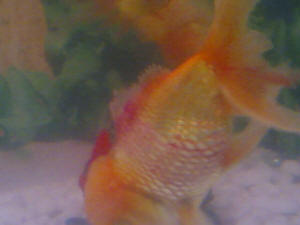
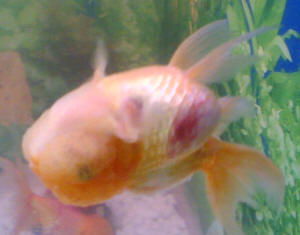
Goldfish.> also just see my goldfish photo <Very very sick
goldfish. Some have Finrot (severe) and some have dropsy. Those
fish are going to die. They aren't "wounded" as you
seem to think, but infected. Obviously VERY POOR water quality.
Without knowing more, I had to assume you have TOO MANY fish in
TOO SMALL an aquarium WITHOUT ENOUGH filtration. Cheers,
Neale.>
|
|
Re: Goldfish lice
5/20/07 Sorry for not telling you thank you. <That's
OK.> Actually I am very much upset with my goldfish and also
my medical entrance exam just finished. <Ah, you are a medic,
eh? I better keep things simple then.> I am really sorry.
<Don't worry.> You said that all my fishes are going to
die. <Unless things improve, yes.> Pls can't we do
something to save them. <Many, many things. Currently they are
showing a variety of symptoms indicating toxic water conditions.
What we need here is the "toxicology" report, if this
was a medical case. In other words, the pH, temperature, ammonia,
and nitrite (NO2-). When fish get sick, these 4 things are almost
always the underlying causes.> They eat their food properly
and also roam here and there. Pls. <This is good, and goldfish
have very strong recuperative abilities. In fact, fish are
amazingly good at repairing physical damage. Piranha fish are
famous for re-growing entire muscle blocks, even where they are
bitten down to the bone. Anyway, assuming water conditions are
optimal, and you use the correct treatment for the *opportunistic
infections* your goldfish have (apparently Finrot and possibly
fungus), your goldfish will recover quickly.> I have also
referred the article on malnutrition. But I wanted to ask that my
inverted goldfish does not eat. So can I catch it with my hands
make it straight and then feed it. <Don't bother. Fish can
survive for weeks without food, and goldfish for months. In
England they survive under the ice, not eating anything, for 2-3
months at a time. Fish are not "warm blooded" so do not
need a constant supply of food. (As you probably recall from
physiology class, a LARGE percentage of the food we eat goes
straight into homeostasis, in particular keeping our body warm.
Cold-blooded animals like fish don't have this constant
expenditure, and can do without food for VERY long periods and
not come to harm. In fact, feeding fish too much is more of a
problem than not feeding them enough. Anyway, force feeding a
fish will stress it, and make things worse.> I have a 55
gallon water tank which has 8 goldfish and 1 small black moor.
<OK. That's a perfect size aquarium for goldfish. Is this
where the sick goldfish live? Or in some other, smaller
aquarium?> Also I change my half water daily. All the ammonia
and nitrates level are under control. <When you say
"under control" what do you mean? Ammonia and NITRITE
must me ZERO. NITRATE can be anything up to 50-100 mg/l for
goldfish, though the lower the better.> Pls save my fishes
<We can certainly try. But your fish must be treated for the
Finrot (caused by Aeromonas and Pseudomonas spp. bacteria). There
are good commercial treatments for this, like eSHa 2000.
Antibiotic or antibacterial drugs may work, but I can't give
advice on those. Once the bacterial infection is cured, the fish
will heal. BUT, you must also ensure that aquarium conditions are
optimal: NO LESS than 20 gallons for a goldfish tank; pH 7.0-7.5;
temperature 15-24C; hardness "hard"; NH3 and NO2- at
ZERO; NO3- at (ideally) less than 50 mg/l.> and once again
thank you for the useful advice which you are giving us.
<Well, I hope this helps. Good luck! Neale>
|
  |
Goldfish lice 6/3/07 thank
you for all ur efforts which u hv shown towards me. <No
problems.> but my that inverted fish died yesterday. she was lion
head. <Too bad. Not surprised though.> now my all fishes are fine
and are healthy. their dropsy also got over. if I introduce 2 new
fishes then will it be ok. will there be any harm <Whoa there!
You've lost some fish. Time to let things settle down. Do water
tests. Wait a few weeks to see if the other fish STAY healthy. You take
things slow. Make sure the water quality has stabilized. Make sure the
ammonia and nitrites stay at zero week in, week out. Make sure all the
other fish are healthy. Look out for things like Whitespot and fungus
and Finrot. After a couple of months, if everything is fine, you can
add one more fish. Then wait again for another few weeks. Then add
another. All aquaria have a "carrying capacity" set by things
like filtration. When you go above that level, the fish die. When the
number of fishes drops down, the tank *seems* okay again. You add more
fish, and it goes over the carrying capacity, and more fish die. So if
you have a 10 gallon tank with 5 fish, and then 2 die, it doesn't
always mean you should add 2 more fish. Sometimes it means your fish
tank can only hold 3 fish. Bottom line, leave things alone for now.
Only add new fish after a couple of months when you are 100% sure the
tank is stable and you have the space/filtration for additional fish.
Cheers, Neale>
A Tale of" two gold fish
problems 5/14/07 Hello everyone!! <Howdy> I have
been reading your site for a while and have emailed in a few times,
LOVE THE SITE!! and I'm back again with more gold fish questions.
These fish, although my favorite, have hands down been the hardest to
level out. I have a 55gal tropical tank, and not to say it came without
obstacles, but now is leveled out and the fish are all doing great.
Anywho....back to the goldies... I'm going to include pictures this
time. pictures will include: the 2 goldfish I'm having problems
with, Pictures of the tank (mostly to show the filters), Ammonia test
results, 5 in 1 Mardel test strip results, liquid nitrite and nitrate
test results. (I'm including these to prove I'm not nuts and
I'm reading my tests correctly hehe) As you'll see in my
pictures the levels are fine (ammonia 0, nitrite 0, nitrate 20-40ppm)
<Do keep this last below 20 ppm... weakens the fish...> Temp 72F
First is the Calico Fantail, he is listless, he sits in that spot for
hours at a time and moves around much less then he sits in that spot,
he is showing no signs on the out side of disease. <Mmm, the
listless behavior is a sign of disease> He is a larger fish, and
color seems to be good, that picture is of him is right after a small
feeding, he ate a little but not much. I Feed them a small amount of
flake food and sinking pellets. <Mmm, do check out the FAQs files,
article/s on goldfish care, feeding on WWM... this may be a
contributing factor here> Occasionally I cook up peas and shell them
one at a time and feed them the inside of the peas. All the reading I
have done indicates that this is a diet or temp problem, hoping for
your insight and advice. <Is environmental (the nitrates) and likely
nutritional as you state...> Second is my Black Oranda. He has a
large white spot on his tail, I could not really get the picture too
clear because he kept moving, but it is not a spot that is external or
raised, it is a faded spot, you can see through it, it looks like a
drop of bleach landed on his tail and all the color was lost in that
one spot. Is this fin rot or anything else to be concerned about??
<Mmm, no... Very likely simply a pinched fin ray that is
healing...> When I first got him his fins were really stout and
erect all the time, now they seem to be getting more limp, and his
dorsal fin which was always erect at the store and when I first got
him, now is always kind of folded, not clinched, just limp and folded.
<The same "causes" as above> I think it is important to
note that this tank has been set up for 2 weeks, and started up with a
product called Turbo Start (similar to bio Spira, <Uh, no...>
which I know you guys back the heck out of, but the LFS said they got
more consistent results with turbo start, subsequently they stopped
carrying Bio Spira and picked up TS) also I transferred Half the gravel
from their old tank (a 45gal tall) and put their old filter on the 75,
you'll see in the pics a bio wheel hanging off the side of the
tank, that was the old filter which had been cycled. <Good move>
The LFS said with Turbo Start, not to touch the tank for a month and
only add water that had evaporated, this seems silly to me, it seems
like the water is what contains the crap you don't want, and the
filters hold all the good stuff, so why would I not water change??
<Perhaps the logic is not to "upset" the new nitrifying
microbes...> none the less, I have been listening to them and I have
been really itching to do a water change, think I should??? <I would
be testing your water for ammonia, nitrite... but if it were me/mine
and I had more than at most 20 ppm of nitrate, I would be changing
water and more... Reading, doing what you can/want to to permanently
disallow its accumulation. Again... see WWM re...> I always write
you guys long a** emails, sorry about that. <No worries> thanks
for any help you can provide! take care guys! --Robb <The indices,
search tool... Bob Fenner>
| Oranda, bumps/pimples on Wen
5/14/07 Hello there, <Hi> First I would like to thank you
all for running such a fantastic website. I am a
frequent visitor and the site proves to be very
informational. <Ah, good> A couple months ago, my
female Oranda came down with some fin rot while I was on
vacation. Happily, the area "burned" and is
now in the process of growing back. My pair spawned
afterwards and now we have six fry (lowly number due to "bad
aim" by the female). <Mmmm, practice makes something...>
Now, the same Oranda who had problems a few months back seems to
have some sort of Wen fungus. That's my guess at
least (please see attached pictures). I have now been
treating the aquarium with API's Triple Sulfa. It is
difficult for me to determine if she is in fact getting better
because I haven't been able to conclude definitely that it is
fungus or what the process of healing is. There is also
what appears to be a cottony blob located on one of her back
fins. To me, this has reaffirmed the fungus diagnosis.
<Mmm, not to worry... not atypical growth here... not
pathogenic> Please advise as to what you feel this ailment is
and what the best plan of attack may be. Thanks a million, Brian
<Continue with good maintenance, feeding and all should be fine.
Bob Fenner> |
|
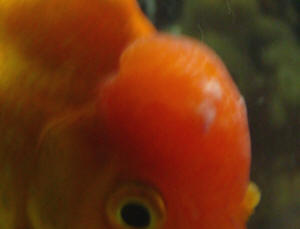
|
| Help EMERGENCY!!! Poor set-up, maintenance... FW
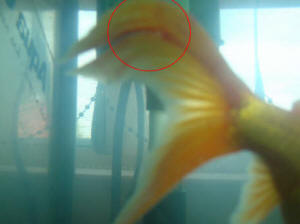
dis., env./infectious 5/14/07 I have attached 3
images I have two fish and in the photos I have circled the point
where the problem is, their tails are starting to rip and
developing some white stuff what should I do? I previously had red
sword fish which developed this problem and died so can you please
help me before these fish die? <Greetings. The immediate problem
is Finrot, which can be cured using any one of various commercial
medications. However, the cause of the Finrot is almost certainly
poor water quality. Check the ammonia or nitrite levels in the
aquarium and also the pH. Goldfish need zero ammonia and zero
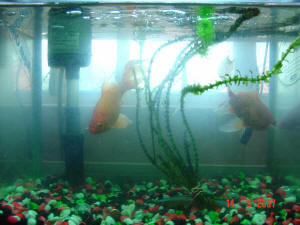
nitrite, and a pH of 7.0-7.5. Your photos seem to suggest a small
aquarium with cloudy water, suggesting inadequate filtration.
Goldfish need a big tank (30 gallons minimum) with a filter that
provides at least 5-6 times to volume of the tank in turnover per
hour. This is slightly *more* than small tropical fish, which is
one reason goldfish are *more* demanding than, say, guppies and
Danios. Big weekly water changes are essential, at least 50% per
week. Have a read of this: http://www.wetwebmedia.com/FWSubWebIndex/gldfshsystems.htm Cheers,
Neale> |
| Re: Help EMERGENCY!!! Goldfish... ?
Neale... better, amended, re-used titles, PLEASE!
5/15/07 my fish tank is 22L and has a filter running at 400L/H
I'm sure that's enough? <In theory the filter should be
fine. But 22 litres is nothing. I have buckets that hold that much
water. Are you sure you don't mean 22 GALLONS? If really 22
litres -- that's far too small for goldfish. Goldfish need
something not less than 100 litres (~30 US gallons), and ideally
substantially more. As for the filter, a 400 litre per hour filter
would be less than I'd recommend for a 100 litre / 30 US gallon
tank. The problem is goldfish are [a] big, so they eat a lot; and
[b] messy, meaning they root about the bottom kicking up sediment
into the water which clogs the filter media. So you need something
like a 600 litre per hour filter for a 100 litre tank to give you
enough flow of water to compensate for the messiness of these fish.
(In other words, the filter processes the water 6 times per hour, 6
x 100 = 600.) Otherwise, the water will constantly be cloudy and
chances are the water quality not that great either. Small tropical
fish (Neons and guppies) can work with a filter having turnover of
just 4 x volume of the water per hour, but marines need as much as
10 x the volume per hour. Goldfish, big catfish, cichlids, and so
on are somewhere between the two.> I recently bought this new
fish tank because they were crowded in my little tank, I have cared
for these fish since they were on 5cm long <Cool! Goldfish are
lovely animals, and it's great when people bond with them and
take good care of them. I'm sure they appreciate it. Good luck!
Neale> sorry about this extra one, the seaweed was moved from
the red sword fish tank and it has been aprox 2
weeks 5/15/07 <Sorry, what's this
about? Neale> |
|
|
Confused with stringy white poop
answers and questions, Goldfish sys./hlth., fdg.
5/12/07 Hi WWM crew, <Greetings.> I currently own 2 fantail
goldfish, 1 being 4" long; YJ and the other 1 1/2" long;
Brandy, both excluding the tail. I have had YJ for over a year now and
she is doing wonderfully well (i.e.: extremely active and always
begging for food =) She even puts up with me petting her whenever I
feed her). She used to live in a small tank on her own and 2 months
ago, when I decided to get her a bigger tank, I also decided to get her
a friend (Brandy). <Goldfish are indeed sociable, and respond
positively to having tankmates of their own kind as well as affection
from their owners.> They both live in a 10 gallon tank (which
I've now found out is not big enough, after reading your website).
<Indeed. Realistically, you want something 30 gallons plus. Goldfish
routinely reach around 25-30 cm in length, and at that size need more
swimming space than 10 or 20 gallon tanks provide.> I use an
under-gravel filter. <Which is fine, provided you maintain it
properly, specifically give it a good stir with a rod of some sort each
couple of weeks and then siphon out the gunk along with the water. Do a
50% water change weekly.> I currently don't do any checks on the
nitrate/ ammonia etc levels as I wasn't told to when I first got
the tank and still have no idea how to go about this. Will this
seriously effect their quality of life? <Long term/short term? Short
term you'll probably be fine. Lots of people manage to keep fish
without test kits. But in the long term, being able to monitor things
like pH and nitrite is very, VERY helpful when things go wrong. 90% of
problems with fish come down to the wrong water chemistry or poor water
quality. Even things caused by obvious pathogens (like Whitespot/Ick)
are usually provoked by changes (declines) in water quality. If
you're cheap like me, go buy the dip-stick test kits. Here in the
UK they're around 10 pounds for 25 tests. But better yet, you can
slice them down the middle with a scalpel or scissors and make twice as
many tests! Each one has colour pads indicating multiple tests
including water chemistry ones and water quality ones. While not as
accurate as traditional test kits, their price/convenience factor is
very high.> I do 1/4 tank water changes every 1 1/2 to 2 weeks.
<Not enough. Do twice as much, weekly. While you might see this as
more work, in the long term it massively reduces the hassle factor by
helping keep the aquarium cleaner and the fish healthier than
otherwise.> When I first got Brandy, I assumed it was a female as it
was quite round and heavy in the belly although I am not very sure of
this anymore. <Sexing goldfish is essentially impossible until they
start spawning. Swelling in the belly by females and the appearances of
"tubercles" on the head of the males are the clues.> This
is because a couple of weeks ago, to my surprise and delight, YJ
spawned! =) So now I'm assuming that Brandy is in fact a male,
which YJ knew from the start although he was too young to do anything
about it. <Not quite sure this is how it works. Are you sure the
eggs aren't snail eggs? Very common mistake. Fish eggs are small
things about 1 mm across and laid separately usually on leaves. Snail
eggs are in lumps of jelly and form small masses around 5-10 mm long
and often appear on the glass. Anyway, fish don't usually release
eggs unless actively spawning with a male. With goldfish, which spawn
first when between 2-4 year old, courtship is very vigorous and
difficult to ignore. Much chasing and splashing!> My main question
is, however, is if Brandy has internal parasites. Just today, I noticed
that there was white stringy poop on the bottom of the tank (and
I'm assuming it's from Brandy as the thickness of the poop is
rather thin, compared to YJ's, whose poop is usually thicker).
<Probably fine. Internal parasites are far less common than people
think. The best sign of parasites is rapid emaciation, that is, however
much the fish eats, it gets thinner. Differences in the texture of the
faeces are more about dietary factors than parasites.> The thing is,
I've searched your website for answers to this question and I'm
starting to get a little confused as to what it could be as most of the
responses say that it MAY be internal parasites, although not
necessarily. I'm also starting to think that maybe Brandy isn't
round and heavy in the belly but bloated due to the internal parasites?
<Fancy goldfish are notoriously difficult to diagnose in this regard
because they have such mutated shapes. The deformities bred into them
make it difficult to tell "normal" from "abnormal"
body shape. If a fish is loaded with internal (gut) parasites such as
worms, the body cavity will be swollen but typically the fish will also
lose swimming ability too. This may be deliberate on the part of the
parasite, since it "wants" the fish to be eaten by a predator
so the parasite can make its way into the next host in its life cycle.
If your fish is swimming and feeding normally, then chances are it is
fine.> Both of them seem fine and are eating well. I feed them JBL
Goldperls and some thawed peas every time I do a water change. <Try
varying the diet a little more. Goldfish are omnivores and respond
positively to as mixed diet as possible. Lean towards plant material,
and use meaty foods sparingly. I'd suggest a ratio of 4 parts plant
food to one part animal (or flake) food. Floating plants are a
convenient way to start here, using things like Elodea. Skip feeding
them once or twice a week and the goldfish will nibble contentedly on
this stuff. Because these foods are low protein but high fibre, they
"fill up" the goldfish nicely, keeping its guts nice and
clean. Goldfish are essentially similar to humans in dietary needs,
more veggies, less meat being the key to good health. You can raid your
salad bowl for goldfish food, too. Most anything green leafy is good
for them. Have a read of this: http://www.wetwebmedia.com/FWSubWebIndex/gldfshmalnut.htm
> I'm very concerned about them, although this may seem like a
small matter to others as I've grown very attached to both of them
and I don't want them to be sick, not even slightly. <An
excellent attitude!> Your help and advice is very much appreciated.
Sincerely, Phylicia <Cheers, Neale>
Goldfish mouth problem
5/10/07 Hello, <Laura> We
have two goldfish, who have always seemed healthy and are about two
years old. However, one of them has recently developed a
problem with his mouth. He rarely opens it and when he does
he doesn't open it as wide as he used to. He is eating,
though not nearly as much as before, and is still
active. There don't seem to be any marks on him and the
other fish is fine. <Mmm, there are some
(unfortunately) developmental/genetic disorders that express themselves
as this...> We've spoken to our vets and they
don't seem to know anything about this kind of
problem. Please advise! Thank you,
Laura and Ruth. <Well, there is always a chance of
spontaneous remission, or that the fish has damaged its mouth and that
it will heal... Perhaps smaller pellets and softer/smooshed food like
cooked peas will be easier for this fish to ingest. Bob Fenner>
Re: Goldfish mouth problem 5/10/07 Thank you, we will
try mushing his food up smaller. Laura and Ruth <Real
good. BobF>
Fancy Fantail, dis.,
env. 5/10/07 Hi Mr. Fenner <Susie>
I have a 30 gallon tank with 4 goldfish.
I am very meticulous in changing water and keeping ammonia
at 0 and ph in the comfortable range for my goldfish. I also
test for Nitrate and Nitrite and my water testing shows none
of each. I am having a problem with my Fancy
Fantail. He has developed Finrot on his dorsal fin. As well
as some small blood streaks on his rear fins. I
have treated him with tetracycline and have also tried
MelaFix in combination with PimaFix. Nothing seems to be
working to stop the Finrot. I have been able to get the
Septicemia to go away. I don't know what to do anymore.
He is my 1st goldfish... He is almost 2 yrs old. He eats
great looks beautiful... and is very active. Just the one
spot on the fin right in the middle!!!! Please help me. I've
tried everything!!!! Susie <Mmm... likely there are other
chemical (accumulations) at play here... that aren't measurable as
ammonia et al... If there is someway to move the mal-affected fish to
other, larger quarters, this would be best... Otherwise "stepping
up" the rate of water changes, using activated carbon in the
filter flow path, perhaps administering a bit of aquarium salt (Please
read here re: http://www.wetwebmedia.com/FWSubWebIndex/saltusefaqs.htm) is
what I would do... Not antibiotic or "Fix" fixable. Bob
Fenner>
Need help on calico, using WWM
5/8/07 SOOO here's the deal. I can't register on your
website to use the forums and I've checked online for the little
problem I have. I just started a new aquarium. The water levels are
normal: Ammonia .25 (that is safe right?) <Mmm, no... any
registerable quantity is toxic, stressful... the more, the worse>
Alkaline normal Ph 7.5 to 8 <This is a bit high> Nitrite and
Nitrate 0 same with chlorine. I feed my fish omega one fish flakes. ( I
plan on adding other dietary foods ex lettuce peas etc.) The plants I
have are Anacharis and red wodobiga or something like
that. And I have a total of 5 fish, <In how large a
volume?> 2 black moor, a red and black Oranda, a bottom feeder (I
think its a plecostomus...) and the problem fish, the RED CALICO. So,
now that the intro's over, here's my problem. All the other
fish are acting normal. Floating around doing there thing you know.
THEN my red calico just goes crazy sometimes and on one occasion
attempted to jump out of the water. He seldom goes into the middle of
the tank and usually hugs the glass. He goes up and down and stuff. I
don't know if you know my e-mail. It's XXXX.com. If you can
render any assistance I would be MUCH obliged. If any is needed.
<Much to relate... and all that is necessary you can find by
self-direction. Start reading here: http://www.wetwebmedia.com/FWSubWebIndex/gldfshsystems.htm
and on to the linked files above. Bob Fenner>
Goldfish - Septicemia, Possible Swim
Bladder, Bending U-Shaped 5/7/07 Fish is a
7-year-old Comet. Of my all fish (4 Comets, 2 Fantails, 1
Pleco), Fish has always been the largest and most delicate one. The
past 6 months, I have dealt with septicemia twice. <This is a
condition... most often related to something/s amiss in the
environment... Akin to "colds" in humans... many
causes...> None of the other fish are effected. Fish has
always been the plow horse in the tank and often had his nose scraped
by gravel. For the past 6 months I have been trying to heal
his nose which will lose flesh and start turning dark red before the
septicemia sets in. I have treated him with Maracyn 2 both
times. Now, the raw nose and septicemia have returned. He is
back in the hospital tank but with new symptoms. Along with
the nose and bloody tail streaking, he is having trouble with his
balance. As he swims, he often wobbles like he is about to
flip over, and sometimes does. Today, his body has started
taking on a U-shape and sometimes he swims in a circle and acts like he
can't straighten his body. I have him in the 10 gallon hospital
tank with Maracyn 2, aquarium salt and a heater at 75
degrees. I have also purchased MelaFix to use on his nose. I
plan on a 50% water change tonight and will add Epson <Epsom...
magnesium sulfate... not the printer co.> Salts. I am
just all torn up about Fish and don't know what else I can do for
him. It breaks my heart to see him looking so miserable.
Dolores <Your treatment regimen reads as okay... but you supply no
useful data re the system, maint., water quality tests, foods and
feeding... Please read here: http://www.wetwebmedia.com/FWSubWebIndex/gldfshsystems.htm
and the linked files above. Very likely the root of the troubles here
are a mix of environment and nutrition... Bob Fenner> Re:
Goldfish - Septicemia, Possible Swim Bladder, Bending U-Shaped
Thank you for your response. Fish passed peacefully a couple
hours ago. <Sorry for the loss... please do refer where you were
referred to... for the sake of your other livestock.
BobF>
please help.. Youngster,
goldfish 5/7/07 Hi please can you help me I found
you on the net but I could not find what I was looking for my goldfish
is swimming on its side and looks like it is going to die I have had it
for about 4 month I have always had fish and this has never happened
before if you could tell me what to do I would be very very grateful
please help me
thank
you
yours
Sarah <... Need much more information Sarah... Please start reading
here: http://www.wetwebmedia.com/FWSubWebIndex/gldfshsystems.htm
and the linked files above... What sort of system do you have this fish
in? What re maintenance, water quality, foods, feeding... You need to
read, and soon... time, as usual, is of essence. Bob
Fenner>
Shall I kill or let die?
Goldfish hlth. -- 5/5/07 Dear crew, <Hello!>
I've lost a Pearlscale from dropsy. It was hard on us, and we tried
everything you mentioned in your article. I've learned a lot from
that disease and changed their feeding completely (according to your
guidelines). I now have a 55 gallons tank with 4 gold fish. All
testings are normal. <Please define "normal". Most fish
sickness is caused by poor water quality and/or the wrong water
chemistry. Dropsy especially is a symptom not a disease (like a fever
in humans) and can be caused by all sorts of different things. So,
what's the pH and hardness? What are the nitrate and nitrite
levels? What sort of filter are you using? With goldfish being so
messy, you want a filter providing turnover at least 5-6 times the
volume of the tank, i.e., in your case a filter with a turnover around
250-300 gallons per hour. Anything less is unlikely to remove the
ammonia fast enough, resulting in chronically poor water quality and
eventually sick fish.> Our uranasocope is now bloated, sinks at the
bottom and is tilted on the side. <Not good. Do bear in mind that
all, repeat all, fancy goldfish are bred to look a certain way rather
than for hardiness. Invariably, the more extreme the variety of
goldfish, the less robust it is. The best goldfish (in terms of
hardiness) are ones only slightly different to their wild ancestors,
such as comets. In other words, if the aquarium isn't perfectly
maintained, fancy goldfish are "delicate" animals likely to
become sick.> I've placed him in an hospital tank with Epsom
salt and feed him small amount of peas. I hate watching him die slowly,
as it looks like he is agonizing. <It's hard to know if he's
dying without any context. If he's unwell because of the wrong
diet, he may recover. If the tank has the wrong water chemistry or poor
water quality, then he's being poisoned to death, and isn't
otherwise "sick". So, first reflect on the conditions of the
aquarium, then try and diagnose the problem, and only when it is clear
the problem is unsolvable do you consider euthanasia. Anything else is
just laziness. Far too often people kill "sick" fish so they
can go buy new ones instead of trying to fix the problems in the tank.
I guess because goldfish cost next to nothing, so replacing them is
cheaper than buying another filter, upgrading the tank, dosing with
medication, etc. May be cheaper, but it isn't nice to kill animals
for no reason.> Do fish hurt? <Yes. Until fairly recently it was
assumed not, because they lack the "pain" nerves mammals
have. However, work by Lynne Sneddon at the University of Liverpool has
demonstrated that fish respond to certain things in a way analogous to
pain, even if not precisely the same thing. For example, if an acid is
(temporarily) put in the lips, the fish will avoid biting or chewing
things, in exactly the same way humans will not put weight on a twisted
ankle. In other words, fish feel damage and avoid things that make it
worse.> Would it be better to sacrifice him and if yes, what is the
more humane way of doing it. <It is only ever best to destroy an
animal when it is quite clear that there is no hope. As said above,
this isn't an excuse to get rid of a problem fish so you can go buy
another. Make 100% sure that the problem is a disease that cannot be
cured, and not, for example, a problem with the way you are keeping the
fish. The reality is that destroying a fish is something that need only
ever be done very, very rarely. For specific details either see here:
http://www.wetwebmedia.com/euthanasiafaqs.htm or else contact
your local animal welfare charity or veterinarian. Destroying large
fish, such as adult goldfish, is not easy, and done clumsily causes a
great deal of stress on the poor fish.> We buried the other one in
the garden. It helped my daughter who is putting flowers on the grave.
<For all children, learning about the cycle of life and death is
important. However, do bear in mind the natural lifespan of a goldfish
is something like 20 years, and many specimens reach more than 30
years. A fish that only lives a year or two will almost always have
died because of something the aquarist did (or failed to do) rather
than "natural causes". While I think it is nice that you and
your daughter show this sort of affection towards your fish, it's
also important for children to learn that animals aren't toys and
they aren't living cartoon characters or even little people with
fins instead of feet. What matters is children learn that animals place
demands on their keepers -- whether aquarists, farmers, scientists,
park rangers or whoever -- and that satisfying those needs is very,
very important.> Sadly, Carole <Good luck! Neale>
Re: Shall I kill or let die? -- 05/07/07 Thank you
Neil for your response. <Hello Carole.> I guess that I wanted to
keep the e-mail short, but do not think that we do not want to try
everything, or that we'll rush to buy another fish. We had
'Billy' for 6 months (now 2 inches), but he lived in a small 10
gallons with 4 other fish (10 inches total) until 3 weeks ago. <10
gallons is far too small for goldfish. To be honest, I don't think
goldfish are good indoor fish. They need a big tank and lots of
filtration, and really aren't ideal "beginners" fish.>
I've bought a 55 gallons Jebo, which I paid $700 to make sure that
the water quality was perfect. <Sounds expensive!> I don't
know the filtration rate, need to look it up. <Should be on the
packaging, on the filter itself, or on the pump inside the filter.>
It has 2 large bacterial filters with ceramic pellets, an activated
charcoal filter and one to remove ammonia, which was recommended for
the first 2 months by the salesperson. <Both of dubious value to the
aquarist but very useful for fish product manufacturers, as they are
extremely good at extracting money from inexperienced aquarists. You
don't need either, and I'd strongly recommend throwing both of
them out. Ammonia remover will be overwhelmed with goldfish unless
you're using literally kilogrammes of the stuff. Carbon is simply a
waste of money in almost all freshwater aquaria; far better to do 50%
water changes that will not only removed the dissolved organics the
carbon removes but also remove nitrate and phosphate, improving fish
health and reducing algae growth.> I do partial water change weekly
(treated to remove chlorine), but did every 2-3 days initially.
<Sounds just about perfect. With goldfish, 50% per week is a good
baseline water change regimen.> I keep the T0 constant at 75C.
Introduced 2 fish for a week than the other 2. I've tested the ph,
nitrites, nitrate and ammonia. ph is 7.5, all others read
0 and have been reading 0 since the new tank got started 3
weeks ago. <OK, zero nitrate, nitrite, and ammonia are all good. The
pH is just about perfect for goldfish, but the temperature is way too
high. Switch the heater off, and let the fish warm up in summer and
cool down in winter naturally.> I've also added 'Cycle'
which contains good bacteria, and add some weekly. <I'm rather
dubious about "Cycle" -- and in a mature aquarium it is
almost certainly a waste of money. But if you have money to burn, then
it certainly won't do any harm.> I've been feeding my fish
your recommended diet for a month now (mainly fresh veggie and brine
shrimp), but made the mistake at the beginning to give my fish the dry
pellets, until the first fish got sick and I found your web site.
<This happens. Sadly, standard flake food just isn't as good for
many fish as you'd imagine, but then humans eating just Cheerios
wouldn't be that healthy either, whatever the "nutritional
balance" on the box suggests. When keeping fish, just as when
feeding children, your maxim should be a little of everything but in
moderation. Goldfish are omnivores in the wild feeding primarily on
algae, decaying plant material, and small invertebrates in the mud. Try
and replicate that in the aquaria, and you're halfway to success
already.> I think that I followed all your instructions by the book.
So I'm a little discouraged and don't know what else to do.
<Almost always, stepping back and applying logic helps. Your tank is
too warm, so fix that. Your filter contains rubbish you don't need,
so remove that and replace with something that supports biological
filtration, such as filter wool or ceramic "hoops". I
don't know your precise water management routine, but certainly
skipping the Cycle product in favour of weekly 50% water changes will
help a lot. A 55 gallon tank is about the ideal for goldfish when kept
indoors, but if the worst happens and Billy succumbs, then my honest
advice is to step away from the "really fancy" goldfish and
go for the hardier, less inbred varieties like comets, Shubunkins, and
even the plain vanilla goldfish. Goldfish are wonderful animals in
their way: they can be trained and are easy to feed from your fingers
(though make sure you/the kids wash your hands afterwards because there
is a small, but real, salmonella risk). A goldfish tank was my first
experience keeping aquatic life, and that morphed into a science at
school, a marine zoology degree, a PhD, and then a career writing (in
part) about fish. So teaching kids about aquatic animals and how they
work is potentially very valuable and a great intro to the science we
call Biology.> Thanks for the info on euthanasia. I'll try to
nurse Billy, just hard to seem him suffer. <Good luck (to you
both).> Very attached, Carole <Cheers, Neale>
Re: Shall I kill or let die? -- 05/07/07 Thank you so
much for such valuable advices. I really appreciate the
fact that you are taking the time to write so many details.
<Not a problem, and thanks for the thanks!> You must be
very passionate about your work. Sadly, Billy passed away
today. I was expecting it, as he didn't want to eat this
morning. <Too bad. I'm sorry.> After debating the
euthanasia issue at home, we decided to let nature takes it
course. We buried him today in the garden, next to Bouboule
(French name for fatty), close to my favorite rose bushes. <Cue the
"Circle of Life" from the Lion King movie...> So today,
more testing. I never tested the hardness. The dh is low,
around 5. Should I treat it? <Goldfish like a little more hardness
than this. The easiest approach would be to use some Lake Malawi or
Lake Tanganyikan salts, but at a 25-50% dosage. You can buy these salts
from good aquarium shops. Alternatively you can add some calcareous
material to the aquarium (e.g. coral sand) or to the filter. Finally,
you can even using ordinary baking soda, at a dosage of a 2-5 teaspoons
/ 40 litres (you'll need to do a water test to get the exact level
you want. I'd recommend pH 7.2-7.5, hardness 10-15 dH). NOTE:
"tonic salt" and "aquarium salt" do not harden the
water, and should not be used.> I'm a bit mixed up with KH
or alkalinity. <In this instance, don't worry about
them. Harden the water as suggested above, and the rest will take care
of itself.> That tests reveals a level of 50 which suggests acidity
and is not good. Should be closer to 80. When I
do the ph (from Nutrafin bottle kit). I get a result around
7.5. I've tried using our pool kit strips to compare.
That also reveals a low ph and low alkalinity (closer to
KH results). Maybe that is the problem. I
don't know which test to trust. <No idea which test kits to say
is "best" as all have margins of error. Question: are you
using softened water? Or is your local water naturally soft? If you
have softened water in your house, use the unsoftened water
instead.> Suggestions? As for the filters, I have the filter wool
(does that need cleaning/rinsing, how often?) <Cleaning,
yes, in buckets of aquarium water. Replace 30-50% of the wool every few
months, when impossible to clean.> ...and bio-filter (ceramic
hoops). <Good.> I will get rid of the ammonia and
charcoal filters, wasn't very expensive. <Good.> I guess the
best is to do 50% water change weekly. I'll stick to this from now
on (was only doing about 20%, but will go up to 50%).
<Agreed. Changing water is so inexpensive, and if you're doing
20% or 50%, the amount of extra work is minimal. Some people do 90%
water changes and get good results!> I don't have any heater,
but T0 is always around 72-74F, what can I do to
cool it? Should I add cooler water with the water change? <Goldfish
quite like cool water, but don't do massive temperature changes,
just a few degrees at a time. If the tank is warm because it is in a
warm room, then don't worry too much. The fish will be fine,
provided the aquarium is not overstocked.> I usually tried to add
the fresh water at the same T as the tank. <A good plan.> I use
the vacuum cleaner that you connect directly to the tap to
fill the tank. Is that a problem? (difficult for me to lift bucket
of water). <If the cleaner is pumping in water straight
from the tap, yes, this is a problem. The chlorine is not removed, and
chlorine is harmful to fish (it burns them).> I pre-treat the
aquarium water first, than add tap water. <I see the logic to this,
but it isn't the ideal approach. The best approach is the
dechlorinate the water fish, and then add it to the tank. If lifting
buckets is difficult, you could do this: Take water from the tap into a
large (5 gallon) bucket. Dechlorinate. Use an electric pump to pump the
water into the aquarium. Such pumps are called powerheads, cost ~$20
for a small one from the aquarium shop.> Thanks for answering all
questions and for your utmost dedication, Carole----- PS: I'm
French speaking, so there could be English mistakes. <No problem,
and much better than my French, limited to buying vegetables and asking
the way to the Post Office. Cheers, Neale>
| Shubunkin with raised discoloration
-- 5/5/07 First off: I promise I've searched the
internet and your website prior to sending this. <Very good.>
All issues pertaining to 'discoloration' with the word
'goldfish' on the page usually say 'this is normal if
it is not raised or depressed' then proceed to not explain what
raised/depressed discolorations might mean! Oh the frustration.
Anyway... <Hmm...> I have a 55 gallon tank, residents of
which are: a 4" Pleco, a 5" Oranda, the 8"
Shubunkin, and a relatively new arrival (been in for a month)
4" blood red parrot cichlid. (all sizes estimated) <A very
odd selection of fish. As you know the Plec and the cichlid need
tropical conditions (25C), whereas the goldfish wants cooler water,
ideally around room temperature or slightly less (~15-18C). Parrot
cichlids are hybrid cichlids and tend to be rather unpredictable in
terms of behaviour, but certainly have the potential to be
extremely aggressive, whereas goldfish are mild, sociable animals
that are stressed when kept with aggressive tankmates.> My 3
year old Shubunkin has developed a raised, discolored area behind
his right gill (pictures attached--any spots other than the large
orangish one are actually on the sides of the tank). <Looks like
a bruise, in other words, a slight swelling caused by physical
damage. Should heal by itself over time, but ensure water quality
is excellent to reduce the risk of secondary infections.>
Observation of all other fish shows they are 'fine'.
<Define "fine". The water temperature at the very
least is definitely un-fine for either the goldfish or the
cichlid/catfish.> The Shubunkin is lively, interested in eating
and in all other ways acting normal--but I just noticed this
development about 40 minutes ago, so this may change. <Sounds as
if he bumped into something. Usually happens when fish are alarmed
and swim away from what they perceive as danger. Very common when
peaceful fish are kept with aggressive or territorial tankmates.
Can also happen when fish are kept nearby slamming doors, noisy
TVs, and other things that can alarm them.> We had a rash of
dropsy earlier this year, which I fervently hope is unrelated.
<Please understand this: dropsy isn't a disease, it's a
symptom, so you can't have an epidemic of it, any more than you
can have an epidemic of twisted ankles. Dropsy is caused by
problems in the aquarium that prevent the internal organs (usually)
of the fish from working properly. Gross overstocking, poor water
quality, the wrong water chemistry, etc. all can lead to dropsy. In
other words, if you have five fish die from dropsy, it doesn't
mean the "dropsy germ" snuck into the tank and carried
off your livestock; it means you failed to keep your fish healthy.
One case of dropsy in five or ten years of fishkeeping is bad luck
and happens to the best of us. A bunch of cases of dropsy all at
the same time isn't bad luck but bad fishkeeping.> Dropsy
seems to have gone away after too many aquatic deaths and a
complete drain, strip, rinse, remove, etc.. 5 hour ordeal with the
55 gallon tank. <Why on Earth did you break down the aquarium?
Doing this was at best a colossal waste of time, and at worst
destroyed some of the filter bacteria reducing the effectiveness of
the biological filter. When fish get sick you should do the
following: [a] check water quality and chemistry and [b] try and
identify any other possible causative factors. Always bear in mind
that water quality and water chemistry trump everything else, so
lots of diseases (such as Finrot and fungus) are provoked into
happening because of poor water quality, rather than happening out
of the blue by themselves.> If I can provide any other
information that may be of use, please let me know. I don't
feel like losing another wonderful fishy this year. <Let's
have the pH, hardness, nitrate, and nitrite levels. Also the
temperature, and what sort of filter you are using. For these big,
messy fish you need a filter with a turnover around 5-6 times the
volume of the tank, i.e., around 250-300 gallons per hour. You
should also be doing 50% water changes per week. Goldfish and plecs
are notoriously messy fish.> Thank you <No probs. Cheers,
Neale> |
|
|
Goldfish... hlth... no
useful info... not reading, spellchecking...
5/5/07 Hi there, This is my first time coming across
<?> your website and I really hope you can help me out. I have
already called the local pet stores and the vet is closed. One of my
goldfish (3-4 Years old) seems to be sick and I was wondering if there
was anything to help him. My goldfish had problems in the past and has
over come them, he now has a bloody lip and it appears to be swollen
making it hard for him to eat or breath. His lip and body has skin
flaking off and peeling. He has lost a lot of his color and at the tips
of all his fins it looks almost burnt. His fin on the top of his body
is almost gone also left with a black looking outskirt. I attempted
taking photos and didn't get a real good one but I will send it
attached to this e mail as you may be able to see some of what I am
talking about. Thanks in advance!!! Rose <...? What re the system,
maintenance, foods/feeding, water quality tests? Please read here:
http://wetwebmedia.com/FWSubWebIndex/gldfshsystems.htm
and the linked files above. BobF, not the Amazing
Kreskin>
Fancy Goldfish problems...
iatrogenic, env. 5/5/07 Hi, <Hello
there> About a month ago I purchased a 10x10x18 inch aquarium, with
a internal sponge filter, some gravel at the bottom and a couple of
plastic plants. We got one fantail goldfish, about 2"
long including the tail, which was doing very well. A week
ago (so roughly three weeks after we bought two more fish - a redcap
and an orange and white goldfish. <... this is too small a
volume...> Two days after we got them, the redcap
started sitting on the bottom with it's fins looking lifeless.
<Environmental... nitrogenous et al. poisoning> I 20% water
change for a few days. The following day it was gasping at
the top and I went to the pet shop and they gave me Myxazin <...>
and advised I should position the filter to make more ripples, which
I've done. After a day or two of gasping at the top, the
redcap spent another couple of days sitting on the bottom. I
went back to the pet shop after work and bought a water test kit,
<For?> aquarium salt and some Interpet "Disease
safe". Unfortunately, by the time I was home, the
redcap was dead. <... killed> That was yesterday - now we've
got two fish. I carried out a water test <...?> and
everything seems to me to be fairly normal - general hardness 180;
carbonate hardness 240, ph 7.0, nitrite 1ppm, <Toxic> nitrate
20ppm. <As well> The problem is that the original
goldfish is starting to display a few signs that are worrying
me. He's still swimming around, but is spending a lot of
time at the surface gasping, OR in his little hiding place a the back
of the aquarium, behind a plant. He normally likes to swim
around with his friend, but he seems to be spending more time on his
own. I've also noticed that the silver circle around his
eyes have little black marks in the middle. The problem is,
I don't know if I am being paranoid and these marks have been there
all the time. What should I do? Should I administer some of
the disease safe? Or the aquarium salt? Or should
I wait and see what happens for a while? Or is there
anything else I can do? Thanks very much, Kevin <Have just skipped
down. Read here: http://wetwebmedia.com/FWSubWebIndex/gldfshsystems.htm
and the linked files above. BobF>
Possible Furunculosis
5/5/07 Hi Guys, Well I starting doing my 25% water
changes with reverse osmosis water. We bought it buy <by> the
gallon. We do have an RO system , but haven't had it installed yet.
<? Easy to do...> My remaining baseball sized Ryukin didn't
eat for 2 weeks, seemed to be in a trance and just sat gasping at the
surface. He was following exactly the symptoms of the 2 dead Orandas.
He had a lump on his tail which burst open into a huge red ulcer. Then
he bloated up to the point that his scales were starting to stick out.
I added Epsom Salts and in four days the bloat went down. Then since he
hadn't eaten in so long, I mashed up some peas and added a few
soaked Spectrum pellets and used a syringe to force feed him. After a
few days he seemed to snap out of it and became really hungry and swam
normally and acts fine. But!!!! That massive ulcer is still there, a
fierce red deep ulcer and his tail fins sometimes get red streaks then
the streaks go away. Ammonia 0 nitrites0 ph 7 nitrates still at 20.
<More water changes...> Should I move him to a hospital tank and
treat him with something? <Given?> That ulcer really bothers me.
He loves peas and I'm feeding Spectrum very lightly. I really think
he has an infection. Thanks. Linda <I would carry on...
BobF>
My 5 year old Comet just
"peed"! -- 5/4/07 Hello, <Hi there> I have a Comet
that is almost full grown (about 8") <Actually... depending on
how measured... get about twice this length> and has had external
and internal parasites (think the internal are still there) fungal
growths and bacteria problems. For all the problems the poor little guy
has had, this is a first - and I know it isn't possible so
what's going on - I just saw him pee! <Mmm, do this all the
time> Dark, not quite dry blood colored, and trailing out his rectum
in several swirly bursts! <Yikes...> Please tell me the parasites
aren't that bad! We just dosed him for them and we thought he was
doing so much better! <What parasites?> His eyes are finally
clear, the worms aren't hanging off him <Lernaea?> and the
only other thing we can't seem to get rid of are the red streaks on
his tail - which he's had for three years - <This is
environmental...> and for the last couple days he's' been
hanging out in the same corner - not quite on the bottom - and
twitching every so often (the man in the house swears he twitches like
that to stay afloat when he's not swimming, but it doesn't seem
right to me...) like a quick short jerk to the left. the pee really
concerns me though. I can't find anything about it anywhere online
- other than fish don't actually pee, but I know that! - and there
aren't any other goldfish in the tank with him (just a few Mountain
Minnows and Danios - the occasional eating of which we assume is where
the intestinal friends came from). I like Phil and I
don't want to have to bury him! What's up and what should I do?
Thanks!! <Mmm, where to start? Goldfish Systems? Disease? Please
read here: http://wetwebmedia.com/FWSubWebIndex/gldfshdisease.htm
If/when you write back, please provide useful information re
the system, maint., foods/feeding, water quality tests...
BobF>
Goldfish Help....Sick -- 5/4/07
Hi, I've had my goldfish fancytail- Goldie- for 9 years. She was
doing great up to a month ago. I have treated the tank with Fungus
Clear and now Ampicillin. What is going on is that Goldie is on the
bottom of the tank will eat, <What?> and swim around on her side
(not a lot). Will stand up right with help... and then just fall over.
She has not swam up to the top of the tank in awhile, or even half way
up. There is a sore that is red and swollen on the left side that is
about 1/4 to1/2 an inch round. The same side that she lays on. She
looks like she needs a sling. I thought that she had swim bladder or
fish bloat or Dropsy. The tank # are all normal. Now heck if
I know.... What is it, and what can I do about it?
Thank-you, for your Help! Amy <Mmm... could be a few
things at play here... likely a bit of environment and nutrition...
coupled with age in captive conditions... You proffer no useful
information re system, maint., water quality tests... Please read here:
http://wetwebmedia.com/FWSubWebIndex/gldfshmalnut.htm and the
linked files above. Bob Fenner>
Goldfish, env. dis.
5/2/07 My adult daughter bought 2 "feeder" goldfish,
which she put in a tiny 1 gallon tank. <Much too little volume...
unsustainable> They are about 1 1/2 -2 inches long, one orange, one
silver. They could hardly swim in that tank... They were unhappy, but
eating... the orange fish kept wigging out and flailing
around the bowl. It's gills and top of it's head were turning
black. I finally felt for them and have temporarily put them in a 10
gallon tank, <Better, but will still need more room than this...>
until the daughter gets set up in her new home. I kept the water fairly
clean, and fed them 2 X a day... now the fins are turning black.
It's actually rather lovely, but I don't think it's
supposed to do that. The silver one tries to comfort the orange and
keep him calm...almost trapping it in a corner when it flails around,
then floats just under it or side by side...this seems to help, but the
black is spreading. The silver fish is fine. If I wasn't such a
softy, I'd flush the darn .15 cent things!!! What do I do?
<Please read here: http://www.wetwebmedia.com/FWSubWebIndex/gldfshsystems.htm
and the linked files above. Bob Fenner>
|
|
New Print and
eBook on Amazon
Goldfish Success
What it takes to keep goldfish healthy long-term
by Robert (Bob) Fenner
|
|
|

