|
|
| Home | Marine Aquariums |
Freshwater Aquariums |
Planted Aquariums |
Brackish Systems |
Ponds,
lakes & fountains |
Turtles & Amphibians |
Aquatic Business |
Aquatic Science |
Ask the WWM Crew a Question |
| Please visit our Sponsors | ||||
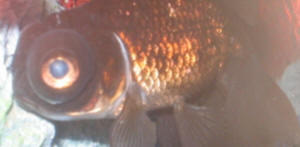
I need your assistance... GF, no useful data... READING 3/30/08 Hello, I need some help with my Black Moor fish. It seems that he's getting sick. He was with a fantail goldfish who passed away last week with the bloating condition (the fantail goldfish was placed in a sick tank prior to his passing so it wasn't dead in the same bowl). <.......> It looks like he's gotten some red marks on the gills, and a little of cloudiness around the tops of his eyes. I thought it was Ick so I put a solution that will aid him, <...> and get rid of that. I just don't know what to do about the red gills, he does eat (I feed him once a day), he usually swims in the morning and at night he usually tends to move the rocks very strongly, but at times he does stay at the bottom of his fish bowl. Any suggestions? Enclosed is a before picture and two present pictures. thank you very much for your time. Jackie Padilla <... what re the system, maintenance, water quality... tests? Foods/feeding... a bowl? You wrote us w/o reading... Start here: http://wetwebmedia.com/FWSubWebIndex/gldfshsystems.htm and the linked files above. Bob Fenner>
Goldfish issue - fused mouth? FAQ 3/26/08 Hi Guys... I am stumped! I rescued a couple goldfish from a wedding centerpiece several months ago. They had been doing well, growing and seemingly happy, or so I thought. <Nice work.> A couple weeks ago, or more, I noticed one fish, the larger one (3", they are still small) was not eating. At this time I also noticed that he would not open his mouth. During feeding, he would swim up to the food, attempt to eat, and it would simply bounce off his mouth. He wouldn't, or couldn't, open his mouth to eat it. I tried several flaked foods, peas, spinach, and some medicated food. All with the same results. The fish has begun to shrink in size, and now at times he appears a little lethargic - but all in all he is still active, just not as much so. I have not noticed him going to the bathroom either. <Going to the bathroom? You mean defecating I assume. I have visions of your pet fish sitting on the loo flipping through golfing magazines.> I pulled him up out of the tank after reading a post on Koivet, to see if I could take a look into his mouth. I could not get him to open his mouth as I pulled him up out of the water. I did notice at this time two things. 1) there was no discernable line where his lower and upper jaw meets, and it seems to be sealed with a light, milky colored skin. 2) I noticed a small slit on the underside of his lower jaw that seems to open when he is pulling water into his gills. Not sure if this is pertinent, but I noticed it. <Quite possibly Mouth Fungus; certainly worth treating proactively with suitable medication. Mouth Fungus is of course a bacterial infection not a fungal infection. Maracyn Plus or eSHa 2000 should do the trick.> At this time I thought he may have a fungal or bacterial infection, and began treating the water with Mela and pima - fix. I have not noticed a change and I am 5 days into the treatment. <Because neither have much efficacy against bacterial infections. Indeed, many would say that neither are much good at anything.> My tank is 28 gallons with two small goldies. I have a filter, 2 airstones, and a heater that kicks on to keep the water temperature between 65-67 degrees. My levels are good, my water is and has always been pretty good. I did have a slight ammonia spike last month, but quickly resolved this. My PH is a touch low, maybe, at around 6.0, although I think this is acceptable. <It's not; Goldfish like nice hard and basic water. Think what you'd do for livebearers or Mbuna: that's what Goldfish want. So find a way to raise the carbonate hardness, and the pH should go upwards as well. Don't go dumping "pH up" products in the water UNLESS you modify the carbonate hardness as well.> I have now moved the afflicted fish to a hospital tank, and all water checks out okay there as well. <I'd leave 'em together to be honest. Whatever the issue is, it isn't likely to be contagious. Moreover, Goldfish like company. I'd keep them together and treat the entire tank.> These are not my first fish and I have seen a multitude of problems, but this is confusing. It appears like his mouth is fused shut. Searching the web, the only info I could find was on cutting the fishes mouth open. This is something that is a little troubling to me! <Indeed. Surgery on fish is very tricky. I'd sooner you try force feeding first. A small plastic pipette can be used to push a mixture of water and flake into the gullet of the fish. Use the pipette to wiggle the jaws open gentle. You could also use plastic forceps of suitable size. The main thing is to work gently, and to always keep your hands as well as the fish wet. You can also push water through the gills forwards, and that *should* force the mouth open. This is a trick used to separate mouthbrooding fish from their fry and is much less alarming than it sounds!> Any info would be great, I'm not sure if you have ever seen something like this, but it is upsetting, because he really wants to eat, but can't, or won't. Thanks a bunch for any help! Mick <Cheers, Neale.> What is best treatment for flukes in goldfish? 3/26/08 Hello, I was wondering what your recommendations are for treating body flukes in goldfish at least I think that's what they are. I have noticed from time to time that my goldfish will quickly rub themselves on aquarium decorations. <This could be a variety of things, not just flukes. Whitespot/Ick often manifests itself as scratching behaviour. Rapid changes in pH will also cause this behaviour. So you need to be a bit more open minded, or at least look for other symptoms that might pin down the problem> At one time I put in Live Bearer by Aquarium Products and that seemed to stop their behavior, but unfortunately I can't find it anymore in the local pet stores. <Do see here: http://www.wetwebmedia.com/FWSubWebIndex/gldfshdisease.htm > I mainly want something that I can use as a preventative and not have to take out the carbon in my filter, etc. <Treating with a "preventative" is counter productive, and says more about how we sometimes view healthcare than what is actually useful. Most medications cause some degree of stress or harm to fish, and in some cases some fish simply get killed by them (loaches and copper-based medication is the classic example). So you need to use medications only when absolutely necessary. Instead focus on REAL preventative medicine, i.e., quarantining new livestock, providing a balanced diet, and ensuring good water quality. As for removing carbon, you need to replace carbon every month for it to do any good, so removing it for treatment purposes shouldn't be a chore. I don't feel that carbon serves ANY useful purpose in a freshwater tank; 50% weekly water changes will do a much better job of removing those pesky dissolved organics, and will also keep the nitrate down and prevent pH swings! Just say NO to carbon!> Thanks Sharon <Cheers, Neale.> Sick Fancytail... no reading... Jewel Is Not Felling Well... Been Mick Jaggered, silver daggered... -- 03/20/08 Hi! I have a silver fancy-tail goldfish. Recently, she seems to be feeling sick. She has lost some scales on both sides of her body. <Bad> The skin underneath is white. My water is often slightly low on pH but I have boosted it back up. <...? How?> The water quality in my 38 gallon tank is usually great and it is well maintained. <?> She has been in the tank with the same fish for about two years. I do not know about the salt percentage - <... but not our instructions before writing us... Am not a fan of salting goldfish> I just follow the directions on the container. I have Quick Cure, <Toxic> Melafix, <Worthless> Antibacterial food pellets, and Neomycin gel on hand (I have attempted to treat a separate fancy-tail with acute swim-bladder disease in a ten gallon tank). What all will help the silver fancy-tail and what products can I use together? I am also willing to buy anything that she may need. Thanks so much! I <... Read here: http://wetwebmedia.com/FWSubWebIndex/goldfish101art.htm and the linked files above. Bob Fenner>
Ick in an uncycled tank, Oranda treated with heat and salt. acidity in water. Iatrogenic troubles, reading 03/16/08 FW Daily? <? all are posted> Hello. First, thank you for your website, which I have perused many times over the last 2 years while getting interested in keeping fish. I have mainly been interested in the cold water section, as my parents have a pond and I have been helping them with their Shubunkin issues. My interest in their fish led me to get really interested in aquatic life in general, particularly in goldfish. <Ahh!> Now to my current issue which concerns my new fish, and temporary tank. I am building a 55 gallon tank for them next week when I get paid. Last week on Friday, I bought 2 x >1.5" Orandas and placed in a 20L tank with filter (un-primed, but dosed with Stress-Zyme) <Mmmm, this won't work... the system needs to be cycled> and an air-stone, and thermometer. The filter has a heater, so I switched it to minimum (18C), for a stable temp <Good> (it can get cold in our house at night). They were acclimatised to the temp for one hour in the bag and then I mixed tank water into the bag three times over the next hour, then released them (with the water which I now regret). I added dissolved rock salt to 0.1ppm, to help them settle down. I kept the tank light off until day 2. Their daily routine is (and has been since): curtains open, 30 minutes before tank light which is on for 8 hours, then tank light off while room light on for an hour, then room light off; and darkness until morning. I didn't feed until following day and gave them cucumber. Next day, a part of a pea, next day a blanched leaf of romaine lettuce and dried blood-worm, next day some dried Nori which I soaked first. I noticed red-cap fish flashing against the airline tube on the 2nd day. The other is an orange Oranda. From the outset, I checked parameters 3 times a day (pH, ammonia, nitrite, salt level, occasionally checking nitrate). Their water was always conditioned with dechloraminator at water-change time (and upon the first tank-fill). I changed 25% per day. On the 4th day I started to see ammonia, so I did PWC partial water change, and added a drop of ammo-lock. <This is only a temporary fix...> I used Stress-Zyme to help prime the filter. <Won't do this> The red-cap was flashing still. I was still feeding lightly with greens as above, including blanched spinach. Back to the 3rd day, I was shocked to see my red-cap covered in white spots. I Googled, diagnosed Ich, and Googled some more. I added more salt up to 0.2ppm. <Not an effective cure...> The feeding continued, very lightly, with different greens. On 4th day, added more salt up to 0.3ppm and increased the temperature slowly. Following days; I kept up with parameter tests, increasing temperature until 29C over two days. The water was going more and more acid, down to between 6.5/7.0 (my tap water comes out at 7.5). I also noticed fluctuation in temperature, so bought a second heater, and installed it too. I set it to 29.5C, <!> and bought another thermometer. The temp in the tank was stable at 30C on the thermometers and the salinity was stable at 0.3ppm. Both fish seemed fine, no gasping for oxygen, I was watching them day-in, day-out. Plenty of aeration, filter making a waterfall, bubbles breaking the surface well. On the 5th day, the infected fish started losing its spots, and on the 7th they were all gone (so I am timing 70 hours until I turn the heat down gradually, or earlier if necessary, or later if possible). Also, the few black coloured ammonia burns that only the red-cap had, started to go away. Both their appetites are great, they try to eat my fingers when I put them on the surface. <A good sign> The water was beginning to smell a bit rich, I thought it must be the heat. Not bad smelling, but rich. Organic and a bit fishy. Some slight foaming around the tank corners. Last night (day 8), the pH was down to 6 (yellow on test card) with only another 2 days to go before I start to lower the heat over a period of days. So I tried not to panic, and decided to do an immediate PWC. I looked at my change-water, already heated to the correct temperature and matched in salinity, and decided to throw it, and get some fresh. The reason being, I used the hot tap to fill it, and let it cool rather than use the cold tap, just for convenience. I panicked that the carbonates were being depleted with this method, <You are wise here> and I didn't want to add more acid water, or rather water which wouldn't buffer. So, I mixed fresh cold and warm water together, aware that I should err on the side of caution with pH, and added the salt as before, and heat, and dechlored it. Meanwhile, still panicking, I thought I would add the tiniest pinch of bicarb, premixed with a little water. Well, I tested the tank 5 minutes later and the result was a little more green, but still green-yellow 6.5. This could have been a whole .5 raise, and of course I felt terrible that I could have altered it too much, too fast. I kept the lights dimmed in the room the whole time to keep the fish calm. But I think I saw one of them go upside down in the bubble stream (the orange one who didn't get the Ich). The red-cap seemed fine. I regret adding it, because I read afterwards on the net, that goldfish will tolerate a pH down to 6 if it was gradual, but on the other hand, I heard that Orandas were more sensitive than other goldfish. I learned about panicking after I did this. I kept the lights dimmed, but sat and watched for a while. Only the orange fish was acting abnormally, although I could have been imagining it. It seemed to be dazed, and rather than resting, it was just glass-staring and going to the corner and back, and repeating. The red-cap seemed fine, perusing the gravel looking for things, like he does at night, in dim light. After a while, I put a bit more light on and approached the tank. They were both full of life, and excited to see me. I talked to them a while, then checked the temperature of my change-over water. It was matched, so I did a 25% change, checked the pH again, it was still green-yellow 6.5. <No worries> My plan for the next day (now this morning), was to do 4 or 5 small small water changes throughout the day. I want to reduce any DOC (concerned about the smell and acids) and get any poop from the bottom before it goes acid. I will continue with this the following days, and see if the pH rises any. Otherwise, it must be my DeChlor, or ammo-remover, or bio-load turning the water acid. I was leaning toward ammo-lock and bio-load. The fish will have to fast until I've worked it out. This morning at 8 am, checked the pH and its more orange-yellow!!! I panic again. I don't think under 6 is going to be good for my fish. I added the tiniest pinch of bicarb this time, more diluted in filtered water, and dripped half the mix in the water, then a 25% water change too. I added some activated carbon but there is no room in my filter because I put a lot of filter wool in it, so I placed 3 pieces in the various currents in the tank. It then occurred to me to flush the filter media with temperature-matched salinity-matched dechlored water. Having done that into a waste bucket, I now know where most of the problem was coming from. There was a green leaf salad and waste in there (the Nori, and possibly bits of cucumber, and green poo), so I flushed it out of the media, and replaced the filter. The foaming on the water has reduced, as has the smell. Just more water changes today are planned and panic over, I'm sure. I also stood by with the net, because my fish were pooing spinach like machines. Any more pH rises when I change water should be gentle with smaller / more frequent water changes, and any acids in the water are now minimised I hope - wouldn't you say? <Mmm, no... see below> The carbonates in the water won't be eaten so quickly too, but I don't want the pH to get too far back to neutral until the ammonia phase is over. An hour later (now), tested for ammonia and it was up to 0.25. <... toxic...> My change-water Isn't heated yet, so added a drop of ammo-lock. Not worried too much as the pH is still 6.5. ; then dosed the filter with Stress-Zyme. In another hour, will do a 25% change, and test the ammonia and pH. if the pH is still 6.5, I will do another 25% (or less) a bit later ??, and remove the carbon. Update: have done the above water change, pH 6.5, ammonia between 0 and 0.25 - slightly green coloured. This is all notes as I've gone along, from about day 5, written up to give to you for help. If you can offer me any advice on how to get through the next days, and help me out with this fear that it's all going to go wrong, I'd really appreciate it. My fish seem perfectly well, I just want them to stay that way. Thanks very much, David. <Troubles... initially... This volume is too small for these fish... it wasn't, isn't cycled... Your reliance on chemical treatments won't work to adjust for nitrogenous accumulation... the Salt... I'd be setting up the 55 gallon, using a bacterial prep. to cycle it stat.! And moving these goldfish ASAP. Bob Fenner> Sick Oranda!! :( No reading...... -- 03/10/08 Hi, <Howzit Damian?> I've searched your FAQ and I can't quite diagnose my Oranda's problem, he is acting very strange! I am a raw newbie to fish keeping, so please excuse my ignorance. <Ignorance is excusable... will gladly help you> He is only brand new, I purchased him yesterday. He is living in a smallish tank <... Goldfish need volume...> with another fish (of which breed I'm not sure, he's black with googly eyes! - similar in size to Oranda, quite large fins - he's much active than the Oranda, especially at the moment!) The water in the tank is slightly murky since the 2 fish were added, <Mmmm, not completely cycled, perhaps not filtered sufficiently> though I do have an AquaOne 100 Clearview hang-on filter attached to the tank, which doesn't seem to be doing much in the way of clearing the water.. <Bingo> My Oranda first starting showing sign of distress when it hovered around the bottom of the tank, a few hours after being introduced to it. (note: they both had a 2 hour car trip from the Aquarium! Might've caused some stress..) The next day I noticed he had some scales missing from his side and was leaning to one side, hiding at the bottom of the tank. I also noticed the left side of his tail is much shorter than his right? I thought the other fish may have attacked it, so I moved him to a small bowl with conditioned water, <...> where he continued to float on his side - still breathing, and occasionally swim around before stopping to slowly lean to his side for a while. He seems a little better, and is sitting upright more often, so I tried moving him back to the main tank, where he quickly retreated to the bottom again to lay on his side! I've moved him back to his little bowl where he seems to be ok - but not 100% Please advise me what I should do! The Aquarium is closed today so I can't purchase a water testing kit, though I will endeavour to tomorrow morning. Thanks! Warm Regards Damian G <Start reading here: http://wetwebmedia.com/FWSubWebIndex/gldfshsystems.htm and the linked files above... Your problems roots are/will become obvious... their solutions, simple. Bob Fenner> Help with goldfish -- 03/10/08 I have two goldfish, I am not sure what kind they are. My two children had gotten about six of them at a school carnival about three or four years ago, some of them died right away and three we alive for awhile then one died, so now we have two. They have been relatively healthy until recently. I keep them in a ten gallon tank and change the water once or twice a month. I used to do total break down of the tank, but stopped and just change some of the water. <Ah, here's part of the problem. The tank is far too small. As the Goldfish grow, they produce more waste, and eventually there gets a tipping point where the tank was adequate but now becomes dangerous. Upgrade to at least a 30 gallon system. Non negotiable. If you don't want to do that, then don't keep Goldfish. Can't be any more clear than that. See here: http://www.wetwebmedia.com/FWSubWebIndex/goldfish101art.htm > We have hard water where we live so I use both tap water with water conditioners and spring water to fill the tank. They have done pretty well with this. <Hard water is fine for Goldfish. Spring water is a waste of your money. Use that money for a bigger tank already!> This week I noticed one of the goldfish started to get some black stuff growing on its fins. I had another goldfish with this before, I did not treat because I was a broke college student, that fish eventually died after it started floating on its side. <Finrot. Look, deciding not to treat and animal because you are too poor is animal cruelty. Period. Your local animal shelter could provide you with assistance here if you really didn't have the $5 to buy Finrot/Fungus treatment. But honestly, I can't be very sympathetic about this -- the cost of medication is minimal, the suffering caused on the fish is huge, and the bad karma incurred on the pet owner substantial! Unless you want to come back as a slug next time, I suggest responding to signs of sickness in your pets quickly!> This fish was in the tank with the two that I have now and these were fine. With this fish I thought it was Ick so I bought some Ick remover. I followed the instructions and the black stuff went away. This morning both of the fish seemed to be breathing heavy and I changed some water and put in more water conditioner. <Hmm... water changes are always a good idea but when fish are breathing heavily but otherwise look fine, the odds are either the water is polluted or too warm. You can check both easily, using a nitrite test kit for the former and a thermometer for the latter.> I also heard about putting baking soda in the water to level the ph so I put in a teaspoon for the ten gallons. <Pointless. Again, stop, save the pennies, and buy a bigger fish tank.> I removed the fish from the tank so that it could settle and now one of the fish is floating on its side and still breathing heavy. I put some peas in the water and it has not done anything. <Why would it? You're doing random things without thinking about what's truly wrong. Have you *done* a nitrite test yet? If not, you're missing one of the key steps to finding out what is wrong with an aquarium. In any case, the problem is the tank is too small.> My kids like these fish and I don't want it to die. What should I do? <Buy a 30 gallon tank together with a decent filter. Problem solved. Nothing NOTHING else is acceptable here. If you decide you don't have space or money for a 30 gallon tank, that's fine -- but you can't keep Goldfish either. It's essential your children learn that keeping animals is a responsibility not just a pleasure. Switch on Animal Planet and watch those shows of people keeping 150 cats locked in a trailer home or feeding their dogs nothing but paper and dirt... cruel, yes, but just the same as keeping Goldfish in a 10 gallon tank. Hope this helps! Cheers, Neale.> Goldfish, env. dis., no reading -- 03/07/08 Hi all, I'm a bit new to fish ownership but have followed the basic rules etc... set up the tank about a week before introducing any fish and then went about slowly stocking my goldfish tank. I have 2 fantail gold fish, a loach and 4 tiny minnows. All was going well until recently when I noticed Dave, my first fantail becoming a bit lethargic. I asked the assistants in the fish department if this was normal they told me it was quite normal for them to rest like that so I thought there was nothing to worry about. But he is starting to move less and less and his fin always seems to be down (its like having a dog that isn't wagging his tail anymore) <A good comparison> I've also started to notice brown marks on the underside of him mainly near his anal spot but also by his chin - I don't really know how to describe it- it looks almost like bruising of some kind. He sometimes floats vertically, but at the moment he is on the bottom of the tank looking very poorly. I thought maybe he had that bladder thing as I have been Googling all night and read about the disease so I haven't fed the usual pellet/flake tonight I have given him peeled peas as suggested by several sources. <Good> I haven't seen him eat anything though - mind you the peas have vanished. Dave and my other fishes live in a BiOrb aquarium and I feed both pellet and flake food and as a treat a little daphnia now and again. <BiOrbs are notorious for being unstable, too small for goldfish of any type> I do a partial water change every week to fortnight use AquaSafe and I never leave the filter in for more that 6 weeks at a time. I really don't know what else to do... the water is clean, I feed 6-8 small pellets and a small pinch of flake, the tank has 3 live plants. Dave is fab and I'm really worried he wont make it to the morning now, please help PS also I think my Loach my have mould, he has small patch of fine whispy white attached to him which I noticed this evening while desperately willing Dave to start swimming about again. How is this treated and how can I confirm if my suspicions are correct? <... environmental... Need larger quarters. Read here: http://wetwebmedia.com/FWSubWebIndex/gldfshsystems.htm and the linked files above. Bob Fenner> Sick goldfish, CAEs - 3/5/08 Hi, I have a question and wondering if you can help. I have a big goldfish that is 4+ years old. We got him at a carnival. He lives in a 20 gallon tank with two mollies and an algae eater. He has been sick for over a week. Usually I can get him better, but this time looks bad. He has been swimming upside down and sideways, and now his eye is bloody and clouded. He is also missing scales. I'm thinking maybe the other fish "picked on him" when he was sick? Now he is laying on his side at the bottom of his "sick tank". He is barely moving. Is there anything I can do? thanks Rachel <Hello Rachel. First, tell me what the "Algae Eater" is. The common or Chinese Algae Eater (Gyrinocheilus aymonieri) is a fish that becomes increasingly aggressive with age. Adults often attack their tankmates, and many specimens have been observed to scrape the scales and skin from slow moving fish. They are simply not acceptable tankmates for community fish. I'm concerned because the missing scales could easily be caused by this. In any case, whatever you do, you will need to do the following: - Check water quality (a 20 gallon tank is too small for Goldfish once they get above about 8 cm/3", so I'm guessing that's at least one factor). - Use a combination Finrot/Fungus medication such as Maracyn or eSHa 2000. When you use medications, be sure and remove carbon from the filter if you've been suckered into using this stuff. Do read the article linked below for more Goldfish basics; if you're not doing everything outlined therein, that's probably where you're going wrong. http://www.wetwebmedia.com/FWSubWebIndex/goldfish101art.htm Cheers, Neale.> Black Moor problems 3/5/08 About a month ago I purchased a Black Moor. He's been really healthy, swims around a lot and eats fine. Two days ago I noticed that his left eye was looking strange and a little discolored. The next day I went to feed him and his eye was gone. He seemed a little sluggish at the time, but now he seems to be back to normal. I'm worried now because his other eye is starting to look like what happened to the left one. I've cleaned the tank water, filter and the gravel 3 times, and I check the water temperature regularly. If you could let me know what's happening with him, and what I could do to help him I would really appreciate it. <Hello Alison. Lost eyes are usually caused by either water quality problems or physical damage. Since Goldfish don't have teeth in their mouths, they can't bite eyes off one another (not that they'd do that anyway) but certain predatory tropical fish, including cichlids and characins have been known to do so. Sharp rocks and clumsy handling by the fishkeeper can also damage the eye, allowing infections to set in. If you don't treat with a suitable antibacterial or antibiotic, the eye will turn septic and die. But it is much more likely that water quality is the issue. I only say that because the vast majority of Goldfish are kept in quarters entirely unsuitable to their needs in terms of size, filtration, and water chemistry. Please read the article linked below, and if there's something you want to discuss, get in touch. http://www.wetwebmedia.com/FWSubWebIndex/goldfish101art.htm Cheers, Neale.> Ick problems with goldfish 3/5/08 Hello, I have a fantail goldfish that got Ich about a week ago and I have been treating her with Maracide using the directions on the bottle. She did not appear to get any better after the week the bottle advised for treatment, so I bought a heater after reading a website that suggested to do so and also got pure NaCl to create a .3% salt solution in the tank. I have the heater set on about 81 degrees, and I was wondering how long it will take for the Ich to all die, and especially wondering if there is anything I am doing wrong? Thank you, Lindsay <Lindsay, do make sure you have removed carbon from the filter. A very common mistake people make is to leave carbon in the filter, and this simply absorbs any medication before it does any good. You don't really need carbon anyway, so you may as well leave it out completely. Do also remember it takes a while to work: the medication *doesn't* kill the visible parasites on the fish, but the next generation parasites they produce once they leave the host. In a coldwater tank this can take a good couple of weeks. Heating the water speeds things up, and you should see results within 3-5 days. If these aren't the issues here, get back in touch. Cheers, Neale.> Growth on Tango Jasoshi's (?!) Tail :( Goldfish hlth. 3/5/08 Hiya guys! have emailed you before concerning my regular old goldfish (that's all they were called at the pet store!) one orange, one yellow. After months of fighting which I think, turned out to be mating, (?!) I separated my fish for fear the orange one would eventually be eaten! Sadly, after all that trauma, I've noticed a little growth developing on the orange one's tail. I had noticed what appeared to be bubbles on or in his tail, but thought nothing more of it. Now, after months of them being there, they seem to have multiplied to form a pinkish-clearish blob on his tail fin. It doesn't seem to be causing him any real discomfort but how can you tell with a fish?! I had a fish with a growth before and he died :( Please help! What could this be and how can I treat it? thanks in advance! Chloe <Hi Chloe. Not quite enough to go on here, but in any event I'd be treating with a broad anti-Finrot/anti-Fungus medication. I happen to like eSHa 2000 which is good value and seems to work well against a variety of infections. Do remember to remove any carbon (if present) from your filter. Goldfish don't really fight, though they do chase one another rather strenuously if feeling the 'joys of spring'. Make sure the tank is big enough for them, and take care to [a] remove anything sharp or scratchy; and [b] provide some nice plastic plants the females can use as hiding places. Cheers, Neale.> Black Spot on Lionhead goldfish face 03/04/2008 Hi Guys, I am writing post death event to find out if I need to do some preventative something for the rest of my fish. I had a great little Lionhead goldfish, maybe 2 inches including tail. Yesterday he was swimming around and eating normally, though I did not take a really close look at him. This morning I got up and he was floating at the top of the tank....not upside down, just hanging there. At first I thought he was just chillin' but he was actually dead. We have had him for 2 years (very sad). I pulled him out of the tank and saw that he had a black spot on his cheek. It sort of looked like a boil or blister, pretty small (but huge for a tiny fish), maybe an 8th of an inch across or slightly smaller, raised up and rough looking but not red. His eyes were darker than normal sort of like he had been punched in the eyes, also strange black lines around them, almost like traceries on the skull bone lines. His lateral lines were the same weird black color and he had a few small spots of black on his tail. I would have taken a photo, but he was so small it wouldn't have shown up with our equipment. <A photo would have helped. The things described here are somewhat inconclusive. Tiny black spots on Goldfish are typically caused by flukes that, once they mature, cannot complete their life cycle in the aquarium and die off. Blisters can be caused by a variety of things, but typically secondary bacterial infections, much like ulcers. In any case, when fish die unexpectedly, it's important to check the water chemistry and water quality. Even if they are normally fine, certain things can cause sudden changes, and the first thing you might now about them is sick/dead livestock.> Our tank is pretty big, approx 35 gallon, and there were 5 goldfish in it, all under 3 inches. We feed them mainly fresh food from our kitchen, peas, greens etc and blood worms every once in a while. One of our fish has chronic swim bladder disease and if we feed him processed food he becomes very uncomfortable. My husband cleans and conditions the water quite often and there is a good filtration system (filter stuff changed last week). I don't know what the pH is yet but will be testing that later. <Very good: Goldfish are sensitive to pH changes, especially acidification; over time tanks become acidic anyway, and as fish grow they produce more metabolic wastes and these speed up the rate of acidification. So even if the pH is stable when the fish are young, there can come a time when pH instability becomes an issue. Goldfish need hard water with a basic pH and lots of carbonate hardness; essentially what works for African Lake cichlids works great for Goldfish too.> The only addition to the tank are two grass type plants purchased a week ago today and a relatively new goldfish added about 2 months ago. <Hmm... do check the pH/carbonate hardness: Vallisneria extracts bicarbonate from the water as a substrate for photosynthesis; while a useful trick in the wild, in aquaria this can dramatically alter water chemistry if you don't have a high level of carbonate hardness to compensate.> Essentially I would like to make sure that my other fish don't die of whatever this thing is, because it moved fast. I know for a fact that our fish did not have any discoloration as of Friday night, that he was swimming and eating normally the last two days, and this morning he was dead. Suffice to say I am keeping a very close eye on the rest of our little guys. <Good.> Thanks for all your help, you do a great job. Lily <You're welcome, Neale.> Sick goldfish... and Koi, env. 2/29/08 Dear Bob I had a 15cm Koi and comet in a 1 metre tank. Koi suddenly died for no apparent reason overnight and the comet who was silver started turning pink and the edges of his back and tail seem to have what looks like bleeding veins as though he is bleeding internally. I've had him for 7 years without any problems. Can you please help?? Sincerest and heartfelt thanks Pearl in Australia <Hello Pearl. The problem with the comet is almost certainly Finrot. The symptoms here start with congestion in the veins of the fins as the bacteria set in (that's the pink stuff you see) followed by the tissue dying (goes white) and then eroding (so the fins look ragged). Finrot itself is almost always caused by water quality problems. Perform (at the very least) a nitrite test. Check the filter is working properly, and regardless do two 50% water changes today (a couple hours apart) to flush out some of the pollutants. Stop feeding the fish. Being treating with a reliable anti-Finrot medication (remember to remove carbon if present in the filter). Melafix/Pimafix aren't my recommendation for this, although often sold as such. Use a decent copper-based medication or antibiotic. Koi really aren't indoor fish, and certainly can't be kept in a 1 meter tank -- I'm guessing that's about 180-200 litres/40-50 gallons, which is adequate for Goldfish but not Koi. Koi are simply too sensitive to poor water conditions. Cheers, Neale.> Fantail Goldfish, hlth. rdg. 2/27/08 Hello! I need some help with my sons fantail goldfish. I have little fish knowledge, I leave that up to my husband, but unfortunately he isn't here and my son is having a meltdown. His fantail is very bloated, sometimes left to swim in a vertical position. But I also noticed a large, red, ring around its anus. I of course have no idea what this may be, that's where you come in! Is there anything we can do to save his fish? I'm willing to try anything! Please help if you can! Thank you so much, Katie (and her very concerned 4 year old) <Greetings. Please read the following articles, in particular references to diet and water quality: http://wetwebmedia.com/FWSubWebIndex/gldfshmalnut.htm http://wetwebmedia.com/FWSubWebIndex/goldfish101art.htm Almost certainly one or both of these are the factors relevant to your situation. Yes you can save the fish, provided you follow up the advice given therein. Cheers, Neale.>
My Orandas are sick! -02/25/08 Hi, About three weeks ago I bought two Orandas and two fan tails. About a week and a half one of the Orandas started hanging out on the bottom of the tank. When I took a good look at him he had white spots all over his body and huge white spots on his head. I asked a friend at work who has a lot of fish and he said it was probably Ich. The pet shop agreed and gave me medication to treat the tank. About a week later his condition worsened and we lost him. Now the other Oranda is getting the same problem, I have still been treating the tank for Ich because I cannot find another symptom that matches there problem. Please help me, I would be heart broken to lose any more of my fish. They have become family! What's wrong with my Orandas???? <Greetings. "White spots" covers quite a bit of ground. As well as Ick there is also Velvet; the former looks like salt grains, the second powdered sugar. Patches of dead skin, Finrot, and Fungus can also be white, and Fancy Goldfish are also prone to develop lumps of mucous on their bodies when water conditions go bad. So, first thing to do is run through our handy dandy freshwater disease troubleshooting chart, here: http://www.wetwebmedia.com/FWSubWebIndex/fwdistrbshtart.htm Second, and before you write back, measure (at minimum) the pH and nitrite; most diseases are associated with water conditions, and without this information, we can't offer much help. Goldfish are quite specific in their needs: http://wetwebmedia.com/FWSubWebIndex/goldfish101art.htm Cheers, Neale.> Black Moor, hlth./env., reading... 2/23/08 Hello, I have a black moor that is almost 3 years old. It lives in a 10 gallon tank with another black moor that is 5 years old and has always been very healthy. The water quality is great and both fish seem happy and healthy. As the younger fish grew it had a golden underside but about a year ago it started loosing it's scale and now just has some at the top and kind of looks like it has a mow hawk. It's tail has lost some of its black as well. In the beginning I did everything I could to try to find a solution and even put it in its own 10 gallon tank for a while but no changes. My research on this has come up with nothing. I don't know if this is just a breed of fish or a disease. I have pretty much just given up and accepted that it will always be this way but would like an answer. Got any suggestions? <My prime suggestion would be some proper reading. A ten gallon tank is far to small for even a single Goldfish, let alone two. Your comment that water quality is "fine" doesn't mean much without cold, hard numbers. What's the nitrite concentration? The hardness? The pH? Goldfish need clean water with zero ammonia and nitrite, and the water chemistry must be hard and alkaline (pH 7.5, 10+ degrees dH). Adding salt to the water doesn't help them, and may do harm in the long term. When Goldfish are kept improperly, they are likely to get sick as they get older -- the bigger they get, the more ammonia they produce, and the worse their health becomes. We have plenty of articles on Goldfish here at WWM; I'd recommend you start by reading them. If you're not doing everything described in them, then likely that's where your problems are coming about. Start here: http://wetwebmedia.com/FWSubWebIndex/goldfish101art.htm http://wetwebmedia.com/FWSubWebIndex/gldfshmalnut.htm And then follow the links to other articles. Hope this helps! Cheers, Neale.> Goldfish with intestines on the outside, using WWM 2/21/08 Hey, I recently noticed that my fancy tail goldfish has a few of his intestines on the outside like he might've exploded. <!> He is still alive and swimming fine as well as eating perfectly fine. I don't want to risk taking a picture <Mmm, not much risk, harm...> and causing undo stress, but this doesn't seem like it is good at all. I was just wondering if there is anything that can be done for him, outside of finding a painless way to put him out of his misery.. I assume it's a him, but I'm not sure he hasn't born any fry but I might have both girls. Anyway, I only noticed this today, and he wasn't like this last night. please help! I've never used this site before, so I'm not sure how the responses work. Sincerely, Kami <Time to introduce you to our search tool, indices... Please read here: http://wetwebmedia.com/WWMAdminSubWebIndex/question_page.htm Try it, you'll like it. Bob Fenner> My Oranda fish lost it's eyes -02/20/08 Hi guys, I searched the site but couldn't find my answer. My Oranda fish is the only Oranda in a 55 gallon tank along with 3 goldfish and a Koi. Three weeks ago I noticed one of my Orandas eyes missing and now today another one. I have seen all the fish at one point or another pick at his fins but, HIS EYES? Why do they do this and can he survive like this? Will the others continue to pick at him? So concerned! Thanks Concerned new fish mommy! Have a wonderful day! Jessica <Hello Jessica. Eyes are -- after fins -- the bits on a fish easily damaged by fighting. So the best thing a "concerned fish mom" would do at the first signs of aggression between fish is to separate them so this couldn't happen. It is unusual for goldfish and/or Koi to be aggressive towards one another, but they can be boisterous, and it is ALWAYS recommended that fancy (double-tail) goldfish are kept in different tanks to single-tail goldfish and Koi. In other words: Orandas, moors, Ryukin, etc. should all be kept in different to tanks to plain goldfish, comets, and Shubunkin's. I'm guessing that you didn't do this. If you didn't, you know now! As for therapy: treat with an anti-Finrot/anti-fungus medication first, to prevent a secondary infection. Do also check the water quality, specifically nitrite, to see that there isn't a problem there. It is entirely possible that minor damage (that could have healed) quickly turned bad because of poor water quality. There should be zero ammonia and nitrite in the system. In addition, check water chemistry for the same reasons. Goldfish need hard (10+ degrees dH) and basic (pH 7.5) water conditions. Will the eyes grow back? Obviously not. Can he live without them? Yes, provided he is kept alone. He will navigate using his lateral line and forage for food by touch and olfaction, but the goldfish with eyes will be able to out-compete him at feeding time. The result will be a lot like dinner time at the home of Phineas. Cheers, Neale.>
Poorly goldfish 2/14/08 Hi! Please help! I noticed last week that the edges of my fishes fins had turned black, like a thin, black pencil line around the fin-edge. I kept my eye on it, then, almost overnight, on the tip of the tail fin, the blackness had spread a little into the fin and the tip of the fin frayed. I thought it might be Finrot, but never seen it black before. I immediately did a water change. At this point, my fish was still swimming and feeding well. I also noticed that the bone of his dorsal fin is blacky/red. On his back, towards the top of his body, he has some red marks/spots- almost blood-like. He has definitely not hurt himself though. Today, his fins are clamped- especially the dorsal fin, and he is sat on the bottom of the fish tank. He will swim about when food is on offer, but he is very doddery, he keeps his dorsal fin clamped though. I already have some anti-inner bacterial treatment (No 9) and some Finrot treatment (no 8), but I can't use both together. The rest of my fish are fine (so far). The tail-tip has been frayed and black for about three days now, and no change to it, but the fish itself is out of sorts. I went to the petstore and bought some (no 5), which is 'Liquisil' a general tonic, as recommended by the sales assistant. The PH balance in the water is fine. Which one of those three would it be better to use? Hope you can help. Thanks again, Sasha =) <This is indeed Finrot. Interpet #8 Finrot is one treatment suitable for this illness. Be sure and use precisely as indicated, in particular make sure you [a] use the right dosage and [b] remove any carbon from the filter. You do not need to add salt, general tonic, etc. These things are mostly about pet stores making money. The reason your fish has Finrot has nothing to do with the absence of tonics or salts, but water quality and/or water chemistry. Just to recap: Goldfish need excellent water quality, and they cannot be kept in tanks without filters. A Goldfish in a bowl is a Goldfish doomed to an early death. Minimum is 30 gallons for an adult Goldfish. You need to also check the Nitrite level; almost always when fish get Finrot the problem is poor water quality, specifically ammonia and nitrite in the water. If you can detect either, it means you are [a] overstocked, [b] under-filtering, or [c] over-feeding. Often all three are true. Next up is water chemistry: Goldfish must have hard, alkaline water. There is no such pH as "fine" so that comment doesn't mean anything, and possibly suggests a lack of understanding. What you need to check is that the water has a nice high level of hardness, at least 10 degrees dH, and a carbonate hardness of at least 5 degrees KH. These being so, the pH should be between 7.5 and 8, the optimal range for Goldfish. Please understand adding "pH up" products is pointless if you don't change the hardness of the water as well, and most inexperienced aquarists who buy them have absolutely no idea what they're for. Once you have treated the Finrot and then made sure water chemistry/quality is acceptable, your fish should return to a healthy life; but if you do not correct the water chemistry/quality issues, no amount of treating will help. Cheers, Neale.> Sad Black Moor... no useful info. or reading 2-12-08 Hey I've had a black moor for almost a year, he's in a 40L tank with 2 comets. <... too crowded> He (I say he though I really don't know what sex he is) <Is this of import?> has been a fairly active fish, he moved around alot <No such word...> and only stopped to sleep. I recently had a small fantail die for unknown reasons. <Uhh> I had that fish isolated and have since changed the water and cleaned the tank. <...?> I have had the water levels checked (pH and ammonia) and they are said to be fine. <Need to be checked by you... do change with time, transporting the water sample> This black moor has recently been acting listless, he sits in the corner of the tank, or floats near the top. He does not seem to have any other symptoms except that today I noticed his eyes are slightly cloudy and he kept running into the tank walls. He still eats normally, I feed him fish flakes and peas a few times a week. The two comets are fine. I really don't want to lose this fish. Is there anything you can recommend for me to do for my black moor? Thanks for your time, Sam <That you read. Start here: http://wetwebmedia.com/FWSubWebIndex/gldfshsystems.htm On to the linked files above... Check your nitrates... look into a larger system... Bob Fenner> Trouble diagnosing/treating a goldfish 2/10/08 I have been struggling sometime with one of my Orandas and have decided to give the internet a shot here. I have found a lot of useful information on this website in the past and hope someone may offer some help. If this issue has been addressed on your website before, my most sincere apologies. *Here are my parameters and tank setup.* Ammonia: 0ppm Nitrate: 0ppm Nitrite: 10-20ppm Ph: 7.5-7.6 Water Temp: 74 F <The above are all fine> Alkalinity and calcium not tested, plan on doing so soon. Tap water readings: New Jersey Ammonia - .25 ppm Nitrites- 0ppm Nitrates - less than 5 ppm Ph- 7.5 These parameters have been consistent since my tank recycled after a move in august, in other words consistent from late august-present, I check them each week before I do a 20% water change. These parameters have also been checked daily for the past week and have remained the same. I have a 3 year old 4" telescopic, 3 year old 4.5" Oranda, 2 year old 4.5" Oranda (the sick one), and a 6 month 3.5" Lionhead in a 75 gallon tank. No observed bullying issues. <Good> Filtration: (2) Emperor 280's and 2 penguin 100's. Carbon and Cartridges are changed once a month on a staggered schedule. <Good> Each water change there is a gravel vacuuming, debris is moderate. Water is aged 3-4 days and conditioned. 20% water changes weekly. The fish are fed Hikari Lionhead and Oranda pellets (soaked) and Spirulina flakes every 4th feeding. No bloating/floating/sinking issues. *The symptoms:* Let me begin by stating that this fish, nor any other fish in the tank, have shown any signs of stress, i.e. not bottom sitting, healthy eating habits, no flashing or clamped fins. Also no other fish has shown similar symptoms as this particular fish. This problem has been occurring over the course of the last 4-5 months so I will try and keep the details informative, yet brief. The problem began in late October with a white/grey discoloration over the Wen. I assumed Wen growth, however, the white growth developed a cotton like appearance and a red spot after about 9 days or so, at this point I brought the water up to a .3% salt level. <Mmm, such Wen growths, colors are "typical"... do occur sans disease issues...> Soon after a very distinct red spot/ulcer appeared under the dorsal fin. I began a Medi-gold treatment. I saw a reduction in the ulcer within hours and after a few days the ulcers were gone, along with the cotton growth. After a 21 day Medi-gold treatment the symptoms appeared to be gone. However, soon after being off the meds the grey/white discoloration came back. I went through this 21 treatment again only I quarantined the fish in a 10 gallon tank with a cycled BioWheel and added PimaFix antifungal to the treatment. Once again I saw the symptoms disappear. When I placed the fish back in the tank I continued the Medi-gold for 7 more days, which ended a 28 day treatment. Three days later I noticed the distinct red ulcer under the dorsal fin once again. I fed Medi-gold in the morning and the ulcer (10 hours later) was reduced to a very faint almost nonexistent mark. The most consistent symptom by far has been the white/grey discolorations. These discolorations tend to stay in a particular spot when not under treatment but in between treatments they appear in new places (unlike the ulcers). I have only observed the discoloration on the Wen, however the fish is a vibrant gold and white which would make it hard to observe elsewhere. The best way to describe the patches would be a concentrated area in which the slime coat is thick. I would also like to note that the original red ulcer on the Wen has not returned, however the area has remained a red dot (not ulcerated) among an otherwise orange Wen. Much thanks to anyone that spares the time to read and respond to this. My local fish store (which is an excellent store) tends to turn its nose up when it comes to goldfish. <I do think/believe this grayish area is mostly genetic/expression... and nothing to really treat... Hopefully the fish will outgrow this marking in time. I would not switch, change anything from what you present above. Cheers, Bob Fenner, who also "keeps" fancy goldfish>
Red eye, Goldfish... infection or
genetics? 2/1/08 Wet Web Media Crew. I have a yellow colored
two year old goldfish that has red rings around the pupils of both
eyes. Fish is otherwise healthy along with 12 other fish in an 80 gal
tank. What is causing the red? Bud <Greetings. Almost certainly an
opportunistic bacterial infection or irritation caused by something in
the water, but bloody eyes are also a symptom of Fish TB. Now, Fish TB
is very rare in freshwater aquaria, and almost always goes along with
emaciation. Goldfish are one of the species known to contract Fish TB
which is why I mention it. Anyway, the much more likely issue is
mechanical damage, perhaps caused by rough handling, followed be a
secondary infection. While an 80 gallon tank is a nice size, you
don't say how big those twelve other fish are, and it would not be
impossible for water conditions to be variable or downright poor. So
I'd be checking the nitrite level first, and then also the pH to
see that water chemistry is stable. Goldfish don't like acidic
conditions, and overstocked tanks can be extremely prone to
acidification. Under poor/variable water conditions, secondary
infections become a problem, and that's likely what's happening
here. Cheers, Neale.> <<Might well be just a heritable
characteristic... No worries if so. BobF>> Black spots on goldfish fins
1/29/08 Hi Crew, We recently got my daughter a couple of goldfish
for her birthday, and yes, I have read what you said about fish not
being a good present. It's too late for that, though, and now are
stuck trying to figure out how to take care of the fish. Since then,
I've done a lot of reading up on goldfish, but realize we are still
far from giving them an ideal environment. <Oh...?> We had two
comets until one died; we now have 1 comet and 1 tinfoil barb. They are
still pretty small and live in a 5 gallon tank (I know). <Whoa...
apart from the fact goldfish are big fish and need at least a 30 gallon
tank long term, tinfoil barbs (Barbonymus schwanenfeldii) are just as
large and far more active, as well as being schooling fish. A 55 gallon
tank would be a squeeze, let along a 5 gallon tank.> I did a water
change when the first fish died, and since then, the remaining comet
has developed black marks on its fins. I researched it on the internet,
and it looks like what's described as black smudge, or healing
scars from damage done by ammonia or sharp objects (entirely possible).
My research indicates that scars are a good sign, as the danger has
been removed and the fish is healing. <Hmm... not sure scars are a
*good sign* per se.> However, the black marks seem to be growing
daily and is now starting to show up faintly on the underbelly,
especially near the anal area. The scale quality seems to be going down
as well. I don't think it's scale loss, but it looks sort of
like they're fading or developing pale spots. <Black Spot
Disease is usually caused by Trematode worms. They have a complex life
cycle that can't be completed in the aquarium, so once the black
cysts burst, the next stage of parasite life cycle gets messed up, and
the disease is finished with.> I recently changed the filter and
treated the water for chlorination, but beyond that I'm not sure
what to do. I know you'll tell me to get a bigger tank, and believe
me, I would if hubby would allow it. Is there anything I can do besides
getting a new tank, or should I even be concerned? <Black Spot
Disease is not, by itself, a major problem. The main risk is secondary
infection, because the burst cysts are effectively openings for
bacteria to work their way into the fish. So Finrot, for example, is
one possible problem. An excessively small aquarium -- which yours is
-- definitely magnifies this problem. I cannot stress this strongly
enough: a 5 gallon tank is simply not viable for even one Goldfish, let
alone a Goldfish and a Tinfoil Barb. It's like trying to keep a dog
in a rabbit hutch.> The fish is behaving normally (as far as I can
tell - I don't know much about normal fish behavior); he's a
pretty outgoing little fellow and enjoys human company. He's
energetic and a good eater. <Goldfish are definitely friendly
animals and yes, they do like people. And that's why we should
repay that compliment by giving them good living conditions.> Any
advice is welcome. Thanks! Amy Kesic <Cheers, Neale.> My yellow goldish, hlth. -- 1/28/08 Hello, it looks like my yellow goldfish has a bloated stomach. I've been reading you other post and comments but I can't seem to find the right answer to my question. I haven't changed any food. Please keep in mind, this is the first I every take care of goldfish. What is the difference between being pregnant and having a bloated stomach? <Greetings. The main difference is that Goldfish do not get pregnant. They lay eggs. Most of the time that Goldfish look bloated they have constipation. Commonly caused by people feeding them nothing but Goldfish food. Strange but true -- "Goldfish Food" isn't very good for them! At least, not every day. Best used as a treat once or twice a week. Rest of the time use a plant-based diet as well as high-fibre things like Daphnia. Do read this excellent article on floaty, bloaty Goldfish... http://www.wetwebmedia.com/FWSubWebIndex/gldfshmalnut.htm Cheers, Neale.> Goldfish flashing and bruising (?) despite good water and 5 day Prazi treatment 1/26/08 Hi, I have spent so much time on your website and am vastly more informed than I was at the outset of this saga, but still have an issue with my goldfish that I am hoping against hope you can help me with. I am a new goldfish owner and I have one fantail goldfish in a 30 gallon tank. I was told by the petstore to cycle my tank by letting it sit for one week with BioZyme added daily, which I did. <Mmm, not likely effective... did you measure appreciable ammonia, nitrite, nitrate changes?> I now know this is very inadequate but now I have the fish. I am getting zero readings on ammonia but still some nitrite readings (low but measurable). <Toxic> I have been doing daily 25% water changes (recommended for the worm treatment) so I don't see how the water could be too bad. <Polluted in varying degrees is not healthy> My fish started out with the noticeable symptom of an anchor worm hanging off of him. I was advised to take him out and pull of the anchor worm, which I did, and also treated with Maracide, a medicine that supposedly treats anchor worm. <... does not. Only useful against some Protozoans> About a week later he had another anchor worm. Again I pulled it off of him and treated with Maracide for three days of the five recommended. <...> By this time, Jingles was flashing and missing scales. Right after I removed the second worm I noticed a black spot on his gill, but in front of it, like a bruise. After day three of the Maracide treatment I reached the people at the Goldfish Connection, who told me they thought my fish had flukes (because of the flashing) <Quite possibly> and that Prazi was a good and safe treatment for that. <Yes> By this time, he had black spots on his side were the scales were missing. To me it appears to be bruising (don't know if that's what it is because I obviously have no idea what I'm doing but just describing their appearance). The black patch on his gill has not gotten bigger but no gotten better either (after a week). I am on day 5 of 5 of the Prazi treatment and he is still flashing. I've seen no more evidence of the anchor worm. <May well still be there... need to be treated with an effective arthrocide... Please read here: http://wetwebmedia.com/FWSubWebIndex/fwcrustdisfaqs.htm and the linked file above re Organophosphate Use> He is still eating and I've been feeding him Medi-Gold on the advice of the Goldfish Connection in case he has any infection from the flukes. He is eating and seems to have a healthy appetite. He is not laying on the bottom or gulping air and his gills are red inside. He seems slightly more lethargic than when I first got him (late December) and when he does move he flashes a lot. My concern is that if the flashing was caused by flukes, shouldn't he have stopped by now? <Mmm, may take some time to abate. The shorter answer, perhaps not yet> And if it's caused by water (which seems unlikely with the daily 25 percent water changes and all) what should I do? <Maybe BioSpira to speed up (really... the other product may not have worked) the cycling process...> And if it's not caused by either of those things, what could it be? I can't find any information on anything else that could cause it despite countless hours Googling. <The Lernaea/Anchorworm may be present still... I would like to "chat" with whoever sold you this infested specimen, gave you the "crap" advice re the Mardel product...> I should also add that I did not do a water change for the first two weeks I had him, not did I test it, as I was just going by what the PetCo people said (I know now this was stupid and have every test strip on the market practically) so there may have been some damage to him then, although he acted completely normal and did not show symptoms until well after I started doing the water changes more frequently. I also can't find much about the black spots except that it might be bruising, which makes sense because of the flashing. I am so desperate to get him better but I am at a loss what to do next. Can you help me? Rebecca <The black spots are best ignored at this point... Are very likely "simply" symptomatic of the parasite presence and treatments, stress from a not-ready environment... Please read where you were referred to, "listen" only to yourself... Trust the fine folks at Goldfish Connection... Bob Fenner>
Goldfish help - 1/24/08 Hello,
I'm hoping you can help. 3 days ago my goldfish all of a sudden
started swimming strangely. Its like it can't keep control of its
right side and has begun swimming on its side, every so often going in
to spinning when it tries to swim normal. Its eating habits haven't
changed, but it does have problems getting to the food and has to try
and come down on top of it to suction it up. I did notice a red line on
its right gill, though I don't know if its a scratch. He rests
either completely on his side on the bottom of the tank or tries to
prop himself up against a plant. The symptoms have gotten progressively
worse, where he has very little control of the swimming. And every so
often he starts getting a curve in him towards the right. Though the
worse symptoms are in between spurts when he has a little more control.
So the "bad times" keep getting worse I should say. The tank
is a 5 gallon Aqua-Tech 5 with a carbon filter. I tried to doing
research and immediately changed out a third of the water and changed
the filter. I also stopped feeding him for a day and gave him skinned
cooked peas yesterday and today just in case it was constipation. I put
in a Mardel LiveNH3 detector yesterday, and its stayed at the safe
color. Today I got a Mardel 5 in 1 test strip. Nitrate was at 40,
Nitrite was at 0, Hardness was at 250, Alkaline was at 180, Buffering
was at 120, and the pH was at 8.0 I also started Jungle Fish Care's
Lifeguard All-In-One Treatment for external fish diseases (bacterial,
fungal, viral, parasitic). Its a 5 day treatment. I'm attaching a
video <<RMF could not open>> I took with my cell phone of
the fish, so you can see how it's behaving. Hopefully this is
enough info, and I appreciate any help. Marty <Hello Marty. The
usual reason Goldfish swim poorly is constipation, caused by poor
feeding. When Goldfish are given flake food day-in, day-out, they often
become constipated and this messes up their buoyancy. See here:
http://www.wetwebmedia.com/FWSubWebIndex/gldfshmalnut.htm
Looking at the video though, your fish may be constipated, but I
suspect something more serious, either poisoning, bad genes, or a
systemic bacterial infection. Poisoning is surprisingly easy to do:
things like paint fumes, bug sprays, and other organic chemicals we use
around the house are toxic to fish, and in small tanks especially they
can quickly reach concentrations that harm or kill fish. I've done
this myself by accident, and the death-throes of the fish are rather
similar to what your Goldfish is doing. Bad genes is something we find
difficult to spot when shopping, but suffice it to say that a lot of
fish breeding on farms is for quantity rather than quality, and a
certain proportion of the fish produced are sub-standard. Swim bladder
problems are very common deformities in these fish, and that's what
might be going on here. Still, if the fish was deformed in some way,
I'd expect it to have always swum badly, rather than suddenly
losing swimming ability. The third option is a bacterial infection.
Aeromonas and Pseudomonas bacteria are harmless in healthy tanks but in
tanks with variable to poor water quality they can cause all sorts of
problems, one of which is a systemic infection including the swim
bladder. Consequently, I think the 5-in-1 treatment is a waste of time.
You need something antibacterial or antibiotic. Maracyn-Two is the
usual antibiotic recommended for this, but (as far as I know) it is
only traded in the US. If you're outside the US, then you might be
able to use an antibacterial such as Interpet #13, but in all honesty
these tend only to work with early to mild infections, and your fish is
so sick that you'll likely need to get a prescription antibiotic
from your vet. I am somewhat concerned that this fish is being kept in
a 5 gallon tank -- this is completely inappropriate for Goldfish, and
while unlikely the immediate cause of the problem, such a small tank
won't be doing anything to help the fish either. Small Goldfish can
be kept in 10-20 gallon tanks, but once they get above about 8
cm/3", they really need something around the 30 gallon mark.
Cheers, Neale.> Recurring Septicemia in Goldfish 1/20/08 Dear Crew <Bernadine,> I have 3 small (2 inch long) fantail Goldfish in a 20 gallon tank with 2 Aquaclear 30 filters running on it. I do understand that this is too many goldfish and I will need to get a bigger tank in future when they have grown a little more but I think they are ok for now as they are still small. <OK, but do be aware that there's more to a big tank than "swimming space". Bigger tanks are chemically and physically more stable, so the fish experience a more moderate environment.> I unfortunately bought the tank and fish before I knew anything about cycling, so I'm afraid the fish were in the tank during the whole cycling process. It completed it's cycle approximately 2 months ago though and ever since then the water has always tested 0 Ammonia, 0 Nitrite and less than 5 Nitrate, and pH is 7.0. <The pH is a bit low. Actually, the pH itself isn't critical, but the low pH does suggest to me that the water has a low carbonate hardness. Goldfish appreciate water that is distinctly hard. They really thrive in "liquid rock" environments! So you probably need to add some sort of chemical buffering. Carbonate hardness inhibits pH changes, and that's at least one critical factor for success with Goldfish. The easiest way is to add some Malawi Mix salts to each bucket of water. You can buy these salts (easy), or you can make your own (cheaply) -- whichever you prefer. A standard Malawi salt mix is this: Per 5 gallons/20 litres add * 1 teaspoon baking soda (sodium bicarbonate) * 1 tablespoon Epsom salt (magnesium sulfate) * 1 teaspoon marine salt mix (sodium chloride + trace elements) Start off mixing one bucket of this 'Malawi' water to every three buckets of tap water, and then see what the pH is. What you're after is a pH around 7.5-8.0. If the pH is still too low, go for one bucket Malawi salted water to one bucket plain tap water. In theory, you could keep Goldfish happily enough in 100% Malawi salted water, but for the sake of economy, you will likely want to mix plain and salted water. Please do note that "tonic salt" or "aquarium salt" DO NOTHING to raise the hardness and are NOT a substitute for this.> I do weekly 30% water changes, treating the water with Seachem Prime, and feed them a variety of foods, a small amount twice daily. <All sounds fine, but do remember Goldfish are herbivores, and at least half their meals should be plants. The easy solution is to add some pondweed to the tank and let them eat that across the weeks. Given adequate green foods, you will only need to provide flake or pellets every other day.> My fish surprisingly didn't ever get sick during the cycling process, but now that the cycle is complete, one fish keeps getting Haemorrhagic Septicemia and I am not sure what I need to do to prevent it coming back. <You really can't. Two things: Haemorrhagic Septicemia is difficult, even impossible, for aquarists to positively identify. Finrot will cause identical symptoms if allowed to progress too far. Secondly, since Haemorrhagic Septicemia is caused by a virus, there's no cure. A fish may get better, but there's no way to make that happen beyond optimising the living conditions.> I think I have probably weakened his immune system during the toxic ups and downs of the cycle, and now he can't seem to shake the illness. He is slightly larger than the other 2 fish and they all get along well, so I don't think it's due to stress from his friends picking on him or anything like that. <Good.> The first time he showed the blood streaks and splotches all over his skin and fins I moved him to a hospital tank (no carbon in the filter of course) and treated him with Furan 2 as directed. By day three he looked completely better but I left him in the medicine for the full 4 days as recommended, then returned him to the main tank. He was fine for 2 weeks and then it happened again, so I put him back in the hospital tank and left him in the medicine for 8 days this time, even though he looked completely better by day 3 of treatment. He was fine for 1 week in the main tank after that, but has just shown symptoms again and is back in the hospital tank on the Furan 2 again. It seems that either the medicine is not quite working, even though it looks like he's cured each time, or there is something else I'm doing wrong that keeps causing it to come back, so I'm unsure what to do. <I'd definitely switch to a reliable antibacterial or antibiotic of a different type. I've had amazing success using eSHa 2000 dealing with unidentified bacterial infections. A lot of people swear by Maracyn and Maracyn 2, so give those a go if they're easier to obtain where you are. If nothing off-the-shelf helps, this is likely a situation where veterinarian help will be required.> Should I leave him in the medicine for even longer (say 12 days) this time, or would that be bad for him? <There's normally no advantage to leaving longer periods for one course of drugs to work, but repeatedly going through the course can help *provided* the fish isn't stressed by the medication and you do decent (50%+) water changes between courses.> I have looked on the website for answers but the other people who have had the same problem didn't seem to know about water chemistry and were advised to simply improve their water quality and it should come right, and my water seems to be perfect so I don't think that's what's causing it for me. If you have any advice for me I would be really grateful for the help. <If this is a viral disease, then there's not really much you can do. Assuming it is viral, it's likely contagious, so take care to isolate the fish and any objects that could move between tanks, such as nets and buckets.> Thank you so much. From Bernadine <Hope this helps, Neale> Sick black moor 1/18/08 I bought a lovely black moor from the local pet store as a gift for my grandmother after her long time goldfish (who lived well over ten years) passed away. Before I even give it to her, I quarantined it for good measure as I wouldn't want her Cory cats to get ill if there should be something wrong with it. I gave the fish a full inspection: Gills, finnage, appetite etc. ... and have noticed a white film on it's gills (the edges and inside). I've looked around different sites and haven't been able to find anything definite. I'm almost certain it has to be a bacterial infection of some kind, but not exactly sure what. It's a very sweet fish and I'd hate t see it die. Do you have any tips regarding treatment? <Without knowing more, my first guess would be Columnaris (Flavobacterium columnare), a Finrot-like bacterial disease that is often associated with necrosis of the gill filaments. So if the gills look sick, rather than merely covered in extra slime, that would one possibility. Columnaris is normally treated using the same antibiotic/antibacterial medications as Finrot. It might also be Velvet, which irritates the gill tissues, resulting in thicker than normal layers of mucous. Underneath the slime, the gills are (to the naked eye at least) normal. But Velvet is usually associated with fine, shiny, powder-like cysts on the fish, from whence comes the "velvet" name. There are numerous commercial Velvet remedies. You might decide to use both medications, one after the other, separated with a nice big water change to prevent any reactions between the two drugs. Cheers, Neale.> New Pearlscales in a tizzy 1/17/08 Hi! <Ave!> I'm a new, and nervous, goldfish owner! <Welcome to the hobby!> I set up my 5 gallon aquarium, with and a small layer of gravel from a settled tank underneath the new gravel. <Whoa... 5 gallons for Goldfish!!! Too small, too small! Please understand that Goldfish are big, messy animals that do not do well (usually die) in small tanks. Even a 20 gallon tank is a bit small, and most of us here at WWM will recommend a 30 gallon tank upwards. If that's too big for your budget/house... then don't keep Goldfish. Simple as that. Ever seen Goldfish in a pond? How happy do they look! Yet you're trapping them in the same volume of water as a bucket, and expecting them to do well. They won't. Please read here: http://www.wetwebmedia.com/FWSubWebIndex/goldfish101art.htm And peruse the other articles on the topic. Trust me on this -- keeping Goldfish is NOT EASY. I cannot begin to tell you how many messages we get about sick Goldfish kept in bowls and other inadequately small containers.> Everything seemed wonderful. No odd readings on pH, ammonia, or nitrite/nitrate while it was running for 5 days without fish. It was at around 75F. <A little warm for Goldfish. While they certainly are subtropical in theory, the warmer the water, the less oxygen it contains while the Goldfish's metabolism (their need for oxygen) goes up. So aim for more moderate temperatures; 65-68F/18-20C is perfect.> Today I added two tiny Pearlscales (and an air stone/pump), and after an hour they began gulping at the top while swimming agitatedly. <I bet.> I added some Cycle just in case and moved the air stone to see if it was the current bothering them. They seem to be settling down a little, but I notice that they hang out unusually often at the top, gasping and being nervous. <Too warm, too little oxygen, and likely ammonia/nitrite poisoning. Do remember ammonia comes out of the fish, not nitrite, and you won't see nitrite until the bacteria in the filter start making it. (You do have a filter, right?). So it may be a week before nitrite levels become detectable, while ammonia levels will rocket upwards, stressing/killing the fish.> Temperature is still riding at about 75F. I've read elsewhere about fish behavior during nitrite poisoning being similar, but it hasn't even been 24 hours! <So? The problem is that fish don't read books or web sites. So they don't know the rules and the nice neat numbers and the graphs and whatnot. If there's ammonia or nitrite in the water, or not enough oxygen, they'll gasp for dear life!> Is the tank too hot, is it cycling, or am I doing something very wrong? <You are doing several things very wrong. Keeping Goldfish in a 5 gallon tank for a start. I don't care how small they are now: a year from now they're going to be 15 cm/6" in length, and maybe double that a couple of years later, or at least they should be if they don't die first. And a 5 gallon tank will obviously be grossly inadequate for them. So you may as well start off properly instead of messing about with silly 5 gallon "buckets" that the guy in the store told you is a fish tank. Next up, you cycle tanks BEFORE adding the fish. There's stuff you can buy to do this, or you can do it the old fashioned way by just dumping small pinches of flake food into an empty tank for a few weeks. As the food rots, it produces ammonia, and the bacteria chow down on that, turning themselves into your biological filtration system. Once you detect zero nitrite, then you add some fish, and off you go!> I'd wait longer to ask, but I'd hate to wait too long and end up having dead fish! <Indeed. Glad you asked, and hopefully this information will help you out!> Thanks, Nervous Nettie (aka Alex) <Best of luck, Neale.> SOS Fantail unbalanced, curling, hyperventilating, eye paralysis, lying on one side. 01/13/2008 Hello, <Helga> I have a very sick friend that needs help ASAP but I do not know what to do. My little fantail went crazy after a water change I did 2 days ago. <... hence the suggestion to store change water for a week or more ahead of use...> Since then it has been lying on one side at the bottom of the 10g tank that he shares with a black moor. <... need more room> Even though he seems to be agonizing, if disturbed he will suddenly spiral to the top and then again to the bottom. In addition, it seems like he cannot keep his balance, his spine curls to one side, and one of his eyes is currently paralyzed (it bulged out and remained looking down). Its breathing is heavy and fast. The black moor, on the contrary, seems to be doing great. I really want to help this fellow. Any help will be greatly appreciated. Helga <... At this point... need to test the water for ammonia, nitrite... perhaps salt use... a bunch to go over... but you can do so self-directed... Start here: http://www.wetwebmedia.com/FWSubWebIndex/gldfshsystems.htm and the linked files above. I do hope you will be able to aid your goldfish, secure their return to health. Bob Fenner> Aggressive goldfish... just too
crowded, not reading 1/7/08 Hello! I'm KJ! First of
all, thank you for having such a helpful site, I have really learned a
lot from it! <Ah, am glad KJ> I have a question about my crazy
goldfish (they aren't actually crazy, it is probably more that
I'm crazy about them). <Insightful> Anyway, I rescued two
goldfish, a comet and a fantail, from my swim team's coach's
office over the summer. I became very attached to them, and wanted a
better home for them than a small bowl. I don't know exactly how
many gallons were in the bowl, but I *know* there was no way any number
of fish should have been in it. So, for a Christmas present, my parents
gave me an Eclipse 12 Gallon tank (Yay!) that I planned on moving my
two lovely fishies into. However, a week or so before Christmas, I
noticed symptoms in my fantail that resembled dropsy (I've had a
beta fish die from it as well). I tried to help him/her, but I think it
only extended his life a little. Sadly, he died on Christmas Eve. So I
set up my new tank on Christmas morning, and my parents were ready to
move my yellow fishy, as I call my comet, into his new home. I made
them wait three days to let the tank mature a bit, because that was the
time most people suggested. <Need more time than this...> Before
I woke up on the 28th, my parents ran out to Petco to surprise me and
bought FIVE new fish, 3 more comets (all very small, about 3/4 o f an
inch), a red-cap Oranda, and a calico fantail. The largest fish in the
tank is yellow fishy, my old comet, but only by about a quarter inch.
<Yikes... the 12 gallon isn't large enough for one goldfish in
time...> So the whole point of that story is that today, I was
procrastinating from my homework and watching my lovely fish when I
noticed that the calico fantail had the uppermost right tip of its tail
missing. It doesn't look like rot, I already checked that out, but
it looks like it was cut off. At first I suspected the pump that draws
water into the filter, but I looked into my tank with horror as my
beloved yellow fishy was nipping the fantail! <Yes... too
crowded> So, I have removed yellow fishy, and put him in his bowl
(only temporarily, of course). My main question is, however, even
though there are too many fish in one tank, why did my yellow fishy
only go after the one fantail? <Crowding... easier target> And he
has more room than in the bowl with my old fantail?! How should I deal
with my yellow fishy and my calico? He really just ignored the other
fish in the tank, but he chased the poor fantail... Oh, and should I
treat the calico's tail? <Mmm, indirectly... by making more
room...> In some earlier responses, it says to treat for fin rot,
but others say just to watch it and keep the water clean. I really hope
I haven't wasted your time and I appreciate your response. Why
can't we all just get along? :) KJ <For about the same
reason/s... Please read here: http://wetwebmedia.com/FWSubWebIndex/gldfshsystems.htm
and the linked files above. Please follow directions and look before
writing us. Bob Fenner> Goldfish troubles, hlth., sys. Hi, first of all I would like to say thank you all for your hard work on the website, I've been finding it enormously helpful. <Thanks, Adrienne.> I'm sure you guys get a ton of questions, and mine's most certainly not the most pressing so I understand completely if you don't answer it. That said, here's my situation: <Ok...> I have three goldfish (comets) in a 30 gallon tank. Two were won by a friend at a carnival 6-7 years ago, and one is a feeder fish that grew too big for my turtle to eat (he's about 3 years old). <Hmm... most pet turtle/terrapin species shouldn't be fed feeder goldfish, unless you deliberately want to make them sick. Goldfish are not only parasite bombs, they containing a lot of fat and Thiaminase, which lead to severe nutritional problems in excess. The common turtle/terrapin species kept by aquarists, the Red-ear Slider, is more a herbivore than anything else, and NEVER needs to be fed live fish.> All three of them had been living with the turtle until about 2 years ago when I started to feel guilty about letting them get harassed by the turtle. I have 2 AquaClear 30 hang on tank filters running, with foam/carbon/bio rings, and there is aeration. I do about 20% water changes every week. They eat Tetra goldfish crisps and I keep strands of Anacharis in there for them to much on, which they enjoy a great deal. <Sounds fine, but with Goldfish I always recommend [a] skipping carbon in favour of more biological or mechanical filtration; and [b] doing 50% water changes. Why? Well, carbon serves no useful purpose in most freshwater systems, while more mechanical filter media will always make the water clearer, and more biological media will make it cleaner. As for water changes, by the time you have the bucket and hose out, it doesn't really make much difference in time changing 20% or 50%, but a 50% water change will DRAMATICALLY improve water clarity and quality. Goldfish are probably the messiest fish kept by aquarists. They are really pond fish, so anyone keeping them indoors has a big job of work keeping the tank clean.> I have two problems. The feeder fish more often than not has mild to moderate bloody streaks around his fins and belly (hemorrhagic septicemia?). <No, doubtless Finrot. Septicaemia tends to kill fish quickly, so if its a chronic problem, it's much more likely Finrot that comes and goes. Finrot is a bacterial infection that opportunistically invades skin that has been irritated or damaged. Ammonia and nitrite will inflame the skin, and long term, allows the bacterial infection to set in. It is almost never seen in clean aquaria unless the fish have been physically damaged. So, the first thing to do is check the nitrite level in your tank. If it is anything other than ZERO, that's your issue. pH can also be a factor; Goldfish want hard, alkaline water much like that preferred by livebearers and Mbuna. The harder the better in fact. Note than adding salt has zero effect on pH and hardness.> I've medicated him countless times with several different types of medications, both in the tank with the others and in a separate quarantine tank. Nothing seems to help. <If the tank itself is unhealthy, the Finrot may be cleared up by one batch of medication, and simply come back a week later.> He seems fine otherwise, very active and hungry. After spending at least $100 on medicines over the last couple years for this overgrown feeder, I've given up on it for the time being as he seems content with the situation. <Hmm... doubt this is true.> The other problem is affecting one of the carnival fish. I noticed a lump on his side (under the skin) about a year ago, it went away after a couple months. Recently, another lump appeared and it just keeps growing. It looks to be a tumor from pictures I've seen on this site. <Most probably Fish Pox or similar. Viral in origin, goes away by itself eventually. Much like a wart. BUT... Fish Pox and its relative Lymphocystis are triggered by water quality issues. In good conditions and with a healthy diet, should clear up after a period of months.> He seems a little unhappy, he's still swimming and eating normally but he just doesn't seem to have the same zest for life anymore. The third fish is just fine. Any insights? <Yep, as above.> I'm not in a position to spend much money on these guys, but I would like to help them out if I could. <Clean water doesn't cost much. A test kit with dip strips is like $10 for 25 strips, and if you slice them down the middle, you get 50 strips. So that's cheap and easy. Monitor the pH and nitrite especially. Do bigger water changes: nothing you can do in fishkeeping helps as much as this. Since dechlorinator costs very little, especially if you buy the big pond-sized bottles (what I do, and these last a year or so!). So again, low cost, minimal hassle.> I know if it's tumors on the one fish there's nothing I can do, but I wasn't sure about any possible connection with the bloody streaks on the other fish. If it is hemorrhagic septicemia on the feeder fish, why won't it go away, and why hasn't he died? Thanks for any and all advice! -Adrienne <Without photos, can't be 100% sure about my diagnoses, but these are definitely the things I'd be thinking about before anything else. Hope this helps. Cheers, Neale.> Re: goldfish troubles 1/8/08 Thank you so much for your help, <You're welcome.> I'll try adding more ceramic rings the filters and doing bigger water changes. I'll also do some testing and what I can find out. <Very good.> All I've been testing for is ammonia and that's never been a problem. <So far...> As for the turtle issue, the feeder fish was from before I knew better than to trust a pet store's advice on any kind of pet keeping. Rest assured, my turtle (a RES) has been living it up on a diet of greens and veggies supplemented with turtle pellets. <Very good.> I've had him checked for parasites since I learned of the issue and he's all clear there. Anyhow, I really do appreciate your replies. Even though I never really planned on having these goldfish I do want to give them a happy and long life! <Nice to hear. Keeping Goldfish isn't hard provided you keep up on water changes and use a tank of reasonable size with an adequate filter. But the idea they're "easy" fish is misleading. On the plus side, they are intelligent, friendly fish that make excellent pets, so the effort is worthwhile. Cheers, Neale.> Black Moor... beh., hlth. 1/3/08 Hi, I have just bought two black Moors and although one seems very happy one of them is staying at the top of the tank and the fin on his back is not standing up, also the two wispy fins that come from the body are flat to the body until he does venture for a little swim down from the top. Is there something wrong with him or is he maybe just adjusting to his surroundings? Many Thanks Alice <Hello Alice... it's difficult to answer this without seeing the fish. While fish can react badly to being moved, they should pep up within 24-48 hours. Do water tests to check the nitrite and pH especially are where they should be (i.e., zero nitrite, and the pH around 7.5). Also keep an eye out for signs of Finrot and Fungus, both quite common on Goldfish when stressed or kept under less than perfect conditions. Do review Bob's article on Goldfish requirements, here: http://www.wetwebmedia.com/FWSubWebIndex/gldfshsystems.htm Let it be noted that the more space and better the filtration, the healthier your fish will be. It's hard to keep Goldfish happy in tanks less than 30 gallons in size and without a decent electric canister filter. Cheers, Neale.>
|
|

|
Features: |
|
| Featured Sponsors: |