|
FAQs on Freshwater
Shrimp Identification
Related Articles: Freshwater Crustaceans, Invertebrates for Freshwater Aquariums by
Neale Monks, Forget
Crawfish Pie, Let's Make a Crawfish Tank! By Gage
Harford
Related FAQs: FW
Shrimp 1, FW Shrimp 2,
& FAQs on: FW
Shrimp Behavior, FW Shrimp
Compatibility, FW Shrimp
Selection, FW Shrimp Systems,
FW Shrimp Feeding, FW Shrimp Disease, FW Shrimp Reproduction, & Shrimp by
Family, Genus, Species: Atyids: Genera Caridina & Neocaridina
(Japanese Marsh, Yamato Numa Ebi, or Amano Shrimp, Bumble/Bee,
Crystal), Genus Atyopsis
(Bamboo, Wood Shrimps), Genera Attya, Atya, Atyoida
(Mountain, Rock Shrimps), Freshwater/Brackish/Marine
Palaemonidae Rafinesque, 1815 & FAQs on: Palaemonetes (Ghost/Grass/Glass
Shrimp), Macrobrachium
(Blue "Lobsters), & FW Crustaceans 1, FW Crustaceans 2, FW Crustaceans 3, FW Crustaceans 4,
& & FAQs on:
FW Crustacean Identification,
FW Crustacean
Behavior, FW Crustacean
Compatibility, FW Crustacean
Selection, FW Crustacean
Systems, FW Crustacean Feeding,
FW Crustacean Disease, FW Crustacean Reproduction &
Terrestrial Hermit Crabs,
Hermit ID, Hermit Behavior, Hermit Compatibility, Hermit Selection, Hermit Systems, Hermit Feeding, Hermit Reproduction, Hermit Disease/Health, & Crayfish FAQs, Crayfish 2, Crayfish ID, Crayfish Behavior, Crayfish Compatibility, Crayfish Selection, Crayfish Systems, Crayfish Feeding, Crayfish Disease, Crayfish Reproduction,
|
|
|
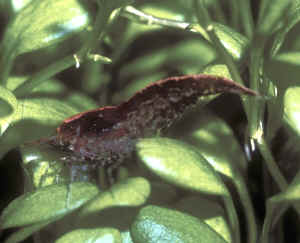
FW Shrimp ID 11/11/19
Hi
Can you please help me with the identity of these shrimp.? They are freshwater .
Thanks
Wendy
<.... 30 megs... PLEASE read and comply w/ our limit on file size. >
Re: 11/11/19
Thank you!
<DO re-size and resend. Cheers, BobF>
Re: 11/11/19
Ok, I will.
<Cheers; we don't have sufficient webmail space, and when in some other
countries, large files are near impossible to download. B>
Shrimp identity 11/11/19
<Dear Wendy, your message appeared to contain no greeting or text, just what
seems to be a header ("Shrimp identity"), and the attachments were over 15 MB
altogether. We do ask people trim photos down to under 1 MB each, because such
large attachments block the server and prevent other emails arriving. We also
seem to have lost the text of your message as well, so if you can re-send,
ensuring the attachments are kept small, that'd be great. Regards, Neale.>
<<Thank you Neale. This appears to be a grass shrimp species of sort: genus
Palaemonetes. BobF>>
|
 |
Re: New rainbow fish won't eat... Now shrimp ID
9/28/19
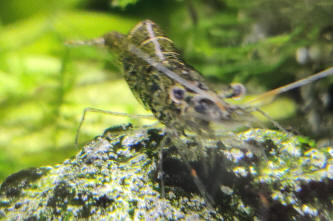
Hi again Neale I was wondering if you could ID this shrimp? I have no
idea what it is. I thought it was A long arm Murray river shrimp but
then after 2 weeks it went a brilliant blue color
https://youtu.be/PlaqeAnccxw
Thanks
<Most likely a Macrobrachium species, possibly Macrobrachium dayanum
var. "blue", but hard to say. Cheers, Neale.>
|
shrimp identification 9/10/11
Hi there
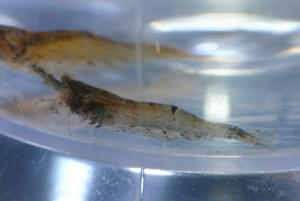
I cannot seem to id this shrimp. I have four of them in my tank
which I didn't purchase. I have other dwarf shrimp and I
would like to know if this shrimp (pictured) is predatory.
Thanks
Lawrence
<Are these in a marine or freshwater tank, Lawrence? Cheers,
Neale.>
|
 |
Re: shrimp identification 9/10/11
Hi Neal
This is a freshwater shrimp. These could have hitchhiked from
PetSmart. I did buy a plant from there. They sell ghost shrimp,
but this doesn't look like the ghosts that they have for
sale. I did buy some java and Christmas moss on eBay from
overseas, I think it was Malaysia. I thought I only had one, but
it turns out I have four of these shrimp. I've been losing
some of my dwarf (red crystal, cherry and mandarin) shrimp and
thought it could be due to some neon tetras (I noticed the other
day after putting some shrimplets in the tank, some of the Neons
were trying to nip at them) or these shrimp. I do have some
celestial pearl Danios but have not noticed any aggression. After
I had sent you the initial email this morning, I checked the
label on the liquid fertilizers and noticed there were trace
amounts of copper. Which is also another variable over the shrimp
loss.
Thanks
lgs
Re: shrimp identification 9/11/11
Hi Neal
Well I also looked at the co2 supplement that I had which is made
by API which does contain glutan. I'm sure this would be
similar to Seachem excel that we had brushed on before. I was
double dosing the tank, so I'm sure that wasn't good for
the shrimp. I think I'll stop using the supplements for
awhile and see if that makes a difference. One more quick
question though. I have several species of dwarf shrimp in the
same tank. Will they cross breed by chance?
<Yes, many of the small Caridina and Neocaridina species we
keep will hybridise. On the other hand, many shrimps we think are
different species are simply colour forms of one single species.
The Red Cherry Shrimp is a red form of Neocaridina heteropoda, as
is the Blue Shrimp and the Yellow Shrimp, and obviously these
will freely interbreed without any hesitation, resulting in
greenish coloured wild-type shrimps. It's best to keep single
sort of shrimp on their own, if breeding is important to you.
>
Thanks
Lawrence
<Cheers, Neale.>
|
Shrimp ID 11/27/08
Hiii!!!!!!! I caught 4 wild shrimp at the beach and threw them
without hesitation in my 17 gallon saltwater tank. it's been
2 month now they r all the same and tiny except one which is
bigger and more colorfull, all the rest are transparent and look
healthy. i did everything i could to identify their name or have
information about them but NOTHING. 6 days ago i noticed the big
shrimp(1 inch) with his belly full of dark green eggs!!!!!!!!
everyday the eggs changed and one the sixth day i can notice 2
dots in each eggs,the shrimp look shy and is not eating like the
others, what can i do to identify the shrimps, when the eggs r
gonna hatch????i really need answers plz!!!! <Heyyyyy! Are you
a child, a non native speaker, a person of diminished
capacity?..... Please fix your English and re-send. Can you send
a picture or two? The color of the eggs is about right. BobF.
> |
| Shrimp ID 11/28/08 i'm sorry for my
english and for the spelling, it's not my official language
<Ah, no worries. I understand> i just wanted to identify
the shrimp i caught, which is pregnant know. <This appears to
be a Grass Shrimp, likely the species Palaemonetes paludosus. Bob
Fenner> |
 |
|
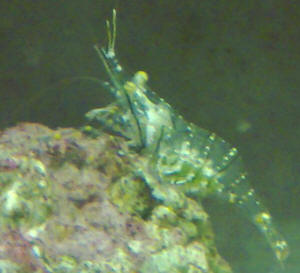
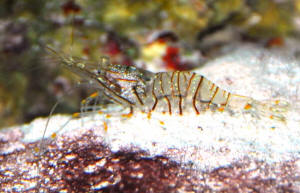
Unidentified Shrimp... Perhaps a Ghost Shrimp 9/11/07 This
is Paul again. <Hola Paul, Mich aqui> I just wanted to send
you a picture of one of the shrimp in my tank. I have another
just like it. I am currently living in Brazil (Curitiba) and this
was a shrimp offered at the aquarium store (www.aquabetta.com.br)
I thought you guys might like to look at it. <Always nice.>
Maybe you haven't seen one like it before. If you have, can
you tell me what its name is? <I could be wrong, but it looks
like a pretty glass or ghost shrimp to me. Ghost shrimp are often
used as feeders More here:
http://images.google.com/imgres?imgurl=http://www.fishlore.com/Pictures/
Profiles/ghost_shrimp_2.jpg&imgrefurl=http://www.fishlore.com/profile-
ghostshrimp.htm&h=150&w=250&sz=6&hl=en&start=16&
um=1&tbnid=mn4UJo7N5z_kqM:&tbnh=67&tbnw=111&prev=/images%
3Fq%3Dglass%2Bshrimp%26svnum%3D10%26um%3D1%26hl%3Den%26safe%3Doff%26client%3Dsafari%26rls%3Den%26sa%3DG
> Thanks a lot. <De nada! Mich>
Re: Unidentified Shrimp... A Ghost Shrimp 9/12/07
Buenos Dias Paul, Mich here again.> I thought ghost shrimp
were freshwater. <Can be fresh... can also be salt... I have
collected myself from saltwater in the Belmar NJ inlet.> They
have been living in my saltwater tank for 7 months now. <Yes,
there are several species. Many can tolerate great ranges in
salinity. RMF is in agreement with this ID.> Paul
|
|
|
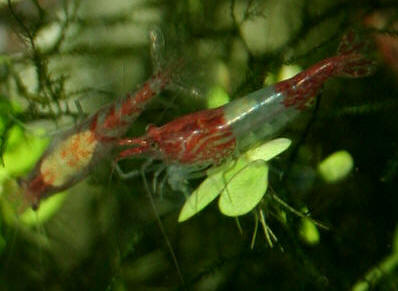
| Cherry shrimp with crystal red striping?
2/16/08 Hi guys! You've helped me in the past and was
hoping you could help me now. I have a genetic variation that has
popped up in my cherry shrimp breeding colony. I have had these
shrimp for two years and have no crystal red shrimp. A few weeks
ago I noticed a female that I thought had a white stripe due to
molting. I got a good look at her last night. This is sure enough
what she looks like. I am thinking of giving her her own 5 gallon
and a few fellas and see if this mutation pops up more frequently.
Any thoughts or comments? Take care, Mary. <Does looks like
Neocaridina sp. "Red Crystal" as opposed to Neocaridina
denticulata sinensis "Red", but since the latter is an
artificial form, it's entirely possible that genetic throwbacks
might turn up occasionally. In any case, if you like the shrimp,
and are 100% sure that it isn't a specimen of Neocaridina sp.
"Red Crystal" that got in somehow, by all means see if
you can 'fix' the mutation through further captive
breeding. Cheers, Neale.> |
|
 Nice. RMF Nice. RMF
|
| Mystery Shrimp - Fun with
Freshwater Inverts Hey all, <Hey, Chris> I have a rather
odd hitchhiker that came with my bumblebee shrimp today. It's
about the size of a large ghost shrimp, it's pincer arms are
about as long as it's body <This alone screams
"Macrobrachium!" Now, Macrobrachium *what* is the
question.> and are sort of banded in alternating pale red and
grayish-black. LFS said it'd snuck in with the bumblebee
shipment and hadn't injured/killed any of the bumblebees in the
couple weeks it had been in their tank at the store, but
they're not sure what it is. <Fun!> Well, due to various
chaos today involving having to return/exchange the tank I got for
Xmas (Marineland 10gs apparently have different dimensions than
All-Glass 10gs), having to take relatives to the zoo for their
annual Zoo Lights event, discovering I either need to buy an
adaptor for the power cord and/or change the outlet the tank was
going to be plugged into, my new 10g didn't get set up like
I'd planned it to be. <Boy, when things go wrong!> So,
for the night, the bumblebees (and unknown) all got placed in a 1
gallon tank with an airstone and some algae wafer bits. A short
time later, both my sister and myself observed this unknown shrimp
would wander the perimeter of the tank trying to pinch the tails of
all the bumblebees (who'd jump out of the way). <Oh yes.
Macrobrachium shrimps almost all are aggressive meat eaters. Fish,
shrimp, anything that holds still long enough to be nabbed, are all
at risk.> So the unknown got moved to a separate 1g, where
he's mostly watching the bumblebees in the tank next door.
<Dreaming of snacking, I'm sure.> (The bumblebees now
appear much happier, munching away on the algae wafer and exploring
instead of sitting in groups along the walls) <Probably feeling
a touch safer, now that they're not potential meals!> So,
can anyone ID this critter? <Your photos are quite unclear (no
offense, just an observation) and therefore very difficult to tell
anything for sure.... is it possible to get him into a position
against a solid background? It'd be especially nice to be able
to see his first pair of legs, their shape, color, etc. From what
you've given me, the best rough guess I can give you is
Macrobrachium japonicum.> I'm probably going to try and take
him back, unless someone can convince me he'd be better behaved
in the 10g with the bumblebees (and future fish inhabitants) rather
than how he acted when stuffed into a 1g with them. <I would not
expect him to change his ill manners, not at all. But it certainly
might be fun to hang on to him in his own tank, see what he grows
up to be! I'm sure he'll worm his way into your heart, even
with an unbeatable appetite and a bit of a bad disposition.>
I'm hazarding a guess it's some kind of Macrobrachium,
perhaps? <Almost definitely.> The object it's sitting on
in the photos is an airstone if that helps with scale at all. Given
the day it's been, you're probably going to tell me I just
got a future 5" monster shrimp that eats fish or something ;)
<Well.... ;) I do believe you're reading my mind! I'm
not at all certain on his ultimate size, though. I'd guess
somewhere in the neighborhood of a couple of inches. Small fish
would likely be at risk, and small shrimp, as you've observed,
certainly aren't safe. But again - don't give up on him
just yet! He may prove to be an endearing little dude, well
deserving of his own tank. Give him a chance, if you can.>
Thanks again for any help you're able to provide, Chris <You
betcha.> --Addendum-- A friend located this photo that sort of
looks like the unknown shrimp:
http://www.shrimpcrabsandcrayfish.co.uk/Shrimp.htm?Longarm.htm~mainFrame
(scroll down to Striped-Hand Prawn and click on the image).
Although this site's photo is a bit redder than the one I have
appears. <This picture looks very much like Macrobrachium
japonicum to me.> And it seems to be the only site on the
internet that uses the name Striped-Hand Prawn (aren't common
names fun to deal with?) <Ugh. I think the world would be a far
less confusing place if we simply scrapped ALL common names.
*sigh*> Also, I already checked through the photos at http://www.wirbellose.de/arten.html#Großarmgarnelen
to try and ID it with no luck (Remembered the site from when it was
pointed out to me in the forums by vintage_fish <Hey, that's
me! ;) > several weeks ago in regards to a different species)
<Try this one: http://www.wirbellose.de/arten.cgi?action=show&artNo=220
. Do please look very closely at the faint striping on the legs (I
bet this is a juvenile or young female) and compare with your
shrimp. Also, try a Google search on Macrobrachium japonicum and
check out some of the pics that come up. If at all possible, try to
get a clearer pic on a plain (perhaps black) background. In any
case, a fun little fellah to find out more about, if you can spare
a tank for him! Wishing you well, -Sabrina> |
 |
 |
| Mystery Shrimp - Fun with Freshwater Inverts -
II Hi Sabrina, thought you might get that e-mail ;) <It
strikes me that there simply aren't that many shrimp-obsessed
people around.... *sigh*> Thanks for the help, I think you may
be right with the species, maybe this one just hasn't gotten
its full color yet since it lacks the markings along its sides. I
located this site:
http://www.aquajapan.com/encyc/shrimp/palaemonidae/macrobrachium/japonicum_e.html
<I've seen that one, hoped you'd Google the name and
find it - glad you did> That has two pictures of females, the
lower one reminds me a little more of what mine is. I'll try to
get a better photo sent in (or posted in the forums) soon, still
trying to figure out proper fish photography with a digital camera
(best results so far have been with tank light off and flash on in
that 1g). <"I feel your pain" - my shrimp photos are
currently far worse than yours, so don't feel bad, not at
all!> The bumblebees are now in the 10g (blending in with the
Fluorite), <They are goo at that.> I was going to try
reintroducing the bully in the 10g after a few days (and after I
add some rockwork for hiding spots) but given this info, I'll
just keep him in the 1g while I figure out what to do with him.
<A good plan. Surely you've got room for a smallish tank
somewhere? He'd probably be fine in the 1g for a while.> LFS
has informed me their return policy on livestock only applies to
dead livestock. < .... That's simply insane. And stupid. And
insane. So, let me see if I've got this right.... They
won't take it back and sell it, but if you kill it and bring it
in, they'll refund you? That's.... Insane.> Happily, one
of the other Aquamaniacs moderators has offered it a home if I
don't/can't keep it, since she has two
"shrimpzillas" already that she was sold as ghost shrimp
(she thinks she's narrowed down the ID of hers to either Indian
or Thailand prawns). <Heh, if it weren't that shipping costs
suck, I'd gladly offer the li'l guy a home. Do consider
keeping him, I think you'd have fun learning about him. The
larger, aggressive shrimps can have a lot of personality (or seem
to, if you're a shrimp nut like me!).> Thanks again for the
help, Chris <Any time. Wishing you and your shrimpums well,
-Sabrina> |
|
Shrimp/Crayfish As a Valentine's Day
gift for my two sons, my husband purchased two African Clawed
Frogs, while the man at the pet store was trying to catch the
albino frog, he came across a little guy my oldest son likes to
call "Pincher." He gave him to us for free since he
wasn't sure what he was. I think he's either a shrimp or
crayfish of some kind. How do you tell the difference between the
two? He's about 1 inch long with two pinchers and a
grayish/brown color and a flat fan like tail. I would greatly
appreciate your answer. Thank you. Susan <Hi Susan, generally
crayfish are larger than shrimp. It's hard to say without a
picture. Does it look like any of these: http://www.thekrib.com/Fish/Shrimp/
Regards, Gage>
Shrimp/Crayfish I am going to try and get a
picture sent to you of "Pincher". <Awesome> I
looked at the site you sent and couldn't find any one shrimp
that looked enough like him, they all resembled him but not
enough for me to say he's a shrimp. The only other way I can
describe him is he likes to hoard food, he at first didn't
mind the African Clawed Frogs but then suddenly started to chase
them around and even pinched off some of the little albino frogs
toes. <Maybe a crayfish, they are pretty aggressive.> He
has dug himself a little home in the gravel under a decoration in
the tank. I know this probably doesn't help you much more, so
like I said I'm going to try to get a picture sent to you.
Thanks for all your help. <In my experience freshwater shrimp
will usually do their best to hide and avoid confrontation with
anything and everything. This sounds like a crayfish to me, I
named mine "fish pinchin' crawdad" I'm working
on a country song about him. A picture would be great. Regards,
Gage> Susan
|
Macrobrachium rosenbergii information Robert, Around 14 years
ago I purchased three "Blue Lobsters" from a pet store in Mt.
Pleasant, MI. Later on I learned that they were known as Macrobrachium
rosenbergii. These three invertebrates were the most interesting
aquarium pets that I had ever owned. They are long gone now, but I
recently purchased a 125 gallon aquarium which I intend to put my
larger Cichlids in. Thinking about what to put into the empty 55
gallon, I remembered the "Blue Lobsters" which I loved having
in the past. My question is where can I purchase them??? I can not find
them anywhere in the West Michigan area. Whenever I ask pet shop
employees they look at me like I am crazy!! If you might have any
information that might be helpful please e-mail me back. <These
crustaceans are still about, though not near as popular as they were
years back. This one species is widely and intensively cultured as a
food organism (mainly in the Far East). It and a handful of new species
of interesting prawns, shrimp and true lobsters can be had from larger
retailers and etailers. Please contact the folks on our Links Page
here: http://www.wetwebmedia.com/links.htm to start your search, and
ask your local fish stores if they'll please look, special order
one, more for you. Bob Fenner> Thank you, Andy Shearer
Freshwater shrimp? Dear Crew, We have unfortunately had a
small tragedy in our freshwater tank (240L, ph6.5-7, temp 75-77,
nitrates 0, hardness 3-4)...in with our neon tetras (11), black widow
tetras (6), Otos (5), Rams (3), Corys (6) we had had 5 "red claw
shrimp". Now from the pictures on your site and on all of the
other freshwater shrimp sites, they look like ghost shrimp, but are a
reddish/orange color. We bought them from one of the LFS staff who
lives in our area and breeds them in her tank. The biggest of these
fellows is about 2 inches long, and the smallest about 1 inch. Until
yesterday all was well (how can you tell there's going to be a but)
but yesterday evening I noticed small red shrimp on its back,
scrabbling a bit. I thought this was strange, so turned him over and
moved him into a sheltered corner, he seemed to be struggling, so I
wondered whether he was molting and turned off the tank lights to
minimize stress and left him to it. This morning at work I have
received an e-mail from home telling me that small red shrimp is no
more. So now I have 2 questions, first of all, do you have any ideas
what species these fellows might be? and secondly, what could have
killed small red? his legs and claws looked strangely pale and he
seemed sort of bunched up (cramp?) but apart from that we have no
clue... Any suggestions would be useful, we want to prevent the same
happening to the other 4. Thanks for your time. Nicola <Hey Nicola,
sorry to hear about your shrimp. It is hard to get a positive ID
without a good picture. The common ghost shrimp will not reach 2in.
Take a look at the link below, is it one of these guys?
http://www.calacademy.org/research/izg/SFBay2K/ghostshrimp.htm My first
concern would be water quality. I would do a good water change, and add
a poly filter to absorb metals and many other contaminants. Keep an eye
on the other shrimp, if it starts happening to the others we will know
that it was not a molting complication and can start troubleshooting
from there. Let us know how it goes, Best of Luck, Gage.> Nicola
Blay, BSc, MSc International Zoo Veterinary Group
| Shades of Uwe Werner! Sabrina, hope
you're all recovered... <Yes, much! Thank you. Nothin' a
little Gatorade couldn't fix.> pls take a peek at the
attached pix. This was the FW shrimp I mentioned at IZOO... about
an inch long. <Attractive little beastie.> Any idea as to
species? <But for the reddish cast, I would almost think just
plain ol' C. japonica; my bigger ones in a brightly lit tank
have taken on that nice coppery cast to their backs, quite
different from the small guys - but the red and patterning on the
sides.... no, I think perhaps this is your fellah:
http://www.wirbellose.de/arten.cgi?action=show&artNo=094
("Redbacked dwarf shrimp") Or perhaps this guy:
http://www.wirbellose.de/arten.cgi?action=show&artNo=117
("Red dwarf") I would lean more toward the first of those
two, though. Unfortunately, no species name for either, but
hopefully an idea as to what they are. Very nice. -Sabrina> Bob
F <Do agree with your analysis. Thank you. Bob F> |
|
|
Shrimp ID <Hi! Ananda here while our resident shrimp
experts are off in the wild blue yonder...> I was hoping you might
be able to help me ID this little guy that came into my tank as a
hitchhiker and where I could find more info. Thanks. Troy <While I
personally don't know what species this is (or even if it's
saltwater or freshwater!), I can point you at a shrimp site with
bunches and bunches of photos: http://www.wirbellose.de/arten.html
...It's a German-language site, but the shrimp species names are
still in Latin. :-) Have fun! --Ananda>
|
The King of Freshwater Shrimp Someone on my message board
was looking for info on these guys. <Would you mind sending
along a link to the discussion? I would be very, very interested
in participating....> I searched all over the web myself and
can't find anything but a single picture. I was wondering if
you could help me out a bit here with some info on these really
neat looking shrimp. Their common name I guess is Vampire Shrimp
and the scientific name is Attya gabonese. <Ahh, Atya
gabonensis! Dear me, these are my ALL-TIME FAVORITE shrimp - and
that's saying a lot, with my major shrimp addiction!! I have
never heard of them being called "vampire shrimp",
though. In fact, I do not believe there are *any* widely used
common names for this animal. Try a search under the accurate
Latin name, this should yield some pics. The only good, solid
information available on the web is located at: http://www.wirbellose.de/arten.cgi?action=show&artNo=030
. This is in German, so it may or may not be of much help to you.
You can translate the page (somewhat) at Google, using their
language tools. Some basic info - they get about 6" long at
their largest. Juveniles are orange, females (and possibly
sub-dominant males?) are grayish-brownish-bluish, and the big
head honcho male will get lustrous black and blue. They are a
filter feeder, and are of absolutely no threat to even tiny fish
or fry. There are actually perhaps even three or four different
animals that fall under this name somewhat loosely.... can be
found in eastern South America with some variances from their
central-western African cousins. As with all filter-feeding
shrimp, these MUST be fed in the aquarium; it is a common
misconception that the animals will take what they need from the
water - our tanks are simply too pristine for that to happen.
Sinking foods which break up into a fine dust, or frozen foods
that can be mushed up (I like Ocean Nutrition's Formula One
and Two for this) are great. These shrimp are largely nocturnal
and very shy. Provide them with a lot of rocky places where they
can hide - stressed shrimp are *not* long-lived shrimp. To
facilitate seeing them once in a while (again, VERY nocturnal),
provide with subdued lighting, or lots of floating plants to
block out some of the light. They prefer to have areas of open
substrate that are not planted, as well; they are quite clumsy.
Lastly, and perhaps most important with these and any other
freshwater shrimp - please dose your tank with iodine. I use
Kent's marine iodine at a rate of one drop per ten gallons
every week (NOT the marine dose!). This really, really, REALLY
makes all the difference in the world. Another tidbit - I got
mine from Toyin at Rehoboth Aquatics ( http://www.rehobothaquatics.com/
). They were (still are) in EXCELLENT shape and great health.
They had poked holes in the nice, thick bag (double bagged) with
their pointy legs and all but a couple tablespoons of water had
leaked out, but they still did absolutely fine. He is a
wholesaler, and may possibly have a store near you that you can
get these from, and if not, he may sell to you directly. Another
'site you should check out: http://www.franksaquarium.com/
- he has several species of not-very-common freshwater shrimp,
and has been an invaluable source of info for me, too.> Thank
you in advance for any help you can give. <Ahh, no, thank YOU
for giving me a chance to discuss my favorite critter! As
uncommon as they are in the US, it is WONDERFUL to hear of
increasing interest in them.> Regards, Kristen <Wishing you
well, -Sabrina>
The King of Freshwater Shrimp - II - 03/01/2004 Thank
you soooo much for all the info on these really neat little
critters. <You bet. And again, thanks for mailing us. I could
talk the ears off of corn regarding these shrimp.> Here's
a link to the thread on my message board.
http://www.aquatiqterrors.com/forums/index.php?s=248e4199c7eb812b3d38122b7b82f115&act=ST&f=46&t=15336&st=0&
<Excellent. I've joined (am "vintage_fish") and
hope to chat there!> Thanks again, Kristen. <And thank you
for helping to increase interest in these awesome little
beasties. Wishing you well, -Sabrina>
|
More Mystery Shrimp! - 10/04/2005 Hello, <Hi! Sabrina the
slightly shrimp-obsessed with you today.... And please let me apologize
for the extreme lateness of my reply; on top of having been sick and
missed some emails in my box a few days back, you've really given
some perplexing pictures! Excellent photos, I must add.> I have seen
this question before ("Mystery Shrimp - Fun with Freshwater
Inverts") but I would like to ask it once again... is what I have
actually a ghost shrimp? <Not what is commonly considered to be a
ghost shrimp, but it does look like a Palaemonetes species to me.
Perhaps P. antennarius - your shrimp seems to have the same bizarre
iridescence that they exhibit. They do develop markings like yours
shows as they grow, but yours is more prominently marked than ones
I've seen.> or is it a "long-arm" - Macrobrachium...
because this guy's arm's aren't longer then his body, but
he is a bit big to be a ghost shrimp. He is about 4.5cm (1 3/4").
<Not a Macrobrachium, as far as I can tell, but not a
"common" "ghost shrimp".> I have posted photos
here: http://www3.telus.net/public/al_s/ShrimpPhotos/ I am
wondering what the morphological difference is between the
Macrobrachium and the Palaemonetes? <Well.... See, you're asking
tough questions now! Just kidding, this is a good one. To be quite
honest with you, I do not know the difference in systematics between
these two genera. They are both in family Palaemonidae, though
Palaemonetes shares the subfamily Palaemoninae with a few other genera,
whereas Macrobrachium is not in that (or other) subfamily.> is it
just the length/size of the pincer arms or am I missing some other key
item? <Macro = big, brachium = arm .... All of the shrimps of genus
Macrobrachium do have very prominent "arms". Some more so
than others, to be sure, but all are quite big. This can be somewhat
less noticeable in females, but even most females have really big arms.
Also, all of the Macrobrachiums (Macrobrachia? Uhh, I don't know
the pluralization of this word!) that I have met seem to have an
impressively large rostrum. Some Palaemonetes do as well though,
including P. antennarius, whose rostrum can be quite wicked-looking.
Physically, those two pincer arms will tell all. Or most, at least.
Yours is not a Macrobrachium, as far as I can tell. Now, that
doesn't mean it's not aggressive! P. antennarius, if it were
just the size of a dog, would take over the world and wipe out
humanity. And you'd hear an evil laugh while they did it.
Fortunately, they stay at or under 2", so hopefully we're
safe. Or maybe that's just what they want us to think....>
Thanks, -Rose <And thank you for showing us these great images; I do
hope you enjoy this animal. Wishing you well, -Sabrina>
Differences between Palaemonetes and Macrobrachium species
shrimps.... 9/21/05 Hey Bob! <Sabrina> I know I should know
this, or at least be able to find it, but I don't and I can't.
I wonder if you know, or can point me in the right direction. <Will
try> What, physiologically, ARE the differences between these two
genera? I mean, aside from the (macro) big (brachia)"
arms"/pincers, what really makes a Macrobrachium a Macrobrachium?
What makes a Palaemonetes a Palaemonetes? Both are of the same family
(Palaemonidae), though Macrobrachium is in sub-family Palaemonidae....
But.... What determines this? I've struggled a couple days to try
to find *something*.... hobby-related websites and the few books that
mention shrimps (including Uwe Werner's Aqualog) just talk about
care, and those big honkin' arms.... and I can't seem to find
any scientific websites that really explain what makes a Macrobrachium
a Macrobrachium, or a Palaemonetes a Palaemonetes. Any thoughts? I
wish/hope it could be as simple as counting scales, rays in fins, tooth
shapes and pharyngeal bones.... Fish are so easy <. <Don't
know... w/o "looking"... likely at SIO... but here is the
feedback from Google on Systematics of the Palaemonidae: http://www.google.com/search?sourceid=navclient&ie=UTF-8&rls=GGLD,GGLD:2004-27,GGLD:en&q=systematics+of+the+palaemonidae
Looks like there are some useful bits here... and I would try the (not
ready for prime time) "Google Scholar" as well... Next time
you're in town, let's make a sojourn down to the Scripps
Library... am facile at searching "the literature". Bob F>
Thanks much.... -Sabrina
Shrimp Discrepancy? - 01/19/2005 Hey, <Hola.> I was
just admiring your site and I noticed you mentioned P. kadiakensis, a
freshwater shrimp. There you mentioned it as a marine species; <Mm,
no, just that this particular individual was living in a marine
aquarium.... A few freshwater Palaemonetes shrimps can be pretty easily
acclimated to brackish or saltwater environments. After looking at the
photos that I have available (including a higher res pic of the one in
question), I am not convinced that this is (or, for that fact, is not)
P. kadiakensis - the only solid information I can find on its tolerance
of salinity suggests 20ppt is okay, but 25ppt is lethal.... I also
assume that, like with other Palaemonetes shrimps, this tolerance may
differ with different geographical populations of the species.>
however, it is true freshwater species, not needing salt or brackish
water to breed, as I raise them successfully. <Agreed
wholeheartedly. The same can be said for other Palaemonetes which can
be acclimated to saltwater, as well (though some species have a much
lower survivability in larvae in lower brackish or fresh conditions,
and vice verse). But, taking into account the areas that P. kadiakensis
can be found in the wild, I am inclined to agree - the species of this
animal is, in fact, in question.... Unfortunately, I do not have other
clear photographs of "known" P. kadiakensis for
comparison.... Sigh. Perhaps you have some that I could take a peek
at?> The shrimp on your site (bottom pic) was most likely P. pugio
or P. vulgaris. <Alas, I do not have access to any clear photographs
of either of these - but from the small pic on the site, I think
identification is impossible.... The high-res version we have is very,
very clear - if you have any photos of pugio or vulgaris, or
kadiakensis for that fact, I would be very eager to see, and perhaps
get this fellah correctly named! Or maybe I should take a road trip and
find some to see with my own two cute little eyes.> It might even be
Macrobrachium or a related Palaemonid species. <Mm, if in saltwater,
I find it very, very unlikely that it's a Macrobrachium - perhaps
I've got this wrong, but I'm not confidant that there are any
saltwater Macrobrachiums, or any species of the genus that can take
fully marine conditions?> If you have any questions, email me.
<Thanks very much for your comments - if you can get any clear
photographs of your kadiakensis, I would very, very much like to have a
peek! Wishing you and your shrimp well, -Sabrina>
|
We were told it was a ghost shrimp I
don't have a picture, and I don't have an digital camera,
but I will try to describe this shrimp the best way I can. It was
a huge shrimp. The pet store told us all ghost shrimp grow that
big if allowed to live that long. I think that's bogus.
Anyways, this shrimp is 3 or 4 inches long, <Mmm, not what
folks generally call a "Ghost Shrimp" then. Please see
here: http://www.aquariumfish.net/catalog_pages/misc_critters/shrimp_ghost.htm>
has long arms with small pinchers on it and a red nose. It's
opaque with black stripes. <Sounds like a (small so far)
Macrobrachium... rosenbergii... put this name in your search
tools> We also bought a dozen ghost shrimp from this place and
it looks like there are much smaller animals of the same species
mixed with the common ghost shrimps. They (the 'ghost
shrimps' in question) have the same black stripes down the
side of it. We tried to ID it at the German language web site you
suggested to someone earlier but didn't see it. I'm
positive it's aggressive as it tore off almost all of a gold
fishes tail within 30 minutes of being in the tank. <Yikes! Do
separate this animal, schnell!> We're not sure what to do
with it. My wife wants to keep it, but if it's going to
terrorize the little fish I'm going to put in the Oscar tank
and see how it likes the terrorism. <Oh, these two may learn
to coexist> I know you don't have much to go on but just
envision a ghost shrimp 4 inches long with similar pinchers and
black stripes down each segment of it's body and a red
nose... Any help you could give us on this would be very
appreciated. Thank you... Jason <Read on my brother. Bob
Fenner>
Re: We were told it was a ghost shrimp (Not a
ghost of a chance) Thanks for your help. We had also bought
crayfish at another store. <Man! Pinch city!> My wife
didn't want to leave this huge shrimp in with a bunch of
white clouds for fear of them getting eaten so we took them out
(after trying to catch him, almost impossible) and put in with a
small crayfish (had to do some tank swapping). The huge shrimp
(which I now believe to be a Macrobrachium lanchester) tried to
eat the crayfish. <Yes... would have eventually> I would
have thought the crayfish would fight it off and they would go to
their respective corners and stay there. <No... like putting
me and a pizza in the same room...> Well, that didn't
happen so we had to separate the two. I don't think my wife
knows what to do with this huge shrimp but she wants to keep it,
if you think it can coexist with the Oscars I'll suggest it
to her. <If both are kept well-fed, not too crowded...> But
the Oscars are only 3 inches long now albeit very aggressive (the
result of feeding mostly live food to them, which included ghost
shrimp). Eventually I think they would eat it. What do you think?
There are 5 of them. Soon there will only be 2 though (55 gal.
tank, <... still too small a system eventually> want them
to pair off then going to get rid of the others), maybe it could
fend off two? I guess I could always get up late at night, grab
the shrimp, steam him and eat him with some cocktail sauce, and
then blame it on the Oscars? What do you think? <Mmm, worth a
try... Bob Fenner>
|
|
|

