|
Related FAQs: Marine Invertebrates,
Marine Invert.s
2, Marine Invert.s 3,
Non-Vert IDs 1, Non-Vert IDs 2, Non-Vert IDs 3, Non-Vert IDs 4, Non-Vert IDs 5, Non-Vert IDs 6, Non-Vert IDs 7, Non-Vert IDs 8, Non-Vert IDs 9, Non-Vert IDs 10, Non-Vert IDs11, Non-Vert IDs 12, Non-Vert IDs 13, Non-Vert IDs 14, Non-Vert IDs 15, Non-Vert IDs 16, Non-Vert IDs 17, Non-Vert IDs 18, Non-Vert. ID 19, Non-Vert. ID 20, Non-Vert. ID 21, Non-Vert. ID 25, Non-Vert ID 26, Non-Vert ID 27, Non-Vert ID 28, Non-Vert ID 29, Non-Vert ID 30 Non-Vert ID 31, Non-Vert ID 32, Non-Vert 33, Non-Vert ID 34, Non-Vert ID 35, Non-Vert ID 36, Non-Vert ID 37, Non-Vert ID 38, Non-Vert ID
39, Non-Vert ID 40,
Non-Vert ID 41, Non-Vert ID 42, & FAQs
about: Marine Invertebrate
Behavior, Marine
Invertebrate Compatibility, Marine Invertebrate Selection,
Marine Invertebrate
Systems, Feeding Reef
Invertebrates, Marine
Invertebrate Disease, Marine Invertebrate
Reproduction, & Quarantine of Corals and
Invertebrates, Feeding Reef Invertebrates,
Lighting Marine
Invertebrates, Marine
Plankton, Marine
Microbes, Marine Virus,
Marine Bacteria, Marine Funguses, Marine Protozoans, Marine Plankton, Live Rock,
Related Articles: Marine Virology, Marine Bacteria, Marine Mycology, Marine Protozoans, Invertebrates, Marine Plankton, Live
Rock, Live Sand, Sponges (Porifera), Stinging-Celled Animals (Cnidaria),
Worm Groups, Mollusks (Snails, Bivalves, Octopus...),
Pycnogonids (Sea Spiders),
Jointed-Legged
Animals (Arthropods), Bryozoans/Ectoprocts, Spiny-Skinned Animals
(Echinoderms), Water Flow, How Much
is Enough,
/The Conscientious Reef
Aquarist
The Pros & Cons of Hitchhikers
in the Reef Aquarium, part 1
To: Part 2,
Part 3, Part 4,
|
|
|
By Bob Fenner
|
|
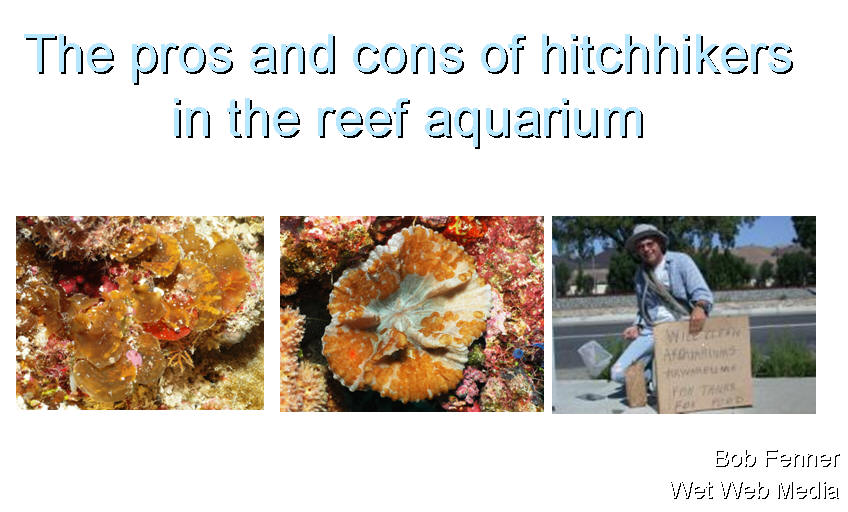 |
Amongst the chief concerns of marine aquarium keepers, the
showing up (for free!) of unwanted, too-often unidentified
livestock is largely over-rated. Using live rock, live sand, even
just natural water, one should come to expect the emergence of
so-called hitchhikers, and indeed, to embrace them as part and
parcel of being a "slice of the real world".
Here I'll offer my glimpses of what a
good bit of this life is, where it comes into your displays, and a
few guidelines and methods for appropriate avoidance, compatibility
judging and control. |
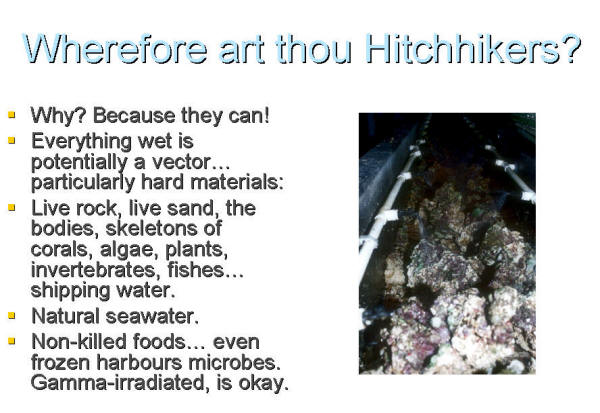 |
Instead of hanging your head and crying "Why me!?",
think about life as you know it... What's that saying...? Oh
yeah, "Nature abhors a vacuum"... Well, nature hates the
Dickens out of not filling up tropical reef habitats chock-a-block
with all manner of life. Really, the more you look, its absolutely
flabbergasting how much diversity and abundance there is in/on the
sand, rock, other life, in the water... Of course a bunch of this
biota is going to manifest itself in your captive slices of these
worlds.
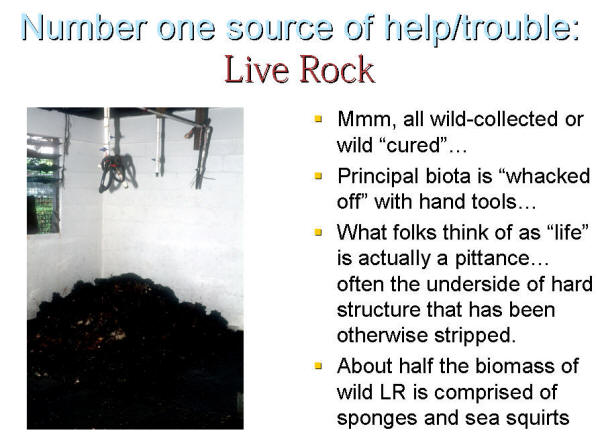
Before "processing" likely more
than half the total mass of live rock is life, living attached and
in particularly in Pacific sources throughout holes and crannies in
the matrix of its carbonate make-up. Micro-life abounds... in the
water, in all interstitial spaces, on and in all other life. All
"macro" organisms have "epi-" life on them,
their own mutualistic-to commensal-to parasitic fauna... If you use
anything but sterile cultures and sterile water, sterile
techniques... You're going to have a plethora of life forms in
your systems. |
 |
| Even "man-made" live rock is cured in the sea...
where it "picks up" a multitude of life in short order...
within hours, with founding organisms (bacteria,
fungi/slime-molds... algae) weeks it is inoculated with founding
"macro" life such as sponges, sea squirts, molluscs,
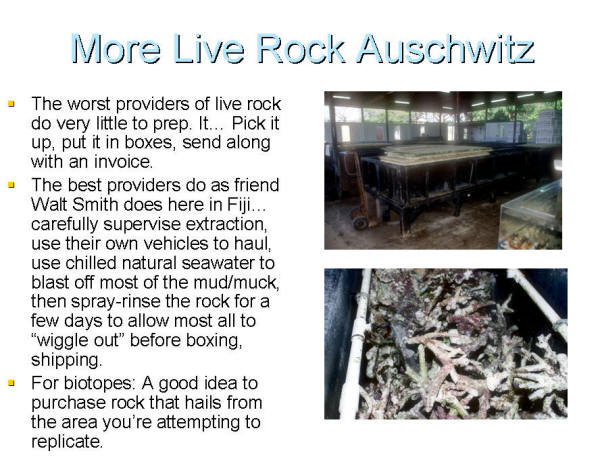
crustaceans... The vast majority of the "real"
externalized life of live rock is whacked off with high pressure
water and hand tools... And rightly so. If the vast majority of
biomass wasn't denuded it would rot enroute and likely kill off
most all other desirable biota. Strangely enough though, what often
constitutes as "life" on this hard material is the
underside... mostly encrusting red coralline algae, that was
"face down" on the reef or sand prior to extraction...
the luxuriant "top side" life having either been
purposely removed or consequently lost due to the rigors of
shipping and handling. |
 |
 |
 |
 |
To: Part 2, Part 3, Part
4,
|
|

