|
|
| Home | Marine Aquariums |
Freshwater Aquariums |
Planted Aquariums |
Brackish Systems |
Ponds,
lakes & fountains |
Turtles & Amphibians |
Aquatic Business |
Aquatic Science |
Ask the WWM Crew a Question |
| Please visit our Sponsors | ||||
|
Mystery Invert - 07/13/2005 While in Ocean City, Maryland my son's friend dug up along the shore what looked like six to eight triangular shaped "clams", about 1.5 cm long, all connected to a central location by soft tissue projecting from each organism. The shells were open at each end. I'm sorry I have no photo. I appreciate any help you can provide. <Hi, Brian! Unfortunately, without a photo, or a very, very in-depth description, it will be difficult to impossible to give you a definite ID.... You might try looking up "gooseneck barnacle" in a google image search, as that (sort of) fits your description. Otherwise, I would suggest you find a book on local ocean shore life, and see if you can find a match.> Take care...Brian Mai <You too. Wishing you well, -Sabrina>
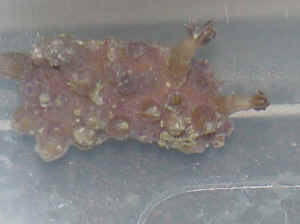
Mystery Creature... I have a 35 gallon salt water aquarium. I put live rock in it about 3 months ago. I noticed a circular specimen crawling on the rock. It has grown a little since I first noticed it. It is now about the size of a nickel. It is a very dark purple color, almost black. It comes out only at night, and retreats when light is turned on. It has tentacles underneath, that makes it mobile. When I tried to move it, it started to cling to the rock and a white stripe along the back appeared, that I never noticed before. Since than, the white line on the back is seen most of the time. Any ideas? <I think that you are imagining it...It does not exist...There are no such creatures found in the reef...Get some sleep! LOL> Is it safe to keep it in my tank, or should I remove it. At this time, I have two starfish, a longnose hawk, and a Banggai cardinal fish. A clown is soon to move in as well from my quarantine tank. Any help would be appreciated. Thanks, Debbie <In all seriousness, Debbie- ya got me on that one...It sounds like some sort of worm, but it's really tough to guess without a pic...If you could forward one to me, I can make a better guess...If you have not had any nasty experiences with this creature yet, then we can at least rest easier until a positive ID is secured! Looking forward to seeing a pic, if possible! Regards, Scott F> White Growths (11-3-03) Hi,<Howdy, Cody here today. Sorry for the delayed reply, I have been having some computer problems lately.> We have a 55 gallons salt water aquarium for ~ 3months. We have ~50 lbs of lace rocks in it. Recently, we are noticing lots of white growths of the lace rocks and it's increasing. The growths usually stand up or form a arch and some of them seems to have some hairy stuff hanging. When we touch them, they feel like paper. Can you tell what are they and if they are harmful for the fish and if so, how to get rid of them? A prompt response will be highly appreciated.<Sounds like some sort of sponge to me and is likely harmless. You can find more info at our website: www.wetwebmedia.com. Cody> Thanks, Sunandita Spontaneous feather duster generation- Hey, I have been noticing tube worms forming on my live rock. They have white calcareous tubes and their "feathers" are a deep red color. The tubes are about 1/4" and they are slightly curled. I have Googled the site but have been unable to find a definitive ID. Any idea what these are? If so, how big could they get? Thanks,<They are just small feather dusters that seem to reproduce readily under ideal conditions, Enjoy these small magnificent creatures, Good luck, IanB> Steve Squiggly snail eggs 10/19/03 Ok, I have a (hopefully) quick question. I've had a 20 gallon saltwater setup for about 9 months now. Due to an incredible sale at a local pet store three days ago I moved everything into a 55 gallon tank. Between yesterday and today an interesting design was laid on the glass, and I'm wondering what it is. <clearly an egg mass, and almost certainly from a snail. Hard to say if it is from a shell-less or shelled species. They are not likely to hatch viably at any rate. Nonetheless... a cool occurrence> The only new resident to the tank is a watchman goby, otherwise there's a pair of clownfish, dwarf lionfish, spotted hawkfish, scooter dragonette (who, thankfully, accepts brine shrimp and my prepared clownfish food) and all the normal snails/crabs. <indeed> The only thing that comes to mind is that the design is snail eggs. <bingo... you win a hairy kewpie doll in the likeness of Robin Williams> There are tiny, distinct white dots within it and it resembles the squiggles turbo snails will make in algae. <not a turbo snail though... that gastropod broadcasts its gametes into the water> There's a picture online here ( http://users.adelphia.net/~sidi/images/squiggle.jpg) but it's 40k. Do you know what it might be, if it isn't snail eggs? Matt Williams <best regards, Anthony> Not So Super Snot - Mysterious Growth in Reef >Hello everyone, >>Good day. >I hope you can help me with a 'mysterious' growth in my reef tank. To describe it without sounding gross, will be difficult, because it indeed looks GROSS! It grows under my rocks, is opaque and whitish, (clear in spots) almost like a milky glass that dripped into the tank. >>Mmm.. sounds like reefs not. (I just made that up.) It could be a bacterial/algal growth, I've never seen anything quite like this, though. >I haven't touched it yet because I can't get to it. I brought a sample of my water down to the LFS to make sure my numbers looked good, (my test kits are about 8 months old and I was getting conflicting results between the kits) and, all is within guidelines for a healthy environment. >>Kit quality is important here, brand, as well as age (8 mths. doesn't seem to be too old, as long as stored properly) are important. >This 'white' stuff has been around for about 4 months. I don't know if it's soft or hard. Any clues?? >>Sorry, I personally don't have one. I believe I've seen photos of encrusting sponges that may resemble this, a web-page appropriate size photo would be helpful. >Also, I have had another form of growth that is ugly. It's blackish/green, and clogs everything. >>Now *this* sounds like Cyanobacteria, and this would indicate an issue with excess nutrients. Of course, not knowing your actual results, as well as what exactly was tested for, means that I can't give you a more specific direction in which to go other than address nutrient control. >I blow it off when I see it and take it out of the tank. It's about 1/8 inch think and it's full of air bubbles. When I squish it between my fingers, it deflates. Any clues with this one? >>Again, this sounds very much like Cyanobacteria. Use the Google search bar on our homepage with this search term. >Thank you everyone of you. It's nice to have a place to ask questions and not be ignored!! Pamela >>Quite welcome, and I hope this has helped a bit. Marina Invert ID 10/5/03 Hi, I have a 30 Gallon reef tank with a T. derasa clam, a daisy polyp rock, a flat brain, a Marshall island devil's hand, egg xenia, and a star polyp rock. Water chemistry is currently ph 8.2, ammonia, nitrites, and nitrates at 0. Just recently I have noticed little "baby" xenias starting to grow around the tank. Unfortunately, my flat brain recently died. However, lately I have noticed some red, branching, tubelike things growing from the top of the brain. I don't have a digital camera or a scanner, otherwise I would send a picture, but I was wondering if you had any idea of what this is? Trevor <there are several things they could be... do consider checking out our new book Reef Invertebrates (Calfo and Fenner) which details a great many creatures. I'm guessing that you have a Vermetid snail (sessile and cone shaped/spun tubes) or a Serpulid tubeworm. If instead you see feathery extensions... you may have small tube barnacles. Do seek pics of the aforementioned to confirm. Anthony> Small creatures crawling on seamat 10/4/03 Hi guys. First of all, thanks for having the faq! <thanks kindly!> I have a 55 gallon tank with one maroon clown, one damsel and one yellow wrasse, several snails. Also have a healthy bubble tip anemone, galaxy? coral, short tentacled plate coral, a bunch of yellow polyps. Recently my sea mat closed up and upon close scrutiny I notice small white creatures were sitting on top of the polyps and moving around as well. The opened polyps had no creatures on them and the ones closed seemed to have at least one sitting on top. What are these creatures and are they harmless? Thanks. Kumarason Kandiah Malaysia <based on the limited description "small white creatures", alas... we cannot say much. Do look closer to see if you can describe the organisms better. Do they look like Planaria/flatworms... or segmented worms, or micro-crustaceans with legs, etc. My guess is that you are merely looking at harmless amphipods (Microcrustaceans like miniature shrimp) that are scurrying about as detritivore. Your fishes will likely eat them in time. Kind regards, Anthony> Small creatures crawling on seamat II 10/4/03 Anthony, Thank for the quick reply. <very welcome my friend> I took out the seamat and shook it under a separate container to see what fell out. <do consider too my friend that this is just the kind of circumstance that underscores the imperative need to quarantine all new livestock (live rock, fish, corals, etc) in a separate QT tank before adding them to a display. It will allow you to evaluate these organisms before they have had a chance to spread into the main display. There are excellent articles and FAQs on our site www.wetwebmedia.com describing QT protocol> I caught a starfish - with a thin hairy legs, a flat main body. It was curled up in the rock. Remove it and storing it. Managed to get a picture of it. <no worries... if it is an Ophiuroid (brittle or serpent) then it is safe> There were also small brown hairy creature with a thin white body. Its head had tentacles (white as well) and to me, the moved like snails. Could this be bad? <hmmm... if it looks like a shell-less snail (sea slug( then it is likely bad (the hairs being cerata evidencing its cnidarian-predatory nature)> Anyway, managed to shake most of them off. Too small to capture using my cell phone camera. I am now waiting to see if my seamat opens up. <understood... but the fear still exists of the unknown creature having laid eggs or there being others. Really... please do employ strict QT protocol my friend. Just an inexpensive 10 gallon tank or plastic bucket will do fine for this.> Thanks for the help again! regards, Kumar <wishing you the best of luck. Anthony> Small creatures crawling on seamat III 10/7/03
Dear Anthony, It's a great relief to WWM. You guys are great! :)
<grazie> By the way, are there any natural predators for this
slugs? <there are a few... although most slugs and flatworms are
rather toxic. Look to wrasses for starters> I am also thinking of
doing away with my wet/dry trickle filter. <probably a good thing
(for reducing nitrates) if your bio-load is light> I have read in
some articles that mechanical filtration can be done away if proper
feeding and water changes (with siphoning) are done
frequently. What is your opinion? <yes... quite correct
and agreed. A good supply of live rock in the tank is also necessary.
1-2 pounds per gallon> Tried searching through FAQs on this...
Thanks. Kumar <with kind regards, Anthony>
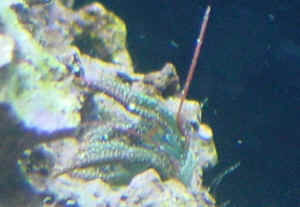
Help with Hitchhiker ID and an Angel for Angel 10/3/03 Hi Fishy Friends! <howdy> First off, thanks again for a great site. Between all the literature and the super people on the forum, I've learned a whole lot in 4 months. <our reward <G>> My first question is about some kind of anemone (?) I got on live rock I bought about 2 months ago from an LFS. I don't know where the LR was from 'originally', so I can't help there. It's located down in a crevice and pops out in the light and retracts in the dark. It's been growing fairly quickly, but not unmanageable -it's about 1/2" in length. It appears to be some kind of anemone but is not the evil Aiptasia. Or I don't think it is. I've asked around the forums and nobody seems to know what it is; my only concern is that it might eventually get nasty towards the inhabitants of the tank (limited to a toadstool and some shrooms right now). I like the little guys (there are 2), so I hope it's not a pest ;-) <the picture is not close enough nor the polyps extended enough to be certain... but it definitely looks like a coral to me. My guess would be a Euphylliid (like torch corals/hammers, etc). Please be sure to feed this animal fine minced meaty foods weekly or better> My second question is regarding a Cherub Angel. My husband is dead set on getting a Banggai Cardinal (tank-raised of course) for our 29 and I'm in love with the little cherubs. Would 1 of each be too much for a 29, assuming they were the only fish except perhaps a neon goby for cleaning? <no trouble at all for stocking... but do know that they are one of the least "safe" dwarf angels regarding sessile inverts. Cherubs are consummate nippers and nibblers (corals, anemones, etc)> It's got about 30 pounds of live rock and 20+ pounds of live sand. My thinking was that the cardinals don't swim around much, so the angel would have plenty of room to roam. Obviously, the cardinal would go in first and we'd wait on the angel for a bit - the tank's about 4 months old now. If you say no go, then I guess we'll get 2 cardinals and the hubby will be really happy. <still can add a second cardinal (they are easily sexed) and have them breed <G>> Thanks so much for all the great advice! Angel <thanks kindly... best regards, Anthony>
Clicking noise at night I have 2 questions. I'm very new to keeping a marine aquarium. I've had my aquarium a bit over 2 months now. My aquarium is 180litres and has live rock and coral etc. and at night I can hear a clicking sound.<could be a mantis or a pistol shrimp> Someone told me that this is a shrimp that eats little fish if you don't feed it properly.<it could be> Is this true? What is the clicking noise and can it be a hazard. If so how do I get rid of it?<if it is a mantis shrimp, you might have to remove it. depending on the size of your fish. though many mantis shrimp grow to about an inch and are pretty much harmless. unless you have inverts I would get rid of this shrimp, just in case. purchase a mantis trap or search the internet. some people have unique ways of catching these stomatopods.)> The fish in my aquarium include, 2 green Chromis, 2 yellow tailed damsels, 2 clownfish (allardi), 1 yellow tang, and 1 coral beauty. When I first added my fish I put a semicircular (Koran) angel fish and a bicolour angel but the semicircular killed the bicolour angel and when I put in the coral beauty I think the coral beauty killed the semicircular. Does this mean I can't keep 2 angelfish at a time?<yeah it does!!> What is your suggestion on my next fish? <I think your pretty much stocked. but you could go with another small wrasse maybe from the genus Pseudocheilinus>Also the fish are very small at the moment and what will happen when they grow because my fish tank is very small? <you will have to purchase another aquarium or get rid of the fish...or they will eventually perish, good luck, IanB> |
|

|
Features: |
|
| Featured Sponsors: |