|
FAQs about Non-Vertebrate Animal
Identification 3
Related Articles: Marine Invertebrates, Quarantine of Corals and
Invertebrates, Feeding
Reef Invertebrates, Lighting
Marine Invertebrates, Water Flow, How Much
is Enough,
Related FAQs: Non-Vert IDs 1, Non-Vert IDs 2, Non-Vert IDs 4, Non-Vert IDs 5, Non-Vert IDs 6, Non-Vert IDs 7, Non-Vert IDs 8, Non-Vert IDs 9, Non-Vert IDs 10, Non-Vert
IDs11, Non-Vert IDs 12, Non-Vert IDs 13, Non-Vert IDs 14, Non-Vert IDs 15, Non-Vert IDs 16, Non-Vert IDs 17, Non-Vert IDs 18, Non-Vert. ID 19, Non-Vert. ID 20, Non-Vert. ID 21, Non-Vert. ID 22, Non-Vert. ID 23, Non-Vert. ID 24, Non-Vert. ID 25, Non-Vert ID 26, Non-Vert ID 27, Non-Vert ID 28, Non-Vert ID 29, Non-Vert ID 30 Non-Vert ID 31, Non-Vert ID 32, Non-Vert 33, Non-Vert ID 34, Non-Vert ID 35, Non-Vert ID 36, Non-Vert ID 37, Non-Vert ID 38, Non-Vert ID 39, Non-Vert ID 40, Non-Vert ID 41, Non-Vert ID 42, Non-Vert ID 43, Non-Vert ID 44, Non-Vert ID 45, Non-Vert ID 46, Non-Vert ID 47, Non-Vert ID 48, Non-Vert ID 49, Non-Vert ID 50, Non-Vert ID 51, Non-Vert ID 52, Non-Vert ID 53, Non-Vert ID 54, Non-Vert ID 55, Non-Vert ID 56,
Non-Vert ID
57, Non-Vert ID 58,
Non-Vert ID 59,
Non-Vert ID 60, Non-Vert ID 61,
& Marine Invertebrates, Marine Invert.s 2, Marine Invert.s 3, & FAQs about:
Marine Invertebrate Behavior,
Marine Invertebrate
Compatibility, Marine
Invertebrate Selection, Marine
Invertebrate Systems, Feeding
Reef Invertebrates, Marine
Invertebrate Disease, Marine
Invertebrate Reproduction, &
LR Life
Identification, LR Hitchhiker ID
1, Anemone Identification,
Aiptasia
Identification, Aiptasia ID 2,
Worm Identification, Tubeworm ID, Polychaete Identification, Snail Identification, Marine Crab
Identification, Marine Invert.s 1,
Marine Invert.s 2, Marine Plankton,
|
|
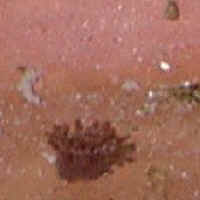
- Algae and Other Stuff - Hey Guys, great
website. I had a question concerning new life in my
tank. I have a 12 gallon SW tank that I've had for one
year now, and its been a happy year (knock on wood). I have
good purple algae coloration on much of my live rock, but lately a few
new things have pooped up. There are small red bubbles, many
with yellow tips forming on the purple algae, and some small red spot
forming on other parts of the rocks. A darker, almost oily
looking, purple spot has grown over some of the rock. <That all
sounds like BGA to me - Cyanobacteria. Read here: http://www.wetwebmedia.com/bluegralgae.htm
> There are also some very skinny, brittle white tubes with strings
coming out of them, that can reel in the strings at times. <That is
probably a Serpulid worm. See here: http://www.wetwebmedia.com/polychaetes.htm
> Lastly, there is a see thru tube shaped item, that looks like a
long tube filled balloon, that is emersed in the rock, could this be an
air bubble? <Not sure.> Its almost metallic, very strange.
<Could be Valonia, bubble algae. See here: http://www.wetwebmedia.com/greenalg.htm>
Anyways, I was wondering if any of these new "friends" were
bad for my tank. <I think mostly good. I wouldn't worry about
anything but the algae. The Valonia, if that's what it is can get
out of hand if it's removed carelessly, the BGA can also get out of
hand, can usually be addressed with improved circulation.> I do 1/4
water changes weekly. Thanks a lot, Sincerely Jon
<Cheers, J -- >
-Live Rock Hitchhiker's!-
Hello Saltwater Gurus, I have a 4 month old 120gallon Reef tank, I
have been very slow adding inhabitants, and have been amazed by the
flora and fauna appearing on the live rock.<And it will only get
better!> I have two ID questions, and 1 general
question. I will start with the general question. I have
a 20 gallon refugium which, after the addition of Chaetomorpha, has
controlled the phosphate issues in my setup. <Excellent,
Chaetomorpha is my favorite macro.> The Chaetomorpha has grown
exponentially, and I have already harvested a bunch to remove the
nutrients from circulation, and the algae has almost grown
completely back filling a third of the refugium. The
algae is a completely amazing source of copepods (I am pretty sure
they are) which are to numerous to count in the refugium, and they
have made it into the main tank and are reaching large populations.
<Mmm... fish food...> I only have two Ocellaris clownfish and
one Bubbletip anemone, and the clownfish show no interest in eating
the copepods. Is there a danger in an unchecked copepod
population? <Should it get too large to sustain itself, it will
crash out. No worries for the tank though.> What type of fish
would like to eat these copepods? <The first fish that comes to
mind is a mandarin dragonet, which you should be able to sustain
very well (you may have to start feeding the 'fuge to really
crank out the bugs though). Six and eight line wrasses are pretty
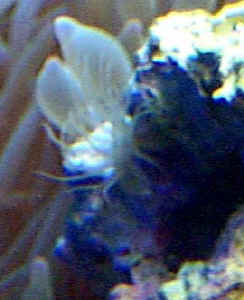
good pod chompers as well.> Now, the two ID questions. There is
a "hitchhiker" anemone that resides directly next to the
spot my BTA has chosen for itself. It is about 1 inch in
length with spindly arms and a translucent body. I have
attached two pictures which are the best I could get. I
believe this may be an Aiptasia. If this is the case, it
is the lone Aiptasia that I can find in the tank. Do I
need to destroy this small anemone now? <YES> Or is it
possible that it will not become a nuisance with adequate nutrient
export? <In theory yes, in practice, no.> If it stays single,
then I would like to keep it. <I would play the odds and
exterminate it, it's not worth having the other inhabitants
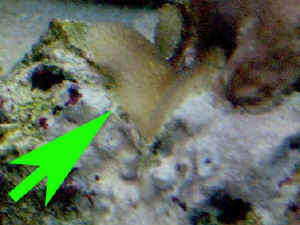
suffer in the future.> Next, there is an animal that has grown
on the live rock that appears to be either a corallimorph or some
form of anemone. It is a "carpet" of tiny
polyps that are less than 1/8" each, but the entire colony is
about 5 inches across. It has grown in an awkward place
to get pictures, but here is the best one I could get, with the
colony pointed to...any idea what this is? The polyps have not
increased in size, but the area covered by the colony is growing,
so I do not believe it is a carpet anemone. <Well, it's not
an anemone, and does not appear to be a soft coral. Although its
impossible to tell exactly what it is from the picture, I think
it's safe to say that it's some type of stony coral. It
appears that most of the colony died in transit and the growing
part was the only part left alive. Could you get a clearer
picture?> Thank you in advance for your time. <I hope this
helps! -Kevin>
Kevin |
 |
 |
Mediterranean Sea invertebrates references Hi Bob, <Hello
George> I am looking for some information on invertebrates from the
Mediterranean sea. We have taken some photos and we would like to learn
a bit more about them. I checked your book about the "Reef
Invertebrates" but naturally there was not much in it. Do you know
of any other reputable source ?? Book or website ? <Do you have the
IKAN/Debelius "Mediterranean and Atlantic Fish Guide"? Has
Helmut redone it as a "Reef Guide" with invertebrates? There
is a bibliog.. in the back of the old edition (mostly fish related)...
I would go to a large/college library and use the computer
bibliographic tools to do a modern search for literature. Bob
Fenner> Thanks a lot in advance,
George J. Reclos Ph.D.
| Odd mushroom, reference to new book 12/3/03
Bob, Anthony, et al <whassup buttercup?> again, excellent
work on the "Reef Inverts" book... loving every page of
it so far.. and finally completed it front to back. <much
thanks... we're very glad to contribute> found something
very interesting on page 157 .. in the pic in lower right hand
corner of 'Clathria' species sponge, there is a lime green
(mushroom?) just to the left... I have something that looks very
much like this but have never been able to find a good id on it..
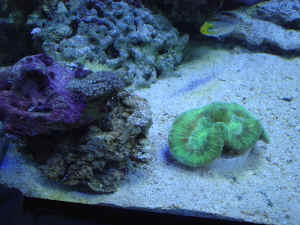
<actually... the pictured organism looks like a small Cynarina
stony coral to me. But the corallimorph is unmistakable if true>
mine have the fleshy nodes but each end in a point (sort of talon
like) and a bright orange mouth in the center... seem to like light
and do not take food directly like some shrooms I've had
before... <hmmm... do see yours retract and try to discover if
there is not some stony corallum (look for the ridges of septa). If
yours truly is a soft animal, then perhaps a better pic of yours is
needed here> (though I suppose most do not anyway) <not
correct... shrooms are generally very heavy organismal feeders...
its the method of delivery that can be a challenge> I have
enclosed a pic to help in the identification .. (its not the best
pic but should give some shape characteristics) flesh looks very
similar to one in your pic referenced above.. <sorry Joe... the
pic link is not working/clear to me. Can you resend as a
attachment?> any pointers or ideas u may have would be
appreciated... <be chatting soon :) Anthony> |
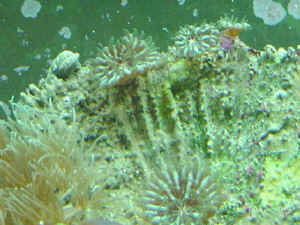
| Odd mushroom? 12/4/03 Anthony, thanks for
the reply... here is pic again, hopefully this will go thru .. if
not I'll send from an alternate account. Thanks Joe <came
through this time my friend... your creature is not a corallimorph,
but appears to be a small anemone species instead. Keep an eye on
it so that does not become a nuisance (if overfed by
nutrients/particles in the system). Very nice looking creature
though :) Anthony> |
|
|
|
Critter ID I was wondering if anyone can ID the
following critter for me: http://www.geocities.com/jtgilkeson/thing.html
I've nicknamed it "thing" (Adams family) as it
looks like hand that walks around. It walks around
quite a bit, it moved from one side of the tank to the other in
less than a day... The guesses so far from the WetWebFotos forum
are: Aiptasia or majano anemone <I go with guess
number two. Bob Fenner>
Thanks!
|
|
|
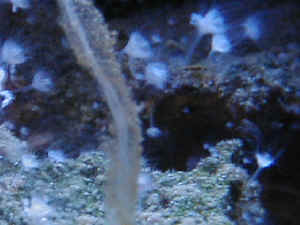
- Little White Flower-looking Things on My Live
Rock - These just appeared yesterday on the
rock. There are also some purple mushrooms
also. I sent a picture of them in the
email. I will explain what they look like also incase
you are having trouble seeing them. <My friend, I can't tell
much of anything from that picture.> They are white, and very
small, short and skinny white stalks. They do not
seem to have any other coloration on them. They can disappear
totally into the rock. My flame angel proved
that. I looked at the nuisance anemone FAQ's
but I could not find anything in there to help me make a final
determination. I also looked at the Starr polyp
FAQ's, and there to I could not determine if they are
that. So I went to dogpile.com and typed in Aiptasia and
found some pictures of brownish anemones, I think I can rule them
out. <Have seen something else like this recently... have no
idea what it "really" is but it is certainly interesting.
My guess is these might be hydroids - man I'd just love to have
a band by that name: They Might be Hydroids.> Then typed in Star
polyp and got some pictures of yellowish little stars mostly
overgrowing what looks to be sticks. Not totally
dissimilar but wrong colors and size. <That may change in time -
will pay to keep a sharp eye on things.> Then I thought hydroid,
no such luck there either so I thought I would send it along to you
and maybe you would know. <Not for certain, and my apologies for
that.> Thanks again Craig B.
<Cheers, J -- > |
|
|
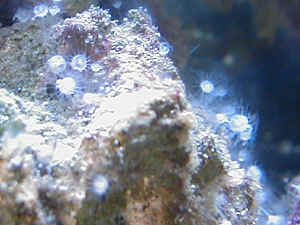
- ID This - Gents - After going
through the FAQ's and postings with no success..... I have
these things that are still quite small, but appear to have
multiplied quite rapidly. My LFS wants to call them tunicates, but
my wife is sure that they're Aiptasia. They don't have the
thick stalks like typical Aip.., nor do they have the articulated
& brownish coloring. <I agree... certainly is polypoid...
perhaps hydroids.> Like anything else that multiples rapidly and
for free, I imagine that it's a nuisance, but I would like to
keep it in the tank, if its growth can be stemmed a bit. <Be
cautious then about overfeeding the other things in your tank.
Typically populations reach a carrying capacity which is limited by
available foods, competition between like organisms.>
Thanks,
Ted.
<Cheers, J -- > |
 |
 |
|
Pests Hello, I was looking closely at my tank when my
eyes came across these tiny little creatures that look like brown
shrimp or something. They are only about the size of a grain of
rice and there are at least a couple hundred of them and they are
all crawling on my live rock and I can sometimes see them in the
sand. What should I do? Are these guys harmful to my fish?<No
these are most likely copepods/amphipods and clean up a lot of
detritus that is in the sand/gravel.>Is there a need to
exterminate?<Not at all!! Thank god for pods!!! Good luck,
IanB> Thanks
|
|
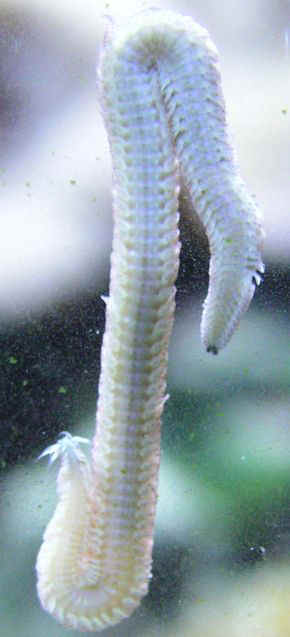
Critter IDs Please, with photos attached The first
photo is of a worm that looks like a bristleworm, but has some
differences. <agreed... is Polychaetous, but not
specifically a "bristleworm".> Have seen this
3" worm on the glass of my 42 gal reef a few times during
the day. Doesn't look like a bristleworm because of the
"mop" head, and BWs don't usually come out in broad
daylight. Photo taken at 4:30 pm, just around feeding
time. There appears to be no damage to corals or fish
in the reef this worm is in. <I frankly have no idea what this
worm is but am comfortable that most are overwhelmingly safe if
not useful as scavengers. You might send that pic to Dr Ron
Shimek over on ReefCentral.com (he has his own forum)> The
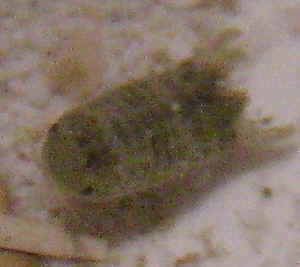
last three photos are of three bugs we sucked out of a well
established 72g reef in which had recently lost all our new fish,
mostly dwarf and larger angels. <my friend...
please (!) do be careful. Watch your own hands in this tank. They
are parasitic isopods and actually can nip/bite you. We have some
data on our wetwebmedia site about them as well as in our Reef
Invertebrates book. Much abroad on the net too about them.
Treatment is possible but an effort> Ammonia, nitrite and
nitrate in the tank at the time of the last fish death were 0
ppm. Had the flashlights out the other night and these
bugs were swimming about near the front glass, though some were
walking on the sandbed at times. Looks like some kind of isopod,
but I cannot say for sure from all the research I've done if
they are parasitic or not. <they appear to be to
me> The bugs were about 1/8th of an inch in length when first
caught. Have since set up a 5g tank with LR, sandbed and
macroalgae from reefs that do not contain these bugs and have
added a green Chromis to determine if the bugs will infest the
fish. Over the week the fish has been in the 5g, the
bugs have grown twice their original size, have been seen on the
glass and sandbed, and the Chromis remains healthy.
<the Chromis for now may be too small and/or fast>
Currently in the 72 gal, at night, there are pinhead sized bugs
on the glass that look like the young of the three bugs now in
the 5g. Can you please ID the worm? <I'll call
him Joey> Also, can you tell from the photos of the bugs if
they are parasitic? <seems so yes> If they are, I imagine a
long period of time, say 2-4 months, without fish would eliminate
these bugs if they are parasitic and have no hosts.
<actually... they are on record going over 6 months and still
surviving> It has been 3 weeks since the last fish
died. During the fallow period I am continuing to feed
the tank daily to maintain high levels of nitrifying and
denitrifying bacteria until the time we will stock the 72g with
fish again. TIA for your time and consideration. Beverly
<wishing you the best of luck my friend. Anthony>
|
 |
 |
|
Thanks, Dr. Ron! (A Happy Ending) Scott, <Hi there
again!> I wanted to let you know that the bugs pics I sent you
were IDed by Dr. Shimek as sphaeromatids and are
harmless. The Chromis in the 5g test tank did not
become infested with them in the three weeks they were
together. All is good :) Thanks for your
time :) Beverly Edmonton AB Canada <Well, no one likes a happy
ending more than me! Glad that Dr. Ron was able to ID these
little creatures for you! Onwards! Regards, Scott F.>
|
|
Critter IDs Please 12/12/03 Anthony, I wanted to let
you know that the bugs pics I sent you were IDed by Dr. Shimek as
sphaeromatids and are harmless. The Chromis in the 5g
test tank did not become infested with them in the three weeks
they were together. All is good :) Thanks
for your time :) <much thanks fo0r sharing this, Beverly. I
will be sure to reference it and consider. Thanks kindly,
Anthony>
|
|
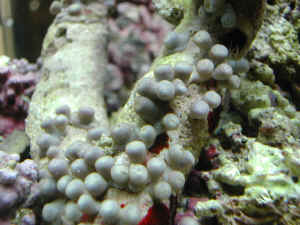
Big White Pasty Milky Jelly looking Growth I have a
large white, pasty, milky, jelly looking growth under one of my
live rocks. I have just noticed it. I have
been looking on your pages and hope it is a sponge. I
am not sure though. Please HELP!!<It is probably
just a sponge that resided in/within your liverock and has just
began to show itself. Lots of interesting creatures come on
LR...good luck my friend, IanB> Thanks
James Ray
|
|
|
Critter ID Hello crew~ <howdy> I have this stuff
growing in my Live Sand bed the last couple of weeks, and trying to
figure it out. What you might not be able to see in the PIC
I am sending is very fine, inch or so long hairs growing out of it
above the sand line. Any ideas? Steve <it is a harmless
and desirable medusa worm (AKA Spaghetti worm)... they are
detritivores. Pictured on pages 170 and 171 of our nifty "Reef
Invertebrates" book (Calfo and Fenner 2003). Anthony>
Red growth on rock 11/23/03 Had a question about leather
corals. I bought a piece of Fiji live rock that appears to
have some sort of coral on it. It looks just like the Fiji
yellow leather coral but it is red in color. It seems to
only be about 1 inch long or so, and feels hard. It has been
in my aquarium for 3 months or so and still seems about the same color,
although some Cyanobacteria grew on it. When you touch it
with your finger it is prickly feeling, and then about a half hour
later it feels like you have been stung or like you have really fine
needles in your finger. It also seems like there is some of
the same thing on the other side of the rock that is not exposed to any
light. If it is a skeleton of a dead coral wouldn't it
have lost the color. I appreciate your help very much! Thank
you!! <it sounds like the growth is a sponge, as best I can tell...
although I picture would clarify this promptly if you can proffer one.
I doubt from the brief description you give that this is a leather
coral. Be careful handling any marine organisms with bare hands, there
are a few uncommon but serious ailments you can contract that way.
Anthony>
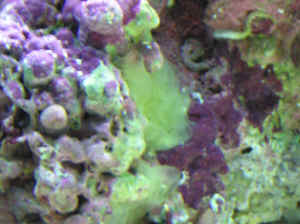
Weird Jelly like substance Hello again
Crew, and thanks once again in advance for the serious info you
provide! For the last couple weeks or so there has been
a weird jelly like substance in the tank, on the live
rock. It's been tough to tell if it has been growing
or not. Any ideas? <Yes. The greenish material in the
middle of your pic is a sponge. Please see here: http://www.wetwebmedia.com/sponges.htm
Bob Fenner>
Steve |
|
|
|
|

