|
FAQs about Non-Vertebrate Animal Identification
48
Related Articles: Marine Invertebrates, Marine Invertebrate Systems, Marine Invertebrate Compatibility,
Marine Invertebrate Disease,
Marine Invertebrate
Reproduction, Quarantine of Corals and
Invertebrates, Feeding
Reef Invertebrates, Lighting
Marine Invertebrates, Water Flow, How Much
is Enough,
Related FAQs: Non-Vert IDs 1, Non-Vert IDs 2, Non-Vert IDs 3, Non-Vert IDs 4, Non-Vert IDs 5, Non-Vert IDs 6, Non-Vert IDs 7, Non-Vert IDs 8, Non-Vert IDs 9, Non-Vert IDs 10, Non-Vert IDs 11, Non-Vert IDs 12, Non-Vert IDs 13, Non-Vert IDs 14, Non-Vert IDs 15, Non-Vert IDs 16, Non-Vert IDs 17, Non-Vert IDs 18, Non-Vert. ID 19, Non-Vert. ID 20, Non-Vert. ID 21, Non-Vert. ID 22, Non-Vert. ID 23, Non-Vert. ID 25, Non-Vert ID 26, Non-Vert ID 27, Non-Vert ID 28, Non-Vert ID 29, Non-Vert ID 30, Non-Vert ID 31, Non-Vert ID 32, Non-Vert 33, Non-Vert ID 34 Non-Vert ID 35, Non-Vert ID 36, Non-Vert ID 37, Non-Vert ID 38, Non-Vert ID 39, Non-Vert ID 40, Non-Vert ID 41, Non-Vert ID 42, Non-Vert ID 43, Non-Vert ID 44, Non-Vert ID 45, Non-Vert ID 46, Non-Vert ID 47, Non-Vert ID 48, Non-Vert ID 49, Non-Vert ID 50, Non-Vert ID 51, Non-Vert ID 52, Non-Vert ID 53, Non-Vert ID 54, Non-Vert ID 55, Non-Vert ID 56,
Non-Vert ID
57, Non-Vert ID 58,
Non-Vert ID 59,
Non-Vert ID 60, Non-Vert ID 61,
& Marine Invertebrates, Marine Invert.s 2, Marine Invert.s 3, & FAQs about:
Marine Invertebrate Behavior,
Marine Invertebrate
Compatibility, Marine
Invertebrate Selection, Marine
Invertebrate Systems, Feeding
Reef Invertebrates, Marine
Invertebrate Disease, Marine
Invertebrate Reproduction, &
& LR
Life Identification, LR Hitchhiker ID
1, Anemone Identification,
Aiptasia
Identification, Aiptasia ID 2,
Worm Identification, Tubeworm ID, Polychaete Identification, Snail Identification, Marine Crab
Identification, Marine Invert.s 1,
Marine Invert.s 2, Marine Plankton,
|
 |
|
Interesting, Help ID?/Ascidian ID?
9/11/09
Hey Wet Web Crew!
<Patty>
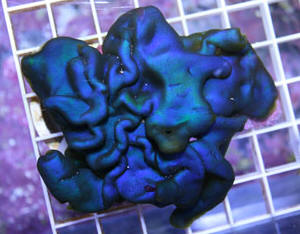
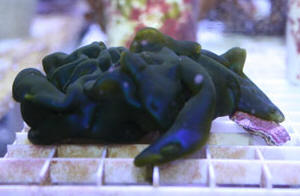
We came across and interesting piece in a bulk coral shipment and
we were wondering if anyone could help ID? We think it to be some
kind of Ascidian,
but haven't found anything quite like it anywhere in books or
web sources.
It has a leathery texture, like wet rubber, not too slimy. Dusky
yellow coloration on the underside and no noticeable openings.
Could it be sea pork or sea liver? Any help would be appreciated
just to satisfy our
curiosity.
<Without a pic, next to impossible, with a pic, the odds
increase in indentifying.
If you believe this critter is an Ascidian, try
looking/indentifying here.
Literally hundreds of pics with ID's from all waters.
http://www.ascidians.com/>
Thanks,
<You're welcome. James (Salty Dog)>
Patty
Re Interesting, Help ID?/Ascidian ID?
9/11/09
Thanks, James.
<You're welcome, Patty>
I am browsing through the site you suggested to see if I can find
anything similar. I did re-send this mail with photos attached, I
jumped the gun the first time and forgot to attach them. It is a
very interesting piece, so
at the least you can enjoy the pics, and if you should have any
other insight,
please let me know.
<Will do, but did not see your email with photos as of
yet.>
Thanks again!
<You're welcome. James (Salty Dog)>
Patty
Re Interesting, Help ID?/Ascidian ID?
9/11/09
Please see attachments.
<YIKES, it's the Blob. No idea what it is Patty. Perhaps
Bob and other
diving crew members may know.>
Thanks
<You're welcome. James (Salty Dog)>
<<Have seen this underwater in the tropical S. Pacific...
Don't know, but my best guess is either a colonial Ascidian
or an amorphous type of Sponge. Thank you for sharing... It's
a beauty whatever it is. Bob Fenner>>
Re Interesting, Help ID?/Ascidian ID?
9/12/09
Yeah, it is unique! If you could pass it along to your colleagues
I would appreciate it. Sometimes having trouble identifying
things is like an itch you can't reach to scratch.
<Yes, and when you look at the diversity of life present in
the oceans, Mmm, unbelievable. James (Salty Dog)>
|
 |
|
Re: interesting, help ID?
09/14/09
Thanks for your help. We have it tucked away in a display tank,
it was too interesting to give up!
<Certainly don't blame you! Please do relate your further
observations, what you learn re this organism. Bob Fenner>
|
A crabb(pp)y question. SW invert. id --
09/08/09
Hey crew,
<Alek>
(I was very impressed at your response time to my last question and
wanted to let my appreciation be known :D )
<Welcome>
So here's the story... I fed our Spider Decorator crab some shrimp
for the first time yesterday. Today, I turn around from doing hw and
stare at the little fellow who's in his favorite concealed corner
of the tank when all of a sudden I notice this small and thin red
filament- looking-thing lying on the substrate beside the glass near
the crab (maybe 2mm in diameter and 6mm in length). I look around the
area to see if I see more and sure enough there's another, a little
thicker and much longer filament lying a few inches away. I have never
seen
these before and am hypothesizing that they are the crab's
excrement, red from the shrimp? What do you think?
<Maybe>
And this leads me to my next question. On the little red
"worms" I noticed small colonies of these translucent
microorganisms crawling all over them and a couple running around on
the glass. I was wondering if you could tell me what they were
<Life>
and how excited/worried I should be about them. They are super small
and move pretty quickly. I would take a picture but I'd be trying
to zoom into a bunch of whitish dashes less a millimeter or less in
length.
Thanks!
Alek
<I wouldn't be concerned... Shallow water marine systems are
chock a block with diverse species... Bob Fenner>
|
Weird Pseudocorynactis sp. behavior
9/5/09
Hi folks,
<Roxanne>
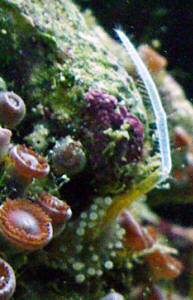
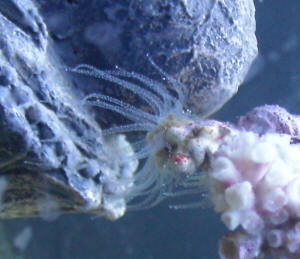
I've recently had these Pseudocorynactis pop up all over the
rocks in my reef tank. But today, I noticed a new and odd
behavior.
<I'll say!>
There is a long two toned "stalk" from the center of
the anemone.
<Corallimorph>
As you can see from the attached picture, the white tip seems to
have several "hairs" all along it to the end.
<I see it/this...>
Have you ever seen anything like this? Any ideas what it may be
doing?
<I have not and don't... the tube portion looks like a
leathery tubiculous worm... the "worm" itself? Bizarre.
Am going to post on WWM in the hope someone will recognize what
this is and chime in. Thank you for sending this along. Bob
Fenner>
Thanks,
Roxanne
|
 |
|
Re: Weird Pseudocorynactis sp. behavior--
9/5/09
Just a note........not sure if it has anything to do with this,
but I have a very large, healthy feather duster in the tank which
was "smoking" but don't recall if it was before or
after this event. If memory serves, it was after.
Also, the "worm" comes from the location of the mouth
of the Corallimorph. In fact, it appears to *be* the mouth.
<Thank you for this further input... Is (to me!) for sure a
mystery! Let's wait, hope not so to someone else. Cheers (and
biers), BobF>
Re: oh, and the mystery marine object--
9/5/09
Hi Bob,
Under the topic "Weird Pseudocorynactis sp. behavior
9/5/09" I do believe that thing is merely a crustacean limb
attached to a sticky Cnidarian.
Whether a moult or otherwise cannot say. The segmentation and the
setae along the edge seem pretty consistent with an arthropod
limb.
Cheers, Neale
<Ahh! A very good "guess" I believe... Was wondering
what the object reminded me of. Will forward to the querior,
accumulate. BobF>
|
|
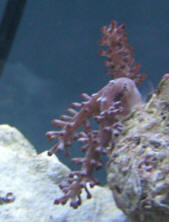
A few IDs... learning... 9/1/2009
Hello all,
I went to the LFS earlier today and got a hefty piece of LR among
other things.
One of the other things I bought was a frag of some sort of
coral. I was hoping I could get an ID on it:
http://i79.photobucket.com/albums/j152/rogutaan/Aquatic%20Mysteries/Frag.jpg
<? See WWM re Soft Coral IDs>
There was a huge sale so I decided to see if my system can keep
corals.
<? What sort of approach to life-keeping is this?>
Even the employee wasn't sure what it was.
Next question is, what are these jelly blob things that are on my
LR?
http://i79.photobucket.com/albums/j152/rogutaan/Aquatic%20Mysteries/JellyBlob.jpg
<... single polyped stony corals... Maybe
Caryophylliids>
Lastly, Caulerpa. I have some Caulerpa, I haven't had any
problems with it, but I'm mostly positive its Caulerpa
toxifolia:
http://i79.photobucket.com/albums/j152/rogutaan/Aquatic%20Mysteries/CaulerpaSps.jpg
<Mis-spelled, but yes...>
If it is, should I get it out now?
<Please... use WWM for these general questions. Your answers
and much pertinent information is archived...>
It hasn't done anything as of yet, but its probably a ticking
time bomb...
Here's a different piece of a Caulerpa, not sure what the
spp. is though:
http://i79.photobucket.com/albums/j152/rogutaan/Aquatic%20Mysteries/CaulerpaSp2.jpg?t=1251776731
<See here: http://wetwebmedia.com/caulerpaalg.htm>
The tank is a 55 Gal with maybe 4 or 5 stalks of the Caulerpa, if
that means anything...
Thanks for your time.
<Thank you for learning/using the search tool and indices. Bob
Fenner>
|
 |
Hitchhiker Question (Bioluminescence) --
08/28/09
Hello!
<<Howdy!>>
I hope everything is well with the crew this fine evening.
<<Morning here in SC now (and boy is it MUGGY!)'¦and
yes, speaking for myself, everything is fine thanks>>
I have a question for you fine folks, here it goes:
As I was checking in on my fishies this evening, making sure all is
well, I saw a very strange sight. Underneath an archway in my
aquascaping came a bright neon green light!
<<Interesting'¦>>
It was small, probably half the size of a pea. But it was quite bright,
like a lightning bug, but it lasted longer than a lightening bug's
light does. It is almost like some creature with a transparent body has
a coil inside of it that produces this bright light.
<<You are likely closer to the truth than you
realize'¦with that 'coil' being an organ capable of
bioluminescence>>
You could actually see a little coil shape like it was a mini neon
bulb.
<<I believe you>>
The lights were off and just my moonlights were on, so I couldn't
tell exactly what it was that was glowing but I am guessing some kind
of worm/shrimp/ hitchhiker?
<<Had your lights been on you probably would have never noticed
this creature'¦and my guess is this is some species of worm
here>>
Do you all have any clue what this could be?
<<Bioluminescence is widespread among marine
organisms'¦from fishes and inverts to alga and bacteria.
What you saw could be about anything'¦though in our captive
aquatic environments, I'm thinking a 'worm' is most likely
here>>
I have not heard any clicking noises for the months I have had my tank
set up, nor heard a clicking noise when the light appeared, so I do not
believe it is a pistol shrimp.
<<Nor do I>>
I have heard they can make light with the extreme pressure that comes
out of their "pistol", but I do not believe that is my
creature. Any ideas?
<<As stated>>
Thanks,
Natalie K.
<<Happy to share Natalie... Enjoy your new find!
EricR>>
Re: Hitchhiker Question? 8/29/2009
Thank you for giving me the correct subject to search upon and
responding so quickly. I have Googled Bioluminescence and believe I
have found a number of answers to my question. Thanks again!
Natalie K.
<Welcome! BobF>
White Spots on Aquarium Glass: Likely Spirorbids,
New Coral Not Opening -- 8/20/09
Hey all
<Hey there Jonathan, Lynn here this evening.>
I recently added some corals to my 24 gallon nano cube and have
recently started to see white dots on the aquarium glass.
<Are they stationary or mobile? Are they hard or soft? Either way,
chances are good that they're harmless. If they're hard and
stationary, they're likely harmless/beneficial Spirorbids -- tiny
feather dusters (filter feeders) that live in coiled calcareous tubes
attached to hard surfaces. They tend to appear in great numbers
(especially in new tanks) on rocks, glass, even equipment then subside
to a few here and there. Please see the following link for comparison:
http://www.melevsreef.com/id/spirorbid_worms.html. Here are several
other common possibilities if that's not what you have. If the
organisms are soft and mobile, they're more than likely some sort
of beneficial micro-crustacean (like copepods, isopods or amphipods).
If they look like tiny snowflakes on the glass, they're probably
harmless crawling hydromedusae in the genus Staurocladia. For more
information on any of these, please use the above terms in our Google
search engine: http://www.wetwebmedia.com/Googlesearch.htm >
I added some polyps
<What variety?>
..and xenias. Have had them in my tank a little over a week and while
the xenias seem to be striving, the polyps are not 100% open.
<It can sometimes take a while for new corals to settle in and
adjust to new conditions.>
I currently have a pair of clowns and a royal gramma.
<Pretty>
Any idea on what it may be?
<Again, it may simply be that the coral hasn't fully adjusted to
recent changes (shipping/store conditions/acclimation, etc.).>
My water parameters are good
<Need specific numbers here: ammonia, nitrite, nitrate, pH, temp,
specific gravity, calcium, alkalinity. Also, what other corals, if any,
do you have and what kind of lighting are you using?>
..and the fish are healthy and active.
<Excellent. I'd give the coral a few more days. Just keep an eye
on it and if it's still not opening/showing signs of improvement,
or you notice anything unusual (rapid bleaching, "melting",
etc.), send us another email with the above
numbers/information.>
Thanks in advance.
<You're very welcome.>
Jonathan
<Take care, LynnZ>
Unidentified larvae in tank 8/21/09
I currently have a 55 gallon fish/live rock tank set-up (running about
5 months). Last month, I had an outbreak of Ich that affected enough
fish that I decided to do hyposalinity in my main tank and move all my
inverts
to my small hospital tank (10 gallon). It has been just about four
weeks, and I am getting ready to increase the salinity in my main tank.
I noticed a few days ago that the walls of my hospital tank were
suddenly covered
with small white larvae. They are about 2mm in length, less than 1 mm
in width, white, and have a dark eye spot. I initially thought they may
be snail larvae, as I have had eggs since the snails have been moved to
the hospital tank. I have 2 Ceriths, 2 turbo snails, a fighting conch,
and a chocolate chip star in the tank currently. I have been
supplementing them with green macroalgae and table shrimp (for the
starfish). I just want to make sure the larvae are not parasitic before
I move my inverts back to the main tank.
Thanks for your help,
Heather
<Can't tell anything from your description; but not likely
deleterious.
Photo/s please. Bob Fenner>
Re: Unidentified larvae in tank
8/24/09
Hey Bob,
My camera doesn't want to focus on the larvae, so I'm out of
luck for a picture. I can try a better description though. They are
similar to roundworms, tapered on the tail end, and blunted on the
head. They move very slowly in a straight line or slight curve, not in
an S or inchworm motion. They have dark eye spots (I'm guessing
two). They seem to only be attached to the glass, not at all free
swimming. They are non-segmented.
There appears to be less of them now than there was a few days ago. I
would say they are similar in shape to C. elegans, but only tapered on
one end. My hospital tank has no live rock/live sand, but I did move
water from my main tank when I first transferred my inverts. At this
point, all I really care about is if they are safe for my fish
(assuming a few might hitchhike when I move my inverts back).
Thanks for your help,
Heather
<... well, maybe some type of Flatworm... e.g.
"Planaria"... many are innocuous. Likely will pass on their
own... in time... all at once. I would just leave be. Bob
Fenner>
|
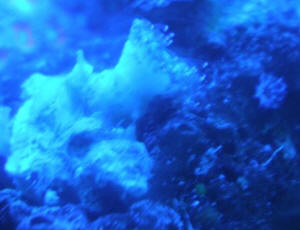
An adventure in bulk zoanthids... Nope... bad pix,
mis-id's 8/20/09
Hello hello,
<You say yes>
I know that you hear it a lot, but here it goes...I love your
site and you are all awesome.
<All bow down>
I am writing with regards to a few curiosities that I came across
while checking over a purchase of some zoanthid rock. It was
being sold by the pound at a wholesaler that I frequent, and I
purchased a few nicer looking pieces totaling about 5lbs. During
my hunt for snails and other nasties, I came across quite a
myriad of things that looked like trouble, as well as some pretty
neat incidental corals. So, here it goes:
I have attached pictures of all the items, please feel free to
post them on your site.
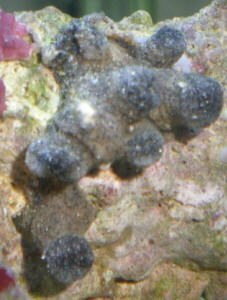
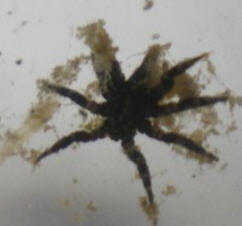
I found these black lice-like guys firmly attached to the
polyp,
<These are sponges>
and the polyp was obviously worse for the wear. When removed,
there was an imprint of the critter. Once out in a dish, they
moved about fairly haphazardly.
They are about 3/8" long.
<These are Pycnogonids>
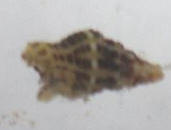
The first snail was attached to a polyp, though the polyp did not
seem too troubled. It is about 1/4" long.
The blurry snail is something I found cruising the glass of my
aquarium, caught, examined and freed. I then found it sucking the
life out of a nice Proto about a week later. It is a flattened
spiral shell, but not quite on a single plane like a nautilus, it
projects very slightly. When it is firmly attached, it sits
vertically.
<Yes, predaceous...>
I am very curious to know what the dark zoanthid-like things
are.
<Poriferans>
They appear almost jet black, and are covered in a fine, black,
very refractive sand-like stuff.
The last ID I want to pester you with is a stony coral that was
also a hitchhiker. It is a single solitary polyp, about 1/2"
across when open. It really looks like a *Corynactis*, but it has
a skeleton, which is about 1/4"
across. I apologize for the lighting. I wanted to catch it open,
and it didn't like my halides.
<Can't make out from this pic... too blurry,
unresolved>
I very much appreciate the help, and look forward to hearing from
you.
Thanks,
Lanny
<Enjoy! Bob Fenner>
|
  |
Re: tiny white creatures in tank
8/16/09
Hello Bob Fenner
<Howsit?>
I am very pleased to inform you I'm now rid of the tiny
crustaceans.
It took 2 weeks of vacuuming, shifting gravel and the death of one of
my silver dollar fish but in the end my tank is clean.
Thank you for the help.
with warm regards
Vishwas Shetty
<Congrats on your success Vishwas. BobF>
Tiny white spots in tank- pls help!
8/15/09
Hello WWM crew. Thank you for reading my post.
Please read through and delete or shorten anything you may have to in
order to post this online if needed. (as I know I am giving
'extra' information that you may not need). I have searched
Google, and WWM archives, but the
only things I am finding are copepods, sponges, syconoids, worms, glass
anemones....none of these are what I am seeing in my tank.
<There's much else>
I am concerned about a new growth - and the only way I can describe it
:
remember when you were a kid (I pray one of you ate these so you know
what I am referring to...) and you would get the "Dot"
candies? They would come in like 4 colors on a strip of paper, and you
would just pluck them off and
eat them?
<I recall>
They were just small circular 'dots'. That is what I have.
Small white dots on my glass walls- mainly the back of my 180g and on
the side of my 14g. They do not have anything growing from them - no
hair like antennae, no feathers, no spiral tubes. The only common
factor is a baby purple tang my husband brought home, (in addition to a
few corals, coral banded shrimp and harlequin shrimp.) The corals were
all placed in the main tank, and the
purple tang was moved to the 14g as the other fish were
'picking' on him too much for him to get adjusted in the
180g-so we moved him to the BioCube until he gets bigger. In both tanks
there is now an outbreak of red slime and the white dots. Again-
everything was great up until the newest additions. Could something
have come in on the baby tang?
<Not likely, no>
Could he have been a 'carrier' of some sort? And how would the
fish bring in slime- without it being noticed?
<Much can be transported in the water with new livestock>
I have some red reef (yellow faced) hermits coming to eat at the
slime,
<Slime...>
and have stopped feeding for the past couple of days- as I do not wish
to feed the bad algae, I purchased today Ultra Life red slime
remover,
<Am not a fan... need to find, fix the allowing circumstances, NOT
the symptoms>
as a last resort as I prefer to correct my tank naturally, not adding
chemicals (which is why I am getting the hermits)
<... not generally useful>
-BUT how do I get rid of the white dots if I cannot even find out what
they are online, in books, etc?
<Perhaps you don't need to... there's a good deal of life
that is innocuous, of little to no consequence that "pops
up", comes and goes in captive systems... If truly curious,
you're encouraged to get/use a microscope... scrape some off and
take a look>
If they are beneficial - then I will gladly accept and keep them- but
it seems odd they are only appearing when the red slime is in the tank?
I emailed this 'after' adding the slime remover, and the water
is now not the clearest- so I will email a picture when it clears - any
help that you or the other members have is always appreciated.
Thank you for all you do - you help us maintain our goals of achieving
our dream of having a piece of the ocean in our homes and hearts.
-Michelle
(wait: sorry! some stats:
180 gallon
78 degrees
refugium
Coralife 72" MH deluxe unit (halides on from 3pm-10pm)
ProClear skimmer
Life Guard UV Sterilizer (QL-40)
2 Koralia power heads -on opposite sides of tank
sg .23
<1.023... I'd raise this to NSW strength>
ph 8.2
nitrite 0.2ppm
<Dangerous... should be 0.0>
nitrate .2 ppm
calcium around 380
my clowns have mated and are CONSTANTLY laying eggs for months now-
although no success in babies yet
each of my hammers are blooming new buds (heads)
<Good signs>
my Australian whisker is now budding another new head- three in total
all fish are well- no stress - corals are fine - no stress (although
when we introduced the tang, shrimps, coral- the flowerpot we had died
back-moved him to BioCube to recover/regrow)
<Good... my overall statement to you is not to worry re the
"dots"... leave them be; I would. Bob Fenner>
Help with identification... misc.
"stuff", no pix -- 08/14/09
Hello Crew!
<Robert>
Last time I wrote to you guys, I was told to use better grammar, so
here goes.
My tank is a 75 gallon reef. I have a blue hippo tang, a yellow tang, a
scooter blenny, two maroon clowns hosting a pink tip Haitian
anemone,
<Really?>
a mixture of hermit crabs, and a mixture of snails. I have a large
variety of corals.
<... a variety...>
My water parameters are all at an acceptable level. I do a 10-20
percent water change every week or two, using reef crystals.
I have searched your site, but can't find anything like I am about
to describe.
I have a Zoanthid garden in a corner of my tank. There are some areas
where my livestock cannot get to between my rock and glass. I usually
see many tiny creatures hanging out here. Most are tiny organisms about
1/8 of an inch or smaller. I don't know if they are copepods or
something else, but you can clearly see them moving. I am not worried
about these.
<I wouldn't be>
Today I was looking in this part of my tank and saw a bunch of small
ball-like things. They are white, and almost look like closed
Zoanthids, but I know they are not Zoanthids. They have a small hole in
the middle of them, and are round. The biggest ones are about a quarter
of an inch and the others are smaller. What are they, and are they
something I should try and get rid of?
<Maybe some sort of sponge. I'd leave be>
They almost look like spider eggs.
Also, I saw some kind of creature come out of a hole and it disappeared
quickly. I don't know how to describe it. It almost looked clear,
and it moved fast. It was kind of creepy looking. It was about a half
an inch, and I really don't know how else to describe it. I know
this is a horrible description, but any ideas?
<... lots>
Thank you guys for everything you do. I have used this site countless
times since I got started in the hobby.
Robert Shear
<Photos please. Bob Fenner>
Baby Sand Dollars? 8/6/09
Good Afternoon,
<Hello Kathy, Lynn here today.>
I have what looks like extremely small sand dollars on the back of my
reef tank,
<Neat. Are they actually on the glass or on the rocks, sand,
etc.?>
I have been trying to figure out what they are, and no one seems to
know. I have looked and researched on the web and have not been able to
find any info. I have asked the fish stores that I buy all my saltwater
fish and live rock from but they have no idea either. There are 2 of
them. They are approximately ¼ of an inch round. They
move around and never stay in one place (they move slowly).
<Hmmm. I thought they might be common little Foraminiferans, like
Marginopora vertebralis, but you wouldn't see them moving around.
See photo for example:
http://digital.lib.uiowa.edu/cdm4/item_viewer.php?CISOROOT=/glenister&CISOPTR=191&CISOBOX=1&REC=1.
One other possibility is a Limpet of some sort, but they're not
flat like sand dollars. Their shells are either conical or domed, and
some have a hole in the top. Please see the following link for
examples:
http://www.wetwebmedia.com/MolluscPIX/Gastropods/Prosobranch%20PIX/Limpets%20Scutus/LimpetF1.htm
>
Do you have any suggestions on what they could be? Sorry I don't
have any pics, my digital camera broke.
<Darn! This is where a photo can make all the difference. In lieu of
that, perhaps you can give me a bit more information. If possible,
carefully remove one individual and place it in a dish with some
tank-water. Next, get out your trusty magnifying glass and tell me what
you see. Is there any evidence of a shell or is the entire animal
soft-bodied? If there is a shell, please describe it in as much detail
as possible. What color is it? Do you see any antennae or structures of
any kind anywhere on the animal? Any information you can give me will
be very helpful indeed! Also, you might want to ask around and see if
it would be possible to borrow a friend's camera. Again, a photo
would be very helpful!>
Thanks for your time,
<It's a pleasure.>
Kathy
<Take care, LynnZ>
|
|

