|
FAQs about Non-Vertebrate Animal Identification
46
Related Articles: Marine Invertebrates, Marine Invertebrate Systems, Marine Invertebrate Compatibility,
Marine Invertebrate Disease,
Marine Invertebrate
Reproduction, Quarantine of Corals and
Invertebrates, Feeding
Reef Invertebrates, Lighting
Marine Invertebrates, Water Flow, How Much
is Enough,
Related FAQs: Non-Vert IDs 1, Non-Vert IDs 2, Non-Vert IDs 3, Non-Vert IDs 4, Non-Vert IDs 5, Non-Vert IDs 6, Non-Vert IDs 7, Non-Vert IDs 8, Non-Vert IDs 9, Non-Vert IDs 10, Non-Vert IDs 11, Non-Vert IDs 12, Non-Vert IDs 13, Non-Vert IDs 14, Non-Vert IDs 15, Non-Vert IDs 16, Non-Vert IDs 17, Non-Vert IDs 18, Non-Vert. ID 19, Non-Vert. ID 20, Non-Vert. ID 21, Non-Vert. ID 22, Non-Vert. ID 23, Non-Vert. ID 25, Non-Vert ID 26, Non-Vert ID 27, Non-Vert ID 28, Non-Vert ID 29, Non-Vert ID 30, Non-Vert ID 31, Non-Vert ID 32, Non-Vert 33, Non-Vert ID 34 Non-Vert ID 35, Non-Vert ID 36, Non-Vert ID 37, Non-Vert ID 38, Non-Vert ID 39, Non-Vert ID 40, Non-Vert ID 41, Non-Vert ID 42, Non-Vert ID 43, Non-Vert ID 44, Non-Vert ID 45, Non-Vert ID 47, Non-Vert ID 48, Non-Vert ID 49, Non-Vert ID 50, Non-Vert ID 51, Non-Vert ID 52, Non-Vert ID 53, Non-Vert ID 54, Non-Vert ID 55, Non-Vert ID 56,
Non-Vert ID
57, Non-Vert ID 58,
Non-Vert ID 59,
Non-Vert ID 60, Non-Vert ID 61,
& Marine Invertebrates, Marine Invert.s 2, Marine Invert.s 3, & FAQs about:
Marine Invertebrate Behavior,
Marine Invertebrate
Compatibility, Marine
Invertebrate Selection, Marine
Invertebrate Systems, Feeding
Reef Invertebrates, Marine
Invertebrate Disease, Marine
Invertebrate Reproduction, &
& LR
Life Identification, LR Hitchhiker ID
1, Anemone Identification,
Aiptasia
Identification, Aiptasia ID 2,
Worm Identification, Tubeworm ID, Polychaete Identification, Snail Identification, Marine Crab
Identification, Marine Invert.s 1,
Marine Invert.s 2, Marine Plankton,
|
Can you feel me; coming out to touch you~!
|
|
Two Questions/Invertebrate ID 4/20/09
Hello there,
<Hi Yvette>
I don't want to waste too much of your time, but wanted to
ask two things:
<OK>
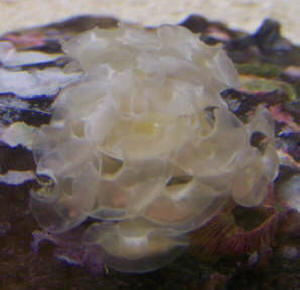
Recently, in a trip to Fort Myers Beach, in the Gulf of Mexico,
we found what we thought was a coral attached to a broken sea
shell. It was pretty and we decided to keep it, so we put it in a
bag with sea water and brought it home, to later get it used to
our tank water little by little and then just add it. I started
trying to find it online and haven't been able to do so, so I
was wondering if you could let me know what it is? We think
it's a colony of corals, but it's soft to the touch and
moves, sometimes, really slowly; it doesn't change place, but
the little "flowers" twirl around.
<Not much contrast to the picture, possibly an Ascidian colony
of some kind...Bob?>
<<Nah, Tulip Snail egg mass. See here:
http://wetwebmedia.com/MolluscPIX/Gastropods/Prosobranch%20PIX/Conchs%20Strombids/ConchF1.htm
RMF>>
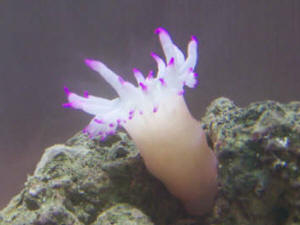
Second thing is, we bought an Eclipse System around 6 months ago,
and has been running terrifically fine until we bought a pink
anemone. I don't know if it's that the lighting is not
good enough for it, but it did very good in the first month, and
now, for the past couple of months it's been opening and
closing like it's not happy. It moved around, found a spot it
liked and opened up, then it moved again and closed up. It eats
shrimp, we defrost it in a container with the tank's water
and then hand feed it to the anemone. I've tried re-arranging
the live rock to get it closer to the top in case the light was
not going in deep enough, but it doesn't seem to make a
difference. It moves back down and kind of hides in the back of
the live rock. It's frustrating, I don't know how many
times I have thought it dead and almost threw it away. Poor
thing, I just want to make sure it's comfortable so it can do
well like it used to.
<This anemone appears to be a small Condylactis, and your
Eclipse hood isn't going to provide nearly enough light to
keep
it alive for any length of time.>
The tanks water is in perfect condition, we even got, for a
while, a bunch of pods that look like tiny white ants crawling
around, which we got told it only happens when the ecosystem is
running properly.
<Not true.>
Attached is two pictures, one of the new addition and one of the
anemone. I know you guys don't have to reply to this email,
but any input will be highly appreciated.
<We reply to all queries we receive, we do not pick and choose
which ones to reply to.>
Thanks!
<You're welcome. James (Salty Dog)>
Yvette
|
  |
|
Critter ID 4/19/09
Good day,
<Jerry>
I come to you once again looking for help in identifying a marine
critter.
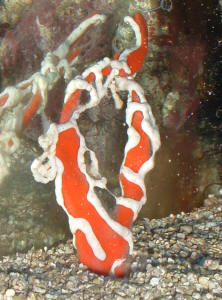
This individual was a freebie from someone that I purchased a
number of frags from. The gent told me that he thought it was
some kind of sponge, but he didn't know what genus nor did he
know anything about its care.
It's been in his tank for about 6 months with no special
handling or feeding.
<You likely have "good reef conditions", as this
looks to be either a sponge or Ascidian growing over/on another
sponge... both of which are filter feeders>
I've scoured the web and your site, but can't seem to
find anything that even remotely resembles this beast.
<Two species here>
The piece that I have is a frag from a much larger organism that
resembled fingers. My section is about 4 inches long. Any help
would be greatly appreciated.
Thanks and cheers.
Jerry
<Maybe a read here:
http://wetwebmedia.com/spongeidfaqs.htm
the linked files above, and Sea Squirts coverage.
Bob Fenner>
|
 |
|
Re: Critter ID 4/19/09
Bob,
Thanks for the quick reply.
<Thank you for this follow-up Jerry>
I did some more digging, and it seems as though this beast is
described in the UK as a Candy Cane Sponge (Axinella damicornis)
with encrusting Parazoanthus axinellae. In Canada it's known
as White Line Sponge,
(Trikentrion flabelliforme).
<I see>
In case you're interested here's a link to a discussion
on the organisms.
http://www.defineyourreef.frihost.net/forums/viewtopic.php?f=9&t=35
As always, thank you so much for your assistance and dedication
to the hobby.
Jerry
<Thank you again. Will append our prev. corr.. Cheers,
BobF>
|
|
Halimeda seeds? 4-13-09
Crew,
<Ryan>
I am a long time reader and I truly appreciate the site. I have
two identifications questions for you. The first is a golf ball
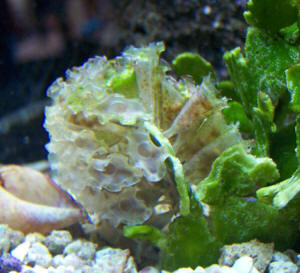
sized seed pod looking thing that came attached to a clump of
Halimeda, I have searched
plenty but found nothing about Halimeda seeds or anything of the
seed ball.
<Mmm, no... Halimeda is a Thallophyte (an algae)... reproduce
by spores... true plants (Embryophytes) have seeds>
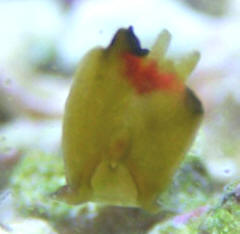
I have now noticed little green maybe Nudibranchs on the tanks
glass near the seed ball. I just want to check the IDs to be sure
I am not unleashing a plague in my tank. I know I should of
probably not put something in my tank with out knowing what it
exactly what it is but the store didn't think it was a big
deal.
Thanks for the help,
Ryan King
Current Tank setup:
AGE - three months
55 Gallon with 17 lbs live rock and 60 lbs lace.
Lighting is a 65x4 power compact.
30 Gallon sump with about 20 gallons of water in it.
The tank runs at 78F and salinity of 1.024
I used instant ocean salt mix and RO/DI water.
Current stock:
Fish: Yellow Tang and two Ocellaris Clowns
Shrimp: Cleaner, pair of Peppermint
Stars: Blue Star, Brittle Star
Snails: 20 various small cleaners
Crabs: 10 Red Leg hermits, 10 Blue Leg hermits
Coral: Xenia, GSP, Mushroom, and a few misc frags
<Looks to me to be a colonial Ascidian... the clear bunch is
dead... Bob Fenner>
|
  |
|
Correction to today's dailies -
4/13/09
Hiya Bob!
<Mich>
So I was looking at that ID question that came and talked to Lynn
about it this morning. It is definitely not a colonial
Ascidian.
Lynn found these photos:
http://www.jaxshells.org/vilano60.htm
http://www.biol.andrews.edu/EVERGLADES/organisms/invertebrates/mollusks/true
_tulip_snail/egg_cases_of_tulips.jpg
We think it is a snail egg mass, likely that of a tulip snail,
which likely wouldn't be good news for Ryan's tank to
have such carnivorous snails.
http://www.indyzoo.com/pdf/TrueTulipSnail.pdf
<Ohhh!>
And the other image which he thought were Nudibranchs look to be
Acoel flatworms, specifically Convolutriloba, similar to the
photo here:
http://macropyga.googlepages.com/convolutriloba_1.jpg
Which came from this site:
http://macropyga.googlepages.com/
and the differences can be seen here:
http://macropyga.googlepages.com/identification
Lynn found all these images. She's really great at getting
these ID's!
Cheers,
Mich
<Thanks much... Will amend on the morrow... a shame that
I've deleted the original senders email address. BobF>
He wrote back!!!! YAY!!!!! Lynn replied to him. M
<Ahh, very good. B
Re: Halimeda seeds? Egg Capsules and Acoel Flatworms -
4/13/09
Bob,
<Hi Ryan, Lynn here this evening. I sure am glad you wrote
back. My fellow crew member, Mich, and I put our heads together
this morning and came up with some information regarding the two
mystery items in your tank. The follow-up will be posted tomorrow
at the dailies, but I've included a copy here as well (see
below). The only thing I'd like to add is that we've got
lots of information at WWM regarding Convolutriloba flatworms and
Tulip snails in marine systems. Just enter the terms in our
search engine and you should be good to go:
http://www.wetwebmedia.com/WWMAdminSubWebIndex/question_page.htm
.>
Thanks for the info - I guess it shows that I am clearly an
electrical engineer and not a biologist (algae has no seeds...
doh).
<Heeheeee! No worries. I hate to think of the wholesale
Godzilla destruction I could cause if I even stepped a toe into
the world of electrical engineering!>
I do enjoy the site and your book.
<On behalf of Bob and the rest of the crew, I thank
you!>
Best Regards,
Ryan King
<Take care, LynnZ>
Re: Halimeda seeds? Egg Capsules and Acoel Flatworms
-- 4/17/09
Lynn and Mich,
<Hi Ryan, Lynn here today.>
Thanks for getting the info on my two mysteries,
<You're very welcome and by the way, thank you for writing
us and including those terrific photos.>
I know there is no way I could have figured that out on my
own.
<Well, don't feel too bad. It took several of us to figure
it out! The thing is, while we may have a certain edge because of
all the odd critters we've seen in the past, there's no
way we could know it all. There's just too much of an
overwhelming wealth of diversity and possibilities out there.
Because of that, these situations make great learning
experiences, not just for person who wrote in, but for us as
well. This was one of those cases. What made the difference was
the information and photos you supplied, along with teamwork.
Mich is not only a friend and fellow crew member she's one of
the best when it comes to identifying the various odd and
assorted creatures that hitchhike their way into our tanks.
She's a real gem!>
Your site rocks! Keep up the good work.
<Heeee -- this is way too much fun to call it work!>
Ryan King
<Take care, LynnZ>
|
|
Worms, Lost and Confused: Ophiuroids and Aiptasia --
4/4/09
Hi there,
<Hello>
First of all, I have to tell you this is a great site for
information, however, that being said, I still have some
questions about strange worms I found in my aquarium.
<Okay>
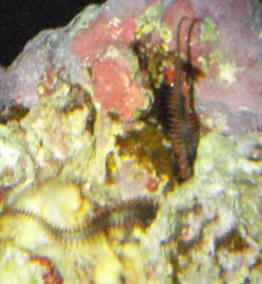
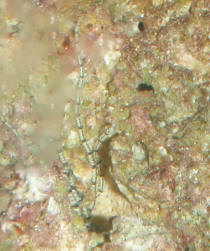
The first one is long, thin, white/yellow with brown/black bands
- photo included. Can you help me?
<Yes, it's a neat little Ophiuroid/Brittlestar of some
sort. They're common, harmless and beneficial hitchhikers
that like to find protected crevices in the rockwork and extend
their arms out into the current to catch passing bits of
food.>
The second one is definitely uglier.
<Awwww, maybe it has a really nice personality though!>
Purplish with red tinge to it, looks almost hairy - bristle
worm?
<Nope, another Ophiuroid.>
Should I get rid of them?
<No need. I'd leave them in place, let them do their
thing, and enjoy them. For more information, please see this link
(as well as those at the top of the page) for more information:
http://www.wetwebmedia.com/brittlestars.htm >
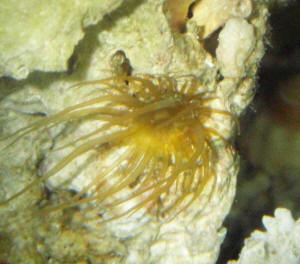
The last photo is a small anemone in the tank, would this be a
pest or one I can keep?
<It looks like a pest anemone to me, namely Aiptasia. I'd
get rid of it before it has the opportunity to spread. Please see
the following link (and those related at the top of the page) for
more information, starting here:
http://www.wetwebmedia.com/marine/inverts/cnidaria/anthozoa/aiptasia/aiptasia.htm
Please help.
Thanks guys
<You're very welcome. Take care, LynnZ>
|
 |
Newbie Question... sm. SW... maint./op., ID guessing game
sans pix 04/02/09
Hello!
I am just starting in the saltwater hobby! I have recently set up my
tank (about 2 months ago) and started my cycle. My ammonia is at .25 my
nitrite is at .25 and my nitrate is at 80, ph is fluctuating (I know
I
am still cycling). I have a 29 gallon with 1 chromis, 1 red legged
hermit crab and 1 turbo snail. I have about 15 pounds of live rock (I
know I need to add more, but I am adding it slowly).
<Wait, I'm confused... please tell me you don't have a fish
in the tank with ammonia readings! You should not be putting any
livestock into a tank that still has detectable ammonia. Ammonia needs
to be 0, no exceptions.>
Here is what I have to ask. I know that aiptasia is a pest, and I am
trying to figure out if this is what I have. I have several small
anemones, they are sort of clear, sort of brown, and the tentacles are
striped a little.
<Sounds like aiptasia. Please see here:
http://www.wetwebmedia.com/marine/inverts/cnidaria/anthozoa/aiptasia/aiptasia.htm
http://www.wetwebmedia.com/marine/inverts/cnidaria/anthozoa/aiptasia/aiptasiaidfaqs.htm
>
They are in crevices in the rocks, and seem to come out more at night
once the lights go out. I tried to take pics, but they are too blurry
to see what they are. They are so small it hard to tell if they match
the photos
that I have found online. Any help you can give me on an ID would be
great, if they are aiptasia I would like to get them out, which brings
me to my next question, it is too early to try to put the peppermint
shrimp
in my tank, right? When would be a good time to add those? Thanks so
much for all your help!
<Please see above... you should not be adding any livestock to a
tank that still has ammonia readings.>
~Susan
<Cheers,
Sara M.>
Re: Newbie Question 04/02/09
Thanks, I have looked over both of those, but none of those look like
mine exactly, hopefully soon I can get a photo,
<Hmm... are you sure they're anemones? Or, do they look more
like this maybe...?
http://www.asira.org/IMG_2062.JPG/IMG_2062-full.jpg>
if they are aiptasia I want to remove them, but if not I don't want
to have to kill anything that I don't have to. I have had my fish
in my tank for 3 days, I added him/her and the inverts after my ammonia
fell to 0 after my initial cycle with live rock and fish food.
<Oh, ok.>
My levels have went up since I added the fish and 2 inverts (a possible
mini cycle since I just added the aquatic life?).
<Yes... not good! You added too much too fast.>
I also have one of Seachem's ammonia detectors in the tank with the
colored dot that changes from yellow/safe to green/alert to light
blue/stress to dark blue/toxic and it has stayed in the yellow.
<Still... not good. I would do additional water changes for awhile
(just my humble advice).>
~Susan
<Best,
Sara M.>
Re: Newbie Question 04/03/09
Thanks! The tentacles look like that, but not nearly as long, what is
that? I will research it more if I can get a name.
<That is a "hair worm" (Cirratulids).>
But it does pull itself back in the rock sometimes, and then it looks
like a bubble, sort of clear, sort of flesh colored.
<Then it's not likely a hair worm, but an anemone. Do try to get
a picture if you can (maybe a friend with a better camera can
help?).>
The guy at the reef store said I would be okay! From here on out I will
go one at a time,
<Good idea, "better safe than sorry.">
I don't want to stress anything in there. I did mix up some water
last night too so that I can do a water change later today.
Thanks again!
~Susan
<De nada,
Sara M.>
Re: Newbie Question 04/03/09
One other thing, whatever this is that I have comes out mostly at
night.
About a hour after the lights go out it is all over 3 of my rocks, I
have been looking with a flashlight (all from the same store). When the
lights are on most of them are retracted into crevices. I have looked
online but can't find if that is a common trait of the aiptasia or
not. Thanks.
<Well, it's more common for worms to do this. But you said the
animal retracts into a flesh-colored blob/ball-- that sounds like an
anemone. So I really don't know what to tell you. We need a picture
here. :-)>
~Susan
<Sara M.>
|
|

