|
|
| Home | Marine Aquariums |
Freshwater Aquariums |
Planted Aquariums |
Brackish Systems |
Ponds,
lakes & fountains |
Turtles & Amphibians |
Aquatic Business |
Aquatic Science |
Ask the WWM Crew a Question |
| Please visit our Sponsors | ||||
Calcium Chloride/Calcium And Alkalinity
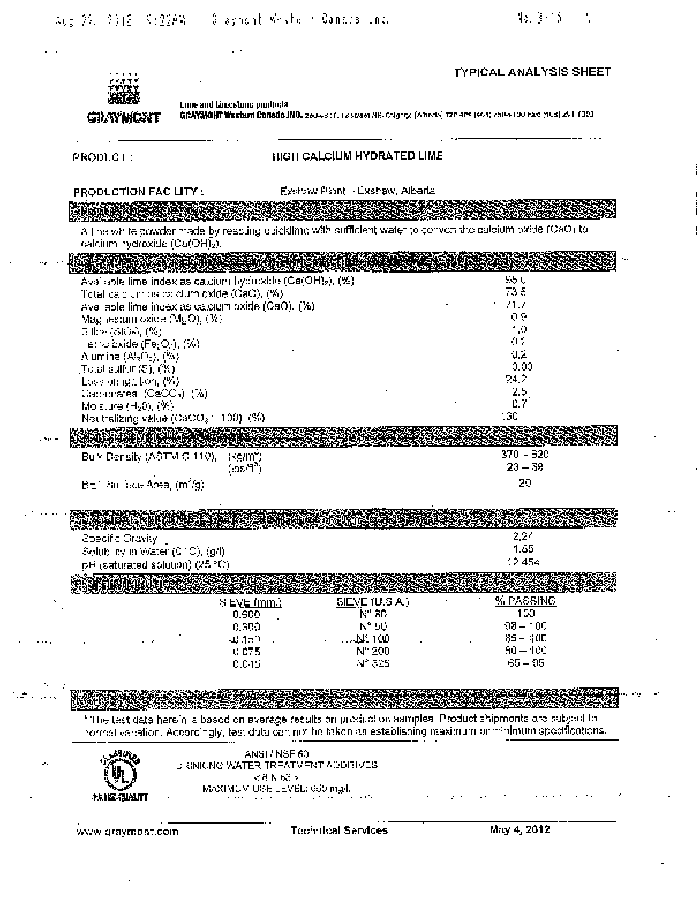
12/12/09 Calcium Oxide (Making Calcium Hydroxide) 01/22/09 At work I have access to food grade Calcium Oxide CaO (lime). I believe when calcium oxide is mixed with water it is Calcium Hydroxide (Kalkwasser mix). <<A bit oversimplified but yes, the Calcium Oxide reacts with the water during a process called slaking to form Calcium Hydroxide. The byproduct would then again be mixed with water to make the Kalkwasser>> Can I use this instead of Kalkwasser? <<Wont be instead of If you go to the trouble to slake the Calcium Oxide, then the byproduct will be Calcium Hydroxide (Kalkwasser powder)>> I know a concern for Kalkwasser is that there could be harmful impurities in the raw material. I have the Certificate of Analysis for this Calcium Oxide so I know that this material has very low to no harmful impurities. <<Considering most of the organisms we keep can detect values in the parts-per-million, even parts-per-billion rangehaving very low harmful impurities can be quite significant. But even so, this food-grade product is likely fine, and certainly no more of a risk than the grocery store pickling lime used by many hobbyists>> I just wanted to get advice from an expert before I go and do a little experiment at home. <<Im no chemist, but the reaction of the Calcium Oxide and water will generate a lot of heatand reportedly about double the volume of the solid material. I also do not know how violent (if at all) this reaction will be. I suggest any experimenting be done outside with very small amounts until you get a feel for the process. Be sure to wear eye and skin protection (as a base substance, the Calcium Oxide/Hydroxide is more damaging to your eyes than an acid!) and do research the slaking process before you start. And though not as readily accessible as he once was, you might also see if you can reach Randy Holmes-Farley (a reef hobbyist AND experienced chemist) over at Reef Central for his take on what you want to do>> Thanks for your help. Love the website. Matt Columbus, Ohio <<Happy to share mate. EricRColumbia, SC>> Calcium, calcium, where for art thou? 6/10/08 Thank you, Bob!. I read through this material last night. If I've interpreted it correctly, you recommend overall water chemistry stability, with a 350+ calcium level, more importantly than a fluctuating water chemistry due to attempting to ratchet up the calcium level? Also, use C-balance and B-ionic instead of the Purple-up? <Ahh, yes on all counts> (Not familiar with them so I will research what each is for and use the appropriate or both). <Do save your time and sensibility by converting brand names to actual common chemical constituencies... you want to largely avoid Calcium Chloride... need carbonate/s, bicarbonates (yes... even that old timey Armand Hammer product can be of use...)... as well as a modicum and proportionality of Ca and Mg.> Will also look into a calcium reactor/Kalk drip. Why not...I've got just about everything else "under the hood" at this point. lol <Heee! A very useful tool> I do already have a refugium with about 3 inches of a "Fiji mud" base. Currently, there is nothing in it as the red/purple Caulerpa I had in it for a long time turned into a bubble coral factory. Been trying to find a replacement, but it's been difficult. <... Not so... I'd put at least a few to several inches of fine carbonate sand under the mud... Switch from Caulerpa to Gracilaria or Chaetomorpha... See here: http://wetwebmedia.com/refugalgfaq2.htm> As far as a replacement adoptee for the clowns, it would seem a bad idea to place an LTA in with all of my corals. Any suggestions as to what may be a good replacement? <Screen the Plerogyra for now and let the Premnas choose> I know they do not need one, but if I can make them a little happier, why not? <Indeed> I'll be moving into a new home this December. The LFS (Aquarium Adventure or The Living Sea) both have services to move the tank. I'm going to check out your site for any hints on this moving process then see if I have any specific questions. <Have done my share and our old co.s "Action Plan" for doing so is posted on WWM> Thanks, Greg <Welcome. BobF> Re: Calcium, calcium, where for art thou? (Follow up) 6/13/08 Hello again Bob, <Greg> I'm taking your advice and going to focus on developing my refugium. Currently there is about 3 inches of Fiji mud in it. The mud has been in it for 19 months and along the way housed some purple Caulerpa, green Caulerpa, and too much bubble algae. Do you recommend adding some booster mud or replacing? <Maybe a bit more> Right now, each of the four refugium walls is lined with green coralline algae...and a little hair algae to boot. Besides a 10 pound piece of live rock and a good number of bristle worms, it's empty. I've alerted my LFS stores and LiveAquaria.com to email me when some Gracilaria or Chaetomorpha is available for purchase. In the mean time, I have located some Halimeda to start with. Before that, I want to add 3 inches of oolitic sand underneath the mud. This should leave me with a depth of 5 inches of saltwater? Is that too shallow? <Mmm, not too shallow... I might raise/trade another inch of water for another of substrate though> Am I missing anything important with regard to placing the oolitic sand under the mud? 1) Rinse the new oolitic sand with...saltwater, R/O water or tap water? <Just tap> 2) Shut down 150 main tank water flow. I'll keep the Wavemaster running the 6 powerheads for some water movement and oxygenation in the main tank. 3) Siphon out some of the water in the refugium area so the disturbed mud will not flow into the sump area. 4) Move the mud from the left half of the refugium on top of the right half. 5) Add 3 inches of oolitic sand to the bottom of the refugium then move the mud back on top of it. 6) Repeat step 4 and 5 for the right side of the refugium. 7) Replace the 10 pound piece of live rock and add the Halimeda. 8) Let the mud settle. 9) Restart the water flow. From reading up on WWM, I didn't see any problems with using Gracilaria, Chaetomorpha and Halimeda in tandem? I understand that a good calcium level is a must for the Halimeda. <Likely one, two of these will be favored over the other/s... but no worries re> Thanks so much for your help! Have a great weekend! Greg <Ah, thank you. Back out for a petfish pitch... This time with Frank Burr out to Phoenix. Bob Fenner>
Water changes in/and calcium supplements 02/19/2008 Hello, <<Hi Tom, Andrew today>> I have a 40 gallon reef. The stony corals I have are a frog spawn with about 10 heads, the entire specimen is somewhere between the size of a baseball and a softball. I have two Montipora caps about the size of my hand, one red, one green. I also have a Montipora digita about the size of my pinky finger. I have a aragonite sand bed that is about 3" deep. I have done a fair amount of research regarding calcium and alkalinity. I am wondering if changing 5 gallons of saltwater per week might be adequate to maintain my calcium and alkalinity levels. If not what kind of calcium supplementation method would you recommend for this size of aquarium. <<A 10% per week water change is about an average to go for on a marine system. Of course, calcium levels are only properly known by testing your water, and buffering calcium as needed on a weekly basis, or even daily, depending on the uptake of calcium. Kent marine or Seachem calcium products should do you good service for replenishing the calcium in this tank>> Thanks a lot, Tom <<Thanks for the questions Tom, hope the above helps. A Nixon>> Pickling Lime Use 10/17/07 Hello James, First I would like to say that I'm a big fan of wetwebmedia.com Q & A. The new UV Lighting website is under construction. Our T-5 lamps have a versatile operating range that allows the lamp to run at normal wattages (e.g. F24,F39, & F54) in most fixtures & a higher wattage specifically with the IceCap ballast. Open the spec sheet attachment to see the lamp types available. I have one question maybe you could answer for me. Have you used Mrs. Wages pickling lime for Kalk top off water? I'm trying to find a cheap quality Kalk substitute. Thanks, Jeremy McLellon <<Hi Bob, I asked for some info on T5 V-HO lamps and was asked a question about Mrs. Wages pickling lime. Any thoughts on this? See attached email below. Regards, James>> <Looks good... Good to ask. BobF> Yes, but what about the pickling lime, you know of anyone that ever used it to raise calcium. Seems like I've heard of it quite a while ago, but not sure. Jim <Is still widely used by some aquaculturists of biomineralizing life, and quite a few hobbyists I run into. BobF> Calcium additions 12/8/05 Mr. Fenner, First, I'd like to say I'm a big fan, I have enjoyed reading both your Conscientious Aquarist book and articles for some time now. I currently have a 24 gallon nano cube aquarium, up until this time I have only a limited experience with dosing and do not feel very comfortable with it. However, I have begun keeping more stony corals and realize their need for sufficient calcium. <And Alkalinity! Calcium and alkalinity should always be added in a balanced fashion. Kalkwasser is one of the best ways. In many cases, simply using Kalkwasser to replace evaporation will meet all of the needs for calcium and alkalinity. Other options include two part additives like B-Ionic or C-Balance. Two part additives are very convenient and easy to use, but are relatively expensive. Calcium reactors are also an option, but are not practical for such small tanks.> I would feel most comfortable with a crushed coral/aragonite substrate to provide both a buffer and calcium source for my tank, but I currently have an established tank with a thin LS substrate. <Crushed coral is a poor choice for many reason. Fine grained aragonite is better, but no calcific substrate will meet all of the needs for calcium and alkalinity. They simply cannot dissolve fast enough, even deep in the bed.> I have read as much as possible but am still confused by the seemingly endless options before me. What I am considering is establishing a considerable aragonite DSB in my refugium or possibly mixing the substrate directly into my LS. Am I getting this all confused or will either of those solutions work? Sincerely, Derek Rooney Silver Spring, MD <It is quite easy to get confused! While there are many benefits to DSB's (I recommend them, especially in refugia), including some modest support of Ca and Alk, they usually cannot meet all of the needs of the corals. Kalkwasser and two part additives are your best bets. Lots of information about their use is available at WWM and elsewhere on the web and better brands include excellent instructions for their use. Best Regards. AdamC.> Calcium Supplementation in a Small Tank - 09/03/06 Hello. <<Howdy>> I've read in your articles that with frequent water changes supplementation of calcium, strontium, magnesium and other trace elements is not necessary in salt water tanks. <<Many times this is true...but it is highly dependent on the amount of calcium assimilating life in the system and the frequency/volume of the water changes>> I am thinking of slowly changing my FOWLR tank into a reef tank. Would the above still be the case in a reef tank or is supplementation required when you begin adding corals? <<Will depend on the quantity and the species...but it is easy enough to perform water tests to determine a need for supplementation>> Just to give you some info on my tank it is a 10 gallon with 15 lbs of live rock and 50 watts of power compact lighting. <<Ah, I see...a tank this size rarely if ever requires supplementation as it is quite simple and inexpensive to perform adequate water changes to keep up with mineral demands>> Thanks for your time. <<Quite welcome. EricR>> High Calcium Levels 2/22/07 Hi...crew, <Hello Mike> I have a 54 gallon corner bow reef tank that has been up and running for about 9 months now. My problem, for which I haven't been able to find an answer to, is this. I seem to have a very high level of calcium. It's over 600 on two different test kits. Despite this high level of calcium I have very little coralline algae growth. My LFS thought I might have low levels of magnesium but I tested it and it is extremely high over 1500. Any thoughts about what's going? I'm using a RODI unit and buffering the top off water. Also, for what it's worth, my lighting is a 250w metal halide with a 20k bulb on for 12 hours a day. Thanks for taking time to read this and thanks for such an outstanding website. <A few questions Mike. What brand salt are you using, which brands of test kits did you test with, and, are you presently dosing calcium and magnesium? And, for the halibut, do you read any calcium level on your RO water before mixing the salt? James (Salty Dog)> Mike Our method of adding calcium - 2/2/05 I absolutely love this site. <Awwww. Thanks. We love it too. A valuable resource for information.> You are awesome... I currently have a 240 with some softies and some mushrooms. I use Ocean's Blend two- part system for calcium. <As good as any I guess> Should I do this everyday or watch the levels? <Watch the levels. I suspect that since you only have softies in the tank that the calcium level is likely stable> Is this even a good way to get good levels of calcium? <Well.....my favorite is......ready for it.......a water change! That's right.....a water change....> Because I want to setup a 90 gallon that is mainly SPS and clams... Reading through your site a reactor is the way to go. <A good consistent source of calcium with less daily fussing over the tank, but the absolute easiest way is to maintain the overall water quality by changing the water regularly. Keep an eye on the levels. As soon as they start to drop you could change the water 10-20 percent. Of course it really depends on how fast and drastic the change is. Sometimes a water change isn't enough> But I don't really want to spend the money. <Understood. Well, saltwater aquariums is not exactly the cheapest hobby, but a water change might be your best bet, second to Kalkwasser in the freshwater makeup solution> Will the two part system be enough for SPS with the addition of eco-systems reef solution? <Yes, likely> Thanks you so much.... <Hope this helps. Any of the above would/will work. Now, which is the most cost effective and the easiest for you to administer. Also, is the proper application for your needs. If a drastic change is needed then the two part is a good bet or if the levels drop due to lots of coral and clam use. One of the more stable ways and easiest to administer is the reactor. Lastly you can use water changes and Kalkwasser in the makeup water if you like to fuss a little bit more but it is tried and true. I add nothing to make tank but makeup water (daily) and seawater (water change) I have an all SPS and clam tank. Sorry for the long drawn out answer but wanted to clarify. Thanks for being part of it all! ~Paul> New Setups And Calcium - 07/27/05 Having read pages of your dialogue with other reefers, before I ask you anything, I have to thank you for all the stimulating advice/discussion. <<We're happy to help...>> I just completed a wooden stand designed to support a 55 gallon tank over a 75 gallon tank. Over the next month I will set up a refugium in the 55 to gravity feed the 75 main display (80 lbs. of rock) and filter the entire arrangement with a small 20 gallon sump (approximately 24") under the 75. <<Great!...love the fact you're adding a large (respectively) 'fuge. Would like to see a larger sump (you'll eventually wish you had the extra space...for media reactors, etc.), but I'm glad you're not doing it the other way around.>> My original plan was to install a plenum and DSB (6") in the fuge using the method prescribed on your website, and a DSB (5") in the main display with sugar sized aragonite sand. I am aware of the benefits that can accompany good water circulation, bugs, and detritivore kits in conjunction with a DSB. However, this will be my 1st tank. <<So glad to see you're doing some research.>> I have a few questions. First, is this too much DSB? <<Not in my opinion.>> Second, is there anything that I can do while setting up the plenum and DSB in the 'Fuge that might induce the release of more calcium into the system from the aragonite in the substrate? <<Other than not rinsing the "fines" (these will dissolve more readily) from the sand, no.>> Or is there any other substance that I could scatter in the DSB substrate that might be naturally dissolved by the normally occurring gasses/processes in the DSB resulting in the release of more calcium? <<The aragonite sand is already your best option. Why all this concern with calcium at this stage? Your tank will have plenty of calcium from the salt mix/aragonite in the system during the cycle period.>> Third, what method of dosing calcium would you recommend for a beginner with this kind of system? <<Frequent partial water changes...really! Until the tank is stocked and you have an idea (through testing) of the demand on your system for calcium, etc., frequent partial water changes will supply what you need. If your testing determines you need to supplement calcium, the two-part additives work well for small dosages (gets expensive otherwise), else you might consider Kalkwasser or adding a calcium reactor.>> Thanks again. <<Regards, Eric R.>> High Ca? Hi gang. OK so tell me, is it normal for my Calcium reading in my freshly mixed replacement water to be at 440 ppm (Salifert test kit)? <high but not yet dangerous if you keep your ALK level under 10 dKH. I assume that your tap water is very hard naturally> I use Instant Ocean. My Alk reads 10 dKH after buffering with PH-guard as I use purified water. <ahh... good but do ease up a little on the buffer while Ca is so high. 8 or 9 dKH would be a little more comfortable> My tank reading that has no fish yet, just 5 turbo snails, reads above 500 ppm Ca and a low 6 dKH Alk (using Kent pro buffer to raise this). <the skewed dynamic is believable but not ideal (neither can be on the high end simultaneously... but this is too far skewed)> Just did a water change but nothing's changed. <all is within your control as you are reconstituting purified water from source. Aim for 350-425 ppm Ca and 8-12 dKH ALK but not the high end of both> I'd like to get the right balance before adding any fish. BTW is this CA / Alk balance necessary if one just keeps fish and a few snails / shrimp and LR? <more important to keep stable/consistent... regular water changes will do this. Weekly is much better than monthly> thanks soo much...again, Justaguy <best regards, Anthony> Re: High Ca? Anthony, Thanks for the reply. I just tested my tap water and it is at the very soft end. So how do I lower my Ca if my freshly mixed seawater reads 440 ppm? If I do nothing to my purified water, the PH reads 7.0 and the Alk is very low. thanks <you need to confirm the accuracy of your test kit. It using soft purified water and not adding Ca... it is rather unlikely you can get an actual reading of 440 ppm Ca from Instant Ocean sea salt. But... it is true/correct... 440ppm is actually a fine Ca level. Just don't add Ca to go much higher. Best regards, Anthony> Calcium (and iodide/iodine) hello guys, I have a quick question. am a bit confused about the difference between iodide and iodine as supplements for my shrimp. <different forms in solution. Iodide is "safer", Lugol's solution is a nutritive Iodine and more potent. Bob favors iodide, I favor Lugol's (iodine mixed with iodide)> calcium, do ya need it or does the sand, shells, etc in tank supply it.. <depends on draw from inverts in the tank... if low demand, water changes will bring enough in ... but do get a calcium test kit and aim for 350-450 ppm (the low end is fine)> thanks a lot. I only have two clowns two snails and two cleaner shrimp......Jennifer <ahhh...yes. Save your money for now on supplements. A small weekly water change will give you these benefits and so much more. Anthony> Calcium additives?Pardon my intrusion, but I would like to hear your opinion re: calcium additives.<In a nutshell... they're worthwhile... two part better than one (i.e. separate biomineral and alkaline input components), with several variations of calcium reactors all being superior in turn...> I have a fairly low-load tank with mostly soft coral. I do have a Frogspawn and Favia Brain. I have been looking at a couple of liquid calcium additives, but I've heard mixed reviews of these products. <Good for your efforts> I have heard very good things about Kent's 2 part calcium/alkalinity system and thought I'd ask your opinion. <Safe, effective formulations... with testing, knowledge of what you're doing, and regular (diluting) maintenance> I know dosing Kalk seems to be the most widely accepted method, but I have a 4-year-old daughter and I'm not keen on the idea of keeping a vat of Kalk in the house. <I agree with you... calcium hydroxide... better for use in cleaning ovens (like the more common sodium(OH)... Kalk will soon be a bad memory of the hobby... and a large deposit in the bank acct.s of those who have been unscrupulous enough to hawk it> I am a diehard "low maintenance" fan and I am willing to forego the addition of more calcium dependent critters if there is no simpler way of introducing the calcium to my tank. I am currently using Thiel's Vital Gold and Iodine supplements, so I don't have any concern with strontium or the like, just calcium. <There are a few other ways of getting "enough" carbonate, bicarbonate, calcium, magnesium, strontium into your water... like much more live rock, a refugium/macroalgae filter, deep sand bed of fine Aragonitic material, plenums... All pale in comparison to using calcium reactors... Trust me... as the next few years go by, computers will become faster and cheaper and folks will be using Ca reactors> Please reply to this email if you have a moment. I would really appreciate it! Thanks, Becky McAlister <Be chatting my friend. Life to you. Bob Fenner> Ca in salt mixes I will keep on looking. Is it easy to convert the Aqua-Medic de-nitrator to a calcium reactor? On the picture they look surprisingly similar. <The body of the unit is similar... the conversion not so easy, but possible.> The thing that puzzles me is:- I notice the coralline algae grows quite well after water changes. This is all I do at present and you can see what the tank looks like on the "My fish tank" web page. I have good coralline algae growth. I just want more! I assume (I could be wrong) that there is something in the Marine Environment salt that helps the coralline algae grow? <Sure, in all salt mixes "worth their salt" (sorry, couldn't resist), there is more alkalinity, free calcium... than natural seawater... this likely is the "boosting" material> Maybe I could just add some extra of whatever it is in the salt? I would still do my water changes every 2 weeks. <Sure> I also notice that my calcium levels increase after water changes. What is causing this? <The contents of the salt mix> If water changes are improving the growth rate of coralline algae and increasing calcium levels, then there is something in the salt that I can dose the tank with? That is what is puzzling me! <Don't be simply puzzled my friend. Test the new seawater, compare its constituents with your "used" water.> Warmest regards Lucien Cinc PS: As I have been learning more and more, I am starting to think that the tank as it has been setup is using the Berlin methodology: Lots of live rock + lights + water movement + calcium + skimmer? <A very simple, effective, stable approach. Bob Fenner> |
|

|
Features: |
|
| Featured Sponsors: |