|
FAQs on Marine Algae Identification
17
Related Articles: Avoiding Algae Problems in Marine System,
Algae
Control, Marine Maintenance,
Nutrient Control and Export,
Marine Scavengers, Snails, Hermit
Crabs, Mithrax/Emerald
Green Crabs, Sea Urchins, Blennies, Algae
Filters, Ctenochaetus/Bristle Mouth
Tangs, Zebrasoma/Sailfin Tangs,
Skimmers, Skimmer Selection, Marine Algae, Coralline Algae, Green Algae, Brown
Algae, Blue-Green
"Algae"/(Cyanobacteria), Diatoms, Brown
Algae,
Related FAQs: FAQ ID Visual
Guide, Marine
Algae ID 1, Marine Algae ID 2,
Marine Algae ID 3, Marine Algae ID 4, Marine Algae ID 5, Marine Algae ID 6, Marine Algae ID 7, Marine Algae ID 8, Marine Algae ID 9, Marine Algae ID 10, Marine Algae ID 11, Marine Algae ID 12, Marine Algae ID 13, Marine Algae ID 14, Marine Algae ID 15, Marine Algae ID 16, Marine Algae ID 18, Marine Algae ID 19, Marine Algae ID 20, Marine Algae ID 21, Marine Algae ID 22, Marine Algae ID 23, Marine Algae ID 24, Marine Algae ID, 25, SW Algae ID 26, SW Algae ID 27, SW Algae ID 29, SW Algae ID 30, SW Algae ID 31, SW Algae ID 32, SW Algae ID 33, SW Algae ID 34,
SW Algae ID 35,
SW
Algae ID 36, SW Algae ID 37,
SW Algae ID 38,
SW Algae ID 39, & Marine Algae Control FAQs 2, Marine Algaecide Use, Nutrient Limitation, Marine Algae Eaters, Culturing Macro-Algae; Controlling: BGA/Cyano, Red/Encrusting Algae, Green Algae, Brown/Diatom
Algae,
|
|
 |
New Print and
eBook on Amazon
Marine Aquarium Algae Control
by Robert (Bob) Fenner
|
|
Algae Identification 3/25/20
Bob,
<Eric>
How are your algae identification skills?
<Much better decades back when I was actively taking phycology classes in
college>
I had a confirmed case of Ostreopsis in one of my tanks that I thought I was
able to eradicate.
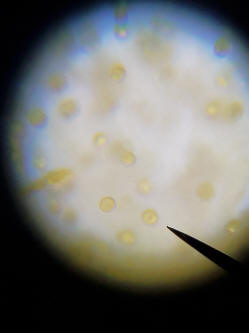
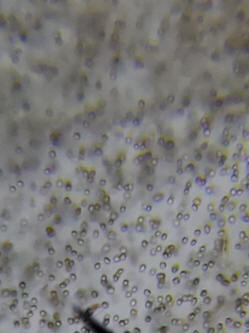
Recently the slimy snotty algae started to come back but it doesn't look
like dinoflagellates under the microscope. Any ideas what it may be?
<Need more magnification to see flagella... Doesn't look apical nor clear on
one end to be Ostreopsis... have you tried staining (with iodine et al.?) to
determine storage food?>
Thanks,
Eric
<Bob Fenner>
|
 |
|
Re: Algae Identification
3/25/20
I haven't. The yellowish photo was taken 40x which is as powerful as my
scope is. It definitely doesn't move. I am thinking it could be some type of
chrysophyte.
<Maybe; not as common as Dinos. B>
Re: Algae Identification 3/26/20
Curious as to what your recommendation would be to get rid of them.
<Posted on WWM>
After my tank was riddled with the Ostreopsis I raised nutrients way up,
nitrates 40/ phosphates 1.02, and blacked out the tank.
<... won't do it. What's going to happen w/ these and other nutrients?
They're still there... once light is available, like Ahnold, they'll be
back>
At least under the microscope the Ostreopsis is no longer there. From my
understanding Chyrsophytes share a similar mechanism as Dinoflagellates.
Should I bring the nutrients down?
<Yeah; a few ways to go, and other... read here:
http://www.wetwebmedia.com/algaeconMar.htm
and the linked files above. BobF>
|
|
What is this? 11/7/18
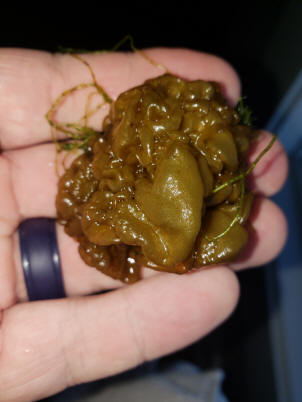
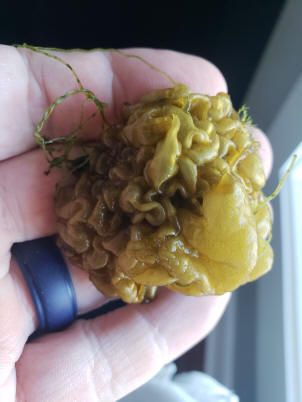
Hey. Do you know what type of algae this is? It's an oddly firm texture and
grows in clumps varying in size 2-4" like heads of cabbages or something
similar. Solitary clumps attached to the walls in refugium under a Kessil grow
light where there is Chaeto growing but nothing else intentionally added. Thank
you!
<Hey John! This is so reminiscent of the genus Colpomenia to me... A Phaeophyte
for sure. Not harmful but likely scarfing up most all iodide/ate you're adding.
I'd keep it trimmed back therefore.
Thank you for sharing, Bob Fenner>
|
  |
|
Re: What is this? 11/7/18
That's interesting as the Iodine was low (icp test) so I dosed it and two weeks
later there were these.
<Ahh!>
Thank you for the info!
<Welcome! BobF>
|
|
Diatoms or Dinos 8/22/15
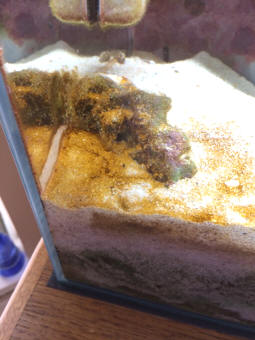
I need help identifying this ‘brown stuff’ on my sand-bed and rocks.
<Can only tell; and it's simple to do; with a look/see through a
microscope... See WWM, books I've penned re>
I’m not certain if it is diatoms or Dinos. (or possibly brown Cyano?)
<My guess is on Dinoflagellates, but could be....>
I am pretty certain it is not diatoms, but I wanted to be sure.
<Slimy? If not, not BGA>
I have attached a pic of my refugium however this stuff is rampant in my main
tank as well (75 Gallon Reef-ready).
Some info…
Tank is 2 years old.
RO/DI water using ‘Silica Buster Resin’ by SpectraPure. (measures 0ppm PO4 and
0ppm Silicates)
<Do you have other chemo-photosynthetic life (on purpose) here? They will need
HPO4, NO3...>
All filters and membranes are 3 months old.
TDS measures ‘0’. TDS meter calibrated with calibration fluid, not distilled
water.
<Okay.... will not be 0.0 in the system, and with time, added foods,
supplements....>
Currently running carbon and Phosguard.
<Not a fan.... more bio., less tech.>
Vertex Omega 150 skimmer
Emperor Aquatics 25 watt sterilizer (new, 1 week old).
I use HW Marine Mix Reefer salt, 1.025 SG
Nitrate = 0ppm (Salifert)
Phosphate = 0ppm (Hanna Checker)
Alk = 10dKh (Hanna)
Calcium = 425 ppm (Hanna)
Mg = 1400 (Salifert)
Silicate = 0ppm (Salifert)
Maxspect Gyre 150XF and Tunze 6055 for flow.
Maxspect Razor 420 x2 (50% both channels 4 hours per day).
I siphon the sand bed (to include sand removal) however this stuff returns
quickly.
It DOES mostly disappear at night, only to return in the morning with the least
amount of light.
I was doing 20% water changes weekly.
<About right>
Attempted to go 2 months without water changes thinking it was Dinos.
This stuff is driving me crazy!
<Would you read if I referred you? What avenues do all have? Restriction of
nutrient, light, more circulation.... competitors, predators....>
I use filter socks and changes them daily!
<Good>
It is beginning to smother corals.
<Actually; no... your actions are at base here.... SEE/READ re my stmt.s
above... you're starving the "corals"; giving the Thallophytes precedence>
I can blow it off with a turkey baster but it returns very quickly.
However, ‘increased flow’ doesn’t do much except unless I blow the sand
everywhere.
3 days of complete darkness helped at first but they returned within a week.
The remaining snails I have seem to be in ‘suspended animation’.
<Also symptomatic... they're being poisoned by the unpalatable algae....>
They haven’t moved for weeks. If I flip them over I can see they are still alive
(or dying slowly). I’ve been reluctant to add more CUC in case it is Dinos.
I’m hoping a positive identification would help me in this battle.
<Not what you really need.... Are there friends, folks, the LFS nearby who can
come by and give you some one on one? I'd be reviewing the set up.... adding a
refugium w/ DSB, RDP, macro-algal culture, ditching the chemical filter media...
And putting some time into reading some worthwhile articles, books>
Thanks for your help in advance!
<Am hoping to save you leaving our hobby.... do consider what I've written here;
and do write back w/ specifics, your progress as time goes by please. Bob
Fenner>
|
 |
|
Re: Diatoms or Dinos 8/22/15
Thank you for the quick reply!
<Welcome Matt>
The pic I sent was a pic of the ‘brown stuff’ in my refugium.
<Mmm; I'd make that bed much deeper... likely by adding a few inches of very
fine coral sand>
It is plumbed into the sump. That brown stuff grows in both refugium and display
tank.
The refugium has about a 4” sand bed. Is that deep enough?
<Not really. See WWM re particulars. Sorry to state, I/we just don't have the
time to re-key...>
Currently the refugium is NOT on a RDP. I guess I should change that…
<Oh yes I would>
When I do not run GFO or Phosguard, PO4 creeps up. I was blaming that for the
‘brown stuff’.
<The RDP macro-algae culture and increased DSB will solve this in a few weeks
time>
I was running carbon ‘in case’ the Dinos were releasing toxins.
<Good point>
Yes, I will read anything I can get my hands on! Please!
<Do you see the search tool on every page on WWM? The indices?>
Will a simple microscope from Amazon work for ID?
<Yes... the QL et al. series are cheap and excellent... again, covered on WWM.
B>
Thanks again for your help.
Matt Kasperski
|
|
Alg. ID, likely BGA 10/15/13
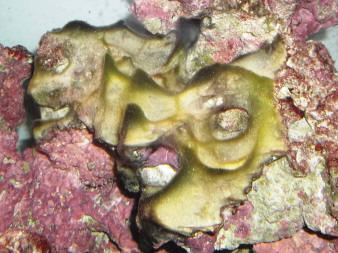
Hi, I know this is not the greatest picture..., but can you tell
me what type of Algae this is.. it seems to be fleshy like and grown
really fast..... I have had my tank up for years and never had this type
and now it is showing up everywhere... how do I get rid of it and what
is it????
<... do you have a microscope? Is, does it feel really slimy? This is
highly likely BGA, possibly a sponge plus...>
Thank you for all your help and any products I can use to treat for
this...
I have just fish, shrimp and hermit crabs in the tank with live rock...
<... none of the above will eat this. There are quite a few FAQs files,
articles on WWM for free for you to peruse. Otherwise I do have a new
eBook out on Amazon re marine algae, control in aquariums.>
Thank you for your knowledge and great information to all on the crew.
Paul
<Welcome! Bob Fenner>
|
 |
|
Algae Question Identification, and control
3/22/13
Hi there.
<Hi David. Jordan with you today.>
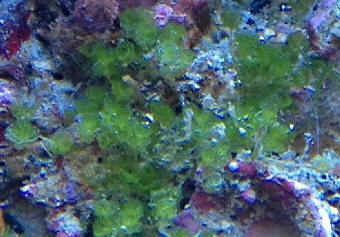
Wondering if anyone there knows what type of algae I have in this
picture and what the best clean up crew suggestion for it is.
<Appears to be Caulerpa verticillata. I have read reports of some species of
Tangs and Rabbitfish eating it but they are few and far between. I would
recommend manual removal. Remove the rock and scrub with a stiff brush. Be
sure to remove all of the algae, including all rhizoids/rhizomes, and rinse
with clean saltwater before adding back to tank. This will likely take
multiple attempts before it is successfully eradicated. Hydrogen
peroxide dips will kill it, but the dip will kill all other life as well.>
I have set up a new tank and just finished my cycle with Florida
live rock and this stuff is starting to grow out of control.
<That is what Caulerpa does.>
I am ready to add my cleanup crew but need to know what will conquer
this stuff the best. I appreciate any help! I have
included some pictures below. Thanks!
<Quite welcome.>
David Rudman
<<Well done Jordan. BobF>>
|
Re: Algae Question Identification
3/22/13
Thanks Bob!
David Rudman
<Welcome David. BobF>
Re: Algae Question Identification 3/22/13
Jordan said Caulerpa verticillata. Which do you think is more
likely the match?
<I believe his is correct. B>
Re: Algae Question Identification 3/22/13
Just Googled pictures. It definitely is Caulerpa verticillata.
<Ah yes>
David Rudman
|
Diatoms?: how to proceed 8/23/07 Dear Crew,
<Mark> I know the information is on your web page; I just
can't seem to put it all together. Tank parameters: 90gal set up
for 3 years. Have always seemed to have an algae problem of one kind or
another since automatic fish feeder fell in the tank while I was at
work 1.5 years ago. Water flow is approximately 1500 gph Filtration:
sand and protein skimmer pH 8.2-8.4 NH3=0 NH2=0 Alk=9dKH
NO3=undetectable with Aquarium Pharm. PO3=undetectable with Aquarium
Pharm. Calcium=400ppm 5 gallon water changes weekly Livestock: 4"
yellow tang 3" flame angel 2" cleaner shrimp 2 species of
Montipora 3 species of Acropora 2 species of star polyps 1 frogspawn
colony Three weeks ago I added Kalkwasser to replace evaporation since
my calcium levels were a little low (350ppm vs. the 400ppm as present).
Two days after I added the Kalkwasser I noticed my BGA was replaced by
what I believe to be diatoms (I looked at them with a microscope and
found they were too large to be BGA, but did not appear as symmetrical
as I would expect from diatoms. <Bacillariophyceans are
distinctive... as you state> Cells were oval shaped with only one
plane of symmetry). <Not diatoms. Were organelles, nuclei
apparent?> Also, many of them float to the water's surface
during the day; less or not at all at night. The SPS don't seem to
be affected but the frogspawn and star polyps don't look very good
(stay closed most of the day). <Yikes...> In an effort to rid my
tank of this bloom I replaced my DIY protein skimmer with a Tunze DOC
9005, added an inch of 1-3mm aragonite sand (it was down to 2.5), and
switched from tap water to RO that I buy from the LFS. I also added a
small clump of Chaetophora to my tank. <Really? Am assuming you
mean/t the genus Chaetomorpha> What should my next step be? Keep up
with the water changes and wait it out? <Yes, I would... unless the
Stony Corals continue to "look bad"... in which case I'd
effect another, larger water change and use carbon in your filter flow
path> Buy some new live rock and/or order live sand activator to
recharge my system with small detritivores? <Also a good move>
Was this caused by the CaOH precipitating PO3 thus killing the BGA and
leading to a diatom bloom? <Possibly... but not diatoms... some
other Protista> Thanks for a wonderful website, Mark <Do send
along pix if you can. Bob Fenner>
Re: Diatoms?: how to proceed 8/24/07
Hi Bob, <Mark> Thanks for your quick reply. I forgot to mention
that I also stopped adding Kalkwasser a few days ago. As a result the
pH in my tank reverted to pre-Kalkwasser readings: 7.8 in the morning
and 8.2 in the afternoon. Also my calcium increased to 420ppm. This
could be due to experimental error (difference in reading of only one
drop) or due to increase calcium solubility in the lower pH. <Better
to look into bolstering alkalinity slowly through your water changes
over time here...> The corals do look a little better today, but I
am concerned about this Protist bloom. I looked at a sample I took from
the bottom of the tank (first time was from top/dead) and found that
when alive they are very mobile. <NOT Diatoms...> It looks like
they use cilia for locomotion. Also they seem to contain brown
chloroplasts and a nucleus. Enclosed is a Word document with a picture
pasted onto it. Are there any good herbivores for this? <I see...
more likely Dinoflagellates...> I am afraid to buy fresh live rock
at this point because I think it would become smothered. <Mmmm>
Thanks, Mark P.S. I did mean Chaetomorpha (not Chaetophora) <Ah,
good. Bob Fenner>
Re: Diatoms?: how to proceed... Maybe
Euglenoids 7/25/07 Hi Bob, Just wanted to thank
you for your help. I did some searching and it looks like these are
Euglenoids from the genus Trachelomonas (though from what I've seen
on the internet this is mostly a freshwater genus). The following link
convinced me; especially the movement.
http://images.google.com/imgres?imgurl=http://silicasecchidisk.conncoll.edu/Pics/Other%2520Algae/Other_jpegs/Trachelomonas1.jpg&imgrefurl=
http://silicasecchidisk.conncoll.edu/LucidKeys/Carolina_Key/html/
Trachelomonas_Main.html&h=235&w=288&sz=38&hl=en&start=27&tbnid=H0z0lEYVy3pntM:&tbnh=94&tbnw=115
&prev=/images%3Fq%3DEuglenoids%26start%3D20%26gbv%3D2%26ndsp%3D20%26svnum%3D10%26hl%3Den%26sa%3DN
<Okay> So eventually the alkalinity will improve with water
changes? <Mmm, yes... should... with higher alkalinity in the new
water...> I've had low pH (7.8-8.2) for at least 1.5 years with
weekly water changes. Of course the addition of the Tunze skimmer may
take some pressure off the buffers in the saltwater mix (Instant
Ocean). Thanks again, Mark <I would look into supplemental
bolstering of your alkalinity here... Bob Fenner>
| Algae ID Please... Better Photo Please --
8/19/07 Hey guys, <Hi there, Mich here, barely.> I have
had this alga for the past 2 years and can't get rid of it.
<OK.> What it is small clusters of very short red hair algae
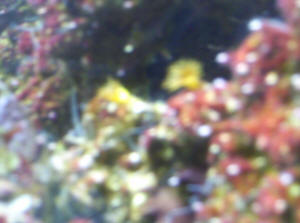
, it is not slimy and its taking over my rocks, even covering my
Maxijet 1200 intake sponge. <I can't really tell anything
from the photo you sent, is very blurry, but the blurs sort of
resemble hydroids to me, but need better sot to really help you out
here. You need to look for the Macro setting on your camera (The
symbol usually looks like a daisy or flower of some sort. This will
allow you to take better close up shots.> I have tried red &
blue-legged hermits and sea bunnies but can't get rid of it.
Only extremely low ph seems to work , but do not want to kill my
BTA. Any Ideas? <A better photo might help.> thanks guys
<Sorry I can't help you more.> here is the link for the
picture: http://img46.imageshack.us/img46/1696/hpim0219dm2.jpg
<You did look at this photo, right? I mean, I know I'm
tired, and a bit bleary eyed, but dang! Mich> |
|
|
| Could You Try and ID This
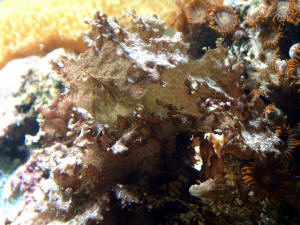
Algae? 8/8/07 This started out as a tiny
paddle looking thing growing out of a mushroom rock. Now it is a
bunch about 4 to 5 inches across. The 'leaves' are very
crinkled on the edges and it looks brown with light speckles
throughout. I can't even see down to the rock where it is
attached to tell how it is attached. It looks really nice in my
tank and moves with water flow. My tangs occasionally nip at it but
mostly leave it alone. 2 photos are attached <We just had
someone else send in a remarkable similar photo and now I can't
seem to find it here on WWM. Bob where'd ya put it? I believe
this is a Rhodophyte, a red alga. Enjoy it! It's a beauty!>
Thanks, <Welcome! Mich> Agnes <Should be w/ the Reds, or
alg. in general... poss. LR hitchhikers... Is a red. B> |
|
|
|
Macroalgae ID 7/13/07
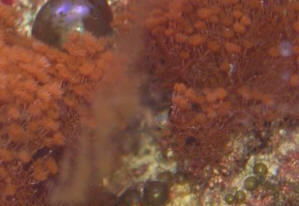
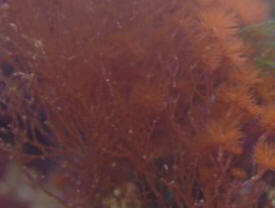
Greetings, Hey Crew! I have a couple of pictures of an unknown
Algae that I was hoping you might be able to ID. <Actually, I
think you have hydroids (most likely of the genus Myrionema). Not
all hydroids are bad, but these ones are. And believe it or not,
they're actually closer to jelly fish than algae.> This
stuff is incredibly prolific and comes right back after
harvesting from the rock. I'm afraid I would have to scrub
the rock to get it off and as almost every rock has some other
important denizen, I'd rather not. Harvesting is not a
problem but I was hoping with an ID, I might find a critter who
would benefit from harvesting it for it's own nutritional
needs. <I hate to be the bearer of bad news, but these things
get really annoying. You're not likely to find something that
eats them. They sting and kill things. Basically, they're
like Aiptasia. For more info, please see:
http://www.wetwebmedia.com/hyzoancompfaq.htm.> Thank you,
<De nada, Sara M.> EL
Re: Macroalgae ID, hydrozoan control
7/13/07 Sara, I looked through what available literature
there was on this species that I could readily find as well as
cruising through the WWW forums. From what I read, short of
removing the rocks and scrubbing them off, I am basically going
to be in a situation of just constantly harvesting them out and
trying to keep them from growing near any corals. <Pretty
much, yes. Controlling excess nutrients with protein skimming,
water changes, macro algae harvesting, etc. will also help.>
However, I noticed that in a previous post Anthony mentioned that
some limpets eat them. I was wondering if there was a way we
could get his attention and find out a suggested suitable species
that I could add to the system to enjoy a wonderful Hydroid
snack!?! <I'll cc dear Anthony here. He's extremely
busy so I don't know how long it might take him to respond.
Also keep in mind that knowing the kind of limpet that eats these
is one thing, finding them is quite another.> Again, thank you
so very much for all your wonderful help! <Happy to help. Good
Sara M.>
-EL
|
|
|
|
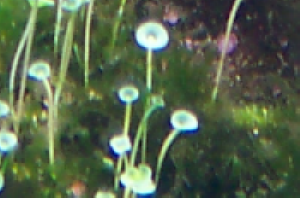
Plant id (Acetabularia spp.) AKA Mermaid's
Wineglass or Mermaid's Winecups 7/12/07 Hello
Everyone, <Hi there! Mich here.> If I missed this somewhere
I'm sorry <No worries...Is on the site. You can see it
here: http://www.wetwebmedia.com/maralgae.htm but what is this
growing <Is an alga, (Acetabularia spp.) AKA Mermaid's
Wineglass or Mermaid's Winecups> and is it good <Is
good.> and how do I get more to grow <Keep doing what your
doing is the best I can tell you.> it is pretty.
<Certainly is! Enjoy them! Mich>
|
|
|
Algae Confusion... Coralline vs. Cyanobacteria aka Red
Slime aka BGA aka Blue/Green Algae 7/10/07 <Hi Kristie,
Mich here.> I have searched the Internet for pix & info on my
question & can't seem to find the right answers. We have a
120-gallon marine fish only & 75-gallon reef tank. But I am unclear
which is coralline algae vs. the red slime or other unwanted algae.
<Really, well, hopefully we can fix that.> It seems that the
large tank without the "excellent" lighting has the coralline
algae & the smaller reef tank with better lighting is starting to
develop red slime (& now bubbles building up). <Is possible, and
coralline algae does not produce bubbles. Coralline algae are generally
hard and encrusting, similar to an eggshell on a hardboiled egg in that
it firmly encapsulates. Red slime on the other hand is very soft, often
produces bubbles, may grow on your sandbed, can be easily blown off the
rocks and sand and has more of a consistency of a raw egg.> I look
online for pics, but am not sure what is what. <We'll help you
here.> thanks for you help. <You're welcome!> I can attach
pics of mine if you like, or if you have a reference to pics of each
online or your website... <I will refer you here:
http://www.wetwebmedia.com/corallinealg.htm
http://www.wetwebmedia.com/bluegralgae.htm This article goes into ways
of controlling BGA. And do a Google image search... for more using the
terms coralline. Cyanobacteria or Blue/green algae doesn't give the
best results, use the WWM link provided above for a more accurate photo
representation.> Thanks. Kristie <Welcome! Mich> ps. We took a
huge green brittle starfish out of the reef tank & put it in the
120 gallon. Could this be why I'm starting to develop this algae?
<Is a scavenger but it is unlikely that this is the cause. Please
read the article re control.>
|
|
New Print and
eBook on Amazon
Marine Aquarium Algae Control
by Robert (Bob) Fenner
|
|
|